Meet the Oud, the “King of All Instruments” Whose Origins Stretch Back 3500 Years Ago to Ancient Persia
The word oud might make some people think of fragrances. Tom Ford’s Oud Wood currently sets fashionistas back between $263 and $360 a bottle: oud can refer to “agarwood,” a very rare ingredient in perfumes. But regular Open Culture readers may be more familiar with the bowl-shaped instrument that made its way to Europe from North Africa during the Middle Ages, giving rise to the lute (al-oud… The word oud, or ud, in Arabic simply means “wood.”) The oud is, after all, a direct, if distant, ancestor of the modern guitar, a subject we like to cover here quite a bit.
Some of the videos we’ve featured on the history of the guitar have starred classical guitarist and stringed instrument specialist Brandon Acker. Just above, he introduces viewers to the tuning, timbre, and playing techniques of the oud, “one of the most popular instruments in Arabic music,” writes the site Maqam World. It is also one of the oldest. Acker leaves his “comfort zone of Western Classical music” in this video because of his fascination with the oud as an ancestor of the lute, “one of the most important instruments of the musical period we call the Renaissance.”
The oud, whose own ancestor dates back some 3500 years to ancient Persia, first arrived with the Moors during their 711 AD invasion of Spain. Although new to Europe, it was known in the Arabic world as “the king or sultan of all instruments” and had evolved from a four string instrument to one with (typically) eleven strings: “that’s five doubled strings tuned in unisons and then one low string, which is single.” Acker goes on to demonstrate the tuning of the single string and doubled “courses,” as they’re called. The strings are plucked and strummed with a long pick called a “risha” (or “feather”), also called a “mizrap” when playing a Turkish oud, or a “zakhme” in Persian.…
Wherever it comes from, each oud features the familiar bowed back, made of strips of wood (hence, “oud”), the flattop soundboard with one to three soundholes, and the fretless neck. “The oud has a warm timbre and a wide tonal range (about 3 octaves),” notes Maqam World. The instrument is tuned to play music written in the Arabic maqam, “a system of scales, habitual melodic phrases, modulation possibilities, etc.,” but it has taken root in many musical cultures in North Africa, the Middle East, and Europe. Acker may come to the oud as a fan of the European lute, but the older instrument is much more than an evolutionary ancestor of the European Renaissance; it is the “sultan” of a rich musical tradition that continues to thrive around the Mediterranean world and beyond.
Famous modern oud players come from Egypt, Syria, Palestine, and Iraq, where Rahim AlHaj was born. The musician “learned to play the oud at age 9,” NPR writes, “and later graduated with honors and a degree in music composition from the Institute of Baghdad,” while also earning a degree in Arabic literature. AlHaj used his talents in the underground movement against Saddam Hussain’s rule, and after imprisonments and beatings, was exiled in 1991. Now based in New Mexico, “he performs around the world, and has even collaborated with Kronos Quartet and R.E.M.” See him perform for Tiny Desk Concert above and hear more oud in contemporary concert settings here.
Related Content:
The History of the Guitar: See the Evolution of the Guitar in 7 Instruments
What Guitars Were Like 400 Years Ago: An Introduction to the 9 String Baroque Guitar
Josh Jones is a writer and musician based in Durham, NC. Follow him at @jdmagness
Read More...How Stanley Kubrick Made 2001: A Space Odyssey: A Seven-Part Video Essay
Andrei Tarkovsky had a rather low opinion of Stanley Kubrick’s 2001: A Space Odyssey. “Phony on many points,” he once called it, built on “a lifeless schema with only pretensions to truth.” His professional response was 1972’s Solaris, by most estimates another high point in the science-fiction cinema of that period. Yet today it isn’t widely regarded as Tarkovsky’s best work; certainly it hasn’t become as much of an object of worship as, say, Stalker. That picture — arguably another work of sci-fi, though one sui generis in practically its every facet — continues to inspire such tributes and exegeses as the video essay on its making we featured earlier this year here on Open Culture.
That video essay came from the channel of Youtuber CinemaTyler, who like many auteur-oriented cinephiles exhibits appreciation for Tarkovsky and Kubrick alike. He’s created numerous examinations on the work that went into Kubrick’s pictures, including A Clockwork Orange, Barry Lyndon, and Full Metal Jacket.
The ambition of 2001, outsized even by Kubrick’s standard, is reflected in what it spurred CinemaTyler on to create: a seven-part series of video essays on its production, with three-hour total runtime that far exceeds that of the film itself. It takes at least that long to explain the achievements Kubrick pulled off, especially with mid-1960s filmmaking technology, which gave us the rare vision of the future that has held up for more than half a century.
Some of the qualities that have made 2001 endure came into being almost by accident. Take the use of Strauss’ “The Blue Danube” to introduce the space station, a stroke of scoring genius inspired by the records Kubrick and company happened to be listening to while viewing their footage. That and other classical pieces replaced an original score by the composer who’d worked on Kubrick’s Spartacus, which would have struck a different mood altogether. So would the portentous narration included in earlier versions of the script, hardly imaginable in the context of such powerfully wordless scenes as the famous four-million-year cut from tossed bone to spacecraft, which turns out to have been originally conceived an Earth-orbiting nuclear-weapon platform. That’s one of the many little-known facts CinemaTyler fits into this series, and a viewing of which even the biggest Kubrick buffs will have reason to admire 2001 more intensely than ever.
Related Content:
1966 Film Explores the Making of Kubrick’s 2001: A Space Odyssey (and Our High-Tech Future)
James Cameron Revisits the Making of Kubrick’s 2001: A Space Odyssey
The Story of Stalker, Andrei Tarkovsky’s Troubled (and Even Deadly) Sci-Fi Masterpiece
Based in Seoul, Colin Marshall writes and broadcasts on cities, language, and culture. His projects include the Substack newsletter Books on Cities, the book The Stateless City: a Walk through 21st-Century Los Angeles and the video series The City in Cinema. Follow him on Twitter at @colinmarshall or on Facebook.
Read More...Fred Armisen Teaches a Short Seminar on the History of Punk
Long before Fred Armisen became known as a SNL cast member or one half of the dynamic duo behind Portlandia, he was a drummer in a punk band called Trenchmouth. Based out of Chicago, the band released four albums between 1988 and 1996 before disbanding. In that time, Armisen did a lot of drumming and saw a *lot* of bands. Many would go on to grab the fame that seemed to constantly elude his band. In the above clip from The Tonight Show, Armisen’s experience is put to hilarious good use with a trip through indie and punk rock history based on rhythm guitar styles.
He starts with a decent Lou Reed imitation to locate the original source at the Velvet Underground, then up through the Ramones and Sex Pistols, eventually winding its way through the ska-influenced pop-punk of Blink-182 and ending with the Strokes. Host Jimmy Fallon, as always, laughs non-stop throughout. And Armisen also name drops Sleater-Kinney as a knowing wink to his Portlandia mate Carrie Brownstein.
If this sounds like a well-rehearsed bit, well, it is. But when Armisen does it live, it’s on the drum set. In the below clip, he makes almost the same stops along the way on his journey. And it helped confirm my suspicion that his post-punk guitar bit (“I am a neon light”) is his parody of Wire.
Armisen spoke to Sam Jones on his monochromatic Off Camera interview show about his years of punk struggle with Trenchmouth, which will help place his numerous band-based comedy skits in the correct context.
Don’t miss his classic punk music SNL skits in the Relateds below. And if you are jonesing for the punk stylings of the hot, young Armisen, here’s live footage of Trenchmouth from 1992:
Related Content:
Classic Punk Rock Sketches from Saturday Night Live, Courtesy of Fred Armisen
Ian Rubbish (aka Fred Armisen) Interviews the Clash in Spinal Tap-Inspired Mockumentary
Ted Mills is a freelance writer on the arts who currently hosts the Notes from the Shed podcast and is the producer of KCRW’s Curious Coast. You can also follow him on Twitter at @tedmills, and/or watch his films here.
Read More...When John Belushi Booked the Punk Band Fear on SNL, And They Got Banned from the Show: A Short Documentary
Like many famous episodes in the lives of famous people, Andy Warhol’s 15 minutes quote turns out to be a garbling of what happened. Warhol simply said that everybody wants to be famous (and by implication, famous forever). To which the Factory’s “court photographer” Nat Finkelstein replied, “yeah, for 15 minutes.” Given the way the idea has come down to us, we’ve missed the ambiguity in this exchange. Do we all want to be famous for 15 minutes (and only 15 minutes), or do we only spend 15 minutes wanting to be famous before we move on and accept it as a sucker’s game?
Finkelstein himself might have felt the latter as he watched “pop die and punk being born” (he said in a 2001 interview). It was the death of Warhol’s fame ideal, and the birth of something new: music that loudly declared open hostilities against the gatekeepers of popular culture. Not every punk band reserved its punches for those above them. California hardcore legends Fear — led by confrontational satirist Lee Ving — swing wildly in every direction, hitting their audience as often as the powers that be.
When their first taste of Warholian fame came around — in Penelope Spheeris’ 1981 documentary The Decline of Western Civilization — Ving used the moment in front of the cameras to taunt and abuse audience members until a few of them rushed the stage to fight him. Had NBC executives seen this footage casual violence, profanity, and worrisome ebullience, it’s unlikely they would have let returning guest John Belushi book Fear on Halloween night of that same year.
The SNL appearance — for which Fear proudly earned a permanent ban — became the stuff of legend. Not only did Ving and band get up to their usual antics onstage, but the show brought in a crew of about 80 DC punks (including Dischord Records/Fugazi founder Ian MacKaye), who smashed up the set and joined the band in solidarity against New York and its saxophones. The network cut the broadcast short when one punk (identified as either MacKaye or John Brannon of the band Negative Approach) yelled “F*ck New York!” into an open mic during the last song, “Let’s Start a War.” NBC shelved the footage for years.
Although well-known in fan communities, the appearance might have faded from memory were it not for the internet, which not only has the Warholian power to make anyone famous (or “internet famous”) for no reason, but also routinely resurrects lost moments of fame and makes them last forever. Just so, the legend of Fear on SNL has grown over time on YouTube. It now warrants a short documentary — one made, no less, by Jeff Krulik, a filmmaker who, five years after the Fear appearance, documented another burgeoning Fear-like fandom in his cult short, “Heavy Metal Parking Lot.”
“Fear on SNL,” above, includes several interview clips from firsthand witnesses. DC “punk superfan” Bill MacKenzie listens to an old interview he gave about the show, in which he says the band asked him to come to the taping. As Ian MacKaye tells it, Lorne Michaels himself placed the call. (He must mean producer Dick Ebersol, as Michaels left the show in 1980 and wouldn’t return until 1985.) But both MacKaye and Ving remember that it was Belushi who really rounded up the audience of authentic punks, leveraging his own hard-won celebrity to stick it to the factory that made his fame.
Related Content:
The Stunt That Got Elvis Costello Banned From Saturday Night Live
Josh Jones is a writer and musician based in Durham, NC. Follow him at @jdmagness
Read More...Stephen Fry Takes Us Inside the Story of Johannes Gutenberg & the First Printing Press
Stephen Fry loves technology. Here on Open Culture we’ve featured his investigations into everything from cloud computing to nanoscience to artificial intelligence and simulation theory. “I have never seen a smartphone I haven’t bought,” he wrote in 2007, the year Apple’s iPhone came out. But the iPhone would surely never have been if not for the Macintosh, the third of which ever sold in the United Kingdom went to Fry. (His fellow British technophile Douglas Adams had already snagged the first two.) And there wouldn’t have been a Macintosh — a stretch though this may seem — if not for the printing press, which by some reckonings set off the technological revolution that carries us along to this day.
The history of the printing press is thus, in a sense, a history of technology in microcosm. In the hourlong documentary The Machine that Made Us, Fry seeks out an understanding of the invention, the workings, and the evolution of the device that, as he puts it, “shaped the modern world.”
The use of movable type to run off many copies of a text goes back to 11th-century China, strictly speaking, but only in Europe did it first flourish to the point of giving rise to mass media. In order to place himself at the beginning of that particular story, Fry travels to Mainz in modern-day Germany, birthplace of a certain Johannes Gutenberg, whose edition of the Bible from the 1450s isn’t just the earliest mass-produced book but the most important one as well.
Fry may not have a straightforward relationship with religion, but he does understand well the ramifications of Gutenberg’s Bible-printing enterprise. And he comes to understand that enterprise itself more deeply while following the “Gutenberg trail,” retracing the steps of the man himself as he assembled the resources to put his invention into action. Since none of the presses Gutenberg built survive today (though at least one functioning approximate model does exist), Fry involves himself in reconstructing an example. He also visits a paper mill and a type foundry whose craftsmen make their materials with the same methods used in the 15th century. The fruit of these combined labors is a single replica page of the Gutenberg Bible: a reminder of what brought about the economic, political, and cultural reality we still inhabit these 570 years later.
Related Content:
Oxford University Presents the 550-Year-Old Gutenberg Bible in Spectacular, High-Res Detail
Stephen Fry Profiles Six Russian Writers in the New Documentary Russia’s Open Book
Stephen Fry Introduces the Strange New World of Nanoscience
Based in Seoul, Colin Marshall writes and broadcasts on cities, language, and culture. His projects include the Substack newsletter Books on Cities, the book The Stateless City: a Walk through 21st-Century Los Angeles and the video series The City in Cinema. Follow him on Twitter at @colinmarshall or on Facebook.
Read More...The Mystery of Who Played Bass on The White Album’s “While My Guitar Gently Weeps”
George Harrison, the quiet Beatle, was the first to break out on his own in 1970 with his glorious triple album All Things Must Pass. “Garbo talks! — Harrison is free!” wrote Melody Maker’s Richard Williams in a review, a reference to the reclusive silent film star who, like the Beatles’ guitarist, kept her mystique and star power even after fans first heard her voice. Harrison’s revelation couldn’t have been as dramatic as all that.
Surely, no fan of “Taxman,” “Within You Without You,” “Here Comes the Sun,” “Something” — and especially The White Album’s stunning “While My Guitar Gently Sleeps” — doubted that George had it in him all along. But the other Beatles would only humor him during The White Album sessions. That is, until he brought Eric Clapton into the studio. “That then made everyone act better,” Harrison remembers in Anthology. “Paul got on the piano and played a nice intro and they all took it more seriously.”
The question in the You Can’t Unhear This video above is whether Paul played bass on the final studio recording and, if not, who did? It’s an integral part of the song’s feel — the gritty, restrained growl, slowly growing in intensity until it sounds like it might give Harrison’s guitar something else to weep about. The mystery of the aggressive-yet-muted part “has perplexed scholars and Beatles fans for decades.” If you’ve remained unperplexed, you might find yourself questioning assumptions about this most beloved of Beatles’ tunes.
Sessions for the song began in late July of 1968, then picked up again in August, but Harrison decided to scrap everything and start over in September once Ringo returned from a “self-imposed exile” in the Mediterranean. The band seemed refreshed: “the quality of the performances on the new September version seemed to reflect that renewed spirit.” Sessions for the track wrapped on September 24. “For many years it was believed that this was the recording session in which Eric Clapton overdubbed his lead guitar solo,” writes the Beatles Bible. Not so — Clapton sat in on all of the live takes recorded with the band. Ah, but who played bass? See the mystery take shape above and post your theories below.
Related Content:
Hear the Beautiful Isolated Vocal Harmonies from the Beatles’ “Something”
Josh Jones is a writer and musician based in Durham, NC. Follow him at @jdmagness
Read More...Tom Petty, Somewhere You Feel Free — The Making of Wildflowers Is Streaming Free on YouTube
Originally released in cinemas last month, the new documentary Tom Petty: Somewhere You Feel Free — The Making of Wildflowers is now streaming free on YouTube. Here’s how Petty’s official YouTube channel prefaces the film:
In early 2020, a collection of 16mm film from 1993–95 was discovered in the archive of legendary artist Tom Petty. The film was shot while Tom was on a prolific songwriting streak for years making what he intended to be a double album called Wildflowers. Tom Petty was known for being reclusive about his personal life and his creative process. “Somewhere You Feel Free” allows you to spend 90 minutes immersed in the candid and musically rich world of Tom’s creativity as he makes his first album with legendary producer Rick Rubin. With collaborators providing unrivaled access and featuring never before seen footage captured during the making of Wildflowers, Tom’s personal favorite album.
You can stream the film by director Mary Wharton above, or find it catalogued in our list of Free Documentaries, a subset of our collection, 4,000+ Free Movies Online: Great Classics, Indies, Noir, Westerns, Documentaries & More. Enjoy!
If you would like to support the mission of Open Culture, consider making a donation to our site. It’s hard to rely 100% on ads, and your contributions will help us continue providing the best free cultural and educational materials to learners everywhere. You can contribute through PayPal, Patreon, and Venmo (@openculture). Thanks!
Related Content:
Tom Petty Takes You Inside His Songwriting Craft
Read More...Meet the Mysterious Genius Who Patented the UFO
American inventors never met a phenomenon — natural, manmade, or otherwise — they couldn’t try to patent. From impossible technologies to possible evidence of aliens visiting planet Earth, everything’s fair game if you can sell the idea. After highly-publicized UFO sightings in Washington State and Roswell, New Mexico, for example, patents for flying saucers began pouring into government offices. “As soon as there was a popular ‘spark,’” writes Ernie Smith at Atlas Obscura, “the saucer was everywhere.” It received its own classification in the U.S. Patent Office, with the indexing code B64C 39/001, for “flying vehicles characterized by sustainment without aerodynamic lift, often flying disks having a UFO-shape.”
Google Patents lists “around 192 items in this specific classification,” with surges in applications between 1953–56, 1965–71, and an “unusually dramatic surge… between 2001 and 2004.” Make of that what you will. The story of the UFO gets both stranger and more mundane when we learn that Alexander Weygers, the very first person to file a patent for such a flying vehicle, invented it decades before UFO-mania and patented it in 1945. He was not an American inventor but the Indonesian-born son of a Dutch sugar plantation family. He learned blacksmithing on the farm, received an education in Holland in mechanical engineering and naval architecture, and honed his mechanical skills while taking long sea voyages alone.
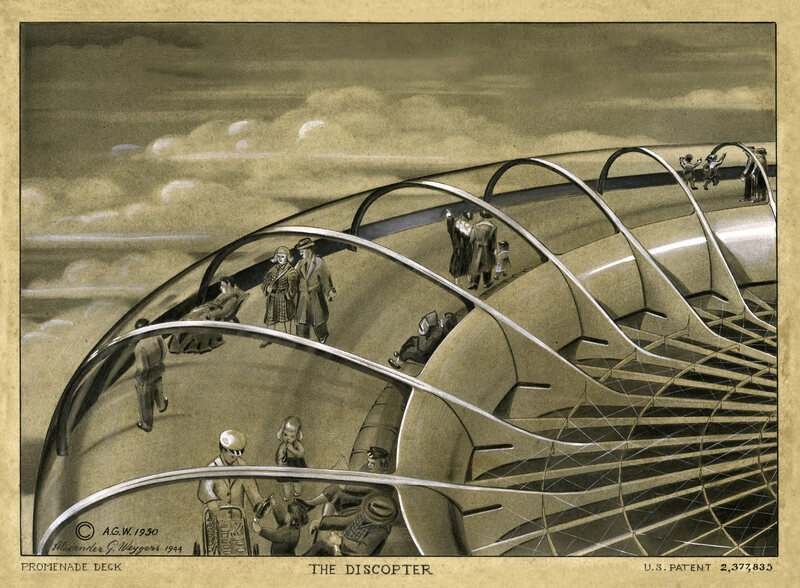
In 1926, Weygers and his wife Jacoba Hutter moved to Seattle, Ashlee Vance writes at Bloomberg Businessweek, “where he pursued a career as a marine engineer and ship architect and began inking drawings of the Discopter” — the flying-saucer-like vehicle he would patent after working for many years as a painter and sculptor, mourning the death of his wife, who died in childbirth in 1928. By the time Weygers was ready to revive the Discopter, the time was ripe, it seems, for a wave of technological convergent evolution — or a technological theft. Perhaps, as Weygers’ claimed, UFOs really were Army test planes: test pilots flying something based on the inventor’s design — which was not a UFO, but an attempt at a better helicopter.

Sightings of strange objects in the sky did not begin in 1947. “Tales of mysterious flying objects date to medieval times,” Vance writes, “and other inventors and artists had produced images of disk-shaped crafts. Henri Coanda, a Romanian inventor, even built a flying saucer in the 1930s that looked similar to what we now think of as the classic craft from outer space. Historians suspect that the designs of Coanda and Weygers, floating around in the public sphere, combined with the postwar interest in sci-fi technology to create an atmosphere that gave rise to a sudden influx of UFO sightings.” In the 1950s, NASA and the U.S. Navy even began testing vertical takeoff vehicles that looked suspiciously like the patented Discopter.
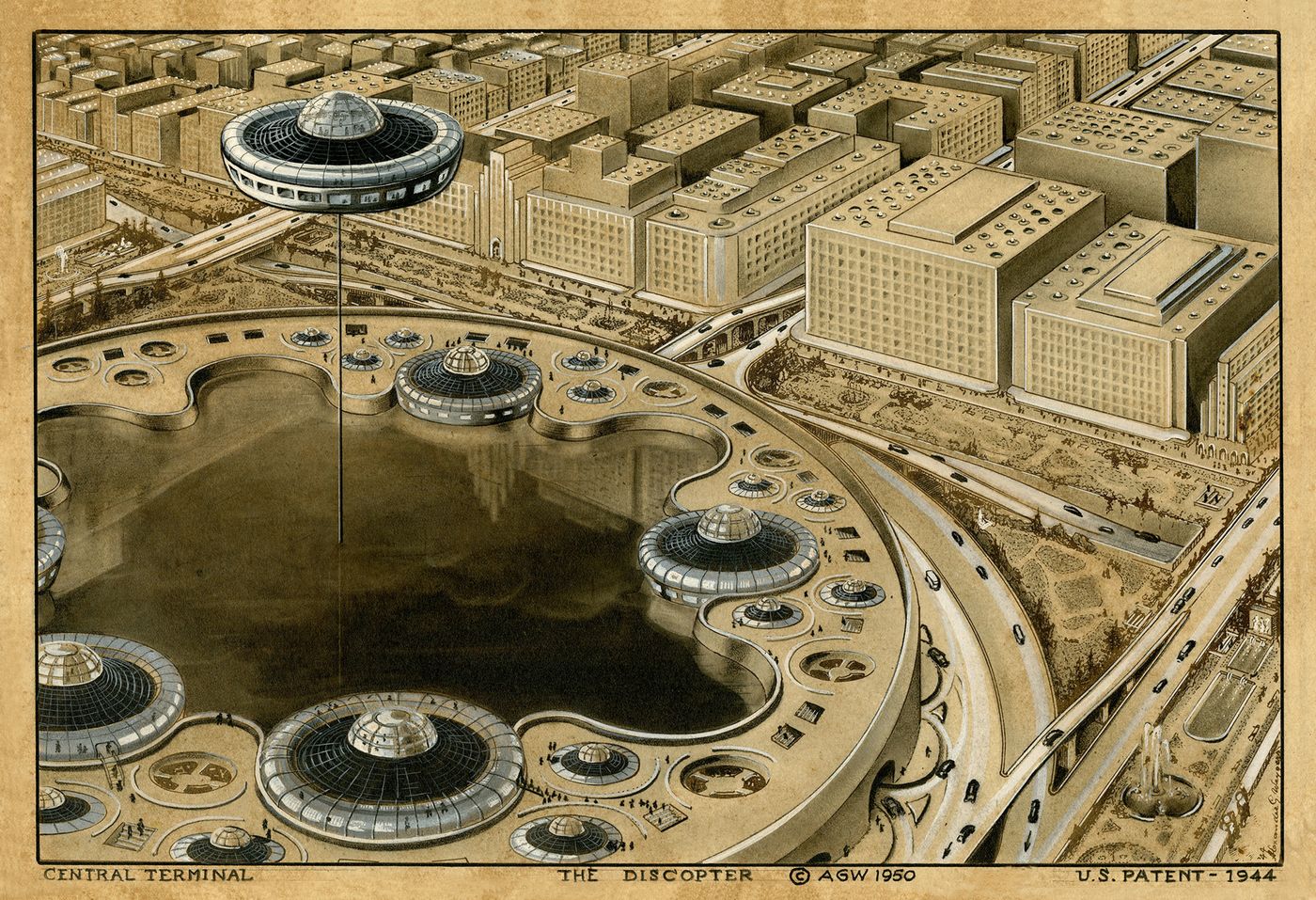
Weygers was livid and “convinced his designs had been stolen.” The press even picked up the story. In 1950 the San Francisco Chronicle ran an article headlined “Carmel Valley Artist Patented Flying Saucer Five Years Ago: ‘Discopter’ May Be What People Have Seen Lately.” Although Weygers never built a Discopter himself, the article goes on to note that “the invention became the prototype for all disk-shaped vertical take-off aircraft since built by the U.S. armed forces and private industry, both here and abroad.” Just how many such vehicles have been constructed, and have actually been air-worthy, is impossible to say.
Smith surveys many of the patents for flying saucers filed over the past 75 years by both individuals and large companies. In the latter category, we have companies like Airbus and startups created by Google co-founder Larry Page currently working on flying saucer-like designs. The history of such vehicles may not provide sufficient evidence to disprove UFO sightings, but it may one day lead to the technology for flying cars we thought would already have arrived this far into the space age. For that we have to thank, though he may never get the credit, the modern Renaissance artist and inventor Alexander Weygers.
Related Content:
Carl Jung’s Fascinating 1957 Letter on UFOs
Josh Jones is a writer and musician based in Durham, NC. Follow him at @jdmagness
Read More...What Is Sun Tzu’s The Art of War About?: A Short Introduction
After wars in Japan and Vietnam, the U.S. military became quite keen on a slim volume of ancient Chinese literature known as The Art of War by a supposedly historical general named Sun Tzu. This book became required reading at military academies and a favorite of law enforcement, and has formed a basis for strategy in modern wartime — as in the so-called “Shock and Awe” campaigns in Iraq. But some have argued that the Western adoption of this text — widely read across East Asia for centuries — neglects the crucial context of the culture that produced it.
Despite historical claims that Sun Tzu served as a general during the Spring and Autumn period, scholars have mostly doubted this history and date the composition of the book to the Warring States period (circa 475–221 B.C.E.) that preceded the first empire, a time in which a few rapacious states gobbled up their smaller neighbors and constantly fought each other.
“Occasionally the rulers managed to arrange recesses from the endemic wars,” translator Samuel B. Griffith notes. Nonetheless, “it is extremely unlikely that many generals died in bed during the hundred and fifty years between 450 and 300 B.C.”
The author of The Art of War was possibly a general, or one of the many military strategists for hire at the time, or as some scholars believe, a compiler of an older oral tradition. In any case, constant warfare was the norm at the time of the book’s composition. This tactical guide differs from other such guides, and from those that came before it. Rather than counseling divination or the study of ancient authorities, Sun Tzu’s advice is purely practical and of-the-moment, requiring a thorough knowledge of the situation, the enemy, and oneself. Such knowledge is not easily acquired. Without it, defeat or disaster are nearly certain:
If you know the enemy and know yourself, you need not fear the result of a hundred battles. If you know yourself but not the enemy, for every victory gained you will also suffer a defeat. If you know neither the enemy nor yourself, you will succumb in every battle.
The kind of knowledge Sun Tzu recommends is practical intelligence about troop deployments, food supplies, etcetera. It is also knowledge of the Tao — in this case, the general moral principle and its realization through the sovereign. In a time of Warring States, Sun Tzu recognized that knowledge of warfare was “a matter of vital importance”; and that states should undertake it as little as possible.
“To subdue the enemy without fighting is the acme of skill,” The Art of War famously advises. Diplomacy, deception, and indirection are all preferable to the material waste and loss of life in war, not to mention the high odds of defeat if one goes into battle unprepared. “The ideal strategy of restraint, of winning without fighting… is characteristic of Taoism,” writes Rochelle Kaplan. “Both The Art of War and the Tao Te Ching were designed to help rulers and their assistants achieve victory and clarity,” and “each of them may be viewed as anti-war tracts.”
Read a full translation of The Art of War by Lionel Giles, in several formats online here, and just above, hear the same translation read aloud.
Related Content:
Life-Changing Books: Your Picks
“The Philosophy of “Flow”: A Brief Introduction to Taoism
When Sci-Fi Legend Ursula K. Le Guin Translated the Chinese Classic, the Tao Te Ching
Josh Jones is a writer and musician based in Durham, NC. Follow him at @jdmagness
Read More...Life Magazine Predicts in 1914 How People Would Dress in the 1950s
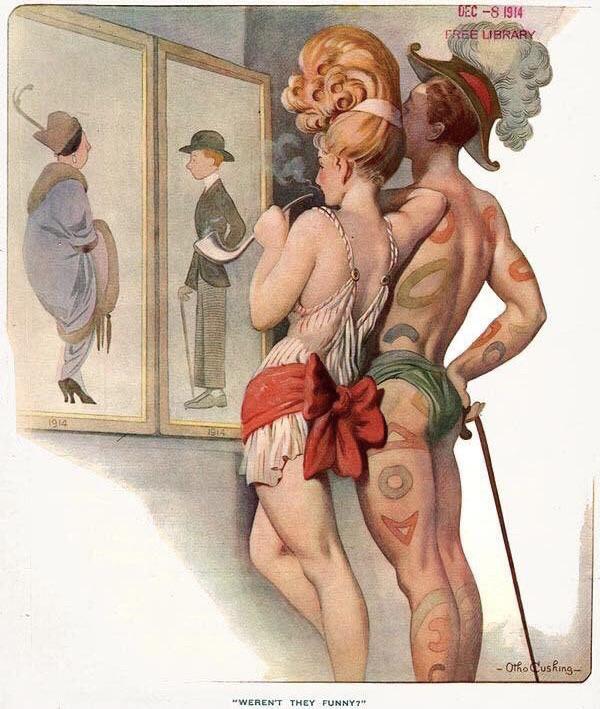
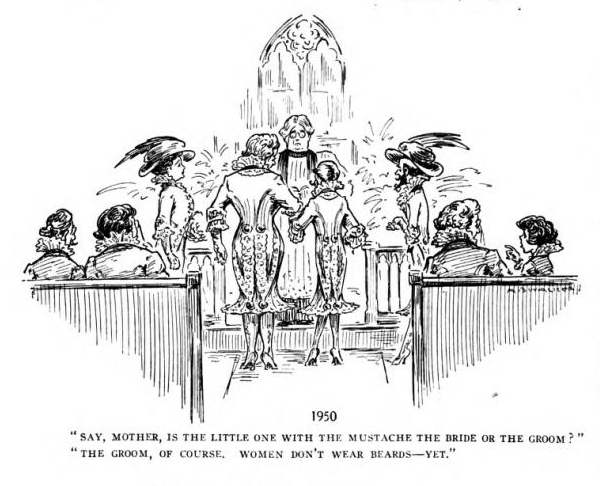
Though still just within living memory, 1950 now seems as if it belongs not just to the past but to a wholly bygone reality. Yet that year once stood for the future: that is to say, a time both distant enough to fire up the imagination and near enough to instill a sense of trepidation. It must have felt that way, at least, to the subscribers of Life magazine in December of 1914, when they opened an issue of that magazine dedicated in part to predicting the state of humanity 36 years hence. Its bold cover depicts a man and woman of the 1950s amusedly regarding pictures of a man and woman in 1914: the latter wear buttoned-up European street clothing, while the former have on almost nothing at all.
As rendered by illustrator Otho Cushing, the thoroughly modern 1950s female wears a kind of slip, something like a garment from ancient Greece updated by abbreviation. Her male counterpart takes his inspiration from an even earlier stage of civilization, his loincloth covering as few as possible of the abstract patterns painted or tattooed all over his body. (About his choice to top it all off with a plumed helmet, an entire PhD thesis could surely be written.)
Any credible vision of the future must draw inspiration from the past, and Cushing’s interests equipped him well for the task: 28 years later, his New York Times obituary would refer to his early specialization in depicting “handsome young men and women in Greek or modern costumes.”
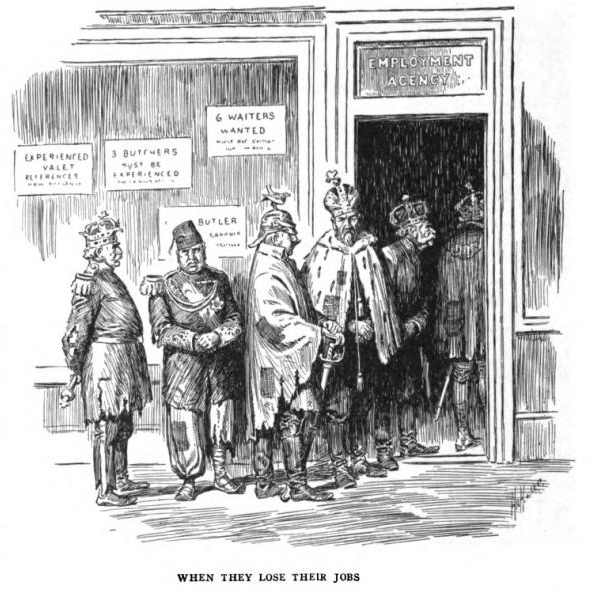
Even though fashions have yet to make a return to antiquity, how many outfits on the street of any major city today would scandalize the average Life reader of 1914? Of course, the cover is essentially a gag, as is much of the ostensible prognostication inside. As circulated again not long ago in a tweet thread by Andy Machals, it foresees monarchs in the unemployment line, boys’ jobs taken by girls, women acquiring harems of men, and the near-extinction of marriage. But some predictions, like 30 miles per hour becoming a slow enough driving speed to be ticketable, have come true. Another piece imagines people of the 1950s hiring musicians to accompany them throughout each phase of the day. Few of us do that even in the 2020s, but living our digitally soundtracked lives, we may still wonder how our early 20th-century ancestors managed: “Between meals they listened to almost absolutely nothing.”
via Messy Nessy
Related Content:
Author Imagines in 1893 the Fashions That Would Appear Over the Next 100 Years
Fashion Designers in 1939 Predict How People Would Dress in the Year 2000
In 1900, Ladies’ Home Journal Publishes 28 Predictions for the Year 2000
How French Artists in 1899 Envisioned Life in the Year 2000: Drawing the Future
Based in Seoul, Colin Marshall writes and broadcasts on cities, language, and culture. His projects include the Substack newsletter Books on Cities, the book The Stateless City: a Walk through 21st-Century Los Angeles and the video series The City in Cinema. Follow him on Twitter at @colinmarshall or on Facebook.
Read More...Support Us
We're hoping to rely on loyal readers, rather than erratic ads. Please click the Donate button and support Open Culture. You can use Paypal, Venmo, Patreon, even Crypto! We thank you!

About Us

Open Culture scours the web for the best educational media. We find the free courses and audio books you need, the language lessons & educational videos you want, and plenty of enlightenment in between.
Advertise With Us
FREE UPDATES!
GET OUR DAILY EMAIL
Get the best cultural and educational resources on the web curated for you in a daily email. We never spam. Unsubscribe at any time.
FOLLOW ON SOCIAL MEDIA
Open Culture editor Dan Colman scours the web for the best educational media. He finds the free courses and audio books you need, the language lessons & movies you want, and plenty of enlightenment in between.
Advertise With Us

