Legendary DJ John Peel Makes a List of His 20 Favorite Albums
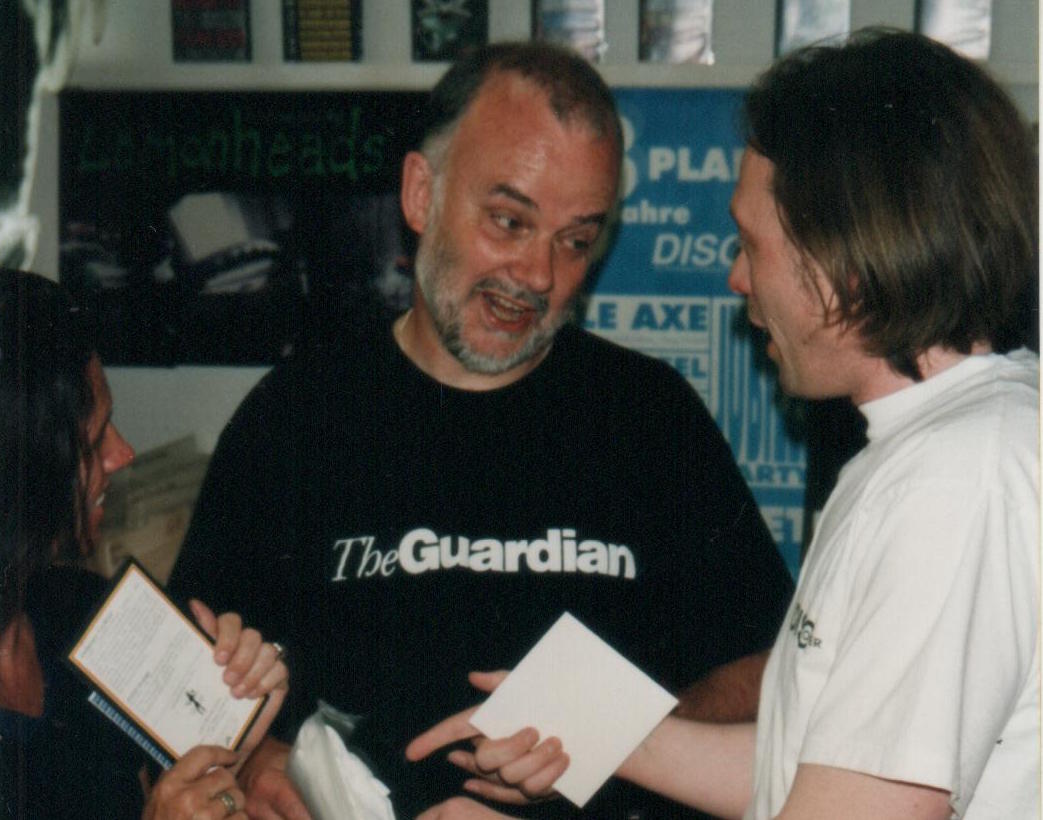
Image by Zetkin, via Wikimedia Commons
Before there were influencers, there was John Peel. The BBC radio DJ and journeyman music writer’s tastes helped define listening habits for generations — from his early championing of Pink Floyd and Captain Beefheart to his early championing of The Smiths and Nirvana, to… well, most everything he played, wrote about and recorded in his legendary John Peel sessions from the 1960s until his death in 2004.
For someone with such influence, Peel had a singularly humble attitude about his own importance and that of music tastemakers generally. In a 1970 interview for Radio Times, “Peel plays down the role of DJs as celebrities,” notes the John Peel Wiki, “and is quoted as saying among other things, ‘Some disc jockeys don’t realise the essential insignificance of their role.’”
His was an attitude shared by few in the music business. One person who comes to mind, producer and musician Steve Albini — an early champion of too many bands to name — likes to similarly exempt himself from the process, treating his opinions about music as incidental to the vital experience of making music itself. In an interview the year after Peel’s death, Albini ruminated on this quality in Peel:
Before he died, John Peel said something that I thought was really profound. He said when he gets a record from somebody and he doesn’t like it, he assumes that it’s his problem and that the band would not have made that record if there wasn’t something valuable about it.
Of course, John Peel had his opinions about music — once saying in 1978, for example, that he wished the Rolling Stones had broken up in 1965. He even had his opinions about Steve Albini, whose brutal three-piece 80s band Big Black ranked at number 15 for their Songs About Fuc&ing on a list Peel made of his 20 favorite albums. The list, below, should be read with all kinds of caveats.
In no way would Peel ever assert that these 20 records are the “20 best” of anything. These are the albums that rose to the top for him, for reasons he declined to specify, at a particular point in time 1997 when The Guardian asked him for his opinion. Peel himself found these exercises “terribly self-indulgent” notes Jon Dennis in brief commentary on each album on the list. Narrowing down one’s favorites was a particularly painful experience for someone who listened to so much music, and Peel didn’t value his own tastes over those of his listeners.
For example, in his “Festive 50,” a fifty-song roundup of his listeners’ top three songs of the year each Christmas, Peel resisted the urge to insert his picks and counterbalance what he saw as an overabundance of “white boys with guitars.” (Peel was a big promoter of reggae bands like Misty in Roots, who come in at number 5 below, as well as various other world musics on his radio show.) He admitted that coming up with his three top songs in any given year was close to impossible: “I couldn’t get any fewer than a list of 250.”
1. Captain Beefheart & The Magic Band: Trout Mask Replica (1969)
2. Velvet Underground: The Velvet Underground and Nico (1967)
3. Ramones: The Ramones (1976)
4. Pulp: Different Class (1995)
5. Misty In Roots: Live At Counter Eurovision 79 (1979)
6. Nirvana: Nevermind (1991)
7. Smiths: The Smiths (1984)
8. Neil Young: Arc Weld (1991)
9. Jimi Hendrix Experience: Are You Experienced? (1967)
10. Wawali Bonané: Enzenzé
11. Pink Floyd: Piper At The Gates Of Dawn (1967)
12. Dreadzone: Second Light (1995)
13. Four Brothers: Makorokoto (1988)
14. Dave Clarke: Dave Archive One (1996)
15. Big Black: Songs About Fucking (1987)
16. PJ Harvey: Dry (1992)
17. Richard & Linda Thompson: I Want to See the Bright Lights Tonight (1974)
18. Elastica: Elastica (1995)
19. Hole: Live Through This (1994)
20. Rolling Stones: The Rolling Stones (1964)
Related Content:
Hear a 9‑Hour Tribute to John Peel: A Collection of His Best “Peel Sessions”
Josh Jones is a writer and musician based in Durham, NC. Follow him at @jdmagness
Read More...Elvis Costello’s Musician Father (and Doppelgänger) Performing in 1963
If you were an English boy growing up in the 1960s, and your dad met the Queen mum, you’d come away with some pretty heavy duty bragging rights.
What if your dad didn’t just meet her, but commanded her attention for a full three minutes… an event you witnessed on the telly, along with 21.2 million others?
That’s what happened to young Declan Patrick McManus, or Elvis Costello as he’s more commonly known these days.
Unfortunately, his musician father Ross’s calypso-inflected, Trini Lopez-inspired rendition of Pete Seeger’s “If I Had a Hammer” at the Queen’s annual Royal Variety Performance was overshadowed by another act in the evening’s line up: The Beatles.
This was the performance where John Lennon famously solicited the audience’s participation on “Twist and Shout”:
For our last number, I’d like to ask your help. The people in the cheaper seats, clap your hands. And the rest of you, if you’d just rattle your jewelry.
https://vimeo.com/151903948?embedded=true&source=video_title&owner=47853706
So, Ross McManus played for the Queen Mum (and Princess Margaret) and all little Declan got was a great anecdote for his 2016 memoir Unfaithful Music & Disappearing Ink and a thoughtful souvenir:
Eventually I couldn’t pretend that I really cared whether he’d… shaken hands with the Queen Mum. I blurted out:
“Did you actually meet The Beatles?”
It had obviously been a long night or an early morning, as my Dad wasn’t that talkative. He mumbled something about them being very nice lads. Then he reached into a jacket slung over the back of his chair and pulled out a sheet of thin airmail paper and handed it to me.
I unfolded it, and there were the signatures of all four of The Beatles on one page. I’d seen reproductions of their signatures in enough magazines and fan club literature to know that these appeared to be the real thing.
The ink seemed barely dry.
What I did next will bring tears to the eyes of those who make a fetish of such objects, but I had only a small autograph book and the paper was too large to be mounted in it.
I carefully, if not so very carefully, cut around each of the signatures, lopping off the e of the “The” in “The Beatles” and pasting the four irregular scraps of paper into my album.
McManus the Elder took another crack at “If I Had a Hammer” when he and other members of the Joe Loss Orchestra were invited to reprise their royal performance in the 1965 short The Mood Man, excerpted at the top of this page.
Clearly, the acorn didn’t fall far from this tree!
Father and son seem more like twins here:
the horn-rimmed specs…
The vibrato…
That vintage style!
(Speaking of which, Costello confides that his father was obliged to wear long johns under his off-white suit “after the television director claimed that his flesh could be detected through the thin material … under the television lights, which would be bound to scandalize the royal party.”)
The two also shared a willingness to experiment with assumed names. Ross McManus found success in Australia with a cover of The Beatles’ “The Long and Winding Road” as “Day Costello” — surname compliments of his grandmother’s maiden name. (Other handles include “Hal Prince” and “Frank Bacon and the Baconeers.”)
Elvis Costello spent enough time in his old man’s orbit to recognize the disembodied hands playing the conga drums in the opening shot shot of McManus’s “If I Had a Hammer“ — Bill Brown’s, taking a bit of a busman’s holiday from the baritone saxophone.
And he acknowledges his own persona’s debt to his dad, citing the section where he “lip-synchs the hell out of the number, miming ‘hammer of justice’ for all it’s worth”:
The close-ups that come on the repeated line, “It’s a song about love between my brothers and my sisters” are eerie to behold for the similarity of our facial expression at about this age, and especially when singing particular words.
Where my Dad holds the advantage over me is in his dance moves.
Those are steps that I am yet to master.
Costello also notes that his father gave him a bit of a professional leg up in 1973, when he got him hired for backing vocals on a musical ad for R. Whites Lemonade:
For some reason, the producer asked my Dad to deliver the song in a mock Elvis Presley voice, while for the background part, they wanted “R. Whites” punched out so that it sounded like the “All right” on a Swinging Blue Jeans record. I suppose the advertising people thought the kids would dig it… given that my Dad and I could easily approximate a suitably nasal Mersey sound, we cut the parts in a couple of takes. It wasn’t exactly the big time, but there was still a thrill to hearing your voice come back off the tape, even if you were singing something farcical.
The ad made a lasting impression. If there’s a club for British people who watched TV in the 70’s “secret lemonade drinker” may well be the password. (Costello, understandably, was not pleased when a tabloid’s brass decided it made a fitting headline for his talented, well-known father’s obituary: “Secret Lemonade Drinker Dies.”)
The first Secret Lemonade Drinker ad’s popularity justified various sequels over the years, particularly when fans got hip to the 19-year-old Costello’s involvement.
He was, in fact, more involved than many would realize.
As he recalls in his memoir, the original recording session turned into an impromptu casting session for an alternate, albeit far harder to find online, take:
The ad men took a look around the studio and decided to cast this second version of the commercial from the musicians on the session. The drummer and hippie guitar player certainly looked the part, but the pianist and bass player were older more conservatively dressed and didn’t really fit the bill. Given our then more fashionable hairstyles, my Dad and I were recruited to mime the keyboard and bass parts, and we spent the day taking and retaking the thirty second clip, lip-synching the “R. Whites / All right” background part with as much animation as we could manage by take forty six.
Behold!
Costello’s relationship with his father — also the only son of a musician — is a prime topic of his 688-page memoir.
It’s not only easy, but worthwhile, to truffle up online evidence of Ross’s recording career. There’s even a rare, early 80s duet between father and son…
For some intel on Costello’s mother Lilian’s influence, read his moving tribute from earlier this year, written shortly after her death.
h/t to reader Greg Kotis.
Related Content:
See the First Ever Video of Elvis Costello Performing, Summer 1974
The Stunt That Got Elvis Costello Banned From Saturday Night Live (1977)
Elvis Costello’s List of 500 Albums That Will Improve Your Life
Ayun Halliday is the Chief Primaologist of the East Village Inky zine and author, most recently, of Creative, Not Famous: The Small Potato Manifesto. Follow her @AyunHalliday.
Read More...The Gift: The Journey of Johnny Cash
YouTube Originals presents The Gift: The Journey of Johnny Cash:
Johnny Cash stands among the giants of 20th century American life. But his story remains tangled in mystery and myth. This documentary, created with the full cooperation of the Cash estate and rich in recently discovered archival materials, brings Cash the man out from behind the legend. Taking the remarkable Folsom Prison recording as a central motif and featuring interviews with family and celebrated collaborators, the film explores the artistic victories, the personal tragedies, the struggles with addiction, and the spiritual pursuits that colored Johnny Cash’s life.
The Gift: The Journey of Johnny Cash will be added to our list of Free Documentaries, a subset of our collection, 4,000+ Free Movies Online: Great Classics, Indies, Noir, Westerns, Documentaries & More. Enjoy!
If you would like to support the mission of Open Culture, consider making a donation to our site. It’s hard to rely 100% on ads, and your contributions will help us continue providing the best free cultural and educational materials to learners everywhere. You can contribute through PayPal, Patreon, and Venmo (@openculture). Thanks!
Related Content
Johnny Cash’s Short and Personal To-Do List
Tom Petty, Somewhere You Feel Free – The Making of Wildflowers Is Streaming Free on YouTube
Johnny Cash Stars as a Menacing, Musical Gangster in 1961 Film Five Minutes to Live
Read More...8 Hours of David Bowie’s Historic 1980 Floor Show: Complete & Uncut Footage
Bowie completists rejoice. Eight hours of footage from his 1973 television program “The 1980 Floor Show,” have found their way to YouTube, including, Boing Boing notes, “uncut footage… multiple takes, backstage moments, and all of the dance rehearsals.” The show — actually an episode of the NBC series The Midnight Special curated by Bowie — lived up to its title (itself a pun on “1984,” the opening song of the broadcast), with elaborate dance numbers, major costume changes, and several guest performers: The Troggs, Amanda Lear, Carmen, and — most importantly — Marianne Faithfull, in career free-fall at the time but also in top form for this cabaret-style variety show.
When Midnight Special producer Burt Sugarman approached Bowie about doing the hour-long show, the singer agreed on the condition that he could have complete creative control. He chose to hold rehearsals and performances at London’s Marquee Club. The audience consisted of 200 young fans drawn from the Bowie fan club. Faithfull was “actually invited as one of the reserve acts,” notes Jack Whatley at Far Out, “ready to be called upon should someone else drop out.”
“The show was heavily advertised in the US press in the run up to the broadcast,” noted Bowie 75 in 2018, “but has never been shown outside the US or officially released,” though bootlegs circulated for years. Shooting took place over three days in late October, just a few months after Bowie played his final show as Ziggy Stardust at the Hammersmith Odeon Theatre, cryptically announcing at the end, “not only is it the last show of the tour, it’s the last show we’ll ever do.” Bowie then went on to release Aladdin Sane and his covers record Pin-Ups the following year, dropping the Ziggy character entirely.
But Bowie brought Ziggy back, at least in costume, for one last gig in “The 1980 Floor Show,” wearing some of the outfits Kansai Yamamoto designed for the Ziggy Stardust tours and still sporting the signature spiked red mullet he would continue to wear as his dystopian Halloween Jack persona on 1974’s Diamond Dogs. “The 1980 Floor Show” promoted songs from Aladdin Sane and Pin-Ups while visually representing the transition from Bowie’s space alien visitor persona to a different kind of outsider — an alien in exile, just like the character he played a few years later in Nicholas Roeg’s The Man Who Fell to Earth. As Maria Matheos writes at Hasta:
Ziggy no longer played guitar: Bowie had metamorphosed into Aladdin Sane. Parading across the stage in red platform boots and a patent-leather black and white balloon leg jumpsuit, referred to by designer Yamamoto as the ‘Tokyo pop’ jumpsuit, Bowie sought to assault the senses of his audience. Completely over the top? Yes. Verging on a parody of excess? Possibly. Would he have wanted us to take him seriously? He certainly did not (take himself seriously).
With Aladdin Sane, Bowie gave us a hyperbolic extension of his prior alien doppelganger; adding that his character, a pun on ‘A Lad Insane’, represented “Ziggy under the influence of America.”
See how Bowie constructed that new, and short-lived, persona from the materials of his former glam superstar character, and see the revelation that was Marianne Faithfull. The singer performed her 1964 hit, written by The Rolling Stones, “As Tears Go By,” solo. But the highlight of the show, and of her mid-seventies period, was the duet of Sonny & Cher’s “I Got You Babe” with which she and Bowie closed the show. “The costumes of the pair are magical.” Whatley writes,” with Bowie “in full Ziggy attire… aka his ‘Angel of Death’ costume—while Faithfull has on a nun’s habit that was open at the back.”
Bowie reportedly introduced the song with the tossed-off line, “This isn’t anything serious, it’s just a bit of fun. We’ve hardly even rehearsed it.” You can scroll through the 8 hours of footage at the top to see those rehearsals, and so many more previously unavailable Bowie moments caught on film.
via Boing Boing
Related Content:
Bowie’s Bookshelf: A New Essay Collection on The 100 Books That Changed David Bowie’s Life
David Bowie Became Ziggy Stardust 48 Years Ago This Week: Watch Original Footage
David Bowie’s Final Gig as Ziggy Stardust Documented in 1973 Concert Film
David Bowie on Why It’s Crazy to Make Art–and We Do It Anyway (1998)
Josh Jones is a writer and musician based in Durham, NC. Follow him at @jdmagness
Read More...
Cornel West Teaches You How to Think Like a Philosopher
Cornel West has never shied away from disagreement, which is one of the qualities that has kept him prominent as a public intellectual for decades. Another is his intense, even lyrical style of expressing those disagreements — and everything else he has to say besides. In his academic career he’s built a reputation as not exactly the average professor, as his former students at Harvard, Yale, Princeton University, the University of Paris, and other schools have experienced first-hand. Now, online education platform Masterclass has made his distinctive pedagogy available to anyone willing to pay USD $20-per-month membership price with its brand new course “Cornel West Teaches Philosophy.”
“This class revolves around three fundamental questions,” West says in the trailer above. First, “What does it mean to be human?” Second, “What are the forms of love that constitute the best of our humanity: love of truth, love of goodness, love of beauty?” Third, “How does community, tradition, heritage shape and mold our conceptions of who we are as human beings?”
This material, one senses, will be less straightforwardly practical than in some other Masterclasses; but then, is there any viewer to whom it could be irrelevant? Whatever our particular field of endeavor, each of us is, as West puts it, “a featherless, two-legged, linguistically conscious creature, born between urine and feces, whose body will soon be the culinary delight of terrestrial worms.”
Yet in West’s view, we can also reach toward higher things. This requires the proper attitude toward wisdom, the love of which is at the root of the very term philosophy: hence the lessons in West’s Masterclass dedicated to “How to Think Like a Philosopher” and “How Philosophy Serves Humanity.” Later he goes deeper, and at one point even “unsettles the mind and empowers the soul by illuminating the delicate interplay between hope, optimism, and despair.” Carrying on the expansive tradition of W. E. B. Du Bois, West has created a role for himself that encompasses the work of academic, activist, public intellectual, and even music-lover. For his dedicated listeners and readers, his lesson on John Coltrane’s A Love Supreme and the “jazz-like conception of philosophy” it encourages will surely be worth Masterclass’ price of admission alone. Explore the course here.
Note: If you sign up for a MasterClass course by clicking on the affiliate links in this post, Open Culture will receive a small fee that helps support our operation.
Related Content:
Daniel Dennett and Cornel West Decode the Philosophy of The Matrix
Neil deGrasse Tyson Teaches Scientific Thinking and Communication in a New Online Course
Philosophy for Beginners: A Free Introductory Course from Oxford University
Based in Seoul, Colin Marshall writes and broadcasts on cities, language, and culture. His projects include the Substack newsletter Books on Cities, the book The Stateless City: a Walk through 21st-Century Los Angeles and the video series The City in Cinema. Follow him on Twitter at @colinmarshall or on Facebook.
Read More...How German Expressionism Gave Rise to the “Dutch” Angle, the Camera Shot That Defined Classic Films by Welles, Hitchcock, Tarantino & More
Expressionism was an art movement that set out to take the internal—emotions, the human condition itself—and make it external, with paintings that made no attempt to recreate reality. It was a break with the classical schools of art that had come before. It was modern, very modern, very colorful, and exciting as hell. And it was soon to run headlong into that most modern of art forms, filmmaking, in the 1920s.
In the above mini-doc on the Dutch Angle, that canted framing so beloved of film noir, and apparently every shot in the first Thor movie, Vox traces its roots back to Expressionism, and particularly back to Germany of the 1910s where schools like Die Brücke and Der Blaue Reiter were assaulting realism with brutal paintings. They sensed something was changing in the subconscious of people and in the country itself. And the movie The Cabinet of Dr. Caligari was the culmination of that horrific vibe.
Three expressionist painters, Hermann Warm, Walter Reimann, and Walter Rohrig designed the crooked, bizarre, and nightmarish sets for that film. They look like the paintings of Ernst Ludwig Kirchner or Fritz Bleyl, but denuded of color. Expressionism had entered film. (Warm, Reimann, and Rohring had worked on, and continued to work as set designers/art directors for many films at that time, but most are lost or destroyed.) Germany being cut off from the Hollywood film industry at the time had led to this strange new direction, but once Hitler rose to power, many artists came to Hollywood, and expressionist techniques infected Hollywood.
The Dutch Angle (really, the Deutsche Angle, before being German became problematic) was a way of turning vertical and horizontal lines in a scene into diagonals. They suggest something had gone wrong, that reality has been knocked off its axis. It became part of the vocabulary of film noir, which was also filled with expressionistic lighting, high contrast black and white, light and shadows.
Those direct emotional parallels have been leached from the Dutch angle from its overuse. It’s been used in many a film as a way to jazz up a scene, or sometimes just as a way to get several elements into a tight frame. It’s ubiquity in music videos and commercials has made it almost invisible.
But when the Dutch angle is used the right way by talented directors, from Hitchcock to Spike Lee and Quentin Tarantino, the effect still works. The angle makes a shot stand out, it can jar us, it can show interior confusion and moral mayhem. And when that happens it can take us back to the Expressionist’s original goal. It can reveal our inner truths, and remind us of the times when we have felt off center, when the world was not on the level.
Related Content:
10 Great German Expressionist Films: From Nosferatu to The Cabinet of Dr. Caligari
How German Expressionism Influenced Tim Burton: A Video Essay
Watch The Cabinet of Dr. Caligari, the Influential German Expressionist Film (1920)
Ted Mills is a freelance writer on the arts who currently hosts the Notes from the Shed podcast and is the producer of KCRW’s Curious Coast. You can also follow him on Twitter at @tedmills, and/or watch his films here.
Read More...Bach on a Möbius Strip: Marcus du Sautoy Visualizes How Bach Used Math to Compose His Music
“A mathematician’s favorite composer? Top of the list probably comes Bach.” Thus speaks a reliable source on the matter: Oxford mathematician Marcus du Sautoy in the Numberphile video above. “Bach uses a lot of mathematical tricks as a way of generating music, so his music is highly complex,” but at its heart is “the use of mathematics as a kind of shortcut to generate extraordinarily complex music.” As a first example du Sautoy takes up the “Musical Offering,” and in particular its “crab canon,” the genius of which has previously been featured here on Open Culture.
Written out, Bach’s crab canon “looks like just one line of music.” But “what’s curious is that when you get to the end of the music, there’s the little symbol you usually begin a piece of music with.” This means that Bach wants the player of the piece to “play this forwards and backwards; he’s asking you to start at the end and play it backwards at the same time.” His composition thus becomes a two-voice piece made out of just one line of music going in both directions. It’s the underlying mathematics that make this, when played, more than just a trick but “something beautifully harmonic and complex.”
To understand the crab canon or Bach’s other mathematically shaped pieces, it helps to visualize them in unconventional ways such as on a twisting Möbius strip, whose ends connect directly to one another. “You can make a Möbius strip out of any piece of music,” says du Sautoy as he does so in the video. “The stunning thing is that when you then look at this piece of music” — that is the fifth canon from Bach’s Goldberg Variations — “the notes that are on one side are exactly the same notes as if this thing were see-through.” (Naturally, he’s also prepared a see-through Bach Möbius strip for his viewing audience.)
In 2017 du Sautoy gave an Oxford Mathematics Public Lecture on “the Sound of Symmetry and the Symmetry of Sound.” In it he discusses symmetry as present in not just the Goldberg Variations but the twelve-tone rows composed in the 20th century by Arnold Schoenberg and even the very sound waves made by musical instruments themselves. Just this year, he collaborated with the Oxford Philharmonic Orchestra to deliver “Music & Maths: Baroque & Beyond,” a presentation that draws mathematical connections between the music, art, architecture, and science going on in the 17th and 18th centuries. Bach has been dead for more than a quarter of a millennium, but the connections embodied in his music still hold revelations for listeners willing to hear them — or see them.
Related Content:
The Genius of J.S. Bach’s “Crab Canon” Visualized on a Möbius Strip
Visualizing Bach: Alexander Chen’s Impossible Harp
How a Bach Canon Works. Brilliant
The Math Behind Beethoven’s Music
Based in Seoul, Colin Marshall writes and broadcasts on cities, language, and culture. His projects include the Substack newsletter Books on Cities, the book The Stateless City: a Walk through 21st-Century Los Angeles and the video series The City in Cinema. Follow him on Twitter at @colinmarshall or on Facebook.
Read More...Carl Sagan Warns Congress about Climate Change (1985)
Without climate change, we couldn’t inhabit the Earth as we do today. The greenhouse effect, by which gases in a planet’s atmosphere increase the heat of that planet’s surface, “makes life on Earth possible.” So says Carl Sagan in the video above. He adds that without it, the temperature would be about 30 degrees centigrade cooler: “That’s well below the freezing point of water everywhere on the planet. The oceans would be solid.” A little of the climate change induced by the greenhouse effect, then, is a good thing, but “here we are pouring enormous quantities of CO2 and these other gases into the atmosphere every year, with hardly any concern about its long-term and global consequences.”
It’s fair to say that the level of concern has increased since Sagan spoke these words in 1985, when “climate change” wasn’t yet a household term. But even then, his audience was Congress, and his fifteen-minute address, preserved by C‑SPAN, remains a succinct and persuasive case for more research into the phenomenon as well as strategies and action to mitigate it.
What audience would expect less from Sagan, who just five years earlier had hosted the hit PBS television series Cosmos, based on his book of the same name. Its broadcast made contagious his enthusiasm for scientific inquiry in general and the nature of the planets in particular. Who could forget, for example, his introduction to the “thoroughly nasty place” that is Venus, research into whose atmosphere Sagan had conducted in the early 1960s?
Venus is “the nearest planet — a planet of about the same mass, radius, density, as the Earth,” Sagan tells Congress, but it has a “surface temperature about 470 degrees centigrade, 900 Fahrenheit.” The reason? “A massive greenhouse effect in which carbon dioxide plays the major role.” As for our planet, estimates then held that, without changes in the rates of fossil fuel-burning and “infrared-absorbing” gases released into the atmosphere, there will be “a several-centigrade-degree temperature increase” on average “by the middle to the end of the next century.” Given the potential effects of such a rise, “if we don’t do the right thing now, there are very serious problems that our children and grandchildren will have to face.” It’s impossible to know how many listeners these words convinced at the time, though they certainly seem to have stuck with a young senator in the room by the name of Al Gore.
Related Content:
A Century of Global Warming Visualized in a 35 Second Video
Based in Seoul, Colin Marshall writes and broadcasts on cities, language, and culture. His projects include the Substack newsletter Books on Cities, the book The Stateless City: a Walk through 21st-Century Los Angeles and the video series The City in Cinema. Follow him on Twitter at @colinmarshall or on Facebook.
Read More...How Led Zeppelin Stole Their Way to Fame and Fortune
When Bob Dylan released his 2001 album Love and Theft, he lifted the title from a book of the same name by Eric Lott, who studied 19th century American popular music’s musical thefts and contemptuous impersonations. The ambivalence in the title was there, too: musicians of all colors routinely and lovingly stole from each other while developing the jazz and blues traditions that grew into rock and roll. When British invasion bands introduced their version of the blues, it only seemed natural that they would continue the tradition, picking up riffs, licks, and lyrics where they found them, and getting a little slippery about the origins of songs. This was, after all, the music’s history.
In truth, most UK blues rockers who picked up other people’s songs changed them completely or credited their authors when it came time to make records. This may not have been tradition but it was ethical business practice. Fans of Led Zeppelin, on the other hand, now listen to their music with asterisks next to many of their hits — footnotes summarizing court cases, misattributions, and downright thefts from which they profited. In many cases, the band would only admit to stealing under duress. At other times, they freely confessed in interviews to taking songs, tweaking them a bit, and giving themselves sole credit for composing and/or arranging.
A list of ten “rip offs” in a Rolling Stone piece on Led Zeppelin’s penchant for theft is hardly exhaustive. It does not include “Stairway to Heaven,” for which the band was recently sued for lifting a melody from Spirit’s “Taurus.” (An internet user saved the band’s case by finding that both songs used an earlier melody from the 1600s.)
During those recent court proceedings, the prosecution quoted from a 1993 interview Jimmy Page gave Guitar World:
“[A]s far as my end of it goes, I always tried to bring something fresh to anything that I used. I always made sure to come up with some variation. In fact, I think in most cases, you would never know what the original source could be. Maybe not in every case – but in most cases. So most of the comparisons rest on the lyrics. And Robert was supposed to change the lyrics, and he didn’t always do that – which is what brought on most of the grief. They couldn’t get us on the guitar parts of the music, but they nailed us on the lyrics.”
The blame shifting was “not quite fair to Plant,” the court found, “as Page repeatedly took entire musical compositions without attribution.” He stood accused of doing so, for example, in “The Lemon Song,” lifted from Howlin’ Wolf’s “Killing Floor.” After a lawsuit, the song is now co-credited to Chester Burnett (Howlin’ Wolf’s real name). For his part, Plant readily blamed Page when given the chance. In his book Led Zeppelin IV, Barney Hoskyns quotes the singer’s thoughts on the “Whole Lotta Love” controversy:
I think when Willie Dixon turned on the radio in Chicago twenty years after he wrote his blues, he thought, ‘That’s my song.’ … When we ripped it off, I said to Jimmy, ‘Hey, that’s not our song.’ And he said, ‘Shut up and keep walking.’
Led Zeppelin’s musical thievery does not make them less talented or ingenious as musicians. They took others’ material, some of it wholesale, but no one can claim they didn’t make it their own, melding American blues and British folk into a truly strange brew. The Polyphonic video above on their use of others’ music begins with a quote from “poet and famous anti-semite” T.S. Eliot, expressing a sentiment also attributed to Picasso, Faulkner, and Stravinsky:
Immature poets imitate, mature poets steal; bad poets deface what they take, and good poets make it into something better, or at least something different.
As far as copyright goes, Zeppelin didn’t always cross legal lines. But as Jacqui McShee said when Page reworked a composition by her Pentangle bandmate, Bert Jansch, “It’s a very rude thing to do. Pinch somebody else’s thing and credit it to yourself.” Maybe so. Still, nobody ever won any awards for politeness in rock and roll, most especially the band that helped invent the sound of heavy metal. See a scoreboard showing the number of originals, credited covers and uncredited thefts on the band’s first four albums here.’
Related Content:
Zeppelin Took My Blues Away: An Illustrated History of Zeppelin’s “Copyright Indiscretions”
When Led Zeppelin Reunited and Crashed and Burned at Live Aid (1985)
Josh Jones is a writer and musician based in Durham, NC. Follow him at @jdmagness
Read More...How the World’s First Anti-Vax Movement Started with the First Vaccine for Smallpox in 1796, and Spread Fears of People Getting Turned into Half-Cow Babies
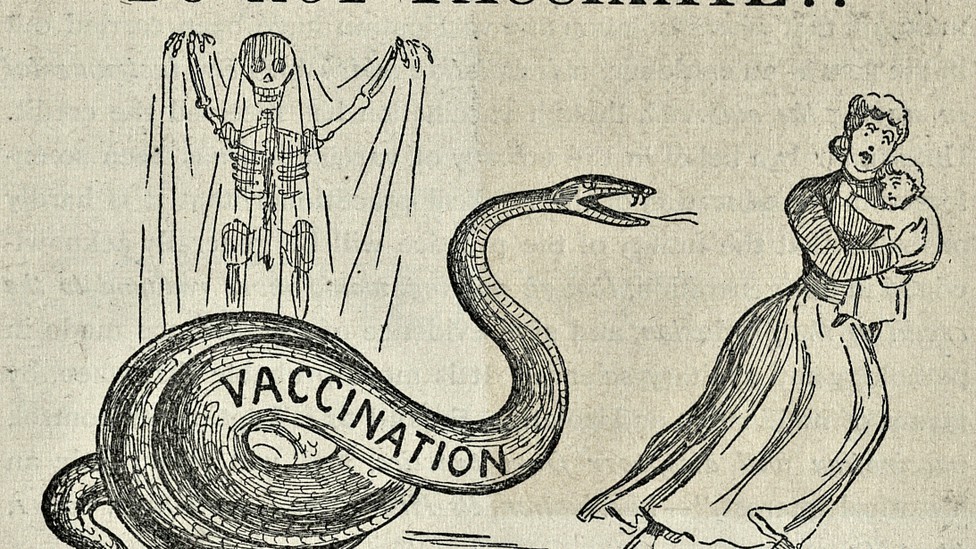
A cartoon from a December 1894 anti-vaccination publication (Courtesy of The Historical Medical Library of The College of Physicians of Philadelphia)
For well over a century people have queued up to get vaccinated against polio, smallpox, measles, mumps, rubella, the flu or other epidemic diseases. And they have done so because they were mandated by schools, workplaces, armed forces, and other institutions committed to using science to fight disease. As a result, deadly viral epidemics began to disappear in the developed world. Indeed, the vast majority of people now protesting mandatory vaccinations were themselves vaccinated (by mandate) against polio, smallpox, measles, mumps, rubella, etc., and hardly any of them have contracted those once-common diseases. The historical argument for vaccines may not be the most scientific (the science is readily available online). But history can act as a reliable guide for understanding patterns of human behavior.
In 1796, Scottish physician Edward Jenner discovered how an injection of cowpox-infected human biological material could make humans immune to smallpox. For the next 100 years after this breakthrough, resistance to inoculation grew into “an enormous mass movement,” says Yale historian of medicine Frank Snowden. “There was a rejection of vaccination on political grounds that it was widely considered as another form of tyranny.”
Fears that injections of cowpox would turn people into mutants with cow-like growths were satirized as early as 1802 by cartoonist James Gilray (below). While the anti-vaccination movement may seem relatively new, the resistance, refusal, and denialism are as old as vaccinations to infectious disease in the West.
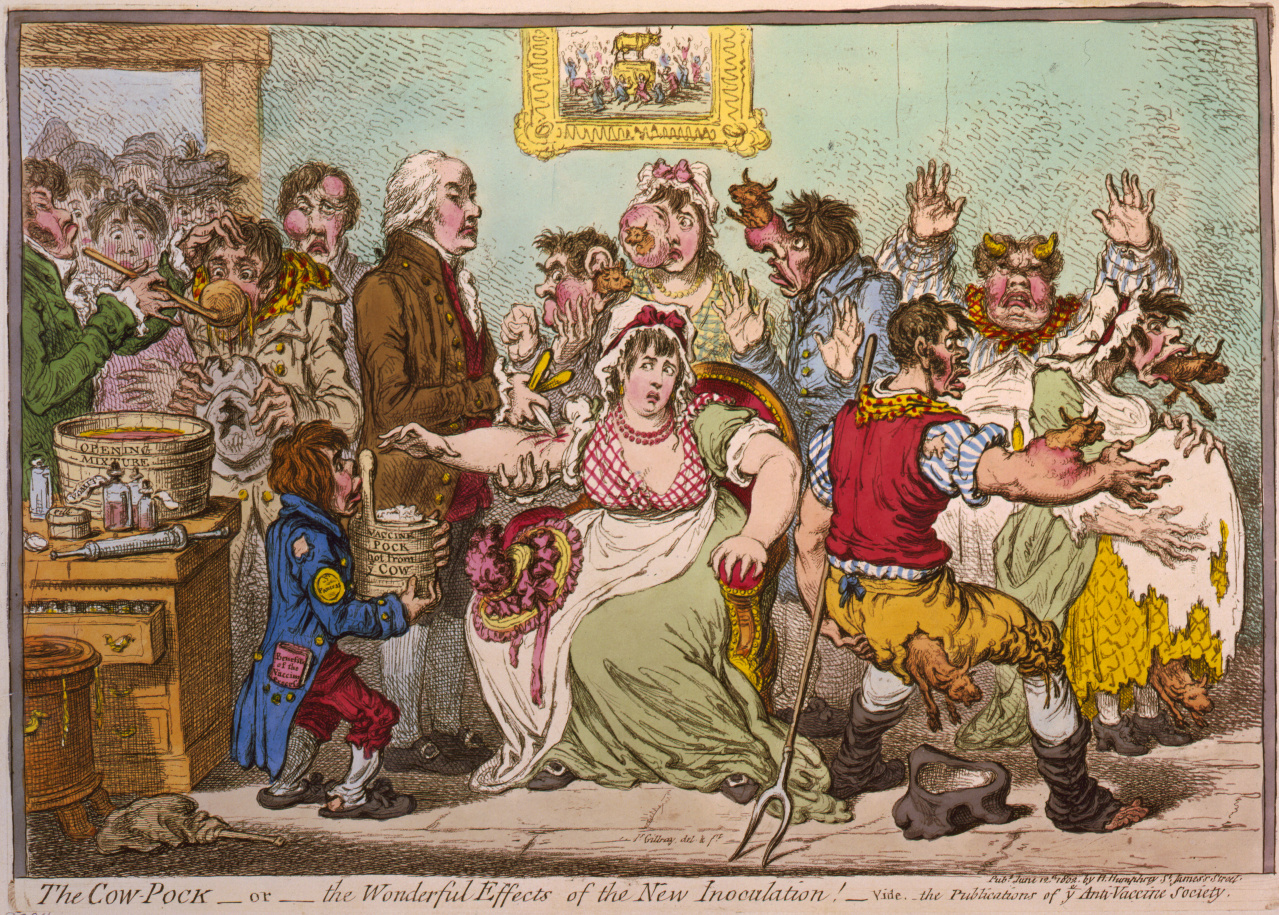
Image via Wikimedia Commons
“In the early 19th century, British people finally had access to the first vaccine in history, one that promised to protect them from smallpox, among the deadliest diseases in the era,” writes Jess McHugh at The Washington Post. Smallpox killed around 4,000 people a year in the UK and left hundreds more disfigured or blinded. Nonetheless, “many Britons were skeptical of the vaccine.… The side effects they dreaded were far more terrifying: blindness, deafness, ulcers, a gruesome skin condition called ‘cowpox mange’ — even sprouting hoofs and horns.” Giving a person one disease to frighten off another one probably seemed just as absurd a notion as turning into a human/cow hybrid.
Jenner’s method, called variolation, was outlawed in 1840 as safer vaccinations replaced it. By 1867, all British children up to age 14 were required by law to be vaccinated against smallpox. Widespread outrage resulted, even among prominent physicians and scientists, and continued for decades. “Every day the vaccination laws remain in force,” wrote scientist Alfred Russel Wallace in 1898, “parents are being punished, infants are being killed.” In fact, it was smallpox claiming lives, “more than 400,000 lives per year throughout the 19th century, according to the World Health Organization,” writes Elizabeth Earl at The Atlantic. “Epidemic disease was a fact of life at the time.” And so it is again. Covid has killed almost 800,000 people in the U.S. alone over the past two years.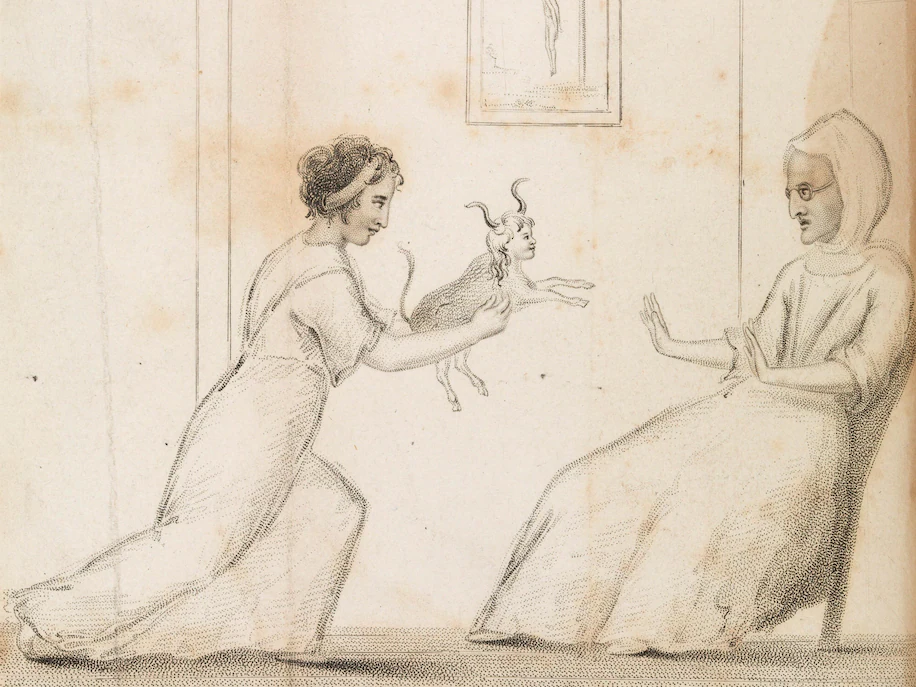
Then as now, medical quackery played its part in vaccine refusal — in this case a much larger part. “Never was the lie of ‘the good old days’ more clear than in medicine,” Greig Watson writes at BBC News. “The 1841 UK census suggested a third of doctors were unqualified.” Common causes of illness in an 1848 medical textbook included “wet feet,” “passionate fear or rage,” and “diseased parents.” Among the many fiery lectures, caricatures, and pamphlets issued by opponents of vaccination, one 1805 tract by William Rowley, a member of the Royal College of Physicians, alleged that the injection of cowpox could mar an entire bloodline. “Who would marry into any family, at the risk of their offspring having filthy beastly diseases?” it asked hysterically.
Then, as now, religion was a motivating factor. “One can see it in biblical terms as human beings created in the image of God,” says Snowden. “The vaccination movement injecting into human bodies this material from an inferior animal was seen as irreligious, blasphemous and medically wrong.” Granted, those who volunteered to get vaccinated had to place their faith in the institutions of science and government. After medical scandals of the recent past like the Tuskegee experiments or Thalidomide, that can be a big ask. In the 19th century, says medical historian Kristin Hussey, “people were asking questions about rights, especially working-class rights. There was a sense the upper class were trying to take advantage, a feeling of distrust.”
The deep distrust of institutions now seems intractable and fully endemic in our current political climate, and much of it may be fully warranted. But no virus has evolved — since the time of the Jenner’s first smallpox inoculation — to care about our politics, religious beliefs, or feelings about authority or individual rights. Without widespread vaccination, viruses are more than happy to exploit our lack of immunity, and they do so without pity or compunction.
Related Content:
Dying in the Name of Vaccine Freedom
How Vaccines Improved Our World In One Graphic
How Do Vaccines (Including the COVID-19 Vaccines) Work?: Watch Animated Introductions
Josh Jones is a writer and musician based in Durham, NC. Follow him at @jdmagness
Read More...Support Us
We're hoping to rely on loyal readers, rather than erratic ads. Please click the Donate button and support Open Culture. You can use Paypal, Venmo, Patreon, even Crypto! We thank you!

About Us

Open Culture scours the web for the best educational media. We find the free courses and audio books you need, the language lessons & educational videos you want, and plenty of enlightenment in between.
Advertise With Us
FREE UPDATES!
GET OUR DAILY EMAIL
Get the best cultural and educational resources on the web curated for you in a daily email. We never spam. Unsubscribe at any time.
FOLLOW ON SOCIAL MEDIA
Open Culture editor Dan Colman scours the web for the best educational media. He finds the free courses and audio books you need, the language lessons & movies you want, and plenty of enlightenment in between.
Advertise With Us


