The 17th Century Japanese Samurai Who Sailed to Europe, Met the Pope & Became a Roman Citizen

Image via Wikimedia Commons
We learn about intrepid Europeans who sought, and sometimes even found, trade and missionary routes to China and Japan during the centuries of exploration and empire. Rarely, if ever, do we hear about visitors from the East to the West, especially those as well-traveled as 17th-century samurai Hasekura Tsunenaga. Sent on a mission to Europe and America by his feudal lord, Date Masumune, Hasekura “set off on a quest to earn riches and spiritual guidance,” Andrew Milne writes at All that’s Interesting. “He circumnavigated the globe, became part of the first Japanese group in Cuba, met the Pope, helped begin a branch of Japanese settlers in Spain (still thriving today), and even became a Roman citizen.”
Hasekura was a battle-tested samurai who had acted on the daimyo’s behalf on many occasions. His mission to the West, however, was first and foremost a chance to redeem his honor and save his life. In 1612, Hasekura’s father was made to commit seppuku after an indictment for corruption. Stripped of lands and title, Hasekura could only avoid the same fate by going West, and so he did, just a few years before the period of sakoku, or national isolation, began in Japan. Traveling with Spanish missionary Luis Sotelo, Hasekura embarked from the small Japanese port of Tsukinoura in 1613 and first reached Cape Mendocino in California, then part of New Spain.
“Seven years before the Mayflower headed to the New World,” Marcel Theroux writes at The Guardian, Hasekura “crossed the Pacific, traveled overland through Mexico, then sailed all the way to Europe. He was accompanied by about 20 fellow countrymen — in all likelihood, the first Japanese to cross The Atlantic.” They set sail on a Japanese-built galleon — called Date Maru, then later San Juan Bautista by the Spanish. “The expedition spent seven years traveling one-third of the globe,” notes PBS in a description of “A Samurai in the Vatican,” an episode of Secrets of the Dead.
Sotelo and Hasekura made formal requests for more missionaries in Japan, delivering letters from from Hasekura’s lord, the daimyo of Sendai, to the King of Spain and Pope Paul V. But the samurai’s most pressing purpose was the establishment of trade links between Japan, New Spain (Mexico), and Europe. In his 1982 novel, The Samurai, Shusaku Endo dramatized the exchange the Spanish missionaries made for such introductions, having a priest say: “In order to spread God’s teaching in Japan… there is only one possible method. We must cajole them into it. Espana must offer to share its profits from trade on the Pacific with the Japanese in return for sweeping proselytizing privileges. The Japanese will sacrifice anything else for the sake of profits.” This was not to be, of course.
The Spanish gambled on trade opening up Japan for the kind of missionary colonization they had achieved elsewhere, using Hasekura’s mission as a proxy. Hasekura gambled on a Christian mission to save his life. Though his own accounts are lost, it seems he came to genuinely embrace the faith, becoming a confirmed Catholic under the name Philip Francis Faxecura. During his mission, however, the Shogun, Tokugawa Ieyasu, banned Christianity in Japan on penalty of death, in advance of the expulsion of the Spanish and Portuguese by his grandson, Tokugawa Iemitsu, in 1623. What became of the explorer samurai when he returned to Japan in 1620 is unknown, but his decedents were executed for practicing his newfound faith. He would be the last visitor to the West from Japan until the Tokugawa Shogunate sent the so-called “First Japanese Embassy to Europe” in 1862, over 200 years later.
Related Content:
Meet Yasuke, Japan’s First Black Samurai Warrior
Discover Japan’s Oldest Surviving Cookbook Ryori Monogatari (1643)
Josh Jones is a writer and musician based in Durham, NC. Follow him at @jdmagness
Read More...Watch John Cage’s 4′33″ Played by Musicians Around the World
Make sure to watch the video above with the sound on. In it musicians from around the world all play a well-known composition: 4′33″ by John Cage. “I spent weeks asking strangers on the internet to send me their radically different interpretations, and boy did they deliver,” writes the video’s creator Sam Vladimirsky. “My inbox filled with adaptations by an Austrian death metal band, a marimba player, a bunny rabbit, the Museum of Musical Instruments in Phoenix, a middle school music teacher, a version played on Guitar Hero and over Zoom.” Though originally composed for piano, 4′33″ is easily transposed to all these instruments and others, calling as it does for their players to do the very same thing: nothing.
“Inspired by Zen Buddhism, the Dada movement and Cage’s strong distaste for the ubiquitous muzak of the time,” says Aeon, “its score instructs performers not to play their instruments for the piece’s four-minute, thirty-three-second duration.” The result is not silence but “the unique ambient soundscape of the environment in which it’s performed, reflecting Cage’s belief that music is ever-present.”
Here the submitted performances take place in such environments as a classroom, a bedroom, a courtyard, a driveway, a bus, and a subway station. Vladimirsky pairs the videos, allowing us to enjoy not just parallel viewing experiences but a layered listening experience of these ambient soundscapes.
“Stuck inside,” writes Vladimirsky, “professional musicians, dedicated amateurs, awkward teens and college students found 4′33″ to be the music of our moment.” If the Rolling Stones could play “You Can’t Always Get What You Want” in lockdown, each from his separate home, then who’s to say this isn’t the next logical step? Each performance of 4′33″ reflects not just its immediate setting but its cultural period: compare the clip just above, in which Cage himself plays it in Harvard Square in 1973. Most of us haven’t seen the inside of a concert hall in quite some time, let alone heard the ambient sounds produced within it in the absence of proper music. But each of us can, at least, perform 4′33″ for ourselves whenever and wherever we like — one way of doing it being simply to play the video at the top of the post with the sound off.
Related Content:
Watch John Cage Play His “Silent” 4’33” in Harvard Square, Presented by Nam June Paik (1973)
The Curious Score for John Cage’s “Silent” Zen Composition 4’33”
John Cage’s Silent, Avant-Garde Piece 4’33” Gets Covered by a Death Metal Band
The 4’33” App Lets You Create Your Own Version of John Cage’s Classic Work
The Virtual Choir: Watch a Choir Conductor Digitally Unite 3500 Singers from Around the World
How to Find Silence in a Noisy World
Based in Seoul, Colin Marshall writes and broadcasts on cities and culture. His projects include the book The Stateless City: a Walk through 21st-Century Los Angeles and the video series The City in Cinema. Follow him on Twitter at @colinmarshall or on Facebook.
Read More...Watch Hilarious Spoofs of Classic Film Genres: Film Noir, Spaghetti Westerns, Scandinavian Crime Dramas, Time Travel Films & More
Comedian Alasdair Beckett-King has a keen ear for entertainment tropes and subscribes to the belief that “putting too much effort into things makes them funnier.”
The result is a series of one-minute videos in which he spoofs the conventions of a particular genre or long running series, with perfect visuals, meta dialogue, and faithfully rendered performance styles.
Beckett-King put his London Film School training to use with this project during lockdown, spending “absolutely ages putting together something very tiny.”
Witness his take on every episode of Star Trek: The Next Generation, in which the captain of the ship, a Patrick Stewart doppelgänger and “vegetarian space socialist who is always right” negotiates with a “representative of a kind of iffy alien race not necessarily based on a specific human ethnicity.” As Beckett-King told Eric Johnson, host of Follow Friday podcast:
That one was very, very hard work because I had to do a CGI bald cap for myself because I have long, long flowing hair. I had to try and do an impression of Captain Picard of the Starship Enterprise… it’s not that good. There’s so much work that went into it.
Before I posted it, I was convinced I’d wasted my time. Then luckily it did quite well and people really liked it. People kept saying, “When are you doing Captain Picard again?” I’m like, “I’m not! because it took ages to do the bald head, and you’ve seen it now.” I think what’s nice about it though, is you get to try something, commit to it and then see if it’s funny afterwards. It’s quite like doing live standup.
(Beckett-King’s partner Rachel Anne Smith gets credits for the non-CGI costumes.)
Some other favorites:
Every Single Scandinavian Crime Drama: The killer could be anyone in Helgasund. That’s over seven people.
Every Single Spooky Podcast: The frozen soil was littered with what appeared to be discarded Casper mattresses and Bombas socks.
Every Single Spaghetti Western: Yeah, well your lips don’t synch…
Every Haunted House Movie: It’s the perfect place for me to quit drinking, finish my novel, and really come to terms with that deer we hit on the way over.
Every Episode of Popular Time Travel Show: Help us, Doctor. The intransigent Implacablons are poised to destroy us.
How Every Film Noir Ends: Talk your way out of a snub nosed pistol held at waist height.
Should you find yourself at loose ends, waiting for the next Beckett-King “every single…” episode to drop, try biding your time with his Art House Movie Spoilers and North East of England spin on Jaws.
Buy a Coffee for Alasdair Beckett-King here.
Related Content:
Download a Complete, Cover-to-Cover Parody of The New Yorker: 80 Pages of Fine Satire
The Time When National Lampoon Parodied Mad Magazine: A Satire of Satire (1971)
Ayun Halliday is the Chief Primaologist of the East Village Inky zine and author, most recently, of Creative, Not Famous: The Small Potato Manifesto. Follow her @AyunHalliday.
Read More...Blade Runner and Alien TV Shows Confirmed by Ridley Scott

Ridley Scott is 83, and good on him for not slowing down. The Last Duel came and went, but it actually existed and was an original idea, based on a true historical event, and with a script from Nicole Holofcener, and featured a re-teaming up of Ben Affleck and Matt Damon. And as of this writing, House of Gucci is set to open and give us some salacious scandal and murder among the hoity and toit, just in time for Oscar season. He’s even recently dropped some hot takes against the superhero movie factory of Hollywood. So Scott’s doing well. Then why does this latest announcement feel so underwhelming?
According to a BBC interview on Monday, Scott is also developing a 10-episode limited series based on Blade Runner *and* a limited series based on Alien, this time set on earth.
It’s not totally clear how much Scott is actively involved.
“We [have already] written the pilot for ‘Blade Runner’ and the bible,” he says, referring to the master plan of the 10 episodes. “So, we’re already presenting ‘Blade Runner’ as a TV show, the first 10 hours.” But who his co-creators are, we don’t know right now. And there are similar questions in the upcoming Alien series, which has been rumored since 2020. Noah Hawley, who turned the Coen Bros. Fargo into something like a jazz riff on the Coen’s films spread across several decades, is set to be the showrunner.
The Blade Runner announcement has sent the pop media press into a tizzy, trying to guess where and when the new series will be set. After all, the 1982 film was set in a bleak, dystopian 2019, and the Denis Villeneuve sequel was set in a bleak, dystopian 2049. And it was only because of this announcement that I even knew of the Adult Swim animated series, Blade Runner: Black Lotus, which is set in a bleak, dystopian 2032. Times have changed, but the Los Angeles of the future sure hasn’t. So when will it take place? Who knows?
“We’ve already written the pilot for Blade Runner.. and Alien has now been written for pilot“
— BBC Radio 4 Today (@BBCr4today) November 22, 2021
Director Ridley Scott, says the Blade Runner and Alien TV shows are in development and they are putting together the ‘bible’ of both projectshttps://t.co/niPYpaHxfG #R4Today pic.twitter.com/4vTPGyZXtz
Look, the two new series might be good, they might be meh, but Scott’s sudden prominence at the end of 2021 feels like an encapsulation of media’s divergent paths. On one hand you have his two films, both original content, one that might have a second life on streaming on and another that feels like it will have some buzz and lead people back to the cinema. Either way, they tell stories with beginnings, middles, and ends. On the other hand you have the continual franchise-ment of culture, revisiting and rehashing two excellent films from the early ‘80s that exist perfectly well as standalone stories. Do we really need more stories about the xenomorph? Do we need more stories about a very damp Los Angeles and its replicants? Is culture at a standstill? Are we doomed to recycle everything from the 1980s onward?
However, if anybody should be making money off of Ridley Scott’s legacy it’s Scott himself. Leave your thoughts in the comments below, while I put on this Vangelis soundtrack.
Related Content:
Three Blade Runner Prequels: Watch Them Online
Ted Mills is a freelance writer on the arts who currently hosts the Notes from the Shed podcast and is the producer of KCRW’s Curious Coast. You can also follow him on Twitter at @tedmills, and/or watch his films here.
Read More...The Drugs Used by the Ancient Greeks and Romans
Many of us living in the parts of the world where marijuana has recently been legalized may regard ourselves as partaking of a highly modern pleasure. And given the ever-increasing sophistication of the growing and processing techniques that underlie what has become a formidable cannabis industry, perhaps, on some level, we are. But as intellectually avid enthusiasts of psychoactive substances won’t hesitate to tell you, their use stretches farther back in time than history itself. “For as long as there has been civilization, there have been mind-altering drugs,” writes Science’s Andrew Lawler. But was anyone using them in the predecessors to western civilization as we know it today?
For quite some time, scholars believed that unlike, say, Mesoamerica or north Africa, “the ancient Near East had seemed curiously drug-free.” But now, “new techniques for analyzing residues in excavated jars and identifying tiny amounts of plant material suggest that ancient Near Easterners indulged in a range of psychoactive substances.”
The latest evidence suggests that, already three millennia ago, “drugs like cannabis had arrived in Mesopotamia, while people from Turkey to Egypt experimented with local substances such as blue water lily.” That these habits seem to have continued in ancient Greece and Rome is suggested by archaeological evidence summarized in the video above.
In 2019, archaeologists unearthed a few precious artifacts from a fourth-century Scythian burial mound near Stavropol in Russia. There were “golden armbands, golden cups, a heavy gold ring, and the greatest treasure of all, two spectacular golden vessels,” says narrator Garrett Ryan, who earned a PhD in Greek and Roman History from the University of Michigan. The interiors of those last “were coated with a sticky black residue,” confirmed in the lab to be opium with traces of marijuana. “The Scythians, in other words, got high” — as did “their Greek and Roman neighbors.” Ryan, author of Naked Statues, Fat Gladiators, and War Elephants: Frequently Asked Questions about the Ancient Greeks and Romans, goes on to make intriguing connections between scattered but relevant pieces of archaeological and textual evidence. We know that some of our civilizational forebears got high; how many, and how high, are questions for future scholastic inquiry.
Related Content:
Algerian Cave Paintings Suggest Humans Did Magic Mushrooms 9,000 Years Ago
Discover the Oldest Beer Recipe in History From Ancient Sumeria, 1800 B.C.
1,000-Year-Old Illustrated Guide to the Medicinal Use of Plants Now Digitized & Put Online
Beer Archaeology: Yes, It’s a Thing
Based in Seoul, Colin Marshall writes and broadcasts on cities and culture. His projects include the book The Stateless City: a Walk through 21st-Century Los Angeles and the video series The City in Cinema. Follow him on Twitter at @colinmarshall or on Facebook.
Read More...Dueling as a Film Trope: Pretty Much Pop #109 Considers The Last Duel and Its Genre

In light of the release of The Last Duel (which you needn’t have watched), we talk about the trope of the honor-resolving duel in movies and TV. Mark and guest co-host Dylan Casey of The Partially Examined Life are joined by Clif Mark, host of the Good in Theory podcast who wrote his political thesis and a 2018 Aeon article on the history and logic of dueling.
Since we’re all philosophy podcasters on this one (our entertainment podcaster guest dropped out at the last minute), we bring in philosophers like Hegel and Nietzsche in as needed, the circle of ethical concern (who gets moral status and so is worthy to duel?), and of course the relevant class and gender critiques.
We also touch on The Duelists (incidentally, Ridley Scott’s directing debut, where The Last Duel is his latest), The Duelist and The Duel (two 2016 films), A Knight’s Tale, The Princess Bride, Dune, Hamilton, Bridgerton, The Karate Kid, and more.
For more information on the specter of dueling in politics, read about Justin Trudeau and Trump/Biden.
Some articles that fed our discussion (in addition to Clif’s “What Is Offensive”) include:
- “The Last Duel: Cinema’s 11 Best Showdowns” by Nicholas Barber
- “‘The Last Duel’ Is More Than Just Unsuccessful Oscar Bait” by Adam Nayman
- “The True History Behind ‘The Last Duel’” by Meilan Solly
- “Duelling Films” by Howard G. Brown
Follow Clif @Clifton_Mark.
This episode includes bonus discussion you can access by supporting the podcast at patreon.com/prettymuchpop or by choosing a paid subscription through Apple Podcasts. This podcast is part of the Partially Examined Life podcast network.
Pretty Much Pop: A Culture Podcast is the first podcast curated by Open Culture. Browse all Pretty Much Pop posts.
Read More...The Illustrated Version of “Alice’s Restaurant”: Watch Arlo Guthrie’s Thanksgiving Counterculture Classic
Alice’s Restaurant. It’s now a Thanksgiving classic, and something of a tradition around here. Recorded in 1967, the 18+ minute counterculture song recounts Arlo Guthrie’s real encounter with the law, starting on Thanksgiving Day 1965. As the long song unfolds, we hear all about how a hippie-bating police officer, by the name of William “Obie” Obanhein, arrested Arlo for littering. (Cultural footnote: Obie previously posed for several Norman Rockwell paintings, including the well-known painting, “The Runaway,” that graced a 1958 cover of The Saturday Evening Post.) In fairly short order, Arlo pleads guilty to a misdemeanor charge, pays a $25 fine, and cleans up the thrash. But the story isn’t over. Not by a long shot. Later, when Arlo (son of Woody Guthrie) gets called up for the draft, the petty crime ironically becomes a basis for disqualifying him from military service in the Vietnam War. Guthrie recounts this with some bitterness as the song builds into a satirical protest against the war: “I’m sittin’ here on the Group W bench ’cause you want to know if I’m moral enough to join the Army, burn women, kids, houses and villages after bein’ a litterbug.” And then we’re back to the cheery chorus again: “You can get anything you want, at Alice’s Restaurant.”
We have featured Guthrie’s classic during past years. But, for this Thanksgiving, we give you the illustrated version. Happy Thanksgiving to everyone who plans to celebrate the holiday today.
If you would like to support the mission of Open Culture, consider making a donation to our site. It’s hard to rely 100% on ads, and your contributions will help us continue providing the best free cultural and educational materials to learners everywhere. You can contribute through PayPal, Patreon, and Venmo (@openculture). Thanks!
Related Content:
William S. Burroughs Reads His Sarcastic “Thanksgiving Prayer” in a 1988 Film By Gus Van Sant
Marilyn Monroe’s Handwritten Turkey-and-Stuffing Recipe
William Shatner Raps About How to Not Kill Yourself Deep Frying a Turkey
F. Scott Fitzgerald’s 13 Tips for What to Do with Your Leftover Thanksgiving Turkey
Read More...Jazz Virtuoso Oscar Peterson Gives Dick Cavett a Dazzling Piano Lesson (1979)
Duke Ellington once called Oscar Peterson the “Maharaja of the Keyboard” for his virtuosity and ability to play any style with seeming ease, a skill he first began to learn as a classically trained child prodigy. Peterson was introduced to Bach and Beethoven by his musician father and older sister Daisy, then drilled in rigorous finger exercises and given six hours a day of practice by his teacher, Hungarian pianist Paul de Marky. “I only first really heard jazz somewhere between the ages of seven and 10,” said the Canadian jazz great. “My older brother Fred, who was actually a better pianist than I was, started playing various new tunes — well they were new for me, anyway…. Duke Ellington and Art Tatum, who frightened me to death with his technique.”
Despite his own prodigious talent, Peterson found Tatum “intimidating,” he told Count Basie in a 1980 interview. He responded to the fear by learning how to play like Tatum, and like everyone else he admired, while adding his own melodic twists to standards and originals. At 14, he won a national Canadian music competition and left school to become a professional musician.
He recorded his first album in 1945 at age 20. “Since his ‘discovery’ in 1947 by Norman Granz,” wrote International Musician in 2002, five years before the pianist’s death, “Peterson has amassed an incredible legacy of recorded work with Louis Armstrong, Ella Fitzgerald, Count Basie, Fred Astaire, Dizzy Gillespie, Coleman Hawkins, and Charlie Parker, among countless other greats.”
In the video at the top of the post from the Dick Cavett Show in 1979, Peterson shows off his elegant technique and demonstrates the “stylistic trademarks” of the greats he admired, and that others have heard expressed in his own style. He begins with his albatross, Tatum’s “stride piano,” a style that requires a good deal of left hand articulation and which, done right, can “put the rhythm section out of business,” Cavett jokes. Peterson then shows off the “the two-fingered percussiveness of Nat Cole,” the “lyric octave work of Erroll Garner,” and double octave melody lines, a very difficult two-hand maneuver.
It’s a dazzling lesson that shows, in just a few short minutes, why Peterson became known for his “stunning virtuosity as a soloist,” as one biography notes. In the video above, producer and YouTube personality Rick Beato explains why he thinks Peterson played the “Greatest Solo of All Time” in the 1974 rendition of “Boogie Blues Study” further up. As David Funk, who posted the Cavett video clip to YouTube, puts it, “What more can you say?” To understand why Louis Armstrong called Peterson “the man with four hands,” we simply need to watch him play.
Related Content:
How Music Unites Us All: Herbie Hancock & Kamasi Washington in Conversation
Jazz Deconstructed: What Makes John Coltrane’s “Giant Steps” So Groundbreaking and Radical?
Josh Jones is a writer and musician based in Durham, NC. Follow him at @jdmagness
Read More...The Secrets of Beethoven’s Fifth, the World’s Most Famous Symphony
Revered by music lovers of temperaments as varied as Peanuts’ Schroeder and A Clockwork Orange’s Alex, Ludwig van Beethoven is one of the most celebrated composers in the Western classical music canon.
Symphony No. 5 in C minor is surely one of his most recognized, and frequently performed works, thanks in large part to its dramatic opening motif –
dun-dun-dun-DAH!
Music educator Hanako Sawada’s entertaining TED-Ed lesson, animated by Yael Reisfeld above, delves into the story behind this symphony, “one of the most explosive pieces of music ever composed.”
Middle and high school music teachers will be glad to know the creators lean into the heightened emotions of the piece, depicting the composer as a tortured genius whose piercing gaze is bluer than Game of Thrones’ Night King.
Beethoven was already enjoying a successful reputation at the time of the symphony’s 1808 premiere, but not because he toiled in the service of religion or wealthy patrons like his peers.
Instead, he was an early-19th century bad ass, prioritizing self-expression and pouring his emotions into compositions he then sold to various music publishers.
With the Fifth, he really shook off the rigid structures of prevailing classical norms, embracing Romanticism in all its glorious turmoil.
The famous opening motif is repeated to the point of obsession:
Throughout the piece, the motif is passed around the orchestra like a whisper, gradually reaching more and more instruments until it becomes a roar.
Besotted teenagers, well acquainted with this feeling, are equipped with the internal trombones, piccolos, and contrabassoons of the sort that make the piece even more urgent in feel.
Just wait until they get hold of Beethoven’s Immortal Beloved letters, written a few years after the symphony, when the hearing loss he was wrestling with had progressed to near total deafness.
Whether or not it was the composer (and not his biographer) who characterized the central motif as the sound of “Fate knocking at the door,” it’s an apt, and riveting notion.
Take a quiz, participate in a guided discussion, and customize Hanako Sawada’s lesson, “The Secrets of the World’s Most Famous Symphony,” here.
Listen to the symphony in its entirety below.
Related Content:
Ayun Halliday is the Chief Primatologist of the East Village Inky zine and author, most recently, of Creative, Not Famous: The Small Potato Manifesto. Follow her @AyunHalliday.
Read More...In 1997, Wired Magazine Predicts 10 Things That Could Go Wrong in the 21st Century: “An Uncontrollable Plague,” Climate Crisis, Russia Becomes a Kleptocracy & More
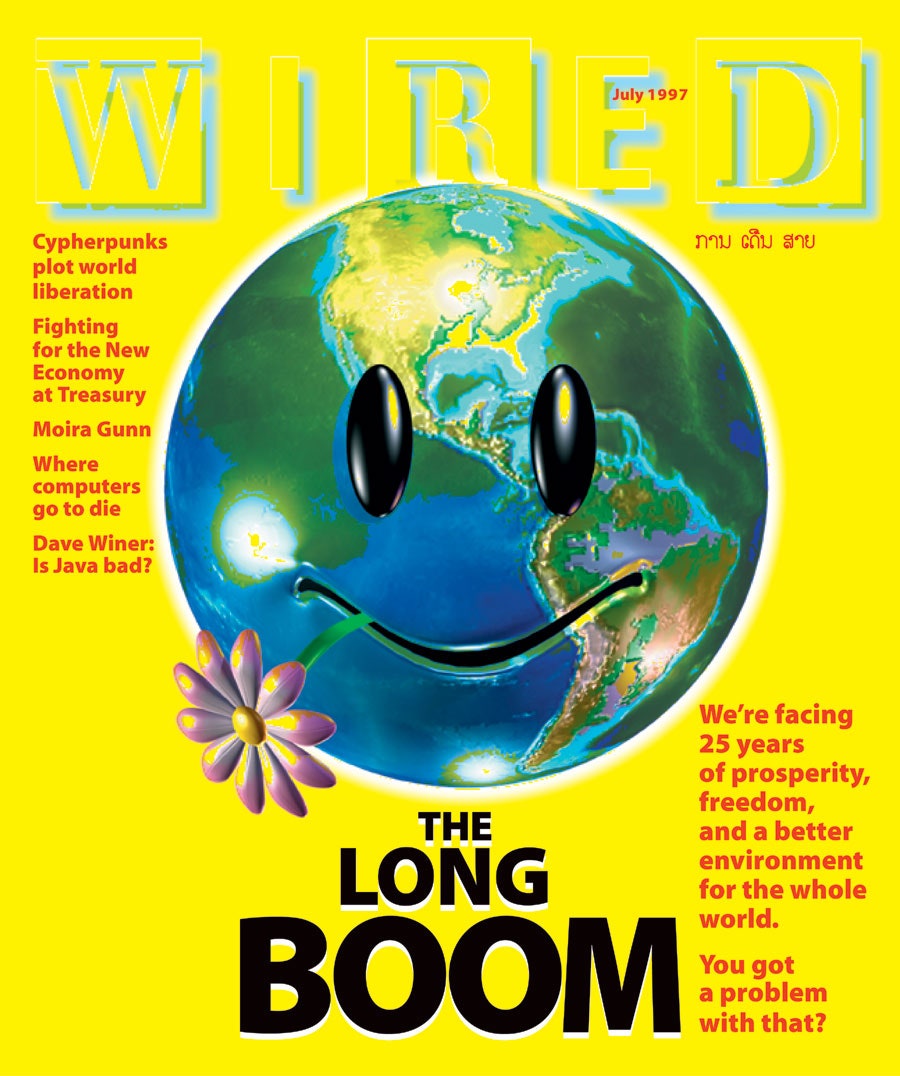
Hydrogen-powered cars. Biological, then quantum computing. Gene-therapy cancer treatments. An end to the War on Drugs. Reliable automatic translation. The impending end of the nation-state. Man setting foot on Mars. These are just a few of the developments in store for our world by the year 2020 — or so, at any rate, predicts “The Long Boom,” the cover story of a 1997 issue of Wired magazine, the official organ of 1990s techno-optimism. “We’re facing 25 years of prosperity, freedom, and a better environment for the whole world,” declares the cover itself. “You got a problem with that?”
Since the actual year 2020, this image has been smirkingly re-circulated as a prime example of blinkered End-of-History triumphalism. From the vantage of 2021, it’s fair to say that the predictions of the article’s authors Peter Schwartz and Peter Leyden (who expanded their thesis into a 2000 book) went wide of the mark.
But their vision of the 21st century hasn’t proven risible in every aspect: a rising China, hybrid cars, video calls, and online grocery-shopping have become familiar enough hardly to merit comment, as has the internet’s status as “the main medium of the 21st century.” And who among us would describe the cost of university as anything but “absurd”?
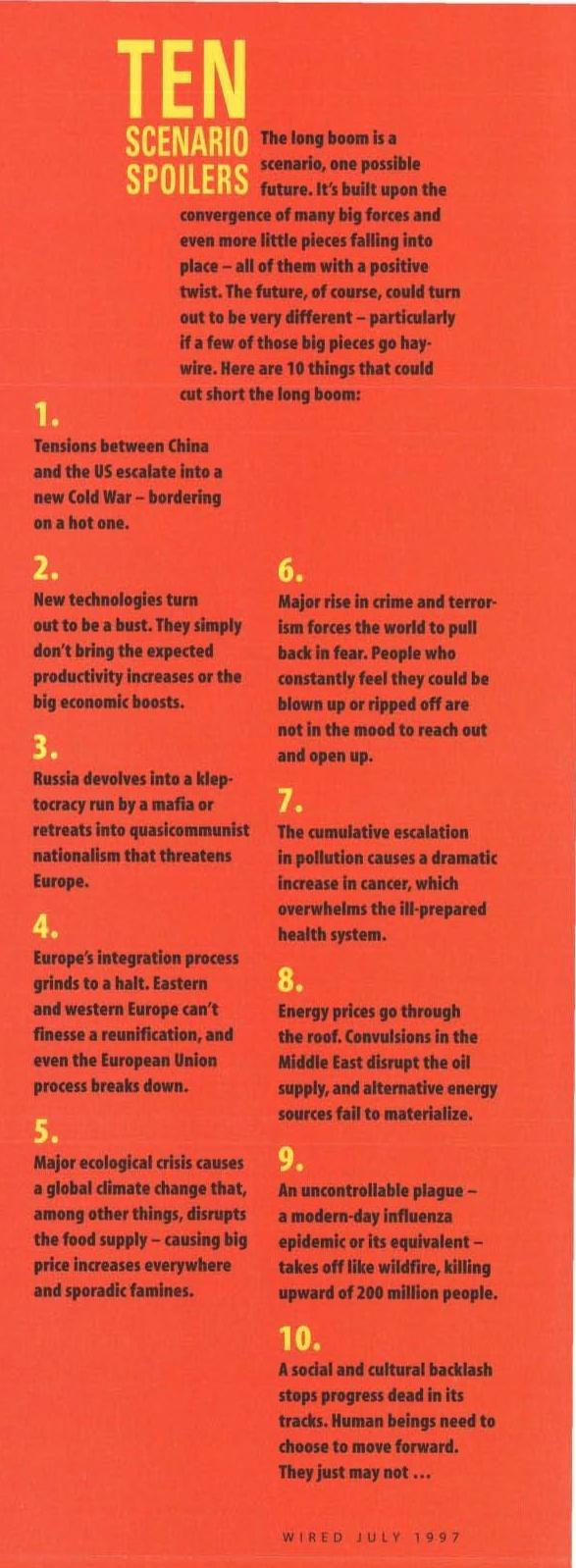
Schwartz and Leyden do allow for darker possibilities than their things-can-only-get-better rhetoric make it seem. Some of these they enumerate in a sidebar (remember sidebars?) headlined “Ten Scenario Spoilers.” Though not included in the article as archived on Wired’s web site, it has recently been scanned and posted to social media, with viral results. A “new Cold War” between the U.S. and China; a “global climate change that, among other things, disrupts the food supply”; a “major rise in crime and terrorism forces the world to pull back in fear”; an “uncontrollable plague — a modern-day influenza epidemic or its equivalent”: to one degree or another, every single one of these ten dire developments seems in our time to have come to pass.
“We’re still on the front edge of the great global boom,” we’re reminded in the piece’s conclusion. “A hell of a lot of things could go wrong.” You don’t say. Yet for all of the 21st-century troubles that few riding the wave of first-dot-com-boom utopianism would have credited, we today run the risk of seeing our world as too dystopian. Now as then, “the vast array of problems to solve and the sheer magnitude of the changes that need to take place are enough to make any global organization give up, any nation back down, any reasonable person curl up in a ball.” We could use a fresh infusion of what Schwartz and Leyden frame as the boom’s key ingredient: American optimism. “Americans don’t understand limits. They have boundless confidence in their ability to solve problems. And they have an amazing capacity to think they really can change the world.” In that particular sense, perhaps we all should become Americans after all.
Related Content:
Pioneering Sci-Fi Author William Gibson Predicts in 1997 How the Internet Will Change Our World
In 1926, Nikola Tesla Predicts the World of 2026
From the Annals of Optimism: The Newspaper Industry in 1981 Imagines its Digital Future
Based in Seoul, Colin Marshall writes and broadcasts on cities and culture. His projects include the book The Stateless City: a Walk through 21st-Century Los Angeles and the video series The City in Cinema. Follow him on Twitter at @colinmarshall or on Facebook.
Read More...Support Us
We're hoping to rely on loyal readers, rather than erratic ads. Please click the Donate button and support Open Culture. You can use Paypal, Venmo, Patreon, even Crypto! We thank you!

About Us

Open Culture scours the web for the best educational media. We find the free courses and audio books you need, the language lessons & educational videos you want, and plenty of enlightenment in between.
Advertise With Us
FREE UPDATES!
GET OUR DAILY EMAIL
Get the best cultural and educational resources on the web curated for you in a daily email. We never spam. Unsubscribe at any time.
FOLLOW ON SOCIAL MEDIA
Open Culture editor Dan Colman scours the web for the best educational media. He finds the free courses and audio books you need, the language lessons & movies you want, and plenty of enlightenment in between.
Advertise With Us



