Watch Franz Liszt’s “Un Sospiro” Played with the Mesmerizing “Three-Hand Technique”
“Piano education is important for teaching polyphony, improving sight-reading, consolidating the knowledge of harmony and gaining much more musical abilities,” write Turkish researchers in the behavioral sciences journal Procedia. The student of the piano can advance solo or with another player in duets, playing what are called “four-hand pieces.” But learning “to gain the attitudes of duet playing” poses a challenge. Researchers Izzet Yucetoker and Koksal Apaydinli suggest a possible intervention — overcoming the difficulties of playing four-hand pieces by learning to play what are called “three-hand pieces.”
How, you might wonder, does one play the piano with three hands? It does not take an extra limb or a partner with one hand tied behind their back. Three-hand technique is a dextrous sleight-of-hand developed in the 1830s, most prominently by pianist Sigismond Thalberg, a rival of Franz Liszt who could “apparently not only counter Liszt’s legendary fire and thunder with subtlety,” Bryce Morrison writes at Gramophone, “but who played as if with three hands. Three hands were heard, two were visible!” Might this somehow be easier than playing duets?
One contemporary reviewer of Thalberg’s playing described it as “myriads of notes sounding from one extremity of the instrument to the other without disturbing the subject, in which the three distinct features of this combination are clearly brought out by his exquisite touch.” The Polish pianist and student of Liszt Moriz Rosenthal claimed Thalberg adopted the technique from the harp. “Such legerdemain quickly had novelty-conscious Paris by the ears,” Morrison writes, “and an elegant white kid-glove rather than than a mere gauntlet was thrown down before Liszt.”
Liszt would have none of it, deriding three-hand technique as a trick unfit for his virtuosity. Nonetheless, “in 1837, Liszt, arguably the most charismatic virtuoso of all time, was challenged for supremacy by Sigismond Thalberg…. Stung and infuriated by what he saw as Thalberg’s aristocratic pretensions… Liszt replied with corruscating scorn.” He agreed to meet Thalberg, not in a duet but a duel, at “the home of Countess Cristina Belgiojoso — lover of Lafayette, Heine and Liszt,” notes Georg Prodota at Interlude.
The Countess “gave a charity event for the refugees of the Italian war of independence, and the contemporary press compared the concert to the battle between Rome and Carthage.” Countess Belgiojoso herself (as did the press) pronounced the outcome a draw:
Never was Liszt more controlled, more thoughtful, more energetic, more passionate; never has Thalberg played with greater verve and tenderness. Each of them prudently stayed within his harmonic domain, but each used every one of his resources. It was an admirable joust. The most profound silence fell over that noble arena. And finally Liszt and Thalberg were both proclaimed victors by this glittering and intelligent assembly. Thus two victors and no vanquished …
History was not so kind. Liszt is now celebrated as “the most charismatic virtuoso of all time,” while Thalberg is hardly remembered. And some of the most celebrated examples of pieces played with three-hand technique come not from Thalberg but from Liszt, such as “Un Sospiro” (“A Sigh”), the last of his Three Concert Études, composed between 1845 and 1849, not only as performance pieces, but — as it so happens — for the general improvement of a pianist’s technique. Hear pianist Paul Barton play three versions of “Un Sospiro” above and download the sheet music for the piece here.
Related Content:
The Piano Played with 16 Increasing Levels of Complexity: From Easy to Very Complex
Acclaimed Japanese Jazz Pianist Yōsuke Yamashita Plays a Burning Piano on the Beach
Josh Jones is a writer and musician based in Durham, NC. Follow him at @jdmagness
Read More...A History of Punk from 1976–78: A Free Online Course from the University of Reading
From Matthew Worley, professor of modern history at the University of Reading, comes the free online course Anarchy in the UK: A History of Punk from 1976–78. (Worley is also the author of the book, No Future: Punk, Politics and British Youth Culture.) The course covers the following ground:
In the late 1970s, a new youth subculture emerged in the UK. This, of course, was punk, and a cultural revolt was underway.
In this course, you will learn about the emergence of punk and its diverse range of meanings. You’ll use that lens to explore how youth cultures provided space for people to reimagine, discover and challenge the society and communities in which they were coming of age.
You’ll explore punk as a tool of expression for young people, and how it related to politics and events. You’ll consider punk’s relationship with gender, class, race, sexuality and protest, drawing comparisons with the youth culture of today…
This history course also has an emphasis on the creative side of punk. You’ll explore DIY punk design and writing, epitomised by fanzines. You’ll learn how to create a real-life fanzine of your own, all the way to publishing and distribution. This will help strengthen your communication skills and encourage independent thought and creativity.
Among other things, the course will cover:
- The diverse meanings of ‘punk’, its roots and its effects on British culture.
- The originators and defining events that led to punk’s spread across the UK and beyond.
- The music: how the Sex Pistols opened the way for a wide range of sounds and bands.
- Why fanzines became the perfect medium for punk.
- Punk’s influence on publishing, fashion, art and design.
- Punk’s impact on issues of gender, class, race, sexuality and protest.
- Punk’s legacy and continuing influence on society.
Anarchy in the UK: A History of Punk from 1976–78 can be taken for free on the FutureLearn platform. The course will be added to our list: 1,700 Free Online Courses from Top Universities.
Related Content:
The Sex Pistols’ 1976 Manchester “Gig That Changed the World,” and the Day the Punk Era Began
Read More...The Rashomon Effect: The Phenomenon, Named After Akira Kurosawa’s Classic Film, Where Each of Us Remembers the Same Event Differently
Toward the end of The Simpsons’ golden age, one episode sent the titular family off to Japan, not without resistance from its famously lazy patriarch. “Come on, Homer,” Marge insists, “Japan will be fun! You liked Rashomon.” To which Homer naturally replies, “That’s not how I remember it!” This joke must have written itself, not as a high-middlebrow cultural reference (as, say, Frasier would later name-check Tampopo) but as a play on a universally understood byword for the nature of human memory. Even those of us who’ve never seen Rashomon, the period crime drama that made its director Akira Kurosawa a household name in the West, know what its title represents: the tendency of each human being to remember the same event in his own way.
“A samurai is found dead in a quiet bamboo grove,” says the narrator of the animated TED-Ed lesson above. “One by one, the crime’s only known witnesses recount their version of the events that transpired. But as they each tell their tale, it becomes clear that every testimony is plausible, yet different, and each witness implicates themselves.”
So goes “In a Grove,” a story by celebrated early 20th-century writer Ryūnosuke Akutagawa. An avid reader, Kurosawa combined that literary work with another of Akutagawa’s to create the script for Rashomon. Both Akutagawa and Kurosawa “use the tools of their media to give each character’s testimony equal weight, transforming each witness into an unreliable narrator.” Neither reader nor viewer can trust anyone — nor, ultimately, can they arrive at a defensible conclusion as to the identity of the killer.
Such conflicts of memory and perception occur everywhere in human affairs: this TED-Ed lesson finds examples in biology, anthropology, politics, and media. Sufficiently many psychological phenomena converge to give rise to the Rashomon effect that it seems almost overdetermined; it may be more illuminating to ask under what conditions doesn’t it occur. But it also makes us ask even tougher questions: “What is truth, anyway? Are there situations when an objective truth doesn’t exist? What can different versions of the same event tell us about the time, place, and people involved? And how can we make group decisions if we’re all working with different information, backgrounds, and biases?” We seem to be no closer to definitive answers than we were when Rashomon came out more than 70 years ago — only one of the reasons the film holds up so well still today.
Related Content:
How to Improve Your Memory: Four TED Talks Explain the Techniques to Remember Anything
What Is Déjà Vu? Michio Kaku Wonders If It’s Triggered by Parallel Universes
Based in Seoul, Colin Marshall writes and broadcasts on cities, language, and culture. His projects include the Substack newsletter Books on Cities, the book The Stateless City: a Walk through 21st-Century Los Angeles and the video series The City in Cinema. Follow him on Twitter at @colinmarshall or on Facebook.
Read More...The Ukulele Orchestra of Great Britain Performs The Clash’s “Should I Stay Or Should I Go”
Over the years, we’ve featured The Ukulele Orchestra of Great Britain performing covers of various rock classics–from the Rolling Stones’ “Satisfaction” and Bowie’s “Heroes,” to Nirvana’s “Smells Like Teen Spirit” and Talking Heads’ “Psycho Killer.” Recorded in London back in 2005, this clip features the Orchestra performing The Clash’s ‘Should I Stay Or Should I Go.’ The performance is an outtake from the DVD, Anarchy in the Ukulele, which is available in digital format. Enjoy.
If you would like to support the mission of Open Culture, consider making a donation to our site. It’s hard to rely 100% on ads, and your contributions will help us continue providing the best free cultural and educational materials to learners everywhere. You can contribute through PayPal, Patreon, and Venmo (@openculture). Thanks!
Related Content:
Jimi Hendrix’s “Voodoo Child” Shredded on the Ukulele
George Harrison Explains Why Everyone Should Play the Ukulele
Read More...
Hear The Velvet Underground’s “Legendary Guitar Amp Tapes,” Which Showcases the Brilliance & Innovation of Lou Reed’s Guitar Playing (1969)
What was the Velvet Underground? A Kim Fowly-like art project that outlived its impresario’s interest? A main vehicle for Lou Reed, rock’s egomaniac underdog (who was no one’s ingénue)? Was it three bands? 1. The Velvet Underground and Nico; 2. The Velvet Underground with John Cale; and 3. The Velvet Underground with Doug Yule after Cale’s departure. (Let’s pass by, for the moment, whether VU without Reed warrants a mention…)
Each iteration pioneered essential underground sounds — dirgy Euro-folk rock, strung-out New York garage rock, junkie ballads, psychedelic drone, experimental noise — nearly all of them channeled through Reed’s underrated guitar playing, which was, perhaps the most important member of the band all along. Whoever taped the Velvets (in their second incarnation) on March 15, 1969, on the last night of a three-show engagement at The Boston Tea Party in Boston, MA, seemed to think so. “The entire set was recorded by a fan directly from Lou Reed’s guitar amplifier,” MetaFilter points out.
The mic jammed in the back of Reed’s amp, a Head Heritage reviewer writes, produced “a mighty electronic roar that reveals the depth and layers of Reed’s playing. Over and undertones, feedback, string buzz, the scratch of fingers on frets and the crackle and hum of tube amps combine to create a monolithic blast of metal machine music.” Known as the “legendary guitar amp tape” and long sought by collectors and fans, the bootleg, which you can hear above, “serves as a testament to the brilliance and innovation of Reed’s guitar-playing — both qualities that are often underrated, if not overlooked entirely, by critics of his work,” as Richie Unterberger writes.
It should be evident thus far that these recordings are hardly a comprehensive document of the Velvet Underground in early 1969. Except for Mo Tucker’s glorious, but muffled thumping and some of Sterling Morrison’s excellent guitar interplay, the rest of the band is hardly audible. Songs like “Candy Says” and “Jesus” — on which Reed does not create sublime swirls of noise and feedback — chug along monotonously without their melodies. “It is frustrating,” Unterberger admits, “to hear such a one-dimensional audio-snapshot of what is clearly a good — if not great — night for the band” (who were far more than one of their parts). On the other hand, nowhere else can we hear the nuance, ferocity, and outright insanity of Reed’s playing so amply demonstrated on the majority of this document.
The tape circulated for years as a Japanese bootleg, an interesting fact, notes a Rate Your Music commenter, “considering this bears more similarity to recordings from the likes of [legendary Japanese psych rock band] Les Rallizes Dénudés than most of the Velvet Underground’s other material.” The recordings may have well paved the way for the explosion of Japanese psychedelic rock to come. They also demonstrate the influence of Ornette Coleman in Reed’s playing, and the liberating philosophy Coleman would come to call Harmolodics.
“Alla that boo-ha about whether Reed really was influenced by free jazz,” writes one reviewer quoted on MetaFilter, “can be put to rest here as he pulls the kind of wailing hallucinatory shapes from the guitar that it would take the goddam Blue Humans to decode a couple of decades later.” It may well overstate the case to claim that “Lou Reed single-handedly invented underground music,” but we can hear in these recordings the seeds of everything from Television to Sonic Youth to Pavement to Royal Trux and so much more. See the full tracklist below, a “classic setlist,” notes MetaFilter, “from around the time of their 3rd LP.”
I Can’t Stand It
Candy Says
I’m Waiting For The Man
Ferryboat Bill
I’m Set Free
What Goes On
White Light White Heat
Beginning To See The Light
Jesus
Heroin / Sister Ray
Move Right In
Run Run Run
Foggy Notion
Related Content:
Hear Ornette Coleman Collaborate with Lou Reed, Which Lou Called “One of My Greatest Moments”
The Velvet Underground Captured in Color Concert Footage by Andy Warhol (1967)
Josh Jones is a writer and musician based in Durham, NC. Follow him at @jdmagness
Read More...Stream 160 In-Depth Radio Interviews with Clive James, Pico Iyer, Greil Marcus & Other Luminaries from the Marketplace of Ideas Archive
Would you like to to hear a long-form conversation about the history of the vinyl LP? Or about the history of human rights? About the plight of book reviewing in America? The wild excesses of the art market? The nature of boredom? The true meaning of North Korean propaganda? What it’s like to live in Bangkok? What it’s like to go on a road trip with David Foster Wallace? The answer to all of the above: of course you do. And now you can hear these conversations and many more besides in the complete archive of the public radio show The Marketplace of Ideas, which has just now come available to stream on Youtube.
How, you may wonder, did I get such early word of this interview trove’s availability? Because, in the years before I began writing here on Open Culture, I created, produced, and hosted the show myself. The project grew, in a sense, out of my dissatisfaction with the radio interviews I’d been hearing, the vast bulk of which struck me as too brief, fragmentary, and programmatic to be of any real value.
What’s more, it was often painfully obvious how little interest in the subject under discussion the interviewers had themselves. With The Marketplace of Ideas, I set out to do the opposite of practically everything I’d heard done on the radio before.
Like all worthwhile goals, mine was paradoxical: to conduct interviews of the deepest possible depth as well as the widest possible breadth. On one week the topic might be evolutionary economics, on another the philosophical quarrel between David Hume and Jean-Jacques Rousseau, on another the history of American film comedy, on another the legacy of Robert Pirsig’s Zen and the Art of Motorcycle Maintenance, and on another still the ascent of Californian wine over French. (This principle also applied to the political spectrum: I delighted in bringing on, say, the granddaughter of Barry Goldwater as well as a former member of the Weather Underground.) An interesting person is, as they say, an interested person, and throughout the show’s run I trusted my listeners to be interesting people.
The same went for my interviewees, whatever their cultural domain: novelists like Alexander Theroux, Tom McCarthy, Joshua Cohen, and Geoff Dyer; scientists like David P. Barash, Alan Sokal (he of the “Sokal Hoax”), and Sean Carroll; critics like James Wood, Greil Marcus, Jonathan Rosenbaum, Dave Kehr, and J. Hoberman; economists like Tyler Cowen (twice), Robin Hanson, Steven E. Landsburg, and Tim Harford (twice); biographers of Brian Eno, Nick Drake, and Michel de Montaigne; translators of Jorge Luis Borges, César Aira, and Robert Walser; broadcasters like Peter Sagal, Robert Pogue Harrison (of Entitled Opinions), Jesse Thorn, and Michael Silverblatt; philosophers like Kwame Anthony Appiah and Simon Blackburn; technologists like Steve Wozniak and Kevin Kelly; filmmakers like Ramin Bahrani (director of the existential Werner Herzog-narrated plastic-bag short previously featured here on Open Culture), So Yong Kim, Andrew Bujalski, Aaron Katz; and musicians like Nick Currie, a.k.a Momus (twice), Jack Hues of Wang Chung, and Chaz Bundick of Toro y Moi.
The Marketplace of Ideas aired between 2007 and 2011, and the passage of a decade since the show’s end prompted me to take a look — or rather a listen — back at it. So did the fact that a fair few of its guests have since shuffled off this mortal coil: Arts & Letters Daily founder Denis Dutton, film critic Peter Brunette, literary scholar Angus Fletcher, documentarian Pepita Ferrari, writer and editor Daniel Menaker, cultural polymath Clive James. That interview with James was a dream fulfilled, due not just to my personal enthusiasm for his writing but the ideal of intellectual omnivorousness he represented — an ideal toward which I strove on the show, and continue to strive in my pursuits today. Even more than our conversation itself, I fondly remember an exchange after we finished recording but before we hung up the phone. He thanked me for actually reading his book, and I told him I’d thought all interviewers did the same. His response: “That’s the first naïve thing you’ve said all hour.”
Related Content:
Entitled Opinions, the “Life and Literature” Podcast That Refuses to Dumb Things Down
The 135 Best Podcasts to Enrich Your Mind: An Introduction to Our New List
Based in Seoul, Colin Marshall writes and broadcasts on cities, language, and culture. His projects include the Substack newsletter Books on Cities, the book The Stateless City: a Walk through 21st-Century Los Angeles and the video series The City in Cinema. Follow him on Twitter at @colinmarshall or on Facebook.
Read More...Watch an Accurate Reconstruction of the World’s Oldest Computer, the 2,200 Year-Old Antikythera Mechanism, from Start to Finish
There’s nothing like an ancient mystery, especially one as seemingly insoluble as the origins of “the world’s first computer,” the Antikythera mechanism. Discovered off the coast of the Greek island of Antikythera in 1901, the corroded collection of gears and dials seemed fake to scientists at first because of its ingeniousness. It has since been dated to 100 to 150 BC and has inspired decades of research and speculative reconstruction. Yet, no one knows who made it, and more importantly, no one knows how it was made.
“The distance between this device’s complexity and others made at the same time is infinite,” says Adam Wojcik, a materials scientist at the University College of London. “Frankly, there is nothing like it that has ever been found. It’s out of this world.”
The expression should not make us think of ancient aliens — the Antikythera mechanism contains more than enough evidence of human limitation, showing a geocentric model of the cosmos with the only five planets its maker would have known.
The 2,000-plus year-old device continues to reveal its secrets, including hidden inscriptions found during CT scans of the object, as Smithsonian reported in 2015. The mechanism is “similar in size to a mantel clock, and bits of wood found on the fragments suggest it was housed in a wooden case. Like a clock, the case would’ve had a large circular face with rotating hands. There was a knob or handle on the side, for winding the mechanism forward or backward. And as the knob turned, trains of interlocking gearwheels drove at least seven hands at various speeds. Instead of hours and minutes, the hands displayed celestial time.”
If the Antikythera mechanism is a “celestial clock,” who better to design and build its reconstruction than a clockmaker? That is exactly what we see in the videos above, created for the clockmaking YouTube channel Clickspring. Using the best scientific model of the mechanism to date — published this year by Dr. Tony Freeth and colleagues of the Antikythera Mechanism Research Project — Clickspring shows how the device might have fit together and makes educated guesses about the right placement of its dozens of small parts.
You can see a preview of the Antikythera reconstruction project at the top, watch the full project above, and see individual episodes showcasing different phases of construction on YouTube. The model “conforms to all the physical evidence,” Freeth writes, “and matches the descriptions in the scientific inscriptions engraved on the mechanism itself.” What no one can figure out, however, is just how the ancient Greek artisans who made it shaped precision metal parts without lathes and other modern tools of the machine-makers trade. Researchers, and clockmakers, may have pieced together the Antikythera puzzle, but the mystery of how it came into existence at all remains unsolved.
Related Content:
Modern Artists Show How the Ancient Greeks & Romans Made Coins, Vases & Artisanal Glass
Josh Jones is a writer and musician based in Durham, NC. Follow him at @jdmagness
Read More...Wikipedia’s Surprising Power in Shaping Science: A New MIT Shows How Wikipedia Shapes Scientific Research

If you were in high school or college when Wikipedia emerged, you’ll remember how strenuously we were cautioned against using such an “unreliable source” for our assignments. If you went on to a career in science, however, you now know how important a role Wikipedia plays in even professional research. It may thus surprise you to learn that students still get more or less the same warning about what, two decades later, has become the largest encyclopedia and fifth most-visited web site in the world. “Many of us use Wikipedia as a source of information when we want a quick explanation of something,” say MIT’s citation guidelines. “However, Wikipedia or other wikis, collaborative information sites contributed to by a variety of people, are not considered reliable sources for academic citation.”
That quotation appears, somewhat ironically, in a recent MIT research paper called “Science is Shaped by Wikipedia: Evidence From a Randomized Control Trial.” Its authors, Neil C. Thompson from MIT and Douglas Hanley from the University of Pittsburgh, use both “Big Data” and experimental approaches to support their claim that “incorporating ideas into a Wikipedia article leads to those ideas being used more in the scientific literature.”
Testing the existence of an underlying causal relationship, they “commissioned subject matter experts to create new Wikipedia articles on scientific topics not covered in Wikipedia.” Half of these articles were added to Wikipedia, and half retained as a control group. “Reviewing the relevant journal articles published later, they find that “the word-usage patterns from the treatment group show up more in the prose in the scientific literature than do those from the control group.”
In other words, Wikipedia does indeed appear to shape science — or as Wharton professor Ethan Mollick put it on Twitter, “The secret heart of academia is… Wikipedia.” Expanding on the idea, he added that “Wikipedia is used like a review article,” which surveys the current state of a particular scientific field. “Review articles are extremely influential on the direction of scientific research, and while Wikipedia articles are generally less influential, there are more of them, they are more up-to-date, and they are free.” That last point — and the implied contrast to traditional, scientific journals with their often shockingly high subscription fees — becomes a key point in Thompson and Hanley’s advocacy for public repositories of knowledge in general, with their power to galvanize research across the whole world. The power of open culture is considerable; the power of open science, perhaps even more so.
You can read Hanley and Thompson’s study on the power of Wikipedia free online: “Science is Shaped by Wikipedia: Evidence From a Randomized Control Trial.”
Related Content:
Listen to Wikipedia: A Web Site That Turns Every Wikipedia Edit Into Ambient Music in Real Time
NASA’s New Online Archive Puts a Wealth of Free Science Articles Online
Royal Society Opens Online Archive; Puts 60,000 Papers Online
Free Online Courses: The Sciences
200 Free Textbooks: A Meta Collection
Based in Seoul, Colin Marshall writes and broadcasts on cities, language, and culture. His projects include the Substack newsletter Books on Cities, the book The Stateless City: a Walk through 21st-Century Los Angeles and the video series The City in Cinema. Follow him on Twitter at @colinmarshall or on Facebook.
Read More...The Age of Cathedrals: A Free Online Course from Yale University
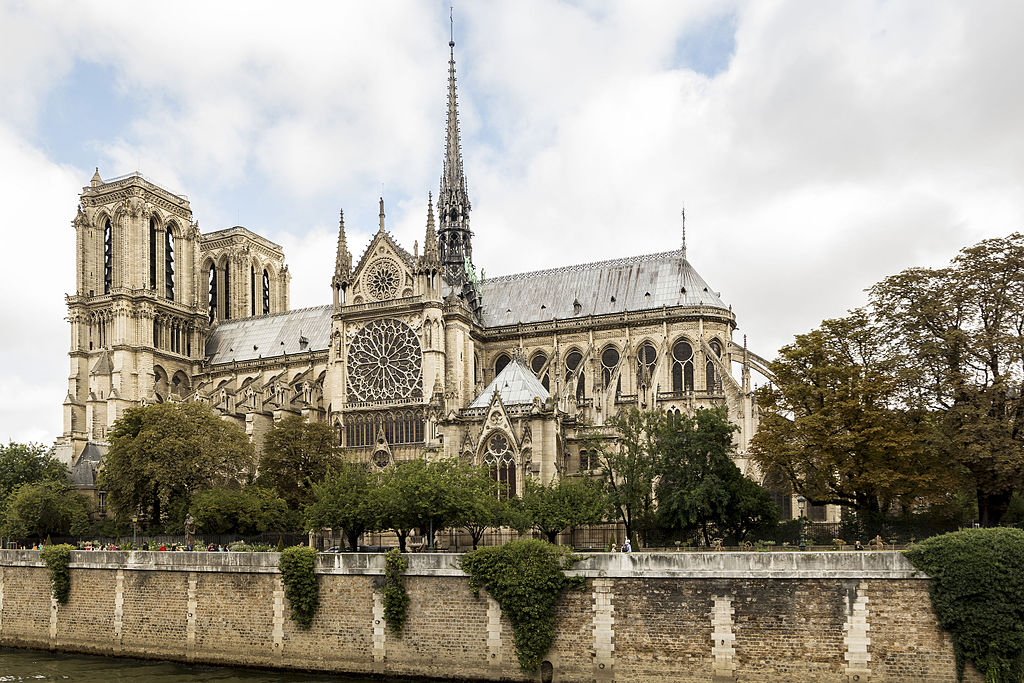
Image by Rafesmar, via Wikimedia Commons
From Yale professor Howard Bloch comes Age of Cathedrals, an online course that offers “an introduction to some of the most astonishing architectural monuments the world has ever known—Gothic cathedrals,” including Notre Dame, Chartres, and Saint-Denis. The course description adds: “We shall study the art, literature, intellectual life, economics, and new social arrangements that arose in the shadow of the cathedrals and that were such an important part of the revival of cities in the twelfth and thirteenth centuries. The goal of the course is a better appreciation of the High Middle Ages, a world that is still recognizably our own.”
You can take Age of Cathedrals for free by selecting the audit option upon enrolling. If you want to take the course for a certificate, you will need to pay a fee.
Age of Cathedrals has been added to our list of Free History Courses, a subset of our collection, 1,700 Free Online Courses from Top Universities.
If you would like to support the mission of Open Culture, consider making a donation to our site. It’s hard to rely 100% on ads, and your contributions will help us continue providing the best free cultural and educational materials to learners everywhere. You can contribute through PayPal, Patreon, and Venmo (@openculture). Thanks!
Related Content:
Making Architecture: A Free Online Course from the IE School of Architecture and Design
Free Course: An Introduction to the Art of the Italian Renaissance
Read More...Blockchain and Money: A Free Online Course from MIT
Taught by MIT professor Gary Gensler, Blockchain and Money is “for students wishing to explore blockchain technology’s potential use—by entrepreneurs and incumbents—to change the world of money and finance. The course begins with a review of Bitcoin and an understanding of the commercial, technical, and public policy fundamentals of blockchain technology, distributed ledgers, and smart contracts. The class then continues on to current and potential blockchain applications in the financial sector.”
You can watch all 23 lectures above, or on YouTube. A syllabus and other course materials can be found on MIT’s website. More related courses are listed below.
Blockchain and Money has been added to our list of Free Business Courses, a subset of our collection, 1,700 Free Online Courses from Top Universities.
If you would like to support the mission of Open Culture, consider making a donation to our site. It’s hard to rely 100% on ads, and your contributions will help us continue providing the best free cultural and educational materials to learners everywhere. You can contribute through PayPal, Patreon, and Venmo (@openculture). Thanks!
Related Content
Bitcoin and Cryptocurrency Technologies: A Free Course from Princeton
The Princeton Bitcoin Textbook Is Now Free Online
Read More...Support Us
We're hoping to rely on loyal readers, rather than erratic ads. Please click the Donate button and support Open Culture. You can use Paypal, Venmo, Patreon, even Crypto! We thank you!

About Us

Open Culture scours the web for the best educational media. We find the free courses and audio books you need, the language lessons & educational videos you want, and plenty of enlightenment in between.
Advertise With Us
FREE UPDATES!
GET OUR DAILY EMAIL
Get the best cultural and educational resources on the web curated for you in a daily email. We never spam. Unsubscribe at any time.
FOLLOW ON SOCIAL MEDIA
Open Culture editor Dan Colman scours the web for the best educational media. He finds the free courses and audio books you need, the language lessons & movies you want, and plenty of enlightenment in between.
Advertise With Us


