Denmark’s Utopian Garden City Built Entirely in Circles: See Astounding Aerial Views of Brøndby Haveby
For decades, urban planners around the world have looked to the Danish capital of Copenhagen, with its low-rise high density and unparalleled culture of everyday cycling, as an example of how to design a city. But what of the Danish track record in designing suburbs? Recently, a photographer by the name of Henry Do brought the world’s attention to one such settlement, Brøndby Haveby or Garden City, with a series of aerial photographs posted to Instagram. “Unreal how my recent images from here went crazy viral,” Do writes in the caption of a follow-up drone video — “unreal” being just the word some have used to describe the place itself, composed as it is entirely out of circles.

Built in 1964 to the design of “genius landscape architect Erik Mygind,” Brøndby Haveby mimics “the traditional patterns of the 18th century Danish villages, where people would use the middle as a focal point for hanging out, mingle and social interchange between neighbors.”
This unusual form, more of which you can see in Do’s drone photos at Lonely Planet, suits the long-established Danish cabin culture, according to which every city-dwelling Dane with the means buys a smaller second home in the countryside as a retreat. (Though the houses in Brøndby Haveby are owned, the gardens are rented, and local zoning laws prevent anyone from occupying their properties for more than six months out of the year.)

Wherever it is, this cabin must be made hyggelige, an adjective often translated into English as “cozy” and that, in recent years, has become a byword for the love of small-scale contentment that sets Denmark apart. (Not everybody is sold on the concept: “With its relentless drive towards the middle ground and its dependence on keeping things light and breezy,” writes British Denmark expat Michael Booth, “hygge does get a bit boring sometimes.”) As Lenni Madsen, a Danish Quora user with a Brøndby Haveby house in the family, puts it, “Imagine your average small-time community, where everyone knows everyone else, you see each other across the hedge, perhaps sharing a beer or having coffee at each others’ houses.”

This seems a far cry from the alienation and depravity of the standard suburban cul-de-sac, at least as portrayed in American popular myth. And it isn’t hard to see the appeal for average urbanites, especially those looking to spend their generous vacation time in as different an environment as possible without having to go far. (Homeowners must already have a primary residence within 20 kilometers, which includes the city of Copenhagen.) The astonished reactions on social media would suggest that most of us have never seen a place like this before. But for the Danes, it’s just another chapter in their civilizational pursuit of all that is hyggelige.
Related Content:
Frank Lloyd Wright Designs an Urban Utopia: See His Hand-Drawn Sketches of Broadacre City (1932)
The Medieval City Plan Generator: A Fun Way to Create Your Own Imaginary Medieval Cities
Japanese Designer Creates Incredibly Detailed & Realistic Maps of a City That Doesn’t Exist
In Search of Ludwig Wittgenstein’s Secluded Hut in Norway: A Short Travel Film
Based in Seoul, Colin Marshall writes and broadcasts on cities, language, and culture. His projects include the Substack newsletter Books on Cities, the book The Stateless City: a Walk through 21st-Century Los Angeles and the video series The City in Cinema. Follow him on Twitter at @colinmarshall, on Facebook, or on Instagram.
Read More...“The Last of Us” Franchise: Can Video Games Be Cinema? A Pretty Much Pop Culture Podcast Discussion (#64)

Your Pretty Much Pop hosts Mark Linsenmayer, Brian Hirt, and Erica Spyres all played both The Last of Us, and more recently immersed themselves in the lengthier The Last of Us 2, which has been generating a lot of acclaim but also controversy. Actually, Erica just watches her husband Drew Jackson play these things, but he showed up to this discussion too. Yes, these creations of Neil Druckmann with the Naughty Dog team are groundbreaking, and riveting, but by design not necessarily “fun,” or thereby involving much “playing.”
The franchise is ostensibly about a zombie apocalypse and an immune girl that might be its cure, but it’s really a drawn-out drama about loss, family, and the cycle of revenge… You know, in between running around looking for scraps to craft weapon upgrades and skulking around driving shivs through the necks of numerous monsters and people.
We compare The Last of Us to other zombie media like Walking Dead, address the shifting points of view in the game (playable flashbacks!), representation, fan and critical reaction, the effectiveness of the game’s message, and more.
This conversation should work both for listeners who’ve actually played the games and those who are just curious about what the fuss is about. There are some plot spoilers about the end of the first game and events near the beginning of the second game necessary to discuss the narrative.
Listen to the official Last of Us podcast. For another player perspective, check out the Besties podcast.
Other resources:
- “The Not So Hidden Israeli Politics of ‘The Last of Us Part II’ ” by Emanuel Maiberg
- “The Last of Us Part 2 Review – Post-Apocalyptic Game Is Groundbreaking and Powerful” by Keza MacDonald
- “The Last of Us Part 2 Review Round-Up: What Critics Have Said About the ‘Groundbreaking, Emotional Masterpiece’ PS4 Sequel” by Alex Finnis
- “The Last of Us Part II’s Queer Representation is Groundbreaking. Is It Enough?” by Louis Chilton
- “The Last of Us Part I & II: How Their Zombies are Based on Real-Life Undead” by Coleman Gailloreto
- “The Last of Us 2 Has Sold 4 Million Copies, Breaking Sony’s PS4 Record” by Andy Robinson
Learn more at prettymuchpop.com. This episode includes bonus discussion that you can only hear by supporting the podcast at patreon.com/prettymuchpop. This podcast is part of the Partially Examined Life podcast network.
Pretty Much Pop: A Culture Podcast is the first podcast curated by Open Culture. Browse all Pretty Much Pop posts.
Read More...Werner Herzog Lists All the Languages He Knows–and Why He Only Speaks French If (Literally) a Gun’s Pointed at His Head
If you’ve explored the filmography of Werner Herzog, you’ve heard him speak not just his signature Teutonically inflected English — often imitated in recent years, though never quite equaled — but German as well. What else does he speak? In the clip above, the Bavarian-born director of Aguirre, the Wrath of God and Fitzcarraldo responds thus to the question of exactly how many languages he has: “Not too many. I mean, Spanish, English, German… and then I spoke modern Greek better than English once. I made a film in modern Greek, but that’s because in school I learned Latin and ancient Greek.”
The list doesn’t end there. “I do speak some Italian. I do understand French, but I refuse to speak it. It’s the last thing I would ever do. You can only get some French out of me with a gun pointed at my head” — which is exactly what happened to him. “I was taken prisoner in Africa” by “drunk soldiers on a truck,” all of them “fifteen, sixteen years old, some of them eight, nine years old,” armed and taking dead aim at him. “That was very unpleasant,” not least due to the lead soldier’s insistence that “on nous parle français ici.” And so Herzog finally “had to say a few things in French. I regret it. I shouldn’t have done it.”
But speaking, in Herzog’s world, isn’t as important as reading. “I read in Spanish and I read in Latin and I read in ancient Greek and I read in, er, whatever,” he told the Guardian in a more recent interview. “But it doesn’t matter. It depends on the text. I mean, take, for instance, Hölderlin, the greatest of the German poets. You cannot touch him in translation. If you’re reading Hölderlin, you must learn German first.” This alongside an appreciation of “trash movies, trash TV. WrestleMania. The Kardashians. I’m fascinated by it. So I don’t say read Tolstoy and nothing else. Read everything. See everything. The poet must not avert his eyes.”
It you want to become like Werner Herzog — well, best of luck to you (though he has created a “rogue film school” and currently stars in a Masterclass). But if you want to follow his lead in this specifically linguistic respect, you can start from our collection of free online lessons in 48 languages. There you’ll find material to start on everything from Spanish to modern as well as ancient Greek. Also included is French, Herzog’s bête noire, as well as Latin, which in the Guardian interview he calls his third language. German, which also figures into our collection, turns out not to be Herzog’s native language: “My mother tongue is Bavarian. Which is not even German, it’s a dialect.” With his filmmaking activities curtailed by world events, perhaps he’d consider producing a series of lessons?
via Kottke
Related Content:
Werner Herzog Offers 24 Pieces of Filmmaking and Life Advice
Werner Herzog Gets Shot During Interview, Doesn’t Miss a Beat
A Map Showing How Much Time It Takes to Learn Foreign Languages: From Easiest to Hardest
Learn 48 Languages Online for Free: Spanish, Chinese, English & More
Based in Seoul, Colin Marshall writes and broadcasts on cities, language, and culture. His projects include the Substack newsletter Books on Cities, the book The Stateless City: a Walk through 21st-Century Los Angeles and the video series The City in Cinema. Follow him on Twitter at @colinmarshall, on Facebook, or on Instagram.
Read More...Marionette Freddie Mercury Performs on the Streets of Madrid
When the pandemic ends and travel resumes, you’ll hopefully find puppeteers Diana Romero and Andrés Maturana entertaining folks, both young and old, on the streets of Madrid. Above, watch them entertain passersby with a marionette of Freddie Mercury singing the Queen classic, “I Want to Break Free.” Down below, you can see their marionette take on the Beatles.
Here’s some quick backstory on their work:
Periplo Puppets are Diana Romero and Andrés Maturana: designers and makers of puppets and stories. We began in 2003 with TitiriBeatles at the Ramblas of Barcelona and studying self-taught at Institut del Teatre Library. We traveled with our puppets through the streets of Europe and America gathering information and experience, until in 2009 we decided to live in Madrid and be a Theatre company. …We focus on audiovisual performance mixing video mapping, string puppets, and latex puppets to make shows that involve the audience.
Related Content:
Make an Adorable Crocheted Freddie Mercury; Download a Free Crochet Pattern Online
Meet Freddie Mercury and His Faithful Feline Friends
Watch Behind-the-Scenes Footage From Freddie Mercury’s Final Video Performance
Freddie Mercury Reimagined as Comic Book Heroes
Read More...How to Win an Argument (at the U.S. Supreme Court, or Anywhere Else): A Primer by Litigator Neal Katyal
Do you like being right? Of course, everyone does. Are you successful at convincing others? That’s a tougher one. We may politely disagree, avoid, or scream bloody murder at each other, but whatever our conflict style, no one is born, and few are raised, knowing how to persuade.
Persuasion does not mean coercion, deceit, or manipulation, the tactics of con artists, underhanded salespersons, or stereotypically untrustworthy lawyers….
Persuasion is about shifting others’ point of view, respectfully and charitably, through the use of evidence and argument, ethical appeals, moving stories, and “faith in the power of your ideas,” as Neal Katyal explains in his TED presentation above, “How to Win an Argument (at the U.S. Supreme Court, or anywhere).”
Katyal’s job as a Supreme Court litigator makes him an authority on this subject. It may also distract you with thoughts about the current Court power struggle. Try to put those thoughts aside. In places where reason, evidence, and ethics have purchase, Katyal’s advice can pay dividends in your quest to win others over.
In his first case before the Court a “handful of years” after the 9/11 attacks, he represented Osama bin Laden’s driver in a suit pressing to recognize Geneva Convention rules in the war on terror and to rule Guantanamo unconstitutional. His opponent, the Solicitor General of the U.S., had argued 35 cases before the court; “I wasn’t even 35 years old,” Katyal says. He won the case, and he’ll tell you how.
His most important lesson? Winning arguments isn’t about being right. It isn’t about believing really, really hard that you’re right. Persuasion is not about confidence, Katyal insists. It’s about empathy. Oral arguments in the courtroom (which judges could just as well read in transcript form) show us as much, he says.
When his legal expertise was not helping in preparation for the big trial, Katyal felt desperate and hired an acting coach, who trained him in such techniques as holding hands while making his arguments. What? Yes, that’s exactly what Katyal said. But he did it, and it worked.
Holding hands with the Justices isn’t an option in court, but Katyal found other ways to remind himself to stay close to what mattered, wearing accessories his parents had given him, for example, and writing his children’s names on a legal pad: “That’s why I’m doing this, for them. To leave the country better than I found it.”
Once he had established his private reasons for caring, he was ready to present his public reasons. As the old saying goes, “people don’t care how much you know, until they know how much you care.” The facts absolutely matter, yet the burden of showing how and why facts matter falls to the persuader, whose own passion, integrity, commitment, etc. will go a long way toward making an audience receptive.
This advice applies in any situation, but if you’re wondering how to move Katyal’s advice online.… well, maybe the ultimate lesson here is that we’re at our most persuasive when we’re close enough—physically or virtually—to take somebody’s hand.…
Related Content:
Literary Theorist Stanley Fish Offers a Free Course on Rhetoric, or the Power of Arguments
How to Argue With Kindness and Care: 4 Rules from Philosopher Daniel Dennett
Josh Jones is a writer and musician based in Durham, NC. Follow him at @jdmagness
Read More...A Creepy 19th Century Re-Creation of the Famous Ancient Roman Statue, Laocoön and His Sons
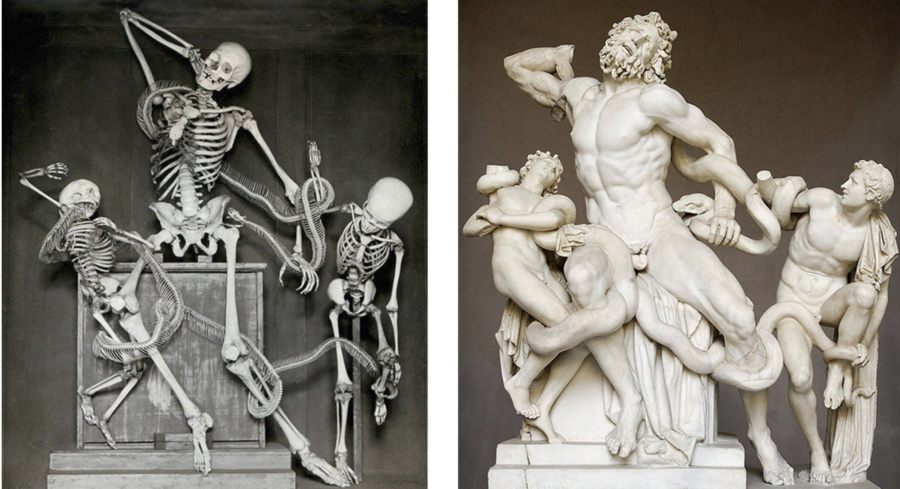
Beware of Greeks bearing gifts. We’ve all heard that proverb, but few of us could name its source: the Trojan priest Laocoön, a historical character in the Aeneid. “Do not trust the Horse, Trojans,” Virgil has him say. “Whatever it is, I fear the Greeks even bearing gifts.” He was right to do so, as we all know, though his death came not at the hands of the Greek army let into Troy by the soldiers hidden inside the Horse, but those of the gods. As Virgil has it, an enraged Laocoön threw a spear at the Horse when his compatriots disregarded words of caution, and in response the goddess Minerva sent forth a couple of sea serpents to do him in.
The Aeneid, of course, offers only one account of Laocoön’s fate. Sophocles, for instance, had him spared and only his sons killed, and his ostensible crime — being a priest yet marrying — had nothing to do with the Trojan Horse. But whatever drew the serpents Laocoön’s way, the moment they set upon him and his sons was immortalized by Rhodian sculptors Agesander, Athenodoros, and Polydorus in Laocoön and His Sons, among the most famous ancient sculptures in existence since its excavation in 1506. (The sculpture was originally created somewhere between 200 BC and 70 AD.) Various tributes have been paid to it over the centuries, most notably by an Austrian anatomist named Josef Hyrtl, whose built his highly Halloween-suitable recreation out of skeletons — both human and snake.
“According to Christopher Polt, an assistant professor in the classical studies department at Boston College who tweeted a side-by-side comparison of the two versions, Hyrtl created his take on the sculpture at the University of Vienna around 1850,” writes Hyperallergic’s Valentina Di Liscia. In response, a historian named Gregory Stringer tweeted that Hyrtl must have been able to intuit the “proper pose” of Laocoön’s right arm, since in the mid-19th century the sculpture’s original arm was still missing, yet to be rediscovered and reattached, and since 1510 had been replaced in copies with an incorrectly outstretched substitute. Laocoön and His Sons now resides at the Vatican (learn more about it in the Smarthistory video below), but Hyrtl’s skeletal Laocoön and His Sons was destroyed in the 1945 Allied bombing of Vienna.
In 2018, a similar project was attempted again for an exhibit at the Houston Museum of Natural Science. The new all-skeleton version of Laocoön and His Sons was created, as the Houston Press’ Jef Rouner reports, by taxidermist Lawyer Douglas, taxidermy collector Tyler Zottarelle, and artist Joshua Hammond. “It looks a lot like interpretative dance,” Rouner quotes Douglas as saying of Hyrtl’s work. “It’s a beautiful piece, but I was concerned it wasn’t able to capture the original struggle of animal versus human.” Though Agesander, Athenodoros, and Polydorus’ original is known as a “prototypical icon of human agony,” it turns out that “getting perpetually grinning skulls to seem in agony is harder than you might think.” But if any time of the year is right for grinning skulls to express the human experience, surely this is it.
via Hyperallergic
Related Content:
Free Art & Art History Courses
How Ancient Greek Statues Really Looked: Research Reveals Their Bold, Bright Colors and Patterns
An Artist Crochets a Life-Size, Anatomically-Correct Skeleton, Complete with Organs
Celebrate The Day of the Dead with The Classic Skeleton Art of José Guadalupe Posada
Based in Seoul, Colin Marshall writes and broadcasts on cities, language, and culture. His projects include the Substack newsletter Books on Cities, the book The Stateless City: a Walk through 21st-Century Los Angeles and the video series The City in Cinema. Follow him on Twitter at @colinmarshall, on Facebook, or on Instagram.
Read More...The Incredible Six-Octave Vocal Range of Opera-Singing Punk Diva Nina Hagen
If you’re a reader of this site, it’s likely you known the name Klaus Nomi, the diminutive German singer who stunned New Wave audiences in New York with his angelic soprano voice and opera covers. If you know of Nomi, you likely know of Nina Hagen, who started releasing records in her native East Germany in the late 70s, mixing opera with punk, funk, and reggae and covering classics from Tina Turner to The Tubes “White Punks on Dope.” She became a major star, but her name does not come up often these days. She is long overdue for a revival.
Like Nomi, Hagen was a master of fright make-up and exaggerated, Expressionist faces. She did not, however, have an alien alter-ego or collection of spacesuits. What she had was a wholly original style all her own, full of eccentric vocalizations critic Robert Christgau compared to The Exorcist’s Linda Blair.
Her stage shows were what Hagen herself described as “indescribable.” She applied her “umpteen-octave range,” as Christgau wrote, without restraint to every imaginable kind of material, from cabaret to Norman Greenbaum’s “Spirit in the Sky.”
Impossible to classify, Hagen was beloved by the likes of the Sex Pistols and the Slits. Less than a decade after her 1978 debut with the Nina Hagen Band, she appeared in Tokyo with the Japanese Philharmonic Orchestra in a concert broadcast to 15 countries, performing the songs of Bertolt Brecht and Kurt Weill. (See her that same year, 1985, sing from Carmen in Copenhagen, Denmark, just above.) She converted to Christianity later in life, frequently sings gospel tunes, and released an album called Personal Jesus in 2010 featuring a cover of the iconic Depeche Mode song.
Hagen emerged in 1978 alongside a number of theatrical female singers with preternaturally unsettling voices, debuting at the same time as Siouxsie Sioux, Kate Bush, and Diamanda Galas (who has received her own comparisons to Linda Blair). But her own journey was particularly unusual. “Listening to Hagen chat matter-of-factly about her life,” wrote The Irish Times in a review, “Madonna seems like Doris Day in comparison, while your pretender Lady Gaga is, in Hagen’s own words, ‘a pop prostitute who has more to do with bikini advertising.’”
Put more in more positive terms, the singer honed her theatrical “quick-change” persona through a “barrage of influences,” the New York Times noted. Critics were divided over her eclecticism. Rolling Stone called her 1982 solo, English-language debut the “most unlistenable” album ever made, an unfairly harsh assessment that didn’t stop her from experimenting with even more dissonant, disorienting sounds.
As Hagen herself tells her story:
I grew up in East Berlin, in a family of artists. I heard opera all day long. From the time I was 9 years old I was imitating the singers; later I studied opera. But we also got Western television and radio, from the Americans in West Berlin. When I was 11 years old, I turned into a hippie and gave flowers to policemen. And when I was 21 and left Berlin for London, I became a punk.
She became a punk diva, that is. Hagen’s vocal range—which you can hear demonstrated in the thorough video analysis above—over her band’s prog-like jams (as in “Naturträne), conjured up both angels and demons. She evokes dread with guttural growls and wide-eyed stares, she can look “childlike, sweet or terrifying,” or all three at once, and she never lacks the essential quality an opera singer needs to make it in rock and roll: a sense of humor.
Related Content:
Klaus Nomi Performs with Kraftwerk on German Television (1982)
How to Listen to Music: A Free Course from Yale University
Josh Jones is a writer and musician based in Durham, NC. Follow him at @jdmagness
Read More...The Great Illustration That Accompanied Eddie Van Halen’s Application to the U.S. Patent and Trademark Office (1987)

Throughout the past week, we’ve read many tributes to Eddie Van Halen and his endless capacity for innovation. Stylistically, EVH changed the sound of rock with tapping, a technique that let him play rapid arpeggios with two hands on the guitar’s fretboard. (Exhibit A is here.) Technically, he created a unique sound by fashioning his own guitar, the Frankenstrat, which melded the sounds of Gibson and Fender guitars. And what’s more, he patented three inventions, one of which came with the dazzling illustration above. Edward L. Van Halen’s 1987 patent for a “musical instrument support” was described as follows:
A supporting device for stringed musical instruments, for example, guitars, banjos, mandolins and the like… The supporting device is constructed and arranged for supporting the musical instrument on the player to permit total freedom of the player’s hands to play the instrument in a completely new way, thus allowing the player to create new techniques and sounds previously unknown to any player. The device, when in its operational position, has a plate which rests upon the player’s leg leaving both hands free to explore the musical instrument as never before. Because the musical instrument is arranged perpendicular to the player’s body, the player has maximum visibility of the instrument’s entire playing surface.
What would this device look like? The graphic above visualizes it all. Find the illustration in the patent application here.
Back in 2015, Van Halen wrote a piece in Popular Mechanics discussing his patents and other technical work on guitars and amps. For those who want to delve deeper into his tinkering, read the article here.
via Bradford Peterson & Boing Boing
If you would like to support the mission of Open Culture, consider making a donation to our site. It’s hard to rely 100% on ads, and your contributions will help us continue providing the best free cultural and educational materials to learners everywhere. You can contribute through PayPal, Patreon, and Venmo (@openculture). Thanks!
Related Content:
Musical Comedian Reggie Watts Reinvents Van Halen’s Classic, “Panama”
Read More...The David Lynch Retrospective: A Two Hour Video Essay on Lynch’s Complete Filmography, from Eraserhead to Inland Empire
If you were to watch David Lynch’s complete filmography from beginning to end, how would you see reality afterward? Video essayist Lewis Bond surely has some idea. As the creator of Channel Criswell, whose examinations of auteurs like Andrei Tarkovsky, Francis Ford Coppola, and Martin Scorsese we’ve previously featured here on Open Culture, he once released a meditation on what makes a Lynch film “Lynchian.” Now, under the new banner of The Cinema Cartography (and in partnership with film streaming service MUBI), Bond not only returns to the well of the Lynchian, but plunges in deeply enough to come up with The David Lynch Retrospective.
In two hours, this video essay makes a journey through all the dark recesses of Lynch’s feature filmography — a filmography that, admittedly, can at times seem made up of nothing but dark recesses. It begins in 1977 with Eraserhead, Lynch’s first full-length picture as well as his least remitting. However harrowing its biomechanical strangeness, that debut drew the eye of Hollywood, resulting in Lynch’s hiring to direct The Elephant Man, a chiaroscuro vision of the life of deformed 19th-century Englishman Joseph Merrick. There follows the infamous Dune, which finds Lynch at the helm (at least nominally) of a $40-million adaptation of Frank Herbert’s science-fiction epic, an extravagant mismatch as was ever made between director and material.
Bond mentions that he considered excluding Dune from The David Lynch Retrospective, seeing as the director himself has disowned the picture. Still, no Lynch enthusiast can deny that it brought him to the artistically uncompromising positions that have made the rest of his body of work what it is. But what, exactly, is it? Bond draws some possibilities from Blue Velvet, Lynch’s return to the art house whose memorably oneiric fusion of idyllic small-town America with sadism and voyeurism also functions as a statement of philosophical and aesthetic intent. Not that Lynch is given to statements, per se: as Bond emphasizes in a variety of ways, none of these works admit of direct explication, and this holds as true for the ultra-pastiche road movie Wild at Heart as it does for the split-personality neo-noir Lost Highway.
Then comes 1999’s The Straight Story, a movie about an old man who drives a tractor across the American Midwest to visit his brother. Bond frames the latter as the most Lynchian choice the director could have made, its seemingly thorough mundanity shedding light on his perception of cinema and reality itself. It also lowers the Lynch-filmography binge-watcher’s psychological defenses for the simultaneous Hollywood fantasy and nightmare to come, Mulholland Drive. Though Bond describes it as “the zenith of all that’s Lynchian,” not every fan agrees that it’s Lynch’s masterpiece: some opt for the impenetrable three-hour dose of pure Lynchianism (and cryptic sitcom rabbits) that is Inland Empire. Bond describes Inland Empire, still Lynch’s most recent feature, as “a torturous film, and this should be seen only as complimentary.” There speaks a true Lynchian.
Related Content:
What Makes a David Lynch Film Lynchian: A Video Essay
A Young David Lynch Talks About Eraserhead in One of His First Recorded Interviews (1979)
How David Lynch Manipulates You: A Close Reading of Mulholland Drive
Watch an Epic, 4‑Hour Video Essay on the Making & Mythology of David Lynch’s Twin Peaks
Twin Peaks Actually Explained: A Four-Hour Video Essay Demystifies It All
Based in Seoul, Colin Marshall writes and broadcasts on cities, language, and culture. His projects include the Substack newsletter Books on Cities, the book The Stateless City: a Walk through 21st-Century Los Angeles and the video series The City in Cinema. Follow him on Twitter at @colinmarshall, on Facebook, or on Instagram.
Read More...A Virtual Table Read of Fast Times at Ridgemont High, Featuring Jennifer Aniston, Morgan Freeman, Shia LaBeouf, Sean Penn, Brad Pitt, Julia Roberts, John Legend & More
If you will forgive a gross oversimplification, there are two kinds of people in this world:
Those (like me) who, having seen Fast Times at Ridgemont High the night before the first day of their senior year of high school, made sure to pack carrots in their lunchboxes, and those who were too young to see it in its original release, possibly because they hadn’t been born yet.
For those of us in the first group, Feelin’ A‑Live’s #FastTimesLive, a virtual table read of the script for Cameron Crowe’s 1982 semi-autobiographical teen sex romp, is a bit of a tough sell, even as a fundraiser for two good causes: the COVID-19 relief organization CORE and REFORM Alliance, which is dedicated to criminal justice reform and staunching COVID-19’s spread within the incarcerated population.
It’s kind of a mess.
Possibly we’re just crabby from all the Zoom performances we’ve watched and taken part in over the last 6+ months.
Were we supposed to be charmed that this live, unrehearsed performance featured A‑list movie stars, bumbling through like regular Joes circa April 2020?
Ray Liotta, reprising the late Ray Walston’s authority figure, Mr. Hand, is hamstrung by his old school paper script, ensuring that most of his lines will be delivered with downcast eyes.
Julia Roberts, as 15-year-old heroine, Stacy, is winsomely fresh, but out of focus.
Is it this blurriness of the technical difficulties that caused the production, originally conceived of as a feature-length table read, to be re-packaged as a sort of highlights tribute?
(Roberts’ computer glitch appears to have been cleared up after organizer Dane Cook’s first interruption to encourage donations (currently standing at a $2,132, which is particularly disappointing given that the film took in $2,545,674 its opening weekend, in 1992.))
Jennifer Aniston, in the role originated by Seventeen model, Phoebe Cates, is predictably funny, and also brings professional quality make up and lighting to the proceedings, but it’s somehow unjust that her celebrity status excuses her face-obscuring hairdo. Actresses of her generation, lacking her star power, plying their trade on Zoom are invariably ordered to barrette up.
The technical problems were not enough to spare us from a reenactment of the film’s most notorious scene, in which Stacy’s older brother, originally played by Judge Reinhold, now brought to life by Anniston’s ex, Brad Pitt, fantasizes about Cates unclasping her bikini top, only to be barged in on enjoying an extremely private moment by the very object of those fantasies.
It’s at the 37 minute mark, FYI.
A fitting punishment for those of us who, remembering the tabloid headlines, eagerly focused on Aniston’s face as Pitt was being introduced.
It wouldn’t hold a candle to the now-problematic original, if Pitt weren’t blushing and Morgan Freeman weren’t reading the stage directions.
(“Do you want me to use my Lorne Greene sonorous voice or just read like I’m not here?”)
Many viewers picked up on the players’ seemingly cool reception of their castmate, Method actor, Shia LaBeouf, born four years after the original film’s release. In the role of surfin’ stoner, Jeff Spicoli, he was tasked with some very big shoes to fill.
It’s a tribute to original Spicoli, activist Sean Penn’s versatility that he wasn’t forever typecast as variants on his star making role. As the only member of the original cast in attendance (as well as the founder of one of the designated charities), he alone seems to be enjoying the hell out of LaBeouf’s scene stealing antics.
Writer Crowe and director Amy Heckerling dish on his audition at the end of the proceedings, and in so doing shed some light on LaBeouf’s eccentricities, and the others’ wariness.
Even though the story conflicts, somewhat, with the casting director’s recollection below, we’re willing to take it on faith that LaBeouf’s fellows’ failure to clap for him is as much a part of the joke as Pitt’s game use of iconic headgear.
Dane Cook hedged his bets in deference to those who may not have lived through the period parodied by the film:
One more thing, before we start, the big disclaimer with a capital D, a whole lot of beliefs and language have changed since this came out, so don’t @ us, unless it’s to donate. Remember, it was a certain time and place, and the sentiments in the script do not reflect the people reading it today. They do reflect the fictional characters from an imaginary school in a totally make believe story, got it?
We get it!
The recasting with actors the same age as Jennifer Jason Leigh (Stacy) and Phoebe Cates remains a bitter pill, but perhaps it spares us all comments fixating on the ravages of time. Instead, we get to hear about the “timeless” beauty of Anniston and Roberts.
Related Content:
1980s Metalhead Kids Are Alright: Scientific Study Shows That They Became Well-Adjusted Adults
10 Tips From Billy Wilder on How to Write a Good Screenplay
Ayun Halliday is an author, illustrator, theater maker and Chief Primatologist of the East Village Inky zine. Follow her @AyunHalliday.
Read More...Support Us
We're hoping to rely on loyal readers, rather than erratic ads. Please click the Donate button and support Open Culture. You can use Paypal, Venmo, Patreon, even Crypto! We thank you!

About Us

Open Culture scours the web for the best educational media. We find the free courses and audio books you need, the language lessons & educational videos you want, and plenty of enlightenment in between.
Advertise With Us

FREE UPDATES!
GET OUR DAILY EMAIL
Get the best cultural and educational resources on the web curated for you in a daily email. We never spam. Unsubscribe at any time.
FOLLOW ON SOCIAL MEDIA

Open Culture editor Dan Colman scours the web for the best educational media. He finds the free courses and audio books you need, the language lessons & movies you want, and plenty of enlightenment in between.
Advertise With Us

