Gil Scott-Heron Spells Out Why “The Revolution Will Not Be Televised”
Consider the influence of television, even in the digital age. Consider the power that networks like Fox and CNN continue to wield over that nebulous thing called public opinion; the continued dominance of NBC and CBS. These giants don’t really inform so much as sell packaged ideological content paid for and approved by corporate sponsors. There’s really no need to update poet and musician Gil Scott-Heron’s radical, 1971 classic “The Revolution Will Not Be Televised,” unless we wanted to change the names. His voice still speaks directly to the moment we live in.
We exist on a continuum of conditions that have worsened since the late 1960s—despite promises and appearances to the contrary—until they have become intolerable. Scott-Heron wrote and sang about those conditions since his fiery 1970 debut.
“Dubbed the ‘Godfather of Rap,’” notes Brooklyn Rail in a 2007 interview, “Scott-Heron has become a ubiquitous and practically de rigueur influence for everyone from hip hoppers and indie rockers to aging literati and dyed-in-the-wool academics.”
One might think Scott-Heron’s classic spoken-word testament “The Revolution Will Not Be Televised” speaks for itself by now, but it still creates confusion in part because people still misconstrue the nature of the medium. Why can’t you sit at home and watch journalists cover protests and revolts on TV? If you think you’re seeing “the Revolution” instead of curated, maybe spurious, content designed to tell a story and gin up views, you’re fooling yourself.
But Scott-Heron also had something else in mind—you can’t see the revolution on TV because you can’t see it at all. As he says above in a 1990s interview:
The first change that takes place is in your mind. You have to change your mind before you change the way you live and the way you move. The thing that’s going to change people is something that nobody will ever be able to capture on film. It’s just something that you see and you’ll think, “Oh I’m on the wrong page,” or “I’m on I’m on the right page but the wrong note. And I’ve got to get in sync with everyone else to find out what’s happening in this country.”
If we realize we’re out of sync with what’s really happening, we cannot find out more on television. The information is where the battles are being fought, at street level, and in the mechanisms of the legal process. “I think that the Black Americans are the only real die-hard Americans here,” Scott-Heron goes on, “because we’re the only ones who’ve carried the process through the process…. We’re the ones who marched… we’re the ones who tried to go through the courts. Being born American didn’t seem to matter.” It still doesn’t, as we see in the killings of George Floyd and Breonna Taylor and so many before them, and in the grievous injuries and deaths from unconstitutional, military-grade police escalations nationwide since.
Scott-Heron asked us to question the narratives. “How do they know?” he sang in “There’s a War Going On” at Woodstock 94, above. How do the self-appointed guardians of information know what’s really going on? Television spreads ignorance and misinformation, as does radio and, of course, social media. This much we should know. But we’ve misinterpreted “The Revolution Will Not Be Televised” if we think it’s really about mass media, Scott-Heron always maintained. Before we can engage meaningfully with current events, a revolutionary change must happen from the inside out. No one’s broadcasting the truths we first, most need to hear.
Related Content:
Gil Scott-Heron, Godfather of Rap, Rest in Peace
Nina Simone’s Live Performances of Her Poignant Civil Rights Protest Songs
How Nina Simone Became Hip Hop’s “Secret Weapon”: From Lauryn Hill to Jay Z and Kanye West
Josh Jones is a writer and musician based in Durham, NC. Follow him at @jdmagness
Read More...When Afrobeat Legend Fela Kuti Collaborated with Cream Drummer Ginger Baker
At the end of the 60s, superstar drummer and angriest man in rock Ginger Baker was on the verge of collapse. Strung out on heroin, deeply grieving Jimi Hendrix’s death, and alienated from his former Cream and Blind Faith bandmates, he needed a new direction. He found it in Nigeria, where he decamped after driving a Range Rover from Algeria across the Sahara Desert. (A madcap adventure captured in the 1971 documentary Ginger Baker in Africa). Once in Lagos, Baker started jamming with Afrobeat legend Fela Kuti.
The meeting of these two musical forces of nature produced a suite of recordings. “Baker’s drumming appeared on several albums alongside the Nigerian king of afrobeat,” writes Okay Africa, “including Why Black Man Dey Suffer (1971), Live! (1972) and Stratavarious (1972).”
Kuti’s longtime drummer and arranger—and inventor of the “afrobeat”—Tony Allen was highly impressed with Baker’s range, and Nigerians, as Jay Bulger writes at Rolling Stone, loved him.
Arriving in Lagos, Nigeria, Baker set up west Africa’s first 16-track recording studio and formed a lifelong friendship with Afrobeat star Fela Kuti. Performing with the musical icon for crowds of 150,000, Baker became famous throughout Nigeria as the “Oyinbo” (White) Drummer. “If Ginger wants to play jazz, he plays jazz,” says the Nigerian drummer Tony Allen. “If he wants to play rock, he starts Cream. If he wants to play Afrobeat, he moves to Nigeria. Whatever he plays, he brings his own pulse and sound. He understands the African beat more than any other Westerner.”
High praise, but Baker didn’t seek the spotlight, his enormous ego offstage notwithstanding. He trained and he learned. Always a collaborative player, by his own description, Baker adapted himself to the needs of the music. In Kuti’s band, he found a well-drilled ensemble and in Fela himself, a kindred spirit with a personality as grandiose and captivating as his own, though Baker’s particular charms were maybe best appreciated at a distance. Hear the loose, sprawling Live! above, with annotations telling the story of the two legends in brief.
Baker and Kuti first met in the early 60s in London when Fela studied at Trinity College of Music. Once they finally connected musically, the sound was explosive, thanks to Baker’s recording studio and Fela’s New Afrika Shrine, the performance space where the live magic happened night after night. Then there are the war stories—not only sex, drugs, and rock and roll, but also the actual Nigerian Army trying to shut down Fela’s compound, which he called the Kalakuta Republic, and which housed his 27 backup singers and his studio. The bandleader was beaten and jailed over and over, and the commune was finally burned to the ground in 1977.
The video above from YouTuber Bandsplaining gives an entertaining synopsis of the Baker/Fela story, though beware, as several commenters have pointed out, it contains several inaccuracies, including at the outset the suggestion that Fela has only recently received widespread recognition. This, of course, is totally false—Latin American musicians have celebrated his fusion of African polyrhythms, big band funk, and psychedelic rock for decades; in Nigeria and elsewhere in Africa, Fela was as big a musical god as Clapton in England, as well as a powerful spiritual and political symbol of Pan-African socialism; and in the US and UK, New Wave bands like Talking Heads made entire albums building on Fela’s inspiration.
One might think of Baker’s collaboration with Fela Kuti and the Afrika ‘70 as an early international supergroup, of the kind that would become commonplace in later decades. But Baker didn’t use Fela’s music as a backdrop for his own brand. He was thrilled just to be there in the band.
Related Content:
See Why Ginger Baker (RIP) Was One of the Greatest Drummers in Rock & World Music
Josh Jones is a writer and musician based in Durham, NC. Follow him at @jdmagness.
Read More...The History of the Batmobile: A Free Documentary
In 2012, Roko Belic directed an hour-long documentary on The Batmobile. Originally released on The Dark Knight Rises (2012) blu-ray, the film explores the history and evolution of the Batmobile in comic books, TV and movies. And it features “notable Batman movie directors including Chris Nolan, Joel Schumacher and Tim Burton, as well as actors Christian Bale from The Dark Knight and Adam West from the 1960s Batman series.” Warner Bros. Entertainment has made the film available on YouTube. Watch it above. Or find it listed in our collection Free Documentaries, a subset of metacollection, 4,000+ Free Movies Online: Great Classics, Indies, Noir, Westerns, Documentaries & More.
If you would like to support the mission of Open Culture, consider making a donation to our site. It’s hard to rely 100% on ads, and your contributions will help us continue providing the best free cultural and educational materials to learners everywhere. You can contribute through PayPal, Patreon, and Venmo (@openculture). Thanks!
Related Content:
When Andy Warhol Made a Batman Superhero Movie (1964)
The Evolution of Batman in Cinema: From 1939 to Present
Read More...Saul Alinsky’s 13 Tried-and-True Rules for Creating Meaningful Social Change
Saul David Alinsky died 36 years before the election of Barack Obama and Hilary Clinton’s first attempt for the presidency. But many feverish screeds on social media, talk radio, and YouTube might have made one think he lurked behind these politicians like Rasputin. Spoken of by many on the right as a servant of the devil, “American Joseph Goebbels,” and “dangerous harbinger of insurrection,” Alinsky developed a reputation for insidiousness that may exceed his influence, considerable though it may be.
But liberals and leftists have no special purchase on Alinsky’s legacy. As one thoughtful, eloquent pundit recently wrote, “the Right has taken Saul Alinsky’s Rules for Radicals and shoved it up where #TheResistance don’t shine.” Not long before this charming appropriation, Alinsky’s 1971 manual of political warfare found its way into the hands of some of the same Tea Party organizers who had made his name synonymous with everything they despised about the left. (See Alinsky court his Luciferian comparisons in the 1966 interview above.)
But Alinsky wrote Rules for Radicals for his demographic. From the 30s to the 70s, he organized poor, working people in Chicago and other cities and addressed countercultural and civil rights activists nationwide. The opening paragraph of the book makes it perfectly clear who his readers are:
What follows is for those who want to change the world from what it is to what they believe it should be. The Prince was written by Machiavelli for the Haves on how to hold power. Rules for Radicals is written for the Have-Nots on how to take it away.
Alinsky’s reference to Machiavelli sets readers up for a high degree of ruthlessness and realpolitik, and the book does not disappoint. If you’re looking for Anarchist Cookbook-level radicalism, you’d best look elsewhere. While Alinsky talked tough, in an honest Chicago way, he did not recommend violence in his manual. In the Prologue, he denounces “parts of the far left who have gone so far in the political circle that they are now all but indistinguishable from the extreme right.” In recent revolutionary violence, he writes, “we are dealing with people who are merely hiding psychosis behind a political mask.”
Rules for Radicals recommends mostly working within the system—though in the twisted way Machiavelli is reputed to have done (whether or not he’s been interpreted fairly). Below, you’ll find Alinsky’s list of 13 “Rules for Radicals,” offered with his proviso that political activism cannot be a self-serving enterprise: “People cannot be free unless they are willing to sacrifice some of their interests to guarantee the freedom of others. The price of democracy is the ongoing pursuit of the common good by all of the people.”
1. “Power is not only what you have, but what the enemy thinks you have.” Power is derived from 2 main sources – money and people. “Have-Nots” must build power from flesh and blood.
2. “Never go outside the expertise of your people.” It results in confusion, fear and retreat. Feeling secure adds to the backbone of anyone.
3. “Whenever possible, go outside the expertise of the enemy.” Look for ways to increase insecurity, anxiety and uncertainty.
4. “Make the enemy live up to its own book of rules.” If the rule is that every letter gets a reply, send 30,000 letters. You can kill them with this because no one can possibly obey all of their own rules.
5. “Ridicule is man’s most potent weapon.” There is no defense. It’s irrational. It’s infuriating. It also works as a key pressure point to force the enemy into concessions.
6. “A good tactic is one your people enjoy.” They’ll keep doing it without urging and come back to do more. They’re doing their thing, and will even suggest better ones.
7. “A tactic that drags on too long becomes a drag.” Don’t become old news.
8. “Keep the pressure on. Never let up.” Keep trying new things to keep the opposition off balance. As the opposition masters one approach, hit them from the flank with something new.
9. “The threat is usually more terrifying than the thing itself.” Imagination and ego can dream up many more consequences than any activist.
10. “The major premise for tactics is the development of operations that will maintain a constant pressure upon the opposition.” It is this unceasing pressure that results in the reactions from the opposition that are essential for the success of the campaign.
11. “If you push a negative hard enough, it will push through and become a positive.” Violence from the other side can win the public to your side because the public sympathizes with the underdog.
12. “The price of a successful attack is a constructive alternative.” Never let the enemy score points because you’re caught without a solution to the problem.
13. “Pick the target, freeze it, personalize it, and polarize it.” Cut off the support network and isolate the target from sympathy. Go after people and not institutions; people hurt faster than institutions.
Alinsky’s rules can and have been used for anti-democratic designs. But he defines the U.S. as a “society predicated on voluntarism.” His vision of democracy leans heavily on that of keen outside observer of early America, Alexis de Tocqueville, the French philosopher who “gravely warned,” writes Alinsky, “that unless individual citizens were regularly involved in the action of governing themselves, self-government would pass from the scene.”
Note: This post originally appeared on our site in 2017. In this moment of protest, we’re bringing it back.
Related Content:
Josh Jones is a writer and musician based in Durham, NC. Follow him at @jdmagness
Read More...What Makes a Cover Song Great?: Our Favorites & Yours
Many years ago I tried to persuade friends I played with in a local indie band to debut a country-punk version of Wu Tang Clan’s “C.R.E.A.M.” live. No one went for it, and looking back, I’m pretty sure it would have been a musical disaster. That 90s hip-hop classic deserves better than our Weird Al-meets-Ween-meets-Wilco approach, which is not to say that such a cover couldn’t work at all, but that Neil Young was more our speed.
Great cover songs come in all styles, and the world’s best musicians (which my friends and I were not) can take material from almost any genre and make it their own (cf. Coltrane). For most people, the cover song is tricky territory.
Hew too closely to an iconic original and you risk a competent but totally unnecessary remake, like Gus Van Sant’s version of Psycho—“all that’s missing is the tension,” as Roger Ebert wrote of that 1998 endeavor, “the conviction that something urgent is happening.”
Stray too far from the source, as I nearly dared to do with “C.R.E.A.M.,” and the effort can seem hokey, tone-deaf, disrespectful, culturally appropriative, and so forth. For some reason, older artists seem to have more grace with others’ material, perhaps because they’ve lived enough to understand it inside and out. Many of my favorite covers, and yours, are in this vein, like two well-known from film and television: Charles Bradley’s cover of Ozzy’s “Changes” and Johnny Cash’s cover of Trent Reznor’s “Hurt.”
The fact that both of these soulful, raspy singers have passed on gives these songs an extra-musical poignancy. They were also two singers well acquainted in life with grief, loss, and hurt. Other cover versions that stick with me include Cat Power’s “At the Dark End of the Street” and R.E.M.’s cover of art-punks Wire’s “Strange.” What makes them great? I could go on about the merits of each one, but I don’t have a general theory of covers. You’ll find such a theory in the Polyphonic video at the top, however, which asks and answers the question, “how does an artist navigate the tumultuous waters of cover songs?”
The narrator admits the ambiguity inherent in judging a successful cover. “I don’t think there’s a clear set of rules you can stick to that will guarantee success. But I do think there are lessons to be learned from looking at the great covers of the past.” He does so by analyzing three of the most successful covers, both critically and commercially, ever recorded: Jimi Hendrix’s haunted electric take on Dylan’s “All Along the Watchtower,” Aretha’s anthemic transfiguration of Otis Redding’s “Respect,” and Cash’s open wound cover of “Hurt.”
All of these songs, in their own ways, transform the source material completely, such that each became a signature for the artist. Dylan, for example, was so impressed with Hendrix’s cover that his live versions began to resemble Jimi’s arrangement. “Strange how when I sing it,” he wrote in the liner notes to Biograph, “I always feel it’s a tribute to him in some kind of way.” That’s a rarified “endorsement of a successful cover,” if there ever was one, Polyphonic says. But there’s more to it than earning the songwriter’s approval.
To understand how a successful cover works, retrospectively at least, we have to go back to the source and find the quality the cover artist extrapolated and expanded upon. In Hendrix’s case, that was a “sense of tension and desperation”—announced in his pounding intro, the first howling line of the song, and, of course, in Hendrix’s slinky, spooky, effects-laden guitar runs. He translated the emotional tenor of Dylan’s original into a musical vocabulary that was fully his own in every respect.
Covers also evoke a host of personal associations, as the video concedes, that are difficult to navigate to firm conclusions about what makes one a success. We form lifelong relationships with certain songs and may accept no substitutes—or we might, on the other hand, be more drawn to cover versions through a love of the original. That’s especially true with covers that alchemically change a song’s sound, meaning, tempo, and feel while keeping its intangible emotional essence intact. Leave your favorite covers in the comments below and tell us what you think makes them so great.
Related Content:
Hear 100 Amazing Cover Versions of Beatles Songs
Josh Jones is a writer and musician based in Durham, NC. Follow him at @jdmagness
Read More...Magnificent Ancient Roman Mosaic Floor Unearthed in Verona, Italy

One often hears about renovation projects that tear up linoleum, shag carpet, or some equally unappealing flooring to discover a pristine (and now much more attractive) layer of hardwood or tile beneath. Any building of sufficient age becomes a palimpsest, a collection of era upon era of trends in architecture and design: a look under a floor or behind a wall can potentially become a trip back in time. The same holds for the land itself, at least in the parts of the world where civilization arrived first. “In former Mesopotamia there are hills in areas that should be entirely flat,” writes Myko Clelland, better known as the Dapper Historian, on Twitter. “They’re actually remains of entire towns, where residents built layer after layer until the whole thing became metres tall.”

Or take Negrar di Valpolicella, home of the eponymous wine varietal, one of whose vineyards has turned out to conceal an ancient Roman villa. The discovery at hand is an elaborate mosaic floor which The History Blog reports as “dating to around the 3rd century A.D.” So far, the dig under the Benedetti La Villa has revealed “long uninterrupted stretches of mosaic pavements with polychrome patterns of geometric shapes, guilloche, wave bands, floral vaults and the semi-circular pelta.”
Though the floor’s brilliance may have been unexpected, its presence wasn’t: that a Roman villa had once stood on the grounds “was known since the 19th century. Indeed, the name of the winery is taken from the name of the contrada (meaning neighborhood or district), evidence of culturally transmitted knowledge of a grand villa there.”

Announced just last week by Negrar di Valipocella, the discovery of this mosaic floor comes a result of the most recent of a series of archaeological digs that began in 1922. “Numerous attempts were made in subsequent decades to find the villa,” says The History Blog, “and another smaller mosaic was discovered in 1975 and covered back up with soil for its preservation.” Though interrupted by budgetary limitations, the work cycle of the still-operational vineyard, and this year’s coronavirus pandemic, the project has nevertheless managed to turn up a strong contender for the archaeological find of the year. With luck it will turn up much more of this 1,800-year-old domus, giving us all a chance to see what other unexpectedly tasteful design choices the ancient Romans made. The images in this post come via Myko Clelland, Dapper Historian on Twitter.

Related Content:
Roman Architecture: A Free Course from Yale
Based in Seoul, Colin Marshall writes and broadcasts on cities, language, and culture. His projects include the book The Stateless City: a Walk through 21st-Century Los Angeles and the video series The City in Cinema. Follow him on Twitter at @colinmarshall, on Facebook, or on Instagram
Read More...An Analysis of Quentin Tarantino’s Films Narrated (Mostly) by Quentin Tarantino
For nearly thirty years, the work of Quentin Tarantino has inspired copious discussion among movie fans. Some of the most copious discussion, as well as some of the most insightful, has come from no less avid a movie fan than Tarantino himself. Every cinephile has long since known that the man who made Reservoir Dogs, Pulp Fiction, and Jackie Brown — and more recently pictures like Django Unchained, The Hateful Eight, and Once Upon a Time… in Hollywood — is one of their own. Now the subject of numerous video essays, Tarantino could, in another life, have become that medium’s foremost practitioner. In the Now You See It video essay above, we have the next best thing: an analysis of Tarantino’s work narrated, for the most part, by the man himself.
“It’s as if a couple of movie-crazy young Frenchmen were in a coffee house, and they’ve taken a banal American crime novel and they’re making a movie out of it based not on the novel, but on the poetry they’ve read between the lines.” So goes New Yorker critic Pauline Kael’s review of Jean-Luc Godard’s Bande à part — as remembered by Tarantino in an interview in the 2000s.
These and other such clips comprise “Quentin Tarantino and the Poetry Between the Lines,” or at least they comprise the parts that don’t come straight from Tarantino’s films or the films that inspired them. From Bande à part Tarantino took not just the name of his production company but also the imperfect style of dancing he had John Travolta and Uma Thurman show off in Pulp Fiction, one of the many acts of cinematic “stealing” to which he gladly cops.
In describing the rule-breaking work of Godard, the first big cinephile-filmmaker, Kael inadvertently bestowed a revelation upon Tarantino: “That’s my aesthetic!” he remembers thinking. “That’s what I want to achieve!” That goal has inspired Tarantino to a number of acts of cultural transposition, and this video essay also brings together the comments several other figures have made about his achievement: Inglourious Basterds star Christoph Waltz remarks on the characteristic way that Tarantino, “the product of the culture that made the Western possible at all,” would “take the genre once removed into the Italian and bring it back to America” as he does in his repatriated spaghetti Western The Hateful Eight. To that picture, and to Quentin Tarantino’s greater cinematic project, applies the observation Gene Siskel made on Pulp Fiction just as it was becoming a cultural phenomenon in its own right: “Like all great films, it criticizes other movies.”
Related Content:
How Quentin Tarantino Steals from Other Movies: A Video Essay
Quentin Tarantino Explains How to Write & Direct Movies
Quentin Tarantino Picks the 12 Best Films of All Time; Watch Two of His Favorites Free Online
The Power of Food in Quentin Tarantino’s Films
Based in Seoul, Colin Marshall writes and broadcasts on cities, language, and culture. His projects include the book The Stateless City: a Walk through 21st-Century Los Angeles and the video series The City in Cinema. Follow him on Twitter at @colinmarshall, on Facebook, or on Instagram.
Read More...An Emotional Journey into the Heart of August Sander’s Iconic Photograph, “Three Farmers on Their Way to a Dance”
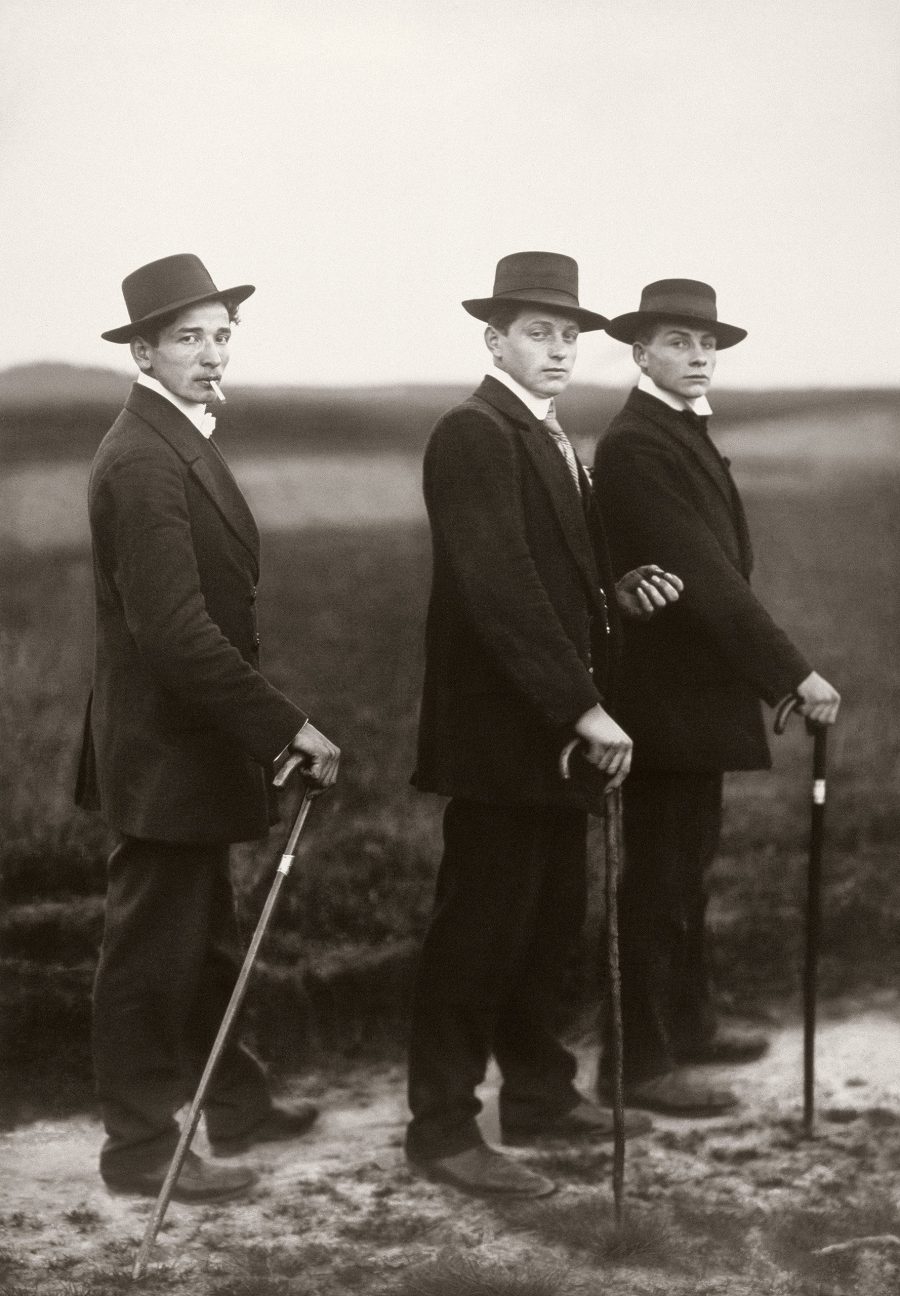
The portrait is your mirror. It’s you. —August Sander
A picture is worth a thousand words, and compelling portraits that speak eloquently to a critical moment in history often earn many more than that.
Author John Green’s thoughtful Art Assignment investigation into Three Farmers on Their Way to a Dance, August Sanders’ 1914 photograph, taps into our need to interpret what we’re looking at.
The descriptive title (the piece is alternatively referred to as Young Farmers) offers some clues, as does the date.
The subjects’ youth and location—a remote village in the German Westerwald—suggest, correctly as it turns out, that they would soon be bound for what Green terms “another dance,” WWI.
Green has learned far more about the people in his favorite photo since he covered it in a 2‑minute segment for his vlogbrothers channel below.
Much of the shorter video’s narration carries over to the Art Assignment script, but this time, Green has the help of “a community of problem solvers” who contributed research that fleshed out the narrative.
We now know the young farmers’ identities, actual occupations, what they did in the war, and their eventual fate.
Ditto their connection to photographer Sanders, who lugged his equipment on foot to the remote mountain path the friends would be traveling in finery made possible by the Second Industrial Revolution.
A consummate storyteller, Greene makes a meal out of what he has learned.
It would provide the basis for a helluva book…though here another author has beaten Green to the punch. Richard Powers’ novel, also titled Three Farmers on Their Way to a Dance, was a National Book Critics Circle Award Finalist in 1985.
Related Content:
The First Photograph Ever Taken (1826)
Take a Visual Journey Through 181 Years of Street Photography (1838–2019)
See the First Photograph of a Human Being: A Photo Taken by Louis Daguerre (1838)
Ayun Halliday is an author, illustrator, theater maker and Chief Primatologist of the East Village Inky zine. Here latest project is an animation and a series of free downloadable posters, encouraging citizens to wear masks in public and wear them properly. Follow her @AyunHalliday.
Read More...This Is What The Matrix Looks Like Without CGI: A Special Effects Breakdown
Those of us who saw the The Matrix in the theater felt we were witness to the beginning of a new era of cinematically and philosophically ambitious action movies. Whether that era delivered on its promise — and indeed, whether The Matrix’s own sequels delivered on the franchise’s promise — remains a matter of debate. More than twenty years later, the film’s black-leather-and-sunglasses aesthetic may date it, but its visual effects somehow don’t. The Fame Focus video above takes a close look at two examples of how the creators of The Matrix combined traditional, “practical” techniques with then-state-of-the-art digital technology in a way that kept the result from going as stale as, in the movies, “state-of-the-art digital technology” usually has a way of guaranteeing.
By now we’ve all seen revealed the mechanics of “bullet time,” an effect that astonished The Matrix’s early audiences by seeming nearly to freeze time for dramatic camera movements (and to make visible the eponymous projectiles, of which the film included a great many). They lined up a bunch of still cameras along a predetermined path, then had each of the cameras take a shot, one-by-one, in the span of a split second.
But as we see in the video, getting convincing results out of such a groundbreaking process — which required smoothing out the unsteady “footage” captured by the individual cameras and perfectly aligning it with a computer-generated background modeled on a real-life setting, among other tasks — must have been even more difficult than inventing the process itself. The manual labor that went into The Matrix series’ high-tech veneer comes across even more in the behind-the-scenes video below:
In the third installment, 2003’s The Matrix Revolutions, Keanu Reeves’ Neo and Hugo Weaving’s Agent Smith duke it out in the pouring rain as what seem like hundreds of clones of Smith look on. Viewers today may assume Weaving was filmed and then copy-pasted over and over again, but in fact these shots involve no digital effects to speak of. The team actually built 150 realistic dummies of Weaving as Smith, all operated by 80 human extras themselves wearing intricately detailed silicon-rubber Smith masks. The logistics of such a one-off endeavor sound painfully complex, but the physicality of the sequence speaks for itself. With the next Matrix film, the first since Revolutions, due out next year, fans must be hoping the ideas of the Platonically techno-dystopian story the Wachowskis started telling in 1999 will be properly continued, and in a way that makes full use of recent advances in digital effects. But those of us who appreciate the enduring power of traditional effects should hope the film’s makers are also getting their hands dirty.
Related Content:
The Philosophy of The Matrix: From Plato and Descartes, to Eastern Philosophy
The Matrix: What Went Into The Mix
Daniel Dennett and Cornel West Decode the Philosophy of The Matrix
Based in Seoul, Colin Marshall writes and broadcasts on cities, language, and culture. His projects include the book The Stateless City: a Walk through 21st-Century Los Angeles and the video series The City in Cinema. Follow him on Twitter at @colinmarshall, on Facebook, or on Instagram.
Read More...50 Songs from a Single Year, Mixed Together Into One 3‑Minute Song (1979–89)
The concept of generations, as we currently use the term, would have made no sense to people living throughout most of human history. “Before the 19th century,” writes Sarah Leskow at The Atlantic, “generations were thought of as (generally male) biological relationships within families—grandfathers, sons, grandchildren and so forth.” The word did not describe common traits shared by, “as one lexicographer put it in 1863, ‘all men living more or less at the same time.’”
The theory was thoroughly ingested into mass culture, as anyone can tell from social media wars and the fixations of newspaper columnists. One such correspondent weighed in a few years ago with a contrarian take: “Your generational identity is a lie,” wrote Philip Bump at The Washington Post in 2015. (He makes an exception for Baby Boomers, for reasons you’ll have to read in his column.)
All this debunking is to the good. While scholars routinely investigate the origins of contemporary ideas, too often the rest of us take for granted that our present ways of seeing the world are timeless and eternal.
Yet, whether generations are a real phenomenon or a cultural construction, globalized mass media of the past several decades ensures that no matter where we come from, most people born around the same time will share some set of near-identical experiences—of listening to the same music, watching the same films, TV shows, etc. Given the way our thinking can be shaped by formative moments in pop culture, we’re bound to have a few things in common if we had access to Hollywood film and MTV. Maybe what most defines generations as we know them now is culture as commodity.
Take the video series featured here. Each one cuts together 50 songs released in a single year, beginning in 1979, along with video montages of some of the year’s most popular artists. Created by The Hood Internet, “a DJ and production duo from Chicago, known for their expertise in mashups and remixes,” the series could serve as a lab experiment to test the emotional reactions of people born at different times. We may have all heard these songs by now. But only those who heard them in their youth will have the nostalgic reactions we associate with generational memory, since music, as David Toop writes at The Quietus, is “a memory machine.”
Everyone else could stand to learn something about what the 80s looked and sounded like. As a historical period, it tends to get cast in a fairly narrow mold, with synthpop and hair metal defining the extent of 80s music. The pop music of the decade was fabulously diverse, with genres cross-pollinating in what turn out to be surprisingly harmonious ways in these mashup videos. The creators of the series worked their way up to 1987, and we get to see some dramatic shifts along the way that further complicate the idea of 80s music, even for those who heard these songs when they came out, and who have nine years of formative moments to go with them. See all of the videos on The Hood Internet’s YouTube channel.
Related Content:
1980s Metalhead Kids Are Alright: Scientific Study Shows That They Became Well-Adjusted Adults
A Soul Train-Style Detroit Dance Show Gets Down to Kraftwerk’s “Numbers” in the Late 80s
How a Recording Studio Mishap Created the Famous Drum Sound That Defined 80s Music & Beyond
Josh Jones is a writer and musician based in Durham, NC. Follow him at @jdmagness
Read More...Support Us
We're hoping to rely on loyal readers, rather than erratic ads. Please click the Donate button and support Open Culture. You can use Paypal, Venmo, Patreon, even Crypto! We thank you!

About Us

Open Culture scours the web for the best educational media. We find the free courses and audio books you need, the language lessons & educational videos you want, and plenty of enlightenment in between.
Advertise With Us

FREE UPDATES!
GET OUR DAILY EMAIL
Get the best cultural and educational resources on the web curated for you in a daily email. We never spam. Unsubscribe at any time.
FOLLOW ON SOCIAL MEDIA

Open Culture editor Dan Colman scours the web for the best educational media. He finds the free courses and audio books you need, the language lessons & movies you want, and plenty of enlightenment in between.
Advertise With Us

