Nikola Tesla’s Grades from High School & University: A Fascinating Glimpse
In the history of science, few people got a rawer deal than Nikola Tesla. Cruelly cheated and overshadowed by Edison and Marconi (who patented the radio technology Tesla invented), the brilliant introvert didn’t stand a chance in the cutthroat business world in which his rivals moved with ease. Every biographer portrays Tesla as Edison’s perfect foil: the latter played the consummate showman and savvy patent hog, where Tesla was a reclusive mystic and, as one writer put it, “the world’s sorcerer.”
“Unlike Tesla,” writes biographer Michael Burgan, “Edison had barely gone to school: Tesla was amazed that a man with almost no formal education could invent so brilliantly.” (He would have a different opinion of Edison years later.)
Tesla began his own education, as you can learn in the survey of his high school and university grades above, with much promise, but he was forced to drop out after his third year in college when his father passed away and he was left without the means to continue. As PBS writes, Tesla showed precocious talent early on.
Passionate about mathematics and sciences, Tesla had his heart set on becoming an engineer but was “constantly oppressed” by his father’s insistence that he enter the priesthood. At age seventeen, Tesla contracted cholera and craftily exacted an important concession from his father: the older Tesla promised his son that if he survived, he would be allowed to attend the renowned Austrian Polytechnic School at Graz.
It was during his time at technical school that Tesla first devised the idea of alternating current, though he could not yet articulate a working design (he was told by a professor that the feat would be akin to building a perpetual motion machine). He solved the engineering challenge after leaving school and going to work for the Central Telephone Exchange in Budapest.
While walking through a city park with a friend, reciting Goethe’s Faust from memory, Tesla recounts in his autobiography, a passage inspired him “like a flash of lightening” and he “drew with a stick on the sand the diagram shown six years later in my address before the American Institute of Electrical Engineers.” The story is one of many in which Tesla, a voracious reader and infinitely curious autodidact, draws on the extensive knowledge that he gathered through self-education.
His patent applications—Croatian scholar Danko Plevnik notes in the introduction to a series of essays on Tesla’s self-schooling—show “the erudition of a learned man, broad knowledge which by far surpassed the knowledge he could acquire through formal education only.” In his lectures, articles, and speeches, Tesla demonstrates a “familiarity with philosophy, science history and invention-related thought, methodology of science, as well as other areas of knowledge that were not included in the subjects and courses he attended through his schooling.”
Not only did he memorize entire books of poetry, but he could accurately foresee the future of technology, his keen insight honed both by his studies of the sciences and the humanities. Until fairly recently Plevnik writes, “Tesla’s education was referred to sporadically, as if it had not influenced his scientific reflection, experimenting and inventions.” That is in large part, many Tesla scholars now argue, because the best education Tesla received was the one he gave himself.
Related Content:
The Electric Rise and Fall of Nikola Tesla: As Told by Technoillusionist Marco Tempest
Nikola Tesla Accurately Predicted the Rise of the Internet & Smart Phone in 1926
Electric Photo of Nikola Tesla, 1899
Albert Einstein’s Grades: A Fascinating Look at His Report Cards
Josh Jones is a writer and musician based in Durham, NC. Follow him at @jdmagness
Read More...DEVO Is Now Selling COVID-19 Personal Protective Equipment: Energy Dome Face Shields
According to DEVO’s co-principle songwriter and bassist Gerald Casale, the experimental art band turned early MTV pop-punk darlings were “pro-information, anti stupid conformity and knew that the struggle for freedom against tyranny is never-ending.”
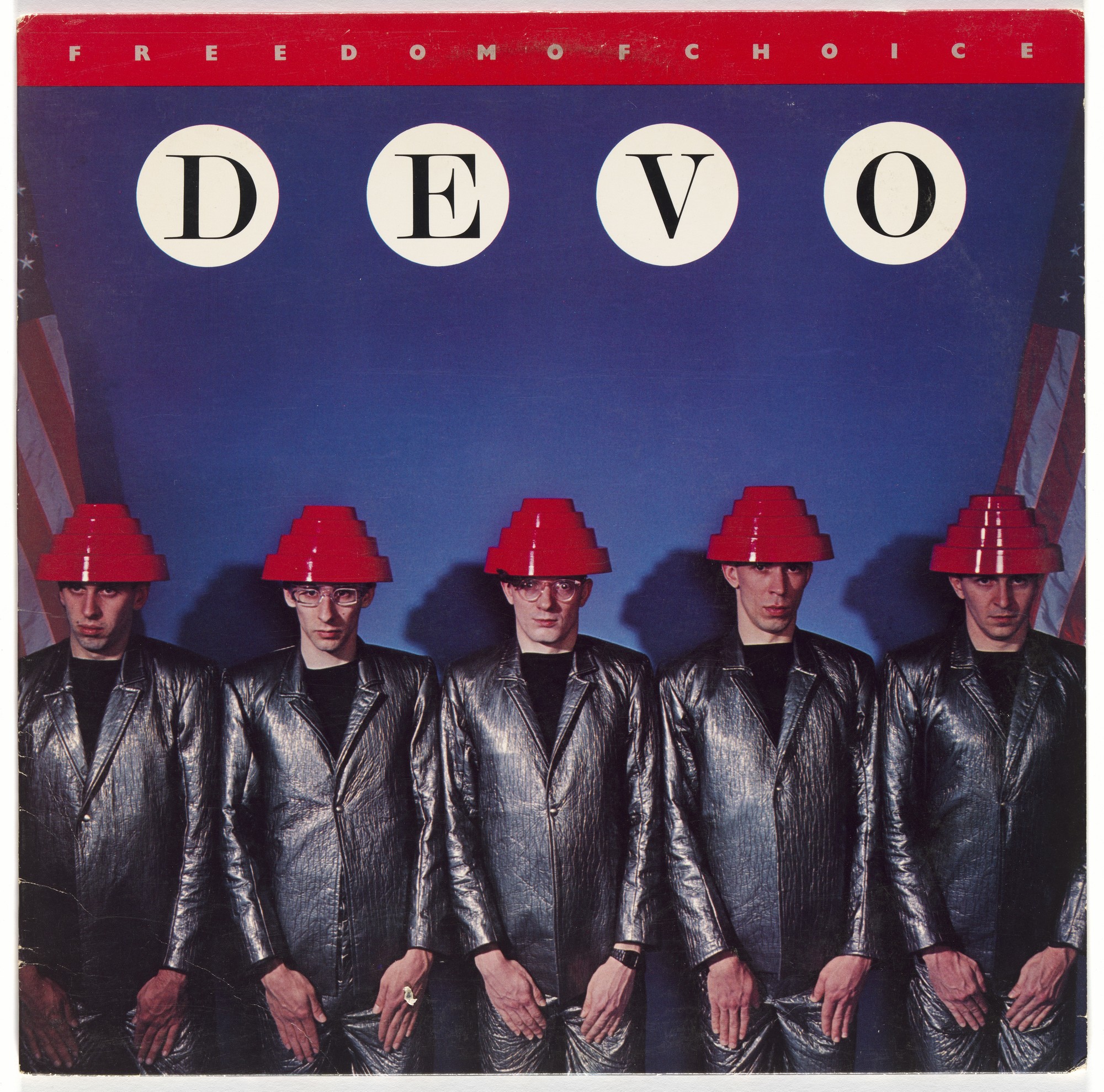
Their singular performance garb also set them apart, and none more so than the bright red plastic Energy Dome helmets they donned 40 years ago this month, upon the release of their third album, Freedom of Choice.
The record, which the band conceived of as a funk album, exploded into mainstream consciousness. The visuals may have made an even more lasting impact than the music, which included the chart topping “Whip It.”
Even the most anti-New Wave metalhead could identify the source of those domes, which have been likened to upturned flower pots, dog bowls, car urinals, and lamp shades.
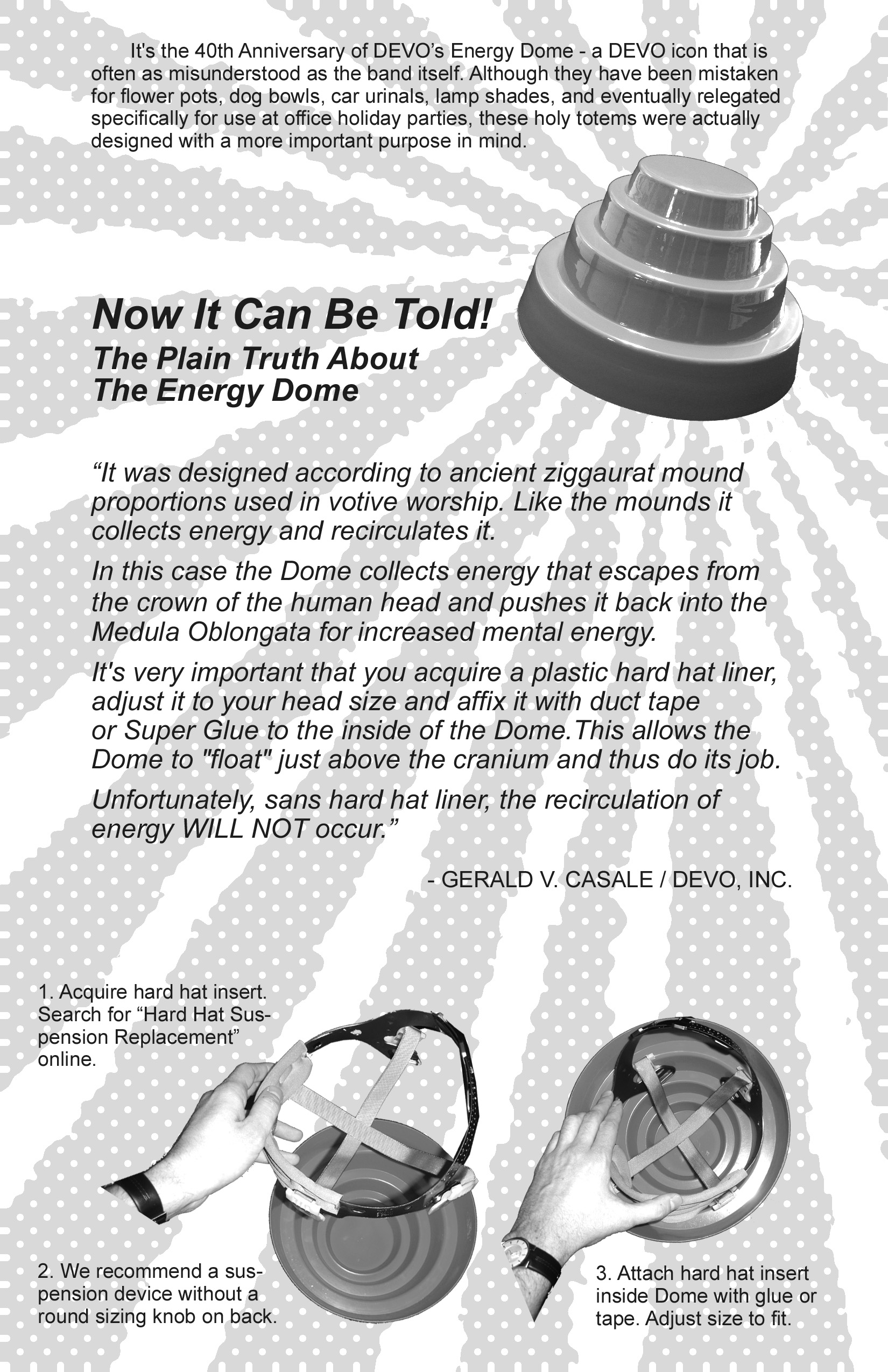
What they probably don’t know is the Energy Dome was “designed according to ancient ziggurat mount proportions used in votive worship. Like the mounds, it collects energy and recirculates it. In this case, the dome collects energy that escapes from the crown of the human head and pushes it back into the Medula Oblongata for increased mental energy.”
Thus sayeth Casale, anyway.
DEVO’s 2020 concert plans were, of course, scotched by the coronavirus pandemic, but the band has found an alternative way to mark the 40th anniversary of Freedom of Choice and the birth of its iconic headgear.
In addition to face masks emblazoned with the familiar red tiered shape, DEVOtees with money and confidence to spare can ante up for a DIY Personal Protective Equipment kit that transforms a standard-issue Energy Dome into a face shield.
It’s worth noting that before taking your converted energy dome out for a particle deflecting spin, you’ll have to truffle up a hard hat suspension liner and install it for a proper fit.

Casale heralded the opening of DEVO’s merch store in a Facebook post:
Here we are 40 years later, living in the alternate reality nightmare spawned by Covid 19 and the botched response of our world “leaders” to do the right thing quickly. We are not exaggerating when we say that 2020 could be the last time you might be able to exercise your freedom of choice. If you don’t use it, you can certainly lose it.
Uh, he’s talking about voting, right, rather than storming the capitol building to demand the premature reopening of inessential businesses or making outsized threats in response to grocery store mask policies?
Perhaps the power of the Energy Dome is such that it could reawaken the pro-information, anti-stupidity sensibilities of some dormant DEVO fans among the unmasked rank and file.
As Casale himself posited in an interview with American Songwriter: “You make it taste good so that they don’t realize there’s medicine in it.”
Pre-order masks and PPE kits from DEVO’s official merch store.
Download instructions for installing a hard hat suspension replacement inside the Energy Dome prior to attaching the shield.
Related Content:
The Mastermind of Devo, Mark Mothersbaugh, Presents His Personal Synthesizer Collection
Ayun Halliday is an author, illustrator, theater maker and Chief Primatologist of the East Village Inky zine. Here latest project is an animation and a series of free downloadable posters, encouraging citizens to wear masks in public and wear them properly. Follow her @AyunHalliday.
Read More...An Archive of 1,000 “Peel Sessions” Available Online: Hear David Bowie, Bob Marley, Elvis Costello & Others Play in the Studio of Legendary BBC DJ John Peel
Before he became the most influential music broadcaster of all time on the BBC, John Peel had to become John Peel. Born and raised in England, he spent a stretch of his early twenties in the United States, working for a cotton producer (his father’s industry), selling insurance, and writing punchcard computer programs before finding his way onto the airwaves. Hosting work in such locales as Dallas, Oklahoma City, and San Bernardino primed him to return to his homeland and take his radio career underground — or rather offshore, to the former minesweeper anchored in the North Sea from which Radio London broadcast in the mid-1960s. In those days, British “pirate radio” took place on actual ships, and it was on Radio London’s MV Galaxy that the returned son of Heswall, born John Robert Parker Ravenscroft, quite literally made his name.
Pirate radio existed because the BBC couldn’t, or wouldn’t, play the quantity and variety of pop and rock music younger audiences demanded — and over in the States, were already getting. After Radio London’s 1967 shutdown, Peel joined the Beeb’s newly launched pop station, Radio 1. But even there limitations continued to apply, and today they sound draconian: the Musicians’ Union and Phonographic Performance Limited, for instance, once limited the number of commercially released records that could be played on air.
The BBC’s solution was to cover popular songs with its in-house orchestra; Peel’s less square solution, as it evolved, was to bring the bands in to do it themselves. Over Peel’s 37-year career at the BBC, these “Peel Sessions” would number over 4,000, about a thousand of which you can enjoy on Youtube today.
Compiled by a fan named Dave Strickson, this list of Peel Sessions available on Youtube goes all the way from the Mancunian pop-punk of A Certain Ratio in 1979 and 1981 to the Glaswegian new wave of Zones in 1978. (Yes, the list technically begins with the numeral-featuring acts as 14 Iced Bears and 23 Skidoo.) In between, Peel’s guests include A Flock of Seagulls (1981), Billy Bragg (1983, 1991), Bob Marley and the Wailers (1973), Cocteau Twins (1982, 1983, 1984), David Bowie and the Spiders from Mars (1972), Elvis Costello & the Attractions (1977, 1978, 1978, 1980), Fairport Convention (1968, 1969, 1969, 1974), Joy Division (1979), Morrissey (2004), Roxy Music (1972, 1972), Shonen Knife (1992), Sonic Youth (1986, 1988, 1989), Tears for Fears (1982), The Jesus and Mary Chain (1984, 1985, 1985, 1988, 1989), and Yo La Tengo (1997).
And of course, Strickson’s list also includes no fewer than eight Peel Sessions by The Fall (1978, 1980, 1981, 1986, 1987, 1991, 2003, 2004), the legendary DJ’s favorite band — or at least the band that took up the most shelf space in his formidable record collection. But as Peel’s fans know, he only met The Fall’s mastermind Mark E. Smith (like Peel, an outspoken Northerner) two brief times in his life. One such fan, a Metafilter commenter by the name of Paul Slade, notes that “Peel used to make a point of staying away from session recordings, partly because he didn’t want to hear the new music till it went out live. That way, he knew he’d be able to react honestly on-air to anything in the session that surprised or delighted him.” His between-song comments do indeed constitute an unexpected charm of these vintage broadcasts, though surprisingly many have nothing to do with the session at hand. Peel undoubtedly loved music, but he seems to have loved Liverpool Football Club even more.
Related Content:
Hear a 9‑Hour Tribute to John Peel: A Collection of His Best “Peel Sessions”
Radio Caroline, the Pirate Radio Ship That Rocked the British Music World (1965)
Brian Eno on Why Do We Make Art & What’s It Good For?: Download His 2015 John Peel Lecture
Based in Seoul, Colin Marshall writes and broadcasts on cities, language, and culture. His projects include the book The Stateless City: a Walk through 21st-Century Los Angeles and the video series The City in Cinema. Follow him on Twitter at @colinmarshall, on Facebook, or on Instagram.
Read More...Japanese Health Manual Created During the 1918 Spanish Flu Pandemic Offers Timeless Wisdom: Stay Away from Others, Cover Your Mouth & Nose, and More
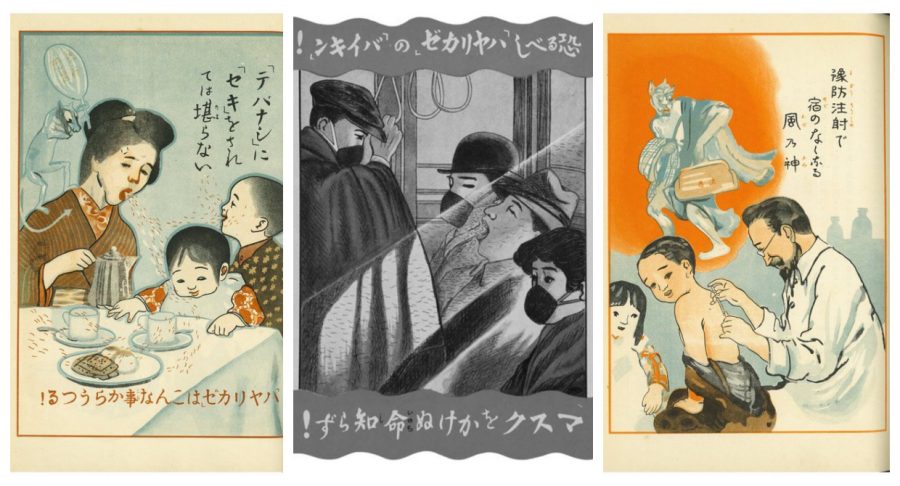
In August of 1918, a group of sumo wrestlers returned to Japan from an exhibition in Taiwan. When they came down with an illness it was first diagnosed as bronchitis or pneumonia. In fact, they had returned with the Spanish Flu.
The “Sumo Flu,” as it was first called by some in the Japanese press, was not taken as seriously as the more prevalent cholera, which had a higher death rate at the time. But cholera was not as infectious. By the time the Spanish Flu had burned its way through the population of Japan it would leave behind nearly half a million dead, either from the flu itself or secondary health complications.
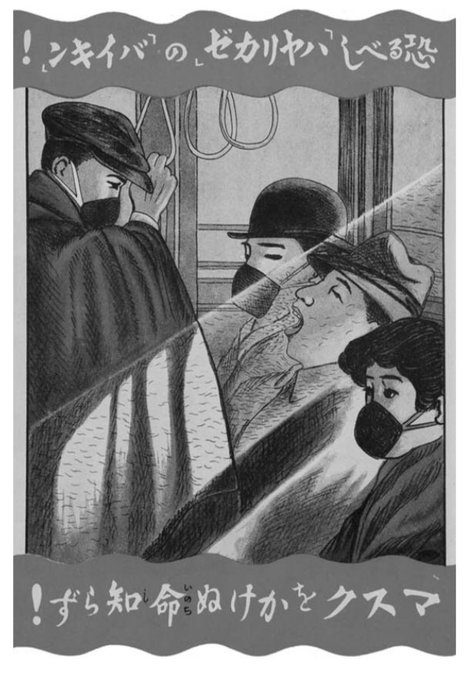
These posters (seen above and throughout this post) were part of Japan’s Central Sanitary Bureau’s plan to educate the public, part of a 455-manual that detailed symptoms and prescriptions, and suggested four rules to avoid contracting the virus and spreading it to others.
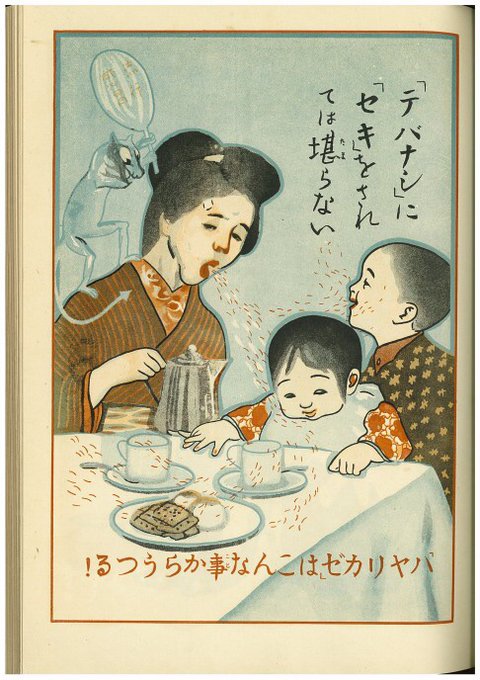
Right now, a lot of us are trying to do number one–Stay Away from Others–without going crazy, some of us are following number two (Cover Your Mouth and Nose), everybody’s waiting for number three (Get Vaccinated), and if you replace “Gargle” (Rule Number 4) with “anxiety drinking,” well we’ve got number four covered.
Back up to Number Three: the vaccine in question at that time helped with symptoms of pneumonia, which was a secondary cause of death. If a person’s immune system could fight off the lung infection part of the flu, they stood a better chance of survival.
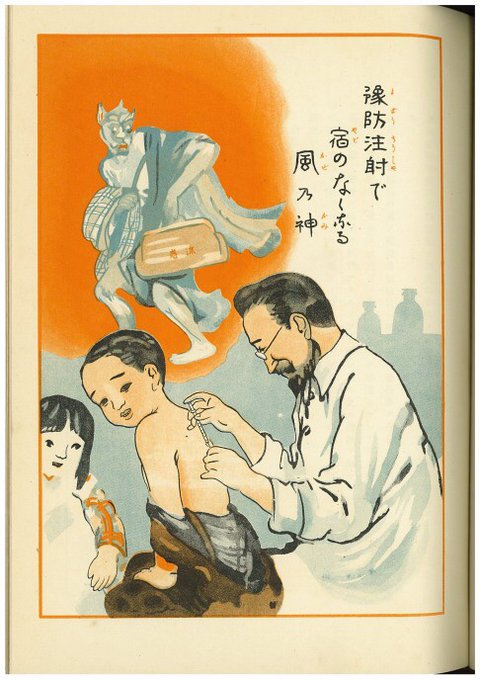
And for Number Two, the Japanese response of wearing face masks to fight infection has continued to this day. Anyone who has visited Japan, especially during cold and flu season, will have noticed the routine use of masks. Will other countries see this become a tradition in the future? We will have to wait and find out.
The central government of Japan, as well as most places around the globe in 1918, did not have the science or knowledge to treat the virus or enforce rules. A lot of decisions for the public were left to various prefectures to decide. Most doctors and researchers were already busy fighting cholera (as mentioned above) and tuberculosis. For a while, the virus was misidentified as a bacteria. And just like in America in 1919, the Japanese public thought things had gotten back to normal when the initial cases dropped–they were sadly mistaken and, after letting its guard down, the Japanese were hit with a second wave, with a mortality rate five times that of the first wave. As it spread from the city to the countryside, the Spanish Flu wiped out entire villages. Quackery and snake oil salesmen promised miracle cures. Others turned to spiritualism, prayer, and special devotional temple visits. The virus didn’t care.
But it also soon fizzled out. Japan reported no new cases in June of 1919, and that was that. (Currently, that does not seem to be the case in Wuhan or Germany.)
As the saying goes, history doesn’t repeat, but it often rhymes, and so take these posters as a warning and as a form of reassurance that we will get through this.
Related Content:
Pandemic Literature: A Meta-List of the Books You Should Read in Coronavirus Quarantine
The History of the Plague: Every Major Epidemic in an Animated Map
Ted Mills is a freelance writer on the arts who currently hosts the Notes from the Shed podcast and is the producer of KCRW’s Curious Coast. You can also follow him on Twitter at @tedmills, and/or watch his films here.
Read More...Breathtakingly-Detailed Tibetan Book Printed 40 Years Before the Gutenberg Bible
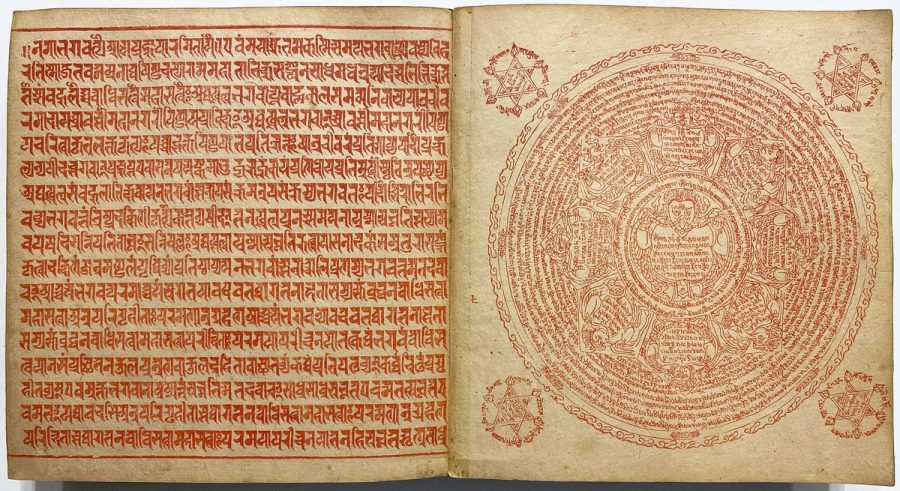
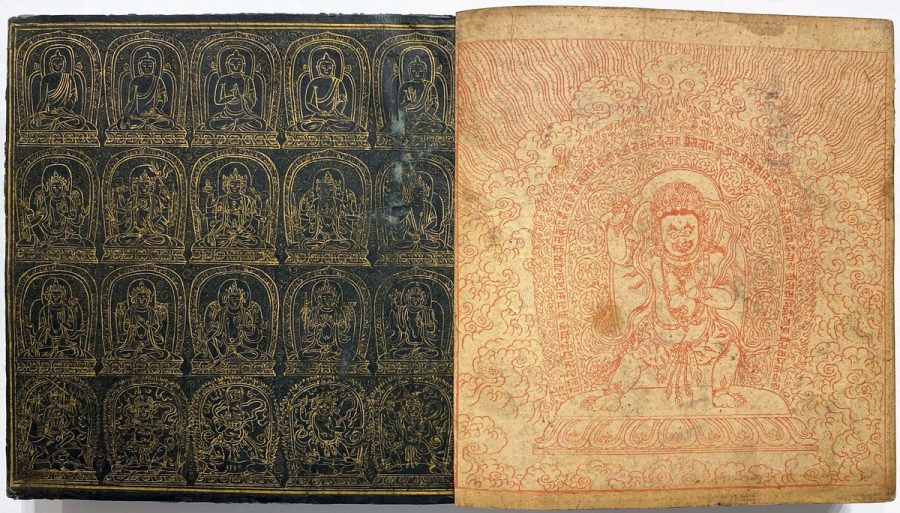
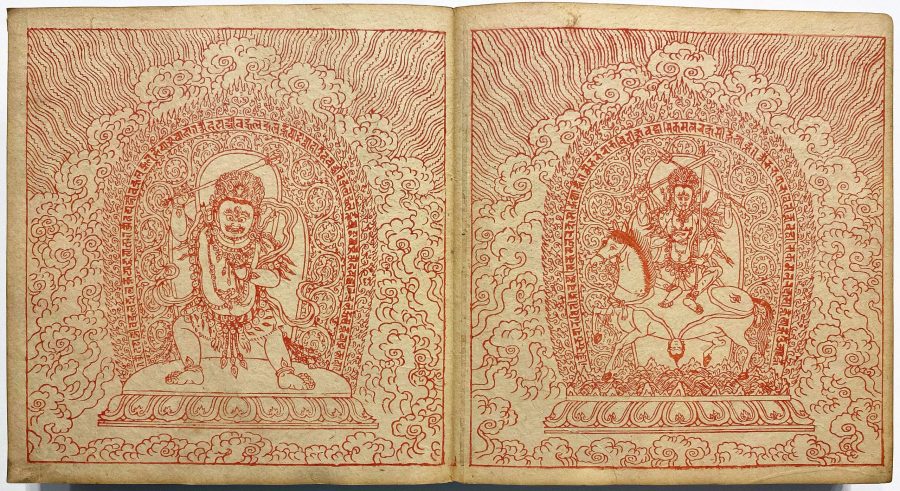
The Gutenberg Bible went to press in the year 1454. We now see it as the first piece of mass media, printed as it was with the then-cutting-edge technology of metal movable type. But in the history of aesthetic achievements in book-printing, the Gutenberg Bible wasn’t without its precedents. To find truly impressive examples requires looking in lands far from Europe: take, for instance, this “Sino-Tibetan concertina-folded book, printed in Beijing in 1410, containing Sanskrit dhāranīs and illustrations of protective mantra-diagrams and deities, woodblock-printed in bright red ink on heavy white paper,” whose “breathtakingly detailed printing” predates Gutenberg by 40 years.
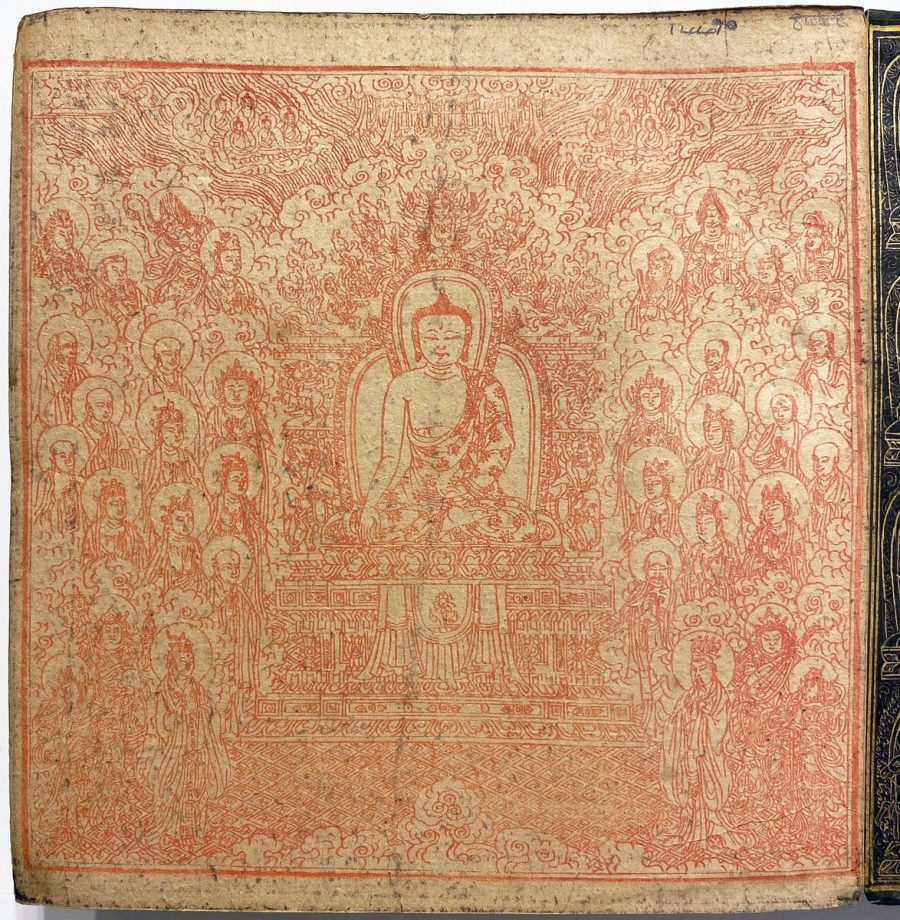
That description comes from a Twitter user called Incunabula (a term referring to early books), a self-described bibliophile and rare book collector who posts about “the history of writing, and of the book, from cave painting to cuneiform tablet to papyrus scroll to medieval codex to Kindle.”
Incunabula’s six-tweet thread on this early 15th-century Sino-Tibetan book includes both pictures and descriptions of this remarkable artifact’s interior and exterior.
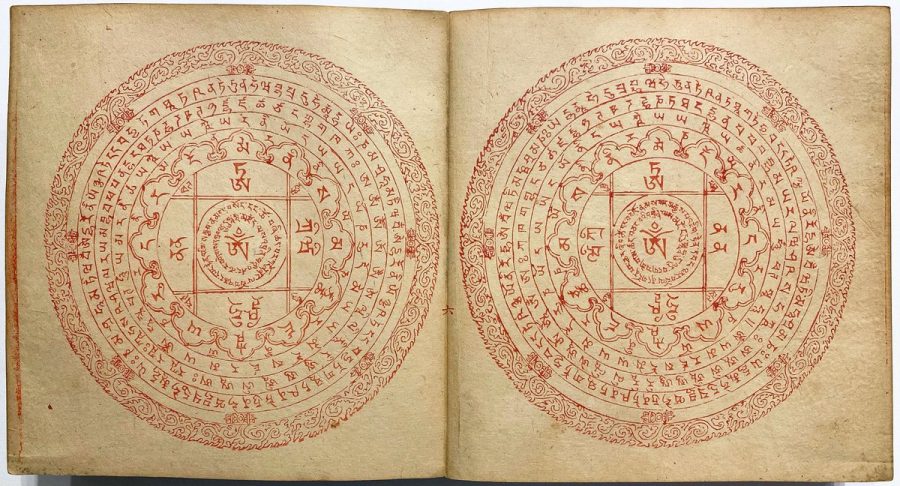
Its text, written in the Tibetan and Nepalese Rañjanā script, “is printed twice, once on each side of the paper, so that the book may be read in the Indo-Tibetan manner by turning the pages from right to left or in Chinese style by turning from left to right.” The book’s content is “a sequence of Tibetan Buddhist recitation texts,” or chants, all “protected at front and back by thicker board-like wrappers,” each “covered in fine pen-drawings in gold paint on black of 20 icons of the Tathāgatas.”
Incunabula has also posted extensively about Buddhist texts from other times and lands: a Thai folding manuscript from the mid-19th century telling of a monk’s journeys to heaven and hell; a Mongolian manuscript from the same period that translates the Čoyijod Dagini, “a popular Buddhist text about virtue, sin and the afterlife”; an example of “Japanese Buddhist printing 150 years before Gutenberg”; an “8th century Khotanese amuletic scroll from the Silk Road.” The creators of these texts would have meant the words they were preserving to survive them — but our marveling at them hundreds, even more than a thousand years later, would surely have come as a surprise.
Related Content:
The World’s Largest Collection of Tibetan Buddhist Literature Now Online
Free Online Course: Robert Thurman’s Introduction to Tibetan Buddhism (Recorded at Columbia U)
Tibetan Musical Notation Is Beautiful
Oxford University Presents the 550-Year-Old Gutenberg Bible in Spectacular, High-Res Detail
Based in Seoul, Colin Marshall writes and broadcasts on cities, language, and culture. His projects include the book The Stateless City: a Walk through 21st-Century Los Angeles and the video series The City in Cinema. Follow him on Twitter at @colinmarshall, on Facebook, or on Instagram.
Read More...John Mayer Teaches Guitarists How to Play the Blues in a 45-Minute Masterclass
Playing the blues is easy, many a budding guitarist thinks—their starry eyes fixed on the mathiest, proggiest, djent-iest (or whatever) guitar pyrotechnics of their favorite 7- or 8‑string slinger. Learn a minor pentatonic blues scale, a few barre chords, some sexy bends, a 12-bar progression and you’re off, right? Why spend time trying to play like Albert King (Jimi Hendrix’s idol) or Buddy Guy when you’re reaching for the ultimate sweep-picking technique, or whatever, in the competitive gamesmanship of guitar heroics?
I’ve encountered this kind of thinking among guitar players quite often and find it baffling given the blues essential place in rock and roll, metal included—and given how much more there is to playing blues than the stereotypical formulas to which the music gets reduced. Black Sabbath started as a blues band, Led Zeppelin never stopped being one, and it was Robert Johnson who turned the devil into rock’s brooding, Byronic hero.
The crossroads story has been told in hindsight as a metaphor for Johnson’s troubled, cursedly short life. But at the time, it was about envy on the part of his fellow bluesmen, who couldn’t believe how good he’d gotten in seemingly no time. Want to emerge from quarantine and inspire similar envy? The devil isn’t offering online lessons, but you can learn the blues from contemporary legend, John Mayer, who posted the lesson above on his Instagram Live a few days back.
As with all such online lessons, everyone will respond differently to the teacher’s style. The format does not allow for Q&A, obviously, but you can pause and rewind indefinitely. Mayer doesn’t move too quickly; if you’re an intermediate player with a grasp on the basics, it won’t be too hard to keep up. He comes across as easygoing and humble (not a quality he’s always been known for), and explains concepts clearly, relating them back to the fretboard each time.
As always, one will get out of the lesson what they put into it. Maybe no one will accuse you of conspiring with the evil one when you’ve mastered some of these techniques and incorporated them into your own playing. But you won’t have to lie, exactly, if you tell people you’ve been jamming with John Mayer. Or, if that’s not cool in your circles, come up with your own legend—abduction by a conspiracy of blues-playing aliens, perhaps.
However you explain it to your friends when we get out of the woodshed, I have no doubt that becoming a better blues player can improve whatever else you plan to do with the guitar.
Related Content:
Pete Seeger Teaches You How to Play Guitar for Free in The Folksinger’s Guitar Guide (1955)
Josh Jones is a writer and musician based in Durham, NC. Follow him at @jdmagness
Read More...The Largest & Most Detailed Photograph of Rembrandt’s The Night Watch Is Now Online: Zoom In & See Every Brush Stroke
What makes great paintings great? Unless you can see them for yourself—and be awed, or not, by their physical presence—the answers will generally come second-hand, through the words of art historians, critics, curators, gallerists, etc. We can study art in reproduction, but seeing, for example, the paintings of Rembrandt van Rijn in the flesh presents an entirely different aesthetic experience than seeing them on the page or screen.
Lately, however, the situation is changing, and the boundaries blurring between a virtual and an in-person experience of art. It’s possible with digital technology to have experiences no ordinary museum-goer has had, of course—like walking into a VR Salvador Dalí painting, or through a simulated Vermeer museum in augmented reality.
But these technological interventions are novelties, in a way. Like famous paintings silkscreened on t‑shirts or glazed on coffee mugs, they warp and distort the works they represent.
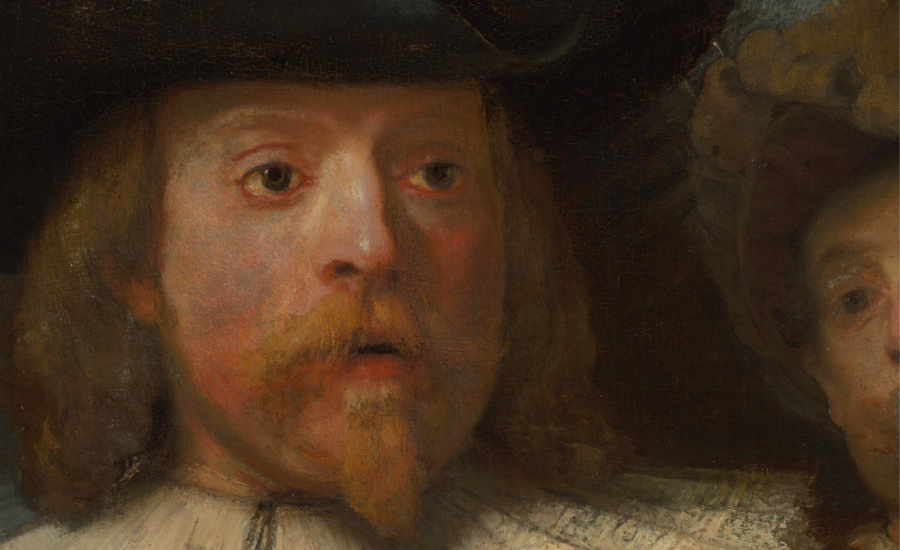
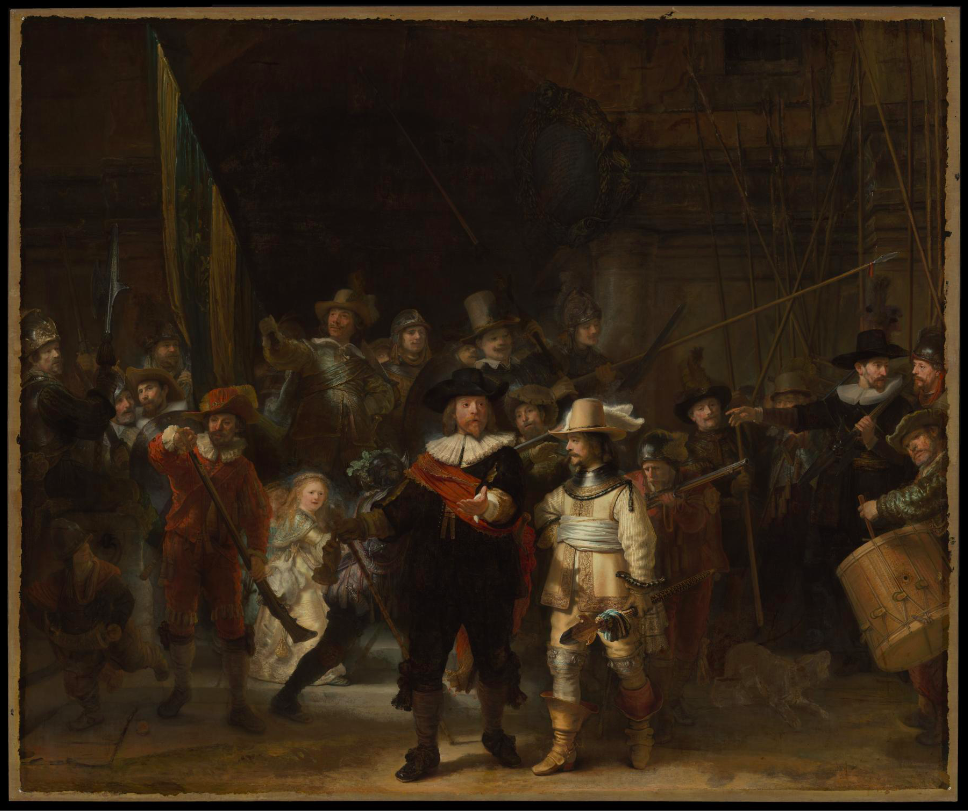
That is not the case, however, with the latest digital reproduction of Rembrandt’s grandest and most exclusive painting, The Night Watch, a 44.8 gigapixel image of the work that the museum has “released online in a zoomable interface,” notes Kottke. “The level of detail available here is incredible.” Even that description seems like understatement. The image comes to us from the same team responsible for the painting’s multi-phase, live-streamed restoration.
The Rijksmuseum’s imaging team led by datascientist Robert Erdmann made this photograph of The Night Watch from a total of 528 exposures. The 24 rows of 22 pictures were stitched together digitally with the aid of neural networks. The final image is made up of 44.8 gigapixels (44,804,687,500 pixels), and the distance between each pixel is 20 micrometres (0.02 mm). This enables the scientists to study the painting in detail remotely. The image will also be used to accurately track any future ageing processes taking place in the painting.
The hugely famous work is so enormous, nearly 12 feet high and over 14 feet wide, that its figures are almost life-size. Yet even when it was possible to get close to the painting—before COVID-19 shut down the Rijksmuseum and before Rembrandt’s masterwork went behind glass—no one except conservationists could ever get as close to it as we can now with just the click of a mouse or a slide of our fingers across a trackpad.
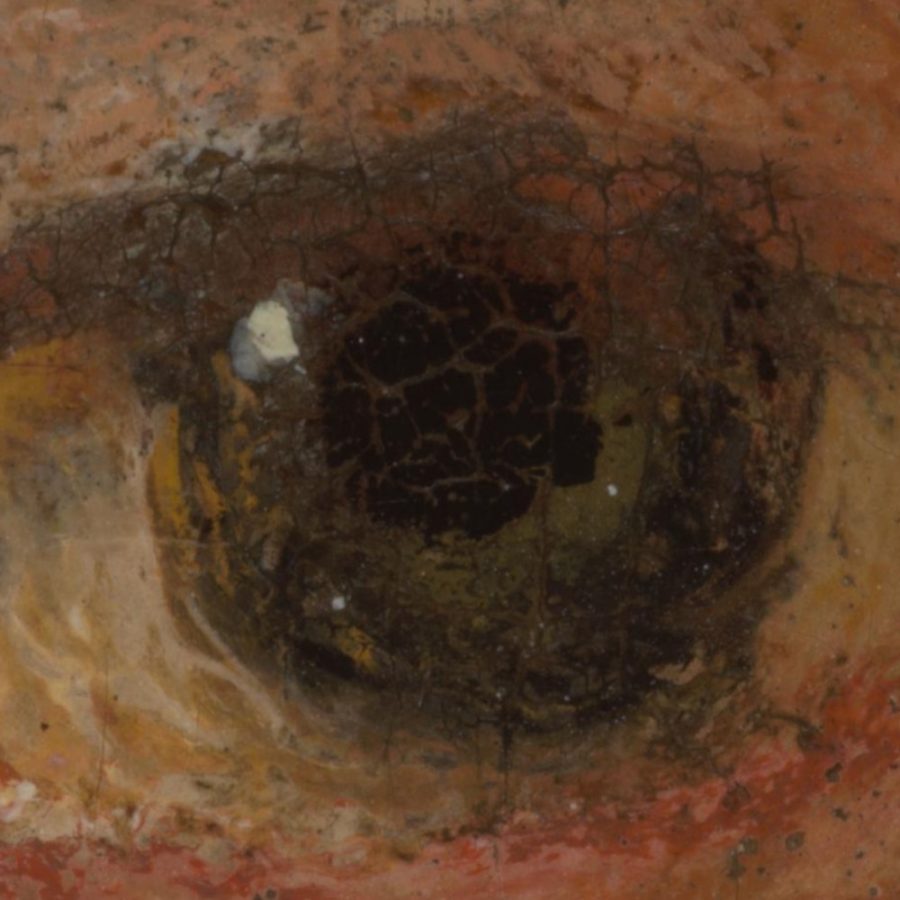
The experience of seeing Rembrandt’s brushstrokes magnified in crystalline clarity doesn’t just add to our store of knowledge about The Night Watch, as the Rijksmuseum suggests above. This astonishing image also—and perhaps most importantly for the majority of people who will view it online—enables us to really commune with the materiality of the painting, and to be moved by it in a way that may have only been possible in the past by making an exclusive, in-person visit to the Rijksmuseum without a tourist in sight. (For most of us, that is an unrealistic way to view great art.)
See the huge photographic reproduction of The Night Watch here and zoom in on any detail until you can almost smell the varnish. This image represents the painting in the current state of its restoration, an effort that the museum previously opened to the public by live streaming it. Yet, the work has stopped for the past two months as conservationists have stayed home. Just yesterday, the team’s onsite research began again, and will continue at least into 2021. This huge photo of the painting may be the closest almost anyone will ever get to the canvas, and the only opportunity for some time to approximately feel its monumental scale.
For anyone interested, there’s also a 10 billion pixel scan of Vermeer’s masterpiece Girl with a Pearl Earring. Explore it here.
Related Content:
What Makes The Night Watch Rembrandt’s Masterpiece
Walk Inside a Surrealist Salvador Dalí Painting with This 360º Virtual Reality Video
Experience the Van Gogh Museum in 4K Resolution: A Video Tour in Seven Parts
Josh Jones is a writer and musician based in Durham, NC. Follow him at @jdmagness
Read More...The Shakespeare and Company Project Digitizes the Records of the Famous Bookstore, Showing the Reading Habits of the Lost Generation
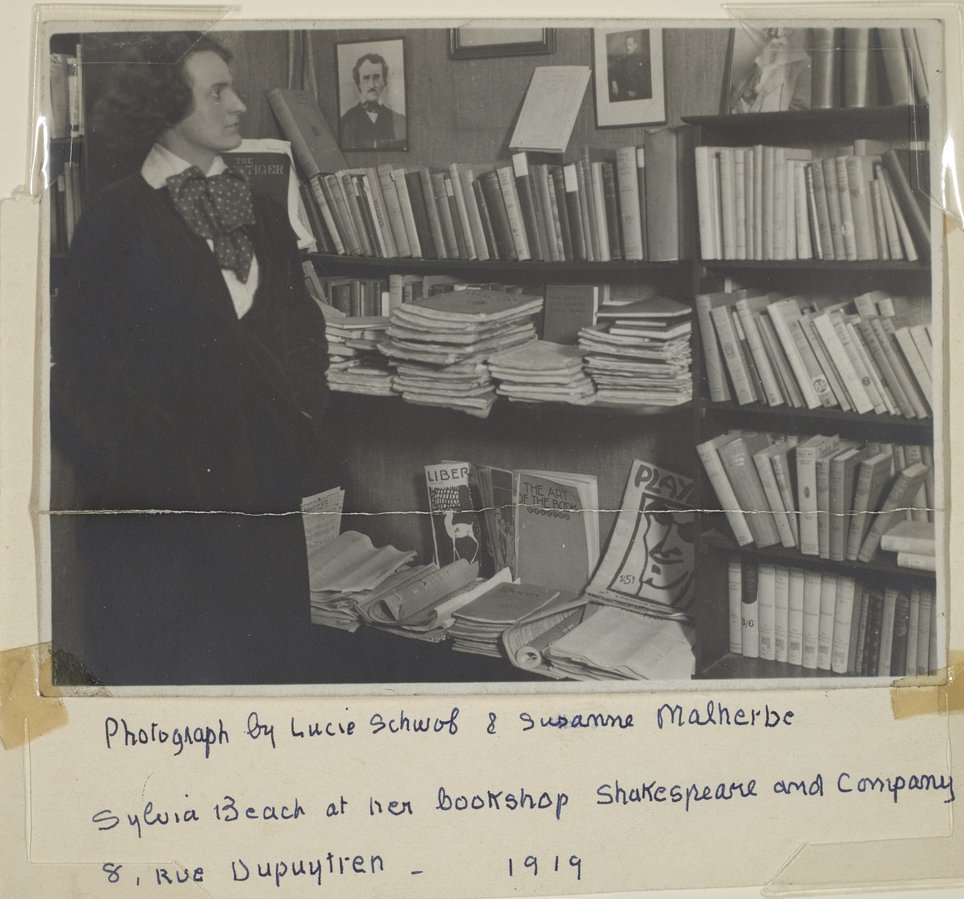
Great writers don’t come out of nowhere, even if some of them might end up there. They grow in gardens tended by other writers, readers, editors, and pioneering booksellers like Sylvia Beach, founder and proprietor of Shakespeare and Company. Beach opened the English-language shop in Paris in 1919. Three years later, she published James Joyce’s Ulysses, “a feat that would make her—and her bookshop and lending library—famous,” notes Princeton University’s Shakespeare and Company Project. (Infamous as well, given the obscenity charges against the novel in the U.S.)
Just as the publication of Allen Ginsberg’s Howl put Lawrence Ferlinghetti’s City Lights at the center of the Beat movement, so Joyce’s masterpiece made Shakespeare and Company a destination for aspiring Modernists.
The shop was already “the meeting place for a community of expatriate writers and artists now known as the Lost Generation.” Along with Joyce, there gathered Ernest Hemingway, Ezra Pound, and Gertrude Stein, all of whom not only bought books but borrowed them and left a handwritten record of their reading habits.
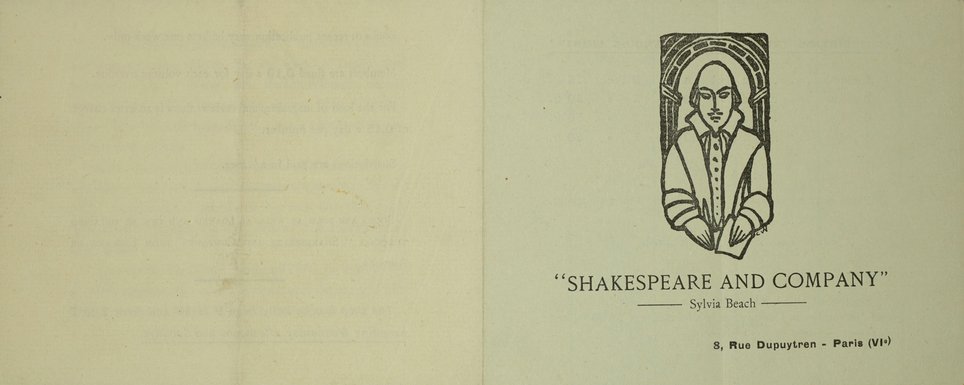
Through a large-scale digitization project of the Sylvia Beach papers at Princeton, the Shakespeare and Company Project will “recreate the world of the Lost Generation. The Project details what members of the lending library read and where they lived, and how expatriate life changed between the end of World War I and the German Occupation of France.” During the thirties, Beach began to cater more to French-speaking intellectuals. Among later logbooks we’ll find the names Aimé Césaire, Jacques Lacan, and Simone de Beauvoir. Beach closed the store for good in 1941, the story goes, rather than sell a Nazi officer a copy of Finnegans Wake.
Princeton’s “trove of materials reveals, among other things,” writes Lithub, “the reading preferences of some of the 20th century’s most famous writers,” it’s true. But not only are there many famous names; the library logs also record “less famous but no less interesting figures, too, from a respected French physicist to the woman who started the musicology program at the University of California.” Shakespeare and Company became the place to go for thousands of French and expat patrons in Paris during some of the city’s most legendarily literary years.
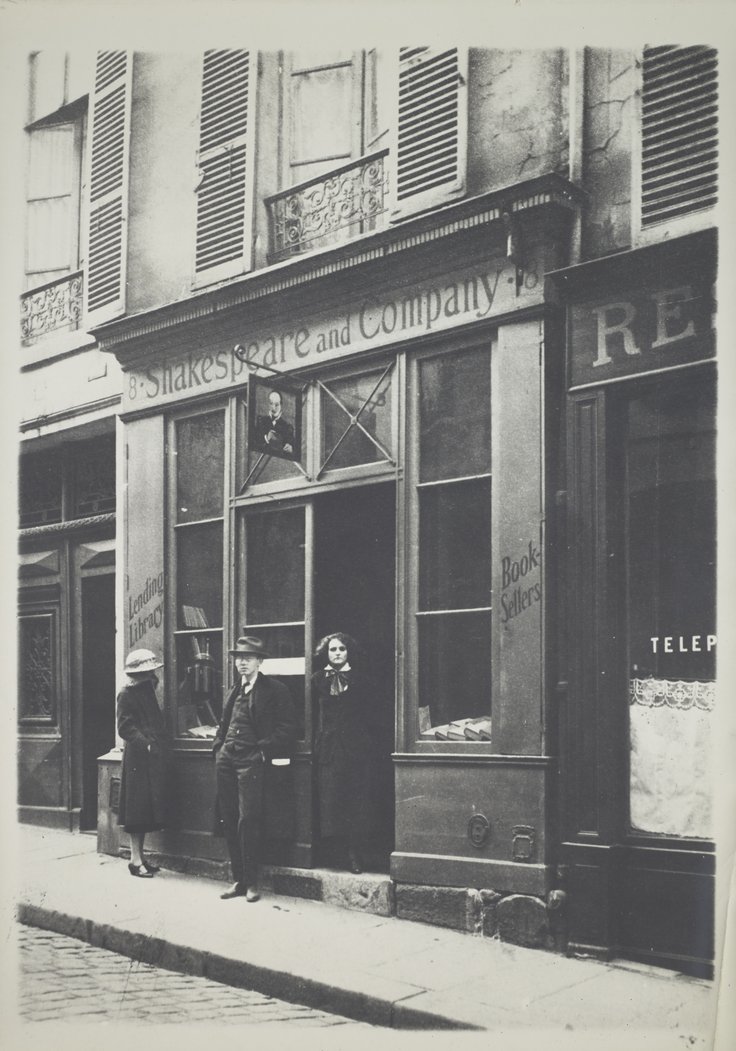
“English-language books are expensive,” if you’ve arrived in the city in the 1920s, the Project explains—“five to twenty times the price of French books.” English-language holdings at other libraries are limited. Readers, and soon-to-be famous writers, go to Shakespeare and Company to borrow a copy of Moby Dick or pick up the latest New Yorker.
You find Shakespeare and Company on a narrow side street, just off the Carrefour de l’Odéon. You step inside. The room is filled with books and magazines. You recognize a framed portrait of Edgar Allan Poe. You also recognize a few framed Whitman manuscripts. Sylvia Beach, the owner, introduces herself and tells you that her aunt visited Whitman in Camden, New Jersey and saved the manuscripts from the wastebasket. Yes, this is the place for you.
The lending library had different membership plans (you can learn about them here) and kept careful records with codes indicating the status of each borrower. These records are still being digitized and the Project is ongoing. It does not officially launch until next month. But at the moment, you can: “Search the lending library membership. Browse the lending library cards. Read about joining the lending library. Download a preliminary export of Project data. In June, you will be able to search and browse the lending library’s books, track the circulation of your favorite novels—and discover new ones.”
See how these literary communities shaped and reshaped themselves around what would become “the most famous bookstore in the world.”
via Lithub
Related Content:
James Joyce Picked Drunken Fights, Then Hid Behind Ernest Hemingway
7 Tips From Ernest Hemingway on How to Write Fiction
Gertrude Stein Gets a Snarky Rejection Letter from Publisher (1912)
Josh Jones is a writer and musician based in Durham, NC. Follow him at @jdmagness
Read More...Hyperland: The “Fantasy Documentary” in Which Douglas Adams and Doctor Who’s Tom Baker Imagine the World Wide Web (1990)
Thirty years ago, the internet we use today would have looked like science fiction. Now as then, we spend a great deal of time staring at streams of video, but the high-tech 21st century has endowed us with the ability to customize those streams as never before. No longer do we have to settle for traditional television and the tyranny of “what’s on”; we can follow our curiosity wherever it leads through vast, ever-expanding realms of image, sound, and text. No less a science-fiction writer than Douglas Adams dreams of just such realms in Hyperland, a 1990 BBC “fantasy documentary” that opens to find him fast asleep amid the mindless sound and fury spouted unceasingly by his television set — so unceasingly, in fact, that it keeps on spouting even when Adams gets up and tosses it into a junkyard.
Amid the scrap heaps Adams meets a ghost of technology’s future: his “agent,” a digital figure played by Doctor Who star Tom Baker. “I have the honor to provide instant access to every piece of information stored digitally anywhere in the world,” says Baker’s Virgil to Adams’ Dante. “Any picture or film, any sound, any book, any statistic, any fact — any connection between anything you care to think of.”
Adams’ fans know how much the notion must have appealed to him, unexpected connections between disparate aspects of reality being a running theme in his fiction. It became especially prominent in the Dirk Gently’s Holistic Detective Agency Series, whose wide range of references includes Samuel Taylor Coleridge’s Kubla Khan — one of the many pieces of information Adams has his agent pull up in Hyperland.
Adams’ journey along this proto-Information Superhighway also includes stops at Beethoven’s 9th Symphony, Picasso’s Guernica, and Kurt Vonnegut’s theory of the shape of all stories. Such a pathway will feel familiar to anyone who regularly goes down “rabbit holes” on the internet today, a pursuit — or perhaps compulsion — enabled by hypertext. Already that term sounds old fashioned, but at the dawn of the 1990s actively following “links” from one piece of information, so common now as to require no introduction or explanation, struck many as a mind-bending novelty. Thus the program’s segments on the history of the relevant technologies, beginning with U.S. government scientist Vannevar Bush and the theoretical “Memex” system he came up with at the end of World War II — and first described in an Atlantic Monthly article you can, thanks to hypertext, easily read right now.
Though to an extent required to stand for the contemporary viewer, Adams was hardly a technological neophyte. An ardent early adopter, he purchased the very first Apple Macintosh computer ever sold in Europe. “I happen to know you’ve written interactive fiction yourself,” says Baker, referring to the adventure games Adams designed for Infocom, one of them based on his beloved Hitchhiker’s Guide to the Galaxy novels. Though Adams’ considerable tech savvy makes all this look amusingly prescient, he couldn’t have known just then how connected everyone and everything was about to become. “While Douglas was creating Hyperland,” says his official web site, “a student at CERN in Switzerland was working on a little hypertext project he called the World Wide Web.” And despite his early death, the man who dreamed of an electronic “guidebook” containing and connecting all the knowledge in the universe lived long enough to see that such a thing would one day become a reality.
Related Content:
Play The Hitchhiker’s Guide to the Galaxy Video Game Free Online, Designed by Douglas Adams in 1984
Pioneering Sci-Fi Author William Gibson Predicts in 1997 How the Internet Will Change Our World
Sci-Fi Author J.G. Ballard Predicts the Rise of Social Media (1977)
Arthur C. Clarke Predicts the Internet & PC in 1974
Based in Seoul, Colin Marshall writes and broadcasts on cities, language, and culture. His projects include the book The Stateless City: a Walk through 21st-Century Los Angeles and the video series The City in Cinema. Follow him on Twitter at @colinmarshall, on Facebook, or on Instagram.
Read More...David Lynch Creates Daily Weather Reports for Los Angeles: How the Filmmaker Passes Time in Quarantine
David Lynch hasn’t directed a feature film in thirteen years, but that doesn’t mean he’s been idle. Quite the opposite, in fact: in addition to the acclaimed Showtime series Twin Peaks: The Return, he’s recorded an album, written a memoir, taught a Masterclass, overseen the development of a Twin Peaks virtual reality game, and made a short film about ants devouring a piece of cheese. In his home studio, he’s also continued the visual art practice he started before turning to filmmaker in the 1970s. We may know Lynch best as the man behind Eraserhead, Blue Velvet, and Mulholland Drive, but he seems equally comfortable working in whichever form or medium is at hand. In this time of COVID-19 quarantine, which has suspended filmmaking, filmgoing, and other kinds of human activity, one such medium is the weather report.
“Here in L.A.… kind of cloudy… some fog this morning,” says the respected filmmaker in his weather-report video for May 11, 2020. “64 degrees Fahrenheit; around seventeen Celsius. This all should burn off pretty soon, and we’ll have sunshine and 70 degrees.” All just what one would expect from the climate of Los Angeles, the southern Californian metropolis where Lynch lives and which he often praises — and which, it’s recently been reported, will likely extend its stay-at-home order for at least three more months.
The sudden lack of movement in this famously mobile city has done wonders for the air quality, but so far that element hasn’t figured explicitly into Lynch’s reports. “We’ve got clouds and kind of foggy weather, with some blue shining through,” he says on the morning of May 12th. But just as the day before, that fog “should burn off later, and we’ll have sunshine.” Longtime followers of Lynch’s internet projects will recognize these as a sequel to the daily video weather reports he posted in 2008:
They’ll also recognize most of the objects that surround Lynch in his office, from his set of drawers to his wall-mounted phone to his angular-handled black coffee cup. But the dramatic increase in the resolution of internet video over the past dozen years has made everything visible in a newly crisp detail, right down to the steam rising from Lynch’s hot beverage of choice. More daily weather reports will presumably appear on the David Lynch Theater Youtube channel, each one colored by his signature (and, given the unrelentingly disturbing qualities of his best-known work, seemingly incongruous) optimism. “It’s going to be a different world on the other side,” he told Vice last month. “It’s going to be a much more intelligent world. Solutions to these problems are going to come and life’s going to be very good. The movies will come back. Everything will spring back and in a much better way, probably.”
Find a playlist of Lynch’s weather reports here.
If you would like to support the mission of Open Culture, consider making a donation to our site. It’s hard to rely 100% on ads, and your contributions will help us continue providing the best free cultural and educational materials to learners everywhere. You can contribute through PayPal, Patreon, and Venmo (@openculture). Thanks!
Related Content:
David Lynch’s New ‘Crazy Clown Time’ Video: Intense Psychotic Backyard Craziness (NSFW)
Based in Seoul, Colin Marshall writes and broadcasts on cities, language, and culture. His projects include the book The Stateless City: a Walk through 21st-Century Los Angeles and the video series The City in Cinema. Follow him on Twitter at @colinmarshall, on Facebook, or on Instagram.
Read More...Support Us
We're hoping to rely on loyal readers, rather than erratic ads. Please click the Donate button and support Open Culture. You can use Paypal, Venmo, Patreon, even Crypto! We thank you!

About Us

Open Culture scours the web for the best educational media. We find the free courses and audio books you need, the language lessons & educational videos you want, and plenty of enlightenment in between.
Advertise With Us

FREE UPDATES!
GET OUR DAILY EMAIL
Get the best cultural and educational resources on the web curated for you in a daily email. We never spam. Unsubscribe at any time.
FOLLOW ON SOCIAL MEDIA

Open Culture editor Dan Colman scours the web for the best educational media. He finds the free courses and audio books you need, the language lessons & movies you want, and plenty of enlightenment in between.
Advertise With Us


