A Vintage Advertising Film Intelligently Satirizes the Selling of the American Dream: Watch The Your Name Here Story (1960)
When did the United States of America attain peak earnestness? It had to have happened sometime in the long 1950s, beginning with victory in the Second World War and ending with the cultural shifts of the early 60s. Though individual Americans back then might express discontent and even cynicism about the nation, U.S. mass culture kept the dial set to triumphant optimism. And in midcentury America there was no cultural force quite as mass as advertising, which broadcast its messages in not just the media of print, radio, television, and billboard, but film as well. This golden age of American earnestness coincides with the golden age of the Calvin Company, once the country’s dominant maker of advertising, educational, and industrial films.
Founded in Kansas City in 1931, the Calvin Company capitalized early on the advertising potential of 16-millimeter film. At first considered suitable only for “home movies,” the format turned out to be ideal for sales pitches, corporate training sessions, and classroom screenings. Calvin’s client list soon grew to include General Mills, Goodyear, Monsanto, Westinghouse, and Encyclopedia Britannica, as well as the Navy, the Air Force, and the Office of Education.
That we can still watch some of the company’s many productions today we owe to the efforts of Rick Prelinger, whose eponymous film archives we’ve previously featured here on Open Culture. At the Internet Archive you can watch such Calvin classics as Coffee Break, Forty Billion Enemies, Fifty Years of Powered Flight, The Bright Young Newcomer, and Enforcing Rules and Procedures.
None have the reputation of The Your Name Here Story, produced by Calvin in 1960 as “the first truly all-purpose film.” While previous jobs were made to order, painstakingly tailored by an ever-expanding staff of filmmakers to the needs the commissioning clients, The Your Name Here Story is completely generic. “From the dawn of human history, a better way of life has been man’s dream,” booms its narrator, launching into an opening whose epic form will be familiar to anyone who’s put off writing a term paper until the night before. After telling the story of civilization — especially American civilization — in a brisk two minutes, the film arrives in high-tech modernity. Alas, “despite the world’s highest living standards, the average American remained vaguely discontent, aware that his goal of a better way of life had still not been fully realized. There was something missing.”
“Gad, it’s ironic,” says a prototypical American husband of the day, lying awake alongside his wife, both of them sleepless with dissatisfaction. “With all our technology and industrial know-how, we still don’t have the one thing that could give us a better way of life.” That “one thing” is anything the company that licenses The Your Name Here Story happens to make, footage of which they can easily insert into the various spaces provided throughout the film. “In countless ways, directly and indirectly, YOUR PRODUCT HERE serves the nation and its citizens,” says the narrator, crediting whatever it may be with playing a vital role in helping them to “achieve success,” “enjoy healthful recreation,” “grow bigger crops,” “strengthen our national defense,” and of course “get real smoking satisfaction.”
Some may now watch most of The Your Name Here Story before catching on to the film’s satirical intent. That owes to the fact that the Calvin Company itself defined the look and feel of the organizational culture of the 1950s, at least as it remains in cultural memory. Originally created as a bit of fun for the “Calvin Workshop,” the company’s annual gathering of industrial film producers and technicians, the film’s spoofs of what Sapiens author Yuval Noah Harari has termed the “military-industrial-scientific complex” almost feel made for audiences of the future. Among the Calvin Company’s surviving films we also find 1956’s A Magic Bond, directed by no less notable a son of Kansas City than Robert Altman. Knowing what we now do of its self-aware corporate culture, does it comes as a surprise that Calvin would have been the training ground for Hollywood’s pre-eminent smart-aleck?
via Aeon
Related Content:
Watch the First Commercial Ever Shown on American TV, 1941
Eisenhower Answers America: The First Political Advertisements on American TV (1952)
Before Mad Men: Familiar and Forgotten Ads from 1950s to 1980s Now Online
A Gallery of Mad Magazine’s Rollicking Fake Advertisements from the 1960s
Sell & Spin: The History of Advertising, Narrated by Dick Cavett (1999)
Download 6600 Free Films from The Prelinger Archives and Use Them However You Like
Based in Seoul, Colin Marshall writes and broadcasts on cities, language, and culture. His projects include the book The Stateless City: a Walk through 21st-Century Los Angeles and the video series The City in Cinema. Follow him on Twitter at @colinmarshall, on Facebook, or on Instagram.
Read More...Rare Grooves on Vinyl from Around the World: Hear Curated Playlists of Arabic, Brazilian, Bollywood, Soviet & Turkish Music
Just as the category of “Foreign Language Film” has serious problems, so too does that of “World Music,” which names so many kinds of music that it names nothing at all. World music “might best be described by what it is not,” noted a 1994 Music Library Association report. “It is not Western art music, neither it is mainstream Western folk or popular music.” The report adds some vague qualifications about “ethnic or foreign elements” then gives away the game: “It is simply not our music, it is their music, music which belongs to someone else.”
Perhaps one can see why the idea is now regarded by some as “outdated and offensive.” As the University of Minnesota’s Timothy Brennan argues in a historical analysis of the term, “world music does not exist” except “as an idea in the mind of journalists, critics, and the buyers of records.”
But to whom can music belong? If Japanese musicians play jazz, are they playing American-owned music? Is it “Japanese jazz” or just jazz? Must it have Japanese instruments for it to be “World Music”?
How these questions get answered can determine whether most listeners ever encounter the recorded output of jazz musicians from Japan, such as that in an excellent thirty-minute sampler from the 1970s that we featured just a few days back. In this mix, DJ Zag Erlat showcases names that “will sound familiar,” wrote Open Culture’s Colin Marshall, “to those of us who’ve spent years digging crates around the world for Japanese jazz on vinyl.” That’s a select group, indeed, and one you may be inspired to join once you’ve heard Erlat’s mix.
The Turkish DJ has further done his part to disambiguate World Music on his YouTube channel My Analog Journal. Here, you’ll find Erlat spinning sets of “Brazilian Grooves,” “Arabic Grooves,” “African Grooves,” “Bollywood Grooves,” and so much more—including a set of Jazz from the USSR in his tenth episode that is quite a revealing listen. Who knew such music existed in the Soviet Union? Well, except for those Soviet jazz crate-diggers.
Now you know too, and you’ll learn a lot more about what the world’s been up to, music-wise. These are also, obviously, very broad categories, and one might reasonably object to them. But it’s a great start for getting to know some classic pop sounds from specific regions in the world. Erlat does get more specific in some sets, as in his Japanese jazz from the 70s. (I’d especially recommend his “Turkish Female Singers from the 70s” mix.)
This is music of the modern world—not “ours” or “theirs”—its basic elements embedded in a global cultural marketplace. “It is 25 years since the concept of world music was created by enthusiasts in a north London pub,” wrote The Guardian’s Ian Birrell in 2012. “Perhaps it made sense then, as a marketing device to promote the sounds of the world that were lost in record shops and on the radio. But not now. Not in this mixed-up, messy and shrunken world.” Perhaps it didn’t make sense then, when artists like Fela Kuti or Os Mutantes made music that was as much “Western” as it was African or South American.
It becomes increasingly impossible to segregate artists from different countries. Genre mashups rule, and the more furiously artists from around the world pick up and put down global styles, the more they attract the positive notice of fans and critics in pop music. But perhaps we’ll continue to refer to indigenous folk traditions as “World Music,” and perhaps that’s what the label has always been meant to describe. In that case, as one writer for the Grammy’s official blog put it, “something tells me that the rest of the world has a different definition.”
Get familiar with several other groovy musics from elsewhere at Erlat’s My Analog Journal.
Related Content:
Josh Jones is a writer and musician based in Durham, NC. Follow him at @jdmagness
Read More...Why is Vermeer’s “Girl with the Pearl Earring” Considered a Masterpiece?: An Animated Introduction
Longtime Open Culture readers will have encountered Johannes Vermeer here in various forms: his paintings have appeared as animations, as the subject of a documentary, and even free for the download in high resolution as well as viewable in augmented reality. Though painted in the mid-17th-century Netherlands, the Dutch master’s work now appeals to modern viewers everywhere. Most who enter Vermeer’s world pass through the gateway of Girl with a Pearl Earring, his 1665 portrait of just that. What is it about that young lady against a plain black background, so much simpler an image than the detailed domestic interiors that constitute most of Vermeer’s oeuvre, that captivates us?
In the TED-Ed lesson above, art historian James Earle places Girl with a Pearl Earring in context with the rest of Vermeer’s work, revealing how it fits in as well as how it stands apart. “Instead of being like a set piece in a theatrical narrative scene, she becomes a psychological object,” Earle says. “Her eye contact and slightly parted lips, as if she is about to say something, draw us into her gaze” — one aspect of what’s made the painting’s reputation as “the Mona Lisa of the North.”
Though not a member of the nobility or clergy, the traditional sources for subjects of portraiture in Vermeer’s day, this “anonymous girl” is ennobled by how the artist depicts her. This reflects the changing political and economic realities of the Netherlands at the time, a country that had “turned against the ruling aristocracy and the Catholic Church.”
Cities like Vermeer’s hometown of Delft, Earle tells us, “were unsupervised by kings or bishops, so many artists like Vermeer were left without traditional patrons.” But the ascendant merchant class, driven by the innovation of the Dutch East India Company, produced new ones. These middle-class patrons preferred to be depicted with symbols of their own worldliness: maps hanging on the wall in domestic interiors, or more ostentatiously the “oriental turban” worn by the subject of Girl with a Pearl Earring. They also tended to appear with symbols of wealth of the kind almost parodied by the implausibly large pearl earring itself. “Likely just a glass or tin drop varnished to look like a pearl,” the object nonetheless appears to posses considerable shape and weight” — at least before “a detailed view shows that it’s just a floating smudge of paint.” But what a smudge, in the beholding of which “we are reminded of Vermeer’s power as an illusion-maker.”
Related Content:
Master of Light: A Close Look at the Paintings of Johannes Vermeer Narrated by Meryl Streep
Paintings by Caravaggio, Vermeer, & Other Great Masters Come to Life in a New Animated Video
Meet Notorious Art Forger Han Van Meegeren, Who Fooled the Nazis with His Counterfeit Vermeers
Based in Seoul, Colin Marshall writes and broadcasts on cities, language, and culture. His projects include the book The Stateless City: a Walk through 21st-Century Los Angeles and the video series The City in Cinema. Follow him on Twitter at @colinmarshall, on Facebook, or on Instagram.
Read More...Free Books About Pandemic & Contagion from Duke University Press

From Duke University Press comes free books on pandemics and contagion. They write: “Amid the worldwide spread of COVID-19, it’s a challenging time, and our thoughts are with those affected by this disease. In support and solidarity, we are providing free access to the following books and journal articles to help build knowledge and understanding of how we navigate the spread of communicable diseases. Listed books are free to read online until June 1, 2020, and journal articles are free until October 1.” Titles include: Contagious: Cultures, Carriers, and the Outbreak Narrative; Virulent Zones: Animal Disease and Global Health at China’s Pandemic Epicenter; Red State, Blue State, Flu State: Media Self-Selection and Partisan Gaps in Swine Flu Vaccinations; and more. Enter the collection here.
If you would like to support the mission of Open Culture, consider making a donation to our site. It’s hard to rely 100% on ads, and your contributions will help us continue providing the best free cultural and educational materials to learners everywhere. You can contribute through PayPal, Patreon, and Venmo (@openculture). Thanks!
Read More...12 Famous Frank Lloyd Wright Houses Offer Virtual Tours: Hollyhock House, Taliesin West, Fallingwater & More
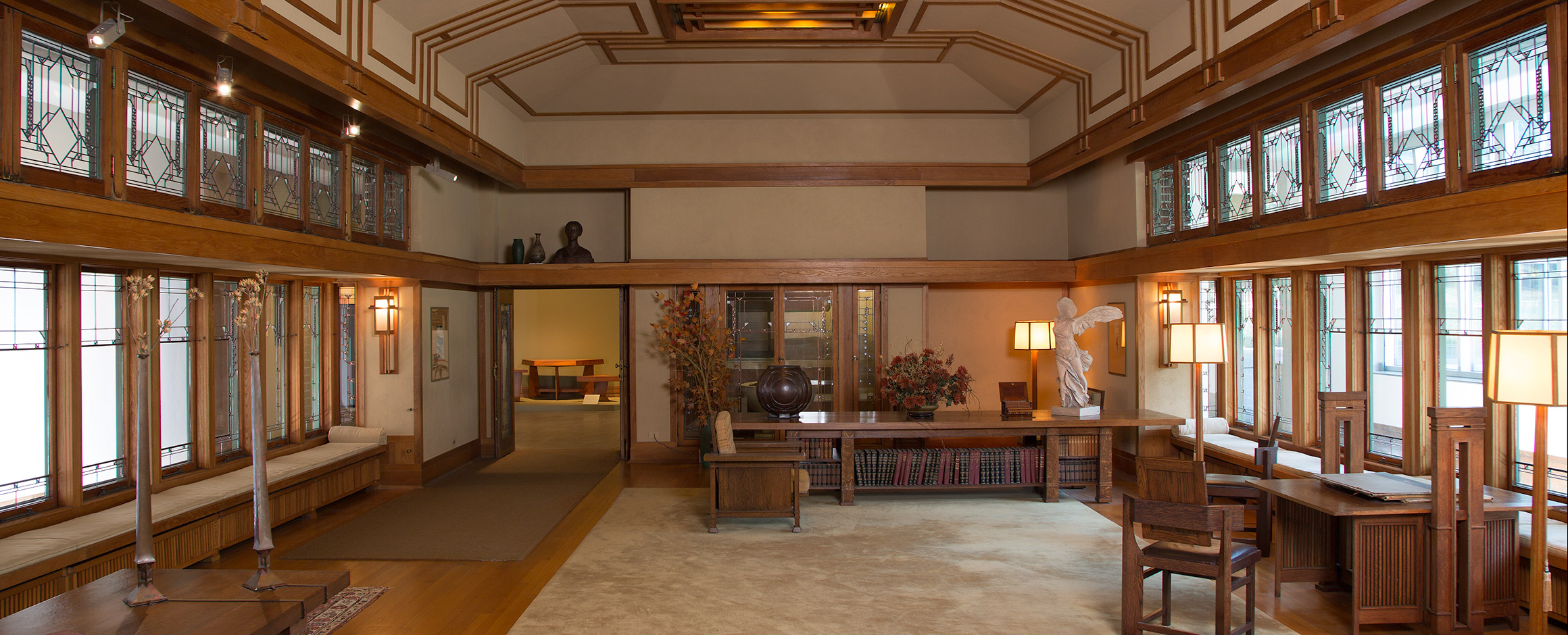
One might, it seems, be almost anywhere in the U.S. and only a few hours drive from a Frank Lloyd Wright house. The “Wisconsin-born Wright’s portfolio,” writes Jess Hoffert at Midwest Living, consists “of about 500 structures, a good portion of which still stand in the Midwest.” Wright houses span the West Coast and nestle in the suburbs of Washington, DC. As millions of visitors see up close every year at the Metropolitan Museum of Art’s Frank Lloyd Wright Room, Wright’s style permeated every part of his designs, inside and out.
But there’s no talk of travel these days. The Wright-designed homes and museum exhibitions that were open to the public have closed their doors to visitors “just when they were gearing up for the spring touring season to begin,” announced the Frank Lloyd Wright Building Conservancy. To make sure the public still has access to twelve of those famous works, the Conservancy—along with the Frank Lloyd Wright Foundation and the Unity Temple Restoration Foundation—have launched #WrightVirtualVisits, which offers virtual tours of 12 iconic houses.
The delivery method is “a touch confusing,” Matt Hickman comments at The Architect’s Newspaper. Tours kick off at 12:00 Central every Thursday “for six weeks (and maybe more). Each week, the conservators of a specific Wright site will share a short yet intimate video tour on its website and associated media pages of another Wright site…. Each week, two fresh Wright properties will partake in this virtual tour swap.” This does require a close reading of the instructions, and requires one to keep a date, as it were, for a Wright tour.
Given the houses on display, you might not find this too troublesome.
Buildings that have been featured already or are up to bat in the coming weeks include the Unity Temple in Oak Park, Illinois; the Hollyhock House, recently named as the first UNESCO World Heritage Site in Los Angeles; Chicago’s Prairie School stunner, the Emil Bach House; Taliesin West, home of the (possibly) defunct School of Architecture at Taliesin, in Scottsdale, Arizona; the stunning yet often-overlooked Graycliff estate outside of Buffalo, New York; Samara, a pristine Usonian design in West Lafayette, Indiana; the Gordon House, the only Wright building in Oregon, and, of course, Fallingwater.
That last house must surely be Wright’s most famous, an exemplar of his “Usonian” style. But no matter what particular idiom he chose, the Midwestern aesthetic values that shaped his early Prairie Style carried through into all of his later work. In her short guide to ten of the most well-known Prairie Houses, Wright expert Carla Lind describes his visual philosophy as representative of “ideals in which midwesterners believed.”
The seeds of the Prairie Style were rooted in an appreciation for nature and a dedication to the freedom and individuality inherent in democracy. To that Wright added his own experiences and influences: his mother’s teaching via the Froebel gifts, that natural law could be understood through geometric abstractions; his father’s passion for music, which introduced him to composition and harmony; the literature of the day that informed him about the Aesthetic and Arts and Crafts movements and transcendental writers such as Whitman, Emerson, and Thoreau… the Japanese art and architecture at the World’s Columbian Exposition….
The price of admission—free for as long as it lasts—makes this opportunity to see, from a safe social distance, how Wright balanced these influences well worth the virtual trip.
Related Content:
Frank Lloyd Wright Reflects on Creativity, Nature and Religion in Rare 1957 Audio
Josh Jones is a writer and musician based in Durham, NC. Follow him at @jdmagness
Read More...Watch Full Productions of Sir Andrew Lloyd Webber’s Musicals, Streaming Free for 48 Hours Every Weekend
Writer and theatermaker Nicholas Berger’s recent polemic, “The Forgotten Art of Assembly: Or, Why Theatre Makers Should Stop Making,” touched a whole plexus of nerves, by positing that the frantic rush to approximate live performance in isolation, using non-broadcast quality home equipment and a live-streaming platform, is an imitation so poor it should cease and desist.
Acknowledging the scary economic reality that drives many of these hastily assembled online readings, solo shows, brand new 24-hour plays, monologues, and inexpertly shot Off-Off-Broadway footage did not get Berger a pass from the theater community.
Nor did attempting to head ‘em off at the pass by fretting that his “cynicism for this emergency style of digital performance will be labeled as pessimism or defeatism” and insisting that it’s his “love for theatre that cringes when (he sees) it inch closer and closer to becoming a TikTok.”
We acknowledge the likelihood that the general public has as much appetite for this sort of theater community infighting as it does for the burgeoning Covid-19 era virtual theater scene, especially if the players are unfamiliar from film or TV.
Not so the free Andrew Lloyd Webber buffet being served up every weekend in the recently hatched The Shows Must Go On YouTube channel.
Here, the excellent production values, famous names, and brand name tunes add up to a genuine television event, especially since each offering sticks around just 48 hours before turning back into a pumpkin.
You’ve already missed comedian Tim Minchin’s unforgettable street punk turn as Judas in 2012’s Jesus Christ Superstar, expertly filmed at London’s cavernous concert venue The O2. (Have a look at the above clip for a taste of what you missed—in addition to the Victoria’s Secret-style angels and mega church-style lighting displays, this production featured pole dancing, Anonymous masks, a former Spice Girl, and a close enough Shepard Fairey tribute poster for a Jesus who won the coveted role in a TV talent show.
Regret to inform, you’ve also missed former teen idol Donny Osmond as the titular character in the 1999 remount of Joseph and the Amazing Technicolor Dreamcoat. (Or not, if Lloyd-Weber takes mercy on hoards of devastated viewers flocking to the YouTube comments section to beg him to air it again, having just discovered that they missed it the first time.)
What’s next? You’ll have to ask the Magic 8 ball, or wait for an announcement, though in the video below, Lloyd Webber pledges that his failed adaptation of author P.G. Wodehouse’s beloved series, By Jeeves, will for sure be a feature of the line up. Other titles in his oeuvre include Cats, Starlight Express, Sunset Boulevard, The Phantom of the Opera, and Evita (the latter with lyrics by Tim Rice, Lloyd Webber’s collaborator on Jesus Christ Superstar, Joseph and the Amazing Technicolor Dreamcoat, and several other shows).
Each week’s feature-length show streams free on YouTube for 48 hours, beginning at 2 PM EST.
As with much of the thrown-together programming Berger decries in “The Forgotten Art of Assembly,” viewers of these not-quite-live performances are encouraged to cap things off with a donation to a theater charity, with suggested links for giving in the US, the UK, and Australia.
For those who’ve never caught an episode of Great Performances and thus find the concept of watching taped theater “a bit of a headfuck,” to quote Minchin, the advice he gave to Time Out (temporarily rebranded as Time In) is:
You’ve just got to get through the first ten minutes, and then it’s an extraordinary experience – because you’re actually watching people in real time.
Subscribe to The Shows Must Go On here.
Related Content:
Tim Minchin Presents “9 Rules to Live By” in a Funny and Wise Commencement Speech (2013)
Soothing, Uplifting Resources for Parents & Caregivers Stressed by the COVID-19 Crisis
Ayun Halliday is an author, illustrator, theater maker and Chief Primatologist of the East Village Inky zine. Her unprompted contribution to the Off-Off-Broadway in Isolation scene is a hastily assembled tribute to the classic 60s social line dance, The Madison. Follow her @AyunHalliday.
Read More...Radiohead Will Stream Concerts Free Online Until the Pandemic Comes to an End
Force thousands of musicians to stay home in their studios and what do you get? There’ll be an album boom for sure, just as there’s been an explosion of direct-to-you online live performances, interviews, and social media messages. Most recently, Richard D. James, aka electronic legend Aphex Twin, shared six new songs on Soundcloud. And Radiohead—a band with an equally loyal fanbase and as much longevity and experimental nerve—announced they’re “doing their bit,” as Dazed reports, “by uploading the best of their concerts to their YouTube channel.”
“Now that you have no choice whether or not you fancy a quiet night in,” the band wrote on Instagram, “we hereby present the first of several LIVE SHOWS from the Radiohead Public Library,” their newly-debuted, extensive online archive. The first concert uploaded, Live From a Tent in Dublin, captures an October 2000 performance just days after the release of Kid A. “The 23-song set included several album tracks including ‘Optimistic,’ ‘Morning Bell,’ ‘The National Anthem,’ and ‘In Limbo,’” notes Consequence of Sound. That’s a pivotal moment in the band’s history, for sure. Maybe the shock of that album is hard to feel 20 years on, but immediately after its release, Kid A shattered ideas of what rock bands were allowed to do.
There are many more classic shows to come—some of them documents of events that stand as music history at this point and most evidence of what an incredible live band Radiohead has been, their command of atmosphere and dynamics eerie in its seeming near-effortlessness. Like so much of their output from OK Computer on, these songs sound as relevant as ever, especially Thom Yorke’s anguished vocal in the opener, above, “The National Anthem.” “Everyone is so near,” he wails, “Everyone has got the fear/It’s holding on,” a lyric that neatly sums up his sense of a dystopian post-modernity’s double edge.
In our isolation, Yorke constantly suggests, we can feel so uncomfortably, claustrophobically shut in with each other. Like the damned in No Exit, there’s nowhere else to go. So, stay home with Radiohead shows. “We will be releasing one a week until either the restrictions resulting from the current situation are eased, or we run out of shows,” the band writes. “Which will be first? No-one knows.” Will there be a new album? Unlikely. The band’s embrace of their roles as active, public curators of their legacy seems like a signal of Radiohead’s emeritus status.
But they’ve spent the last several years giving away exclusive new songs, live streaming shows, releasing their entire studio catalogue on YouTube, and communicating directly with fans, so neither is their Radiohead Public Library a departure. At Consequence of Sound you can also hear recent podcast interviews with Radiohead guitarist Ed O’Brien (whose first solo album comes out this month) and longtime Radiohead producer and perhaps sixth member of the band, Nigel Godrich.
Check the band’s YouTube channel each week for the latest uploaded concert and enjoy it while it lasts!
Related Content:
Radiohead Puts Every Official Album on YouTube, Making Them All Free to Stream
Josh Jones is a writer and musician based in Durham, NC. Follow him at @jdmagness
Read More...Japanese Buddhist Monk Covers Ramones’ “Teenage Lobotomy,” “Queen’s “We Will Rock You,” Beatles’ “Yellow Submarine” & More
The music of the Beatles, the most influential band of all time, has endured for more than five decades now. It also seems to have crossed all cultural boundaries: how many people around the world can listen to the recordings made together by John Lennon, Paul McCartney, George Harrison, and Ringo Starr, and claim to be hearing something alien? The sheer adaptability of the Beatles’ songs surely also has something to do with their staying power: they’re recognizable when played more or less as the Fab Four played them, and they’re just as recognizable when sung by completely different voices, played by completely different instruments, and set in completely different cultural contexts.
Take the cover of “Yellow Submarine” at the top of the post, performed not by Ringo Starr but by a Japanese Buddhist monk who calls himself Kossan. Accompanying himself only with the kinds of drums and gongs one would hear in a temple, Kossan makes the Beatles’ musical tale of life beneath the waves his own.
Critic Ian MacDonald calls the original “Yellow Submarine” a “sparkling novelty song impossible to dislike,” and viewers on Youtube have found this more monkish version equally irresistible. Kossan’s cover of the Ramones’ “Teenage Lobotomy” just above, whose distorted guitars sound both incongruous and very congruous indeed, has also begun to attract attention.
The original New York punk rockers may seem an even odder choice than the Beatles for a Buddhist monk, but not for this Buddhist monk, who’s put in his own time on the streets of the Big Apple. “Every weekend, Kazutaka Yamada straps on his blue Rollerblades and heads from his Chelsea apartment to the Upper East Side,” writes Corey Kilgannon in a 2007 post at The New York Times, referring to Kossan monk by his real name. “After navigating the city’s streets and gliding through Central Park, he stops in front of the Metropolitan Museum of Art,” where he “puts on black shoes and a large, cone-shaped straw hat, then holds out a wooden bowl and for hours on end, chants in Japanese the same four lines of a Buddhist prayer.” The Times also produced a video of Kossan’s public chanting, which includes a brief interview with the man himself.
More in-depth is this English-translated conversation at My Eyes Tokyo, in which Kossan tells of how his musical career began in Central Park: “When I was playing the sanshin on a bench, a guy gave me a dollar. I was surprised because I didn’t expect that at all. I was playing it there only because it was a nice day.” Thirteen years later he plays from his homeland to internet audiences around the world, performing not just hit songs from the West (and it would be hard to get more western than “We Will Rock You”), but Eastern rock as well, like “Linda Linda Linda” by Japanese punk icons The Blue Hearts. Even in this way, Kossan remains in a New York of the mind: “I’m totally Japanese and came from Japan so I stick to being a ‘100% pure Japanese’ here in New York,” as he told My Eyes Tokyo. “I believe that is a real New Yorker.”
via Boing Boing
Related Content:
Punk Dulcimer: The Ramones’ “I Wanna Be Sedated” Played on the Dulcimer
Hear 100 Amazing Cover Versions of Beatles Songs
Watch the Buddhism-Inspired Video for Leonard Cohen’s Newly-Released Song, “Happens to the Heart”
Based in Seoul, Colin Marshall writes and broadcasts on cities, language, and culture. His projects include the book The Stateless City: a Walk through 21st-Century Los Angeles and the video series The City in Cinema. Follow him on Twitter at @colinmarshall, on Facebook, or on Instagram.
Read More...Nikon Offers Free Online Photography Courses in April

A quick heads up. Through the end of April, Nikon has made its curriculum of online photography courses free. Normally priced at $15-$50 per course, this 10-course offering covers Fundamentals of Photography, Dynamic Landscape Photography, Macro Photography, Photographing Children and Pets, and more. Sign up for the courses here.
If you would like to support the mission of Open Culture, consider making a donation to our site. It’s hard to rely 100% on ads, and your contributions will help us continue providing the best free cultural and educational materials to learners everywhere. You can contribute through PayPal, Patreon, and Venmo (@openculture). Thanks!
Related Content:
Annie Leibovitz Teaches Photography in Her First Online Course
Take a Free Course on Digital Photography from Stanford Prof Marc Levoy
Learn Digital Photography with Harvard University’s Free Course
1,700 Free Online Courses from Top Universities Read More...A 30-Minute Introduction to Japanese Jazz from the 1970s: Like Japanese Whisky, It’s Underrated, But Very High Quality
“Jazz and Japan shouldn’t mix,” says All-Japan: The Catalogue of Everything Japanese. “After all, the essence of jazz lies in improvisation — a concept largely absent from both traditional Japanese music and Japanese society as a whole. Japan may adapt, but it does not improvise.” And yet, as the book goes on to tell, jazz and Japan do indeed mix, and they began doing so even before the Second World War. Japanese jazz dates back to the 1920s, when it drew inspiration from visiting Filipino bands who had picked the music up from their American occupiers. In the century since then, devoted Japanese players (and their even more devoted Japanese listeners) have developed perhaps the most robust jazz culture in the world.
But please, don’t believe me: have a listen to the mix of 1970s Japanese jazz on vinyl above. Spun by Turkish DJ Zag Erlat on his Youtube channel My Analog Journal, it showcases such musicians as trombonist Hiroshi Suzuki, saxophonist Mabumi Yamaguchi, and guitarist Kiyoshi Sugimoto. These names will sound familiar — though not over-familiar — to those of us who’ve spent years digging crates around the world for Japanese jazz on vinyl.
Thanks to Youtube, they’re now becoming better-known among jazz fans of all stripes: just like the 1980s Japanese high-tech disco-funk now known as city pop, Japanese jazz owes much of its modern recognition to the algorithm. As a result, actual Japanese jazz albums like the ones nonchalantly displayed by Erlat in the video have become a hotter commodity than they used to be.
Like all of Erlat’s “coffee break sessions” (others of which focus on Japanese drama funk, Turkish female singers from the 70s, and “USSR grooves”), this mix runs a brisk 33 minutes. If you enjoy the taste enough to go back for more, allow me to suggest the work of such Japanese jazzmen as Teruo Nakamura, Masayoshi Takanaka, and Terumasa Hino — much of which comes from the 1970s, an era that enthusiasts across the world now see as something of a golden age. You’ll still only have skimmed the surface of Japanese jazz, one of the many Western inventions taken to another level of mastery, and exhilarating new directions, in the Land of the Rising Sun. As one commenter on Youtube puts it, “Japanese Jazz is like Japanese whisky: underrated, but very high quality.”
Related Content:
Acclaimed Japanese Jazz Pianist Yōsuke Yamashita Plays a Burning Piano on the Beach
Haruki Murakami’s Passion for Jazz: Discover the Novelist’s Jazz Playlist, Jazz Essay & Jazz Bar
Hear 2,000 Recordings of the Most Essential Jazz Songs: A Huge Playlist for Your Jazz Education
Based in Seoul, Colin Marshall writes and broadcasts on cities, language, and culture. His projects include the book The Stateless City: a Walk through 21st-Century Los Angeles and the video series The City in Cinema. Follow him on Twitter at @colinmarshall, on Facebook, or on Instagram.
Read More...Support Us
We're hoping to rely on loyal readers, rather than erratic ads. Please click the Donate button and support Open Culture. You can use Paypal, Venmo, Patreon, even Crypto! We thank you!

About Us

Open Culture scours the web for the best educational media. We find the free courses and audio books you need, the language lessons & educational videos you want, and plenty of enlightenment in between.
Advertise With Us

FREE UPDATES!
GET OUR DAILY EMAIL
Get the best cultural and educational resources on the web curated for you in a daily email. We never spam. Unsubscribe at any time.
FOLLOW ON SOCIAL MEDIA

Open Culture editor Dan Colman scours the web for the best educational media. He finds the free courses and audio books you need, the language lessons & movies you want, and plenty of enlightenment in between.
Advertise With Us

