Banksy Debuts His COVID-19 Art Project: Good to See That He Has TP at Home
“Who is Banksy?” asked an Artnet roundup of possible suspects in 2016. One might well respond, “who cares?”—a rhetorical question Artnet’s Henri Neuendorf answers. At least a few years ago, before some other things got seriously out of hand, the identity of the notorious guerilla street artist turned international man of mystery was “an obsession that seems to have gripped the world.”
One answer, assessed by curator and street art expert Carlo McCormick, was arrived at through the use of geographic profiling, a “sophisticated statistical analysis technique used in criminology to locate repeat offenders.” McCormick rates its conclusion as probable, but also finds it “scary” to bend such methods to such ends, an anxiety resonant with concerns over surveillance tech used to track COVID-19 vectors.
Another question is whether it matters who Banksy is. “The improbably ornate fiction is always going to be more compelling than the simple mundane truth.” Do we really need to ruin the illusion? If those who want to remain anonymous can be tracked with algorithms—while the rest of us volunteer our personal data daily in a culture of competitive oversharing—is there any room left for privacy? Now that we’re trapped inside for days on end with families, roommates, partners, pets, maybe our only personal space is in the loo (where we’re still inclined to bring our phones).
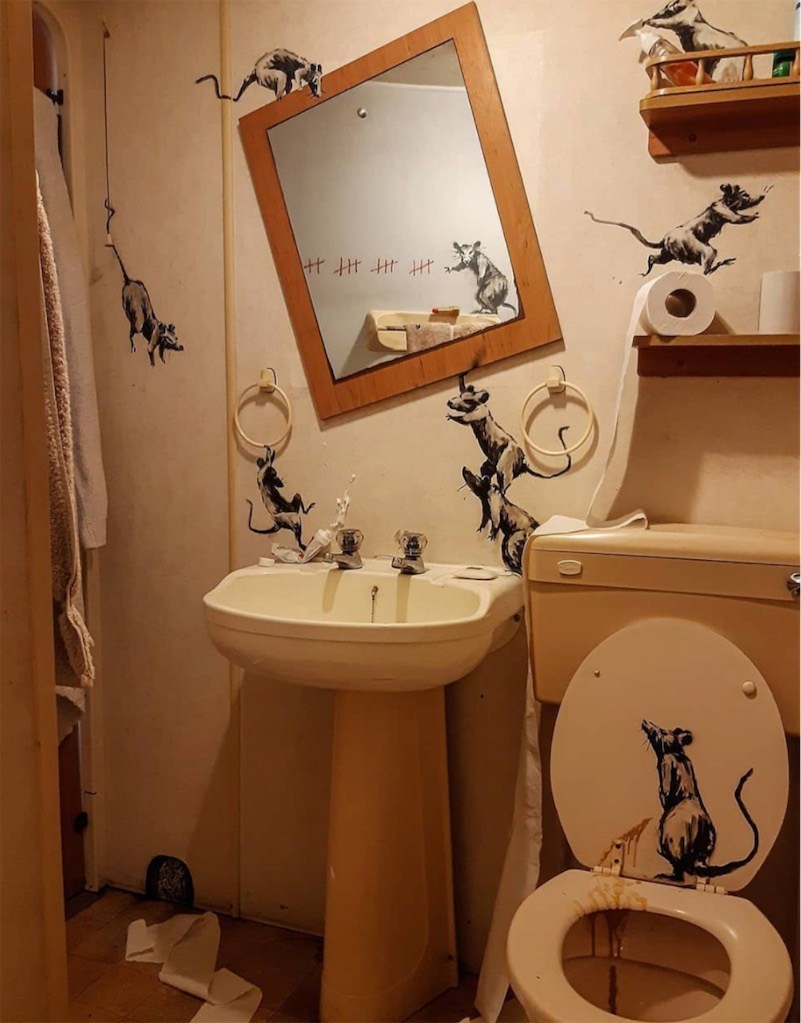
Banksy’s latest work, posted on Instagram, plays with all of these themes and shows he doesn’t have a problem defacing his own property, and sharing an intimate portrait with his millions of followers. Hell, it’s almost a selfie, minus the preening, duck-faced self.
As Daria Harper writes at Artsy:
The notoriously elusive street artist Banksy debuted his latest work in a rather peculiar place: his bathroom. With much of the world on lockdown due to the COVID-19 crisis, artists like Banksy have been forced to get innovative with their artistic practices. The artist posted photos of the new artwork on his Instagram page yesterday with the caption: “My wife hates it when I work from home.”
Is this really Banksy working from home? (“One particularly baffled commenter,” notes Hyperallergic, “wrote: ‘You are one of the world’s most famous artists… and THAT’S YOUR shitty little BATHROOM????’”)
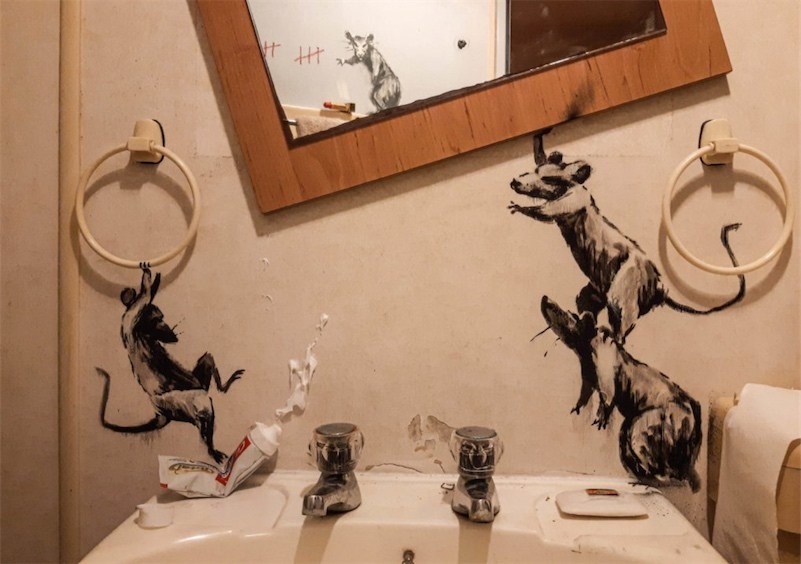
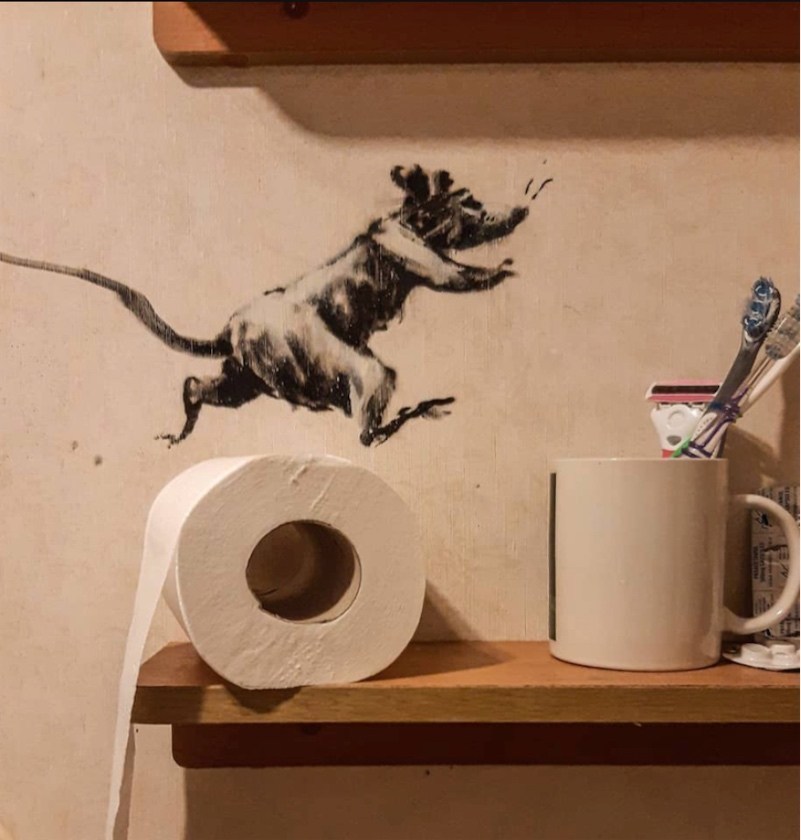
Is there really a Mrs. Banksy? Little Banksies running around the yard, wearing coronavirus facemasks and hoodies? Is he on the verge of outing himself? At least we know he’s still got toilet paper.
Maybe you find this tantalizing window on the artist’s inner sanctum credible evidence of his mundane real life. Maybe the signature rats destroying his crapper are his cabin-fever dream. Or maybe, as usual, he’s just taking the piss with this creative installation. We await comment from Mrs. Banksy.
via Boing Boing
Related Content:
Banksy Strikes Again in Venice
Banksy Paints a Grim Holiday Mural: Season’s Greetings to All
Behind the Banksy Stunt: An In-Depth Breakdown of the Artist’s Self-Shredding Painting
Josh Jones is a writer and musician based in Durham, NC. Follow him at @jdmagness
Read More...Watch the Rolling Stones Play “You Can’t Always Get What You Want” While Social Distancing in Quarantine
Ladies and gentleman, the greatest rock n roll band in the world, the Rolling Stones. Live, in quarantine, at home, performing “You Can’t Always Get What You Want.” Any theories on what’s the story with Charlie’s drum kit? And why they have red in their homes? Enjoy.
If you would like to support the mission of Open Culture, consider making a donation to our site. It’s hard to rely 100% on ads, and your contributions will help us continue providing the best free cultural and educational materials to learners everywhere. You can contribute through PayPal, Patreon, and Venmo (@openculture). Thanks!
Related Content:
Jefferson Airplane Wakes Up New York; Jean-Luc Godard Captures It (1968)
Read More...Hayao Miyazaki’s Studio Ghibli Releases Free Backgrounds for Virtual Meetings: Princess Mononoke, Spirited Away & More
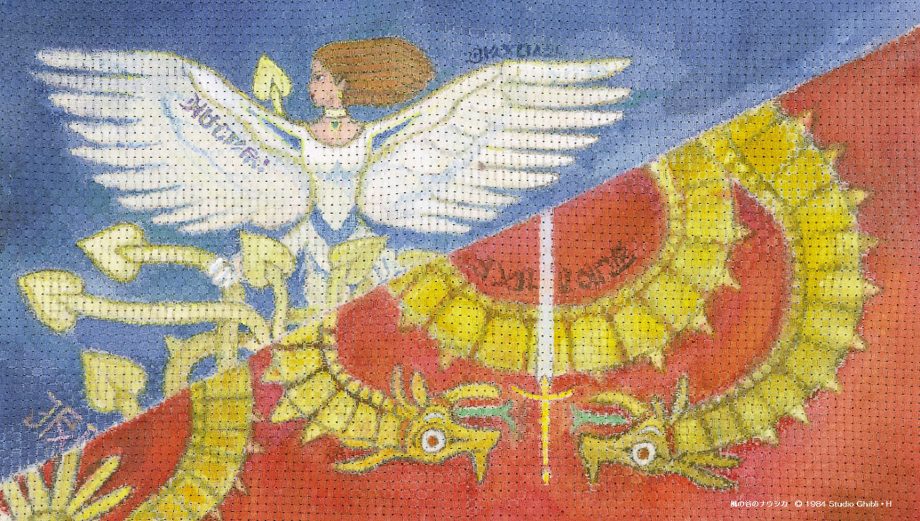
To a degree that surpasses any other studio in animation history, Studio Ghibli has created a reality of its own. All of its fans around the world appreciate the artistry of its films, directed by such luminaries of Japanese animation as Hayao Miyazaki and Isao Takahata, and many appreciate it so fervently that they’d prefer to occupy any of Ghibli’s worlds to this one. The studio has responded to their desires by not just continuing to produce motion pictures — the “retired” Miyazaki is now at work on his latest, How Do You Live? — but by authorizing a wide and ever-changing range of merchandise, and even building a museum outside Tokyo and a theme park outside Nagoya.
Alas, like most museums, Ghibli’s is temporarily closed. Neither the Ghibli theme park nor How Do You Live? will open any time soon, and even if they could open today, it would hardly be an opportune time to do so. With so few of us anywhere able to go to movie theaters, let alone theme parks (though we can now, at long last, stream Ghibli movies online), we have to enter the realm of Ghibli in a digital fashion.
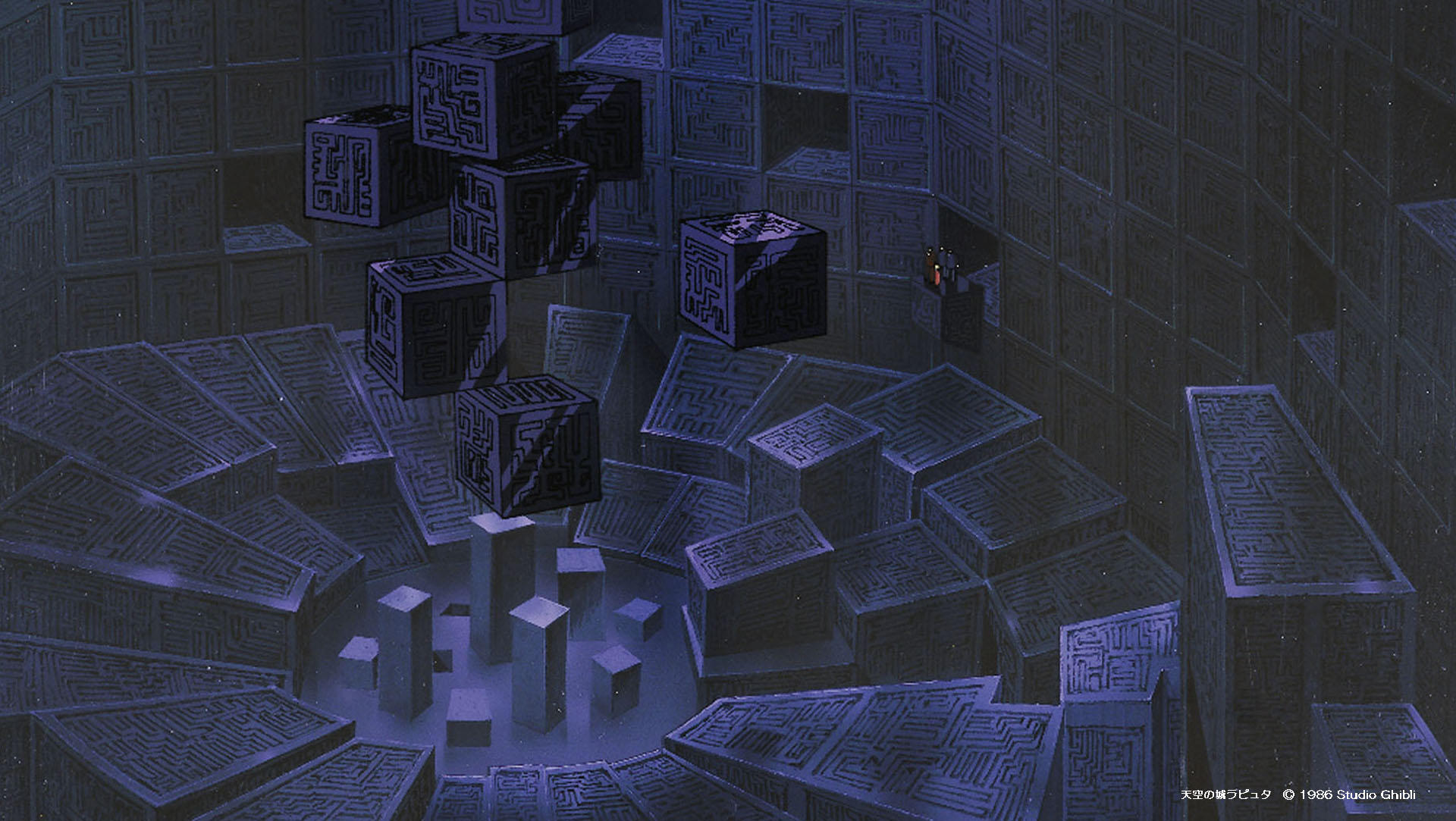
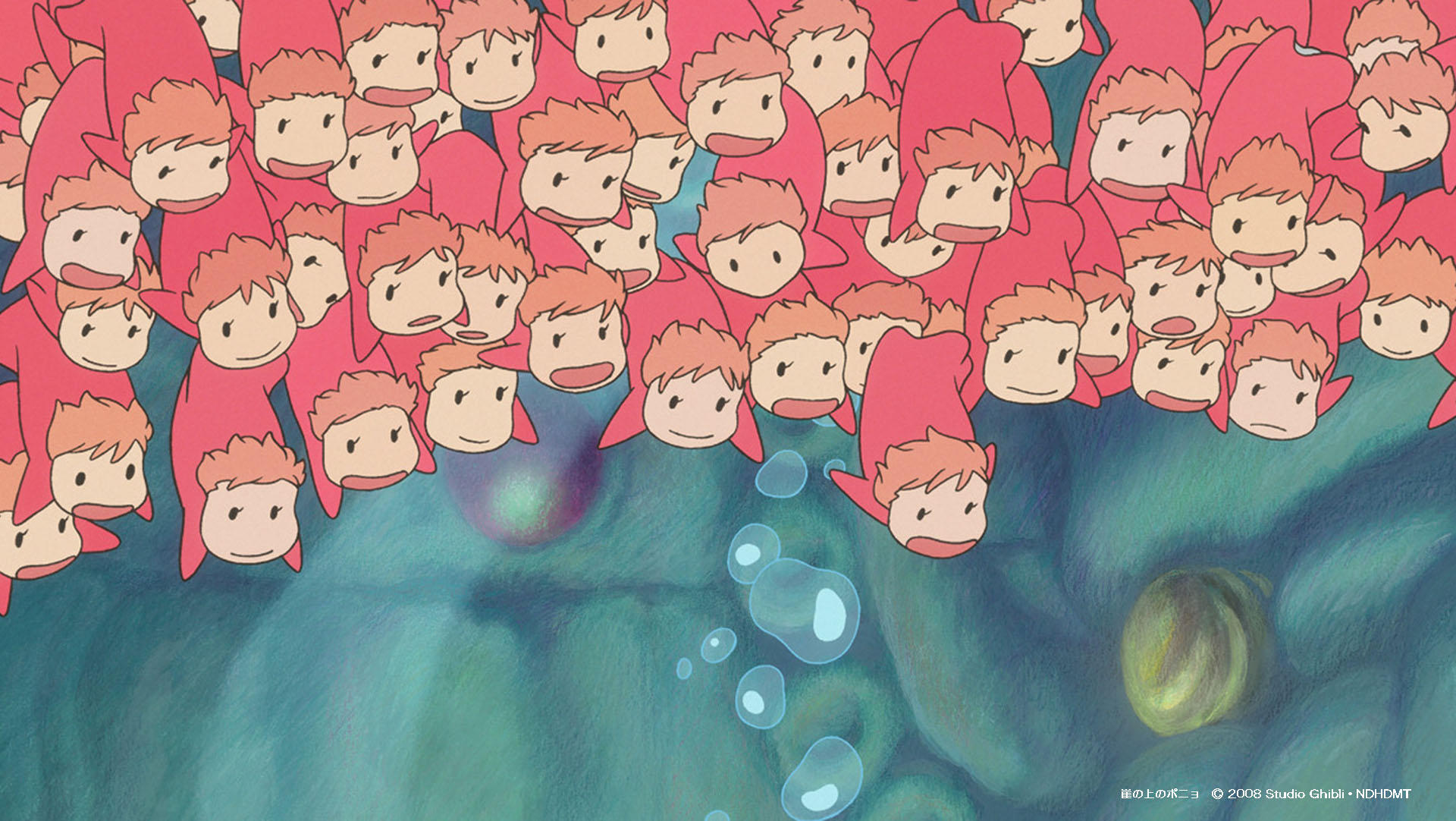
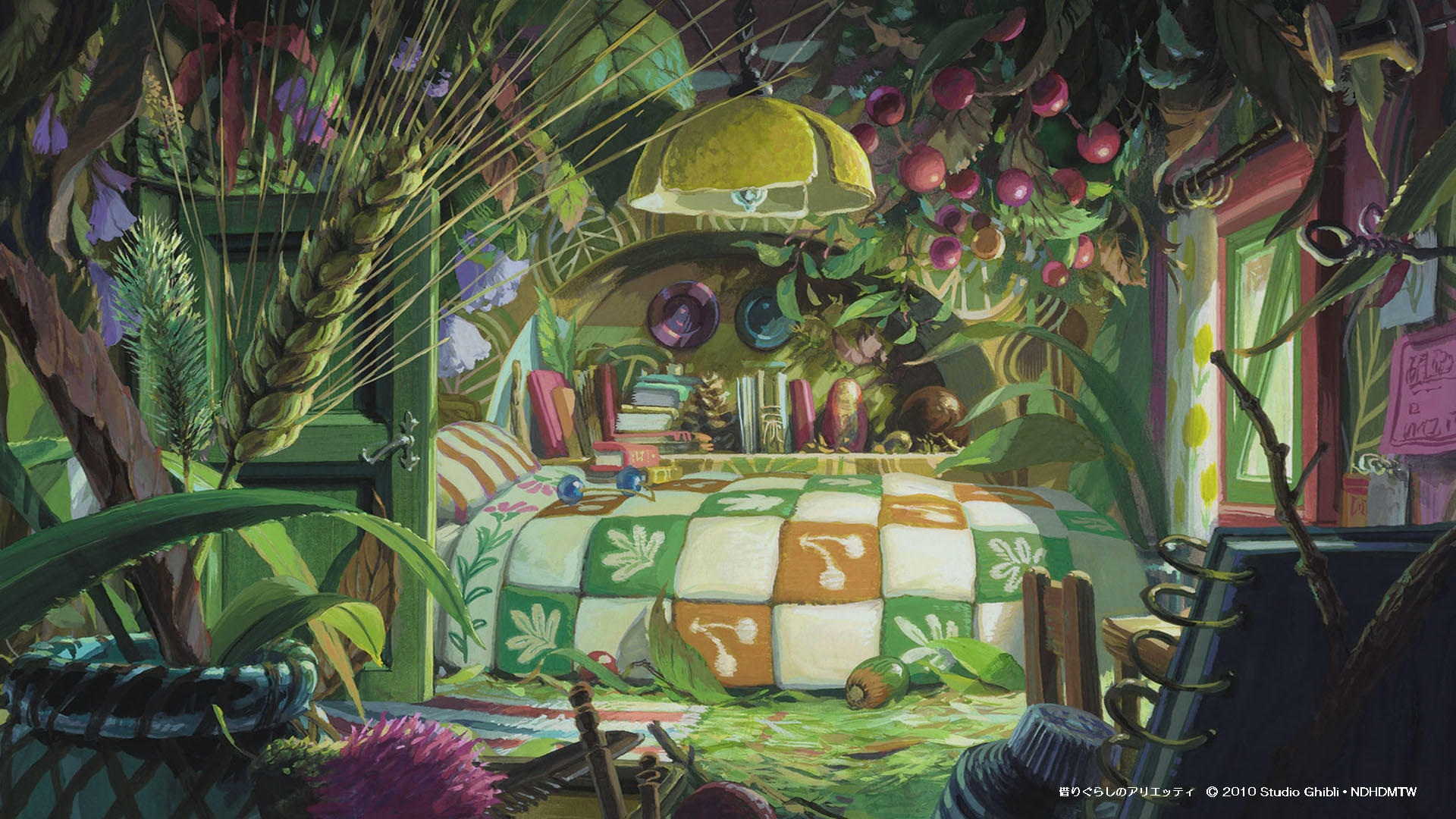
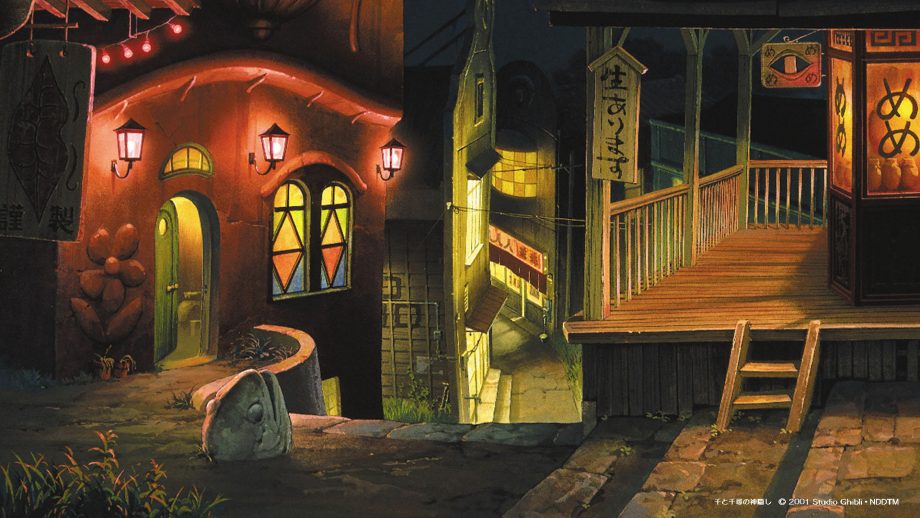
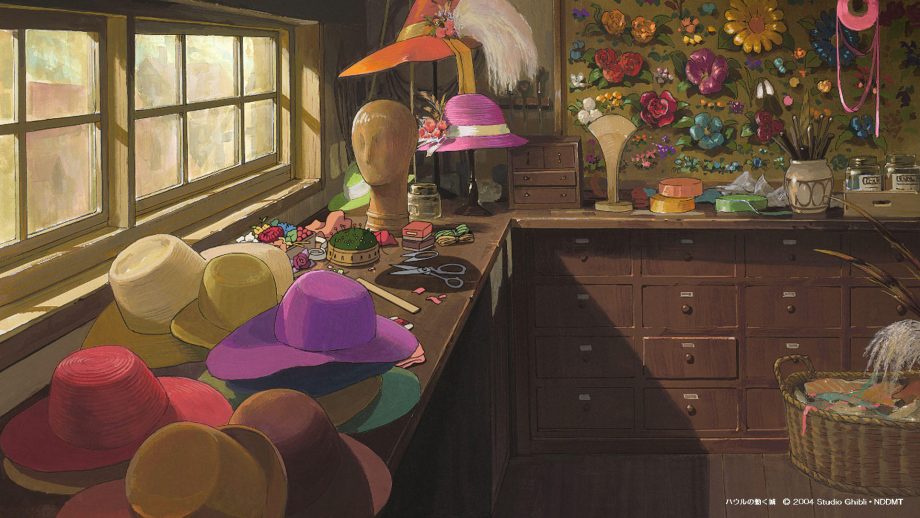
To make this a bit more possible, the studio has officially released a set of eight backgrounds, suitable for use as backdrops on Zoom or other video-conferencing applications. You’ll find them all at Ghibli’s web site: in Japanese only, true to form, but even non-Japanese speakers can easily click and save the images. (For instructions on how to set one as your background, see our previous post on the subject.)

Drawn from the sweep of Studio Ghibli’s history, from Nausicaä of the Valley of the Wind to Castle in the Sky, Princess Mononoke, Spirited Away, Howl’s Moving Castle, Ponyo, Arrietty, and The Tale of the Princess Kaguya, the backdrops show the wide aesthetic range of its work. Some of them depict memorable settings from these films (any Ghibli fan will know exactly where you “are” the moment you connect) but others capture a character, an icon, or an atmosphere.

Whichever Ghibli background you pick, it will remind your interlocutors of the formidable imagination exercised by each and every one of the studio’s films, whether its characters soar across the sky, live beneath the sea, or plunge into an unseen underworld — do anything, essentially, but stay at home making calls.
Related Content:
Watch Hayao Miyazaki’s Beloved Characters Enter the Real World
Hayao Miyazaki’s Beloved Characters Reimagined in the Style of 19th-Century Woodblock Prints
Calm Down & Study with Relaxing Piano, Jazz & Harp Covers of Music from Hayao Miyazaki Films
Customize Your Zoom Virtual Background with Free Works of Art
Based in Seoul, Colin Marshall writes and broadcasts on cities, language, and culture. His projects include the book The Stateless City: a Walk through 21st-Century Los Angeles and the video series The City in Cinema. Follow him on Twitter at @colinmarshall, on Facebook, or on Instagram.
Read More...Watch Samuel Beckett Walk the Streets of Berlin Like a Boss, 1969
Samuel Beckett long had a fondness for Berlin, from his first trip in the late 1920s–when he fell in love with his cousin while visiting his uncle on his mom’s side–to his longtime relationship with his German translator Erika Tophoven and with the Schiller Theater, which produced many of his plays.
The above footage shows the 63-year old Beckett walking the streets of Berlin, asking for directions, or reading the daily paper at a cafe. At one point he is seen walking with a woman (possibly Tophoven?).
Why was this film shot? It has the feeling of surveillance footage, but the more logical explanation is that it was b‑roll for some news feature. Beckett was awarded the Nobel Prize for Literature in 1969, so that might be the reason.
However, the illogical but *best* reason is that Beckett was filming the title sequence for his detective show pilot, named, of course, Beckett. YouTube user oobleckboy created this hilarious rework a few years ago, which we told you about then. But it’s worth another look, surely.
On a more serious note, Beckett’s main tour of Berlin came long before his journey as a playwright. Self-taught in the language and interested in the culture, he traveled to Berlin right after the 1936 Olympic Games and stayed through 1937. He had lost his job in Dublin, and he had fallen out with James Joyce, so he was avoiding Paris. So Beckett traveled to Berlin to devour the arts. He knew the dangers of the rising Nazi threat and took it seriously. Instead he wanted to see the culture before it disappeared. (And it would, on one hand through the Nazis and their campaign against “degenerate art.” On the other, from the Allies bombing during the war.) Beckett spent countless hours in museums. He attended operas. He got so fluent in the language he could read Schopenhauer (for the style, not the content, apparently).
But it was such a private trip that his German friends from the ‘60s never knew of it. He did not mention it to them. The only reason we know is because in 1989, his nephew discovered his diary from that time–the only diary Beckett ever kept–and after years of it being available only to researchers, it was published in 2011. (Or rather, selections of the 120,000 word journal, were published.)
Lastly, it was on one of those Berlin museum trips where he saw the painting Two Men Contemplating the Moon by Caspar David Friedrich. The image would stick in his mind until many years later when it would influence the set design for his most famous play, Waiting for Godot. (A country road. A tree. Evening.) You can see the painting here.
via Ubu Web
Related Content:
The Books That Samuel Beckett Read and Really Liked (1941–1956)
When Robin Williams & Steve Martin Starred in Samuel Beckett’s Waiting For Godot (1988)
Samuel Beckett Directs His Absurdist Play Waiting for Godot (1985)
Ted Mills is a freelance writer on the arts who currently hosts the Notes from the Shed podcast and is the producer of KCRW’s Curious Coast. You can also follow him on Twitter at @tedmills, and/or watch his films here.
Read More...How to Paint Water Lilies Like Monet in 14 Minutes
Some of us are using this period of self-isolation to make sourdough.
Others are learning to play an instrument or initiating a daily yoga practice.
For those considering taking up painting, David Dunlop’s Emmy-Award winning PBS series Landscapes Through Time offers an excellent alternative (or supplement) to the well-established joys of cult figure Bob Ross, the eternal king of television art instruction.
Like Ross, Dunlop has a mellow onscreen temperament that pairs beautifully with the enchanting setting of Claude Monet’s famous water garden, above.
(Those who’ve visited Monet’s house and garden at Giverny will envy him his tourist-free access to the site. Even those with no intention of picking up a brush should find it restorative to spend time gazing at the same lovely view that Dunlop, like Monet before him, looks at through a deliberately Impressionistic squint.)
He packs a lot of art appreciation into 14 easily digested minutes, touching on art history, brush technique, composition, use of light, and, in particular, color theory.
When the museums reopen, you may find this crash course has enhanced your enjoyment, especially as pertains to canvases by Monet and his fellow Impressionists.
For those pursuing the hands-on oil painting experience, Dunlop provides a supply list of colors, all readily available:
Cobalt Blue
Cadmium Yellow
Alizarin Crimson
Ultramarine
Brilliant Rose
Emerald Green
Hooker’s Green
Titanium White
His brushes and paper appear to be garden variety, and his approach, like Ross’, is fast and loose.
Those who favor a less brazen approach may feel more at home with his watercolor painting demonstration in Cezanne’s Mont Sainte-Victoire in Provence, France, below.
There are more excerpts and instruction on Dunlop’s YouTube channel. For those wishing to take it to the next level, Dunlop is teaching a series of interactive studio demonstration classes via Zoom. Register here.
Related Content:
Rare 1915 Film Shows Claude Monet at Work in His Famous Garden at Giverny
Bob Ross’ Christmas Special: Celebrate, Relax, Nod Off
Ayun Halliday is an author, illustrator, theater maker and Chief Primatologist of the East Village Inky zine. Her art in isolation has taken the form of a hastily assembled tribute to the classic 60s social line dance, The Madison. Follow her @AyunHalliday.
Read More...Experience the Van Gogh Museum in 4K Resolution: A Video Tour in Seven Parts
When we think of the most technologically inclined artists of all time, we don’t necessarily think of Vincent van Gogh. Though he wrote of his determination to create “the art of the future,” when he got down to painting he did so with traditional tools. Whatever Van Gogh’s own feelings about technology, technology certainly seems to like him: take, for example, 2017’s Loving Vincent, a feature film about him animated with 65,000 paintings; the digital exhibition of his work that took place in Paris last year; his paintings brought to life with 3D animation and visual mapping; and a virtual-reality version of The Night Cafe, all previously featured here on Open Culture — not to mention the 1,400 paintings and drawings by van Gogh made available online by the Van Gogh Museum.
However forward-looking its full-featured online presence made the Van Gogh Museum seem before, this particular moment has made it look like an even more prescient institution. With it and so many other brick-and-mortar museums temporarily closed due to the coronavirus pandemic, online is the only way any of us can enjoy them.
In addition to its existing resources on the web, the Van Gogh Museum has over the past month been uploading a private tour, all shot in 4K video. Much like the five-hour iPhone ad shot in the Hermitage about which we posted last month, this series provides a drifting, floating view of the museum’s galleries and the works they proudly display, all quite unlike any experience one could ever have had there in person.
In the six parts of the series that have gone up so far, with a seventh and final installment to come next, not a single other person appears to get between you and Van Gogh’s portraits, Van Gogh’s still lifes, Van Gogh’s scenes urban and rural. But you do get some accompaniment in the form of a full musical score, an element that has become quite important for this now-emerging form of cinematic, high-resolution museum tour video.
Though brief, this Van Gogh Museum tour in 4K covers a wide swath of the artist’s work, and will surely only whet the appetite of viewers who’ve been meaning to make the trip to Amsterdam themselves. Until then, we can take in Van Gogh’s “art of the future” using the technology of the present — the likes of which wouldn’t have appeared in even his wildest visions.
Related Content:
Download Hundreds of Van Gogh Paintings, Sketches & Letters in High Resolution
13 Van Gogh’s Paintings Painstakingly Brought to Life with 3D Animation & Visual Mapping
Van Gogh’s 1888 Painting, “The Night Cafe,” Animated with Oculus Virtual Reality Software
Based in Seoul, Colin Marshall writes and broadcasts on cities, language, and culture. His projects include the book The Stateless City: a Walk through 21st-Century Los Angeles and the video series The City in Cinema. Follow him on Twitter at @colinmarshall, on Facebook, or on Instagram.
Read More...See Web Cams of Surreally Empty City Streets in Venice, New York, London & Beyond
The lack of human presence in majorly polluted cities these past couple months has had some people seeing utopias as the skies begin to clear. But empty cities seem a little more dystopian to me. Dystopias are “a kind of surrealism,” writes Kim Stanley Robinson. They unearth the dreamlike dread beneath the veneer of the normal. No matter when they’re set, dystopias don’t depict the future so much as “the feeling of the present… heightened by exaggeration to a kind of dream or nightmare.” The events in dystopian fiction approach the truth of someone’s situation somewhere in the world and make visible what has been hidden.
We know ghost cities exist as ancient disasters like Pompeii and Herculaneum and modern ones like Pripyat, Ukraine, outside Chernobyl. But there are more of them than many of us know. Gleaming cities like Ashgabat, Turkmenistan, which broke ground in 1991 and contains the largest number of marble buildings in the world.
The 4.5 million square meter metropolis has almost no inhabitants, an enormous government folly. Towns and cities around the world have been abandoned for for all sorts of reasons, and they continue to as sea levels rise. Which is what makes viewing live camera footage of some of the world’s most iconic streets—almost completely emptied by the pandemic at the height of tourist season—so… surreal.
It’s true that people haven’t fled these cities, but made cozy bunkers of their apartments. Yet seeing the vacant streets live on camera, in Venice, London, New York, and elsewhere in the world, I get the uncanny feeling of looking at proto-surrealist painter Giorgio de Chirico’s The Enigma of a Day, a depiction of a shadowy, uninhabited street through which we expect the Italian version of a tumbleweed to roll. Surveillance technology has inadvertently become a medium of modernist art.
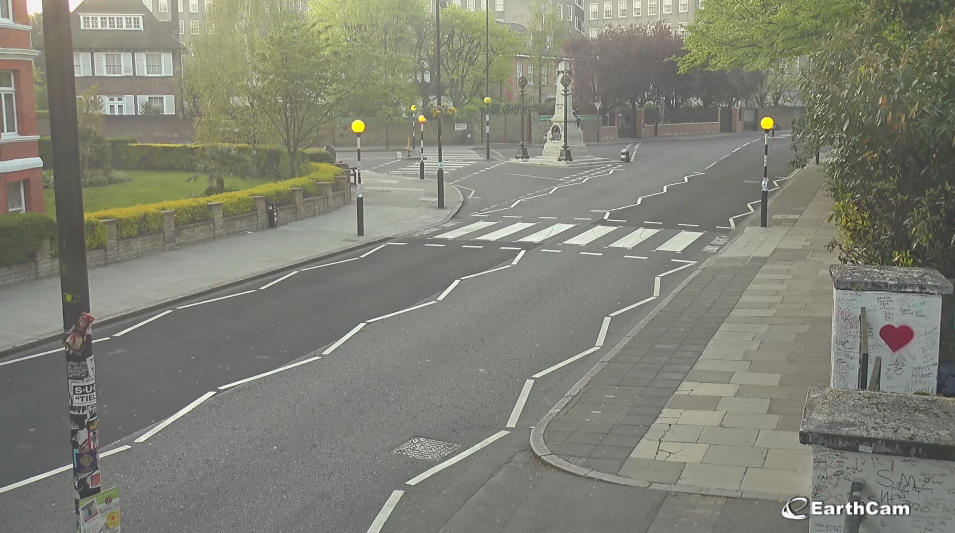
There is so much beauty in the live view at the top of the Ponte delle Guglie in Venice from the Hotel Filù Venezia, and there is also such lonely melancholy, depending on the time of day and where the shadows fall. See a live view of Times Square, above, and another Times Square view at EarthCam, where you can also catch a feed of a mostly empty Abbey Road (some times of day emptier than others, as in the early-morning screenshot below). Skyline Webcams hosts even more live camera views of Venice, including feeds from the Rialto Bridge and the Piazza San Marco, as well as live feeds from several sites in Padua and other places in Italy.
These real-time visions are transporting in their strangeness. Are we living in the present or the future? In a dystopian world, there isn’t any difference. All futures are foreclosed by catastrophe, “all distances in time and space are shrinking,” wrote Martin Heidegger, a thinker who understood disaster, and who fell in line behind it. In that same essay, “The Thing” (as translated by Albert Hofstader), the German philosopher made his famous comment, “the terrible has already happened.”
The terrible that has happened to us is not only a deadly pandemic. The virus is not likely to disappear on its own; who knows how long this will go on? But not far behind the current crisis are more climate events that threaten to empty streets. If we empty cities not only as indicative of temporarily social distancing, but as images of the possible near-future, maybe we’ll be far less inclined to come out of this surreal experience and get right back to business-as-usual.
Related Content:
Take a Virtual Tour of Venice (Its Streets, Plazas & Canals) with Google Street View
Google Lets You Take a 360-Degree Panoramic Tour of Street Art in Cities Across the World
Spring Break vs. COVID-19: Mapping the Real Impact of Ignoring Social Distancing
Josh Jones is a writer and musician based in Durham, NC. Follow him at @jdmagness
Read More...Take a Long Virtual Tour of the Louvre in Three High-Definition Videos
So, you’ve had to put off a trip to Paris, and a long-awaited visit to the Louvre, which “will remain closed until further notice,” has been pushed into the indefinite horizon. It could be worse, but the loss of engaging up close with cultural treasures is something we should all grieve in lockdown. Art is so important to human well-being that UK Secretary of Health Matt Hancock argued all doctors in the NHS should prescribe gallery visits and other art activities for everything from mental issues to lung diseases.
As you know from planning your trip (ideally several trips) to the famous museum—first opened to the public in 1793 on the first anniversary of Louis XVI’s imprisonment—you can luxuriate in art for days on end once there, provided you can evade the massive crowds.
The Louvre is immense, with 60,500 square meters of floor space and around 35,000 paintings, sculptures, and other artifacts. But with roughly 10 million visitors per year, who make it the world’s most visited museum, it isn’t easy to find space for contemplation.
Video visits are no substitute, but these days they’re the best we’ve got. If you’re eager to see what you’re missing—or what you could never get to in person even without a pandemic—take a look at the 4K virtual tours here from Wanderlust Travel Videos. Yes, you’ll see the heroic masterworks of Jacques-Louis David, Eugene Delacroix, and Théodore Géricault. You’ll see the famous glass pyramid, the treasures of Napoleon’s Apartments, and, yes, the Mona Lisa.
But you’ll also see hundreds and hundreds of works that don’t get the same kind of press, each one named in a timestamped list on the YouTube pages. The experience is admittedly like visiting the museum in person, rushing through each gallery, peering over and around the backs of heads to get a glimpse of the Fra Filippo Lippis, Cimabues, and Mantegnas. But you can mute the constant background chatter and pause and rewind as much as you like.
After touring a good bit of the museum, stroll around the Carrousel Arc de Triomphe, Jardin de l’infante, and the Pont Neuf, above. Judging by the comments, these videos are proving a balm to the psyches of homebound art lovers around the world, whether they’ve been to the Louvre before, just scrapped their travel plans, or know they’ll probably never get the chance to visit.
The virtual opportunity to tour this magnificent collection, or part of it, may refresh our exhausted imaginations. It may also soothe the part of us that really misses huge crowds of people all talking at once. Something about the experience, even on the screen, feels so strangely compelling right now you might find yourself hoping if and when you finally get to the Louvre, it’s simply mobbed.
Related Content:
Mona Lisa Selfie: A Montage of Social Media Photos Taken at the Louvre and Put on Instagram
Take a Virtual Tour of 30 World-Class Museums & Safely Visit 2 Million Works of Fine Art
Visit The Museum of Online Museums (MoOM): A Mega Collection of 220 Online Exhibitions
Josh Jones is a writer and musician based in Durham, NC. Follow him at @jdmagness
Read More...Louis Armstrong Remembers How He Survived the 1918 Flu Epidemic in New Orleans
Born into poverty in New Orleans in 1901, and growing up during some of the most brutal years of segregation in the South, Louis Armstrong first lived with his grandmother, next in a “Colored Waif’s Home” after dropping out of school at age 11, then with his mother and sister in a home so small they had to sleep in the same bed. After already living through the first World War, he would go on to witness the Spanish Flu epidemic, the Great Depression, World War II, the Cold War, and the turbulent 1960s and the Vietnam conflict.
That’s a lot for one lifetime, though for much of it, Armstrong was a star and living legend who beat the odds and rose above his origins with will and talent. Even so, he suffered some severe ups and downs during the hard times, touring so much to cover his debts in the lean 1930s, for example, that he injured his lips and fingers, and finally moving to Europe when the mob came after him.
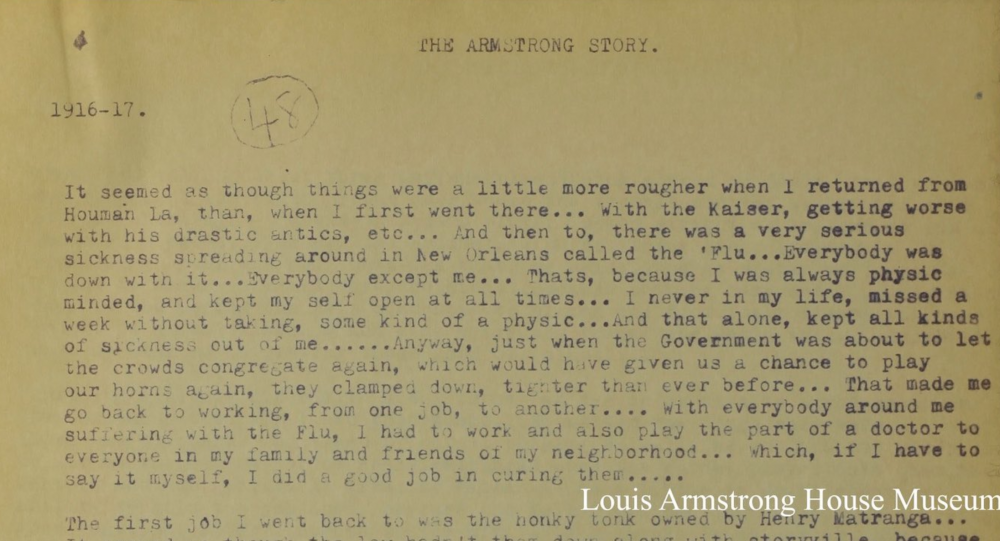
Armstrong’s descriptions of his experience of the 1918 influenza pandemic—as he remembers it in his 1954 memoir Satchmo: My Life in New Orleans—are almost jaunty, as you can partly see in the typescript page above from the Louis Armstrong House. But he remembered it from the perspective of a 17-year-old musician in robust health—who seemed to have some kind of resistance to the flu.
He devotes no more than two paragraphs to the flu, which hit the city hard in October of that year. According to the Influenza Encyclopedia, an online project documenting the flu in the U.S. between 1918–1919, New Orleans city authorities “acted immediately,” once they discovered the outbreak, arrived by cargo ship the month before.
On October 9th, the New Orleans Superintendent of Health, “with Mayor Martine Behrman’s consent and the blessing of state authorities… ordered closed all schools (public, private, and parochial, as well as commercial colleges), churches, theaters, movie houses, and other places of amusement, and [prohibited] public gatherings such as sporting events and public funerals and weddings.”
For a struggling young musician making a living playing clubs and riverboats, the closure of “other places of amusement” took a serious toll. The loss of livelihood is what seems to have hurt Armstrong the most when he returned to the city from touring, still unsure if the Great War would end.
When I came back from Houma things were much tougher. The Kaiser’s monkey business was getting worse, and, what is more, a serious flu epidemic had hit New Orleans. Everybody was down with it, except me. That was because I was physic-minded. I never missed a week without a physic, and that kept all kinds of sickness out of me.
Whatever “physic” helped Armstrong’s avoid infection, it wasn’t for lack of exposure. In lieu of playing the trumpet he began caring for the sick, since all of the hospitals, even those that would take black patients, were completely overcrowded.
Just when the government was about to let crowds of people congregate again so that we could play our horns once more the lid was clamped down tighter than ever. That forced me to take any odd jobs I could get. With everybody suffering from the flu, I had to work and play the doctor to everyone in my family as well as all my friends in the neighborhood. If I do say so, I did a good job curing them.
We might imagine some of those “odd jobs” were what we now call “essential”—i.e. low paid and high risk under the circumstances. He persevered and finally got a gig playing a “honky-tonk” that avoided a shut-down because it was “third rate,” and he “could play a lot of blues for cheap prostitutes and hustlers.” Few things could get Satchmo down, it seemed, not even a flu pandemic, but he was one of the lucky ones—luckily for the future of jazz. Only, we don’t have to imagine how hard this must have been for him. We just have to take a look around.
Learn more about the 1918 influenza epidemic in the U.S. at the Influenza Encyclopedia and read the rest of Armstrong’s account of his formative years at the Internet Archive.
Related Content:
Louis Armstrong Plays Historic Cold War Concerts in East Berlin & Budapest (1965)
Josh Jones is a writer and musician based in Durham, NC. Follow him at @jdmagness
Read More...A Playlist of Songs to Get You Through Hard Times: Stream 20 Tracks from the Alan Lomax Collection

There’s an argument to be made that folk music is always political, in a broad sense. It is music made by ordinary people struggling against overwhelming forces: natural disasters, oppressive governments, corrupt bosses, job loss, the pains of marriage and illicit relationships… and epidemic infectious diseases. It’s music of consolation and resilience. Folk music helps us navigate—as the title of a 20-song collection of Alan Lomax’s recordings newly released on Bandcamp puts it—“hard times: up, over and through.”
At least, the fact that we know of and can hear so much folk music from around the world has a good deal to do with political decisions made, for example, in the U.S., where Lomax began working with his folklorist father John, collecting music and interviews for the Library of Congress’s Archive of American Folk Song. This work was funded on the premise that conserving the voice of the people had value independent of its profitability.
But profitable it was: first creatively, as Lomax’s recordings inspired the American and British folk revivals of the mid-20th century: then financially, as folk and folk-rock artists sold millions of records. Given the tenor of those times, it’s no wonder folk became mainly associated with Civil Rights, labor, and anti-war movements. Yet as folklorists like Lomax showed, even after the Congressional funding ended, folk songs from around the world have stories to tell that we may never have heard otherwise.
A 20-track selection of those songs, dating between 1936 and 1982, can hardly be representative of the massive trove of recordings Lomax collected. It does show, a press release notes, “an enormous range of geographical and stylistic diversity across 50 years,” with artists ranging from “legends of American vernacular music—Bessie Jones, Skip James, and Dock Boggs among them—to rural Italian, Spanish, and Scottish singers.” This music offers, “in these trying times, comfort diversion, and historical perspective.”
Such perspective is critical when the world seems to be falling apart. The struggles of “folk”—wherever they may be in the world—are interconnected and ongoing. Hearing how people responded to disaster, both personal and collective, in decades past provides a sense of continuity. Things have been very bad before, and people have had reason to lament. To declare that “Money is King,” as a track by The Growling Tiger tells us. To wonder plaintively, as Harry Cox does, “What will become of England/if things go on this way?”
But folk singers have also had reasons for joy, in the best and the bleakest of times, and joy is also a kind of politics, a show of strength in the face of what Rev. Pearly Brown plainly calls “A Mean Old World.” Stream the collection, which includes six previously unreleased tracks, above, and buy individual tracks or the full digital album for $5 at Bandcamp.
Related Content:
Alan Lomax’s Massive Music Archive Is Online: Features 17,000 Historic Blues & Folk Recordings
Hear 17,000+ Traditional Folk & Blues Songs Curated by the Great Musicologist Alan Lomax
Legendary Folklorist Alan Lomax: ‘The Land Where the Blues Began’
Josh Jones is a writer and musician based in Durham, NC. Follow him at @jdmagness
Read More...Support Us
We're hoping to rely on loyal readers, rather than erratic ads. Please click the Donate button and support Open Culture. You can use Paypal, Venmo, Patreon, even Crypto! We thank you!

About Us

Open Culture scours the web for the best educational media. We find the free courses and audio books you need, the language lessons & educational videos you want, and plenty of enlightenment in between.
Advertise With Us

FREE UPDATES!
GET OUR DAILY EMAIL
Get the best cultural and educational resources on the web curated for you in a daily email. We never spam. Unsubscribe at any time.
FOLLOW ON SOCIAL MEDIA

Open Culture editor Dan Colman scours the web for the best educational media. He finds the free courses and audio books you need, the language lessons & movies you want, and plenty of enlightenment in between.
Advertise With Us