New Digital Archive Will Bring Medieval Chants Back to Life: Project Amra Will Feature 300 Digitized Manuscripts and Many Audio Recordings
Among historians of European Christianity, it long seemed a settled question that Irish Catholicism, the so-called “Celtic Rite,” differed significantly in the middle ages from its Roman counterpart. This despite the fact that the phrase Celtic Rite “must not be taken to imply any necessary homogeneity,” notes the Catholic Encyclopedia, “for the evidence such as it is, is in favour of considerable diversity.” Far from an insular religion, Irish Catholicism spread to France, Germany, Switzerland, Italy, and Northern Spain through the missions of St. Columbanus and others, and both influenced and absorbed the Continent’s practices throughout the medieval period.
Historians have recently set out to “restore [the Irish Church] to its rightful place on the European historical map,” writes Trinity College Dublin’s Ann Buckley in her introduction to a book of scholarly essays called Music, Liturgy, and the Veneration of Saints of the Medieval Irish Church in a European Context.
To varying degrees, all of the scholars represented in this collection write to counter the essentializing “quest for what might be unique or ‘other’ about Ireland and Irish culture” among all other European national and religious histories.
Buckley’s writing on the veneration of Irish saints has made a significant contribution to this effort, and her decade and a half of archival work has helped create the Amra project, which aims “to digitize and make freely available online over 300 manuscripts containing liturgical material associated with some 40 Irish saints which are located in research libraries across Europe.” So write Medievalists.net, who also point out some of the most exciting aspects of this accessible resource:
The digital archive, when completed, will also incorporate recordings and performing editions of all the chants and prayers from the original manuscripts, as well as translations of the Latin texts into a number of European languages. In this way, contemporary audiences can enjoy first-hand the devotional songs associated with Irish saints, bringing them out of their slumber after more than half a millennium.
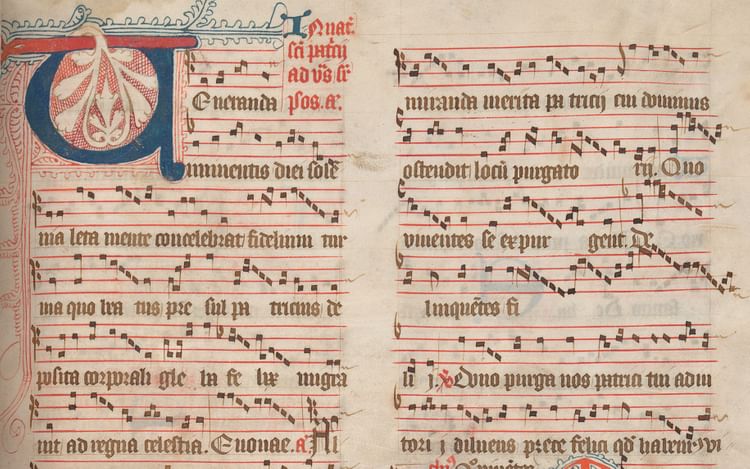
You can hear one antiphonal chant, “Magni patris/Mente mundi,” from the Office St. Patrick, just above. Perhaps unsurprisingly, “no other Irish saint is represented so extensively or with such variety in medieval liturgical sources,” writes Buckley. Manuscript hymns, prayers, and offices for Patrick have been found in Dublin, Oxford, Cambridge, the British Library, and “in the Vienna Schottenkloster dating from the time of its foundation by Irish Benedictine monks in the twelfth century.” (See the opening of the Office of St. Patrick, “Venerenda imminentis,” from a late-15th century manuscript, at the top.)
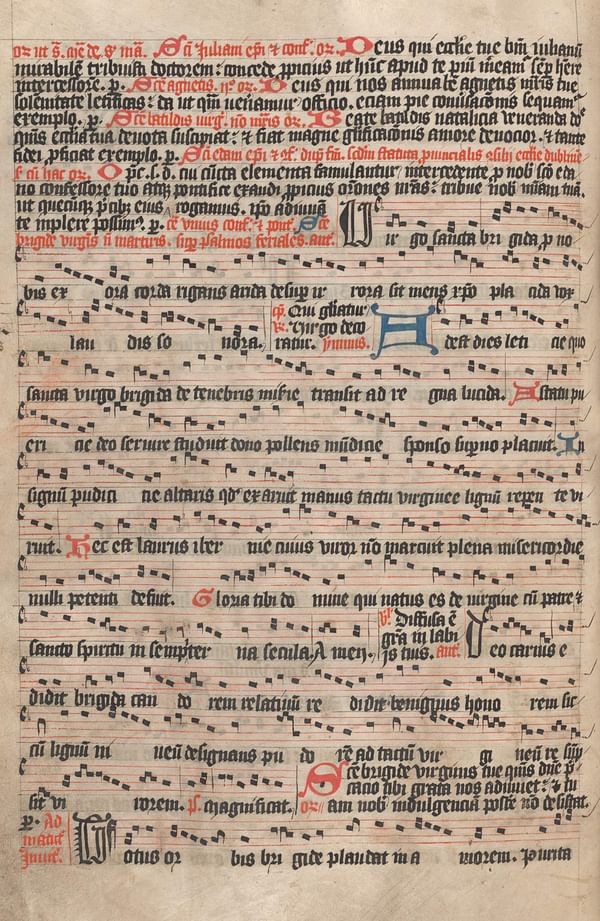
Other saints represented in the archival material include Brigit, Colmcille, Columbanus, Canice, Declan, Ciaran, Finian, and Laurence O’Toole. The missionary monks all received their own “offices,” liturgical ceremonies performed on their feast days. Many of the manuscripts, such as the opening of the Office of St. Brigit, above, contain musical notation, allowing musicologists like Buckley to recreate the sound of Irish Catholicism as it existed in Ireland, Britain, and Continental Europe several hundred years ago.
The project is developing a digital archive of such recordings, as well as “a fully searchable database,” Medievalists.net notes, with “interactive maps showing the geographical distribution of the cults of Irish saints across Europe, and of the libraries where the manuscripts are now housed. A series of documentary films is also envisaged.” You don’t have to be a specialist in the history of the Irish Church, or an Irish Catholic, for that matter, to get excited about the many ways such a rich resource will bring this medieval history to new life.
Related Content:
The Medieval Masterpiece, the Book of Kells, Is Now Digitized & Put Online
Josh Jones is a writer and musician based in Durham, NC. Follow him at @jdmagness
Read More...Bob Marley’s Redemption Song Finally Gets an Official Video: Watch the Animated Video Made Up of 2747 Drawings
Whoever Bob Marley was singing for, it could sound like he’s singing for all of us. Of course, this is received opinion, on the other side of almost 50 years of Marley worship since the Wailers crossed over to a rock audience with Catch a Fire and Clapton’s cover of “I Shot the Sheriff.” Calling Marley an icon is perhaps ironically accurate in ways he would never condone. In death he has become a brand.
Though he wrote some beautiful love songs, Marley also didn’t water down his message to Rastafarian true believers, nor temper his pan-Africanism for scores of new white fans when fame struck. Like the waves of reggae bands that broke into the international scene in the 70s, the cultural particularities of Marley’s religion and politics didn’t seem much hindrance to his wide appeal.
Proof is in the listening, and no song in the Marley oeuvre seems more pointedly directed to the historic black experience—even quoting Marcus Garvey—while also appealing to universal sentiments, than “Redemption Song.” (To very different emotional effect, U2’s “Sunday Bloody Sunday” comes to mind as accomplishing a similar feat.)
The song telegraphs a kind of wise but tender strength, announces its intentions with confident candor, and invites its listeners, all of them, to join in. The references may not be part of your experience, but if this can be redeemed, Marley suggests, maybe everything can.
In its essentials, “Redemption Song” is classic Marley—tough-minded but gentle, hopeful but real, and pure melodic genius. But musically, it’s a significant departure, and perhaps a knowing farewell to the world, as the last song to appear on the Wailers’ twelfth and final album, 1980’s Uprising,
“While there’s no indication that Marley knew for sure that the song would be his last recorded document,” writes Jim Beviglia at American Songwriter, “the contemplative mood of Uprising and the fact that he had been battling the cancer for years seems to suggest that he knew the end was near.”
The song’s “empathetic strains and social concerns, along with its campfire sing-along quality,” has made it a favorite to cover almost since its release. Now, in its 40th year anniversary, it’s finally got a proper video, thanks to French artists Octave Marsal and Theo De Gueltzl. The “breathtaking animation,” notes Twisted Sifter, features “2,747 original drawings” and “uses powerful symbols to amplify the magnitude of the song’s timeless lyrics and importance in today’s world.”
Its black and white imagery directly references the Rastafarian themes and Middle Passage experience in Marley’s lyrics, but pulls back now and then to show his stadium-sized crowds, and the whole Earth, as if to say, “this is a global story.” The video is the first in a year-long celebration of Marley’s 75th birthday, which would have been February 6th, 2020. Learn more about upcoming events here.
Related Content:
Johnny Cash & Joe Strummer Sing Bob Marley’s “Redemption Song” (2002)
Bob Marley, The Legend, Live in Santa Barbara: Watch the Complete 1979 Concert
Video: Bob Marley Plays a Big Soccer Match in Brazil, 1980
Josh Jones is a writer and musician based in Durham, NC. Follow him at @jdmagness
Read More...Bertrand Russell’s Prison Letters Are Now Digitized & Put Online (1918 — 1961)
Boethius, Henry David Thoreau, Antonio Gramsci, Martin Luther King, Jr…. It’s possible, if one tried, to draw other comparisons between these disparate figures, but readers familiar with the work of all four will immediately recognize their most obvious literary commonality: all wrote some of their most impassioned and persuasive work while unjustly confined to a cell.
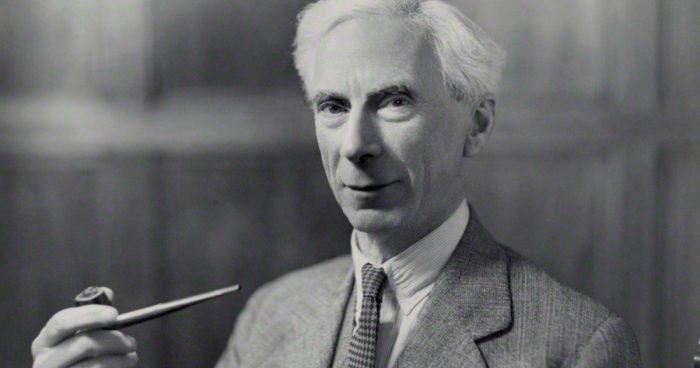
In the case of Bertrand Russell, however, perhaps one of the most famous figures in 20th century philosophy and intellectual life more generally, periods of incarceration in Brixton prison in 1918 and, forty-three years later, in 1961, play a minimal role in the larger drama of his writing life, despite the fact that he did a good deal of writing, including some significant philosophical work, behind bars.
Even scholars well-read in Russell’s work may have little knowledge of his prison writing, and for good reason: most of it has been inaccessible. “Now, for the first time,” writes Erica Balch at McMaster University’s Brighter World blog, “Russell’s prison letters—part of McMaster’s Bertrand Russell Archives—are being made available online through a new digitization project developed by the Bertrand Russell Research Centre. Complete with detailed annotations and fully searchable text, the project is providing scholars from around the world with access to these rarely seen materials.”
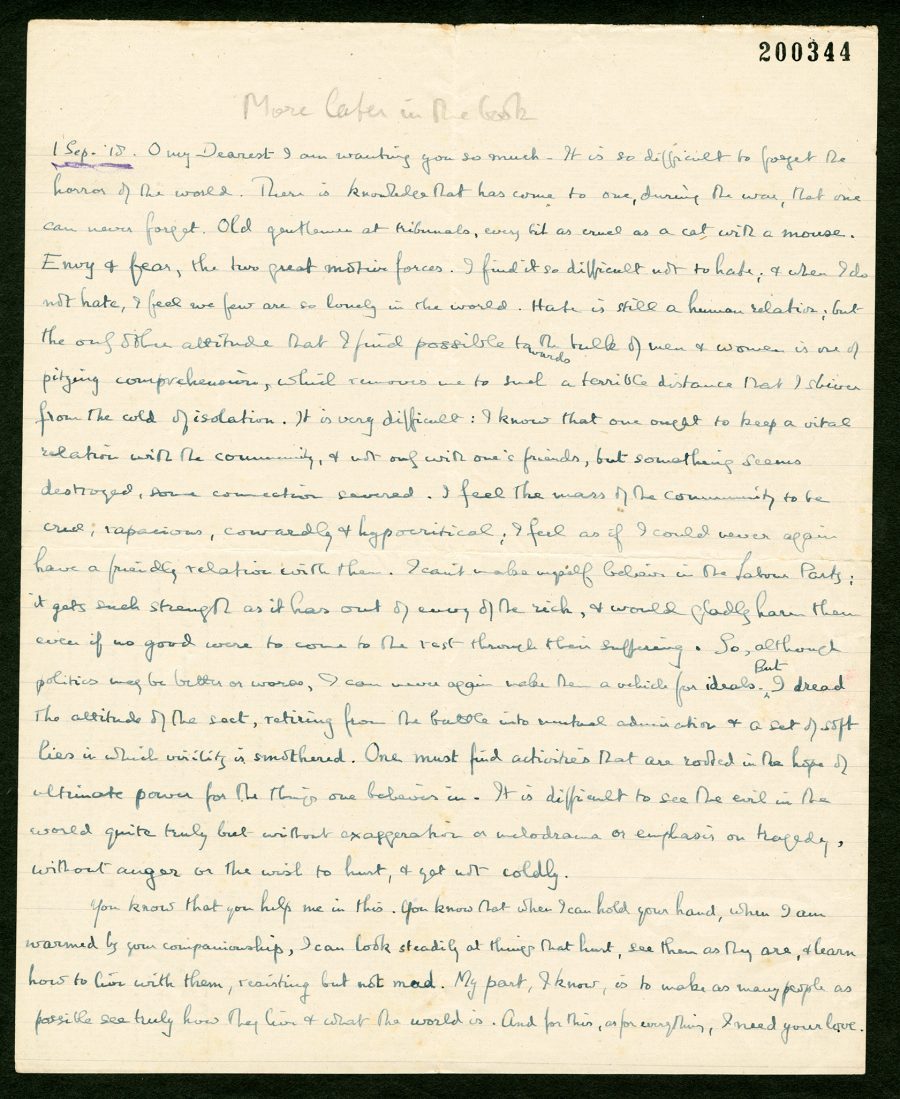
The contents of the letters reveal other reasons that Russell’s prison writing isn’t better known. He did plenty of impassioned and persuasive writing for the public outside of a prison cell—publishing fiery books, essays, and lectures against war and propaganda and in defense of free thought throughout his life. Behind bars, however, Russell’s writing turned almost solely professional and personal, in letters addressed primarily to “his then lover Lady Constance Malleson (known as ‘Colette’) and his former lover, aristocrat and socialite Lady Ottoline Morrell.”
The 105 letters “reveal the private thoughts of one of the 20th century’s most public figures and provide an interesting window on Russell’s inner life,” says Andrew Bone, Senior Research Associate at McMaster’s Bertrand Russell Research Centre. Most of the letters “were written in secret,” Balch notes, “and smuggled out of Brixton by Russell’s friends, concealed between the uncut pages of books.” Russell was only allowed one letter per week; officially sanctioned correspondence is written on prison stationary and bears the Brixton governor’s initials.
A lifelong pacifist, Russell was first jailed for six months in 1918 for a speech opposing U.S. entry into World War I. “I found prison in many ways quite agreeable,” he later wrote in his autobiography. “I had no engagements, no difficult decisions to make, no fear of callers, no interruptions to my work. I read enormously; I wrote a book, ‘Introduction to Mathematical Philosophy’… and began the work for ‘Analysis of Mind,’” a project that never reached fruition. In 1961, at age 89, he was jailed for seven days for participating in a London anti-nuclear demonstration.
During his first stay as a prisoner of Brixton’s “first division,” Russell was “allowed to furnish his cell, wear civilian clothes, purchase catered food, and most importantly, be exempted from prison work while he pursued his profession as an author,” as the Bertrand Russell Research Centre points out. It’s little wonder he looked forward to the experience as a “holiday from responsibility,” he wrote in a letter to his brother, Frank, four days after he began his sentence.
Russell may not have suffered—or acquired a heightened sense of political urgency—while behind bars (at one point he was heard laughing out loud and had to be reminded by the warden that “prison is a place of punishment”). But his prison letters offer significant insight into not only the deeply emotional relationships he had with Malleson and Morrell, but also his relationship with other members of the famous Bloomsbury group and “literary celebrities such as D.H. Lawrence, and T.S. Eliot,” writes Balch, “many of whom are referenced in the letters.”
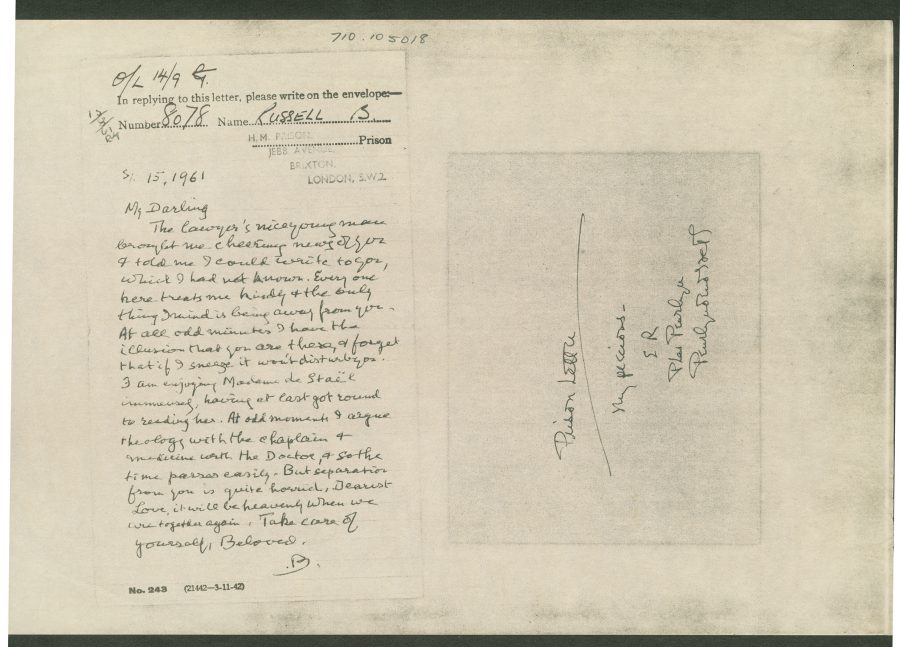
The 104 letters from 1918, including Russell’s correspondence with his brother, his publisher, The Nation magazine and others, are all available in original scans with transcriptions and annotations at the McMaster University Bertrand Russell Research Centre site. The final letter, number 105, the sole piece of correspondence from Russell’s weeklong stay in Brixton in 1961, is addressed to his wife Edith.
My Darling,
The lawyer’s nice young man brought me cheering news of you and told me I could write to you, which I had not known. Every one here treats me kindly and the only thing I mind is being away from you. At all odd minutes I have the illusion that you are there, and forget that if I sneeze it won’t disturb you. I am enjoying Madame de Staël immensely, having at last got round to reading her. At odd moments I argue theology with the chaplain and medicine with the Doctor, and so the time passes easily. But separation from you is quite horrid, Dearest Love, it will be heavenly when we are together again. Take care of yourself, Beloved.
B.
As in most of the earlier letters, Russell avoids politics and keeps things personal. But as in nearly all of his writing, the prose is lively, evocative, and poignant, revealing much about the personality behind it. While these letters may never achieve the status of great literature, by virtue of their private nature and their minor role in Russell’s major canon, that does not mean they aren’t a joy to read, for students of Bertrand Russell and anyone else who appreciates the workings of a brilliant philosophical and ethical mind. Enter the Brixton Letter archive here.
Related Content:
Bertrand Russell Authority and the Individual (1948)
Josh Jones is a writer and musician based in Durham, NC. Follow him at @jdmagness
Read More...Watch the Grateful Dead Slip Past Security & Play a Gig at Columbia University’s Anti-Vietnam Protest (1968)
In 1968, the Vietnam War was not a catalyst for protests but a sort of nexus for all other injustices–the part contained elements of the whole: racism, class war, capitalist profiteering, imperialism. It was symptom and cause, much like climate change feels today. In April of that year, one inflection point happened on New York’s Columbia University campus.
The University wanted to build a military gym, not on campus, but in Morningside Park, a public space that bordered on Harlem. The student body immediately protested the construction. For one thing, it was planned to feature one entrance for students and faculty, and another entrance in the basement for Harlem’s mostly African-American residents. Protestors saw this, and the displacement of black residents from their neighborhood park, as racist. The Student Afro-American Society (SAS) of the University nicknamed it “Gym Crow.” At the same time, another activist group, the Students for a Democratic Society, discovered links between the University and the Department of Defense. The two events were separate, but stood for a bigger problem.
Students staged protests, sit-ins, and generally disrupted the University, vowing to continue until their demands were met–specifically divestment in the war machine and halting construction of the gym. Things got so bad, with some 148 injuries and 372 reports of police brutality from New York’s Finest, that the University went into lockdown.
That was April. On May 3, enter the Grateful Dead. Still a young band, the Dead were comparatively unknown on the East Coast, but set out to support the students with a free concert. What you see above is one of the few reels of footage of the illegal gig, with music from earlier gigs used over the silent footage. No sound recording exists of this event, but the uploader seems to think “The Eleven” was part of the set.
Mickey Hart, who had only recently joined the band as a second drummer, recalled how they made their way onto the campus:
[Grateful Dead manager] Rock [Scully] reached out to the strike organizers and offered to do a free show for the students. Always up for an adventure, we of course, went right along. Since the police and guards were closing off access to the majority of the campus – we were “smuggled” on campus to Low Library Plaza in the back of a bread delivery truck. Equipment and all. We were already jamming away before the security and police could to stop us.
This other footage shows more context–shots of Morningside Park, the protests, the police response, the sit-ins, a chalk noticeboard featuring messages from the outside to the students–all truly a time capsule. One YouTube commenter says he was there:
They set up on the porch of Ferris Booth Hall, which was the student union, in effect. A small crowd gathered; the Dead were not widely known yet in New York. I had a nice chat with Garcia [while] they were setting up. They started to play, but someone from the administration cut the power, which was not received favorably by the students. After some brief negotiating — someone pointed out that legally Ferris Booth Hall was owned by the students and does the university really need another riot — the power was turned back on and the show continued.
In the end, the student protests continued right through graduation–students held their own ceremony off campus–but they worked. The gym was not built and the University broke off its work with the DoD.
Flash forward to 2019 and it’s all coming around again: students and faculty demanded the University divest from all fossil fuels, in support of the Extinction Rebellion hunger strikers. As of this writing (February 2020), the University is still mulling it over. (No free concerts have been announced either…yet.)
Related Content:
Ted Mills is a freelance writer on the arts who currently hosts the artist interview-based FunkZone Podcast and is the producer of KCRW’s Curious Coast. You can also follow him on Twitter at @tedmills, read his other arts writing at tedmills.com and/or watch his films here.
Read More...Explore Ancient Athens 3D, a Digital Reconstruction of the Greek City-State at the Height of Its Influence
Today any of us can go Athens, a city with flavorful food, pleasant weather, a picturesque setting, reasonable prices, and a decent subway system. That is to say, we can enjoy Athens as it is, but what about Athens as it was? As one of the oldest cities in the world, not to mention a developmental center of Western civilization itself, its history holds as much interest as its present reality. Despite all the historical research into ancient Greece, we lack a fully accurate image of what Athens looked and felt like at the height of its power as a city-state. But thanks to the last dozen years of work by photographer and visual effects artist Dimitris Tsalkanis, we can experience Athens as it might have been in the form of Ancient Athens 3D.
“Visitors to the site can browse reconstructions that date back as early as 1200 BCE, the Mycenaean period — or Bronze Age — through Classical Athens, featuring the rebuilds made necessary by the Greco-Persian War, and ages of occupation by Romans and Ottomans,” writes Hyperallergic’s Sarah Rose Sharp.
“Tsalkanis traces the evolution of sites like the Acropolis throughout the ages, the rise and fall of the city walls, the Agora, which served as center of city life, and various temples, libraries, and other fortifications.” All we might see only as monochromatic ruins on our modern Athenian travels stands tall and colorful in Tsalkanis’ three-dimensional digital recreation — as does all that hasn’t survived even as ruins.
Tsalkanis writes of using “artistic license” to reconstruct “monuments that have left few or no traces at all (like the Mycenaean palace of the Acropolis) and other complementary constructions — such as houses — that were incorporated into the render in order to create a more complete image of the monument and its space.” Though he draws on all the historical and archaeological information he can find, much of that information remains sketchy, or at least incomplete. Fortunately, the digital nature of the project, as well as its accessibility to viewers with knowledge of their own to offer, keeps it more or less current with the state of the research. “Tsalkanis stays up to date with his fantasy city,” writes Sharp, “updating reconstructions constantly for better quality of models and better archaeological and historical accuracy.
“You can immerse into this environment,” Tsalkanis tells Sharp, “or you can even 3D print it if you like.” You can also view the individual digital reconstruction videos posted to Ancient Athens 3D’s Youtube channel, which showcase such monuments as the Temple of Ilissos, the Temple of Hephaestus, and the city of Delphi. Just as Tsalkanis’ historical models of Athens will continue to be filled in, expanded, and improved, the technological range of their possible uses will only expand. Tsalkanis himself mentions the smartphone apps that could one day enrich our visits to Athens with augmented reality — allowing us, in other words, to experience Athens as it is and Athens as it might have been, both at the same time.
via Hyperallergic
Related Content:
The Ancient Greeks: A Free Online Course from Wesleyan University
The History of Ancient Greece in 18 Minutes: A Brisk Primer Narrated by Brian Cox
Introduction to Ancient Greek History: A Free Course from Yale
How Ancient Greek Statues Really Looked: Research Reveals their Bold, Bright Colors and Patterns
Watch Art on Ancient Greek Vases Come to Life with 21st Century Animation
Based in Seoul, Colin Marshall writes and broadcasts on cities, language, and culture. His projects include the book The Stateless City: a Walk through 21st-Century Los Angeles and the video series The City in Cinema. Follow him on Twitter at @colinmarshall or on Facebook.
Read More...The New York Public Library Creates a List of 125 Books That They Love
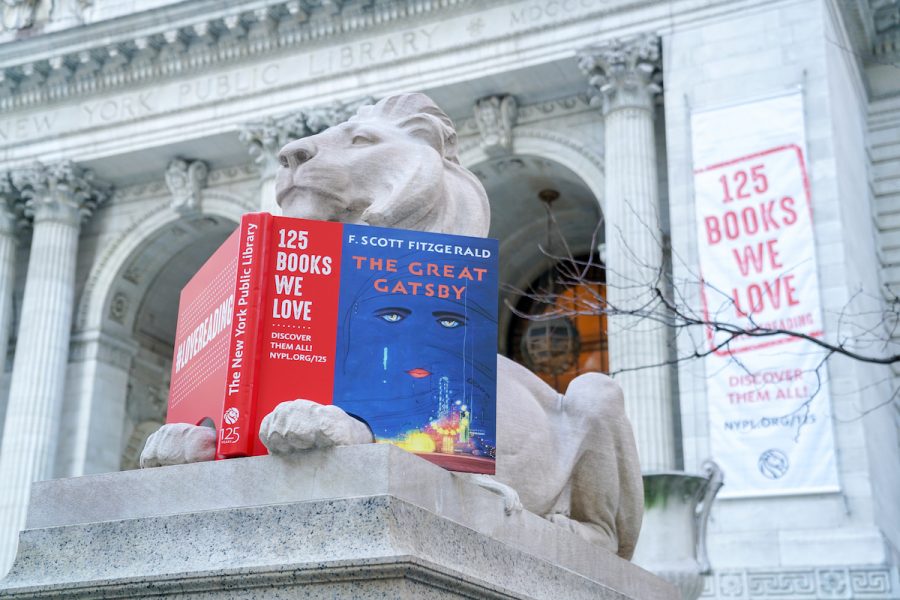
The New York Public Library sure knows how to celebrate a quasquicentennial. In honor of its own 125th anniversary, it’s rolling out a number of treats for patrons, visitors, and those who must admire it from afar.
In addition to the expected author talks and live events, Patience and Fortitude, the iconic stone lions who flank the main branch’s front steps, are displaying some reading material of their own—Toni Morrison’s 1987 novel Beloved and F. Scott Fitzgerald’s Jazz Age classic The Great Gatsby, from 1925.
Donors who kick in $12.50 or more to help the library continue providing such public services as early literacy classes, free legal aid, and job training courses will be rewarded with a cheerful red sticker bearing the easy to love slogan “♥ reading.”
The cover image of Ezra Jack Keats’ 1962 Caldecott Award-winning picture book The Snowy Day, which at 485,583 checkouts holds the title for most popular book in the circulating collection, graces special edition Library and MetroCards.
And a team of librarians drew up a list of 125 books from the last 125 years that inspire a lifelong love of reading.
The list is deliberately inclusive with regard to authors’ gender, race, and sexual orientation as well as literary genre. In addition to novels and non-fiction, you’ll find memoir, poetry, fantasy, graphic novels, science fiction, mystery, short stories, humor, and one children’s book, Harry Potter and the Sorcerer’s Stone, which the judges decided “transcends age categories.” (A similar list geared toward younger readers will be released later this year.)
The list was drawn from a pool containing anything published after May 23rd, 1895, the day attorney John Bigelow’s plan to combine the resources of the Astor and Lenox libraries and the Tilden Trustin into The New York Public Library was officially incorporated.
The selection criteria can be viewed here.
Obviously, the list—and any perceived omissions—will generate passionate debate amongst book lovers, a prospect the library relishes, though it’s enlisted one of its most ardent supporters, author Neil Gaiman, whose American Gods made the final cut, to remind any disgruntled readers of the spirit in which the picks were made:
The New York Public Library has put together a list of 125 books that they love—the librarians and the people in the library. That’s the criteria. You may not love them, but they do. And that’s exciting. The thing that gets people reading is love. The thing that makes people pick up books they might not otherwise try, is love. It’s personal recommendations, the kind that are truly meant. So here are 125 books that they love. And somewhere on this list you will find books you’ve never read, but have always meant to, or have never even heard of. There are 125 chances here to change your own life, or to change someone else’s, curated by the people from one of the finest libraries in the world. Read with joy. Read with love. Read!
To really get the most out of the list, tune in to the NYPL’s The Librarian Is In podcast, which will be devoting an episode to one of the featured titles each month.
The current episode kicks things off with co-hosts Frank Collerius and Rhonda Evans’ favorites from the list:
Maus by Art Spiegelman
Beloved by Toni Morrison
Invisible Man by Ralph Ellison
The Haunting of Hill House by Shirley Jackson
The House of Mirth by Edith Wharton
Harry Potter and the Sorcerer’s Stone by J.K. Rowling
In Cold Blood by Truman Capote
Their Eyes Were Watching God by Zora Neale Hurston
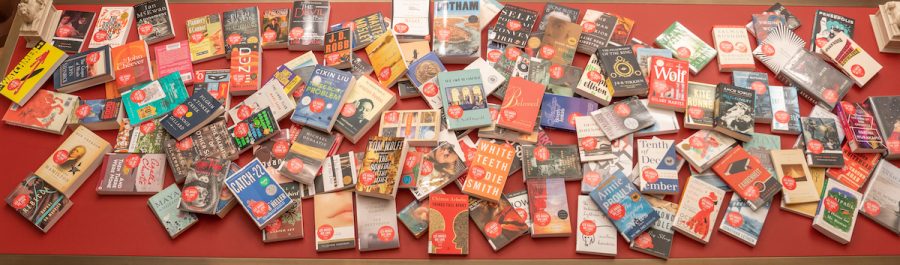
Readers, have a look at the complete list of the New York Public Library’s 125 Books for Adult Readers, and leave us a comment to let us know what titles you wish had been included. Or better yet, tell us which as-yet unread title you’re planning to read in honor of the New York Public Library’s 125th year:
George Orwell, 1984
Saul Bellow, The Adventures of Augie March
W.H. Auden, The Age of Anxiety
Ron Chernow, Alexander Hamilton
Erich Maria Remarque, All Quiet on the Western Front
James Patterson, Along Came a Spider
Michael Chabon, The Amazing Adventures of Kavalier & Clay
Neil Gaiman, American Gods
Mary Oliver, American Primitive
Agatha Christie, And Then There Were None
Maggie Nelson, The Argonauts
Sylvia Plath, Ariel
Ian McEwan, Atonement
Anne Carson, Autobiography of Red
Toni Morrison, Beloved
Raymond Chandler, The Big Sleep
Tom Wolfe, The Bonfire of the Vanities
Evelyn Waugh, Brideshead Revisited
Colm Tóibín, Brooklyn
Joseph Heller, Catch-22
J.D. Salinger, The Catcher in the Rye
Claudia Rankine, Citizen
Stacy Schiff, Cleopatra
David Mitchell, Cloud Atlas
Langston Hughes, The Collected Poems of Langston Hughes
Terry Pratchett, The Color of Magic
Alice Walker, The Color Purple
Walter Mosley, Devil in a Blue Dress
Erik Larson, The Devil in the White City
Frank Herbert, Dune
Michael Ondaatje, The English Patient
Alyssa Cole, An Extraordinary Union
Ray Bradbury, Fahrenheit 451
J.R. R. Tolkien, The Fellowship of the Ring
N.K. Jemisin, The Fifth Season
Alison Bechdel, Fun Home
George R. R. Martin, A Game of Thrones
James Baldwin, Giovanni’s Room
Arundhati Roy, The God of Small Things
Flannery O’Connor, A Good Man is Hard to Find
Edwin G. Burrows and Mike Wallace, Gotham
John Steinbeck, The Grapes of Wrath
F. Scott Fitzgerald, The Great Gatsby
Margaret Atwood, The Handmaid’s Tale
J.K. Rowling, Harry Potter and the Sorcerer’s Stone
Shirley Jackson, The Haunting of Hill House
Carson McCullers, The Heart Is a Lonely Hunter
Dave Eggers, A Heartbreaking Work of Staggering Genius
Douglas Adams, The Hitchhiker’s Guide to the Galaxy
Arthur Conan Doyle, The Hound of the Baskervilles
V.S. Naipaul, A House for Mr. Biswas
Edith Wharton, The House of Mirth
Marilynne Robinson, Housekeeping
Allen Ginsberg, Howl
Maya Angelou, I Know Why the Caged Bird Sings
Truman Capote, In Cold Blood
Beverly Jenkins, Indigo
Jhumpa Lahiri, Interpreter of Maladies
Jon Krakauer, Into Thin Air
Ralph Ellison, Invisible Man
Gore Vidal, Julian
Khaled Hosseini, The Kite Runner
Ursula K. Le Guin, The Left Hand of Darkness
Mary Karr, The Liars’ Club
Kate Atkinson, Life After Life
Tracy K. Smith, Life on Mars
Vladimir Nabokov, Lolita
Art Spiegelman, Maus
David Sedaris, Me Talk Pretty One Day
John Berendt, Midnight in the Garden of Good and Evil
Salman Rushdie, Midnight’s Children
Martin Amis: Money
Michael Lewis: Moneyball
Jonathan Lethem, Motherless Brooklyn
Virginia Woolf, Mrs. Dalloway
Elena Ferrante, My Brilliant Friend
J.D. Robb, Naked in Death
Richard Wright, Native Son
Elizabeth Strout, Olive Kitteridge
Jack Kerouac, On the Road
Gabriel García Márquez, One Hundred Years of Solitude
Jeanette Winterson, Oranges Are Not the Only Fruit
Adam Johnson, The Orphan Master’s Son
Per Petterson, Out Stealing Horses
Octavia E. Butler, Parable of the Sower
Marjane Satrapi, Persepolis
Annie Dillard, Pilgrim at Tinker Creek
Philip Roth, Portnoy’s Complaint
Graham Greene, The Quiet American
Daphne du Maurier, Rebecca
Kazuo Ishiguro, The Remains of the Day
Louise Erdrich, The Round House
Amor Towles, Rules of Civility
Alice Munro, Runaway
John Ashbery, Self-Portrarit in a Convex Mirror
Stephen King, The Shining
Annie Proulx, The Shipping News
Rachel Carson, Silent Spring
Nalini Singh, Slave to Sensation
Joan Didion, Slouching Towards Bethlehem
Leslie Feinberg, Stone Butch Blues
John Cheever, The Stories of John Cheever
Albert Camus, The Stranger
Ernest Hemingway, The Sun Also Rises
Patricia Highsmith, The Talented Mr. Ripley
George Saunders, Tenth of December
Zora Neale Hurston, Their Eyes Were Watching God
Chinua Achebe, Things Fall Apart
Cixin Liu, The Three-Body Problem
Harper Lee, To Kill a Mockingbird
Denis Johnson, Train Dreams
Henry James, The Turn of the Screw
Milan Kundera, The Unbearable Lightness of Being
Colson Whitehead, The Underground Railroad
Joseph Mitchell, Up in the Old Hotel
Jeffrey Eugenides, The Virgin Suicides
Jennifer Egan, A Visit from the Goon Squad
Isabel Wilkerson, The Warmth of Other Suns
Alan Moore and Dave Gibbons, Watchmen
Raymond Carver, What We Talk About When We Talk About Love
Don DeLillo, White Noise
Zadie Smith, White Teeth
Haruki Murakami, The Wind-Up Bird Chronicle
Hilary Mantel, Wolf Hall
Maxine Hong Kingston, The Woman Warrior
Via Lit Hub
Related Content:
The New York Public Library Announces the Top 10 Checked-Out Books of All Time
New York Public Library Card Now Gives You Free Access to 33 NYC Museums
Ayun Halliday is an author, illustrator, theater maker and Chief Primatologist of the East Village Inky zine. Join Ayun’s company Theater of the Apes in New York City this March for her book-based variety series, Necromancers of the Public Domain, and the world premiere of Greg Kotis’ new musical, I AM NOBODY. Follow her @AyunHalliday.
Read More...America’s First Drag Queen Was Also America’s First LGBTQ Activist and a Former Slave
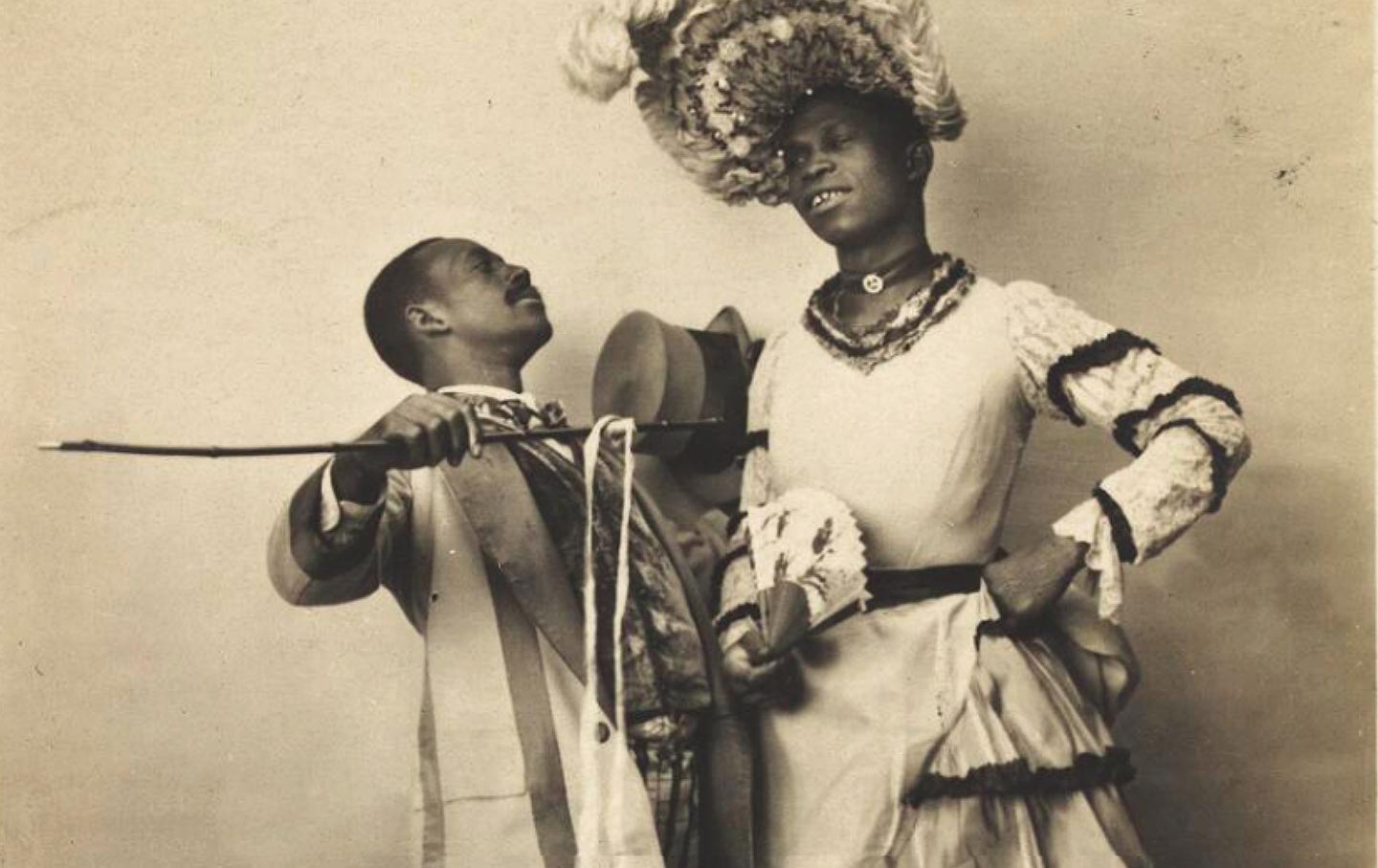
Negro Dive Raided. Thirteen Black Men Dressed as Women Surprised at Supper and Arrested. —The Washington Post, April 13, 1888
Sometimes, when we are engaged as either participant in, or eyewitness to, the making of history, its easy to forget the history-makers who came earlier, who dug the trenches that allow our modern battles to be waged out in the open.
Take America’s first self-appointed “queen of drag” and pioneering LGBTQ activist, William Dorsey Swann, born into slavery around 1858.
30 years later, Swann faced down white officers busting a drag ball in a “quiet-looking house” on Washington, DC’s F street, near 12th.
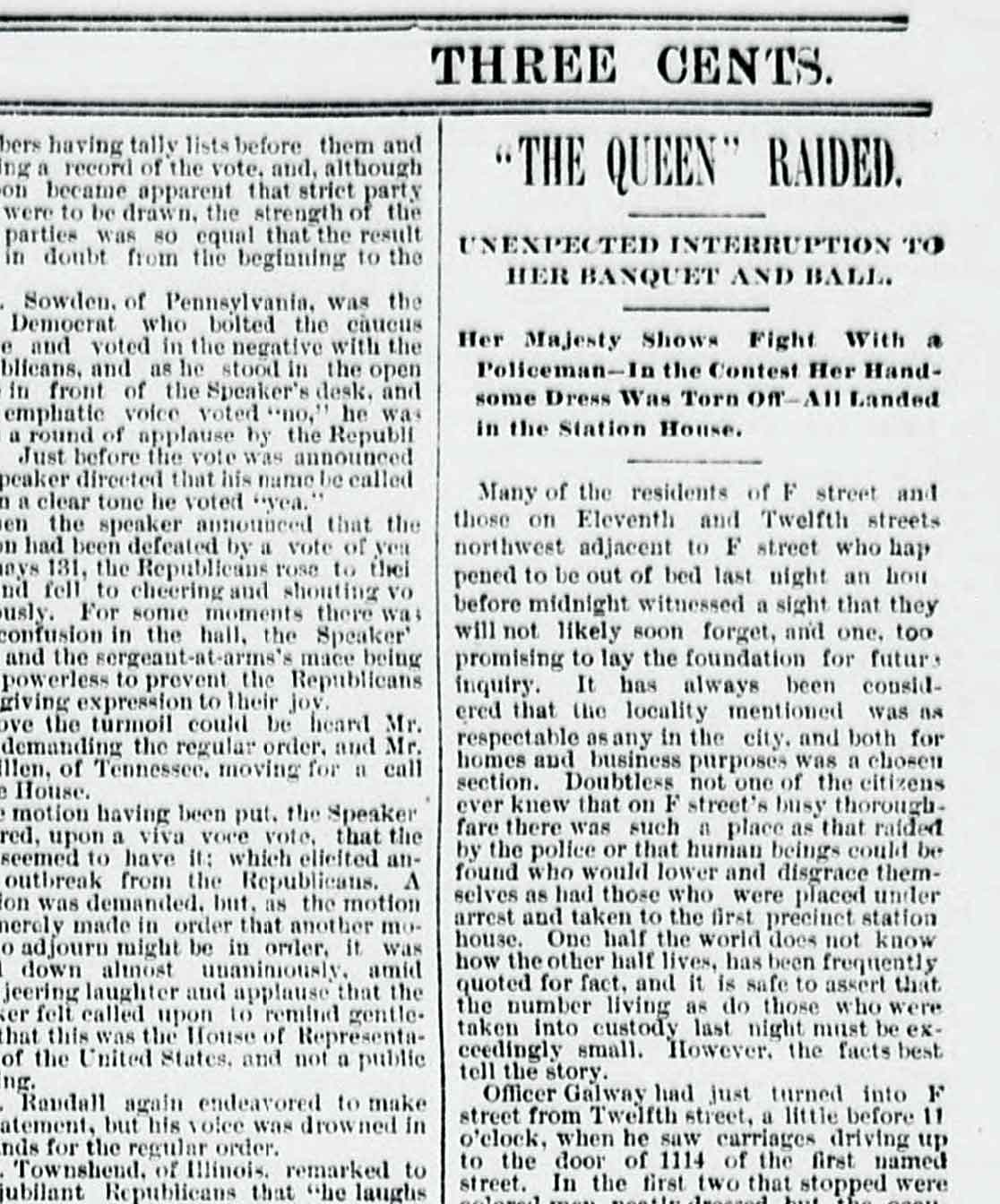
“You is no gentleman,” Swann allegedly told the arresting officer, while half the guests broke for freedom, correctly surmising that anyone who remained would see their names published in the next day’s newspaper as participants in a bizarre and unseemly ritual.
A lurid Washington Post clipping about the raid caught the eye of writer, historian, and former Oberlin College Drag Ball queen, Channing Gerard Joseph, who was researching an assignment for a Columbia University graduate level investigative reporting class:
An animated conversation, carried on in effeminate tones, was in progress as the officers approached the door, but when they opened it and the form of Lieut. Amiss was visible to the people in the room a panic ensued. A scramble was made for the windows and doors and some of the people jumped to the roofs of adjoining buildings. Others stripped off their dresses and danced about the room almost in a nude condition, while several, headed by a big negro named Dorsey, who was arrayed in a gorgeous dress of cream-colored satin, rushed towards the officers and tried to prevent their entering.
Joseph’s interest did not flag when his reporting class project was turned in. House of Swann: Where Slaves Became Queens will be published in 2021.
Meanwhile you can bone up on Swann, Swann’s jail time for running a brothel, and the Washington DC drag scene of the Swann era in Joseph’s essay for The Nation, “The First Drag Queen Was a Former Slave.”
Please note that William Dorsey Swann does not appear in the photo at the top of the page. As per Joseph:
The dancers — one in striped pants, the other in a dress — were recorded in France by Louis Lumière. Though their names are lost, they are believed to be American. In the show, they performed a version of the cakewalk, a dance invented by enslaved people, and the precursor to vogueing.
Related Content:
Before Brokeback: The First Same-Sex Kiss in Cinema (1927)
When John Waters Appeared on The Simpsons and Changed America’s LGBTQ Views (1997)
Ayun Halliday is an author, illustrator, theater maker and Chief Primatologist of the East Village Inky zine. Join Ayun’s company Theater of the Apes in New York City this March for her book-based variety series, Necromancers of the Public Domain, and the world premiere of Greg Kotis’ new musical, I AM NOBODY. Follow her @AyunHalliday.
Read More...Watch This Year’s Oscar-Winning Short The Neighbor’s Window, a Surprising Tale of Urban Voyeurism
As the last couple of generations to come of age have rediscovered, urban living has its benefits. One of those benefits is the ability to keep an eye on your neighbors — quite literally, given a situation of buildings in close proximity, sufficiently large windows, and minimal usage of drapes. Fortysomething Brooklyn couple Alli and Jacob find themselves turned into voyeurs by just such a situation in Marshall Curry’s The Neighbor’s Window, the Best Live Action Short Film at this year’s Academy Awards. “Do they have jobs, or clothes?” asks Alli, overcome by the frustration of looking after her and Jacob’s three young children. “All they do is host dance parties and sleep ’till noon and screw.”
You may recognize Maria Dizzia and Greg Keller, who play Alli and Jacob, from their appearances in Noah Baumbach’s While We’re Young. That film, too, dealt with the envy New York Gen-Xers feel for seemingly more freewheeling New York Millennials, but The Neighbor’s Window takes it in a different direction.
Curry based it on “The Living Room,” an episode of the storytelling interview podcast Love and Radio in which writer and filmmaker Diana Weipert tells of all she saw when she enjoyed a similarly clear view into the life of her own younger neighbors. “Am I supposed to have maybe respected their privacy and just looked away?” Weipert asks, rhetorically. “But it’s impossible because that’s the way the chairs face. They face the window! I couldn’t have not seen them if I wanted to.”
Then again, she adds, “I guess I could’ve not gotten the binoculars.” That irresistible detail makes it into The Neighbor’s Window as a symbol of Alli and Jacob’s surrender to their fascination with the couple across the street. “They’re like a car crash that you can’t look away from,” as Alli puts it. “Okay, a beautiful, sexy, young car crash.” Yet both she and her husband, like any human beings with a partial view of other human beings, can’t help but compare their circumstances unfavorably with those seen from afar. Eventually, as in “The Living Room,” the twentysomethings experience a reversal of fortune, changing Alli and Jacob’s view of them. They also regain the view of themselves they’d lost amid all their voyeurism — enough of it to make them forget that the observers can also be observed.
The Neighbor’s Window will be added to our collection, 4,000+ Free Movies Online: Great Classics, Indies, Noir, Westerns, Documentaries & More.
Related Content:
Father and Daughter: An Oscar-Winning Animated Short Film
The Last Farm: An Oscar Nominated Short Film
Based in Seoul, Colin Marshall writes and broadcasts on cities, language, and culture. His projects include the book The Stateless City: a Walk through 21st-Century Los Angeles and the video series The City in Cinema. Follow him on Twitter at @colinmarshall or on Facebook.
Read More...How the Brooklyn Bridge Was Built: The Story of One of the Greatest Engineering Feats in History
When Emily Roebling walked across the Brooklyn Bridge on May 24th, 1883, the first person to cross its entire span, she capped a family saga equal parts triumph and tragedy, a story that began sixteen years earlier when her father-in-law, German-American engineer John Augustus Roebling, began design work on the bridge. Roebling had already built suspension bridges over the Monongahela River in Pittsburgh, the Niagara River between New York and Canada, and over the Ohio River between Cincinnati and Covington, Kentucky. But the bridge over the East River was to be something else entirely. As Roebling himself said, it “will not only be the greatest bridge in existence, but it will be the greatest engineering work of the continent, and of the age.”
New York City officials may have had little reason to think so in the mid-1860s. “Suspension bridges were collapsing all across Europe,” notes the TED-Ed video above by Alex Gendler. “Their industrial cables frayed during turbulent weather and snapped under the weight of their decks.” But the overcrowding city needed relief. An “East River Bridge Project” had been in the works since 1829 and was seen as more necessary with each passing decade. Despite their misgivings, the authorities were willing to trust Roebling with a hybrid design that combined methods used by both suspension and cable-stayed bridges. Two years later, he was dead, the result of a tetanus infection contracted after he lost several toes in a dock accident.
Roebling’s son Washington, a civil engineer who had fought for the Union Army at the Battle of Gettysburg, took over the project, only to suffer from paralysis after he got the bends while trapped inside a caisson in 1870. For the remainder of the bridge’s construction, he would advise from his bedroom, relaying instructions through his wife Emily—who became after a time the bridge’s de facto chief engineer. She “studied mathematics, the calculations of catenary curves, strengths of materials and the intricacies of cable construction,” writes Emily Nonko at 6sqft. She knew the bridge so well that “many were under the impression she was the real designer.”
“1.5 times longer than any previously built suspension bridge,” the video lesson notes, Roebling’s design worked because it used steel cables instead of hemp, with towers rising over 90 meters (295 feet) above sea level. This is almost three times higher than editors at the New York Mirror projected in 1829, when they called the brand new “East River Bridge Project” an “absurd and ruinous” proposition. “Who would mount over such a structure, when a passage could be effected in a much shorter time, and that, too, without exertion or trouble, in a safe and well-sheltered steamboat?”
Just six days after Emily Roebling crossed the newly opened Brooklyn Bridge, a stampede killed twelve people, and months later, P.T. Barnum led 21 elephants over the bridge to prove its safety. Who would cross such a structure? It turned out, for better or worse, anyone and everyone would drive, walk, run, subway, bike, scoot, climb up, leap from, and otherwise “mount over” the East River by way of the neo-gothic wonder (and later its much uglier sibling, the Manhattan Bridge). Learn much more in the short lesson above how John A. Roebling’s bombastic claims about his design were not far off the mark, and why the Brooklyn Bridge is one of the greatest engineering feats in modern history.
Related Content:
A Mesmerizing Trip Across the Brooklyn Bridge: Watch Footage from 1899
An Online Gallery of Over 900,000 Breathtaking Photos of Historic New York City
Immaculately Restored Film Lets You Revisit Life in New York City in 1911
Josh Jones is a writer and musician based in Durham, NC. Follow him at @jdmagness
Read More...Robin Williams’ Celebrity Struggles: A Discussion with Dave Itzkoff by Pretty Much Pop: A Culture Podcast (ep. 31)
New York Times culture reporter Dave Itzkoff joins your hosts Mark Linsenmayer, Erica Spyres, and Brian Hirt to consider issues raised by Dave’s 2018 biography Robin: How do we make sense of our strange relation to celebrities, and what are strategies that celebrities use to deal with their asymmetric relationship to the world? While Robin Williams tried, in gratitude, to share himself with his fans, and was very anxious about letting us all down when some of his later work didn’t garner the widespread praise he was used to, someone like Joaquin Phoenix takes a much more seemingly detached attitude, keenly aware of the absurdity of the celebrity-audience relation.
We also talk to Dave about interview technique and the different attitudes that his subjects take toward him. Can an interview be something that has intrinsic value and not just parasitic on popular media?
For more about Robin, Dave participated in a recent podcast called Knowing: Robin Williams, which was created in part to support Dave’s book (which some of us read for this episode; it’s really good). HBO also recently released the documentary Come Inside My Mind that relates much of the same story.
For more on Joaquin Phoenix, read Dave’s interview, this 2017 Times article by Bret Easton Ellis, or this Guardian article on I’m Still Here.
Read Dave’s interviews at nytimes.com/by/dave-itzkoff or follow him @ditzkoff.
This episode includes bonus discussion that you can only hear by supporting the podcast at patreon.com/prettymuchpop. This podcast is part of the Partially Examined Life podcast network.
Pretty Much Pop: A Culture Podcast is the first podcast curated by Open Culture. Browse all Pretty Much Pop posts or start with the first episode.
Read More...Support Us
We're hoping to rely on loyal readers, rather than erratic ads. Please click the Donate button and support Open Culture. You can use Paypal, Venmo, Patreon, even Crypto! We thank you!

About Us

Open Culture scours the web for the best educational media. We find the free courses and audio books you need, the language lessons & educational videos you want, and plenty of enlightenment in between.
Advertise With Us

FREE UPDATES!
GET OUR DAILY EMAIL
Get the best cultural and educational resources on the web curated for you in a daily email. We never spam. Unsubscribe at any time.
FOLLOW ON SOCIAL MEDIA

Open Culture editor Dan Colman scours the web for the best educational media. He finds the free courses and audio books you need, the language lessons & movies you want, and plenty of enlightenment in between.
Advertise With Us

