Quentin Tarantino’s Once Upon a Time… In Hollywood Examined on Pretty Much Pop #12

Wes Alwan, who co-hosts The Partially Examined Life philosophy podcast with PMP host Mark Linsenmayer, joins the discussion along with PMP co-hosts Erica Spyres and Brian Hirt to discuss Quentin Tarantino’s Once Upon a Time… In Hollywood in the context of Tarantino’s other films.
Wes thinks the film is brilliant, even though he’s not otherwise a Tarantino fan. How is this film different? We consider T’s strange sense of pacing, his comic violence, his historical revisionism, and casting choices. Is this a brilliant film or a fundamentally misguided idea badly in need of an editor?
Some articles we drew on:
- “On the Troubling Subtext of Once Upon a Time in Hollywood” by Jen Chaney
- “A Battle For Creative Freedom: Why The Tarantino Backlash Is Bad For Hollywood” by Travis Bean
- “Tarantino’s Gruesome Revenge Fantasies Are Growing More Puerile and Misogynistic” by Casper Salmon
Wes is working on a very long essay on this film that isn’t yet complete, but he’s written plenty of other long essays about the media and has recorded several episodes of his own PEL spin-off show, (sub)Text: Get it all here.
This episode includes bonus discussion that you can only hear by supporting the podcast at patreon.com/prettymuchpop. This podcast is part of the Partially Examined Life podcast network.
Pretty Much Pop is the first podcast curated by Open Culture. Browse all Pretty Much Pop posts or start with the first episode.
Read More...An Animated Michael Sandel Explains How Meritocracy Degrades Our Democracy
Imagine if governments and institutions took their policy directives straight from George Orwell’s 1984 or Jonathan Swift’s “A Modest Proposal.” We might veer distressingly close to many a literary dystopia in these times, with duckspeak taking over all the discourse. But some lines—bans on thinking or non-procreative sex, or seriously proposing to eat babies—have not yet been crossed.
When it comes, however, to meritocracy—a term that originated in a 1958 satirical dystopian novel by British sociologist Michael Young—it can seem as if the political class had taken fiction as manifesto. Young himself wrote in 2001, “much that was predicted has already come about. It is highly unlikely the prime minister has read the book, but he has caught on to the word without realizing the dangers of what he is advocating.”
In Young’s historical analysis, what began as an allegedly democratic impulse, a means of breaking up hereditary castes, became itself a way to solidify and entrench a ruling hierarchy. “The new class has the means at hand,” wrote Young, “and largely under its control, by which it reproduces itself.” (Wealthy people bribing their children’s way into elite institutions comes to mind.) Equal opportunity for those who work hard and play by the rules doesn’t actually obtain in the real world, meritocracy’s critics demonstrate—prominent among them the man who coined the term “meritocracy.”
One problem, as Harvard’s Michael Sandel frames it in the short RSA animated video above, is an ancient one, characterized by a very ancient word. “Meritocratic hubris,” he says, “the tendency of winners to inhale too deeply of their success,” causes them to “forget the luck and good fortune that helped them on their way.” Accidents of birth are ignored in a hyper-individualist ideology that insists on narcissistic notions of self-made people and a just world (for them).
“The smug conviction that those on the top deserve their fate” comes with its inevitable corollary—“those on the bottom deserve theirs too,” no matter the historical, political, and economic circumstances beyond their control, and no matter how hard they might work or how talented they may be. Meritocracy obviates the idea, Sandel says, that “there but for the grace of God or accidents of fortune go I,” which promoted a healthy degree of humility and an acceptance of life’s contingency.
Sandel sees meritocratic attitudes as corrosive to democracy, describing their effects in his upcoming book The Tyranny of Merit. Yale Law Professor Daniel Markovits, another ivy league academic and heir to Michael Young’s critique, has also just released a book (The Meritocracy Trap) decrying meritocracy. He describes the system as a “trap” in which “upward mobility has become a fantasy, and the embattled middle classes are now more likely to sink into the working poor than to rise into the professional elite.”
Markovitz, who holds two degrees from Yale and a doctorate from Oxford, admits at The Atlantic that most of his students “unnervingly resemble my younger self: They are, overwhelmingly, products of professional parents and high-class universities.” Once an advocate of the idea of meritocracy as a democratic force, he now argues that its promises “exclude everyone outside of a narrow elite…. Hardworking outsiders no longer enjoy genuine opportunity.”
According to Michael Young, meritocracy’s tireless first critic and theorist (he adapted his satire from his 1955 dissertation), “those judged to have merit of a particular kind,” whether they truly have it or not, always had the potential, as he wrote in The Guardian, to “harden into a new social class without room in it for others.” A class that further dispossessed and disempowered those viewed as losers in the endless rounds of competition for social worth.
Young died in 2002. We can only imagine what he would have made of the exponential extremes of inequality in 2019. A utopian socialist and tireless educator, he also became an MP in the House of Lords and a baron in 1978. Perhaps his new position gave him further vantage to see how “with the coming of the meritocracy, the now leaderless masses were partially disfranchised; a time has gone by, more and more of them have been disengaged, and disaffected to the extent of not even bothering to vote. They no longer have their own people to represent them.”
Related Content:
Michael Sandel’s Famous Harvard Course on Justice Launches as a MOOC on Tuesday
Piketty’s Capital in a Nutshell
Josh Jones is a writer and musician based in Durham, NC. Follow him at @jdmagness
Read More...“Thou Shalt Not”: A 1940 Photo Satirically Mocks Every Vice & Sin Censored by the Hays Movie Censorship Code
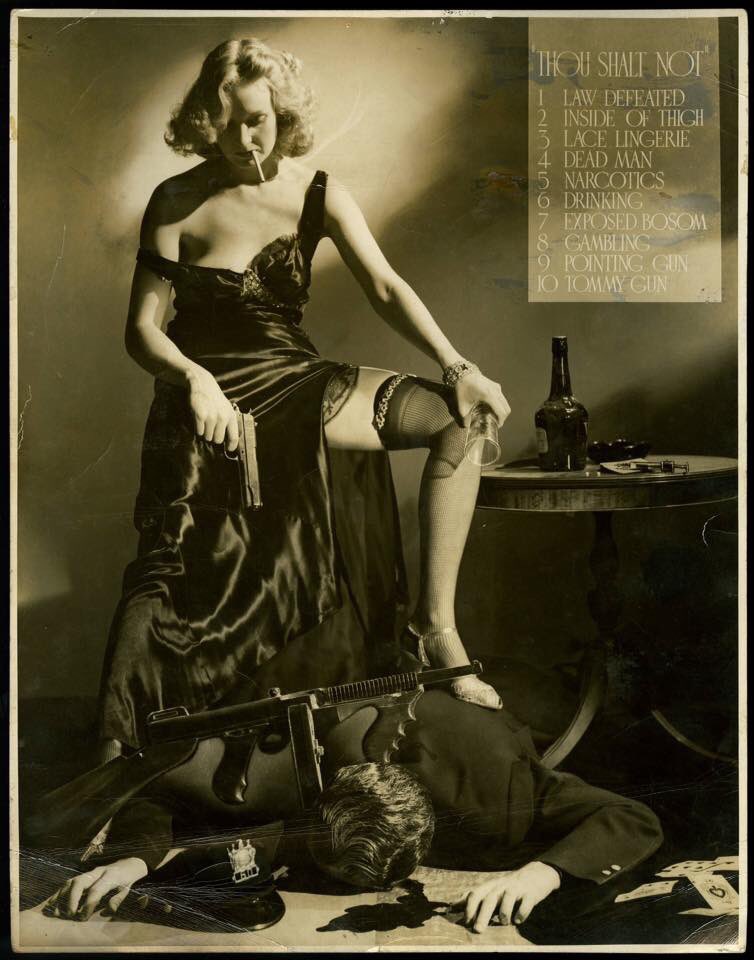
The history of Hollywood film before 1968 breaks down into two eras: “pre-Code” and “post-Code.” The “Code” in question is the Motion Picture Production Code, better known as the “Hays Code,” a reference to Motion Picture Producers and Distributors of America president Will H. Hays. The organization we now know as the MPAA hired Hays in 1922, tasking the Presbyterian deacon and former chairman of the Republican National Committee and Postmaster General with “cleaning up” early Hollywood’s sinful image. Eight years into Hays’ presidency came the Code, a pre-emptive act of self-censorship meant to dictate the morally acceptable — and more importantly, the morally unacceptable — content in American film.
“The code sets up high standards of performance for motion-picture producers,” NPR’s Bob Mondello quotes Hays as saying at the Code’s 1930 debut. “It states the considerations which good taste and community value make necessary in this universal form of entertainment.” No picture, for example, should “lower the moral standards of those who see it,” and “the sympathy of the audience shall never be thrown to the side of crime, wrongdoing, evil or sin.” There was also “an updated, much-expanded list of ‘don’ts’ and ‘be carefuls,’ with bans on nudity, suggestive dancing and lustful kissing. The mocking of religion and the depiction of illegal drug use were prohibited, as were interracial romance, revenge plots and the showing of a crime method clearly enough that it might be imitated.”
Serious enforcement of the Code commenced in 1934, and it didn’t take long thereafter for Hollywood filmmakers to start flouting it. “American film producers are inured by now to the Hays Office which regulates movie morals,” says a Life article from 1946. Indeed, “knowing that things banned by the code will help sell tickets,” those producers “have been subtly getting around the code for years.” In other words, they “observe its letter and violate its spirit as much as possible.” Atop the article appears an enormous photograph, taken by Paramount photographer A. L. “Whitey” Schafer, that “shows, in one fell swoop, many things producers must not do,” or rather must not depict: the defeat of the law, the inside of the thigh, narcotics, drinking, an “exposed bosom,” a tommy gun, and so on.
For 1941’s inaugural Hollywood Studios’ Still Show, “Schafer decided to create a novelty shot to satirically slap at the Production Code, the censorship standards of the Motion Picture Producers and Distributors Assn,” writes Hollywood historian Mary Mallory. “His satirical image, entitled, “Thou Shalt Not,” displayed the top 10 faux-pas disallowed by industry censors, who approved every photographic image shot by studios before they could be distributed.” When “outraged organizers pulled the image from the competition” and threatened Schaefer with a fine, he explained that “all the judges were hoarding the 18 prints submitted for the show.” Few of us today would feel so titillated, let alone morally corrupted, by Schafer’s image, but as filmmaker Aislinn Clarke recently demonstrated on Twitter, it may offer more pure entertainment value than ever.
(via @AislinnClarke)
Related Content:
A Brief History of Hollywood Censorship and the Ratings System
The 5 Essential Rules of Film Noir
The Essential Elements of Film Noir Explained in One Grand Infographic
Based in Seoul, Colin Marshall writes and broadcasts on cities, language, and culture. His projects include the book The Stateless City: a Walk through 21st-Century Los Angeles and the video series The City in Cinema. Follow him on Twitter at @colinmarshall or on Facebook.
Read More...The Sex Pistols Riotous 1978 Tour Through the U.S. South: Watch/Hear Concerts in Dallas, Memphis, Tulsa & More
The Sex Pistols “started out as an elaborate Situationist-inspired performance art piece dreamed up by megalomaniac manager Malcolm McLaren,” wrote Jonathan Crow in a post here at Open Culture about one of the band’s storied, disastrous final shows in Dallas of 1978. After beginning as the creation of McLaren and partner Vivienne Westwood, however, they “evolved beyond just being a stunt.”
The statement is objectively true by music history standards. The band’s earliest gigs were directly responsible for almost every major band that took British punk in subsequent post-punk, goth, new wave, dub, etc. directions, including the Buzzcocks, Siouxsie and the Banshees, The Clash, Joy Division, Wire, and too many others to list.
Later came the hugely influential post-punk of John Lydon’s (formerly Rotten) own project, Public Image Limited, which reflected his serious interest in making experimental, cerebral, music with oblique lyrics deriving as much from symbolist poetry as the “deep simmering well of cultural discontent” he’d tapped into with the Pistols.
Lydon retired the character of Johnny Rotten when the band broke up at the end of their first and last U.S. tour, famously ending things at San Francisco’s Winterland Ballroom by sneering “ever get the feeling you’ve been cheated?”—a bitter comment on the band’s collapse, its very existence, and a press and audience willing to buy the act. No matter how influential they may have been, the Sex Pistols’ architects always maintained they were a cynical prank to the end.
The “one-time hippie haven of the Winterland in San Francisco,” as Ultimate Classic Rock describes it, may have been the perfect venue for their demise, a final screw you to the self-satisfied 60s rock culture Rotten loathed. But it was their tour through Atlanta, Memphis, San Antonio, Baton Rouge, Tulsa and the formerly Jack Ruby-owned Longhorn Ballroom in Dallas that made the most press, just as McLaren had designed it to do, booking country & western venues expressly to provoke, enrage, and scandalize.
Rotten had more complicated feelings about what would become a series of violent spectacles. He seemed half in on the joke, and half hoping that “real people” outside of coastal cities would become real fans. “We’re playing these cities because these are the people who will either accept us or hate us,” he said at the time. “They’re not as pretentious as they are in New York.”
He maintained in his autobiography that McLaren had also foreseen the U.S. tour as savvy marketing. “It wasn’t a question of throwing the band to the wolves when we chose to just play the South…. We felt that if we were ever going to be taken seriously in America, it would be from a base we built down south. The cowboys seemed to take it for the joke it was meant to be. We weren’t there to destroy their way of life or anything like that.”
Of course, he must have seen the U.S. press accuse the band of doing just that before their arrival—corrupting the youth, etc. Did he really hope for a warmer welcome from “the cowboys”? Was it all the glorious train wreck everyone thinks it was? Reports from eyewitnesses vary widely, as Altpress and The Dallas Morning News point out, with some expressing serious disappointment and others awe. Noel Monk’s book 12 Days on the Road describes “outrageous behavior, and concerts that frequently degenerated into near-riots.”
You can see for yourself what those unprecedented, at the time, shows looked and sounded like in the recordings here from the entire seven-city run. (Begun after a cancelled December 1977 gig in Pittsburgh). At the top we have “Anarchy in the U.K.” from the January 1978 tour opener in Atlanta; then audio of the entire show in Memphis days later; film from Randy’s Rodeo in San Antonio (in which Sid Vicious hits a fan with his bass); audio of the Baton Rouge concert; film of the entire performance at the Longhorn; film from Cain’s Ballroom in Tulsa, OK, with audio from the Winterland finale, and, finally, the Winterland itself.
After their flame-out in the first month of 1978, and Sid’s alleged murder of Nancy Spungeon and his overdose and death, John Lydon “claimed the Pistols had ‘killed’ rock and roll,” notes the site Randy’s Rodeo (named for the riotous Texas show further up). The whole tour “was a perverse, provocative joke.” McLaren’s “intent was not to sell tickets, but to incite controversy and mayhem.” The band, fractious, burned out, and eager to escape McLaren’s machinations, would have been more than happy to make some money for their trouble. Ever get the feeling you’ve been cheated?
Related Content:
The Sex Pistols Play in Dallas’ Longhorn Ballroom; Next Show Is Merle Haggard (1978)
Watch the Sex Pistols’ Very Last Concert (San Francisco, 1978)
Malcolm McLaren: The Quest for Authentic Creativity
Josh Jones is a writer and musician based in Durham, NC. Follow him at @jdmagness
Read More...How Bicycles Can Revolutionize Our Lives: Case Studies from the United States, Netherlands, China & Britain
A two- (and three- and one-) wheeled revolution is upon us. Dubbed “micro-mobility” by start-up marketers and influencers, the trend incorporates all sorts of personal means of transport. While the buzz may hover around electric scooters and skateboards, the faithful bicycle still leads the pack, as it has for over a hundred years. And advocates—who bike as their primary means of exercise, commuting, and running daily errands—are challenging the orthodoxies of car culture.
As an avid cyclist myself, who bikes as often as I can for groceries and other errands, I will admit to a strong bias in their favor. But even I’ve been challenged and surprised by what I’ve learned from biking advocates like Liz Canning, producer and narrator of a new documentary film, Motherload, a portrait of the many people who have chosen to use cargo bikes instead of cars for nearly everything.
The film is remarkable for the ordinariness of its subjects. As one cargo cyclist, Brent Patterson of Buffalo, New York, says, “I’m not an athlete. I’m not superhuman. I’m just a completely normal person like you.” The Patterson family “sold its car,” notes Outside magazine, “and travels by cargo bike year-round, even in snowstorms.” Another cargo cyclist in the film, Emily Finch, “carts all six of her kiddos around on two wheels.” We see cargo cyclists around the world, using bikes as emergency transport haulers and daily grocery-getters.
Most of the Americans profiled live in bike-friendly communities like Marin County, California or Portland, Oregon. But others, like the Pattersons, do not, “and not all are as comfortably off as Canning,” who retired as a commercial filmmaker to raise her kids in bike-friendly Fairfax, CA. “Some had to sell their car or take out a no-interest loan in order to afford a cargo bike.” No one seems to have regretted the decision.
Readers who hail from, or have lived in, places in the world where bike-reliance is the norm may scoff at the presumed novelty of the idea in Canning’s film. But at one time, even the Netherlands—home of the ubiquitous Bakfiets—was almost as car-centric as most of the U.S., as American Dan Kois writes in a New Yorker essay about how he learned to become bike commuter in the Netherlands.
I had assumed that Dutch people’s adeptness at biking was the result of generations of incessant cycling. In fact, after the Second World War, the Netherlands had, like the U.S., become dominated by cars. Cycling paths were overtaken by roads, and neighborhoods in Amsterdam were razed to make room for highways. Between 1950 and 1970, the number of cars in the country exploded from about a hundred thousand to nearly two and a half million. During that same period, bike use plummeted; in Amsterdam, the percentage of trips made by bike fell from eighty to twenty.
That all changed when young activists and parents, especially mothers—like the biking mothers in Motherload—began protesting high numbers of traffic deaths. They took to the streets on their bikes, blocking traffic, running for office, and pressuring city officials to make infrastructure and public space safe and accommodating for bikes. Now, there are more bikes than people in the Netherlands, and cars co-exist on roads full of cyclists of all ages and classes, on their way to work, school, and everywhere else.
Dutch drivers “look out for cyclists,” writes Kois. “After all, nearly all of those drivers are cyclists themselves,” using the car for a brief, necessary outing before they get back on their bikes for most everything else. Next to Kois’ first-person account of his few-months-long sojourn through Delft, we have the global testimony of the Bicycle Architecture Biennale, a “showcase of cutting edge and high profile building designs that are facilitating bicycle travel and transforming communities around the world.” The exhibits, writes Karen Wong at David Byrne’s Reasons to Be Cheerful, “point the way to a two-wheeled utopia.”
BYCS, the group responsible for this well-curated exhibition, come from Amsterdam. The projects they feature, however, are in London and Chongmin and Chengdu, China. The cargo cyclists in Motherload, and the ferocious activism of cyclists in places like New York City, despite tremendous “bikelash,” may show Americans they don’t need to look abroad to see how bikes could slowly displace cars as Americans’ vehicles of choice in some parts of the country. But learning from how other places have reimagined their infrastructure could prove necessary for lasting change.
Many Americans cannot imagine life without their cars, even if they also have garages full of bikes. Some lash out at cyclists as a threat to their way of life. The country is enormous (though we do most driving locally); cars serve as modes of transport—for human, plant, animal, and everything else—and also as escape pods and status symbols. Canning’s film shows us ordinary American men and women getting the gumption to trade some comfort and security for lives of minor adventure and ecological simplicity. (And a good many of them still have cars if they need them.)
We also see, in exhibitions like that previewed in the video above how design principles and policy can help make such choices easier and safer for everyone to make. Canning pointedly frames her argument in Motherload around cycling’s radical history. “100 years before the bicycle saved me,” she says in the film’s official trailer at the top, “it liberated the poor, empowered the suffragettes, and transformed society faster than any invention in human history. It could happen again.”
via Outside
Related Content:
The Art & Science of Bike Design: A 5‑Part Introduction from the Open University
How Leo Tolstoy Learned to Ride a Bike at 67, and Other Tales of Lifelong Learning
Josh Jones is a writer and musician based in Durham, NC. Follow him at @jdmagness
Read More...Make an Adorable Crocheted Freddie Mercury; Download a Free Crochet Pattern Online

Given his passion for his pussycats, is it really such a stretch to imagine Queen frontman Freddie Mercury passing a quiet evening at home with a cup of tea and a basket of crochet supplies?
Tis but a handicrafter’s fantasy.
Other than a boyish interest in stamp collecting, Mercury claimed to have no hobbies, famously telling an interviewer who inquired, “I have none. I have a lot of sex. Try and get out of that one!”
Which is not to say sex and crochet are mutually exclusive.
If your crochet notions are rooted in frumpy afghans, lumpy baby sweaters, and 1970s beer can hats, you need to get with the times and picture a church bazaar populated exclusively by sexy woolen Mercurys in miniature facsimiles of his Wembley Stadium era garb.
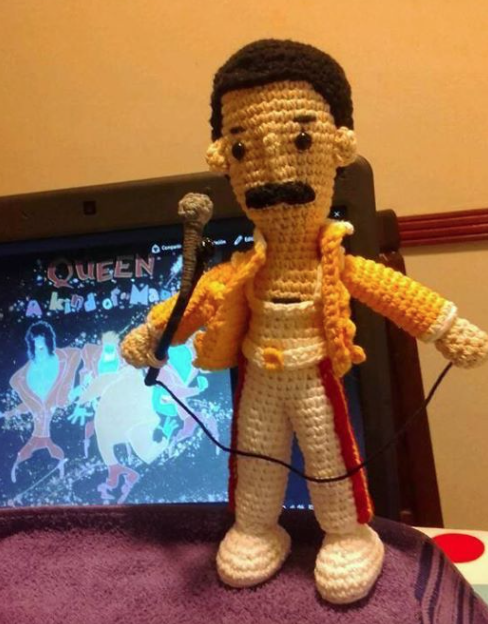
Moji-Moji Design’s Janice Holmes, a self-taught expert in amigurumi, the art of tiny crocheted creatures, devised the pattern in order to stitch up a special request for a Queen-loving friend.
The result, complete with hairy chest, jacket buckles, and a bamboo skewer mic stand, was so fabulous that she felt compelled to share the pattern with the world, in hope that those who took advantage of the free download would consider donating to the Mercury Phoenix Trust, a charity that bandmates Brian May and Roger Taylor and Queen manager Jim Beach founded to fight HIV/AIDS worldwide.
Those who braved the tricky, many-stepped pattern were invited to share photos of their final creation on Moji-Moji’s Facebook page. As of last count, there are 21, and it’s fascinating to note the slight variations in eyes, mustache, and chest hair.
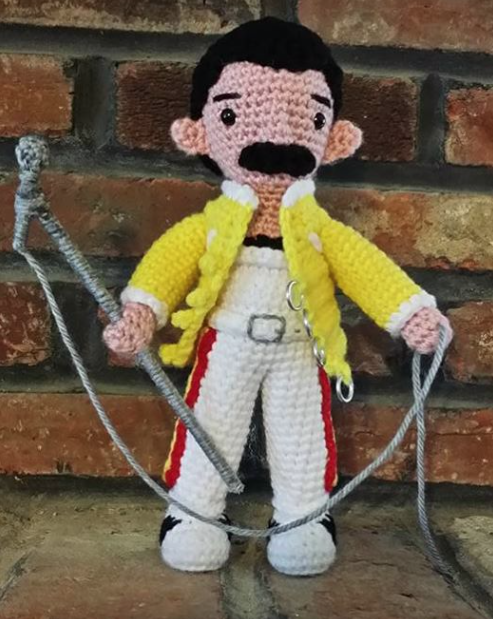
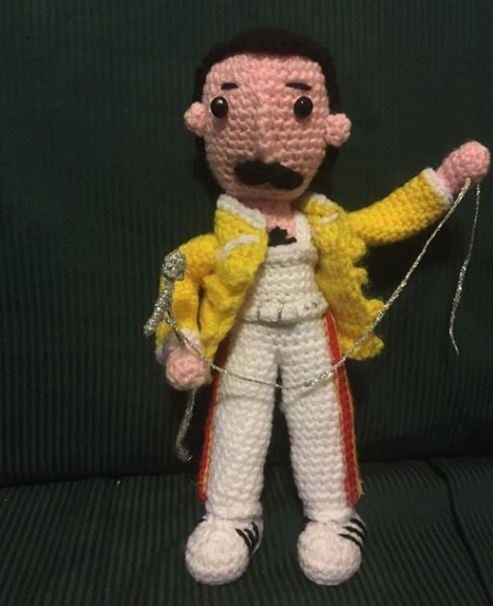

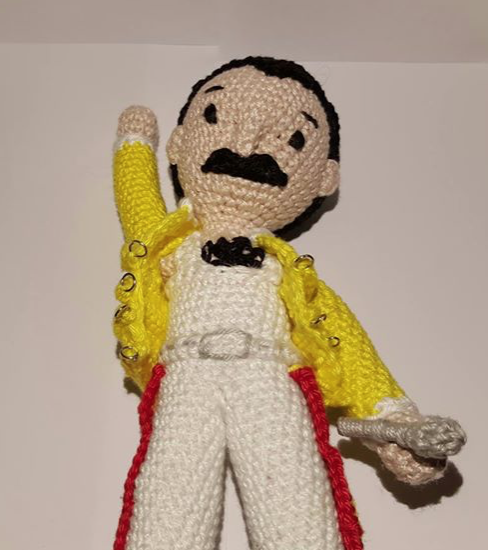

In keeping with amigurumi tradition, the affordable patterns in Moji-Moji’s Etsy shop run toward cute animals, cuddly monsters, and seasonal favorites like witches and elves.
But Freddie clearly stirred something up. Read the comments and you’ll find crafters petitioning Holmes for more music icons like David Bowie and Prince.
Ready to snuggle up with a crochet hook? Download Moji-Moji’s free Freddie Mercury amigarumi pattern here.
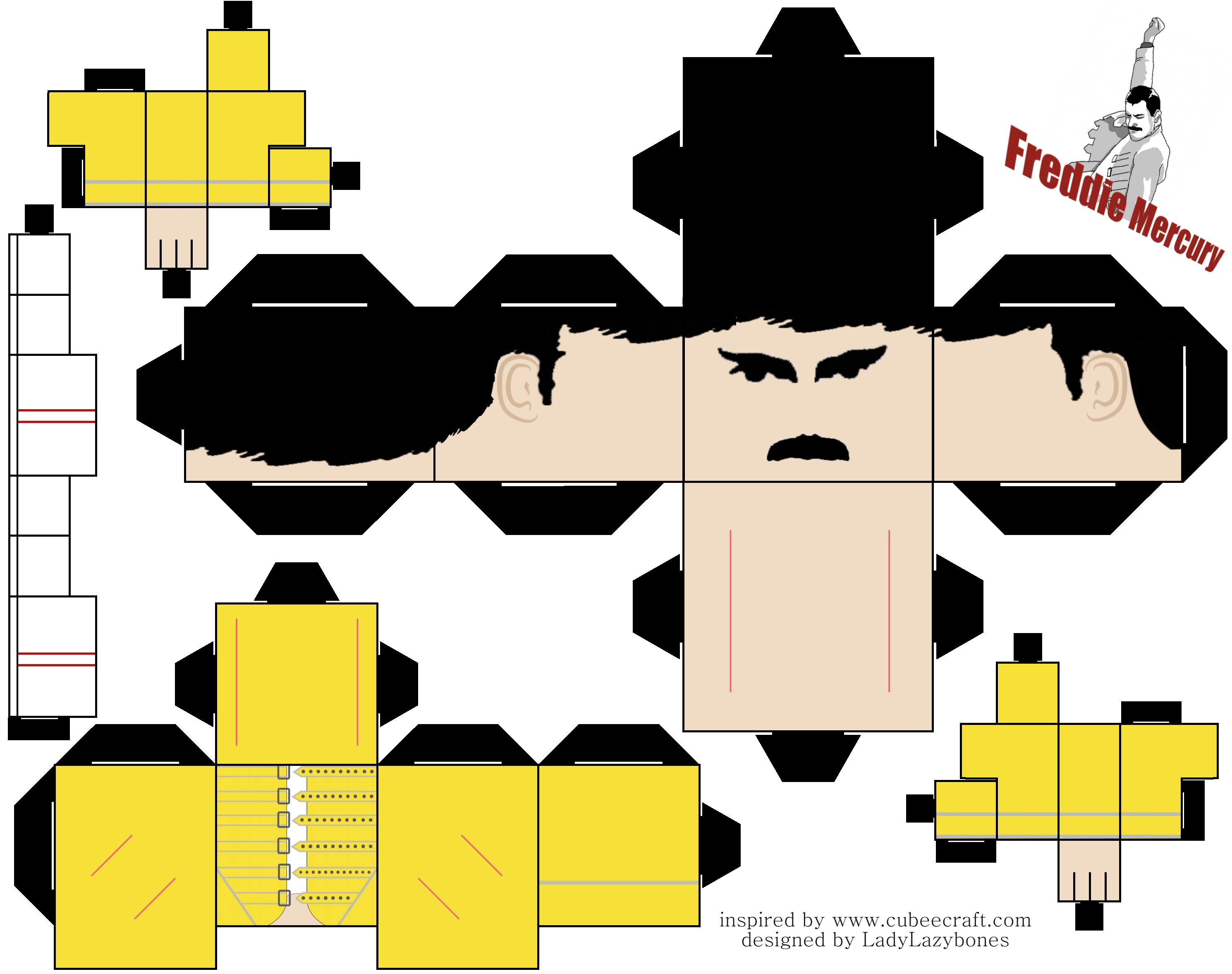
If that’s rather too daunting, ease into the craftiness with another free download—Lady Lazybones’ far less advanced foldable cubecraft Freddie.
Even if you plan on sticking with sex as your sole hobby, please consider making a voluntary contribution to the Mercury Phoenix Trust here.
via Boing Boing
Related Content:
Meet Freddie Mercury and His Faithful Feline Friends
Watch Behind-the-Scenes Footage From Freddie Mercury’s Final Video Performance
Freddie Mercury Reimagined as Comic Book Heroes
Ayun Halliday is an author, illustrator, theater maker and Chief Primatologist of the East Village Inky zine. Join her in NYC on Monday, October 7 when her monthly book-based variety show, Necromancers of the Public Domain celebrates the art of Aubrey Beardsley. Follow her @AyunHalliday.
Read More...The Coddling of the American Mind: Malcolm Gladwell Leads a Conversation with Jonathan Haidt, Greg Lukianoff & Lenore Skenazy
From the 92nd Street Y in New York City comes a wide-ranging conversation featuring Malcolm Gladwell, Jonathan Haidt (NYU), Greg Lukianoff (Foundation for Individual Rights in Education), and Lenore Skenazy (founder of the Free-Range Kids movement). Here’s a quick summary of the ground they cover:
Civil discourse is in decline, with potentially dire results for American democracy.
On college campuses across America, visiting speakers are disinvited, or even shouted down, while professors, students, and administrators are afraid to talk openly, for fear that someone will take offense. Political discussion on social media and television has devolved into a wave of hyper-partisan noise. A generation of overprotective parents are reluctant to let their children play outside without supervision. How did we get here? And how can we change the way that we engage with one another?
Greg Lukianoff and Jonathan Haidt’s The Coddling of the American Mind sounds the depths of this generational crisis. Join us for a lively discussion with the authors, president of the non-profit Let Grow and founder of the Free-Range Kids movement Lenore Skenazy, and #1 New York Times bestseller Malcolm Gladwell on how we as citizens can engage with one another across the political spectrum.
If it’s not already clear, the conversation is based on Lukianoff and Haidt’s book The Coddling of the American Mind: How Good Intentions and Bad Ideas Are Setting Up a Generation for Failure. Skenazy is the author of Free-Range Kids, How to Raise Safe, Self-Reliant Children (Without Going Nuts with Worry). If you sign up for a free trial with Audible, you can download copies of both books.
If you would like to support the mission of Open Culture, consider making a donation to our site. It’s hard to rely 100% on ads, and your contributions will help us continue providing the best free cultural and educational materials to learners everywhere. You can contribute through PayPal, Patreon, and Venmo (@openculture). Thanks!
Read More...Why Time Seems to Fly By As You Get Older, and How to Slow It Down: A Scientific Explanation by Neuroscientist David Eagleman
The Buddha, it’s said, struggled mightily with three specters of adulthood—aging, sickness, and death—when reflections on mortality harshed his hedonistic life as a prince. His “intoxication with life entirely dropped away,” the stories say, when he reflected on its passing. Nothing cured his fatal unease until a memory from childhood arose unbidden: of stopping time by quietly sitting under a rose-apple tree.
In another version of this story, Marcel Proust discovered timelessness baked in a cookie. His potent memories of madeleines also came from childhood. As he recalled “the taste of tea and cake,” he writes, “at once the vicissitudes of life had become indifferent to me, its disasters innocuous, its brevity illusory …. I had ceased now to feel mediocre, accidental, mortal.”
Neuroscientist David Eagleman also invokes a childhood memory in his discussion of time and aging, in the BBC video above. It is also a memory resonant with a remarkable physical detail: red brick pavement hurtling toward him as he falls from the roof of a house, experiencing what must have been a terrifying descent in slow motion. Quite a different experience from communing with trees and eating tea cakes, but maybe the content of a childhood memory is irrelevant to its temporal dimensions.
What we can all remember is that along with impatience and distractibility, childhood seems rich with carefree, absorptive languor (or moments of slow-motion panic). Psychologists have indeed shown in several studies that adults, especially those over the age of 40, perceive time as moving faster than it did when they were children. Why?
Because time is a “psychological construct,” says Eagleman, and can vary not just between ages and cultures, but also between individual consciousnesses. “It can be different in your head and my head,” he says. “Your brain is locked in silence and darkness inside the vault of your skull.” In order to “figure out what’s going on outside,” it’s got to do “a lot of editing tricks.” One trick is to convince us that we’re living in the moment, when the moment happened half a second in the past.
But we can notice that gap when we’re faced with novelty, because the brain has to work harder to process new information, and it creates thicker descriptions in the memory. All of this additional processing, Eagleman says, seems to take more time, so we perceive new experiences as happening in a kind of slow motion (or remember them that way). That includes so many experiences in our childhood as well as emergency situations in which we have to navigate a challenging new reality very quickly.
As writer Charles Bukowski once said, “as you live many years, things take on a repeat…. You keep seeing the same thing over and over again.” The brain can coast on familiarity and expend little energy generating perception. We retain fewer detailed memories of recent events, and they seem to have flown by us. The remedy, says Eagleman, is to seek novelty. (You thought he was going to say “mindfulness”?) Wear your watch on a different wrist, change the way you brush your teeth….
Mundane examples, but the point remains: we need new and varied experiences to slow our sense of time. Routine lack of novelty in adulthood may be the primary reason that “our early years,” write psychologists James Broadway and Brittaney Sandoval write at Scientific American,“tend to be relatively overrepresented in our autobiographical memory and, on reflection, seem to have lasted longer.”
They can also, for that reason, seem all the sweeter. But nostalgia, however tempting, can’t take the place of going new places, meeting new people, reading new books, hearing new music, seeing new films, and so on and so forth—and thereby effectively slowing down time.
via Aeon
Related Content:
Why Time Seems to Speed Up as We Get Older: What the Research Says
Josh Jones is a writer and musician based in Durham, NC. Follow him at @jdmagness
Read More...Watch 16 Hours of Historic Live Aid Performances: Queen, Led Zeppelin, Neil Young & Much More
12 pm — 2 pm | Wembley Stadium, London
As Live Aid geared up for its momentous series of concerts of both sides of the Atlantic, famous concert promoter Bill Graham compared it to Woodstock: “What we’re doing now is entirely different. The reason for the event is more important than the event itself.”
Three decades later, the memory of the event has eclipsed its reason (and one Queen performance has eclipsed most of the concert). It was a gathering of the best of mainstream ‘80s rock–still trying to justify itself alongside acts from the 60s and the ‘70s–and the zenith of the fundraising telethon: broadcast live in 140 countries to raise $50 million for victims of a relentless African famine. (Fun fact: the concerts raised about $560 million in 2019 money, about two days’ worth of Jeff Bezos’ current earnings!)
If you have a day to spare, you can recreate that amazing July 13th in 1985 with this series of YouTube playlists.
The day started at London’s Wembley Stadium (up top), with the Regimental Band of the Coldstream Guards performing the Royal Salute for Queen and Country and all that, and then things really started with Status Quo, those grizzled ol’ blokes playing “Rockin’ All Over the World.” Yanks might have said “who?” but it was the Brits who either bopped along or said, “Not this bloody Dad rock!” (Okay, not true, the phrase hadn’t been invented, but something similar was uttered.)
2 pm — 4 pm | Wembley Stadium, London
The British side was indeed a mixed bag, reflecting the idiosyncrasies of its own singles chart compared to the more steadfast American charts. Elvis Costello sang “All You Need Is Love”; the Style Council sang their hits; Nik Kershaw played his chart-topper. Phil Collins performed “Against All Odds,” then jumped on a Concorde for New York, arriving to sing it again for a different audience.
4 pm — 6 pm | Wembley Stadium, London
There’s so much more to explore in these playlists: the Led Zeppelin reunion, The Cars at the height of their powers (RIP Ric Ocasek), Neil Young (and his reunion with Crosby, Stills, and Nash), Bob Dylan, The Four Tops, Run D.M.C., the list really goes on and on.
6 pm — 8 pm | Wembley Stadium, London
8 pm — 10 pm | Wembley Stadium, London
2 pm — 5 pm | John F. Kennedy Stadium, Philadelphia
5 pm — 8 pm | John F. Kennedy Stadium, Philadelphia
8 pm — 11 pm | John F. Kennedy Stadium, Philadelphia
Live Aid | 11 pm- 2 am | John F. Kennedy Stadium, Philadelphia
Live Aid | 2 am — 4 am | John F. Kennedy Stadium, Philadelphia
Find a complete list of Live Aid performances here.
Related Content:
Ted Mills is a freelance writer on the arts who currently hosts the artist interview-based FunkZone Podcast and is the producer of KCRW’s Curious Coast. You can also follow him on Twitter at @tedmills, read his other arts writing at tedmills.com and/or watch his films here.
Read More...Musicians Around the World Play The Band’s Classic Song, “The Weight,” with Help from Robbie Robertson and Ringo Starr
Playing For Change, a “movement created to inspire and connect the world through music,” has released its latest video–this one featuring musicians from five continents playing “The Weight,” a classic song from The Band’s 1968 album, Music from Big Pink. Amongst the musicians you’ll find The Band’s own Robbie Robertson and The Beatle’s Ringo Starr. In our archive, find other Playing for Change takes on The Grateful Dead’s “Ripple,” The Rolling Stones’ “Gimme Shelter,” Bob Marley’s “Redemption Song,” and Ben King’s “Stand by Me.” For more, visit Playing for Change’s YouTube channel.
If you would like to support the mission of Open Culture, consider making a donation to our site. It’s hard to rely 100% on ads, and your contributions will help us continue providing the best free cultural and educational materials to learners everywhere. You can contribute through PayPal, Patreon, and Venmo (@openculture). Thanks!
Related Content:
Watch The Band Play “The Weight,” “Up On Cripple Creek” and More in Rare 1970 Concert Footage
Martin Scorsese Captures Levon Helm and The Band Performing “The Weight” in The Last Waltz
Jeff Bridges Narrates a Brief History of Bob Dylan’s and The Band’s Basement Tapes
Read More...Support Us
We're hoping to rely on loyal readers, rather than erratic ads. Please click the Donate button and support Open Culture. You can use Paypal, Venmo, Patreon, even Crypto! We thank you!

About Us

Open Culture scours the web for the best educational media. We find the free courses and audio books you need, the language lessons & educational videos you want, and plenty of enlightenment in between.
Advertise With Us

FREE UPDATES!
GET OUR DAILY EMAIL
Get the best cultural and educational resources on the web curated for you in a daily email. We never spam. Unsubscribe at any time.
FOLLOW ON SOCIAL MEDIA

Open Culture editor Dan Colman scours the web for the best educational media. He finds the free courses and audio books you need, the language lessons & movies you want, and plenty of enlightenment in between.
Advertise With Us

