If you’ve ever been to Japan, you’ll know that in Japanese restaurants, mistakes are not made. And on the off chance that a mistake is made, even a trivial one, the lengths that proprietors will go to make things right with their customers must, in the eyes of a Westerner, be seen to be believed. But as its name suggests, the Tokyo pop-up Restaurant of Mistaken Orders does things a bit differently. “You might think it’s crazy. A restaurant that can’t even get your order right,” says its English introduction page. “All of our servers are people living with dementia. They may, or may not, get your order right.”
Un-Japanese though that concept may seem at first, it actually reflects realities of Japanese society in the 21st century: Japan has an aging population with an already high proportion of elderly people, and that puts it on track to have the fastest growing number of prevalent cases of Alzheimer’s Disease.
Whole towns have already begun to structure their services around a growing number of citizens with dementia. But dementia itself remains “widely misunderstood,” says Restaurant of Mistaken Orders producer Shiro Oguni in the “concept movie” at the top of the post. “People believe you can’t do anything for yourself, and the condition will often mean isolation from society. We want to change society to become more easy-going so, dementia or no dementia, we can live together in harmony.”
You can see more of the Restaurant of Mistaken Orders in last year’s “report movie” just above, which shows its team of servers with dementia in action. Some shown are in middle age, some are in their tenth decade of life, but all seem to have a knack for building rapport with their customers — a skill that anyone who has ever worked front-of-the-house in a restaurant will agree is essential, especially when mistakes happen. We see them deliver orders both correct and incorrect, but the diners seem to enjoy the experience either way: “37% of our orders were mistaken,” the restaurant reports, “but 99% of our customers said they were happy.” This contains another truth about Japanese food culture that anyone who has eaten in Japan will acknowledge: whatever you order, the chance of its being delicious is approximately 100%.
Based in Seoul, Colin Marshall writes and broadcasts on cities, language, and culture. His projects include the book The Stateless City: a Walk through 21st-Century Los Angeles and the video series The City in Cinema. Follow him on Twitter at @colinmarshall or on Facebook.
In terms of brand recognition, one has to admit it is remarkable that the name Zildjian—stamped on millions of cymbals worldwide—has such wide cultural currency. The product this company makes is not one most people get very close to outside of a drum kit in a grade school music room. You never see Zildjian advertisements, unless you are a musician, and you won’t encounter a Zildjian cymbal at your local all-in-one big box store. Yet Zildjian cymbals might even be more famous than iconic brands of electric guitars like Fender and Gibson or amps like Marshall and Vox.
Why is that? It’s easy, the company was founded 400 years ago in Constantinople and has remained in the Zildjian family since an alchemist named Avedis was given the surname by Sultan Osman II in the early 17th century. In all that time, Mozart praised Zildjians (then just called “Turkish cymbals”), they appeared at London’s Great Exhibition, and they have been essential to the kits of jazz and rock drummers for as long as both genres have existed. It will never be possible to buy this kind of publicity.
How has Zildjian, who incorporated in the U.S. in 1929, stayed in business so long and continued to maintain such a reputation for quality? It’s all down, they say, to a secret recipe, passed down from generation to generation, descended from Avedis himself, whose name graces the Avedis Varteresian Melting Room, where Zildjian castings are made. You can watch what happens to those castings in the fascinating 10-minute video above. “Only 4 factory employees and the owners of the company are allowed inside” the Melting Room, notes the video’s YouTube page, “due to their knowledge of the ‘Zildjian Secret.’”
We do not learn the secret recipe, nor do we learn how a trade secret can be kept for 400 years, but we do see Zildjians heated, rolled out, shaped, cut, hammered, lathed, finished, and, finally, “stamped with the Zildjian Logo as well as the model/size of the cymbal.” It’s generally pretty cool to watch unremarkable, everyday products go through the many stages of a factory production process. Watching the Zildjian process adds a layer of historical legend and intrigue, and the allure of seeing raw materials transformed into objects of visual and aural beauty.
See Zildjian’s YouTube page for a timestamped commentary on each step in the production.
As Josh Jones observed yesterday, Miles Davis’ legendary jazz album Kind of Blueturns 60 this week. Today, we want to keep the party going a little longer and feature this video essay from Sweetwater. They write:
In 1959, Miles Davis went to Columbia Records in Manhattan to forge a new style of music improvisation. With the company of other legendary musicians, like John Coltrane and Bill Evans, Kind of Blue was recorded; the greatest selling jazz album of all time. Miles chose to take an interpretive dance approach to improvisation, developing ideas and using space to create his unique style. This new style of modal jazz pushed musicians to express themselves through melodic creativity. Take a look into the history and music theory of Kind of Blue with Sweetwater’s Jacob Dupre (piano/trumpet), accompanied by Michael Patterson (bass) and Sean Parr (drums). Karl Stabnau (alto sax) performs the solo on “Blues For Alice,” as played by Charlie Parker.
If you would like to support the mission of Open Culture, consider making a donation to our site. It’s hard to rely 100% on ads, and your contributions will help us continue providing the best free cultural and educational materials to learners everywhere. You can contribute through PayPal, Patreon, and Venmo (@openculture). Thanks!
In a very short span of time, the descriptor “electronic music” has come to sound as overly broad as “classical.” But where what we (often incorrectly) call classical developed over hundreds of years, electronic music proliferated into hundreds of fractal forms in only decades. A far steeper quality curve may have to do with the ease of its creation, but it’s also a factor of this accelerated evolution.
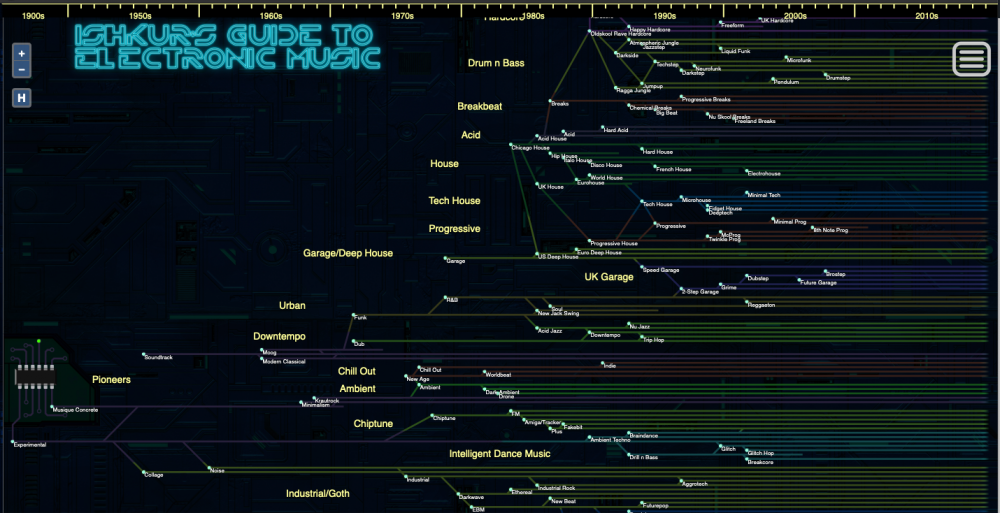
Music made by machines has transformed since its early 20th-century beginnings from obscure avant-garde experiments to massively popular genres of global dance and pop. This proliferation, notes Ishkur—designer of Ishkur’s Guide to Electronic Music—hasn’t always been to the good. Take what he calls “trendwhoring,” a phenomenon that spawns dozens of new works and subgenera in short order, though it’s arguable whether many of them should exist.
Ishkur, describes this process below in an excerpt from his erudite, sardonic “Frequently Unasked Questions”:
If fart noises were suddenly popular, each scene would trendwhore it with fartstep, fartcore, techfart, farthouse, fart trance, etc. It is especially noticeable in classic tracks that are remixed into modern genres, which some might consider sacreligious. A good example is the Dream Trance hit Robert Miles — Children, in which there is now a Hardstyle version, a Dutch House version, a McProg version, a Eurotrance version, a Goa Trance version, and even a Snap version and a shitty Brostep version. None of these genres existed when the original song came out in 1995.
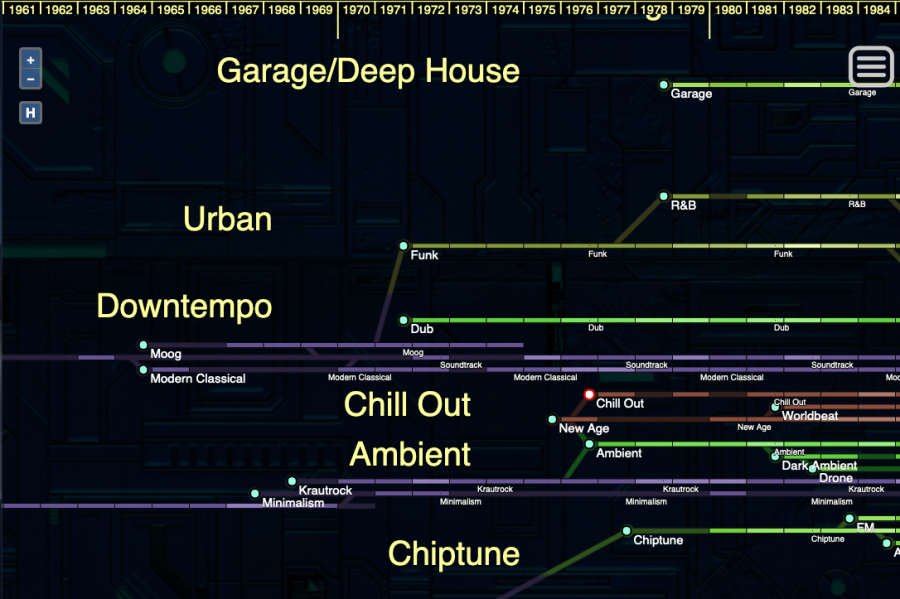
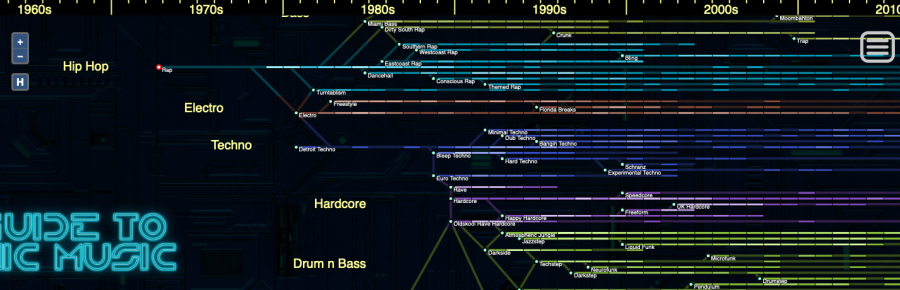
Viciously irreverent tone and completist attention to detail are typical throughout thisencyclopedia, an interactive Flash flowchart that chronicles the development of 100s of genres, subgenres, microgenres, etc., with streaming musical examples of every one. It’s a deeply researched, and continually expanding project first created by Ishkur, aka Kenneth John Taylor, in 1999. In 2003, Taylor updated and expanded the project and moved it to its current location. He has continuously updated it since then.
The recorded examples on Taylor’s timeline currently span around 80 years, from 1937 to 2019—a tiny drop in the great ocean of musical history. Nonetheless, the music shows how rich and complex electronic music history truly is, despite its potential—as its developmental speed (and tempos) increased—to produce disposable, derivative compositions as much as chart-burning classics and innovative, mind-expanding creative work.
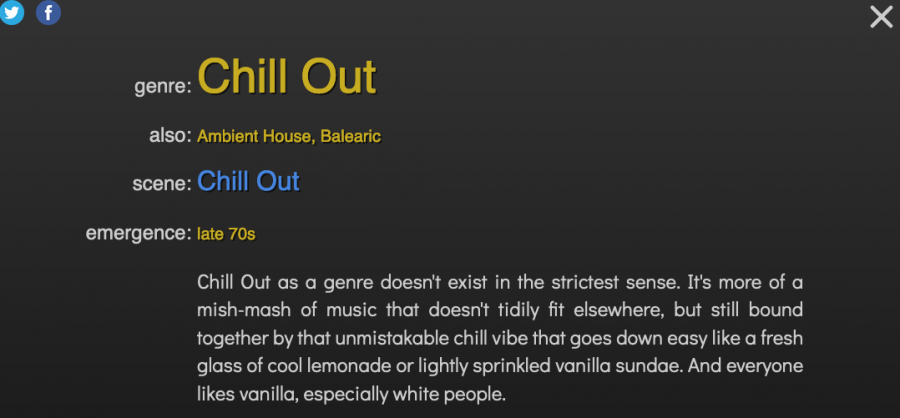
As you zoom into the chart and click on the dots next to each genre, you’ll have the option to pull up Taylor’s witty guides, as informative as they are unsparingly critical. He explains “Chill Out,” for example, as a grab-bag term for electronic easy listening that “goes down easy like a fresh glass of cool lemonade or lightly sprinkled vanilla sundae…. Not only did it appeal to post-comedown party kids but their moms too, as heard in movie soundtracks, advertisement jingles, or played over the radio while shopping at the market.”
Does he approve of any forms of electronic music? Obviously. No one would spend this much time and effort and amass “30 years of back issues of Electronic Music and Keyboard magazine” and “an ungodly number of books” on a subject they despised. It’s just that he’s… well, a purist, you might say. Any media, for example, of any kind, that “uses the acronym ‘EDM,’” he writes “is complete donkey balls and should not be relied on as a source for anything.” He’s also ambitiously comprehensive, including Hip Hop and all of its variants in the mix, a move most historians of electronic music do not make, for fear of getting it wrong, perhaps, or because of cultural biases and narrow ideas about what electronic music is.
The data visualization crossed with extensive pop musicology crossed with an almost quaint kind of ultra-nerdy online snark has something for everyone. But don’t call it art, as one interviewer did. “I feel uneasy about this,” Ishkur answered. “It’s a joke more than anything. Very funny. Very silly. I poke fun at a lot of genres. It’s meant to be entertainment.” This is the standard internet disclaimer, but if you follow the guide’s branching streams through hundreds of expanding genres and scenes, you might just find you’ve become a serious student of electronic music yourself, while learning not to take any of it too seriously.
Ishkur’s guide has recently been updated for 2019. He’s also released a “15 hour DJ set of electronic music,” he announced on Twitter, “spanning several eras and a wide range of genres, all mixed in that inimitable Ishkur style.” Get the mixhere.
Jonathan built his career playing 19th century American Indians on horseback and is best known for his voice acting as John Redcorn III in King of the Hill (starting season 2) and then for his recurring role as Chief Ken Hotate in Parks and Recreation. Erica Spyres, Mark Linsenmayer, and Brian Hirt talk to him about those roles plus acting in The Magnificent Seven, True Grit, and his current role as Sitting Bull in Annie Get Your Gun (also featuring Erica) currently running at the Bay Street Theater in Sag Harbor.
Jonathan talks about Hollywood’s record and progress in portraying indigenous Americans, his own struggles to get native views reflected in the works he’s participated in and the differences between acting on stage vs. film and TV. When is an anachronistic work too far gone to update it, and is it even legitimate to try?
The actor in the film Minutes that Mark refers to is comedian Tatanka Means. Jonathan brings up native author/activist John Trudell, and Erica brings up the play Tribes about the deaf community.
No amount of continuous repeats in coffeeshops around the world can dull the crystalline brilliance of Miles Davis’ Kind of Blue one bit. The album turned 60 three days ago, and it still stands as one of the most influential albums, jazz or otherwise, of all time… indeed, as “one of the single greatest achievements in American music.”
So says one of several critics praising the album in the introduction to an interview with Ashley Kahn, author of Kind of Blue: The Making of the Miles Davis Masterpiece. Kind of Blue is a “cornerstone record, not only for jazz. It’s a cornerstone record for music,” another voice comments. It “captures the essence of jazz.” It’s “sort of like the Bible, in a way. You know, you just have one in your house.”
This would make Davis not only the composer of a new jazz Bible, but also a Bible salesman. He had no doubt his product would sell. “Davis was a canny money man and promoter of his own image,” wrote David Yearsley on the album’s anniversary. One 1960 record company memo stated he “’was primarily concerned with the amount of jazz now on jukeboxes in many areas of the country while he is not represented.’”
Columbia responded, and as a result, many people around the U.S. “first heard this music in diners and bars over the jukebox.” The creative tensions in the Birth of the Cool recordings, made ten years earlier, announced a new kind of jazz with their full release in 1957. The cool had matured in Kind of Blue’s fully modal turn. “Its icy hauteur sets the standard for art that draws you in by pretending it doesn’t need anyone or anything but itself.” It’s quite a confident appeal.
Sales are neither necessary nor sufficient to make a classic album, but in the case of Kind of Blue, all of the stars aligned: critics universally praise it, musicians universally love it, and record buyers universally buy it. “The thing about this album,” says Kahn, “that’s different from what happened with some other well-celebrated albums… is that it became an iconic album not when it came out but long after because people kept buying it. People would not let it go out of print.”
Davis knew how to get his work before the public, but he also knew it deserved to be heard by millions both inside and outside jazz. Beloved in the jazz world right away, it was the “vox populi” that spread the album’s fame everywhere else. Drummer Jimmy Cobb talks in the clip at the top about how Davis “fell a little bit into [the] concept” of Bill Evans, the pianist who played a significant role in the music’s construction. “To me,” says Cobb, the gig was “just another Miles Davis session,” with an Evans twist.
None of the musicians in the sextet had any idea the record would get as big as it did. Yet as Davis himself said, in a classic line from an earlier recording session, “I’m gonna play it first, and tell you what it is later.” We look back on 1959 as a watershed year in jazz, thanks in large part to the impact of Kind of Blue. Maybe we still haven’t figured out, 60 years later, what it is. Learn more about the critical, musical, and commercial importance of Kind of Blue in the Polyphonic video explainer above, “How Miles Davis Changed Jazz.”
At her site Ari’s Bass Blog, bass player and teacher Ariane Cap shoots down many of the arguments against solo bass music—that is, music played solely on bass guitar. To the objection that “basses have a job to do in a band context,” she writes, “what this ‘job’ is can vary greatly!” To another complaint, she responds, “even when imitating guitar techniques on the bass, it is still bass playing.” Her defenses of solo bass (and her fine instructions on how to play it well) work equally for the bass solo, when the often least-noticed member of the band steps out and takes the lead for a few moments.
The idea that bass players are all wallflowers or invisible, less-talented members of the band is, of course, a bad rock and roll stereotype. Naturally, the best bass soloists in rock are some of the players who have drawn the most attention to the instrument and shown how critical it is.
But not all great bass players are great soloists. The solo requires a particular combination of power and agility. The bass soloist is something of a musical athlete.
A guitar solo can coast, so to speak, on tone, on perfectly-chosen notes played with just the right vibrato and sustain. A bass solo is another monster. Whether plucked, picked, or slapped, bass solos usually involve a lot of notes attacked very hard and very fast, up and down the neck—a feat anyone who’s held a bass guitar will know requires a lot of dexterity and strength.
Marvel as you watch the shoulders, arms, and fingers on left and right hands of these players move with uncanny precision, in clips from some of the all-time bass solo greats here. At the top, John Entwistle wins top prize for succinctness. His bored expression may seem to give away the pre-recorded TV game, but even live onstage he never seemed to raise an eyebrow when pulling off licks like these.
Below him, Geddy Lee stretches out, and makes your arms tired from watching him move all over the fretboard, building from one figure to another before a final explosive shred. Further up, Stuart Hamm, onstage with Joe Satriani in 1988, gives a solo bass performance at the Montreux Jazz Festival, moving effortlessly from Beethoven’s “Moonlight Sonata” to a series of gorgeous arpeggios to some genre-hopping theatrics the crowd devours.
Though he made his bones as one of the fastest bass soloists on the block, Fleas’s solo bass performance uses delay and echo effects to slow things down significantly and expand the possibilities of solo bass, bringing it into the tonal realm of the guitar while still demonstrating the tremendous physicality bass playing requires. Just above, see Bootsy Collins pull off a similar feat in a full band context, proving that bass solos can be made of slow, soulful melodicism and heavy, fuzzed-out licks.
Collin’s tour-de-force performance is hard to top, but for contrast, and to reemphasize the versatility of the bass as a solo instrument, whether playing all alone or taking a brief turn in the spotlight, see Queen’s John Deacon pull out a flawless, short and seriously sweet bass solo live on “Liar,” just above, looped for ten minutes straight so you can memorize every note.
It’s one of cinema’s greatest ironies that editing can make or break a film, but few moviegoers understand what an editor actually does. Editing involves taking shots and assembling them in the right order, yes, but what makes an order — all the transitions from moment to moment and scene to scene — “right”? Even if we can’t explain good editing, we know bad editing when we see it, and even more so when when we feel it. The hard-to-pin-down sensation of a movie being “off” or “wrong” often comes out of incompetent editing, and by breaking down the bad editing in a variety of recent pictures, these three videos throw into contrast what it takes for editing to be good.
Most of the nine “Movies that Were Ruined by Really Bad Editing” in the Looper video at the top of the post are part of high-profile franchises. Given the size of their budgets and the importance of their box-office performance, you might think such films wouldn’t permit technical sloppiness of any kind. Yet in Alien: Covenant everything happens in an order that kills the dramatic tension; the chaotic Taken 3, “a severe case of death by a thousand cinematic cuts,” plays out “at the speed any other movie would run if you accidentally hit the fast-forward button several times”; Transformers: Age of Extinction goes heavy on the wrong scenes and “treats its robot aliens as a subplot”; and Suicide Squad provides an example of “a studio publicly advertising a movie as one thing, panicking, then completely reshaping the same film all inside of one frantic marketing blitz.”
“Editing is going down the crapper these days,” says Folding Ideas host Dan Olson in his in-depth examination of Suicide Squad’s incompetent cutting. “The editing was shockingly awful in every way,” he says, turning it into a kind of negative showcase of the editor’s art: “I would seriously advise anyone with an interest in the art of cinematic editing to do their own full autopsy to see just how much went wrong and plain old doesn’t work.” Olson points to examples of Suicide Squad’s often inexplicable choices, such as filling the first half of the film with hyperkinetic character introductions that play more like trailers, developing characters only to suddenly drop them, losing track of the physical locations of characters, and repeatedly abusing the Kuleshov Effect in a way that feels like the “cinematic equivalent of putting the emphasis on the wrong syllable.”
But then, it would have been more of a surprise for a critical disaster like Suicide Squad to have been well-edited. What about the Freddie Mercury biopic Bohemian Rhapsody, which won an Academy Award specifically for its editing? Its reception of that particular Oscar is interesting, says video essayist Thomas Flight, “because the movie contains several scenes that are master classes in poor editing.” In one offending sequence, “many of the cuts are unmotivated,” which mean that the editor made them for no apparent reason, at least none serving story or the drama. Others “ignore spatial continuity,” which makes it difficult or impossible for the audience to understand who and what is supposed to be where. And “the pace is simply too fast,” meaning that the lengths of the shots are too short for the action: editing that suits a rock concert doesn’t suit a conversation.
Even viewers who otherwise enjoyed Bohemian Rhapsody will have sensed something the matter with the cuts in the scene Flight highlights. But nobody could have a worse reaction to it than John Ottman, the man who edited the film, and whose work has been credited with making (rather than further breaking) the troubled production. As mentioned in March here on Open Culture, that particular scene was cut not by Ottman but director Dexter Fletcher, who came in to take Bohemian Rhapsody’s reins after the departure of Bryan Singer. “Whenever I see it, I want to put a bag over my head,” Ottman told the Washington Post. Most moviegoers don’t see editing when it’s good, only when it’s bad — but when it’s especially bad, it makes editors themselves long for invisibility.
Based in Seoul, Colin Marshall writes and broadcasts on cities, language, and culture. His projects include the book The Stateless City: a Walk through 21st-Century Los Angeles and the video series The City in Cinema. Follow him on Twitter at @colinmarshall or on Facebook.
In 2001 or 2002, guitarist and singer David Gilmour of Pink Floyd recorded a musical interpretation of William Shakespeare’s “Sonnet 18″ at his home studio aboard the historic, 90-foot houseboat the Astoria. This video of Gilmour singing the sonnet was released as an extra on the 2002 DVD David Gilmour in Concert, but the song itself is connected with When Love Speaks, a 2002 benefit album for London’s Royal Academy for the Dramatic Arts.
The project was organized by the composer and conductor Michael Kamen, who died a little more than a year after the album was released. When Love Speaks features a mixture of dramatic and musical performances of Shakespeare’s Sonnets and other works, with artists ranging from John Gielgud to Ladysmith Black Mambazo.
Kamen wrote much of the music for the project, including the arrangement for Sonnet 18, which is sung on the album by Bryan Ferry. A special benefit concert to celebrate the release of the album was held on February 10, 2002 at the Old Vic Theatre in London, but Ferry did not attend. Gilmour appeared and sang the sonnet in his place. It was apparently around that time that Gilmour recorded his own vocal track for Kamen’s song.
“Sonnet 18” is perhaps the most famous of Shakespeare’s 154 sonnets. It was written in about 1595, and most scholars now agree the poem is addressed to a man. The sonnet is composed in iambic pentameter, with three rhymed quatrains followed by a concluding couplet:
Shall I compare thee to a summer’s day? Thou art more lovely and more temperate: Rough winds do shake the darling buds of May, And summer’s lease hath all too short a date; Sometime too hot the eye of heaven shines, And often is his gold complexion dimm’d; And every fair from fair sometime declines, By chance or nature’s changing course untrimm’d But thy eternal summer shall not fade, Nor lose possession of that fair thou ow’st; Nor shall death brag thou wander’st in his shade, When in eternal lines to time thou grow’st: So long as men can breathe or eyes can see, So long lives this, and this gives life to thee.
Note: An earlier version of this post appeared on our site in 2013.
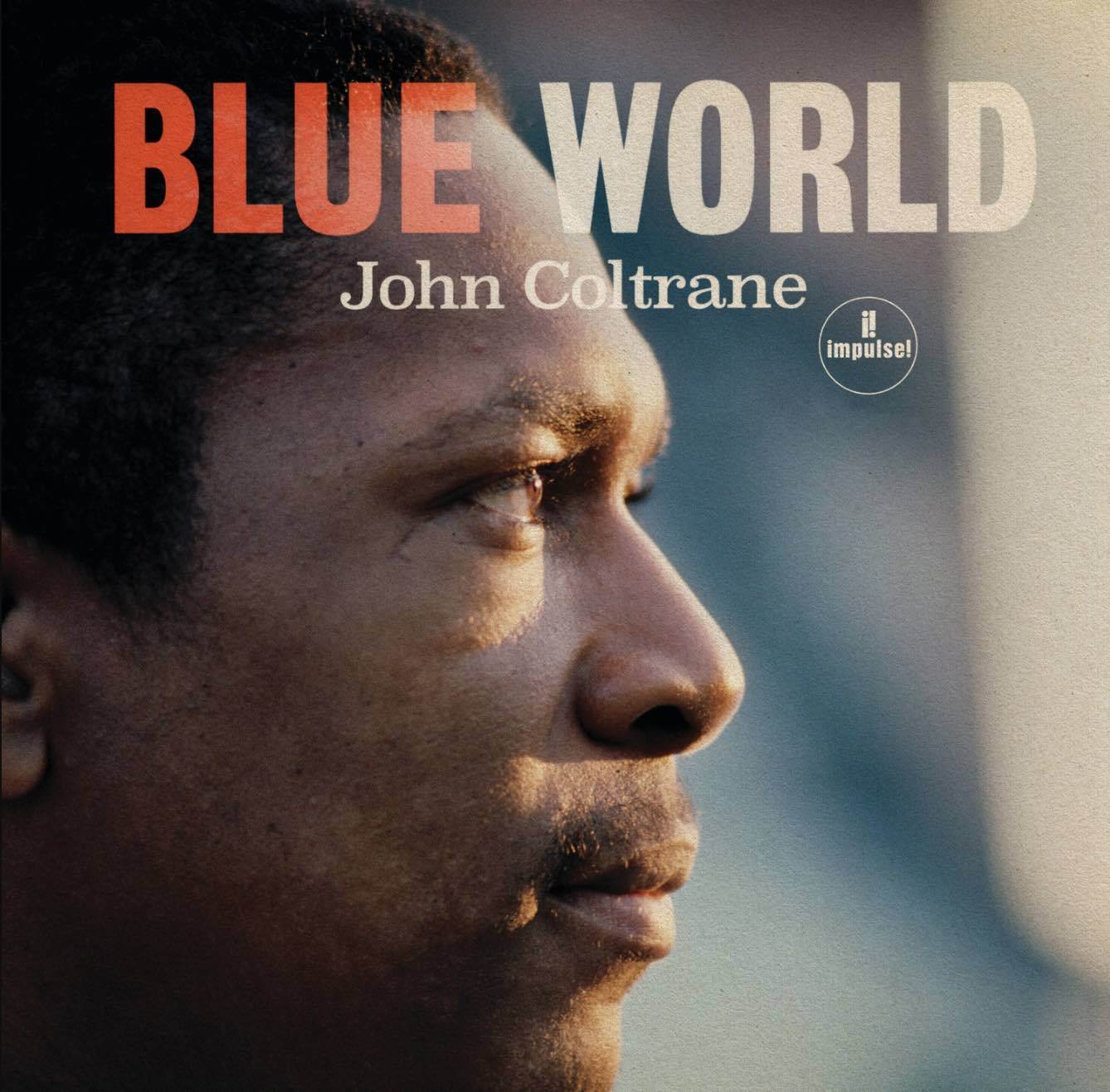
In the photo on the cover of soon-to-be-released Coltrane album Blue World, the legendary saxophonist and composer is shown in profile, gazing into the middle distance, resolute, vigilant, and searching—a ship’s captain sighting a new shore. Recorded at Rudy Van Gelder’s study in New Jersey in 1964, the collection of songs sees Coltrane guiding classic quartet of McCoy Tyner, Jimmy Garrison, and Elvin Jones between 1964’s “epic album” Crescent and their 1965 masterpiece, A Love Supreme.
Like the “lost album,” Both Directions at Once—made in 1963 and released just last year—the newly-discovered Blue Worldshowcases some excellent alternate takes of famous Coltrane compositions, as well as new (to most listeners) original material in the form of the title track, which you can hear in the video above. The album was recorded as a soundtrack to the film Le chat dans le sacby Quebecoise director Gilles Groulx, and the session’s “date had gone unnoticed” for decades “in session recordings logs” reports Nate Chinen at NPR. “The music has occupied a blind spot for Trane-ologists, archivists and historians.
The full album, to be released on September 27th, features two alternate takes of Giant Steps’ “Naima,” three takes of “Village Blues” and alternate recordings of “Like Sonny” and “Traneing In.” Blue World“offers a special opportunity,” notes Ashley Kahn in the album’s liner notes, “to compare these versions with previous perspectives, revealing both Coltrane’s personal progress and the interactive consistency and sonic details the Classic Quartet had firmly established as their collective signature.”
Fans of Groulx’s film will have heard 10 minutes of Blue World in the film, which is all the director ended up using of the 37-minute session, though the movie’s first viewers may not have known exactly what they were hearing in the title track, whose “methodical yet unscripted push into different tonal centers,” writes Chinen, expresses “a form of incantatory fervor” as a prelude to A Love Supreme. This posthumous release presages Coltrane’s modal forms moving into what is arguably the greatest, and most personal, work of his career.
The album also joins the distinguished company of jazz soundtracks for French New Wave films, like the Miles Davis-scored Elevator to the Gallows, directed by Louis Malle. Inspired by Godard and his jazz-loving contemporaries, Groulx’s very New Wave style can be seen in the excerpts from Le Chat dans le sac in the video at the top (and in the full film here). Coltrane’s restless energy continues to surprise and inspire over fifty years after his death, showing, perhaps, that there really “is never any end,” as he told Nat Hentoff around the time of Blue World’s recording. “There are always new sounds to imagine; new feelings to get at” in his timeless sound.
Look for Blue Worldfrom Impulse! records on September 27th. See a full tracklist, courtesy of Spin, below.
01 Naima (Take 1)
02 Village Blues (Take 2)
03 Blue World
04 Village Blues (Take 1)
05 Village Blues (Take 3)
06 Like Sonny
07 Traneing In
08 Naima (Take 2)
We're hoping to rely on loyal readers, rather than erratic ads. Please click the Donate button and support Open Culture. You can use Paypal, Venmo, Patreon, even Crypto! We thank you!
Open Culture scours the web for the best educational media. We find the free courses and audio books you need, the language lessons & educational videos you want, and plenty of enlightenment in between.
Get the best cultural and educational resources on the web curated for you in a daily email. We never spam. Unsubscribe at any time.
FOLLOW ON SOCIAL MEDIA
Open Culture editor Dan Colman scours the web for the best educational media. He finds the free courses and audio books you need, the language lessons & movies you want, and plenty of enlightenment in between.