Scenes from Bohemian Rhapsody Compared to Real Life: A 21-Minute Compilation
Bohemian Rhapsody, the 2018 bio pic about the British rock band Queen, had its fair share of factual inaccuracies–all well documented by sites like The Wrap and ScreenCrush. But, here and there, the film paid attention to detail. Witness the scenes from Live Aid, and compare them to actual footage from 1985. Or simply start at the 9:20 mark of the lengthy compilation above, which dutifully juxtaposes scenes from the film with the real life events…
If you would like to support the mission of Open Culture, consider making a donation to our site. It’s hard to rely 100% on ads, and your contributions will help us continue providing the best free cultural and educational materials to learners everywhere. You can contribute through PayPal, Patreon, and Venmo (@openculture). Thanks!
Related Content:
Read More...How Michel Legrand (RIP) Gave the French New Wave a Sound: Revisit the Influential Music He Composed for Jean-Luc Godard & Jacques Demy’s Films
When he died this past weekend, the prolific composer Michel Legrand left behind a large and varied body of work, one that won him not just five Grammy awards but, for the films he scored, three Oscars as well. Though he composed the music for more than 200 films and television shows, many cinephiles will remember him — and generations of cinephiles to come will know him — as the man who gave the French New Wave a sound. Having appeared on camera as a pianist in Agnès Varda’s Cleo from 5 to 7 in 1961, he went on to score The Umbrellas of Cherbourg, the beloved 1964 musical (and a musical without any dialogue spoken at all, only sung) directed by Varda’s husband Jacques Demy.
Legrand also composed the music for Demy’s next film, the also-musical The Young Girls of Rochefort, in 1967. That same decade, without a doubt the headiest for La Nouvelle Vague, he worked with no less a cinematic rule-breaker than Jean-Luc Godard on 1962’s Vivre sa vie and 1964’s Bande à part (also known as Band of Outsiders).
“I can’t help wondering whether, since the music is dubbed in, so are the claps, foot-stamps, and finger-snaps,” writes New Yorker film critic and Godard scholar Richard Brody of the well-known dance scene in the latter, “or whether, for the take used in the film, there was no music playing at all, and the trio” — none of them trained dancers — “did their dance to the time of music playing in their minds.”
Brody names as “the greatest flourish in the sequence” the moment when “the music cuts out, and Godard speaks, in voice-over: ‘Now it’s time to open a second parenthesis, and to describe the emotions of the characters.’ ” The way the director’s words interrupt the motion of the visuals, and of Legrand’s score, “distinguishes the scene from so many scenes in so many films where so many filmmakers are so concerned with bringing out their characters’ emotions solely by means of action,” the reason for the dull fact that “many movies — and many wrongly hailed — give a sense of being constructed as illustrations of script elements, the connections of dots planted in just the right place to yield a particular portrait.”
Legrand did, of course, compose for a few such less artistically adventurous films as well, but that just goes to show how wide a variety of cinematic visions his musical aesthetic could accommodate. He scored such memorable and even influential pictures as the original The Thomas Crown Affair and Summer of ’42, as well as Orson Welles’ decades-awaited The Other Side of the Wind, which came out just last year as what Brody calls a “belated masterpiece” and “one of the great last dramatic features by any director.” Legrand’s music could fairly be called romantic, even sentimental, but like few other composers working today, he knew exactly what it took — and exactly whom to work with — to keep those qualities from turning saccharine or banal.
Related Content:
An Introduction to Jean-Luc Godard’s Innovative Filmmaking Through Five Video Essays
Jacques Demy’s Lyrical Masterpiece, The Umbrellas of Cherbourg
Based in Seoul, Colin Marshall writes and broadcasts on cities, language, and culture. His projects include the book The Stateless City: a Walk through 21st-Century Los Angeles and the video series The City in Cinema. Follow him on Twitter at @colinmarshall or on Facebook.
Read More...Hear Neil Gaiman Read a Beautiful, Profound Poem by Ursula K. Le Guin to His Cousin on Her 100th Birthday
It’s quite profound, isn’t it? — Helen Fagin, aged 100
Every time I open my laptop to discover a friend posting a vintage photo of their parent as a beaming bride or saucy sailor boy in lush black and white or gold-tinged Kodachrome, I know the deal.
Another elder has left the building.
With luck, I’ll have at least two or three decades before my kids start sniffing around in my shoe boxes of old snapshots.
In the meantime, I’ll wonder how much of the emotion that’s packed into those memorial postings gets expressed to the subject in the days leading up to their final exit.
Seems like most of us pussyfoot around the obvious until it’s too late.
There are, of course, medical situations that force us to acknowledge in a loved one’s presence the abyss in their immediate future, but otherwise, Western tradition has positioned us to shy away from those sorts of discussions.
Perhaps our loved ones prefer it that way.
Perhaps we do too.
It’s clear that author Neil Gaiman enjoys a special relationship with his 100-year-old cousin, Helen Fagin, a Holocaust survivor and professor of literature.
He has shared memories of her with those attending his public appearances and in honor of World Refugee Day.
His wife, musician Amanda Palmer, included a verse about Helen’s 98th birthday in her song “A Mother’s Confession,” below, fleshing out the lyrics with footnotes on her blog.
In celebration of Helen’s centenary, Palmer asked Brain Picking’s Maria Popova to recommend a poem that Gaiman could read aloud during another in-person birthday visit.
Popova settled on “How It Seems To Me,” a late-in-life poem by science fiction writer Ursula K. Le Guin, a close friend of Gaiman’s who died in January of 2018, 12 years shy of her own centenary:
HOW IT SEEMS TO ME
In the vast abyss before time, self
is not, and soul commingles
with mist, and rock, and light. In time,
soul brings the misty self to be.
Then slow time hardens self to stone
while ever lightening the soul,
till soul can loose its hold of self
and both are free and can return
to vastness and dissolve in light,
the long light after time.
It’s a hell of a hundredth birthday gift, though far from a one-size-fits all proposition.
Perhaps when you are a nonagenarian, you’d rather the young people err on the side of tradition with a comfy new robe.
There are octogenarian birthday boys and girls who’d pick an African violet over the misty self, tricky to keep alive though they may be.
As filmed by Palmer, Helen seemed to receive the gift in the spirit it was intended. Life equipped her for it.
Related Content:
18 Stories & Novels by Neil Gaiman Online: Free Texts & Readings by Neil Himself
Neil Gaiman Reads “The Man Who Forgot Ray Bradbury”
Ayun Halliday is an author, illustrator, theater maker and Chief Primatologist of the East Village Inky zine. See her onstage in New York City in February as host of Theater of the Apes book-based variety show, Necromancers of the Public Domain. Follow her @AyunHalliday.
Read More...Watch Oscar-Nominated Documentary Universe, the Film that Inspired the Visual Effects of Stanley Kubrick’s 2001 and Gave the HAL 9000 Computer Its Voice (1960)
Before astronauts of the Apollo 8 mission took the Earthrise photo in December 1968, the world had never seen a clear color image of Earth from space. That is if we discount the stunning space photography screened months earlier to the tune of the “Blue Danube” in Stanley Kubrick’s 2001: A Space Odyssey. The film “used visual effects and imagination (both to a still-impressive degree),” as Colin Marshall wrote here in a recent post, to make audiences believe that what they saw was indeed our blue marble of a planet and other colorful points of interest in the solar system—on the way to a journey into uncharted, psychedelic territory.
Eight years earlier, filmmakers Roman Kroitor and Colin Low used similar technology, “realistic animation,” writes the National Film Board of Canada, that takes us “into the far regions of space, beyond the reach of the strongest telescope, past Moon, Sun, and Milky Way into galaxies yet unfathomed.”
Their short documentary, Universe, may not be much remembered now—and may have been far outshone by both real and computer-generated footage—but in 1961, it claimed a nomination at the 33rd Academy Awards for Best Documentary Short Subject. “Upon its release in 1960,” notes Liam Lacey at The Globe and Mail, “the National Aeronautics and Space Administration ordered 300 copies.”
Another of the film’s admirers also happened to be Kubrick. Biographer Vincent Lobrutto describes the auteur’s first encounter with Universe:
Kubrick watched the screen with rapt attention while a panorama of the galaxies swirled by, achieving the standard of dynamic visionary realism that he was looking for. These images were not flawed by the shoddy matte work, obvious animation and poor miniatures typically found in science fiction films. Universe proved that the camera could be a telescope to the heavens. As the credits rolled, Kubrick studied the names of the magicians who created the images: Colin Low, Sidney Goldsmith, and Wally Gentleman.
The film was in black and white, not the eye-popping technicolor of Kubrick’s masterpiece, but he saw in it exactly what he would need when he began work on 2001. “After studying Universe for much of 1964,” writes Kubrick scholar Michael Benson, “early in the new year Kubrick decided to replicate the film’s techniques.” He tried to hire Low, who declined because of his work on “his own ambitious project: In the Labyrinth,” Lacey writes. He did succeed in hiring Wally Gentleman, the special effects artist who brought Universe’s wizardry to Kubrick’s film.
Kubrick also hired Universe’s narrator, Douglas Rain, the Canadian actor who passed away this past November but who will live on indefinitely into the future as the chilling, affectless voice of the HAL 9000 computer, ancestor of Siri, Alexa, and the many voices of GPS systems everywhere. Hear Rain’s cool, detached narration in Universe, above, and see why this extraordinary film—with the Richard Strauss-like pounding tympani of Eldon Rathburn’s score—would have inspired Kubrick to make what may rank as the most mesmerizingly cinematic, dramatically compelling, of science fiction space films to this day.
Universe will be added to our collection, 1,700 Free Online Courses from Top Universities.
via Kottke
Related Content:
1966 Film Explores the Making of Kubrick’s 2001: A Space Odyssey (and Our High-Tech Future)
Josh Jones is a writer and musician based in Durham, NC. Follow him at @jdmagness
Read More...Why Should We Read Ray Bradbury’s Fahrenheit 451? A New TED-Ed Animation Explains
Ray Bradbury’s Fahrenheit 451 envisions a future where “firemen” are sent out not to put out fires, but to burn up any books they find with flamethrowers. To students assigned to read the novel today, the idea of an America that has outlawed books entirely might seem like an intriguing if far-fetched notion, perhaps more suited to the reality of the 1950s than the reality of today. Even if we’ve never read Fahrenheit 451, nearly all of us know the basic outline of its story by now, so why should we still read it? In less than five minutes, the animated TED-Ed video above by the University of Wisconsin-Madison’s Iseult Gillespie offers an answer to that question.
“Fahrenheit 451 depicts a world governed by surveillance, robotics, and virtual reality, a vision that proved remarkably prescient, but also spoke to concerns of the time,” says Gillespie. “The novel was published in 1953, at the height of the Cold War. The era kindled widespread paranoia and fear throughout Bradbury’s home country of the United States, amplified by the suppression of information and brutal government investigations. In particular, this witch hunt mentality targeted artists and writers who were suspected of communist sympathies. Bradbury was alarmed at this cultural crackdown. He believed it set a dangerous precedent for further censorship, and was reminded of the destruction of the Library of Alexandria and the book-burning of fascist regimes.”
These concerns, though relevant to the era in which Bradbury wrote Fahrenheit 451, are essentially timeless. As with all dystopian fiction, the novel “amplifies troubling features of the world around us and imagines the consequences of taking them to an extreme.” Some of the troubling features of the world 65 years ago have diminished, but some have greatly increased, and we would do well to bear in mind that in Fahrenheit 451 “it was the apathy of the masses that gave rise to the current regime. The government merely capitalized on short attention spans and the appetite for mindless entertainment, reducing the circulation of ideas to ash. As culture disappears, imagination and self-expression follow.” Culture may take many more forms now than it did in the 1950s, but without our constant vigilance, all of them could still be extinguished, just as easily as paper goes up in flame.
Related Content:
An Asbestos-Bound, Fireproof Edition of Ray Bradbury’s Fahrenheit 451 (1953)
Hear Ray Bradbury’s Classic Sci-Fi Story Fahrenheit 451 as a Radio Drama
Based in Seoul, Colin Marshall writes and broadcasts on cities, language, and culture. His projects include the book The Stateless City: a Walk through 21st-Century Los Angeles and the video series The City in Cinema. Follow him on Twitter at @colinmarshall or on Facebook.
Read More...Visualizing the Bass Playing Style of Motown’s Iconic Bassist James Jamerson: “Ain’t No Mountain High Enough,” “For Once in My Life” & More
As part of Motown’s Funk Brothers house band, James Jamerson was the bubbling bass player behind hundreds of hit records from Stevie Wonder, Marvin Gaye, The Supremes, Martha and the Vandellas, and plenty more. His licks duck and dive and weave like Ali but never get in the way of the melody or the rest of the band.
Paul McCartney was an early fan, but for the general public, Jamerson was not a household name for decades–Motown never listed the Wrecking Crew in its credits–until much later when music journalists and filmmakers pushed him into the spotlight.
But his style is so identifiable that YouTube channel Scott’s Bass Lessons has several videos about the man, explaining in detail how Jamerson produced that sound.
Jamerson used a Precision Bass made by Fender, heavy flat wound strings that gave it those thick tones, and a very high action (i.e. how tight the strings are). So high in fact, that many contemporaries said his bass was impossible to play. (The tightness had warped the neck of the instrument.) He also placed foam under the bridge, and played high on the body with only his index finger, “the hook” as they used to call it.
The other peculiarity of Jamerson’s recordings it that he plugged straight into the recording deck, instead of recording his amp. (McCartney started doing this in the middle of the Beatles’ career as well.) This led to a very compressed sound that helped his playing stand out in the mix.
These techniques are all easy to adopt, but one then has to add the talent, and that’s the hard part.
As you can see from these visualizations, Jamerson never stays still. If he could play a note on an open string he would (instead of moving over a fret), and that led to a fluid journey over the neck. On something like “I Was Made to Love Her,” Jamerson always makes sure to head up to double the sitar-like riff at the end of the verse:
While on “For Once In My Life,” he uses the steady groove of the band (not heard on the video, but listen here) as a jumping off point of some very tricky rhythms. And though it’s complex, it never gets in the way, nor does it feel flashy or indulgent.
Jamerson rarely changed strings, only if they broke, and he didn’t really look after his “black beauty” bass.
Asked why, he said, “The dirt keeps the funk.”
Related Content:
How Carol Kaye Became the Most Prolific Session Musician in History
The “Amen Break”: The Most Famous 6‑Second Drum Loop & How It Spawned a Sampling Revolution
Every Appearance James Brown Ever Made On Soul Train. So Nice, So Nice!
Ted Mills is a freelance writer on the arts who currently hosts the artist interview-based FunkZone Podcast and is the producer of KCRW’s Curious Coast. You can also follow him on Twitter at @tedmills, read his other arts writing at tedmills.com and/or watch his films here.
Read More...Watch 110 Lectures by Donald Knuth, “the Yoda of Silicon Valley,” on Programming, Mathematical Writing, and More
Many see the realms of literature and computers as not just completely separate, but growing more distant from one another all the time. Donald Knuth, one of the most respected figures of all the most deeply computer-savvy in Silicon Valley, sees it differently. His claims to fame include The Art of Computer Programming, an ongoing multi-volume series of books whose publication began more than fifty years ago, and the digital typesetting system TeX, which, in a recent profile of Knuth, the New York Times’ Siobhan Roberts describes as “the gold standard for all forms of scientific communication and publication.”
Some, Roberts writes, consider TeX “Dr. Knuth’s greatest contribution to the world, and the greatest contribution to typography since Gutenberg.” At the core of his lifelong work is an idea called “literate programming,” which emphasizes “the importance of writing code that is readable by humans as well as computers — a notion that nowadays seems almost twee.
Dr. Knuth has gone so far as to argue that some computer programs are, like Elizabeth Bishop’s poems and Philip Roth’s American Pastoral, works of literature worthy of a Pulitzer.” Knuth’s mind, technical achievements, and style of communication have earned him the informal title of “the Yoda of Silicon Valley.”
That appellation also reflects a depth of technical wisdom only attainable by getting to the very bottom of things, which in Knuth’s case means fully understanding how computer programming works all the way down to the most basic level. (This in contrast to the average programmer, writes Roberts, who “no longer has time to manipulate the binary muck, and works instead with hierarchies of abstraction, layers upon layers of code — and often with chains of code borrowed from code libraries.) Now everyone can get more than a taste of Knuth’s perspective and thoughts on computers, programming, and a host of related subjects on the Youtube channel of Stanford University, where Knuth is now professor emeritus (and where he still gives informal lectures under the banner “Computer Musings”).
Stanford’s online archive of Donald Knuth Lectures now numbers 110, ranging across the decades and covering such subjects as the usage and mechanics of TeX, the analysis of algorithms, and the nature of mathematical writing. “I am worried that algorithms are getting too prominent in the world,” he tells Roberts in the New York Times profile. “It started out that computer scientists were worried nobody was listening to us. Now I’m worried that too many people are listening.” But having become a computer scientist before the field of computer science even had a name, the now-octogenarian Knuth possesses a rare perspective to which anyone in 21st-century technology could certainly benefit from exposure.
Related Content:
Free Online Computer Science Courses
50 Famous Academics & Scientists Talk About God
The Secret History of Silicon Valley
When J.M. Coetzee Secretly Programmed Computers to Write Poetry in the 1960s
Introduction to Computer Science and Programming: A Free Course from MIT
Peter Thiel’s Stanford Course on Startups: Read the Lecture Notes Free Online
Based in Seoul, Colin Marshall writes and broadcasts on cities, language, and culture. His projects include the book The Stateless City: a Walk through 21st-Century Los Angeles and the video series The City in Cinema. Follow him on Twitter at @colinmarshall or on Facebook.
Read More...Moebius Draws Adventurous Ads for Maxwell House Coffee (1989)
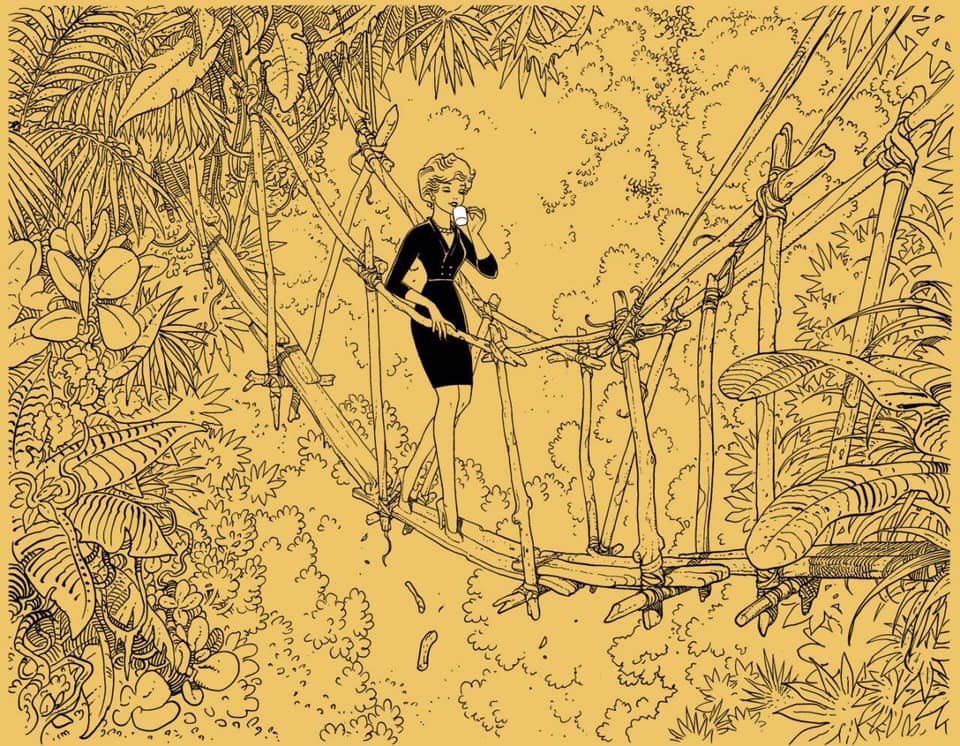
What do you do after you’ve helped create one of the “first anti-heroes in Western comics”; pioneered the underground comics industry and heavy metal album covers; won the enduring admiration of Federico Fellini, Stan Lee, and Hayao Miyazaki; and brought your distinctive creative style to the look of sci-fi classics like Blade Runner, Alien, Tron, and The Abyss?
Sit back, have a coffee, and design a series of ads for Maxwell House. Why not? You’re Moebius. You can draw whatever you want. No one’s going to accuse Alejandro Jodorowsky’s partner in the legendary never-made Dune film and The Incal comics of selling out—not when contemporary comic art, science fiction, and fantasy could hardly have existed without him.
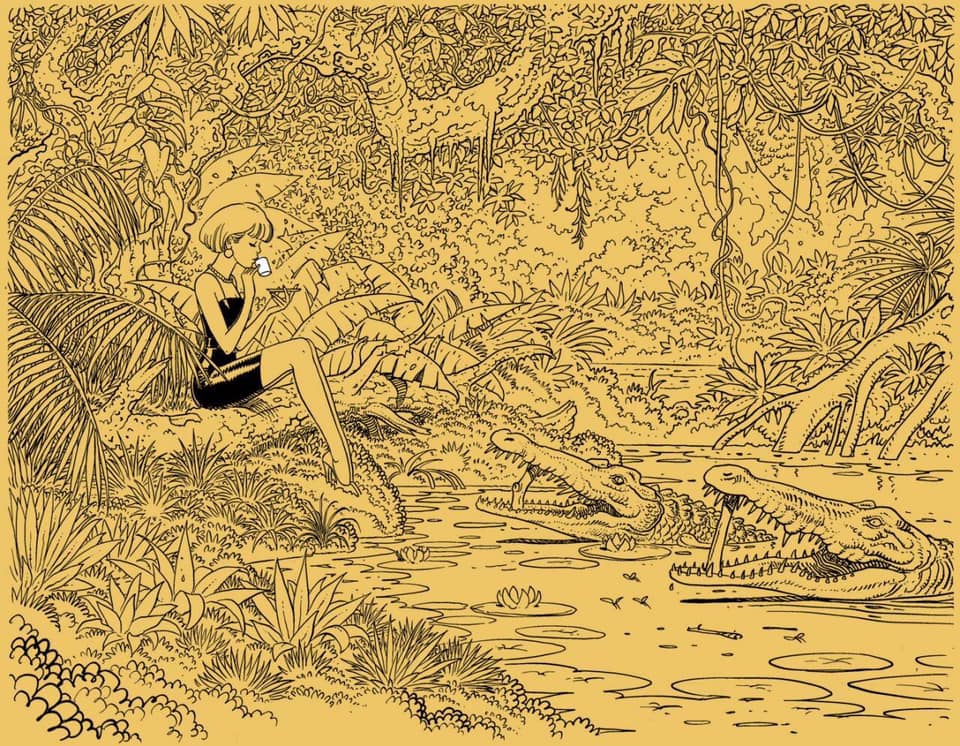
“Probably the most important fantasy comic artist of all time,” as Art Futura dubs him, the man originally known by his birth name Jean Giraud began his career as an illustrator for the youth press Fleurus, who were the first in France to publish fellow bande dessinées artist Herge’s Adventures of Tintin. The Maxwell House ads here, drawn in 1989, recall those early days of Franco-Belgian comic art, when adventurers raced around the colonies, braving wild animals and surly natives.
Moebius’ confident hand leaves a signature in the dense patterns of the foliage and slender jawline of the elegant, coffee-sipping damsel, who does not seem remotely in distress, downed plane and curious gorillas notwithstanding. But the settings are just as reminiscent of Tintin’s juvenile conceptions of the Amazon and “darkest Africa,” though Moebius leaves out the swashbucklers and ugly native caricatures.
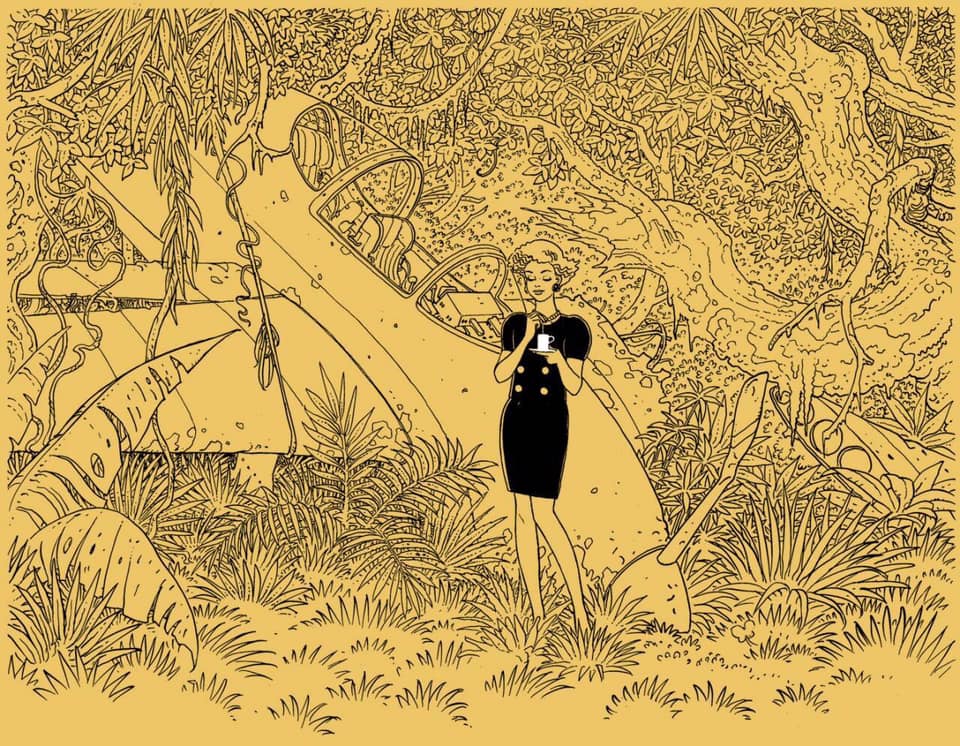
Giraud’s own travels took him through Mexico—where he joined his mother as a teenager and saw for the first time the magnificent Western landscapes he had always dreamed of—and through Algeria, where he worked as an illustrator for the French army magazine while finishing his military service. Unlike many of his contemporaries, he portrayed non-European nations and people with sympathy and respect.
Though he first took the name Moebius in 1974 in order to pursue more fantasy-oriented work after drawing the Western Blueberry for over a decade, some of Giraud’s ‘70s comic stories under the name drew upon real events, like the murder of a North African immigrant, Wounded Knee, and the famous speech of Chief Seattle.

The Maxwell House panels keep things light and sweet, so to speak, though where the cream and sugar might be hiding is anyone’s guess. The heroine of the series, named Tatiana, is “a self-possessed and fashionable young woman who happens to find herself alone on a desert jungle island or the like,” as Martin Schneider writes at Dangerous Minds. Unperturbed, she takes more interest in her coffee than the wildness around her.
At Dangerous Minds you’ll find alternate unused images and the ad campaign’s droll captions describing Tatiana taking coffee breaks from some mundane errand or chore. The commentary, though amusing, is hardly necessary. We can imagine dozens of stories embedded in each panel. The ability to create such complex and evocative illustrations, every one a world within a world, has always set Moebius ahead of his peers and many imitators.
via TripWire/Dangerous Minds
Related Content:
Watch Groundbreaking Comic Artist Mœbius Draw His Characters in Real Time
Behold Moebius’ Many Psychedelic Illustrations of Jimi Hendrix
Josh Jones is a writer and musician based in Durham, NC. Follow him at @jdmagness
Read More...Nutritional Psychiatry: Why Diet May Play an Essential Role in Treating Mental Health Conditions, Including Depression, Anxiety & Beyond
For years neuroscientists have been trying to correct the old assumption that our minds are reducible to our brains. Research into what is known as the gut microbiome, for example, has shown that mood and mental health are intimately linked to the functioning of an ecosystem of microorganisms within the digestive system. As researchers write in the Journal of Neuroscience, “experimental changes to the gut microbiome can affect emotional behavior and related brain systems [and] may play a pathophysiological role in human brain diseases, including autism spectrum disorder, anxiety, depression, and chronic pain.”
Even Parkinson’s Disease has been linked to gut bacteria in studies performed by microbiologist Sarkis Mazmanian, who points out that “70 percent of all neurons in the peripheral nervous system—that is, not the brain or spinal cord—are in the intestines, and the gut’s nervous system is directly connected to the central nervous system through the vagus nerve.” Our guts also supply the brain with fuel, and it requires a “constant supply,” notes Dr. Eva Selhub at the Harvard Health Blog. “That ‘fuel’ comes from the foods you eat—and what’s in that fuel makes all the difference. Put simply, what you eat directly affects the structure and function of your brain and, ultimately, your mood.”
Such findings have given rise to the emerging field of Nutritional Psychiatry, which you can hear described in the TEDx talk above by clinical psychologist Julia Rucklidge. Initially taught that “nutrition and diet were of trivial significance for mental health,” Rucklidge, like most of her colleagues, believed that “only drugs and psychotherapy could treat these serious conditions.” But after encountering evidence to the contrary, she decided to do her own studies. Beginning at around 5:30, she presents compelling evidence for a dramatic reduction in rates of ADHD, PTSD, depression, and psychosis after dietary treatments.
That’s not to say that drugs and psychotherapy do not play important roles in treatment, nor that they should be supplanted by a nutrition-only approach. But it does mean that nutritional treatments are shown by many fields of study to be effective and perhaps essential, for reasons consistent with widespread knowledge about the body and brain. “It is now known,” for example, as Joyce Cavaye reports at the Independent, “that many mental health conditions are caused by inflammation in the brain which ultimately causes our brain cells to die.” Inflammation is, in part, caused by “a lack of nutrients such as magnesium, omega‑3 fatty acids, probiotics, vitamins and minerals… all essential for the optimum functioning of our bodies.”
Diets consisting primarily of highly processed foods and sugars are also a cause of inflammation. “Multiple studies have found a correlation between a diet high in refined sugars and impaired brain function,” Dr. Selhub writes. These diets promote a “worsening of symptoms of mood disorders, such as depression.” Processed foods with high carbohydrate content and few nutrients have created an epidemic of malnutrition among a significant portion of the population who otherwise seem to have plenty to eat. The situation seems to have majorly contributed to the corresponding epidemics of depression and other mental health conditions.
Nutritional psychiatry is not a fad or a program claiming to recreate the diet of early humans. While “a potential evolutionary mismatch between our ancestral past (Paleolithic, Neolithic) and the contemporary nutritional environment” merits exploration, as researchers write in an article published at the Journal of Physiological Anthropology, many more contemporary factors—such as economic development and the rise of scientific medicine—play a role in how we understand diet and mental health.
Rather than look to prehistory, scientists have studied the diets of “traditional” societies (those not reliant on mass-produced processed foods) in the Mediterranean and Japan. They have found a 25–35% lower rate of depression, for example, in those who eat diets “high in vegetables, fruits, unprocessed grains, and fish and seafood,” writes Selhub, with “only modest amounts of lean meats and dairy.” There is no perfect dietary formula, however. Everyone’s gut processes things differently. Dr. Selhub recommends cutting out processed foods and sugar and experimenting with adding and subtracting foods to see how you feel. (Nutritional experiments like these are probably best carried out after consulting with your doctor.)
Just as we will need to change the way we eat if we want to preserve our outer environment, the health of that rich, and no less necessary, inner world known as the microbiome will require what for many is a dramatic change in eating habits. Sadly, it is not a change everyone can afford to make. But for millions suffering from mental illnesses, nutritional psychiatry may represent a life-altering course of treatment.
Related Content:
Josh Jones is a writer and musician based in Durham, NC. Follow him at @jdmagness
Read More...Mountain Monks: A Vivid Short Documentary on the Monks Who Practice an Ancient, Once-Forbidden Religion in Japan
If you need to get some serious thinking done, go to the mountains. That notion holds across a wide range of cultures, but it has a particular force in Japan, where solo hiking, sometimes greatly extended solo hiking, has long been a popular treatment for a wide variety of troubles both personal and professional. But no group has taken it to quite the extreme as have the Yamabushi, ascetic mountain hermits who have practiced Shugendō, a hybridization of versions of esoteric Buddhism, Taoism, and Shinto that goes back to the eighth century. What sort of lifestyle, one wonders, would such serious religious dedication in such a harsh, remote location produce?
Visual journalist Fritz Schumann, previously featured here on Open Culture for his documentaries on a 1300-year-old Japanese hotel and a nearly extinct Japanese printing technique, gives us a sense of that in his new short Mountain Monks. “Walking barefoot through rivers, meditating under waterfalls and spending the nights on mountaintops — that is the way of the Yamabushi,” he writes.
“They walk into the forest to die and be born again.” Their Shugendō teachings “peaked in popularity during the 17th century, when Yamabushi visited around 90 percent of all villages in northern Japan,” and when its monks “were said to have magical powers and served as advisors to samurai and warlords.” But then, “in the late 19th century, when Japan opened itself to the west and moved from a feudal state towards industrialization, their religion was forbidden.”
Though the proscription on Yamabushi has long since been lifted, as a religion it no longer possesses quite the following it once did. A group of monks has kept its flame alive in secret in isolation, up in northern Japan’s Yamagata prefecture, and now anyone can sign up for private courses through the official Yamabushido web site, even foreigners. The simple rigors of their daily life may sound appealing indeed to those fed up with whichever modern, technology-saturated society they’ve come from, and Schumann’s film may well convince a fair few to look into the experience themselves. Not to say that he sugar-coats it: “The idea,” declares one Yamabushi member right at the beginning, “is to experience the tortures of hell.”
Related Content:
A Hypnotic Look at How Japanese Samurai Swords Are Made
Based in Seoul, Colin Marshall writes and broadcasts on cities, language, and culture. His projects include the book The Stateless City: a Walk through 21st-Century Los Angeles and the video series The City in Cinema. Follow him on Twitter at @colinmarshall or on Facebook.
Read More...Support Us
We're hoping to rely on loyal readers, rather than erratic ads. Please click the Donate button and support Open Culture. You can use Paypal, Venmo, Patreon, even Crypto! We thank you!

About Us

Open Culture scours the web for the best educational media. We find the free courses and audio books you need, the language lessons & educational videos you want, and plenty of enlightenment in between.
Advertise With Us

FREE UPDATES!
GET OUR DAILY EMAIL
Get the best cultural and educational resources on the web curated for you in a daily email. We never spam. Unsubscribe at any time.
FOLLOW ON SOCIAL MEDIA

Open Culture editor Dan Colman scours the web for the best educational media. He finds the free courses and audio books you need, the language lessons & movies you want, and plenty of enlightenment in between.
Advertise With Us

