A History of the Entire World in Less Than 20 Minutes
Thanks for watching history. I hope I mentioned everything. — Bill Wurtz
Here at Open Culture, we happily acknowledge that learning is not a one-size-fits-all proposition.
The internet may be doing a number on our attention spans, but as the world has grown smaller, the educational buffet has grown richer, more varied, and vastly more affordable.
Take for example the History of the World.
Geography fans can approach the subject via Ollie Bye’s year-by-year animated map.
John Green’s playful Crash Course series offers a wonderful respite for any kid grinding their way through AP World History.
Those of a more traditional mindset, who prefer a statelier pace can lose themselves in 46 lectures by Richard Bulliet, professor of history at Columbia University.
And then there’s world history according Bill Wurtz, above, a creator of short, anachronistic-looking videos, whose YouTube fame was kindled by Vine, a now defunct app for sharing short-form videos.
Chafing at Vine’s 7‑second time constraints, Wurtz undertook a more ambitious project, a condensed History of Japan that would employ the same techniques he brought to bear in his shorter works: graphic text, clip art, and Microsoft Paint drawings. He zeroed in on the subject because he knew precious little about Japan, and looked forward to doing some virgin research.
Wurtz followed up the 9‑minute History of Japan, above, with History of the Entire World, I guess.
The nonchalance of the title is reflected in Wurtz’s offhanded narration. Any word or phrase over two syllables runs a risk of being transformed into an infomercial-worthy musical jingle: space dust, the moon, Egypt…
You may bridle at first, but stick it out. Its charms sneak up on you.
Time is not particularly relative in Wurtz’s compressed universe. Whether it’s 10 minutes passing before some major development or 500 million years, their passage is accorded equal heft.
Humans show up around the four minute mark, grabbing stuff, banging rocks, figuring out agriculture…
(Mesopotamia’s characterization as a “sweet dank valley” between the Tigris and Euphrates is a particular highlight.)
This is the rare history video where science plays a major role. It takes time out for weather updates—the floor is no longer lava, the entire world is now an ocean… it’s sobering to remember that ozone is what made it safe for multi-celled life forms to venture forth on land.
Empires rise and fall, unconquerable rulers are unseated and forgotten.
(That’s the Tamil Kings. Nobody conquers the Tamil Kings. Who are the Tamil Kings? Merchants probably and they’ve got spices…)
Of course the problem with a great overview such as this is the back end’s shelf life can prove rather short. It’s been a little over a year and a half since Wurtz posted the video, and thus far, his parting shots still feel pretty relevant: armed drones, 3d printing, plastic-choked oceans, and a seemingly unbridgeable gap between the desire to save the world and an actual plan for doing so.
Fried by 11 months of intensive research and labor on History of the Entire World, I guess, Wurtz is currently taking a leave of absence from history. These days, he’s pouring his energies into original music videos like “At the Airport Terminal.” He also devotes a bit of every day to answering fans’ questions, routinely turning in upwards of a dozen succinct humble, all-lowercase replies:
1.18.19 7:00 pm what inspired you to make “the entire world, i guess”? was it a project you already had in mind from before or did you start it when you saw you could do more than just japan
it’s always a nice idea to try to explain the whole world in one video. it’s surely something i’ve always wanted to do, but wasn’t confident/experienced/stupid enough to believe i could do it until after i had done japan which worked so well
1.18.19 12:53 am are you ever going to make anything else as in depth as history of japan or the world?
that would take so much time that by the time it was done you probably wouldn’t care anymore, but someone else will so i still might do it
Unsurprisingly, he’s the subject of a lively sub-reddit. One fan, reddit user n44m, was inspired to plot the timeline of History of the Entire World, I Guess, below.
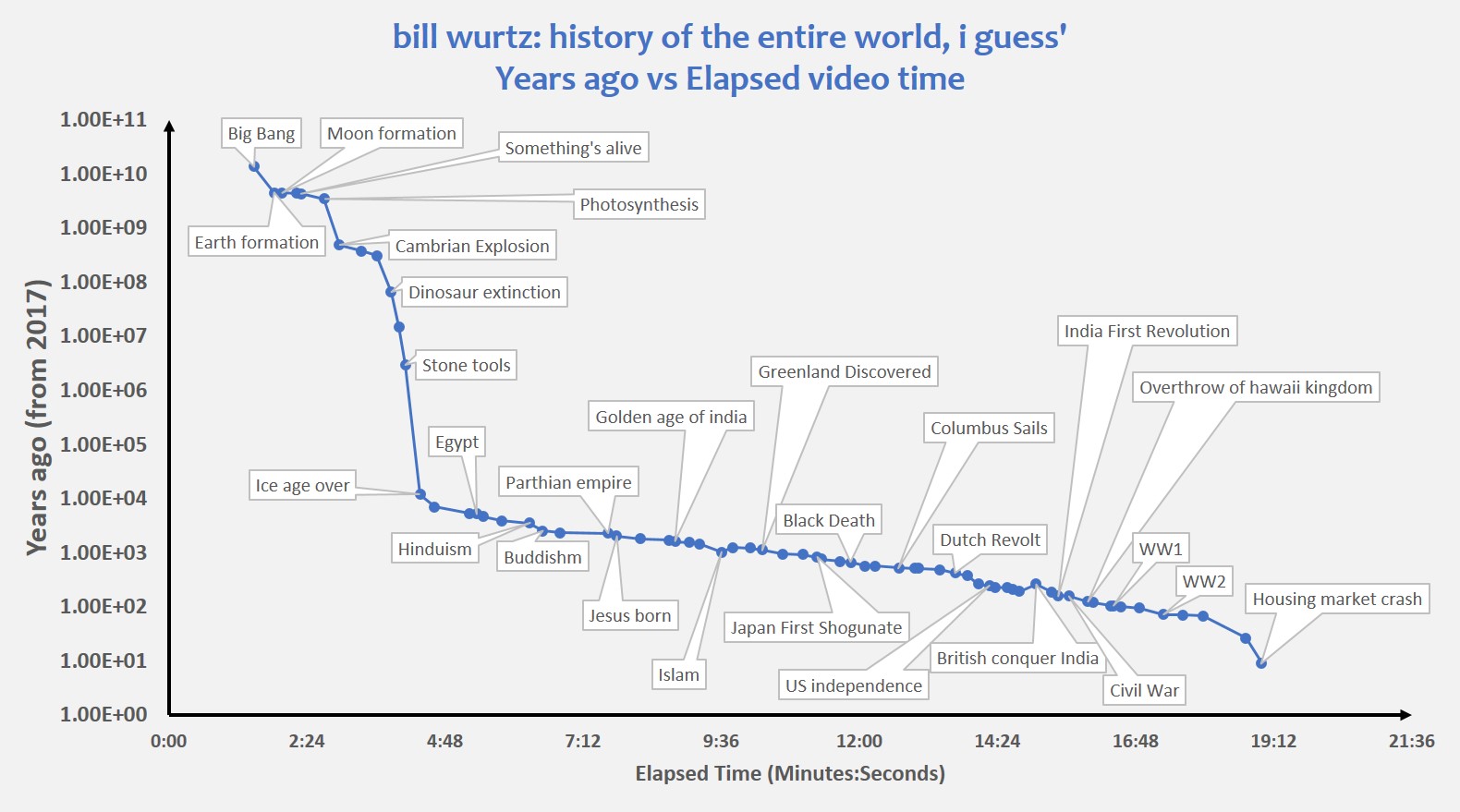
To learn more about some of the civilizations, events and persons featured in History of the Entire World, I Guess, check out another fan’s annotated transcription here.
And rather than nitpick about certain critical bits of history that were left on the cutting room floor, try writing a script for your own history based animation:
The more you learn, the more you find out how much you’re gonna have to leave out. It’s like 99%. That was painful. — Bill Wurtz
Related Content:
The Entire History of Japan in 9 Quirky Minutes
A Crash Course in World History
The History of the World in 46 Lectures From Columbia University
Ayun Halliday is an author, illustrator, theater maker and Chief Primatologist of the East Village Inky zine. See her onstage in New York City in February as host of Theater of the Apes book-based variety show, Necromancers of the Public Domain. Follow her @AyunHalliday.
Read More...The Evolution of the Alphabet: A Colorful Flowchart, Covering 3,800 Years, Takes You From Ancient Egypt to Today
No matter our native language, we all have to learn a writing system. And whichever language we learn, its writing system had to come from somewhere. Take English, the language you’re reading right now and one written in Latin script, which it shares with a range of other tongues: the European likes of French, Spanish, and German, of course, but now also Icelandic, Swahili, Tagalog, and a great many more besides. The video above by Matt Baker of UsefulCharts explains just where this increasingly widespread writing system came from, tracing its origins all the way back to the Proto-Sinaitic script of Egypt in 1750 BCE.
As revealed in the video, or by the poster available for purchase from UsefulCharts, the letters used to write English today evolved from there “through Phoenician, early Greek and early Latin, to their present forms. You can see how some letters were dropped and others ended up evolving into more than one letter.”
The color-coding and direction dotted lines help to make clearly legible what was, in reality, an evolution that happened organically over about two millennia. Enough changed over that time, as Jason Kottke writes, that “it’s tough to see how the pictographic forms of the original script evolved into our letters; aside from the T and maybe M & O, there’s little resemblance.”
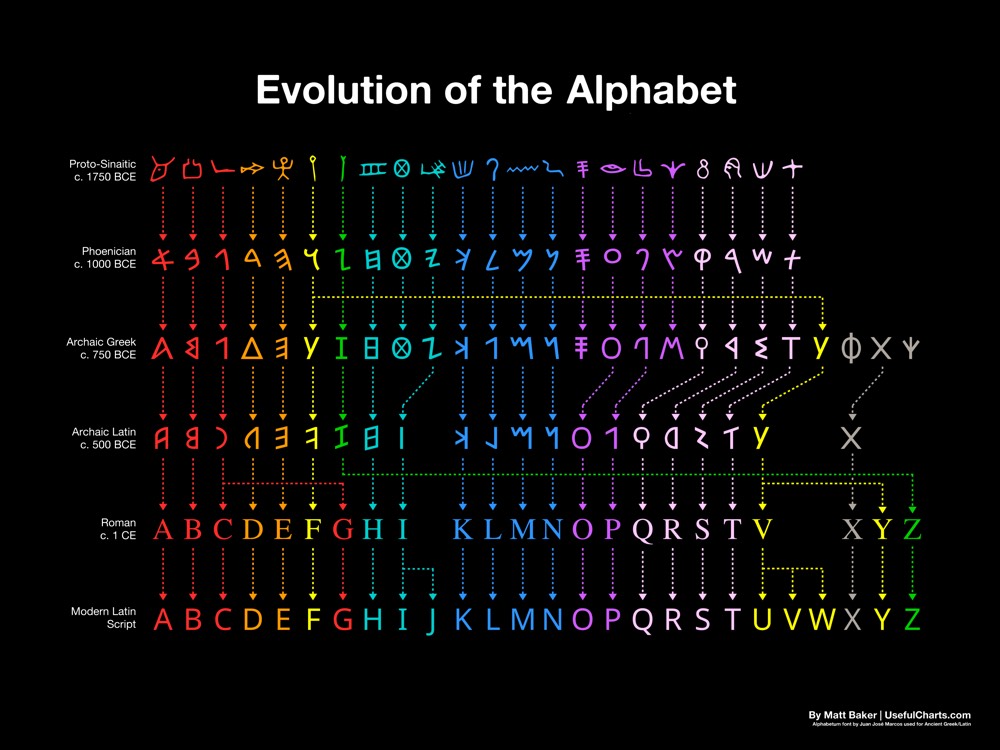
Baker’s design for this poster, notes Colossal’s Kate Sierzuputowski, “was created in association with his Writing Systems of the World chart which takes a look at 51 different writing systems from around the world.” All of the research for both those posters informs his video on the history of the alphabet, which looks at writing systems as they’ve developed across a variety of civilizations. You’ll notice that all of them respond in different ways to the needs of the times and places in which they arose, and some possess advantages that others don’t. (In Korea, where I live, one often hears the praises sung of the Korean alphabet, “the most scientific writing system in the world.”) But what the strengths of the descendant of modern Latin 2000 years on will be — and whether it will contain anything resembling emoji — not even the most astute linguist knows.
Related Content:
Now I Know My LSD ABCs: A Trippy Animation of the Alphabet
You Could Soon Be Able to Text with 2,000 Ancient Egyptian Hieroglyphs
The History of the English Language in Ten Animated Minutes
Based in Seoul, Colin Marshall writes and broadcasts on cities, language, and culture. His projects include the book The Stateless City: a Walk through 21st-Century Los Angeles and the video series The City in Cinema. Follow him on Twitter at @colinmarshall or on Facebook.
Read More...The Real Locations of Ukiyo‑e, Historic Japanese Woodblock Prints, Plotted on a Google Map

The undisputed last great master of ukiyo‑e was Utagawa Hiroshige. He is best known for the many series he created of bucolic landscapes, which offered collectors a chance to see parts of Japan they might never reach. The Japan of his early 19th century work holds a special place in Japanese hearts–a final look at an isolated and beautiful country just before the opening up of the ports to the West and, with it, industrialization.
Apart from Mount Fuji, the locations that Hiroshige drew have long gone, but “Computer science undergrad, martial artist, ukiyo‑e lover” and British resident George–he goes by the Twitter handle @Cascadesssss–has plotted the location of Hiroshige’s prints on an interactive Google map that has gone quickly viral.
The red circles represent the series “One Hundred Famous Views of Edo,” the blue circles “The Fifty-Three Stations of the Tokaido” (one of five main routes in Edo Japan), and the green “Famous Views of the Sixty-odd Provinces,” the most expansive series showing scenes all the way from the The Two-sword Rocks of Bo Bay to the north province of Dewa and Mount Gassan. Each location opens to a separate web page with location information, including latitude-longitude numbers. (Pull up a chair map-lovers, you might be here a long time.)
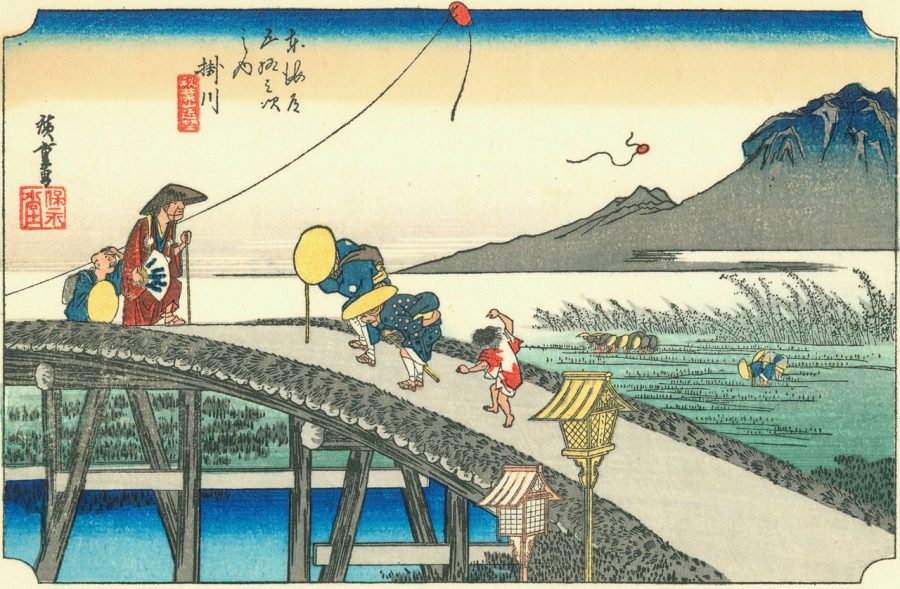
“The Fifty-Three Stations of the Tokaido” was Hiroshige’s most popular series and unlike the other two depicted horizontal landscapes. The artist sketched these in 1832 as he rode in a procession from Edo (now Tokyo) to Kyoto and set to work on the prints once he returned home. The 55 prints (two extra drawings of the starting and ending points of the journey) sold like crazy, as they cost about the same as a bowl of soup for the common person.
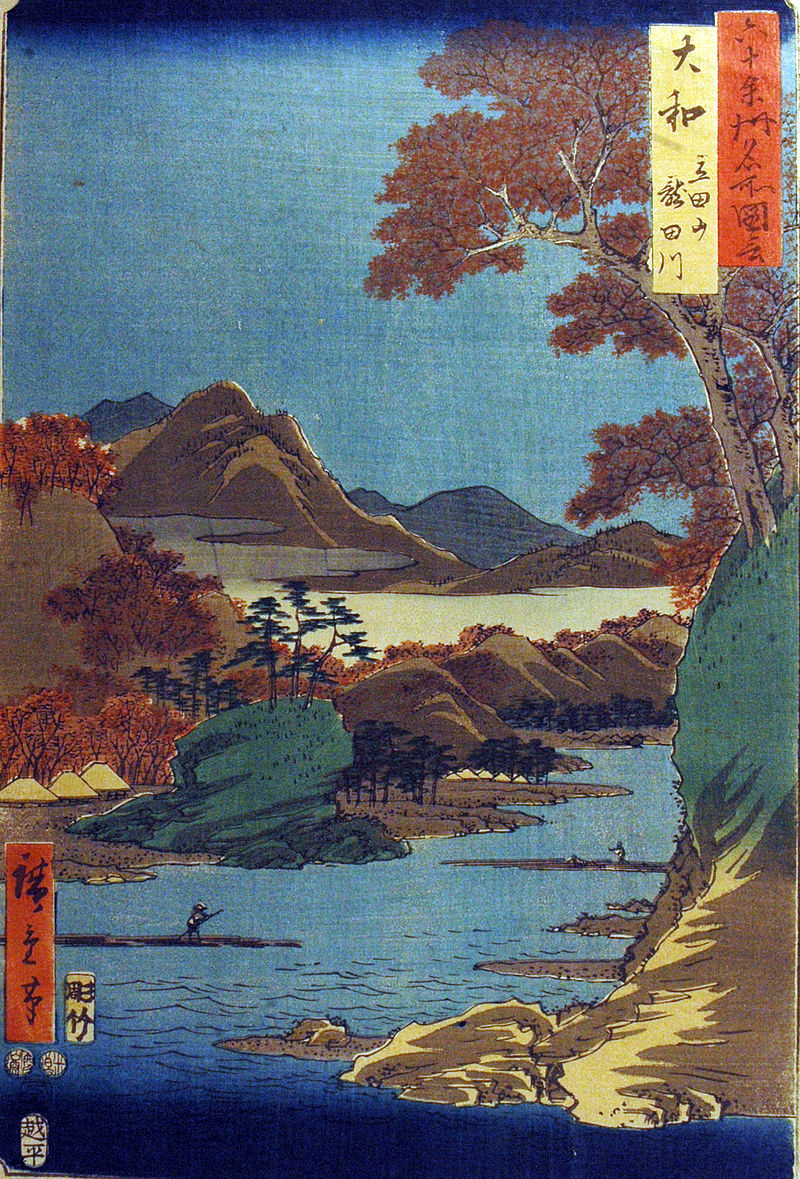
“Famous Views of the Sixty-odd Provinces” is different in that Hiroshige did not make trips to see all these beloved locations–instead he put his own spin on existing drawings found in guide books and other sources. The total series of 70 prints took four years to complete, from 1853 to 1856.
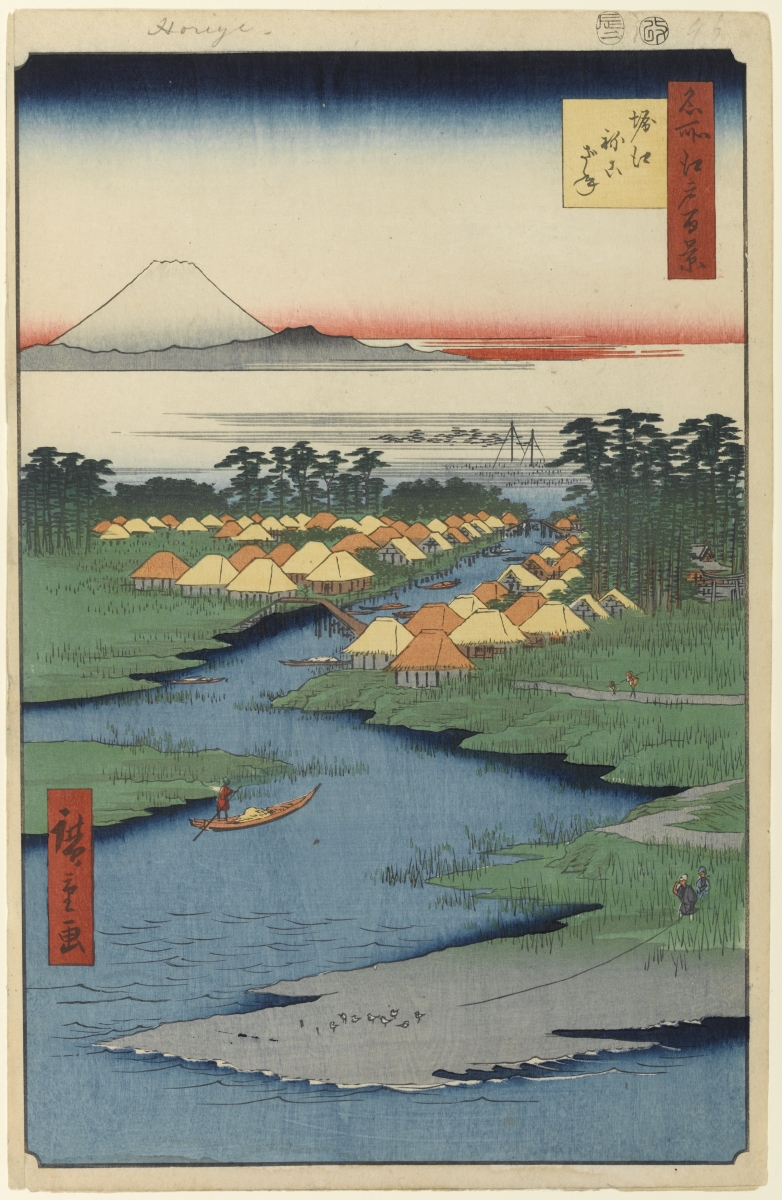
By the time the “Provinces” series was winding down, Hiroshige started work on his final series “One Hundred Famous Views of Edo,” which he worked on until his death. Again, though living in Edo, Hiroshige drew from the works of others from decades before. This is also the artist at his most adventurous–some landscapes are obscured by posts and bridge railings or even a carp streamer. One features what is rumored to be Hiroshige’s favorite geisha. These prints would go on to influence Western artists, especially Vincent van Gogh.
Hiroshige produced more series over his life–he died aged 61–and here’s hoping Cascadesssss plots more on his map soon.
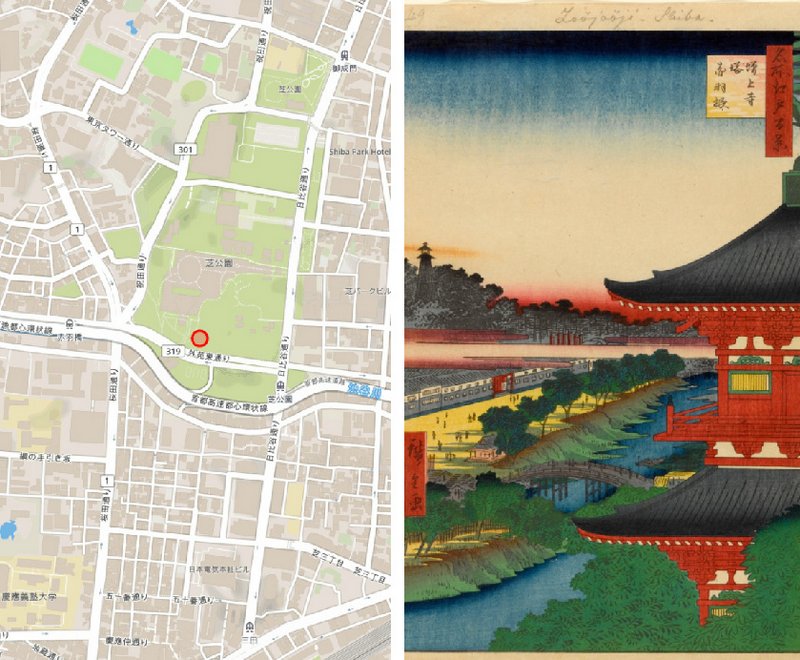
via Spoon and Tamago
Related Content:
Enter a Digital Archive of 213,000+ Beautiful Japanese Woodblock Prints
Download 2,500 Beautiful Woodblock Prints and Drawings by Japanese Masters (1600–1915)
Ted Mills is a freelance writer on the arts who currently hosts the artist interview-based FunkZone Podcast and is the producer of KCRW’s Curious Coast. You can also follow him on Twitter at @tedmills, read his other arts writing at tedmills.com and/or watch his films here.
Read More...Watch The Beatles Perform Their Famous Rooftop Concert: It Happened 50 Years Ago Today (January 30, 1969)
On January 3oth 1969, The Beatles took to the rooftop of the headquarters of Apple Records, located at 3 Savile Row, in central London. And there they played an impromptu last gig (a coda to their final official concert at Candlestick Park on August 29, 1966), much to the delight of Londoners on nearby rooftops … and to the chagrin of the police.
At the time, The Beatles were recording their album, Let It Be, and the rooftop show let them run through various tracks from those sessions. Songs played during the set include “Get Back,” where the Beatles were accompanied by Billy Preston on the keyboards, and “Don’t Let Me Down” (above), “I’ve Got A Feeling,” “One After 909,” and “Danny Boy.” And finally “Dig A Pony” and another version of “Get Back.”
Famously, The Beatles’ live legacy ends with the police shutting down the show (it was a noise violation, you know?) and John Lennon uttering the immortal words, “I’d like to say thank you on behalf of the group and ourselves, and I hope we passed the audition.” That’s going out in style…
Footnote: It’s not clear which band played the first rooftop concert, but one thing is for certain. Jefferson Airplane played their own rooftop gig on December 7, 1968, and Jean-Luc Godard filmed it. Once again, the police pay a friendly visit. Watch it here.
Learn more about the Beatles’ historic performance by picking up a copy of the recently-released book, The Roof: The Beatles’ Final Concert, or download it from Audible through this free trial offer.
If you would like to support the mission of Open Culture, consider making a donation to our site. It’s hard to rely 100% on ads, and your contributions will help us continue providing the best free cultural and educational materials to learners everywhere. You can contribute through PayPal, Patreon, and Venmo (@openculture). Thanks!
Related Content:
Audio: The Beatles Play Their Final Concert at Candlestick Park, 1966
Read More...Neil Gaiman Teaches the Art of Storytelling in His New Online Course
How has Neil Gaiman, author of fiction in a variety of forms ranging from novels and short stories to comic books, radio plays, and films, managed to win over such a large and devoted fan base? Ask a member of that fan base, and you’ll more than likely hear an explanation along the lines of, “He knows how to tell a story.” That may sound like a simple skill, but telling a story at Gaiman’s level requires a deep-rooted expertise in the essential nature and still-unexplored possibilities of storytelling itself — an expertise that Gaiman himself has lately proven more than willing to share. A few years ago we featured his lecture “How Stories Last” here on Open Culture; now, he’s come out with an online course on the art of storytelling at MasterClass.
“Human beings are storytelling creatures,” Gaiman says in the course’s trailer above. “Stories are vital. We convey truth with stories. That is the magic of fiction.” But even the author of stories like The Sandman, Neverwhere, Stardust, American Gods, Coraline, and much more besides has certain admissions to make about the practice of writing them: “Writing a novel is like driving through the fog with one headlight out,” for example.
“You can’t see very far ahead of yourself. But every now and again, the mists will clear.” And when it comes time to revise, he explains, “the process of doing your second draft is the process of making it look like you knew what you were doing all along.” What do you need most to make it through this harrowing process? The “conviction that you are brilliant.”
Not that you don’t need anything else. The nineteen lessons of Gaiman’s MasterClass cover everything from “using the ‘lie’ of a made-up story to tell a human truth,” to “how to overcome the fear of making mistakes,” to techniques like “cold opens, withholding information, finding emotional weight, and choosing memorable details,” to the art of worldbuilding, which Gaiman describes as “honestly, the joy of getting to play god.” Other lessons provide case studies focusing on his short stories, novels, and comic books, all of which have no doubt inspired many to tell stories themselves. But who, hearing Gaiman talk about storytelling, could possibly resist trying their hand at it?
You can sign up for Gaiman’s course here.
You can take this class by signing up for a MasterClass’ All Access Pass. The All Access Pass will give you instant access to this course and 85 others for a 12-month period.
FYI: If you sign up for a MasterClass course by clicking on the affiliate links in this post, Open Culture will receive a small fee that helps support our operation.
Related Content:
18 Stories & Novels by Neil Gaiman Online: Free Texts & Readings by Neil Himself
Neil Gaiman Reads “The Man Who Forgot Ray Bradbury”
Where Do Great Ideas Come From? Neil Gaiman Explains
Margaret Atwood Offers a New Online Class on Creative Writing
Based in Seoul, Colin Marshall writes and broadcasts on cities, language, and culture. His projects include the book The Stateless City: a Walk through 21st-Century Los Angeles and the video series The City in Cinema. Follow him on Twitter at @colinmarshall or on Facebook.
Read More...Enter an Online Interactive Documentary on Rembrandt’s The Night Watch and Learn About the Painting’s Many Hidden Secrets
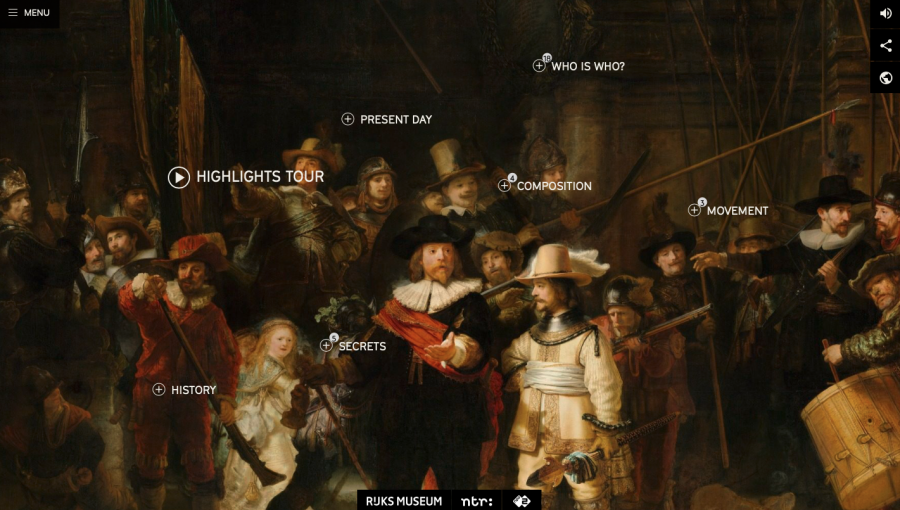
What possessed the man who attacked Rembrandt’s The Night Watch with a bread knife in 1975, “jabbing two-foot-long knife marks into the surface,” as Nina Siegal writes at The New York Times, “cutting a seven-foot-wide hole, and ripping off a section of the canvas”? This was not the first time the painting had been mangled. In 1715, just a little over 70 years after the monumental work’s 1642 completion, the Amsterdam city government decided to move it, and removed a significant part to shrink it down for easier transport. The missing top and left portions have never been recovered.
It survived intact for two centuries then faced its first knife attack in 1911. Then it survived two World Wars only to endure the second attack. Then, in 1990, it was set upon by a man armed with sulphuric acid.
Thanks to the quick thinking of a Rijksmuseum guard, only the painting’s varnish sustained injury. These are just some of the facts we learn in the interactive documentary Experience The Night Watch, a joint creation of NTR TV channel and the Amsterdam Rijksmuseum.
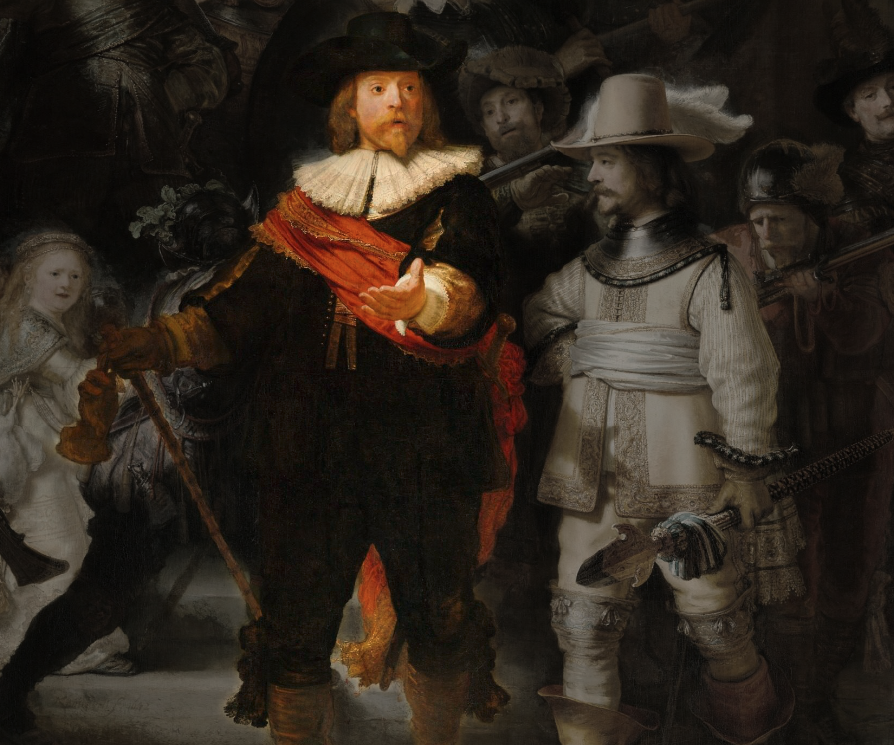
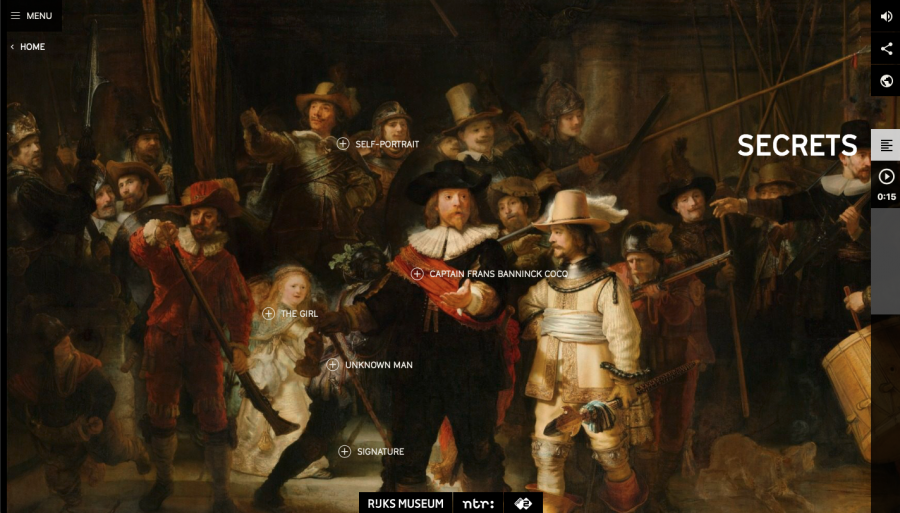
You can read or hear the painting’s history in Dutch or English, learn the names of the historical figures depicted in it, learn about Rembrandt’s command of composition and chiaroscuro, and much more. (Enter the interactive documentary here.) The painter’s masterful, dramatic use of light and shadow to create a sense of depth—probably the most famous example of his use of the technique—is responsible for the painting’s usual title, since most of its viewers have assumed that the assembled volunteer militia depicted in it came together in the dead of night. (The shadows had darkened considerably over the years until a thick layer of varnish was removed in the 1940s.)
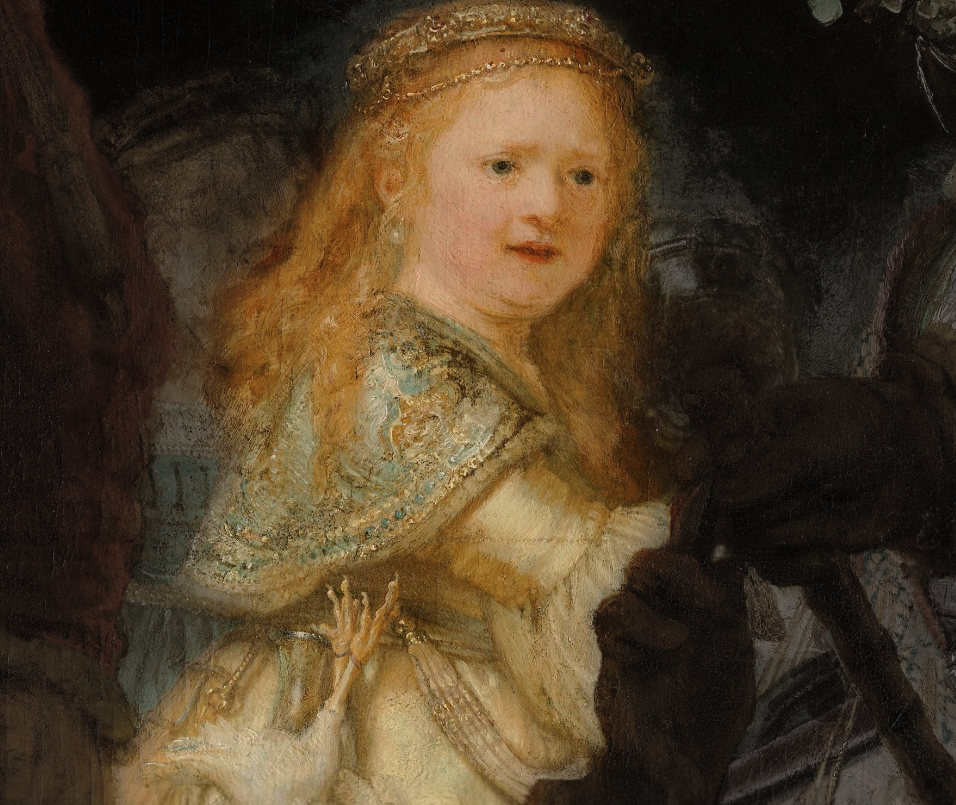
But Rembrandt’s masterpiece was originally called Militia Company of District II under the Command of Captain Frans Banninck Cocq, and it records not a troop of seasoned soldiers but a gentleman’s shooting company, one of the bands of civic guards that had “effectively developed into a social club for well-to-do citizens” who would “turn up mostly as ceremonies or to quell minor riots.” Each of the men memorialized paid to have his likeness included. We may never have known their names except that in 1715 they were added inside a shield painted by an anonymous artist for some reason. The work is full of other such mysteries.
Who is the small girl in white, bathed in angelic light, to whom our eyes are inevitably drawn? “She does not have any traceable identity,” our narrator tells us, “she is Rembrandt’s invention,” a symbol of the company. And yet behind her, almost completely shrouded, is another girl, identity unknown, who most of us would probably never have noticed had she not been pointed out. “In The Night Watch,” we discover, “nothing is what it seems.”
Learn more of the painting’s secrets at the online documentary project here, see similarly interactive art histories from NTR on M.C. Escher and Hieronymus Bosch, and, above, listen to an Artsy podcast featuring Rijksmuseum curator Pieter Roelofs and other Rembrandt experts who explain what makes The Night Watch so wildly famous that more than one person has felt driven to destroy it.
Related Content:
300+ Etchings by Rembrandt Now Free Online, Thanks to the Morgan Library & Museum
What Makes The Night Watch Rembrandt’s Masterpiece
Read More...Ursula K. Le Guin’s Daily Routine: The Discipline That Fueled Her Imagination
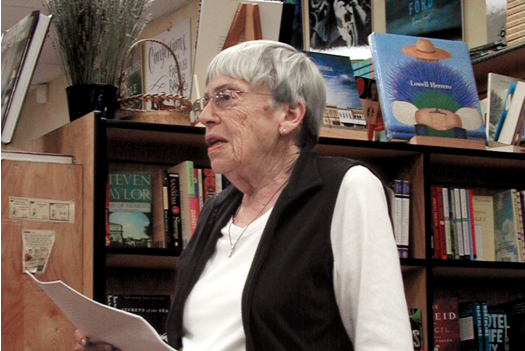
Image by Gorthian, via Wikimedia Commons
“Some of us are Norman Mailer,” said Ursula K. LeGuin in a 1976 interview with science-fiction fanzine Luna Monthly, “but others of us are middle-aged Portland housewives.” And though Le Guin may have thought of herself as one of the latter, “middle-aged Portland housewife” is hardly the way the rest of us would describe her. Over a nearly 60-year-long career, Le Guin produced an enormous body of literary work, including but not limited to the six books in which she created the world of Earthsea and other acclaimed sci-fi novels like The Left Hand of Darkness, The Dispossessed, and The Lathe of Heaven. And somehow she managed to write all of it between 7:15 a.m. and 1:00 p.m. each day.
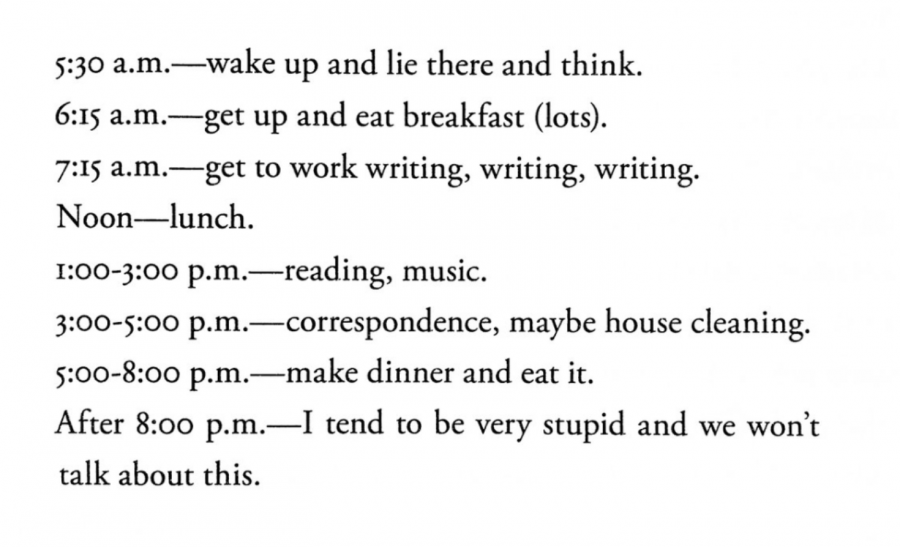
Or that’s what her ideal writing schedule dictates, anyway. Recently tweeted out by writer Michael J. Seidlinger as “the ideal writing routine,” it first appeared in an interview she gave in 1988 (and more recently reappeared in Ursula Le Guin: The Last Interview and Other Conversations).
Beginning at the early hour of 5:30 in the morning, the time to “wake up and lie there and think,” it continues on to breakfast — and “lots” of it — at 6:15, and the commencement of the day’s “writing, writing, writing” an hour later, which lasts until lunch at noon. After that, Le Guin considered what we consider her main work to be done, moving on to such pursuits as reading, music, correspondence, “maybe house cleaning,” and dinner. Past 8:15, she said, “I tend to be very stupid,” a state in which nobody could write the sort of books we remember her for.
But however originally she wrote, Le Guin was hardly exceptional in living this way while doing it. “Be regular and orderly in your life, so that you may be violent and original in your work,” said Gustave Flaubert, a maxim true for enough writers that we also worked it in when we featured an infographic on the daily routines of famous creative people. In both Flaubert and Le Guin’s case (or in the case of a writer like Haruki Murakami, who rises famously early and runs famously hard when working on a book), their domestic lives, well-ordered to the point that an outside observer would find them boring, facilitated the creation of literature like none that had ever come before. This despite the fact that, on the surface, few novels could seem more dissimilar than Flaubert and Le Guin’s, but each writer would have seen what the other had in common: specifically, that they knew what it took to get the imagination well and truly fired up.
Related content:
The Daily Habits of Famous Writers: Franz Kafka, Haruki Murakami, Stephen King & More
The Daily Routines of Famous Creative People, Presented in an Interactive Infographic
Ursula Le Guin Gives Insightful Writing Advice in Her Free Online Workshop
Ursula K. Le Guin Names the Books She Likes and Wants You to Read
Based in Seoul, Colin Marshall writes and broadcasts on cities, language, and culture. His projects include the book The Stateless City: a Walk through 21st-Century Los Angeles and the video series The City in Cinema. Follow him on Twitter at @colinmarshall or on Facebook.
Read More...The Cleveland Museum of Art Digitizes Its Collection, Putting 30,000 Works Online and Into the Public Domain
The lines of the descent from the plutocratic wealth and autocratic power of the late 19th century to the worst atrocities of the early 20th might seem apparent to some people. So too can we trace from the Gilded Age an institutional system of monuments to art, culture, and higher learning unique to modern times. Whether by virtue of greed, guilt, or noblesse oblige, or some of all of the above, wealthy industrialists sought to show—as Andrew Carnegie wrote in his “Gospel of Wealth”—that “the houses of some should be homes for all that is highest and best in literature and the arts, and for all the refinements of civilization.”
The treasures of world culture were donated back to the world, but the proud beneficence of their givers lived on in the institutions. In the case of Cleveland telegraph magnate Jeptha Wade, who was himself a daguerreotypist and portrait painter, the memory of the generous gift continues in Wade Park, home of the Fine Arts Garden and the Cleveland Museum of Art, created from his bequest.
Now, over 125 years later, Wade’s patronage lives on online. “Brace yourself for some meme-worthy Egyptian cats and gif-able Renaissance babies,” as Zachary Small jokes at Hyperallergic.
The museum has just announced its digital collection with a poignant quote from its founder declaring it an eternal donation to humankind: “The statement ‘for the benefit of all the people forever’ was written into Jeptha Wade’s 1892 deed of gift for the land on which the museum stands… reflecting its founders’ belief that museums should be places for inspiration and for creating wonder and meaning in people’s lives.”

This may sound like ostentatious rhetoric, but the announcement also tells us that its free digital collection is “using Open Access,” which means “the public now has the ability to share, remix, and reuse images of as many as 30,000 CMA artworks—“nearly half of the museum’s entire collection,” notes Small—are now “in the public domain for commercial as well as scholarly and noncommercial purposes.” Take even a small sampling of their open collections and you may find more than enough inspiration, wonder, and meaning.
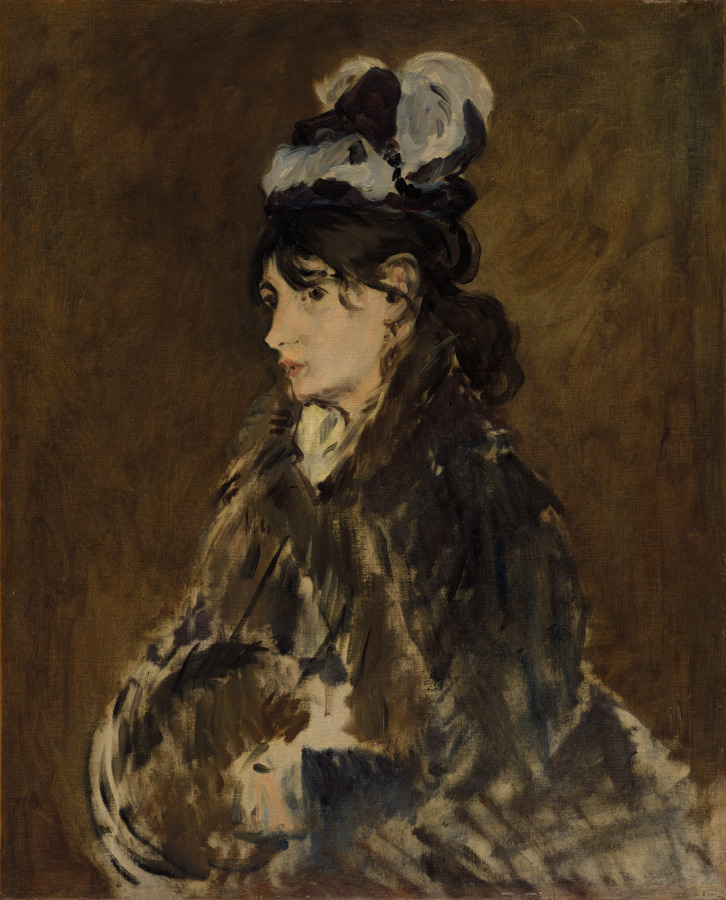
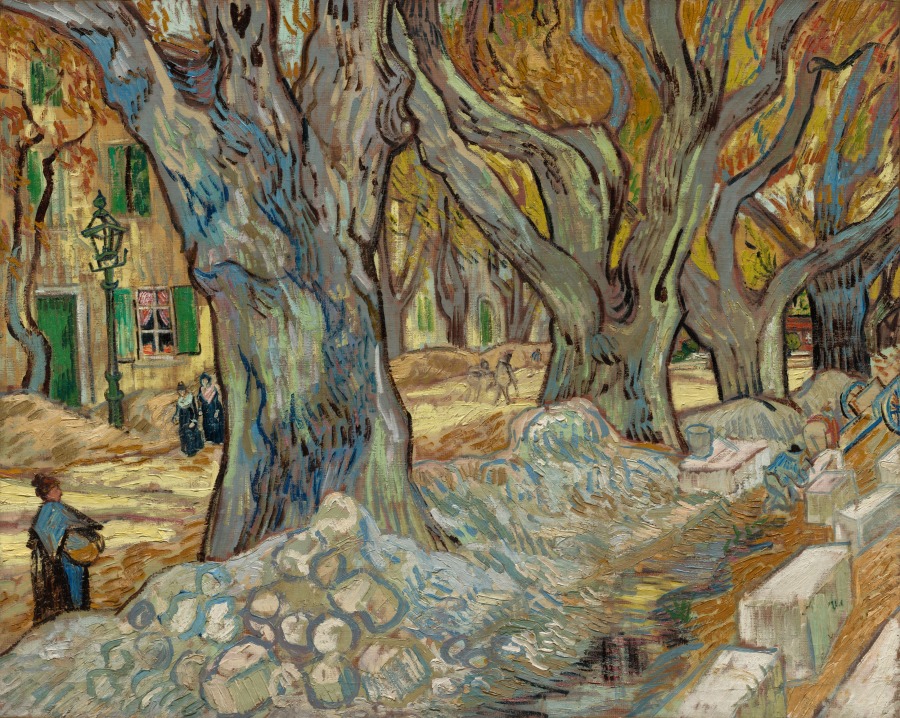
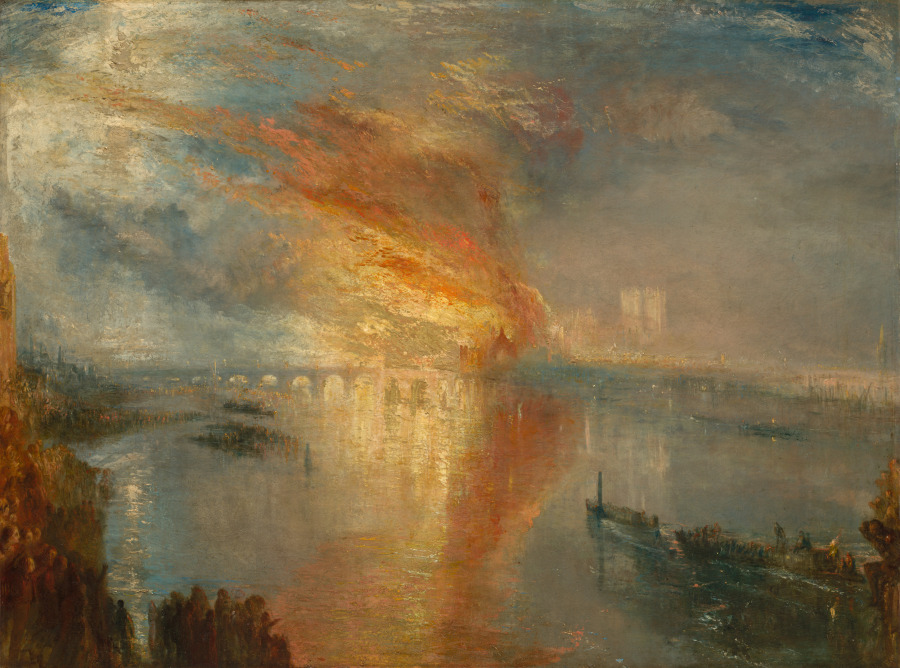
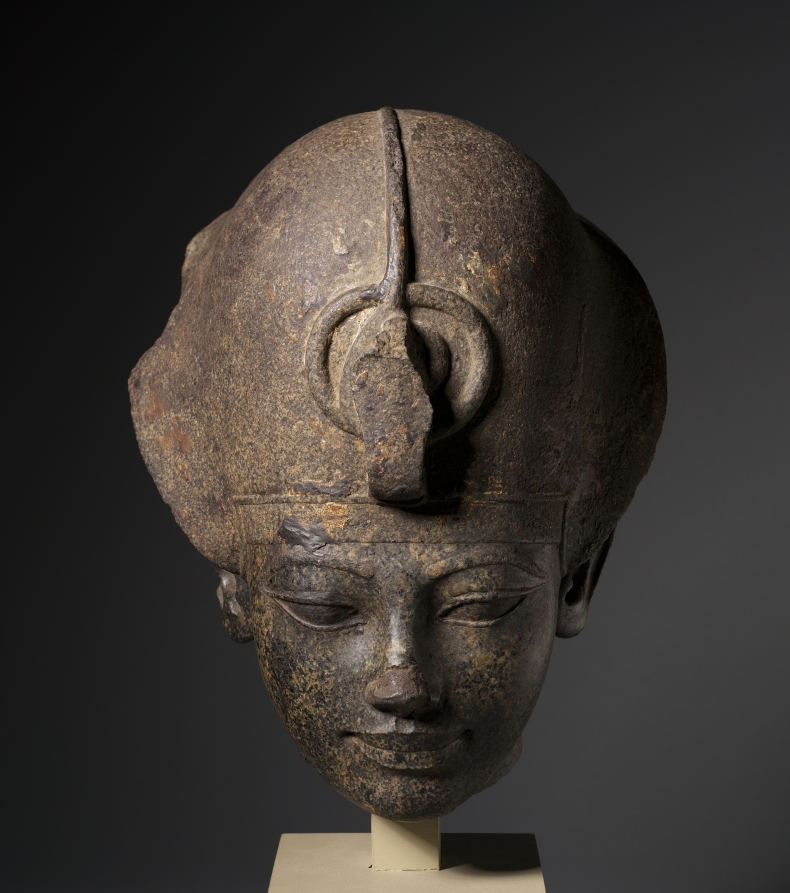
Take, for example, Van Gogh’s The Large Plane Trees, J.M.W. Turner’s The Burning of the Houses of Lords and Commons, El Greco’s The Holy Family with Mary Magdalen, and Edouard Manet’s Berthe Morisot. Take work from Rembrandt, Velázquez, Monet, Cezanne, Caravaggio, Pissarro, Degas, Rubens, Poussin, Rodin. Take masterful works like ancient Egyptian New Kingdom Head of Amenhotep II Wearing the Blue Crown and Timurid period Iranian Royal Reception in a Landscape—as well as many from central Africa, China, India, Japan and Korea.
The Open Access collection has swelled to over 34,000 images that can be downloaded as jpgs or high-resolution tiffs. These and over 60,000 more online works come with descriptions, citations, exhibition histories, and more. Whatever confluence of historical and contemporary events brought Cleveland’s digital collection into being, it does indeed seem to be for the great benefit of a great number of internet-connected people around the world. Take full advantage of its newly public resources here.
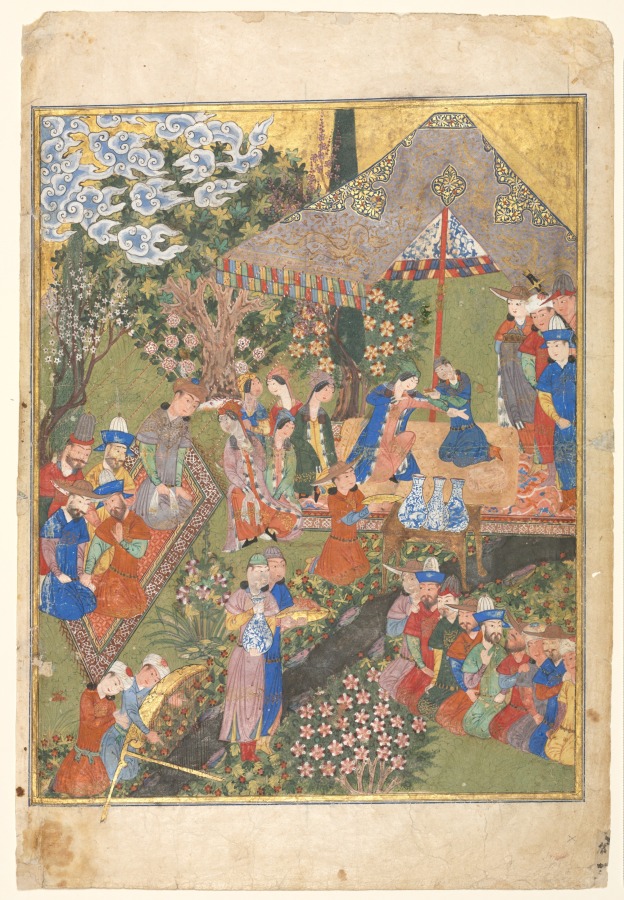
via Hyperallergic
Related Content:
The Art Institute of Chicago Puts 44,000+ Works of Art Online: View Them in High Resolution
The Metropolitan Museum of Art Puts 400,000 High-Res Images Online & Makes Them Free to Use
Google Puts Over 57,000 Works of Art on the Web
Josh Jones is a writer and musician based in Durham, NC. Follow him at @jdmagness
Read More...Watch a New Virtual Reality Production of Shakespeare’s Hamlet: A Modern Take on a Classic Play
Often compared to The Tempest, Samuel Beckett’s Endgame may have as much of Shakespeare’s Hamlet in it, though the author was unwilling to acknowledge the influence to Theodor Adorno. Beckett’s central character, the blind, aged Hamm, spends all of his time in a throne haranguing the other three, in a gloomy place, The New York Times’ Brooks Atkinson wrote, “somewhere between life and death.” Hamm might have been the Danish prince grown old and bitter, left with nothing but what Beckett called Shakespeare’s “fat greasy words.”
In any case, Hamlet has long been thought of as a prototype of the absurd, a play where little happens because its protagonist is too haunted to have relationships with the living or make decisions, a condition he complains about in scene after scene. Trauma, existential paralysis, crippling doubt punctuated by fits of rage and violence—these are the makings of the 20th century anti-hero. If the play has a classical hero, a man of action and resolve, it is, absurdly, a dead man, Hamlet’s father, who testily declares his purpose in his final speech, “to whet thy almost blunted purpose.”
Should Hamlet be turned into an immersive VR and augmented reality experience, allowing viewers to inhabit a character’s point of view, they might not opt to see things as the moody, depressive, speechifying prince. In Hamlet 360: Thy Father’s Spirit, we instead get to inhabit the ghost, who only appears in the play a handful of times but still fills every scene with his glowering presence. The 60-minute VR “modern adaptation” is a co-production of Boston’s Commonwealth Shakespeare Company and Google.
“Both extremely long by the standards of virtual reality and extremely short by the standards of Hamlet,” writes Elizabeth Harris at The New York Times, the film “can be watched in 3‑D using a V.R. headset or in two dimensions on a desktop or mobile device” (see it above). On a vast, darkened set cluttered with fine but shabby furnishings in heaps, glowing lamps, a bathtub, and a car, actors perform condensed scenes while we, as ghost, freely roam about, viewing the action in three dimensions, a device intended to give the viewer “a sense of agency and urgency as an omniscient observer, guide and participant,” the production notes.
The film’s creators, Harris writes, “hope that beyond the fresh experience it provides, it will also serve as a tool to bring great theater to wider audiences—and bring bigger audiences to theater.” It may have that effect, though one might feel it privileges digital effects over the truly immersive, full experience of Shakespeare’s “fat greasy words.” It’s hard to think the “great Shakespearean” Beckett would approve, but he found little to his liking.
Younger, less cantankerous audiences might, however. “Many young people’s first experience of Shakespeare is not all that great,” says director Steven Maler. Hamlet 360 allows the Commonwealth Shakespeare Company to “scale up” their mission to “truly democratize Shakespeare and theater.” Experience it for yourself above or on YouTube and learn more at Boston’s WGBH, who recently premiered the film. The actors “deliver powerful performances,” the PBS station writes, “that bring the play forward to today, making it both current and timeless.”
Related Content:
Free Online Shakespeare Courses: Primers on the Bard from Oxford, Harvard, Berkeley & More
Josh Jones is a writer and musician based in Durham, NC. Follow him at @jdmagness
Read More...Nick Cave Answers the Hotly Debated Question: Will Artificial Intelligence Ever Be Able to Write a Great Song?

Photo by Bleddyn Butcher via Wikimedia Commons
Spike Jonze’s AI love story Her offered a sort of an answer to one of the critical questions posed about Artificial Intelligence: Can machines feel love? Maybe, and maybe deeply, in a certain sense, but maybe not for just one person and not for very long before they take off to explore limitless others, which makes them sound like very seductive but also very shallow lovers.
Maybe it helps to keep that metaphor in mind when we read Nick Cave’s answer to a question a Slovenian fan posed in the Birthday Party/Bad Seeds/Grinderman singer’s brutally tender newsletter, The Red Right Hand. “Do you think,” asks Peter from Ljubljana, “AI will ever be able to write a good song?” Cave begins with a concession: AI might “produce a song that makes us feel,” and maybe “more intensely than any human songwriter could do.”
And yet, after listing a number of human examples, from Nirvana to Prince to Iggy Pop to Nina Simone, Cave describes what makes their abilities alien to a machine mind:
We go to songs to make us feel something – happy, sad, sexy, homesick, excited or whatever – but this is not all a song does. What a great song makes us feel is a sense of awe. There is a reason for this. A sense of awe is almost exclusively predicated on our limitations as human beings. It is entirely to do with our audacity as humans to reach beyond our potential.
AI cannot die, at least in the sense we understand it. Nor is it constrained by painful physical limitations, nor privy to fleeting physical pleasures. “Artificial Intelligence, for all its unlimited potential, simply doesn’t have this capacity. How could it? And this is the essence of transcendence.” The holy or harrowing knowledge of finitude and fragility, love and death and grief.
Another way to state the case comes from the most moving of Cave’s fan letter answers, in which he consoles a bereaved fan in Vermont with a description of his own grief over the death of his son.
Maybe AI could write the sentence, “dread grief trails bright phantoms in its wake.” But it could not write it from the heart of a bereaved parent who learns that “grief and love are forever intertwined,” or from a place where supernatural beliefs may be untrue yet still have supernatural power. Cave’s description of his grief is also a description of transcendence, of going beyond what is possible to find what is timeless.
Like ideas, these spirits speak of possibility. Follow your ideas, because on the other side of the idea is change and growth and redemption. Create your spirits. Call to them. Will them alive. Speak to them. It is their impossible and ghostly hands that draw us back to the world from which we were jettisoned; better now and unimaginably changed.
In answer to Peter’s question, he concludes with the poetic authority of a writer of great songs: “AI would have the capacity to write a good song, but not a great one. It lacks the nerve.”
Read Nick Cave’s full response here. And while there, sign up for his free newsletter.
via Austin Kleon
Related Content:
Listen to Nick Cave’s Lecture on the Art of Writing Sublime Love Songs (1999)
Josh Jones is a writer and musician based in Durham, NC. Follow him at @jdmagness
Read More...Support Us
We're hoping to rely on loyal readers, rather than erratic ads. Please click the Donate button and support Open Culture. You can use Paypal, Venmo, Patreon, even Crypto! We thank you!

About Us

Open Culture scours the web for the best educational media. We find the free courses and audio books you need, the language lessons & educational videos you want, and plenty of enlightenment in between.
Advertise With Us

FREE UPDATES!
GET OUR DAILY EMAIL
Get the best cultural and educational resources on the web curated for you in a daily email. We never spam. Unsubscribe at any time.
FOLLOW ON SOCIAL MEDIA

Open Culture editor Dan Colman scours the web for the best educational media. He finds the free courses and audio books you need, the language lessons & movies you want, and plenty of enlightenment in between.
Advertise With Us


