Behold an Anatomically Correct Replica of the Human Brain, Knitted by a Psychiatrist
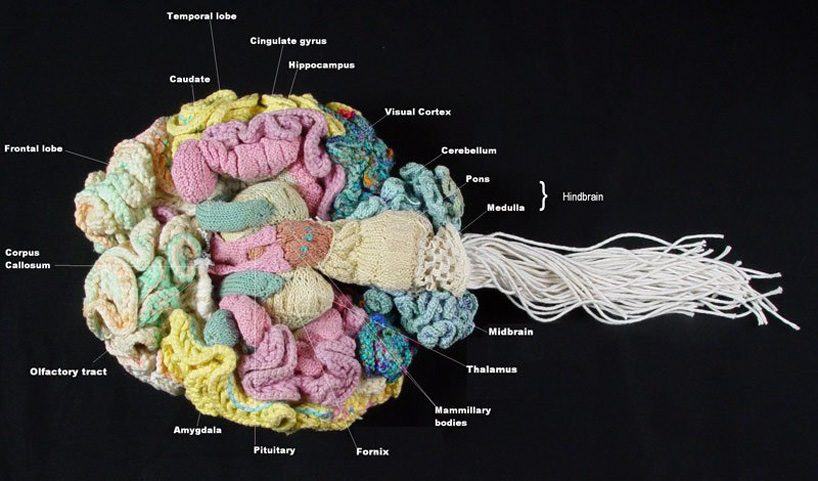
Our brains dictate our every move.
They’re the ones who spur us to study hard, so we can make something of ourselves, in order to better our communities.
They name our babies, choose our clothes, decide what we’re hungry for.
They make and break laws, organize protests, fritter away hours on social media, and give us the green light to binge watch a bunch of dumb shows when we could be reading War and Peace.
They also plant the seeds for Fitzcarraldo-like creative endeavors that take over our lives and generate little to no income.
We may describe such endeavors as a labor of love, into which we’ve poured our entire heart and soul, but think for a second.
Who’s really responsible here?
The heart, that muscular fist-sized Valentine, content to just pump-pump-pump its way through life, lub-dub, lub-dub, from cradle to grave?
Or the brain, a crafty Iago of an organ, possessor of billions of neurons, complex, contradictory, a mystery we’re far from unraveling?
Psychiatrist Dr. Karen Norberg’s brain has steered her to study such heavy duty subjects as the daycare effect, the rise in youth suicide, and the risk of prescribing selective serotonin reuptake inhibitors as a treatment for depression.

On a lighter note, it also told her to devote nine months to knitting an anatomically correct replica of the human brain.
(Twelve, if you count three months of research before casting on.)
How did her brain convince her to embark on this madcap assignment?
Easy. It arranged for her to be in the middle of a more prosaic knitting project, then goosed her into noticing how the ruffles of that project resembled the wrinkles of the cerebral cortex.
Coincidence?
Not likely. Especially when one of the cerebral cortex’s most important duties is decision making.
As she explained in an interview with The Telegraph, brain development is not unlike the growth of a knitted piece:
You can see very naturally how the ‘rippling’ effect of the cerebral cortex emerges from properties that probably have to do with nerve cell growth. In the case of knitting, the effect is created by increasing the number of stitches in each row.

Dr. Norberg—who, yes, has on occasion referred to her project as a labor of love—told Scientific American that such a massive crafty undertaking appealed to her sense of humor because “it seemed so ridiculous and would be an enormously complicated, absurdly ambitious thing to do.”
That’s the point at which many people’s brains would give them permission to stop, but Dr. Norberg and her brain persisted, pushing past the hypothetical, creating colorful individual structures that were eventually sewn into two cuddly hemispheres that can be joined with a zipper.
(She also let slip that her brain—by which she means the knitted one, though the observation certainly holds true for the one in her head—is female, due to its robust corpus callosum, the “tough body” whose millions of fibers promote communication and connection.)
Note: An earlier version of this post appeared on our site in 2019.
Related Content:
The Human Brain: A Free Online Course from MIT
Ayun Halliday is an author, illustrator, theater maker.
Read More...Hear the First Masterpiece of Electronic Music, Karlheinz Stockhausen’s Gesang der Jünglinge
Karlheinz Stockhausen appears, among many other cultural figures, on the cover of Sgt. Pepper’s Lonely Hearts Club Band. His inclusion was more than a trendy gesture toward the European avant-garde; anyone who knows that pathbreaking electronic composer’s work will notice its influence on the album at first listen. Paul McCartney himself went on record with his notion that assuming the alter egos of the title would allow him and his fellow Beatles to branch out both culturally and intellectually in their music, incorporating pastiches of Ravi Shankar, B. B. King, Albert Ayler, the Doors, the Beach Boys, and indeed Stockhausen, whose Gesang der Jünglinge had already inspired “Tomorrow Never Knows” on Revolver.
Literally “Song of the Youths,” Gesang der Jünglinge was an early work for Stockhausen, who composed it in 1954, when he was still a PhD student in communications at the University of Bonn. Inspired by not just his technological interests but also his devout Catholicism, he decided to create a mass for electronic sounds and voices, with the intent to debut it at Cologne Cathedral. (Legend has it that he was rebuffed by religious authorities, who insisted that loudspeakers had no place in a house of worship, but sources disagreed on whether he actually sought their permission in the first place.)
He drew its words from a passage of the Old Testament story of three boys cast into the fire by King Nebuchadnezzar for their refusal to worship a golden idol and kept unharmed by the praise to God they sang amid the flames.
In Stockhausen’s high-tech rendering, the boys are represented by the voice of twelve-year-old Josef Protschka (who would grow up to become an acclaimed vocalist in his own right), and the fire by a collage of electronic sounds. Though the composer’s manipulations, part design and part chance, the human and mechanical halves of the piece become one: Protschka’s vocals break apart and reform into fragments of language never before heard, and the artificially generated tones bend uncannily toward the sound of sung vowels. All this, to say nothing of its playback in five-channel sound in a time when stereo was still a novelty, would have sounded deeply, even disturbingly unfamiliar to the audience at Gesang der Jünglinge’s premiere — and its impact probably hadn’t been much diminished by the time of the 2001 performance above. Stockhousen’s music may have been after the shock of the new, but it also faced the eternal.
Related content:
Hear Karlheinz Stockhausen’s Pioneering Compositions for Music Boxes
The History of Electronic Music in 476 Tracks (1937–2001)
Based in Seoul, Colin Marshall writes and broadcasts on cities, language, and culture. His projects include the Substack newsletter Books on Cities and the book The Stateless City: a Walk through 21st-Century Los Angeles. Follow him on the social network formerly known as Twitter at @colinmarshall.
Read More...The World’s Most Famous Organ Piece Played on the World’s Largest Fully Operational Pipe Organ
The world’s most famous organ piece, played on the world’s largest fully functioning pipe organ. That’s what you have above. Here, organist Dylan David Shaw performs Bach’s Toccata and Fugue in D minor on the famous Wanamaker organ.
Originally built for the St. Louis World’s Fair in 1904, the organ ended up in Philadelphia’s Wanamaker’s department store in 1911. More than a century later, the organ still resides in the same store. But Macy’s eventually took over Wanamaker’s, and Macy’s now plans to close the store, leaving the fate of the organ unknown. Where will the 28,000-pipe organ find a new home? That’s still TBD, something that’s likely to get resolved in the months to come.
Related Content
Download the Complete Organ Works of J.S. Bach for Free
Bohemian Rhapsody Played on the Pipe Organ
Bach’s Most Famous Organ Piece Played on Wine Glasses
Read More...How Raphael Became A Master: Watch the Evolution of the Artist Through His Madonna Paintings
No artist became a Renaissance master through a single piece of work, though now, half a millennium later, that may be how most of us identify them. Leonardo? Painter of the Mona Lisa. Michelangelo? Painter of the Sistine Chapel ceiling (or, perhaps, the sculptor of the most famous David, depending on your medium of choice). Raphael? Painter of The School of Athens, as recently featured here on Open Culture. Raphael painted that masterwork in Vatican City’s Apostolic Palace between the years 1509 and 1511, when he was in his mid-twenties. Understanding how he could have attained that level of skill by that age requires examining his other work, as Evan Puschak, better known as the Nerdwriter, does in the new video above.
Specifically, Puschak examines Raphael’s Madonnas, a subject to which he returned over and over again throughout the course of his short but productive career. In what seems to have been his first rendition of Mary and her holy son, Puschak says, “you can see that Raphael has a better sense of three-dimensional bodies and how to make them feel like they’re part of the space that they’re in” than his father, who’d been a well-regarded painter himself, or even than Piero della Francesca, from whom his father learned.
“Yet the painting also suffers from “an awkwardness in the arrangement of the figures,” as well as a lack of “emotion, relationships, or any sense of narrative” — much like “a thousand other Madonnas that came before.”
Yet Raphael was a quick study, a trait reflected in the development of the many Madonnas he painted thereafter. From Leonardo he learned techniques like sfumato, the creation of soft transitions between colors; from Michelangelo, “how to use the human body as an expressive tool.” But what most clearly emerges is the concept contemporary theorist Leon Battista Alberti called historia: a narrative that plays out even within the confines of a static image. In Raphael’s circular, abundantly detailed Alba Madonna of 1511, Puschak sees the infant Jesus “not so much taking as grabbing his future and pulling it closer” as Mary looks on with emotions subtly layered into her face. How, exactly, Raphael honed his instinct for drama is a question for art historians. But would it be too much of a reach to guess that he also learned a thing or two from his time as a stage-set designer?
Related content:
Why Leonardo da Vinci’s Greatest Painting is Not the Mona Lisa
Based in Seoul, Colin Marshall writes and broadcasts on cities, language, and culture. His projects include the Substack newsletter Books on Cities and the book The Stateless City: a Walk through 21st-Century Los Angeles. Follow him on the social network formerly known as Twitter at @colinmarshall.
Read More...A Massive Choir Sings “Paranoid” to Honor Ozzy Osbourne
In Toronto, 7,000 singers participated in Choir Choir Choir’s tribute to Ozzy Osbourne, all taking part in a giant sing-along of “Paranoid.” The first single on Black Sabbath’s second album (1970), “Paranoid” reached #4 in the UK market and put Sabbath on the map. The song also became an early heavy metal classic. Watch Sabbath perform the song live in 1970 here; or watch them perform it for the very last time on July 5, 2025 here. Then enjoy the Choir Choir Choir tribute above.
If you would like to support the mission of Open Culture, consider making a donation to our site. It’s hard to rely 100% on ads, and your contributions will help us continue providing the best free cultural and educational materials to learners everywhere. You can contribute through PayPal, Patreon, and Venmo (@openculture). Thanks!
Related Content
Watch David Byrne Lead a Massive Choir in Singing David Bowie’s “Heroes”
Watch The Nine Lives of Ozzy Osbourne: A Free Documentary on the Heavy Metal Pioneer (RIP)
Ozzy Osbourne’s Guitarist Zakk Wylde Plays Black Sabbath on a Hello Kitty Guitar
Kids Orchestra Plays Ozzy Osbourne’s “Crazy Train” and Zeppelin’s “Kashmir”
Patti Smith Sings “People Have the Power” with a Choir of 250 Fellow Singers
Read More...Empire Without Limit: Watch Mary Beard’s TV Series on Ancient Rome
As the founding myth has it, the city of Rome was established by a man named Romulus, one of two orphaned twin brothers raised by a she-wolf on the banks of the Tiber river. The legend of Romulus and Remus, which involves the former’s fratricidal slaying of the latter, lends itself to striking imagery, though it also gives forth more questions than answers. “The Latin for wolf, lupa, also means prostitute,” for example, “so was it actually a prostitute who came to the rescue?” So asks historian Mary Beard in Rome: Empire Without Limit, a four-part series you can watch in its entirety above.
In a sense, the story works either way: the mortal clash of brother against brother makes for a recurring metaphorical theme in the long history of Rome, but so does the irrepressible power of commerce. Crisscrossing the European continent, Great Britain, the Mediterranean, and Africa by car, boat, bicycle, subway train, and above all on foot, Beard uses the traces of the mightiest ancient empire to explain how the whole operation actually worked, and what its day-to-day experience was like for its subjects. When it originally aired in 2016, Empire Without Limit followed up her acclaimed book SPQR: A History of Ancient Rome, which covers some of the same themes.
Those who’ve followed Beard’s work in print, on television, or in other media know that her version of Roman history is hardly another succession of emperors and military campaigns. While she does devote time to discussing such signal figures as Julius Caesar (who definitely didn’t say “Et tu, Brute?”), Augustus, Hadrian, and Constantine, she displays equal or greater interest in a four-year-old silver miner in what’s now Spain, say, or an anonymous young woman the shape of whose skull suggests the extent of migration within the empire. And just as worthy of consideration as any particular Roman citizenship is the concept of Roman citizenship itself, which ultimately extended across the vastest empire the world had ever known.
All roads lead to Rome, as the saying goes, and in the heyday of the Roman empire, as Beard points out, it was actually true. The ancient Romans were the first to build what she calls “a joined-up world,” where getting on a path in Rome and following it could get you all the way to places like Spain or Greece. (And also unprecedentedly, you could take a glance at mile markers along that road and immediately “place yourself in the world.”) Roman dominance may have ended long ago, but the parts of the world have continued to join up in much the same way since, and indeed, the broad Roman worldview survives. As Beard puts it, “there’s a little bit of the Romans in the head of every one of us” — especially those of us who think about their empire every day.
Related content:
The History of Ancient Rome in 20 Quick Minutes: A Primer Narrated by Brian Cox
A Map Showing How the Ancient Romans Envisioned the World in 40 AD
How Rome Began: The History As Told by Ancient Historians
Is America Declining Like Ancient Rome?
Rick Steves’ Europe: Binge Watch 11 Seasons of America’s Favorite Traveler Free Online
Based in Seoul, Colin Marshall writes and broadcasts on cities, language, and culture. His projects include the Substack newsletter Books on Cities and the book The Stateless City: a Walk through 21st-Century Los Angeles. Follow him on the social network formerly known as Twitter at @colinmarshall.
Read More...What Makes Picasso’s Guernica a Great Painting?: Explore the Anti-Fascist Mural That Became a Worldwide Anti-War Symbol
A painting is not thought out and settled in advance. While it is being done, it changes as one’s thoughts change. And when it’s finished, it goes on changing, according to the state of mind of whoever is looking at it. — Pablo Picasso
In a famous story about Guernica, Pablo Picasso’s wrenching 1937 anti-war mural, a gestapo officer barges into the painter’s Paris studio and asks, “did you do that?”, to which Picasso acerbically replies, “you did.” The title refers to the 1937 bombing of a Basque town during the Spanish Civil War, carried out by Spanish Nationalists and the Luftwaffe. Whether or not the anecdote about Picasso and the Nazi ever happened is unimportant; it encapsulates the artist’s disgust and outrage over the atrocities of war and the takeover of his country by Franco’s Nationalists, unyielding sentiments found not only in the painting but also its path through the world.
“Guernica had this really unique relationship with Picasso and his life,” says art historian Patricia Failing. “In a way it was his alter ego.” This is a bold claim considering that during most of his career, “Picasso generally avoids politics,” notes PBS, “and disdains overtly political art.” After the mural’s exhibition at the Spanish Pavilion of the 1937 Paris World’s Fair, however, the painting was sent on tours of Europe and North America “to raise consciousness about the threat of fascism.”
In 1939, after the fall of Madrid, the artist declared, “The painting will be turned over to the government of the Spanish Republic the day the Republic is restored in Spain!” Then, almost 30 years later,
In a surprisingly ironic turn, Franco launched a campaign in 1968 for repatriation of the painting, assuring Picasso that the Spanish Government had no objection to the controversial subject matter. One can only imagine how incredulous Picasso must have been. Through his lawyers, Picasso turned the offer down flat, making it clear that Guernica would be turned over only when democracy and public liberties were restored to Spain.
Picasso died in 1973 and never saw his country free from fascism. Franco died two years later. The painting was not exhibited in Spain until 1981 — not a “return,” but a restoration, perhaps, of an international icon that had endured 44 years of exile, had become a potent anti-war symbol during the Vietnam War, and had survived a vandal attack the year after the artist’s death.
In the Great Art Explained video above, James Payne “looks at some of the more acknowledged interpretations along with techniques, composition and artistic inspiration,” as the video’s description notes. “We all know that Art is not truth,” Picasso said, consistently discouraging tidy interpretations of Guernica as a straightforward protest painting. “Art is a lie that makes us realize truth.” What do we realize when we stand before the mural — all 11 by 25 feet of it? It depends upon our state of mind, the artist might say, as he engulfs viewers in an allegorical nightmare standing in for a very real horror.
Note: An earlier version of this post appeared on our site in 2021.
Related Content:
The Mystery of Picasso: Landmark Film of a Legendary Artist at Work, by Henri-Georges Clouzot
Josh Jones is a writer and musician based in Durham, NC. Follow him at @jdmagness
Read More...1,000+ Artworks by Vincent Van Gogh Digitized & Put Online by Dutch Museums
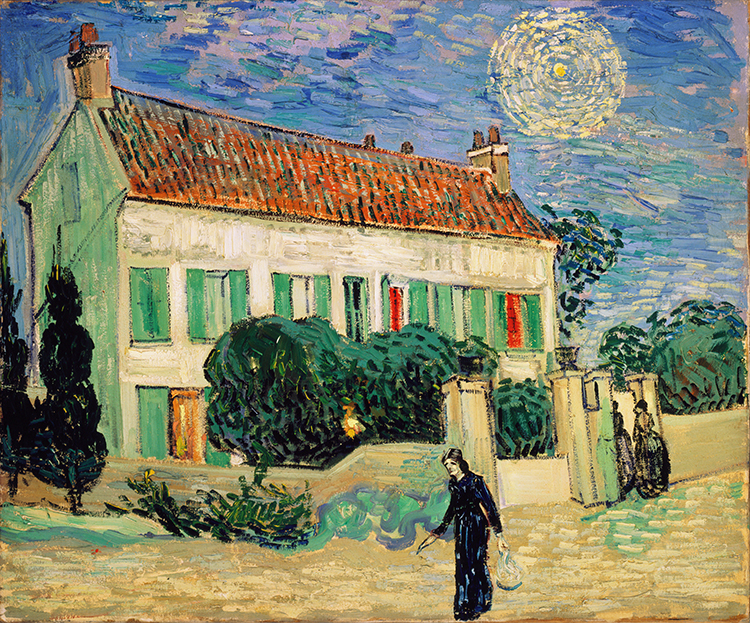
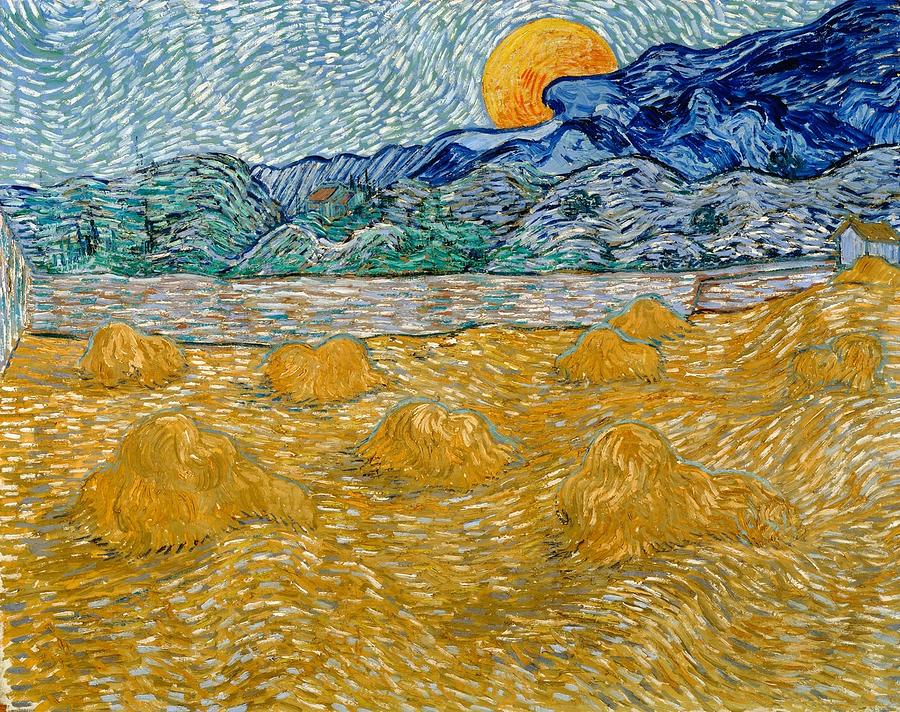
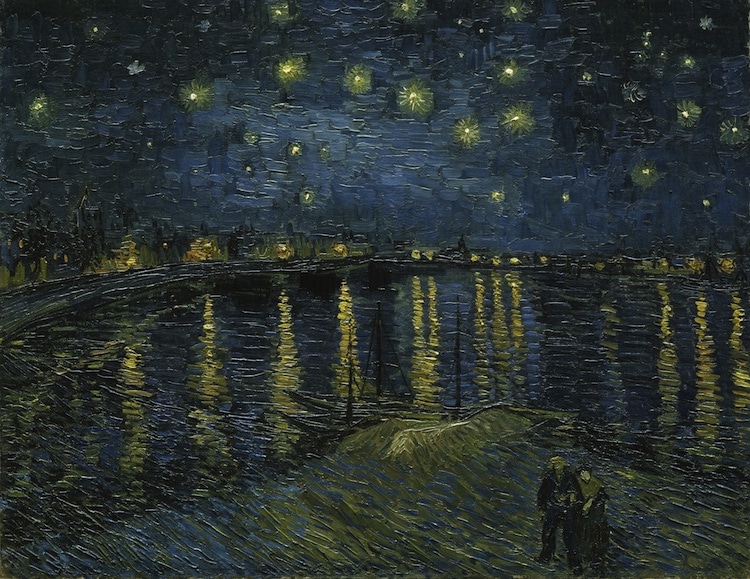
It gets dark before dinner now in my part of the world, a recipe for seasonal depression. Vincent van Gogh wrote about such low feelings with deep insight. “One feels as if one were lying bound hand and foot at the bottom of a deep dark well, utterly helpless.” Yet, when he looked up at the night sky he saw not darkness but blazing light: a full moon shines yellow from White House at Night like the sun, and peeks like a gold coin from behind blue mountains in Landscape with Wheat Sheaves and Rising Moon. The stars in Starry Night Over the Rhône appear like fireworks. We are all familiar with the blazing night sky of its sequel, The Starry Night.
It’s been suggested that Van Gogh saw halos of light because of lead poisoning from his paint, and that the Digitalis Dr. Gachet prescribed for his temporal lobe epilepsy caused him to “see in yellow,” the Van Gogh Gallery Blog writes, “or see yellow spots which could explain van Gogh’s consistent use of the color yellow in his later works.”
His most brilliant works date from this later period, during his time at the hospital at Arles, where he painted his famous bedroom. All of these paintings, and hundreds more, can be found in high-resolution scans at the new van Gogh resource, Van Gogh Worldwide, “a consortium of museums,” notes Madeleine Muzdakis at My Modern Met, “doing their part to bring the work of one of the world’s most famous artists to the global masses.”
The museums represented here are all in the Netherlands and include the Van Gogh Museum, Kröller-Müller Museum, the Rijksmuseum, the Netherlands Institute for Art History, and the Museum Boijmans Van Beuningen. Van Gogh was not only a prolific painter, of shining night scenes and otherwise, but he was “also a prolific sketch artist. His pencil and paper drawings are worth exploration; they depict landscapes as well as emotive figures from Van Gogh’s everyday life. Van Gogh Worldwide provides insight into these works of art and the artist behind them. One can also find behind-the-scenes museum information, such as details of restorations, verso (back) images, and other curatorial notes.”
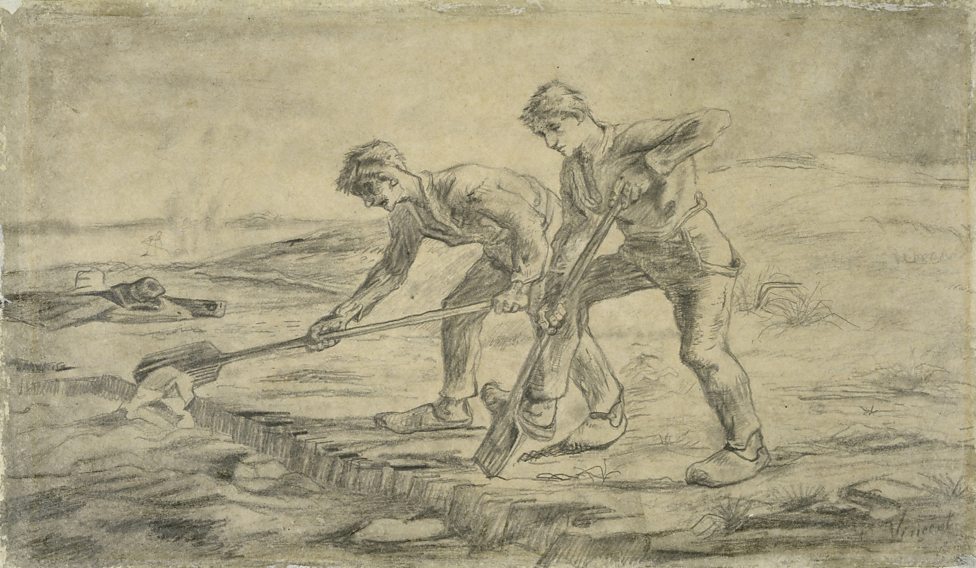
Van Gogh Worldwide expands other digital collections like the Van Gogh Museum’s almost 1,000 online works. Where that resource includes short informational articles and links to literature about the artworks, Van Gogh Worldwide does not, as yet, feature such additional materials, but it does include links to Van Gogh’s letters. In one of them, he writes to his brother, Theo, about their parents: “They’ll find it difficult to understand my state of mind, and not know what drives me when they see me do things that seem strange and peculiar to them—will blame them on dissatisfaction, indifference or nonchalance, while the cause lies elsewhere, namely the desire, at all costs, to pursue what I must have for my work.”
Note: An earlier version of this post appeared on our site in 2020.
Related Content:
Vincent Van Gogh’s “The Starry Night”: Why It’s a Great Painting in 15 Minutes
Download Hundreds of Van Gogh Paintings, Sketches & Letters in High Resolution
Discover the Only Painting Van Gogh Ever Sold During His Lifetime
Josh Jones is a writer and musician based in Durham, NC.
Read More...Watch Momijigari, Japan’s Oldest Surviving Film (1899)
At first, film simply recorded events: a man walking across a garden, workers leaving a factory, a train pulling into a station. The medium soon matured enough to accommodate drama, which for early filmmakers meant simply shooting what amounted to stage productions from the perspective of a viewer in the audience. At that stage, we could say, film still hadn’t evolved past simple documentary purposes, having yet to incorporate editing, to say nothing of the other qualities we now regard as characteristically cinematic. This wasn’t a cultural matter, but a technical one, as evidenced by Momijigari, the oldest Japanese film in existence.
Shot in 1899, Momijigari depicts nearly four minutes of a kabuki play involving Onoe Kikugorō V and Ichikawa Danjūrō IX, two famous masters of the form at the time. The idea was to preserve a record of their presence on stage, no matter how haphazardly or for how short a time, before they shuffled off this mortal coil.
It certainly wasn’t too soon: both men would die in 1903, the year of the film’s first exhibition. No fan of Western modernity, Danjūrō had stipulated that it be shown only after his death, but in the event, it was screened for the public in his place at a performance at which he was too sick to appear, which extended to a longer run in honor of Kikugorō’s recent death.
Like its Western historical equivalents, Momijigari depicts a theatrical work. The titular sixteenth-century Noh play, also performed in kabuki and dance-oriented shosagoto versions, involves a woman and her retinue on an outing to do some maple-leaf viewing (the literal meaning of momijigari). Like all female kabuki roles, these would have been played without exception by male actors, who were in any case thought better able to convey femininity onstage. The lady entices a passing warrior to drink, and when he passes out, he’s informed in his dream that she’s actually a demon. In the following scene, she reverts to demon form and the two do battle. Pioneering Japanese filmmaker Shibata Tsunekichi fits a surprising amount of this narrative into a very brief runtime, which also includes the wholly accidental loss of a fan. Danjūrō had insisted on shooting outside, even on a windy day, and one doesn’t simply say no to a kabuki master.
Related content:
Watch the Oldest Japanese Anime Film, Jun’ichi Kōuchi’s The Dull Sword (1917)
Essential Japanese Cinema: A Journey Through 50 of Japan’s Beautiful, Often Bizarre Films
Hand-Colored 1860s Photographs Reveal the Last Days of Samurai Japan
Watch Vintage Footage of Tokyo, Circa 1910, Get Brought to Life with Artificial Intelligence
Based in Seoul, Colin Marshall writes and broadcasts on cities, language, and culture. His projects include the Substack newsletter Books on Cities and the book The Stateless City: a Walk through 21st-Century Los Angeles. Follow him on the social network formerly known as Twitter at @colinmarshall.
Read More...Franz Kafka’s Anxious Letters to His Fiancée, Read Aloud by Richard Ayoade
It can’t have been easy being Franz Kafka. But then, it can’t have been much easier being Franz Kafka’s fiancée, as evidenced by the correspondence read aloud by Richard Ayoade in the new Letters Live video above. “It is now 10:30 on Monday morning,” he wrote to Felice Bauer on November 4, 1912. “I have been waiting for a letter since 10:30 on Saturday morning, but again nothing has come. I have written every day but don’t I deserve even a word? One single word? Even if it were only to say ‘I never want to hear from you again.’ ” This anxious, hectoring tone was not a one-off indulgence. “Dearest, what have I done that makes you torment me so?” he pleaded just over two weeks later.
Kafka and Bauer had been introduced three months before. She was a relative of Max Brod, Kafka’s friend and eventual literary executor, and according to Kafka’s diaries, made a fairly unprepossessing first impression: “Bony, empty face that wore its emptiness openly. Bare throat. A blouse thrown on. Looked very domestic in her dress although, as it turned out, she by no means was.”
Yet during their ensuing five-year correspondence, he was moved to write her more than 500 letters, some of them sent one day after the other — and more than a few berating her for not writing back quickly enough.
This relationship twice led to engagement, but perhaps unsurprisingly, never culminated in marriage. Nevertheless, Bauer’s relationship with Kafka remained important enough to her that she saved everything he wrote to her, which was collected and published in book form as Briefe an Felice (and later, in translation, as Letters to Felice) in 1967. Perhaps, as burdensome as they could no doubt be, Kafka’s letters suggested to Bauer a certain literary skill. (This was, after all, the same period in which he wrote The Metamorphosis and “In the Penal Colony,” as well as early versions of The Trial). They also hint at his since-celebrated sense of humor, not least in a concluding line like “Damn the mail!” — words that, in Ayoade’s delivery, draw a round of applause.
Related content:
Franz Kafka’s Kafkaesque Love Letters
Franz Kafka: An Animated Introduction to His Literary Genius
What Is Kafkaesque?: The Philosophy of Franz Kafka
Behold the Drawings of Franz Kafka (1907–1917)
Based in Seoul, Colin Marshall writes and broadcasts on cities, language, and culture. His projects include the Substack newsletter Books on Cities and the book The Stateless City: a Walk through 21st-Century Los Angeles. Follow him on the social network formerly known as Twitter at @colinmarshall.
Read More...Support Us
We're hoping to rely on loyal readers, rather than erratic ads. Please click the Donate button and support Open Culture. You can use Paypal, Venmo, Patreon, even Crypto! We thank you!

About Us

Open Culture scours the web for the best educational media. We find the free courses and audio books you need, the language lessons & educational videos you want, and plenty of enlightenment in between.
Advertise With Us

FREE UPDATES!
GET OUR DAILY EMAIL
Get the best cultural and educational resources on the web curated for you in a daily email. We never spam. Unsubscribe at any time.
FOLLOW ON SOCIAL MEDIA

Open Culture editor Dan Colman scours the web for the best educational media. He finds the free courses and audio books you need, the language lessons & movies you want, and plenty of enlightenment in between.
Advertise With Us

