Albert Einstein Gives a Speech Praising Immigrants’ Contributions to America (1939)
There have been many times in American history when celebrations of the country’s multi-ethnic, ever-changing demography served as powerful counterweights to narrow, exclusionary, nationalisms. In 1855, for example, the publication of Brooklyn native Walt Whitman’s Song of Myself offered a “passionate embrace of equality,” writes Kathleen Kennedy Townsend, “the soul of democracy.” We can contrast the vibrancy and dynamism of Whitman’s vision with the violent nativism of the anti-immigrant Know-Nothings, who reached their peak in the 1850s. The movement was founded by two other New Yorkers, gang leader William “Bill the Butcher” Poole and writer Thomas R. Whitney, who asked in one of his political tracts, “What is equality but stagnation?”
Almost 100 years later, we see another nationalist movement taking hold, not only in Europe, but in the States. Before the U.S. entered World War II, its views on National Socialist Germany were decidedly ambivalent, with glowing portraits of its leader published throughout the 30s, and a sizable Nazi presence in the U.S. From 1934 to 1939, for example, German groups in the U.S. organized massive rallies in Madison Square Garden. Additionally, the German-American Bund promoted the Nazi Party throughout the U.S. with 70 different local chapters. These organizations held Nazi family and summer camps in New Jersey, Wisconsin, Pennsylvania…. “There were forced marches in the middle of the night to bonfires,” says historian Arnie Bernstein, “where the kids would sing the Nazi national anthem and shout ‘Sieg Heil.’”
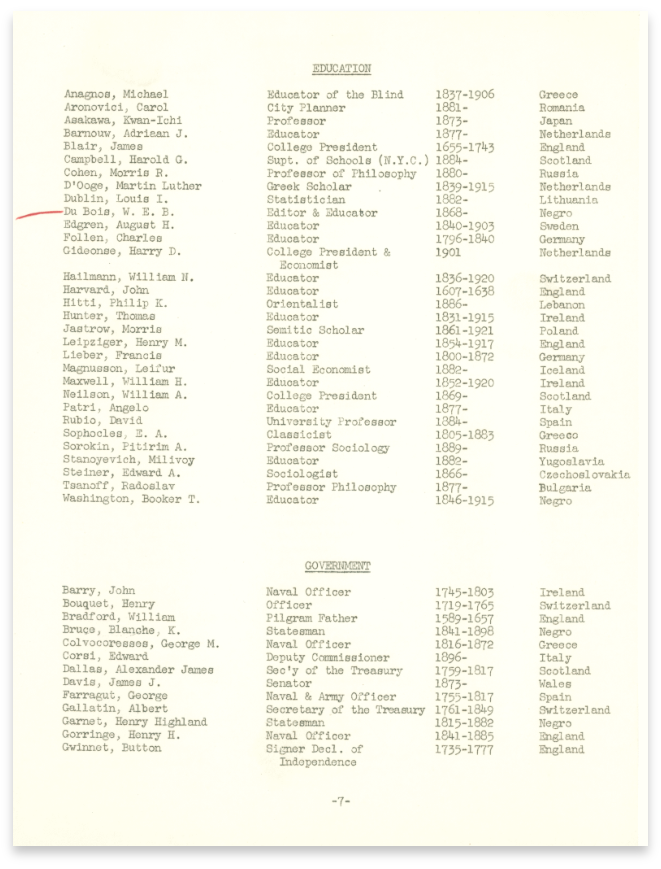
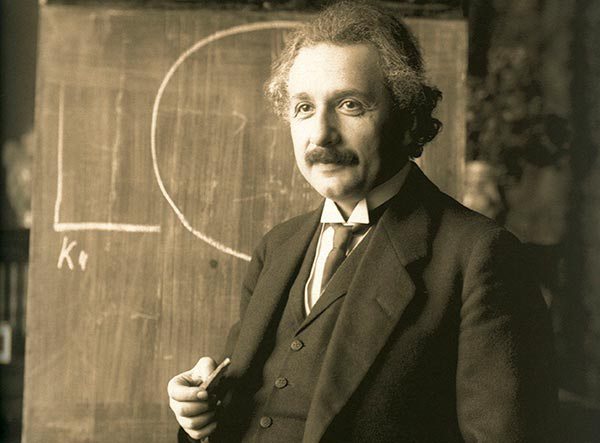
Needless to say, these scenes made a number of minority groups and immigrants particularly nervous, especially Jews who had just escaped from Europe. One such immigrant, physicist Albert Einstein, had made the U.S. his permanent home in 1933 when he accepted a position at Princeton after living as a refugee in England. He would go on to become a forceful advocate for equality in the U.S., speaking out against the racial caste system of segregation. In 1940, Einstein gave a little-known speech at the New York World’s Fair to inaugurate an exhibit that paid “homage to the diversity of the U.S. population.” On the display, called the “Wall of Fame,” were inscribed “the names and professions of hundreds of the nation’s most notable ‘immigrants, Negroes and American Indians.’” (See the first page of the typed list above, and the full list here.)
Einstein’s speech comes to us via Speeches of Note, a sibling of two favorite sites of ours, Letters of Note and Lists of Note. Below, you can read the full transcript of the speech, in which Einstein—having adopted the country as it had adopted him—-declaims, “these, too, belong to us, and we are glad and grateful to acknowledge the debt that the community owes them.”
It is a fine and high-minded idea, also in the best sense a proud one, to erect at the World’s Fair a wall of fame to immigrants and Negroes of distinction.
The significance of the gesture is this: it says: These, too, belong to us, and we are glad and grateful to acknowledge the debt that the community owes them. And focusing on these particular contributors, Negroes and immigrants, shows that the community feels a special need to show regard and affection for those who are often regarded as step-children of the nation—for why else this combination?
If, then, I am to speak on the occasion, it can only be to say something on behalf of these step-children. As for the immigrants, they are the only ones to whom it can be accounted a merit to be Americans. For they have had to take trouble for their citizenship, whereas it has cost the majority nothing at all to be born in the land of civic freedom.
As for the Negroes, the country has still a heavy debt to discharge for all the troubles and disabilities it has laid on the Negro’s shoulders, for all that his fellow-citizens have done and to some extent still are doing to him. To the Negro and his wonderful songs and choirs, we are indebted for the finest contribution in the realm of art which America has so far given to the world. And this great gift we owe, not to those whose names are engraved on this “Wall of Fame,” but to the children of the people, blossoming namelessly as the lilies of the field.
In a way, the same is true of the immigrants. They have contributed in their way to the flowering of the community, and their individual striving and suffering have remained unknown.
One more thing I would say with regard to immigration generally: There exists on the subject a fatal miscomprehension. Unemployment is not decreased by restricting immigration. For unemployment depends on faulty distribution of work among those capable of work. Immigration increases consumption as much as it does demand on labor. Immigration strengthens not only the internal economy of a sparsely populated country, but also its defensive power.
The Wall of Fame arose out of a high-minded ideal; it is calculated to stimulate just and magnanimous thoughts and feelings. May it work to that effect.
The speech is remarkable for its egalitarianism. The exhibit works more or less as a “who’s who” of notable personalities—all of them men. Of course, Einstein himself was one of the most notable immigrants of the age. And yet, his ethos is Whitmanian, celebrating the multitudes of laborers and artists “blossoming namelessly” and those who have “remained unknown.” The country, Einstein suggests, could not possibly be itself without its diversity of people and cultures. That same year, Einstein would pass his citizenship test, and explain in a radio broadcast, “Why I am an American.”
Note: An earlier version of this post appeared on our site in 2017.
Related Content:
Albert Einstein Expresses His Admiration for Mahatma Gandhi, in Letter and Audio
Josh Jones is a writer and musician based in Durham, NC.
Read More...Everything That Went Wrong During The Wizard of Oz’s Seriously Troubled Production
The Wizard of Oz is now showing at Las Vegas’ Sphere. Or a version of it is, at any rate, and not one that meets with the approval of all the picture’s countless fans. “The beloved 1939 film starring Judy Garland, widely considered one of the greatest Hollywood classics, has been stretched and morphed and adapted to fit the enormous dome-shaped venue,” writes the New York Times’ Alissa Wilkinson. This entailed an extension “upward and outward with the help of A.I. as well as visual effects artists. The cool tornado created by Arnold Gillespie for the original has been traded for something digital, and eventually you can’t see it at all, because you’re inside the funnel. New performances and vistas have also been generated,” which is “at best questionable” ethically, to say nothing of the aesthetics.
Yet even given the considerable modifications to — and excisions from — the original film, “most audiences will gladly overlook all of this, wowed by the sheer scale of the spectacle.” The Wizard of Oz has, as has often been said, the kind of “magic” that endures through even great deficiencies in presentation.
That quality first became apparent in 1956, seventeen years after the movie’s release in cinemas, when it first aired on television. Though the dramatic transition from black-and-white to color would have been lost on most home viewers at the time, “45 million people tuned in, far more than those who had seen it in theaters,” says the narrator of the It Was A Sh*t Show video above. Another broadcast, in 1959, did even better, and thereafter The Wizard of Oz became an “annual must-see event” on TV, which eventually made it “the most-watched film in history.”
That status justifies the movie’s infamously troubled production, which is the video’s central subject. From its numerous rewrites all the way through to its feeble box office performance, The Wizard of Oz encountered severe difficulties every step of the way, which gave rise to rumors that continue to haunt it: that an actor died from poison makeup, for example, or that one of the munchkins committed suicide in view of the camera. While the production caused no fatalities — at least not directly — it did come close more than once, to say nothing of the psychological toll the combination of high ambition and persistent dysfunction must have taken on many, if not most, of its participants. Even hearing enumerated only its clearly documented problems is enough to make one wonder how the picture was ever completed in the first place. Yet now, 86 years later, its Sphere reinterpretation is raking in $2 million in ticket sales per day: an act of wizardry if ever there was one.
Related content:
Watch the Earliest Surviving Filmed Version of The Wizard of Oz (1910)
The Wizard of Oz Broken Apart and Put Back Together in Alphabetical Order
The Complete Wizard of Oz Series, Available as Free eBooks and Free Audio Books
Hear Waiting for Godot, the Acclaimed 1956 Production Starring The Wizard of Oz’s Bert Lahr
Based in Seoul, Colin Marshall writes and broadcasts on cities, language, and culture. His projects include the Substack newsletter Books on Cities and the book The Stateless City: a Walk through 21st-Century Los Angeles. Follow him on the social network formerly known as Twitter at @colinmarshall.
Read More...The Technology That Brought Down Medieval Castles and Changed the Middle Ages
Civilization moved past the use of castles long ago, but their imagery endures in popular culture. Even young children here in the twenty-twenties have an idea of what castles look like. But why do they look like that? Admittedly, that’s a bit of a trick question: the popular concept of castles tends to be inspired by medieval examples, but in historical fact, the design of castles changed substantially over time, albeit slowly at first. You can hear that process explained in the Get to the Point video above, which tells the story of “star forts,” the built response to the “technology that ended the Middle Ages.”
You may be familiar with the concept of “motte and bailey,” now most widely understood as a metaphor for a certain debate tactic irritatingly prevalent on the internet. But it actually refers to a style of castle constructed in Europe between the tenth and the thirteenth centuries, consisting of a fortified hilltop keep, or “motte,” with a less defensible walled courtyard, or “bailey,” below. In case of an attack, the battle could primarily take place down in the bailey, with retreats to the motte occurring when strategically necessary. The motte-and-bailey castle is a “great idea,” says the video’s narrator, provided “you don’t have cannons shooting at you.”
Castles, he explains, “were a reflection of armies at the time: build a big wall, keep the barbarians out.” But once the cannon came on the scene, those once-practically impervious stone walls became a serious liability. That was definitively proven in 1453, when “the Ottomans famously battered down the great walls of Constantinople with their cannons. That brought an end not only to the 1500-year-old Roman Empire, but also to the Middle Ages as an era entirely.” In response, castle architects added dirt slopes, or glacis, at the edges, as well as circular bastions to deflect cannon fire at the corners — which, inconveniently, created “dead zones” in which enemy soldiers could hide, protected from any defenses launched from within the castle.
The solution was to make the bastions triangular instead, and then to add further triangular structures between them. Seen from the side, castles became much lower and wider; from above, they grew ever pointier and more complex in shape. Sébastien Le Prestre, Marquis of Vauban, an army officer under Louis XIV, became the acknowledged master of this form, the trace italienne. You may not know his name, but his designs made France “literally impossible to invade.” For sheer beauty, however, it would be hard to top the plans for star forts to defend Florence in the fifteen-twenties by a multi-talented artist named Michelangelo. Perhaps you’ve heard of him?
Related Content:
Leonardo da Vinci Draws Designs of Future War Machines: Tanks, Machine Guns & More
How to Build a 13th-Century Castle, Using Only Authentic Medieval Tools & Techniques
A Forgotten 16th-Century Manuscript Reveals the First Designs for Modern Rockets
Based in Seoul, Colin Marshall writes and broadcasts on cities, language, and culture. His projects include the Substack newsletter Books on Cities and the book The Stateless City: a Walk through 21st-Century Los Angeles. Follow him on the social network formerly known as Twitter at @colinmarshall.
Read More...How Erik Satie Invented Modern Music: A Visual Explanation
Once you hear Erik Satie’s Gymnopédie No. 1, you never forget it. Not that popular culture would let you forget it: the piece has been, and continues to be, reinterpreted and sampled by musicians working in a variety of genres from pop to electronic to metal. In versions that sound close to what Satie would have intended when he composed it in 1888, it’s also been featured in countless films and television shows. It’s even heard with some frequency in YouTube videos, though in the case of the one from The Music Professor above, it’s not just the soundtrack, but also the subject. Using an annotated score, it explains just what makes the piece so enduring and influential.
Upon “a simple iambic rhythm with two ambiguous major 7th chords,” Gymnopédie No. 1 introduces a melody that “floats above an austere procession of notes,” then “moves down the octave from F# to F#.” With its lack of a clear key, as well as its lack of development and drama that the orchestral music of the day would have trained listeners to expect, the piece was “as shocking as the dance of naked Spartans it was meant to evoke.”
The melody makes its turns, but never quite arrives at its seeming destinations, going around in circles instead — before, all of a sudden, swerving into the “minor and dissonant” before ending in “profound melancholy.”
Despite music in general having long since assimilated the daring qualities of Gymnopédie No. 1, the original piece still catches our ears — in its subtle way — whenever it comes on. So, in another way, do the less recognizable and more experimental Gnossiennes with which Satie followed them up. In the video above, the Music Professor provides a visual explanation of Gnossienne No. 1, during whose performance “soft dissonance hangs in the air” while “a curious melody floats over gentle syncopations in the left hand” over just two chords. The score comes with “surreal comments”: “Très luisant,” “Du bout de la pensée,” “Postulez en vous-même,” “Questionez.” Satie is often credited with pioneering what would become ambient music; could these be proto-Oblique Strategies?
Related Content:
Listen to Never-Before-Heard Works by Erik Satie, Performed 100 Years After His Death
The Velvet Underground’s John Cale Plays Erik Satie’s Vexations on I’ve Got a Secret (1963)
How Erik Satie’s “Furniture Music” Was Designed to Be Ignored and Paved the Way for Ambient Music
Based in Seoul, Colin Marshall writes and broadcasts on cities, language, and culture. His projects include the Substack newsletter Books on Cities and the book The Stateless City: a Walk through 21st-Century Los Angeles. Follow him on the social network formerly known as Twitter at @colinmarshall.
Read More...Browse Thousands of Free Vintage Cocktail Recipes Online (1705–1951)
Where do the hipster mixologists of Tokyo, Mexico City and Brooklyn take their inspiration?
If not from the Exposition Universelle des Vins et Spiritueux’ free collection of digitized vintage cocktail recipe books, perhaps they should start.
An initiative of the Museum of Wine and Spirits on the Ile de Bendor in Southeastern France, the collection is a boon to anyone with an interest in cocktail culture …ditto design, illustration, evolving social mores…
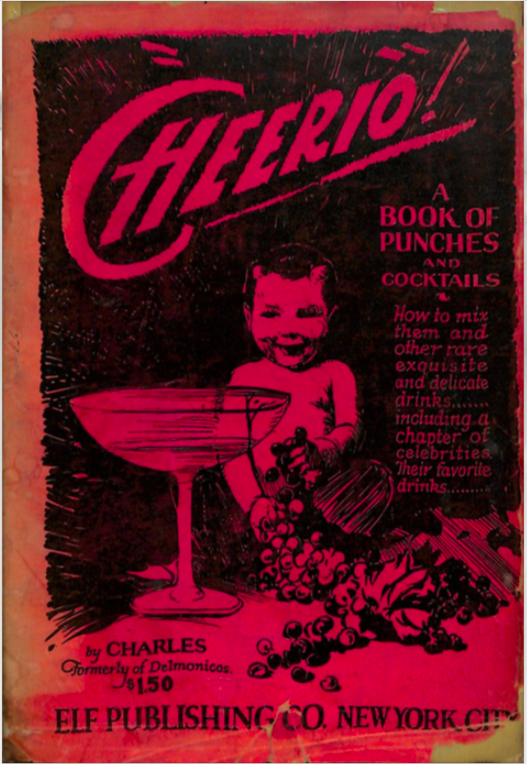
1928’s Cheerio, a Book of Punches and Cocktails was written by Charles, formerly of Delmonico’s, touted in the introductory note as “one who has served drinks to Princes, Magnates and Senators of many nations”. No doubt discretion prevented him from publishing his surname.
Charles apparently abided by the theory that it’s five o’clock somewhere, with drinks geared to various times of day, from the moment you “stagger out of bed, groggy, grouchy and cross-tempered” (try a Charleston Bracer or a Brandy Port Nog) to the midnight hour when “insomnia, bad dreams, disillusionment and despair” call for such remedies as a Cholera Cocktail or an Egg Whiskey Fizz.
As noted on the cover, there’s a section devoted to favorite recipes of celebrities. These bigwigs’ names will likely mean nothing to you nearly one hundred years later, but their first person reminiscences bring them roaring back to theatrical, boozy life.
Here’s celebrated vaudevillian Trixie Friganza:
In that nautical city of Venice, I first made the acquaintance of a remarkably delicious drink known as ‘Port and Starboard’. Pour one half part Grenadine or raspberry syrup in a cordial glass. Then on top of this pour one half portion of Creme de Menthe slowly so that the ingredients will not mix. Dear old Venice.
Indeed.
Presumably any cocktail recipe in the EUVS’s vast collection could be adapted as a mocktail, but Charles gives a deliberate nod to Prohibition with a section on alcohol-free (and extremely easy to prepare) Temperance Drinks.
Don’t expect a Shirley Temple — the triple threat child star was but an infant when Cheerio was published. Expand your options with a Saratoga Cooler or an Oggle Noggle instead.
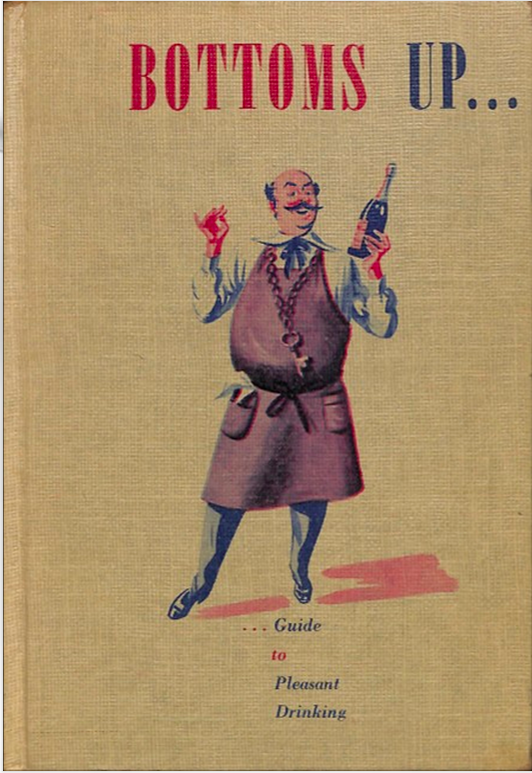
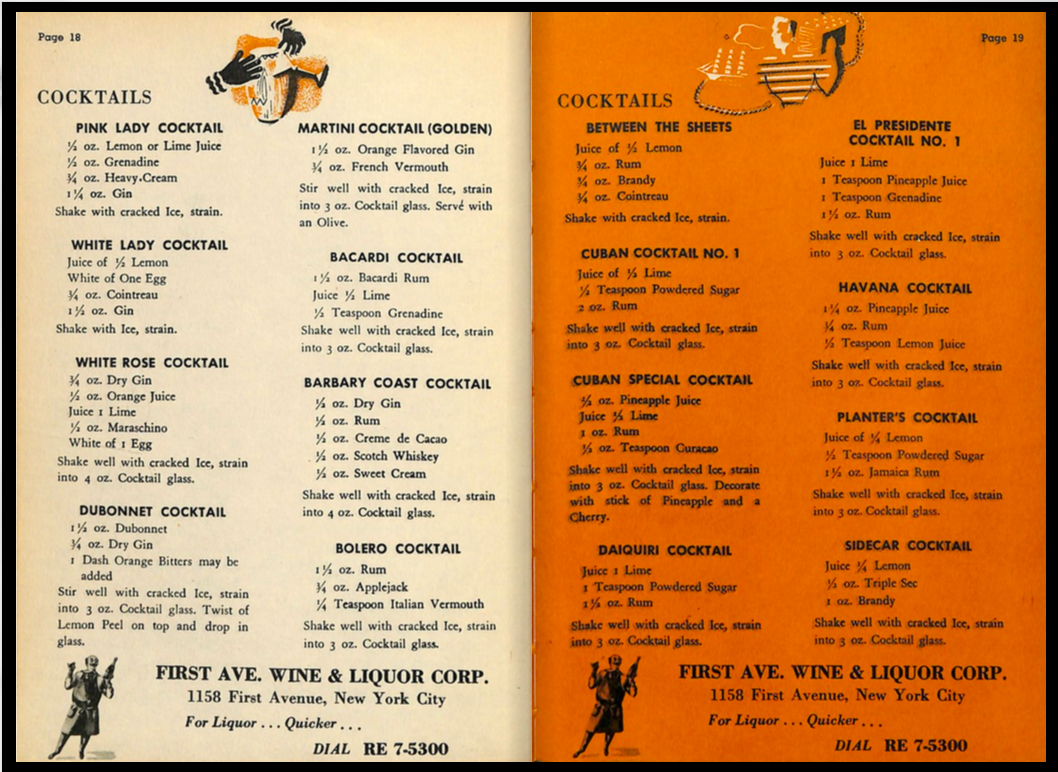
Before attempting to recite the poem that opens 1949’s Bottoms Up: A Guide to Pleasant Drinking, you may want to slam a couple of Depth Bombs Cocktails or a Merry Widow Cocktail No. 1.
In an abstemious condition, there’s no way this ditty can be made to scan…or rhyme:
The Advent of the Cocktail
A lonely, abandoned jigger of gin
Sat on a table top. “Alas”, cried he,
“Who will join me?” And he tried a friendly grin.
Came a pretty youth, Mam’selle Vermouth,
Who was bored with just being winey.
Said she to Sir Gin: “You’d be ever so nice
With Olive and Ice. And so they were Martini.
The cocktail recipes are solid, throughout, however, as one might expect from a book that doubled as an ad for sponsor First Avenue Wine and Liquor Corporation — “for Liquor…Quicker.”
We’ve yet to try anything from the “wines in cookery” section — but suspect that sturdy fare like Potato Soup and Baked Beans could help sop up some of the alcohol, even if contains some hair of the dog…
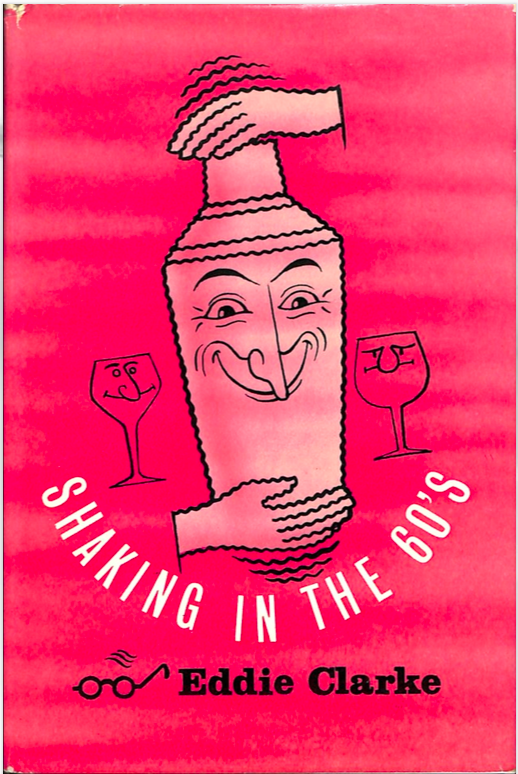
Shaking in the 60’s author Eddie Clark’s previous titles include Shaking with Eddie, Shake Again with Eddie and 1954’s Practical Bar Management.
Clark, who served as head bartender at London’s Savoy Hotel, Berkeley Hotel and Albany Club, gets in the swinging 60s spirit, by dedicating this work to “all imbibing lovers.”
William S. McCall’s decidedly boozy illustrations of elephants, anthropomorphized cocktail glasses and scantily clad ladies contribute to the festive atmosphere, though you probably won’t be surprised to learn that some of them have not aged well.
Shaking in the 60’s boasts dozens of straightforward cocktail recipes (the Beatnik the Bunny Hug and the Monkey Hugall feature Pernod), a surprisingly serious-minded section on wine, and a couple of pages devoted to non-alcoholic drinks.
If your child turns up their nose at Clark’s Remain Sober, serve ‘em an Albermarle Pussycat.
Clark also draws on his professional expertise to help home bartenders get a grip on measurement conversions, supply lists, and toasts.
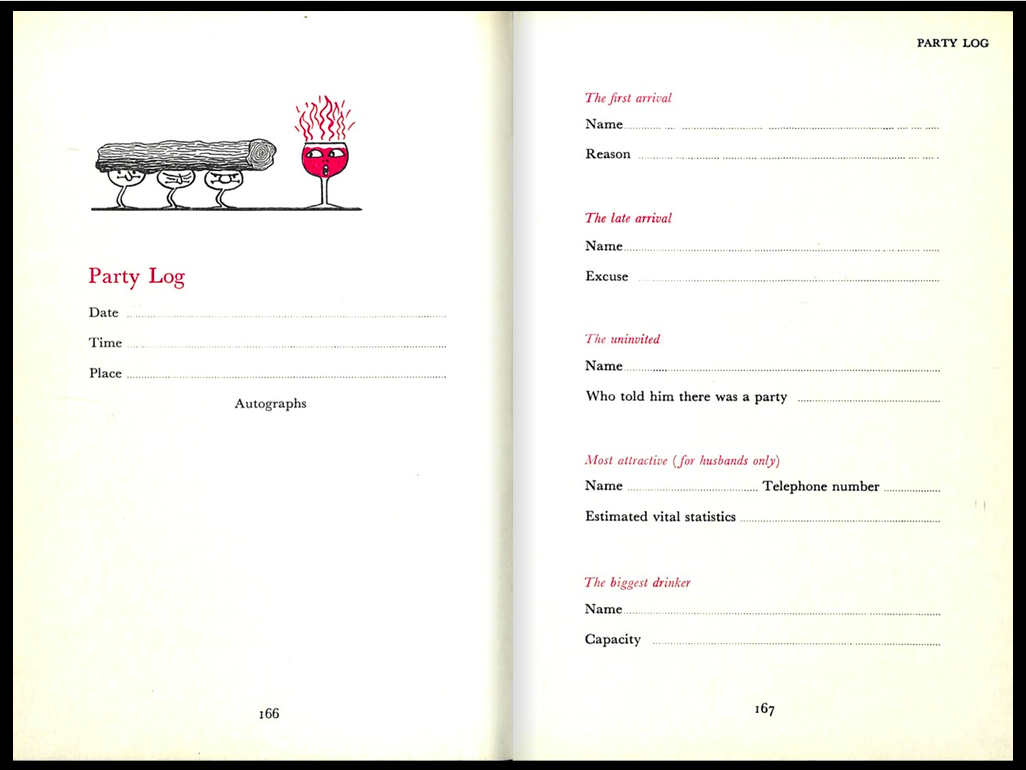
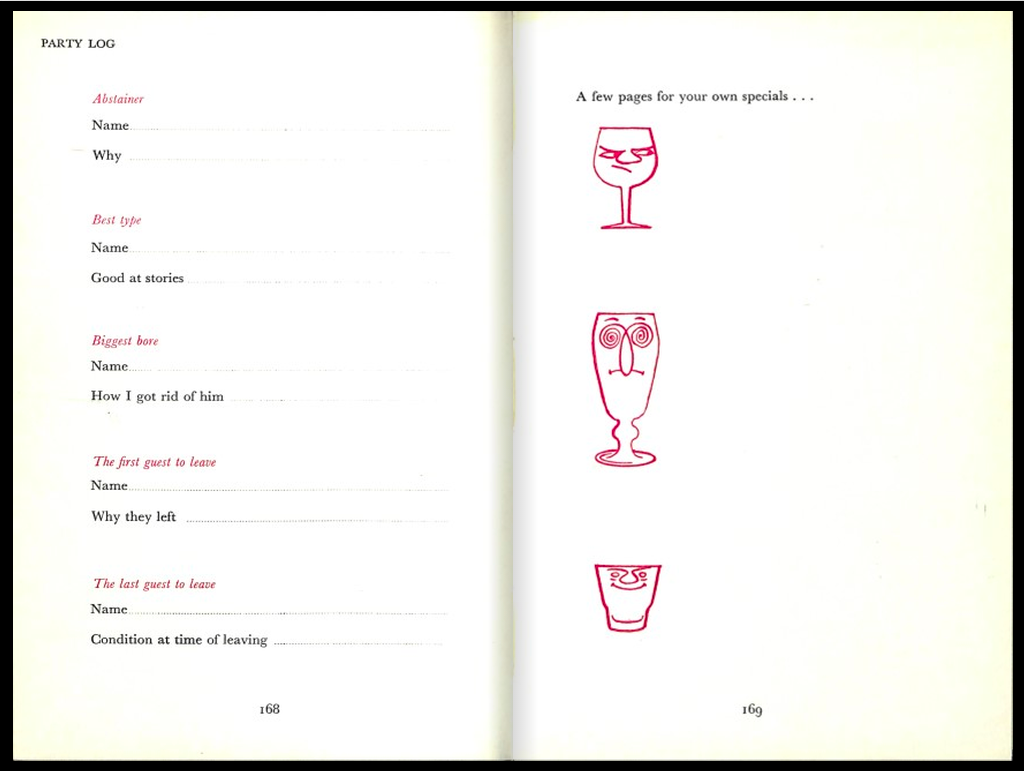
So confident is he in his ability to help readers throw a truly memorable party, he includes a dishy party log, that probably should be kept under lock and key after it’s been filled out. We imagine it would pair well with the Morning Mashie, another Pernod-based concoction dedicated to “all those entering the hangover class.”
Delve into the Exposition Universelle des Vins et Spiritueux’ free collection of digitized vintage cocktail recipe books from the 1820s through the 1960s here.
Note: An earlier version of this post appeared on our site in 2021.
Related Content:
A Digital Library for Bartenders: Vintage Cocktail Books with Recipes Dating Back to 1753
Explore an Online Archive of 12,700 Vintage Cookbooks
Ayun Halliday is an author, illustrator, theater maker.
Read More...The Advanced Technology of Ancient Rome: Automatic Doors, Water Clocks, Vending Machines & More
Ancient Rome never had an industrial revolution. Granted, certain historians have objected now and again to that once-settled claim, gesturing toward large heaps of pottery discovered in garbage dumps and other such artifacts clearly produced in large numbers. Still, the fact remains that Ancient Rome never had an industrial revolution of the kind that fired up toward the end of the eighteenth century, but not due to a complete absence of the relevant technology. As explained in the new Lost in Time video above, Romans had witnessed the power of steam harnessed back in the first century — but they dismissed it as a novelty, evidently unable to see its power to transform civilization.
That’s just one of a variety of examples of genuine high Roman technology featured in the video, many or all of which would seem implausible to the average viewer if inserted into a story set in ancient Rome.
Take the set of automatic doors installed in a temple, triggered by a fire that heats an underground water tank, which in turn fills up a pot attached to a cable that — through a system of pulleys — throws them open. (When the fire cools down, the doors then shut again.) This was the work of the Greek-born inventor Hero of Alexandria, who would bear comparison in one sense or another with everyone from Rube Goldberg to Leonardo da Vinci.
It was also Hero who came up with that early steam turbine, called the aeolipile. He came along too late, however, to take credit for the “self-healing” Roman concrete previously much-featured here on Open Culture, the material of buildings like the Pantheon, “still the largest unreinforced concrete dome in the world.” Another invention highlighted in the video comes from Alexandria, but well before Hero’s time, and even before that of the Roman Empire itself: the accurate water clock engineered by Ctesibius, whose underlying design remained influential in the Roman era. Hydraulic power was also used in Roman mills, which made possible complex factory systems, even in a civilization that never reached an industrial revolution proper. And if a Roman factory worker got thirsty at break time, maybe he could drop a coin into one of Hero’s wine vending machines.
Related content:
How the Ancient Romans Built Their Roads, the Lifelines of Their Vast Empire
The Amazing Engineering of Roman Baths
Archaeologists Discover an Ancient Roman Snack Bar in the Ruins of Pompeii
Based in Seoul, Colin Marshall writes and broadcasts on cities, language, and culture. His projects include the Substack newsletter Books on Cities and the book The Stateless City: a Walk through 21st-Century Los Angeles. Follow him on the social network formerly known as Twitter at @colinmarshall.
Read More...Discover the 100-Year-Old Self-Playing Violin, One of the Most Complex Music Players Ever Made
At the 1910 World’s Exhibition in Brussels, Ludwig Hupfeld unveiled the Phonoliszt-Violina, an instrument once dubbed “the eighth wonder of the world.” A leading maker of automated instruments in Germany, Hupfeld built a company that produced everything from phonola push-up players to player pianos. In 1907 he created his most famous invention, the Phonoliszt-Violina. It featured three vertically mounted violins, each with a single active string, played by a rotating bow of 1,300 horsehairs. Meanwhile, pneumatic bellows pressed the strings according to perforated rolls. And a player piano could accompany the violins. Sold in upright home and commercial models, the Phonoliszt-Violina entertained patrons of upscale hotels, restaurants, and cafes, before gradually fading into obsolescence. The Wintergatan video above, along with the WelteMax video below, will give you a nice introduction to one of the most complex music players ever made.
If you would like to support the mission of Open Culture, consider making a donation to our site. It’s hard to rely 100% on ads, and your contributions will help us continue providing the best free cultural and educational materials to learners everywhere. You can contribute through PayPal, Patreon, and Venmo (@openculture). Thanks!
Related Content
Read More...What an 85-Year-Long Harvard Study Says Is the Real Key to Happiness
We’ve long used the French word milieu in English, but not with quite the same range of meanings it has back in France. For example, French society (and especially the members of its older generations) explicitly recognizes the value of a milieu in the sense of the collected friends, acquaintances, and relations with whom one has regular and frequent contact. Keeping a good milieu is a key task for living a good life. Robert Waldinger doesn’t use the word in the new hour-long Big Think video above, but then, he comes from a different cultural background: he’s American, for one, a Harvard psychiatrist, and he also happens to be a Zen Buddhist priest. But he would surely agree wholeheartedly about the importance of the milieu to human happiness.
As the fourth director of the long-term Harvard Study of Adult Development, which has been keeping an eye on the well-being of its subjects for more than 85 years now, Waldinger knows something about happiness. Early in the video, he cites findings that half of it is “a kind of biological set point,” 10 percent is “based on our current life circumstances,” and the remaining 40 percent is under our control. The single most important factor in the variability of our happiness, he explains, is our relationships. To take the measure of that aspect of our own lives, we should ask ourselves these questions: “Do I have enough connection in my life?” “Do I have relationships that are warm and supportive?” “What am I getting from relationships?”
There are, of course, good relationships and bad relationships, those that fill you with energy and those that drain you of energy. To a great extent, Waldinger says, good relationships can be cultivated, and even bad relationships can be modified or approached in an advantageous way. What makes learning to do so important is that a lack of relationships — that is, loneliness — can take as much of a physical toll as obesity or heavy smoking. Alas, since television made its way into the home after the Second World War, we’ve lived with a rapidly and ceaselessly multiplying array of forces that make it difficult to form and maintain relationships; at this point, we’re so “constantly distracted by our wonderful screens” that we have trouble paying attention to even the people we think we love. This is where Zen comes in.
Attention, as one of Waldinger’s own teachers in that tradition put it, is “the most basic form of love,” and meditation has always been a reliable way to cultivate it. Such a practice reveals our own minds to be “messy and chaotic,” and from that realization, it’s not far to the understanding that “everybody’s minds are messy and chaotic.” Attaining a clear view of our own questionable impulses and irritating deficiencies helps us to accept those same qualities in others. “We can sometimes imagine that other people have it all figured out, and we’re the only one who has ups and downs in our life,” says Waldinger, but the truth is that “everybody has ups and downs. We never figure it out, ultimately.” The fleeting nature of satisfaction constitutes just one facet of the impermanence Zen requires us to accept. Nothing lasts forever: certainly not our lives, nor those of the members of our milieu, so if we want to enjoy them, we’d better start paying attention to them while we still can.
Related content:
What Are the Keys to Happiness? Lessons from a 75-Year-Long Harvard Study
A 6‑Step Guide to Zen Buddhism, Presented by Psychiatrist-Zen Master Robert Waldinger
All You Need is Love: The Keys to Happiness Revealed by a 75-Year Harvard Study
How Much Money Do You Need to Be Happy? A New Study Gives Us Some Exact Figures
How Loneliness Is Killing Us: A Primer from Harvard Psychiatrist & Zen Priest Robert Waldinger
Based in Seoul, Colin Marshall writes and broadcasts on cities, language, and culture. His projects include the Substack newsletter Books on Cities and the book The Stateless City: a Walk through 21st-Century Los Angeles. Follow him on the social network formerly known as Twitter at @colinmarshall.
Read More...Why You Should Only Work 3–4 Hours a Day, Like Charles Darwin, Virginia Woolf & Adam Smith
These days, we hear much said on social media — surely too much — in favor of the “hustle culture” and the “grind mindset” (or, abbreviated for maximum efficiency, the “grindset”). Dedication to your work is to be admired, provided that the work itself is of value, but the more of a day’s hours you devote to it, the likelier returns are to diminish. Oliver Burkeman, a popular writer on productivity and time management, has made this point in a variety of ways, usually returning to the same finding: look at the work habits of a range of luminaries including Charles Darwin, Henri Poincaré, Thomas Jefferson, Charles Dickens, Virginia Woolf, J.G. Ballard, Ingmar Bergman, Alice Munro, John le Carré, and Adam Smith, and you’ll find that they all put in about three or four hours of concentrated effort per day.
“You almost certainly can’t consistently do the kind of work that demands serious mental focus for more than about three or four hours a day,” Burkeman writes on his site. If you do work of that kind, it would behoove you to “just focus on protecting four hours — and don’t worry if the rest of the day is characterized by the usual scattered chaos.”
Doing so entails making an “internal psychological move: to give up demanding more of yourself than three or four hours of daily high-quality mental work.” You’ll also finally have to “abandon the delusion that if you just managed to squeeze in a bit more work, you’d finally reach the commanding status of feeling ‘in control’ and ‘on top of everything’ at last.”
The “the truly valuable skill here,” Burkeman continues, “isn’t the capacity to push yourself harder, but to stop and recuperate despite the discomfort of knowing that work remains unfinished, emails unanswered, other people’s demands unfulfilled.” This is easier said than done, of course, but any attempt to implement what Burkeman calls the “three-to-four-hour rule” must begin with a bit of trial and error: about when best in the day to schedule those hours, but also about how best to eliminate distractions during those hours. Underneath all this lies the need to accept life’s finitude, as Burkeman explains in the interview at the top of the post, with its implication that we can only get so much done in what he often describes as our allotted 4,000 weeks — minus however many thousand we’ve already lived so far.
To think more about managing your time effectively, see Burkerman’s books: Four Thousand Weeks: Time Management for Mortals and also Meditations for Mortals: Four Weeks to Embrace Your Limitations and Make Time for What Counts.
Related Content:
The Daily Routines of Famous Creative People, Presented in an Interactive Infographic
Write Only 500 Words Per Day and Publish 50+ Books: Graham Greene’s Writing Method
David Lynch Explains How Simple Daily Habits Enhance His Creativity
Haruki Murakami’s Daily Routine: Up at 4:00 a.m., 5–6 Hours of Writing, Then a 10K Run
Based in Seoul, Colin Marshall writes and broadcasts on cities, language, and culture. His projects include the Substack newsletter Books on Cities and the book The Stateless City: a Walk through 21st-Century Los Angeles. Follow him on the social network formerly known as Twitter at @colinmarshall.
Read More...How Egon Schiele Made Enduring Art from His Troubled Life and Times
“May you live in interesting times,” goes the apocryphal but nevertheless much-invoked “Chinese curse.” Egon Schiele, born in the Austria-Hungary of 1890, certainly did live in interesting times, and his work, as featured in the new Great Art Explained video above, can look like the creations of a cursed man. That’s especially true of those of his many self-portraits that, as host James Payne puts it, render his own body “more emaciated than it actually was, radically distorted and twisted, sometimes faceless or limbless, sometimes in abject terror.” Here Schiele worked at “an intersection of suffering and sex, as if he is disgusted by his own body.”
Such a preoccupation, as Payne suggests, may not seem completely unreasonable in a man who witnessed his own father’s death from syphilis — caught from a prostitute, on the night of his wedding to Schiele’s mother — when he was still in adolescence.
But what tends to occupy most discussions of Schiele’s art is less his familial or psychological background than his line: the “thin line between beauty and suffering” that clearly obsessed him, yes, but also the line created by the hand with which he drew and painted. His art remains immediately recognizable today because “his line has a particular rhythm: angular, tense, and economically placed. It’s not just a means of describing form; it’s a voice.”
In this voice, Schiele composed not likenesses but “psychological portraits, a search for the self or the ego, a preoccupation of the time.” The figure of Sigmund Freud loomed large over fin-de-siècle Vienna, of course, and into the twentieth century, the city and its civilization were “caught between the old imperial order and modern democratic movements.” A “laboratory for psychoanalysis, radical art, music, and taboo-breaking literature,” Vienna had also given rise to the career of Schiele’s mentor Gustav Klimt. By the time Schiele hit his stride, he could express in his work “not just personal discomfort, but the sickness and fragility of an entire society” — before he fell victim to the Spanish flu pandemic of 1918 at just 28 years old, along with his wife and unborn child. In a sense, he was unlucky to live when and where he did. But as his art also reminds us, we don’t merely inhabit our time and place; we’re created by them.
Related Content:
Based in Seoul, Colin Marshall writes and broadcasts on cities, language, and culture. His projects include the Substack newsletter Books on Cities and the book The Stateless City: a Walk through 21st-Century Los Angeles. Follow him on the social network formerly known as Twitter at @colinmarshall.
Read More...Support Us
We're hoping to rely on loyal readers, rather than erratic ads. Please click the Donate button and support Open Culture. You can use Paypal, Venmo, Patreon, even Crypto! We thank you!

About Us

Open Culture scours the web for the best educational media. We find the free courses and audio books you need, the language lessons & educational videos you want, and plenty of enlightenment in between.
Advertise With Us

FREE UPDATES!
GET OUR DAILY EMAIL
Get the best cultural and educational resources on the web curated for you in a daily email. We never spam. Unsubscribe at any time.
FOLLOW ON SOCIAL MEDIA

Open Culture editor Dan Colman scours the web for the best educational media. He finds the free courses and audio books you need, the language lessons & movies you want, and plenty of enlightenment in between.
Advertise With Us


