Ernst Haeckel’s Sublime Drawings of Flora & Fauna: The Beautiful Scientific Drawings That Influenced Europe’s Art Nouveau Movement (1889)
If you follow the ongoing beef many popular scientists have with philosophy, you’d be forgiven for thinking the two disciplines have nothing to say to each other. That’s a sadly false impression, though they have become almost entirely separate professional institutions. But during the first, say, 200 years of modern science, scientists were “natural philosophers”—often as well versed in logic, metaphysics, or theology as they were in mathematics and taxonomies. And most of them were artists too of one kind or another. Scientists had to learn to draw in order to illustrate their findings before mass-produced photography and computer imaging could do it for them. Many scientists have been fine artists indeed, rivaling the greats, and they’ve made very fine musicians as well.
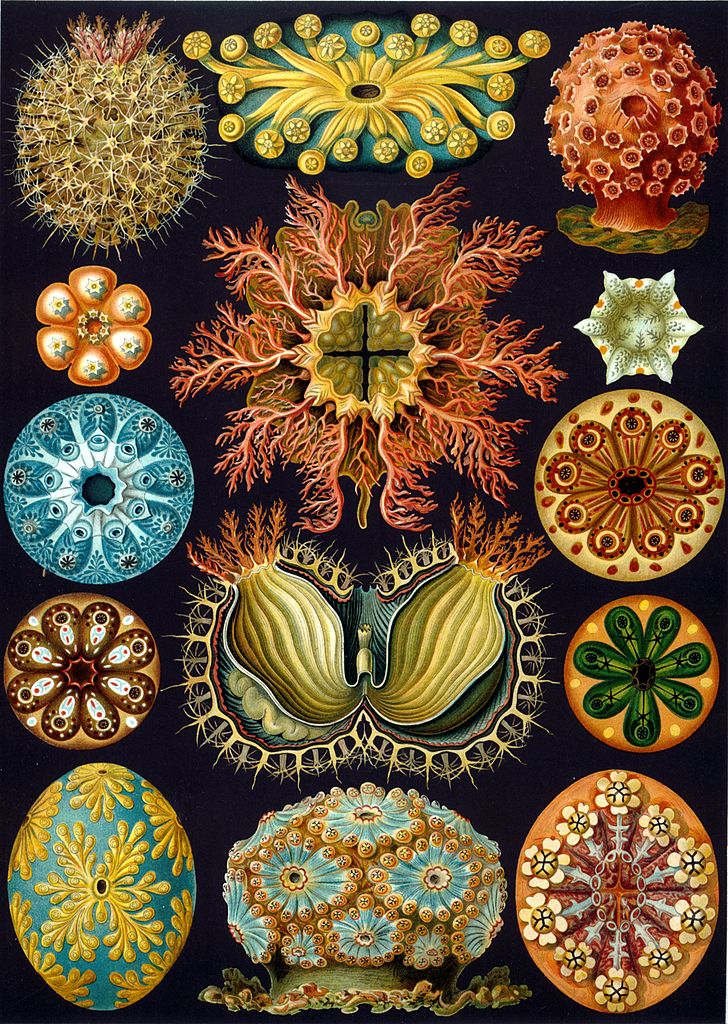
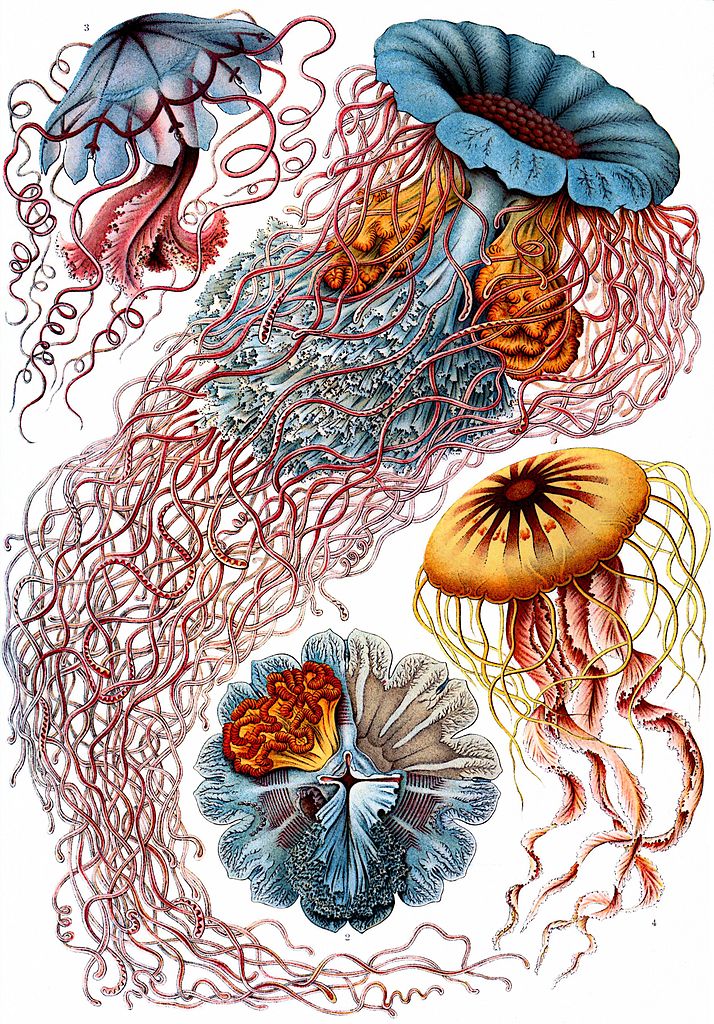
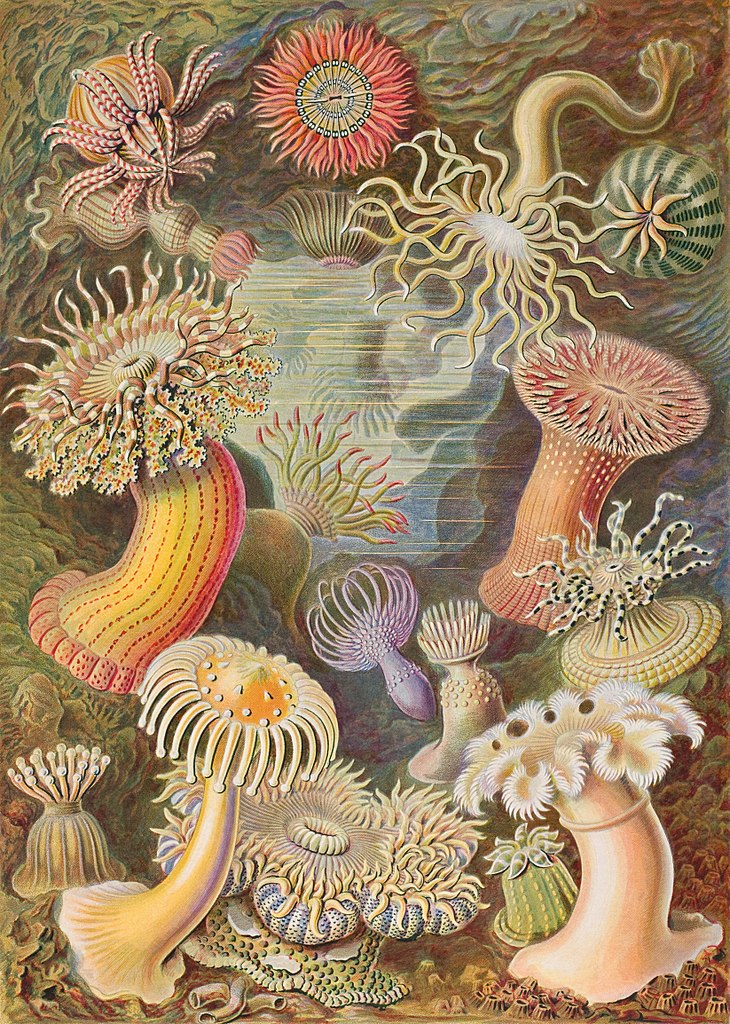
And then there’s Ernst Heinrich Haeckel, a German biologist and naturalist, philosopher and physician, and proponent of Darwinism who described and named thousands of species, mapped them on a genealogical tree, and “coined several scientific terms commonly known today,” This is Colossal writes, “such as ecology, phylum, and stem cell.” That’s an impressive resume, isn’t it? Oh, and check out his art—his brilliantly colored, elegantly rendered, highly stylized depictions of “far flung flora and fauna,” of microbes and natural patterns, in designs that inspired the Art Nouveau movement. “Each organism Haeckel drew has an almost abstract form,” notes Katherine Schwab at Fast Co. Design, “as if it’s a whimsical fantasy he dreamed up rather than a real creature he examined under a microscope. His drawings of sponges reveal their intensely geometric structure—they look architectural, like feats of engineering.”
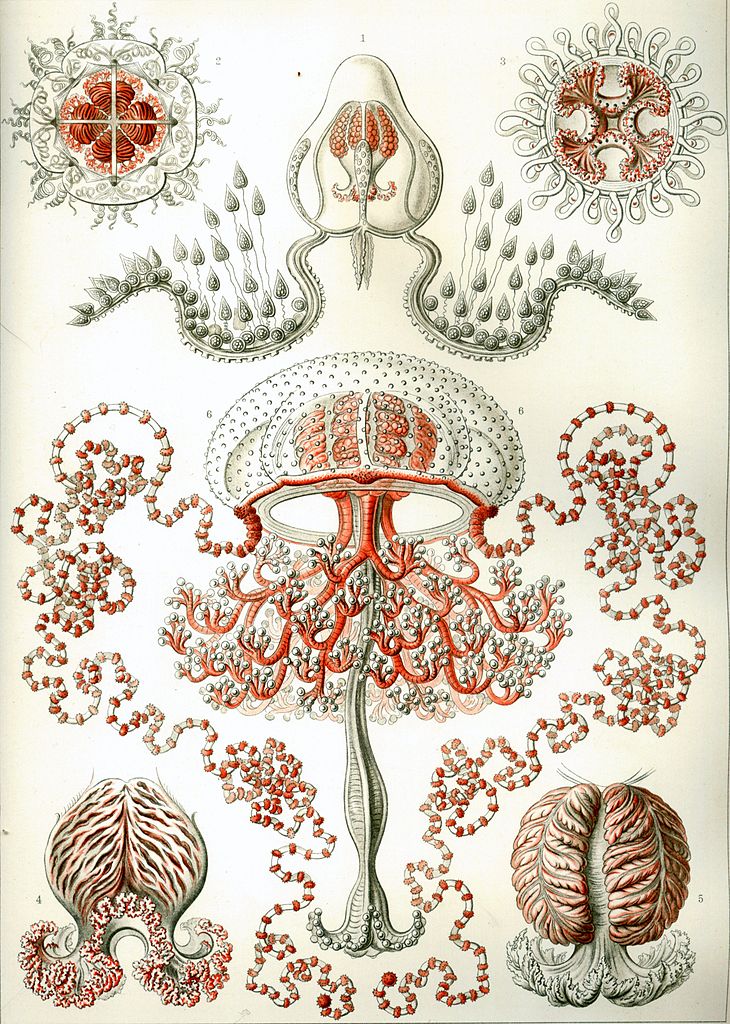
Haeckel published 100 fabulous prints beginning in 1889 in a series of ten books called Kunstformen der Natur (“Art Forms in Nature”), collected in two volumes in 1904. The astonishing work was “not just a book of illustrations but also the summation of his view of the world,” one which embraced the new science of Darwinian evolution wholeheartedly, writes scholar Olaf Breidbach in his 2006 Visions of Nature.
Haeckel’s method was a holistic one, in which art, science, and philosophy were complementary approaches to the same subject. He “sought to secure the attention of those with an interest in the beauties of nature,” writes professor of zoology Rainer Willmann in a book from Taschen called The Art and Science of Ernst Haeckel, “and to emphasize, through this rare instance of the interplay of science and aesthetics, the proximity of these two realms.”
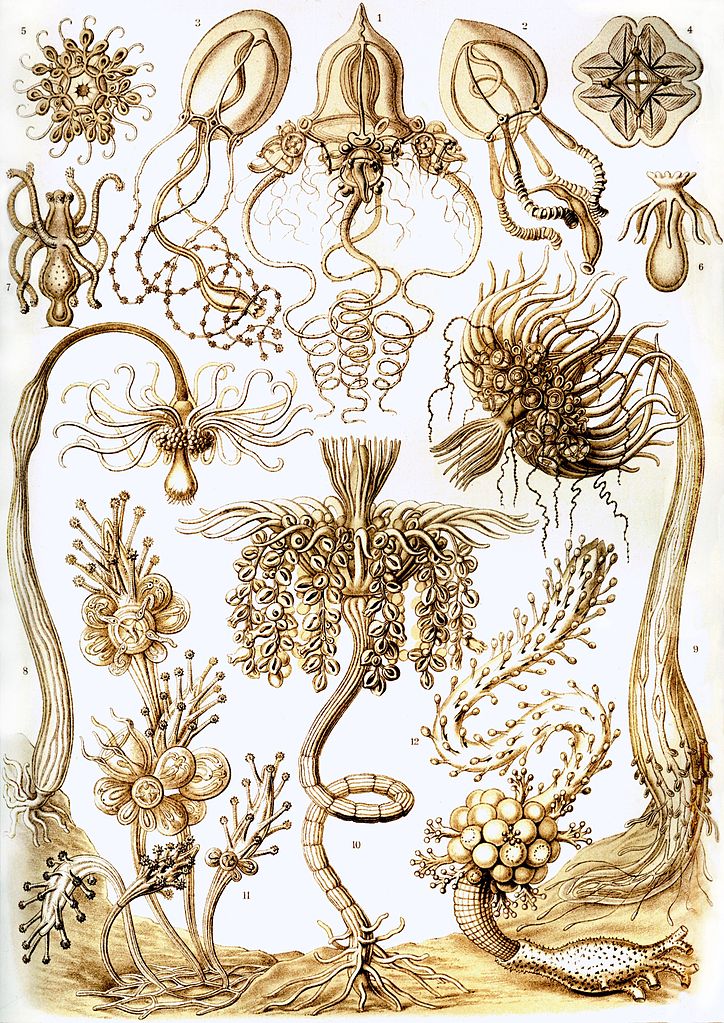
The gorgeous Taschen book includes 450 of Haeckel’s drawings, watercolors, and sketches, spread across 704 pages, and it’s expensive. But you can see all 100 of Haeckel’s originally published prints in zoomable high-resolution scans here. Or purchase a one-volume reprint of the original Art Forms in Nature, with its 100 glorious prints, through this Dover publication, which describes Haeckel’s art as “having caused the acceptance of Darwinism in Europe…. Today, although no one is greatly interested in Haeckel the biologist-philosopher, his work is increasingly prized for something he himself would probably have considered secondary.” It’s a shame his scientific legacy lies neglected, if that’s so, but it surely lives on through his art, which may be just as needed now to illustrate the wonders of evolutionary biology and the natural world as it was in Haeckel’s time.
Note: An earlier version of this post appeared on our site in 2017.
Related Content
Download 435 High Resolution Images from John J. Audubon’s The Birds of America
Two Million Wondrous Nature Illustrations Put Online by The Biodiversity Heritage Library
Cats in Japanese Woodblock Prints: How Japan’s Favorite Animals Came to Star in Its Popular Art
Josh Jones is a writer and musician based in Durham, NC. Follow him at @jdmagness
Read More...Explore a New Digital Edition of Printing Types, the Authoritative History of Printing & Typography from 1922
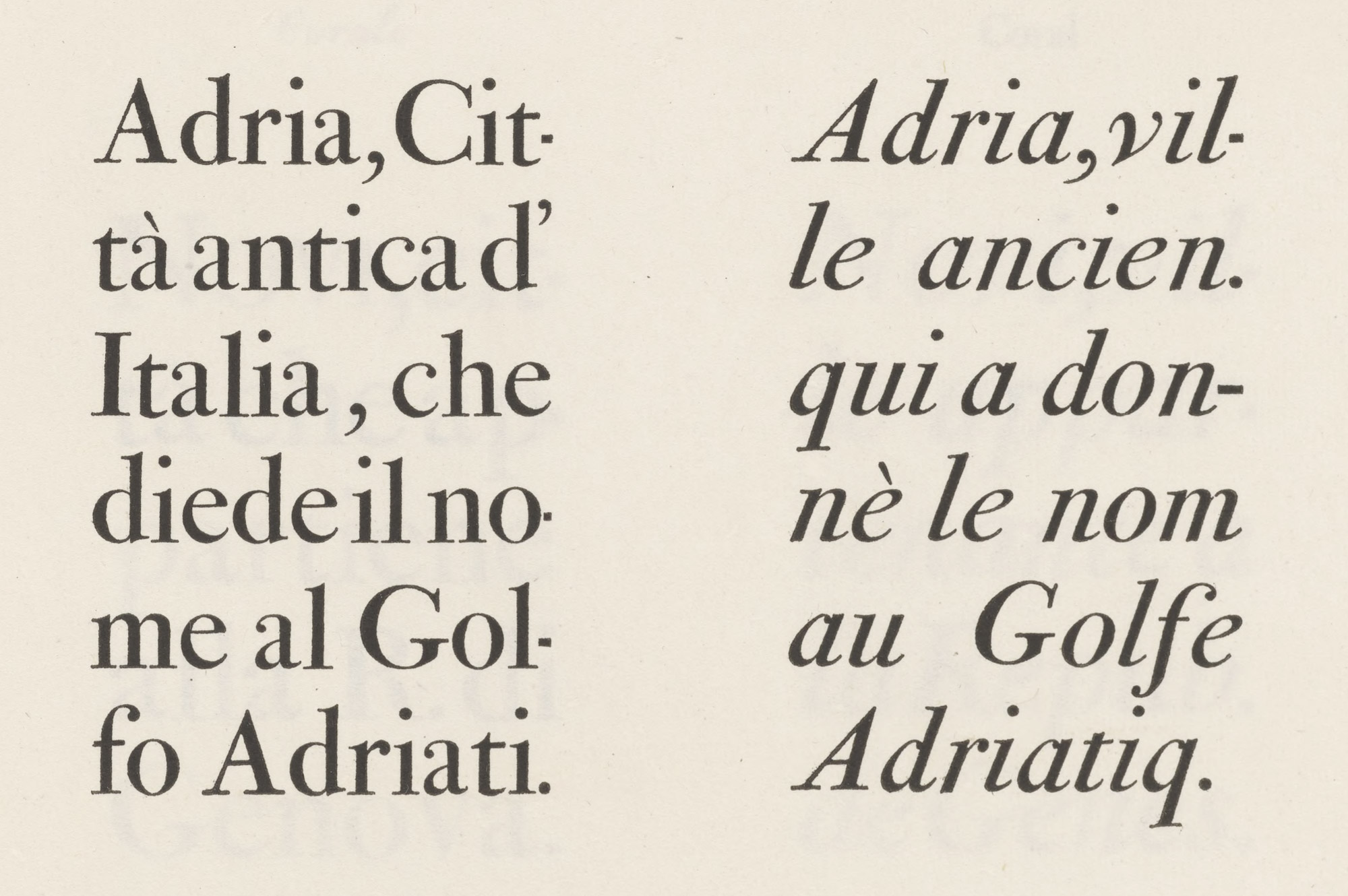
Times New Roman has been around since 1931, longer than most of us have been alive — and for longer than many of us have been alive, word-processing applications have come with it as the default font. We tend, therefore, to regard it less as something created than as something for all intents and purposes eternal, but there was a time when publishers had to actively adopt it. The first American firm to start using Times New Roman was the Merrymount Press, which had already made a highly prestigious name for itself with publications like the elegant Book of Common Prayer financed by no less a captain of industry than J. Pierpont Morgan. But other printers knew Merrymount for a book that would have inspired in them an equally worshipful impulse.
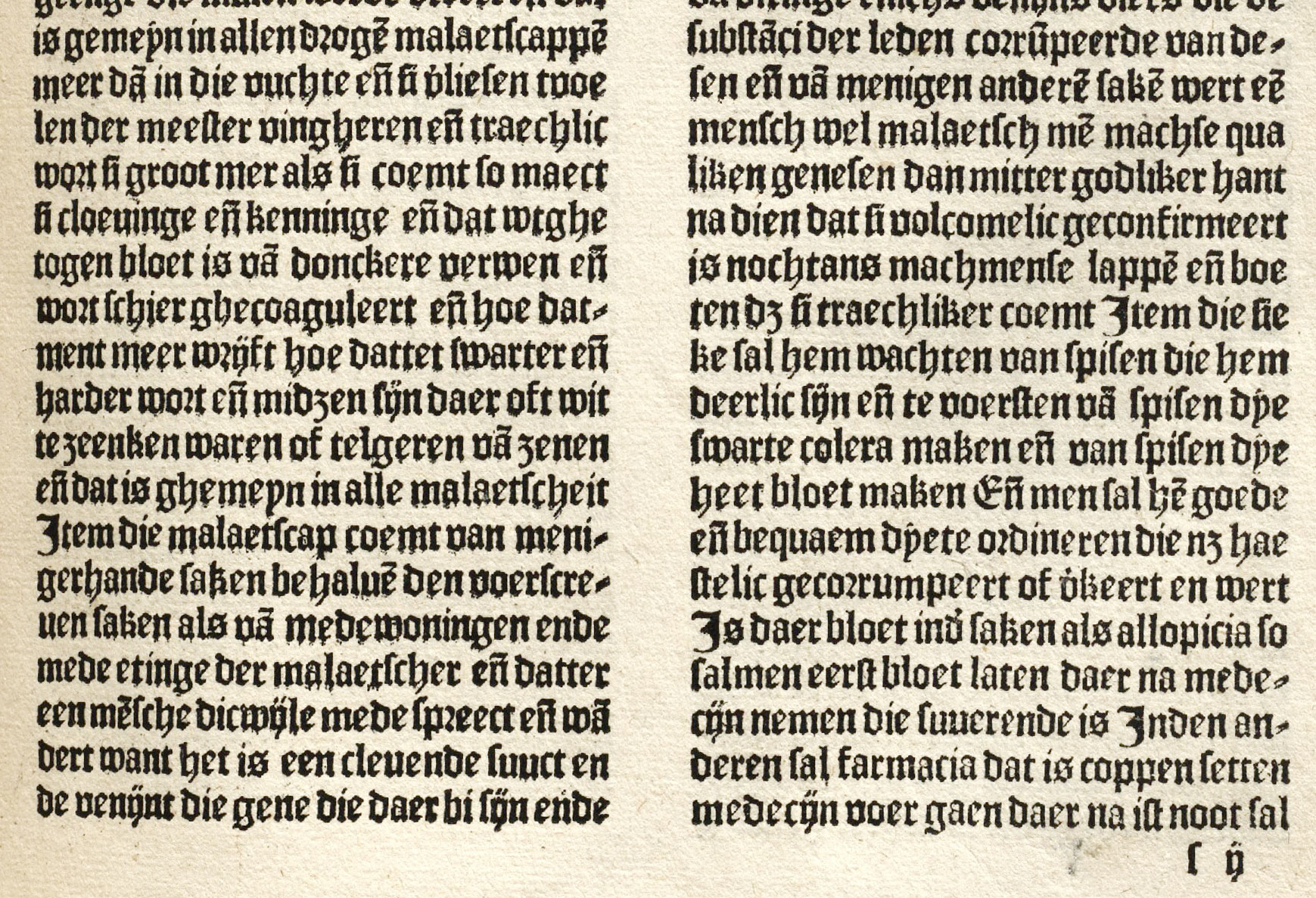
“Released in 1922 with a later revision in 1937,” Printing Types: Their History, Forms and Use “became known as the standard work on the history of [printing and typography] and a basic book for all interested in the graphic arts. This two-volume work spans nearly 450 years and includes detailed analyses of the printers and type designers and their work.”
So writes the designer Nicholas Rougeux, previously featured here on Open Culture for his digital editions of vintage books like Illustrations of the Natural Orders of Plants; British & Exotic Mineralogy; A Monograph of the Trochilidæ, or Family of Humming-Birds; Werner’s Nomenclature of Colours; Euclid’s Elements, and Pierre-Joseph Redouté’s collections of rose and lily illustrations. His latest project to go live is a painstakingly assembled digital edition of Printing Types, which you can explore here.
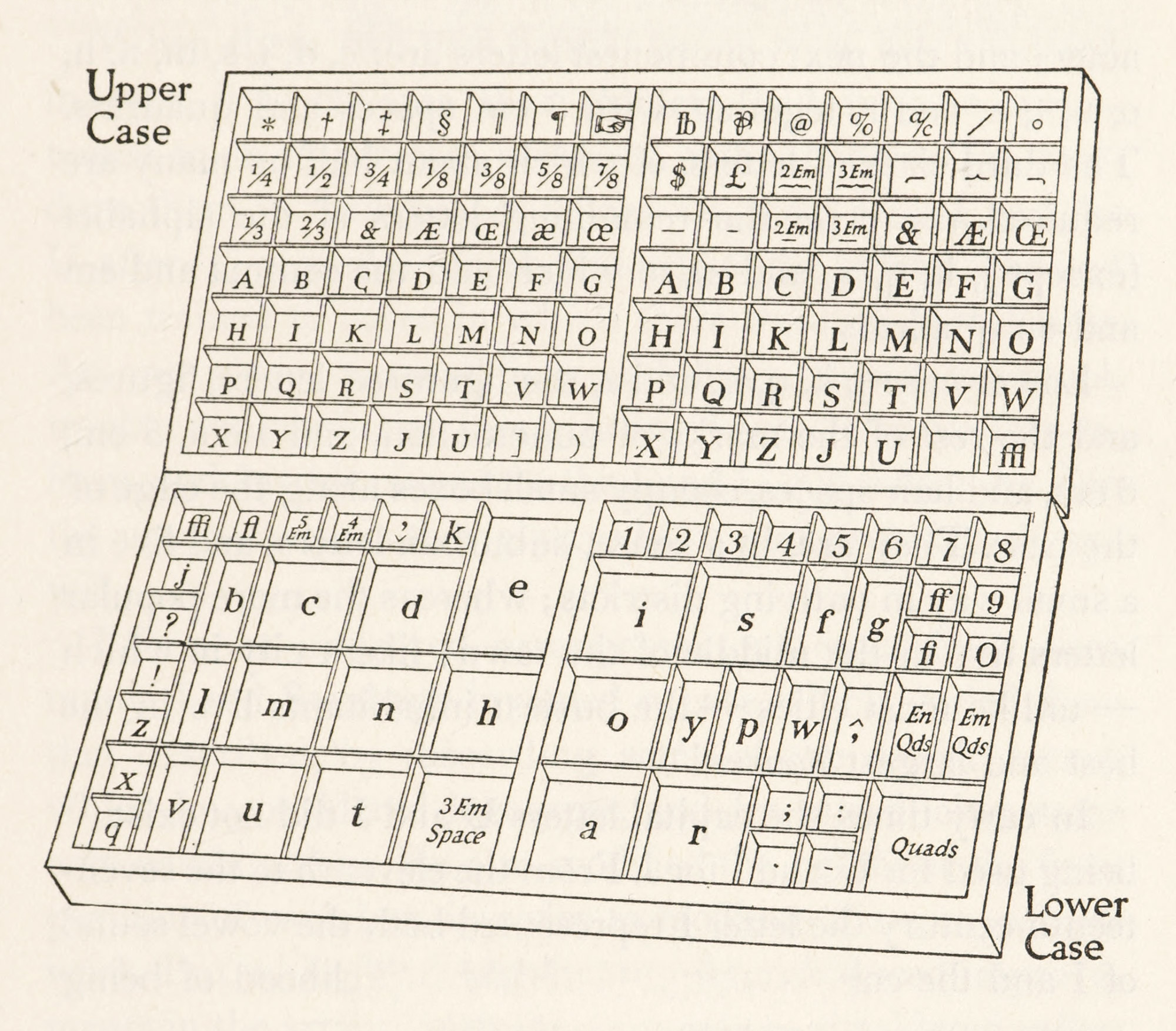
That book was also originally the work of one man, Merrymount Press founder Daniel Berkeley Updike. “During his tenure at Harvard University, he taught a course on Technique of Printing in the Graduate School of Business Administration for five years,” Rougeux writes, “the lectures of which served as the basis for Printing Types.” In the book, Updike offers a history of “the art of typography from the dawn of Western printing in the fifteenth century to the beginning of the twentieth — focusing primarily on European printing in Germany, France, Italy, the Netherlands, Spain, and England as well as the United States.” In tracing “the development of type design,” he also discusses “the importance of each historic period and the lessons they contain for contemporary designers.”
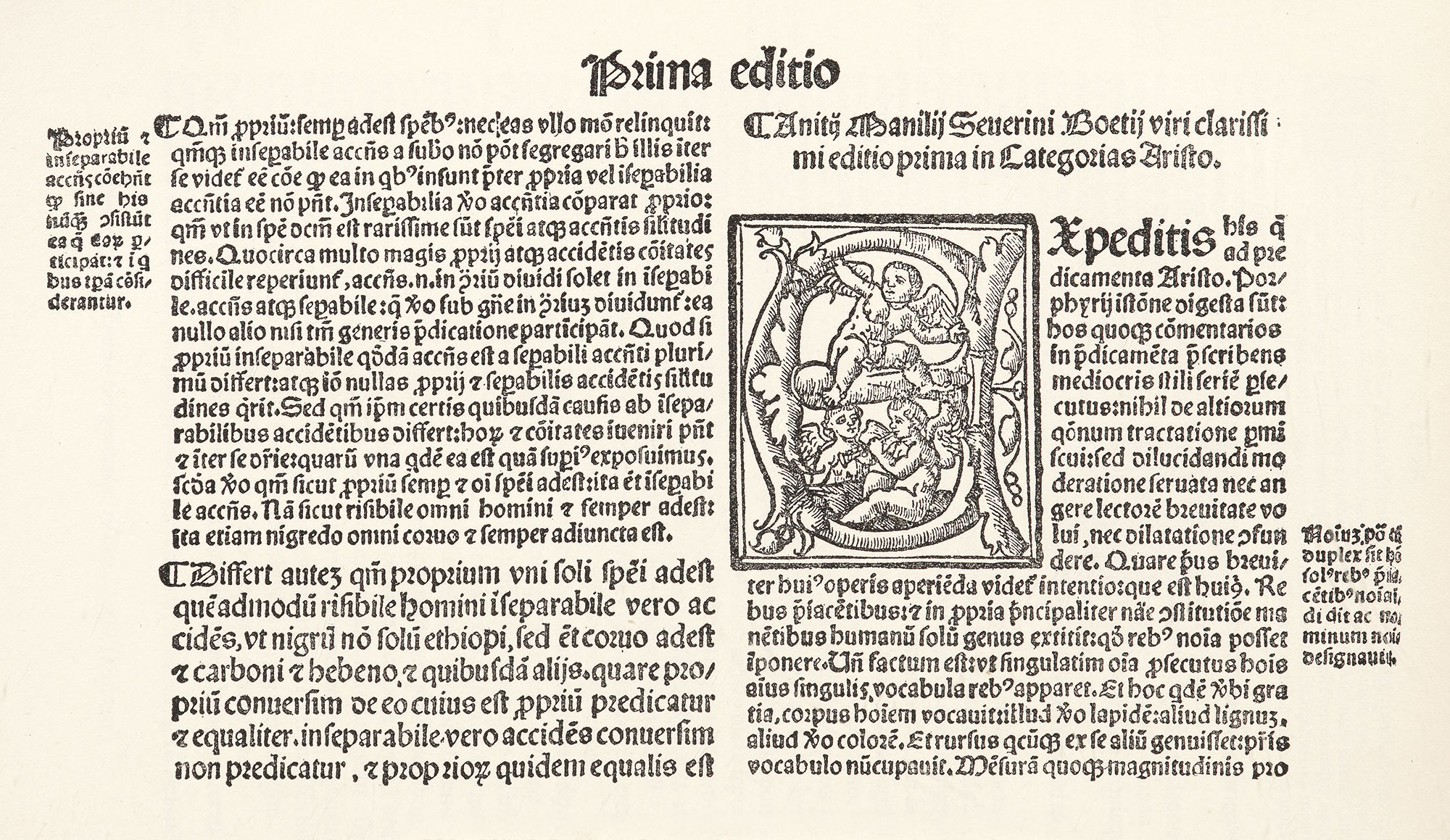
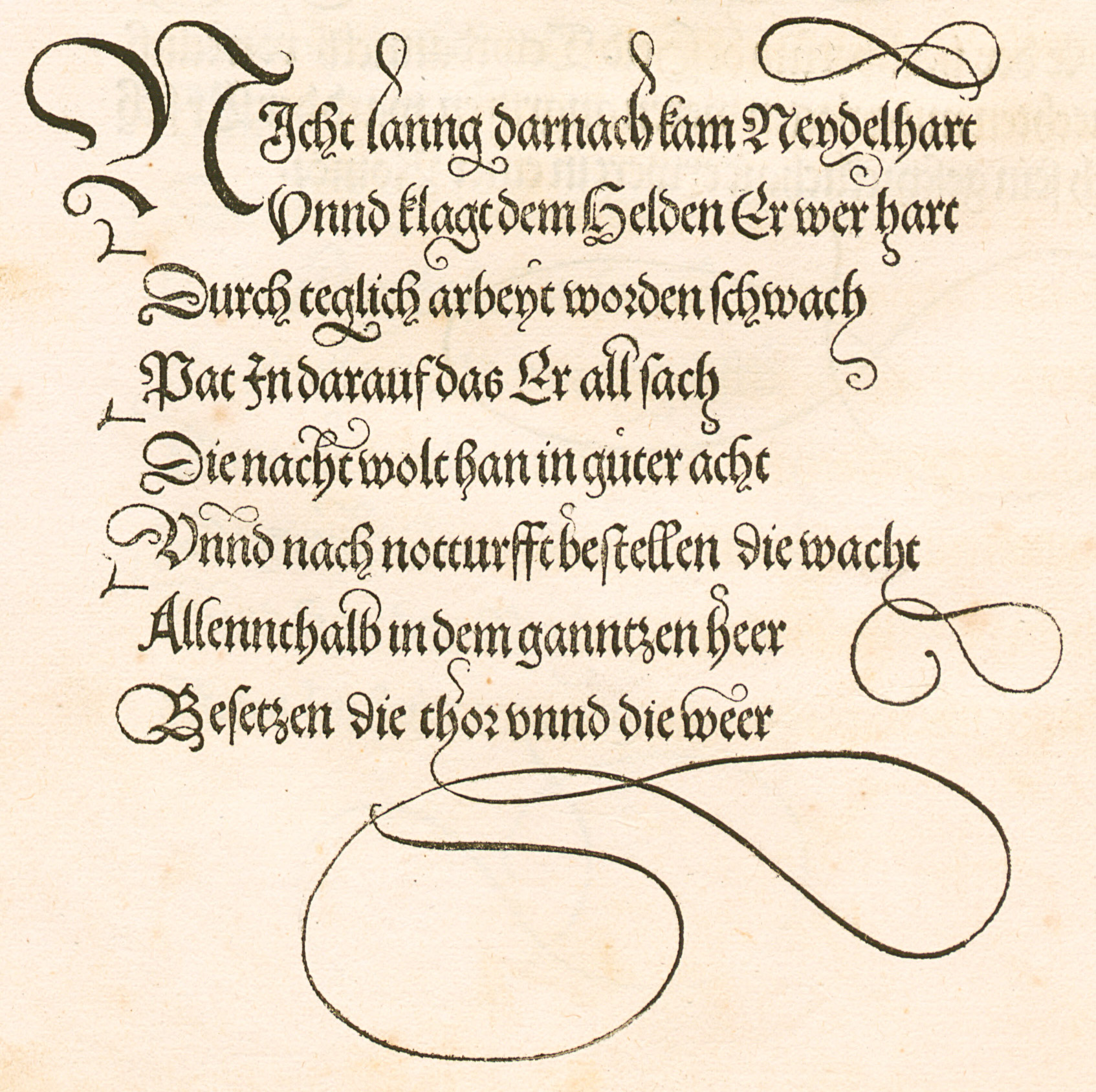
Originally published in 1922 and extensively revised in 1937, Printing Types long stood as the authoritative history of typography in the Latin alphabet, with its “more than 360 facsimile illustrations showcasing examples of typography, borders, flowers, and pages pulled from the books covered.” Tracking down the sources of those illustrations constituted no small part of the painstaking production of Rougeux’s digital edition, and the 100 of them most highly praised by Updike have also been made available for purchase in poster form. For those who do a lot of work with text, in print or digital forms, it could provide just as much motivation as an actual copy of Printing Types on the shelf to find our way beyond the defaults.
Related Content:
The History of Typography Told in Five Animated Minutes
Behold a Digitization of “The Most Beautiful of All Printed Books,” The Kelmscott Chaucer
Fonts in Use: Enter a Giant Archive of Typography, Featuring 12,618 Typefaces
Based in Seoul, Colin Marshall writes and broadcasts on cities, language, and culture. His projects include the Substack newsletter Books on Cities and the book The Stateless City: a Walk through 21st-Century Los Angeles. Follow him on the social network formerly known as Twitter at @colinmarshall.
Read More...A Trip Around the World in 1900: See Restored Footage Showing Life in New York, London, India, Japan, China & Beyond
From today’s vantage, the first decade of the twentieth century can look like an even more distant period of history than it is. In many corners of urban civilization, the cabarets, tearooms, and other near-paralytically mannered institutions of the Belle Époque were very much going concerns. To those who lived in that era, it must have been easy enough to believe that the ways of nineteenth-century-style aristocracy and empire could perpetuate themselves forever. Yet those were also the years of Georges Méliès Le Voyage dans la Lune, the Wright brothers’ first flight; the proliferation of automobiles and subway trains; Russia’s loss in war to Japan and first revolution; Einstein’s discovery of relativity, the photoelectric effect, and Brownian motion; and Picasso’s Les Demoiselles d’Avignon.
The world as it was, in other words, was giving way to the world as it would be. Such is the context of the documentary footage collected — and colorized, and upscaled — in the video at the top of the post. Beginning in a bustling working-class street in Hollinwood, England, this tour of the nineteen-hundreds continues on to places like Spain, India, China, New York, Japan, Brazil, Denmark, Austria, and Germany.
One aspect of all this footage liable to catch the twenty-first-century eye is all the myriad forms of transportation on display, some running on solely animal or even human muscle, and others propelled by the kind of engines then at the heart of industrial revolutions the world over. (You can even catch a glimpse of Wuppertal’s suspended Schwebebahn, previously featured here on Open Culture.)
All this gives us a clearer sense of why so many contemporary observers expressed feelings of civilizational whiplash, especially if, as was becoming more and more common, they’d emigrated from a less technologically advanced society to a more technologically advanced one. For those living at the edge of progress, the shape of things to come (a phrase later used as a book title by one such observer, the prolific H. G. Wells) was anyone’s guess, and it’s hardly surprising that so many forward-looking philosophies, ideologies, and art movements would arise from such a ferment. Still, it would have taken a prescient mind indeed to foresee the ascendance of communism, Nazism, the American empire, and mass broadcast media just ahead, to say nothing of two world wars. William Gibson had yet to be born, let alone to utter his now-famous quote, but as we can see, the future was already here in the nineteen-tens — and unevenly distributed.
Related content:
Footage of Cities Around the World in the 1890s: London, Tokyo, New York, Venice, Moscow & More
Paris Had a Moving Sidewalk in 1900, and a Thomas Edison Film Captured It in Action
Immaculately Restored Film Lets You Revisit Life in New York City in 1911
Berlin Street Scenes Beautifully Caught on Film (1900–1914)
Based in Seoul, Colin Marshall writes and broadcasts on cities, language, and culture. His projects include the Substack newsletter Books on Cities and the book The Stateless City: a Walk through 21st-Century Los Angeles. Follow him on the social network formerly known as Twitter at @colinmarshall.
Read More...Hermann Rorschach’s Original Rorschach Test: What Do You See? (1921)
There is a well-known scene in Woody Allen’s Take The Money And Run (1969) when Virgil Starkwell (Allen) takes a psychological test to join the Navy, but is thwarted by his lascivious unconscious. The psychological measure that proves to be Starkwell’s undoing—rejected, he turns to a life of crime—is the Rorschach inkblot test, devised a century ago by Carl Jung’s compatriot and fellow psychologist, Hermann Rorschach. Although Rorschach would die young, at 37, his namesake remains embedded in our perception of psychology, alongside Freud’s couch and Pavlov’s dog.
Hermann Rorschach’s father was an art teacher, and encouraged his son to express himself. Whether the young Rorschach had innate artistic leanings, or had begun to listen to his father more closely after the death of his mother at age 12, is uncertain. What is known, however, is that Hermann became so fascinated with making pictures out of inkblots—a Swiss game known under the delightful designation of Klecksography—that his schoolmates gave him the nickname of Klecks.
Although he struggled to choose between art and science as a career, Rorschach, on the counsel of eminent German biologist and ardent Darwin supporter Ernst Haeckel, chose medicine, specializing in psychology. Still, he never abandoned art.
Even before the young Rorschach began to study psychology, the medical profession had flirted with imagery association. In 1857, a German doctor named Justinus Kerner published a book of poetry, with each poem inspired by an accompanying inkblot. Alfred Binet, the father of intelligence testing, also tinkered with inkblots at the outset of the 20th century, seeing them as a potential measure of creativity. While the claim that Rorschach was familiar with these particular inkblots rests on conjecture, we know that he was familiar with the work of Szymon Hens, an early psychologist who explored his patients’ fantasies using inkblots, as well as Carl Jung’s practice of having his patients engage in word-association.
After noticing that schizophrenic patients associated vastly different things with inkblots than other patients, Rorschach, following some experimentation, created the first version of the inkblot test as a measure of schizophrenia in 1921. The test, however, only came to be used as a form of personality assessment when Samuel Beck and Bruno Klopfer expanded its original scope in the late 1930s. Since then, psychologists have frequently used the various aspects of people’s responses (e.g., inkblot focus area) to make judgment calls about broad personality traits. Ironically, Rorschach himself had been skeptical about the inkblots’ value in assessing personality.
In honor of Rorschach’s birthday (he was born on this day in 1884), we’ve highlighted his original images below, as well as some of the most popular responses. If you see something else in these images, feel free to let us know in the comments section below. The images, we should note, are in the public domain, and otherwise readily viewable on Wikipedia. And, according to Wikimedia Commons, the images are in the public domain.
Image 1: Bat, butterfly, moth
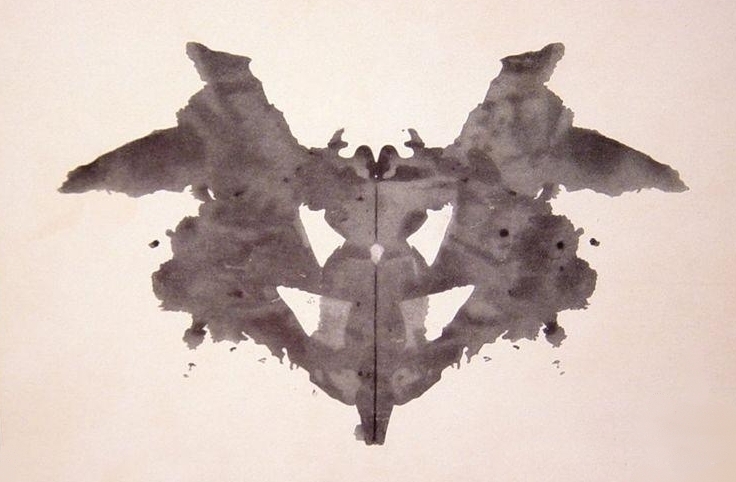
Image 2: Two humans
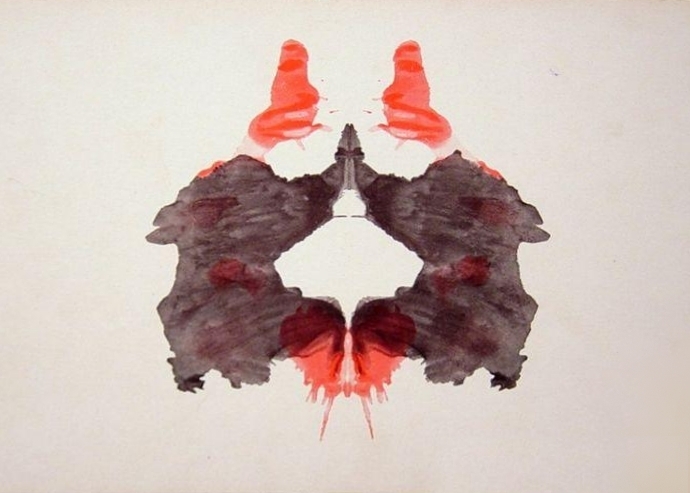
Image 3: Two humans
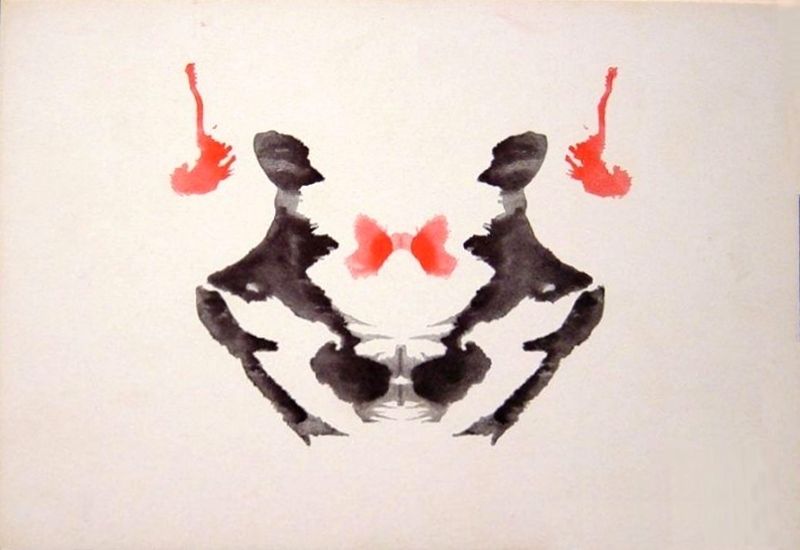
Image 4: Animal hide, skin, rug
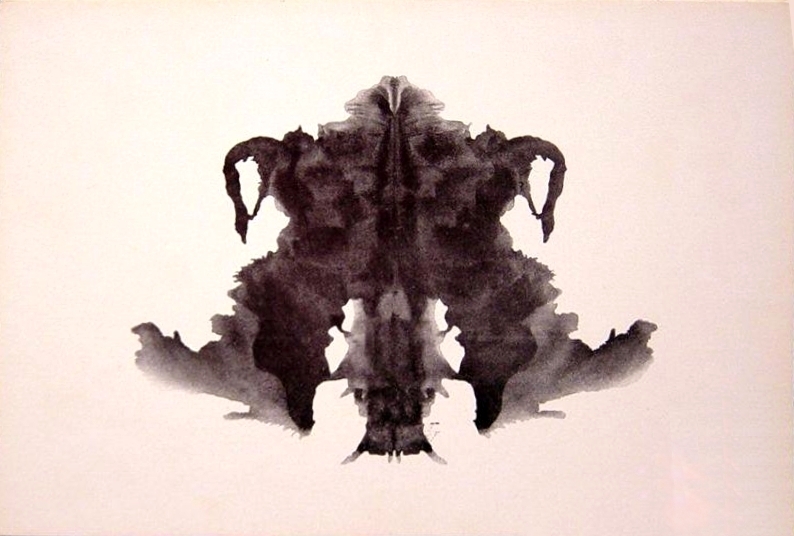
Image 5: Bat, butterfly, moth

Image 6: Animal hide, skin, rug

Image 7: Human heads or faces

Image 8: Animal; not cat or dog
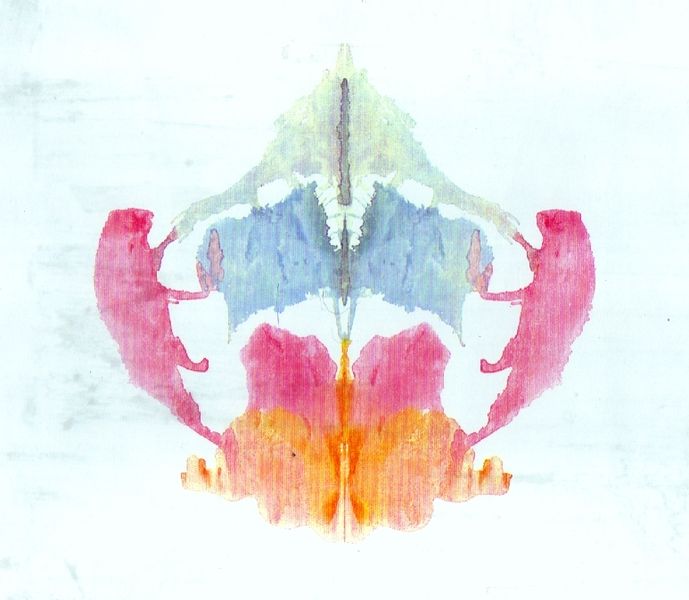
Image 9: Human
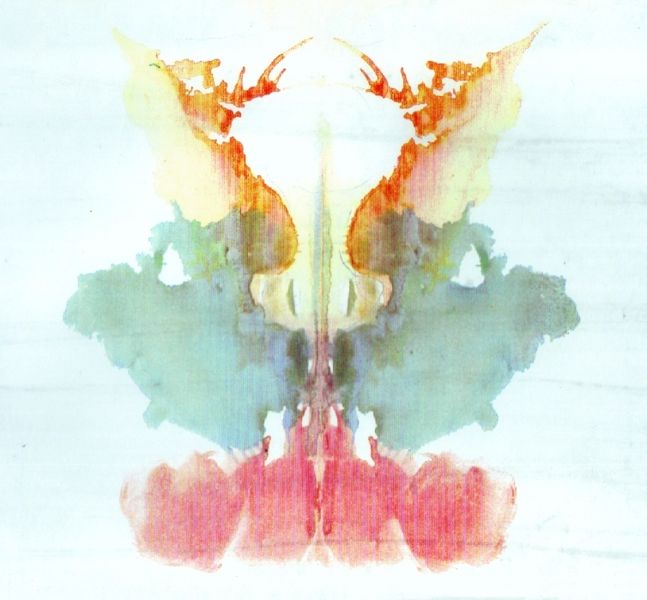
Image 10: Crab, lobster, spider,
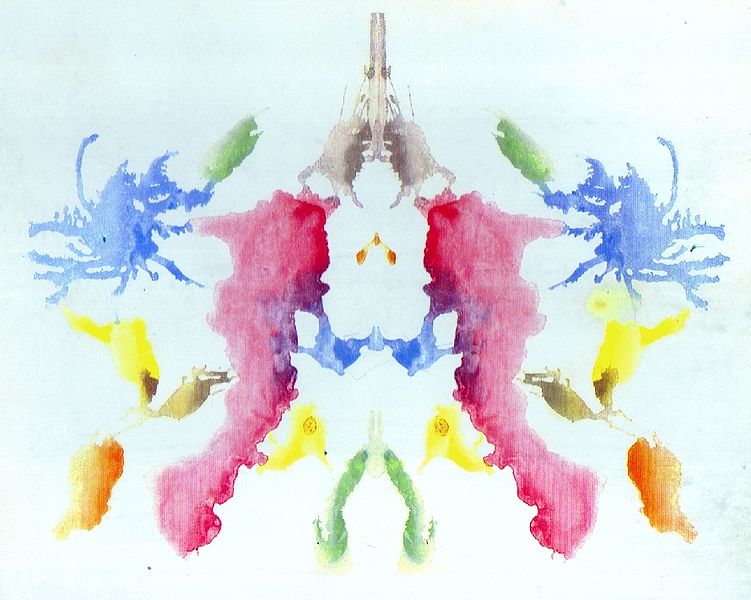
Happen to see an elephant and a men’s glee club engaged in unmentionable acts? Don’t fret—you’ve likely projected nothing intelligible. The test has long been out of date, and is deemed neither reliable nor valid in the vast majority of cases (although an updated version exists, it suffers from similar methodological flaws). Virgil Starkwell, it seems, would have made a fine Navy officer.
Ilia Blinderman is a Montreal-based culture writer. Follow him at@iliablinderman
Read More...When CBS Canceled The Smothers Brothers Comedy Hour for Criticizing the American Establishment and the Vietnam War (1969)
Rigorously clean-cut, competent on the acoustic guitar and double bass, and seldom dressed in anything more daring than cherry-red blazers, Tom and Dick Smothers looked like the antithesis of nineteen-sixties rebellion. When they first gained national recognition with their variety show The Smothers Brothers Comedy Hour, they must have come off to many young viewers as the kind of act of which their mother — or even grandmother — would approve. But the brothers’ cultivatedly square, neo-vaudevillian appearance was deceiving, as CBS would soon find out when the two took every chance to turn their program into a satirical, relentlessly authority-challenging, yet somehow wholesome showcase of the counterculture.
The Smothers Brothers Comedy Hour premiered in February of 1967, and its first season “featured minimal controversial content,” writes Sarah King at U.S. History Scene. Thereafter, “the show became increasingly political. The brothers invited activist celebrities onto their show, including folk singers Pete Seeger and Joan Baez and singer-actor Harry Belafonte.
The show also produced its own political material criticizing the Vietnam War and the politicians who supported it,” not least President Lyndon Johnson. Bringing on Seeger was a daring move, given that he’d been blacklisted from network television for the better part of two decades, though CBS’s censors made sure to cut out the most politically sensitive parts of his act.
Even more so was the brothers’ own performance, with George Segal, of Phil Ochs’s “Draft Dodger Rag,” which they ended by urging their audience to “make love, not war.” All this can look fairly tame by today’s standards, but it locked the show — which had become top-rated, holding its own in a time slot against the cultural phenomenon that was Bonanza — into a grudge match with its own network. Before the third season, CBS’ higher-ups demanded that each show be turned in ten days in advance, ostensibly in order to undergo review for sensitive material. In one instance, they claimed that the deadline hadn’t been met and aired a re-run instead, though it may not have been entirely irrelevant that the intended program contained a tribute by Baez to her then-husband, who was being sent to prison for refusing to serve in the military.
CBS did broadcast Baez’s performance on a later date, after clipping out the reference to the specific nature of her husband’s offense. A similar struggle took place around the “sermonettes” delivered by David Steinberg, one of which you can see in the video above. The irreverence toward U.S. foreign policy, religion, and much else besides in these and other segments eventually proved too much for the network, which fired the brothers after it had already given the green light to a fourth season of the Comedy Hour. Though they successfully sued CBS for breach of contract thereafter, they never did regain the same level of televisual prominence they’d once enjoyed, if enjoy be the word. At any rate, the fallout of all this controversy firmly installed the Smothers Brothers in the pantheon of twentieth-century free-speech warriors, and their experience reminds us still today that, without the freedom to give offense, there can be no comedy worthy of the name.
Related content:
Watch Steve Martin Make His First TV Appearance: The Smothers Brothers Comedy Hour (1968)
When The Who (Literally) Blew Up The Smothers Brothers Comedy Hour in 1967
Based in Seoul, Colin Marshall writes and broadcasts on cities, language, and culture. His projects include the Substack newsletter Books on Cities and the book The Stateless City: a Walk through 21st-Century Los Angeles. Follow him on the social network formerly known as Twitter at @colinmarshall.
Read More...Explore the Fascinating Map of Fungi: An Introduction to the Vast Mushroom Kingdom
Here on Open Culture, we’ve previously featured Domain of Science’s elaborate infographic maps of such vast fields of intellectual endeavor as mathematics, physics, computer science, quantum physics, quantum computing, chemistry, biology, and medicine. Over time, the series’ creator Dominic Walliman has branched out, as it were, even to kingdoms of the natural world, like plants. With Plantae down, which of the other five has he taken on next? That question is answered in the video above, which introduces Domain of Science’s new Fascinating Map of Fungi.
Yes, this big map depicts the realm of the humble mushroom, which “shares the forest with the plants and the animals, but it’s not a plant, and it’s not an animal.” And the mushroom itself, like we’re used to seeing sprouting beneath our feet, is only a small part of the organism: the rest “lives hidden, out of sight, below ground. Beneath every mushroom is a fungal network of hair-like strands called the mycelium,” which begins as a spore.
The hugely diverse “fruiting bodies” that they push out of the surface have only one job: “to disperse the spores and grow the next generation.” But only ten percent of fungi species actually do this; the rest don’t produce anything we would recognize as mushrooms at all.
About 150,000 species of fungi have been discovered so far. Though inanimate, they manage to do quite a lot, such as supplying nutrients to plants (or killing them), generating chemicals that have proven extremely useful (or at least consciousness-expanding) to humans, hijacking the nervous systems of arthropods, and even surviving in outer space. And of course, “because of their ability to concentrate nutrients from within the soil, fungi are an excellent source of food for us and many other animals.” Mycologists estimate that there remain at least two or three million more species “out there in nature waiting to be discovered.” At least a few of them, one hopes, will turn out to be tasty.
Related content:
The Beautifully Illustrated Atlas of Mushrooms: Edible, Suspect and Poisonous (1827)
Death-Cap Mushrooms are Terrifying and Unstoppable: A Wild Animation
Based in Seoul, Colin Marshall writes and broadcasts on cities, language, and culture. His projects include the Substack newsletter Books on Cities and the book The Stateless City: a Walk through 21st-Century Los Angeles. Follow him on the social network formerly known as Twitter at @colinmarshall.
Read More...How to Write in Cuneiform, the Oldest Writing System in the World: A Short Introduction
Teaching child visitors how to write their names using an unfamiliar or antique alphabet is a favorite activity of museum educators, but Dr. Irving Finkel, a cuneiform expert who specializes in ancient Mesopotamian medicine and magic, has grander designs.
His employer, the British Museum, has over 130,000 tablets spanning Mesopotamia’s Early Dynastic period to the Neo-Babylonian Empire “just waiting for young scholars to come devote themselves to (the) monkish work” of deciphering them.
Writing one’s name might well prove to be a gateway, and Dr. Finkel has a vested interest in lining up some new recruits.
The museum’s Department of the Middle East has an open access policy, with a study room where researchers can get up close and personal with a vast collection of cuneiform tablets from Mesopotamia and surrounding regions.
But let’s not put the ox before the cart.
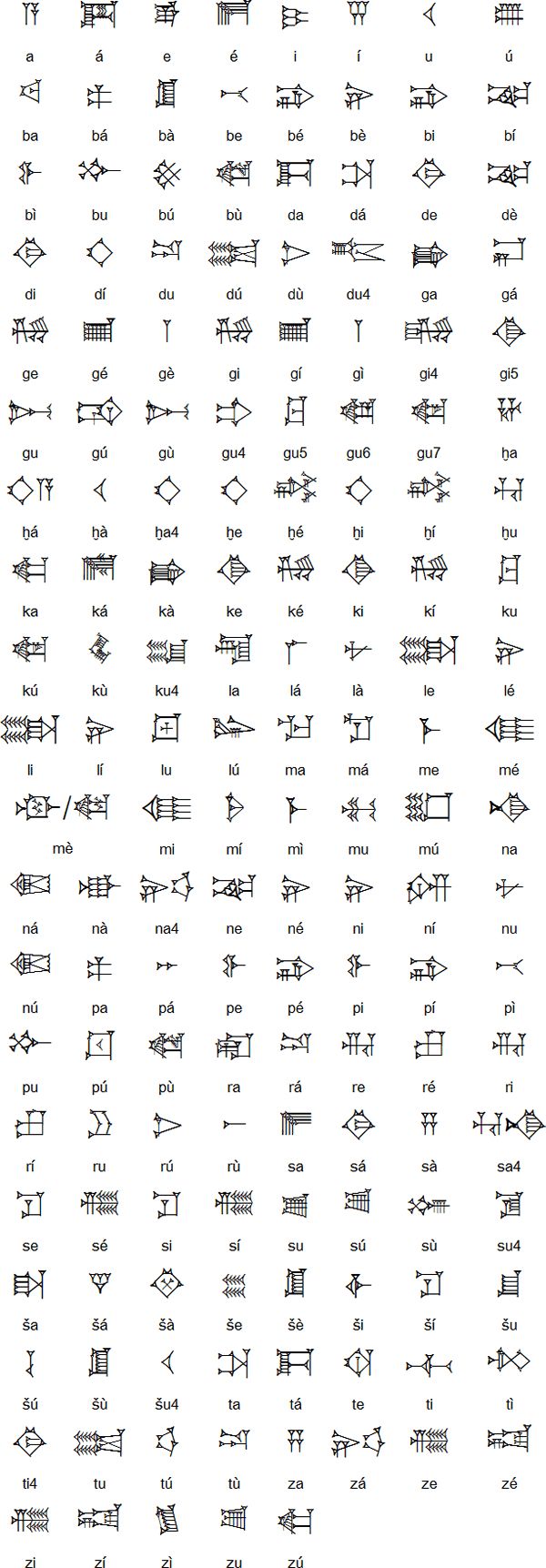
As the extremely personable Dr. Finkel shows Matt Gray and Tom Scott of Matt and Tom’s Park Bench, above, cuneiform consists of three components—upright, horizontal and diagonal—made by pressing the edge of a reed stylus, or popsicle stick if you prefer, into a clay tablet.
The mechanical process seems fairly easy to get the hang of, but mastering the oldest writing system in the world will take you around six years of dedicated study. Like Japan’s kanji alphabet, the oldest writing system in the world is syllabic. Properly written out, these syllables join up into a flowing calligraphy that your average, educated Babylonian would be able to read at a glance.
Even if you have no plans to rustle up a popsicle stick and some Play-Doh, it’s worth sticking with the video to the end to hear Dr. Finkel tell how a chance encounter with some naturally occurring cuneiform inspired him to write a horror novel, which is now available for purchase, following a successful Kickstarter campaign.
Begin your cuneiform studies with Irving Finkel’s Cuneiform: Ancient Scripts.
Note: An earlier version of this post appeared on our site in 2018.
Related Content:
Hear The Epic of Gilgamesh Read in its Original Ancient Language, Akkadian
Learn Ancient Greek in 64 Free Lessons: A Free Online Course from Brandeis & Harvard
Ayun Halliday is an author, illustrator, theater maker and Chief Primatologist in NYC.
Read More...A 107-Year-Old Irish Farmer Reflects on the Changes He’s Seen During His Life (1965)
Talk to a clear-headed 107-year-old today, and you could expect to hear stories of adolescence in the Great Depression, or — if you’re lucky — the Jazz Age seen through a child’s eyes. It’s no common experience to have been formed by the age of radio and live deep into the age of the smartphone, but arguably, Michael Fitzpatrick lived through even greater civilizational transformation. Born in Ireland in 1858, he sat for the interview above 107 years later in 1965, which was broadcast on television. That device was well on its way to saturating Western society at the time, as the automobile already had, while mankind was taking to the skies in jetliners and even to the stars in rocket ships.
The contrast between the world into which Fitzpatrick was born and the one in which he eventually found himself is made starker by his being a son of the land. A lifelong farmer, he can honestly reply, when asked to name the biggest change he’s seen, “Machinery.”
Not all of his answers come across quite so clearly, owing to his thick dialect that must surely have gone extinct by now, even in rural Ireland. Luckily, the video comes with subtitles, making it easier to understand what he has to say about the advent of the “mowing machine” and his memories of the Bodyke evictions of the eighteen-eighties, when mêlées broke out over a local landlord’s attempt to oust his destitute tenants.
One can come up with vaguely analogous events to the Bodyke evictions in the modern world, but in essence, they belong to the long stretch of history when to be human meant to engage in agriculture, or to oversee it. The Industrial Revolution didn’t happen at the same pace everywhere at once, and indeed, Fitzpatrick lived the first part of his life in an effectively pre-industrial reality, before witnessing the scarcely believable process of mechanization take place all around him. He experienced, in other words, the arrival of the civilization into which we were all born, and to which we know no alternative. As for those of us of a certain age today, we can expect to be asked six or seven decades hence — assuming we can go the distance — what life was like with only dial-up internet.
Related content:
Real Interviews with People Who Lived in the 1800s
Philosopher Bertrand Russell Talks About the Time When His Grandfather Met Napoleon
1400 Engravings from the 19th Century Flow Together in the Short Animation “Still Life”
A Rare Smile Captured in a 19th Century Photograph
Based in Seoul, Colin Marshall writes and broadcasts on cities, language, and culture. His projects include the Substack newsletter Books on Cities and the book The Stateless City: a Walk through 21st-Century Los Angeles. Follow him on the social network formerly known as Twitter at @colinmarshall.
Read More...40,000-Year-Old Symbols Found in Caves Worldwide May Be the Earliest Written Language
We may take it for granted that the earliest writing systems developed with the Sumerians around 3400 B.C.E. The archaeological evidence so far supports the theory. But it may also be possible that the earliest writing systems predate 5000-year-old cuneiform tablets by several thousand years. And what’s more, it may be possible, suggests paleoanthropologist Genevieve von Petzinger, that those prehistoric forms of writing, which include the earliest known hashtag marks, consisted of symbols nearly as universal as emoji.
The study of symbols carved into cave walls all over the world—including penniforms (feather shapes), claviforms (key shapes), and hand stencils—could eventually push us to “abandon the powerful narrative,” writes Frank Jacobs at Big Think, “of history as total darkness until the Sumerians flip the switch.” Though the symbols may never be truly decipherable, their purposes obscured by thousands of years of separation in time, they clearly show humans “undimming the light many millennia earlier.”
While burrowing deep underground to make cave paintings of animals, early humans as far back as 40,000 years ago also developed a system of signs that is remarkably consistent across and between continents. Von Petzinger spent years cataloguing these symbols in Europe, visiting “52 caves,” reports New Scientist’s Alison George, “in France, Spain, Italy and Portugal. The symbols she found ranged from dots, lines, triangles, squares and zigzags to more complex forms like ladder shapes, hand stencils, something called a tectiform that looks a bit like a post with a roof, and feather shapes called penniforms.”
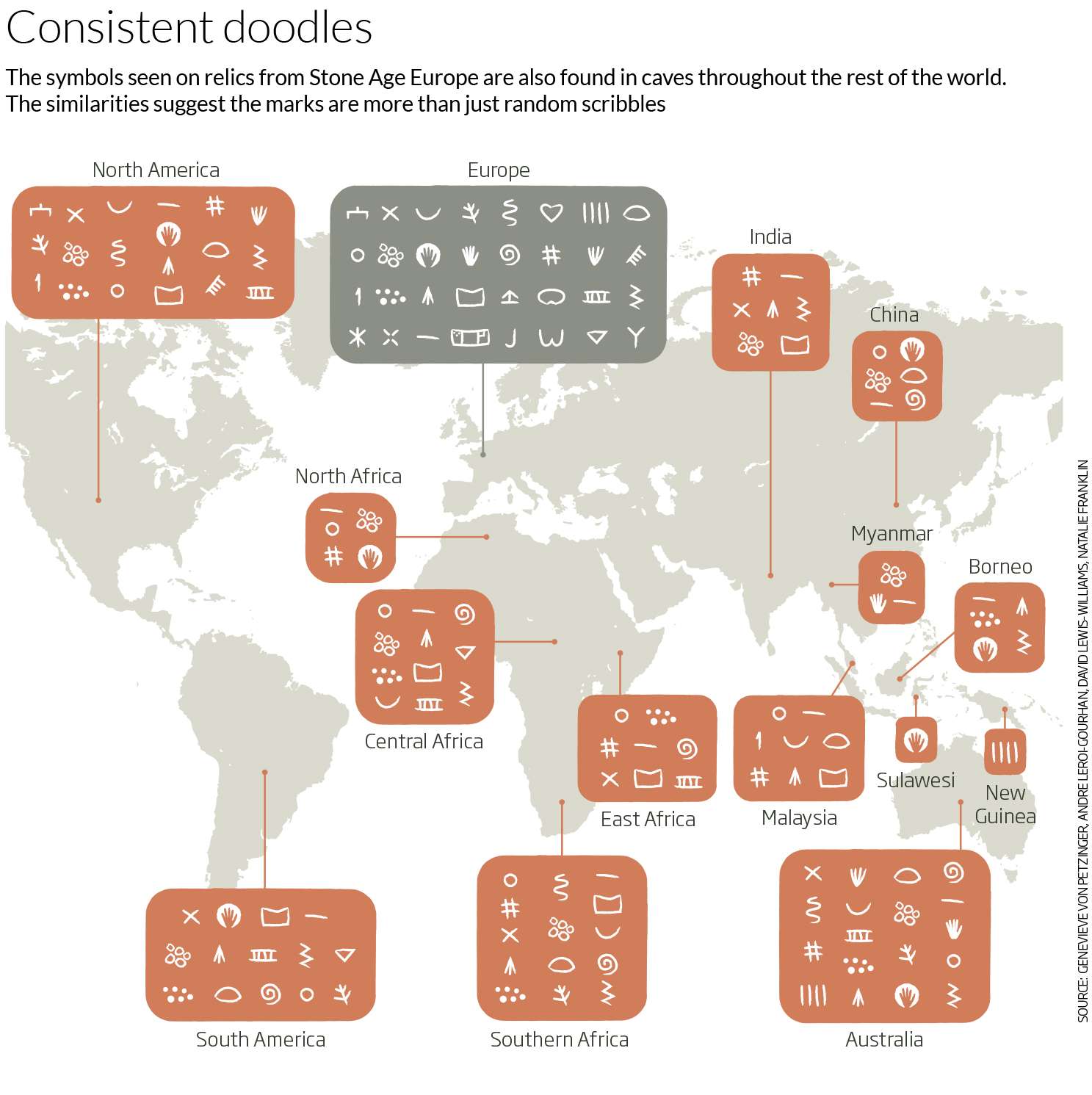
She discovered 32 signs found all over the continent, carved and painted over a very long period of time. “For tens of thousands of years,” Jacobs points out, “our ancestors seem to have been curiously consistent with the symbols they used.” Von Petzinger sees this system as a carryover from modern humans’ migration into Europe from Africa. “This does not look like the start-up phase of a brand-new invention,” she writes in her book The First Signs: Unlocking the mysteries of the world’s oldest symbols.
In her TED Talk at the top, von Petzinger describes this early system of communication through abstract signs as a precursor to the “global network of information exchange” in the modern world. “We’ve been building on the mental achievements of those who came before us for so long,” she says, “that it’s easy to forget that certain abilities haven’t already existed,” long before the formal written records we recognize. These symbols traveled: they aren’t only found in caves, but also etched into deer teeth strung together in an ancient necklace.
Von Petzinger believes, writes George, that “the simple shapes represent a fundamental shift in our ancestors’ mental skills,” toward using abstract symbols to communicate. Not everyone agrees with her. As the Bradshaw Foundation notes, when it comes to the European symbols, eminent prehistorian Jean Clottes argues “the signs in the caves are always (or nearly always) associated with animal figures and thus cannot be said to be the first steps toward symbolism.”
Of course, it’s also possible that both the signs and the animals were meant to convey ideas just as a written language does. So argues MIT linguist Cora Lesure and her co-authors in a paper published in Frontiers in Psychology last year. Cave art might show early humans “converting acoustic sounds into drawings,” notes Sarah Gibbens at National Geographic. Lesure says her research “suggests that the cognitive mechanisms necessary for the development of cave and rock art are likely to be analogous to those employed in the expression of the symbolic thinking required for language.”
In other words, under her theory, “cave and rock [art] would represent a modality of linguistic expression.” And the symbols surrounding that art might represent an elaboration on the theme. The very first system of writing, shared by early humans all over the world for tens of thousands of years.
Note: An earlier version of this post appeared on our site in 2019.
Related Content:
Tracing English Back to Its Oldest Known Ancestor: An Introduction to Proto-Indo-European
Was a 32,000-Year-Old Cave Painting the Earliest Form of Cinema?
Josh Jones is a writer and musician based in Durham, NC.
Read More...How a 19th Century Scientist Created Incredibly Realistic 3D Models of the Moon (1874)
At the moment, there’s no better way to see anything in space than through the lens of the James Webb Space Telescope. Previously featured here on Open Culture, that ten-billion-dollar successor to the Hubble Space Telescope can see unprecedentedly far out into space, which, in effect, means it can see unprecedentedly far back in time: some 13.5 billion years, in fact, to the state of the early universe. We posted the first photos taken by the James Webb Space Telescope in 2022, which showed us distant galaxies and nebulae at a level of detail in which they’d never been seen before.
Such images would scarcely have been imaginable to James Nasmyth, though he might have foreseen that they would one day be a reality. A man of many interests, he seems to have pursued them all during the nineteenth century through which he lived in its near-entirety.
His invention of the steam hammer, which turned out to be a great boon to the shipbuilding industry, did its part to make possible his early retirement. At that point, he was freed to pursue such passions as astronomy and photography, and in 1874, he published with co-author James Carpenter a book that occupied the intersection of those fields.
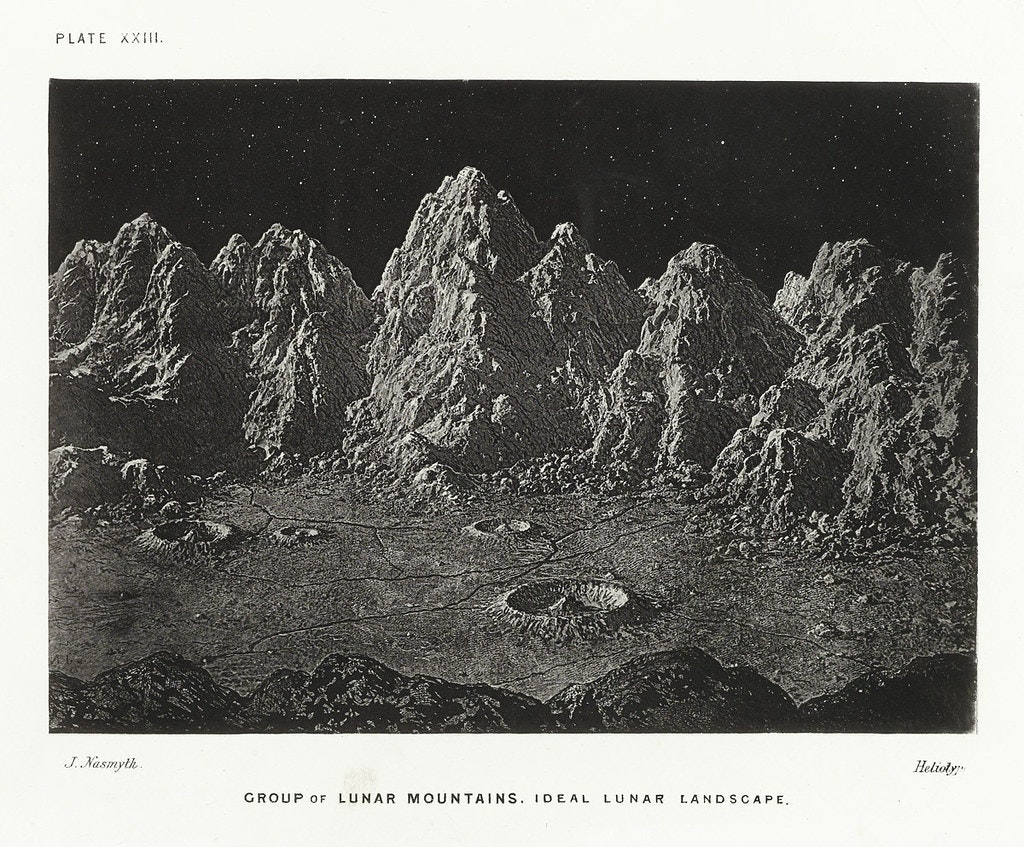
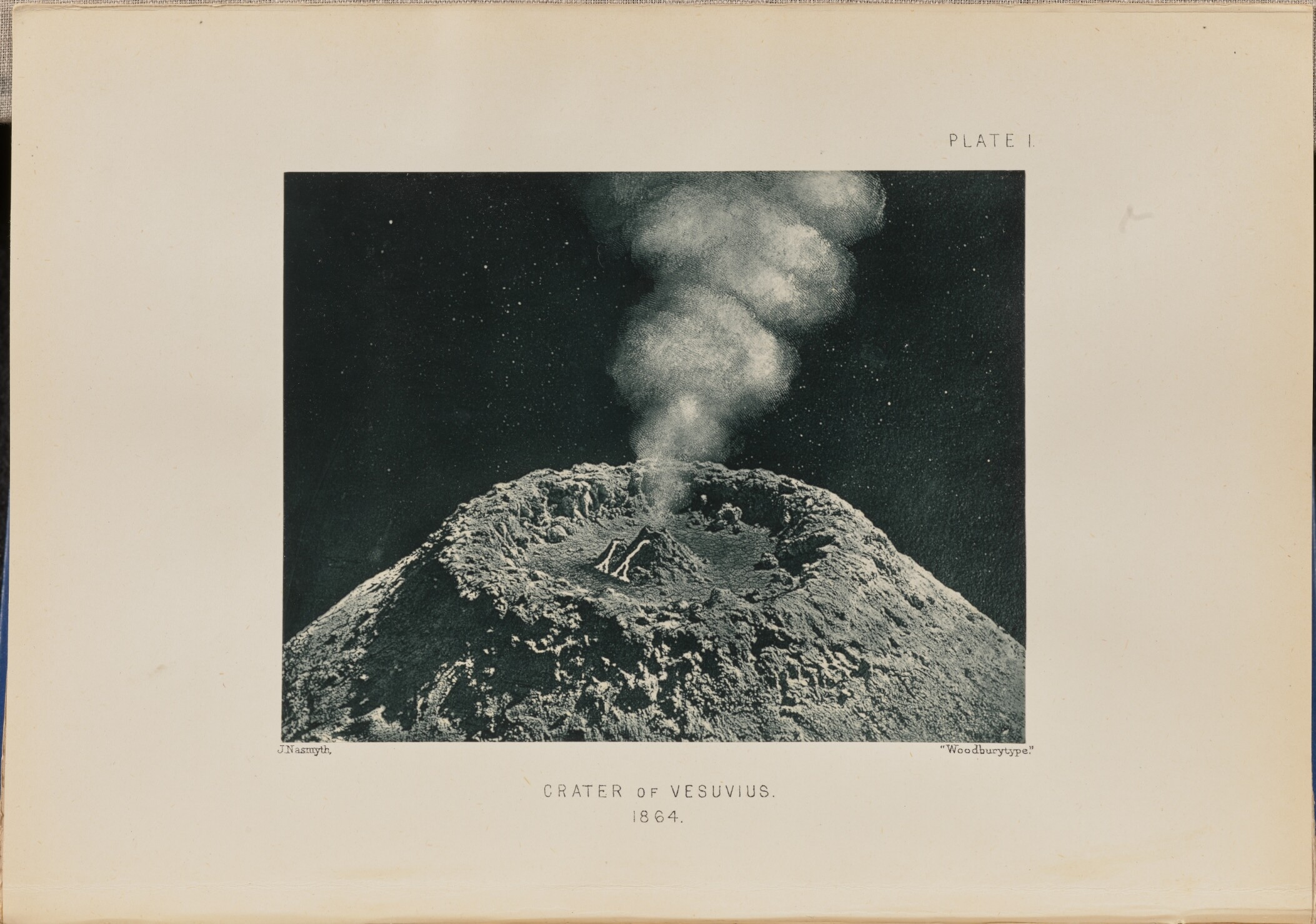
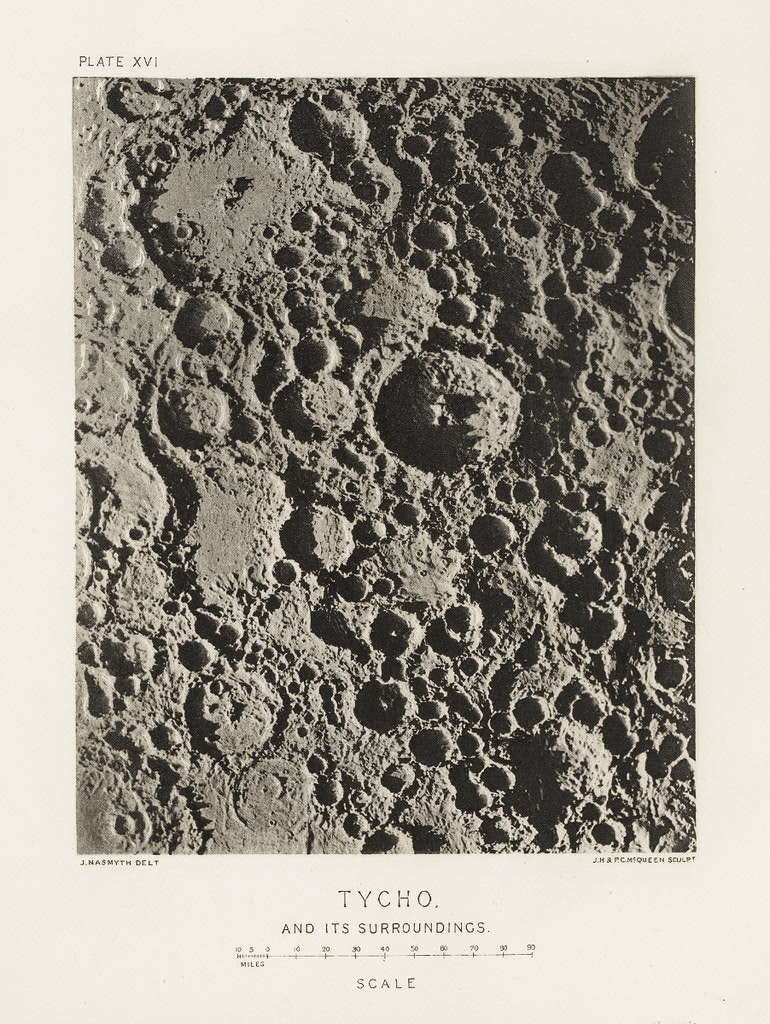
The Moon: Considered as a Planet, a World, and a Satellite contains what still look like strikingly detailed photos of the surface of that familiar but then-still-mysterious heavenly body: quite a coup at the time, considering that the technology for taking pictures through a telescope had yet to be invented. Nasmyth did use a telescope — one he made himself — but only as a reference in order to sketch “the moon’s scarred, cratered and mountainous surface,” writes Ned Pennant-Rea at the Public Domain Review. “He then built plaster models based on the drawings, and photographed these against black backgrounds in the full glare of the sun.”
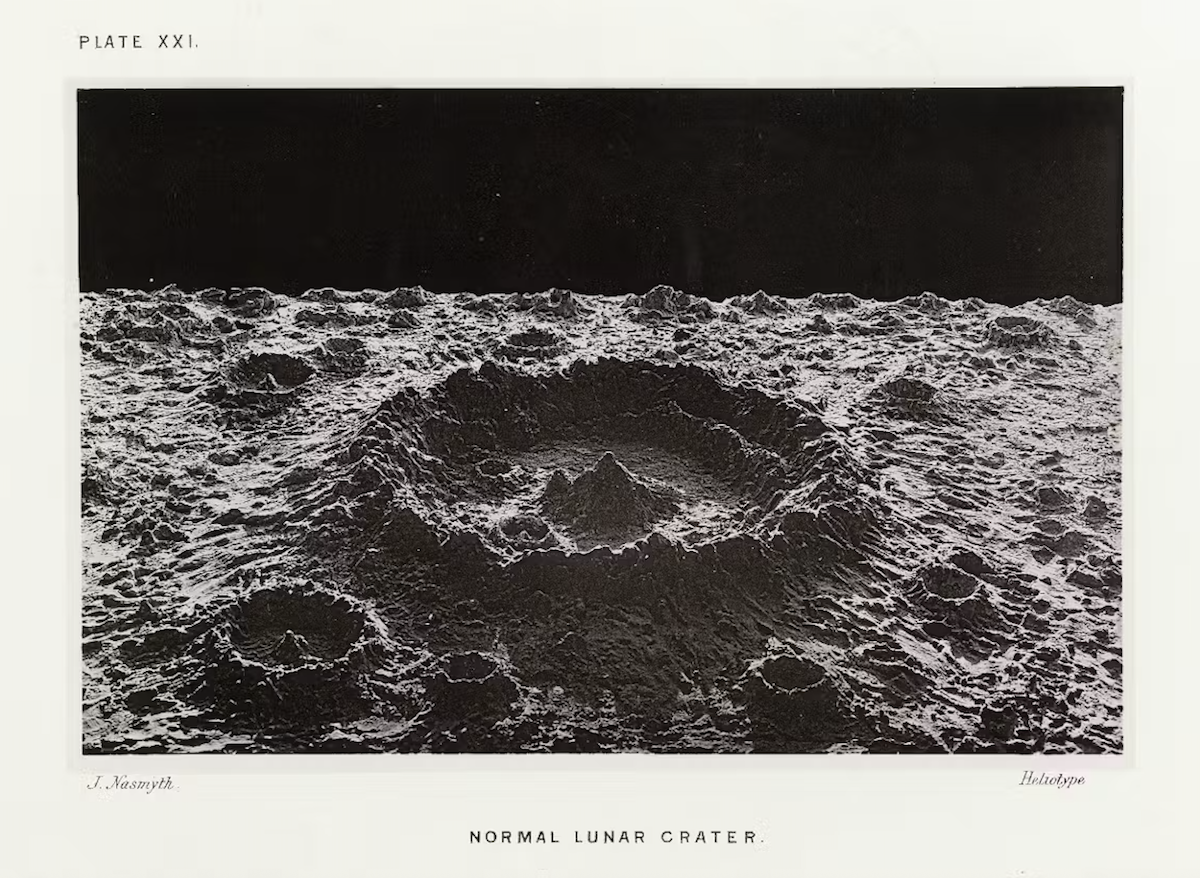
In the book’s text, Nasmyth and Carpenter showed a certain scientific prescience with their observations on such phenomena as the “stupendous reservoir of power that the tidal waters constitute.” You can read the first edition at the Internet Archive, and you can see more of its photographs at the Public Domain Review. Compare them to pictures of the actual moon, and you’ll notice that he got a good deal right about the look of its surface, especially given the tools he had to work with at the time. There’s even a sense in which Nasmyth’s photos look more real than the 100 percent faithful images we have now, that they vividly represent something of the moon’s essence. As millions of disappointed viewers of CGI-saturated modern sci-fi movies understand, sometimes only models feel right.
Related content:
The First Surviving Photograph of the Moon (1840)
The Very First Picture of the Far Side of the Moon, Taken 60 Years Ago
The Full Rotation of the Moon: A Beautiful, High Resolution Time Lapse Film
The Evolution of the Moon: 4.5 Billions Years in 2.6 Minutes
A Trip to the Moon (1902): The First Great Sci-Fi Film
Based in Seoul, Colin Marshall writes and broadcasts on cities, language, and culture. His projects include the Substack newsletter Books on Cities and the book The Stateless City: a Walk through 21st-Century Los Angeles. Follow him on the social network formerly known as Twitter at @colinmarshall.
Read More...Support Us
We're hoping to rely on loyal readers, rather than erratic ads. Please click the Donate button and support Open Culture. You can use Paypal, Venmo, Patreon, even Crypto! We thank you!

About Us

Open Culture scours the web for the best educational media. We find the free courses and audio books you need, the language lessons & educational videos you want, and plenty of enlightenment in between.
Advertise With Us

FREE UPDATES!
GET OUR DAILY EMAIL
Get the best cultural and educational resources on the web curated for you in a daily email. We never spam. Unsubscribe at any time.
FOLLOW ON SOCIAL MEDIA

Open Culture editor Dan Colman scours the web for the best educational media. He finds the free courses and audio books you need, the language lessons & movies you want, and plenty of enlightenment in between.
Advertise With Us


