The Foot-Licking Demons & Other Strange Things in a 1921 Illustrated Manuscript from Iran
Few modern writers so remind me of the famous Virginia Woolf quote about fiction as a “spider’s web” more than Argentine fabulist Jorge Luis Borges. But the life to which Borges attaches his labyrinths is a librarian’s life; the strands that anchor his fictions are the obscure scholarly references he weaves throughout his text. Borges brings this tendency to whimsical employ in his nonfiction Book of Imaginary Beings, a heterogeneous compendium of creatures from ancient folktale, myth, and demonology around the world.
Borges himself sometimes remarks on how these ancient stories can float too far away from ratiocination. The “absurd hypotheses” regarding the mythical Greek Chimera, for example, “are proof” that the ridiculous beast “was beginning to bore people…. A vain or foolish fancy is the definition of Chimera that we now find in dictionaries.” Of what he calls “Jewish Demons,” a category too numerous to parse, he writes, “a census of its population left the bounds of arithmetic far behind.
Throughout the centuries, Egypt, Babylonia, and Persia all enriched this teeming middle world.” Although a lesser field than angelology, the influence of this fascinatingly diverse canon only broadened over time.
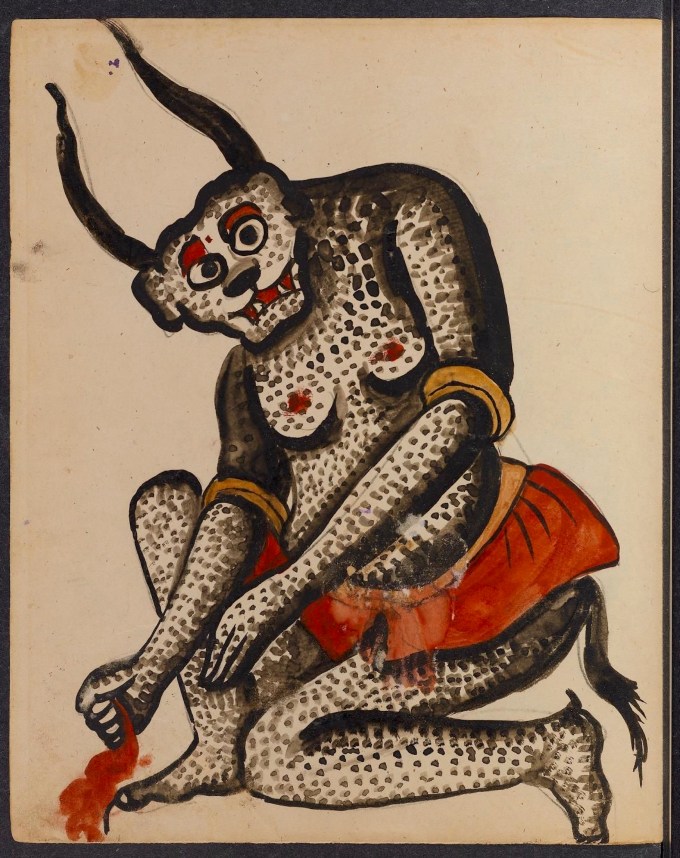
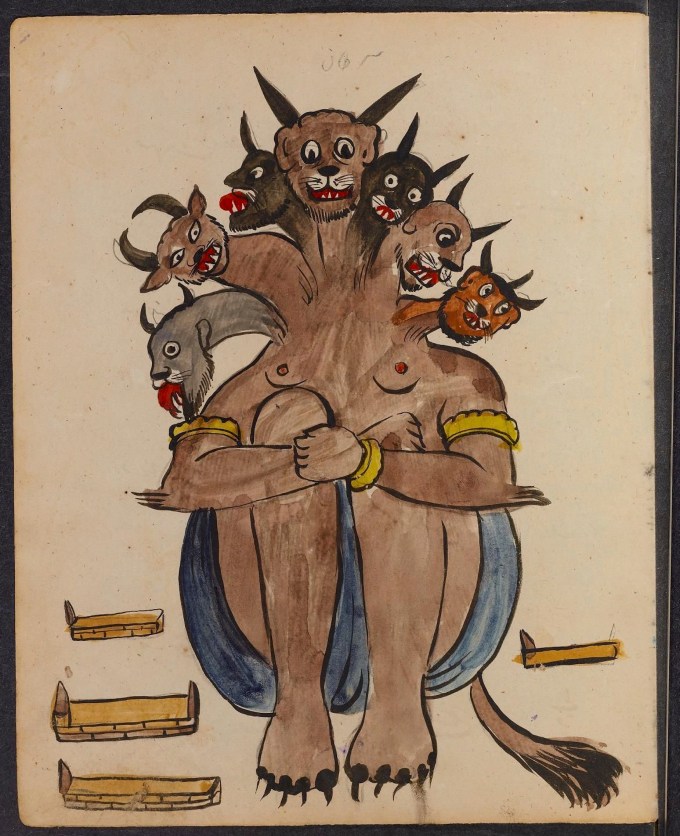
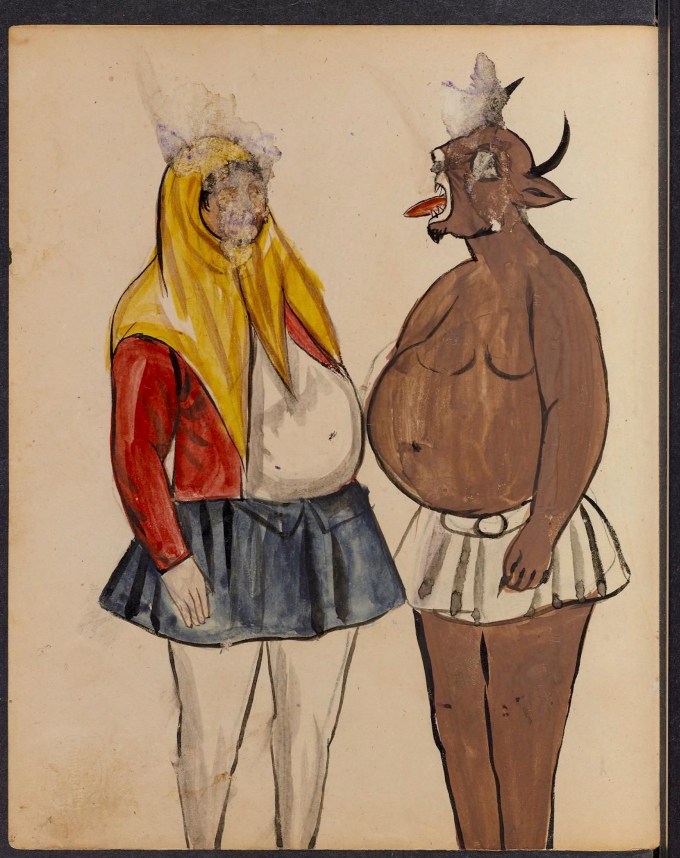
“The natives recorded in the Talmud” soon became “thoroughly integrated” with the many demons of Christian Europe and the Islamic world, forming a sprawling hell whose denizens hail from at least three continents, and who have mixed freely in alchemical, astrological, and other occult works since at least the 13th century and into the present. One example from the early 20th century, a 1902 treatise on divination from Isfahan, a city in central Iran, draws on this ancient thread with a series of watercolors added in 1921 that could easily be mistaken for illustrations from the early Middle Ages.
As the Public Domain Review notes:
The wonderful images draw on Near Eastern demonological traditions that stretch back millennia — to the days when the rabbis of the Babylonian Talmud asserted it was a blessing demons were invisible, since, “if the eye would be granted permission to see, no creature would be able to stand in the face of the demons that surround it.”
The author of the treatise, a rammal, or soothsayer, himself “attributes his knowledge to the Biblical Solomon, who was known for his power over demons and spirits,” writes Ali Karjoo-Ravary, now an assistant professor of Islamic history at Columbia University. Predating Islam, “the depiction of demons in the Near East… was frequently used for magical and talismanic purposes,” just as it was by occultists like Aleister Crowley at the time these illustrations were made.
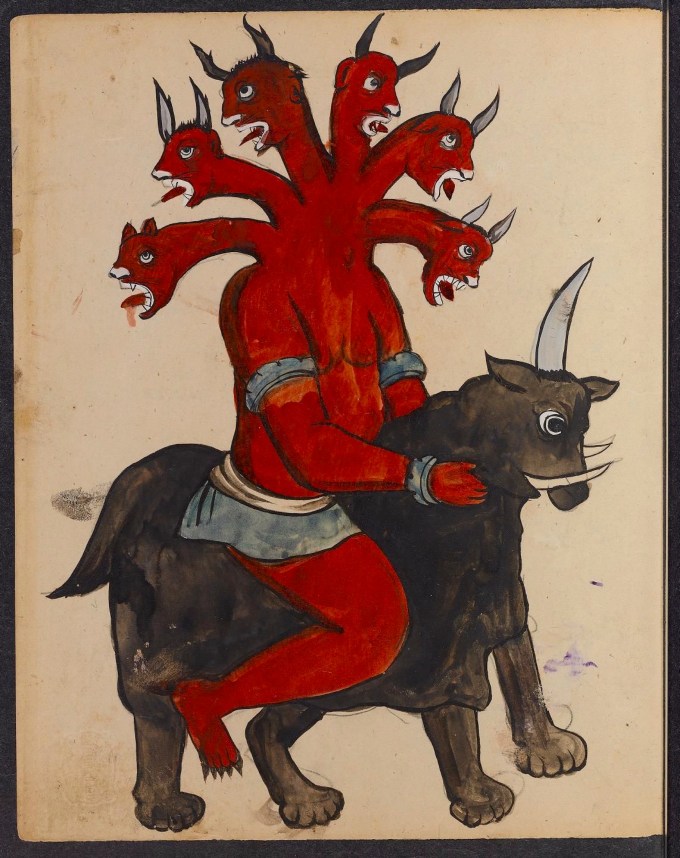
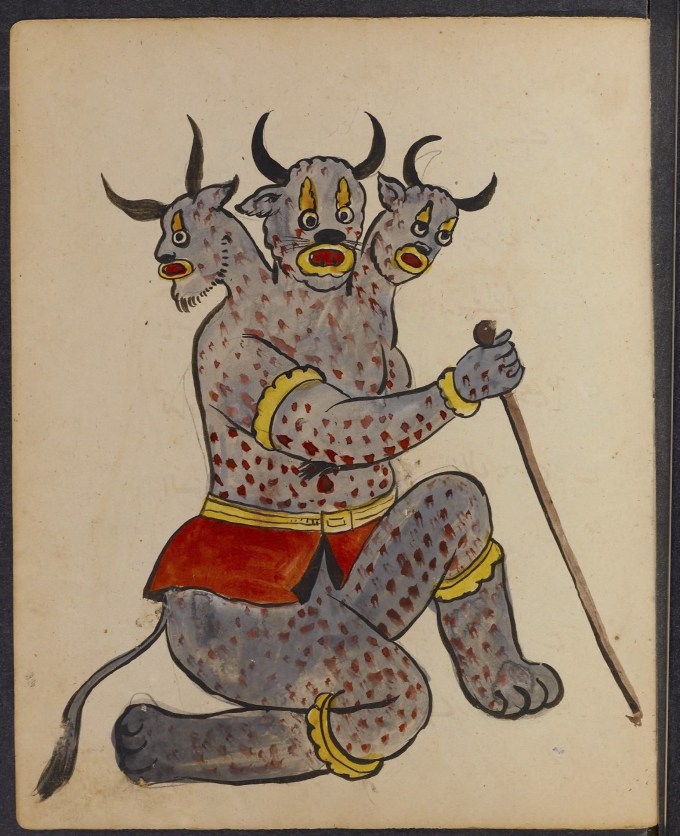
“Not all of the 56 painted illustrations in the manuscript depict demonic beings,” the Public Domain Review points out. “Amongst the horned and fork-tongued we also find the archangels Jibrāʾīl (Gabriel) and Mikāʾīl (Michael), as well as the animals — lion, lamb, crab, fish, scorpion — associated with the zodiac.” But in the main, it’s demon city. What would Borges have made of these fantastic images? No doubt, had he seen them, and he had seen plenty of their like before he lost his sight, he would have been delighted.
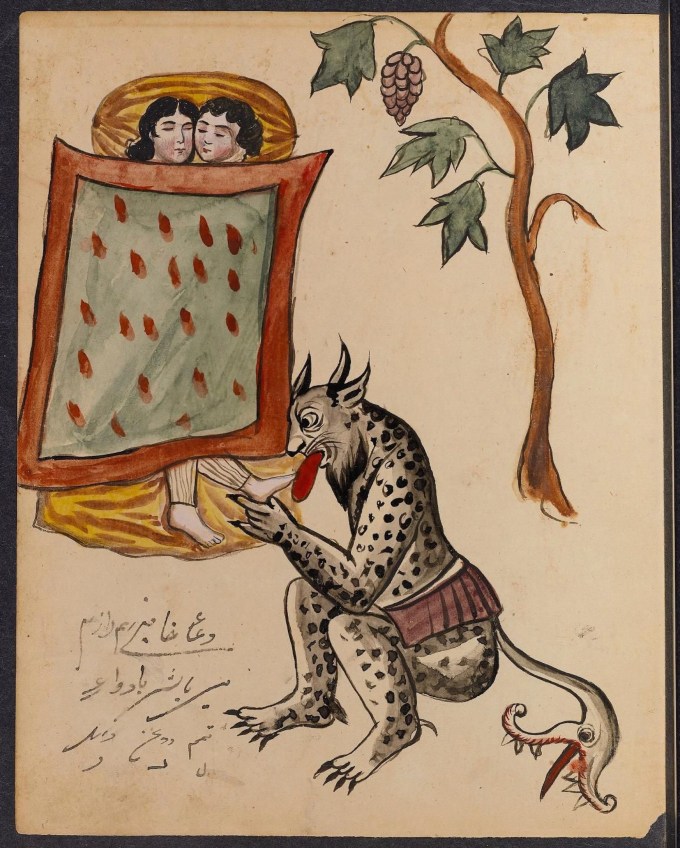
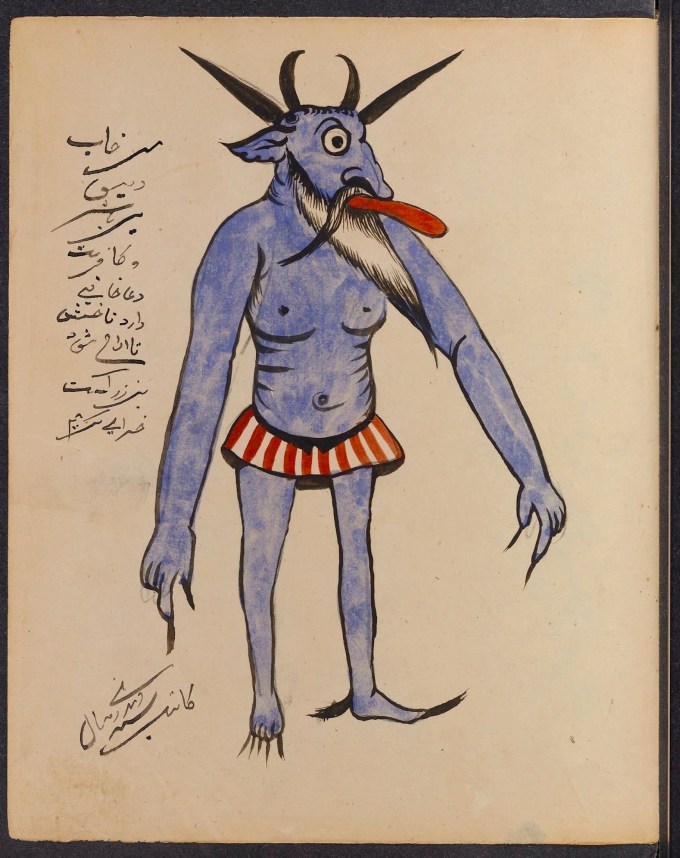
A blue man with claws, four horns, and a projecting red tongue is no less frightening for the fact that he’s wearing a candy-striped loincloth. In another image we see a moustachioed goat man with tuber-nose and polka dot skin maniacally concocting a less-than-appetising dish. One recurring (and worrying) theme is demons visiting sleepers in their beds, scenes involving such pleasant activities as tooth-pulling, eye-gouging, and — in one of the most engrossing illustrations — a bout of foot-licking (performed by a reptilian feline with a shark-toothed tail).
There’s a playful Boschian quality to all of this, but while we tend to see Bosch’s work from our perspective as absurd, he apparently took his bizarre inventions absolutely seriously. So too, we might assume, did the illustrator here. We might wonder, as Woolf did, about this work as the product of “suffering human beings… attached to grossly material things, like health and money and the houses we live in.” What kinds of ordinary, material concerns might have afflicted this artist, as he (we presume) imagined demons gouging the eyes and licking the feet of people tucked safely in their beds?
See many more of these strange paintings at the Public Domain Review.

Note: An earlier version of this post appeared on our site in 2020.
Related Content:
700 Years of Persian Manuscripts Now Digitized and Available Online
Josh Jones is a writer and musician based in Durham, NC.
Read More...See Beethoven’s Entire 9th Symphony Visualized in Colorful Animations
While reporting on the Eurovision Song Contest, the New Yorker’s Anthony Lane “asked a man named Seppo, from the seven-hundred-strong Eurovision Fan Club of Norway, what he loved about Eurovision. ‘Brotherhood of man,’ he said — a slightly ambiguous answer, because that was the name of a British group that entered, and won, the contest in 1976.” And the concept has a longer history in European music than that: Friedrich Schiller claimed to be celebrating it when he wrote his poem “An die Freude,” or “To Joy,” which Ludwig van Beethoven adapted a few decades thereafter into the final movement of his Symphony No. 9. Later still, in 1972, that piece of music was adopted by the Council of Europe as the continent’s anthem; in 1985, the European Union made it official as well.
In a sense, “Ode to Joy” is a natural choice for a musical representation of Europe, not just for its explicit themes, but also for the obvious ambition of the symphony that includes it to capture an entire civilization in musical form.
Its complexity and contradiction may be easier to appreciate through these videos, which constitute a visualization by Stephen Malinowski, creator of the Music Animation Machine, previously featured here on Open Culture for his animated scores of everything from Vivaldi’s Four Seasons to Bach’s Brandenburg Concerto no. 4 to Debussy’s Clair de lune. As one of the most frequently performed symphonies in the world, Beethoven’s 9th comes to us laden with a fair amount of cultural baggage, but Malinowski’s sparely elegant rendering lets us listen while keeping our mind on the essentials of its structure.
That structure, as the viewing experience emphasizes, is not a particularly simple one. Though already deaf, Beethoven nevertheless composed this final complete symphony with layer after ever-changing yet interlocking layer, drawing from a variety of musical traditions as well as pieces he’d already written for other purposes. At its 1824 premiere in Vienna, Symphony No. 9 received no fewer than five standing ovations, though over the centuries since, even certain of its appreciators question whether the final movement really fits in with the rest. Indeed, some even regard “Ode to Joy” as kitschy, an exercise unbecoming of the symphony as a whole, to say nothing of the man who composed it. But then, it’s undeniable that European culture has since achieved heights of kitsch unimaginable in Beethoven’s day.
Related content:
Slavoj Žižek Examines the Perverse Ideology of Beethoven’s “Ode to Joy”
The Story of How Beethoven Helped Make It So That CDs Could Play 74 Minutes of Music
Beethoven’s “Ode to Joy” Movingly Flashmobbed in Spain
Based in Seoul, Colin Marshall writes and broadcasts on cities, language, and culture. His projects include the Substack newsletter Books on Cities and the book The Stateless City: a Walk through 21st-Century Los Angeles. Follow him on the social network formerly known as Twitter at @colinmarshall.
Read More...Remembering Jane Goodall (RIP): Watch Jane, the Acclaimed National Geographic Documentary
Jane Goodall, the revered conservationist, passed away today at age 91. In her honor, we’re featuring above a National Geographic documentary called Jane. Directed by Brett Morgen, the film draws “from over 100 hours of never-before-seen footage that has been tucked away in the National Geographic archives for over 50 years.” The documentary offers an intimate portrait of Goodall and her chimpanzee research that “challenged the male-dominated scientific consensus of her time and revolutionized our understanding of the natural world.” It’s set to an orchestral score by composer Philip Glass.
You can find Jane added to our collection of Free Documentaries, a subset of our larger collection, 4,000+ Free Movies Online: Great Classics, Indies, Noir, Westerns, Documentaries & More.
If you would like to support the mission of Open Culture, consider making a donation to our site. It’s hard to rely 100% on ads, and your contributions will help us continue providing the best free cultural and educational materials to learners everywhere. You can contribute through PayPal, Patreon, and Venmo (@openculture). Thanks!
Related Content
Animated: The Inspirational Story of Jane Goodall, and Why She Believes in Bigfoot
Read More...Discover the Oldest, Weirdest Instrument On Earth: The Lithophone
Stalactites hang tight to the ceiling, and stalagmites push up with might from the floor: this is a mnemonic device you may once have learned, but chances are you haven’t had much occasion to remember it since. Still, it would surely be called to mind by a visit to Luray Caverns in the American state of Virginia, home of the Great Stalacpipe Organ. As its name suggests, that attraction is an organ made out of stalactites, the geological formations that grow from cave ceilings. Not long after the discovery of Luray Caverns itself in 1878, its stalactites were found to resonate through the underground space in an almost musical fashion when struck — a property Leland W. Sprinkle took to its logical conclusion in the mid-nineteen fifties.
“During a tour of this world-famous natural wonder, Mr. Sprinkle watched in awe, which was still customary at the time, as a tour guide tapped the ancient stone formations with a small mallet, producing a musical tone,” says Luray Caverns’ official site. “Mr. Sprinkle was greatly inspired by this demonstration and the idea for a most unique instrument was conceived.”
Conception was one thing, but execution quite another: it took him three years to locate just the right stalactites, shave them down to ring out at just the right frequency, and rig them up with electronically activated, keyboard-controlled mallets. For the technically minded Sprinkle, who worked at the Pentagon as a mathematician and electronics scientist, this must not have been quite as tedious a labor as it sounds.
The result was the biggest, the oldest (at least according to the age of the cave itself), and arguably the weirdest musical instrument on Earth, a lithophone for the mid-twentieth century’s heroic age of engineering. You can see the Great Stalacpipe Organ in the video from Veritasium at the top of the post, and hear a recording of Sprinkle himself playing it below that. In the video just above, YouTuber and musician Rob Scallon gets a chance to take it for a spin. Viewers of his channel know how much experience he has with exotic instruments (including the glass armonica, originally invented by Ben Franklin, which we’ve featured here on Open Culture), but even so, the opportunity to play a cave — and to make use of its surround sound avant la lettre — hardly comes every day. Here we have proof that the old, weird America endures, and that the Great Stalacpipe Organ is its ideal soundtrack.
Related Content:
A Modern Drummer Plays a Rock Gong, a Percussion Instrument from Prehistoric Times
Hear a 9,000 Year Old Flute—the World’s Oldest Playable Instrument—Get Played Again
Was a 32,000-Year-Old Cave Painting the Earliest Form of Cinema?
Based in Seoul, Colin Marshall writes and broadcasts on cities, language, and culture. His projects include the Substack newsletter Books on Cities and the book The Stateless City: a Walk through 21st-Century Los Angeles. Follow him on the social network formerly known as Twitter at @colinmarshall.
Read More...The Night John Belushi Booked the Punk Band Fear on Saturday Night Live & They Got Banned from the Show (1981)
Punk rock has a robust tradition of gross-out, offensive comedy—one carried into the present by bands like Fat White Family and Diarrhea Planet, who may not exist were it not for Fear, an unstable L.A. band led by an obnoxious provocateur who goes by the name Lee Ving. Like fellow L.A. punks the Germs, Circle Jerks, and Black Flag, Fear gets credit for pioneering a California punk sound known for adolescent brattiness and a total lack of pretension to any kind of artfulness or cool.
Like many of their peers, Fear rose to prominence when Penelope Spheeris featured them in her 1981 punk documentary The Decline of Western Civilization, Part I. But before that seminal film’s release, Fear was discovered by John Belushi, who first caught the band on a local L.A. music show called New Wave Theatre in 1980. He tracked down Ving, who tells Rolling Stone, “we had a couple of beers and became fast friends.” At the time, Belushi was at work on his comedy Neighbors with Dan Aykroyd and contracted the band to record a song for the film (his last before his death in 1982).
The film’s producers, Rolling Stone writes, “were appalled” by the song “and refused to use it,” so to make it up to Ving and company, Belushi pushed to have the band booked on Saturday Night Live on Halloween, 1981. The resulting performance has become legendary for what happened, and what didn’t, and led to Fear becoming, says Ving, “one of the esteemed members of the permanently banned.” You can watch a clip above of the band playing “Beef Boloney” and “New York’s Alright if You Like Saxophones” (introduced by Donald Pleasance), and just below see Ving in a clip from an interview show discussing the ill-fated gig.
Belushi stage-managed the band’s appearance, striving for authenticity by bringing into the studio what Ving calls “an actual punk rock audience rather than just Mr. and Mrs. Missouri.” (That audience included now-legends Ian MacKaye of Minor Threat and Fugazi, members of New York hardcore band the Cro-Mags, and Tesco Vee of the Meatmen.) The resulting mosh pit was nothing out of the ordinary for the typical punk show. But, unsurprisingly, “the real audience at Saturday Night Live was scared to death,” says Ving, “They didn’t know what was happening with all the mayhem.”
During the riotous proceedings, SNL producer Dick Ebersol “got hit in the chest with a pumpkin,” some equipment was damaged, and during the final song, “Let’s Have a War,” an audience member grabbed the microphone and yelled out “F*ck New York!” The profanity freaked out NBC, who cut the broadcast short and shelved the footage for several years. The New York Post later quoted an unnamed NBC technician as saying, “This was a life-threatening situation. They went crazy. It’s amazing no one got killed.” The paper also quoted a figure of $400,000 for damages to the Rockefeller Center set.
But as Billboard reported two weeks later, the figure was totally erroneous (supplied to the Post by Ving as a practical joke, as he says above). “We had to pay $40 in labor penalties. That was the extent of it,” said SNL spokesman Peter Hamilton. As for the shock to viewers, it seems the network received “all of 12 complaints” after the broadcast. Ving himself found the overreaction ridiculous, and NBC’s long shelving of the footage—only recently made available in a truncated version—a humorless mistake. “They seem to be… losing the sense of humor about the whole idea,” he told Rolling Stone, “I had a sense of humor at the whole idea of starting Fear. It was extremely humorous to me, and I think John saw that humor.”
Indeed he did, but Belushi’s appreciation for Fear’s antics was ahead of its time. Now we can see, at least in part, what all the fuss was about. And we can also finally hear the long-shelved single for Neighbors that Belushi recorded with the band.
Note: An earlier version of this post appeared on our site in 2016.
Related Content:
The Stunt That Got Elvis Costello Banned From Saturday Night Live (1977)
Saturday Night Live’s Very First Sketch: Watch John Belushi Launch SNL in October, 1975
Josh Jones is a writer and musician based in Durham, NC.
Read More...
An Introduction to Moebius, the Comic Artist Who Influenced Blade Runner and Miyazaki
The work of the comic artist Jean Giraud, better known as Moebius (or, more stylishly, Mœbius), has often appeared on Open Culture over the years, but even if you’ve never seen it here, you know it. Granted, you may never have read a page of it, to say nothing of an entire graphic novel’s worth, but even so, you’ve absorbed it indirectly through generations of international popular culture. If you enjoy Blade Runner, Akira, the manga and anime of Hayao Miyazaki, and even the Star Wars movies, you must, on some level, enjoy Moebius, so deeply did his comic art shape the look and feel of those major works, to say nothing of all it has inspired at further remove.
The new video above by Youtuber matttt goes in depth on the biographical, cultural, and psychological force that shaped the artist’s vision on the page, whose sheer imaginative force and persistently strange sublimity looked like nothing else in comics when he hit his stride in the nineteen-seventies. It helped that he was French, and thus an inheritor of the grand Francophone tradition of the bande dessinée, an art form taken much more seriously than comic strips and books in America. Belgian comics like Spirou and Tintin caught his attention early on, and time spent as a teenager amid the vast desert landscapes of Mexico instilled him with a taste for spiritual grandeur.
An apprenticeship under the Belgian comic artist Joseph “Jijé” Gillain, whom he idolized, helped Giraud — who had not yet become Moebius — to refine his style. His creation of the Jean Paul Belmondo-looking cowboy Blueberry in the early nineteen-sixties produced what turned out to be his most lucrative franchise. But it wasn’t until his encounter with taboo-breaking American “underground” comics that flourished later in that decade, and especially the work of Robert Crumb, that he found it within himself to let loose, exploring technological, mythological, and psychosexual realms hitherto unknown in his medium.
It was with the launch of the comics-anthology magazine Métal Hurlant in 1974, later repackaged in the United States as Heavy Metal, that Moebius’ work found its way to a much wider public. Notable readers included William Gibson, Ridley Scott, Luc Besson, George Lucas, Alejandro Jodorowsky, and the Wachowskis: some imitated Moebius, and others hired him. Through the Japanese edition of Starlog magazine in the late seventies, his art re-shaped the aesthetics of mangaka like Akira creator Katsuhiro Otomo and Studio Ghibli co-founder Hayao Miyazaki. Moebius himself later took on Otomo as one of his own influences, and in tribute to Miyazaki, named his daughter Nausicaa. For Jean Giraud, inspiration wasn’t a one-way street; it was more like a Möbius strip.
Related content:
Watch Groundbreaking Comic Artist Mœbius Draw His Characters in Real Time
Mœbius & Jodorowsky’s Sci-Fi Masterpiece The Incal Brought to Life in a Tantalizing Animation
Watch Moebius and Miyazaki, Two of the Most Imaginative Artists, in Conversation (2004)
Moebius Gives 18 Wisdom-Filled Tips to Aspiring Artists
Based in Seoul, Colin Marshall writes and broadcasts on cities, language, and culture. His projects include the Substack newsletter Books on Cities and the book The Stateless City: a Walk through 21st-Century Los Angeles. Follow him on the social network formerly known as Twitter at @colinmarshall.
Read More...Musician Plays the Last Stradivarius Guitar in the World, the “Sabionari” Made in 1679
Last night, while the home team lost the big game on TVs at a local dive bar, my noisy rock band opened for a chamber pop ensemble. Electric guitars and feedback gave way to classical acoustics, violin, piano, accordion, and even a saw. It was an interesting cultural juxtaposition in an evening of cultural juxtapositions. The sports and music didn’t gel, but an odd symmetry emerged from the two bands’ contrasting styles, to a degree. The instrument above, on the other hand, would have fit right in with the second act, whose old world charm would surely find a place for a 1679 guitar—one crafted by the legendary master luthier Antonio Stradivari, no less.
If you know nothing at all about music or musical instruments, you know the name Stradivari and the violins that bear his name. They are such coveted, valuable objects they sometimes appear as the target of crime capers in the movies and on television. This Stradivarius guitar, called the “Sabionari,” is even rarer than the violins. The Stradivari family, writes Forgotten Guitar, “produced over 1000 instruments, of which 960 were violins.” Yet, “a small number of guitars were also crafted, and as of today only one remains playable.” Highly playable, you’ll observe in these videos, thanks to the restoration by luthiers Daniel Sinier, Francoise de Ridder, and Lorenzo Frignani.
In the clip just above, Baroque concert guitarist Rolf Lislevand plays Santiago de Murcia’s “Tarantela” on the restored guitar, whose sonorous ringing timbre recalls another Baroque instrument, the harpsichord.
So unique and unusual is the ten-string Stradivarius Sabionari that it has its own website, where you’ll find many detailed, close-up photos of the elegant design as well as more music, like the piece above, Angelo Michele Bartolotti’s Suite in G Minor as performed by classical guitarist Krishnasol Jiménez, who, along with Lislevand, has been entrusted with the instrument for many live performances. Owned by a private collector, the Sabionari very often appears at lectures on restoration and conservation of classical instruments, as well as in performances around Europe. You’ll find on sabionari.com many more videos of the guitar in action (like that below of guitarist Ugo Nastrucci improvising), links to exhibits, descriptions of the challengingly long neck and Baroque tuning, and a sense of just how much the Sabionari gets around for such a rare, antique instrument.
Note: An earlier version of this post appeared on our site in 2016.
Related Content:
Why Violins Have F‑Holes: The Science & History of a Remarkable Renaissance Design
Josh Jones is a writer and musician based in Durham, NC.
Read More...Carl Sagan’s Baloney Detection Kit: Tools for Thinking Critically & Knowing Pseudoscience When You See It
Though he died too young, Carl Sagan left behind an impressively large body of work, including more than 600 scientific papers and more than 20 books. Of those books, none is more widely known to the public — or, still, more widely read by the public — than Cosmos, accompanied as it was by Cosmos: A Personal Voyage, a companion television series on PBS. Sagan’s other popular books, like Shadows of Forgotten Ancestors or Contact (the basis of the 1997 Hollywood movie) are also well worth reading, but we perhaps ignore at our greatest peril The Demon-Haunted World: Science as a Candle in the Dark. Published in 1995, the year before Sagan’s death, it stands as his testament to the importance of critical, scientific thinking for all of us.
The Demon-Haunted World is the subject of the Genetically Modified Skeptic video above, whose host Drew McCoy describes it as his favorite book. He pays special attention to its chapter in which Sagan lays out what he calls his “baloney detection kit.” This assembled metaphorical box of tools for diagnosing fraudulent arguments and constructing reasoned ones involves these nine principles:
- Wherever possible there must be independent confirmation of the “facts.”
- Encourage substantive debate on the evidence by knowledgeable proponents of all points of view.
- Arguments from authority carry little weight — “authorities” have made mistakes in the past. They will do so again in the future. Perhaps a better way to say it is that in science there are no authorities; at most, there are experts.
- Spin more than one hypothesis. If there’s something to be explained, think of all the different ways in which it could be explained. Then think of tests by which you might systematically disprove each of the alternatives.
- Try not to get overly attached to a hypothesis just because it’s yours. It’s only a way station in the pursuit of knowledge. Ask yourself why you like the idea. Compare it fairly with the alternatives.
- See if you can find reasons for rejecting it. If you don’t, others will.
- If whatever it is you’re explaining has some measure, some numerical quantity attached to it, you’ll be much better able to discriminate among competing hypotheses. What is vague and qualitative is open to many explanations.
- If there’s a chain of argument, every link in the chain must work (including the premise) — not just most of them.
- Occam’s Razor. This convenient rule-of-thumb urges us when faced with two hypotheses that explain the data equally well to choose the simpler. Always ask whether the hypothesis can be, at least in principle, falsified…. You must be able to check assertions out. Inveterate skeptics must be given the chance to follow your reasoning, to duplicate your experiments and see if they get the same result.
As McCoy points out, these techniques of mind have to do with canceling out the manifold biases present in our thinking, those natural human tendencies that incline us to accept ideas that may or may not coincide with reality as it is. If we take no trouble to correct for these biases, Sagan came to believe, we’ll become easy marks for all the tricksters and charlatans who happen to come our way. And that’s just on the micro level: on the macro level, vulnerability to delusion can bring down entire civilizations.
“Like all tools, the baloney detection kit can be misused, applied out of context, or even employed as a rote alternative to thinking,” Sagan cautions. “But applied judiciously, it can make all the difference in the world — not least in evaluating our own arguments before we present them to others.” McCoy urges us to heed these words, adding that “this kit is not some perfect solution to the world’s problems, but as it’s been utilized over the last few centuries” — for its basic precepts long predate Sagan’s particular articulation — “it has enabled us to create technological innovations and useful explanatory models of our world more quickly and effectively than ever before.” The walls of baloney may always be closing in on humanity, but if you follow Sagan’s advice, you can at least give yourself some breathing room.
Related content:
Carl Sagan on the Importance of Choosing Wisely What You Read (Even If You Read a Book a Week)
Carl Sagan’s Syllabus & Final Exam for His Course on Critical Thinking (Cornell, 1986)
Richard Feynman Creates a Simple Method for Telling Science From Pseudoscience (1966)
How to Spot Bullshit: A Manual by Princeton Philosopher Harry Frankfurt (RIP)
Critical Thinking: A Free Course
Based in Seoul, Colin Marshall writes and broadcasts on cities, language, and culture. His projects include the Substack newsletter Books on Cities and the book The Stateless City: a Walk through 21st-Century Los Angeles. Follow him on the social network formerly known as Twitter at @colinmarshall.
Read More...The Gilded Age: A Free Historical Documentary That Helps Make Sense of Our Own Fraught Times
Ever-increasing economic inequality, rapid technological change, the creation of dominant corporations controlled by a small business elite, politicians in the pocket of big business leaders, and the rise of populism and nativism. These are all features of American life in 2025. But our nation has also seen this movie play before, most notably back in the Gilded Age, which ran from the 1870s through the late 1890s. Above, we have a free two-hour documentary on the Gilded Age created by PBS. They write:
In the closing decades of the nineteenth century, during what has become known as the Gilded Age, the population of the United States doubled in the span of a single generation. The nation became the world’s leading producer of food, coal, oil, and steel, attracted vast amounts of foreign investment, and pushed into markets in Europe and the Far East. As national wealth expanded, two classes rose simultaneously, separated by a gulf of experience and circumstance that was unprecedented in American life. These disparities sparked passionate and violent debate over questions still being asked in our own times: How is wealth best distributed, and by what process? Does government exist to protect private property or provide balm to the inevitable casualties of a churning industrial system? Should the government concern itself chiefly with economic growth or economic justice? The battles over these questions were fought in Congress, the courts, the polling place, the workplace and the streets. The outcome of these disputes was both uncertain and momentous, and marked by a passionate vitriol and level of violence that would shock the conscience of many Americans today. The Gilded Age presents a compelling and complex story of one of the most convulsive and transformative eras in American history.
To a certain degree, this documentary will help you make better sense of our own fraught times and perhaps feel more optimistic about where we might end up. (It’s worth keeping in mind that the disruptions of the Gilded Age eventually gave way to the reforms of the Progressive Era.) What’s more, if you’re watching the excellent HBO series, The Gilded Age, the film provides historical background that will directly add to your appreciation of the show. You can watch the film online above, or find it in our collection of Free Documentaries, a subset of our collection 4,000+ Free Movies Online: Great Classics, Indies, Noir, Westerns, Documentaries & More.
If you would like to support the mission of Open Culture, consider making a donation to our site. It’s hard to rely 100% on ads, and your contributions will help us continue providing the best free cultural and educational materials to learners everywhere. You can contribute through PayPal, Patreon, and Venmo (@openculture). Thanks!
Read More...
A Tour of the New David Bowie Archive Featuring 90,000 Artifacts from His Life & Career
With the tenth anniversary of David Bowie’s death coming up early next year, more than a few fans will have their minds on a pilgrimage to mark the occasion. Perhaps with that very time frame in mind, the V&A East Storehouse in London has just opened the David Bowie Center. Run by the Victoria and Albert Museum, to which Bowie left an archive of about 90,000 of his possessions, this new institution will show a few hundred of those artifacts at a time, and even make a range of them available on request to visitors. As for what exactly is in there, Jessica the Museum Guide makes a brief survey of the Bowieana currently on display in the video above.
Some of the featured objects, like the suits Bowie wore in his videos for “Life on Mars?” and “Let’s Dance” or the crystal ball he held aloft as Jareth the Goblin King in Labyrinth, may well be recognizable even to casual Bowie appreciators. Longer-term fans will surely recognize the outlandish but elegant Kansai Yamamoto-designed costumes that visually defined personae like Ziggy Stardust and Aladdin Sane, the Alexander McQueen-designed Union Jack frock from the cover of Earthling, and perhaps even the metal angel wings Bowie donned onstage during the highly ambitious but much-derided Glass Spider Tour of the late nineteen-eighties.
Going deeper, there’s also the Stylophone, a kind of toy electronic instrument from the late sixties, that Bowie used on “Space Oddity” (and had to repurchase on eBay); the much more professional-grade EMS suitcase synthesizer given to him by Brian Eno, which he used on the “Berlin trilogy” albums they made together; the personal deck of Oblique Strategies, co-created by Eno, that shows signs of intensive use in Bowie’s own creative process; his correspondence with Let’s Dance producer Nile Rodgers (a curator of the Bowie Center’s current exhibition), about their second album Black Tie White Noise; and materials from Omikron: The Nomad Soul, the computer game to which he contributed music as well as a digitized performance in the late nineties.
The collection that Bowie donated to the V&A already came carefully organized and cataloged, which shows a meticulousness uncommon to rock stars, and a deliberateness about not just cultivating his public image at any given cultural moment, but also actively curating the materials of his own historical narrative. It seems Bowie always had one eye on the past: his own, of course, but also more distant eras, rich with disused aesthetics to revive and make his own. The other eye he kept on the future, especially as the internet was growing into a cultural force. The David Bowie Center has his personal notes on the subject, which include a reference to BowieNet, the internet service provider he founded around the turn of the millennium. BowieNet is now long gone, of course, but Bowie’s legacy — especially now that it’s been institutionally enshrined and made so accessible to the public — will outlast us all.
Related Content:
The Art Collection of David Bowie: An Introduction
Meet the Memphis Group, the Bob Dylan-Inspired Designers of David Bowie’s Favorite Furniture
The Musical Career of David Bowie in One Minute … and One Continuous Take
Based in Seoul, Colin Marshall writes and broadcasts on cities, language, and culture. His projects include the Substack newsletter Books on Cities and the book The Stateless City: a Walk through 21st-Century Los Angeles. Follow him on the social network formerly known as Twitter at @colinmarshall.
Read More...Support Us
We're hoping to rely on loyal readers, rather than erratic ads. Please click the Donate button and support Open Culture. You can use Paypal, Venmo, Patreon, even Crypto! We thank you!

About Us

Open Culture scours the web for the best educational media. We find the free courses and audio books you need, the language lessons & educational videos you want, and plenty of enlightenment in between.
Advertise With Us

FREE UPDATES!
GET OUR DAILY EMAIL
Get the best cultural and educational resources on the web curated for you in a daily email. We never spam. Unsubscribe at any time.
FOLLOW ON SOCIAL MEDIA

Open Culture editor Dan Colman scours the web for the best educational media. He finds the free courses and audio books you need, the language lessons & movies you want, and plenty of enlightenment in between.
Advertise With Us

