Hear What the Language Spoken by Our Ancestors 6,000 Years Ago Might Have Sounded Like
As scholars of ancient texts well know, the reconstruction of lost sources can be a matter of some controversy. In the ancient Hebrew and less ancient Christian Biblical texts, for example, critics find the remnants of many previous texts, seemingly stitched together by occasionally careless editors. Those source texts exist nowhere in any physical form, complete or otherwise. They must be inferred from the traces they have left behind—signatures of diction and syntax, stylistic and thematic preoccupations….
So it is with the study of ancient languages, but since oral cultures far predate written ones, the search for linguistic ancestors can take us back to the very origins of human culture, to times unremembered and unrecorded by anyone, and only dimly glimpsed through scant archaeological evidence and observable aural similarities between vastly different languages. So it was with the theoretical development of Indo-European as a language family, a slow process that took several centuries to coalesce into the modern linguistic tree we now know.
The observation that Sanskrit and ancient European languages like Greek and Latin have significant similarities was first recorded by a Jesuit missionary to Goa, Thomas Stephens, in the sixteenth century, but little was made of it until around 100 years later. A great leap forward came in the mid-nineteenth century when German linguist August Schleicher, under the influence of Hegel, published his Compendium of the Comparative Grammar of the Indo-European Languages. There, Schleicher made an extensive attempt at reconstructing the common ancestor of all Indo-European languages, “Proto-Indo-European,” or PIE, for short, thought to have originated somewhere in Eastern Europe, though this supposition is speculative.
To provide an example of what the language might have been like, Schleicher made up a fable called “The Sheep and the Horses” as a “sonic experiment.” The story has been used ever since, “periodically updated,” writes Eric Powell at Archaeology, “to reflect the most current understanding of how this extinct language would have sounded when it was spoken some 6,000 years ago.” Having no access to any texts written in Proto-Indo-European (which may or may not have existed) nor, of course, to any speakers of the language, linguists disagree a good deal on what it should sound like; “no single version can be considered definitive.”
And yet, since Schleicher’s time, the theory has been considerably refined. At the top of the post, you can hear one such refinement based on work by UCLA professor H. Craig Melchert and read by linguist Andrew Byrd. See a translation of Schleicher’s story, “The Sheep and the Horses” below:
A sheep that had no wool saw horses, one of them pulling a heavy wagon, one carrying a big load, and one carrying a man quickly. The sheep said to the horses: “My heart pains me, seeing a man driving horses.” The horses said: “Listen, sheep, our hearts pain us when we see this: a man, the master, makes the wool of the sheep into a warm garment for himself. And the sheep has no wool.” Having heard this, the sheep fled into the plain.
Byrd also reads another story in hypothetical Proto-Indo-European, “The King and the God,” using “pronunciation informed by the latest insights into PIE.”
See Powell’s article at Archaeology for the written transcriptions of both Schleicher’s and Melchert/Byrd’s versions of PIE, and see his article here to learn about the archeological evidence for the Bronze Age speakers of this theoretical linguistic common ancestor.
Note: An earlier version of this post appeared on our site in 2017.
Related Content:
Listen to The Epic of Gilgamesh Being Read in its Original Ancient Language, Akkadian
Hear Homer’s Iliad Read in the Original Ancient Greek
Hear What Homer’s Odyssey Sounded Like When Sung in the Original Ancient Greek
Was There a First Human Language?: Theories from the Enlightenment Through Noam Chomsky
What Ancient Greek Music Sounded Like: Listen to a Reconstruction That’s “100% Accurate”
Josh Jones is a writer and musician based in Durham, NC. Follow him at @jdmagness
Read More...Marc Maron Wraps Up the WTF Podcast: Watch His Final Interview with Barack Obama
Back in 2015, President Obama joined Marc Maron on the WTF podcast, marking the first time a sitting president took part in this new kind of broadcasting format. It was a watershed moment—a moment when podcasting went mainstream and became, soon enough, a big business. A decade later, and after nearly 1,700 episodes, Marc Maron has decided to bring WTF to an end, saying: “It really comes down to the fact that we’ve put up a new show every Monday and Thursday for almost sixteen years and we’re tired. We’re burnt out. And we are utterly satisfied with the work we’ve done. We’ve done great work.” On Monday, Maron dropped his final episode, bringing things full circle and talking once again with Barack Obama. If you’re going to leave your audience, especially during these dystopian times, it’s nice to leave them with some perspective and hope, and that’s what Obama does best. Watch the final episode above.
Boomer lives. Monkey and Lafonda. Cat angels everywhere.
Related Content
An Animated Marc Maron Recalls Interviewing a Shirtless Iggy Pop in LA Garage
Stream Marc Maron’s Excellent, Long Interview with The Band’s Robbie Robertson
Read More...The 1976 Synth Album That Promised to Help Your Plants Grow: Discover Mother Earth’s Plantasia
In 1973, Peter Tompkins and Christopher Bird’s The Secret Life of Plants became a bestseller. Drawing from the results of scientific studies about whose replicability we may now feel certain doubts, the book suggested that emotion, and indeed sentience, belong not just to humans and animals, but also to, say, the potted fern in your living room. Many of Tompkins and Bird’s readers must have owned such a plant, and probably a variety of others besides, given the nineteen-seventies’ fad for domestic vegetation. Though ridiculed in the major media, The Secret Life of Plants proved sufficiently in tune with its time to inspire a feature-length documentary film with a high-tech soundtrack by none other than Stevie Wonder.
Did Wonder ever hear the album Mother Earth’s Plantasia? Subtitled Warm Earth Music for Plants… and the People Who Love Them, the album also features electronic compositions — exclusively electronic compositions, in fact, performed entirely with a Moog synthesizer. Its composer Mort Garson had been a versatile professional in the world of what was then called “easy listening,” and worked on the writing, arrangement, or production of popular songs like Brenda Lee’s “Dynamite,” Ruby & The Romantics’ “Our Day Will Come,” The Sandpipers’ “Guantanamera,” and Bill Withers’ “Three Nights and a Morning.” Upon meeting Robert Moog himself at a convention in 1967, Garson seems to have undergone a conversion, becoming one of the first composers to dedicate himself to exploring the musical potential of the then-novel synthesizer technology.
The music Garson went on to make with his Moog reflects the zeitgeist: there was Electronic Hair Pieces, with versions of numbers from the musical Hair, a series of twelve discs based on the signs of the zodiac, and even the score that accompanied the Apollo 11 moon landing broadcast. Of particular interest to early electronic music buffs is Black Mass, for which Garson took the pseudonym Lucifer, and which ought to be worth adding to one’s library with Halloween coming up.
Mother Earth’s Plantasia was released in 1976, three years before the Secret Life of Plants movie, though released may not be the right word: it could only be obtained free with purchase of either a houseplant from a shop called Mother Earth on Melrose Avenue in Los Angeles or a Simmons mattress from Sears. As music YouTuber David Hartley explains in his latest video, Garson was asked to create an album of music conducive to plant growth by Mother Earth’s owners, Lynn and Joel Rapp.
For decades thereafter, Mother Earth’s Plantasia could presumably be encountered by serious crate-diggers: the Pharcyde, for example, sampled one of its tracks on “Guestlist” in 2000. But it was only in the twenty-tens, after the establishment of YouTube and its obscure-music-uploading culture, that the album found an audience appreciative enough to inspire a proper release. (Its rediscovery played out similarly to that of Mariya Takeuchi’s “Plastic Love,” the golden tip of the Japanese city pop revival.) Its tracks eventually even appeared in ad campaigns for TurboTax and the French supermarket chain Intermarché. To listeners today, they may sound uncannily like video game music as it would take shape in the eighties, albeit with a soft-edged analog texture. As far as whether it actually helps plants grow, even Joel Rapp’s liner notes can only manage the promise that “it couldn’t possibly hurt.” But I can report that it does a decent job putting my infant twins to sleep.
Related Content:
How the Moog Synthesizer Changed the Sound of Music
Plants Emit High-Pitched Sounds When They Get Cut, or Stressed by Drought, a New Study Shows
Based in Seoul, Colin Marshall writes and broadcasts on cities, language, and culture. His projects include the Substack newsletter Books on Cities and the book The Stateless City: a Walk through 21st-Century Los Angeles. Follow him on the social network formerly known as Twitter at @colinmarshall.
Read More...The Aberdeen Bestiary, One of the Great Medieval Illuminated Manuscripts, Now Digitized in High Resolution & Made Available Online
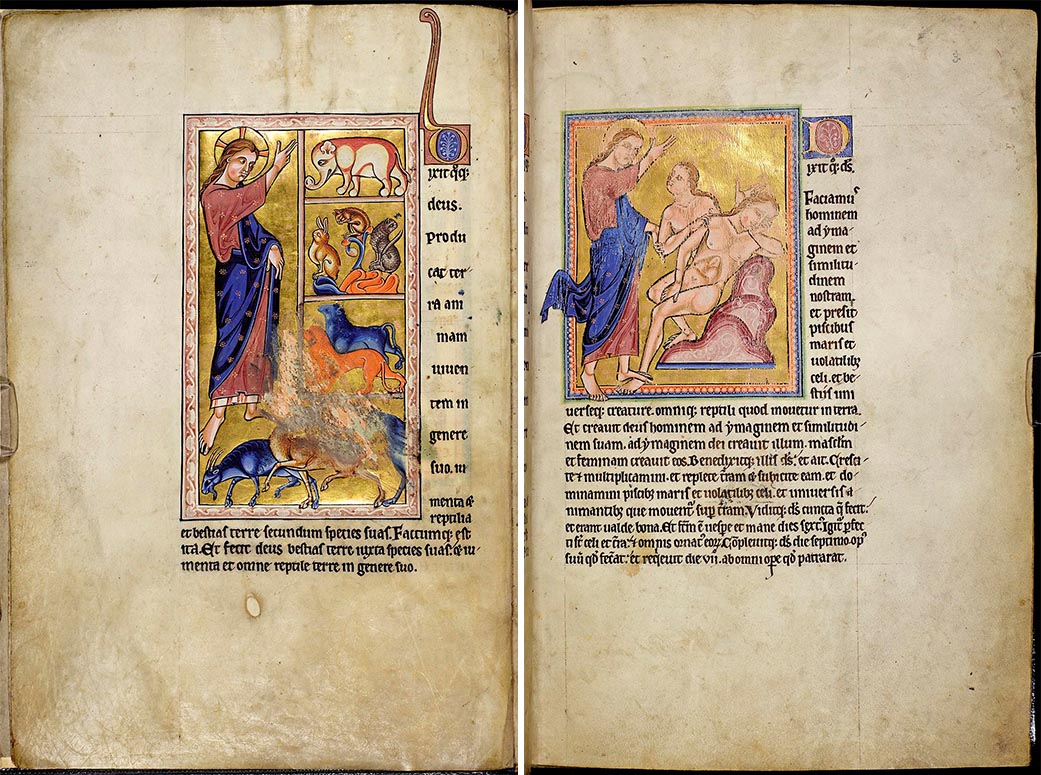
For thousands of years, ordinary people all over the world not only worked side-by-side with domestic animals on a daily basis, they also observed the wild fauna around them to learn how to navigate and survive nature. The closeness produced a keen appreciation for animal behavior that informs the folk tales of every continent and the popular texts of every religion. Our delight in animal stories survives in children’s books, but in grown-up language, animal comparisons tend to be nasty and dehumanizing. The demeaning adjective “bestial” conveys a typical attitude not only toward people we don’t like, but toward the animal world as well. Orwell’s Animal Farm and Kafka’s Metamorphosis have become the standard references for modern animal allegory.

Early literature shows us a range of different attitudes, where animals are treated as equals, with character traits both good and bad, or as noble messengers of a god or gods rather than livestock, moving scenery, or exploitable resources.
We might refer in an eastern context to the Jataka Tales, fables of the Buddha’s many rebirths in the human and animal worlds that provide their readers with moral lessons. In the Christian west, we have the medieval bestiary—compendiums of animals, both real and mythological—that introduced readers to a moral typology through “reading” what early Christians thought of as the “book of nature.”

The most lavish of them all, the Aberdeen Bestiary, which dates from around 1200, was once owned by Henry VIII. Now, the University of Aberdeen has digitized the text and made it freely available to readers online. Beginning with the key creation stories from the book of Genesis, the book then dives into its descriptions of animals, beginning with the lion, the pard (panther), and the elephant.
You’ll notice that these are not animals that your typical medieval European reader would have encountered. One important difference between the bestiary and the fable is that the former draws many of its beasts from hearsay, conjecture, or pure fiction. But the intent is partly the same. These “were teaching tools,” notes Claire Voon at Hyperallergic, and the Aberdeen Bestiary contains illustrated “lengthy tales of moral behavior.”
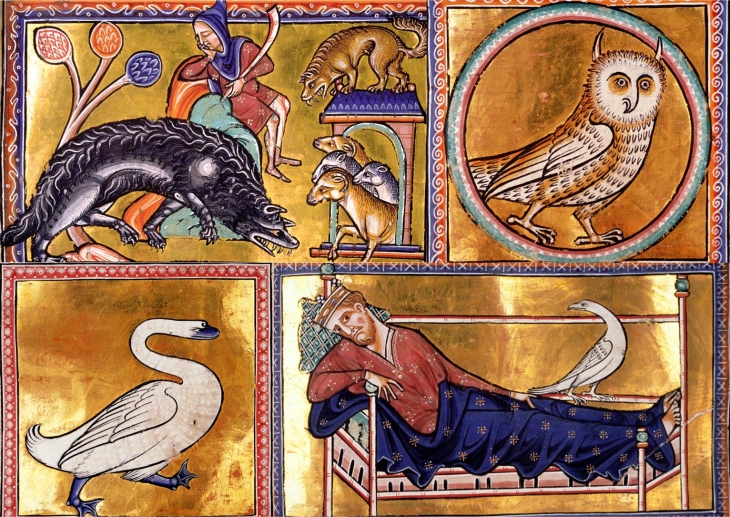
Like the stories of Aesop, the bestiary presents important lessons, mixing in the fabulous with the naturalist. As Voon describes the Aberdeen Bestiary:
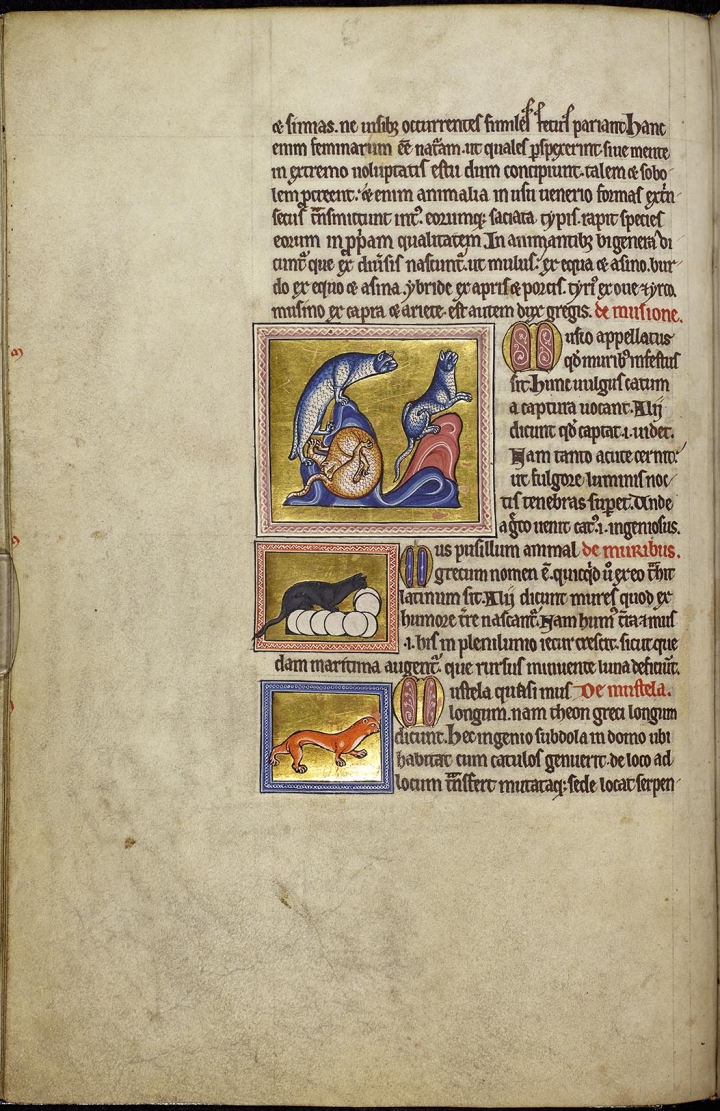
The illustrations are impressively varied, depicting common animals from tiny ants to elephants, as well as fantastic beasts, from the leocrota to the phoenix. Even the moral qualities of the humble sea urchin are honored with paragraphs of discussion. Beyond this array of creatures, the bestiary details the appearances and qualities of various trees, gems, and humans. Some of these may seem comical to 21st-century eyes: a swarm of bees, for instance, resembles an orderly line of shuttlecocks streaming into their hives. Yet other paintings are impressive for their near-accuracy, such as one image of a bat that shows how its membranous wings connect its fingers, legs, and tail. All of these rich details would have helped readers better understand the natural world as it was defined at the time of the book’s creation.
Incredibly ornate and bearing the marks of dozens of scribal hands, the book, historians believe, was originally produced for a wide audience, then taken by Henry’s librarians from a dissolved monastery. Never fully completed, it remained in the Royal Library for 100 years after Henry. “I doubt if the Tudor monarchs took it out for a regular read,” says Aberdeen University professor Jane Geddes. Now an open public document, it returns to its “original purpose of education,” writes Voon, “although for us, of course, it illuminates more about the past than the present.” See the high res scans here.
Note: An earlier version of this post appeared on our site in 2017.
Related Content:
The Medieval Masterpiece, the Book of Kells, Is Now Digitized and Available Online
How to Make a Medieval Manuscript: An Introduction in 7 Videos
When Medieval Manuscripts Were Recycled & Used to Make the First Printed Books
Josh Jones is a writer and musician based in Durham, NC.
Read More...When David Bowie Starred in—and Created Music for—a Dystopian Cyberpunk Video Game: Discover Omikron: The Nomad Soul (1999)
When it was announced that SARS-CoV‑2, the virus at the center of the COVID-19 pandemic, had evolved into an even more contagious variant called Omicron, public reactions varied. For those of us with long memories of computer and video gaming, it brought to mind a title we hadn’t thought about in quite some time: Omikron: The Nomad Soul, released for Windows in 1999 and the Sega Dreamcast in 2000. More than a few gamers know it as the debut of controversial designer David Cage, whose studio Quantic Dream has gone on to produce various games of considerable cinematic and emotional ambit (if also an often frustrating eccentricity). But it made a wider cultural impact at the time by incorporating the performance of none other than David Bowie.
Or rather, it incorporated performances, plural, by David Bowie: in the game, he used motion capture technology to play both Boz, the wholly digital leader of an ancient religious order, and the lead singer of the band The Dreamers, whose concerts (shown in the video above) the player can view here and there around the dystopian cyberpunk city of Omikron.
Originally, the developers had only gone to Bowie in order to license his songs for the game’s soundtrack, but, as explained in the mrixrt video below, the project so appealed to his technophilia that he proposed a much deeper involvement. That included recording a set of original songs, later included on his album Hours… (which is itself notable in the history of technology and culture for being one of the first downloadable releases by a major artist).
Among its many novel qualities, including pioneering the “open world” environment now standard in big-budget games, Omikron grants the player — as the titular “nomad soul” — the ability to inhabit the bodies of a host of other characters (including one played by Bowie’s wife Iman). It isn’t hard to imagine the concept’s appeal for a performer who made his name with frequent changes of identity — and who even suggested, at one point, that he leave that name behind in the reality of the game, re-emerging into public life as David Jones. By the time he died, the better part of two decades later, his role in gaming was mostly forgotten, but one of the many tributes paid to him included a free re-release of Omikron. Those who took the chance to revisit the game would have remembered the feeling it first gave them that its digital world continued even when they weren’t playing — accompanied by a sense that, somehow, Bowie continues to live within it.
Related content:
When David Bowie Launched His Own Internet Service Provider: The Rise and Fall of BowieNet (1998)
A Tour of the New David Bowie Archive Featuring 90,000 Artifacts from His Life & Career
How David Bowie Used William S. Burroughs’ Cut-Up Method to Write His Unforgettable Lyrics
The David Bowie Monopoly Game Is Here: Advance to GO and Collect 200 Hunky Dorys!
Based in Seoul, Colin Marshall writes and broadcasts on cities, language, and culture. His projects include the Substack newsletter Books on Cities and the book The Stateless City: a Walk through 21st-Century Los Angeles. Follow him on the social network formerly known as Twitter at @colinmarshall.
Read More...Dr. Weil’s 60-Second Technique for Falling Asleep
Give Dr. Andrew Weil three minutes, and he can teach you a 60-second technique for falling asleep. Above, the alternative medicine guru walks you through the 4–7‑8 breathing method. As he demonstrates, it “takes almost no time, requires no equipment and can be done anywhere.” And once you master it, you can use the 4–7‑8 breathing technique (explained and demonstrated in greater detail here ) to lower your anxiety levels (useful these days!), navigate tension-filled moments, and deal with food cravings.
Elsewhere, Weil has said, “If I had to limit my advice on healthier living to just one tip, it would be simply to learn how to breathe correctly.” Hence why he created an audio recording, Breathing: The Master Key to Self Healing, which you can still purchase online.
If you would like to support the mission of Open Culture, consider making a donation to our site. It’s hard to rely 100% on ads, and your contributions will help us continue providing the best free cultural and educational materials to learners everywhere. You can contribute through PayPal, Patreon, and Venmo (@openculture). Thanks!
Related Content:
How a Good Night’s Sleep — and a Bad Night’s Sleep — Can Enhance Your Creativity
10 Hours of Ambient Arctic Sounds Will Help You Relax, Meditate, Study & Sleep
Read More...Einstein’s Divorce Letters and the Cruel List of Marital Demands He Imposed on His First Wife
Albert Einstein is the rare figure who’s universally known, but almost entirely for his professional achievements. Few of us who can explain the theory of relativity can also say much about the personal life of the man who came up with it, though that doesn’t owe to a lack of documentation. Thanks to science YouTuber Toby Hendy, we have, for example, some of the love letters he wrote to the women who constituted a veritable parade through his life. Also, in another video for her channel Tibees, Hendy reads the letters he wrote in the process of divorcing his first wife, the Serbian physicist and mathematician Mileva Marić.
Einstein married Marić in January 1903, says Hendy, “after they had been together for around five years. The relationship was in its prime, and so was the academic productivity. It was in 1905 that Einstein would publish his four major papers that would change the face of physics. By 1912, however, Einstein had started having an affair with his cousin,” Elsa Lowenthal.
By 1914, Einstein wrote to Marić a letter “detailing some conditions of them continuing to live together,” if not quite as man and wife. The conditions read as follows:
CONDITIONS
A. You will make sure:
1. that my clothes and laundry are kept in good order;
2. that I will receive my three meals regularly in my room;
3. that my bedroom and study are kept neat, and especially that my desk is left for my use only.
B. You will renounce all personal relations with me insofar as they are not completely necessary for social reasons. Specifically, You will forego:
1. my sitting at home with you;
2. my going out or travelling with you.
C. You will obey the following points in your relations with me:
1. you will not expect any intimacy from me, nor will you reproach me in any way;
2. you will stop talking to me if I request it;
3. you will leave my bedroom or study immediately without protest if I request it.
D. You will undertake not to belittle me in front of our children, either through words or behavior.
Though they agreed to put this stringent plan into effect, less than two weeks later, he wrote to Elsa, “Yesterday my wife left for good with the children” — and “you, dear little Elsie, will now become my wife and become convinced that it is not at all so hard to live by my side.”
Einstein did marry Lowenthal in 1919, and the union, though hardly characterized by ideal faithfulness, did last until her death in 1935. There would be plenty of other women, but none who played quite the same role in his life as Marić, not only the mother of his children, but also — according to some historians — a collaborator on some of his accomplishments in physics. According to Lost Women of Science, “there is little tangible evidence to support the claims that Marić was a co-author of Einstein’s first major work. That said, there are plenty of personal testimonies from those who knew Marić and Einstein that her involvement was likely.” One condition of their divorce settlement, at any rate, held that Marić receive his Nobel Prize money, were he to win it, which he went on to do a couple of years later. This makes clear that, whatever the importance of her own scientific work, she must’ve had a good head on her shoulders.
Related Content:
Albert Einstein Imposes on His First Wife a Cruel List of Marital Demands
“Do Scientists Pray?”: A Young Girl Asks Albert Einstein in 1936. Einstein Then Responds
Albert Einstein’s Grades: A Fascinating Look at His Report Cards
Based in Seoul, Colin Marshall writes and broadcasts on cities, language, and culture. His projects include the Substack newsletter Books on Cities and the book The Stateless City: a Walk through 21st-Century Los Angeles. Follow him on the social network formerly known as Twitter at @colinmarshall.
Read More...A Complete Digitization of Leonardo Da Vinci’s Codex Atlanticus, the Largest Collection of His Drawings & Writings
No historical figure better fits the definition of “Renaissance man” than Leonardo da Vinci, but that term has become so overused as to become misleading. We use it to express mild surprise that one person could use both their left and right hemispheres equally well. But in Leonardo’s day, people did not think of themselves as having two brains, and the worlds of art and science were not so far apart as they are now.
That Leonardo was able to combine fine arts and fine engineering may not have been overly surprising to his contemporaries, though he was an extraordinarily brilliant example of the phenomenon. The more we learn about him, the more we see how closely related the two pursuits were in his mind.
He approached everything he did as a technician. The uncanny effects he achieved in painting were the result, as in so much Renaissance art, of mathematical precision, careful study, and firsthand observation.
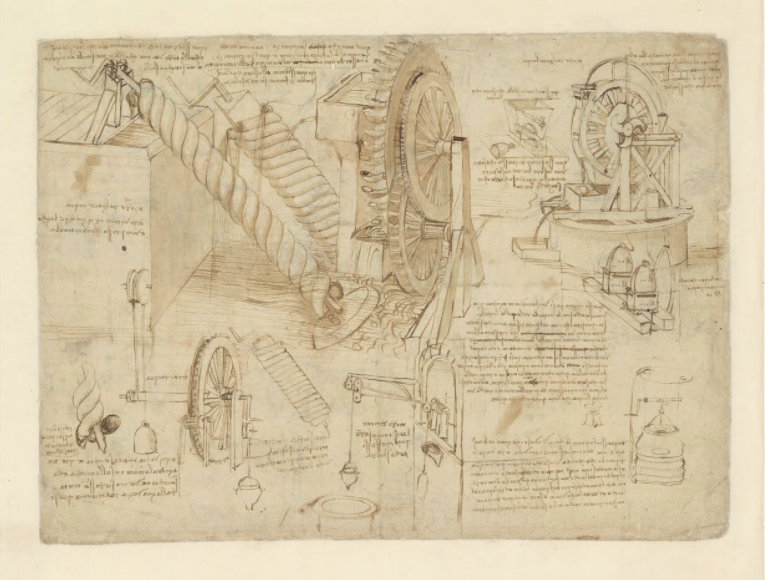
His artistic projects were also experiments. Some of them failed, as most experiments do, and some he abandoned, as he did so many scientific projects. No matter what, he never undertook anything, whether mechanical, anatomical, or artistic, without careful planning and design, as his copious notebooks testify. As more and more of those notebooks have become available online, both Renaissance scholars and laypeople alike have learned considerably more about how Leonardo’s mind worked.
First, there was the Codex Arundel. It is, writes Jonathan Jones at The Guardian, “the living record of a universal mind”—but also, specifically, the mind of a “technophile.” Then, the Victoria and Albert National Art Library announced the digitization of Codex Forster, which contains some of Leonardo’s earliest notebooks. Now The Visual Agency has released a complete digitization of Leonardo’s Codex Atlanticus, a huge collection of the artist, engineer, and inventor’s finely-illustrated notes.
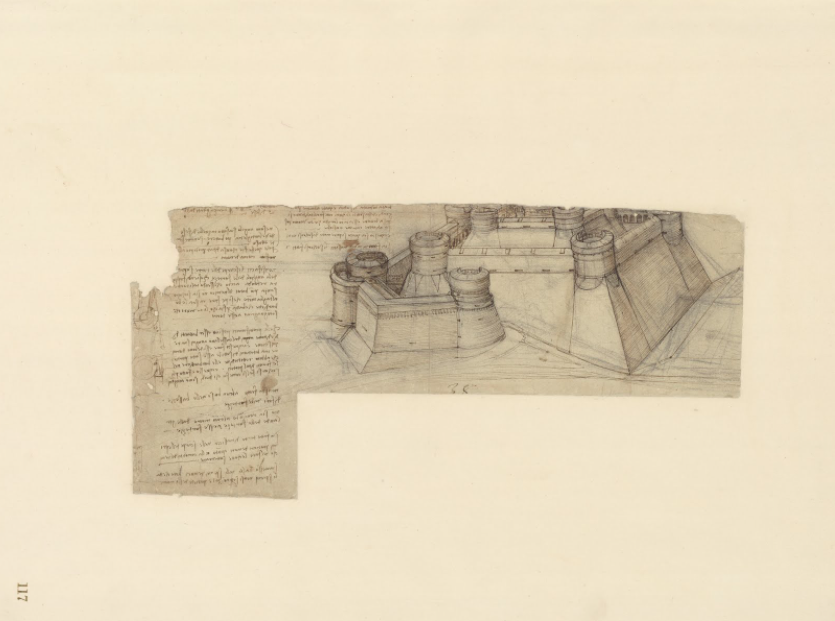
“No other collection counts more original papers written by Leonardo,” notes Google. The Codex Atlanticus “consists of 1119 papers, most of them drawn or written on both sides.” Its name has “nothing to do with the Atlantic Ocean, or with some esoteric, mysterious content hidden in its pages.” The 12-volume collection acquired its title because the drawings and writings were bound with the same size paper that was used for making atlases. Gathered in the 16th century by sculptor Pompeo Leoni, the papers descended from Leonardo’s close student Giovan Francesco Melzi, who was entrusted with them after his teacher’s death.
The history of the Codex itself makes for a fascinating narrative, much of which you can learn at Google’s Ten Key Facts slideshow. The notebooks span Leonardo’s career, from 1478, when he was “still working in his native Tuscany, to 1519, when he died in France.” The collection was taken from Milan by Napoleon and brought to France, where it remained in the Louvre until 1815, when the Congress of Vienna ruled that all artworks stolen by the former Emperor be returned. (The emissary tasked with returning the Codex could not decipher Leonardo’s mirror writing and took it for Chinese.)
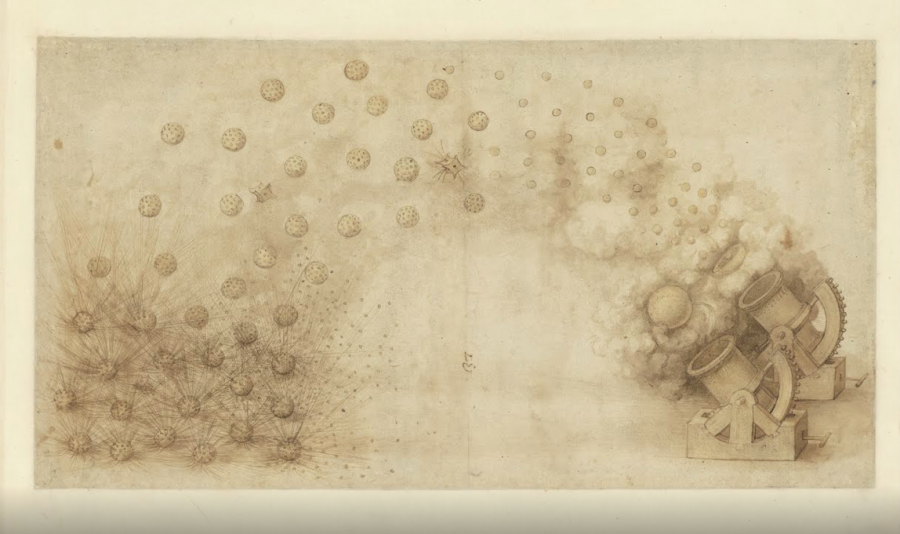
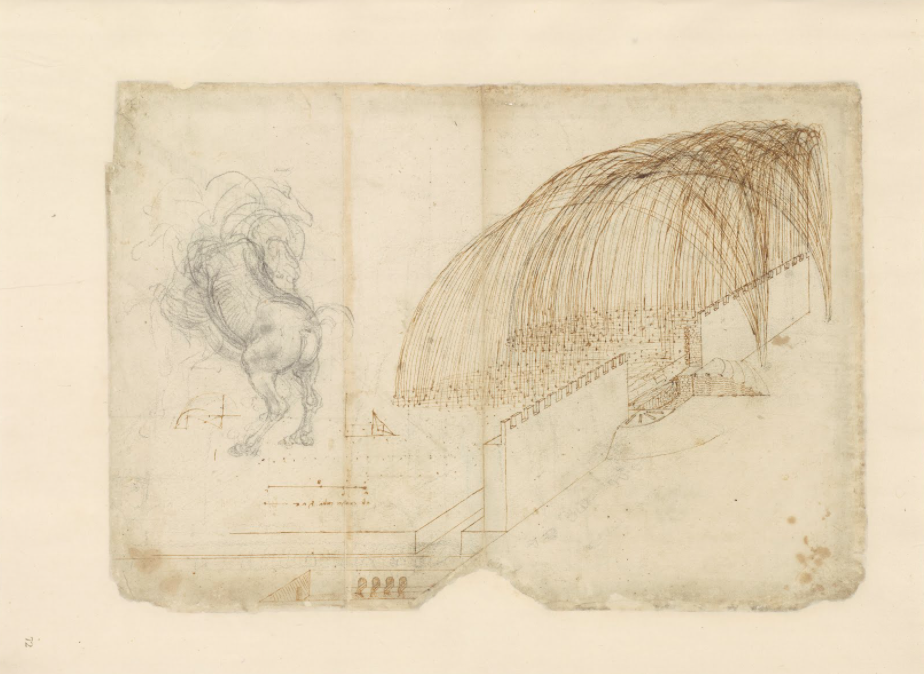
The Codex contains not only engineering diagrams, anatomy studies, and artistic sketches, but also fables written by Leonardo, inspired by Florentine literature. And it features Leonardo’s famed “CV,” a letter he wrote to the Duke of Milan describing in nine points his qualifications for the post of military engineer. In point four, he writes, “I still have very convenient bombing methods that are easy to transport; they launch stones and similar such in a tempest full of smoke to frighten the enemy, causing great damage and confusion.”
As if in illustration, elsewhere in the Codex, the drawing above appears, “one of the most celebrated” of the collection.” It was “shown to traveling foreigners visiting the Ambrosiana [the Biblioteca Ambrosiana in Milan, where the Codex resides] since the 18th century, usually arousing much amazement.” It is still amazing, especially if we consider the possibility that its artistry might have been something of a byproduct for its creator, whose primary motivation seems to have been solving technical problems—in the most elegant ways imaginable.
See the complete digitization of Leonardo’s Codex Atlanticus here.
Note: An earlier version of this post appeared on our site in 2019.
Related Content:
How Leonardo da Vinci Drew an Accurate Satellite Map of an Italian City (1502)
Leonardo da Vinci’s Handwritten Resume (Circa 1482)
Leonardo Da Vinci’s To-Do List from 1490: The Plan of a Renaissance Man
Josh Jones is a writer and musician based in Durham, NC.
Read More...The Fascinating Story of How the Electric Music Pioneer Delia Derbyshire Created the Original Doctor Who Theme (1963)
We’ve focused a fair bit here on the work of Delia Derbyshire, pioneering electronic composer of the mid-twentieth century—featuring two documentaries on her and discussing her role in almost creating an electronic backing track for Paul McCartney’s “Yesterday.” There’s good reason to devote so much attention to her: Derbyshire’s work with the BBC’s Radiophonic Workshop laid the bedrock for a good deal of the sound design we hear on TV and radio today.
And, as we pointed out previously, her electronic music, recorded under her own name and with the band White Noise, influenced “most every current legend in the business—from Aphex Twin and the Chemical Brothers to Paul Hartnoll of Orbital.”
Yet for all her influence among dance music composers and sound effects wizards, Derbyshire and her music remain pretty obscure—that is except for one composition, instantly recognizable as the original theme to the BBC’s sci-fi hit Doctor Who (hear it at the top), “the best-known work of a ragtag group of technicians,” writes The Atlantic, “who unwittingly helped shape the course of 20th-century music.” Written by composer Ron Grainer, the song was actually brought into being by the Radiophonic Workshop, and by Derbyshire especially. The story of the Doctor Who theme’s creation is almost as interesting as the tune itself, with its “swooping, hissing and pulsing” that “manages to be at once haunting, goofy and ethereal.” Just above, you can see Derbyshire and her assistant Dick Mills tell it in brief.
What we learn from them is fascinating, considering that compositions like this are now created in powerful computer systems with dozens of separate tracks and digital effects. The Doctor Who theme, on the other hand, recorded in 1963, was made even before basic analog synthesizers came into use. “There are no musicians,” says Mills, “there are no synthesizers, and in those days, we didn’t even have a 2‑track or a stereo machine, it was always mono.” (Despite popular misconceptions, the theme does not feature a Theremin.) Derbyshire confirms; each and every part of the song “was constructed on quarter-inch mono tape,” she says, “inch by inch by inch,” using such recording techniques as “filtered white noise” and something called a “wobbulator.” How were all of these painstakingly constructed individual parts combined without multitrack technology? “We created three separate tapes,” Derbyshire explains, “put them onto three machines and stood next to them and said “Ready, steady, go!” and pushed all the ‘start’ buttons at once. It seemed to work.”
The theme came about when Grainer received a commission from the BBC after his well-received work on other series. He “composed the theme on a single sheet of A4 manuscript,” writes Mark Ayres in an extensive online history, “and sent it over from his home in Portugal, leaving the Workshop to get on with it.” Aware that the musique concrète techniques Derbyshire and her team used “were very time-consuming, Grainer provided a very simple composition, in essence just the famous bass line and a swooping melody,” as well as vaguely evocative instructions for orchestration like “wind bubble” and “cloud.” Ayres writes, “To an inventive radiophonic composer such as Delia Derbyshire, this was a gift.” Indeed “upon hearing it,” The Atlantic notes, “a very impressed Grainer barely recognized it as his composition. Due to BBC policies at the time, Grainer—against his objections—is still officially credited as the sole writer.” But the credit for this futuristic work—which sounds absolutely like nothing else of the time and “which brought to a wide audience methods once exclusive to the high modernism of experimental composition”—should equally go to Derbyshire and her team. You can contrast that ahead-of-its-time original theme with all of the iterations to follow in the video just above.
Note: An earlier version of this post appeared on our site in 2016.
Related Content:
Hear Seven Hours of Women Making Electronic Music (1938- 2014)
Two Documentaries Introduce Delia Derbyshire, the Pioneer in Electronic Music
Josh Jones is a writer and musician based in Durham, NC.
Read More...What a Lack of Social Contact Does to Your Brain
To many of us, the concept of solitary confinement may not sound all that bad: finally, a reprieve from the siege of social and professional requests. Finally, a chance to catch up on all the reading we’ve been meaning to do. Finally, an environment conducive to this meditation thing about whose benefits we’ve heard so much. (Perhaps we made those very assurances to ourselves when the COVID-19 pandemic set in.) But according to the animated TED-Ed lesson above, written by psychiatrist and correctional mental health expert Terry Kupers, the negatives of the experience would well outweigh the positives. It all comes by way of answering the question, “What happens to your brain without any social contact?”
Unsurprisingly, perhaps, isolation takes its greatest toll when imposed against the will of the isolated, and even more so when imposed for an indefinite duration. “Early on, stress hormones may spike, and as time passes, that stress can become chronic,” says the video’s narrator.
Without the availability of social interactions as “a sounding board where we can gauge how rational our perceptions are,” one’s “sense of identity and reality becomes threatened.” The stage is therefore set for “depression, obsessions, suicidal ideation, and, for some, delusions and hallucinations.” Sleeping difficulties can manifest on the more strictly physical end, potentially accompanied by “heart palpitations, headaches, dizziness, and hypersensitivity.”
While traveling in the United States, Charles Dickens bore witness to the punishment by solitary confinement already in effect in American prisons, coming away with the impression that it was “worse than any torture of the body.” He wrote that after a visit to a Philadelphia penitentiary, whose very name reflects the theory, held by the Quaker groups who introduced the practice in the late eighteenth century, that it could “bring about reflection and penitence.” After much research on the matter, Kupers has come to the conclusion that, in fact, it “does immense damage that is contrary to rehabilitation, while failing to reduce prison violence.” If you’re reading this, you may not be especially likely to be sentenced to involuntary confinement. But the next time you start feeling out of sorts for reasons you can’t pin down, consider how long it’s been since you’ve spent real time with real people.
Related content:
What Happens When You Spend Weeks, Months, or Years in Solitary Confinement
How Loneliness Is Killing Us: A Primer from Harvard Psychiatrist & Zen Priest Robert Waldinger
Modern Art Was Used As a Torture Technique in Prison Cells During the Spanish Civil War
What an 85-Year-Long Harvard Study Says Is the Real Key to Happiness
On the Power of Teaching Philosophy in Prisons
Based in Seoul, Colin Marshall writes and broadcasts on cities, language, and culture. His projects include the Substack newsletter Books on Cities and the book The Stateless City: a Walk through 21st-Century Los Angeles. Follow him on the social network formerly known as Twitter at @colinmarshall.
Read More...Support Us
We're hoping to rely on loyal readers, rather than erratic ads. Please click the Donate button and support Open Culture. You can use Paypal, Venmo, Patreon, even Crypto! We thank you!

About Us

Open Culture scours the web for the best educational media. We find the free courses and audio books you need, the language lessons & educational videos you want, and plenty of enlightenment in between.
Advertise With Us

FREE UPDATES!
GET OUR DAILY EMAIL
Get the best cultural and educational resources on the web curated for you in a daily email. We never spam. Unsubscribe at any time.
FOLLOW ON SOCIAL MEDIA

Open Culture editor Dan Colman scours the web for the best educational media. He finds the free courses and audio books you need, the language lessons & movies you want, and plenty of enlightenment in between.
Advertise With Us

