The Mystery of Edgar Allan Poe’s Death: 19 Theories on What Caused the Poet’s Demise
One of my very first acts as a new New Yorker many years ago was to make the journey across three boroughs to Woodlawn Cemetery in the Bronx. My purpose: a pilgrimage to Herman Melville’s grave. I came not to worship a hero, exactly, but—as Fordham University English professor Angela O’Donnell writes—“to see a friend.” Professor O’Donnell goes on: “It might seem presumptuous to regard a celebrated 19th-century novelist so familiarly, but reading a great writer across the decades is a means of conducting conversation with him and, inevitably, leads to intimacy.” I fully share the sentiment.
I promised Melville I would visit regularly but, alas, the pleasures and travails of life in the big city kept me away, and I never returned. No such petty distraction kept away a friend-across-the-ages of another 19th-century American author.
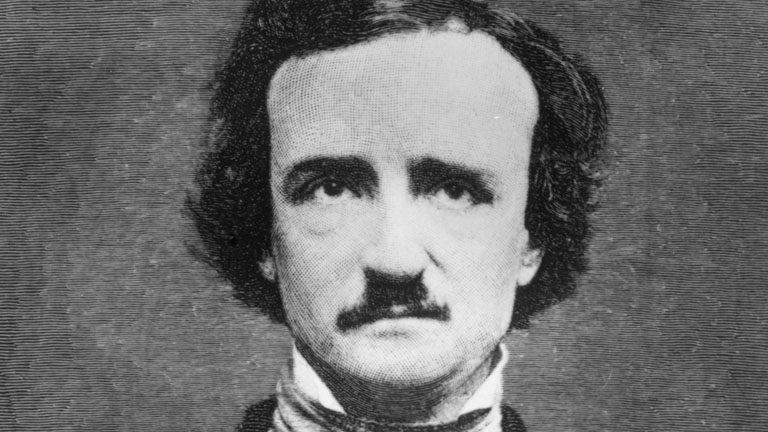
“For decades,” writes the Baltimore Sun, “Edgar Allan Poe’s birthday was marked by a mysterious visitor to his gravesite in Baltimore. Beginning in the 1930s, the ‘Poe Toaster’ placed three roses at the grave every Jan. 19 and opened a bottle of cognac, only to disappear into the night.” The identity of the original “Poe Toaster”—who may have been succeeded by his son—remains a tantalizing mystery. As does the mystery of how Edgar Allan Poe died.
Most of you have probably heard some version of the story. On October 3, 1849, a compositor for the Baltimore Sun, Joseph Walker, found Poe lying in a gutter. The poet had departed Richmond, VA on September 27, bound for Philadelphia “where he was to edit a volume of poetry for Mrs. St. Leon Loud,” the Poe Museum tells us. Instead, he ended up in Baltimore, “semiconscious and dressed in cheap, ill-fitting clothes so unlike Poe’s usual mode of dress that many believe that Poe’s own clothing had been stolen.” He never became lucid enough to explain where he had been or what happened to him: “The father of the detective story has left us with a real-life mystery which Poe scholars, medical professionals, and others have been trying to solve for over 150 years.”
Most people assume that Poe drank himself to death. The rumor was partly spread by Poe’s friend, editor Joseph Snodgrass, whom the poet had asked for in his semi-lucid state. Snodgrass was “a staunch temperance advocate” and had reason to recruit the writer posthumously into his campaign against drink, despite the fact that Poe had been sober for six months prior to his death and had refused alcohol on his deathbed. Poe’s attending physician, John Moran, dismissed the binge drinking theory, but that did not help clear up the mystery. Moran’s “accounts vary so widely,” writes Biography.com, “that they are not generally considered reliable.”
So what happened? Doctors at the University of Maryland Medical Center theorize that Poe may have contracted rabies from one of his own pets—likely a cat. This diagnosis accounts for the delirium and other reported symptoms, though “no one can say conclusively,” admits the Center’s Dr. Michael Benitez, “since there was no autopsy after his death.” As with any mystery, the frustrating lack of evidence has sparked endless speculation. The Poe Museum offers the following list of possible cause of death, with dates and sources, including the rabies and alcohol (both overimbibing and withdrawal) theories:
- Beating (1857) The United States Magazine Vol.II (1857): 268.
- Epilepsy (1875) Scribner’s Monthly Vo1. 10 (1875): 691.
- Dipsomania (1921) Robertson, John W. Edgar A. Poe A Study. Brough, 1921: 134, 379.
- Heart (1926) Allan, Hervey. Israfel. Doubleday, 1926: Chapt. XXVII, 670.
- Toxic Disorder (1970) Studia Philo1ogica Vol. 16 (1970): 41–42.
- Hypoglycemia (1979) Artes Literatus (1979) Vol. 5: 7–19.
- Diabetes (1977) Sinclair, David. Edgar Allan Poe. Roman & Litt1efield, 1977: 151–152.
- Alcohol Dehydrogenase (1984) Arno Karlen. Napo1eon’s Glands. Little Brown, 1984: 92.
- Porphryia (1989) JAMA Feb. 10, 1989: 863–864.
- Delerium Tremens (1992) Meyers, Jeffrey. Edgar A1lan Poe. Charles Scribner, 1992: 255.
- Rabies (1996) Maryland Medical Journal Sept. 1996: 765–769.
- Heart (1997) Scientific Sleuthing Review Summer 1997: 1–4.
- Murder (1998) Walsh, John E., Midnight Dreary. Rutgers Univ. Press, 1998: 119–120.
- Epilepsy (1999) Archives of Neurology June 1999: 646, 740.
- Carbon Monoxide Poisoning (1999) Albert Donnay
The Smithsonian adds to this list the possible causes of brain tumor, heavy metal poisoning, and the flu. They also briefly describe the most popular theory: that Poe died as a result of a practice called “cooping.”
A site called The Medical Bag expands on the cooping theory, a favorite of “the vast majority of Poe biographies.” The term refers to “a practice in the United States during the 19th century by which innocent people were coerced into voting, often several times, for a particular candidate in an election.” Oftentimes, these people were snatched unawares off the streets, “kept in a room, called the coop” and “given alcohol or drugs in order for them to follow orders. If they refused to cooperate, they would be beaten or even killed.” One darkly comic detail: victims were often forced to change clothes and were even “forced to wear wigs, fake beards, and mustaches as disguises so voting officials at polling stations wouldn’t recognize them.”
This theory is highly plausible. Poe was, after all, found “on the street on Election Day,” and “the place where he was found, Ryan’s Fourth Ward Polls, was both a bar and a place for voting.” Add to this the notoriously violent and corrupt nature of Baltimore elections at the time, and you have a scenario in which the author may very well have been kidnapped, drugged, and beaten to death in a voter fraud scheme. Ultimately, however, we will likely never know for certain what killed Edgar Allan Poe. Perhaps the “Poe Toaster” was attempting all those years to get the story from the source as he communed with his dead 19th century friend year after year. But if that mysterious stranger knows the truth, he ain’t talking either.
Note: An earlier version of this post appeared on our site in 2015.
Related Content:
7 Tips from Edgar Allan Poe on How to Write Vivid Stories and Poems
Josh Jones is a writer and musician based in Durham, NC.
Read More...How Did The World Get So Ugly?: Then Versus Now
More than a few of us might be interested in the opportunity to spend a day in Victorian London. But very few of us indeed who’ve ever read, say, a Charles Dickens novel would ever elect to live there. “London’s little lanes are charming now,” says Sheehan Quirke, the host of the video above, while standing in one of them, “but 150 years ago in places like this, you’d have had whole families crammed into these tiny rooms without running water. There would have been open cesspits spilling down the streets, and the stench of sewage boiling in the midday sun would have been unbearable.” The stinking city, already the biggest in the world and growing every day, “wasn’t only horrible to live in, but genuinely dangerous.”
Much of the tremendous amount of waste produced by Londoners went straight into the River Thames, which eventually grew so foul that the engineer Joseph Bazalgette took on the job of designing not just a sewer system, but also an embankment to “replace what was essentially a stinking swamp filled with rubbish and human waste and eels.” Though eminently, even miraculously functional, Bazalgette’s design wasn’t utilitarian.
After its completion in 1870, the embankment was lined with elaborately decorated lamps (some of the first pieces of electric lighting in the world) that still catch the eye of passersby today, well into the twenty-first century. “We don’t associate decoration with cutting-edge technology, and that’s a major difference between us and the Victorians,” who “saw no contradiction between startling modernity and time-honored tradition.”
Quirke became renowned as The Cultural Tutor a few years ago on the social media platform then called Twitter. His threads have cultivated the understanding of countless many readers about a host of subjects to do with history, art, architecture, music, and design, with an eye toward the ways in which past civilizations may have done them better than ours does. The Victorians, for instance, may have lacked modern amenities that none of us could live without, but they designed even their sewage pumping stations “with the same ornamental exuberance as any church or palace.” Perhaps they thought their sanitation workers deserved beautiful surroundings; they certainly had “a sense of pride, a belief that what they’d done here was worthwhile, that it meant something.” Current infrastructure, large-scale and small, is technologically superior, yet almost none of it is worth regarding, to put it mildly. Whether our own civilization could return to beauty is the question at the heart of Quirke’s enterprise — and one his growing group of followers has begun to ask themselves every time they step outside.
Related content:
Why Do People Hate Modern Architecture?: A Video Essay
Dieter Rams Lists the 10 Timeless Principles of Good Design — Backed by Music by Brian Eno
Saul Bass’ Advice for Designers: Make Something Beautiful and Don’t Worry About the Money
Based in Seoul, Colin Marshall writes and broadcasts on cities, language, and culture. His projects include the Substack newsletter Books on Cities and the book The Stateless City: a Walk through 21st-Century Los Angeles. Follow him on the social network formerly known as Twitter at @colinmarshall.
Read More...The 135 Movies You Must See to Understand Cinema
If you wish to become a cinephile worthy of the title, you must first pledge never to refuse to watch a film for any of the following reasons. First, that it is in a different language and subtitled; second, that it is too old; third, that it is too slow; fourth, that it is too long; and fifth, that it has no “story.” These categories of refusal are what Lewis Bond, co-creator of the YouTube channel The House of Tabula, calls “the five cardinal sins of cinema,” and no one who commits them can ever attain an understanding of the art form, its nature, its history, and its potential. Once you’ve made your vow, you’ll be ready to watch through the 135 chronologically ordered motion pictures that constitute The House of Tabula’s “Ultimate Film Studies Watchlist,” fully explained in the video above.
While the movies first emerged in the nineteenth century, and plenty continue to be made here in the twenty-first, they stand unopposed as the defining popular art form of the twentieth. And it is from the span of that century that all the films on this list are drawn, from Georges Méliès’ Le Voyage dans la Lune and D. W. Griffith’s The Birth of a Nation to all the way to Quentin Tarantino’s Pulp Fiction and the Wachowskis’ The Matrix.
What happened to cinema between those periods was, in a sense, a process of technological and artistic evolution, but as Bond’s commentary underscores, older films aren’t superseded by newer ones — or at least, older films of value aren’t. Indeed, the ambition and creativity of these decades, or even century-old movies, puts many a current release to shame.
By no means is the list dominated by obscurities. Gone with the Wind, Fantasia, Singin’ in the Rain, Psycho, Jaws, Alien: even the least cinematically inclined among us have seen a few of these movies, or at least they feel like they have. Maybe they’ve never got around to watching Citizen Kane, but they’ll have a sense that it belongs on any syllabus meant to cultivate an understanding of film as an art form. The presence of Star Wars may come as more of a surprise, but no less than Citizen Kane, it illustrates the benefit of watching your way through cinema history: if you do, you’ll experience just how much of a break they represented with all that came before. Ordinary moviegoers may feel like they’ve seen it all before, but cinephiles — especially those who’ve made the journey through The House of Tabula’s watchlist — know how vast an area of cinematic possibility remains unexplored.
Related content:
78 Great Directors Who Shaped the History of Cinema: An Introduction
The 30 Greatest Films Ever Made: A Video Essay
Martin Scorsese Creates a List of 39 Essential Foreign Films for a Young Filmmaker
The Evolution of Cinema: Watch Nearly 140 Years of Film History Unfold in 80 Minutes
Based in Seoul, Colin Marshall writes and broadcasts on cities, language, and culture. His projects include the Substack newsletter Books on Cities and the book The Stateless City: a Walk through 21st-Century Los Angeles. Follow him on the social network formerly known as Twitter at @colinmarshall.
Read More...Alejandro Jodorowsky Explains How Tarot Cards Can Give You Creative Inspiration
The practice of cartomancy, or divination with cards, dates back several hundred years to at least 14th century Europe, perhaps by way of Turkey. But the specific form we know of, the tarot, likely emerged in the 17th century, and the deck we’re all most familiar with—the Rider-Waite Tarot—didn’t appear until 1909. Popular mainly with occultists like Aleister Crowley and Madame Blavatsky in the early 20th century, the tarot exploded into popular culture in the new age 70s with books like Stuart Kaplan’s Tarot Cards for Fun and Fortune Telling, and by way of cult filmmakers like Alejandro Jodorowsky.
Since its relatively recent popularization, “fun” and “fortune telling” have more or less defined most people’s attitude to the tarot, whether they approve or disapprove of either one. But for artists and poets like William Butler Yeats, T.S. Eliot, and surrealist director Jodorowsky—whose film narration is perhaps the most poetic in modern cinema—the tarot has always meant something much more mysterious and inspiring. “The tarot,” says Jodorowsky in the short film above, “will teach you how to create a soul.”
After studying the Major and Minor Arcana and the suits, and puzzling over the symbols on each card, Jodorowsky discovered that “all 78 cards could be joined in a mandala, in just one image.” Learning to see the deck thus, “You must not talk about the future. The future is a con. The tarot is a language that talks about the present. If you use it to see the future, you become a conman.” Like other mystical poets, Jodorowsky’s study of the tarot did not lead him to the supernatural but to the creative act.
And like many a poet before him, Jodorowsky explored the journey of the Fool in his 1973 film The Holy Mountain, a “dazzling, rambling, often incoherent satire,” writes Matt Zoller Seitz, that “unfurls like a hallucinogenic daydream.” Jodorowsky’s cinematic dream logic comes not only from his work as a “shamanic psychotherapist.” He also credits the tarot for his psychomagical realism. “For me,” says Jodorowsky in the video at the top, “the tarot was something more serious. It was a deep psychological search.” The result of that search—Jodorowsky’s singular and totally unforgettable body of work—speaks to us of the value of such an undertaking, whatever means one uses to get there.
Or as Jodorowsky says in one of his mystical pronouncements, “If you set your spirit to something, that phenomenon will happen.” If that sounds like magical thinking, that’s exactly what it is. Jodorowsky shows us how to read the tarot as he does, for psychological insight and creative inspiration, in the video above, addressed to a fan named John Bishop. Spanish speakers will have no trouble understanding his presentation, as he quickly slides almost fully into his native language through lack of confidence in his facility with English. The video belongs to a series on Jodorowsky’s YouTube channel, most of them fully in Spanish without subtitles.
Nevertheless, for English speakers, the subtitled video at the top offers a surprisingly dense lesson on the Chilean mystic’s interpretation of the tarot’s supposed wisdom as a symbolic system, and a way of telling the present.
Should you wish to know more, you can find it in Jodorowsky’s book The Way of Tarot: The Spiritual Teacher in the Cards, and practice on your very own deck of Jodorowsky-designed tarot cards.
Note: An earlier version of this post appeared on our site in 2016.
Related Content:
Meet the Forgotten Female Artist Behind the World’s Most Popular Tarot Deck (1909)
Behold the Sola-Busca Tarot Deck, the Earliest Complete Set of Tarot Cards (1490)
The Tarot Card Deck Created by Salvador Dalí
Josh Jones is a writer and musician based in Durham, NC.
Read More...How Thieves Stole Priceless Jewels at the Louvre in 8 Minutes
On Sunday morning, some audacious thieves stole priceless jewels from the Louvre Museum. The heist took only eight minutes from start to finish.
At 9:30 a.m., the robbers parked a truck with a portable ladder in front of the Parisian museum. They ascended the ladder, cut through a second-floor window, entered the museum, smashed through display cases, and snatched priceless jewels, including a royal emerald necklace. By 9:38 a.m., they descended the ladder and escaped on motorcycles. And, with that, they made off like bandits.
Above, the Wall Street Journal video helps you visualize how the theft unfolded, as does this article in the New York Times.
In the Relateds below, you can learn about the greatest theft in Louvre history—that is, the 1911 theft of the Mona Lisa, which helped turn da Vinci’s artwork into the most famous painting in the world.
Related Content
When Pablo Picasso and Guillaume Apollinaire Were Accused of Stealing the Mona Lisa (1911)
The Greatest Art Heist in History: How the Mona Lisa Was Stolen from the Louvre (1911)
Read More...
The 100 Greatest Novels of All Time, According to 750,000 Readers in the UK (2003)
In the eighteenth century, the readers of Europe went mad for epistolary novels. France had, to name the most sensational examples, Montesquieu’s Lettres persanes, Rousseau’s Julie, and Laclos’ Les Liaisons dangereuses; Germany, Goethe’s Die Leiden des jungen Werther and Hölderlin’s Hyperion. The English proved especially insatiable when it came to long-form stories composed entirely out of letters: soon after its publication in 1740, Samuel Richardson’s Pamela — by some reckonings, the first real English novel — grew into an all-encompassing cultural phenomenon, which Richardson himself outdid eight years later with Clarissa. Alas, when the BBC surveyed the public two and three-quarter centuries later to determine the most beloved novel in the U.K., neither of those books even made the top 100.
With the possible exceptions of Bram Stoker’s Dracula (#104) and Mary Shelley’s Frankenstein (#171) — two works of nineteenth-century horror that make use of a variety of textual forms, letters included — the rankings produced by “The Big Read” included practically no epistolary novels. (Nor did eighteenth-century works of any other kind make the cut.) What happened to the literary genre that had once caused such a national craze? For one thing, Jane Austen happened: novels like Pride and Prejudice, Emma, and Persuasion revealed just how rich a story could become when its narration breaks away from the pen of any character in particular, gaining the ability to know more about them than they know about themselves. Not for nothing did all three of those books perform well on The Big Read the better part of 200 years after they came out; Pride and Prejudice even came in at number two.
The top spot was taken by J. R. R. Tolkien’s Lord of the Rings trilogy: an understandable outcome, given not just its ambition but also its massive and enduring popularity and influence. Still, one does wonder if Peter Jackson’s blockbuster film adaptations, released in the years leading up to the poll, might have had something to do with it. Similar suspicions adhere to the likes of Captain Corelli’s Mandolin (#19), American Psycho (#185), The Beach (#103), and Bridget Jones’s Diary (#75), all of which provided the basis for major motion pictures around the turn of the millennium. Umberto Eco’s The Name of the Rose, one of a scattering of translated novels to make the list, also got the Hollywood treatment, but it’s worth remembering that the book itself sold so well that its English translator could use his royalties to build an addition to his Tuscan villa called the “Eco Chamber.”
Apart from Austen, the other novelists with multiple books on The Big Read’s top 100 include Stephen King, who also has three; Thomas Hardy, with four; and Charles Dickens, with seven. Those are, in any case, some of the novelists for adults. The abiding British appreciation for children’s literature shows in the high rankings of Roald Dahl, who secured a great many votes with even lesser works like The Twits and Danny, the Champion of the World; J. K. Rowling, who would have benefited from the height of Harry Potter mania in any case; and the prolific Dame Jacqueline Wilson, whose fourteen novels on the list place her second only to Sir Terry Pratchett’s fifteen. It could be that his comic-fantasy sensibility, saturated with both the outlandish and the mundane, resonated uniquely with the British psyche. Or, as Pratchett himself says in the BBC’s Big Read television broadcast, “it could just be that I’m quite popular.”
In total, more than 750,000 readers participated in the Big Read poll. Find readers’ top 100 books below:
Related content:
800 Free eBooks for iPad, Kindle & Other Devices
The 10 Greatest Books Ever, According to 125 Top Authors (Download Them for Free)
The 100 Best Novels: A Literary Critic Creates a List in 1898
Based in Seoul, Colin Marshall writes and broadcasts on cities, language, and culture. His projects include the Substack newsletter Books on Cities and the book The Stateless City: a Walk through 21st-Century Los Angeles. Follow him on the social network formerly known as Twitter at @colinmarshall.
Read More...The First Electric Guitar: Behold the 1931 “Frying Pan”

The names Leo Fender and Les Paul will be forever associated with the explosion of the electric guitar into popular culture. And rightly so. Without engineer Fender and musician and studio wiz Paul’s timeless designs, it’s hard to imagine what the most iconic instruments of decades of popular music would look like.
They just might look like frying pans.
Though Fender and Paul (and the Gibson company) get all the glory, it’s two men named George who should rightly get much of the credit for inventing the electric guitar. The first, naval officer George Breed, has a status vis-à-vis the electric guitar similar to Leonardo da Vinci’s to the helicopter.
In 1890, Breed submitted a patent for a one-of-a-kind design, utilizing the two basic elements that would eventually make their way into Stratocasters and Les Pauls—a magnetic pickup and wire strings. Unfortunately for Breed, his design also included some very impractical circuitry and required battery operation, “resulting in a small but extremely heavy guitar with an unconventional playing technique,” writes the International Repertory of Music Literature, “that produced an exceptionally unusual and unguitarlike, continuously sustained sound.”
Like a Renaissance flying machine, the design went nowhere. That is, until George Beauchamp, a “musician and tinkerer” from Texas, came up with a design for an electric guitar pickup that worked beautifully. The first “Frying Pan Hawaiian” lap steel guitar, whose schematic you can see at the top of the post, “now sits in a case in a museum,” writes Andre Millard in his history of the electric guitar, “looking every inch the historic artifact but not much like a guitar.” Gizmodo quotes guitar historian Richard Smith, who discusses the need in the 20s and 30s for an electric guitar to be heard over the rhythm instruments in jazz and in Beauchamp’s preferred style, Hawaiian music, “where… the guitar was the melody instrument. So the real push to make the guitar electric came from the Hawaiian musicians.”
Beauchamp developed the guitar after he was fired as general manager of the National String Instrument Corporation. Needing a new project, he and another National employee, Paul Barth, began experimenting with Breed’s ideas. After building a working pickup, they called on another National employee, writes Rickenbacker.com, “to make a wooden neck and body for it. In several hours, carving with small hand tools, a rasp, and a file, the first fully electric guitar took form.” (An earlier electro-acoustic guitar—the Stromberg Electro—contributed to amplifier technology but its awkward pickup design didn’t catch on.)
Needing capital, manufacturing, and distribution, Beauchamp contracted with toolmaker Adolph Rickenbacker, who mass produced the Frying Pan as “The Rickenbacher A‑22″ under the company name “Electro String.” (The company became Rickenbacker Guitars after its owner sold it in the 50s.) Although the novelty of the instrument and its cost during the Great Depression inhibited sales, Beauchamp and Rickenbacker still produced several versions of the Frying Pan, with cast aluminum bodies rather than wood. (See an early model here.) Soon, the Frying Pan became integrated into live jazz bands (see it at the 3:34 mark above in a 1936 Adolph Zukor short film) and recordings.
How does the Frying Pan sound? Astonishingly good, as you can hear for yourself in the demonstration videos above. Although Rickenbacker and other guitar makers moved on to installing pickups in so-called “Spanish” guitars—hollow-bodied jazz boxes with their familiar f‑holes—the Frying Pan lap steel continues to have a particular mystique in guitar history, and was manufactured and sold into the early 1950s.
The next leap forward in electric guitar design? After the Frying Pan came Les Paul’s first fully solidbody electric: The Log.
Learn More about the invention of the electric guitar in the short Smithsonian video just above.
Note: An earlier version of this post appeared on our site in 2013.
Related Content:
The History of the Electric Guitar Solo: A Seven-Part Series
Oxford Scientist Explains the Physics of Playing Electric Guitar Solos
Josh Jones is a writer and musician based in Durham, NC. Follow him at @jdmagness
Read More...The Surprising Power of Boredom: It Lets You Confront Big Questions & Give Life Meaning
The twenty-first century so far may seem light on major technological breakthroughs, at least when compared to the twentieth. An artificial intelligence boom (perhaps a bubble, perhaps not) has been taking place over the past few years, which at least gives us something to talk about. Before that, most of us would have named the smartphone, for better or for worse, as the defining development of our time. Relatedly, we could also zoom out and declare that humankind has eliminated boredom. But unlike, say, getting rid of smallpox, that achievement has yielded mixed blessings at best. The reason is that, as Harvard Business School professor Arthur C. Brooks puts it in the Harvard Business Review video above, you need to be bored.
“Boredom is a tendency for us not to be occupied otherwise, cognitively, which switches over our thinking system to use a part of our brain that’s called the default mode network,” Brooks says. In that mode, which kicks in absent any other stimulation, we must face “big questions of meaning” — by their very nature, uncomfortable ones — in our lives. “One of the reasons we have such an explosion of depression and anxiety in our society today is because people actually don’t know the meaning of their lives, much less so than in previous generations.” What has insulated us so completely from the need even to consider it? Why, “that thing in your pocket with the screen, which you take out even when you’re standing on the street corner, waiting for the light to change.”
“We all have pocket-sized computers now,” wrote the journalist Kaleb Horton, who died last month, in a blog post from earlier this year addressed to his own father in the nineteen-eighties. “You can look up encyclopedia articles and stuff but you’ll mostly use it for checking the stock market and playing a game called Candy Crush. It’s really just something to do with your hands, like cigarettes.” To those suffering the kind of strange malaise he senses besetting so many of us here in the hyper-connected twenty-twenties, he offers recommendations including the following: “Log off as hard as you can. Go outside, talk to people in real life where it’s actually kind of rude to talk about the news, try to actually see the friends you usually just text message. Go for a long drive and turn the phone off while you do it. Get back into your hobbies or pick one and learn it for a while.”
In other words, get offline and “try out some of those normal things you hear about and if you get bored that’s wonderful because we’re not supposed to get bored anymore. It turns out boredom is the Cadillac of feelings.” Without it, we’re liable to find ourselves on the way to the junkyard: “If every time you’re slightly bored, you pull out your phone,” Brooks says, “it’s going to get harder and harder for you to find meaning, and that’s the recipe for depression and anxiety and a sense of hollowness, which, by the way, are all through the roof.” If you deliberately and regularly go without checking your phone, or indeed exposing yourself to any other source of electronic stimulation, you’ll build “the skill of boredom,” which will enable you not only to confront life’s grand questions, but also to be less bored with ordinary life — something we should all learn to savor while we still can.
Related content:
The Benefits of Boredom: How to Stop Distracting Yourself and Get Creative Ideas Again
How to Take Advantage of Boredom, the Secret Ingredient of Creativity
Bored at Work? Here’s What Your Brain Is Trying to Tell You
Meditation for Beginners: Buddhist Monks & Teachers Explain the Basics
Based in Seoul, Colin Marshall writes and broadcasts on cities, language, and culture. His projects include the Substack newsletter Books on Cities and the book The Stateless City: a Walk through 21st-Century Los Angeles. Follow him on the social network formerly known as Twitter at @colinmarshall.
Read More...The Genius Engineering of Roman Aqueducts
We tend to think of the Roman Empire as having fallen around 476 AD, but had things gone a little differently, it could have come to its end much earlier — before it technically began, in fact. In the year 44 BC, for instance, the assassination of Julius Caesar and the civil wars raging across its territories made it seem as if the foundering Roman Republic was about to go down and take Roman civilization with it. It fell to one man to ensure that civilization’s continuity: “His name was Octavian, and he was Caesar’s adopted son,” says science reporter Carolyn Beans in the new Coded Chambers video above. “At first, no one expected much from him,” but when he took control, he set about rebuilding the empire “city by city” before it had officially been declared one.
This ambitious project of restoration necessitated an equally ambitious shoring up of infrastructure, no single example of which more clearly represents Roman engineering prowess than the empire’s aqueducts.
Using as an example the system that fed the city of Nemausus, or modern-day Nîmes, Beans explains all that went into their construction over great lengths of challenging terrain — no stage of which, of course, benefited from modern construction techniques — with the help of University of Texas at Austin classical archaeology professor Rabun Taylor. The most basic task for Rome’s engineers was to determine the proper slope of the aqueduct’s channels: too steep, and the flowing water could cause damage; too flat, and it could stop before reaching its destination.
Surveying the prospective aqueduct’s route involved such ancient tools as the dioptra (used to establish direction and distance over long stretches of land), the groma (for straight lines and right angles between checkpoints), and the chorobates (to check if a surface was level). Then construction could begin on a network of underground tunnels called cuniculi. Where digging them proved unfeasible, up went arcades, some of which — like the Pont du Gard in southern France, seen in the video — still stand today. They do so thanks in large part to their limestone bricks having been arranged into arches, whose geometry directs tension in a way that allows the stone to support itself, with no masonry required. When water began running through an aqueduct and into the city, it would then be distributed to the gardens, fountains, thermae, and elsewhere — through conduit pipes that happened to be made of lead, but then, even the most brilliant Roman engineers couldn’t foresee every problem.
Related Content:
Built to Last: How Ancient Roman Bridges Can Still Withstand the Weight of Modern Cars & Trucks
The Amazing Engineering of Roman Baths
The Mystery Finally Solved: Why Has Roman Concrete Been So Durable?
Based in Seoul, Colin Marshall writes and broadcasts on cities, language, and culture. His projects include the Substack newsletter Books on Cities and the book The Stateless City: a Walk through 21st-Century Los Angeles. Follow him on the social network formerly known as Twitter at @colinmarshall.
Read More...78 Great Directors Who Shaped the History of Cinema: An Introduction
When first we take an interest in movies, we must figure out our own method of deciding what to watch next. The central factor may be box office performance, the presence of a favorite performer, adherence to a favorite genre, or the use of a familiar story from other media. Such paths through cinema can lead to entertaining viewing experiences, no doubt, but it’s safe to say that very few movie-lovers become bona fide cinephiles without eventually switching their allegiance to directors. In eras past, a properly organized video store — that is, one whose tapes, Laserdiscs, or DVDs were ordered alphabetically, by the director’s name — could provide a gateway. (Mine was Scarecrow Video.) Today’s budding cinephiles have YouTube channels like The House of Tabula.
Formerly known as The Cinema Cartography (and before that as Channel Criswell), The House of Tabula has produced many video essays on film previously featured on Open Culture. More than a few closely examine particular directors: Andrei Tarkovsky, Stanley Kubrick, David Lynch, and Quentin Tarantino, to name just four that appear in The House of Tabula’s new three-and-a-half-hour video “The Masters of Cinema.”
A journey through the evolution of film as reflected in the work of 78 different directors, it covers Tarkovsky, Kubrick, Lynch, and Tarantino in its later chapters on “the Modern Masters” and “the New School.” The earlier chapters examine pictures by everyone from Georges Méliès, Sergei Eisenstein, D.W. Griffith, and Charlie Chaplin to Alfred Hitchcock, Akira Kurosawa, Federico Fellini, and Orson Welles.
This view of cinema subscribes to “auteur theory,” which holds the director to be the guiding artistic intelligence, or “author,” of a film. Most of us accept at least a version of this idea relatively early in our journey into cinephilia, and soon thereafter encounter the varieties of objection to it that have been lodged for decades and decades. Some directors may operate their own cameras, but most don’t; a few directors act in their own movies, but the vast majority wouldn’t even consider it (which is probably all to the good). With some notable exceptions, cinema is an intensely collaborative art, but as House of Tabula co-creator Lewis Bond puts it, the director is still the “voice” of a film. Together, the voices of the auteur filmmakers like the ones featured in this video define the language of cinema, or perhaps the language that is cinema — one that every cinephile spends a lifetime learning to understand.
Related Content:
The 30 Greatest Films Ever Made: A Video Essay
480 Filmmakers Reveal the 100 Greatest Movies in the World
Martin Scorsese Makes a List of 85 Films Every Aspiring Filmmaker Needs to See
Based in Seoul, Colin Marshall writes and broadcasts on cities, language, and culture. His projects include the Substack newsletter Books on Cities and the book The Stateless City: a Walk through 21st-Century Los Angeles. Follow him on the social network formerly known as Twitter at @colinmarshall.
Read More...Support Us
We're hoping to rely on loyal readers, rather than erratic ads. Please click the Donate button and support Open Culture. You can use Paypal, Venmo, Patreon, even Crypto! We thank you!

About Us

Open Culture scours the web for the best educational media. We find the free courses and audio books you need, the language lessons & educational videos you want, and plenty of enlightenment in between.
Advertise With Us

FREE UPDATES!
GET OUR DAILY EMAIL
Get the best cultural and educational resources on the web curated for you in a daily email. We never spam. Unsubscribe at any time.
FOLLOW ON SOCIAL MEDIA

Open Culture editor Dan Colman scours the web for the best educational media. He finds the free courses and audio books you need, the language lessons & movies you want, and plenty of enlightenment in between.
Advertise With Us

