Explore Frank Lloyd Wright’s Iconic Houses Through Eight Short Documentaries
Look up the word architecture in the dictionary, and though you won’t actually find a picture of Frank Lloyd Wright, it may feel as if you should. Or at least it will feel that way if you’re looking in an American dictionary, given that Wright has been regarded as the personification of American architecture longer than any of us have been alive. Exactly when he gained that status isn’t easy to pin down. Like all architects, he began his career unknown; only later did even his early solo works from around the turn of the twentieth century, like his private home and studio and the Unity Temple, both in Oak Park, Illinois, become sites of pilgrimage. By 1935, however, Wright’s name had long since been internationally made — and unmade.
Fortunately for him, that was the year he designed the Edgar J. Kaufmann Sr. House, better known as Fallingwater, which is now widely considered his masterpiece. Naturally, Fallingwater appears in one of the videos included in the playlist of short documentaries on Wright’s houses from Architectural Digest at the top of the post.
It could hardly have been otherwise; nearly as unignorable are his Arizona home and studio and his much-filmed Maya revival Ennis House in Los Angeles. Through these videos, you can also get tours of his lesser-known works like Toy Hill House in Pleasantville, New York; Tirranna in New Canaan, Connecticut; and the Circular Sun House in Phoenix, Arizona, his final realized home design.
For all the varied interests he pursued and influences he absorbed, Wright did stick to certain philosophical principles, some of which Architectural Digest has traced in its videos. Using three different houses, the one just above illuminates perhaps Wright’s single most important guiding idea: “A home, he believed, should not be placed upon the land, but grow from it, natural, intentional, and inseparable from the environment around it.” As his architecture evolved, he increasingly “treated the landscape not as a backdrop, but as a collaborator,” creating “spaces that invite the outside in and express the essential principles of organic architecture.” Wright’s houses can thus be stunning in a way we might’ve only thought possible in a natural landscape — and, as generations of buyers have found out by now, just as unruly and demanding as any purely organic cultivation.
Related content:
Frank Lloyd Wright: America’s Greatest Architect? — A Free Streaming Documentary
A Meditative Tour of Fallingwater, Frank Lloyd Wright’s Architectural Masterpiece
What Frank Lloyd Wright’s Unusual Windows Tell Us About His Architectural Genius
That Far Corner: Frank Lloyd Wright in Los Angeles — A Free Online Documentary
Frank Lloyd Wright Designs an Urban Utopia: See His Hand-Drawn Sketches of Broadacre City (1932)
Based in Seoul, Colin Marshall writes and broadcasts on cities, language, and culture. His projects include the Substack newsletter Books on Cities and the book The Stateless City: a Walk through 21st-Century Los Angeles. Follow him on the social network formerly known as Twitter at @colinmarshall.
Read More...Nikola Tesla Accurately Predicted the Rise of Wireless Technology & the Smartphone in 1926
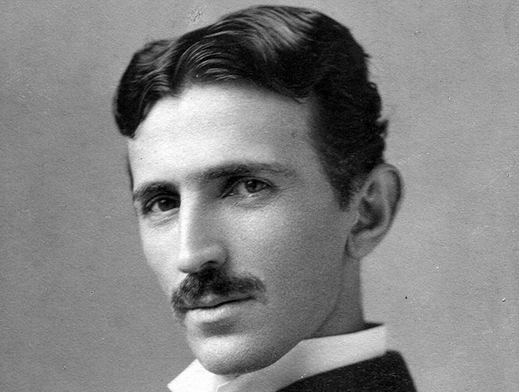
Certain cult historical figures have served as prescient avatars for the techno-visionaries of the digital age. Where the altruistic utopian designs of Buckminster Fuller provided an ideal for the first wave of Silicon Valley pioneers (a group including computer scientist and philosopher Jaron Lanier and Wired editor Kevin Kelly), later entrepreneurs have hewn closer to the principles of brilliant scientist and inventor Nikola Tesla, who believed, as he told Liberty magazine in 1935, that “we suffer the derangement of our civilization because we have not yet completely adjusted ourselves to the machine age.”
Such an adjustment would come, Tesla believed, only in “mastering the machine”—and he seemed to have supreme confidence in human mastery—over food production, climate, and genetics. We would be freed from onerous labor by automation and the creation of “a thinking machine,” he said, over a decade before the invention of the computer. Tesla did not anticipate the ways such machines would come to master us, even though he cannily foresaw the future of wireless technology, computing, and telephony, technologies that would radically reshape every aspect of human life.
In an earlier, 1926, interview in Collier’s magazine, Tesla predicted, as the editors wrote, communicating “instantly by simple vest-pocket equipment.” His actual words conveyed a much grander, and more accurate, picture of the future.
When wireless is perfectly applied the whole earth will be converted into a huge brain, which in fact it is…. We shall be able to communicate with one another instantly, irrespective of distance. Not only this, but through television and telephony we shall see and hear one another as perfectly as though we were face to face, despite intervening distances of thousands of miles; and the instruments through which we shall be able to do this will be amazingly simple compared with our present telephone. A man will be able to carry one in his vest pocket.
The complexity of smartphones far outstrips that of the telephone, but in every other respect, Tesla’s picture maps onto the reality of almost 100 years later. Other aspects of Tesla’s future scenario for wireless also seem to anticipate current technologies, like 3D printing, though the kind he describes still remains in the realm of science fiction: “Wireless will achieve the closer contact through transmission of intelligence, transport of our bodies and materials and conveyance of energy.”
But Tesla’s vision had its limitations, and they lay precisely in his techno-optimism. He never met a problem that wouldn’t eventually have a technological solution (and like many other techno-visionaries of the time, he heartily endorsed state-sponsored eugenics). “The majority of the ills from which humanity suffers,” he said, “are due to the immense extent of the terrestrial globe and the inability of individuals and nations to come into close contact.”
Wireless technology, thought Tesla, would help eradicate war, poverty, disease, pollution, and general discontent, when we are “able to witness and hear events—the inauguration of a President, the playing of a world series game, the havoc of an earthquake or the terror of a battle—just as though we were present.” When international boundaries are “largely obliterated” by instant communication, he believed, “a great step will be made toward the unification and harmonious existence of the various races inhabiting the globe.”
Tesla did not, and perhaps could not, foresee the ways in which technologies that bring us closer together than ever also, and at the same time, pull us ever further apart. Read Tesla’s full interview here, in which he also predicts that women will become the “superior sex,” not by virtue of “the shallow physical imitation of men” but through “the awakening of the intellect.”
Note: An earlier version of this post appeared on our site in 2019.
Related Content:
Sci-Fi Author J.G. Ballard Predicts the Rise of Social Media (1977)
Isaac Asimov Predicts in 1964 What the World Will Look Like in 2014
A 1947 French Film Accurately Predicted Our 21st-Century Addiction to Smartphones
Josh Jones is a writer and musician based in Durham, NC.
Read More...Celebrate Halloween with Michael Jackson’s Horrifically Entertaining “Thriller” Music Video—and a Behind-the-Scenes Documentary
Michael Jackson’s Thriller is the best-selling album of all time, and not by a particularly slim margin. The most recent figures have it registered at 51.3 million copies, as against the 31.2 million notched by the runner up, AC/DC’s Back in Black. But it would surely be a closer call without the title song’s celebrated music video, thirteen John Landis-directed minutes full of not just singing and dancing, but also classic-style Hollywood monsters, some of them doing that singing and dancing themselves. Halloween night is, of course, the best time to revisit Michael Jackson’s Thriller, as it’s officially titled. This year, why not chase it with the behind-the-scenes documentary below, Making Michael Jackson’s Thriller?
Younger fans may not know that “Thriller” wasn’t even released as a single until November of 1983: about a year after the album itself, which had already spun off six songs, including enormous hits like “Billie Jean” and “Beat It.” In fact, Jackson’s unprecedented vision for the album had been that every song could be a hit, with no filler in between.
The higher-ups at Epic Records felt that its popularity, however sensational to that point, had just about run its course. That made them unwilling, at first, to put out “Thriller” on its own, as did the song’s campy scary-movie lyrics, sound effects, and “rap” by none other than Vincent Price, the embodiment of old-Hollywood horror. (This sort of thing wasn’t without precedent: with his siblings, Jackson had created a similar spooky atmosphere in “This Place Hotel,” from 1980.)
Still, at that point in his rise to the kind of fame no cultural figure may ever know again, Jackson understood much that the old guard didn’t. He knew that “Thriller” could succeed, not just as a song on the radio, but a multimedia cultural phenomenon. It would, of course, need a music video, but not one that merely met the (still fairly lax) standards of MTV. Impressed by the horror, comedy, and visual effects of John Landis’ An American Werewolf in London, Jackson called up Landis and asked him to direct what he’d been envisioning for “Thriller” at feature-film production values. The $500,000 budget came from television networks like MTV and Showtime, officially for broadcasting rights to Making Michael Jackson’s Thriller.
The documentary captures various aspects of the video’s creation, from casting to choreography to shooting to makeup, that last being an especially painstaking process overseen by industry master Rick Baker. Whatever the rigors of the production, Jackson displays undisguised enjoyment of it all in this footage, perhaps foreseeing that it would culminate in the kind of expression that could come from no other artist. Though an intensely collaborative effort, Michael Jackson’s Thriller is true to its name in ultimately being the product of a single, guiding performative sensibility, somehow both universally appealing and highly idiosyncratic at the same time. Jackson’s insistence on calling his music videos “short films” may have been regarded as a typical eccentricity, but never was the label more appropriate than when he brought back the old-school monster movie one last, funky time.
Related content:
Where Zombies Come From: A Video Essay on the Origin of the Horrifying, Satirical Monsters
Based in Seoul, Colin Marshall writes and broadcasts on cities, language, and culture. His projects include the Substack newsletter Books on Cities and the book The Stateless City: a Walk through 21st-Century Los Angeles. Follow him on the social network formerly known as Twitter at @colinmarshall.
Read More...When Marcel Duchamp Drew a Mustache & Goatee on the Mona Lisa (1919)
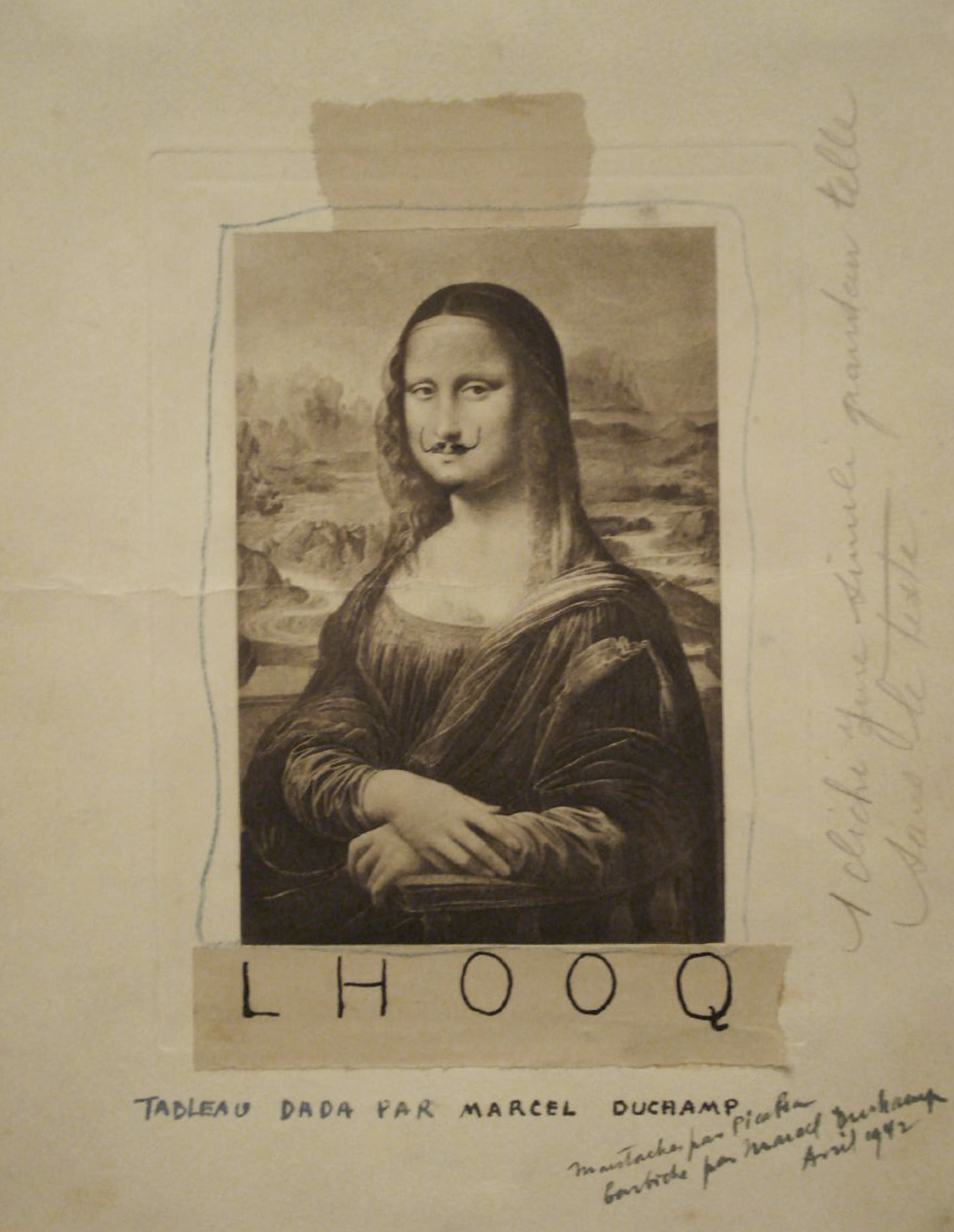
Apart from certain stretches of absence, Leonardo’s Mona Lisa has been on display at the Louvre for 228 years and counting. Though created by an Italian in Italy, the painting has long since been a part of French culture. At some point, the reverence for La Joconde, as the Mona Lisa is locally known, reached such an intensity as to inspire the label Jocondisme. For Marcel Duchamp, it all seems to have been a bit much. In 1919, he bought a postcard bearing the image of that most famous of all paintings, drew a mustache and goatee on it, and dubbed the resulting “artwork” L.H.O.O.Q., whose French pronunciation “Elle a chaud au cul” translates to — as Duchamp modestly put it — “There is fire down below.”
A century ago, this was a highly irreverent, even blasphemous act, but also just what one might expect from the man who, a couple years earlier, signed a urinal and put it on display in a gallery. Like the much-scrutinized Fountain, L.H.O.O.Q. was one of Duchamp’s “readymades,” or artistic provocations executed by modifying and re-contextualizing found objects.
Neither was singular: just as Duchamp signed multiple urinals, he also drew (or didn’t draw) facial hair on multiple Mona Lisa postcards. In one instance, he even gave the okay to his fellow artist Francis Picabia to make one for publication in his magazine in New York as, nevertheless, “par Marcel Duchamp” — though it lacked a goatee, an omission the artist corrected in his own hand some twenty years later.
In the 1956 interview just above, Duchamp describes L.H.O.O.Q. as a part of his “Dada period” (and, with characteristic modesty, “a great iconoclastic gesture on my part”). He also brings out a fake check — belonging to “no bank at all” — that he created to use at the dentist (who accepted it); and a system designed to “break the bank at Monte Carlo” (which stubbornly remained unbroken). “I believe that art is the only form of activity in which man, as a man, shows himself to be a true individual, and is capable of going beyond the animal state,” he declares. With his collision of Jocondisme and Dada, among the other unlikely juxtapositions he engineered, he showed himself to be the premier prankster of early twentieth-century art — and one whose pranks transcended amusement to inspire a scholarly industry that persists even today.
Related content:
What Makes the Mona Lisa a Great Painting: A Deep Dive
How Did the Mona Lisa Become the World’s Most Famous Painting?: It’s Not What You Think
How Marcel Duchamp Signed a Urinal in 1917 & Redefined Art
When Brian Eno & Other Artists Peed in Marcel Duchamp’s Famous Urinal
Salvador Dalí Reveals the Secrets of His Trademark Moustache (1954)
Based in Seoul, Colin Marshall writes and broadcasts on cities, language, and culture. His projects include the Substack newsletter Books on Cities and the book The Stateless City: a Walk through 21st-Century Los Angeles. Follow him on the social network formerly known as Twitter at @colinmarshall.
Read More...Roger Waters Reflects on the Haunting Psychological Decline of Pink Floyd’s Syd Barrett
To many longtime fans, there are — at the very least — two Pink Floyds. The first is the rock band that in 1965 took the name the Pink Floyd Sound, an invention of its newest member Syd Barrett. A guitar-playing singer-songwriter, the young Barrett soon became the group’s guiding creative intelligence, albeit of a cracked kind. It was under his influence that, two years later, the Floyd released their first two hit singles,“Arnold Layne” and “See Emily Play,” as well as their debut studio album The Piper at the Gates of Dawn. This early material exhibits a kind of darkly whimsical English eccentricity that turned out to fit neatly indeed with the psychedelia of the music-driven late-sixties counterculture.
This first Pink Floyd lasted until partway through the production of their second album, A Saucerful of Secrets. Up to that point, Barrett’s behavior had been turning ever stranger and less manageable; eventually, he passed entire concerts in a state of near catatonia onstage (with the occasional spasm of a deep-seated tendency to practical jokes).
After considering and finding unfeasible the option to retain him as a non-touring contributor, the other members decided simply to eject him from the band. Thus began the Floyd’s second iteration, which, despite the loss of the man who’d been writing 90 percent of their songs, did nevertheless manage to come up with albums like Atom Heart Mother, The Dark Side of the Moon, Wish You Were Here, and The Wall.
When Barrett died in 2006, after decades of life as a recluse (and, ever the Englishman, an enthusiastic gardener), he was widely remembered as a casualty of the psychedelic drug wave. But according to Roger Waters, who took the band’s reins, “LSD was not solely responsible for Syd’s illness.” He says so in the video above, a compilation of his recollections of Barrett’s decline. “It felt to me at the time that Syd was drifting off the rails, and when you’re drifting off the rails, the worst thing you could do is start messing around with hallucinogenics.” There was “no doubt that Syd was schizophrenic, and that he was taking those drugs at the same time.” It could well have been that Barrett’s state of mind allowed him to voyage into realms that the Floyd could otherwise never have accessed. But whatever the causal factors and their proportions, he eventually found himself unable to come back home.
Related content:
Psychedelic Scenes of Pink Floyd’s Early Days with Syd Barrett, 1967
Understanding Pink Floyd’s Wish You Were Here, Their Tribute to Departed Bandmate Syd Barrett
Watch David Gilmour Play the Songs of Syd Barrett, with the Help of David Bowie & Richard Wright
An Hour-Long Collection of Live Footage Documents the Early Days of Pink Floyd (1967–1972)
The Inventive Artwork of Pink Floyd’s Syd Barrett
Based in Seoul, Colin Marshall writes and broadcasts on cities, language, and culture. His projects include the Substack newsletter Books on Cities and the book The Stateless City: a Walk through 21st-Century Los Angeles. Follow him on the social network formerly known as Twitter at @colinmarshall.
Read More...A Tour of a Utopian Home Designed by Frank Lloyd Wright, Presented by His Last Living Client
American is a tricky word. It can refer to everyone and everything of or pertaining to all the countries of North America — and potentially South America as well — but it’s commonly used with specific regard to the United States. For Frank Lloyd Wright, linguistic as well as architectural perfectionist, this was an untenable state of affairs. To his mind, the newest civilization of the New World, a vast land that offered man the rare chance to remake himself, needed an adjective all its own. And so, repurposing a demonym proposed by geographer James Duff Law in the nineteen-hundreds, Wright began to refer to his not just architectural but also broadly cultural project as Usonian.
Wright completed the first of his so-called “Usonian houses,” the Herbert and Katherine Jacobs House in Madison, Wisconsin, in the middle of the Great Depression. Challenged to “create a decent home for $5,000,” says the Frank Lloyd Wright Foundation’s web site, the architect seized the chance to realize “a new affordable architecture that freed itself from European conventions and responded to the American landscape.”
This first Usonian house and its 60 or so successors “related directly to the earth, unimpeded by a foundation, front porch, protruding chimney, or distracting shrubbery. Glass curtain walls and natural materials like wood, stone and brick further tied the house to its environment.” In Pleasantville, New York, there even exists a Usonia Historic District, three of whose 47 homes were designed by Wright himself.
The BBC Global video at the top of the post offers a tour of one of the Usonia Historic District’s houses led by the sole surviving original owner, the 100-year-old Roland Reisley. The Architectural Digest video above features Reisley’s home as well as the Bertha and Sol Friedman House, which Wright dubbed Toyhill. Both have been kept as adherent as possible to the vision that inspired them, and that was meant to inspire a renaissance in American civilization. The Usonian homes may have fallen short of Wright’s Utopian hopes, but they did have a certain influence on postwar suburb-builders, and have much enriched the lives of their more appreciative inhabitants. The centenarian Reisley credits his startling youthfulness to the man-made and natural beauty of his domestic surroundings — but then, this last of the Usonians also happens to be one of the rare clients who could get along with Frank Lloyd Wright.
Related content:
What Frank Lloyd Wright’s Unusual Windows Tell Us About His Architectural Genius
How Frank Lloyd Wright’s Architecture Evolved Over 70 Years and Changed America
Frank Lloyd Wright Designs an Urban Utopia: See His Hand-Drawn Sketches of Broadacre City (1932)
How Frank Lloyd Wright Became Frank Lloyd Wright: A Video Introduction
Based in Seoul, Colin Marshall writes and broadcasts on cities, language, and culture. His projects include the Substack newsletter Books on Cities and the book The Stateless City: a Walk through 21st-Century Los Angeles. Follow him on the social network formerly known as Twitter at @colinmarshall.
Read More...Meet the Forgotten Female Artist Behind the World’s Most Popular Tarot Deck (1909)
As an exercise draw a composition of fear or sadness, or great sorrow, quite simply, do not bother about details now, but in a few lines tell your story. Then show it to any one of your friends, or family, or fellow students, and ask them if they can tell you what it is you meant to portray. You will soon get to know how to make it tell its tale.
- Pamela Colman-Smith, “Should the Art Student Think?” July, 1908
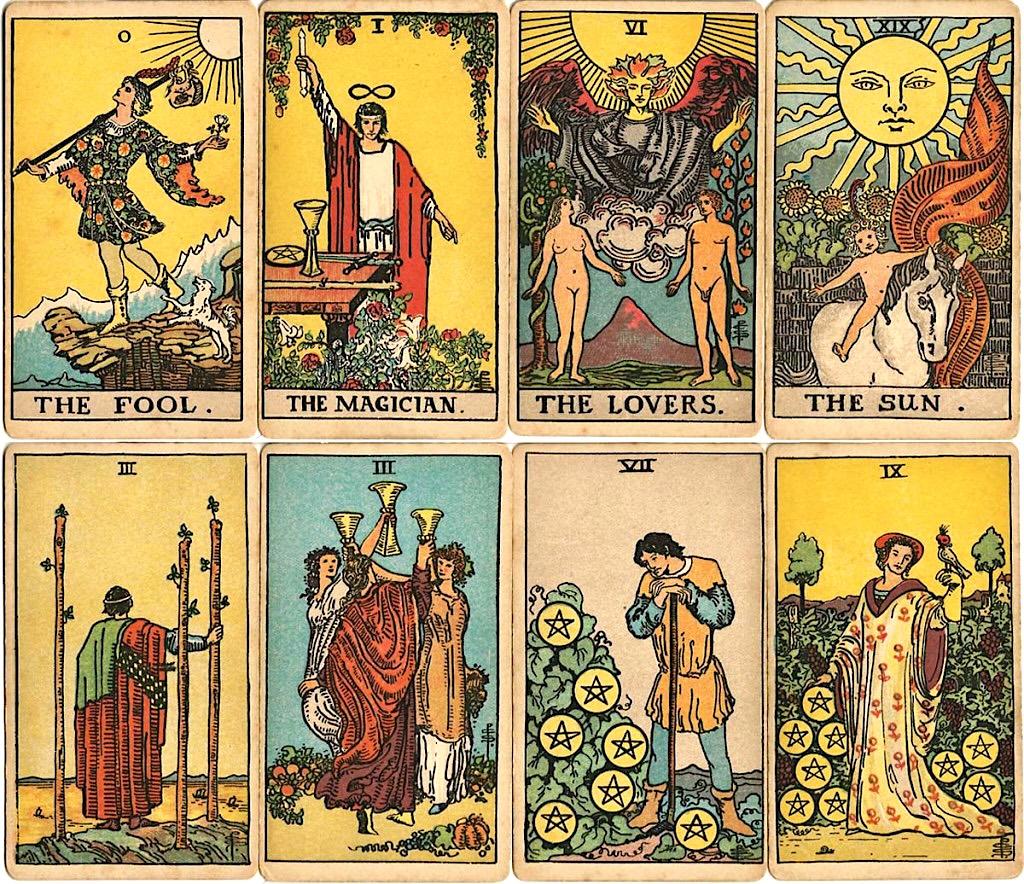
A year after Arts and Crafts movement magazine The Craftsman published illustrator Pamela Colman-Smith’s essay excerpted above, she spent six months creating what would become the world’s most popular tarot deck. Her graphic interpretations of such cards as The Magician, The Tower, and The Hanged Man helped readers to get a handle on the story of every newly dealt spread.
Colman-Smith—known to friends as “Pixie”—was commissioned by occult scholar and author Arthur E. Waite, a fellow member of the British occult society the Hermetic Order of the Golden Dawn, to illustrate a pack of tarot cards.
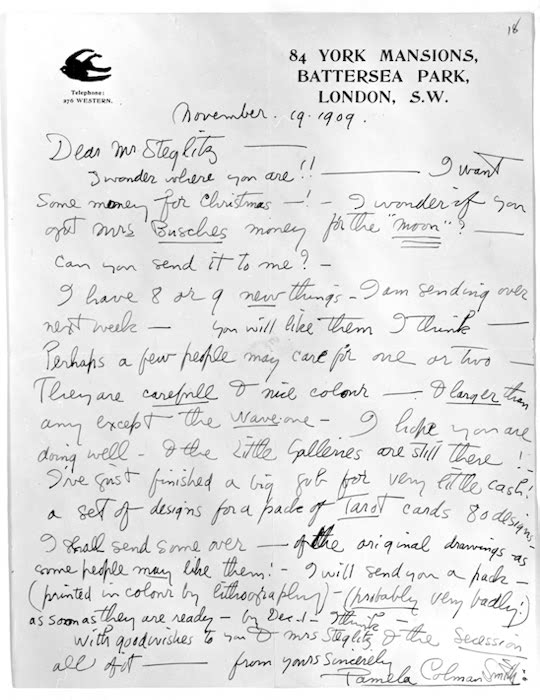
In a humorous letter to her eventual champion, photographer Alfred Stieglitz, Colman-Smith (1878 – 1951) described her 80 tarot paintings as “a big job for very little cash,” though she betrayed a touch of genuine excitement that they would be “printed in color by lithography… probably very badly.”
Although Waite had some specific visual ideas with regard to the “astrological significance” of various cards, Colman-Smith enjoyed a lot of creative leeway, particularly when it came to the Minor Arcana or pip cards.
These 56 numbered cards are divided into suits—wands, cups, swords and pentacles. Prior to Colman-Smith’s contribution, the only example of a fully illustrated Minor Arcana was to be found in the earliest surviving deck, the Sola Busca, which dates to the early 1490s. A few of her Minor Arcana cards, notably 3 of Swords and 10 of Wands, make overt reference to that deck, which she likely encountered on a research expedition to the British Museum.
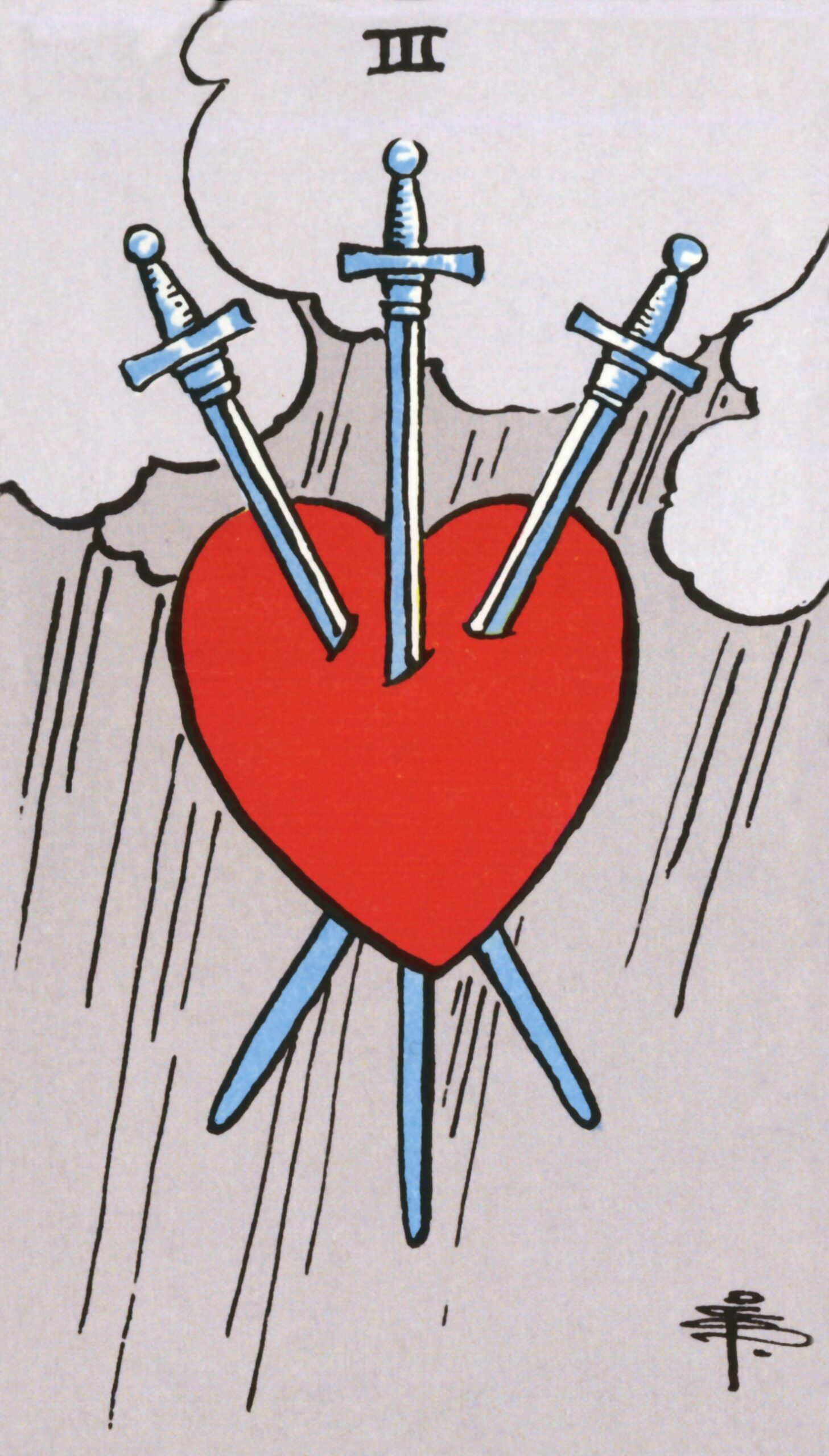
Mostly the images were of Colman-Smith’s own invention, informed by her sound-color synesthesia and the classical music she listened to while working. Her early experience in a touring theater company helped her to convey meaning through costume and physical attitude.
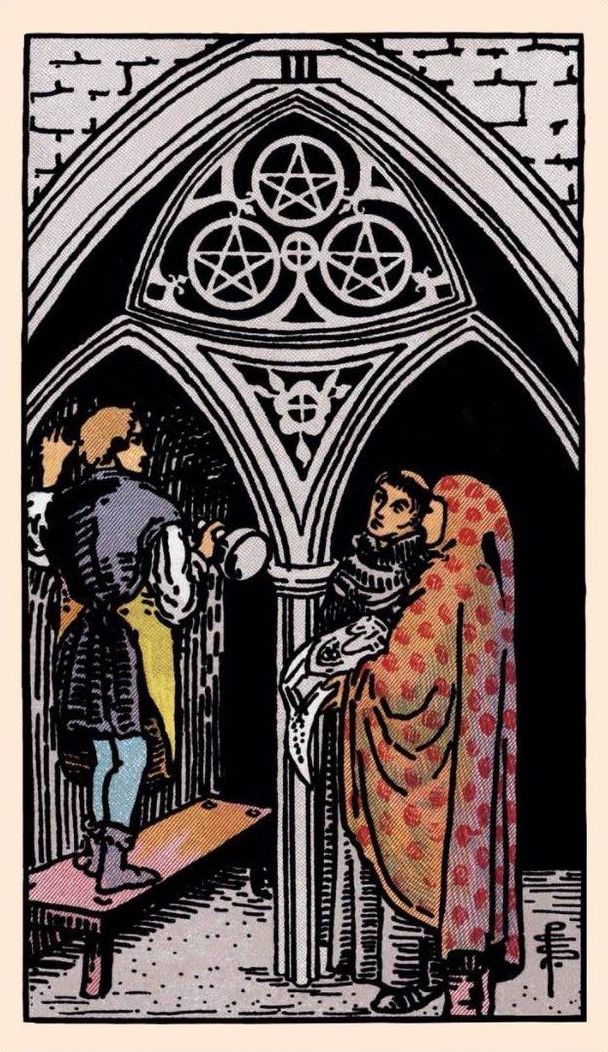
Here are Pacific Northwest witch and tarot practitioner Moe Bowstern’s thoughts on Smith’s Three of Pentacles:
Pentacles are the suit of Earth, representative of structure and foundation. Colman-Smith’s theater-influenced designs here identify the occupations of three figures standing in an apse of what appears to be a cathedral: a carpenter with tools in hand; an architect showing plans to the group; a tonsured monk, clearly the steward of the building project.
The overall impression is one of building something together that is much bigger than any individual and which may outlast any individual life. The collaboration is rooted in the hands-on material work of foundation building, requiring many viewpoints.
A special Pixie Smith touch is the physical elevation of the carpenter, who would have been placed on the lowest rung of medieval society hierarchies. Smith has him on a bench, showing the importance of getting hands on with the project.
For years, Colman-Smith’s cards were referred to as the Rider-Waite Tarot Deck. This gave a nod to publisher William Rider & Son, while neglecting to credit the artist responsible for the distinctive gouache illustrations. It continues to be sold under that banner, but lately, tarot enthusiasts have taken to personally amending the name to the Rider Waite Smith (RWS) or Waite Smith (WS) deck out of respect for its previously unheralded co-creator.
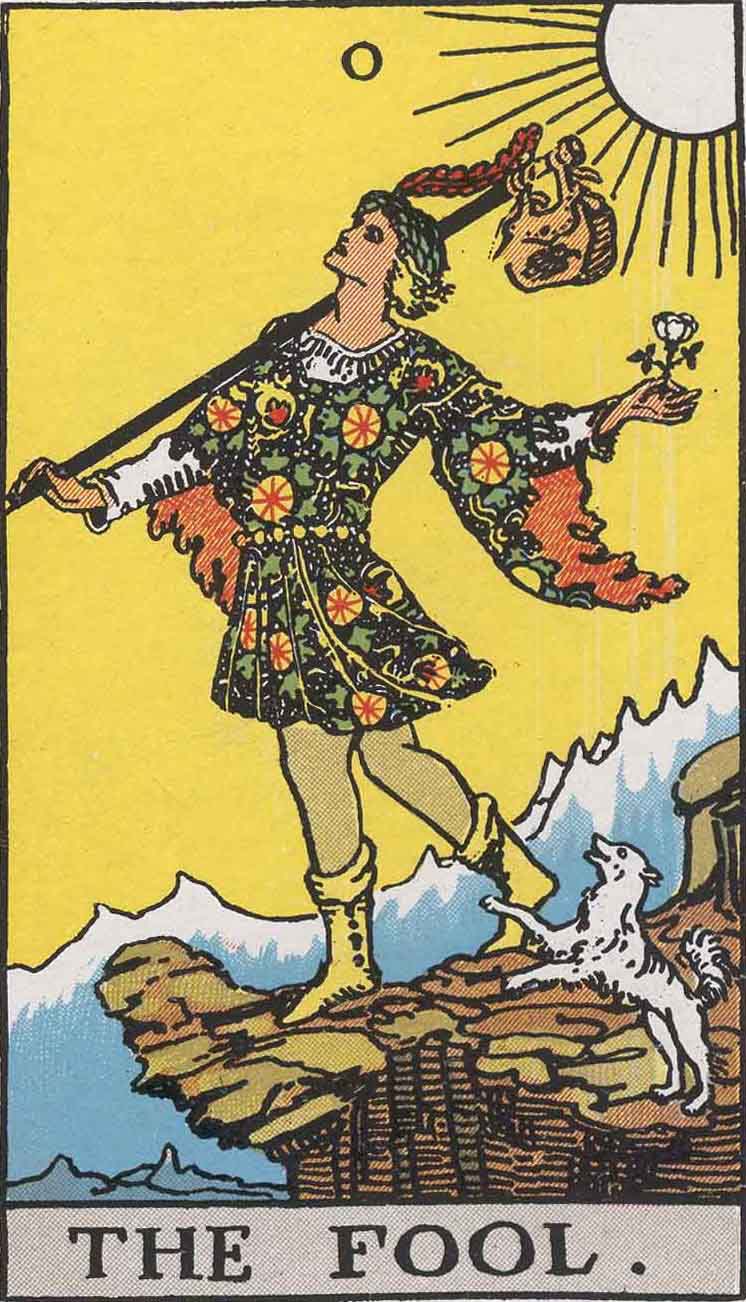
While Colman-Smith is best remembered for her tarot imagery, she was also a celebrated storyteller, illustrator of children’s books and a collection of Jamaican folk tales, creator of elaborate toy theater pieces, and maker of images on behalf of women’s suffrage and the war effort during WWII.
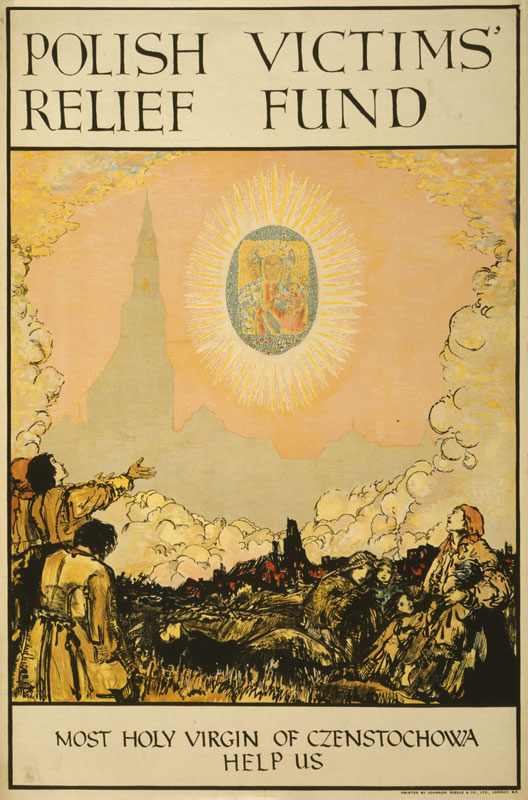
Outside of some early adventures in a traveling theater, and friendships with Stieglitz, author Bram Stoker, actress Ellen Terry, and poet William Butler Yeats, certain details of her personal life—namely her race and sexual orientation—are difficult to divine. It’s not for lack of interest. She is the focus of several biographies and an increasing number of blog posts.
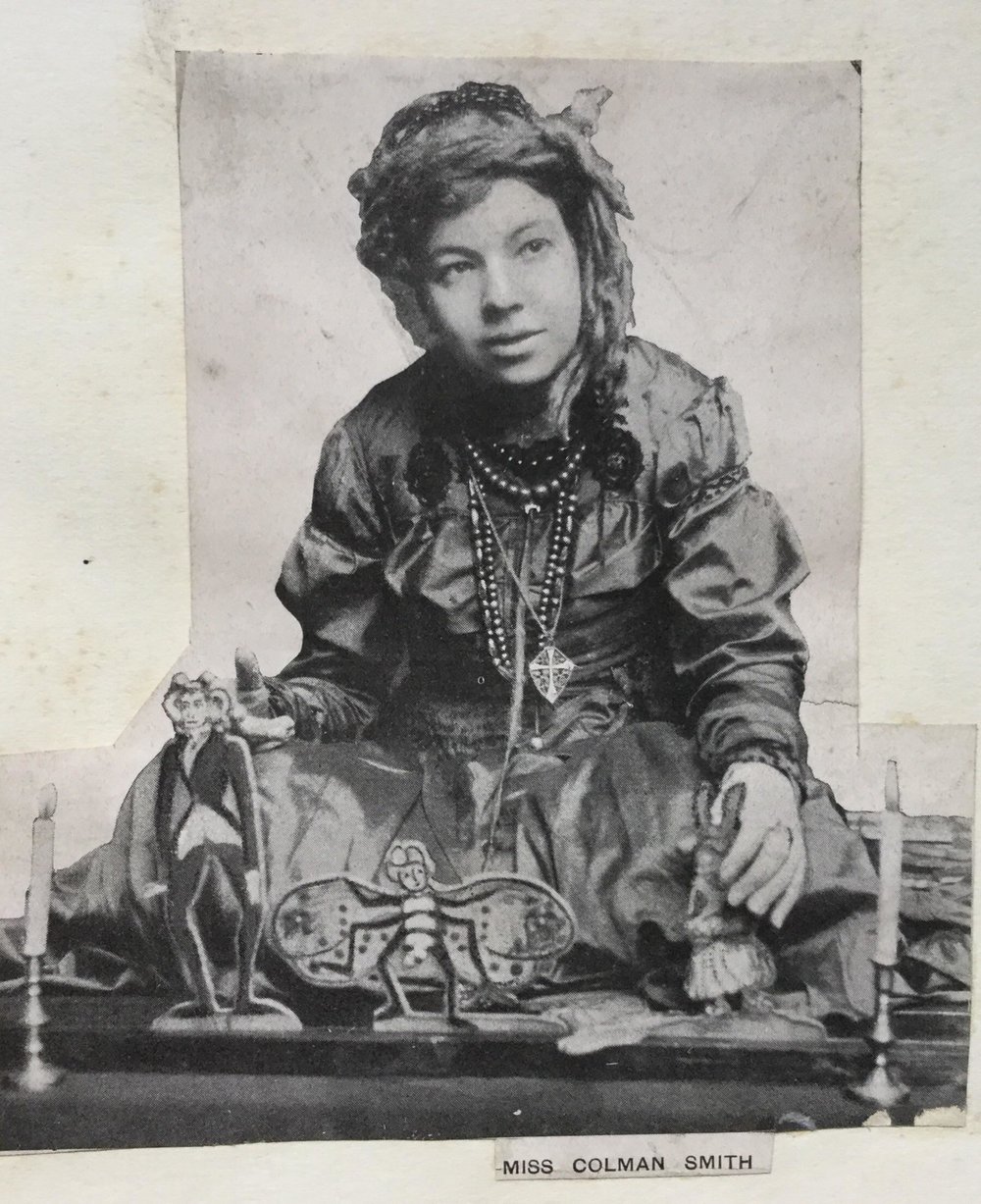
It’s sad, but not a total shocker, to learn that this interesting, multi-talented woman died in poverty in 1951. Her paintings and drawings were auctioned off, with the proceeds going toward her debts. Her death certificate listed her occupation not as artist but as “Spinster of Independent Means.” Lacking funds for a headstone, she was buried in an unmarked grave.

Read some of her letters to Alfred Stieglitz at Yale University’s Beinecke Rare Book and Manuscript Library collection.
Note: An earlier version of this post appeared on our site in 2021.
Related Content:
Alejandro Jodorowsky Explains How Tarot Cards Can Give You Creative Inspiration
Ayun Halliday is an author, illustrator, theater maker and Chief Primatologist in NYC.
Read More...How Saul Bass Designed the Strange Original Poster for Stanley Kubrick’s The Shining
With Halloween just days away, many of us are even now readying a scary movie or two to watch on the night itself. If you’re still undecided about your own Halloween viewing material, allow us to suggest The Shining, Stanley Kubrick’s “masterpiece of modern horror.” Those words come straight from the original poster hung up at theaters when the film was released in 1980, and presumptuous though they may have sounded at the time — especially considering the mixed first wave of critical reception — the decades have proven them right. Even if you’ve watched it for ten, twenty, forty Halloweens in a row, The Shining remains frightening on both the jump-scare and existential-dread levels, while its each and every frame appears more clearly than ever to be the work of an auteur.
One could hardly find a more suitable figure to represent the notion of the auteur — the director as primary “author” of a film — than Kubrick, whose aesthetic and intellectual sensibility comes through in all of his major pictures, each of which belongs to a different genre. Kubrick had tried his hand at film noir, World War I, swords-and-sandals epic, psychological drama, Cold War black comedy, science fiction, dystopian crime, and costume drama; a much-reworked adaptation of Stephen King’s novel, The Shining represents, of course, Kubrick’s foray into horror.
Despite the famously quick-and-dirty tendencies of that defiantly unrespectable cinematic tradition, Kubrick exercised, if anything, an even greater degree of meticulousness than that for which he was already notorious, demanding perfection not just on set, but also in the creation of the marketing materials.
According to the new Paper & Light video above, famed designer Saul Bass (who’d previously created the title sequence of Kubrick’s Spartacus) did more than 300 drawings for The Shining’s movie poster. The only concept that met with the director’s approval placed a terrified, vaguely inhuman visage inside the lettering of the title. We don’t know whose face it’s supposed to be, but Paper & Light hazards a guess that it may be that of Danny, the young son of the Overlook Hotel’s doomed caretaker Jack Torrance, or even Danny’s invisible friend Tony. (Note the containment of all of its features within the T.) Though Kubrick credited Bass’ final design with solving “the eternal problem of trying to combine artwork with the title of the film,” The Shining’s bright yellow poster now sits somehow uneasily with the movie’s legacy, more as a curiosity than an icon. Nevertheless, it does evoke — and maybe too well — what we’ll all hope to feel when we press play this, or any, Halloween night.
Related content:
Saul Bass’ Rejected Poster Concepts for The Shining (and His Pretty Excellent Signature)
40 Years of Saul Bass’ Groundbreaking Title Sequences in One Compilation
Saul Bass’ Advice for Designers: Make Something Beautiful and Don’t Worry About the Money
Based in Seoul, Colin Marshall writes and broadcasts on cities, language, and culture. His projects include the Substack newsletter Books on Cities and the book The Stateless City: a Walk through 21st-Century Los Angeles. Follow him on the social network formerly known as Twitter at @colinmarshall.
Read More...Aldous Huxley to George Orwell: My Hellish Vision of the Future is Better Than Yours (1949)
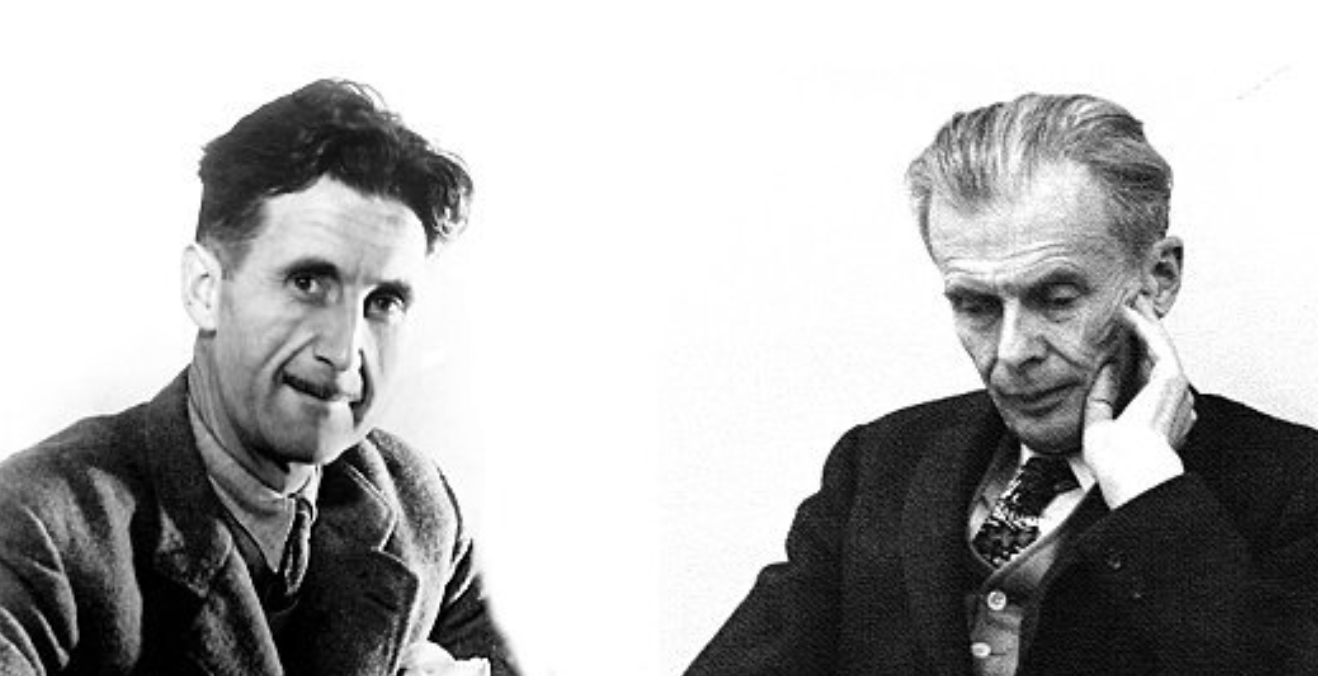
In 1949, George Orwell received a curious letter from his former high school French teacher.
Orwell had just published his groundbreaking book Nineteen Eighty-Four, which received glowing reviews from just about every corner of the English-speaking world. His French teacher, as it happens, was none other than Aldous Huxley, who taught at Eton for a spell before writing Brave New World (1931), the other great 20th-century dystopian novel.
Huxley starts off the letter praising the book, describing it as “profoundly important.” He continues, “The philosophy of the ruling minority in Nineteen Eighty-Four is a sadism which has been carried to its logical conclusion by going beyond sex and denying it.”
Then Huxley switches gears and criticizes the book, writing, “Whether in actual fact the policy of the boot-on-the-face can go on indefinitely seems doubtful. My own belief is that the ruling oligarchy will find less arduous and wasteful ways of governing and of satisfying its lust for power, and these ways will resemble those which I described in Brave New World.” (Listen to him read a dramatized version of the book here.)
Basically, while praising Nineteen Eighty-Four, Huxley argues that his version of the future was more likely to come to pass.
In Huxley’s seemingly dystopian World State, the elite amuse the masses into submission with a mind-numbing drug called Soma and an endless buffet of casual sex. Orwell’s Oceania, on the other hand, keeps the masses in check with fear thanks to an endless war and a hyper-competent surveillance state. At first blush, they might seem like they are diametrically opposed but, in fact, an Orwellian world and a Huxleyan one are simply two different modes of oppression.
While we haven’t quite arrived at either dystopian vision, the power of both books is that they tap into our fears of the state. While Huxley might make you look askance at The Bachelor or Facebook, Orwell makes you recoil in horror at the government throwing around phrases like “enhanced interrogation” and “surgical drone strikes.”
You can read Huxley’s full letter below.
Wrightwood. Cal.
21 October, 1949
Dear Mr. Orwell,
It was very kind of you to tell your publishers to send me a copy of your book. It arrived as I was in the midst of a piece of work that required much reading and consulting of references; and since poor sight makes it necessary for me to ration my reading, I had to wait a long time before being able to embark on Nineteen Eighty-Four.
Agreeing with all that the critics have written of it, I need not tell you, yet once more, how fine and how profoundly important the book is. May I speak instead of the thing with which the book deals — the ultimate revolution? The first hints of a philosophy of the ultimate revolution — the revolution which lies beyond politics and economics, and which aims at total subversion of the individual’s psychology and physiology — are to be found in the Marquis de Sade, who regarded himself as the continuator, the consummator, of Robespierre and Babeuf. The philosophy of the ruling minority in Nineteen Eighty-Four is a sadism which has been carried to its logical conclusion by going beyond sex and denying it. Whether in actual fact the policy of the boot-on-the-face can go on indefinitely seems doubtful. My own belief is that the ruling oligarchy will find less arduous and wasteful ways of governing and of satisfying its lust for power, and these ways will resemble those which I described in Brave New World. I have had occasion recently to look into the history of animal magnetism and hypnotism, and have been greatly struck by the way in which, for a hundred and fifty years, the world has refused to take serious cognizance of the discoveries of Mesmer, Braid, Esdaile, and the rest.
Partly because of the prevailing materialism and partly because of prevailing respectability, nineteenth-century philosophers and men of science were not willing to investigate the odder facts of psychology for practical men, such as politicians, soldiers and policemen, to apply in the field of government. Thanks to the voluntary ignorance of our fathers, the advent of the ultimate revolution was delayed for five or six generations. Another lucky accident was Freud’s inability to hypnotize successfully and his consequent disparagement of hypnotism. This delayed the general application of hypnotism to psychiatry for at least forty years. But now psycho-analysis is being combined with hypnosis; and hypnosis has been made easy and indefinitely extensible through the use of barbiturates, which induce a hypnoid and suggestible state in even the most recalcitrant subjects.
Within the next generation I believe that the world’s rulers will discover that infant conditioning and narco-hypnosis are more efficient, as instruments of government, than clubs and prisons, and that the lust for power can be just as completely satisfied by suggesting people into loving their servitude as by flogging and kicking them into obedience. In other words, I feel that the nightmare of Nineteen Eighty-Four is destined to modulate into the nightmare of a world having more resemblance to that which I imagined in Brave New World. The change will be brought about as a result of a felt need for increased efficiency. Meanwhile, of course, there may be a large scale biological and atomic war — in which case we shall have nightmares of other and scarcely imaginable kinds.
Thank you once again for the book.
Yours sincerely,
Aldous Huxley
Note: An earlier version of this post appeared on our site in 2015.
Related Content:
Hear Aldous Huxley Narrate His Dystopian Masterpiece, Brave New World
George Orwell Explains in a Revealing 1944 Letter Why He’d Write 1984
Aldous Huxley to George Orwell: My Hellish Vision of the Future is Better Than Yours (1949)
Aldous Huxley’s Most Beautiful, LSD-Assisted Death: A Letter from His Widow
Jonathan Crow is a writer and filmmaker whose work has appeared in Yahoo!, The Hollywood Reporter, and other publications.
Read More...You Can Now See the Parthenon Without Scaffolding for the First Time in 200 Years
If you’ve made the journey to Athens, you probably took the time to visit its most popular tourist attraction, the Acropolis. On that monument-rich hill, you more than likely paid special attention to the Parthenon, the ancient temple dedicated to the city’s namesake, the goddess Athena Parthenos. But no matter how much time you spent amid the ruins of the Parthenon, if that visit happens to have taken place in the past 200 years, you may now question whether you’ve truly seen it at all. That’s because only recently has scaffolding been removed that has partially obscured its western façade for the past two decades, resulting in the purer visual state seen in the clips collected above.
The press attention drawn by this event prompted Greece’s Minister of Culture Linda Mendoni to declare this the first time the Parthenon’s exterior has been completely free of scaffolding in about two centuries. Having been originally built in the fifth century BC, and come through most of that span much the worse for wear, it requires intensive and near-constant maintenance.
Its inundation by visitors surely doesn’t help: an estimated 4.5 million people went to the Acropolis in 2024, the kind of figure that makes you believe in the diagnoses of global “overtourism” thrown around these days. The Greek government’s countermeasures include a daily visitor cap of 20,000, implemented in 2023, and a requirement to reserve a timed entry slot.
If you’d like to see the wholly un-scaffolded Parthenon in person, you’d best reserve your own slot as soon as possible: more conservation work is scheduled to begin in November, albeit with temporary infrastructure designed to be “lighter and aesthetically much closer to the logic of the monument,” as Mendoni has explained. But if you miss that window, don’t worry, since that operation should only last until early next summer, and upon its completion, “the Parthenon will be completely freed of this scaffolding too, and people will be able to see it truly free.” Not that they’ll be able to see it for free: even now, a general-admission Acropolis reservation costs €30 (about $35 USD) during the summertime peak season. Athena was the goddess of wisdom, warfare, and handicraft, not wealth, but it clearly lies within her powers to command a decent price.
Related content:
How the Ancient Greeks Built Their Magnificent Temples: The Art of Ancient Engineering
A 3D Model Reveals What the Parthenon and Its Interior Looked Like 2,500 Years Ago
How the Parthenon Marbles Ended Up In The British Museum
Based in Seoul, Colin Marshall writes and broadcasts on cities, language, and culture. His projects include the Substack newsletter Books on Cities and the book The Stateless City: a Walk through 21st-Century Los Angeles. Follow him on the social network formerly known as Twitter at @colinmarshall.
Read More...
Support Us
We're hoping to rely on loyal readers, rather than erratic ads. Please click the Donate button and support Open Culture. You can use Paypal, Venmo, Patreon, even Crypto! We thank you!

About Us

Open Culture scours the web for the best educational media. We find the free courses and audio books you need, the language lessons & educational videos you want, and plenty of enlightenment in between.
Advertise With Us

FREE UPDATES!
GET OUR DAILY EMAIL
Get the best cultural and educational resources on the web curated for you in a daily email. We never spam. Unsubscribe at any time.
FOLLOW ON SOCIAL MEDIA

Open Culture editor Dan Colman scours the web for the best educational media. He finds the free courses and audio books you need, the language lessons & movies you want, and plenty of enlightenment in between.
Advertise With Us