How Peter Jackson Made His State-of-the-Art World War I Documentary, They Shall Not Grow Old: An Inside Look
There are very few working directors today who can do what Peter Jackson does so well—create extraordinary spectacles on the grandest of scales while also staying tightly focused on character development and emotional depth. He’s made missteps. His Hobbit trilogy felt bloated, busy and unnecessary, but one reason it so disappointed was because he’d already shown himself a master of fantasy filmmaking with what many considered the unfilmmable Lord of the Rings.
Of course non-Tolkien-related Jackson films like Heavenly Creatures also showcase these strengths, on a smaller scale: the ability to retain the human dimension amidst cinematic spectacles and inhuman darkness (a quality he mined explicitly in his years as a horror director). All of these sensibilities, including a pronounced streak of dark humor and talent for manipulating his audiences, make him the ideal director for a documentary on World War I.
It’s a conflict that makes little historical sense to most of us, that unfolded on a scale few of us can imagine, with few identifiable heroes and villains and a complicated geopolitical situation that can feel out of our grasp.
Many documentaries on the war are informative but, frankly, quite dull. In striving for objectivity, they lose sight of humanity. Rather than adopt the voice of god and newsreel look that characterizes the usual fare, Jackson has taken an active role in shaping the narrative for us with cutting-edge blockbuster cinematic techniques. He gives us characters to care about in showing the horror of trench warfare, the confusion and camaraderie of war. Though he uses original footage, it is digitally enhanced and colorized, screened in 3D, with recordings of remembrances from the soldiers themselves dramatically overlaid to create the sense that the figures we see onscreen are speaking to us.
The result, as Guy Lodge writes at Variety, “is a technical dazzler with a surprisingly humane streak…. So dazzlingly transformative is the restoration of this footage that it may as well be the product of a movie shoot.” Indeed, once the credits roll, viewers see the same “veritable army of magic-working technicians’ names” as they would on any big-budget action movie. Jackson has, in effect, produced “the world’s most state-of-the-art educational film,” applying all the emotional levers and pulleys of feature filmmaking to a historical archive.
Like most of us, students have trouble understanding the scale of the war and connecting with the lives of people so indistinctly photographed and far away in time. Jackson makes sure that they can do both, and his film will be sent to every high school in the U.K. Those schools will not, of course, be able to reproduce the 3D effects. Yet even these, though they sound “gimmicky on the face of it,” writes Lodge, prove “to have an experiential purpose, conveying the juddering movement and chaos of a conflict many of us have largely viewed through calcified still images.”
In the interviews and behind the scenes videos here, we learn how Jackson and his team solved the film speed problem to make the old reels look natural, how they created a color palette and removed blurriness and blemishes. Jackson also talks about his own personal stake in the project, imagining what his grandfather endured in the Great War. This connection seems to have spurred him all the more in the effort.
“To memorialize these soldiers a hundred years later,” he says, “is to try to bring some of their humanity back into the world again, to stop them being a black and white cliché.” In creating this moving memorial, Jackson goes far beyond the mandate of an educational film. He has used all the techniques at his disposal to make good on the promise in Robert Laurence Binyon’s 1914 poem “For the Fallen,” from which the documentary takes its title:
They shall grow not old, as we that are left grow old:
Age shall not weary them, nor the years condemn.
At the going down of the sun and in the morning
We will remember them.
Related Content:
Watch World War I Unfold in a 6 Minute Time-Lapse Film: Every Day From 1914 to 1918
The Great War: Video Series Will Document How WWI Unfolded, Week-by-Week, for the Next 4 Years
Josh Jones is a writer and musician based in Durham, NC. Follow him at @jdmagness
Read More...Watch 99 Movies Free Online Courtesy of YouTube & MGM: Rocky, The Terminator, Four Weddings and a Funeral & More
We all have those major motion pictures we’re sure we’ll see one day, but somehow haven’t seen yet. Usually they’ve had such a huge influence on popular culture, inspiring decades of references, homages, and jokes, that we feel like we’ve seen them anyway. Back in the days of yore when television reigned supreme, we might occasionally catch one of them (or most of one of them) while flipping channels at night, albeit in a form re-edited to remove sensitive content and fit the image onto a square screen. Given how dramatically those viewing practices have migrated to the internet in the 21st century, it only makes good sense that Youtube — that vast temple of modern-day channel-flipping — would strike a deal with a Hollywood studio to make more than a few of these movies available, free to view.
Just this month, MGM put nearly 100 of its films up on Youtube, some of the best known of which include The Terminator, the Rocky and Pink Panther movies, Legally Blonde, Dirty Rotten Scoundrels, and Four Weddings and a Funeral. Some of them you’ve almost certainly seen (and quite possibly want to see again), and others you’ve been meaning to see for ten, twenty, thirty, maybe even forty years.
Just like on television, the fact that you can watch them for free means that they come with ads, albeit ads less intrusive than traditional commercial breaks — unless you pay the monthly $9.99 USD for Youtube Premium, in which case they’ll play ad-free. (And in any case, they’re available at the moment only to viewers in the United States.) And also, as in the days of wee-hours channel-surfing, you’ll find the acclaimed classics mixed in with lesser-known pictures, even oddities, that may hold even more cinematic fascination.
Some of the unexpected titles among MGM’s free movies on Youtube include documentaries like Jiro Dreams of Sushi — the one about the most sternly and obsessively dedicated sushi chef in Tokyo, and probably the world, you may remember everyone talking about a few years ago — and With Great Power: The Stan Lee Story, posted no doubt in tribute to the recently deceased comic book-industry legend. Cinematically-inclined readers who remember with amusement the internet and our perceptions of the internet back in the cable-TV days should take note that the free MGM collection on Youtube Movies also includes Hackers, Hollywood’s most vivid depiction of the fear and optimism that swirled around computers and their connectedness in the mid-1990s. We had a fair few unrealistic expectations of the internet back then, which that movie and movies like it now reveal, but how many of us dared imagine that it would take over the role of the television?
Related Content:
1,150 Free Movies Online: Great Classics, Indies, Noir, Westerns, etc.
101 Free Silent Films: The Great Classics
Based in Seoul, Colin Marshall writes and broadcasts on cities, language, and culture. His projects include the book The Stateless City: a Walk through 21st-Century Los Angeles and the video series The City in Cinema. Follow him on Twitter at @colinmarshall or on Facebook.
Read More...“More Barn!” The Story of How Neil Young First Played Harvest for Graham Nash (1972)

Image by Darren Swim, via Wikimedia Commons
Everyone knows the punchline “more cowbell” from SNL’s affectionate jab at the Blue Öyster Cult’s enthusiasm. But how many people know the true story of “more barn”?
Too precious few, I’d say.
It’s a classic from that icon of classic rock, Neil Young, a yarn—as told by Graham Nash—that defies parody, and beautifully illustrates the absurdity of Neil Young’s commitment to raw, rustic authenticity. For his dedicated fans, Neil’s ramshackle methods always yield worthy results. Even when he’s off, he’s so damned into it, it’s hard to ever fault him.
And when he’s on—in masterpieces like 1972’s Harvest—Neil does no wrong. His talents stretch beyond intensely impassioned songcraft and delivery to a holistic appreciation of sound in all its forms (and a loathing for technology that does sound an injustice).
In the interview above with NPR’s Terry Gross after the publication of his book Wild Tales: A Rock & Roll Life, Young’s erstwhile CSNY bandmate Nash recounts the day Young first played him Harvest:
The man is totally committed to the muse of music. And he’ll do anything for good music. And sometimes it’s very strange. I was at Neil’s ranch one day just south of San Francisco, and he has a beautiful lake with red-wing blackbirds. And he asked me if I wanted to hear his new album, “Harvest.” And I said sure, let’s go into the studio and listen.
Oh, no. That’s not what Neil had in mind. He said get into the rowboat.
I said get into the rowboat? He said, yeah, we’re going to go out into the middle of the lake. Now, I think he’s got a little cassette player with him or a little, you know, early digital format player. So I’m thinking I’m going to wear headphones and listen in the relative peace in the middle of Neil’s lake.
Oh, no. He has his entire house as the left speaker and his entire barn as the right speaker. And I heard “Harvest” coming out of these two incredibly large loud speakers louder than hell. It was unbelievable. Elliot Mazer, who produced Neil, produced “Harvest,” came down to the shore of the lake and he shouted out to Neil: How was that, Neil?
And I swear to god, Neil Young shouted back: More barn!
Now, whether or not that last bit is a Nash invention, it must forever remain the punchline of the story, which must always be referred to as “more barn.” But there’s no reason to think it didn’t happen just the way Nash tells it.
In the film at the top, Young listens to playback of Harvest through the barn, comments on the “natural echo” of its reverberations from yonder hillside, drinks a Coors, and lounges in the straw. (He also talks in earnest depth about the ethical and personal challenges of being a “rich hippie.”)
I’ve heard this album countless times through headphones and stereo, surround, and car speakers, but until I can yell out “more barn!” I’m convinced I have not truly heard it at all.
Related Content:
Neil Young Performs Classic Songs in 1971 Concert: “Old Man,” “Heart of Gold” & More
Neil Young Busking in Glasgow, 1976: The Story Behind the Footage
When Neil Young & Rick James Created the 60’s Motown Band, The Mynah Birds
Miles Davis Opens for Neil Young and “That Sorry-Ass Cat” Steve Miller at The Fillmore East (1970)
Josh Jones is a writer and musician based in Durham, NC. Follow him at @jdmagness
Read More...How the Inca Used Intricately-Knotted Cords, Called Khipu, to Write Their Histories, Send Messages & Keep Records
Those of us who learned to write in a (mostly) phonetic language learned to take it for granted that writing should correspond (roughly) to sound. Then we learned of the pictographs, ideographs, and logograms of the Chinese alphabet, or of Ancient Egyptian or Mayan, or of other non-phonemic orthographies, and we were forced to revise earlier assumptions. Those who pursue the study of symbolic systems even further will eventually come to meet khipu, the Incan system of record-keeping that uses intricately knotted rope.
Khipu, long thought an abacus-like means of bookkeeping, has recently been acknowledged as much more than that, countering a scholarly view Daniel Cossins summarizes at New Scientist as the belief that the Incas, despite their technological and political “sophistication… never learned to write.” This European logocentrism (in the Derridean sense), persisted for centuries despite some evidence to the contrary four hundred years ago.
For example, the poet Garcilaso de la Vega, son of an Incan princess and Spanish conquistador, wrote in 1609 that the Incas “recorded on knots everything that could be counted, even mentioning battles and fights, all the embassies that had come to visit the Inca, and all the speeches and arguments they had uttered.” There may be some hyperbole here. In any case, the point “was moot,” notes Cossins, “because no one could read any of them.”
Like mostly illiterate cultures in the West and East that relied on scribes for record-keeping, Incan civilization relied on khipumayuq, “or the keepers of the khipus, a specially trained caste who could tie and read the cords.” As explorer Alejandro Chu and Patricia Landa, Conservator of the Incahuasi Archeological Project, explain in the National Geographic video at the top, these specialists died, or were killed off, before they could pass their knowledge to the next generations.
But the linguistic code, it seems, may have been cracked—by an undergraduate freshman economics major at Harvard named Manny Medrano. As Atlas Obscura reported last year, Medrano, working under his professor of Pre-Columbian studies, Gary Urton, spent his spring break matching a set of six khipu against a colonial-era Spanish census document. He was able to confirm what scholars had long assumed, that khipu kept track of census and other administrative data.
Moreover, though, Medrano “noticed that the way each cord was tied onto the khipu seemed to correspond to the social status of the 132 people recorded in the census document. The colors of the strings also appeared to be related to the people’s first names.” (Now a senior, Medrano’s findings have been published in the journal Ethnohistory; he is first author on the paper, “indicating that he contributed the bulk of the research”).
This research shows how khipu can tell stories as well as record data sets. Medrano built upon decades of work done by Urton and other scholars, which Cossins summarizes in more detail. Other ethnographers like St. Andrews’ Sabine Hyland have had similar epiphanies. Hyland chanced upon a woman in Lima who pointed her to khipus in the village of San Juan de Collata. The villagers “believe them to be narrative epistles,” writes Cossins, “created by local chiefs during a rebellion against the Spanish in the late 18th century.”
After careful analysis, Hyland found that the khipus’ pendant cords “came in 95 different combinations of colour, fibre type and direction of ply. That is within the range of symbols typically found in syllabic writing systems.” She has since hypothesized that khipu “contain a combination of phonetic symbols and ideographic ones, where a symbol represents a whole word.”
Hyland grants it’s possible that later khipus made after contact with the Spanish may have absorbed an alphabet from Spanish writing. Nevertheless, these findings should make us wonder what other artifacts from around the world preserve a language Western scholars have never learned how to read.
Attempts to decipher khipus use all sorts of comparative methods, from comparing them with each other to comparing them with contemporary Spanish documents. But one innovative method at MIT began by comparing Incan khipu with student attempts to create their own rope language, in a 2007 course led by the “Khipu Research Group,” a collection of scholars, including Urton, from archeology, electrical engineering, and computer science.
“To gain insight into this question” of how the code might work, the syllabus notes, “this class will explore how you would record language with knots in rope.” Maybe you’d rather skip the guesswork and learn how to make a khipu the way the Inca may have done? If so, see the series of six videos above by Harvard Ph.D. student in archeology, Jon Clindaniel. And to learn as much about khipu as you might ever hope to know, check out the Khipu Database Project at Harvard, whose goal is to collect “all known information about khipu into one centralized repository.”
Related Content:
Take a Virtual Tour of Machu Picchu, One of the New 7 Wonders of the World
Trigonometry Discovered on a 3700-Year-Old Ancient Babylonian Tablet
Josh Jones is a writer and musician based in Durham, NC. Follow him at @jdmagness
Read More...Watch Jeff Beck Smash His Guitar While Jimmy Page & the Yardbirds Jam By His Side: A Classic Scene from Antonioni’s Blowup (1966)
Art film and rock and roll have, since the 60s, been soulmates of a kind, with many an acclaimed director turning to musicians as actors, commissioning rock stars as soundtrack artists, and filming scenes with bands. Before Nicolas Roeg, Jim Jarmusch, David Lynch, Martin Scorsese and other rock-loving auteurs did all of the above, there was Michelangelo Antonioni, who barreled into the English-language market, under contract with Metro-Goldwyn-Mayer, with a trilogy of films steeped in the sights and sounds of sixties counterculture.
Blowup, the first and by far the best of these, though scored by jazz pianist Herbie Hancock, prominently featured the Yardbirds—with both Jimmy Page and Jeff Beck. In the memorable scene above, Beck smashes his guitar to bits after his amp goes on the fritz. The Italian director “envisioned a scene similar to that of Pete Townshend’s famous ritual of smashing his guitar on stage,” notes Guitarworld’s Jonathan Graham. “Antonioni had even asked The Who to appear in the film,” but they refused.
In stepped the Yardbirds, during a pivotal moment in their career. The year before, they released mega-hit “For Your Love,” and said goodbye to lead guitarist Eric Clapton. Beck, his replacement, heralded a much wilder, more experimental phase for the band. Jeff Beck, it seemed, could play anything, but what he didn’t do much of onstage is emote. Next to the guitar-smashing Townshend or the fire-setting Hendrix (see both below), he was a pretty reserved performer, though no less thrilling to watch for his virtuosity and style.
But as he tells it, Antonioni wouldn’t let the band do their “most exciting thing,” a cover of “Smokestack Lightning” that “had this incredible buildup in the middle which was just pow!” That moment would have been the natural pretext for a good guitar smashing.
Instead, the set piece with the broken amp gives the introverted Beck a reason to get agitated. As Graham describes it, he also played a guitar specially designated as a prop:
Due to issues over publishing, the Yardbirds classic “Train Kept A‑Rollin’,” was reworked as “Stroll On” for the performance, and as the scene involved the destruction of an instrument, Beck’s usual choice of his iconic Esquire or Les Paul was swapped for a cheap, hollow-body stand-in that he was directed to smash at the song’s conclusion.
The scene is more a tantrum than the orgiastic onstage freak-out Townshend would probably have delivered. Its chief virtue for Yardbird’s fans lies not in the funny, out-of-character moment (which SF Gate film critic Mick LaSalle calls “one of the weirdest scenes in the movie”). Rather, it was “the chance,” as one fan tells LaSalle, “in the days before MTV and YouTube, to see the Yardbirds, with Jeff Beck and Jimmy Page.” Antonioni had seized the moment. In addition to firing “the opening salvo of the emerging ‘film generation,’” as Roger Ebert wrote, he gave contemporary fans a reason (in addition to explicit sex and nudity), to go see Blowup again and again.
Related Content:
13-Year-Old Jimmy Page Plays Guitar on TV in 1957, an Early Moment in His Spectacular Career
Jim Jarmusch: The Art of the Music in His Films
Josh Jones is a writer and musician based in Durham, NC. Follow him at @jdmagness
Read More...How Nicolas Roeg (RIP) Used David Bowie, Mick Jagger & Art Garfunkel in His Mind-Bending Films
Critics have applauded Bradley Cooper for the bold move of casting Lady Gaga in his new remake of A Star Is Born, and as its titular star at that. As much cinematic daring as it takes to cast a high-profile musician in their first starring role in the movies, the act has its precedents, thanks not least to filmmaker Nicolas Roeg, who died last week. Having started out at the bottom of the British film industry, serving tea at London’s Marylebone Studios the year after World War II ended, he became a cinematographer (not least on David Lean’s Lawrence of Arabia) and then a director in his own-right. That chapter of Roeg’s career began with 1970’s Performance, which he co-directed with Donald Cammell and in which he cast no less a rock star than Mick Jagger in his acting debut.
You can see Jagger in action in Performance’s trailer, which describes the picture as “a film about madness… madness and sanity. A film about fantasy. This is a film about fantasy and reality… and sensuality. A film about death… and life. This is a film about vice… and versa.”
Those words reflect something real about not just Performance itself — which crashes the end of the swinging 1960s into grim gangsterism in a manner that draws equally from Borges and Bergman — but Roeg’s entire body of work, and also the struggle that marketers went through to sell it to the public. But you don’t so much buy a ticket to see a Nicolas Roeg film as you buy a ticket to experience it, not least because of the particular performative qualities brought to the table by the music stars Roeg put onscreen.
In 1976 Roeg cast David Bowie as a space alien named Thomas Jerome Newton in the “shocking, mind-stretching experience in sight, in space, in sex” of The Man Who Fell to Earth, arguably the role he was born to play. “I thought of David Bowie when I first was trying to figure out who would be Mr. Newton, someone who was inside society and yet awkward in it,” Roeg says in the documentary clip above. “David got more than into the character of Mr. Newton. I think he put much more of himself than we’d been able to get into the script. It was linked very much to his ideas in his music, and towards the end, I realized a big change had happened in his life.” How much Bowie took from the role remains a matter for fans to discuss, though he himself admits to taking one thing in particular: the wardrobe. “I literally walked off with the clothes,” he says, “and I used the same clothes on the Station to Station tour.”
Even if stepping between the concert stage and the cinema screen looks natural in retrospect for the likes of Jagger and Bowie, can it work for a lower-key but nevertheless world-famous performer? Roeg’s 1980 film Bad Timing cast, in the starring role of an American psychiatrist in Cold War Vienna who grows obsessed with a young American woman, Art Garfunkel of Simon and Garfunkel. (Playing the woman, incidentally, is Theresa Russell, who would later show up in Roeg’s Insignificance in the role of Marilyn Monroe.) The clip above shows a bit of how Roeg uses the persona of Garfunkel, surely one of the least Dionysian among all 1960s musical icons, to infuse the character with a cerebral chill. In Roeg’s New York Times obituary, Garfunkel remembers — fondly — that the director “brought me to the edge of madness.” Roeg, for his part, had already paid his musician stars their compliments in that paper decades earlier: “The fact is that Jagger, Bowie and Garfunkel are all extremely bright, intelligent and well educated. A long way from the public stereotype.” But will any director use performers like them in quite the same way again?
Related Content:
Marilyn Monroe Explains Relativity to Albert Einstein (in a Nicolas Roeg Movie)
Watch David Bowie Star in His First Film Role, a Short Horror Flick Called The Image (1967)
When David Bowie Became Nikola Tesla: Watch His Electric Performance in The Prestige (2006)
Mick Jagger Acts in The Nightingale, a Televised Play from 1983
Based in Seoul, Colin Marshall writes and broadcasts on cities, language, and culture. His projects include the book The Stateless City: a Walk through 21st-Century Los Angeles and the video series The City in Cinema. Follow him on Twitter at @colinmarshall or on Facebook.
Read More...Watch David Bowie Take MTV to Task for Failing to Play Music Videos by Black Artists (1983)
The old vaudeville phrase “Will it play in Peoria?” has its roots in the late 19th century, specifically in Horatio Alger’s novel Five Hundred Dollars; Or Jacob Marlowe’s Secret. Like all of the books Alger wrote extolling the virtues of thrift, study, grooming, industry, etc., this one articulates a middle American bootstraps philosophy and rags-to-riches mythology, while giving the entertainment industry a colorful way to sum up the small-town audiences who embraced Alger’s straight-laced ethic, and who needed to be pandered to or they wouldn’t get all those big city jokes and references.
Peoria has been many places in the U.S.—from Tulsa to Boise—but whatever the test market, the assumptions have always been the same: the American mainstream is insular, middle class or aspiring to it, culturally conservative, unfailingly white, and fearful of everyone who isn’t. Such demographic dogma has persisted for over a hundred years. Even when it is shown to be outmoded or plain wrong, broadcasters and journalists continue to play to Peoria, genuflecting to a static, populist version of the U.S. that ignores large, rapidly changing segments of the population.
In the early eighties it took an Englishman with a very high profile to interrogate this state of affairs on the air. You may have seen the interview making the rounds in 2016, after David Bowie passed away and social media began several months of mourning and memorializing. One thread that got a lot of attention involved the transcript of a 1983 interview Bowie gave the fledgling MTV, in which he “turns the tables on reporter Mark Goodman,” writes Takepart’s Jennifer Swann, “to grill him about the youth-oriented network’s lack of ethnic diversity.”
“It’s a solid enterprise, and it’s got a lot going for it,” says Bowie. “I’m just floored by the fact there’s so few black artists featured in it. Why is that?” On the spot, Goodman reaches for a marketing term, “narrowcasting,” to suggest that the network is deliberately targeting a niche. But when Bowie keeps pushing, Goodman admits that the “narrow” demographic is the very same supposed mass market that existed in Alger’s day, when the only representations of black entertainers most white audiences in Peoria (or wherever) saw were in blackface.
We have to try and do what we think not only New York and Los Angeles will appreciate, but also Poughkeepsie or the Midwest. Pick some town in the Midwest that would be scared to death by Prince, which we’re playing, or a string of other black faces, or black music. We have to play music we think an entire country is going to like, and certainly we’re a rock and roll station.
What does the Isley brothers, asks Goodman, mean to a seventeen year old? To which Bowie replies, “I’ll tell you what the Isley Brothers means to a black seventeen year old, and surely he’s part of America as well.” To the defense that it’s just way things are, especially in radio, he gives a reply that might be derided by many in the readymade terms that routinely pop up in such discussions these days. Bowie, who successfully crossed over into playing for black audiences on Soul Train in the mid-seventies, would have sneered at phrases like “SJW.” As he says in response to one young fan who ranted in a letter about “what he didn’t want to see” on MTV: “Well that’s his problem.”
The Peoria effect, says Bowie, “does seem to be rampant through American media. Should it not be a challenge to make the media far more integrated, especially, if anything, in musical terms?” The “lines are beginning to blur,” Goodman admits. At the end of that year, Michael Jackson’s John Landis-directed “Thriller” video debuted and “changed music videos for ever,” breaking the primetime barriers for black artists on MTV, transforming the network “into a cultural behemoth,” as Swann writes, and giving the lie to the Peoria myth, one Bowie knew had little to do in actuality with the country’s culture or its tastes but with a narrow, archaic view of who the media should serve.
See Goodman’s full interview with Bowie just above.
Related Content:
David Bowie Sings “Fame” & “Golden Years” on Soul Train (1975)
David Bowie and Cher Sing Duet of “Young Americans” and Other Songs on 1975 Variety Show
Josh Jones is a writer and musician based in Durham, NC. Follow him at @jdmagness
Read More...Two Cats Keep Trying to Get Into a Japanese Art Museum … and Keep Getting Turned Away: Meet the Thwarted Felines, Ken-chan and Go-chan
Paging director Hayao Miyazaki.
A compelling subject for a feature length animation is hanging around the sliding glass doors of Hiroshima Prefecture’s Onomichi City Museum of Art.
In June of 2016, a black tomcat started showing up at the museum on the regular, for reasons unknown.
Those open to the sort of narrative whimsy at which Miyazaki excels might choose to believe that the beast was drawn by a cat-themed exhibit of work by noted wildlife photographer and filmmaker Mitsuaki Iwago, a portion of which would have been visible to him through the modern building’s large glass windows.
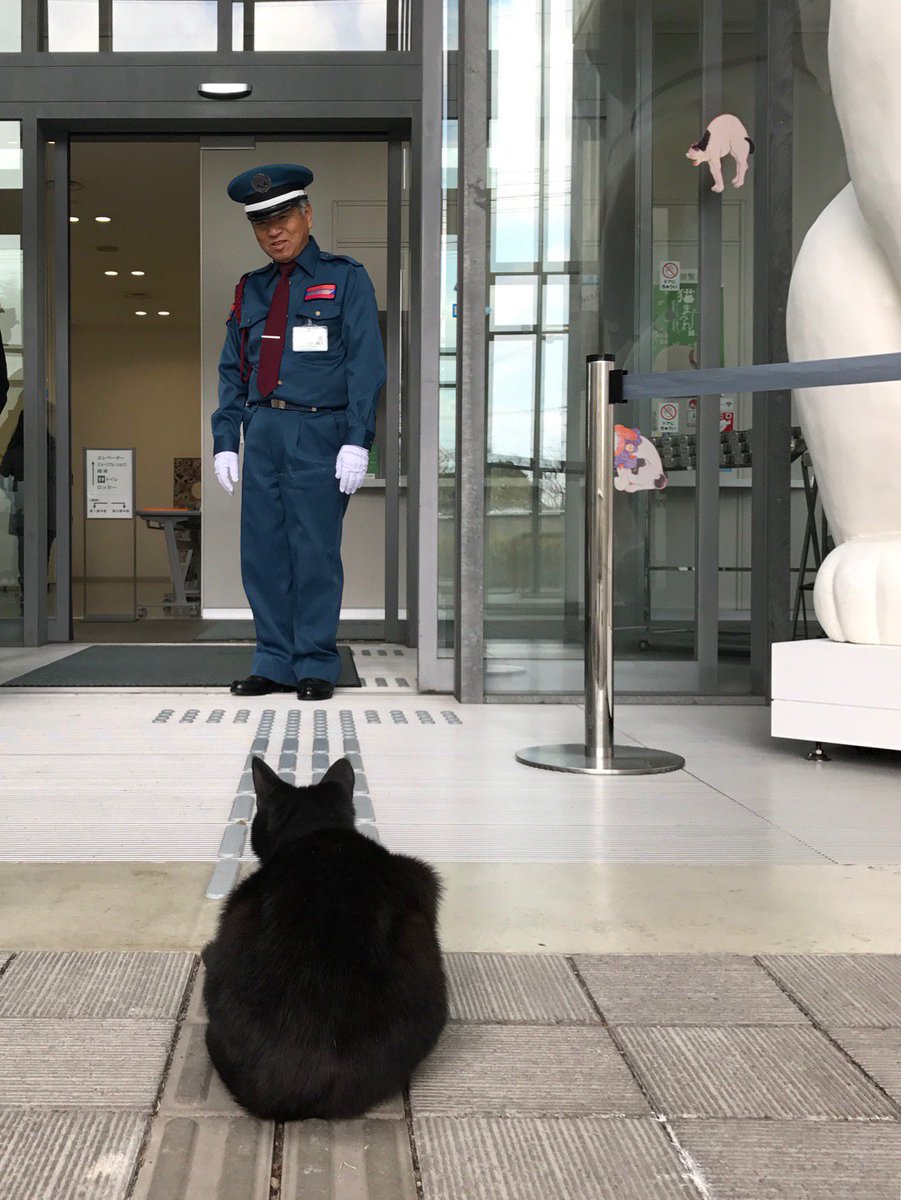
Whatever his reasons, the cat, Ken-chan, whose owners run a nearby restaurant, was refused entry by a white-gloved security guard and other staffers, whose efforts to send him on his way started blowing up the Internet shortly after his first appearance.
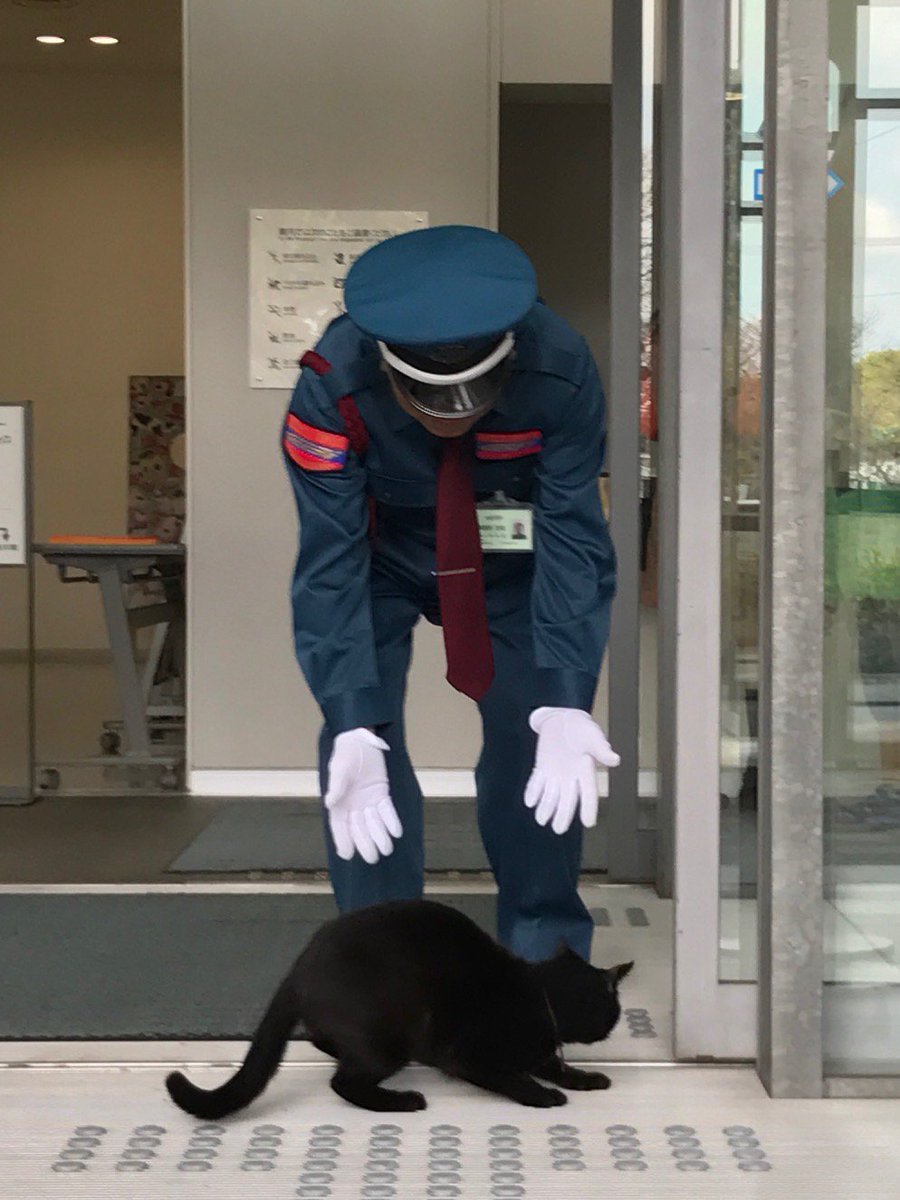
Eventually, Ken-chan started bringing back-up in the form of a well-mannered orange tomcat the museum staff dubbed Go-chan.
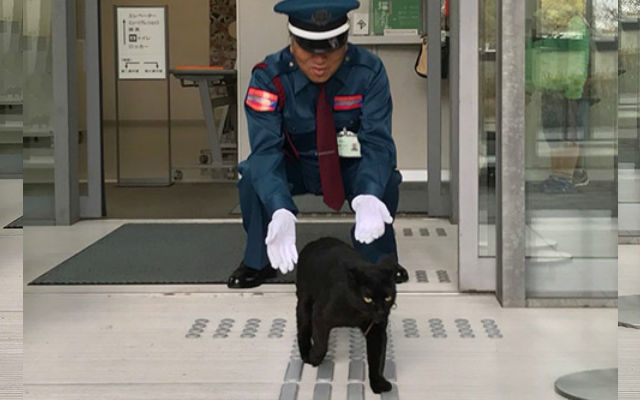
Their visits have proved to be a boon for both the small museum and the city they call home.
The New York Public Library has its lions.
Boston’s Public Garden has its ducks.
Onomichi and its small art museum have Ken-chan and Go-chan, whose Internet fame is quickly outpacing the supply of commemorative tote bags, below.

Tender hearted fans bombard the museum’s Twitter account with requests to grant the feline pair entry, but the museum brass is wisely prioritizing dramatic tension over consummation.
Meanwhile, officials in Zelenogradsk, a Russian resort town boasting both a cat museum and giant cat street monument have invited Ken-chan, Go-chan, and museum staff to be their guests in March, for a cat-centric holiday celebration.
For now, Ken-chan and Go-chan are sticking close to home, alternately entertaining and disappointing visitors who show up, camera in hand, hoping to catch them in the act.
Armchair travelers can enjoy a cat’s eye view tour of Onomichi, thanks to Google Street View-style 360-degree camera technology.
And photographer Iwago shares some pro advice for anyone seeking to capture feline subjects:
…male cats are easier to photograph. Male cats seem to have more latitude and leisure in their lives. Because females do things such as raise the kittens, they concentrate more on what goes on around them. Because males are out on patrol, it is more likely that you will encounter them. Because they have the free time, they’ll let you hang out and photograph them.
Depending on the cat, there are a number of ways to get a cat’s attention. For example, when it’s starting to get dark out, you need to use a lower shutter speed. However, this means that the cat will be blurry if it moves. To avoid this, in such situations, I say to the cat, ‘Stop, hold your breath!’ At that instant, when the cat is frozen, I snap the picture. When you speak out to a cat, they get the message. That said, you can also get shots of good cat body language by letting them roam freely. They don’t need to be looking at the camera.
Even a cellphone camera is enough. However, if you don’t have a telephoto lens, you’re going to have to get close to the cat you’re photographing. Due to this, it might be good to use a single-lens reflex (SLR) camera if you are photographing outside. However, if you are photographing the cat you live at home with, a big camera may prove intimidating. To avoid this problem, it is necessary to regularly put your camera in a place that the cat can see. It is good to start snapping pictures only after your cat has gotten over its fear of cameras. If you use a flash to photograph cats indoors, their hair will look spiky and lose its softness. Therefore, I recommend avoiding a flash. I also recommend not using a tripod, considering the line of sight will become too high. When I am photographing cats, I kneel down so that I am at the same eye line as they are. It’s as if I’m crawling forward into battle.

Follow the Onomichi City Museum of Art on Twitter to keep up with Ken-chan and Go-chan.
via The Guardian/Hyperallergic
Related Content:
Insanely Cute Cat Commercials from Studio Ghibli, Hayao Miyazaki’s Legendary Animation Shop
Free Entertainment for Cats and Dogs: Videos of Birds, Squirrels & Other Thrills
Ayun Halliday is an author, illustrator, theater maker and Chief Primatologist of the East Village Inky zine. Join her in NYC this December for the 10th anniversary production of Greg Kotis’ apocalyptic holiday tale, The Truth About Santa, and the next monthly installment of her book-based variety show, Necromancers of the Public Domain. Follow her @AyunHalliday.
Read More...Malcolm Gladwell and Rick Rubin Launch a New Music Podcast, Broken Record: Listen Online

This past month, Malcolm Gladwell (author), Rick Rubin (record producer), and Bruce Headlam (media desk editor of the New York Times) teamed up to launch Broken Record. It’s a music podcast that doubles as “liner notes for the digital age.” Or, as Gladwell tells Rolling Stone, it’s “a kind of musical variety show.” Some episodes offer an in-depth narrative. Others feature mini performances and interviews with musicians–plus an assortment of “digressions, arguments, back-stories, and random things to disagree with about music.”
The episodes released so far can be streamed online here. For new episodes, subscribe to the podcast via iTunes or Spotify. The latest episode with Niles Rodgers and Chic appears below:
If you would like to support the mission of Open Culture, consider making a donation to our site. It’s hard to rely 100% on ads, and your contributions will help us continue providing the best free cultural and educational materials to learners everywhere. You can contribute through PayPal, Patreon, and Venmo (@openculture). Thanks!
Related Content:
Rick Rubin Revisits the Origins of Def Jam Records & the NYU Dorm Room Where It All Began
Read More...In 17th-Century Japan, Creaking Floors Functioned as Security Systems That Warned Palaces & Temples of Approaching Intruders and Assassins
Offer a cutting-edge security system, and you’ll suffer no shortage of customers who want it installed. But before our age of concealed cameras, motion sensors, retinal scanners, and all the other advanced and often unsettling technologies known only to industry insiders, how did owners of large, expensive, and even royalty-housing properties buy peace of mind? We find one particularly ingenious answer by looking back about 400 years ago, to the wooden castles and temples of 17th-century Japan.
“For centuries, Japan has taken pride in the talents of its craftsmen, carpenters and woodworkers included,” writes Sora News 24’s Casey Baseel. “Because of that, you might be surprised to find that some Japanese castles have extremely creaky wooden floors that screech and groan with each step. How could such slipshod construction have been considered acceptable for some of the most powerful figures in Japanese history? The answer is that the sounds weren’t just tolerated, but desired, as the noise-producing floors functioned as Japan’s earliest automated intruder alarm.”
In these specially engineered floors, “planks of wood are placed atop a framework of supporting beams, securely enough that they won’t dislodge, but still loosely enough that there’s a little bit of play when they’re stepped on.” And when they are stepped on, “their clamps rub against nails attached to the beams, creating a shrill chirping noise,” rendering stealthy movement nearly impossible and thus making for an effective “countermeasure against spies, thieves, and assassins.”

According to Zen-Garden.org, you can still find — and walk on — four such uguisubari, or “nightingale floors,” in Kyoto: at Daikaku-ji temple, Chio-in temple, Toji-in temple, and Ninomura Palace.
If you can’t make it out to Kyoto any time soon, you can have a look and a listen to a couple of those nightingale floors in the short clips above. Then you’ll understand just how difficult it would have been to cross one without alerting anyone to your presence. This sort of thing sends our imaginations straight to visions of highly trained ninjas skillfully outwitting palace guards, but in their day these deliberately squeaky floors floors also carried more pleasant associations than that of imminent assassination. As this poem on Zen-Garden.org’s uguisubari page says says:
鳥を聞く
歓迎すべき音
鴬張りを渡る
A welcome sound
To hear the birds sing
across the nightingale floor
Related Content:
Omoshiroi Blocks: Japanese Memo Pads Reveal Intricate Buildings As The Pages Get Used
A Virtual Tour of Japan’s Inflatable Concert Hall
Based in Seoul, Colin Marshall writes and broadcasts on cities, language, and culture. His projects include the book The Stateless City: a Walk through 21st-Century Los Angeles and the video series The City in Cinema. Follow him on Twitter at @colinmarshall or on Facebook.
Read More...Support Us
We're hoping to rely on loyal readers, rather than erratic ads. Please click the Donate button and support Open Culture. You can use Paypal, Venmo, Patreon, even Crypto! We thank you!

About Us

Open Culture scours the web for the best educational media. We find the free courses and audio books you need, the language lessons & educational videos you want, and plenty of enlightenment in between.
Advertise With Us

FREE UPDATES!
GET OUR DAILY EMAIL
Get the best cultural and educational resources on the web curated for you in a daily email. We never spam. Unsubscribe at any time.
FOLLOW ON SOCIAL MEDIA

Open Culture editor Dan Colman scours the web for the best educational media. He finds the free courses and audio books you need, the language lessons & movies you want, and plenty of enlightenment in between.
Advertise With Us


