Watch Classic Performances by Peter Green (RIP), Founder of Fleetwood Mac & the Only British Blues Guitarist Who Gave B.B. King “the Cold Sweats”
Update: According to the BBC, Peter Green died peacefully in his sleep this weekend, at the age of 73.
“Of all the guitar giants to emerge from the British blues boom,” writes Stuart Penny at Empty Mirror, “Peter Green was perhaps the most naturally gifted.” After replacing Eric Clapton in John Mayall & the Bluesbreakers (and earning the nickname “The Green God”), the guitarist formed his own band, originally given the unwieldy name “Peter Green’s Fleetwood Mac featuring Jeremy Spencer.” Soon shortened to Fleetwood Mac, the band recorded their debut, eponymous album in 1968, and went on in the following year to spend “more weeks on the UK singles charts than the Beatles, the first time anyone had achieved that feat since 1963.”
Sadly, Green succumbed to what Penny describes as “the early onset of mental illness thought to be the result of an unsolicited LSD experience in Munich, Germany.” He left his band and joined the ranks of other wildly talented 60s musicians like Syd Barrett, Roky Erickson, and Moby Grape’s Skip Spence whose careers were cut short by serious mental health issues apparently brought on, or worsened, by serious drug use.
Green began to be forgotten, especially as his legacy with Fleetwood Mac was overshadowed by albums like the legendary Rumours and the band’s second self-titled record.
1975’s Fleetwood Mac was like a reboot of the band after the introduction of Stevie Nicks and Lindsey Buckingham, who resisted playing any of the old material. Fans may get to hear those old songs live again—Fleetwood Mac is back and touring, and they’ve even reignited old feuds by firing Buckingham (he’s suing, of course). The move gives them the freedom draw from their back catalog again. Nicks remarked in May, “we’re gonna lock in to the history of Fleetwood Mac, which we were never able to do since 1975, because certain people in the band weren’t really interested in doing that.”
Green won’t take part in the band’s revisiting of old material. But he deserves full credit for the band’s success, despite its many successful reinventions, as Mick Fleetwood told the Irish Times last year.
For his legacy I think it’s important we remember that Fleetwood Mac was, first and foremost, a blues band. We all played and loved blues. And long after Peter left, we went to Chess Records in Chicago where we recorded with Willie Dixon and Buddy Guy. Can you imagine how that made us feel? Such an incredible experience could not have happened without Peter because, even though he wasn’t with us, the reason there’s a Fleetwood Mac at all is because of him.
Green made four albums with the band before departing in 1970 and scored a hit with the single “Black Magic Woman,” before Carlos Santana made the song his own. Like Barrett, Spence, and Erickson, he continued making music after leaving his famous band, recording in the early 70s with former bandmate John Mayall. In 1972, he did a session with BB King, who called him the only British blues guitarist “who gave me the cold sweats.” Voted the third greatest guitarist of all time by Mojo (after Hendrix and Steve Cropper), Green is still revered by diehard fans and guitar players of all kinds, even if his strictly blues-rock version of Fleetwood Mac never had as wide an appeal as the pop juggernaut the band later became.
But the low profile was part of Green’s personality. He has always bristled at the acclaim heaped on his playing, telling The Telegraph in 1996 “If I was a guitar hero, then what does that make my masters and teachers?” As Mick Fleetwood puts it, “Peter could have been the stereotypical guitar player and control freak. But that wasn’t his style. He named the band after the bass player and drummer, for Christ’s sake.” Green’s collaborative spirit and self-effacing manner may be rare qualities for a rock star, but he never seemed to aspire to that role. Nonetheless, he left his mark, as Allmusic’s Thom Jurek writes, as “the terminally shy skinny kid who could rain down fire from the heavens and draw water from the wells of hell on a guitar.”
See and hear some of Green’s classic performances with Fleetwood Mac in the videos here (some with out-of-sync audio), including “Black Magic Woman” at the top. And just above, see a much mellower Green in a much more recent performance playing “Albatross” with an acoustic ensemble.
Related Content:
23-Year-Old Eric Clapton Demonstrates the Elements of His Guitar Sound (1968)
Josh Jones is a writer and musician based in Durham, NC. Follow him at @jdmagness
Read More...Pink Floyd’s “Wish You Were Here” Movingly Performed by the Six-String Soldiers, of The United States Army Field Band
Since 1946, The United States Army Field Band has traveled throughout the world, performing at public concerts, school assemblies, educational outreach programs, and other venues. Above you can watch one of the band’s performing units–the Six-String Soldiers–play an acoustic version of Pink Floyd’s “Wish You Were Here.” Because we all know someone we surely miss. To explore more of their work, see their cover versions of The Allman Brothers’ “Ramblin’ Man” and The Beatles’ “Strawberry Fields Forever.”
If you would like to support the mission of Open Culture, consider making a donation to our site. It’s hard to rely 100% on ads, and your contributions will help us continue providing the best free cultural and educational materials to learners everywhere. You can contribute through PayPal, Patreon, and Venmo (@openculture). Thanks!
Related Content:
Download Pink Floyd’s 1975 Comic Book Program for The Dark Side of the Moon Tour
Understanding Pink Floyd’s Wish You Were Here, Their Tribute to Departed Bandmate Syd Barrett
Read More...Behold the Original Deck of Oblique Strategies Cards, Handwritten by Brian Eno Himself
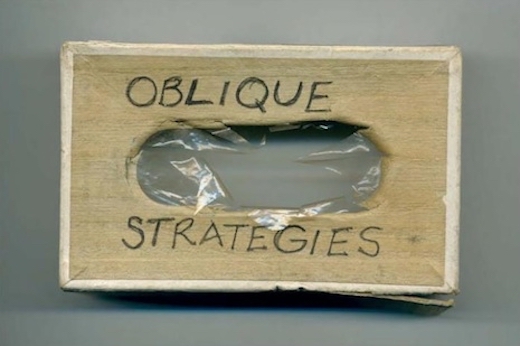
“Honor thy error as a hidden intention.” “Work at a different speed.” “Try faking it!” These suggestions will sound familiar to everyone who’s ever flipped through the deck of cards known as Oblique Strategies. You can now do that digitally, of course, but Oblique Strategies remains an essentially physical experience, one whose shuffling and drawing reminds the user that they’re drawing from the well of chance for a way to break them through a creative impasse or just rethink part of a project. It also began as thoroughly a physical experience, invented by producer-artist-ambient musician Brian Eno and painter Peter Schmidt, who first came up with them in the pre-digital days of 1974.

Back then, writes Dangerous Minds’ Martin Schneider, the concept for Eno and Schmidt’s “set of 115 cards with elliptical imperatives designed to spark in the user creative connections unobtainable through regular modes of work” emerged as a form of “radical intervention with roots in Eastern philosophy.”
Having first come on the market in the 1970s, Oblique Strategies has gone through several different production runs, usually packaged in handsome boxes with the deck’s name emblazoned in gold. “The first four editions are out of print and collector’s items (and priced to match). The 5th edition is currently available from Eno’s website for £30 (about $50). In 2013 a limited 6th edition of 500 numbered sets were available but quickly sold out.” At this moment, you can find one imported set on Amazon.
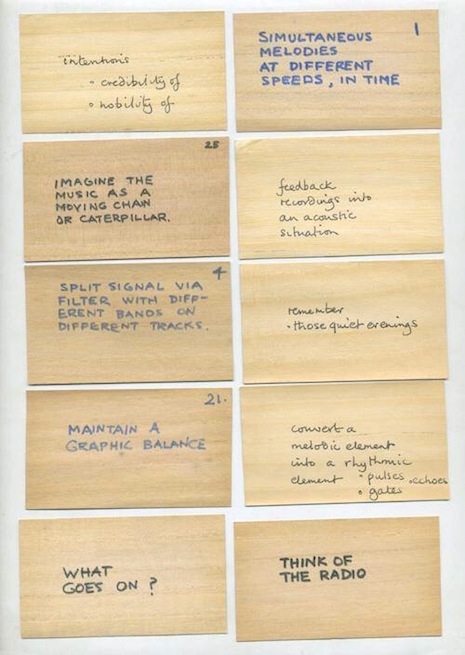
But it seems that the very first set of Oblique Strategies, featured in Schneider’s post, is unavailable at any price. Written in Eno’s own hand, sometimes cursive and sometimes block, on cards with a wooden-looking texture and without the rounded corners that characterize the commercial version, these first Oblique Strategies include “Don’t be frightened to display your talents,” “If a thing can be said, it can be said simply,” and “Do we need holes?” Those who have followed Eno’s work will surely appreciate in particular the card that says to “use non-musicians,” “non-musician” being one of Eno’s preferred titles for himself, especially when working in a musical capacity. The total package of Oblique Strategies may have grown more refined over the years, but this handmade first set does have a certain immediacy, and also, in a sense, the imprimatur of history: after all, they worked for Brian Eno.
Related Content:
Jump Start Your Creative Process with Brian Eno’s “Oblique Strategies” Deck of Cards (1975)
Marshall McLuhan’s 1969 Deck of Cards, Designed For Out-of-the-Box Thinking
Brian Eno on Creating Music and Art As Imaginary Landscapes (1989)
Based in Seoul, Colin Marshall writes and broadcasts on cities, language, and culture. His projects include the book The Stateless City: a Walk through 21st-Century Los Angeles and the video series The City in Cinema. Follow him on Twitter at @colinmarshall or on Facebook.
Read More...The Thoughtful Note That George H.W. Bush Left on Bill Clinton’s Desk Before Leaving the White House (1993)
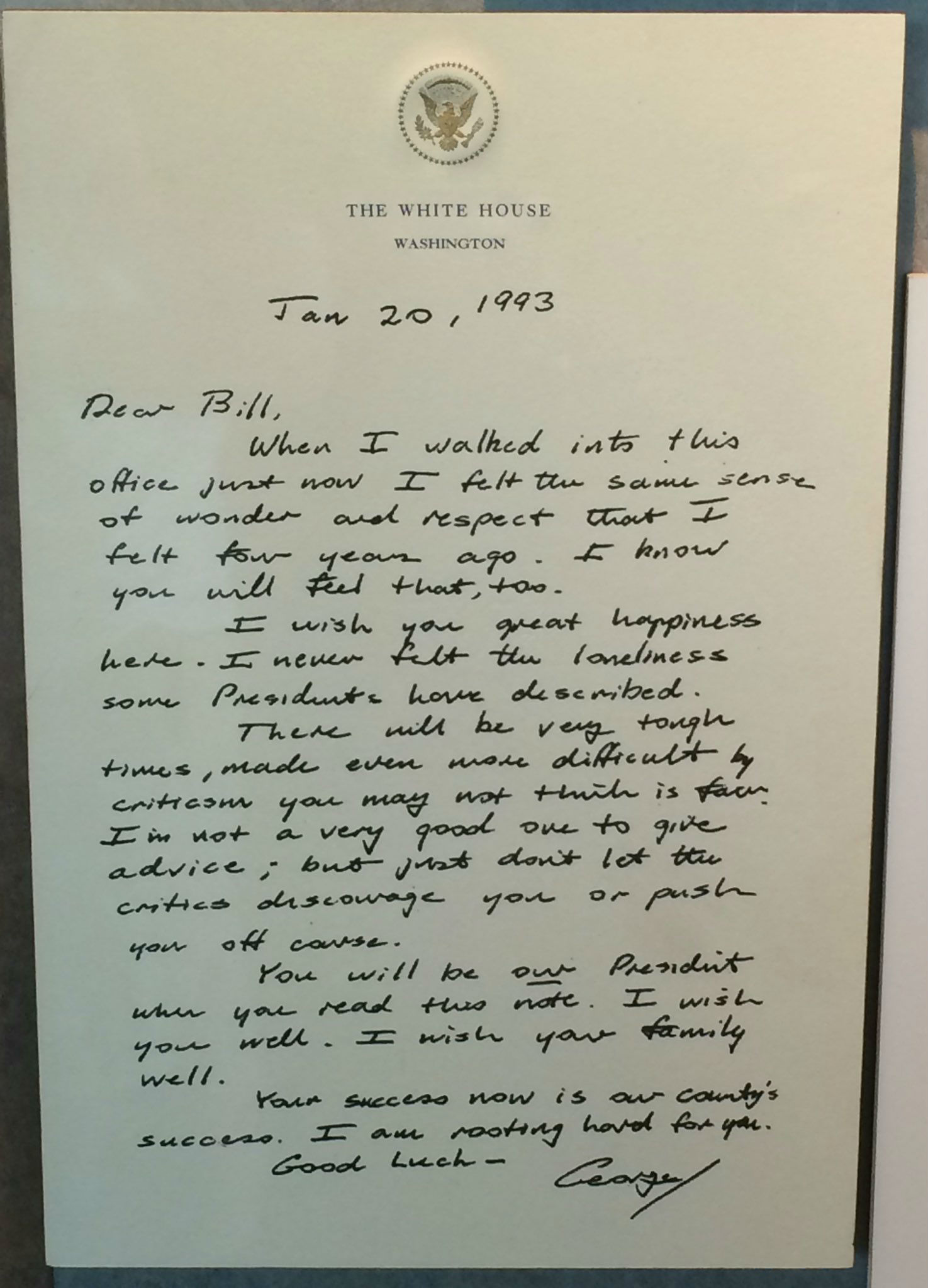
With the passing of George H.W. Bush, Bill Clinton reflected on the life and legacy of his political predecessor, and particularly the thoughtful note that Bush 41 left on his desk, right before leaving the White House. Dated January 20, 1993, it read:
Dear Bill,
When I walked into this office just now I felt the same sense of wonder and respect that I felt four years ago. I know you will feel that, too.
I wish you great happiness here. I never felt the loneliness some Presidents have described.
There will be very tough times, made even more difficult by criticism you may not think is fair. I’m not a very good one to give advice; but just don’t let the critics discourage you or push you off course.
You will be our President when you read this note. I wish you well. I wish your family well.
Your success now is our country’s success. I am rooting hard for you.
Good luck—
George
It’s hard not to see this letter as a relic of an irretrievable age in American politics. But Clinton won’t quite buy that. He writes today in the Washington Post: “Given what politics looks like in America and around the world today, it’s easy to sigh and say George H.W. Bush belonged to an era that is gone and never coming back — where our opponents are not our enemies, where we are open to different ideas and changing our minds, where facts matter and where our devotion to our children’s future leads to honest compromise and shared progress. I know what he would say: ‘Nonsense. It’s your duty to get that America back.’ ” Soon enough, after enough sturm and drang, the majority of Americans (Electoral College included) may be ready to sign up for that.
If you would like to support the mission of Open Culture, consider making a donation to our site. It’s hard to rely 100% on ads, and your contributions will help us continue providing the best free cultural and educational materials to learners everywhere. You can contribute through PayPal, Patreon, and Venmo (@openculture). Thanks!
Related Content:
The 2,000+ Films Watched by Presidents Nixon, Carter & Reagan in the White House
Gonzo Illustrator Ralph Steadman Draws the American Presidents, from Nixon to Trump
Barack Obama Shares a List of Enlightening Books Worth Reading
Read More...When South Africa Banned Pink Floyd’s The Wall After Students Chanted “We Don’t Need No Education” to Protest the Apartheid School System (1980)
When Apartheid states get the blessing of powerful nations, lobbies, and corporations, they seem to feel empowered to do whatever they want. Such was the case, for a time, in South Africa, the country that coined the term when it put its version of racial segregation in place in 1948. The Apartheid system finally collapsed in 1991, decades after its counterpart in the U.S.—its undoing the accumulated weight of global condemnation, UN sanction, boycotts, and growing pressure from citizens in wealthy countries.
Of course, central to Apartheid’s demise were the outcries and actions of celebrity musicians. One such celebrity, Roger Waters, hasn’t stopped using his fame to lobby for change, a characteristic that can sometimes make him seem sanctimonious, but which also gave his most compelling Pink Floyd songs an urgency and bite that holds many decades later, even though the circumstances are much changed (or not). Lines like “we don’t need no thought control” have as much currency now as they did forty years ago.
No doubt, some of the most strident, personal, and powerful music Waters wrote for the band comes from The Wall. The rock opera to beat all rock operas, it turned out, provided a rallying cry for South African students, who chanted the notorious lyrics sung by a children’s chorus in “Another Brick in the Wall (Part II)” to protest racial inequalities in the school system. “We don’t need no education,” they sang in unison, and the song “held the top spot on the local charts for almost three months,” writes Nick Deriso at Ultimate Classic Rock, “a total of seven weeks longer than it did in America.”
Threatened by the phenomenon, the South African government banned the song, then the whole album, in 1980, imposing what Waters called “a cultural blockade… on certain songs.” Deriso explains that “South Africa’s Directorate of Publications held sweeping power in that era to ban books, movies, plays, posters, articles of clothing and, yes, music that it deemed ‘political or morally undesirable.’” The censors were not the only people to interpret the song as a threat. “People were really driven to frenzies of rage by it,” Waters remembers.
He has since played the song all over the world, including Berlin in 1990, and he spray painted its lyrics on the wall in the West Bank in 2006. “Twenty-five years later,” he writes at The Guardian, The Wall still resonated, this time with Palestinian children, who “used the song to protest Israel’s wall around the West Bank. They sang: ‘We don’t need no occupation! We don’t need no racist wall!” Waters compares the current boycott campaign to the refusal of major stars in the 80s to play South Africa’s Sun City resort “until apartheid fell and white people and black people enjoyed equal rights.”
As for the durability of “Another Brick in the Wall (Part II)” as a rallying cry for young activists, the best comment may come from an unlikely source—the Archbishop of Canterbury, who “went on record,” Waters writes, “saying that if it’s very popular with school kids, then it must in some way be expressing some feelings that they have themselves. If one doesn’t like it, or however one feels about it, one should take the opportunity of using it as a starting point for discussion—which was exactly how I felt about it.”
Related Content:
Understanding Pink Floyd’s Wish You Were Here, Their Tribute to Departed Bandmate Syd Barrett
Josh Jones is a writer and musician based in Durham, NC. Follow him at @jdmagness
Read More...Mira Nair, Director of Monsoon Wedding and The Namesake, Teaches an Online Course on Indie Filmmaking
FYI: Mira Nair, the director of Monsoon Wedding and The Namesake, has just released an online masterclass on independent filmmaking. In 17 video lessons, the Oscar-nominated director teaches students how to “make a big impact on a small budget, evoke the best from actors and non-actors, and protect your creative vision so you tell the story that can only come from you.” Nair’s course runs $90. But for $180, you can get an All-Access Pass to Masterclass’ catalogue of 45 courses, which includes courses by a number of other prominent filmmakers–Martin Scorsese, Spike Lee, Ken Burns, Ron Howard, Werner Herzog and more. Not to mention actors and actresses like Samuel L. Jackson and Helen Mirren.
FYI: If you sign up for a MasterClass course by clicking on the affiliate links in this post, Open Culture will receive a small fee that helps support our operation.
Related Content:
Werner Herzog Offers 24 Pieces of Filmmaking & Life Advice
Director Robert Rodriguez Teaches The Basics of Filmmaking in Under 10 Minutes
The Student of Prague: The Very First Independent Film (1913)
Read More...Blade Runner Getting Adapted into a New Anime Series, Produced by Cowboy Bebop Animator Shinichiro Watanabe
You may remember, in the run-up to the theatrical release of Blade Runner 2049 last October, that three short prequels appeared on the internet. Black Out 2022 (above), the most discussed installment of that miniature trilogy, stood out both aesthetically and culturally: directed by famed Japanese animator Shinichiro Watanabe, it expanded the reality of Blade Runner through a form that has drawn so much from that universe over the previous 35 years. “I just want an animated bladerunner series now,” says the current top-rated comment below that video, “this was magical.” And so, a year later, the answer to the prayer of that commenter (and clearly many other viewers besides) has appeared on the horizon: a Japanese animated series called Blade Runner — Black Lotus.
Overseen by Watanabe in the producer role and directed by Kenji Kamiyama and Shinji Aramaki, the latter of whom worked in the art department on Black Out 2022, the new series will take place in 2032, between the events of the short and those of Blade Runner 2049.
“It will also include some ‘established characters’ from the Blade Runner universe, but that could mean all sorts of things,” writes The A.V. Club’s Sam Barsanti. “Harrison Ford’s Rick Deckard would already be in hiding at that point after fathering the miracle replicant baby, so it could be about him going off on some cool guy adventures, but Deckard doesn’t exactly seem like a guy who goes on cool guy adventures. Ryan Gosling’s K probably wasn’t ‘born’ yet, since he’s a Nexus‑9 replicant and those weren’t created until later in the 2030s, but we don’t know for sure.”
Perhaps supporting characters from both movies, “like Edward James Olmos’ Gaff (he might still be an LAPD cop) or Jared Leto’s Niander Wallace (he’s definitely hanging around, being an evil rich guy),” will show up. Whatever happens, the thirteen episodes of Blade Runner — Black Lotus will certainly have no small amount of both familiarity and surprise in store for fans of Blade Runner, as well as those of Watanabe’s other work. That goes especially for his philosophical space bounty-hunter series Cowboy Bebop, itself the source material for a new live-action television series on Adult Swim, who will air Blade Runner — Black Lotus at the same time as it’s streamed on anime site Crunchyroll.com. No release date has thus far been announced, but odds are the show’s debut will happen some time in 2019 — the perfect year for it, as everyone thrilling to the prospect of more Blade Runner already knows.
Related Content:
Three New Prequels Get You Ready to Watch Blade Runner 2049
How Ridley Scott’s Blade Runner Illuminates the Central Problem of Modernity
Based in Seoul, Colin Marshall writes and broadcasts on cities, language, and culture. His projects include the book The Stateless City: a Walk through 21st-Century Los Angeles and the video series The City in Cinema. Follow him on Twitter at @colinmarshall or on Facebook.
Read More...Andy Kaufman Creates Mayhem on Late Night TV: When Comedy Becomes Performance Art (1981)
While there are many styles of comedy, the contract between comedian and audience is a fairly standard one. The comedian endeavors to get laughs. The audience understands that sort of currency, and is eager to lavish it on deserving candidates.
The late Andy Kaufman wasn’t much interested in that sort of exchange.
His comedy was experimental to the point of performance art, and often felt experimental in a scientific sense as well. When he read long passages from The Great Gatsby to comedy club audiences, went after professional wrestlers twice his size, or insisted he’d found Jesus and gotten engaged to a Lawrence Welk Show singer, it was as if he was conducting a stress test. How much disorientation would an audience put up with?
He was a genuine weirdo. The genius kid who seems hellbent on winning the animosity of his classmates with his cryptic remarks and odd behavior.
Knowing young comedy fans who idolize prankster Sacha Baron Cohen’s shapeshifting stunts may find it hard to appreciate just how unsettling the off-kilter Kaufman could be.
Witness his 1981 guest spot on Fridays, a rival network’s short-lived attempt to duplicate Saturday Night Live’s success.
In the sketch above, Kaufman wanders pretty egregiously afield of expected conduct. In an era where guest stars appeared not infrequently bombed out of their gourds, it wasn’t entirely surprising that one might appear confused, or have trouble reading cue cards. But Kaufman seemed to be making a deliberate choice to scupper his career, or at the very least, the goodwill of Fridays’ cast and crew, by refusing to play along in a sketch about restaurant patrons sneaking off to the bathroom to get high.
“I can’t play stoned,” he breaks character to announce, mid-scene. Hmm. Seems like the kind of thing one might bring up during the table read. An a‑hole would wait till dress rehearsal, when such a move would for sure inspire the enmity of cast and crew. Kaufman waited till the sketch was being taped in front of a live studio audience.
But then, Kaufman’s experiments needed an audience to succeed.
As with Sacha Baron Cohen’s elaborate ruses, it helped to limit the number of people who were in on the joke.
Actor Melanie Chartoff recalled how she and Kaufman’s other two scene partners, Mary Edith Burrell and Seinfeld’s Michael Richards, were tipped off fairly late in the process by producer/announcer Jack Burns, who was thrilled to snap up the live wire whose antics had permanently burned his bridges with Saturday Night Live:
Andy’s gonna bust out of the show tonight,” he gleamed. “He’s gonna mess up and break the fourth wall from the top of the monologue. It’s gonna be great. It’s gonna kick our ratings through the ROOF!
And so it did, abetted by benighted crew members who sprang to provide back up, when a furious-seeming Burns stormed the set as if to kick the ornery guest star’s ass.
But the piece de resistance came the following week, when producer John Moffitt went on air to satisfy the public’s need to know, confessing that the stunt was indeed a fake and piously suggesting they should take it as a reminder of the “spontaneity of live television, something that rarely happens in this basically passive medium today.”
Then Kaufman—who genuinely hated that his sleight of hand had been revealed—turned on Moffitt for the halting, miserable, and seemingly forced 4 minute apology below.
When the live audience laughed delightedly, he lashed out, insisting that his previous week’s actions were about to cost him his gig on the hit sitcom Taxi, all future roles, a number of friendships, and his marriage.
Never mind that he was unmarried.
This comedian played a long game, and easy laughs were never the goal.
Related Content:
A Look Back at Andy Kaufman: Absurd Comic Performance Artist and Endearing Weirdo
The Improbable Time When Orson Welles Interviewed Andy Kaufman (1982)
Ayun Halliday is an author, illustrator, theater maker and Chief Primatologist of the East Village Inky zine. Join her in NYC this December for the 10th anniversary production of Greg Kotis’ apocalyptic holiday tale, The Truth About Santa, and the next monthly installment of her book-based variety show, Necromancers of the Public Domain. Follow her @AyunHalliday.
Read More...Watch Queen’s Dragtastic “I Want to Break Free” Video: It Was More Than America & MTV Could Handle (1984)
I remember the early part of 1984 when Queen’s “Radio Gaga,” their single from The Works album with a video that mixed in clips from Fritz Lang’s Metropolis, was played nearly every hour on MTV. Or it least it seemed that way. And then in April, the band released their follow-up single, “I Want to Break Free,” seen above. This is when things got weird for Queen stateside and where truth starts to split from rumor.
In the fine tradition of British pantomime and Monty Python, the band appear in drag, with Mercury in a black leather skirt vacuuming the floor of a typical English living room, Brian May in curlers and nightdress; John Deacon as a more conservative grandmother; and Roger Taylor as a schoolgirl. British viewers would have got the joke–the style and dress and setting was a direct parody of popular working class soap opera Coronation Street, and its first shot of chimneys and row houses was a further giveaway.
“We had done some really serious, epic videos in the past, and we just thought we’d have some fun,” said Roger Taylor. “We wanted people to know that we didn’t take ourselves too seriously, that we could still laugh at ourselves. I think we proved that.”
But some Americans apparently did take it seriously and believed the video to be promoting cross-dressing. (There’s no mention whether they thought the middle section, featuring members of the Royal Ballet and a parody of Nijinsky’s Afternoon of a Faun, promoted ballet, leotards, or Claude Debussy).
Now most accounts from here on out say that MTV banned the video, despite the song being in the charts for eight weeks. It failed to be the blockbuster hit like “Radio Gaga,” for sure, and Queen never again really had a foothold on American pop culture until Live Aid, and even then their appearance meant more to the Brits than the Yanks. Queen went from a classic rock act to something the British got and the Americans didn’t.
Brian May agreed that the video was a turning point when he sat for a Terry Gross interview in 2010:
I remember doing a promo tour for this song that we did, which was called “I Want to Break Free.” Now we made a video for that, which was a pastiche of an English soap called “Coronation Street,” and we dressed up as the characters in that soap, and they were female characters. So we’re dressing up as girls — as women and we had a fantastic laugh doing it. It was hilarious to do it. And all around the world people laughed and they got the joke and they sort of understood it.
I remember being on the promo tour in the Midwest of America and people’s faces turning ashen and they would say, no, we can’t play this. We can’t possibly play this. You know, it looks homosexual. And I went, so? But it was a huge deal. And I know that it really damaged our sort of whole relationship with certainly radio in this country and probably the public as well…
But it was very difficult for us to sort of get back. And there’s a whole kind of gap in Queen history if you view it from America. And Freddie was very aware of that. And we never really came back and toured the way we should’ve done. You know, every place else in the world, we played football stadiums. But it never happened in the States. And Freddie, when I played him this thing, said — (laughter) well, he said, you know, it might do for us what nothing else would do, and he was dead right.
You know, it’s amazing that even the fact that Freddie died didn’t make that much of a difference. But the fact that Wayne’s World put it in their film did make a difference. And I suppose the quote that I’m steering clear of is that Freddie, at one point, said to me, you know, I suppose I’ll have to [expletive] die before we ever get big in America again.
While that is true, I’m not too sure about this “banned video” business. I saw this video a lot on MTV. I remember both my parents laughing at the video because it reminded them of the Pythons. And apart from a line repeated over and over on the Internet and in some very recent Queen biographies, it’s hard to find contemporary proof that this ban happened and when.
Being banned has often been great publicity and often ginned up controversy. But if you want to see a definitely banned Queen video, check out “Body Language,” from their 1982 album Hot Space. Filled with sweaty body parts, plenty of leather, and set in some sort of unisex bathhouse, this indeed was banned by MTV. Believe me, I would have remembered seeing this at the time if they hadn’t.
Related Content:
Ted Mills is a freelance writer on the arts who currently hosts the artist interview-based FunkZone Podcast and is the producer of KCRW’s Curious Coast. You can also follow him on Twitter at @tedmills, read his other arts writing at tedmills.com and/or watch his films here.
Read More...How David Lynch Manipulates You: A Close Reading of Mulholland Drive
David Lynch messes with your mind. You’ve probably heard variations on that observation before, as likely to come from people who love Lynch’s films as from those who can’t stand them. Unlike most “normal” filmmakers, who tell stories comfortably ensconced in the reality that the tradition of cinema has built, Lynch has always told his stories in a cinematic reality of his own, built out of the existing elements of cinema but bolted together by him in surprising and often unsettling ways. Hence his name’s long-ago conversion into an adjective: David Lynch movies are Lynchian, and it falls to we who watch them to deal with the psychological effects — frightening, thrilling, completely disorienting, or some combination of those and more — that Lynchianness stirs within us.
In the video essay “Mulholland Drive: How Lynch Manipulates You,” Evan Puschak, better known at the Nerdwriter, breaks down Lynch’s process of mind-messing, at least as it works in one particular scene of one of his best-known and most acclaimed films, Mulholland Drive. Lynch, Puschak explains, “uses expectation as a tool. He wields expectation — the expectation that comes from what we know about film, about its history, the history of stories, and from our humanity — with the same nuance and power as someone else might use light to create a variety of moods in a space.”
Mulholland Drive, which seems to begin as the story of a would-be blonde ingenue arriving in Hollywood with dreams of making it big, gets further and further off kilter as it goes, leveraging the ostensible stiffness and even corniness it dares to present at the beginning to deliver a much darker and more complex cinematic experience in the end. “All throughout the film, from the overdubbed dialogue on down, David Lynch has made us privy to the veneer of things,” says Puschak. “It’s all curiously two-dimensional, and that puts us on our guard, since surfaces are what we get. Lynch encourages us to examine those surfaces, always remaining detached enough for a disinterested, critical view of what we’re seeing.”
But “as with everything that Lynch does, this two-dimensionality, this flatness, is also a deception. While we think we’re on our guard, superior to the cloying emotions of Hollywood wish-fulfillment, Lynch relishes dropping the bottom out, showing us just how unprepared for and susceptible we are to emotions that our society treasures or deeply fears.” In Mulholland Drive he accomplishes this over and over again by using ancient Hollywood stereotypes, film noir tropes, a nightclub singer lip-syncing to a Roy Orbison song in Spanish, a caveman living behind a Sunset Strip diner, Angelo Badalamenti spitting out an espresso, Billy Ray Cyrus, and much more besides. And as both Lynch’s fans and detractors must suspect, he no doubt has a few more ways to drop the bottoms out from under his audiences in his toolbox yet.
Related Content:
The Surreal Filmmaking of David Lynch Explained in 9 Video Essays
What Makes a David Lynch Film Lynchian: A Video Essay
An Animated David Lynch Explains Where He Gets His Ideas
David Lynch Muses About the Magic of Cinema & Meditation in a New Abstract Short Film
Based in Seoul, Colin Marshall writes and broadcasts on cities, language, and culture. His projects include the book The Stateless City: a Walk through 21st-Century Los Angeles and the video series The City in Cinema. Follow him on Twitter at @colinmarshall or on Facebook.
Read More...Support Us
We're hoping to rely on loyal readers, rather than erratic ads. Please click the Donate button and support Open Culture. You can use Paypal, Venmo, Patreon, even Crypto! We thank you!

About Us

Open Culture scours the web for the best educational media. We find the free courses and audio books you need, the language lessons & educational videos you want, and plenty of enlightenment in between.
Advertise With Us

FREE UPDATES!
GET OUR DAILY EMAIL
Get the best cultural and educational resources on the web curated for you in a daily email. We never spam. Unsubscribe at any time.
FOLLOW ON SOCIAL MEDIA

Open Culture editor Dan Colman scours the web for the best educational media. He finds the free courses and audio books you need, the language lessons & movies you want, and plenty of enlightenment in between.
Advertise With Us

