The CIA’s Former Chief of Disguise Show How Spies Use Costumes in Undercover Operations
Think on this as you ready your Halloween finery. Sometimes it’s not a case of winning a costume contest, or impressing your friends with your witty take on current events or pop culture.
Sometimes, masquerade is a thin line between life and death.
The CIA’s former Chief of Disguise, Jonna Mendez, rose up through the ranks, having signed on as receptionist shortly after her fiancé revealed—three days before the wedding—that he was actually an undercover agent.
As Chief of Disguise, her mission was to protect case officers in dangerous situations, as well as foreign sources who routinely put their lives at risk by meeting with American operatives.
Transforming their appearance was an additive proposition—while it’s difficult to make someone shorter, slimmer, or younger, it’s not difficult to render them taller, heavier, older…
In her experience, women are easily disguised as men. (She shared with The New York Times’ Matthew Rosenberg how she herself passed undetected in male mufti, thanks primarily to a lit cigar.)
Men have a tougher time passing as women. Fans of RuPaul’s Drag Race might take exception to this position, were it not for the assertion that blending in is key.
The goal is to be forgettable, not fabulous.
For Americans abroad, this poses certain cultural challenges.
Mendez stresses that disguise is much more than a simple facial transformation, involving makeup, false hair, and prosthetics.
It’s dress, carriage, gait, jewelry, scent…
The biggest American giveaway is our shoes. An Italian civilian can peg ‘em with one swift glance.
Passing requires further behavioral modifications in the realms of table manners, gait, and even hanging out. (Europeans distribute their weight evenly, whereas Americans lean.)
To fly beneath the radar, the disguised operative must shoot to transform every aspect of their appearance. Imagine a survey wherein the participant recalls every physical aspect of someone they’ve just encountered. The goal is to nudge that participant into answering every question incorrectly.
What color are your eyes? Your hair? How much do you weigh? How tall are you? How old? How would you describe your nose? Your voice? Your clothing?
Change it.
Change it all.
You can do so by low tech methods, using whatever is on hand. Mendez once maneuvered an agent out of a tight spot on the Sub-Continent, by improvising a quick change with Dr. Scholl’s powder and cosmetics collected from local CIA wives.
She credits her own second husband, CIA “master of disguise” Tony Mendez (the inspiration for Ben Affleck’s character in Argo) with many trade secrets she put into regular practice: dental facades, speech-altering artificial palettes, prosthetics…
At the high end is the mask she wore to brief former CIA Chief, President George HW Bush, on developments within the disguise program. The President was none the wiser.
Meanwhile, a masked American agent chucked his mask under a Moscow rock when danger compelled him to scupper his mission midway through. That mask now resides in the KGB museum where Mendez cannot visit it.
Check out the Mendezes’ book Spydust for more information on their adventures in the field.
Related Content:
Ayun Halliday is an author, illustrator, theater maker and Chief Primatologist of the East Village Inky zine. Join her in NYC on Monday, November 12 for another monthly installment of her book-based variety show, Necromancers of the Public Domain. Follow her @AyunHalliday.
Read More...David Lynch Is Creating a Virtual Reality Experience for Twin Peaks

David Lynch and Mark Frost’s Black Lodge/Red Room, the extra-dimensional space that is both an integral part of Twin Peaks and iconic in its set design, is a place most of us would not want to visit. Detective Dale Cooper got trapped there for 25 years and it was not pleasant. But that hasn’t stopped fans from wanting to create that space any chance they get, whether as a bar or place to sing karaoke. And when the final episode of the second season showed the lodge was an endless series of rooms connected by hallways, it wasn’t long until the video game versions started appearing.
Well, now you can really get lost in the Black Lodge with the slow unveiling of Twin Peaks VR, which AdWeek says will be available “sometime in 2019” on Steam for HTC Vive and Oculus Rift.
Fans who follow the Welcome to Twin Peaks blog have been hearing about this game/not game since the beginning of the year, but it seems that the footage out there was only proof of concept graphics or some such attempt.
The first video dropped in January of 2018, and it’s er, something:
No doubt made by fans, this gives us a brief visit to the Red Room; a very strange and not particularly flattering portrayal of the Man from Another Place; a trip to the RR Diner featuring what I assume is Major Briggs; and a return to the frightening glass box somewhere in New York City first seen in The Return. The man playing the VR seems appropriately confused. “Is it future or past?” It’s your living room, man!
This second clip gives us a bit more of the Red Room and a dubious looking Audrey Horne. The Convenience Store, however, is well done.
But this is, we stress, nowhere near a finished version. It’s not even clear if any of this will make it into the final version.
A beta version premiered two weeks ago at Lynch’s Festival of Disruption in Los Angeles. AdWeek had the only real description of the five minute demo, which starts near the ring of saplings in Glastonbury Grove:
Immediately after the pool turns to blood, viewers are transported to the Red Room, an extra-dimensional space that’s been a key feature of Twin Peaks in both the original series from the 1990s and the modern revival that aired last year. (It’s also a location frequently visited by the show’s main character, FBI Special Agent Dale Cooper.) Inside the room, viewers aren’t able to walk like they can in some VR experiences, but they’re able to teleport within the room as it rapidly changes in ways similar to what happens in the show itself. (One moment, a statue falls over before running around as a shadow on the other side of a curtain. In another, users can pick up a coffee mug that won’t empty until the second time it’s picked up.) The demo ends as a white horse appears in the room in the distance, surrounded in darkness but unreachable.
The best news is that the company developing the game, Collider Games, is giving creative control to Lynch, so hopefully the game won’t be like those terrible non-Lynch episodes in Season Two. Says AdWeek:
“[T]he more we show, and the more we progress with this development, hopefully the more [Lynch] will want to be involved,” Rassool said. “And the more we can do with maybe even some new narrative—because I’m not going to write new narrative for this. I’m only ever going to let David Lynch [write].”
Here’s to hoping Lynch doesn’t just give us a cheap VR version of what we’ve already seen. Instead, let’s hope he gives us something that blows our minds (and a reason to finally buy a VR headset).
Related Content:
Watch an Epic, 4‑Hour Video Essay on the Making & Mythology of David Lynch’s Twin Peaks
Twin Peaks Tarot Cards Now Available as 78-Card Deck
Play the Twin Peaks Video Game: Retro Fun for David Lynch Fans
David Lynch’s Twin Peaks Title Sequence, Recreated in an Adorable Paper Animation
Ted Mills is a freelance writer on the arts who currently hosts the artist interview-based FunkZone Podcast and is the producer of KCRW’s Curious Coast. You can also follow him on Twitter at @tedmills, read his other arts writing at tedmills.com and/or watch his films here.
Read More...Yale Professor Jason Stanley Identifies 3 Essential Features of Fascism: Invoking a Mythic Past, Sowing Division & Attacking Truth
New books on fascism are popping up everywhere, from independent presses, former world leaders like Madeleine Albright, and academics like Jason Stanley, Jacob Urowsky Professor of Philosophy at Yale University. Stanley’s latest book, How Fascism Works: The Politics of Us and Them, has been described as a “vital read for a nation under Trump.” And yet, as The Guardian’s Tom McCarthy writes, one of the ironies Stanley points out is that—despite the widespread currency of the term these days—fascism succeeds by making “talk of fascism… seem outlandish.”
Is it?
The word has certainly been diluted by years of misuse. Umberto Eco wrote in his 1995 essay “Ur-Fascism” that “fascist” as an epithet was casually thrown around “by American radicals… to refer to a cop who did not approve of their smoking habits.” When every authority figure who seems to abuse power gets labeled a fascist, the word loses its explanatory power and its history disappears. But Eco, who grew up under Mussolini and understood fascist Europe, insisted that fascism has clearly recognizable, and portable, if not particularly coherent, features.
“The fascist game can be played in many forms,” Eco wrote, depending on the national mythologies and cultural history of the country in which it takes root. Rather than a single political philosophy, Eco argued, fascism is “a collage… a beehive of contradictions.” He enumerated fourteen features that delineate it from other forms of politics. Like Eco, Stanley also identifies some core traits of fascism, such as “publicizing false charges of corruption,” as he writes in his book, “while engaging in corrupt practice.”
In the short New York Times opinion video above, Stanley summarizes his “formula for fascism”—a “surprisingly simple” pattern now repeating in Europe, South America, India, Myanmar, Turkey, the Philippines, and “right here in the United States.” No matter where they appear, “fascist politicians are cut from the same cloth,” he says. The elements of his formula are:
1. Conjuring a “mythic past” that has supposedly been destroyed (“by liberals, feminists, and immigrants”). Mussolini had Rome, Turkey’s Erdoğan has the Ottoman Empire, and Hungary’s Viktor Orban rewrote the country’s constitution with the aim of “making Hungary great again.” These myths rely on an “overwhelming sense of nostalgia for a past that is racially pure, traditional, and patriarchal.” Fascist leaders “position themselves as father figures and strongmen” who alone can restore lost greatness. And yes, the fascist leader is “always a ‘he.’”
2. Fascist leaders sow division; they succeed by “turning groups against each other,” inflaming historical antagonisms and ancient hatreds for their own advantage. Social divisions in themselves—between classes, religions, ethnic groups and so on—are what we might call pre-existing conditions. Fascists may not invent the hate, but they cynically instrumentalize it: demonizing outgroups, normalizing and naturalizing bigotry, stoking violence to justify repressive “law and order” policies, the curtailing of civil rights and due process, and the mass imprisonment and killing of manufactured enemies.
3. Fascists “attack the truth” with propaganda, in particular “a kind of anti-intellectualism” that “creates a petri dish for conspiracy theories.” (Stanley’s fourth book, published by Princeton University Press, is titled How Propaganda Works.) We would have to be extraordinarily naïve to think that only fascist politicians lie, but we should focus here on the question of degree. For fascists, truth doesn’t matter at all. (As Rudy Giuliani says, “truth isn’t truth.”) Hannah Arendt wrote that fascism relies on “a consistent and total substitution of lies for factual truth.” She described the phenomenon as destroying “the sense by which we take our bearings in the real world.… [T]he category of truth verses falsehood [being] among the mental means to this end.” In such an atmosphere, anything is possible, no matter how previously unthinkable.
Using this rubric, Stanley links the tactics and statements of fascist leaders around the world with those of the current U.S. president. It’s a persuasive case that would probably sway earlier theorists of fascism like Eco and Arendt. Whether he can convince Americans who find talk of fascism “outlandish”—or who loosely use the word to describe any politician or group they don’t like—is another question entirely.
FYI: You can download Stanley’s new book How Fascism Works, as a free audiobook if you want to try out Audible.com’s no-risk, 30-day free trial program. Find details here.
Related Content:
Umberto Eco Makes a List of the 14 Common Features of Fascism
Josh Jones is a writer and musician based in Durham, NC. Follow him at @jdmagness
Read More...The Art Institute of Chicago Puts 44,000+ Works of Art Online: View Them in High Resolution
After the fire that totally destroyed Brazil’s Museu Nacional in Rio, many people lamented that the museum had not digitally backed up its collection and pointed to the event as a tragic example of why such digitization is so necessary. Just a couple decades ago, storing and displaying this much information was impossible, so it may seem like a strange demand to make. And in any case, two-dimensional images stored on servers—or even 3D printed copies—cannot replace or substitute for original, priceless artifacts or works of art.
But museums around the world that have digitized most–or all–of their collections don’t claim to have replicated or replaced the experience of an in-person visit, or to have rendered physical media obsolete.
Digital collections provide access to millions of people who cannot, or will not, ever travel to the major cities in which fine art resides, and they give millions of scholars, teachers, and students resources once available only to a select few.
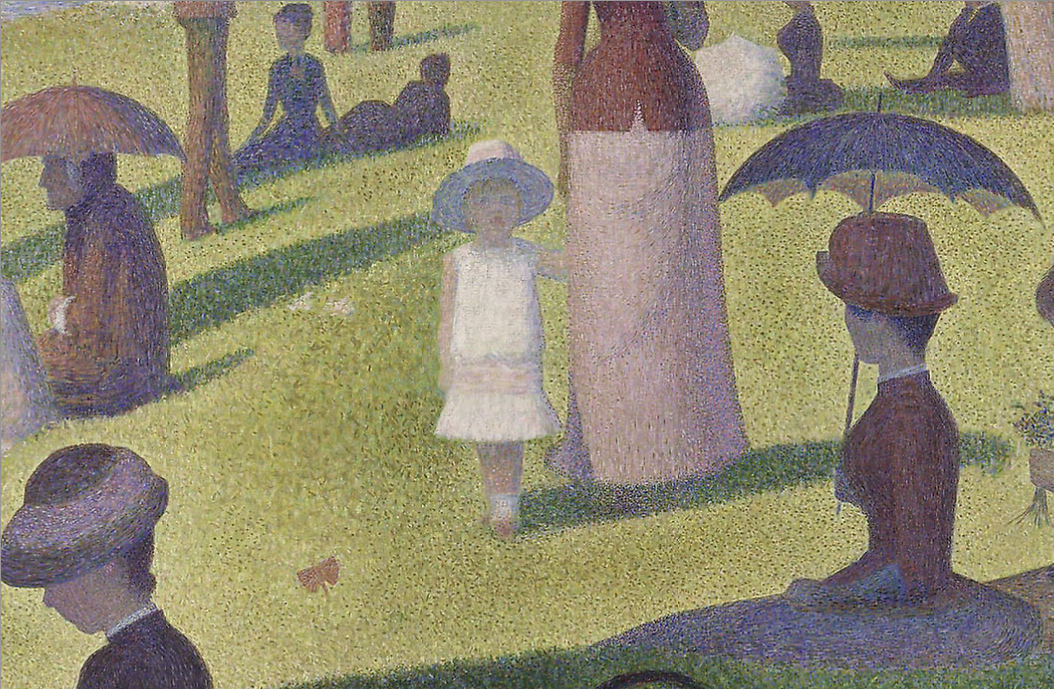
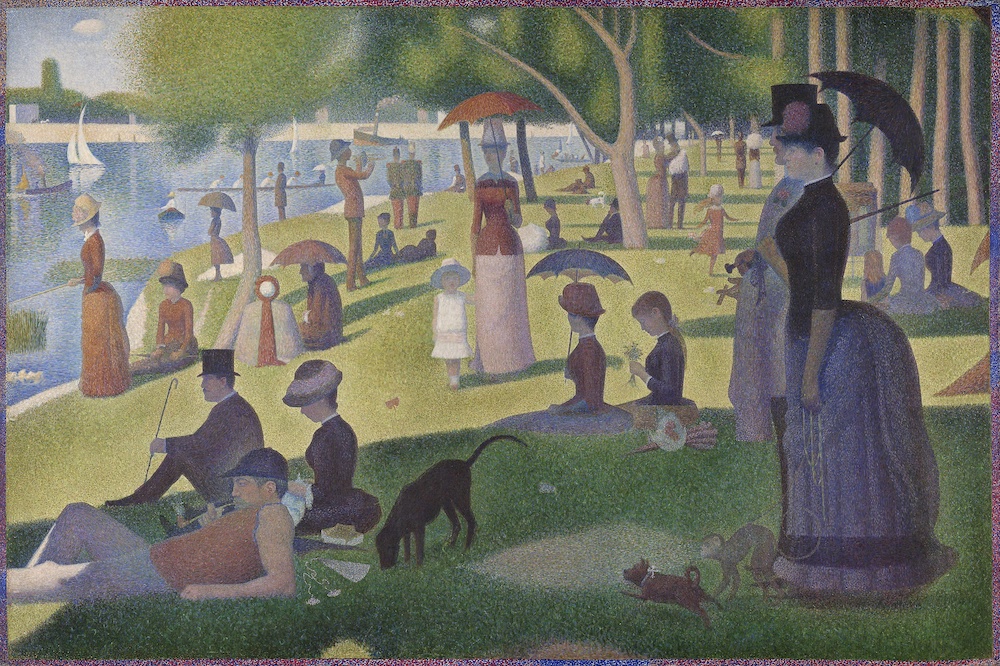
We can’t all take the day off like Ferris Bueller and stand in front of Georges Seurat’s Sunday Afternoon on the Island of La Grande Jatte. But thanks to the Art Institute of Chicago, we can all view and download the 1884 pointillist painting in high resolution, zoom in closely like the troubled Cameron to specific details, share the digital image under a Creative Commons Zero license, and similarly interact with an oil sketch for the final painting and several conté crayon studies.

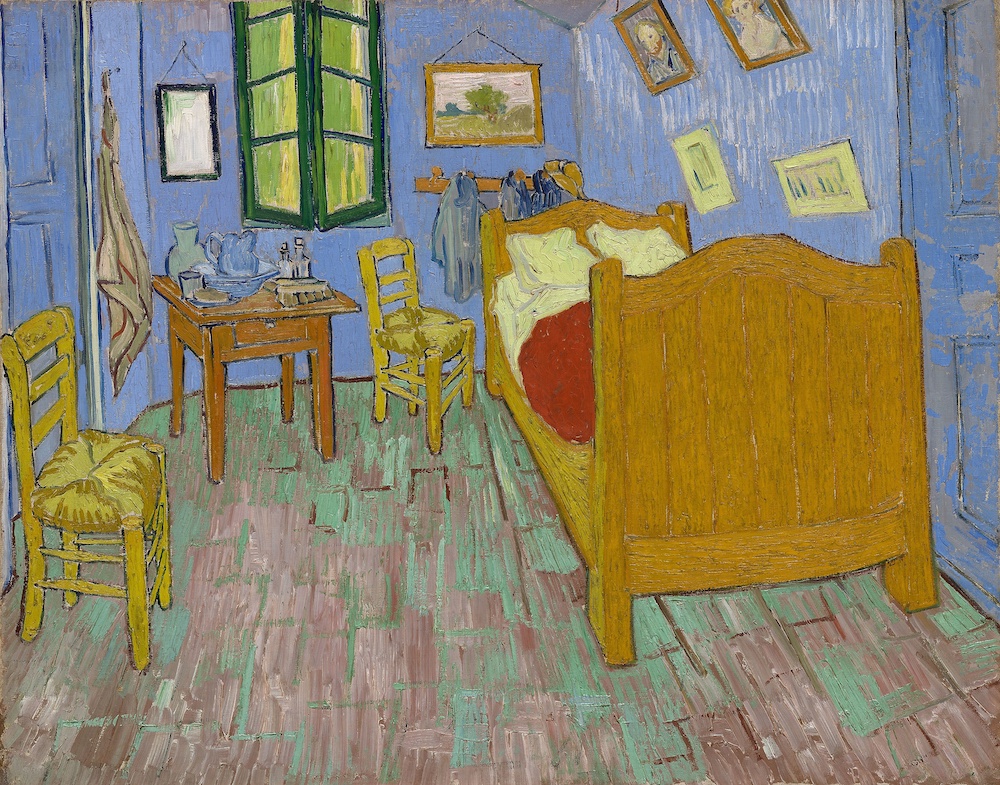
And if that weren’t enough, the museum also includes a bibliography, exhibition history, notes on provenance, audio and video histories and descriptions, and educational resources like teacher manuals, lesson plans, and exams. This goes for many of the 44,312—with more to come—digital images online, including such famous works of art as Vincent van Gogh’s 1889 The Bedroom, Grant Wood’s 1930 American Gothic, Pablo Picasso’s 1903–4 blue period painting The Old Guitarist, Edward Hopper’s 1942 Nighthawks, Mary Cassatt’s 1893 The Child’s Bath, and so many more that it boggles the mind.

Browse Impressionism, Pop Art, works from the African Diaspora, Cityscapes, Fashion, Mythological Works, and other genres and categories. Search artists, dates, styles, media, departments, places, and more.
A personal visit to the Art Institute is an awe-inspiring, and somewhat overwhelming experience, if you can get the day to go. You can visit the website, with full unrestricted access, and gather information, study, marvel, and casually browse, at any time of day—every day if you like. No, it’s not the same, but as a learning experience, in some ways, it’s even better. And if, by some awful chance, anything should happen to this art, we won’t have to rely on user-submitted photos to reconstruct the cultural memory.
The launch of this collection comes as part of the museum’s website redesign, and it is an extensive, and expensive, endeavor. The Art Institute, which charges for entry, can afford to make its collections free online. Some other museums charge image fees to support their online work. Ideally, as art historian Bendor Grosvenor writes at Art History News, museums should offer free and open access to both physical and online collections, and some institutions, like Sweden’s Nationalmuseum, have shown that this is possible.
And, as Grosvenor shows, the success of open access online collections has yielded another benefit, for both viewers and museums alike. The more people are exposed to art online, the more likely they are to visit museums in person. Chicago awaits you. Until then, virtually immerse yourself in the Art Institute’s many thousands of treasures here.

Related Content:
1.8 Million Free Works of Art from World-Class Museums: A Meta List of Great Art Available Online
Josh Jones is a writer and musician based in Durham, NC. Follow him at @jdmagness
Read More...The Golden Age of Ancient Greece Gets Faithfully Recreated in the New Video Game Assassin’s Creed: Odyssey
If you haven’t played video games in a long time, you might feel a certain trepidation at the idea of picking them up again. So rapidly have they evolved in the 21st century that they now resemble less the electronic entertainments we once knew than full-fledged alternate realities. The sudden rise of the word immersive to describe the very kind of experiences they constitute says it all. If you enter one of the elaborate worlds built by modern video game developers, how do you extract yourself again — especially if the world is one as fascinating as ancient Greece, recreated elaborately and to great acclaim in this year’s Assassin’s Creed: Odyssey?
Even non-gamers will have heard of the Assassin’s Creed series, which began in 2007 and has had a major release (in addition to as many minor ones, as well as ventures into other media) each and every year since. It has previously taken as its settings such chapters of human history as Victorian England, the Italian Renaissance, and Ptolemaic Egypt, but its latest installment goes farther back in time than any other. Players will find themselves dropped “into 431 BCE in Ancient Greece, at the start of the Peloponnesian War predominantly fought between Athens and Sparta,” writes Hyperallergic’s Zachary Small. “For a video game that includes bloody mercenaries, extraterrestrial beings, and time travel, Assassin’s Creed: Odyssey is shockingly faithful to our contemporary historical understanding of what Ancient Greece looked like during its golden age.”
The very idea might startle those of us who remember the settings of video games as perfunctory at best, mere backgrounds to run past while we blasted enemies, jumped from platform to platform, and collected power-ups. Assassin’s Creed takes its historical world-building so seriously that the previous game in the series, Assassin’s Creed: Origins, even came with an “educational mode” that allowed players to freely explore ancient Egypt — a far cry indeed from the dull, purpose-built educational games of yore. But Assassin’s Creed: Odyssey takes it to another level, incorporating seemingly everything known about ancient Greece at the time of its development. “The Ubisoft development team behind the game even hired a historical advisor to help them recreate a meticulous version of the Ancient World,” writes Small, “one that includes hundreds of polychromatic statues, temples, and tombs.”
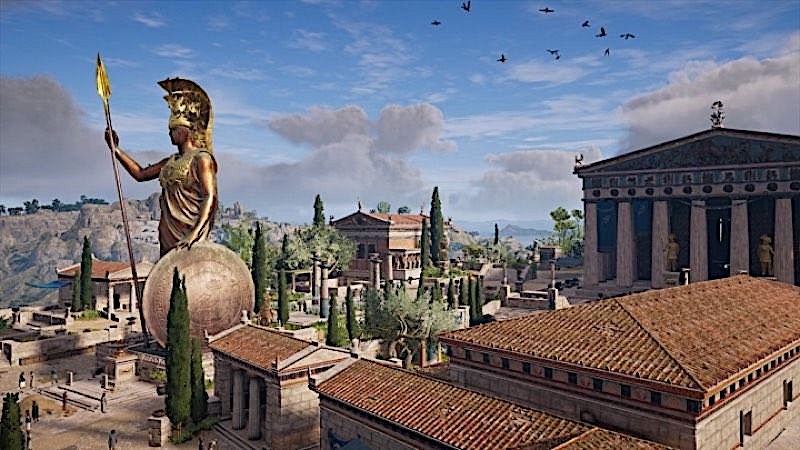
Yes, that means the game’s vision of ancient Greece includes plenty of sculpture made, as we’ve previously featured here on Open Culture, with not just with raw marble but brightly colored paint as well. The sheer amount of history and lore incorporated into the Assassin’s Creed: Odyssey experience has even inspired a discussion among experts on Twitter using the hashtag #ACademicOdyssey.
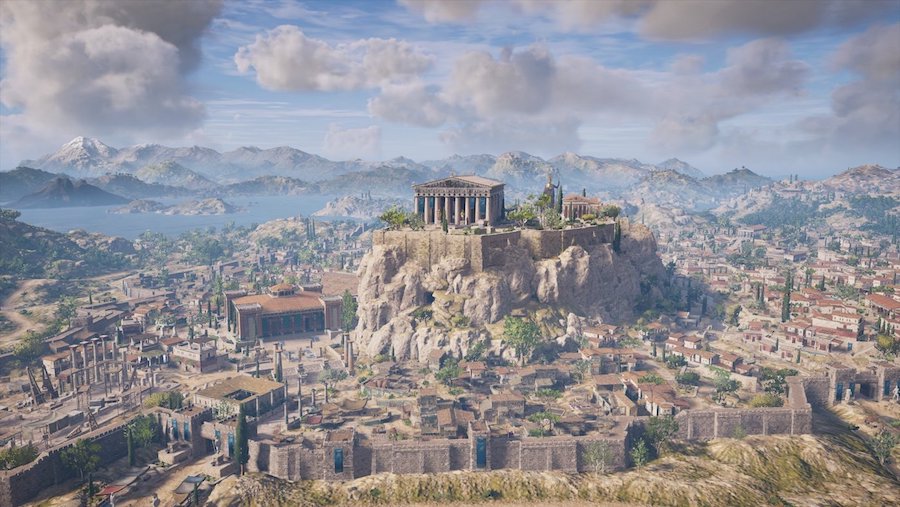
Though nobody claims that the game recreates ancient Greece perfectly in every detail — even apart from the gaps in human knowledge of the period, the developers seem to have had to cut a corner here and there to meet the series’ famously demanding release schedule — it succeeds in ways that no one Hellenically inclined, professionally or otherwise, had dared hope before. “I have played about 5 minutes of the game and I’m ready to cry from joy,” tweeted classicist Christine Plastow, a sentiment one can hardly imagine any academic expressing about, say, Golden Axe.
via Ars Technica/Hyperallergic
Related Content:
How Ancient Greek Statues Really Looked: Research Reveals their Bold, Bright Colors and Patterns
Watch Art on Ancient Greek Vases Come to Life with 21st Century Animation
Ancient Greek Punishments: The Retro Video Game
Concepts of the Hero in Greek Civilization (A Free Harvard Course)
Based in Seoul, Colin Marshall writes and broadcasts on cities, language, and culture. His projects include the book The Stateless City: a Walk through 21st-Century Los Angeles and the video series The City in Cinema. Follow him on Twitter at @colinmarshall or on Facebook.
Read More...Leonardo da Vinci Saw the World Differently… Thanks to an Eye Disorder, Says a New Scientific Study

Leonardo da Vinci was a man of many abilities, so many that he has defined the very image of the man of many abilities for more than 500 years now. History remembers him for his impressive intellectual feats of science and engineering (as well as the ambition of his to-do lists), but even more so for his works of visual art. Most of us get our introduction to Leonardo through images like the Mona Lisa, The Last Supper, and Vitruvian Man, not least because they’ve long since become too culturally prominent to avoid. The question of how on earth he did it naturally springs from contemplation of Leonardo’s whole body of work, but also from contemplation of many of the individual pieces that constitute it. A part of the answer, recent research suggests, may well have to do with a disability.
“There is now evidence that da Vinci’s renowned capacity to reproduce the three-dimensional world in paintings may have been aided by an eye disorder that allowed him to see in both 2‑D and 3‑D, according to a study published Thursday in JAMA Opthalmology, a peer-reviewed journal,” writes The Washington Post’s Allyson Chiu.
“Da Vinci is believed to have had a condition called intermittent exotropia, a form of strabismus, commonly referred to as being ‘walleyed’,” a form of an eye misalignment. If he did, it would have hampered his depth perception enough for him to see a flatter world than the one most everyone else does, and thus a world more suited to faithful replication on the page or the canvas.
But the fact Leonardo that could sometimes control his eyes enough to get them into proper alignment, says the study’s author Christopher Tyler, would make him “very aware of the 3‑D and 2‑D depth cues and the difference between them.” He came to suspect that Leonardo suffered from exotropia — if “suffered” is quite the right word here — after noticing the alignment of the eyes in both images considered portraits of the man himself as well as the portraits Leonardo made of others (on the theory that the work of an artist will, to an extent, reflect his own characteristics). The ophthalmologically inclined can judge for themselves by reading Tyler’s paper online. And if other, similar studies done in the past also hold up, Leonardo isn’t alone in art history: such figures as Rembrandt, Picasso, and Degas have also left behind evidence of their possibly strabismic vision. We sometimes say that artists see the world differently; the greatest artists may take that saying to a new level of literalness.
Related Content:
Leonardo da Vinci’s Visionary Notebooks Now Online: Browse 570 Digitized Pages
The Anatomical Drawings of Renaissance Man, Leonardo da Vinci
Leonardo da Vinci’s Bizarre Caricatures & Monster Drawings
What Leonardo da Vinci Really Looked Like
Based in Seoul, Colin Marshall writes and broadcasts on cities, language, and culture. His projects include the book The Stateless City: a Walk through 21st-Century Los Angeles and the video series The City in Cinema. Follow him on Twitter at @colinmarshall or on Facebook.
Read More...The Lenny Bruce Archive: Brandeis Digitally Preserves the Legacy of the Pathbreaking Comedian
Edgy, smart, aggressive, unapologetically Jewish, Lenny Bruce mixed Yiddishisms, hipster slang, colorful terms for various sex acts, and social, political, and religious satire in a high-wire improvisatory act he thought of as “verbal jazz.” Marketed as a “sick comedian,” Bruce got his start playing strip clubs, and ended up—bitter, defeated, blacklisted, and addicted—ranting and reading court transcripts from his various obscenity trials. It was a sad end to a brilliant and too-short career.
When Bruce died of an overdose at 40, “his widow and their daughter,” Kitty, “started archiving all that he had left behind,” notes NPR. Now that archive resides at Brandeis University, acquired in 2014 by librarian for archives and special collections Sarah Schoemaker. An episode of The Kitchen Sisters Present podcast called “The Keepers” tells the story of that collection, kept for decades in Kitty’s attic, with backup copies in Michigan and L.A. in case of fire. “10 linear feet” of material, as Kitty Bruce remembers it.
The story of that archive involves not only Bruce’s daughter and Shoemaker but also one of Bruce’s biggest champions, Hugh Hefner, his daughter Christie, and his lawyer Martin Garbus. It also features Steve Krief, who wrote the first Ph.D. thesis on Bruce. When Krief visited Kitty in Pennsylvania, she told him “you know what I don’t know what I’m going to do with my father’s things. They’re going to get destroyed.” Krief advised her to call Hefner, who eventually made a donation to Brandeis to fund the archive.
Some of the material, the collection notes, “has been previously released in edited form. Most of these recordings are of Lenny Bruce’s stand-up comedy performances…. Some of the recordings are of a personal nature, such as the ‘phone letters’ and private conversations between Bruce and his friends and family.” At the collection’s site, you can hear frustratingly short, 10-second clips of several routines, but to hear the tapes in full, you need to contact the university and set up an in-person appointment. But the archive is fully open to the public, and Bruce’s considerable legacy is secure. Note: you can hear some longer recordings on this page: Click here and then scroll down.
It’s a legacy that really should be better known. Bruce considered himself “a soldier fighting for the Constitution” and against government censorship. Without him, it’s hard to imagine the careers of George Carlin or Richard Pryor ever happening, and he even left his imprint on American literature, as Garbus tells it. At his obscenity trial in New York, for which he was given two years probation, a sentence only overturned after his death, Philip Roth sat in the courtroom. Roth later said that without Bruce, he couldn’t have written Portnoy’s Complaint.
“Lenny broke down so many barriers,” says Garbus, and though his humor may seem tame today—though his comedy still holds up—in the early 1960s few people dared to say the things he did, the way he did. Bruce railed against the hypocritical puritanism of American culture and paid a heavy price for telling truths we might take for granted now—and many we still don’t want to hear. (See Dustin Hoffman doing one of Bruce’s more serious bits above in a clip from the 1974 Bob Fosse biopic Lenny.) Browse the contents of the Lenny Bruce Audio Files here and learn more about Bruce’s life and influence at his official website.
Related Content:
George Carlin Performs His “Seven Dirty Words” Routine: Historic and Completely NSFW
Bill Hicks’ 12 Principles of Comedy
Josh Jones is a writer and musician based in Durham, NC. Follow him at @jdmagness
Read More...Laurie Anderson Creates a Virtual Reality Installation That Takes Viewers on an Unconventional Tour of the Moon
Next year, NASA will celebrate the 50th anniversary of the moon landing, and as part of the celebration will restore the original beige and green control panels from the late 60’s Mission Control. “We want to take you back to July 20, 1969,” says director of the non-profit Space Center Houston, the official visitors center for the Johnson Space Center. “You’re going to experience the final few moments before Neil Armstrong and Buzz Aldrin landed on the moon for the first time.”
But the agency isn’t only looking back to half a century ago. It’s also looking forward to launching more moon expeditions—in partnership with commercial and international agencies—next year. And while those of us who aren’t astronauts or billionaires are unlikely to ever see the moon up close, Laurie Anderson, NASA’s first artist-in-residence, can transport viewers there for the cost of a ticket to Denmark.
Starting last month and running until January 2019, the country’s Louisiana Museum of Modern Art features Anderson’s new moon-themed virtual reality project as part of its exhibition The Moon: From Inner Worlds to Outer Space.
Created with multimedia artist Hsin-Chien Huang—with whom Anderson collaborated on another beautiful VR experience last year—this project transports visitors to a virtual moon, where they can view constellations invented by Anderson, symbols of things that have, or that seem poised to, disappear: a dinosaur, a polar bear, democracy. “All of those things that you think are so stable are so fragile, and can be lost,” she says in the video introduction to her project above.
So, okay, it’s not the moon Armstrong and Aldrin planted their country’s flag on in 1969. It’s also populated by dinosaurs, birds, and other creatures created from a latticework of DNA molecules.
Not only did Anderson and Huang depict a thrilling fantasy VR moon, but they also created a “’hideous’ version,” reports CNN, “in which people had dumped all the radioactive material from Earth. “We did different phases of the moon,” says Anderson, “different aspects, looked not just at the romanticism of the moon but dystopias.” This isn’t her first foray into moon-themed art. As artist-in-residence at NASA since 2003, she has had some time to reflect on the agency’s mission.
After her first year with NASA, she debuted a 90-minute performance piece called “The End of the Moon,” the second in a trilogy she described as an “epic poem” about contemporary American culture. She is not the obvious choice to work for a government agency. Her work has been fiercely critical of the country’s wars and its repression on the domestic front. “Frankly, I find living in American culture at the moment really problematic,” she said back in 2004. “But when I think of NASA, it’s the one thing that feels future-oriented in a way that’s inspiring.”
Looking both backward and forward, next year’s anniversary of the moon landing will give us all reasons to think about humanity’s past and future in outer space. Will it include “unbelievable aspirations,” as Anderson mused, like “the greening of Mars,” or the dystopian dumping of radioactive waste on the Moon? Given the trash and treasure of our current relationship with the cosmos—not to mention our own planet—probably both. See more 2‑D excerpts from Anderson and Huang’s piece in the scene test above, and, if you can score a ticket, enter the full VR experience at the Louisiana Museum of Modern Art.
Related Content:
Laurie Anderson’s Top 10 Books to Take to a Desert Island
Josh Jones is a writer and musician based in Durham, NC. Follow him at @jdmagness
Read More...How an 18th-Century Monk Invented the First Electronic Instrument

We tend to think of electronic music as a modern phenomenon, dating back only to the 20th century, but the invention of the first instrument made to use electricity occurred a couple centuries deeper than that. The man pictured above, Czech theologian and scientist Václav Prokop Diviš, “is now regarded as the earliest visionary of electronic music,” writes Motherboard’s Becky Ferreira, owing to the fact that “his dual interests in music and electricity had merged into a single obsession with creating an electrically enhanced musical instrument.” Around the year 1748, that obsession produced the “Denis d’or,” or “Golden Dionysus,” a “keyboard-based instrument outfitted with 790 iron strings that were positioned to be struck like a clavichord rather than plucked like a guitar.” Through the electromagnetic excitation of the piano strings, the monk could “imitate the sounds of a whole variety of other instruments.”
“Diviš was an interesting character, having also invented the lightning rod at the same time as, but independently of, Benjamin Franklin,” says the Cambridge Introduction to Electronic Music. He designed the Denis d’or with “an ingenious and complex system of stops” that reportedly allowed it to “imitate an astonishing array of instruments, including, it was claimed, aerophones.” The same applied to “chordophones such as harpsichords, harps and lutes, and even wind instruments.”
The term aerophone (which denotes any musical instrument that makes a body of air vibrate) might not sound familiar to many of us, but the functionality of Diviš’ invention will. Don’t we all remember the thrill of sitting down to our first synthesizer and discovering how many different instrumental sounds it could make, vague though the sonic approximation might have been?
Whether the Denis d’or counts as the founding instrument of all electronic music or a mere early curiosity, you can learn more about it at 120 Years of Electronic Music and Electrospective Music. The pre-history of electronic music (since its history proper begins around 1800) has remembered it as a practical-joke device as much as an instrument. “Diviš devised a novel method of temporarily charging the strings with electricity in order to ‘enhance’ the sound,” says the Cambridge Introduction. “What effect this had is unclear (unfortunately only one instrument was made and this did not survive), but it apparently allowed Diviš to deliver an electric shock to the performer whenever he desired.” Nobody ever said a polymath couldn’t also be a prankster.
via Motherboard
Related Content:
The History of Electronic Music in 476 Tracks (1937–2001)
Based in Seoul, Colin Marshall writes and broadcasts on cities, language, and culture. His projects include the book The Stateless City: a Walk through 21st-Century Los Angeles and the video series The City in Cinema. Follow him on Twitter at @colinmarshall or on Facebook.
Read More...Take a Free Animation Course from a Renowned French Animation School
An FYI for any aspiring animators who happen to speak some French…
A free course that covers the basics of computer animation has just gotten underway. Called Anima Podi, the free course is offered by the Gobelins, L’École de L’Image, the famed Parisian school of visual arts.
According to Cartoon Brew, the “MOOC [Massive Open Online Course] is aimed at first-time or self-taught animators. The first week of the course will be dedicated to introductory preparation, while each subsequent week will focus on a new animation exercise.” “Anima Podi will also dedicate a significant amount of time to animation history … and delve into styles and traditions from around the world ‘so that people understand what is animation beyond Disney.’ ” Animation exercises will be completed with a software called Rumba.
The free course (register here) is currently offered in French, but an English version will appear down the road.
If you would like to support the mission of Open Culture, consider making a donation to our site. It’s hard to rely 100% on ads, and your contributions will help us continue providing the best free cultural and educational materials to learners everywhere. You can contribute through PayPal, Patreon, and Venmo (@openculture). Thanks!
Related Content:
Take a Free Online Course on Making Animations from Pixar & Khan Academy
Pixar’s 22 Rules of Storytelling … Makes for an Addictive Parlor Game
Download 15,000+ Free Golden Age Comics from the Digital Comic Museum
1300 Free Online Courses from Top Universities
Read More...Support Us
We're hoping to rely on loyal readers, rather than erratic ads. Please click the Donate button and support Open Culture. You can use Paypal, Venmo, Patreon, even Crypto! We thank you!

About Us

Open Culture scours the web for the best educational media. We find the free courses and audio books you need, the language lessons & educational videos you want, and plenty of enlightenment in between.
Advertise With Us

FREE UPDATES!
GET OUR DAILY EMAIL
Get the best cultural and educational resources on the web curated for you in a daily email. We never spam. Unsubscribe at any time.
FOLLOW ON SOCIAL MEDIA

Open Culture editor Dan Colman scours the web for the best educational media. He finds the free courses and audio books you need, the language lessons & movies you want, and plenty of enlightenment in between.
Advertise With Us

