Free Guided Imagery Recordings Help Kids Cope with Pain, Stress & Anxiety
I don’t have to tell you modern life is full of stressors that exacerbate hypertension, depression, and everything in-between. Therapeutic stress reduction techniques based in mindfulness meditation, trauma research, and a number of other fields have proliferated in our daily lives and everyday conversation, helping people cope with chronic pain, career anxiety, and the toxic miasma of our geopolitics.
These methods have been very successful among adult populations—of monks, veterans, clinical subjects, etc.—but adults process information very differently than children. And as every parent knows, kids get majorly stressed out too, whether they’re absorbing our anxieties second-hand or feeling the pressures of their own social and educational environments.
We can’t expect young children to sit still and pay attention to their breath for thirty minutes, or to change their mental scripts with cognitive behavioral therapy. It’s far easier for kids to process things through their imagination, channeling anxiety through play, or art, or—as pediatric psychologists at the Children’s Hospital of Orange County (CHOC) explain—guided mental visualization, or “guided imagery,” as they call it. How does it work?
Guided imagery involves envisioning a certain goal to help cope with health problems or the task or skill a child is trying to learn or master. Guided imagery is most often used as a relaxation technique that involves sitting or lying quietly and imagining a favorite, peaceful setting like a beach, meadow or forest.
The therapists at CHOC “teach patients to imagine sights, sounds, smells, tastes or other sensations to create a kind of daydream that ‘removes’ them from or gives them control over their present situation.” In the video at the top, Dr. Cindy Kim describes the technique as “akin to biofeedback,” and it has been especially helpful for children facing a scary medical procedure.
While all of us might need to go to our happy place once in a while, most kids find it hard to relax without some form of creative redirection, like the guided imagery program above from Johns Hopkins All Children’s Hospital. At the CHOC website, you’ll find over a dozen other audio programs tailored for pain and stress management and relaxation, for both young children and adolescents. Lifehacker’s parenting editor Michelle Woo describes a representative sampling of the programs:
- For pain management for young kids, listen to “The Special Cake.” Sample line: “With your next deep breath in, notice the sweet smell of the yummy frosting.”
- For pain management for teens, listen to “Climbing a Ladder.” Sample line: “Let’s have a look at the first step. As you put your foot on it, you begin to remember a time when you realize that you can have control over your body.”
- For anxiety, listen to “The Magic Kite.” Sample line: “All of the uncomfortable feelings or sadness or anger or pain or worry are all on the ground and you are flying away from it.”
As kids listen to audio, Woo writes, “have them notice how their body feels—their breathing may slow and their muscles might relax.” And hey, there’s no reason guided imagery can’t work for grown-ups too. Try it if you’re feeling stressed and let us know how it works for you.
via Lifehacker
Related Content:
Daily Meditation Boosts & Revitalizes the Brain and Reduces Stress, Harvard Study Finds
How Stress Can Change Your Brain: An Animated Introduction
Meditation 101: A Short, Animated Beginner’s Guide
Josh Jones is a writer and musician based in Durham, NC. Follow him at @jdmagness.
Read More...Why Read Waiting For Godot?: An Animated Case for Samuel Beckett’s Classic Absurdist Play
Iseult Gillespie’s latest literature themed TED-Ed lesson—Why should you read Waiting For Godot?—poses a question that’s not too difficult to answer these days.
The meaning of this surprisingly sturdy Absurdist play is famously open for debate.
Author Samuel Beckett told Roger Blin, who directed and acted in its first production at the Théâtre de Babylon in 1953, that all he knew for certain was that the two main characters, Vladimir and Estragon, wore bowler hats.
(Another thing he felt sure of was that they were male, and should only be brought to life by those in possession of a prostate gland, a specification that rankles female theater artists eager to take a crack at characters who now seem as universal as any in Shakespeare. The Beckett estate’s vigorous enforcement of the late playwright’s wishes is itself the subject of a play, The Underpants Godot by Duncan Pflaster.)
A “tragicomedy in two acts,” according to Beckett, Waiting for Godot emerged during a vibrant moment for experimental theater, as playwrights turned their backs on convention to address the devastation of WWII.
Comedy got darker. Boredom, religious dread, and existential despair were major themes.
Perhaps we are on the brink of such a period ourselves?
Critics, scholars, and directors have found Godot a meaningful lens through which to consider the Cold War, the French resistance, England’s colonization of Ireland, and various forms of apocalyptic near-future.
Perhaps THAT is why we should read (and/or watch) Waiting for Godot.
Vladimir:
Was I sleeping, while the others suffered? Am I sleeping now? Tomorrow, when I wake, or think I do, what shall I say of today? That with Estragon my friend, at this place, until the fall of night, I waited for Godot? That Pozzo passed, with his carrier, and that he spoke to us? Probably. But in all that what truth will there be? (Estragon, having struggled with his boots in vain, is dozing off again. Vladimir looks at him.) He’ll know nothing. He’ll tell me about the blows he received and I’ll give him a carrot. (Pause.) Astride of a grave and a difficult birth. Down in the hole, lingeringly, the grave digger puts on the forceps. We have time to grow old. The air is full of our cries. (He listens.) But habit is a great deadener. (He looks again at Estragon.) At me too someone is looking, of me too someone is saying, He is sleeping, he knows nothing, let him sleep on. (Pause.) I can’t go on! (Pause.) What have I said?
Gillespie’s lesson, animated by Tomás Pichardo-Espaillat, above, includes a supplemental trove of resources and a quiz that educators can customize online.
Related Content:
Samuel Beckett Directs His Absurdist Play Waiting for Godot (1985)
Hear Waiting for Godot, the Acclaimed 1956 Production Starring The Wizard of Oz’s Bert Lahr
An Animated Introduction to Samuel Beckett, Absurdist Playwright, Novelist & Poet
The Books Samuel Beckett Read and Really Liked (1941–1956)
Watch the Opening Credits of an Imaginary 70s Cop Show Starring Samuel Beckett
Ayun Halliday is an author, illustrator, theater maker and Chief Primatologist of the East Village Inky zine. Her play Zamboni Godot premiered in New York City in 2017. Join her in NYC on Monday, October 15 for another monthly installment of her book-based variety show, Necromancers of the Public Domain. Follow her @AyunHalliday.
Read More...The Big Lebowski at 20: Jeff Bridges, John Goodman & Steve Buscemi Reunite to Discuss the Coen Brothers’ Beloved Film
The Big Lebowski came out 20 years ago. Statements of that kind are often preceded by the question of whether you want to feel old, but this one wouldn’t have quite the same effect: on some level, The Big Lebowski feels as old as, or maybe even older than, cinema itself. In their half-hour conversation looking back at the film and its legacy, NBC’s Harry Smith asks actors John Goodman, Steve Buscemi, and Jeff Bridges, better known to the movie’s legions of fans as Walter Sobchak, Donny Kerabatsos, and of course Jeff Lebowski — also known as His Dudeness, Duder, El Duderino if you’re not into the whole brevity thing, but above all as the Dude — whether it felt like 20 years have passed. More than one of them come right back with just the right response: “It does and doesn’t.”
The conversation touches on such subjects as what they first thought of the script (“Right on the page, it felt like it was improvisation,” says Bridges), the spiritual implications of the story and characters (Bridges tells of the encounter with a Buddhist teacher that led to the book The Dude and the Zen Master in 2013), how many “F‑bombs” the final product ended up containing (275), and what usually happens in the still extremely common event of an encounter with a Lebowski fan on the street.
All three actors evince great pleasure at the opportunity to remember working with Joel and Ethan Coen on what would become the directing brothers’ most beloved film, one that has inspired its own festival, its own religion, and much more besides. But as many of the movie’s current enthusiasts (perhaps due to their youth, perhaps due to their indulgence in memory-clouding substances) won’t remember, The Big Lebowski didn’t become a phenomenon right away.
“So you make a movie like this, you love the script, you love working together,” as Smith puts it, “and then nobody goes to see it.” Indeed, the moviegoing public of 1998 didn’t quite know what to make of the fact that, as a follow-up to the Academy Award-winning Fargo, the Coen brothers served up what Goodman describes as “Philip Marlowe meets The Trip.” As Buscemi remembers, “it took like five or six years before people started coming up to me and saying that they loved it.” Then came the college kids, who would tell him not just that they loved it, but that they’d seen it eight, nine, ten times. The first time people saw The Big Lebowski they came out in bewilderment asking what it means, but “what the movie does so brilliantly is, once you know what it is, then you really enjoy, like, every moment of it.”
Among the few viewers attuned enough to its frequency to enjoy it right away was Roger Ebert: “Some may complain The Big Lebowski rushes in all directions and never ends up anywhere,” he wrote in his initial review. “That isn’t the film’s flaw, but its style.” But even his appreciation grew over time, and in 2010 he anointed it one of his official Great Movies, describing it as involving “kidnapping, ransom money, a porno king, a reclusive millionaire, a runaway girl, the Malibu police, a woman who paints while nude and strapped to an overhead harness, and the last act of the disagreement between Vietnam veterans and Flower Power,” all held together by “a plot and dialogue that perhaps only the Coen brothers could have devised.” Hence Bridges’ worries about getting the music of the script down cold before shooting: “Did I get the ‘man’ in the right place? Did I add another F‑bomb?”
Related Content:
Is The Big Lebowski a Great Noir Film? A New Way to Look at the Coen Brothers’ Iconic Movie
The Big Lebowski Reimagined as a Classic 8‑Bit Video Game
Tuileries: The Coen Brothers’ Short Film About Steve Buscemi’s Very Bad Day in the Paris Metro
Based in Seoul, Colin Marshall writes and broadcasts on cities, language, and culture. His projects include the book The Stateless City: a Walk through 21st-Century Los Angeles and the video series The City in Cinema. Follow him on Twitter at @colinmarshall or on Facebook.
Read More...Rembrandt’s Masterpiece, The Night Watch, Will Get Restored and You Can Watch It Happen Live, Online
Many of the world’s most admired paintings don’t look the same now as when the artists completed them. Time, especially when it adds up to centuries and centuries, takes its toll on paints and the canvases to which they’re applied, or at least it changes them in ways humanity hasn’t predicted or fully understood. Take Rembrandt’s 1642 Militia Company of District II under the Command of Captain Frans Banninck Cocq, much better known as The Night Watch — but only because a layer of varnish on top of the paint darkened over time, giving the scene an unintended nocturnal quality. The varnish came off in the 1940s, but much more work remains to return Rembrandt’s masterpiece to the state in which Rembrandt himself beheld it.
Starting next summer, the Rijksmuseum will launch a multi-year, multimillion-dollar project to give The Night Watch its long-awaited thoroughgoing restoration. (The three restorations the painting received in the 20th century repaired damages inflicted by the occasional visitor bent, for reasons known only to themselves, on destroying it.)
The institution “plans to first study the painting for about eight months, using new scanning technologies that were not available during previous restorations, such as macro X‑ray fluorescence scanning, which can explore different layers of the paint surface to determine what needs to be done.” Throughout the whole process, “a transparent showcase will be built around the painting, the scientists and the restorers, so that visitors can view the progress.”
Art conservators have traditionally done their meticulous work away from public eyes, but in the 21st century public restoration has become, as we now say, a thing. Earlier this month, Artnet’s Janelle Zara wrote about various other museum projects that have put “a public face on this normally closed-door profession,” even involving social media platforms like Instagram in the process. The Rijksmuseum, as its director Taco Dibbits announces in the video above, will take it a step further by streaming all the restoration work online, providing viewers around the world a closer look at the painting than they’ve ever had before, no matter how many times they’ve visited the Rijksmuseum’s Night Watch Hall in person. The first stages of the process will determine how, exactly, The Night Watch has changed over the past 376 years. During it we’ll no doubt find that Rembrandt, whose finest work seems to grow richer with each examination, still has a few surprises in store for us.
Related Content:
300+ Etchings by Rembrandt Now Free Online, Thanks to the Morgan Library & Museum
What Makes The Night Watch Rembrandt’s Masterpiece
Flashmob Recreates Rembrandt’s “The Night Watch” in a Dutch Shopping Mall
The Art of Restoring a 400-Year-Old Painting: A Five-Minute Primer
Based in Seoul, Colin Marshall writes and broadcasts on cities, language, and culture. His projects include the book The Stateless City: a Walk through 21st-Century Los Angeles and the video series The City in Cinema. Follow him on Twitter at @colinmarshall or on Facebook.
Read More...Behold Kurt Vonnegut’s Drawings: Writing is Hard. Art is Pure Pleasure.
I see hints of blueprints, tile work, leaded-glass windows, William Blake, Paul Klee, Saul Steinberg, Al Hirschfeld, Edward Gorey, my mother’s wasp waist, cats and dogs. I see my father, at age four, forty, and eighty-four, doodling his heart out.
—Nanette Vonnegut
Cartoonist, educator, and neurology buff Lynda Barry believes that doodling is good for the creative brain.
In support of that theory, we submit author Kurt Vonnegut, a very convincing case.
His daughter, Nanette, notes that he was drawn by the human face—his own and those of others.

Portraits include one of his best-known fictional characters, the unsuccessful science fiction author Kilgore Trout. It’s a revelation, especially to those of us who imagined Trout as something closer to veteran character actor Seymour Cassel.
In addition to his humorous doodles, Vonnegut was known to chisel out a sculpture or two on the kitchen counter.
As a Cape Cod year-rounder, he painted seascapes.
He had a one-man show of his felt tip drawings in Greenwich Village in 1980 (“not because my pictures were any good but because people had heard of me”).
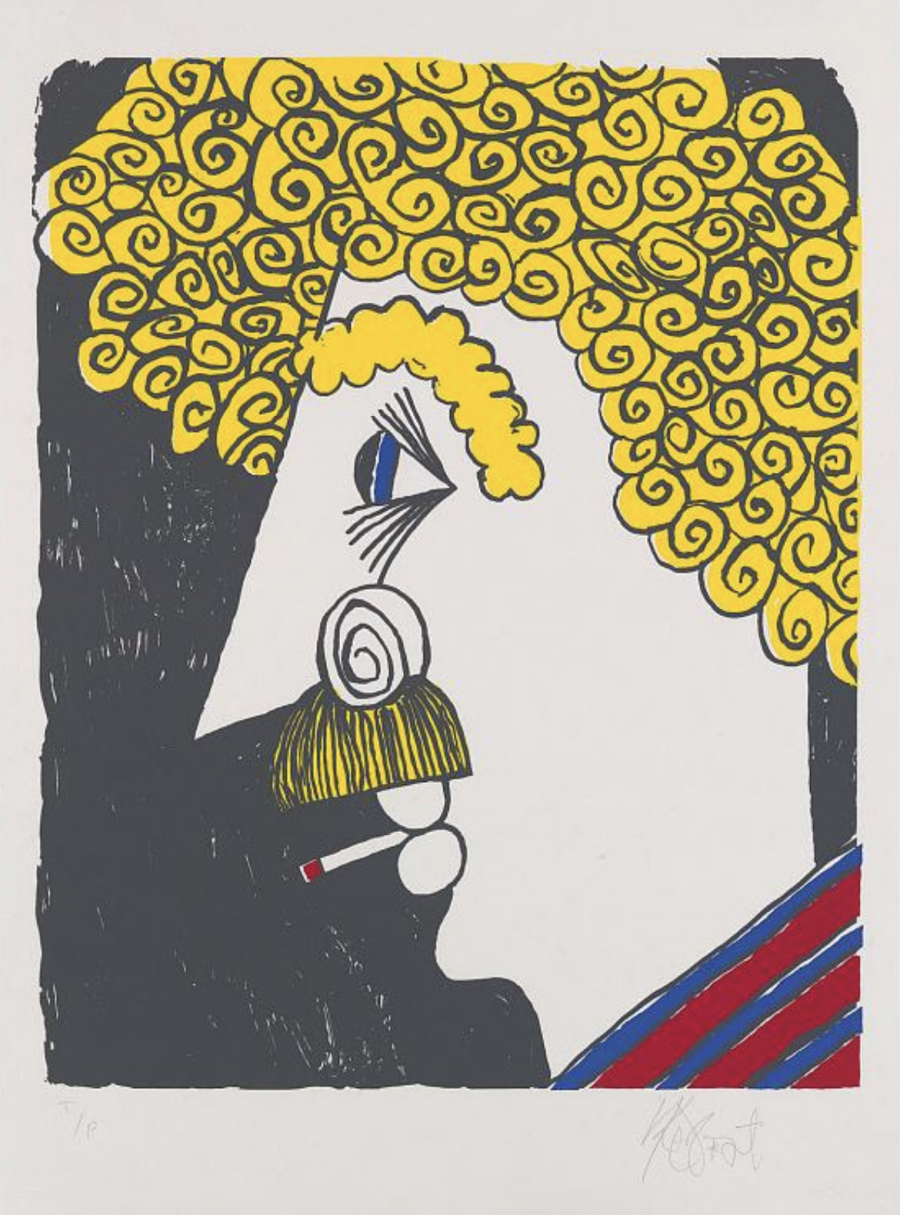
But the doodles are what captured the public’s imagination, from the illustrations of Breakfast of Champions to his numerous self portraits.
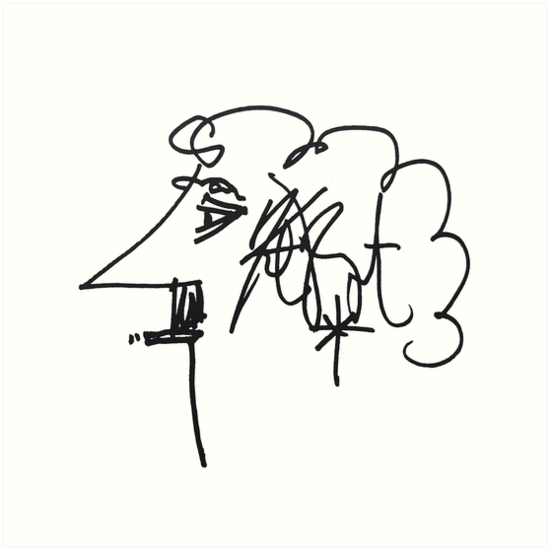
The son and grandson of architects, Vonnegut preferred to think of himself less as an artist than as a “picture designer.” Working on a novel was a “nightmare,” but drawing was pure pleasure.
Perfection was not the goal. Vonnegut realized a sympathetic community would spring up around an artist struggling within his limitations, and acted accordingly.
To that end, he recommended that people practice art “no matter how badly because it’s known to make a soul grow.”

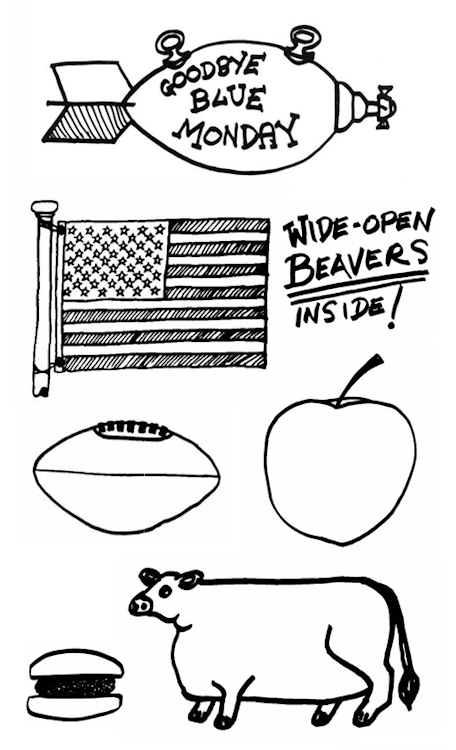
See a book of 145 Vonnegut drawings curated by his daughter, Nanette Vonnegut here.
Related Content:
Kurt Vonnegut Maps Out the Universal Shapes of Our Favorite Stories
22-Year-Old P.O.W. Kurt Vonnegut Writes Home from World War II: “I’ll Be Damned If It Was Worth It”
Ayun Halliday is an author, illustrator, theater maker and Chief Primatologist of the East Village Inky zine. Join her in NYC on Monday, October 15 for another monthly installment of her book-based variety show, Necromancers of the Public Domain. Follow her @AyunHalliday.
Read More...How the Sears Catalog Disrupted the Jim Crow South and Helped Give Birth to the Delta Blues & Rock and Roll

For all of the justified ire directed at certain online retailers for their anti-competitive practices, tax evasion, labor exploitation, and so on, one fact often goes unremarked upon since it seems to fall outside the usual narratives. The explosion of online retail gave purchasing power to people locked out of certain markets because of income or geography or disability, etc. Moreover, it gave people outside of traditional market demographics the opportunity to experiment with new interests in judgment-free zones.
These changes have allowed a generation of musicians access to instruments they would never have been willing or able to find in the past. For example, Fender guitars has discovered that women now account for 50 percent of all “beginner and aspirational players,” notes Rolling Stone. “The instrument-maker is adjusting its marketing focus accordingly… around a massive new audience that it’d previously been ignoring.” Walking into a music store and feeling like you’ve been ignored by the big companies may not make for an encouraging experience. But the ability to buy gear online without a hassle may be one significant reason why so many more women have taken up the instrument.
Which brings us to Sears. Yes, it’s a roundabout way to get there, but bear with me. You’ve surely heard the news by now, the venerable retail giant has gone bankrupt after 132 years in business—a casualty of predatory capitalism or bad business practices or the inevitably changing times or what-have-you. A number of eulogies have described the company’s early “catalogue shopping system” as “the Amazon of its day,” as Lila MacLellan points out at Quartz. The comparison surely fits. During its heyday, people all over the country, in the most far-flung rural areas, could order almost anything, even a house.
But a number of stories, including MacLellan’s, have also described Sears, Roebuck & Company as a great equalizer of its day for the way it busted the Jim Crow barriers black shoppers once faced. Cornell University history professor Louis Hyman has posted a thread on his Twitter and given an interview on Jezebel describing the democratizing power of the Sears Catalog in the late 19th century for black Americans, most of whom lived in rural areas (as did most Americans generally) and had to suffer discrimination from white shopkeepers, who charged inflated prices, denied sales and credit, forced black customers to wait at the back of long lines, and so on.
Hyman talks about this specific history in the video lecture above (starting at 6:24). The viciousness of segregation didn’t stop at the store. As he says, local postmasters would often refuse to sell stamps or money orders to black customers. The Sears Catalog, then, included specific instructions for giving cash directly to mail carriers. Storekeepers burned the catalogs, but still rural customers were able to get their hands on them and order what they needed, pay cash, and receive it without difficulty. A new world opened up for people previously shut out of many consumer markets, and this included, writes Chris Kjorness at Reason, turn-of-the-century musicians.
The Sears guitar, says Michael Roberts, who teaches the history of the blues at DePaul University, “was inexpensive enough that the blues artists were able to save up the money they made as sharecroppers to make that purchase.” As Kjorness puts it, “There was no Delta blues before there were cheap, readily available steel-string guitars. And those guitars, which transformed American culture, were brought to the boondocks by Sears, Roebuck & Co.”
The first Sears, Roebuck catalog was published in 1888. It would go on to transform America. Farmers were no longer subject to the variable quality and arbitrary pricing of local general stores. The catalog brought things like washing machines and the latest fashions to the most far-flung outposts. Guitars first appeared in the catalog in 1894 for $4.50 (around $112 in today’s money). By 1908 Sears was offering a guitar, outfitted for steel strings, for $1.89 ($45 today), making it the cheapest harmony-generating instrument available.
Quality improved, prices went down, and bluesmen could get their instruments by mail. Most of the big names we associate with the Delta blues bought a guitar from the Sears Catalog. Guitars became such a popular item that Sears introduced their own brand, under the existing Silvertone line, in the 1930s. Later budget guitars and amplifiers sold through Sears included Danelectro, Valco, Harmony, Kay, and Teisco (all of whom, at one time or another, made Silvertones).
These brands are now known to musicians as classic roots and garage rock instruments played by the likes of Jack White, but their histories all come together with Sears (you may hear them lumped together sometimes as “the Sears guitars”). The company first supplied bluesmen and country pickers with acoustic guitars, but “once the sound of the electric guitar became that of American music,” Whet Moser writes at Chicago Magazine, “teens in garages all over started picking up axes, and Sears was there to supply them.”
Through their business deal with Nathan Daniel, they manufactured the “amp-in-case” line of Danelectro Masonite guitars, sold in stores and catalogs. These funky 50s instruments, designed for maximum cost-cutting, incorporated surplus lipstick tubes as housing for their pickups. They made such a distinctive jangly sound, thanks to the way Daniel wired them, that it became a hallmark of 50s and 60s garage rock. Often sold under the Silvertone name as well, Danelectro guitars were cheap, but well designed. (Jimmy Page has had a particular fondness for the Danelectro 59).
While the product history of Sears electric guitars is incredibly complicated, with brand names, designs, and product lines shifting from year to year, it’s enough to say that without their budget guitars and amps, many of the struggling musicians who innovated the blues and rock and roll would have been unable to afford their instruments. The story of Sears writ large can be told as the story of a market “disruptor” raising standards of living for millions of rural and urban Americans. The company’s innovative marketing and distribution schemes were also totally central to the history of American popular music.
Related Content:
History of Rock: New MOOC Presents the Music of Elvis, Dylan, Beatles, Stones, Hendrix & More
Josh Jones is a writer and musician based in Durham, NC. Follow him at @jdmagness
Read More...Stephen Hawking’s Final Book and Scientific Paper Just Got Published: Brief Answers to the Big Questions and “Information Paradox”
How did it all begin? Is there a god? Can we predict the future? Is there other intelligent life in the universe? For decades, many of us turned to Stephen Hawking for answers to those questions, or at least supremely intelligent suggestions as to where the answers might lie. But the celebrated astrophysicist’s death earlier this year — after an astonishingly long life and career, given the challenges he faced — took that option away. It turns out, though, that we haven’t actually heard the last of him: his last book, Brief Answers to the Big Questions (whose trailer you can watch just above), came out just this week.
“The book is quintessential Hawking,” writes physics professor Marcelo Gleiser at NPR. “He starts by addressing the questions in physics and cosmology that he dedicated his intellectual life to answer, using easy-to-follow arguments and drawing from everyday images and thought experiments.” Hawking’s answers to the big questions figure into his view of not just the world but all existence: he believes, writes Gleiser, “that humanity’s evolutionary mission is to spread through the galaxy as a sort of cosmic gardener, sowing life along the way. He believes, even if not without worry, that we will develop a positive relationship with intelligent machines and that, together, we will redesign the current fate of the world and of our species.”
In parallel with his career as a public figure and writer of popular explanatory books, which began with 1988’s A Brief History of Time, Hawking performed scientific research on black holes. The Guardian’s science editor Ian Sample describes it as a “career-long effort to understand what happens to information when objects fall into black holes,” capped off by a posthumously published paper titled “Black Hole Entropy and Soft Hair.” “Toss an object into a black hole and the black hole’s temperature ought to change,” writes Sample. “So too will a property called entropy, a measure of an object’s internal disorder, which rises the hotter it gets.” In the paper Hawking and his collaborators show that “a black hole’s entropy may be recorded by photons that surround the black hole’s event horizon, the point at which light cannot escape the intense gravitational pull. They call this sheen of photons ‘soft hair’.”
If that sounds tricky to understand, all of us who have appreciated Hawking’s writing know that we can at least go back to his books to get a grip on black holes and the questions about them that get scientists most curious. Much remains for future astrophysicists to work on about that “information paradox,” to do with where, exactly, everything that seemingly gets sucked into a black hole actually goes. “We don’t know that Hawking entropy accounts for everything you could possibly throw at a black hole, so this is really a step along the way,” Hawking’s collaborator Malcolm J. Perry tells Sample. “We think it’s a pretty good step, but there is a lot more work to be done.” As Hawking surely knew, the big questions — in physics or any other realm of existence — never quite get fully answered.
Related Content:
Watch A Brief History of Time, Errol Morris’ Film About the Life & Work of Stephen Hawking
The Big Ideas of Stephen Hawking Explained with Simple Animation
Based in Seoul, Colin Marshall writes and broadcasts on cities, language, and culture. His projects include the book The Stateless City: a Walk through 21st-Century Los Angeles and the video series The City in Cinema. Follow him on Twitter at @colinmarshall or on Facebook.
Read More...The Serial Killer Who Loved Jazz: The Infamous Story of the Axeman of New Orleans (1919)
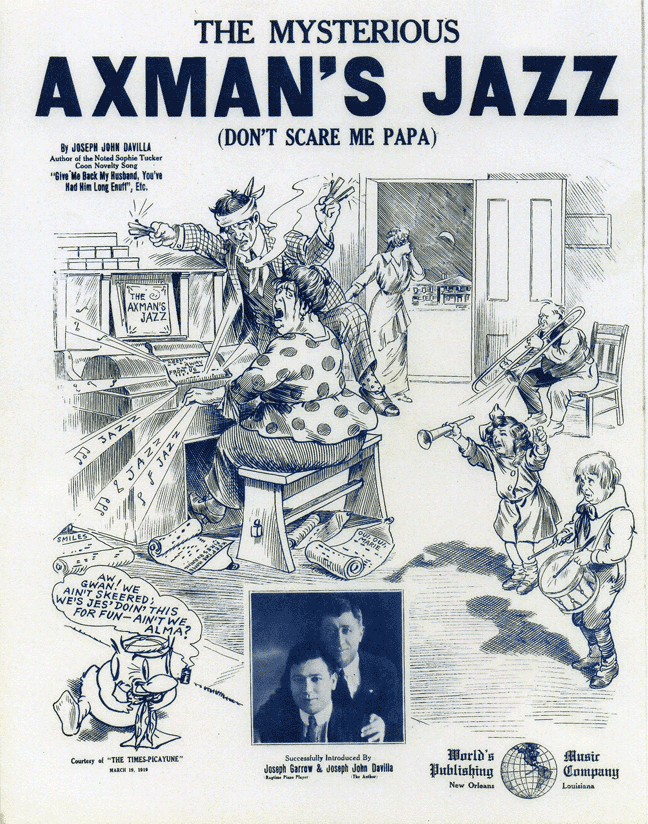
If you are a fan of “American Horror Story” you might remember a character in Season Three (“Coven”) played by Danny Huston, brother of actress Anjelica, son of director John. He was called The Axeman, and if you were not particularly steeped in New Orleans lore or serial killer history, that particular reference might have flown right past.
But denizens of the city know him full well, because of his brutal killing methods, his weapon of choice, his random attacks…and his love of jazz. Oh, and the fact that he was never caught.
Let’s talk about that jazz, though. At the time of his attacks, between 1918 and 1919, jazz was in its infancy and rapidly evolving in this southern port city, which was newly unsegregated in the years after the Civil War. It was a mix of African-Americans, Jews, Creole, whites, and everybody else, and jazz was the sound of a young generation ready to party. (Needless to say, older generations hated this music.)
At first the killer was not known as the Axeman, but a mysterious intruder who had chiseled open front doors, hacked owners (and their wives) to death with his axe, and disappeared, leaving behind his signature weapon (which, it turned out, usually belonged to the home owner). The newspapers at the time reported on every lurid detail and sent the city into a state of fear during the summer of 1918.
His victims were all Italian shopkeepers, but that wasn’t enough to add his name to the history books. But on March 14, 1919, that changed, when the New Orleans Times-Picayune published an infamous letter from the hand of the killer himself:
Esteemed Mortal of New Orleans:
They have never caught me and they never will. They have never seen me, for I am invisible, even as the ether that surrounds your earth. I am not a human being, but a spirit and a demon from the hottest hell. I am what you Orleanians and your foolish police call the Axeman.
When I see fit, I shall come and claim other victims. I alone know whom they shall be. I shall leave no clue except my bloody axe, besmeared with blood and brains of he whom I have sent below to keep me company.
If you wish you may tell the police to be careful not to rile me. Of course, I am a reasonable spirit. I take no offense at the way they have conducted their investigations in the past. In fact, they have been so utterly stupid as to not only amuse me, but His Satanic Majesty, Francis Josef, etc. But tell them to beware. Let them not try to discover what I am, for it were better that they were never born than to incur the wrath of the Axeman. I don’t think there is any need of such a warning, for I feel sure the police will always dodge me, as they have in the past. They are wise and know how to keep away from all harm.
Undoubtedly, you Orleanians think of me as a most horrible murderer, which I am, but I could be much worse if I wanted to. If I wished, I could pay a visit to your city every night. At will I could slay thousands of your best citizens (and the worst), for I am in close relationship with the Angel of Death.
Now, to be exact, at 12:15 (earthly time) on next Tuesday night, I am going to pass over New Orleans. In my infinite mercy, I am going to make a little proposition to you people. Here it is: I am very fond of jazz music, and I swear by all the devils in the nether regions that every person shall be spared in whose home a jazz band is in full swing at the time I have just mentioned. If everyone has a jazz band going, well, then, so much the better for you people. One thing is certain and that is that some of your people who do not jazz it out on that specific Tuesday night (if there be any) will get the axe.
Well, as I am cold and crave the warmth of my native Tartarus, and it is about time I leave your earthly home, I will cease my discourse. Hoping that thou wilt publish this, that it may go well with thee, I have been, am and will be the worst spirit that ever existed either in fact or realm of fancy.
–The Axeman
Did you note the part in bold (our emphasis)? Readers in 1919 certainly did.
That Tuesday, the musical city was even more lively than usual. If you had a record player, it played all night and loudly. If you had a piano, you were banging away at the keys. And if you had a jazz club nearby, it was standing room only. It might have been the biggest night of jazz in history. And indeed, nobody got the chop that evening.
The Axeman struck four more times that year, with only one victim succumbing to his wounds. And after that The Axeman disappeared. With no fingerprints, suspects, or descriptions of the killer, the case was never solved.
Historians haven’t done well in uncovering his identity either, but one thing they agree on: the killer probably didn’t write the letter.
Historian Miriam Davis has a theory that it was one John Joseph Dávila, a musician and a jazz composer. Right after the publication of the Axeman letter, he published a sheet-music tie-in called “The Mysterious Axeman’s Jazz (Don’t Scare Me Papa)”, and made a bundle of money from it.
Cashing in on a murderous event and public hysteria? Now that’s quintessentially American, my friends, just like jazz.
For more on this story, read Miriam Davis’ book, The Axeman of New Orleans: The True Story.
Related Content:
A New Series About A Young Crime-Fighting Sigmund Freud Is Coming to Netflix
Some Joy for Your Ears: New Orleans Brass Band Plays Life-Affirming Cover of Marvin Gaye’s “Sexual Healing”
Guns N’ Roses “Sweet Child O’ Mine” Retooled as 1920s New Orleans Jazz
Ted Mills is a freelance writer on the arts who currently hosts the artist interview-based FunkZone Podcast and is the producer of KCRW’s Curious Coast. You can also follow him on Twitter at @tedmills, read his other arts writing at tedmills.com and/or watch his films here.
Read More...Watch Richard Linklater’s Anti-Ted Cruz Political Ads: The Texas Director Versus the Texas Senator
If you think of Texas filmmakers, Richard Linklater surely comes to mind right away. Despite the success and acclaim he has steadily garnered over the past three decades, the director of Slacker, Dazed and Confused, Boyhood, and the Before trilogy remains resolutely based in Austin, and even continues to set many of his movies in his home state. If you think of Texas politicians, can you possibly keep Ted Cruz from coming to mind? The state’s junior senator has remained a fixture on the highest-profile American political scene since at least his candidacy in the Republican presidential primaries of 2016. Linklater and Cruz’s fan bases might not overlap much, and given Texas’ famously enormous size, the men themselves may never have run into each other before. But now, in the form of political advertisements, their worlds have collided.
Since his rise to prominence, Cruz has suffered something of an image problem. (“Cruz may be unique among politicians anywhere in that every mention of his name is always accompanied by remarks on his loathesomeness,” as essayist Eliot Weinberger puts it.) His campaign in the run-up to the 2018 midterm elections has attempted to correct that problem with the slogan “Tough as Texas,” but not every Texan has accepted its portrayal of the candidate as a macho, no-nonsense son of the Lone Star State.
Certainly Linklater seems to have had trouble swallowing it, seeing as he’s directed a couple of video ads for the unambiguously named political action committee Fire Ted Cruz. Both feature actor Sonny Carl Davis, seemingly staying in the character he played in Bernie, one of Linklater’s most thoroughly Texan pictures. In them he airs the kind of criticisms of Cruz one might imagine coming from the mouth of the straight-talking and somewhat ornery Texas everyman.
In Linklater’s first anti-Cruz spot, Davis questions whether someone who so publicly allies himself with a president who insulted him so viciously during the last election has truly demonstrated a Texas-grade toughness (not that he puts it quite that way). The second moves on to a territory even more suited to fightin’ words: cheeseburgers. It seems that Cruz recently called his election rival Beto O’Rourke a “Triple Meat Whataburger liberal who is out of touch with Texas values.” But to the mind of Davis’ character, such a tone-deaf insult to as beloved a Texas institution as Whataburger — especially from a man who has also praised the “little burgers” of White Castle — cannot stand. Can the power of such ridicule, harnessed to the power of cinema, unseat a senator? We’ll have to wait until November to find out, but if I were Cruz, I wouldn’t exactly be looking forward to what Linklater comes up with next.
Related Content:
Based in Seoul, Colin Marshall writes and broadcasts on cities, language, and culture. His projects include the book The Stateless City: a Walk through 21st-Century Los Angeles and the video series The City in Cinema. Follow him on Twitter at @colinmarshall or on Facebook.
Read More...Meet Berea College, the Innovative College That Charges No Tuition & Gives Students a Chance to Graduate Debt-Free
“The looming student loan default crisis is worse than we thought,” writes Professor of Economics Judith Scott-Clayton at Brookings. I’ll leave it to you to parse the report, but to sum up… it looks bad. Subprime mortgage crisis bad. Maybe… there’s another way? Working models of fully subsidized higher ed systems in other countries—like fully subsidized healthcare systems—strongly suggest as much. Some high-end programs in the U.S., like NYU’s newly free medical school, have taken an early lead, hoping to solve the problem of doctor shortages.
But there’s an earlier, humbler, more progressive model of free college in the States, Kentucky’s little-known Berea College, founded in 1855 by an abolitionist Presbyterian minister John Gregg Fee as the first integrated, co-educational college in the American South. “It has not charged students tuition since 1892,” Adam Harris reports at The Atlantic. “Every student on campus works, and its labor program is like work-study on steroids. The work includes everyday tasks such as janitorial services, but older students are often assigned jobs aligned to their volunteer programs.”
Rather than working to pay off tuition, “students receive a physical check for their labor that can go toward housing and living expenses.” Nearly half of the school’s graduates leave with no debt, with the remaining carrying an average of less than $7,000 from room and board expenses. Compare that to a national average of $37,172 in loan debt per student for the class of 2016. How does Berea do it? It funds tuition with its large endowment of 1.2 billion dollars.
Through a perverse historical irony, as Harris describes, the same racist hatred that ran Berea’s founder out of town in 1859, and forced the school to segregate in 1904, made certain that its funding model would sustain it far into its (re)integrated future. After Kentucky’s passage of the so-called “Day Law,” barring black students from attending, money began to pour in.
The prospect of educating poor white people from Appalachia for no tuition was something that the community could get behind. And nearly 100 years ago, on October 20, 1920, the board made sure that the college would be able to do so for a long time. According to Jeff Amburgey, the school’s chief financial officer, “The board essentially said, for Berea to sustain its funding model,” any unrestricted bequests—essentially money that someone leaves the institution after they have passed away, that is not tagged for a specific purpose—could not be spent right away. Instead, he says, the money was expected to be treated as part of the endowment, and only the return on that investment could be spent.
Berea could not, as some other schools do, spend millions on football stadiums instead of investing in its students. In the 50s, the school reintegrated, but the process was very slow, as it was everywhere in the country. “The community was gone,” says Berea history professor Alicestyne Turley, referring to the Reconstruction-era community that had a student body mix of 50–50 black and white students.
The school had to relearn its founding principles, as expressed in its founder’s chosen motto, from the Book of Acts: “God has made of one blood all peoples of the earth.” Now most of the enrollees, low-income white and black students mostly from Appalachia, qualify for Pell grants. 10 percent of the budget comes from charitable gifts. But the school pays the bulk of the tuition, $39,400 per student, from its endowment.
Is this sustainable? Time will tell. Though a 1937 promotional film, above, from the college’s segregated past decries “the false glitter of easy prosperity,” its current president tells Harris “we’re not the kind of institution that holds the world of finance in disdain. We are dependent on it.” A stock market crash could bankrupt Berea, and no bailouts would be forthcoming. But for now, the college thrives, with very impressive ranking numbers in the U.S. News Best Colleges report (it comes in a #4 in Best Undergraduate Teaching and #3 in Most Innovative Schools).
The school hosts bell hooks as a professor in residence and boasts as an alumnus Carter G. Woodson, the “father of black history,” with a center named for him whose mission is “to assert the kinship of all people and provide interracial education with a particular emphasis on understanding and equality among blacks and whites as a foundation for building community among all peoples of the earth.”
Maybe if there were a way to, say, fund Berea, and colleges and universities nationwide, through some kind of, say, taxation on, say, the most profitable companies on the planet, or some such… just imagine.…
Related Content:
In Japanese Schools, Lunch Is As Much About Learning As It’s About Eating
Josh Jones is a writer and musician based in Durham, NC. Follow him at @jdmagness
Read More...Support Us
We're hoping to rely on loyal readers, rather than erratic ads. Please click the Donate button and support Open Culture. You can use Paypal, Venmo, Patreon, even Crypto! We thank you!

About Us

Open Culture scours the web for the best educational media. We find the free courses and audio books you need, the language lessons & educational videos you want, and plenty of enlightenment in between.
Advertise With Us

FREE UPDATES!
GET OUR DAILY EMAIL
Get the best cultural and educational resources on the web curated for you in a daily email. We never spam. Unsubscribe at any time.
FOLLOW ON SOCIAL MEDIA

Open Culture editor Dan Colman scours the web for the best educational media. He finds the free courses and audio books you need, the language lessons & movies you want, and plenty of enlightenment in between.
Advertise With Us

