36 Artists Give Advice to Young Creators: Wim Wenders, Jonathan Franzen, Lydia Davis, Patti Smith, David Byrne, Umberto Eco & More
“Whatever you do, nobody else can do that better than you. You have to find what you can do better than anyone else, what you have in yourself that nobody else has in them. Don’t do anything that you know, deep in your heart, that somebody else can do better, but do what nobody else can do except for you.” That sounds like fine advice, but when receiving advice we should always consider the source. In this case we could hardly do better: the source is Wim Wenders, director of Alice in the Cities, Paris, Texas, Wings of Desire, and many other films besides, an auteur seldom accused of making movies anyone else could make.
Wenders’ interview clip and the others here come from “Advice to the Young,” a video series created by the Louisiana Museum in Denmark (which has quite an impressive gift shop, incidentally, if you happen to need advice on gift-shopping). Jonathan Franzen, author of novels like The Corrections, Freedom, and Purity, admits to feeling embarrassment about “giving advice to the young writer,” but he still has valuable words for creators in any domain: “The most important advice I have is to have fun, to try to create something that is fun to work on.”
And by fun he means fun like you have on a tennis court, where “you’re not just messing around, you’re not just hitting the ball wherever you want — you are focused on having a game, and once you are in it you are having fun. That’s the kind of focused fun I’m talking about, and if you are having that kind of focused fun, there’s a good chance that the reader will too.”
The range of writers from which Louisiana Museum has sought advice also includes Lydia Davis, whose sensibility may differ from Franzen’s but who has garnered an equal (or even greater) degree of respect from her readership. “You learn from models and you analyze them, you study them, you analyze them very closely, one thing at a time,” she says, beginning her more expansive advice based on her own method. “You don’t just sort of read the paragraph and say, ‘Oh, that really flows, you know? That’s good.’ You say, ‘What kind of adjectives? How many? What kind of nouns? How long are the sentences? What’s the rhythm?’ You know, you pick it apart, and that’s very helpful.” Her other suggestions include to “be very patient, even patient with chaos” and to keep a notebook (“it takes some of the tension and the worry away, because if you write it down, it may just be a note. It doesn’t have to be the beginning of anything”).
“Do what you want to do,” Davis concludes, “and don’t worry if it’s a little odd or doesn’t fit the market.” That bit of guidance seems to have worked for her, and in the great variety of forms it can take seems to have worked for seemingly every other artist. Take Ed Ruscha, for instance, whose canvasses of gas stations, corporate signage, and other icons of American blankness must hardly have seemed geared toward any particular “market” when first he painted them. For the young he has only one piece of advice, received second-hand and briefly delivered: “No one could ever beat this thing that Max Ernst said. They asked him what a young artist should do, and he said, ‘cut off an ear.’ That’s good advice to follow. You can’t beat that.”
Other artists featured in the video playlist include Laurie Anderson, David Byrne, Umberto Eco, Patti Smith & more.
Related Content:
Brian Eno’s Advice for Those Who Want to Do Their Best Creative Work: Don’t Get a Job
John Cleese’s Advice to Young Artists: “Steal Anything You Think Is Really Good”
Ursula Le Guin Gives Insightful Writing Advice in Her Free Online Workshop
Based in Seoul, Colin Marshall writes and broadcasts on cities, language, and culture. His projects include the book The Stateless City: a Walk through 21st-Century Los Angeles and the video series The City in Cinema. Follow him on Twitter at @colinmarshall or on Facebook.
Read More...Patti Smith’s Award-Winning Memoir, Just Kids, Now Available in a New Illustrated Edition
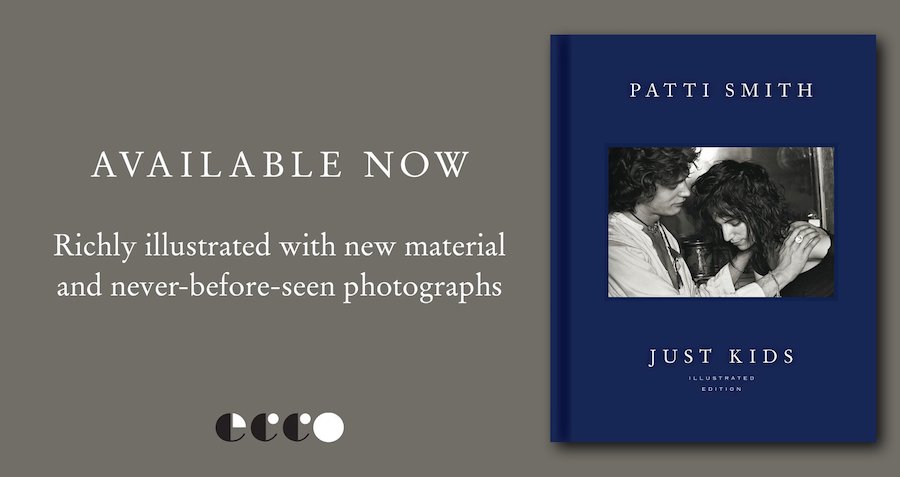
Hard to believe it’s almost a decade ago now since Patti Smith’s Just Kids took over Barnes & Noble displays, topped bestseller lists, won the National Book Award, and sent Wikipedia searches for “Patti Smith” into the stratosphere. A memoir of her gritty New York salad days with roommate/lover/best friend/soulmate/photographer Robert Mapplethorpe, the book immediately entered “that golden canon of classic New York stories about young people coming to the city to find out who they were meant to be,” as NPR’s Maureen Corrigan writes.
Indeed, Just Kids should be considered representative, its full text now a locus classicus of bohemian finding-yourself-in-New-York stories. (The embittered converse of the genre is forever crowned by Joan Didion’s “Goodbye to All That.”) But Smith didn’t rest on the many laurels the book garnered her. She released a widely-acclaimed album two years later, with a bonus track on the deluxe edition called “Just Kids,” then collaborated with Colombian artist José Antonio Suárez Londoño on the (sadly out-of-print) Hecatomb.
In 2015, Smith followed Just Kids with another memoir, M Train, a travelogue of sorts—of her literary pilgrimages and journeys through the city that embraced her. But as her work ethic shows, and as Just Kids documents in detail, she didn’t just luck out in the big city but fought her way to creative freedom and independence with zeal and real self-confidence, believing in the power of poetry and rock and roll, and of her place among the sixties royalty she encountered while “still a gangly twenty-two-year-old book clerk, struggling simultaneously with several unfinished poems.”
“I felt an inexplicable sense of kinship with these people,” she wrote, for example, of her run-ins with Janis Joplin, Grace Slick, and Jimi Hendrix ahead of Woodstock, a “feeling of prescience” that she might “one day walk in their path.” She saw “infinite possibilities” in the Chelsea Hotel’s plaster ceiling, “the mandala of my life.” You may call it faith, hubris, or delusion, but she sure showed us, and keeps showing us, that she earned her cred. Just Kids will inspire young artists for generations, not only through its first, explosive printing, but through a possible series on Showtime, who acquired the rights in 2015, and, now, in an illustrated edition just released last week.
The book resonates for its depictions of a bygone, decayed New York, when free spirits could scrape together their artistic selves with next to nothing, without having to craft their every move for social media. Smith’s vividly expressive writing brings that lost world alive in a wildly successful experiment, as she told KCRW in a 2010 interview, to “infuse truth with magic and love.”
She announced the book’s new edition on her Instagram, a forum she has taken to with aplomb, as anticipating the “30th year since Robert Mapplethorpe’s passing.” A poignant reminder, especially since she wrote the book, she once revealed, as a deathbed promise to her friend.
The full-color illustrated edition of Just Kids features never-before published photos, drawings, and other ephemera depicting major figures in Smith’s young life, like Sam Shepard, William Burroughs, and Allen Ginsberg, as well as her and Mapplethorpe’s first Brooklyn apartment, the iconic Max’s Kansas City, and the fire escape of the Chelsea Hotel. Order a copy here.
Related Content:
Patti Smith’s 40 Favorite Books
Patti Smith, The Godmother of Punk, Is Now Putting Her Pictures on Instagram
Josh Jones is a writer and musician based in Durham, NC. Follow him at @jdmagness
Read More...Radiohead’s Thom Yorke Performs Songs from His New Soundtrack for the Horror Film, Suspiria
It’s a strange time to remake a Dario Argento movie. The master of giallo (Italian for “yellow”), the crime, thriller, and horror genre films that flourished in the 60s and 70s, took particular pleasure in torturing his female characters, often in scenes involving rape and starring his topless daughter. Luca Guadagnino’s 2018 Suspiria “opens its eyes in a world where female power has never been stronger or more under attack,” writes Wired’s Angela Watercutter, who advises those who haven’t seen the original to save it until they’ve watched the modern homage.
Aiming to “de-victimize” Argento’s women, the remake takes the original story of a coven of witches operating a dance studio in Berlin but emphasizes its characters as figures of mysterious power who are both “fear and revered.” Where Argento goes for the maximal amount of luridness—in blazing reds and yellows echoed in the first scenes in a neon McDonald’s sign—Guadagnino’s approach “is more muted in both palatte and tone, opting for insidious weirdness over shock and gore,” as David Roony writes at The Hollywood Reporter.
Contributing heavily to the shift in tone is a score from Radiohead’s Thom Yorke that could “hardly be more dissimilar to the cacophonous prog-rock of Goblin that was such an essential part of the original’s sensory assault.” To call the first Suspiria and its glorious score an “assault” is not at all pejorative, but a purely accurate description of their style. But Guadagnino wisely sensed that the grim beauty of Yorke’s songwriting would best speak to a contemporary version, so he hounded the Radiohead singer until he agreed.
Though he’d never scored a film before, and was intimated by the challenge, Yorke found his way in through the script. “There was this melancholy which I was really surprised about. Not like a normal horror film at all,” he says in the BBC interview at the top with Mary Anne Hobbs. He calls the film’s mood “a weird form of darkness,” which could equally describe the evocations of dread underlying all of his work. The process of scoring Suspiria, he says, was “freeing… because there’s no sense of my identity on it at all…. I’m whoever he wanted me to be at the moment, for whatever particular section of the film.”
These live performances for the BBC, especially “Suspirium” further up, might seem to belie that assessment. The songs draw deeply from Yorke’s familiar well of spare, atmospheric angst, which is all to the good. They also see him moving in unexpected directions. “Open Again” builds on a gently finger-picked acoustic guitar figure, and “Unmade,” above, almost channels Burt Bacharach’s moodier film pieces, with its lounge‑y piano and yearning vocal melody.
The score became a family project; Yorke’s son played drums on some of the tracks and his daughter helped design the artwork. On a BBC Radio 6 appearance, Yorke also played an hour-long mix of his favorite atmospheric records and debuted a previously unreleased track called “Suspiria Solo Glass Harmonica.” Listen here and see the new Suspiria trailer below.
Related Content:
The Secret Rhythm Behind Radiohead’s “Videotape” Now Finally Revealed
Thom Yorke’s Isolated Vocal Track on Radiohead’s 1992 Classic, ‘Creep’
Josh Jones is a writer and musician based in Durham, NC. Follow him at @jdmagness
Read More...Wagashi: Peruse a Digitized, Centuries-Old Catalogue of Traditional Japanese Candies

If you’ve been to Japan, or even to any of the Japanese neighborhoods in cities around the world, you’ve seen wagashi (和菓子). You’ve probably, at least for a moment, marveled at their appearance as well: though essentially nothing more than sweet treats, they’re made with such striking variety and refinement that you might hesitate to bite into them.

First created in the 16th century, when trade with China made sugar into a staple in Japan, wagashi have developed into one of the country’s signature delicacies, appreciated for their taste but beloved for their form. You can browse and download a three-volume catalog of wagashi designs, itself centuries old, at the web site of Japan’s National Diet Library: volume one, volume two, volume three.

The site also has a special section about wagashi, though in Japanese only. The catalog itself, of course, also contains text in no other language, but wagashi isn’t about words.
Even without knowing Japanese, you can flip through each volume’s pages (volume one — volume two - volume three) and recognize the look of dozens of sweets you’ve seen or maybe even sampled in real life, where their colors may well look even more vivid than on the page.

Like most realms of traditional Japanese culture, wagashi demands painstaking craftsmanship. Often brought out at festivals and given as gifts, it also celebrates different aspects of Japan: its seasons, its landscapes, chapters of its history, and even its works of literature. Some wagashi designs do this abstractly, while others lean toward the representative, replicating real sights and symbols in a form both recognizable and edible.

Many wagashi, as Boing Boing’s Andrea James writes, “still look the same as they did hundreds of years ago when the art form flourished in the Edo period” of the 17th and 18th century. Instagram, as she points out, has proven a natural online home for not just the kind of traditional wagashi seen in these catalogs but designs that pay tribute to figures of more recent vintage, such as Rilakkuma and the aliens from Toy Story.

And though Halloween may not be an originally Japanese holiday, it hasn’t stopped modern wagashi-makers from bringing out the ghosts, skulls, and jack-o-lanterns in force.

via BoingBoing
Related Content:
Download Classic Japanese Wave and Ripple Designs: A Go-to Guide for Japanese Artists from 1903
How Japanese Things Are Made in 309 Videos: Bamboo Tea Whisks, Hina Dolls, Steel Balls & More
20 Mesmerizing Videos of Japanese Artisans Creating Traditional Handicrafts
Enter a Digital Archive of 213,000+ Beautiful Japanese Woodblock Prints
Based in Seoul, Colin Marshall writes and broadcasts on cities, language, and culture. His projects include the book The Stateless City: a Walk through 21st-Century Los Angeles and the video series The City in Cinema. Follow him on Twitter at @colinmarshall or on Facebook.
Read More...The World’s Largest Collection of Tibetan Buddhist Literature Now Online

FYI: The Buddhist Digital Resource Center (BDRC) and Internet Archive (IA) announced earlier this month “that they are making a large corpus of Buddhist literature available via the Internet Archive. This collection represents the most complete record of the words of the Buddha available in any language, plus many millions of pages of related commentaries, teachings and works such as medicine, history, and philosophy.” In a press release from the Internet Archive, Chokyi Nyima Rinpoche, a respected teacher of Tibetan Buddhism, expressed gratitude that the teachings of the Buddha have been made available online. “We can share the entire body of literature with every Tibetan who can use it. These texts are sacred, and should be free.” It should be noted that the texts aren’t written in English, but rather the authors’ native tongue.
If you would like to support the mission of Open Culture, consider making a donation to our site. It’s hard to rely 100% on ads, and your contributions will help us continue providing the best free cultural and educational materials to learners everywhere. You can contribute through PayPal, Patreon, and Venmo (@openculture). Thanks!
Related Content:
Free Online Course: Robert Thurman’s Introduction to Tibetan Buddhism (Recorded at Columbia U)
The Dalai Lama’s Introduction to Buddhism
Buddhism 101: A Short Introductory Lecture by Jorge Luis Borges
Free Online Religion Courses
Read More...
The Evolution of Bob Dylan: Early Recordings Let You Hear an Unknown Singer Turn Into a 60s Superstar (1958–1965)
Approaching Bob Dylan’s body of work as a newcomer can be intimidating. The Nobel Laureate now gets taught at Harvard and Princeton, compared to Virgil and Ovid, Yeats and Joyce. Diving into Dylan’s own literary influences requires a formidable reading list. But as Sean Wilentz, consummate Dylan fan, Princeton professor of history, and author of Bob Dylan in America, points out, the Dylan legacy carries so much weight not only because of the singer’s voracious reading habits, but because he emerged “in a culture in which songwriting has always been a major force” on the culture.
New Dylan fans come to him through his influence on the past 50 years of popular music, and understand him through the influence of the first 50 years of 20th century American music on him. He’s cited by such diverse legends as Hendrix, Bowie, and Boy George—at one time everyone wanted to be Dylan, or to write like him, at least—but one reason so many have imitated him is because he acquired his considerable depth by imitating others.
Growing up in the bleak surroundings of Hibbing, Minnesota, “a good place to leave,” he said, Dylan spent his time absorbing all he could from the Delta blues, the Carter Family, Johnny Cash, Little Richard, and Elvis. Like the best of his own imitators, Dylan developed the ability to transmute his influences into something new through close study, critical appreciation, and just plain-old goofing around.
In his earliest known recordings, made in 1958 in Hibbing with his hometown friend John Bucklen, Dylan does a little bit of all three, but mostly he sings ramshackle covers of rhythm and blues songs on an acoustic guitar, honing his talent for barreling through solo performances two years before he hit the stages of Greenwich Village’s coffeehouse folk scene.
The John Bucklen tape opens up a 5‑hour Youtube collection featuring recordings from 1958 to 1965, which you can stream above. It’s a set of “almost all the earliest tapes Bob made before signing up with Columbia Records,” notes the Youtube uploader. (“Some of the early stuff is dismal at best,” one reviewer of the collection writes, “but its historical importance cannot be overstated.”) From the ’58 home recordings, overdubbed with Bucklen’s later commentary, we move to the so-called Minnesota Party Tape, “a 35 minute recording in Bob’s apartment in Minneapolis” featuring his renditions of some traditional songs like “Johnny I hardly Knew You” and “Streets of Glory.”
This tape also shows the predominating influence of Woody Guthrie on Dylan at the time, the songwriter whom he most modeled himself after in the early sixties—later writing that he aimed to be “Guthrie’s greatest disciple”—and who pops up again and again in nearly all of these recordings after 1960. In January of 1961, Dylan moved to New York to visit Guthrie, then dying of Huntington’s disease, and began picking up Irish folk songs and African American spirituals from Dave Van Ronk, Odetta, and other downtown folk singers. He integrates these styles into his Guthrie imitation and picks up bits of Pete Seeger, Hank Williams, Blind Lemon Jefferson, and Jesse Fuller from his covers of their songs.
In tapes from 1962–63, we hear home recording versions of well-known originals from his first two albums—“A Hard Rain’s A‑Gonna Fall,” “Don’t Think Twice, It’s All Right”—and hear in them the cumulative layering of influence from Dylan’s years of apprenticeship. The entire collection, which includes interviews with Billy James and Steve Allen and performances on radio and TV, shows Dylan “evolving from a young kid in Minnesota to a superstar in 1965 before going electric… an amazing look at a young Bob Dylan becoming a legend in front of you.” Key to that evolution was his talent for creative imitation of traditional American music and its greatest interpreters.
See the full tracklist in the comment section of the video, and note that the third and fourth segments are in the wrong order in the Youtube video above.
Related Content:
The Bob Dylan Demos: They Are A‑Streamin’
A Massive 55-Hour Chronological Playlist of Bob Dylan Songs: Stream 763 Tracks
Hear Bob Dylan’s Newly-Released Nobel Lecture: A Meditation on Music, Literature & Lyrics
Josh Jones is a writer and musician based in Durham, NC. Follow him at @jdmagness
Read More...A Data Visualization of Modern Philosophy, 1950–2018
Those of us who think of ourselves as philosophy enthusiasts remain free to read and think about whatever we like, no matter how obscure, marginal, or out-of-fashion the ideas. But the academy presents a different picture, one fraught with political maneuvering, funding issues, and fretting about tenure. Does professionalization do philosophy a disservice by codifying the kinds of problems we should be thinking and writing about? Or do we need professional philosophy for exactly this reason? It depends on who you ask.
One argument against the academy consists in pointing out that many, if not most, of history’s influential philosophers have been amateurs in one sense or another: grinding away at day jobs, for example, like Baruch Spinoza, or living on family money, like Ludwig Wittgenstein, two radical philosophical outsiders whose Ethics and Tractatus, respectively, have been turned into data visualizations by Maximilian Noichl. It’s interesting to speculate about how these thinkers, both so visually-inclined, would respond to the treatment.
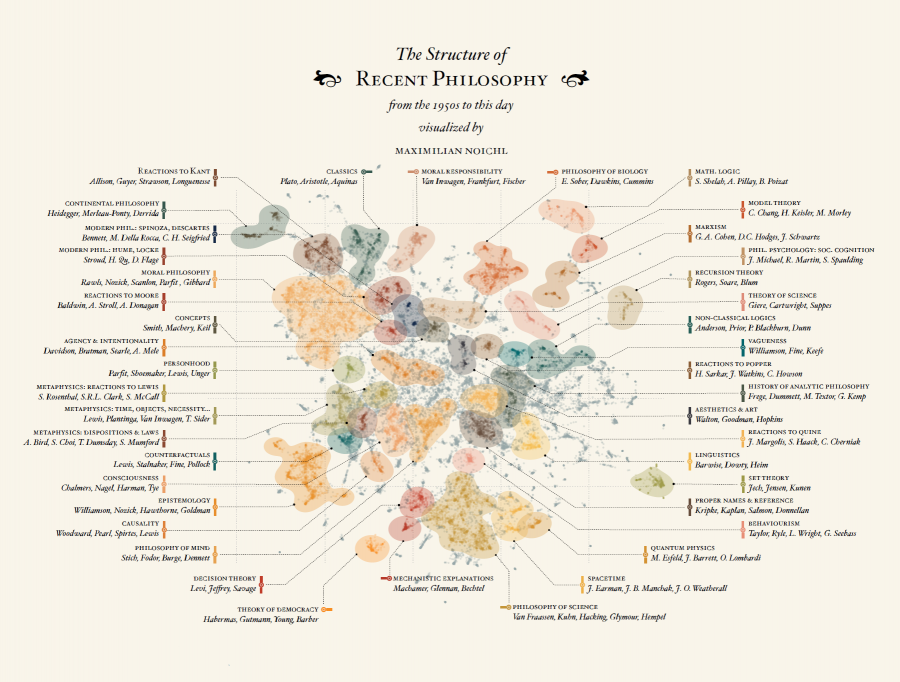
Noichl’s latest project, now in its third and, so far, final iteration, involves tracing “The Structure of Recent Philosophy from the 1950s to this day.” Clearly implied, but unstated in his description is that these maps chart only the specialized interests of academic philosophy, but the omission highlights the fact that contemporary philosophical work outside the academy receives no recognition in the literature and, therefore, hardly qualifies as philosophy at all under current strictures.
To construct the map at the top (click here to see the full infographic, then click it again for a high resolution version), Noichl aggregated over 50,000 articles “from various philosophy journals.” The journals all come from Clarivate Analytics Web of Science collection, which skews the selection. Noichl began with a “snow-ball-sampling (a few thousand papers),” then extended his sample by “repeatedly looking at the most cited publications.” The resulting papers were then “spatially distributed according to their citation-patterns.”
Every point on the graphic represents one article. Noichl used two different algorithms to sort and group the data, and his explanatory text on the original graphic at his site explains the technical details. The clusters are “a bit heterogenic in their nature,” he writes.
While some are thematic, others are determined strongly by specific persons or eras, which seems in itself to be an interesting observation about the structure of the literature….. [T]here is… a remarkable cleft between theory of science and epistemology. And the ways various historical clusters group themselves around moral philosophy suggests an internal relation. We can also observe that continental philosophy seems to split into two halves…
The exercise presents us with a summary image of some of the field’s most persistent concerns for the past 60 years or so. I can imagine historians of philosophy—and maybe critics of academic philosophy—making excellent use of this colorfully organized data. Noichl vaguely mentions a possible use of the map as a “reality check for some debates.” The question of what it contributes to philosophical thinking remains open. And we might ask whether big data does philosophy a disservice by algorithmically reproducing certain existing conditions, rather than critically interrogating them as philosophers have always done.
Yet it’s clear that data visualizations are now standard tools for teaching and learning any number of subjects, and in many cases, they offer helpful shorthand, as does another of Noichl’s interactive graphics, “Relationships Between Philosophers, 600 B.C.-160 B.C.,” a “delightful depiction,” writes Justin Weinberg at Daily Nous, “of the interrelation of the ideas of ancient philosophers over time.” See Noichl’s site for the three versions of “The Structure of Recent Philosophy” and other philosophy data visualizations.
And at the links below, see how others have used data visualization tools to organize the history of philosophy in different ways.
via Daily Nous
Related Content:
The History of Philosophy Visualized in an Interactive Timeline
The History of Philosophy Visualized
Josh Jones is a writer and musician based in Durham, NC. Follow him at @jdmagness
Read More...How to Practice Effectively: Lessons from Neuroscience Can Help Us Master Skills in Music, Sports & Beyond
Practice makes perfect, so the cliché says, although like many clichés, it has also spawned corrective variants. “Practice makes permanent,” a common one of them goes, and what it lacks in catchiness it may well make up for in neuroscientific truth. We’ve all recognized that, when we do things a certain way, we tend to keep doing them in that certain way; in fact, the more we’ve done them that way before, the more likely we’ll do them that way next time. What holds true for simple habits, formed over long periods of time and often inadvertently, also holds true for deliberately perfected — or anyway, permanent-ified — tasks. But what happens in our brains to cause it?
“Practice is the repetition of an action with the goal of improvement, and it helps us perform with more ease, speed, and confidence,” says the narrator of “How to Practice Effectively… for Just About Anything,” educators Annie Bosler and Don Greene’s TED Ed video above. It then goes on to explain our two kinds of neural tissue, grey matter and white matter. The former “processes information in the brain, directing signals and sensory stimuli to nerve cells,” and the latter “is mostly made up of fatty tissue and nerve fibers.” When we move, “information needs to travel from the brain’s grey matter, down the spinal cord, through a chain of nerve fibers called axons to our muscles,” and those axons in the white matter “are wrapped with a fatty substance called myelin.”
Myelin, and the sheath it forms, is key: “similar to insulation on electrical cables,” it “prevents energy loss from electrical signals that the brain uses, moving them more efficiently along neural pathways.” (You’ve probably read about the weakening of myelin sheaths as a factor in ALS and other movement-related neurological disorders.) Recent studies performed on mice suggest that repeating a motion builds up the layers of those axon-insulating myelin sheaths, “and the more layers, the greater the insulation around the axon chains; forming a sort of superhighway for information connecting your brain to your muscles.” This, though it has no direct effect on our muscles, may be what we’re building when we say we’re building “muscle memory.”
All interesting facts, to be sure, but how can they help us in or own practice sessions, whatever those sessions may find us practicing? Bosler and Greene provide a series of tips, each quite simple but all in alignment with current neuroscientific knowledge. They include:
- Focus on the task at hand. “Minimize potential distractions by turning off the computer or TV and putting your cell phone on airplane mode.”
- Go slow. “Coordination is built with repetitions, whether correct or incorrect. If you gradually increase the speed of the quality repetitions, you have a better chance of doing them correctly.”
- Frequent repetitions with allotted breaks. “Studies have shown that many top athletes, musicians, and dancers spend 50–60 hours per week on activities related to their craft. Many divide their time used for effective practice into multiple daily practice sessions of limited duration.”
- Practice in your imagination. “In one study, 144 basketball players were divided into two groups. Group A physically practiced one-handed free throws while Group B only mentally practiced them. When they were tested at the end of the two week experiment, the intermediate and experienced players in both groups had improved by nearly the same amount.”
If you’d like more suggestions on how to practice effectively, have a look at the list of twelve tips from Wynton Marsalis we featured here on Open Culture last year. He takes a more expansive approach, encouraging those who practice — not just music but sports, art, or anything else besides — to adopt strategies like writing out a schedule, avoiding showing off, and staying optimistic. We must also stay realistic: optimism, even optimism backed by science, can’t make our skills perfect. None of our skills are perfect — not even Wynton Marsalis’ — but with the right techniques, we can at least give them some degree of permanence.
Related Content:
Playing an Instrument Is a Great Workout For Your Brain: New Animation Explains Why
Based in Seoul, Colin Marshall writes and broadcasts on cities, language, and culture. His projects include the book The Stateless City: a Walk through 21st-Century Los Angeles and the video series The City in Cinema. Follow him on Twitter at @colinmarshall or on Facebook.
Read More...RIP Todd Bol, Founder of the Little Free Library Movement: He Leaves Behind 75,000 Small Libraries That Promote Reading Worldwide
“The Little Free Library: Billions and billions read.”
In the 2013 Ted‑X talk above, Todd Bol, founder of the Little Free Library movement, expressed the desire that one day, he might be able to boast that his labor of love had surpassed McDonalds with regard to the number of customers’ served.
It’s closing in…
Bol, who passed away earlier this month, was inspired by Andrew Carnegie’s mission of repaying his own good fortune by establishing 2,509 free public libraries.
The Little Free Libraries are vastly more numerous if less imposing than Carnegie’s stately edifices.

Some, like the prototype Bol crafted with lumber salvaged from a garage door in his late mother’s honor, resemble doll houses.
One in Detroit is a dead ringer for Doctor Who’s TARDIS.
There’s a bright yellow one emblazoned with characters from The Simpsons, autographed by series creator Matt Groening.
Others are housed in repurposed suitcases, storage cabinets, or newspaper honor boxes.
While the non-profit Little Free Library store sells several sturdy, weatherproof models and its website hosts a healthy collection of blueprints and tips for DIYers, Bol was never doctrinaire about the aesthetics, preferring to leave that up to each volunteer steward.
He seemed proudest of the libraries’ community building effect (though he was also pretty chuffed when Reader’s Digest ranked the project above Bruce Springsteen in its 2013 feature ”50 Surprising Reasons We Love America.” )
While not entirely devoid of naysayers, the goodwill surrounding the Little Free Library movement cannot be underestimated.
A steward who posted news of his dog’s death on the side of his library received sympathy cards from neighbors both known and unknown to him.
A steward who specializes in giving away cookbooks, and invites patrons to snip herbs from an adjacent garden, frequently wakes to find homemade quiche and other goodies on the doorstep.
And when an arsonist torched a Little Free Library in Indianapolis, the community rallied, vowing to get enough donations to replace it with 100 more.
To date, stewards have registered over 75,000, in 85 countries, in service of Bol’s “Take a book, Leave a book” philosophy.
Find a Little Free Library near you, learn how to become a steward, or make a donation on the project’s website.
Related Content:
The Rise and Fall of the Great Library of Alexandria: An Animated Introduction
Ayun Halliday is an author, illustrator, theater maker and Chief Primatologist of the East Village Inky zine. Join her in NYC on Monday, November 12 for another monthly installment of her book-based variety show, Necromancers of the Public Domain. Follow her @AyunHalliday.
Read More...The CIA’s Former Chief of Disguise Show How Spies Use Costumes in Undercover Operations
Think on this as you ready your Halloween finery. Sometimes it’s not a case of winning a costume contest, or impressing your friends with your witty take on current events or pop culture.
Sometimes, masquerade is a thin line between life and death.
The CIA’s former Chief of Disguise, Jonna Mendez, rose up through the ranks, having signed on as receptionist shortly after her fiancé revealed—three days before the wedding—that he was actually an undercover agent.
As Chief of Disguise, her mission was to protect case officers in dangerous situations, as well as foreign sources who routinely put their lives at risk by meeting with American operatives.
Transforming their appearance was an additive proposition—while it’s difficult to make someone shorter, slimmer, or younger, it’s not difficult to render them taller, heavier, older…
In her experience, women are easily disguised as men. (She shared with The New York Times’ Matthew Rosenberg how she herself passed undetected in male mufti, thanks primarily to a lit cigar.)
Men have a tougher time passing as women. Fans of RuPaul’s Drag Race might take exception to this position, were it not for the assertion that blending in is key.
The goal is to be forgettable, not fabulous.
For Americans abroad, this poses certain cultural challenges.
Mendez stresses that disguise is much more than a simple facial transformation, involving makeup, false hair, and prosthetics.
It’s dress, carriage, gait, jewelry, scent…
The biggest American giveaway is our shoes. An Italian civilian can peg ‘em with one swift glance.
Passing requires further behavioral modifications in the realms of table manners, gait, and even hanging out. (Europeans distribute their weight evenly, whereas Americans lean.)
To fly beneath the radar, the disguised operative must shoot to transform every aspect of their appearance. Imagine a survey wherein the participant recalls every physical aspect of someone they’ve just encountered. The goal is to nudge that participant into answering every question incorrectly.
What color are your eyes? Your hair? How much do you weigh? How tall are you? How old? How would you describe your nose? Your voice? Your clothing?
Change it.
Change it all.
You can do so by low tech methods, using whatever is on hand. Mendez once maneuvered an agent out of a tight spot on the Sub-Continent, by improvising a quick change with Dr. Scholl’s powder and cosmetics collected from local CIA wives.
She credits her own second husband, CIA “master of disguise” Tony Mendez (the inspiration for Ben Affleck’s character in Argo) with many trade secrets she put into regular practice: dental facades, speech-altering artificial palettes, prosthetics…
At the high end is the mask she wore to brief former CIA Chief, President George HW Bush, on developments within the disguise program. The President was none the wiser.
Meanwhile, a masked American agent chucked his mask under a Moscow rock when danger compelled him to scupper his mission midway through. That mask now resides in the KGB museum where Mendez cannot visit it.
Check out the Mendezes’ book Spydust for more information on their adventures in the field.
Related Content:
Ayun Halliday is an author, illustrator, theater maker and Chief Primatologist of the East Village Inky zine. Join her in NYC on Monday, November 12 for another monthly installment of her book-based variety show, Necromancers of the Public Domain. Follow her @AyunHalliday.
Read More...Support Us
We're hoping to rely on loyal readers, rather than erratic ads. Please click the Donate button and support Open Culture. You can use Paypal, Venmo, Patreon, even Crypto! We thank you!

About Us

Open Culture scours the web for the best educational media. We find the free courses and audio books you need, the language lessons & educational videos you want, and plenty of enlightenment in between.
Advertise With Us

FREE UPDATES!
GET OUR DAILY EMAIL
Get the best cultural and educational resources on the web curated for you in a daily email. We never spam. Unsubscribe at any time.
FOLLOW ON SOCIAL MEDIA

Open Culture editor Dan Colman scours the web for the best educational media. He finds the free courses and audio books you need, the language lessons & movies you want, and plenty of enlightenment in between.
Advertise With Us

