Robert Reich Makes His UC Berkeley Course on Wealth and Inequality in America Available on Facebook
Robert B. Reich served as Secretary of Labor under President Bill Clinton and was later named one of the 10 most effective cabinet secretaries of the 20th century by TIME Magazine. Nowadays, Reich teaches courses on public policy at UC Berkeley, and uses his popular Facebook page to discuss policy questions with a much broader audience. So here’s the next the logical step: This semester, Reich is teaching a Berkeley course on wealth and inequality in America, and he’s making the lectures themselves available on Facebook too. Watch the opening lecture above, and then check back in for new installments.
Note: Once you start playing the video, you might need to enable the audio in the lower right hand corner of the video player.
If you would like to support the mission of Open Culture, consider making a donation to our site. It’s hard to rely 100% on ads, and your contributions will help us continue providing the best free cultural and educational materials to learners everywhere. You can contribute through PayPal, Patreon, and Venmo (@openculture). Thanks!
Related Content:
Robert Reich Debunks Three Economic Myths by Drawing Cartoons
Free Online Political Science Courses
Read More...Read the Shortest Academic Article Ever Written: “The Unsuccessful Self-Treatment of a Case of ‘Writer’s Block’ ”
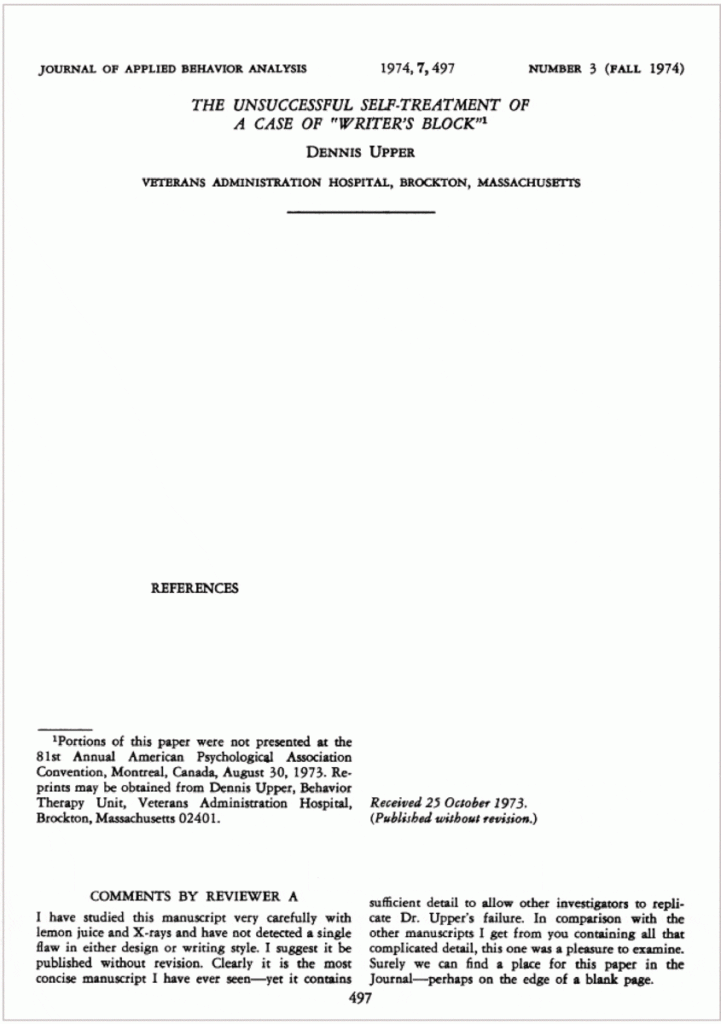
We’ve featured impressively short academic papers here on Open Culture before, like John Nash’s 26-page PhD thesis and this two-sentence “Counterexample to Euler’s Conjecture on Sums and Like Powers,” but if you’ve set your sights on writing one shorter still, don’t get your hopes up. The almost certainly unbeatable example of a short academic paper appeared more than forty years ago, in the fall 1974 issue of the Journal of Applied Behavior Analyses, its main text coming in at exactly zero words. You can read it, if indeed “read” is the word, above or at the National Center for Biotechnology Information.
Written, or at least thought up, by psychologist Dennis Upper, “The Unsuccessful Self-Treatment of a Case of ‘Writer’s Block’ ” has nothing but its title, one footnote (indicating that “portions of this paper were not presented at the 81st annual American Psychological Association Convention”), and the fulsome comments of a reviewer: “I have studied this manuscript very carefully with lemon juice and X‑rays and have not detected a single flaw in either design or writing style. I suggest it be published without revision. Clearly it is the most concise manuscript I have ever seen — yet it contains sufficient detail to allow other investigators to replicate Dr. Upper’s failure. In comparison with the other manuscripts I get from you containing all that complicated detail, this one was a pleasure to examine.”
Some describe writer’s block, whether in science or literature or any other field requiring the proper arrangement of words, as a fear of the blank page. If looking at Upper’s void-like paper frightens you, consider having a look at the Louisiana Channel series we featured in 2016 wherein writers like Margaret Atwood, Jonathan Franzen, Joyce Carol Oates, and David Mitchell talk about how they deal with the blank page themselves. Atwood finds that it “beckons you in to write something on it,” that “it must be filled,” but if you don’t hear the same call, you’ll have to come up with an approach of your own. Just don’t try titling, footnoting, and turning in the empty sheet — it’s been done.
Related Content:
The Shortest-Known Paper Published in a Serious Math Journal: Two Succinct Sentences
When a Cat Co-Authored a Paper in a Leading Physics Journal (1975)
Based in Seoul, Colin Marshall writes and broadcasts on cities and culture. His projects include the book The Stateless City: a Walk through 21st-Century Los Angeles and the video series The City in Cinema. Follow him on Twitter at @colinmarshall or on Facebook.
Read More...Watch Animated Scores to Music by Radiohead, Talking Heads, LCD Soundsystem, Photek & Other Electronic/Post-Punk/Avant-Garde Musicians
A few weeks ago, we told you about Stephen Malinowski and the Music Animation Machine, a popular and pretty expansive YouTube channel that features scrolling, color-coordinated animated “scores” for classical works from Debussy to Bach and Stravinsky.
But what if there was a version of this, somewhere somehow, for electronic music?
Ask the question of the Internet, dear reader, and the gods will provide. For just over a year motion graphics designer Johannes Lampert has been working in a similar style to interpret the work of electronic, post-punk, and modern composers like Steve Reich and Arvo Pärt in which every sound is represented by a different animated symbol.
In the above video, Lampert takes on Talking Heads’ multilayered, Fela Kuti-inspired “The Great Curve” from Remain in Light. The video gives us jagged lines for Tina Weymouth’s bass, a steady border of dots for Chris Frantz’ propulsive drum tracks, and several gaps into which the three vocal lines of the song—David Byrne’s lead, and Nona Hendryx and the band’s multitracked call-and-response backing vocals—drop and pulse. Add to that an unbroken jagged line that replicates Adrian Belew’s searing and soaring solo.
Currently there are 12 tracks available on Anatomy of a Track’s Youtube channel, with a posting record that suggests Johannes Lampert is working on one every two months.
Lampert experiments with the layout and graphics of his animations, making their design complement the music. Hence “The Great Curve” looking like African textiles, Gil-Scott Heron’s “New York Is Killing Me” aping the New York Subway map, and Photek’s “The Rain” as a puddle filled with pulsing raindrops.
Maybe the most complex video so far is for Radiohead’s “Bloom,” which is just as chaotic as the band’s tumbling drum machine. But it does uncover how steady the bass is in this track while all around the other instruments are shimmering and ethereal. And for just a good time, Justice’s “Phantom” is turned into a dynamic light show that looks like a night drive down a Japanese expressway.
I would put it to you that modern electronic artists think about their music much like these animations. I mean, what are music editing programs like ProTools or Logic Pro but horizontal scrolls of dots and sound waves?
No doubt Lampert has more tricks up his sleeve and more tracks to animate. Stay tuned.
Related Content:
Optical Poems by Oskar Fischinger, the Avant-Garde Animator Hated by Hitler, Dissed by Disney
Watch Classical Music Get Perfectly Visualized as an Emotional Roller Coaster Ride
Ted Mills is a freelance writer on the arts who currently hosts the artist interview-based FunkZone Podcast and is the producer of KCRW’s Curious Coast. You can also follow him on Twitter at @tedmills, read his other arts writing at tedmills.com and/or watch his films here.
Read More...Celebrate the Life & Writing of Ursula K. Le Guin (R.I.P.) with Classic Radio Dramatizations of Her Stories
Until yesterday, had you asked me to name my favorite living writers, Ursula K. Le Guin’s name would appear near the top of the list. As of yesterday, I can no longer say this. Le Guin passed away at the age of 88, and left millions of fans bereft—fans with whom she had shared some of the finest science fiction and fantasy written in the 20th century, and with whom she happily shared her wisdom and advice in the free online workshops she held in her later years, her way of connecting with readers when she retired from writing.
Like many people, I first came to Le Guin’s work through her 1969 Nebula and Hugo-winning novel The Left Hand of Darkness, a book that exploded ideas about what science fiction could be and do. That novel is part of a series of stories called the “Hainish cycle,” which—like C.S. Lewis’ Space Trilogy—are deeply philosophical and deeply sensitive to the emotional and psychological resonances of the questions they grapple with.
But unlike Lewis, Le Guin sought not to resurrect old mythologies, but to show how the boundaries and divisions we take for granted might easily become arbitrary and unfamiliar; how we might become something entirely new and different.
There are many other writers who come to mind when I think of Le Guin—Octavia Butler, Frank Herbert, Iain Banks, and, of course, Tolkien. Like many of the best writers in her genres, Le Guin’s fiction is contemplative as well as spectacular—she could write space opera, sword and sorcery, and adventure stories just as well as any of her contemporaries, but her sustained focus on the nuanced interrelations of character and theme—on the agony of choice, the possibility of freedom and connection without coercion, the social and ecological consequences of blind acquisition and thoughtless action—gave her work a depth many of her contemporaries lacked.
Le Guin’s anarchist environmentalism and “tough-minded feminist sensibility” opened up paths for dozens of writers who came after her and who also did not fit the typical molds established by the pulpy magazine stories of the early twentieth century. She was a scholar, earning an M.A. in French and Italian literature and doing doctoral work in France on a Fulbright in the mid-fifties. But unlike certain, more insecure, writers, Le Guin did not wear her learning on her sleeve. She wove it into the texture of her narratives and the allusive lyricism of her prose.
Le Guin’s highly distinctive qualities—her poetry and inquiry, toughness and sensitivity—are evident in even minor, lesser-known stories. Today, to celebrate her life, we bring you a few of those stories, as adapted into radio dramas by the 70s program Mind Webs and the late 80s NPR showcase Sci-Fi Radio. At the top of the post, hear “Diary of a Rose,” below, “Field of Vision,” and, above, “The End.”
And, just above, hear part one of a CBC dramatization of Le Guin’s novel The Dispossessed, the fifth novel in the Hainish cycle, though chronologically the cycle’s beginning. (Hear all six parts of the dramatized novel here.) Subtitled “an Ambiguous Utopia,” the novel, writes DePauw University’s Judah Bierman, is “a prizeworthy contribution to the debate about the responsibility of knowledge, of the visionary and of the scientist, in a planned society.” But like all of Le Guin’s fiction, it is so much more than that, a work that bears repeated reading, and listening, and that never exhausts its possibilities.
Note: If you’re interested in getting professionally read versions of Le Guin’s novels, consider signing up for a 30-day free trial to Audible.com. When you sign up for a free trial, they let you download two audiobooks for free, and keep the books, regardless of whether you become a long-term subscriber or not. Get details here.
Related Content:
1,000 Free Audio Books: Download Great Books for Free
Hear Inventive Stories from Ursula LeGuin & J.G. Ballard Turned Into CBC Radio Dramas
Ursula Le Guin Gives Insightful Writing Advice in Her Free Online Workshop
Josh Jones is a writer and musician based in Durham, NC. Follow him at @jdmagness
Read More...Carl Sagan’s “The Pale Blue Dot” Animated
Back in 1990, Voyager 1 snapped a photo of planet Earth from a record distance – 3.7 billion miles away. And there we saw it, our home, Planet Earth, a small blue dot almost swallowed by the vastness of space. This image inspired the title of Carl Sagan’s 1994 book, The Pale Blue Dot: A Vision of the Human Future in Space, which captivated millions of readers then, and still many more now.
A quarter century later, The Pale Blue Dot continues to give creative inspiration to many, including filmmakers who have produced animations that sync with Sagan’s narration of a famous passage from his book. The latest animation comes from a class of students at the Ringling College of Art and Design, located in Sarasota, Florida. Give it a watch. It will help you put everything in perspective.
If you would like to support the mission of Open Culture, consider making a donation to our site. It’s hard to rely 100% on ads, and your contributions will help us continue providing the best free cultural and educational materials to learners everywhere. You can contribute through PayPal, Patreon, and Venmo (@openculture). Thanks!
Related Content:
Carl Sagan Presents His “Baloney Detection Kit”: 8 Tools for Skeptical Thinking
Carl Sagan Explains Evolution in an Eight-Minute Animation
Carl Sagan Issues a Chilling Warning to America in His Final Interview (1996)
Read More...Watch “Bells of Atlantis,” an Experimental Film with Early Electronic Music Featuring Anaïs Nin (1952)
For decades, outside of feminist scholarship and readerships, French-Cuban-American diarist, novelist, and essayist Anaïs Nin was primarily known through her famous friends—most notably the experimental novelist Henry Miller, but also psychoanalyst Otto Rank. She had affairs with both men, and inspired some of their work, but Nin has always deserved much wider appreciation as an artist in her own right, whose surrealist explorations of sexuality, and sexual abuse, and posthumous collections of erotica rival Miller’s body of work—and for many readers far surpass his talents.
Now Nin’s expressive face and oracular quotations have taken over the Tumblr-sphere, such that she has been called the “patron saint of social media” and compared to Lena Dunham. Whether one finds these terms flattering or not comes down to matters of taste and, probably even more so, of age. But those who wish for a short introduction to Nin outside of the world of memes and macros will surely take an interest in the 1952 film above, “Bells of Atlantis,” shot and edited by her then-husband Ian Hugo (also known as banker High Guiler), with Nin in the starring role as the queen of Atlantis. Coilhouse offers this succinct description:
Over cascading experimental footage, Nin reads aloud from her novella House of Incest. We catch glimpses of her nude form swinging in a hammock, and we see her shadow undulating over sheer fabric blowing in the wind, but for the most part, the imagery, captured by Nin’s husband Ian Hugo, remains very abstract.
But it is not only the rare, hazy glimpses of Nin and the snippets of her reading that should draw our attention, but also the burbling, whistling, hypnotic electronic score, composed and created by the husband-and-wife-hobbyist team of Louis and Bebe Barron. Over a decade before Delia Derbyshire wowed audiences with her Dr. Who theme, the Barrons were making unheard-of experimental sounds using the technology available at the time—tape machines, oscillators, microphones, and other such low-tech analog devices.
“The Barrons were true pioneers of electronic music,” writes Messy Nessy, “and one of the crown jewels of their auditory collection is the soundtrack for the 1956 thriller sci-fi film, Forbidden Planet,” the first major motion picture with an all-electronic score. “Bells of Atlantis” breaks ground as an even earlier example of the form, and its hallucinatory visual journey recalls the surrealist filmmaking of decades past and looks forward to the psychedelic 60s.
Both the sounds the Barrons produced and the visions of Hugo turn out to be, in my humble opinion, the perfect setting for a brief introduction to Nin’s voice. After watching “Bells of Atlantis,” put on some more early electronica, and read Nin’s 1947 House of Incest for yourself, a hallucinatory prose-poem about, in Nin’s description, the “escape from a woman’s season in hell.”
Related Content:
Hear Anaïs Nin Read From Her Celebrated Diary: A 60-Minute Vintage Recording (1966)
Henry Miller Makes a List of “The 100 Books That Influenced Me Most”
Josh Jones is a writer and musician based in Durham, NC. Follow him at @jdmagness
Read More...Artificial Intelligence Writes a Piece in the Style of Bach: Can You Tell the Difference Between JS Bach and AI Bach?
This week, the artificial intelligence community Botnik published a 2018 Coachella Lineup poster composed entirely of performer names generated by neural networks. It does get one wondering what the music of “Lil Hack,” “House of the Gavins,” or “Paper Cop” might sound like — or, given the direction of technology these days, how long it will take before another neural network can actually compose it. But why use AI to create yet another millennial-minded Coachella act, you might ask, when it could create another Johann Sebastian Bach?
“One form of music that Bach excelled in was a type of polyphonic hymn known as a chorale cantata,” says the MIT Technology Review. “The composer starts with a well-known tune which is sung by the soprano and then composes three harmonies sung by the alto, tenor, and bass voices.” Such compositions “have attracted computer scientists because the process of producing them is step-like and algorithmic. But doing this well is also hard because of the delicate interplay between harmony and melody.” Hence the fascination of the question of whether a computer could ever compose a truly Bach-like chorale.
The video at the top of the post offers a listening experience that points toward an answer. The minute-long piece you hear, and whose score you see, comes not from Bach himself, nor from any human Bach imitator, but from a neural network called DeepBach, a system developed by Gaetan Hadjeres and Francois Pachet at the Sony Computer Science Laboratories in Paris.
Like any such deep learning system, the more existing material it has to “learn” from, the more convincing a product it can produce on its own: just as Botnik’s network could learn from all the band names featured on Coachella posters since 1999, DeepBach could learn from the more than 300 short chorale compositions the real Bach wrote in his lifetime.
“About half the time,” says the MIT Technology Review, “these compositions fool human experts into thinking they were actually written by Bach.” But of course, this sort of artificial intelligence has a greater and more diverse potential than tricking its listeners, as other experiments at Sony CSL-Paris suggest: the AI-composed “Beatles” song “Daddy’s Car,” for instance, or the “Flow Machine” that re-interprets Beethoven’s “Ode to Joy” in the style of the Beatles, Take 6, and even electronic lounge music. But we won’t know the technology has matured until the day we find ourselves booking tickets for artificial intelligence-composed music festivals.
Related Content:
Artificial Intelligence Program Tries to Write a Beatles Song: Listen to “Daddy’s Car”
Neural Networks for Machine Learning: A Free Online Course
Based in Seoul, Colin Marshall writes and broadcasts on cities and culture. His projects include the book The Stateless City: a Walk through 21st-Century Los Angeles and the video series The City in Cinema. Follow him on Twitter at @colinmarshall or on Facebook.
Read More...The Largest Early Map of the World Gets Assembled for the First Time: See the Huge, Detailed & Fantastical World Map from 1587
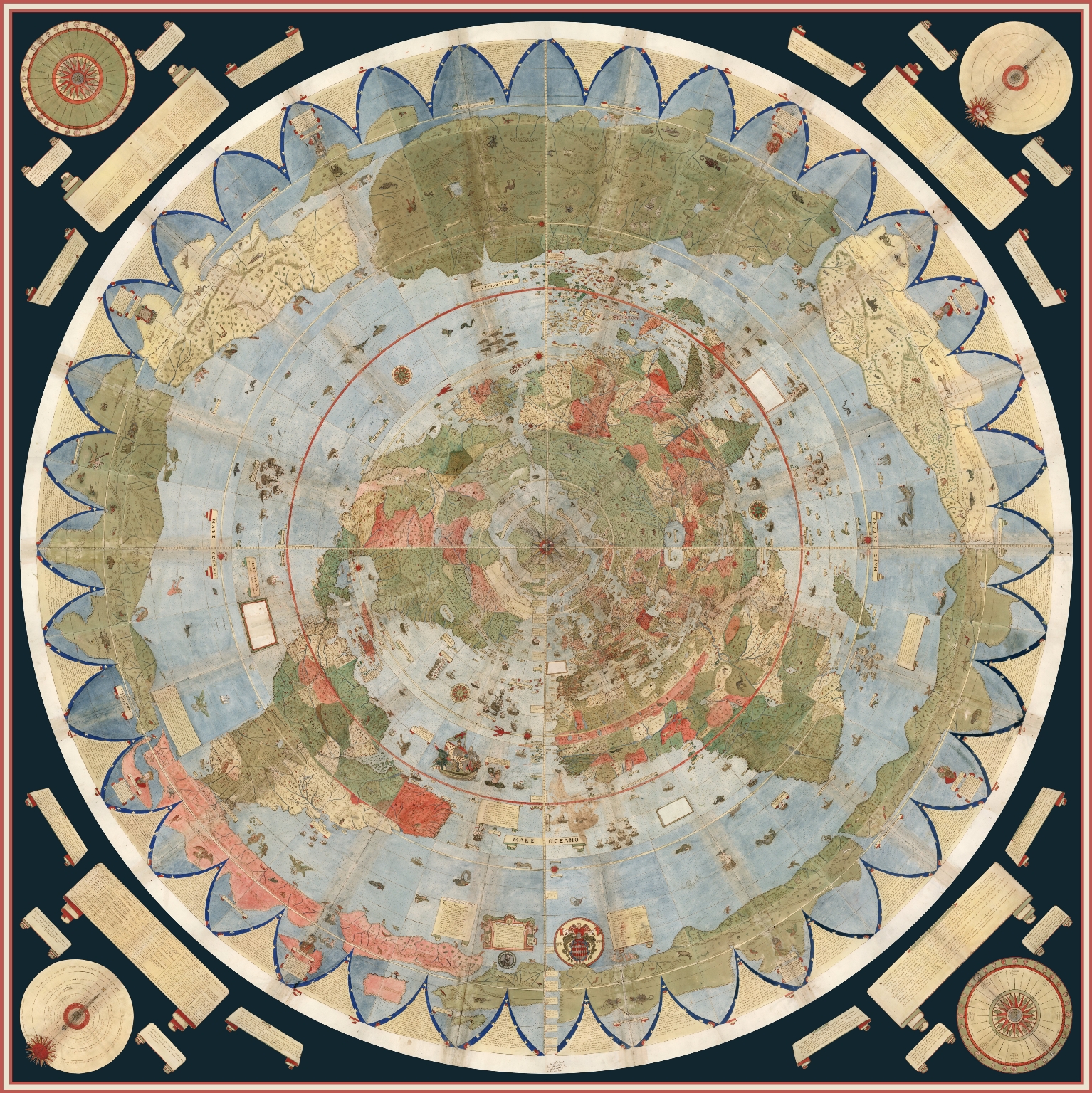
We in the early 21st century can call up detailed maps of almost any place on Earth with little more effort than typing its name. Most of us can dimly recall a time when it wasn’t quite so easy, but imagine trying to satisfy your geographical curiosity in not just decades but centuries past. For the 16th-century Milanese gentleman scholar Urbano Monte, figuring out what the whole world looked like turned into an enormous project, in terms of both effort and sheer size. In 1587, he created his “planisphere” map as a 60-page manuscript, and only now have researchers assembled it into a single piece, ten feet square, the largest known early map of the world. View it above, or in a larger format here.
“Monte appears to have been quite geo-savvy for his day,” writes National Geographic’s Greg Miller, noting that “he included recent discoveries of his time, such as the islands of Tierra del Fuego at the tip of South America, first sighted by the Portuguese explorer Ferdinand Magellan in 1520,” as well as an uncommonly detailed Japan based on information gathered from a visit with the first official Japanese delegation to Europe in 1585.
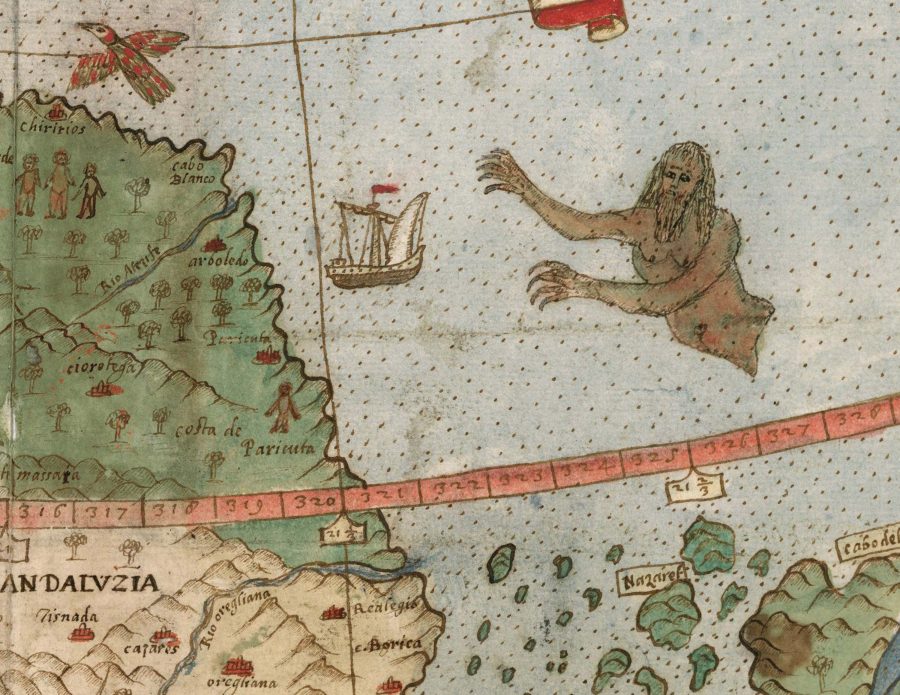
And in accordance with the mapmaking style of the time, he got more fanciful in the less-understood spaces: “Animals roam the land, and his oceans teem with ships and monsters. King Philip II of Spain rides what looks like a floating throne off the coast of South America, a nod to Spanish prominence on the high seas.”
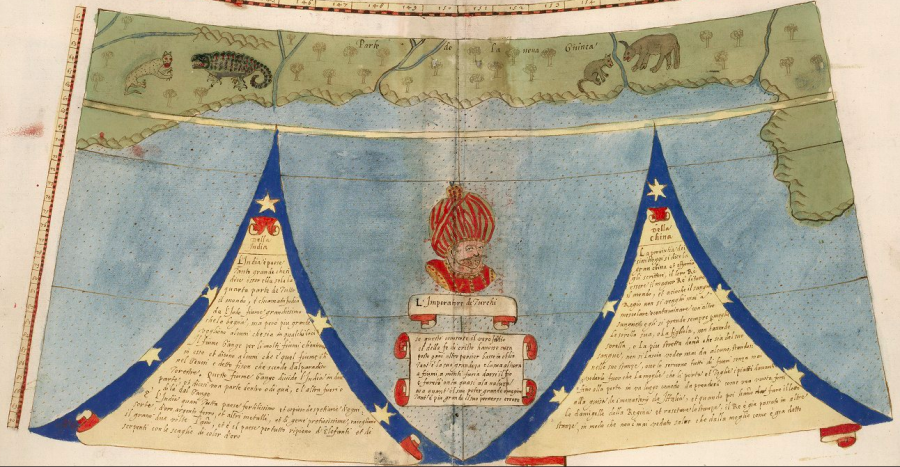
“Monte’s map reminds us of why historical maps are so important as primary resources,” says Stanford University’s David Rumsey Map Collection, which holds one of only three extant versions of the map and which conducted the digital project of scanning each of its pages and assembling them into a whole. Not only does its then-unusual (but now long standard in aviation) north polar azimuthal projection show Monte’s use of “the advanced scientific ideas of his time,” but the “the artistry in drawing and decorating the map embodies design at the highest level; and the view of the world then gives us a deep historical resource with the listing of places, the shape of spaces, and the commentary interwoven into the map.”
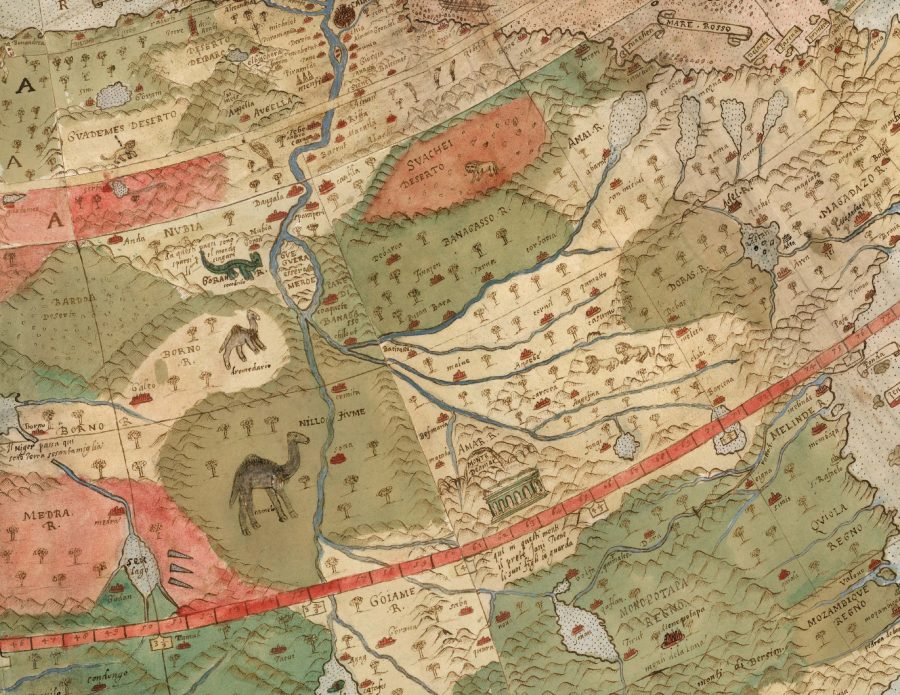
You can see/download Monte’s planisphere in detail at the David Rumsey Map Collection, both as a collection of individual pages and as a fully assembled world map. There you can also read, in PDF form, cartographic historian Dr. Katherine Parker’s “A Mind at Work: Urbano Monte’s 60-Sheet Manuscript World Map.” And to bring this marvel of 16th-century cartography around to a connection with a marvel of 21st-century cartography, they’ve also taken Monte’s planisphere and made it into a three-dimensional model in Google Earth, a mapping tool that Monte could scarcely have imagined — even though, as a close look at his work reveals, he certainly didn’t lack imagination.
via Hyperallergic
Related Content:
The History of Cartography, the “Most Ambitious Overview of Map Making Ever,” Now Free Online
Japanese Designers May Have Created the Most Accurate Map of Our World: See the AuthaGraph
Watch the History of the World Unfold on an Animated Map: From 200,000 BCE to Today
Based in Seoul, Colin Marshall writes and broadcasts on cities and culture. His projects include the book The Stateless City: a Walk through 21st-Century Los Angeles and the video series The City in Cinema. Follow him on Twitter at @colinmarshall or on Facebook.
Read More...Massive New Database Will Finally Allow Us to Identify Enslaved Peoples and Their Descendants in the Americas
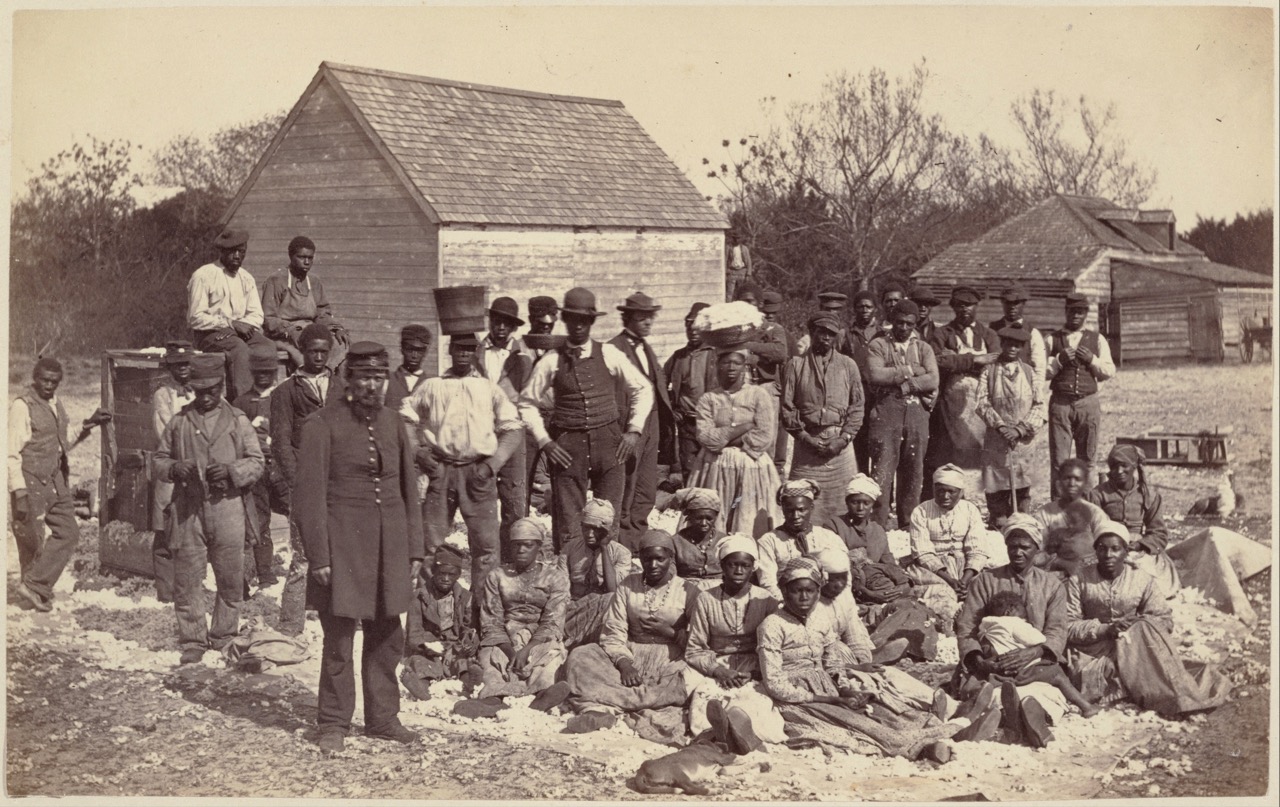
Throughout the history of the so-called “New World,” people of African descent have faced a yawning chasm where their ancestry should be. People bought and sold to labor on plantations lost not only their names but their connections to their language, tradition, and culture. Very few who descend from this painful legacy know exactly where their ancestors came from. The situation contributes to what Toni Morrison calls the “dehistoricizing allegory” of race, a condition of “foreclosure rather than disclosure.” To compound the loss, most descendants of slaves have been unable to trace their ancestry further back than 1870, the first year in which the Census listed African Americans by name.
But the recent work of several enterprising scholars is helping to disclose the histories of enslaved people in the Americas. For example, The Freedman’s Bureau Project has made 1.5 million documents available to the public, in a searchable database that combines traditional scholarship with digital crowdsourcing.
And now, a just-announced Michigan State University project—supported by a $1.5 million grant from the Mellon Foundation—will seek to “change the way scholars and the public understand African slavery.” Called “Enslaved: The People of the Historic Slave Trade,” the multi-phase endeavor is expected to take 18 months to complete an “online hub,” reports Smithsonian, linking together dozens of databases from all over the world.
“By linking data collections from multiple universities,” writes MSU Today, the resulting website “will allow people to search millions of pieces of slave data to identify enslaved individuals and their descendants from a central source. Users can also run analyses of enslaved populations and create maps, charts and graphics.” The project is headed by MSU’s Dean Rehberger, director of Matrix: The Center for Digital Humanities and Social Sciences at MSU; Ethan Watrall, assistant professor of anthropology; and Walter Hawthorne, professor and chair of MSU’s history department and a specialist in African and African American history.
In addition to publishing several books on the Atlantic slave trade, Hawthorne has worked on previous digital history projects like the website Slave Biographies, which compiles information on the “names, ethnicities, skills, occupations, and illnesses” of enslaved individuals in Maranhão, Brazil and colonial Louisiana. In the video above, you can see him describe this latest project, which coincides with MSU’s “Year of Global Africa,” an 18-month celebration of the university’s many partnerships on the continent and “throughout the African Diaspora.”
Digital history projects like those spearheaded by Hawthorne and other researchers help not only scholars but also the general public develop a much more nuanced understanding of the history of slavery. These tools provide a wealth of information, but they cannot truly capture the emotional and psychological impact of the history. For such an understanding, Morrison said in the first of her 2016 Harvard Norton lectures, “I look to literature for guidance.”
Related Content:
African-American History: Modern Freedom Struggle (A Free Course from Stanford)
The Anti-Slavery Alphabet: 1846 Book Teaches Kids the ABCs of Slavery’s Evils
Josh Jones is a writer and musician based in Durham, NC. Follow him at @jdmagness
Read More...A YouTube Channel Completely Devoted to Medieval Sacred Music: Hear Gregorian Chant, Byzantine Chant & More
The artists of medieval Europe, at least according to the impression we get in history class, gave far less consideration to the world around them than the world above. Historians argue about how much that general attitude hindered the improvement of the human lot during those ten centuries or so, but even we denizens of the 21st century can feel that the imaginations of the Middle Ages did tap into something resonant — and in the domain of music quite literally resonant, since the sacred songs of that time still create a properly otherworldly sonic atmosphere when they echo through cathedrals.
If you don’t happen to live near a cathedral, you can experience something of that atmosphere through your headphones anywhere you happen to be with Callixtus, a channel on the not normally sacred space of Youtube. “Perhaps named in honor of either Pope Callistus or Xanothopoulos Callistus, Patriarch of Constantinople,” writes Catholic web site Aleteia’s Daniel Esparza, it offers “an impressive collection of sacred music, mostly medieval, including choral works belonging to both Western Christianity and the Eastern tradition.”
Callixtus’ playlist includes such enduring “hits” of these traditions as the Gregorian chant “Invitatorium: Deum Verum,” the Byzantine chant “Δεύτε λαοί” (“Come Ye Peoples”), and the multi-part Medieval Chant of the Templars.
How did this still-haunting style of music come about? According to former Talking Heads frontman David Byrne, who laid out these ideas in a popular TED Talk, it evolved alongside the houses of worship themselves, the architecture shaping the music and the music shaping the architecture: “In a gothic cathedral, this kind of music is perfect,” says Byrne. “It doesn’t change key, the notes are long, there’s almost no rhythm whatsoever, and the room flatters the music. It actually improves it.” So familiarize yourself with all this sacred music through Callixtus, but as soon as you get the chance, hie thee to a gothic cathedral: no matter your religious sensibilities, it will certainly enrich your aesthetic ones.
via Aleteia and @dark_shark
Related Content:
David Byrne: How Architecture Helped Music Evolve
Hear What Homer’s Odyssey Sounded Like When Sung in the Original Ancient Greek
What Ancient Greek Music Sounded Like: Hear a Reconstruction That is ‘100% Accurate’
Listen to the Oldest Song in the World: A Sumerian Hymn Written 3,400 Years Ago
Based in Seoul, Colin Marshall writes and broadcasts on cities and culture. His projects include the book The Stateless City: a Walk through 21st-Century Los Angeles and the video series The City in Cinema. Follow him on Twitter at @colinmarshall or on Facebook.
Read More...Support Us
We're hoping to rely on loyal readers, rather than erratic ads. Please click the Donate button and support Open Culture. You can use Paypal, Venmo, Patreon, even Crypto! We thank you!

About Us

Open Culture scours the web for the best educational media. We find the free courses and audio books you need, the language lessons & educational videos you want, and plenty of enlightenment in between.
Advertise With Us

FREE UPDATES!
GET OUR DAILY EMAIL
Get the best cultural and educational resources on the web curated for you in a daily email. We never spam. Unsubscribe at any time.
FOLLOW ON SOCIAL MEDIA

Open Culture editor Dan Colman scours the web for the best educational media. He finds the free courses and audio books you need, the language lessons & movies you want, and plenty of enlightenment in between.
Advertise With Us