An 8‑Hour Marathon Reading of 500 Emily Dickinson Poems
It’s unlikely that reclusive poet Emily Dickinson would have wanted much fuss made over her birthday while still alive to celebrate it.
But with the lady safely ensconced in Amherst’s West Cemetery’s plot 53 for more than a century, fans can observe the day in the manner they see fit.
The Library of Congress’ Poetry and Literature Center threw in with the Folger Library in celebration of her 184th, inviting poetry lovers to the free marathon reading of her work, above (and below).
Poet Eleanor Heginbotham cited Dickinson’s letter to her editor, abolitionist Thomas Wentworth Higginson–“Are you too deeply occupied to say if my verse is alive?”–before priming the breakfast crowd on what they should expect from the 8 hour marathon:
We’re just going to have a day with no discussion beyond… And it will be frustrating that we can’t ask questions, we can’t stop and say, “Oh, my goodness. Let’s do that one over again.” We’re just going to read and read and read. And from this moment on, the voice of Emily Dickinson, through those of you in this room, that’s the only voice we’re going to hear, and won’t that be fun?
Yes, though you may want to pack a nutritious snack to keep your energy up. The reading slots were secured by means of an online sign up sheet, and while such egalitarianism is laudable, it does not necessarily confer performance chops on the inexperienced.
Naturally, there are stand outs.
Marianne Noble, Associate Professor of Literature at American University, is a highlight with Poem 75, (2:36:40, above). Her Emily Rocks t‑shirt is pretty rad too.
Professor Heginbotham is another sort of treat with Poem 416, 30 minutes and 40 seconds into the second video, below.
All told, the volunteer readers held the podium for 8 hours, making it through 500 poems, slightly less than a third of the poet’s output.
A transcript of the event, with the readers’ names recorded before their chosen verses can be found here.
Single tickets for the Folger’s 2017 Emily Dickinson Birthday Tribute, co-hosted by poet and feminist literary critic, Sandra M. Gilbert, go on sale August 1.
This marathon reading of Dickinson’s poems will be added to our collection, 1,000 Free Audio Books: Download Great Books for Free.
Related Content:
The Online Emily Dickinson Archive Makes Thousands of the Poet’s Manuscripts Freely Available
The Second Known Photo of Emily Dickinson Emerges
Bill Murray Reads Poetry at a Construction Site: Emily Dickinson, Billy Collins & More
Ayun Halliday is an author, illustrator, theater maker and Chief Primatologist of the East Village Inky zine. Discuss Emily Dickinson with her informally at Pete’s Mini Zinefest in Brooklyn this Saturday. Follow her @AyunHalliday.
Read More...65,000 Fans Break Into a Singalong of Queen’s “Bohemian Rhapsody” at a Green Day Concert in London’s Hyde Park
Last week, Green Day played a massive concert in London’s Hyde Park. But arguably the climax happened before the band even took the stage. Prior to the show, the stadium piped Queen’s “Bohemian Rhapsody” through the speakers, at which point a massive singalong got underway. As one YouTuber put it, “Only Queen can rock a stadium without even being there,” a testament to their enduring influence. Enjoy the show.
If you would like to support the mission of Open Culture, consider making a donation to our site. It’s hard to rely 100% on ads, and your contributions will help us continue providing the best free cultural and educational materials to learners everywhere. You can contribute through PayPal, Patreon, and Venmo (@openculture). Thanks!
Related Content:
1910 Fairground Organ Plays Queen’s “Bohemian Rhapsody,” and It Works Like a Charm
Bohemian Gravity: String Theory Explored With an A Cappella Version of Bohemian Rhapsody
Read More...New Archive Is Digitizing the Entirety of Phenomenology: Browse Works by Husserl, Heidegger, Merleau-Ponty and More
Chances are, if you can define the word phenomenology, you’re already a student of the 20th century philosophical school, field, movement, or—as its earliest expositor, Edmund Husserl wrote in a preface to the English edition of his 1913 Ideas: General Introduction to Pure Phenomenology, “new science—though, indeed, the whole course of philosophical development since Descartes has been preparing the way for it.”
Husserl’s messianic claim for phenomenological thinking–that which, broadly, deals with the contents of consciousness and the objects of experience–presages the discipline’s enormity, well represented by the totalizing thought of Martin Heidegger, the Nazi philosopher who intended with his 1927 Being and Time to accomplish the “destruction” of philosophy. In a way, writes Simon Critchley, he succeeded. “There is no way of understanding what took place in continental philosophy after Heidegger without coming to terms with Being and Time.”
Another prominent phenomenologist, French thinker Maurice Merleau-Ponty, asserts a no less mind-bogglingly huge mandate for the method: “phenomenology is the study of essences,” he writes in his 1947 Phenomenology of Perception. “It is the search for a philosophy which shall be a ‘rigorous science,’ but it also offers an account of space, time and the world as we ‘live’ them.” Again, if this makes sense to you, you may already be a student of phenomenology, and you’ve probably read a lot of it.
Philosophy students and professors must have ready access to a huge number of texts by a wide range of authors, most of whom are having multiple conversations with each other at once. It is, of course, ideal to have at hand the kinds of resources one might find at the Stadtbibliothek in Berlin, one of the largest libraries in the world, or even at most large university libraries. But if you don’t have such access, you can still gather a fair number of full texts by Husserl, Heidegger, Merleau-Ponty and their many famous students and colleagues on the web.
Soon, you will be able to do so all in one place, in multiple languages and formats, at the Open Commons of Phenomenology, a “non-profit, international scholarly association” aiming to “provide free access to the full corpus of phenomenology” by 2020. A suitably ambitious task for a very ambitious school of thought. Currently, project founders Patrick Flack (whom you’ll see in the promo video at the top), Rodney Parker, Nicolas de Warren, and the Husserl Archives have compiled “about 12000 bibliographic entries,” close to a quarter of which link to open access pdfs.
The project still needs to iron out a number kinks, and broken links, but it plans in the coming years to collect not only previously online essays and books, but also newly digitized texts and translations, “enhanced with a number of powerful tools, such as interactive timelines and genealogies of phenomenologists and psychologists, .xml versions of texts,” and much more. Read more about the project at Daily Nous, at the now-closed Indiegogo page from its funding campaign last year, and at the Open Commons site itself, where you’ll also find reviews, calls for papers, lists of events, and more. The dense outline on the site’s About page promises great things for this new “digital infrastructure” of phenomenology research. Enter the Open Commons of Phenomenology here.
via Daily Nous
Related Content:
Take First-Class Philosophy Courses Anywhere with Free Oxford Podcasts
Free Online Philosophy Courses
Josh Jones is a writer and musician based in Durham, NC. Follow him at @jdmagness
Read More...Behold Lewis Carroll’s Original Handwritten & Illustrated Manuscript for Alice’s Adventures in Wonderland (1864)
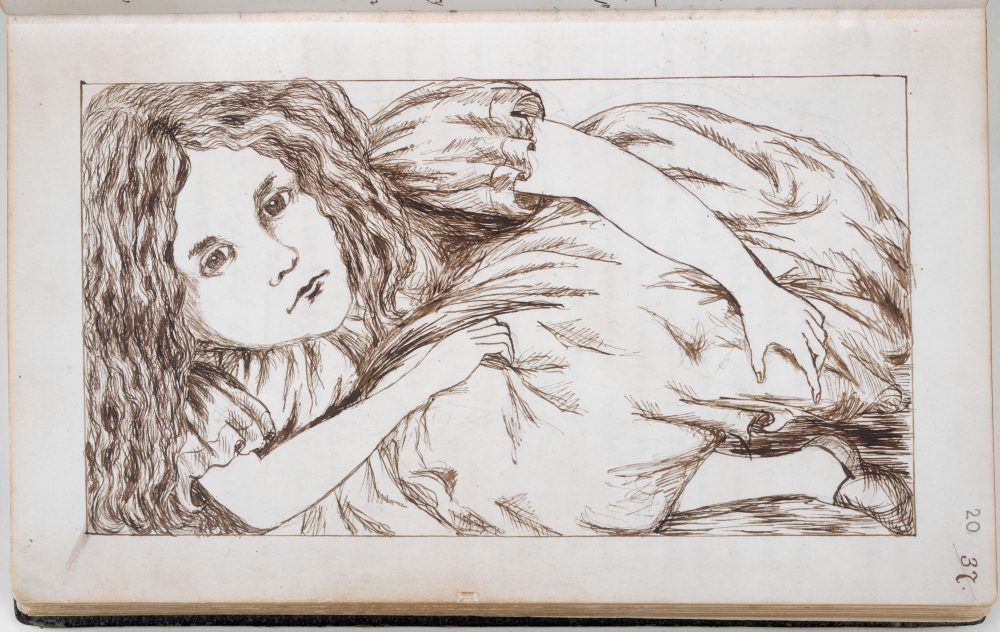
Almost exactly 155 years ago, Lewis Carroll told three young sisters a story. He’d come up with it to enliven a long boat trip up the River Thames, and one of the children aboard, a certain Alice Liddell, enjoyed it so much that she insisted that Carroll commit it to paper. Thus, so the legend has it, was Alice’s Adventures in Wonderland born, although Lewis Carroll, then best known as Oxford mathematics tutor Charles Lutwidge Dodgson, hadn’t taken up his famous pen name yet, and when he did write down Alice’s Adventures in Wonderland, it took its first form as Alice’s Adventures Under Ground. You can read that handwritten manuscript, complete with illustrations.
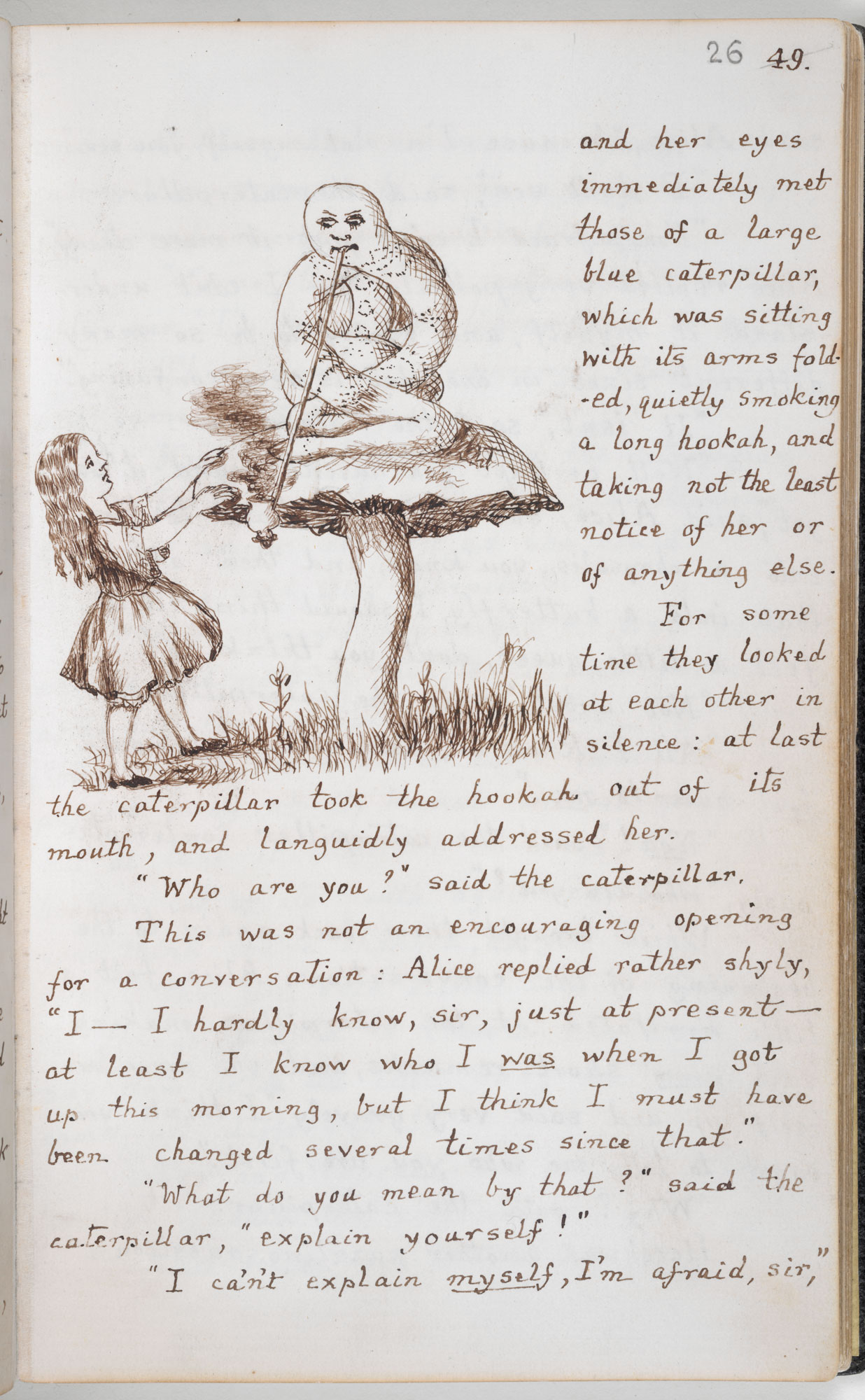
Carroll presented the fictional Alice’s namesake with the manuscript, according to the British Library, as an early Christmas present in 1864. When his friends encouraged him to publish it, he performed a few revisions, “removing some of the family references included for the amusement of the Liddell children,” adding a couple of chapters (the beloved Cheshire Cat and the Mad Hatter’s tea party being among their new material), and enlisting John Tenniel, a Punch magazine cartoonist known for his illustrations of Aesop’s Fables, to create professional art to accompany it. The result, retitled Alice’s Adventures in Wonderland, came out in 1865 and has never gone out of print.
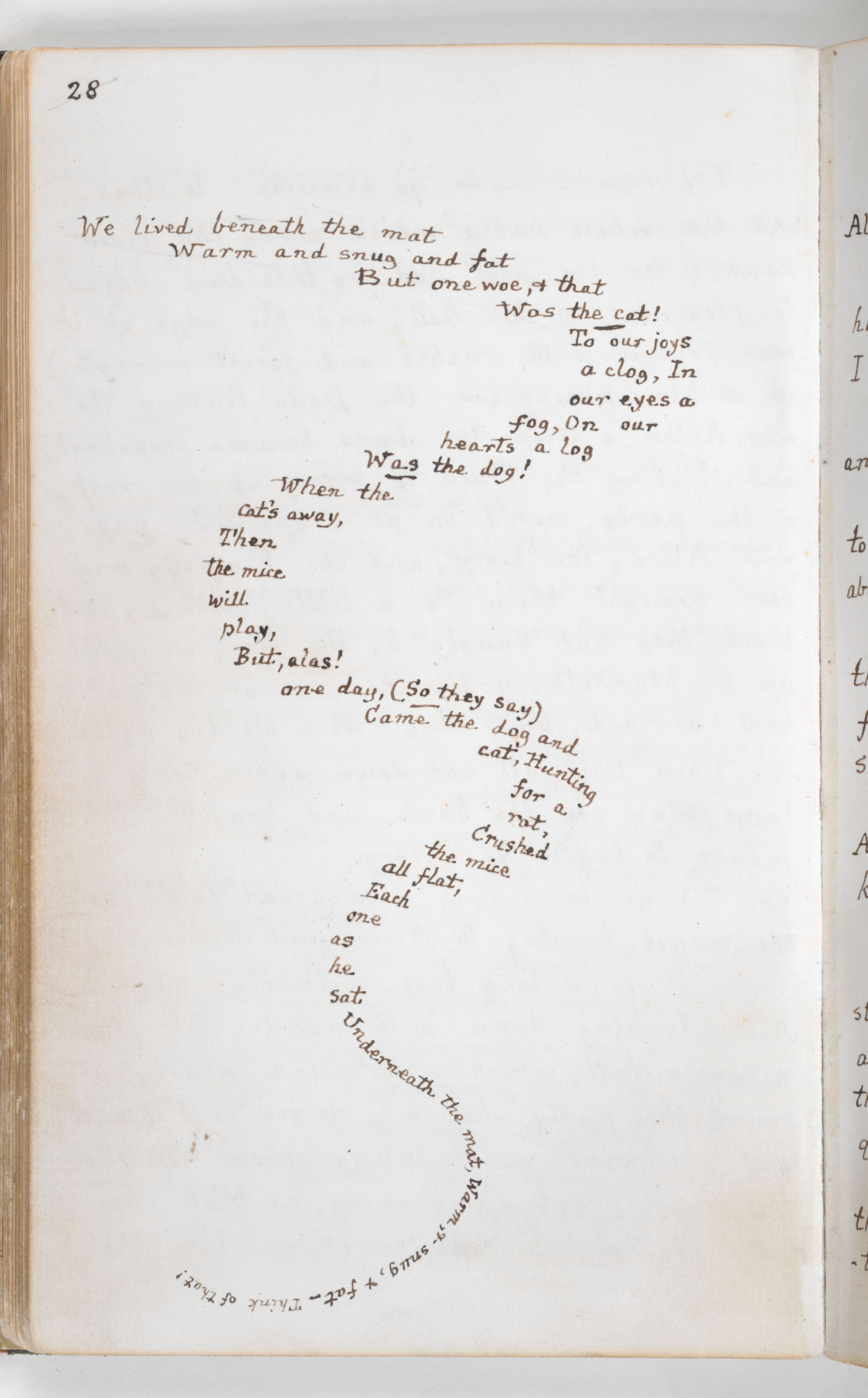
Though Tenniel’s vivid renderings of Alice and the eccentric characters she encounters have remained definitive, plenty of other artists, including Salvador Dalí and Ralph Steadman, have attempted the surely almost irresistible challenge of illustrating Carroll’s highly imaginative story. But today, says Skidmore College professor Catherine J. Golden at The Victorian Web, “critics have reevaluated Carroll’s caricature-style illustration. Carroll expertly intertwines his handwritten text with his pictures to advance the growth motif. His conception of the mouse’s ‘tale’ shaped like an actual mouse’s ‘tail’ is an excellent example of emblematic verse.”
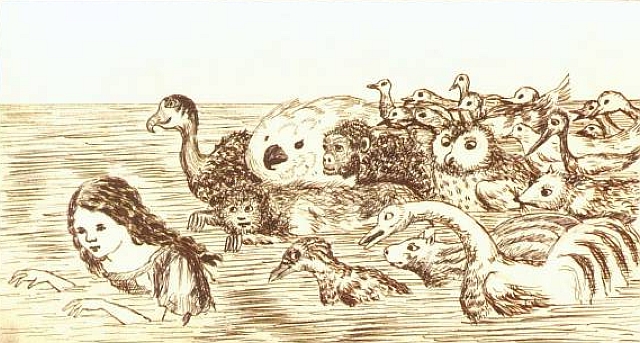
Tenniel, Golden argues, “essentially refashioned with realism and improved upon many of Carroll’s sketchy or anatomically incorrect illustrations, adding domestic interiors and landscapes that appealed to middle-class consumers of the 1860s.” Even “late twentieth-century graphic novel adaptations of Alice in Wonderland recall many of Carroll’s inventive designs as well as those of Tenniel,” which gives Carroll’s original manuscript more claim to having provided the visual basis, not just the textual one, for the following century and a half of sequels official and unofficial, as well as adaptations, reenvisionings, and reimaginings of this “Christmas gift to a dear child in memory of a summer day.”
You can view Carroll’s original manuscript, complete with illustrations, here.
Related Content:
Lewis Carroll’s Photographs of Alice Liddell, the Inspiration for Alice in Wonderland
Photo of the Real Alice in Wonderland Circa 1862
The First Film Adaptation of Alice in Wonderland (1903)
Lewis Carroll’s Classic Story, Alice’s Adventures in Wonderland, Told in Sand Animation
When Aldous Huxley Wrote a Script for Disney’s Alice in Wonderland
Based in Seoul, Colin Marshall writes and broadcasts on cities and culture. He’s at work on the book The Stateless City: a Walk through 21st-Century Los Angeles, the video series The City in Cinema, the crowdfunded journalism project Where Is the City of the Future?, and the Los Angeles Review of Books’ Korea Blog. Follow him on Twitter at @colinmarshall or on Facebook.
Read More...Does Quentin Tarantino’s First Film, Reservoir Dogs, Hold Up 25 Years Later?: A Video Essay
When’s the last time you watched Reservoir Dogs? For myself, it really has been a while, but certain iconic scenes stick in my mind: the slo-mo walk (parodied endlessly since), the opening diner discussion, the “Mexican standoff” of guns. But there’s a lot I’ve forgotten (and since having been underwhelmed by Tarantino’s last film, the relentless cruel and much too long The Hateful Eight), I wondered, much like Evan “The Nerdwriter” Puschak, does in his video essay above, “Has Reservoir Dogs Aged Well?”
Puschak’s quick answer is yes, and in his usual jam-packed but salient style he goes through the reasons.
Though this is Tarantino’s first feature (or rather the first fully surviving one), it contains the seeds of a style, but one held back by budget. A clip of Siskel & Ebert suggests that favorable critics knew this too. Siskel calls the film “an exercise in style” and wishes it went further. Pulp Fiction would grant Siskel’s wish.
Puschak points out the adrenaline of its in media res opening, with Mr. Orange (Tim Roth) bleeding out in the back of Mr. White’s car. We already know a heist has gone wrong, but not how, and we’re not hopeful about Mr. Orange’s chances of surviving. Tarantino would go on to pull a similar trick in Pulp Fiction, but as he’s matured, he’s left this kind of jolting opening behind.
The film propels ahead not like a novel, as Tarantino once remarked, but, as Puschak says, more like a classic album, a perfectly sequenced selection of contrasting moods and pacing.
Where the film hasn’t aged as well, he continues, is in its use of dated references that don’t land like they once did 25 years ago. Yet, Puschak notes, this sort of pop-culture laden dialog still exists. In fact, it’s everywhere, from Marvel blockbusters to Netflix series.
If the film is one of the weakest in Tarantino’s filmography–I would dispute that, actually, but feel free to hash that out in the comments–it does contain a thread that rises above its pulpy, referential style, and that’s the “commode” story, which we see Mr. Orange learn, rehearse, perform, and perfect through the film. Its examination of performance, of playing a role, would later get a full workout in Pulp Fiction and in many other Tarantino films, and here’s where that fascination begins. Lastly, why does the film still hold up? Simply: because of videos like this, and web articles also like this. We can’t help revisiting those Reservoir Dogs.
Related Content:
The Music in Quentin Tarantino’s Films: Hear a 5‑Hour, 100-Song Playlist
Ted Mills is a freelance writer on the arts who currently hosts the artist interview-based FunkZone Podcast and is the producer of KCRW’s Curious Coast. You can also follow him on Twitter at @tedmills, read his other arts writing at tedmills.com and/or watch his films here.
Read More...Women of Jazz: Stream a Playlist of 91 Recordings by Great Female Jazz Musicians
Browse through an archive of jazz writing from the last, oh, hundred years, and you’ll get the distinct impression that jazz, like the NFL, has been a man’s‑man’s‑man’s‑man’s world. “Of course,” writes Margaret Howze at NPR, “we have Billie, Ella, and Sarah,” and many other powerhouse female vocalists everyone knows and loves. These unforgettable voices seem to stand out as exceptions, and what’s more, “when we think of women in jazz, we automatically think of singers,” not instrumentalists.
Part of the marginalization of women in jazz has to do with the same kinds of cultural blind spots we find in discussions on every subject. We’ve been as guilty here as anyone of neglecting many great women in jazz, sadly. But women in jazz have also historically faced similar social barriers and stigmas as other women in all the arts. There are more than enough female vocalists, pianists, guitarists, trumpeters, drummers, saxophonists, bandleaders, teachers, producers to form a “worthy pantheon,” yet until fairly recently, a great many women jazz musicians have worked in the shadows of more famous men.
Howze’s two-part sketch of women in jazz offers a succinct chronological introduction, noting that “the piano, one of the earliest instruments that women played in jazz, allowed female artists” in the 20s and 30s “a degree of social acceptance.” In those years, “female instrumentalists usually formed all-women jazz bands or played in family-based groups.” One early standout musician, Dolly Hutchinson, née Jones, played the trumpet and cornet in bands all over the country. Hutchinson doesn’t appear in the Women of Jazz playlist below, but you can see her at the top in a clip from Oscar Michaux’s 1938 film Swing!
The Spotify playlist Women of Jazz does, however, offer samples from many other female jazz greats in its 91 tracks, from the very well-known—Nina Simone, Norah Jones, Diana Krall, “Billie, Ella, and Sarah”—to the very much overlooked. In that latter category falls a woman whose last name is familiar to us all. Lil Hardin Armstrong never achieved close to the degree of fame as her husband Louis, but the pianist, writes Howze, “helped shape Satchmo’s early career,” playing in “King Oliver’s Creole Jazz Band, a group Armstrong joined in 1922. He and Hardin began a romance and eventually married and it was Hardin who encouraged Armstrong to embark on a solo career.”
Hardin’s “Clip Joint,” featured in the playlist, showcases her sweet, clear contralto, distinguished by a tendency to wrap surprising hooks around the end of each line, pulling us forward to the next or keeping us hanging on for more. (Equally charming and effortlessly swinging, see her on the piano, above, accompanied by drummer Mae Barnes.) Another hugely influential woman in jazz, whose legacy “has also been somewhat occluded,” writes Alexa Peters at Paste, “by the legacy of her husband,” harpist and pianist Alice Coltrane deserves far more acclaim than she receives (at least in this writer’s humble opinion).
“An incredibly gifted avant-garde musician, composer, and arranger,” Coltrane’s solo compositions and her collaborations with saxophonist Pharoah Sanders, “are as sublime as they are indelibly important” to the development of spiritual jazz. Her incorporation of Hindustani instrumentation “like drones, ragas, Tabla drum, and sitar,” together with long hypnotic free jazz passages and the unusual choice of harp, contributed a new sonic vocabulary to the form.
Though hardly comprehensive, the Women of Jazz playlist does an excellent job of outlining a list of great female singers and instrumentalists throughout the history of jazz. As someone might point out, the compilation has its own blind spots. Though firmly rooted in the traditions of the American South, jazz has, since its golden age, been an international phenomenon. Yet the majority of the artists here are from the U.S. For a contemporary corrective, check out The Guardian’s list, “Five of the Best Young Female Jazz Musicians” from the U.K. and Scandinavia, or Afripop’s “Five South African Female Jazz Instrumentalists You Should Know,” or NPR’s list of four great “Latina Jazz Vocalists”.…
And we should not neglect to mention great French women in jazz. In the short film above on French jazz and trumpet duo Nelson Veras and Airelle Besson, the two musicians discuss their collaborative process. Any mention of gender would probably seem awkwardly irrelevant to the conversation. Perhaps all jazz talk should be like that. But it seems that first most jazz fans and writers need to spend some time getting caught up. We’ve got a wealth of resources above to get them started.
Related Content:
Hear 2,000 Recordings of the Most Essential Jazz Songs: A Huge Playlist for Your Jazz Education
Herbie Hancock to Teach His First Online Course on Jazz
Josh Jones is a writer and musician based in Durham, NC. Follow him at @jdmagness
Read More...An Animated Introduction to Economist John Maynard Keynes
If you know anything about modern economic theory, you’ve learned the names Milton Friedman and John Maynard Keynes—generally pitted against each other as representing the divide down the center in Western political economy. While more radical thinkers like F.A. Hayek and, of course, Marx and Engels, hold sway over a significant part of the population, when it comes to the entrenched two-party system in the U.S. and so-called moderate Democratic and Republican politicians, we can handily refer to Friedman and Keynes, respectively, as advocating on the one hand very little government intervention into free market affairs and, on the other, a significant, very visible, guiding hand.
Keynes “believed that governments have it in their power,” says Alain de Botton in his School of Life animated introduction above, “to solve some of the greatest ills of capitalism.” Rejecting both communism and “the utter wisdom of the unfettered free market,” Keynes sought to chart a middle way, theorizing capitalist economies planned through “judicious injections” of money and “wise regulations” to “smooth out the peaks and troughs to which all economies seem fatefully prone.” Keynes himself was not prone to many financial ups and downs. Born in 1883 in Cambridge to a “well-to-do academic family,” writes the BBC, his “father was an economist and a philosopher” and his mother “became the town’s first female mayor.” He “amassed a considerable personal fortune from the financial markets” between the wars and became a “board member of a number of companies.”
At the height of the economic crisis in 1930, Keynes published an essay titled “Economic Possibilities for Our Grandchildren,” in which he “outlined his belief that most economic problems could be overcome, and give way to an age where the chief challenge for human beings would be how to occupy their leisure time in conditions of mass prosperity.” His utopian outlook may have been partly conditioned by his position as “part of the British establishment.” But Keynes was a nuanced, creative thinker, a member of the Bloomsbury group—Virginia Woolf was one of his closest friends—who “recognized that good economics was as fundamental to well-being as good painting or literature, and in a deep sense not fundamentally different in its search for the wellsprings of fulfillment, and its attention to human error and blindness.”
Like Woolf, Keynes tended to view human well-being through a narrow class prism, with some of the ugly prejudices such a view entails. Yet his theory began by considering the needs of huge numbers of unemployed in Britain and the U.S. who should not have to live in precarity and poverty, he reasoned, until the market got around to correcting itself, if it happened to do so in their lifetimes. The interventionist theories Keynes elaborated in his General Theory of Employment, Interest and Money, his great work of 1936, led to his creation in 1944 of the IMF and the World Bank, two of the most controversial global institutions of the past half-century for what many see as their disastrous, coercive meddling in the economic affairs of poorer nations.
While deficit spending may be a de facto practice of every government administration, it is the theory of John Maynard Keynes that most attaches it philosophically to the center-left. And while it may be that more Keynesian stimulus spending, with government as the “primary shopper in the land,” as Peter Coy argued in 2014, is just what a sagging, stagnant world economy needs, the perpetual challenge, as de Botton points out, is the question of just “who should pay for the loans” governments issue, or the services it funds to buoy the citizenry. Few people, no matter how wealthy, seem to want to shoulder the burden, however light it may be for some, even if Keynes’ “multiplier effect” can be shown to raise all boats once it takes hold.
Related Content:
A Short Course in Behavioral Economics
Free Online Economics Courses
Josh Jones is a writer and musician based in Durham, NC. Follow him at @jdmagness
Read More...Hear Chris Cornell’s Masterful Vocals in the Isolated Track for Soundgarden’s “Black Hole Sun”
Since Soundgarden and Audioslave frontman Chris Cornell’s recent, tragic suicide, tribute after tribute has affirmed his status as a towering icon of 90s grunge and a powerful presence in contemporary music ever since his first band emerged from Seattle with their sludgy metal riffs and operatic choruses. Sure, all of the members of Soundgarden deserve credit for that band’s thundering awesomeness. But as for Cornell’s continued success and renown long after most 90s stalwarts had burned out or faded away—well, you already know the answer: it’s that voice, an instrument over which, as Luke O’Neil writes at Esquire, the singer had “complete mastery.” Though it defined a specific time and place, Cornell’s voice also “transcended generations.”
The singer’s near four-octave range “made his live performances an incredible sight to watch” and his recordings a stirring experience to listen to, whether they showcased his own material or his unique talent for covering songs across a spectrum of styles and genres. “The imposing architecture” of Cornell’s voice, writes Pitchfork in a retrospective of some of his finest recorded moments, “was part and parcel to his legacy, but it would be nothing if he didn’t also know how to brilliantly arrange it.”
Hitting every note on the beat, “building tension until the exact moment it unlocks.” Hear that dynamic control above, stripped bare of instrumentation, in the reverb-drenched, isolated vocal tracks for Superunknown’s “Black Hole Sun,” a song—with its disturbing video—that widened Soundgarden’s already considerable fanbase when it debuted in 1994.
For contrast, and to get a sense of just how rhythmically attuned Cornell was, listen to the studio release before and/or after the stripped version at the top to hear how the vocal gives the song its spine, bearing the meter, melody, and mood. L.A. Times critic Mikael Wood describes Cornell’s voice as a “brawny yet soulful wail, grounded in sorrow but always reaching upward for a way out of the muck.” I can hardly think of a better way to characterize such a uniquely moving singer, one who, for many of us, remained a benchmark for rock vocals—in various bands and solo projects—for a solid thirty years.
Related Content:
Josh Jones is a writer and musician based in Durham, NC. Follow him at @jdmagness
Read More...Christopher Lee Reads Four Classic Horror Stories by Edgar Allan Poe (1979)
Christopher Lee, whose nearly 70-year acting career spanned most of the 20th century and nearly all of the 21st century so far, saw numerous technological, cinematic, and cultural trends come and go but remained an institution all the while. He first grew famous, as his many fans know, in the vivid, campy Hammer Horror films of the 1950s, 60s, and 70s like The Curse of Frankenstein, Corridor of Blood, and Dracula. His starring role in that last gave him his signature onscreen persona — he would go on to play the blood-sucking Count a total of ten times — but though he specialized in dark, villainous roles, his understanding of their essence meant his hundreds of performances transcended their eras, and often their material as well.
Lee knew, in other words, what it meant to be frightening, ominous, or simply unsettling in a rich and intriguing way, and that knowledge can hardly have come without an appreciation for the enduring work of Edgar Allan Poe.
We’ve previously featured several of Lee’s readings of the 19th-century American master of the macabre, including Poe’s most famous works like “The Raven” and “The Fall of the House of Usher,” but only dedicated collectors will have run across the long out-of-print release we submit for your enjoyment today: Christopher Lee Reads Edgar Allan Poe Tales of Horror, originally released in 1979, on cassette only, by the discount label Music for Pleasure, Ltd.
Spanning two tapes, this recording includes not only “The Fall of the House of Usher” but “The Black Cat,” “The Pit and the Pendulum,” and “The Cask of Amontillado,” all of which demonstrate not just Lee’s ability to conjure up a spooky atmosphere with his voice alone, but his perfect suitability to the kind of language Poe used to tell his stories, always highly mannered even while hinting at the unspeakable depths below. The question of what makes Poe’s writing so of its time yet so timeless may never be fully answered, but then, nor, probably, will the question of what makes Lee’s elegant performances stand out from even the most schlocky or dated productions. Whatever the reasons, the union of the two always guarantees captivating listening, even from a simple 1970s bargain-bin package like this one. You can find old cassettes of Christopher Lee Reads Edgar Allan Poe Tales of Horror floating around on Amazon.
Related Content:
1,000 Free Audio Books: Download Great Books for FreeChristopher Lee Reads Edgar Allan Poe’s “The Raven,” and From “The Fall of the House of Usher”
Horror Legend Christopher Lee Reads Bram Stoker’s Dracula
Horror Legend Christopher Lee Presents a Heavy Metal Version of The Little Drummer Boy
Based in Seoul, Colin Marshall writes and broadcasts on cities and culture. He’s at work on the book The Stateless City: a Walk through 21st-Century Los Angeles, the video series The City in Cinema, the crowdfunded journalism project Where Is the City of the Future?, and the Los Angeles Review of Books’ Korea Blog. Follow him on Twitter at @colinmarshall or on Facebook.
Read More...Dog Crashes a Performance of the Vienna Chamber Orchestra, in the Ancient City of Ephesus: The “Cutest Moment in Classical Music”
A quick one for all dog lovers out there. Last week, while performing Mendelssohn’s ‘Italian’ Symphony No.4 in the ancient city of Ephesus, members of the Vienna Chamber Orchestra noticed something strange out of the corner of their eyes: a dog wandering on stage, mid performance, and taking a seat, right at the feet of the first violinist. The short clip above comes from Turkish pianist Fazil Say, who called it the “Cutest moment in classical music.” Hard not to agree.
If you would like to support the mission of Open Culture, consider making a donation to our site. It’s hard to rely 100% on ads, and your contributions will help us continue providing the best free cultural and educational materials to learners everywhere. You can contribute through PayPal, Patreon, and Venmo (@openculture). Thanks!
Related Content:
The Bohr-Einstein Debates, Reenacted With Dog Puppets
Read More...Support Us
We're hoping to rely on loyal readers, rather than erratic ads. Please click the Donate button and support Open Culture. You can use Paypal, Venmo, Patreon, even Crypto! We thank you!

About Us

Open Culture scours the web for the best educational media. We find the free courses and audio books you need, the language lessons & educational videos you want, and plenty of enlightenment in between.
Advertise With Us

FREE UPDATES!
GET OUR DAILY EMAIL
Get the best cultural and educational resources on the web curated for you in a daily email. We never spam. Unsubscribe at any time.
FOLLOW ON SOCIAL MEDIA

Open Culture editor Dan Colman scours the web for the best educational media. He finds the free courses and audio books you need, the language lessons & movies you want, and plenty of enlightenment in between.
Advertise With Us

