The Music from Jack Kerouac’s Classic Beat Novel On the Road: Stream Tracks by Miles Davis, Dexter Gordon & Other Jazz Legends
When readers talk about the “music” of On the Road, they usually mean the distinctive qualities of its prose, all typed out by Jack Kerouac, so literary legend has it, on a three-week writing bender in April of 1951. “Time being of the essence in the purity of speech, sketching language is undisturbed flow from the mind of personal secret idea-words, blowing (as per jazz musician) on subject of image,” he wrote, spontaneously, in his “Essentials of Spontaneous Prose.” He also insisted on “no periods separating sentence-structures already arbitrarily riddled by false colons and timid usually needless commas-but the vigorous space dash separating rhetorical breathing (as jazz musician drawing breath between outblown phrases).”
But actual music, and especially jazz music, also forms an integral part of the background — or rather, an integral part of the ever-shifting backgrounds — of the story of Sal Paradise and Dean Moriarty’s automotive criscrossing of America. “Kerouac often made it clear that the sound of jazz in the 1940s had a lot to do with the kind of tone, intensity and unpremeditated drive he was trying to capture in the rhythms of his book,” writes the Guardian’s John Fordham. “In Los Angeles, Kerouac describes ‘the wild humming night of Central Avenue — the night of Hamp’s (that’s swing-band leader Lionel Hampton’s) ‘Central Avenue Breakdown’ — howled and boomed … they were singing in the halls, singing from their windows, just hell and be damned and look out.’ ”
An evocative passage, to be sure, and one drawn from just one of many jazz-infused sections of the novel. After enough of them, though, readers will want to hear some of this music, with its power to bring the cops “swarming from the nearest precinct,” for themselves. The 25-track Youtube playlist at the top of the post comes packed with selections drawn straight from the text, such as Miles Davis and the Charlie Parker Septet’s “Ornithology,” which Kerouac uses to establish the period of bop in which the novel opens, and Dexter Gordon and Wardell Gray’s The Hunt, so invigorating a live recording that Neal and Sal put it on the turntable in two separate chapters. The playlist even includes Red Norvo’s Congo Blues, the record that a girl at one point breaks over Dean’s head — and at Sal’s suggestion, no less — a memorable moment that shows that, however much Kerouac loved and drew inspiration from jazz, he certainly didn’t feel the need to keep reverent about it.
Related Content:
Jack Kerouac Reads from On the Road (1959)
Jack Kerouac’s Hand-Drawn Map of the Hitchhiking Trip Narrated in On the Road
Jack Kerouac Lists 9 Essentials for Writing Spontaneous Prose
Based in Seoul, Colin Marshall writes and broadcasts on cities and culture. He’s at work on the book The Stateless City: a Walk through 21st-Century Los Angeles, the video series The City in Cinema, the crowdfunded journalism project Where Is the City of the Future?, and the Los Angeles Review of Books’ Korea Blog. Follow him on Twitter at @colinmarshall or on Facebook.
Read More...An Animated Introduction to the Life & Work of Marie Curie, the First Female Nobel Laureate
Looking for an introduction or reintroduction to the life and work of scientist Marie Curie?
You could have a peek at her original manuscripts, after first signing a waiver and garbing yourself in protective gear, so as to avoid the radioactivity permeating her possessions…
Or you could turn to song. Army of Lovers, the Crypts!, and the Deedle Deedle Dees have all written songs in celebration of this brilliant woman, the first female Nobel Laureate and only person in history to have been awarded Nobel prizes in two different sciences.
(Her lead-lined coffin, forbidden studies, and romance with fellow physicist and husband Pierre are the stuff from which golden lyrics are spun…)
Or you could watch the TED-Ed animation above, written and narrated by Dr. Shohini Ghose, Physics Professor and Director of Wilfrid Laurier University’s Centre for Women in Science.
Ghose counterbalances the tantalizing biographical tidbits of the world’s most famous female scientist with her actual contributions to the fields of oncology, technology, medicine, and nuclear physics.
Ghose’s full TED-Ed lesson includes a review quiz and further resources.
To get an even more in-depth introduction to the Curies, listen to the episode of In Our Time, below.
And do remember to put down the sparklers and potato salad for a moment in silent recognition that this July 4th marks the 83rd anniversary of Mme. Curie’s death from aplastic anemia, the result of prolonged exposure to radiation.
Related Content:
Marie Curie’s Research Papers Are Still Radioactive 100+ Years Later
Real Women Talk About Their Careers in Science
The Contributions of Women Philosophers Recovered by the New Project Vox Website
Ayun Halliday is an author, illustrator, theater maker and Chief Primatologist of the East Village Inky zine. Follow her @AyunHalliday.
Read More...209 Beatles Songs in 209 Days: Memphis Musician Covers The Beatles’ Songbook
There’s a danger for musicians in covering well-known songs from famous artists. The obvious problem: one can fail to meet the challenge and deliver a substandard performance of a beloved classic, almost a criminal act in the estimation of die-hard fans. But it’s too tempting not to try. Musicians, like writers and other artists, learn best by mimicking the greats, then take what they’ve learned and develop their own style. Some of the best covers of popular songs are those that transpose them into a different key, style, tempo, or another genre entirely. “Make it your own!” as they say. Still a risky move… especially when it comes to the Beatles.
There are indeed many phenomenal Beatles covers—such as Bad Brains’ live take on “Day Tripper” (for me anyway)—that rival the originals. Some others… not so much. But when a Beatles cover is really good, and I mean really, really good… it’s usually a pro who pulls it off. So hats off to David Brookings, an able non-famous musician and Beatles superfan who set himself the gargantuan task of covering 209 Beatles songs in 209 days. Are all his cover versions gems?
No, but the bar is set so high that it’s an impossible expectation, especially given the constraints. Brookings isn’t re-inventing the pop genius wheel. He’s having fun with Beatles’ songs, accompanied by an acoustic guitar, a keyboard, a friend—singing Yoko’s parts in the silly “The Continuing Story of Bungalow Bill,” above—or his wife Shelby, as in “Please Please Me,” below.…
With their home video production values, Brookings’ covers don’t rise far above the wealth of other such efforts that flood YouTube, many of which are highly admirable in their own way. But what sets his project apart—beyond its ambitious scope—is his occasionally trenchant commentary and an interesting personal backstory. Brookings undertook his Beatles covers project in 2010 as a tribute not only to the Beatles, but also, perhaps, to Steve Jobs, founder of that company named after the band’s own label (and likely tax shelter). Brookings says the whole thing may have been just a stunt just to show that “some idiot recorded all 209 songs in 209 days.” But it’s surely more than a coincidence that the year earlier, while working as a tour guide at Memphis’ legendary Sun Studios, he made such an impression on Jobs that the Apple founder invited him to Cupertino to help build Apple’s iTunes library of blues and early rock and roll.
A dream gig for any musician and student of musical history, and enough of an inspiration to take on the entire catalog of the most famous band in the world. What’s more, Brookings happened to be recovering from liver-transplant surgery when he met Jobs at Sun and scored the job. See Brookings and his adorable daughter McKinley sing “Norwegian Wood,” above and “She Said She Said” below, and check out all of his covers, as well as original songs and performances with his band, on his YouTube channel. Find Beatles covers 1–110 here. And songs 111–209 here.
h/t Mark at PartiallyExaminedLife
Related Content:
Hear 100 Amazing Cover Versions of Beatles Songs
Josh Jones is a writer and musician based in Durham, NC. Follow him at @jdmagness
Read More...Sylvia Plath, Ted Hughes & Peter Porter Read Their Poetry: Free Audio
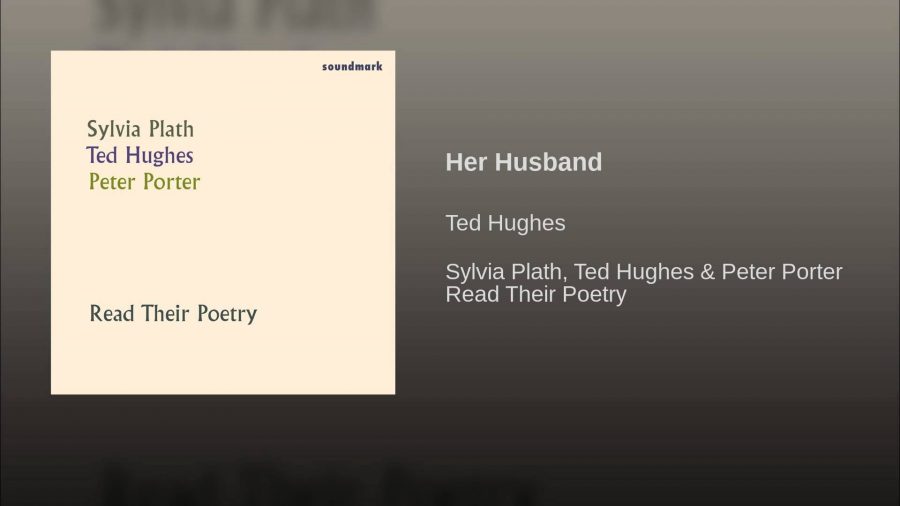
Sylvia Plath, Ted Hughes & Peter Porter Read Their Poetry was released December 04, 2013 on the Soundmark label. All 21 tracks can be heard free on Spotify. Stream the tracks below. If you need Spotify’s free software, download it here.
Sylvia Plath, Ted Hughes & Peter Porter Read Their Poetry will be added to our collection, 1,000 Free Audio Books: Download Great Books for Free.
Hear Sylvia Plath’s Barely-Known Radio Play, Three Women
Hear Sylvia Plath Read 50+ of Her Dark, Compelling Poems
Hear Sylvia Plath Read Fifteen Poems From Her Final Collection, Ariel, in 1962 Recording
The Art of Sylvia Plath: Revisit Her Sketches, Self-Portraits, Drawings & Illustrated Letters
Sylvia Plath, Girl Detective Offers a Hilariously Cheery Take on the Poet’s College Years
Read More...How Ada Lovelace, Daughter of Lord Byron, Wrote the First Computer Program in 1842–a Century Before the First Computer
I’ve never quite understood why the phrase “revisionist history” became purely pejorative. Of course, it has its Orwellian dark side, but all knowledge has to be revised periodically, as we acquire new information and, ideally, discard old prejudices and narrow frames of reference. A failure to do so seems fundamentally regressive, not only in political terms, but also in terms of how we value accurate, interesting, and engaged scholarship. Such research has recently brought us fascinating stories about previously marginalized people who made significant contributions to scientific discovery, such as NASA’s “human computers,” portrayed in the book Hidden Figures, then dramatized in the film of the same name.
Likewise, the many women who worked at Bletchley Park during World War II—helping to decipher encryptions like the Nazi Enigma Code (out of nearly 10,000 codebreakers, about 75% were women)—have recently been getting their historical due, thanks to “revisionist” researchers. And, as we noted in a prior post, we might not know much, if anything, about film star Hedy Lamarr’s significant contributions to wireless, GPS, and Bluetooth technology were it not for the work of historians like Richard Rhodes. These few examples, among many, show us a fuller, more accurate, and more interesting view of the history of science and technology, and they inspire women and girls who want to enter the field, yet have grown up with few role models to encourage them.
We can add to the pantheon of great women in science the name Ada Byron, Countess of Lovelace, the daughter of Romantic poet Lord Byron. Lovelace has been renowned, as Hank Green tells us in the video at the top of the post, for writing the first computer program, “despite living a century before the invention of the modern computer.” This picture of Lovelace has been a controversial one. “Historians disagree,” writes prodigious mathematician Stephen Wolfram. “To some she is a great hero in the history of computing; to others an overestimated minor figure.”
Wolfram spent some time with “many original documents” to untangle the mystery. “I feel like I’ve finally gotten to know Ada Lovelace,” he writes, “and gotten a grasp on her story. In some ways it’s an ennobling and inspiring story; in some ways it’s frustrating and tragic.” Educated in math and music by her mother, Anne Isabelle Milbanke, Lovelace became acquainted with mathematics professor Charles Babbage, the inventor of a calculating machine called the Difference Engine, “a 2‑foot-high hand-cranked contraption with 2000 brass parts.” Babbage encouraged her to pursue her interests in mathematics, and she did so throughout her life.
Widely acknowledged as one of the forefathers of computing, Babbage eventually corresponded with Lovelace on the creation of another machine, the Analytical Engine, which “supported a whole list of possible kinds of operations, that could in effect be done in arbitrarily programmed sequence.” When, in 1842, Italian mathematician Louis Menabrea published a paper in French on the Analytical Engine, “Babbage enlisted Ada as translator,” notes the San Diego Supercomputer Center’s Women in Science project. “During a nine-month period in 1842–43, she worked feverishly on the article and a set of Notes she appended to it. These are the source of her enduring fame.” (You can read her translation and notes here.)
In the course of his research, Wolfram pored over Babbage and Lovelace’s correspondence about the translation, which reads “a lot like emails about a project might today, apart from being in Victorian English.” Although she built on Babbage and Menebrea’s work, “She was clearly in charge” of successfully extrapolating the possibilities of the Analytical Engine, but she felt “she was first and foremost explaining Babbage’s work, so wanted to check things with him.” Her additions to the work were very well-received—Michael Faraday called her “the rising star of Science”—and when her notes were published, Babbage wrote, “you should have written an original paper.”
Unfortunately, as a woman, “she couldn’t get access to the Royal Society’s library in London,” and her ambitions were derailed by a severe health crisis. Lovelace died of cancer at the age of 37, and for some time, her work sank into semi-obscurity. Though some historians have seen her as simply an expositor of Babbage’s work, Wolfram concludes that it was Ada who had the idea of “what the Analytical Engine should be capable of.” Her notes suggested possibilities Babbage had never dreamed. As the Women in Science project puts it, “She rightly saw [the Analytical Engine] as what we would call a general-purpose computer. It was suited for ‘developping [sic] and tabulating any function whatever… the engine [is] the material expression of any indefinite function of any degree of generality and complexity.’ Her Notes anticipate future developments, including computer-generated music.”
In a recent episode of the BBC’s In Our Time, above, you can hear host Melvyn Bragg discuss Lovelace’s importance with historians and scholars Patricia Fara, Doron Swade, and John Fuegi. And be sure to read Wolfram’s biographical and historical account of Lovelace here.
Related Content:
The Contributions of Women Philosophers Recovered by the New Project Vox Website
Real Women Talk About Their Careers in Science
Josh Jones is a writer and musician based in Durham, NC. Follow him at @jdmagness
Read More...
Arnold Schoenberg Creates a Hand-Drawn, Paper-Cut “Wheel Chart” to Visualize His 12-Tone Technique
“These go up to eleven,” Spinal Tap famously said of the amplifiers that, so they claimed, took them to a higher level in rock music. But the work of Austrian composer Arnold Schoenberg, one of the best-known figures in the history of avant-garde music, went up to twelve — twelve tones, that is. His “twelve-tone technique,” invented in the early 1920s and for the next few decades used mostly by he and his colleagues in the Second Viennese School such as Alban Berg, Anton Webern, and Hanns Eisler, allowed composers to break free of the traditional Western system of keys that limited the notes available for use in a piece, instead granting each note the same weight and making none of them central.
This doesn’t mean that composers using Schoenberg’s twelve-tone technique could just use notes at random in complete atonality, but that a new set of considerations would organize them. “He believed that a single tonality could include all twelve notes of the chromatic scale,” writes Bradford Bailey at The Hum, “as long as they were properly organized to be subordinate to tonic (the tonic is the pitch upon which all others are referenced, in other words the root or axis around which a piece is built).” The mathematical rigor underlying it all required some explanation, and often mathematical and musical concepts — mathematics and music being in any case intimately connected — become much clearer when rendered visually.
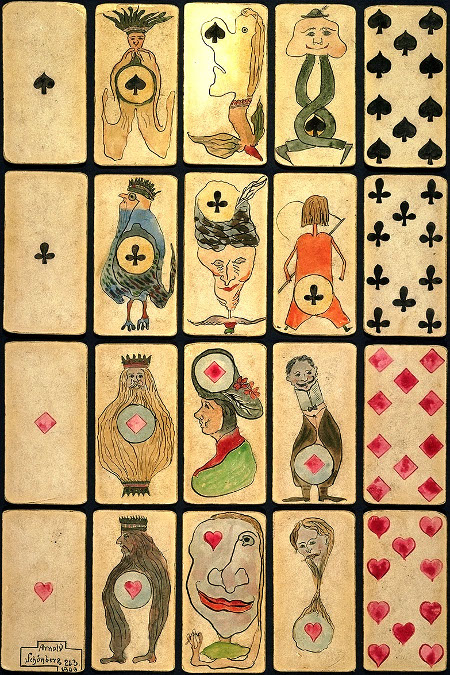
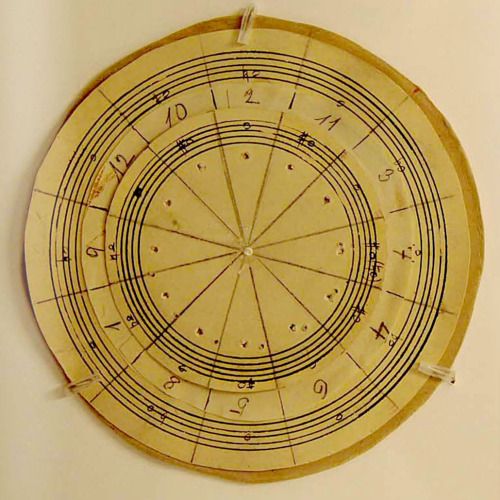
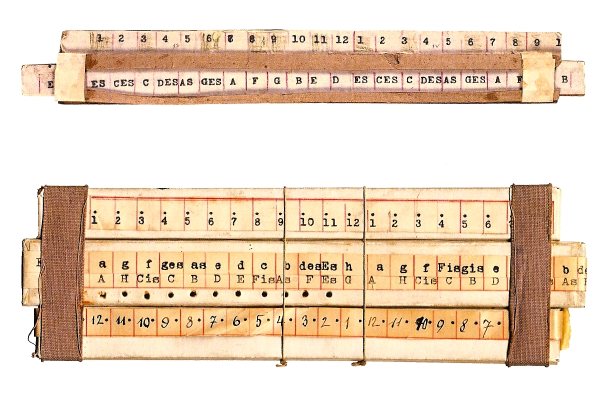
Hence Schoenberg’s twelve-tone wheel chart pictured at the top of the post, one of what Arnold Schoenberg’s Journey author Allen Shawn describes as “no fewer than twenty-two different kinds of contraptions” — including “charts, cylinders, booklets, slide rules” — “for transposing and deriving twelve-tone rows” needed to compose twelve-tone music. (See the slide ruler above too.) “The distinction between ‘play’ and ‘work’ is already hard to draw in the case of artists,” writes Shawn, “but in Schoenberg’s case it is especially hard to make since he brought discipline, originality, and playfulness to many of his activities.” These also included making special playing cards (two of whose sets you can see here and here) and even his own version of chess.
As Shawn describes it, Koalitionsscach, or “Coalition Chess,” involves “the armies of four countries arrayed on the four sides of the board, for which he designed and constructed the pieces himself.” Instead of an eight-by-eight board, Coalition Chess uses a ten-by-ten, and the pieces on it “represent machine guns, artillery, airplanes, submarines, tanks, and other instruments of war.” The rules, which “require that the four players form alliances at the outset,” add at least a dimension to the age-old standard game of chess — a form that, like traditional Western music, humanity will still be struggling to master decades and even centuries hence. But apparently, for a mind like Schoenberg’s, chess and music as he knew them weren’t nearly challenging enough.
Related Content:
Vi Hart Uses Her Video Magic to Demystify Stravinsky and Schoenberg’s 12-Tone Compositions
Interviews with Schoenberg and Bartók
John Coltrane Draws a Picture Illustrating the Mathematics of Music
Based in Seoul, Colin Marshall writes and broadcasts on cities and culture. He’s at work on the book The Stateless City: a Walk through 21st-Century Los Angeles, the video series The City in Cinema, the crowdfunded journalism project Where Is the City of the Future?, and the Los Angeles Review of Books’ Korea Blog. Follow him on Twitter at @colinmarshall or on Facebook.
Read More...Garry Kasparov Now Teaching an Online Course on Chess
FYI: If you sign up for a MasterClass course by clicking on the affiliate links in this post, Open Culture will receive a small fee that helps support our operation.
Quick FYI: Garry Kasparov is now teaching an online course on chess, apparently his first online course ever. A grandmaster and six-time World Chess Champion, Kasparov held the highest chess rating (until being surpassed by Magnus Carlsen in 2013) and also the record for consecutive tournament victories (15 in a row). In his course, featuring 29 video lessons, Kasparov gives students “detailed lessons,” covering “his favorite openings and advanced tactics,” all of which will help students “develop the instincts and philosophy to become a stronger player.”
The course is being offered by MasterClass, the same venture developing classes with these other luminaries–Herbie Hancock on Jazz, Jane Goodall on the Environment, David Mamet on Dramatic Writing, Steve Martin on Comedy, Aaron Sorkin on Screenwriting, Gordon Ramsay on Cooking, Judy Blume on Writing, and Werner Herzog on Filmmaking.
You can take this class by signing up for a MasterClass’ All Access Pass. The All Access Pass will give you instant access to this course and 85 others for a 12-month period.
Related Content:
A Free 700-Page Chess Manual Explains 1,000 Chess Tactics in Plain English
Claymation Film Recreates Historic Chess Match Immortalized in Kubrick’s 2001: A Space Odyssey
A Human Chess Match Gets Played in Leningrad, 1924
Play Chess Against the Ghost of Marcel Duchamp: A Free Online Chess Game
Watch Bill Gates Lose a Chess Match in 79 Seconds to the New World Chess Champion Magnus Carlsen
Read More...All the Rivers & Streams in the U.S. Shown in Rainbow Colors: A Data Visualization to Behold

This is a sight for sore eyes. Created by Hungarian geographer and map-designer Robert Szucs, using open-source QGIS software, the high resolution map above shows:
all the permanent and temporary streams and rivers of the contiguous 48 states in beautiful rainbow colours, divided into catchment areas. It shows Strahler Stream Order Classification. The higher the stream order, the thicker the line.
When you look at the map, you’ll see, as The Washington Post observes, “Every river in a color drains to the same river, which then drains into the ocean. The giant basin in the middle of the country is the Mississippi River basin. Major rivers like the Ohio and the Missouri drain into the behemoth.” Pretty impressive.
The map was apparently made using data from the European Environment Agency and the Rivers Network System.
You can find the map on Imgur, or purchase “ultra high” resolution copies through Etsy for $8.
Szucs has als0 produced data visualizations of the river systems in China, India, Europe and other parts of the world.

If you would like to support the mission of Open Culture, consider making a donation to our site. It’s hard to rely 100% on ads, and your contributions will help us continue providing the best free cultural and educational materials to learners everywhere. You can contribute through PayPal, Patreon, and Venmo (@openculture). Thanks!
Related Content
Ancient Rome’s System of Roads Visualized in the Style of Modern Subway Maps
Japanese Designers May Have Created the Most Accurate Map of Our World: See the AuthaGraph
Buckminster Fuller’s Map of the World: The Innovation that Revolutionized Map Design (1943)
Read More...The Female Pioneers of the Bauhaus Art Movement: Discover Gertrud Arndt, Marianne Brandt, Anni Albers & Other Forgotten Innovators
You’d be forgiven for assuming that the Bauhaus, the modern art and design movement that emerged from the eponymous German art school in the 1920s and 30s, didn’t involve many women. Perhaps the famous near-industrial austerity of its aesthetic, especially at large scales, has stereotypical associations with maleness, but also, Bauhaus’ most oft-referenced leading lights — Paul Klee, Walter Gropius, Wassily Kandinsky, László Moholy-Nagy, Oskar Schlemmer — all happened to be men. But if we seek out the women of the Bauhaus, what can we learn?

“When it opened, the Bauhaus school declared itself progressive and modern and advocated equality for the sexes, which was rare at the time,” says Evelyn Adams in her short video on the Women of the Bauhaus above. “Value was placed on skill rather than gender. Classes weren’t segregated, and women were free to select whichever subjects they wanted.”
This had an understandable appeal, and in the school’s first year more women applied than men. But alas, “in reality, despite having radical aspirations, the men in charge of the school represented the societal attitudes of the time. If everyone was welcomed as equals, then why did none of the women reach the same level of recognition as Paul Klee or Wassily Kandinsky?”
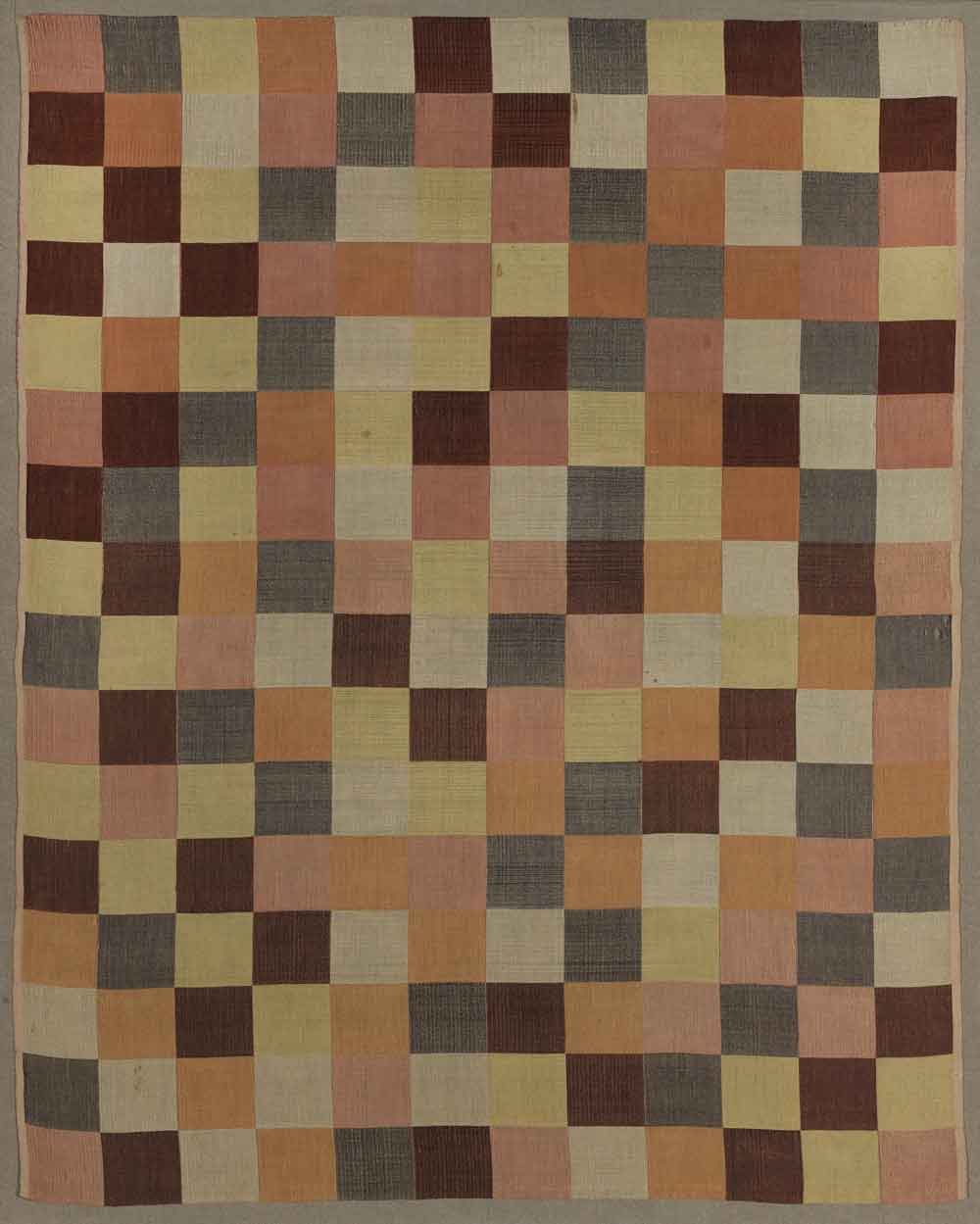
The story of Gertrud Arndt, one of whose self-portraits appears above and one of whose textiles appears below that, sheds some light on the answer. “She must have felt so optimistic,” writes the New York Times’ Alice Rawsthorn, when she arrived at the Bauhaus school of art and design in 1923 as “a gifted, spirited 20-year-old who had won a scholarship to pay for her studies. Having spent several years working as an apprentice to a firm of architects, she had set her heart on studying architecture.” But because of a “long-running battle between its founding director, the architect Walter Gropius, and one of its most charismatic teachers, Johannes Itten, who wanted to use the school as a vehicle for his quasi-spiritual approach to art and design,” the Bauhaus’ house, as it were, had fallen out of order.

Alas, “Arndt was told that there was no architecture course for her to join and was dispatched to the weaving workshop.” In recent years, the Bauhaus Archive in Berlin has put on shows to honor female Bauhausers like Ardnt, textile designer Benita Koch-Otte, and theater designer, illustrator, and color theorist Lou Scheper-Berkenkamp. “The situation improved after Gropius succeeded in ousting Itten in 1923,” writes Rawsthorn, hiring Moholy-Nagy in Itten’s place. “Having ensured that female students were given greater freedom, Moholy encouraged one of them, Marianne Brandt, to join the metal workshop. She was to become one of Germany’s foremost industrial designers during the 1930s,” and her 1924 tea infuser and strainer appears just above.
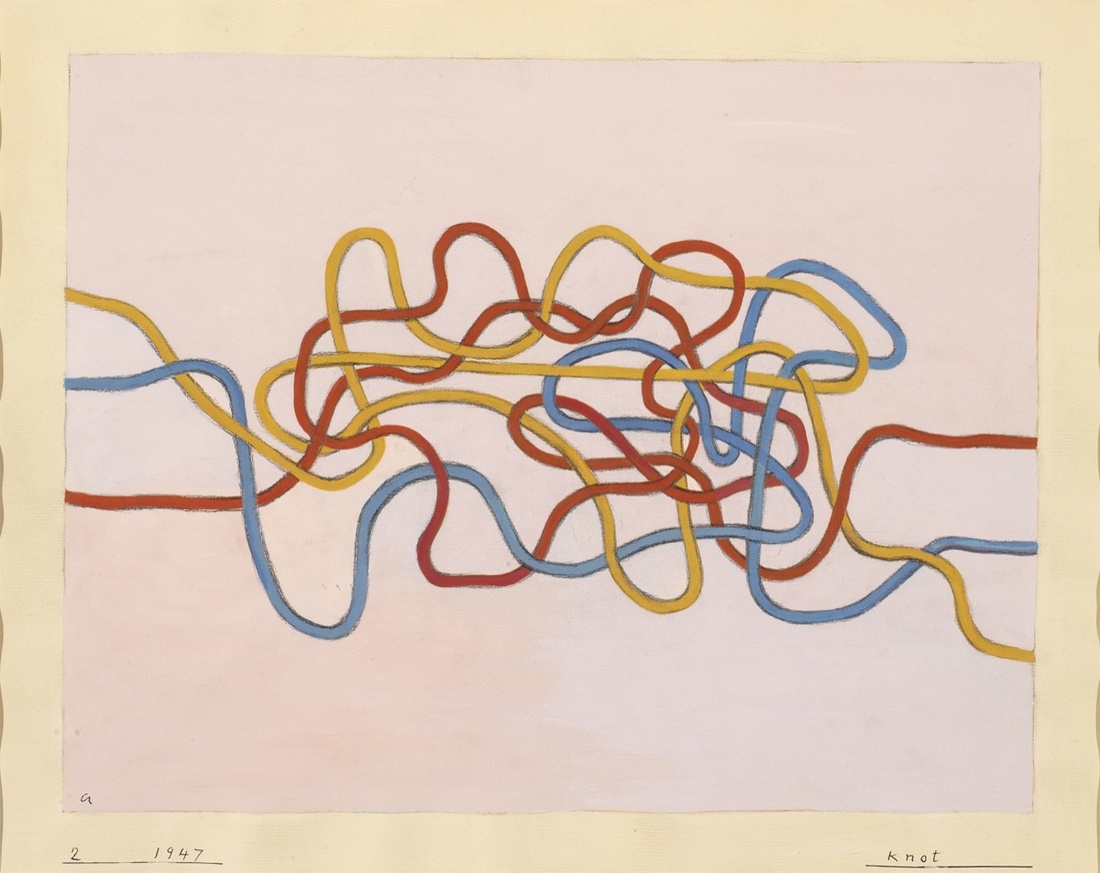
Artsy’s Alexxa Gotthardt has the stories of more women of the Bauhaus, including Anni Albers, whose 1947 Knot 2 appears just above. Her other work includes “a cotton and cellophane curtain that simultaneously absorbed sound and reflected light” and tapestries that “would go on to have a considerable impact on the development of geometric abstraction in the visual arts.” Alma Siedhoff-Buscher, writes Gotthardt, dared “to switch from the weaving workshop to the male-dominated wood-sculpture department,” where she invented a “small ship-building game,” pictured below and still in production today, that “manifested Bauhaus’s central tenets: its 22 blocks, forged in primary colors, could be constructed into the shape of a boat, but could also be rearranged to allow for creative experimentation.”

Bauhaus art and design took criticism in its heyday, as it still takes criticism now, for a certain coldness and sterility — or at least the work of the men of the Bauhaus does. But the more we discover about the lesser-known women of the Bauhaus, the more we see how they managed to bring no small degree of humanity to its artistic fruits, even to those of its most rigorous branches. “There is no difference between the beautiful sex and the strong sex,” Gropius once insisted in a somewhat self-defeating pronouncement, but the differences between the male and female Bauhausers — in their personalities as well as in their work — make the movement look all the richer in retrospect.
Related Content:
32,000+ Bauhaus Art Objects Made Available Online by Harvard Museum Website
Bauhaus, Modernism & Other Design Movements Explained by New Animated Video Series
Based in Seoul, Colin Marshall writes and broadcasts on cities and culture. He’s at work on the book The Stateless City: a Walk through 21st-Century Los Angeles, the video series The City in Cinema, the crowdfunded journalism project Where Is the City of the Future?, and the Los Angeles Review of Books’ Korea Blog. Follow him on Twitter at @colinmarshall or on Facebook.
Read More...The Animated Score for Penderecki’s “Threnody to the Victims of Hiroshima,” the Horrifying Composition Featured in Lynch’s Twin Peaks, Cuarón’s Children of Men & Other Films
If you were watching episode 8 of Twin Peaks on Sunday night, you might still be recovering from an overdose of uncut, pure David Lynch. We’re not here to summarize the episode but instead to point to the musical accompaniment to one of the most startling sequences in all of the director’s filmography: The slow tracking aerial shot into the heart of the first nuclear test mushroom cloud, right into the middle of hell itself (see below).
Although Angelo Badalamenti is back on board as the show’s composer, Lynch chose to use for this scene the modern classical work by Krzysztof Penderecki, Threnody to the Victims of Hiroshima, one of the most harrowing works of the 20th century.
The eight-and-a-half minute composition—-which you can listen to while following the composer’s abstract score in the video above—-was written by the Polish composer for 52 strings, nothing else. This accounts for the shrill, all treble nature of the piece. The title and dedication came later, only after Penderecki had listened to it being performed.
“I was struck by the emotional charge of the work,” Penderecki said, “I searched for associations and, in the end, I decided to dedicate it to the Hiroshima victims.”
The work went on to take third place at the Grzegorz Fitelberg Composers’ Competition in Katowice in 1960 and won the Tribune Internationale des Compositeurs UNESCO prize in 1961, two major awards that began Penderecki’s journey to become one of Poland’s most respected composers, second only to Henryk Górecki.
This isn’t Lynch’s first use of Penderecki, having put an excerpt of 1970’s Kosmogonia in Wild at Heart’s “lipstick freakout” scene, and six pieces in Inland Empire.
And it isn’t the first time Threnody to the Victims of Hiroshima, has been used in film. It was chosen by Alfonso Cuarón for Children of Men, and by Wes Craven for The People Under the Stairs, which coincidentally starred two actors from Twin Peaks.
Interestingly, Penderecki had scored films in the ‘60s, but they were work for hire jobs: a pleasant folk filled score for Wojciech Has’s The Saragossa Manuscript and choral pastiche in a Renaissance style for Alain Resnais’ Je t’aime, Je t’aime, along with some television work. But he kept that music separate from his serious work as a concert composer, seeing soundtrack work as undignified—-this was long before Philip Glass was scoring films, when careers were more regimented.
Because he refused to score William Friedkin’s The Exorcist for that reason, the director chose instead to use five of Penderecki’s already existing works for some of the film’s scariest moments: the appearance of words on Regan’s body, Father Merrin’s vision of evil near the start of the film, and during the exorcism itself. People remember Mike Oldfield’s “Tubular Bells” for its futuristic sound of occult apprehension, but it’s Penderecki’s work that accompanied all the screaming from the audiences.
Six years later in 1979, Stanley Kubrick would use seven Penderecki works for The Shining, underlining the state of madness in that particularly jarring film.
By the mid-1970s, the composer was turning away from the discordant tonal clusters of these early works and towards a more traditional and often beautiful style. But for a certain generation of filmmakers, Penderecki will be synonymous with horror. Last Sunday showed the piece still holds a grim, devastating power.
Related Content:
The Classical Music in Stanley Kubrick’s Films: Listen to a Free, 4 Hour Playlist
The Scores That Electronic Music Pioneer Wendy Carlos Composed for Stanley Kubrick’s A Clockwork Orange and The Shining
Angelo Badalamenti Reveals How He and David Lynch Composed the Twin Peaks‘ “Love Theme”
Ted Mills is a freelance writer on the arts who currently hosts the FunkZone Podcast. You can also follow him on Twitter at @tedmills, read his other arts writing at tedmills.com and/or watch his films here.
Read More...Support Us
We're hoping to rely on loyal readers, rather than erratic ads. Please click the Donate button and support Open Culture. You can use Paypal, Venmo, Patreon, even Crypto! We thank you!

About Us

Open Culture scours the web for the best educational media. We find the free courses and audio books you need, the language lessons & educational videos you want, and plenty of enlightenment in between.
Advertise With Us

FREE UPDATES!
GET OUR DAILY EMAIL
Get the best cultural and educational resources on the web curated for you in a daily email. We never spam. Unsubscribe at any time.
FOLLOW ON SOCIAL MEDIA

Open Culture editor Dan Colman scours the web for the best educational media. He finds the free courses and audio books you need, the language lessons & movies you want, and plenty of enlightenment in between.
Advertise With Us

