History of Modern Philosophy: A Free Online Course
This 23-lecture course, History of Modern Philosophy, was taught by Professor John DePoe at Marywood University in the Spring of 2014. The course covers Descartes, Leibniz, Locke, Berkeley, Hume, and Kant. And it “concentrates on the development of modern thought, examining the concepts of mind, body, and causation among others.”
History of Modern Philosophy will be added to our list of Free Online Philosophy courses, a subset of our meta collection, 1,700 Free Online Courses from Top Universities.
If you would like to support the mission of Open Culture, consider making a donation to our site. It’s hard to rely 100% on ads, and your contributions will help us continue providing the best free cultural and educational materials to learners everywhere. You can contribute through PayPal, Patreon, and Venmo (@openculture). Thanks!
Read More...Take a 360 Degree Tour of Miniature Models of Famous Landmarks: From the Taj Mahal to The Great Wall of China
Pretty cool item. A new exhibition in New York, called “Gulliver’s Gate,” shrinks the world’s most famous sites–everything from the Taj Mahal to The Great Wall of China–into miniature versions of themselves, roughly 87 times smaller than the original. In the video above, you can take a 360 degree tour of parts of the exhibition. Click on the clip, swirl around, and check out the tiny creations. It’s particularly neat if you try it on your phone.
Below, find an introduction to the project and don’t miss their behind-the-scenes footage.
If you would like to support the mission of Open Culture, consider making a donation to our site. It’s hard to rely 100% on ads, and your contributions will help us continue providing the best free cultural and educational materials to learners everywhere. You can contribute through PayPal, Patreon, and Venmo (@openculture). Thanks!
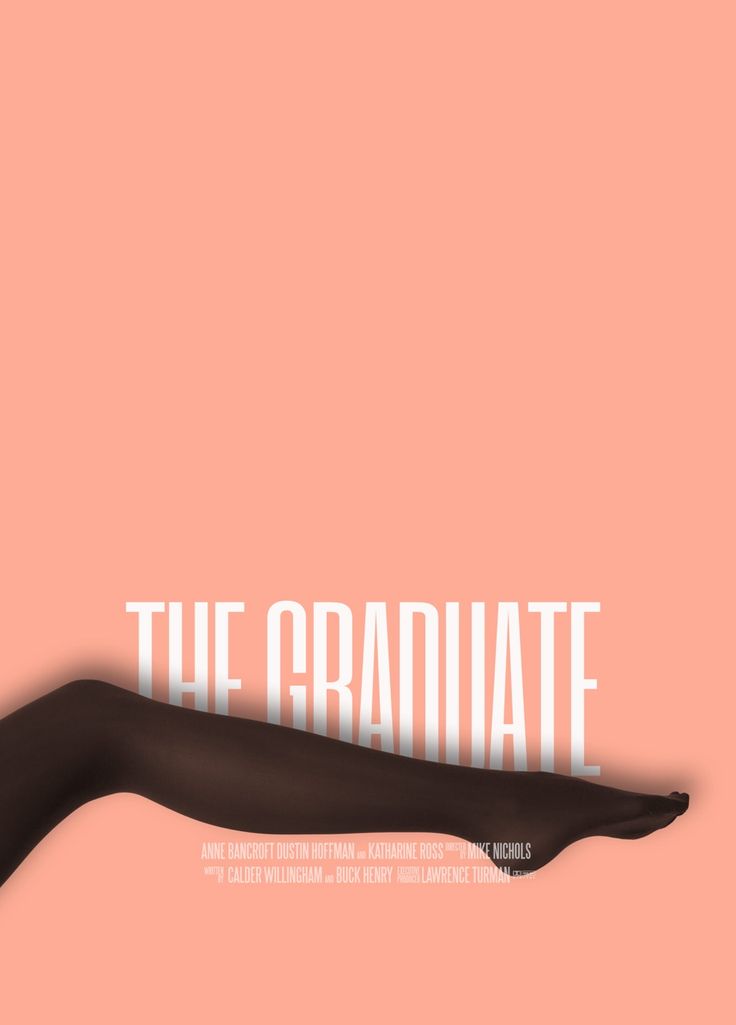
Read More...Graphic Designer Redesigns a Movie Poster Every Day, for One Year: Scarface, Mulholland Dr., The Graduate, Vertigo, The Life Aquatic and 360 More
No scene in a movie counts for as much as its opening, but even before its first frame passes through the projector, its poster has already made the real first impression. This remains basically as true in the era of digital cinema as it was when film actually passed through projectors. But while filmmakers only occasionally go back and retool their past works — not that the experience of, say, George Lucas and the original Star Wars trilogy vouches for the practice — film posters can easily undergo any number of revisions through the decades. What cinephile graphic designer wouldn’t want to take a shot at creating a new face for a favorite movie?
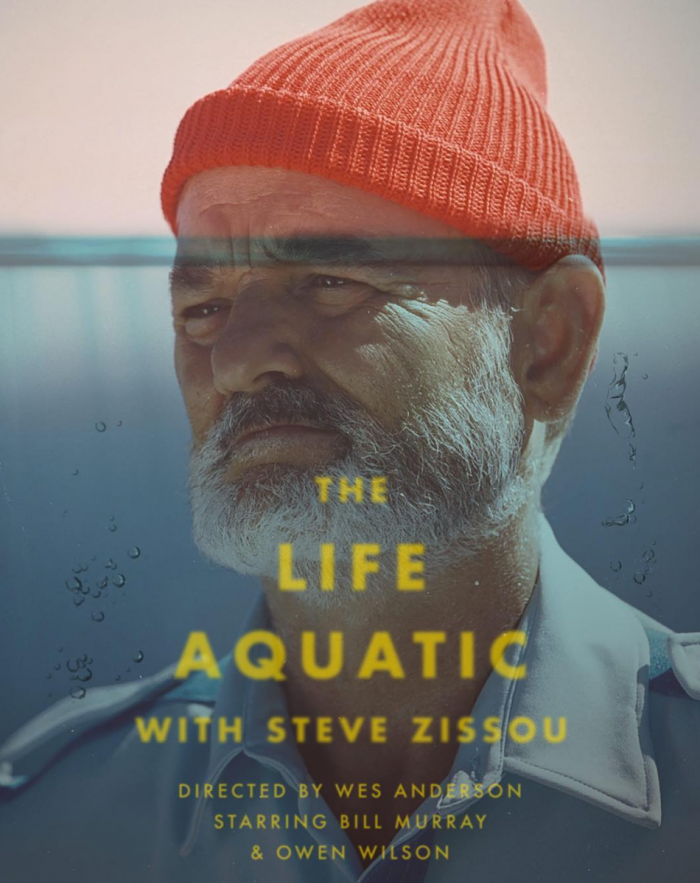
Last year, the Sydney-based designer Peter Majarich took shots at 365 of them, creating one new poster for an existing movie each and every day. “The feat is a huge undertaking,” writes the Creators Project’s Diana Shi, “but Majarich’s final products never give the impression of last-minute creations; instead, they show off an acute attention to detail and a bold, digital-influenced style. The inventiveness of each poster reveals how much of a cinephile Majarich really is.” His selections include “a pool of zeitgeist directors, Oscar winners, and art-house films with cult followings.
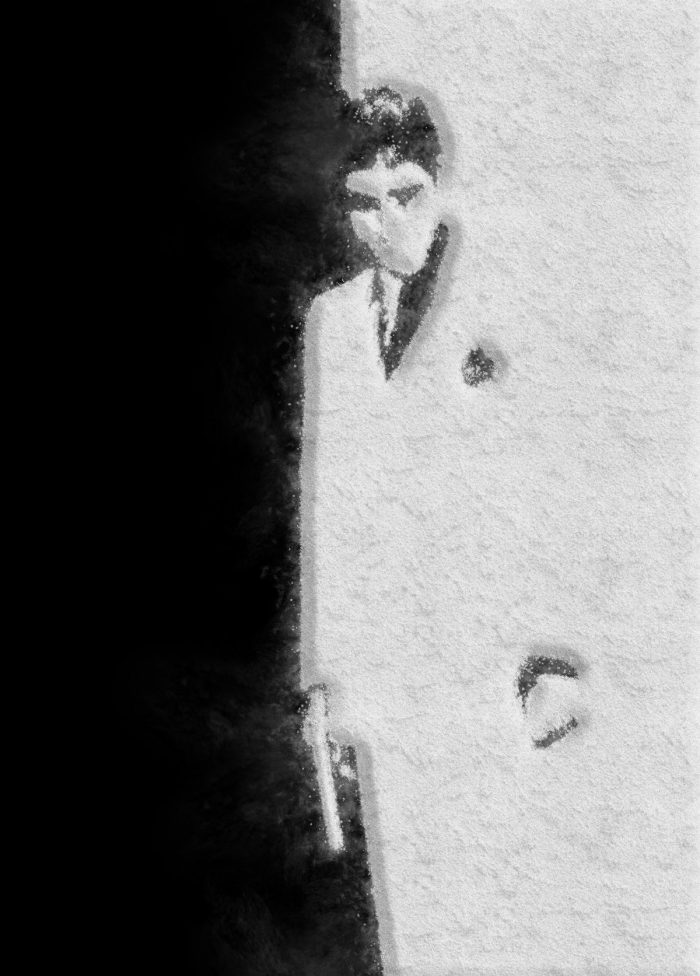
A rendering of De Palma’s Scarface is a subtle assembly of white powder to starkly draw out Al Pacino’s profile. While what looks like a body of complex coding language forms the blank-staring face of Alicia Vikander’s lead in Ex Machina.” You can browse all these at A Movie Poster a Day, see them displayed in sequence in the video above, and buy them on his design company’s site.
Their simultaneous aesthetic and cinematic references will please design- and film-lovers alike (groups hardly separate on the Venn diagram anyway), and while many constitute good visual gags, the best provide new perspectives on even much-watched favorite movies.
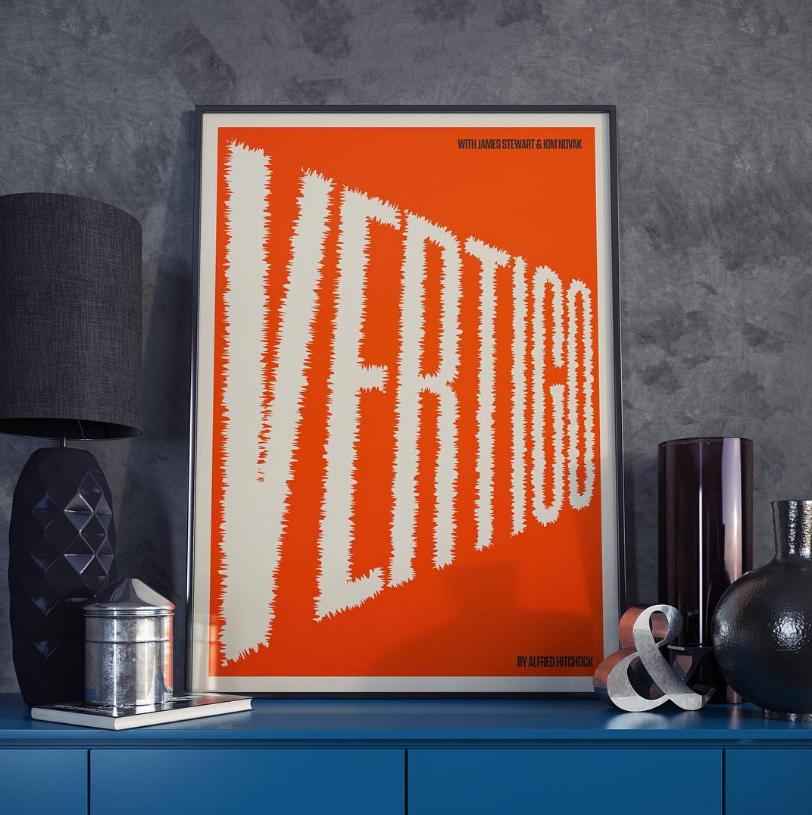
For Wes Anderson’s The Life Aquatic with Steve Zissou, Majarich depicts the emotional submersion of its seafaring protagonist; for Alfred Hitchcock’s Vertigo he works only with the title itself imbuing the type with the combination of shock and dread on display in the film; for David Lynch’s Mulholland Drive he uses a pink-skied landscape of the titular Los Angeles road leading off, as Lynch’s work often does, to who knows where. After you’ve seen the first 286, you’ll come upon a selection that will hardly surprise you: Gary Hustwit’s Helvetica.

Related Content:
A Look Inside Martin Scorsese’s Vintage Movie Poster Collection
The Strange and Wonderful Movie Posters from Ghana: The Matrix, Alien & More
Based in Seoul, Colin Marshall writes and broadcasts on cities and culture. He’s at work on a book about Los Angeles, A Los Angeles Primer, the video series The City in Cinema, the crowdfunded journalism project Where Is the City of the Future?, and the Los Angeles Review of Books’ Korea Blog. Follow him on Twitter at @colinmarshall or on Facebook.
Read More...Harvard Students Launch a Free Course on How to Resist: Now You Can Watch the Lectures
NOTE: As of July 22, we updated this post to include the videos from the class sessions. Watch the playlist of lectures above.
I have my doubts about whether we should call regular acts of civic duty “resistance,” rather than Constitutionally-protected democratic freedoms. Yesterday we remembered Martin Luther King, Jr. on the 49th anniversary of his assassination (and the 50th anniversary of his speech opposing the Vietnam War). As King and countless other civil rights and anti-war campaigners have demonstrated—some at the cost of their lives—civil disobedience is very often required and morally justified when legal appeals for justice fail. But for better or worse, “The Resistance” has become a catch-all media term for a loose and very often fractious collection of mainstream Democrats, progressives, and radicals of all stripes, whose tactics range from polite phone lobbying to brawling with white supremacists in the streets.
Millions of people who formerly had little to no involvement in politics have thrown themselves into activism, and veteran organizers have been overwhelmed with new recruits. Just as quickly, those organizers have met the challenge by disseminating guides for lobbying representatives, running for office, and participating in more direct forms of action.

Every movement has its resident scholars and educators, whether they be erudite laypeople, professional academics, or enterprising college students. A group from the latter category, “progressive students,” writes CNN, from Harvard’s Kennedy School of Government, begin today what they’re calling “Resistance School,” a “4‑week course in anti-Trump activism… open to people across the country and the world.” (You can watch the video from the course above.)
At their site, the students bill “Resistance School” as a series of “practical skills for taking back America” and open their online syllabus with a quote spuriously attributed to Thomas Jefferson: “When injustice becomes law, resistance becomes duty.” It’s possible that whoever said it had bloodier things in mind. Resistance School sticks to peaceful means, with four sessions that teach, in order, “How to Communicate our Values in Political Advocacy,” “How to Mobilize and Organize our Communities,” “How to Structure and Build Capacity for Action,” and “How to Sustain the Resistance Long-Term.” Instructors are drawn from the ranks of academia, labor organizing, and the Obama administration, and you can stream the sessions on the school’s site or on Facebook, or attend in person.
The Resistance School is sure to attract criticism, not only from the expected sources but from more anti-establishment factions on the left. But that may be unlikely to deter the more than 10,000 people who have registered for the first class. Organizers have encouraged people to attend in groups, and currently have about 3,000 groups enrolled. “Some are coming with groups of 700 people,” says co-founder Shanoor Seervai, “some are smaller groups, potlucks, gathering in people’s kitchens.”
Servaai and fellow Kennedy School students have been taken aback and are now, writes CNN, “grappling with questions of scale.” How, they wonder, will such large numbers of people coordinate; how to measure the impact of the program?.… questions, perhaps, they will resolve by the fourth session, “How to Sustain the Resistance Long-Term.” But they’re certainly not alone in trying to steer a massive surge of new interest in activism and electoral politics. As the millions now planning and participating in civil actions across the country attest, people have begun to take to heart sentiments recently expressed by organizer Alice Marshall: “If we wait for some great leader to save us we are lost. We have to save ourselves.”
Related Content:
Henry David Thoreau on When Civil Disobedience and Resistance Are Justified (1849)
Josh Jones is a writer and musician based in Durham, NC. Follow him at @jdmagness
Read More...Crystallography: A Free Online Course
This is a complete course in Crystallography, taught by H. K. D. H. Bhadeshia, a British metallurgist and TATA Steel Professor of Metallurgy at the University of Cambridge. The lectures were recorded in 2016.
This course has been added to our collection, 1,700 Free Online Courses from Top Universities
If you would like to support the mission of Open Culture, consider making a donation to our site. It’s hard to rely 100% on ads, and your contributions will help us continue providing the best free cultural and educational materials to learners everywhere. You can contribute through PayPal, Patreon, and Venmo (@openculture). Thanks!
Read More...Cosmologies of Capitalism: A Free Online Course
This course by Alan Macfarlane was originally presented to second-year students in the Department of Social Anthropology at Cambridge University as a foundation course in the development of social theories. The course covers all of the social sciences, arts and humanities over the last five hundred years and the main paradigm shifts: circularity, progress, Enlightenment.
The lecture titles are listed below. You can find the videos online here.
- Theoretical Systems in the Social Sciences: Nature and Origins
- Theoretical Systems in Social Science: Anthropological Approaches
- Three Major Theoretical Systems: An Overview
- Three Major Theoretical Systems: Structuralism and Causation
- From Circular to Linear Time: The Renaissance 1400–1700
- From Circular to Serial Time: Some Causes of the Change
- The Enlightenment — 1: Nature and Causes
- The Enlightenment — 2: France and the Reversal
- Evolution: The Background
- Evolution: Some Features
- Evolutionism: Social Sciences
- Structuralism: A Portrait
- Structuralism: Social Sciences
- New Evolutionism 1930–1980
- Reflections on the Lectures: December 2012
Cosmologies of Capitalism will be added to our collection, 1,700 Free Online Courses from Top Universities.
If you would like to support the mission of Open Culture, consider making a donation to our site. It’s hard to rely 100% on ads, and your contributions will help us continue providing the best free cultural and educational materials to learners everywhere. You can contribute through PayPal, Patreon, and Venmo (@openculture). Thanks!
Read More...
An Animated Introduction to Roland Barthes’s Mythologies and How He Used Semiotics to Decode Popular Culture
In 1979, French theorist Jean-François Lyotard declared the end of all “grand narratives”—every “theory or intellectual system,” as Blackwell’s dictionary defines the term, “which attempts to provide a comprehensive explanation of human experience and knowledge.” The announcement arrived with all the rhetorical bombast of Nietzsche’s “God is Dead,” sweeping not only theology into the dustbin but also overarching scientific theories, Freudian psychology, Marxism, and every other “totalizing” explanation. But as Lyotard himself explained in his book The Postmodern Condition, the loss of universal coherence—or the illusion of coherence—had taken decades, a “transition,” he wrote, “under way since at least the end of the 1950s.”
We might date the onset of Postmodernism and the end of “master narratives” even earlier—to the devastation at the end of World War II and the appearance of Theodor Adorno and Max Horkheimer’s Dialectic of Enlightenment and of Roland Barthes’ slim volume Mythologies, a collection of essays written between 1954 and 56 in which the French literary theorist and cultural critic put to work his understanding of Ferdinand de Saussure’s semiotics.
As a result of reading the Swiss linguist, Barthes wrote in a preface to the 1970 edition of his book, he had “acquired the conviction that by treating ‘collective representations’ as a sign-systems, one might hope to go further than the pious show of unmasking them and account in detail for the mystification which transforms petit-bourgeois culture into a universal nature.”
While generally lumped into the category of “structuralist” thinkers, as opposed to “post-structuralists” like Lyotard, Barthes nonetheless paved the way for a particularly French mistrust of “petit-bourgeois culture” and its populist spectacles and all-knowing talking heads. He was an opponent of totalizing narratives just as he was “an unrelenting opponent of French imperialism,” writes Richard Brody at The New Yorker. Like Adorno and many other post-war European intellectuals, Barthes riffed on Marx’s notion of “false consciousness”—the mental fog produced by dogmatic education, mass media, and popular culture—and applied the idea relentlessly to his analysis of the post-industrial West.
“Barthes’s work on myths,” writes Andrew Robinson at Ceasefire Magazine, “prefigures discourse-analysis in media studies.” He directed his focus to “certain insidious myths… particularly typical of right-wing populism and of the tabloid press.” Barthes though of populist mythology as a “metalanguage” that “removes history from language,” making “particular signs appear natural, eternal, absolute, or frozen” and transforming “history into nature.” Through its normalization, we lose sight of the artifice of cable news, for example, and take for granted its formatting as a universal standard for high seriousness and credibility (as in the portentous signification of “Breaking News”), even when we know we’re being lied to.
The Al Jazeera video at the top of the post asks us to consider the “rhetorical motifs” of such media, which construct “the biggest myth of all: that what we are watching is unmediated reality.” The observation may seem elementary, but Barthes sought to go further than “the pious show of unmasking,” as he wrote. He “would have seen,” the video’s narrator says, “the TV screen as a cultural text, and he would have unveiled its myths,” as he did the myths proffered by wrestling, advertising, popular film and novels, tourism, photography, dining, and other seemingly mundane popular phenomena.
The video above from educational company Macat offers a more formal summary of Barthes’ Mythologies. The French critic and semiotician made significant contributions to literary and critical theory, demonstrating—with the wide-ranging wit and erudition of his humanist countryman Michel de Montaigne—how “dominant ideologies successfully present themselves as simply the way the world should be.” Looking back on his book over twenty years later, after the events in Paris of May 1968, Barthes remarked that the need for “ideological criticism” had been “again made brutally evident.” Indeed, we have ample reason to think that, over sixty years since Barthes published his classic analysis, the need for a rigorously critical view of mass media, advertising, and political spectacle has become more pressing than ever.
Related Content:
Hear Roland Barthes Present His 40-Hour Course, La Préparation du roman, in French (1978–80)
Animated Introductions to Edward Said’s Groundbreaking Book Orientalism
Josh Jones is a writer and musician based in Durham, NC. Follow him at @jdmagness
Read More...Behold the Ingenious “Ambiguous Cylinder Illusion” (and Then Find Out How It Works)
Created by Kokichi Sugihara, a math professor at Meiji University in Tokyo, the “Ambiguous Cylinder Illusion” wowed audiences at “the Best Illusion of the Year Contest” in 2016. Here’s the general gist of the illusion:
The direct views of the objects and their mirror images generate quite different interpretations of the 3D shapes. They look like vertical cylinders, but their sections appear to be different; in one view they appear to be rectangles, while in the other view they appear to be circles. We cannot correct our interpretations although we logically know that they come from the same objects. Even if the object is rotated in front of a viewer, it is difficult to understand the true shape of the object, and thus the illusion does not disappear.
So how do those rectangles look like circles, and vice-versa? The video below–if you care to spoil the illusion–will show you. Find more videos from the Illusion Contest here.
If you would like to support the mission of Open Culture, consider making a donation to our site. It’s hard to rely 100% on ads, and your contributions will help us continue providing the best free cultural and educational materials to learners everywhere. You can contribute through PayPal, Patreon, and Venmo (@openculture). Thanks!
Read More...Creating Saturday Night Live: Behind-the Scenes Videos Reveal How the Iconic Comedy Show Gets Made
I’ve yet to meet anyone who doesn’t have some gripe about the state of SNL, very often rooted in nostalgia for a simpler, funnier Golden Age. It’s hard not to associate iconic TV shows with lost youth, even shows that have moved on when some of the rest of us haven’t.
The live sketch comedy show, now two years into its fourth decade, has done its best to keep pace with changing times and tastes. While my own fandom has waxed and waned, one thing has remained a constant: my considerable appreciation for the talent and sheer moxie required to stage original live comedy on national television, week after week for forty years.
Comics and celebrity guests risk the disaster of dead air when jokes fall flat. Crewmembers rig up convincing sets only to strike them minutes later for completely different environs. Make-up artists transform Kate McKinnon from the cartoonish Jeff Sessions to the bald, jowly “Shud the Mermaid” in-between sketches, a process that seems to unfold in seconds in the sped-up behind-the-scenes video above.
Sure, everything on the show is scripted and choreographed, and the actors read from cue cards. But as the popular phenomenon of “corpsing”—breaking character by breaking into laughter—shows us, anything can go wrong live with the best-laid plans of writers and directors. The quick-change transition between the cold open and the opening monologue, which both happen on the “home base stage” of studio 8H, as you can see at the top; the rock-solid segues from the live band, below…. The SNL machine depends on every one of its many moving parts to function.
And if—or inevitably when—one of those parts malfunctions, well the show goes on… and on and on and on…. How many seasons does SNL have left in it? Another forty? A possibly infinite number? Given how well its teams of creatives and crew have mastered the art of live televised sketch comedy—not all of it to everyone’s taste, to be sure—it’s possible that Saturday Night Live will outlive even the phenomenon of television, transplanting itself somewhere in our brains in the far future, where we’ll lean back, close our eyes, and hear the saxophones and that familiar, rousing announcement, “Live, from New York….”
See the show’s makeup department head and hair designer walk us through their process below, and watch four more behind-the-scenes shorts at the “Creating Saturday Night Live” playlist on Youtube.
Related Content:
Saturday Night Live: Putin Mocks Trump’s Poorly Attended Inauguration
When William S. Burroughs Appeared on Saturday Night Live: His First TV Appearance (1981)
Josh Jones is a writer and musician based in Durham, NC. Follow him at @jdmagness
Read More...Stream 72 Hours of Ambient Sounds from Blade Runner: Relax, Go to Sleep in a Dystopian Future
As reflexively as we may now describe the 2019 Los Angeles of Blade Runner as “dystopian” — and indeed, as vivid a modern dystopia as cinema has yet produced — who among us wouldn’t want to spend at least a few hours there? Much of the surface appeal is, of course, visual: the rainy neon-lined streets, the industrial fearsomeness, those tower-side video geisha. But no film truly succeeds, at creating a world or anything else, without the right sound. We may not consciously realize it when we watch the movie, no matter how many times we’ve seen it before, but the sonic elements, all carefully crafted, do more than their fair share to make Blade Runner feel like Blade Runner.
And so the best way to put yourself into Blade Runner’s world may be to surround yourself with its sounds, a task made much easier by “ambient geek” Crysknife007, whose Youtube channel offers a playlist of ambient noise from Blade Runner places. These include Deckard’s apartment, the Tyrell Building, the Bradbury Hotel, and others, each of which loops for a continuous twelve hours. (The complete playlist above runs for 72 hours.) Some of the locations even die-hard fans of the movie might not recognize, because they come from another extension of Blade Runner’s reality: the 1997 PC adventure game that has a new cast of characters play out a different story in the proto-cyberpunk urban setting with the same necessity for just the right sound to create just the right atmosphere
Crysknife007, who as an ambient musician goes under the name “Cheesy Nervosa,” seems to have a side line in this sort of thing: last month we featured other sci-fi-inspired selections from the same Youtube channel like the sounds of the ship’s engine from Star Trek: the Next Generation and the TARDIS from Doctor Who. But it’s Blade Runner, as Thom Andersen says in his documentary Los Angeles Plays Itself, that “continues to fascinate. Perhaps it expresses a nostalgia for a dystopian vision of the future that has become outdated. This vision offered some consolation because it was at least sublime. Now the future looks brighter, hotter, and blander.” But even as the real 2019 draws near, whatever the future actually ends up looking like, we at least know we can keep it sounding interesting.
Related Content:
10 Hours of Ambient Arctic Sounds Will Help You Relax, Meditate, Study & Sleep
Based in Seoul, Colin Marshall writes and broadcasts on cities and culture. He’s at work on a book about Los Angeles, A Los Angeles Primer, the video series The City in Cinema, the crowdfunded journalism project Where Is the City of the Future?, and the Los Angeles Review of Books’ Korea Blog. Follow him on Twitter at @colinmarshall or on Facebook.
Read More...Support Us
We're hoping to rely on loyal readers, rather than erratic ads. Please click the Donate button and support Open Culture. You can use Paypal, Venmo, Patreon, even Crypto! We thank you!

About Us

Open Culture scours the web for the best educational media. We find the free courses and audio books you need, the language lessons & educational videos you want, and plenty of enlightenment in between.
Advertise With Us

FREE UPDATES!
GET OUR DAILY EMAIL
Get the best cultural and educational resources on the web curated for you in a daily email. We never spam. Unsubscribe at any time.
FOLLOW ON SOCIAL MEDIA

Open Culture editor Dan Colman scours the web for the best educational media. He finds the free courses and audio books you need, the language lessons & movies you want, and plenty of enlightenment in between.
Advertise With Us

