The Nature of Causation: A Free Online Course from Oxford
From Marianne Talbot (Oxford University) comes a short course on The Nature of Causation. It covers the following ground:
We have causal theories of reference, perception, knowledge, content and numerous other things. If it were to turn out that causation doesn’t exist, we would be in serious trouble! Causation is so important in fact that it has been said that: “With regard to our total conceptual apparatus, causation is the centre of the centre”, and it has been called called ‘the cement of the universe’. In these lectures you will be introduced to the most influential theories of causation, the motivations for them and arguments behind them, and the problems they face.
This 6‑lecture course will be added to our list of Free Online Philosophy Courses, a subset of our list, 1,700 Free Online Courses from Top Universities.
You can find the audio available in other formats here.
Read More...The Great War and Modern Philosophy: A Free Online Course
Above, you can watch the lectures from a course called The Great War and Modern Philosophy. Taught by Nicolas de Warren, Research Professor in Philosophy at KU Leuven University, the course covers this basic ground:
World War 1 was the original catastrophe of the 20th-century. This course investigates the complex ways in which the First World War mobilized philosophical reflection during the war and the varied ways in which philosophical thought responded to the war.
Students in this course will be introduced to different philosophical reactions to the First World War through discussion and analysis of texts, documents, images, artworks, film, and music. The relation between philosophy and poetry will also be explored. In this course, students will gain historical knowledge, conceptual understanding, and literacy for a clearer grasp of the complex ways in which philosophy and the Great War intersected.
Periodically, this course is offered as a MOOC, featuring more polished lectures, over on edX.
Thinkers covered in the course include: Carl von Clausewitz, Carl Schmitt, Franz Rosenzweig, Edmund Husserl, and more.
The Great War and Modern Philosophy will be added to our list of Free Philosophy Courses, part of our collection, 1,700 Free Online Courses from Top Universities.
Read More...Pink Floyd Adapts George Orwell’s Animal Farm into Their 1977 Concept Album, Animals (a Critique of Late Capitalism, Not Stalin)
Pink Floyd will always be known for their massively successful concept albums, and David Gilmour and Roger Waters’ tense, and personally explosive, dynamic on albums like Dark Side of the Moon seems reminiscent of another masterful songwriting duo known for rock high concepts. Indeed, “there would have been no Dark Side of the Moon, and no dragons-and-warlocks-themed prog-rock epics,” writes Jody Rosen at Slate, “had the Beatles not decided to don epaulets for their lark of an album cover and impersonate a vaudeville band.”
But where The Beatles’ loose conceptual masterpieces had their stormy and sad moments, they generally kept things chipper on albums like Sgt. Pepper’s. Pink Floyd seemed determined to do precisely the opposite, setting a template for entire genres of metal to follow. 1977’s Animals especially reminds me of nothing so much as an album by Megadeth or Mastodon. Musical and thematic similarities abound: epic, booming, doomy songs with lyrics completely uninterested in charming their listeners. “Sheep,” for example, contains a modified version of the 23rd Psalm: “The Lord is my shepherd. He maketh me to hang on hooks in high places and coverteth me to lamb cutlets.”
As the brutish title alerts us, Animals is an adaptation of George’s Orwell’s Animal Farm (and the origin of Pink Floyd’s giant inflatable pig). The schematic allegory of Orwell’s book lends a high degree of coherence to Waters’ extended songs—only five in total. But he supplies his own characteristic bile (he famously spit on a fan during one tour, an incident that inspired The Wall). It couldn’t be more appropriate. Where Orwell’s novel is a transparent attack on Stalinism, Waters adapts his critique to “the economic and ideological systems within late-twentieth century liberal democracies.” So argues Phil Rose in an in-depth study of Waters’ lyrical ideas. The album’s “primary concern… is to reveal the effects that technocratic capitalist relations have on the nature of human beings and the evident divisions that undemocratic structures of power create among us as individuals.”
Orwell showed the effects of “undemocratic structures” by reducing individuals to animal types, and so does Waters, simplifying the classes further into three (and leaving out humans altogether): the ruling pigs, praetorian and aspiring capitalist dogs, and the sheep, the mindless masses. The opener, “Pigs on the Wing (Part One)” (top), an urgent acoustic strummer that gets picked up at the end of the album in a strangely upbeat reprise, sets a dystopian tone with images that may now seem old hat (bear in mind Animals debuted five years before Blade Runner).
If you didn’t care what happened to me,
And I didn’t care for you,
We would zig zag our way through the boredom and pain
Occasionally glancing up through the rain.
Wondering which of the buggers to blame
And watching for pigs on the wing.
Most of the songs began their lives as a rough collection that came together after Dark Side of the Moon and Wish You Were Here. Waters insisted on the literary conceit, against Gilmour’s objections, but the themes had already been very much on his mind. “Dogs,” above, was once a sardonic rant called “You’ve Gotta Be Crazy,” and one of its bleakest stanzas survives from that earlier track:
You gotta keep one eye looking over your shoulder.
You know it’s going to get harder, and harder, and harder as you
get older.
And in the end you’ll pack up and fly down south,
Hide your head in the sand,
Just another sad old man,
All alone and dying of cancer.
There may be no sharper an antithesis to “When I’m 64.” The image is made all the more devastating by the homicidal paranoia surrounding it. Not all of the Orwell overlay works so well, but when it does, it does so with devastating force. Consider these lines from “Sheep,” as terrifying as any late Medieval judgement scene, and more effective for an age that may not believe in hell but has seen the slaughterhouses:
What do you get for pretending the danger’s not real.
Meek and obedient you follow the leader
Down well trodden corridors into the valley of steel.
What a surprise!
A look of terminal shock in your eyes.
Now things are really what they seem.
The band’s “bleakest studio album,” argues Brice Ezell at Consequence of Sound, “feels eerily relevant in these grave times.” I can’t help but agree. Pink Floyd greatly inspired much of the heavy music to follow, doing as much as Black Sabbath or Led Zeppelin, I’d argue, to engage the imaginations of metalheads and prog-rock storytellers. Much of the music that followed them sounds very dated, but forty years after its release, their gloomiest record—which is saying a lot—seems more relevant than ever. Animals ends on an ambivalent note, hopeful but wary. The pigs are still on the wing, and the only remedy at hand, Waters suggests in the last few lines, may be to “know that I care what happens to you / And I know that you care for me.”
Related Content:
Pink Floyd’s “Echoes” Provides a Soundtrack for the Final Scene of Kubrick’s 2001: A Space Odyssey
Josh Jones is a writer and musician based in Durham, NC. Follow him at @jdmagness
Read More...An Introduction to Game Theory & Strategic Thinking: A Free Course from Yale University
Taught by Ben Polak, an economics professor and now Provost at Yale University, this free course offers an introduction to game theory and strategic thinking. Drawing on examples from economics, politics, the movies and beyond, the lectures cover topics essential to understanding Game theory–including “dominance, backward induction, the Nash equilibrium, evolutionary stability, commitment, credibility, asymmetric information, adverse selection, and signaling.”
Since Game Theory offers “a way of thinking about strategic situations,” the course will “teach you some strategic considerations to take into account [when] making your choices,” and “to predict how other people or organizations [will] behave when they are in strategic settings.”
The 24 lectures can be streamed above. (They’re also on YouTube and iTunes in audio and video). A complete syllabus can be found be on this Yale web site. Texts used in the course are the following:
- A. Dixit and B. Nalebuff. Thinking Strategically, Norton 1991
- J. Watson. Strategy: An Introduction to Game Theory, Norton 2002
- P.K. Dutta. Strategies and Games: Theory And Practice, MIT 1999
Game Theory will be added to our list of Free Economics Courses, a subset of our collection, 1,700 Free Online Courses from Top Universities.
If you would like to support the mission of Open Culture, consider making a donation to our site. It’s hard to rely 100% on ads, and your contributions will help us continue providing the best free cultural and educational materials to learners everywhere. You can contribute through PayPal, Patreon, and Venmo (@openculture). Thanks!
Read More...Watch Marcel Marceau Mime The Mask Maker, a Story Created for Him by Alejandro Jodorowsky (1959)
Alejandro Jodorowsky, as anyone who’s witnessed a movie of his play out onscreen might guess, has steeped himself in the mystical arts, but it would take an astute viewer to guess that he received some of his earliest training in the field of mime. During his time in Paris in the 1950s, the Chilean-born filmmaker, yet to shoot a single frame but having already run his own performance troupe back in Santiago, began studying under Étienne Decroux, not only a master of mime but a master teacher of mime. Jodorowsky then joined and went on a world tour with a mime group led by one of Decroux’s especially promising students, one Marcel Marceau.
Few today could think of mime without Marceau’s name coming to mind, and none could think of Marceau without having at least a sense that the man redefined the art. Performers had, of course, used their bodies to wordlessly evoke different elements of the human experience since antiquity, but Marceau — who could take his viewers through an entire human life in four minutes — brought it to another level entirely.
Some of Jodorowsky’s fans might say the same about the director, and in the video above they can witness perhaps the two men’s only surviving creation: Marceau’s 1959 performance of The Mask Maker, a piece Jodorowsky thought up for him.
“Jodorowsky would say, ‘Marcel, will you accept if I give you an idea for a story?’ ” remembered Marceau in a late interview. “I replied, ‘Of course, if the idea is good.’ Jodorowsky said, ‘What do you think of a man who tries on different masks showing a variety of emotions? He puts on a laughing mask that gets stuck on his face; he tries desperately but it will not come off. He has to blind himself to take it off his face.’ I did the choreography myself, and then we shared the rights for this pantomime.” Two other Marceau-Jodorowsky works in mime followed, The Saber of the Samurai and “another cruel tale” called The Eater of Hearts.
At once shocked and moved, according to Projected Figures’ “Brief Guide to Alejandro Jodorowsky,” by the “excess of violence” in these mime routines, Marceau nevertheless performed them with what looks like the fullest commitment to the concept. Jodorowsky in turn made use of what he’d learned from Marceau even as he switched arts and began making films. The influence shows in his very first short film, 1957’s La Cravate, a wordless physical performance for the camera. History hasn’t recorded whether Marceau ever watched it, but he’d surely recognize his former collaborator’s sensibility in the content: it also goes by the English title The Severed Heads.
A 1975 version appears below:
Related Content:
Marcel Marceau Mimes the Progression of Human Life, From Birth to Death, in 4 Minutes
How Marcel Marceau Started Miming to Save Children from the Holocaust
Alejandro Jodorowsky’s 82 Commandments for Living
Alejandro Jodorowsky Explains How Tarot Cards Can Give You Creative Inspiration
Based in Seoul, Colin Marshall writes and broadcasts on cities and culture. He’s at work on a book about Los Angeles, A Los Angeles Primer, the video series The City in Cinema, the crowdfunded journalism project Where Is the City of the Future?, and the Los Angeles Review of Books’ Korea Blog. Follow him on Twitter at @colinmarshall or on Facebook.
Read More...What It Cost to Shop at the Grocery Store in 1836, and What Goods You Could Buy
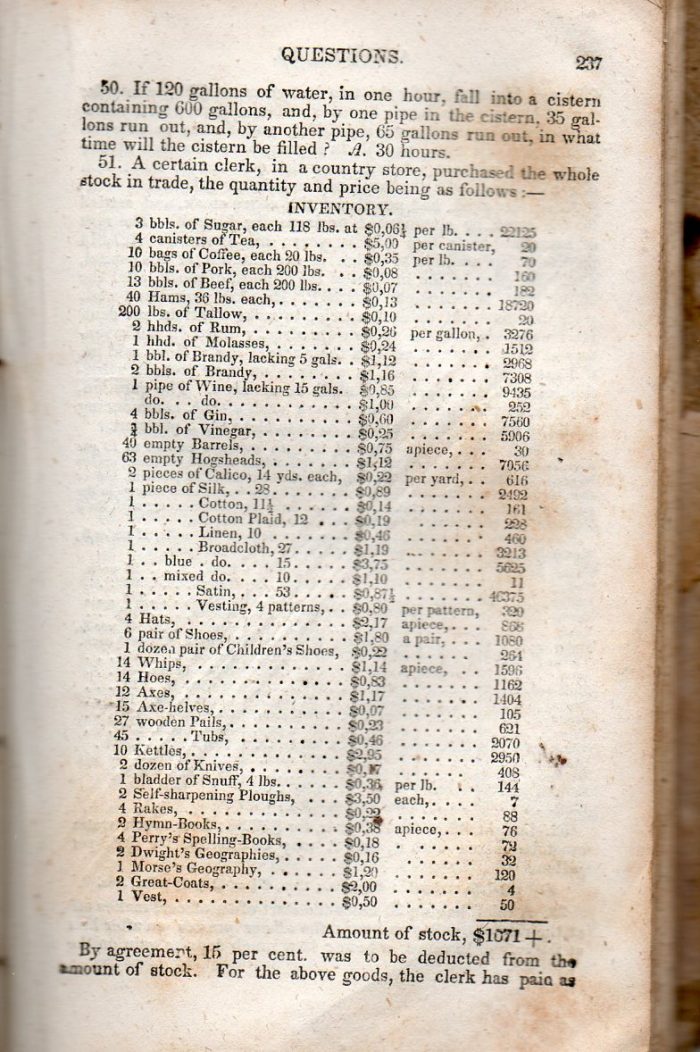
Click here to view the image in a larger format.
Like many children in possession of a toy cash register, I was a big fan of playing store.
A short stint working retail in a 90’s era Chicago hippie clothing emporium cured me of that for the most part.
But looking over the above page from Roswell C. Smith’s 1836 Practical and Mental Arithmetic on a New Plan, I must admit, I feel some of the old stirrings, and not because I love math, even when it’s intended to be worked on a slate.
Coffee, 35 cents per pound. A self-sharpening plough, $3.50. A whip, a buck fourteen. And a gallon of gin, 60 cents, which was “about two-thirds of a day’s wages for the average non-farm white male worker.” (View the prices in a larger format here.)
But I’m less intrigued by the wholesale price of the various items Smith’s hypothetical country storekeeper would pay to stock his shelves in 1836, though I do love a bargain.
It’s more the type of goods listed on that inventory. They’re exactly the sort of items that figure in one of the most memorable chapters of Little House on the Prairie—“Mr Edwards Meets Santa Claus.”
Okay, so maybe not exactly the same. Author Laura Ingalls Wilder was pretty explicit about the simple pleasures of her 1870s and 80s childhood. Her family’s bachelor neighbor, Mr. Edwards, risked life and limb fording a near-impassable, late-December creek, a bundle containing his clothes, a couple of tin cups, some peppermint sticks, and two heart-shaped cakes, tied to his head. Without his kindly initiative, their stockings would have been empty that year.
Presumably, the Independence, Kansas general store where Neighbor Edwards did his Christmas shopping would’ve stocked a lot of the same merch’ that Smith alludes to in the above fragment of a bookkeeping-related story problem. Online bookseller John Ptak, on whose blog the page was originally reproduced, is keeping page 238 close to the vest (coincidentally the last item to be mentioned on the inventory, almost as an afterthought, just one, priced at 50¢.)
Childhood recollections aside, perhaps there was something else in Mr. Edward’s bundle, something the adult Laura chose not to mention. The sort of hostess gift that could’ve warmed Pa and Ma on those long, cold frontier nights…
Some gin, perhaps…or wine? Rum? Brandy?
Smith’s shopkeeper would’ve been well provisioned, laying the stuff in by the barrel, hogshead, and pipe-full.
As for that “bladder” of snuff, a post on the Snuffhouse forum suggests that it wasn’t a euphemism, but the actual bladder of a hog, paced with 4 pounds of snortin’ tobacco.
Of course, Smith’s shopkeeper would’ve also carried a healthy assortment of wholesome goods- hymnals, children’s shoes, calico, satin, whips…
Perhaps we should do the math.
Related Content:
Enter an Archive of 6,000 Historical Children’s Books, All Digitized and Free to Read Online
19th Century Maps Visualize Measles in America Before the Miracle of Vaccines
Thomas Jefferson’s Handwritten Vanilla Ice Cream Recipe
Ayun Halliday is an author, illustrator, theater maker and Chief Primatologist of the East Village Inky zine. Follow her @AyunHalliday
Read More...How Henry David Thoreau Revolutionized the Pencil
Last Thursday was National Pencil Day, which commemorates, according to The New York Public Library (NYPL), “the day in 1858 when Philadelphia immigrant Hymen Lipman patented his invention for a pencil with an eraser on top, creating the conveniently-designed pencil we know and love.”
Of course, Lipman’s invention didn’t take place in a vacuum. Throughout the 18th and 19th centuries, American inventors were hard at work, trying to find ways to make improvements to the pencil, whose history traces back to 1564. During those early days of our republic, “American pencil-making was in sorry shape,” writes NYPL. “Poor materials made domestic pencils smudgy and frail, in comparison to their superior British counterparts, which were made of purer graphite.” So the pressing question became: how to improve the quality of the graphite? Enter Henry David Thoreau, America’s great essayist, poet, philosopher, abolitionist, naturalist and tax resister. And apparently innovator too:
Seeking employment after studying at Harvard, [Thoreau] worked at his father’s pencil factory, which Edward Emerson — son of Ralph Waldo Emerson — recalled as being somewhat better than the typical American pencil factory at the time. Still, Henry David Thoreau aspired to improve the family business, so he hit the books at the Harvard College library to find out more.
…Having no knowledge of chemistry, Henry David nevertheless came up with a formula to make a pencil rivaling that made in Europe. It was the first of its kind in America.
Soon, Thoreau pencils were taking over the market, and the family’s business grew and grew. Thoreau pencils were awarded twice by Mechanic Associations and gained a local reputation in Boston for their quality. Ralph Waldo Emerson himself praised them. News of Thoreau’s pencils spread quickly, and soon, Petroski writes, they were “without peer in this country.”
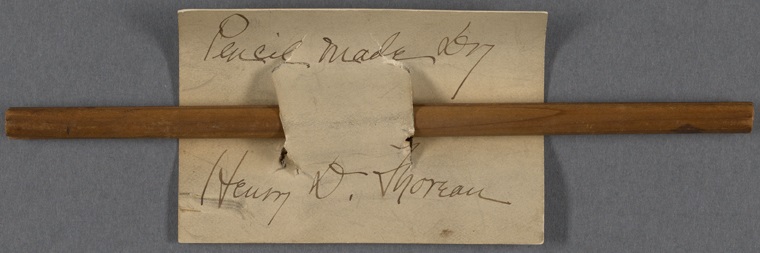
Add an eraser to Thoreau’s pencil, and you’ve got Hymen Lipman’s patent for the pencil you’re pretty much using today. You can see pictures of Thoreau’s pencil over at The New York Public Library.
If you would like to support the mission of Open Culture, consider making a donation to our site. It’s hard to rely 100% on ads, and your contributions will help us continue providing the best free cultural and educational materials to learners everywhere. You can contribute through PayPal, Patreon, and Venmo (@openculture). Thanks!
Related Content:
Henry David Thoreau on When Civil Disobedience and Resistance Are Justified (1849)
David Rees Presents a Primer on the Artisanal Craft of Pencil Sharpening
David Rees and His One-Man Artisanal Pencil Sharpening Service
Read More...10-Week Online Seminar Will Teach You to Be a Great Los Pollos Hermanos Employee: A Teaser for the New Season of Better Call Saul
To get you ready for the new season of Better Call Saul, the show’s creators have put out a faux employee training video from the proprietor of Los Pollos Hermanos, Gustavo Fring. You know Gus from Breaking Bad, and something tells me you’ll be meeting him again in Season 3 of the prequel. It airs next Monday (4/10) at 10pm on AMC. Enjoy.
If you would like to support the mission of Open Culture, consider making a donation to our site. It’s hard to rely 100% on ads, and your contributions will help us continue providing the best free cultural and educational materials to learners everywhere. You can contribute through PayPal, Patreon, and Venmo (@openculture). Thanks!
Read More...Watch Derek Jarman’s Daring 12-Minute Promo Film for Marianne Faithfull’s 1979 Comeback Album Broken English (NSFW)
Note: There are a few not-safe-for-work scenes in the film.
The world of music video was in its infancy in the late 1970s. MTV had yet to exist, and promotional films for singles were seen as useful for the times when a show couldn’t book a band to play live, or the band just didn’t play live any more. Into this world fell many a commercial director, used to the promotion side of the promo film business. But there were also directors like Derek Jarman, the punkest of UK directors at that time. This new format paid the bills in between features, and let him experiment.
Though he would go on to work with the Pet Shop Boys and The Smiths, Jarman’s first promo video is above, for three songs from Marianne Faithfull’s masterpiece of a new wave album, Broken English (1979).
Faithfull had been out of the public eye for years, having spent a lot of the ’70 trying to kick her drug habit. The anger and cynicism of this album, her cracked but commanding voice, and the electronic sounds were such that many forget she released two other “comeback albums” before this one. On Broken English she forcefully rewrites her own history as an artist, not content to be seen as a drug casualty or Mick Jagger’s ex-girlfriend.
Jarman was known at the time as the controversial filmmaker of both the homoerotic Sebastiane and the anti-Royal Jubilee, which more than any film at the time encapsulated the UK punk scene. It’s both brutal and romantic and charmingly D.I.Y.
The Broken English promo film features three songs, bracketed by black and white footage of Faithfull wandering around London and playing Space Invaders in a local arcade. The first, “Witch’s Song,” is the closest to Jarman’s short films during that period: languid, ambiguously gendered young people, apocalyptic dockside ruins, reflected mirrors, occultism and debauchery. The second, “The Ballad of Lucy Jordan,” features scenes of domesticity double exposed and/or projected over footage of Faithfull. The final one, for the title track, is a short collage of 20th century fascism and carnage, featuring Hitler, Mussolini, Oswald Mosley, British strikes, and self-immolated monks.
The two artists got along so well that she recorded the theme song for his film The Last of England, featuring a very young Tilda Swinton.
Both Jarman and Faithfull went on to successfully reinvent themselves, but for the 21st century viewer, they are also both worth rediscovering.
Related Content:
A Very Young Marianne Faithfull Sings Her First Hit, ‘As Tears Go By’ (1965)
Watch David Bowie & Marianne Faithfull Rehearse and Sing Sonny & Cher’s “I Got You Babe” (1973)
Jean-Luc Godard Shoots Marianne Faithfull Singing “As Tears Go By” (1966)
Ted Mills is a freelance writer on the arts who currently hosts the artist interview-based FunkZone Podcast and is the producer of KCRW’s Curious Coast. You can also follow him on Twitter at @tedmills, read his other arts writing at tedmills.com and/or watch his films here.
Read More...Edgar Allan Poe Published a “CliffsNotes” Version of a Science Textbook & It Became His Only Bestseller (1839)
A fascinating 20th century literary strain, “documentary poetics,” melds journalistic accounts, photography, official texts and memos, politics, and scientific and technical writing with lyrical and literary language. Perhaps best exemplified by Muriel Rukeyser, the category also includes, at certain times, James Agee, Langston Hughes, Richard Wright, Zora Neale Hurston, and—currently—Claudia Rankine and “powerhouse” new poet Solmaz Sharif. It does not include Edgar Allan Poe, famously alcoholic 19th century master of the macabre and “father of the detective story.”
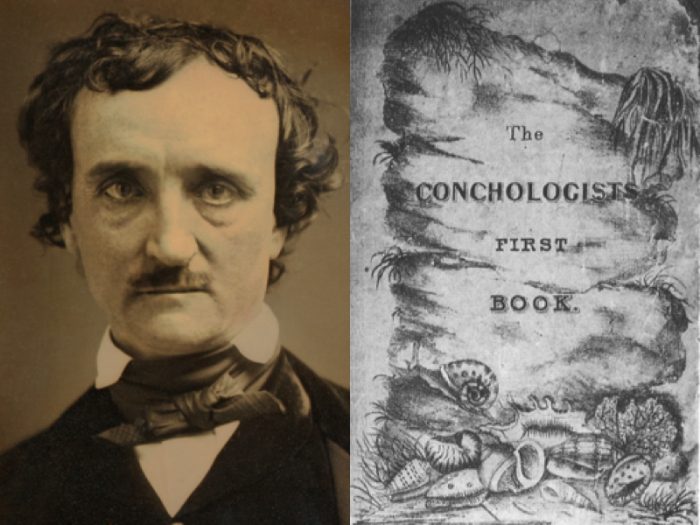
But you’ll forgive me for thinking, excitedly, that it just might, when I learned Poe had published a text called The Conchologist’s First Book (1839), a condensation, rearrangement, and “remixing,” as Rebecca Onion writes at Slate, of “an existing… beautiful and expensive” science textbook, Thomas Wyatt’s Manual of Conchology, including the original plates and a “new preface and introduction.”
My mind reeled: what wondrous horrors might the morose, romantic Poe have contributed to such an enterprise, his best-selling work, it turns out, in his lifetime. (For which Poe was paid $50 and, typically, received no royalties). What kind of experimental madness might these covers contain?
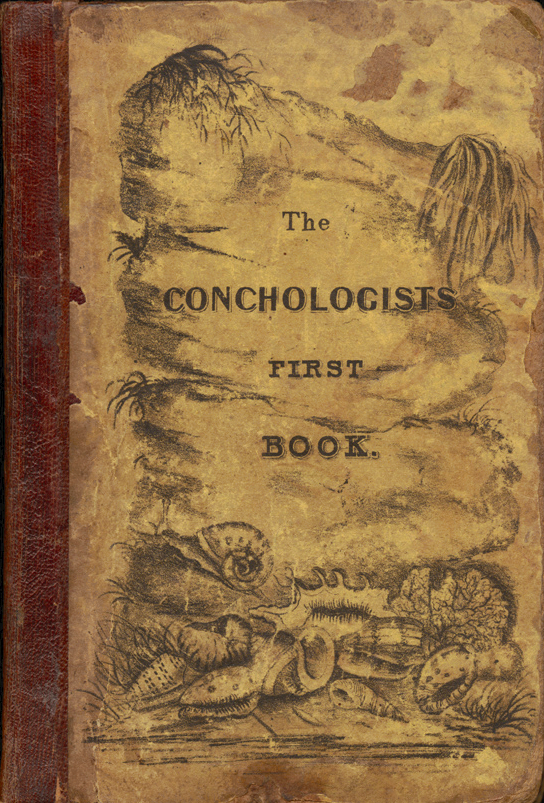
As I might have assumed from the book’s total obscurity, Poe’s writerly contributions to the project were meager. For all his genius as a storyteller, he could be a long-winded bore as an essayist. It seems he thought this aspect of his voice was best suited to the original writing he did for Conchologist’s First. His biographers, notes University of Houston professor emeritus John H. Lienhard, all “mutter an embarrassed apology for Poe’s shady side-track—then hurry back to talk about The Raven.” Onion quotes one biographer Jeffrey Meyers, who writes, “Poe’s boring pedantic and hair-splitting Preface was absolutely guaranteed to torment and discourage even the most passionately interested schoolboy.”
As for its “shadiness,” the book also elicits embarrassment from Poe devotees because, as esteemed biologist and historian of science Stephen J. Gould wrote in his exculpatory essay “Poe’s Greatest Hit,” it was “basically a scam,” though “not so badly done” as most allege. The naturalist Wyatt, a friend of Poe’s, had begged his publisher to release an abridged student edition of his original lavish and pricey $8 textbook, which had not sold well. When the publisher balked, Wyatt contracted Poe to lend his name and considerable editorial skill to a more-or-less bootleg “CliffsNotes” version to be sold for $1.50. To make matters worse, Poe and Wyatt were both accused of plagiarism, having “lifted chunks of their book from an English naturalist, Thomas Brown,” Lienhard points out.
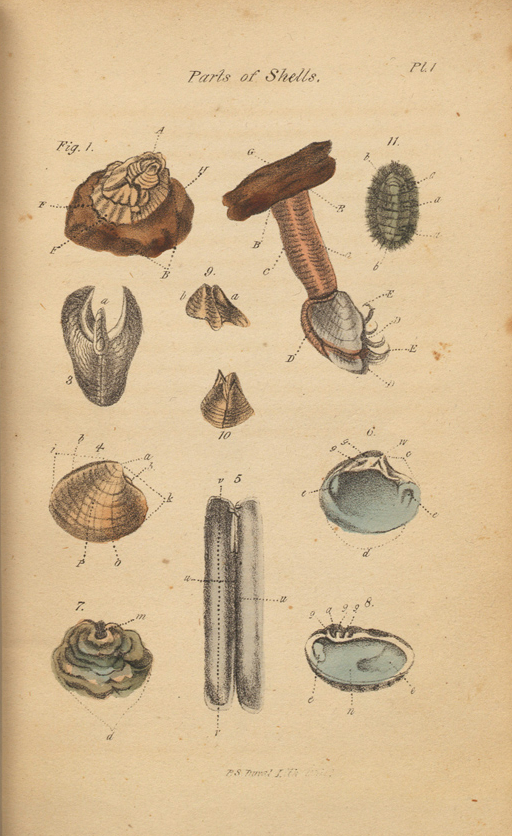
Gould defended Poe as a rewriter of others’ work. “Yes, Poe plagiarized,” as Lienhard summarizes the argument. He presented Brown’s, and Wyatt’s, work as his own, but, “fluent in French, [he] went back to read Georges Cuvier, the great French naturalist” and made his own translations. He wrote his own introductory material, and he reorganized Wyatt’s book in such a way as to provide “genuinely useful insight into biological taxonomy.” Poe’s edition—with its “formidable subtitle,” A System of Testaceous Malacology, arranged Expressly for the Use of Schools—actually proved a hit with students, and likely not only because it sold cheap. It was the only publication in Poe’s lifetime to make it to a second edition.
Maybe humanist readers approach the work with biases firmly in place, expecting a genre that’s dry by its very nature to contain all the literary brilliance and entertaining intrigue of “The Tell-Tale Heart.” Lienhard suggests as much, describing irritation at how his “literary friends” ignore the scientific work of writers like Thoreau, Thomas Paine, Goethe, and poet Oliver Goldsmith. “Poe’s excursion into natural philosophy,” he writes, “was an embarrassment to people who are embarrassed by science in the first place.” Maybe.
Both Gould and Lienhard shrug off the less-than-scrupulous circumstances of the book’s creation, the latter citing a “cynical remark” by playwright Wilson Mizner: “If you steal from one author, it’s plagiarism. If you steal from many, it’s research.” At least he doesn’t go as far as Mark Twain, who once wrote in defense of Helen Keller, after she was charged with literary borrowing, “the kernel, the soul—let us go further and say the substance, the bulk, the actual and valuable material of all human utterance—is plagiarism.”
Read the first, 1839 edition of The Conchologist’s First Book, published under Edgar A. Poe, at the Internet Archive, and the revised second, 1840 edition at Google Books.
Related Content:
Download The Complete Works of Edgar Allan Poe: Macabre Stories as Free eBooks & Audio Books
Mark Twain’s Patented Inventions for Bra Straps and Other Everyday Items
Josh Jones is a writer and musician based in Durham, NC. Follow him at @jdmagness
Read More...Support Us
We're hoping to rely on loyal readers, rather than erratic ads. Please click the Donate button and support Open Culture. You can use Paypal, Venmo, Patreon, even Crypto! We thank you!

About Us

Open Culture scours the web for the best educational media. We find the free courses and audio books you need, the language lessons & educational videos you want, and plenty of enlightenment in between.
Advertise With Us

FREE UPDATES!
GET OUR DAILY EMAIL
Get the best cultural and educational resources on the web curated for you in a daily email. We never spam. Unsubscribe at any time.
FOLLOW ON SOCIAL MEDIA

Open Culture editor Dan Colman scours the web for the best educational media. He finds the free courses and audio books you need, the language lessons & movies you want, and plenty of enlightenment in between.
Advertise With Us

