Neural Networks for Machine Learning: A Free Online Course
The 78-video playlist above comes from a course called Neural Networks for Machine Learning, taught by Geoffrey Hinton, a computer science professor at the University of Toronto. The videos were created for a larger course taught on Coursera, which gets re-offered on a fairly regularly basis.
Neural Networks for Machine Learning will teach you about “artificial neural networks and how they’re being used for machine learning, as applied to speech and object recognition, image segmentation, modeling language and human motion, etc.” The courses emphasizes ” both the basic algorithms and the practical tricks needed to get them to work well.” It’s geared for an intermediate level learner — comfortable with calculus and with experience programming Python. [Get a free course on Python here.]
You can find the video playlist on YouTube. It’s also indexed in our collection of Free Computer Science courses, part of our meta collection, 1,700 Free Online Courses from Top Universities.
If you would like to support the mission of Open Culture, consider making a donation to our site. It’s hard to rely 100% on ads, and your contributions will help us continue providing the best free cultural and educational materials to learners everywhere. You can contribute through PayPal, Patreon, and Venmo (@openculture). Thanks!
Read More...Richard Feynman’s “Notebook Technique” Will Help You Learn Any Subject–at School, at Work, or in Life
Richard Feynman knew his stuff. Had he not, he probably wouldn’t have won the Nobel Prize in Physics, let alone his various other prestigious scientific awards. But his reputation for learning all his life long with a special depth and rigor survives him, and in a sense accounts for his fame — of a degree that ensures his stern yet playful face will gaze out from dorm-room posters for generations to come — even more than does his “real” work. Many students of physics still, understandably, want to be like Feynman, but everyone else, even those of us with no interest in physics whatsoever, could also do well to learn from him: not from what he thought about, but from how he thought about it.
On his Study Hacks Blog, computer science professor Cal Newport explains what he calls “the Feynman notebook technique,” whereby “dedicating a notebook to a new learning task” can provide “concrete cues” to help mitigate the difficulty of starting out toward the mastery of a subject.
Feynman did it himself at least since his graduate-school days at Princeton when, according to biographer James Gleick, he once prepared for his oral examinations by opening a fresh notebook titled “NOTEBOOK OF THINGS I DON’T KNOW ABOUT.” In it “he reorganized his knowledge. He worked for weeks at disassembling each branch of physics, oiling the parts, and putting them back together, looking all the while for the raw edges and inconsistencies. He tried to find the essential kernels of each subject.”
“At first, the notebook pages are empty,” writes Newport, “but as they fill with careful notes, your knowledge also grows. The drive to fill more pages keeps your motivation stoked.” In other, more general terms: “Translate your growing knowledge of something hard into a concrete form and you’re more likely to keep investing the mental energy needed to keep learning.” But how sure can you feel of your newly acquired knowledge if you don’t regularly test it? Feynman had to go face-to-face with the elders of the Princeton physics department, but if you don’t benefit from that kind of institutional threat, you might consider putting into practice another Feynman technique: “teaching” what you’ve learned to someone else.

In addition to being a great scientist, explains study-skills vlogger Thomas Frank, Feynman “was also a great teacher and a great explainer,” owing to his ability to “boil down incredibly complex concepts and put them in simple language that other people could understand.” Only when Feynman could do that did he know he truly understood a concept himself — be it a concept in physics, safecracking, or bongo-playing. As Frank explains, “if you’re shaky on a concept and you want to quickly improve your understanding,” try your hand at producing a Feynmanesque simple explanation, which will “test your understanding and challenge your assumptions.” Just make sure to bear in mind one of Feynman’s most quotable quotes: “The first principle is that you must not fool yourself — and you are the easiest person to fool.” And if you find that you have indeed fooled yourself, head right back to the drawing board — or rather, to the notebook.
Related Content:
Richard Feynman Creates a Simple Method for Telling Science From Pseudoscience (1966)
Richard Feynman Presents Quantum Electrodynamics for the NonScientist
The Drawings & Paintings of Richard Feynman: Art Expresses a Dramatic “Feeling of Awe”
Based in Seoul, Colin Marshall writes and broadcasts on cities and culture. He’s at work on a book about Los Angeles, A Los Angeles Primer, the video series The City in Cinema, the crowdfunded journalism project Where Is the City of the Future?, and the Los Angeles Review of Books’ Korea Blog. Follow him on Twitter at @colinmarshall or on Facebook.
Read More...Neural Networks for Machine Learning: A Free Online Course Taught by Geoffrey Hinton
The 78-video playlist above comes from a course called Neural Networks for Machine Learning, taught by Geoffrey Hinton, a computer science professor at the University of Toronto. The videos were created for a larger course taught on Coursera, which gets re-offered on a fairly regularly basis.
Neural Networks for Machine Learning will teach you about “artificial neural networks and how they’re being used for machine learning, as applied to speech and object recognition, image segmentation, modeling language and human motion, etc.” The courses emphasizes ” both the basic algorithms and the practical tricks needed to get them to work well.” It’s geared for an intermediate level learner — comfortable with calculus and with experience programming (Python).
You can find the video playlist on YouTube. It’s also indexed in our collection of Free Computer Science courses, part of our meta collection, 1,700 Free Online Courses from Top Universities.
Read More...Søren Kierkegaard: A Free Online Course on the “Father of Existentialism”
The playlist above features roughly eight hours of video lectures on Søren Kierkegaard, the “father of existentialism.” They’re presented by Jon B. Stewart, currently a fellow at Harvard’s Radcliffe Institute for Advanced Study, and before that Associate Professor at the Søren Kierkegaard Research Center at the University of Copenhagen. You can watch them independently, or as part of an online course regularly offered by Coursera. Here’s the description for the course:
It is often claimed that relativism, subjectivism and nihilism are typically modern philosophical problems that emerge with the breakdown of traditional values, customs and ways of life. The result is the absence of meaning, the lapse of religious faith, and feeling of alienation that is so widespread in modernity.
The Danish thinker Søren Kierkegaard (1813–55) gave one of the most penetrating analyses of this complex phenomenon of modernity. But somewhat surprisingly he seeks insight into it not in any modern thinker but rather in an ancient one, the Greek philosopher Socrates.
In this course created by former associate professor at the Søren Kierkegaard Research Centre, Jon Stewart, we will explore how Kierkegaard deals with the problems associated with relativism, the lack of meaning and the undermining of religious faith that are typical of modern life. His penetrating analyses are still highly relevant today and have been seen as insightful for the leading figures of Existentialism, Post-Structuralism and Post-Modernism.
The lecture series is available on YouTube. Or find them indexed in our collection of 150 Free Philosophy Courses, a subset of our meta collection, 1,700 Free Online Courses from Top Universities.
Related Content:
Download Walter Kaufmann’s Lectures on Nietzsche, Kierkegaard, Sartre & Modern Thought (1960)
Existential Philosophy of Kierkegaard, Sartre, Camus Explained with 8‑Bit Video Games
Read More...Iggy Pop Sings Edith Piaf’s “La Vie En Rose” in an Artfully Animated Video
It’s been covered by everyone from Daffy Duck to Grace Jones, from Pascal of Bollywood to a ukulele-strumming Madonna…
It’s graced the soundtracks of dozens of films, and provided the title for at least two more: the recent Edith Piaf bio-pic and an award winning French feature about a pre-adolescent transgender girl…
Its title has been hijacked for rose-colored memoirs, beer bottle labels, an article about women in boardrooms…
And now the above love story, set on the Pont des Art, starring an anthropomorphic rose and a long tall stick of beef jerky bearing a suspicious resemblance to Iggy Pop.
The animated Iggy stalks across toward his lady love with the stiffness of a White Walker, but it’s undeniably moving when this biologically ill-matched couple begins to dance in a swirl of green and red leaves signifying… what?
The impermanence of romance? (The padlocks which starry eyed couples affixed to the Pont des Art were unceremoniously removed a few years ago…)
The impermanence of iconic pop stars?
The thorny persistence of visionary artists in a consumer driven economy?
Ah well, the lyrics have always been a bit open to interpretation, but the sentiment is eternal.
Related Content:
Watch Édith Piaf Sing Her Most Famous Songs: “La Vie en Rose,” “Non, Je Regrette Rien” & More
Iggy Pop Reads Edgar Allan Poe’s Classic Horror Story, “The Tell-Tale Heart”
Ayun Halliday is an author, illustrator, theater maker and Chief Primatologist of the East Village Inky zine. Follow her @AyunHalliday.
Read More...Wynton Marsalis Gives 12 Tips on How to Practice: For Musicians, Athletes, or Anyone Who Wants to Learn Something New
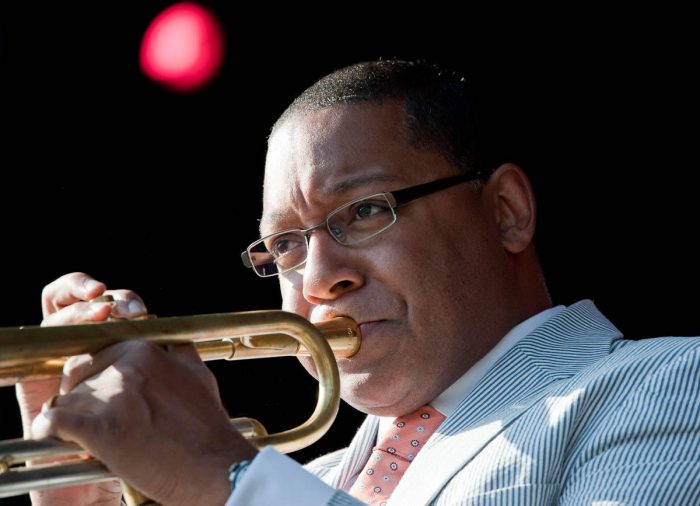
Image by Eric Delmar, via Wikimedia Commons
Practicing for countless hours before we can be good at something seems burdensome and boring. Maybe that’s why we’re drawn to stories of instant achievement. The monk realizes satori (and Neo learns kung fu); the superhero acquires great power out of the blue; Robert Johnson trades for genius at the crossroads. At the same time, we teach children they can’t master a skill without discipline and diligence. We repeat pop psych theories that specify the exact number hours required for excellence. The number may be arbitrary, but it comforts us to believe that practice might, eventually, make perfect. Because in truth we know there is no way around it. As Wynton Marsalis writes in “Wynton’s Twelve Ways to Practice: From Music to Schoolwork,” “practice is essential to learning music—and anything else, for that matter.”
For jazz musicians, the time spent learning theory and refining technique finds eloquent expression in the concept of woodshedding, a “humbling but necessary chore,” writes Paul Klemperer at Big Apple Jazz, “like chopping wood before you can start the fire.”
Yet retiring to the woodshed “means more than just practicing…. You have to dig deep into yourself, discipline yourself, become focused on the music and your instrument.” As beginners, we tend to look at practice only as a chore. The best jazz musicians know there’s also “something philosophical, almost religious” about it. John Coltrane, for example, practiced ceaselessly, consciously defining his music as a spiritual and contemplative discipline.
Marsalis also implies a religious aspect in his short article: “when you practice, it means you are willing to sacrifice to sound good… I like to say that the time spent practicing is the true sign of virtue in a musician.” Maybe this piety is intended to dispel the myth of quick and easy deals with infernal entities. But most of Marsalis’ “twelve ways to practice” are as pragmatic as they come, and “will work,” he promises “for almost every activity—from music to schoolwork to sports.” Find his abridged list below, and read his full commentary at “the trumpeter’s bible,” Arban’s Method.
- Seek out instruction: A good teacher will help you understand the purpose of practicing and can teach you ways to make practicing easier and more productive.
- Write out a schedule: A schedule helps you organize your time. Be sure to allow time to review the fundamentals because they are the foundation of all the complicated things that come later.
- Set goals: Like a schedule, goals help you organize your time and chart your progress…. If a certain task turns out to be really difficult, relax your goals: practice doesn’t have to be painful to achieve results.
- Concentrate: You can do more in 10 minutes of focused practice than in an hour of sighing and moaning. This means no video games, no television, no radio, just sitting still and working…. Concentrated effort takes practice too, especially for young people.
- Relax and practice slowly: Take your time; don’t rush through things. Whenever you set out to learn something new – practicing scales, multiplication tables, verb tenses in Spanish – you need to start slowly and build up speed.
- Practice hard things longer: Don’t be afraid of confronting your inadequacies; spend more time practicing what you can’t do…. Successful practice means coming face to face with your shortcomings. Don’t be discouraged; you’ll get it eventually.
- Practice with expression: Every day you walk around making yourself into “you,” so do everything with the proper attitude…. Express your “style” through how you do what you do.
- Learn from your mistakes: None of us are perfect, but don’t be too hard on yourself. If you drop a touchdown pass, or strike out to end the game, it’s not the end of the world. Pick yourself up, analyze what went wrong and keep going….
- Donʼt show off: It’s hard to resist showing off when you can do something well…. But my father told me, “Son, those who play for applause, that’s all they get.” When you get caught up in doing the tricky stuff, you’re just cheating yourself and your audience.
- Think for yourself: Your success or failure at anything ultimately depends on your ability to solve problems, so don’t become a robot…. Thinking for yourself helps develop your powers of judgment.
- Be optimistic: Optimism helps you get over your mistakes and go on to do better. It also gives you endurance because having a positive attitude makes you feel that something great is always about to happen.
- Look for connections: If you develop the discipline it takes to become good at something, that discipline will help you in whatever else you do…. The more you discover the relationships between things that at first seem different, the larger your world becomes. In other words, the woodshed can open up a whole world of possibilities.
You’ll note in even a cursory scan of Marsalis’ prescriptions that they begin with the imminently practical—the “chores” we can find tedious—and move further into the intangibles: developing creativity, humility, optimism, and, eventually, maybe, a gradual kind of enlightenment. You’ll notice on a closer read that the consciousness-raising and the mundane daily tasks go hand-in-hand.
While this may be all well and good for jazz musicians, students, athletes, or chess players, we may have reason for skepticism about success through practice more generally. Researchers at Princeton have found, for example, that the effectiveness of practice is “domain dependent.” In games, music, and sports, practice accounts for a good deal of improvement. In certain other “less stable” fields driven by celebrity and networking, for example, success can seem more dependent on personality or privileged access.
But it’s probably safe to assume that if you’re reading this post, you’re interested in mastering a skill, not cultivating a brand. Whether you want to play Carnegie Hall or “learn a language, cook good meals or get along well with people,” practice is essential, Marsalis argues, and practicing well is just as important as practicing often. For a look at how practice changes our brains, creating what we colloquially call “muscle memory,” see the TED-Ed video just above.
Related Content:
Wynton Marsalis Takes Louis Armstrong’s Trumpet Out of the Museum & Plays It Again
Sonny Rollins Describes How 50 Years of Practicing Yoga Made Him a Better Musician
Playing an Instrument Is a Great Workout For Your Brain: New Animation Explains Why
Josh Jones is a writer and musician based in Durham, NC. Follow him at @jdmagness
Read More...S‑Town: The Podcast That Will Help You Binge-Listen Your Way Through This Week

Last week, the folks behind Serial and This American Life, teamed up to release S‑Town (short for Shittown), a seven-episode/seven-hour podcast which I devoured in three days flat. I don’t want to give any spoilers. So let me give you just the text that promotes the podcast on iTunes, and then suggest you start listening:
John despises his Alabama town and decides to do something about it. He asks a reporter to investigate the son of a wealthy family who’s allegedly been bragging that he got away with murder. But then someone else ends up dead, sparking a nasty feud, a hunt for hidden treasure, and an unearthing of the mysteries of one man’s life.
Find episodes on iTunes, Stitcher, RSS feed, Radio Public, or the web.
If you would like to support the mission of Open Culture, consider making a donation to our site. It’s hard to rely 100% on ads, and your contributions will help us continue providing the best free cultural and educational materials to learners everywhere. You can contribute through PayPal, Patreon, and Venmo (@openculture). Thanks!
Read More...Ray Bradbury’s The Martian Chronicles: A Radio Drama Starring Derek Jacobi & Hayley Atwell (Free Audio Book)

Image by Futurilla, via Flickr Commons
For your weekend listening pleasure, we present a 70 minute radio dramatization of The Martian Chronicles, Ray Bradbury’s “timeless fable of doomed Martian colonisation.” Aired by the BBC, this production stars Derek Jacobi and Hayley Atwell. Read this little blurb, which helps set the stage. Then stream the embedded Spotify audio below.
When the first expedition to Mars mysteriously disappears, Earth sends a second to find out what happened. But the real mission is classified. And only Captain Wilder knows the truth. Spender, an anthropologist on Wilder’s crew, attempts to prevent the colonisation that she believes will eradicate the last of an ancient people living on Mars. But to what lengths will she go?
As the honourable but duty-bound Captain Wilder tracks the now rogue Spender into the Martian mountains, the future of this ancient planet is at stake. Meanwhile, Earth itself teeters on the brink of its own global catastrophe as the very survival of humanity hangs in the balance.…
If you need Spotify, download it here.
This production will be added to our collection, 1,000 Free Audio Books: Download Great Books for Free.
Looking for free, professionally-read audio books from Audible.com? Here’s a great, no-strings-attached deal. If you start a 30 day free trial with Audible.com, you can download two free audio books of your choice. Get more details on the offer here.
Read More...Animated Introductions to Edward Said’s Groundbreaking Book Orientalism
For a few years, many people—those who might these days be called a “self-satisfied liberal elite” (or something like that)—believed that the arguments in Edward Said’s 1978 book Orientalism were becoming generally accepted. Put broadly, Said argued that our conceptions of cultural and historical differences between “the West” and “the East” are produced by European intellectual and literary traditions that have exaggerated and distorted such differences, creating a narrative in which “the West” is civilized, disciplined, industrious, and enlightened and “the East” is exotic, backward, sensualist, lazy, passive, dangerous, irrational.…
The tradition of Orientalism—which stretches back into the middle ages—came to justify colonialism, land and resource theft, slavery, and imperial aggression in the name of civilization and salvation, Even where European Orientalist scholars and writers had a nuanced understanding of other cultures, such nuance was lost in the popularizing and instrumental use of their ideas.
Said’s theoretical intervention into Orientalist discourse showed us how the “clash of civilizations” trope that pervades hundreds of years of interactions between “the west and the rest” of the world itself has a history—as a rationalization for dominance and exploitation. The short animated Al Jazeera video above neatly summarizes Said’s major arguments in the book, and asks us to “unlearn the myth.”
Casting West and East as two distinct civilizations makes little common sense on its face. Christianity, one key supposed bedrock of Western Civilization, is an Eastern religion. Aristotle, a foundation of Western thought, was preserved for many years by Islamic scholars, who were in frequent dialogue with Greek thinkers, who were themselves in frequent dialogue with North Africans…. the interrelationships and correspondences between continents and cultures are innumerable, the boundaries between the categories highly permeable. But with the rise of what we’re calling “populism” in the past decade or so, the nuances of intellectual history have been lost. Old false dichotomies, always haunting the margins, have once again moved firmly to the center.
In the realm of cable news punditry, corporate security conferences, and congressional committees not only do we rarely see actual scholars represented, but we almost never see scholars like Edward Said, a Palestinian intellectual who spoke and wrote critically as a person from the Middle East with expertise in Western literature and history. This fact is itself central to the construction of Orientalist discourse, as Said wrote in 1978:
The Orient and Islam have a kind of extrareal, phenomenologically reduced status that puts them out of reach of everyone except the Western expert. From the beginning of Western speculation about the Orient, the one thing the Orient could not do was to represent itself.
We can accept nothing about “the East,” in other words, unless it is first filtered through the lenses of Euro-American administrative “experts,” who often have extremist views, very little scholarly expertise, and whose ideas often still come directly from Orientalist novels and philosophies.
Said’s theories in Orientalism have received ample criticism from across the political spectrum. He’s been cast by the right as a kind of reverse racist against “Caucasians,” an anti-intellectual accusation that distorts his views and makes ad hominem attacks. Said traced Euro-American colonial history with a level of depth that demonstrated the remarkable continuity in the way major European colonial powers and the U.S.—their successor by the late 20th century—constructed ideologies of exceptionalism and superiority through very similar rhetoric.
For a slightly drier overview of Said’s Orientalism, watch the short video above from educational company Macat, a self-described “global leader in critical thinking.” Neither of these explainers can substitute for actually engaging with the arguments in Said’s book. His history of Orientalist fables is itself an adventurous tale. As a literary product, “the Orient was almost a European invention,” he writes in his Introduction, yet as a region, it “is an integral part of European material civilization and culture.” There is no one without the other.
Related Content:
Edward Said Recalls His Depressing Meeting With Sartre, de Beauvoir & Foucault (1979)
Clash of the Titans: Noam Chomsky & Michel Foucault Debate Human Nature & Power on Dutch TV, 1971
Middle Eastern History: Free Courses
Josh Jones is a writer and musician based in Durham, NC. Follow him at @jdmagness
Read More...The M.C. Escher Mirror Puzzle: Test Your Imagination & Concentration with an Artistic Brain Teaser
The art of M.C. Escher apparently makes for some good puzzles. Head over to Amazon and you’ll find a number of ornate Escher works of art turned into traditional 1,000-piece puzzles. They’ll keep you busy for hours on end. But will they challenge you as much as the M.C. Escher Mirror Puzzle featured above? This puzzle takes things to another level. The directions read like this: “Use the slanted mirror inside each cube to reflect the image on the side of an adjacent cube. Once you place all nine cubes in the right pattern, a complete Escher image will appear.” Finish the first puzzle, and then start on the next one. There are five puzzles in this set.
If you would like to support the mission of Open Culture, consider making a donation to our site. It’s hard to rely 100% on ads, and your contributions will help us continue providing the best free cultural and educational materials to learners everywhere. You can contribute through PayPal, Patreon, and Venmo (@openculture). Thanks!
Related Content:
M.C. Escher Cover Art for Great Books by Italo Calvino, George Orwell & Jorge Luis Borges
Metamorphose: 1999 Documentary Reveals the Life and Work of Artist M.C. Escher
Inspirations: A Short Film Celebrating the Mathematical Art of M.C. Escher
Read More...Support Us
We're hoping to rely on loyal readers, rather than erratic ads. Please click the Donate button and support Open Culture. You can use Paypal, Venmo, Patreon, even Crypto! We thank you!

About Us

Open Culture scours the web for the best educational media. We find the free courses and audio books you need, the language lessons & educational videos you want, and plenty of enlightenment in between.
Advertise With Us

FREE UPDATES!
GET OUR DAILY EMAIL
Get the best cultural and educational resources on the web curated for you in a daily email. We never spam. Unsubscribe at any time.
FOLLOW ON SOCIAL MEDIA

Open Culture editor Dan Colman scours the web for the best educational media. He finds the free courses and audio books you need, the language lessons & movies you want, and plenty of enlightenment in between.
Advertise With Us


