Free: Hear Robert Louis Stevenson’s Treasure Island, Read by Hans Conried (1958)
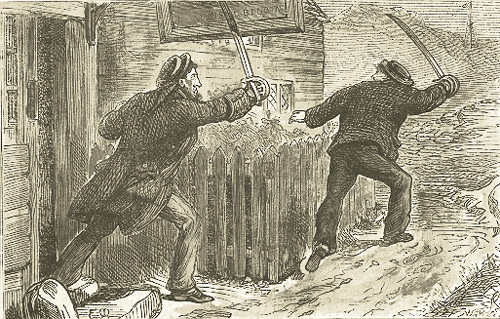
Briefly noted: Over on Spotify you can stream a classic audio book of Robert Louis Stevenson’s Treasure Island (iPad/iPhone – Kindle + Other Formats – Read Online). Recorded in 1958 by character actor Hans Conried, this classic pirate’s tale runs 5 hours, 20 minutes–which is shorter than other recordings available on the market, suggesting that it’s abridged. But nonetheless it’s worth the listen. Conried’s reading (which can also be purchased online) will be added to our collection, 1,000 Free Audio Books: Download Great Books for Free. Stevenson’s text itself appears in our collection of Free eBooks. If you need Spotify’s free software, download it here.
Looking for free, professionally-read audio books from Audible.com? Here’s a great, no-strings-attached deal. If you start a 30 day free trial with Audible.com, you can download two free audio books of your choice. Get more details on the offer here.
Read More...Hear Arthur C. Clarke Read 2001: A Space Odyssey: A Vintage 1976 Vinyl Recording
When we hear the opening of Also Sprach Zarathustra, we instinctively steel ourselves for enormous leaps through space and time. We have since 1968, when Stanley Kubrick’s 2001: A Space Odyssey made Richard Strauss’ 1896 piece its theme music. (Kubrick, as we posted in 2014, did commission an original score, only to reject it as “completely inadequate for the film.”) If you saw and loved it during its original theatrical run, long before the advent of home video, you had only a limited set of ways to re-live it at will. The obvious choice included buying a copy of the soundtrack or Arthur C. Clarke’s eponymous novel (or, for the kids, to go eat at Howard Johnson’s), but in 1976, you could also buy a record that gave you a bit of both at once.
On this now out-of-print record, Clarke reads the final chapters of 2001 with the accompaniment of that most recognizable piece from the film score, all packaged in a sleeve featuring an image of Keir Dullea as Mission Commander David Bowman on one of the film’s immaculately crafted space-station sets. You can hear side one at the top, and side two below.
If all this strikes you as an unconscionable intermingling of book and movie, remember that Kubrick’s 2001 doesn’t straightforwardly adapt Clarke’s 2001. Both of those independent but complementary works grew from the seed of “The Sentinel,” Clarke’s 1948 short story about a dazzling and mystifying artifact left behind by an ancient alien civilization. Kubrick had originally tapped Clarke to write a whole new screenplay, but that collaboration ultimately turned into two parallel projects, with the novelist writing to his own sensibility and the filmmaker certainly directing to his. Some Clarke fans prefer the novel and some Kubrick fans prefer the film, but those who admire the virtues of both 2001s will appreciate the existence of this record, in its own way an impressive artifact of a distant era.
You can’t buy this album new these days, but used copies can still be purchased online.
Related Content:
The Classical Music in Stanley Kubrick’s Films: Listen to a Free, 4 Hour Playlist
James Cameron Revisits the Making of Kubrick’s 2001: A Space Odyssey
1966 Film Explores the Making of Kubrick’s 2001: A Space Odyssey (and Our High-Tech Future)
Watch Steven Soderbergh’s Re-Edited Version of Kubrick’s 2001: A Space Odyssey Free Online
Howard Johnson’s Presents a Children’s Menu Featuring Kubrick’s 2001: A Space Odyssey (1968)
Based in Seoul, Colin Marshall writes and broadcasts on cities and culture. He’s at work on a book about Los Angeles, A Los Angeles Primer, the video series The City in Cinema, the crowdfunded journalism project Where Is the City of the Future?, and the Los Angeles Review of Books’ Korea Blog. Follow him on Twitter at @colinmarshall or on Facebook.
Read More...What Ancient Latin Sounded Like, And How We Know It
Latin is a language
It killed the Romans long ago,
And now it’s killing me.
That famed ditty isn’t likely to resonate with many modern school children, but interest in ancient Rome remains fairly robust.
We’ve come to accept that those stately ruins were once covered in graffiti.
We can recreate their meals from hors d’oevures (Boiled Eggs with Pine Nut Sauce) to dessert (Pear Patina).
Thermae Romae, a popular Japanese manga-cum-feature-film, took us inside Emperor Hadrian’s bathhouse.
But what did the Romans sound like?
Kirk Douglas’ Spartacus? Or Laurence Olivier’s Crassus?
The recent series Rome upheld the tradition of British accents.
Animator Josh Rudder of NativLang did a fair amount of digging in service of finding out What Latin Sounded Like, above.
(And he seems to have done so without the help of Derek Jarman’s NSFW Sebastiane, the only feature film to be filmed entirely in sermo vulgaris or vulgar Latin.)
Instead, he draws from ancient rhetorician Quintilian and Virgil’s’ poetic meter. Scroll backward through the romance languages, and you’ll see Germanic tribes trading with and fighting ancient Roman troops.
The result is not so much a reconstructive pronunciation guide as a linguistic detective story.
Related Content:
1,600-Year-Old Illuminated Manuscript of the Aeneid Digitized & Put Online by The Vatican
Learn Latin, Old English, Sanskrit, Classical Greek & Other Ancient Languages in 10 Lessons
Rome Reborn: Take a Virtual Tour of Ancient Rome, Circa 320 C.E.
Ayun Halliday is an author, illustrator, theater maker and Chief Primatologist of the East Village Inky zine. Her latest comic contrasts the birth of her second child with the uncensored gore of Game of Thrones. Follow her @AyunHalliday
Read More...The Neuroscience & Psychology of Procrastination, and How to Overcome It
Procrastination is a skill, an art, a slight-of-hand technique. I’m procrastinating right now, but you’d never know it. How many tabs do I have open in my multiple browser windows? Pick a number, any number. How many tasks have I put off today? How many dreams have I deferred? I’ll never tell. The unskilled procrastinators stick out, they’re easy to spot. They talk a lot about what they’re not doing. They run around in circles of bewilderment like the troubled hero of Dr. Seuss’s Hunches in Bunches. The skilled practitioner makes it look easy.
But no matter how much Facebook time you get in before lunch and still manage to ace those performance reviews, you’re really only cheating yourself, am I right? You wanted to finish that novel/symphony/improv class/physics theorem. But something stopped you. Something in your brain perhaps. That’s where these things usually happen. When Stuart Langfield asked a neuroscientist about the neuroscience of procrastination, he got the following answer: “People think that you can turn on an MRI and see where something’s happening in the brain, but the truth is that’s not so. This stuff is vastly more complicated, so we have theories.”
There are theories aplenty that tell us, says Langfield, “what’s probably happening” in the brain. Langfield explains his own: the primitive, pleasure-seeking, pain-avoiding limbic system acts too quickly for our more deliberative, rational prefrontal cortex to catch up, rendering us stupefied by distractions. Piers Steel, Distinguished Research Chair at the University of Calgary and a procrastination expert, shares this view. You can see him explain it in the short video below. The evolutionary “design flaw,” says Langfield, might make the situation seem hopeless, were it not for “neuroplasticity,” a fancy buzzword that means we have the ability to change our brains.
Langfield’s purpose in his short video is not only to understand the biology of procrastination, but to overcome it. He asks psychologist Tim Pychyl, whose answers we see and hear as an incomprehensible jumble of ideas. But then Pychyl reduces the complicated theories to a simple solution. You guessed it, mindfulness meditation—to “downregulate the limbic system.” Really, that’s it? Just meditate? It is a proven way to reduce anxiety and improve concentration.
But Pychyl and his research team at Carleton University have a few more very practical suggestions, based on experimental data gathered by Steel and others. The Wall Street Journal offers this condensed list of tips:
Break a long-term project down into specific sub-goals. State the exact start time and how long (not just “tomorrow”) you plan to work on the task.
Just get started. It isn’t necessary to write a long list of tasks, or each intermediate step.
Remind yourself that finishing the task now helps you in the future. Putting off the task won’t make it more enjoyable.
Implement “microcosts,” or mini-delays, that require you to make a small effort to procrastinate, such as having to log on to a separate computer account for games.
Reward yourself not only for completing the entire project but also the sub-goals.
A Stockholm University study tested these strategies, assigning a group of 150 self-reported “high procrastinators” several of the self-help instructions over 10 weeks, and employing a reward system and varying levels of guidance. “The results,” WSJ reports, “showed that after intervention with both guided and unguided self-help, people improved their procrastination, though the guided therapy seemed to show greater benefit.”
Other times, adding self-help tasks to get us to the tasks we’re putting off doesn’t work so well. We can all take comfort in the fact that procrastination has a long history, dating back to ancient Egypt, Rome, and 18th century England. The wisdom of the ages could not defeat it, or as Samuel Johnson wrote, “even they who most steadily withstand it find it, if not the most violent, the most pertinacious of their passions, always renewing its attacks, and, though often vanquished, never destroyed.”
But there are people who procrastinate, beset by its pertinacity, and then there are chronic procrastinators. “If you’re an occasional procrastinator, says Pychyl, “quit thinking about your feelings and get to the next task.” Suck it up, in other words, and walk it off—maybe after a short course of self-help. For all the conflicting neuroscientific theory, “there is a quiet science behind procrastination,” writes Big Think, and “according to recent studies, procrastination is a learned habit.” Most research agrees it’s one we can unlearn through meditation and/or patient retraining of ourselves.
However if you’re of the chronic subset, say Pychyl, “you might need therapy to better understand your emotions and how you’re coping with them through avoidance.” Psychologist Joseph Ferrari at DePaul University agrees. Citing a figure of “20 percent of U.S. men and women” who “make procrastination their way of life,” he adds, “it is the person who does that habitually, always with plausible ‘excuses’ that has issues to address.” Only you can determine whether your trouble relates to bad habits or deeper psychological issues.
Whatever the causes, what might motivate us to meditate or seek therapy are the effects. Chronic procrastination is “not a time management issue,” says Ferrari, “it is a maladaptive lifestyle.” Habitual procrastinators, the WSJ writes, “have higher rates of depression and anxiety and poorer well-being.” We may think, writes Eric Jaffe at the Association for Psychological Science’s journal, of procrastination as “an innocuous habit at worst, and maybe even a helpful one at best,” a strategy Stanford philosophy professor John Perry argued for in The Art of Procrastination. Instead, Jaffe says, in a sobering summary of Pychyl’s research, “procrastination is really a self-inflicted wound that gradually chips away at the most valuable resource in the world: time.”
Related Content:
Free Online Psychology & Neuroscience Courses
Daily Meditation Boosts & Revitalizes the Brain and Reduces Stress, Harvard Study Finds
Miranda July Teaches You How to Avoid Procrastination
The Art of Structured Procrastination
Josh Jones is a writer and musician based in Durham, NC. Follow him at @jdmagness
Read More...When Steve Buscemi Was a Firefighter — and Took It Up Again After 9/11
Steve Buscemi’s roles in movies like In the Soup, The Big Lebowski, and Ghost World have associated him for life with a certain kind of character: awkward, ineffectual, and even slightly creepy, but nevertheless strangely endearing. But types and the actors who play them can, and usually do, diverge, and that goes especially for Buscemi. He may have made his name portraying a host of loser-ish men, but his skill at bringing them and other characters to distinctive life have kept him a highly successful performer for decades now. And what did he do before that? Why, he fought fires — and he didn’t hesitate to do it again after becoming famous.

Unilad’s Alex Watt quotes a post on the Brotherhood of Fire Facebook page which reveals how the Boardwalk Empire star entered his other profession: “In 1976 Steve Buscemi took the FDNY civil service test when he was just 18 years old,” became a firefighter a few years later, and for four years “served on one of FDNY’s busiest, Engine Co. 55.” He returned to that very same engine after September 11, 2001, “and for several days following Brother Steve worked 12-hour shifts alongside other firefighters digging and sifting through the rubble from the World Trade Center looking for survivors.”
Though he avoided publicizing his brief return to firefighting at the time, Buscemi has spoken openly about it since, as he does in the CBS Sunday Morning clip at the top of the post. Many who hear the story of a high-profile actor putting his life on hold and rushing right into a disaster site might rush right to the urban legend site Snopes, which doesn’t just verify it, but also collects some of Buscemi’s own words about his firefighting days. He started, he recalls, when he “was living in Manhattan, working as a furniture mover during the day, doing stand-up comedy at night and looking for a change. I liked the job — the guys I worked with and the nature of the work. I think I would have been happy doing it if I hadn’t had a greater passion for acting.”
Buscemi’s firefighting experience and ability to appear onscreen come together in A Good Job: Stories of the FDNY, the documentary just above. Co-produced by Buscemi himself, the film goes “behind the scenes” of the New York City Fire Department, showing just what it takes to put out the blazes of America’s most demanding city. (You can see Buscemi talking about his experience during 9/11 around the 43 minute mark.) The “good job” of the title, one retired firefighter explains, means “a really tough fire.” And no matter what kind of “job,” Buscemi says, “they’re all frightening. Any time you go into a burning building, there’s the potential for disaster. I never had any real close calls, though there’s no such thing as a routine fire.” No doubt he keeps himself mentally prepared for another — just in case.
Related Content:
Steve Buscemi’s Top 10 Film Picks (from The Criterion Collection)
Quentin Tarantino & Steve Buscemi Rehearse Scenes for Reservoir Dogs in 1991 (NSFW)
William S. Burroughs’ Home Movies, Featuring Patti Smith, Allen Ginsberg, Steve Buscemi & Cats
Based in Seoul, Colin Marshall writes and broadcasts on cities and culture. He’s at work on a book about Los Angeles, A Los Angeles Primer, the video series The City in Cinema, the crowdfunded journalism project Where Is the City of the Future?, and the Los Angeles Review of Books’ Korea Blog. Follow him on Twitter at @colinmarshall or on Facebook.
Read More...The CIA Puts Hundreds of Declassified Documents About UFO Sightings Online, Plus 10 Tips for Investigating Flying Saucers

Let down by the X‑Files reboot? Maybe you never really dug the whole alien conspiracy thing with the bees and the black sludge in the first place. Maybe you didn’t need another convoluted, inscrutable, bonkers plotline. Maybe you wanted the truth. It’s out there. The CIA might know where it is.
In 1978, the agency known in some circles for masterminding nearly every world event since its inception declassified a vast number of files, “hundreds of documents… detailing the Agency’s investigations into Unidentified Flying Objects (UFOS). The documents date primarily from the late 1940s and 1950s.”
And since this past January the public has had full and open access to all of those documents on the internet. To celebrate the seriousness of this archive’s widespread availability, the Agency made two lists of five different documents each, to “highlight a few documents both skeptics and believers will find interesting.”
Who do you think they picked for their model skeptic and believer? “The truth is out there,” as the CIA is apparently fond of saying, “click on the links to find it.”
The Mulder and Scully lists serve as lighthearted introductions to the sometimes bewildering array of documents in the CIA’s Freedom of Information Act (FOIA) Electronic Reading Room, which hosts those several hundred reports, memos, etc., sometimes redacted or written in Agency code.
Then, of course, there’s this precious eyewitness testimony, from Mulder’s list, taken from a man in East Germany in 1952:
Now, the side of the object on which the holes had been opened began to glitter. Its color seemed green but later turned to red. At the same time I began to hear a slight hum. While the brightness and hum increased, the conical tower began to slide down into the center of the object. The whole object then began to rise slowly from the ground and rotate like a top.
If you’re seeing a description from a classic sci-fi radio drama or pulp magazine, read on. The craft becomes “surrounded by a ring of flames,” rises, and flies away. And, of course, the man had earlier witnessed men “dressed in some shiny metallic clothing.” It all sounds very silly except that many other unrelated people in the small town reported seeing something very strange in the sky that night. One witnesses’ overactive imagination does not invalidate the testimony of the others.
Or does it?
We’ve had many sightings of UFOs from astronauts and pilots in the last few decades (mostly debunked), and ordinary people on the ground have never stopped seeing lights in the sky. So we might wonder why all of the CIA documents on the site come from the 1960s and before? Is this a sign of increased activity in the years after the supposed Roswell event? Perhaps the alien conspiracy’s feverish, devious start?
Or, as GeekWire writes, was the CIA “worried about the potential threat that UFOs posed to national security… they assumed that the UFOs might be part of a Soviet weapons test program.” With the gradual warming of relations, then glasnost, the spies lost interest… (Or…?) … but we might wonder why the Agency used the new X‑Files debut to draw attention to itself. Your conspiracy theory is probably as good as any other.
If CIA did stop investigating alien invasions, you don’t have to. The Agency has left it in your capable hands, publishing “10 Tips When Investigating a Flying Saucer” to guide you in your quest for the truth. Be warned: it’s a very skeptic-friendly set of guidelines; one that—were everyone to follow it—might virtually eliminate every reported UFO sighting. Curious that. What are they hiding?
Find the list below, and see the complete explanation of each tip (such times we live in) at the CIA’s website.
1. Establish a group to investigate and evaluate sightings
2. Determine the objectives of your investigation
3. Consult with experts
4. Create a reporting system to organize incoming cases
5. Eliminate false positives
6. Develop methodology to identify aircraft and other aerial phenomena often mistaken for UFOs
7. Examine witness documentation
8. Conduct controlled experiments
9. Gather and test physical and forensic evidence
10. Discourage false reporting
Again, to dig deeper into the CIA’s fascinating archive of UFO sightings, visit its FOIA UFO collection. True believers may want to know more, and they can, if they’re willing to follow the Byzantine research instructions on the UFO collection’s main page to find an Agency article about the “CIA’s Role in the Study of UFOs, 1947–1990.” Or they could just click here.
Related Content:
Carl Jung’s Fascinating 1957 Letter on UFOs
Josh Jones is a writer and musician based in Durham, NC. Follow him at @jdmagness
Read More...When Glenn O’Brien’s TV Party Brought Klaus Nomi, Blondie & Basquiat to Public Access TV (1978–82)
“This is not a test!” the host shouts into his microphone. “This is an actual show!” If you lived in New York and had cable in the late 1970s, you may have witnessed it yourself — and you may well have needed the reminder, because this show neither looked nor felt like anything that ever aired before. A fixture on public access Channel D and Channel J from 1972 to 1982, it threw down a redefinition of televisual possibilities that hasn’t just survived as a time capsule of the downtown Manhattan scene at its creative rolling boil, but retains its anarchic charge to this day. Welcome, whether you first tuned in back then or have only just tuned in on the internet now, to Glenn O’Brien’s TV Party.
O’Brien, who co-created and presided over the show, didn’t always shout, but when he did, he managed to retain his deadpan self-possession. He even kept his cool when hanging out, live on the air, with the regulars of a guest list including “David Bowie, David Byrne, Robert Fripp, the B‑52s, Chris Burden, George Clinton, Iggy Pop, Steven Meisel, Mick Jones, James Chance, John Lurie, Klaus Nomi, Kraftwerk, the Screamers, Robert Mapplethorpe, Jean-Michel Basquiat, Nile Rodgers, Kid Creole, the Offs, Alex Chilton, the Brides of Funkenstein, Arthur Russell, David McDermott, and Charles Rocket, just to name a few.” At its height, TV Party let its audience hang out with such luminaries almost every week as well — literally, if they managed to find their way to the studio.
Having attained subcultural fame as the first editor of Andy Warhol’s Interview magazine, the Cleveland-born O’Brien also engaged in such straightforwardly countercultural efforts as writing for, and later editing, the infamous journal of the cannabis lifestyle High Times.
That bit of status drew an invitation to appear on the early public-access variety program The Coca Crystal Show. The experience immediately inspired him to create one of his own, a strike against the threat to free speech he sensed when mass media meant just a few mainstream television channels. And so O’Brien, along with Blondie co-founder and guitarist Chris Stein, launched TV Party, a drug-fueled re-interpretation of Hugh Hefner’s Playboy After Dark, “the TV show that’s a party,” as he put it in a memorably askew phrasing on its very first broadcast, “but which could be a political party.”
Here we have a few particularly memorable TV Party evenings, including a performance by the not-of-this-earth proto-glam-rocker Klaus Nomi, an interview of painter Jean-Michel Basquiat (who became a regular presence on the show and a “little brother” figure to the crew), and an episode with Blondie. Vice put up a TV Party best-of a couple years ago, which has let a new generation experience what now seems strikingly like a predecessor of the shows created for the internet video platforms they frequent today. It also includes a 90-minute documentary about the history of TV Party, which provides the necessary historical and cultural context for those unfamiliar with the New York O’Brien describes as “like a third-world country.” Shot in the ghostly black-and-white one associates with 1970s video artists, its visual elements either psychedelically bleeding into or jaggedly cutting between one another, “the show could get abstract quickly,” remembers O’Brien.
But in upholding its mission to erase the distinction between performer and audience, TV Party belongs as much to the late 70s as it does to the 21st century. It used to the fullest extent possible the freedom of public-access television, very much the Youtube of its day. (Certainly the callers-in could sound just as abusive as Youtube commenters.) It even ended in the highly modern fashion of not getting canceled, but simply fading away, the stretches between episodes growing longer and longer. “Maybe Chris and I will start it up again,” O’Brien speculates in the documentary, but he presumably has his hands full with his latest talk show: Tea at the Beatrice with Glenn O’Brien, created especially for the internet. The sensibility may have changed — nobody fires up a joint on camera anymore — but the excitement of exploring uncharted media territory remains.
Related Content:
Blondie Plays CBGB in the Mid-70s in Two Vintage Clips
Klaus Nomi: The Brilliant Performance of a Dying Man
David Bowie and Klaus Nomi’s Hypnotic Performance on SNL (1979)
The Odd Couple: Jean-Michel Basquiat and Andy Warhol, 1986
Based in Seoul, Colin Marshall writes and broadcasts on cities and culture. He’s at work on a book about Los Angeles, A Los Angeles Primer, the video series The City in Cinema, the crowdfunded journalism project Where Is the City of the Future?, and the Los Angeles Review of Books’ Korea Blog. Follow him on Twitter at @colinmarshall or on Facebook.
Read More...Three-Hour Mixtape Offers a Sonic Introduction to Underground Goth Music
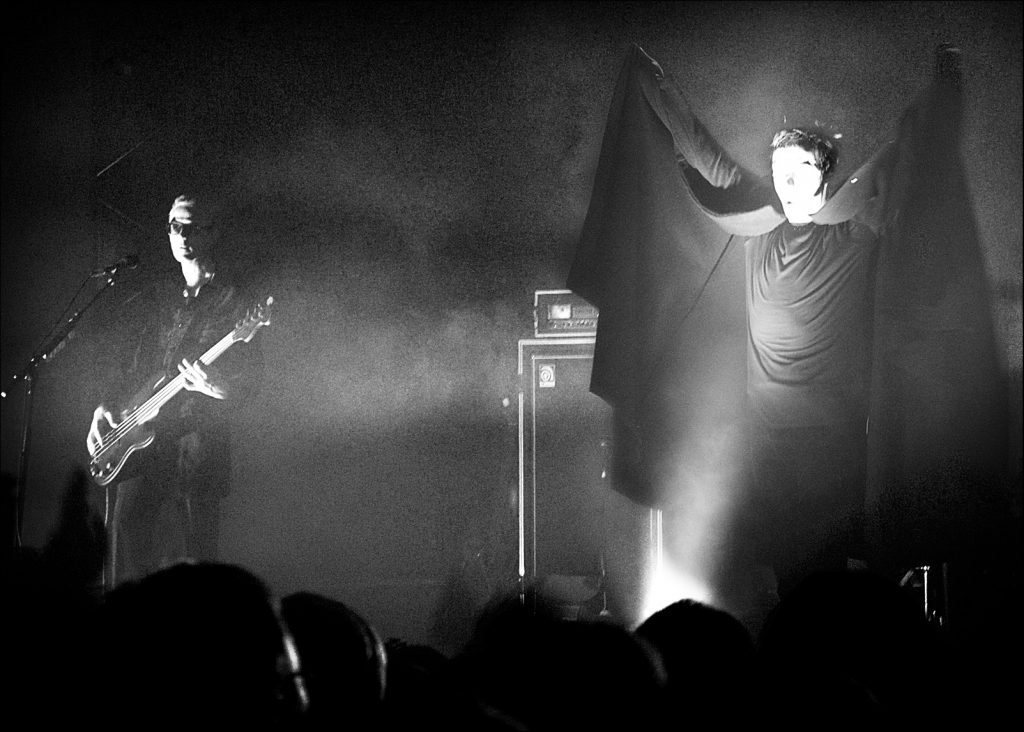
Image by Pedro Figueiredo, via Wikimedia Commons
Why, in my day we called it “post-punk” and we walked miles to find it in catacombs with secret passwords, far away from any mall apparel stores or beverage-sponsored music festivals….
Mostly rubbish, though I have heard many an old campaigner say as much, decrying Goth rock as a recent, devolution from more serious, avant-garde trends. Some amalgam of The Doors, Leonard Cohen, Nico and the Velvet Underground, The Damned, Screamin’ Jay Hawkins, and Hammer horror films, early goth rock went spare, atmospheric, and punky, like the early Cure, or baroque, morose, and cabaret like Bauhaus, or any other number of respectable art-rock directions.
These bands, many of my cohort believe, had integrity, and much better taste than kids today. All that get off my lawn-ness makes an easy target, as does the increasing popularity of a genre of music made for and by unpopular people.
Mix blog Secret Thirteen, curator of the goth rock mix above, admits as much. “Goth has never been an easy affair to discuss,” reads the mix intro in idiosyncratic English: “Kitschy atmosphere of massive contemporary goth festivals and stereotyping discourses usually overwhelmed the textural and emotional core of goth.” Contemporary perceptions, fair or not, obscure the diversity—stylistically, that is… of the music, with its “diverse elements including Dada movement, surrealist aesthetics, post-modernism, French ‘fin-de-siecle’ poetry, 19th century romanticism, punk, kraut, glam, shoegaze, ambient, folk, etc….”
Indeed, it’s all there, when a band with the abrasive low-camp, grindhouse punk of Nick Cave’s The Birthday Party shares a musical lineage with the early synthpop of Ministry (with DJ-scratching!) and the medieval- and world music-obsessed Dead Can Dance. But the key operator in these extremes is theatricality. Since Siouxsie Sioux’s fishnets and swastikas, Dave Vanian’s vampire costumes and pancake makeup, and Robert Smith’s enormous weeping willow hair and onstage mist-shrouded cathedrals of despair, goth has had to make overwrought spectacles of itself, at times horribly tacky ones.
But the Secret Thirteen mix, compiled by founder Justinas Mikulskis, reminds us it’s really about the music, by putting together “the deep cuts,” writes Electronic Beats, “none of this ‘Bela’s Lugosi’s Dead’ stuff” (referring to Bauhaus’ biggest hit).
Here instead we find “the boisterous deathrock of Mighty Sphincter, Specimen’s Batcave thrashiness, the artsy weirdness of Red Wedding and early 4AD stalwarts Mass.” It’s a very 80s mix, but unless you were digging deep in the crates of alternative record stores at the time, few names may be familiar. The Birthday Party shows up, and a band called Kommunity FK that had a very minor hit. Former Sex Pistol John Lydon’s Public Image Ltd. appears with their pounding rant “Religion II.” The Virgin Prunes also make the cut, number 42 in the mix—a very much overlooked, and very disturbing band, often only known for their childhood and family association with U2. Find a complete list of the tracks at the bottom of this page.
It is overall, I think, an excellent way to approach “goth”—or one definition of it—free from the wardrobe squabbles and generational condescension. The mix, writes Secret Thirteen, isn’t intended as “encyclopedic or anthological” in nature, but is “rather presented as a narrative with unexpected twists and turns showcasing a wide variety of elements, moods.” Sort of like a good story by Poe, or a good B horror movie.
Related Content:
A Massive 800-Track Playlist of 90s Indie & Alternative Music, in Chronological Order
Josh Jones is a writer and musician based in Durham, NC. Follow him at @jdmagness
Read More...33 Songs That Document the History of Feminist Punk (1975–2015): A Playlist Curated by Pitchfork
Women have always been central to punk rock, even though they had to fight very hard to get and stay there. As veteran punk journalist and musician Vivien Goldman writes at Pitchfork, “Resistance to our existence was an acknowledged fact of life.” And yet, “punk freed female musicians,” she argues. She knows of what she speaks, having observed firsthand the “laddist boystown” of rock before punk broke barriers for women, and having been a part of that barrier-breaking herself. Goldstein’s essay introduces us to a playlist (stream it above) compiled by the Pitchfork staff called “The Story of Feminist Punk in 33 Songs,” which in a way acts as a critical complement to a recent publishing trend.
In the past few years, we’ve learned a lot about what central moments in punk looked like in memoirs from big names like Sonic Youth’s Kim Gordon, the Slits’ Viv Albertine, and Sleater-Kinney’s Carrie Brownstein. In Girl in a Band: A Memoir, Gordon describes scraping by in the “postapocalyptic hell” of New York circa 1979; Albertine’s book shows us the “astonishing level of violence” the Slits faced on the streets of London around the same time; and Brownstein’s autobiography immerses us in the mid-90s Pacific Northwest scene and her band’s attempt to “expand the notion of what it means to be female.”
That’s not even to mention Patti Smith’s National Book Award-winning memoir or Kathleen Hanna’s public remembrances. The wave of press does risk obscuring something crucial, however; punk has always had its stars, but its primary appeal has been that anyone, no matter who, can do it, and all of the women above began in that spirit. Even if many of the women who left their stamp on early and later punk did not become famous, their fans remember them, as do the many thousands of people who heard them and then went out to start their own bands.
But the angle in Pitchfork’s compilation is not simply “women in punk.” Their 33-song playlist follows the specific thread of what they call “feminist punk,” meaning “songs that make their feminist messages clear—not just songs by punks who are feminists.” The rubric means that in addition to all of the artists mentioned above, and obscure bands like The Bags and The Brat, the all-male Fugazi get a mention for their song “Suggestion,” in which Ian MacKaye sings from a woman’s perspective about “the aggressive objectification of women’s bodies.” The song is a “tentpole for male feminism in punk,” and we can think of it as a kind of benign tokenism and an important moment for other male punk bands who followed suit in denouncing the patriarchy.
The playlist spans four decades, beginning with Patti Smith in 1975 and ending with Downtown Boys in 2015. The best-known artists happen to arrive in the late 70s and the mid-90s (Hanna makes the list thrice with three different bands). Not coincidentally, these are the moments—in England and the U.S.—when feminist punks made the most noise, and Goldman points out just how much the women in these eras had in common:
Because women’s contributions are so often hidden from herstory, when the riot grrrl movement began in America, those women were virtually unaware that their UK sisters had been fighting parallel battles two decades earlier. But the Americans were way better funded and organized than we had been, lurching through no-woman’s‑land to make ourselves heard. It took awhile before Kurt Cobain championed the Raincoats and Sonic Youth bonded with the Slits.
Punk may be dead, or it may remain what Goldstein calls the “global music of rebellion.” Either way, Pitchfork’s playlist—with its critical commentary on each selection—offers young female artists making music in their bedrooms a sense of continuity with a long line of mostly DIY feminist punks who made “fissures and cracks, some crumbling walls” in the edifice of rock’s boy’s club. Goldman warns her target readers—who so clearly are those young bedroom guitarists, singers, producers, etc.—against complacency, but also leaves them with some clear, concise advice: “Where possible, please create a community with complementary skills. Nowadays, it often starts online. Still, try and find a way to actually, physically be with your new creative cohorts. Because nothing beats jamming with your sisters.”
See Pitchfork for the full, annotated playlist with Goldman’s introduction and hear the full playlist in order at the top of the post.
Related Content:
Four Female Punk Bands That Changed Women’s Role in Rock
Chrissie Hynde’s 10 Pieces of Advice for “Chick Rockers” (1994)
Josh Jones is a writer and musician based in Durham, NC. Follow him at @jdmagness
Read More...Oliver Sacks Explains the Biology of Hallucinations: “We See with the Eyes, But with the Brain as Well”
We all understand that hallucination involves seeing things that aren’t really there, but what are hallucinations themselves? “They don’t seem to be of our creation. They don’t seem to be under our control. They seem to come from the outside, and to mimic perception.” Those words come from Oliver Sacks, who would know. We featured a short clip of him discussing what he learned from his personal experience with LSD and amphetamines back in 2012, when his book Hallucinations had just come out. He died almost exactly three years later — and therefore just under a year ago — leaving behind a body of work from which we all stand to gain much understanding of the workings of the brain, as illuminated by both its normal and abnormal states.
In this 2009 TED Talk on what hallucinations reveal about our minds, Sacks tells of his experiences with one patient, elderly and blind, who kept “seeing” visions of “people in Eastern dress, in drapes, walking up and down stairs.” Another, with limited eyesight, ” said she saw a man in a striped shirt in a restaurant. And he turned around. And then he divided into six figures in striped shirts, who started walking towards her. And then the six figures came together again, like a concertina.” Another, with a small tumor on the occipital cortex, “would see cartoons. These cartoons would be transparent and would cover half the visual field, like a screen. And especially she saw cartoons of Kermit the Frog.”
Sacks connects all this to something called Charles Bonnet syndrome, first described by the naturalist of that name in 1760. Bonnet’s grandfather, who’d had cataract surgery (and 18th-century cataract surgery at that), said he saw things like handkerchiefs and wheels floating in midair. These hallucinations work differently than psychotic ones, which “address you. They accuse you. They seduce you. They humiliate you. They jeer at you.” But Charles Bonnet syndrome produces an experience more like watching a film — a term Sacks’ patients could use to describe it, though obviously nobody could have in Bonnet’s day.
Bonnet, Sacks concludes, “wondered how, thinking about these hallucinations, as he put it, the theater of the mind could be generated by the machinery of the brain. Now, 250 years later, I think we’re beginning to glimpse how this is done.” Thanks to Sacks’ inspiration of succeeding generations of neuroscientific researchers, that glimpse of how we “see with the eyes, but with the brain as well” will only widen.
Related Content:
Oliver Sacks’ Last Tweet Shows Beethoven’s “Ode to Joy” Movingly Flashmobbed in Spain
This is What Oliver Sacks Learned on LSD and Amphetamines
Based in Seoul, Colin Marshall writes and broadcasts on cities and culture. He’s at work on a book about Los Angeles, A Los Angeles Primer, the video series The City in Cinema, the crowdfunded journalism project Where Is the City of the Future?, and the Los Angeles Review of Books’ Korea Blog. Follow him on Twitter at @colinmarshall or on Facebook.
Read More...Support Us
We're hoping to rely on loyal readers, rather than erratic ads. Please click the Donate button and support Open Culture. You can use Paypal, Venmo, Patreon, even Crypto! We thank you!

About Us

Open Culture scours the web for the best educational media. We find the free courses and audio books you need, the language lessons & educational videos you want, and plenty of enlightenment in between.
Advertise With Us

FREE UPDATES!
GET OUR DAILY EMAIL
Get the best cultural and educational resources on the web curated for you in a daily email. We never spam. Unsubscribe at any time.
FOLLOW ON SOCIAL MEDIA

Open Culture editor Dan Colman scours the web for the best educational media. He finds the free courses and audio books you need, the language lessons & movies you want, and plenty of enlightenment in between.
Advertise With Us


