The 5 Books on President Obama’s 2016 Summer Reading List
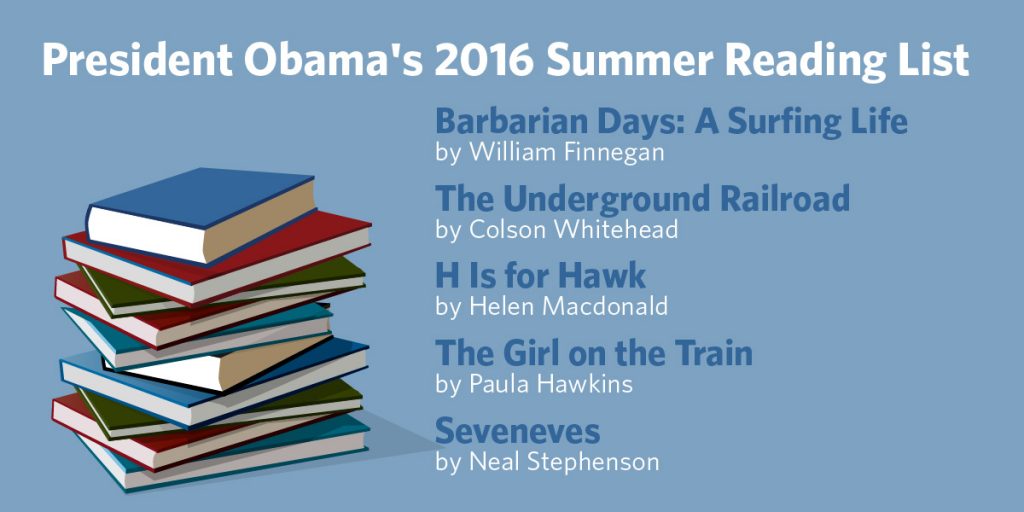
As he kicked off a summer vacation, President Obama released last week a free 39-song playlist for a summer day–essentially a soundtrack for a summer vacation. He also shared his summer reading list–five books which offer, notes the White House, “a mix of fiction and non-fiction, including a Pulitzer Prize-winning surf memoir, a psychological thriller, and a science fiction novel. They include:
- Barbarian Days: A Surfing Life by William Finnegan
- The Underground Railroad by Colson Whitehead
- H Is for Hawk by Helen Macdonald
- The Girl on the Train by Paula Hawkins
- Seveneves by Neal Stephenson
For anyone interested in revisiting Pres. Obama’s five picks from last summer, we have them here:
- All The Light We Cannot See by Anthony Doerr
- The Sixth Extinction by Elizabeth Kolbert
- The Lowland by Jhumpa Lahiri
- Between the World and Me by Ta-Nehisi Coates
- Washington: A Life by Ron Chernow
If you would like to support the mission of Open Culture, consider making a donation to our site. It’s hard to rely 100% on ads, and your contributions will help us continue providing the best free cultural and educational materials to learners everywhere. You can contribute through PayPal, Patreon, and Venmo (@openculture). Thanks!
Related Content:
Ta-Nehisi Coates’ List of 13 Recommended Books
Patti Smith’s List of Favorite Books: Camus, Shakespeare, Woolf, Wilde & More
800 Free eBooks for iPad, Kindle & Other Devices
Read More...Harvard Puts Online a Huge Collection of Bauhaus Art Objects
You may have first encountered the word Bauhaus as the name of a campy, arty post-punk band that influenced goth music and fashion. But you’ll also know that the band took its name from an even more influential art movement begun in Germany in 1919 by Walter Gropius. The appropriation makes sense; like the band, Bauhaus artists often leaned toward camp—see, for example, their costume parties—and despite their serious commitment, had a sense of humor about their endeavor to radically alter European art and design. But the Bauhaus movement has been unfairly pegged at times as overly serious: cold technologists and proponents of faceless glass and steel buildings and austere modernist furniture. That impression only tells a part of the tale.
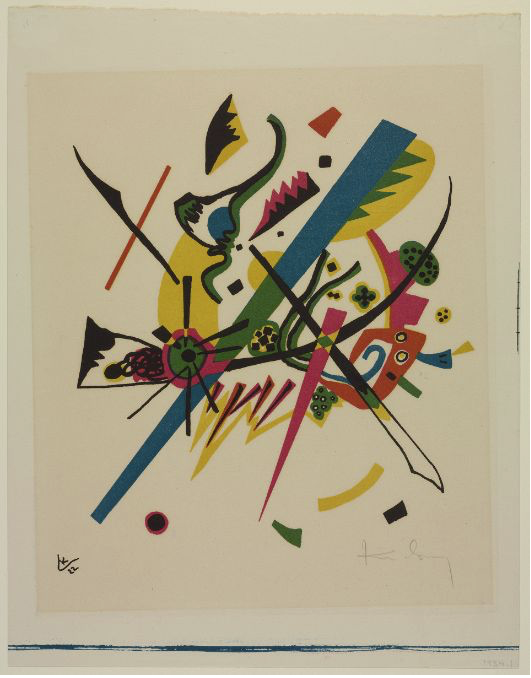
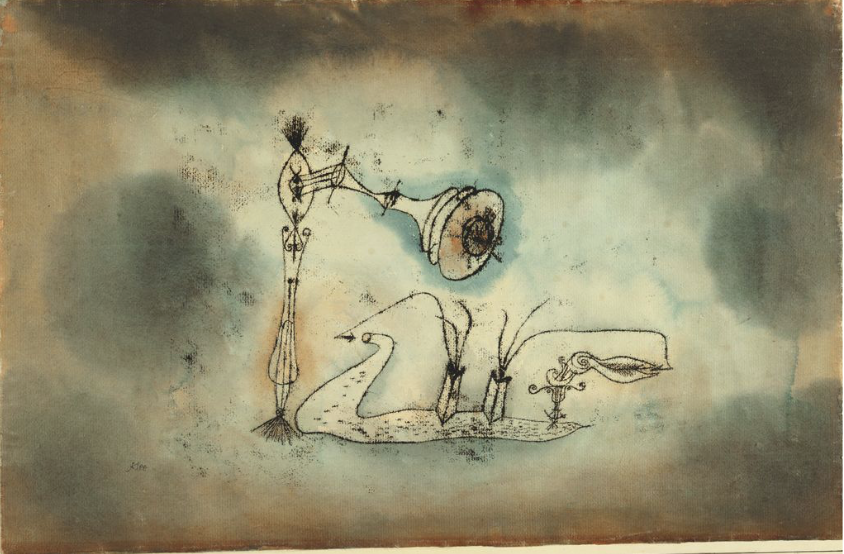
When we speak of Bauhaus design, we often forget that the Bauhaus was also—and first principally—an art school. Until broken up by the Nazis in 1933, it operated under a rigorous course of training with a faculty who brought with them a variety of organic theories and practices—not all of them enamored of technology or 90-degree angles. Paul Klee, for example, mocked our fascination with machines in works like Apparatus for the Magnetic Treatment of Plants (top) and Wassily Kandinsky enacted his mystical theories of symbolism in increasingly abstract, vibrant canvases like Small Worlds, above.
Both of these paintings reside in Harvard’s special collection, “one of the first and largest collections relating to the Bauhaus,” and at the Harvard Museums website, you can find more works–in fact, more than 32,000 objects–by these artists and others like Oskar Schlemmer, who designed many of those outlandish costumes. (See some of those designs in his costumes for the Triadic Ballet, below.)
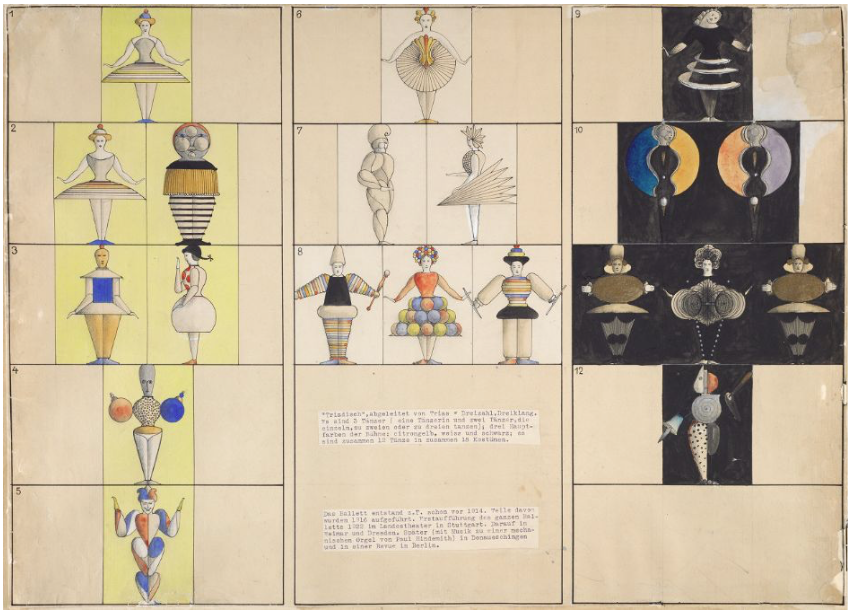
The Harvard Bauhaus collection demonstrates how the Bauhaus school “served as hothouse for a variety of ‘isms,’ from expressionism, Dadaism, constructivism, and functionalism.” The tendency to associate Bauhaus with primary colors and minimalist glass, steel, and concrete has much to do with some of its best-known faculty/alumni, like founder Gropius, and architects/designers Mies Van der Rohe, Le Corbusier, Eero Saarinen, and his student Charles Eames.
These names are represented in the Harvard collection, but so are “different facets of the Bauhaus and its legacy.” Paintings, photographs, ceramics, textiles, metalwork…. One section of the site, Pedagogy, shows us student work of artists like Herbert Bayer, below. Known for his “hard-edged ‘machine aesthetic,” Bayer’s traditional charcoal study of wool and wood shavings “appears antithetical to the school’s revolutionary program.” Yet it is an example of Bauhaus’ emphasis on fundamentals of technique, “pedagogical methods that persist in various form in art schools today.”
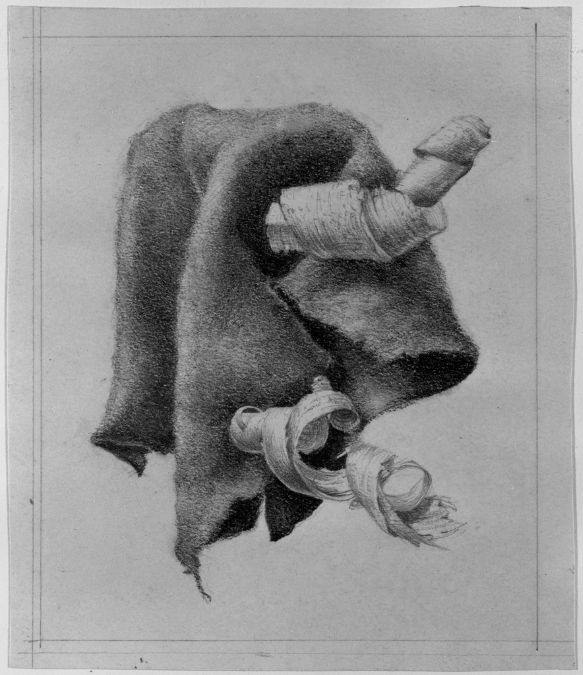
Harvard’s web site represents its physical collection, but it does not duplicate it. Many of the small images in its online archive do not expand to larger versions and cannot be downloaded. However, if you follow the guided tour by clicking “Continue Reading” under the site’s introduction, you’ll be able to click on the several dozen examples in each section and see them up close. You’ll also get a thorough survey of the Bauhaus school’s brief history and mission. The best way to access the collection is to click here, then scroll down to the box where it says “Search the Bauhaus special collection by keyword, title, artist, or object number, and by using the filters below.”
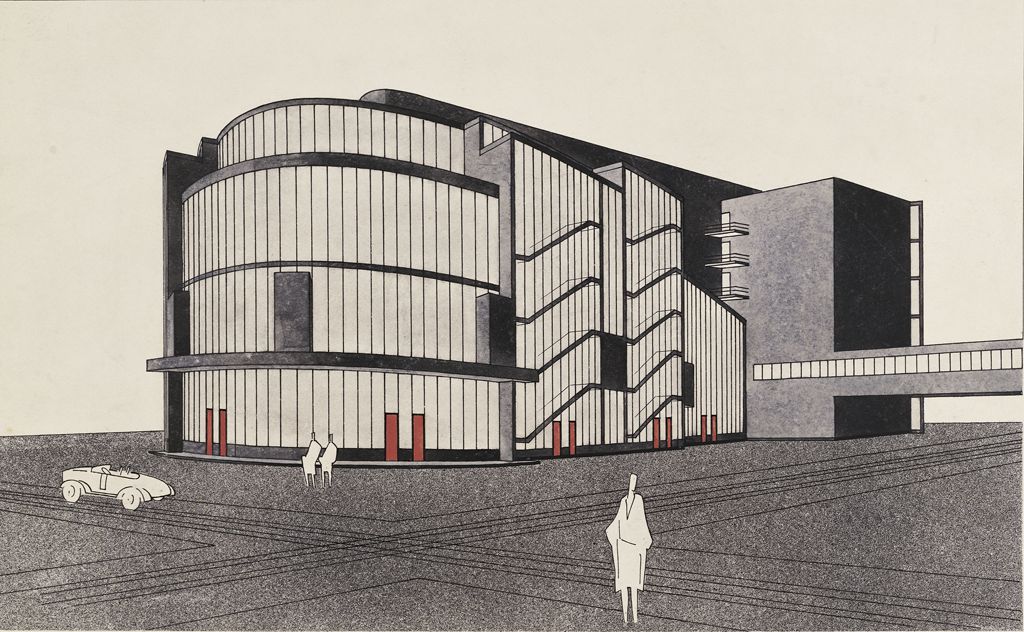
The only U.S. exhibition of Bauhaus artists during the school’s lifetime took place at Harvard in 1930, organized by undergraduates. And Walter Gropius taught for fifteen years at Harvard’s Graduate School of Design, during which time “he built the school up as a bastion of architectural modernism.” Gropius and his students and colleagues changed the way we build and design. (See Gropius’ Total Theater for Erwin Piscator, above). The Harvard Museum Bauhaus collection also reminds us that they revolutionized art education in Europe and the U.S.
Related Content:
Time Travel Back to 1926 and Watch Wassily Kandinsky Create an Abstract Composition
Josh Jones is a writer and musician based in Durham, NC. Follow him at @jdmagness
Read More...Free Audio: The Dream Keeper and Other Poems of Langston Hughes (Read by Langston Hughes)

Image by Carl Van Vechten, via Wikimedia Commons
From Smithsonian Folkways comes the 1955 album, The Dream Keeper and Other Poems of Langston Hughes. The collection features 10 tracks of Langston Hughes, the great Harlem Renaissance poet, reading his poems, starting with “The Dream Keeper.” And it’s all available on Spotify for free. If you need Spotify’s software, download it here. The collection can also be purchased in CD format here.
The Dream Keeper and Other Poems of Langston Hughes will be added to our collection, 1,000 Free Audio Books: Download Great Books for Free.
Looking for free, professionally-read audio books from Audible.com? Here’s a great, no-strings-attached deal. If you start a 30 day free trial with Audible.com, you can download two free audio books of your choice. Get more details on the offer here.
Read More...When James Joyce & Marcel Proust Met in 1922, and Totally Bored Each Other
When we invoke the names of famous artists of the past, we refer to their most hallowed work—Orson Welles simultaneously means Citizen Kane, for example, or War of the Worlds, and H.G. Wells means The Time Machine or… War of the Words. It happens that when these two artists got together in 1940, they found that their worlds, which had already met in Welles’ notorious broadcast, had quite a lot to say to each other, genially trading stories, ideas, and mutual admiration.
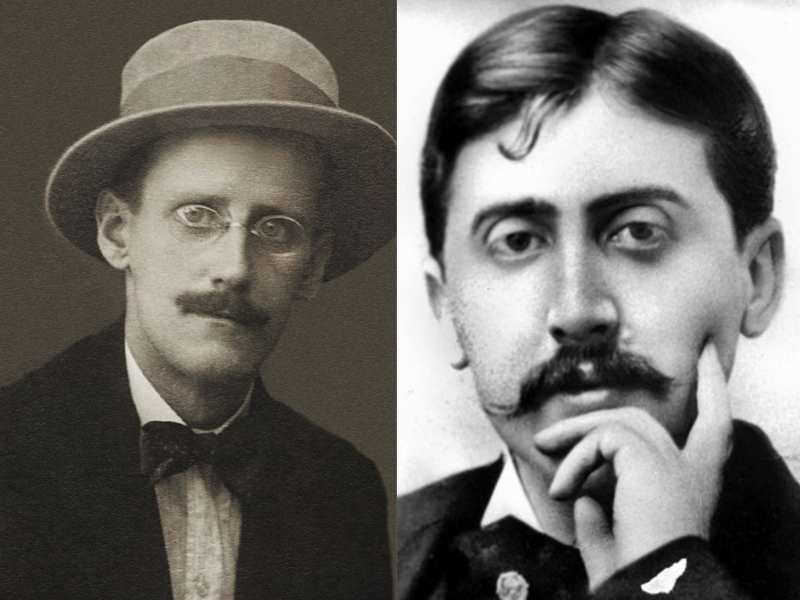
Another historic meeting between two artists we might consider kindred, James Joyce of Ulysses fame and Marcel Proust of In Search of Lost Time, did not produce such a rich exchange. As Irish critic Arthur Power remarked, “Here are the two greatest literary figures of our time meeting and they ask each other if they like truffles.”
That, at least, is one account of the occasion in May of 1922, near the end of Proust’s life. The meeting took place at a party for Igor Stravinsky and Sergei Diaghilev at the Majestic Hotel. Though both novelists propelled their greatest work forward by extrapolating from their favorite subject, themselves, the selves in their work are expansive and vast, taking in whole cities, nations, and social worlds. Both were voracious readers with incredible memories (as we certainly know of Proust) and an intuitive grasp of the cultural mechanisms of modernity. Such serious conversations the two of them might have.…
But one attendee, William Carlos Williams, paints a much more comic picture.….
Joyce, writes Ben Jackson at the London Review of Books, “arrived drunk and poorly dressed; Proust, draped in furs, opened the door.” Then, writes Williams, the two men sat in chairs side by side, while “partisans” waited for “the wits to sparkle and flash.” Instead, they kvetched in the sports-and-weather small talk of two elderly men meeting in a doctor’s waiting room, or two Samuel Beckett characters, beset by petty complaints of ultimate importance.
Joyce said, “I’ve headaches every day. My eyes are terrible.”
Proust replied, “My poor stomach. What am I going to do? It’s killing me. In fact, I must leave at once.”
“I’m in the same situation,’ replied Joyce. ‘If I can find someone to take me by the arm. Goodbye!”
“Charmé,” said Proust. “Oh, my stomach, my stomach.”
Ford Madox Ford confirms the account, but the party’s host, novelist Sydney Schiff denied it, reports Joyce’s most respected biographer Richard Ellmann. Ellmann doesn’t seem to favor one version or another, but he does give us Joyce’s own version, multiply attested. The Ulysses author remembered that their “talk consisted solely of the word ‘No.’ Proust asked me if I knew the duc du so-and-so. I said, ‘No.’” Proust was asked if he’d read Ulysses, and likewise replied in the negative. “The situation,” Joyce remembered, “was impossible.” Other guests remembered the meeting similarly.
In yet another version, we see the aftermath of their conference—in a story that resembles many an end-of-the-night-gone-sour scenario. Sydney Schiff’s wife Violet recalled Joyce drunkenly inviting himself into a taxi with the two of them and Proust, and promptly opening the window. “Knowing Proust’s deadly fear of drafts,” writes a Proust site, Violet “immediately closed the window.” When the cab arrived at Proust’s apartment, the French novelist “urged the Irishman to let the taxi take him home,” then “fled to his apartment.”
The many conflicting renditions all seem to agree on one thing: the meeting was a wash. Nonetheless, one author recently published what purports to be an entire book on the subject. Even he concludes “no one can say for certain exactly what they said to each other.” It’s tempting to think things might have gone otherwise, had they met earlier or in different circumstances, given Joyce’s tendency to get too drunk and Proust’s ill health and aversion to, well, company. The New Inquiry cites a remark Joyce made to Samuel Beckett about Proust: “If we had been allowed to meet and have a talk somewhere….”
Although it’s said that both writers confessed to not having read the other, Jackson notes that when Joyce “did admit to passing his eyes over a few pages he declared that he did not see ‘any special talent.’” He also confessed to some envy of Proust’s comfortable circumstances. Proust, who died six months later, left no mention of their meeting.
Related Content:
The Historic Meeting Between Dickens and Dostoevsky Revealed as a Great Literary Hoax
Edward Said Recalls His Depressing Meeting With Sartre, de Beauvoir & Foucault (1979)
Josh Jones is a writer and musician based in Durham, NC. Follow him at @jdmagness
Read More...The History of Civilization Mapped in 13 Minutes: 5000 BC to 2014 AD
Above, watch “a geopolitical history of all empires, nations, kingdoms, armies and republics” unfold in 13 minutes. Created by a YouTuber who simply goes by the name “kardboardking,” the video stitches together “more than 500 world maps spanning all historical events.” We start in Sumer, somewhere around 5500–4000 BC. And end in 2014, with the world as we know it today.
Kardboardking is careful to point out that the clip features civilizations with a writing system and urban centers. Hence “pre-historical cultures” don’t make an appearance here. For a truly comprehensive history of the world, see: The History of the World in 46 Lectures From Columbia University.
If you would like to support the mission of Open Culture, consider making a donation to our site. It’s hard to rely 100% on ads, and your contributions will help us continue providing the best free cultural and educational materials to learners everywhere. You can contribute through PayPal, Patreon, and Venmo (@openculture). Thanks!
Related Content:
The History of Cartography, the “Most Ambitious Overview of Map Making Ever,” Now Free Online
New York Public Library Puts 20,000 Hi-Res Maps Online & Makes Them Free to Download and Use
Free Online History Courses
Read More...Watch Sunspring, the Sci-Fi Film Written with Artificial Intelligence, Starring Thomas Middleditch (Silicon Valley)
This past spring the streets of Seoul, where I live, felt more like a sci-fi movie than usual. Large overhead video screens kept the population posted on the progress of a series of Go matches between 18-time world champion Lee Sedol and AlphaGo, a piece of artificial intelligence developed by Google DeepMind. Computers have long had a special difficulty mastering that traditional game, but before long it became clear that this computer would win most of the matches, despite the human’s formerly unshakable prediction of the opposite outcome. What would artificial intelligence achieve next?
“In the wake of Google’s AI Go victory, filmmaker Oscar Sharp turned to his technologist collaborator Ross Goodwin to build a machine that could write screenplays,” say the video notes for the new short film Sunspring. They assembled hundreds of science fiction scripts, mostly from 1980s and 90s television shows and movies, and fed them into the artificial intelligence, which eventually named itself Benjamin, so as to teach it the mechanics of screenwriting. “Building a team including Thomas Middleditch, star of HBO’s Silicon Valley, they gave themselves 48 hours to shoot and edit whatever Benjamin decided to write.” Benjamin decided to write eight minutes’ worth of its own interpretation of the tropes of a certain kind of sci-fi entertainment.
It did come up with, fair to say, some dialogue a human screenwriter could only dream of — that is to say, words with the kind of unconscious logic that, delivered by living, breathing actors in physical spaces, take on weight, humor, and even an askew kind of meaning. (Middleditch’s despondent “I am not a bright light” will surely stay quotable for years to come.) You can learn more about the making of Sunspring from this Ars Technica piece by Annalee Newitz. Benjamin won’t put any sci-fi scribes out of work just yet, haunting though it may seem for a program to have come so close to doing something classically human as telling a story about the future. But remember, people had to write that program, just as people had to create AlphaGo; every achievement of artificial intelligence thus also counts as an achievement of humanity.
Related Content:
Noam Chomsky Explains Where Artificial Intelligence Went Wrong
Based in Seoul, Colin Marshall writes and broadcasts on cities and culture. He’s at work on a book about Los Angeles, A Los Angeles Primer, the video series The City in Cinema, the crowdfunded journalism project Where Is the City of the Future?, and the Los Angeles Review of Books’ Korea Blog. Follow him on Twitter at @colinmarshall or on Facebook.
Read More...Mashup Weaves Together 57 Famous Classical Pieces by 33 Composers: From Bach to Wagner
Musical mash up artist Grant Woolard has found a perfectly ethical way to sidestep copyright issues. Sample the greatest hits of long dead classical composers.
The pragmatically titled “Classical Music Mashup,” above, weaves 57 melodies by Mozart, Beethoven, Verdi, and 30 other greats into one six minute composition.
Woolard invites listeners to separate out the strands, most of which will sound familiar, even if you are unable to name that tune.
(One sharp-eared listener not only accepted the challenge, but posted a complete listing of all the composers and compositions in chronological order with time stamps. Those who don’t mind SPOILERS can view it at the end of this post.)
Those who crave an even more interactive assignment can download the sheet music (for a small fee), then recruit two more pianists to perform the six-handed piece.
You can also buy an audio track of the composition here.
And now, the list of Woolard’s raw ingredients, compliments of youtube commenter, Yifeng Huang:
1. Mozart Eine Kleine Nachtmusik K525 0:01
2. Haydn Symphony 94 “Surprise” II 0:01
3. Beethoven Symphony 9 IV (Ode to Joy) 0:06
4. Mendelssohn Wedding March in Midsummer Night’s Dream, second theme 0:06
5. Dvorak Humoresque No.7 0:13
6. Wagner Lohengerin, Bridal Chorus 0:13
7. Tchaikovsky Piano Concerto 1 0:19
8. Saint-Saens Carnival of Animals: Swan 0:19
9. Bach Well Tempered Clavier Book 1 Prelude 1 0:19
10. Tchaikovsky 1812 Overture 0:29
11. Bach Cello Suite No. 1 0:32
12. Mendelssohn Song without Words “Spring” 0:33
13. Schubert Ave Maria 0:40
14. Schubert Symphony 8 “Unfinished” 0:46
15. Verdi “La Donna è Mobile” in Rigoletto 0:51
16. Boccherini String Quartet in E, Op.11 No.5, III. Minuetto 0:55
17. Beethoven für Elise 1:03
18. CPE Bach Solfeggietto 1:04
19. Paganini Capriccio 24 1:11
20. Mozart Piano Sonata No.11 III (Turkish March) 1:15
21. Grieg Piano Concerto 1:22
22. Mozart Requiem Lacrimosa 1:26
23. Schubert Serenade 1:30
24. Chopin Prelude in C minor 1:35
25. Strauss II Overture from Die Fledermaus (Bat) 1:46
26. Brahms 5 Lieder Op.49, IV. Wiegenlied (Lullaby) 1:46
27. Satie Gymnopedie 1:56
28. Debussy Arabesque 2:00
29. Holst Planets, Jupiter 2:05
30. Schubert Trout 2:14
31. Liszt Hungarian Rhapsody No.2 2:28
32. Mozart Variation on Twinkle Twinkle Little Star 2:41
33. Schumann Op.68, No.10 Merry Peasant 2:47
34. Schubert Military March in D 2:54
35. Bach* (could be Petzold) Minuet in G 3:00
36. Mozart Piano Sonata No.16 in C, K545 3:07
37. Offenbach Can-can in “Orpheus in the underworld” 3:08
38. Beethoven Piano Sonata No.8 “Pathetique” II 3:18
39. Mozart Die Zauberflöte Overture 3:24
40. Tchaikovsky Romeo and Juliet Overture 3:31
18′. CPE Bach Solfeggietto 3:44
41. Beethoven Symphony 5 “Fate” 3:47
6′. Wagner Wedding March 3:52
42. Rachmaninoff Prelude Op.3 No.2 in C# minor 3:53
18′. CPE Bach Solfeggietto 3:56
43. Chopin Piano Sonata No. 2 III. Funeral March 4:11
44. Williams Imperial March in Star War 4:19
45. Tchaikovsky Marche Slave 4:25
46. Smetana Ma Vlast II. Moldau 4:38
47. Tchaikovsky Nutcracker — Flower Waltz (not the main theme!) 4:45
48. Borodin Polovtsian Dances 4:45
49. Strauss II Blue Danube 4:58
50. Vivaldi Four Seasons I. Spring 5:03
51. Handel Messiah, Hallelujah 5:03
52. Handel The Entrance of the Queen of Sheba 5:08
53. Elgar Pomp and Circumstance Marches No. 1 5:15
54. Pachelbel Canon in D 5:21
55. Mozart Symphony No. 35 in D major (Haffner) K. 385, IV. Finale, Presto 5:27
56. Chopin Etude Op.25 No.9 in G flat, “Butterfly” 5:34
57. Bach Gavotte from French Suite No. 5 in G Major, BWV 816 5:42
Related Content:
The World Concert Hall: Listen To The Best Live Classical Music Concerts for Free
Debussy’s Clair de lune: The Classical Music Visualization with 21 Million Views
Ayun Halliday is an author, illustrator, theater maker and Chief Primatologist of the East Village Inky zine. Her latest script, Fawnbook, is available in a digital edition from Indie Theater Now. Follow her @AyunHalliday.
Read More...Watch What Happens When 100 Metronomes Perform György Ligeti’s Controversial Poème Symphonique
A loose association of mid-20th century artists including at times John Cage, Yoko Ono, and Joseph Bueys, the Fluxus group produced a lot of strange performative work and anti-art stunts influenced by similar provocations from earlier Dada artists. The movement’s “patron saint,” Martha Schwendener writes at The New York Times, was Marcel Duchamp, whose “idea of art (or life) as a game in which the artist reconfigures the rules is central to Fluxus.” Also central was Duchamp’s concept of the “ready-made”—everyday objects turned into objets d’art by means part ritual and part prank.
We can think of the piece above in both registers. György Ligeti’s Poème symphonique, a composition involving 100 metronomes and ten operators, fit right in with Fluxus during Ligeti’s brief association with them.
Written in 1962—and yes, it has a written score—Ligeti’s piece “owes much of its success to its presentation as a ridiculous spectacle,” writes composer Jason Charney, who has made a digital recreation. Ligeti provides specific instructions for the performance.
The work is performed by 10 players under the leadership of a conductor … Each player operates 10 metronomes … The metronomes must be brought onto the stage with a completely run-down clockwork … the players wind up the metronomes … at a sign from the conductor, all the metronomes are set in motion by the players.
These are followed almost to the letter in the video at the top of the page, with the added bonus of holding the performance in a Gothic church. What does it sound like? A cacophonous racket. A waterfall of typewriters. And yet, believe it or not, something interesting does happen after a while; you become attuned to its internal logic. Patterns emerge and disappear in the reverberation from the church walls: A wave of robot applause, then soothing white noise, then a movement or two of a factory symphony.…
“The score,” notes Matt Jolly, who shot the video, “calls for a long silence and then up to an hour of ticking. We decided to shorten this considerably. The metronomes are supposed be fully wound but we had to limit that to 13 turns on average.” The ingenuity of Ligeti’s piece far surpasses that of any mere prank, as does the logistical and material demand. The composer fully acknowledged this, providing specifics as to how performers might go about securing their “instruments,” hard to come by in such large quantity even in 1962. (Mechanical metronomes are now all but obsolete.) Charney quotes from Ligeti’s helpful suggestions, which include enlisting the services of an “executive council of a city, one or more of the music schools, one or more businesses, one or more private persons….”
I doubt he meant any of this seriously. Dutch Television canceled a planned 1963 broadcast of Poème symphonique from an early performance in the Netherlands. The event included speeches by local politicians and an audience who had no idea what to expect. As you might imagine, they did not react favorably. Like the earlier anti-art Ligeti’s idea draws from, he explicitly framed the composition as “a special sort of critique,” whose score is “admittedly rather ironic” and in which he rants vaguely against “all ideologies” and “radicalism and petit-bourgeois attitudes” alike. How seriously he means this is also anyone’s guess. And yet, prank or art, people continue to perform the piece, as in the even shorter rendition above, which goes even further in removing the human element by designing a machine to start all the metronomes simultaneously.
Related Content:
Hear the Radical Musical Compositions of Marcel Duchamp (1912–1915)
Hear the Experimental Music of the Dada Movement: Avant-Garde Sounds from a Century Ago
The Music of Avant-Garde Composer John Cage Now Available in a Free Online Archive
Josh Jones is a writer and musician based in Durham, NC. Follow him at @jdmagness
Read More...A Free POTUS Summer Playlist: Pres. Obama Curates 39 Songs for a Summer Day
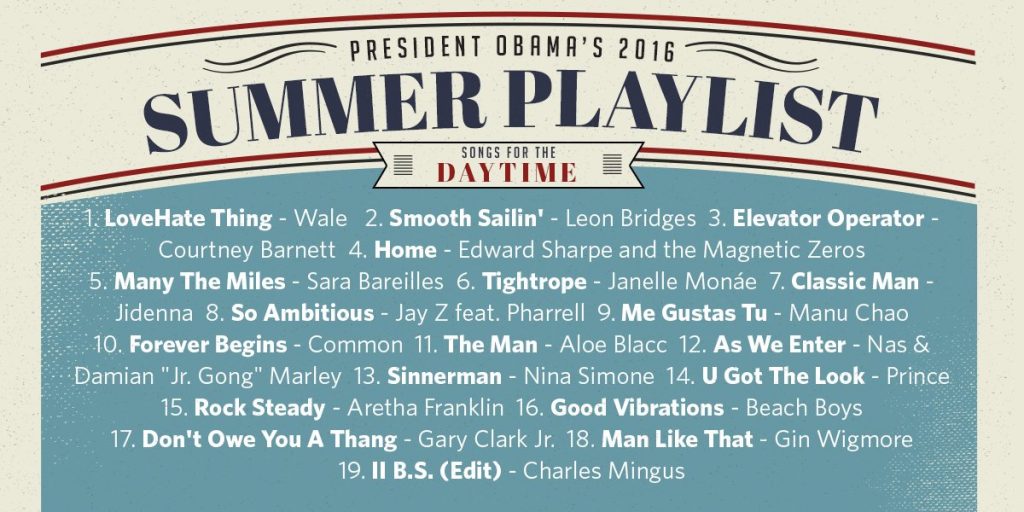
Like he did last summer, President Obama has put together two eclectic music playlists–one for a hot summer day, and another for a summer evening. And they’re both pretty chill, the stuff vacations are made of. If you have Spotify (download it here), you can start streaming all of the songs below. And if you want to know more about Clinton and Trump’s favorite songs, check out this piece on Rolling Stone.
The President’s Summer Playlist: Daytime
- LoveHate Thing — Wale
- Smooth Sailin’ — Leon Bridges
- Elevator Operator — Courtney Barnett
- Home — Edward Sharpe and the Magnetic Zeros
- Many the Miles — Sara Bareilles
- Tightrope — Janelle Monae
- Classic Man — Jidenna
- So Ambitious — Jay‑Z, feat. Pharrell
- Me Gustas Tu — Manu Chao
- Forever Begins — Common
- The Man — Aloe Blacc
- As We Enter — Nas & Damian “Jr. Gong” Marley
- Sinnerman — Nina Simone
- U Got the Look — Prince
- Rock Steady — Aretha Franklin
- Good Vibrations — Beach Boys
- Don’t Owe You A Thang — Gary Clark Jr.
- Man Like That — Gin Wigmore
- II B.S. (edit) — Charles Mingus
The President’s Summer Playlist: Nighttime
- If I Have My Way — Chrisette Michelle
- Espera — Esperanza Spalding
- Tell It Like It Is — Aaron Neville
- Alright — Ledisi
- Trapped By A Thing Called Love — Denise Lasalle
- Lady — D’Angelo
- So Very Hard to Go — Tower of Power
- Midnight Sun — Carmen McCrae
- Cucurrucucu Paloma — Caetano Veloso
- Green Aphrodisiac — Corinne Bailey Rae
- I’ll Be There for You / You’re All I Need — Mary J Blige / Method Man
- Lover Man — Billie Holiday
- Criminal — Fiona Apple
- Acid Rain — Chance the Rapper
- My Funny Valentine — Miles Davis
- Do You Feel Me — Anthony Hamilton
- I Get Lonely — Janet Jackson
- Lean In — Lizz Wright
- All Day Music — War
- Say Yes — Floetry
If you would like to support the mission of Open Culture, consider making a donation to our site. It’s hard to rely 100% on ads, and your contributions will help us continue providing the best free cultural and educational materials to learners everywhere. You can contribute through PayPal, Patreon, and Venmo (@openculture). Thanks!
Read More...Watch collective:unconscious, the Acclaimed Indie Film Where 5 Filmmakers Adapt Each Other’s Dreams for the Screen
What an irony that, when you have a vivid, funny, terrifying, elaborate dream, you dare not tell anyone for fear of boring them. But what if you could let someone else experience your dreams first-hand? The group of independent filmmakers behind this year’s collective:unconscious (not to be confused with the New York artist group of almost the same name) have put their waking heads together to come as close as possible to doing just that. Daniel Patrick Carbone, Josephine Decker, Lauren Wolkstein, Frances Bodomo, and Lily Baldwin have created a portmanteau film by adapting one another’s dreams for the screen, which you can dream along with them by watching free on Vimeo.
“I remember back when I was a teen, watching Mulholland Drive for the first time in the theater,” writes collective:unconscious’ producer Dan Schoenbrun in an essay on the making of the film at Indiewire. “I remember my mind being blown. I remember thinking, ‘Movies can do that?’ ”
David Lynch has made his name with pictures, Mulholland Drive and others, that feel dreamlike in the richest, most haunting sense of the word. But rather than a set of Lynch homages, each of the five filmmakers contributing here come at the project of cinematizing the unconscious experience differently. Some may feel just like your own dreams; others may feel nothing like them.
Rolling Stone summarizes the “hypnotically senseless” results neatly: “a gorgeous sketch about a woodland sniper drifts into a Malick-esque portrait of an ex-con’s first day of freedom; a gym teacher prepares his class for a volcano drill; a young mother who’s giving birth to an elemental monster; the grim reaper hosts a TV show about murdered black children.” The film has already made an impressive circuit around the festivals, including his year’s South by Southwest (where the New Yorker’s Richard Brody named it as a favorite), so clearly their review committees saw something much more interesting going on than the kind of recounting of dreams that goes on over breakfast. As they say, there’s much more going on in the unconscious — more of artistic use, anyway — than we understand.
collective:unconscious will be added to our collection, 4,000+ Free Movies Online: Great Classics, Indies, Noir, Westerns, Documentaries & More.
Related Content:
David Lynch Presents the History of Surrealist Film (1987)
Based in Seoul, Colin Marshall writes and broadcasts on cities and culture. He’s at work on a book about Los Angeles, A Los Angeles Primer, the video series The City in Cinema, the crowdfunded journalism project Where Is the City of the Future?, and the Los Angeles Review of Books’ Korea Blog. Follow him on Twitter at @colinmarshall or on Facebook.
Read More...Support Us
We're hoping to rely on loyal readers, rather than erratic ads. Please click the Donate button and support Open Culture. You can use Paypal, Venmo, Patreon, even Crypto! We thank you!

About Us

Open Culture scours the web for the best educational media. We find the free courses and audio books you need, the language lessons & educational videos you want, and plenty of enlightenment in between.
Advertise With Us

FREE UPDATES!
GET OUR DAILY EMAIL
Get the best cultural and educational resources on the web curated for you in a daily email. We never spam. Unsubscribe at any time.
FOLLOW ON SOCIAL MEDIA

Open Culture editor Dan Colman scours the web for the best educational media. He finds the free courses and audio books you need, the language lessons & movies you want, and plenty of enlightenment in between.
Advertise With Us


