Mesmerizing Animation, Made of Photos from Early-1900s America, Lets You Travel in a Steampunk Time Machine
Surely you remember Cheers, if only from the sitcom’s syndicated reruns ceaselessly aired around the world. And if you remember Cheers, you’ll remember no part of it more vividly than its opening credits sequence, which broke from the well-established tradition of showing the faces of the series’ cast members.
Instead, writes Stephen Cole at Fonts in Use, the studio charged with creating the sequence “collected archival illustrations and photographs of bar life, culled from books, private collections, and historical societies. They hand-tinted the images and paired them with typography inspired by a turn-of-the-century aesthetic.”
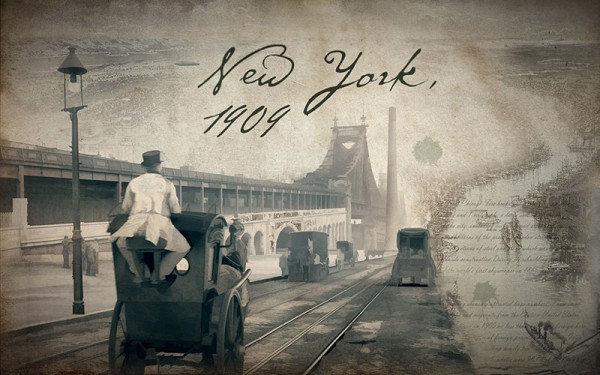
As fondly as we remember their work, the art of bringing turn-of-the-century photos to life has come a long way indeed since Cheers debuted in 1982. Take, for instance, the short above: The Old New World by Russian photographer and animator Alexey Zakharov, who in just over three and a half minutes takes us right back to early-1900s America. “The photos show New York, Boston, Detroit, Washington, D.C., and Baltimore between 1900 and 1940, and were obtained from the website Shorpy,” writes Petapixel’s Michael Zhang, quoting Zakharov’s own description of the work as a “photo-based animation project” as well as a chance to “travel back in time with a little steampunk time machine.”
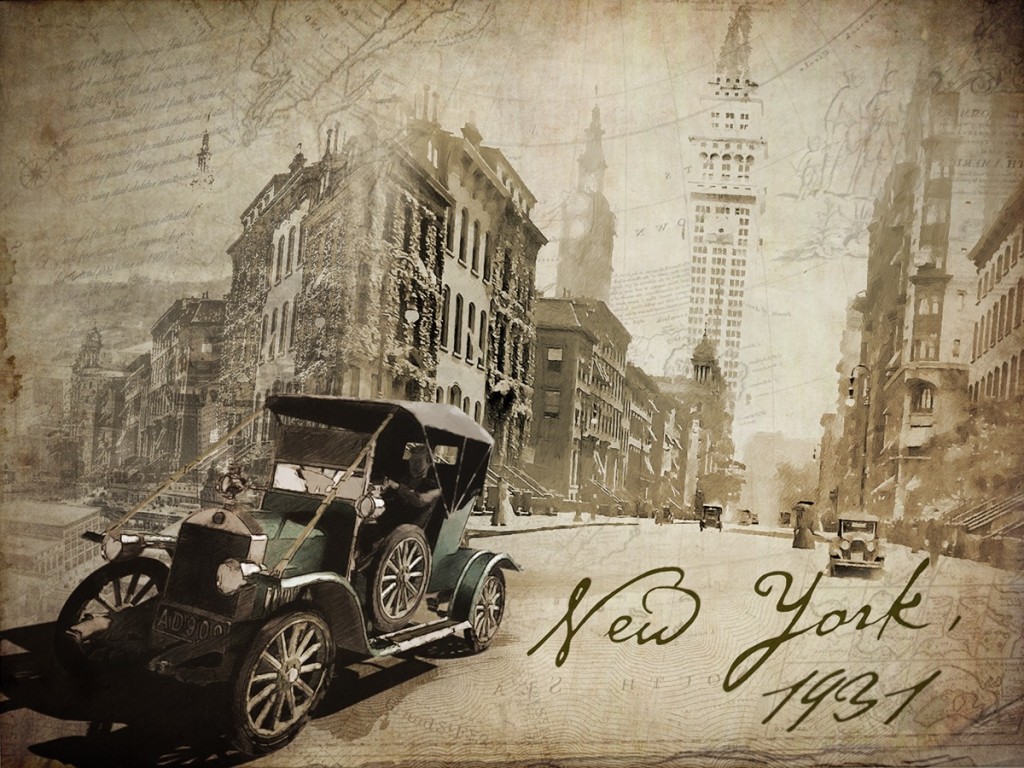
You can see a gallery of more of the materials that went into The Old New World at Behance. Just as those Cheers opening credits evoked the conviviality of old-time tavern culture, Zakharov’s film evokes what it meant — or at least, to all of us currently alive and thus without any living memory of that era, what we think it meant — to live in the headiest cities going in the headiest country going, places whose booming industry and culture held out seemingly infinite promise, even on quiet days.
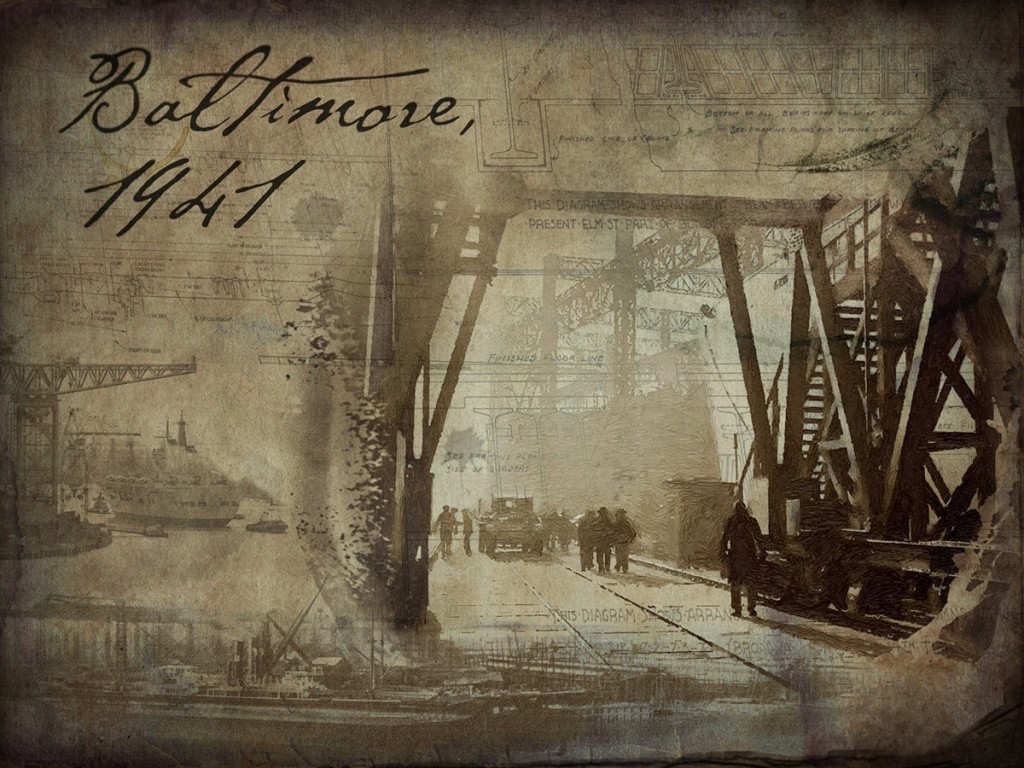
Should Netflix picks Cheers as their next beloved sitcom to revive, they might consider going to Zakharov for a new title sequence. He’s certainly got all the pictures of Boston he’d need.

via Petapixel
Related Content:
London Mashed Up: Footage of the City from 1924 Layered Onto Footage from 2013
James Joyce’s Dublin Captured in Vintage Photos from 1897 to 1904
Based in Seoul, Colin Marshall writes and broadcasts on cities, language, and style. He’s at work on a book about Los Angeles, A Los Angeles Primer, the video series The City in Cinema, the crowdfunded journalism project Where Is the City of the Future?, and the Los Angeles Review of Books’ Korea Blog. Follow him on Twitter at @colinmarshall or on Facebook.
Read More...Hear Prince and Miles Davis’ Rarely-Heard Musical Collaborations
The days and weeks after a celebrity death tend to fill up with public inquiries. The vaguer the circumstances, the more questions proliferate, lead to investigations, trials, depressing tabloid paydays…. But many fans don’t linger over procedural goings-on or prurient details. Many wonder instead “What if?”—as in, how do we reckon the artistic loss? What projects went uncompleted? What kind of collaborations might have been on the horizon?
The speculative answers to the latter question often give us far more interesting results than the real thing. While David Bowie’s work with Freddie Mercury and Queen is unquestionably masterful, for example, his joint effort with Mick Jagger now just makes us laugh. Bowie worked with nearly everyone it seems—there are few match-ups left to ponder…. Well, everyone that is except Prince. What if….?
And now that Prince has left us, we might wonder about all of the superduos that might have formed had he lived into his sixties and beyond. One collaboration that did bear some fruit during his lifetime came just in time for Prince’s superstar partner, Miles Davis, who died in 1991. During the latter half of the ‘80s, the two formed a bond, based on mutual admiration for each other’s music, of course, as well as for each other’s image and generally uncompromising personality.
In fact, since at least 1982, Davis, writes his biographer Ian Carr, became “almost obsessively interested in the androgynous, multi-talented black pop star… whom he rated very highly as an artist.” In the short (almost inaudible) interview clip above, Davis describes Prince as a synthesis of James Brown, Marvin Gaye, Jimi Hendrix, and Charlie Chaplin. He also compared Prince to Sly Stone and Little Richard, writes Carr, and commented, “He’s a mixture of all those guys and Duke Ellington.”
For his part, Prince supposedly saw in Davis an older version of himself. After the two artists met in 1985, they crossed paths several more times in the following years, with Miles appearing onstage to play a solo at a Paisley Park New Year’s Eve benefit and recording a solo on the Prince/Chaka Khan song “Sticky Wicked” in 1988. What’s particularly interesting about Prince and Davis’s musical love affair is that the resulting music played to both artists’ strengths, instead of attempting to meld their styles into something out of character.
Davis’ experiments with ‘80s R&B tropes in his 1986 album Tutu stem from their work together, and the record was originally intended as a Prince collaboration. At the top of the post, you can hear an unreleased track originally written for Tutu called “Can I Play With U?” and featuring Prince’s vocals. Tutu ended up going in a different direction, and received some highly mixed reviews, but it retained much of the spirit of Prince. And for Miles—who since the late sixties had absorbed and transformed influences from so many contemporary styles—this seemed perfectly fitting.
The Tutu collab may not have panned out—Prince was apparently unhappy with the results and scrapped his songs—but the two didn’t give up on each other. On the contrary, much of the music Davis played and recorded at the end of his life was written by Prince. Above, hear one such composition, the suggestively named “Penetration,” in a 1991 performance. Though Prince’s funk roots shine through, it’s also a work very much in Davis’s fusion wheelhouse. Although Davis died before the two could complete their long-awaited collaborative album, we don’t have to wonder “What if?”
Much of the music they wrote together survives in live performances like that above and has circulated in a Davis bootleg titled Miles Davis Plays Prince and a Prince bootleg titled Crucial. Does the music on these recordings live up to the outsized talent and personalities of these two geniuses? Probably not—whatever could? But it shows us the direction Davis would have continued to move in had he lived on, and also gives us a way to think about the significant jazz influences in Prince’s music, a subject rarely discussed but worthy of much more consideration.
Related Content:
The Night When Miles Davis Opened for the Grateful Dead in 1970: Hear the Complete Recordings
Josh Jones is a writer and musician based in Durham, NC. Follow him at @jdmagness
Read More...Franz Kafka: An Animated Introduction to His Literary Genius
Franz Kafka — he wrote that story about the guy who turns into a bug, and lot of stuff about complex and implacable bureaucracy, right? What more do you need to know? Well, given the enduring use (and abuse) of the adjective “Kafkaesque,” the man’s work must tap into some deeper reality of the human condition than our fears of waking up transformed into something gross and inhuman or getting trapped in the purgatory of vast, soulless, and irrational systems. Here to explain a little bit more about that deeper reality, we have this explanatory animated video above from Alain de Botton’s School of Life.
Kafka, says de Botton, “was a great Czech writer who has come to own a part of the human emotional spectrum which we can now call the ‘Kafkaesque,’ and which, thanks to him, we’re able better to recognize and to gain a measure of perspective over and relief from.” We find ourselves in Kafka’s world whenever “we feel powerless in front of authority: judges, aristocrats, industrialists, politicians, and most of all, fathers. When we feel that our destiny is out of our control. When we’re bullied, humiliated, and mocked by society, and especially by our own families. We’re in Kafka’s orbit when we’re ashamed of our bodies, of our sexual urges, and feel that the best thing for us might be to be killed or squashed without mercy, as if we were an inconvenient and rather disgusting bedbug.”
You might expect any writer who takes those as his themes to have led a troubled life, and this video gets into detail about Kafka’s: the self-hatred of his youth, his unsuccessful relationships with women, the agonizing disease that kept him in pain, and everything else that shaped his writing of not just The Metamorphosis but the novels The Trial, The Castle, and Amerika, all left unfinished, to his own mind, in his short lifetime. But in a way, his dreary life story ends well: “Within a few years of his death, his reputation began. By the second World War, he was recognized as one of the greatest writers of the age.”
Acknowledging the Kafkaesque in our world has become important to many of us, but according to this video’s view of Kafka, you can’t fully understand it unless you understand the writer’s relationship with his “terrifyingly psychologically abusive” father. “Any boy who has ever felt inadequate in front of or unloved by a powerful father will at once relate to what Kafka went through in his childhood,” says de Botton, who has himself spoken publicly about growing up in the similarly dark shadow of his own “cruel tyrant” banker father. But even if you didn’t suffer in the same way, you’ll find something to at least crack the frozen sea within you in the work of this writer who stands as “a monument in German literary history,” and at the same time “a sad, ashamed, terrified part of us all.”
Related Content:
Franz Kafka’s Kafkaesque Love Letters
Vladimir Nabokov Makes Editorial Tweaks to Franz Kafka’s Novella The Metamorphosis
The Art of Franz Kafka: Drawings from 1907–1917
The Animated Franz Kafka Rock Opera
Based in Seoul, Colin Marshall writes and broadcasts on cities, language, and style. He’s at work on a book about Los Angeles, A Los Angeles Primer, the video series The City in Cinema, the crowdfunded journalism project Where Is the City of the Future?, and the Los Angeles Review of Books’ Korea Blog. Follow him on Twitter at @colinmarshall or on Facebook.
Read More...In Search of Ludwig Wittgenstein’s Secluded Hut in Norway: A Short Travel Film
If you like philosophy and road tripping, then you’ll want to put Wittgenstein in Norway in your YouTube queue. Posted this month by Kirsten Dirksen, the short film takes through the beautiful countryside of Norway, in search of the hut where Ludwig Wittgenstein exiled himself from society from time to time, first starting in 1913. Dirksen gives this preface to the film:
Over 100 years ago, philosopher Ludwig Wittgenstein went to the fjords of Norway to escape the scholarly world of Cambridge. His former teacher Bertrand Russell wrote, “I said it would be lonely, and he said he prostituted his mind talking to intelligent people.”
Not content with simply moving to the isolation of rural Norway- at the end of the Sognefjord (the deepest and second longest fjord)- Wittgenstein built his hut across the lake and halfway up a mountain from the nearest town (Skjolden). Measuring just 7 by 8 meters, the small cabin dubbed “Little Austria” (his native country) became his home on and off throughout his life (his longest stay here was 13 months).
Wittgenstein was fleeing the distractions and interruptions of a more social lifestyle and hoping to confront only his own thoughts. “Whoever is unwilling to descend into himself,” he wrote, “because it is too painful, will of course remain superficial in his writing.’” He wrote some of his most important work here (a precursor to his “Tractatus Logico-Philosophicus” and some of his “Philosophical Investigations”).
Today all that remains of his hut are its stone foundation and a very faint hikers trail up the mountain, though some Norwegians are trying to change this. Artists Marianne Bredesen, Sebastian Makonnen Kjølaas and Siri Hjorth (in collaborations with the Wittgenstein Society in Skjolden and funded by Public Art Norway) threw an all-expenses-paid vacation to bring fellow Oslo residents to the ruin. Inspired by Wittgenstein’s argument that “philosophical problems arise when language goes on holiday”, they are calling their art holiday “Wittgenstein on Vacation”. For part one, they entertained their guests with a weekend of lectures, meals and a Wittgenstein interpretation at the site of his cabin. We captured some of the show on our own journey to this disappearing piece of history.
Other videos about simple living, self-sufficiency, small homes, and philosophies of life can be found on Dirksen’s YouTube channel.
If you would like to support the mission of Open Culture, consider making a donation to our site. It’s hard to rely 100% on ads, and your contributions will help us continue providing the best free cultural and educational materials to learners everywhere. You can contribute through PayPal, Patreon, and Venmo (@openculture). Thanks!
Related Courses:
Free Online Philosophy Courses
Ludwig Wittgenstein’s Short, Strange & Brutal Stint as an Elementary School Teacher
Ludwig Wittgenstein’s Tractatus Gets Adapted Into an Avant-Garde Comic Opera
Wittgenstein and Hitler Attended the Same School in Austria, at the Same Time (1904)
Read More...How Ink is Made: The Process Revealed in a Mouth-Watering Video
As depicted above, ink making is as voluptuous a process as making a high end candy bar. Having grown up around the printing floor of a daily newspaper, I know that ink’s pungent aroma is the opposite of chocolate‑y, but my mouth still started to water. Was it the commercial-ready classical soundtrack or hearing Chief Ink Maker Peter Welfare comparing the pigment’s gooey “vehicle” to honey?
I won’t be dipping my tongue in the ink pot any time soon, but the multistep four color process by which powdered cyan, magenta, yellow, and black hues become press-bound ink proved far more sensual than expected.
Ink making in the 21st-century is a combination of Old and New World techniques.
The history of ink and printing is very old indeed. The Chinese developed moveable type around 1045 and used it to print paper money. The Gutenberg Press was up and running by 1440. The rollers, vats, and mixing tools in use at the Printing Ink Company, Welfare’s family business, are not so far removed from the tools used by early practitioners.
Workers at the Printing Ink Compnany use their fingers to test their product’s tackiness, a predictor of its on-press performance. Presumably, you develop a feel for it after a while.
State of the art computer programs provide further quality control, analyzing for consistency of color and gloss with an accuracy that eludes even the most practiced human eye.
The results can be seen on everything from brochures to fine art prints.
Related Content:
Learn How Crayons Are Made, Courtesy of 1980s Videos by Sesame Street and Mr. Rogers
How Vinyl Records Are Made: A Primer from 1956
How Film Was Made in 1958: A Kodak Nostalgia Moment
Ayun Halliday is an author, illustrator, and Chief Primatologist of the East Village Inky zine. Her play, Fawnbook, opens in New York City later this fall. Follow her @AyunHalliday
Read More...Prince Plays a Mind-Blowing Guitar Solo On “While My Guitar Gently Weeps”
Amidst all its other unsettling excesses, 2016 has become a year of collective mourning as musical icon after musical icon passes away. The names begin to sound like a list of battlefield casualties. Our latest loss was much more than a leader among men: he was royalty.
Prince’s death strikes me as a tragedy for so many reasons: he was too young, only 57. He was—as for nearly everyone of my generation—a fixture of my childhood, a figure of impossible cool; his loss feels deeply personal. Lastly, Prince seemed so above it all—above all of the ugly, petty crap the rest of us slog through every day, including death.
All pop stars seem like that to their fans.
But when it comes to Prince, it wasn’t just his forever young sexuality that made me think he’d never die, but the fact that he could do anything, and I mean anything at all as a musician. He seemed to have no limitations. Unlike many of this year’s lost stars, I was lucky enough to see him play. That show became the high watermark by which I’ve unfairly measured every other performer.
He played for three hours, then held an afterparty and played for two more. He tore through his catalog, then played everyone else. Members of his band left the stage one by one, and Prince continued, picking up instrument after instrument. The hugeness of the sound didn’t seem diminished one bit when he remained on stage alone with his guitar at three o’clock in the morning.
And that guitar, man.… Whether his trademark butterscotch Telecaster or series of unique, signature instruments—he played like no one else: he made the guitar cry, sing, howl, wail, and launch into outer space hysterics. His power and control were unmatched. Eric Clapton, when asked what it felt like to be the world’s greatest guitarist, supposedly said, “ask Prince.” Apocryphal or not, it’s believable. No guitarist can be anything but blown away by Prince’s prowess. Witness his solo at the end of the 2004 all-star Rock and Roll Hall of Fame George Harrison tribute performance of “While My Guitar Gently Weeps” (top), widely cited as one one of the best guitar moments caught on tape, and as evidence for why Prince belongs in the top ten of world’s greatest players. He’s accompanied on the stage by Tom Petty (RIP), Steve Winwood, Jeff Lynne and Dhani Harrison.
I don’t think there’s any hyperbole in saying that Prince may have been the greatest stage performer of the past forty years, as a total package: showman, songwriter, and musician. And though he dominated center stage, he wasn’t too proud to play the sideman. Check him out above, for example, backing Lenny Kravitz on “American Woman.” But when it came time for Prince to take a solo (see him tear it up at around 4:50), it was like everyone else had left the stage.
Rest In Peace, Prince. As a guitarist, singer, and general explosion of purple amazingness, he was in a class all his own.
Related Content:
David Bowie (RIP) Sings “Changes” in His Last Live Performance, 2006
Josh Jones is a writer and musician based in Durham, NC. Follow him at @jdmagness
Read More...Call Me Burroughs: Hear William S. Burroughs Read from Naked Lunch & The Soft Machine in His First Spoken Word Album (1965)

Image by Christiaan Tonnis, via Wikimedia Commons
Where did you first hear the voice of William S. Burroughs? Weary yet vigorous, flat yet powerful, wry yet haunting, it has, to a good-sized segment of several generations now, defined a cadence for the counterculture. Many of those enthusiasts (most of whom would have come to know the grand old man of the Beat Generation’s postmodernist wing through his writing, like the novels Naked Lunch and Junky) had their first genuine Burroughs listening experience through the record album Call Me Burroughs, first released in 1965, and more recently re-issued by Superior Viaduct.
In these sessions, recorded in the basement of The English Bookshop in Paris, Burroughs reads from Naked Lunch as well as Nova Express, the third book in the “Nova Trilogy” that the author considered a “mathematical continuation” of his best-known work. Both emerged as the fruits of the “cut-up” technique of literary composition Burroughs developed with artist Brion Gysin, creating new texts out of decontextualized and reassembled pieces of existing text found in the mass media.
“Burroughs believed that language and image were viral and that the mass-dissemination of information was part of an arch-conspiracy that restricted the full potential of the human mind,” writes Glenn O’Brian at Electronic Beats. “With cut-up, Burroughs found a means of escape; an antidote to the sickness of ‘control’ messages that mutated their original content. If mass media already functioned as an enormous barrage of cut-up material, the cut-up method was a way for the artist to fight back using its same tactics.”
Call Me Burroughs, which at one point became a deep-out-of-print collector’s item, has now come available free on Spotify. (You can download its free software here.) You can also stream it on Youtube. Counterculture chronicler Barry Miles notes that the Beatles all had copies (and Paul McCartney, particularly impressed with it, went on to hire its producer himself), and “art dealer Robert Fraser bought ten copies to give to friends such as Brian Jones and Mick Jagger. Marianne Faithful and Keith Richards’ dealer had copies, as did numerous painters and writers.” So whatever inspiration you draw from this “talisman of cool in Greenwich Village in the mid-1960s,” as Greil Marcus once called it, you’ll certainly join a long line of distinguished listeners.
Call Me Burroughs will be added to our collection, 1,000 Free Audio Books: Download Great Books for Free.
Related Content:
William S. Burroughs Reads & Sings His Experimental Prose in a Big, Free 7‑Hour Playlist
William S. Burroughs Teaches a Free Course on Creative Reading and Writing (1979)
William S. Burroughs Reads Edgar Allan Poe’s “The Masque of the Red Death”
How David Bowie, Kurt Cobain & Thom Yorke Write Songs With William Burroughs’ Cut-Up Technique
Based in Seoul, Colin Marshall writes and broadcasts on cities, language, and style. He’s at work on a book about Los Angeles, A Los Angeles Primer, the video series The City in Cinema, the crowdfunded journalism project Where Is the City of the Future?, and the Los Angeles Review of Books’ Korea Blog. Follow him on Twitter at @colinmarshall or on Facebook.
Read More...Becoming Bilingual Can Give Your Brain a Boost: What Recent Research Has to Say
From the time my daughter was born, my wife and I took her out to restaurants—not to annoy the other diners, mind you, she was usually very well behaved—but to expose her palate to as much variety as possible and socialize her early to new and unfamiliar environments. At one establishment, during her second year, another toddler her age approached us, her mother trailing behind. “Can we say hi?” the mother asked. We said, “of course.” “What languages does your child speak?” the woman politely inquired.
We looked at each other, a little chagrined. Parents of young children often play subtle games of one-upsmanship, whether they mean to or not, and most parents fret over whether they’re offering their kids the richest learning experiences they can.
At that moment we felt slightly inadequate. “She just knows the one language,” we mumbled, turning back to our menus after a few more pleasantries. I may have studied Latin for several years, learned to read a little French and Italian and speak enough Spanish for some halting small talk, but for all intents and purposes, we’re a monolingual household.
And according to current research on infant brain development, this may put our poor preschooler at a disadvantage to children who can greet her in two or more tongues. That’s not only because those children will grow up able to easily conduct business across countries and continents, but also because, Big Think reports, “a new study shows that babies raised in bilingual environments develop more cognitive skills like decision-making and problem-solving—before they can even speak.” The brains of bilingual (and trilingual, etc.) people “look and act differently,” the TED-Ed video at the top of the post claims, than those of the monolingual. (The New York Times puts things more bluntly: “Being bilingual, it turns out, makes you smarter.”)
Is this really so? Princeton University neuroscientist Sam Wang explains why it may be in the short Big Think video further up. Wang and other researchers have acquired their findings by conducting research on some of the most adorable scientific subjects ever. One study, conducted at the University of Washington, tested 16 babies—half from only English-speaking families and half from English- and Spanish-speaking households. As you can see in the video clip above, the tots were monitored via a magnetoencephalographic helmet designed specially for babies, as they listened to sounds specific to one or both languages.
Lead author of the study Naja Ferjan Ramirez writes, “results suggest that before they even start talking, babies raised in bilingual households are getting practice at tasks related to executive function.” Her co-author Patricia Kuhl elaborates:
Babies raised listening to two languages seem to stay ‘open’ to the sounds of novel languages longer than their monolingual peers, which is a good and highly adaptive thing for their brains to do.
The University of Washington researchers are but one team among several dozen who have drawn these kinds of conclusions about the benefits of growing up bilingual. Both The New York Times and The New Yorker survey and link to much of this research. The New Yorker also profiles a skeptical study by psychologist Angela de Bruin that undercuts some of the enthusiasm and possible overstatement of the benefits of bilingualism; and yet her research doesn’t deny that they exist. Whatever their degree, the question might arise for anxious parents like myself: Is there anything we can do to help our monolingual children catch up?
Never fear, they can still profit from exposure to other languages, though you may not speak them fluently at home. Big Think offers a couple pointers for raising a bilingual child, even if you’re not bilingual yourself.
Lots of foreign words make their way into English. You can point out foreign foods every time you have them, or watch a bilingual show with your child. As long as you expose them to the foreign words in a consistent way with the same context, they’ll reap the benefits.
Try using a Language Exchange community, where you and your child can speak another language with native speakers together. You’ll both reap the benefits with constant practice.
Every little bit of exposure helps, and no amount of language training will ever do any harm. “Basically,” writes Big Think, “there is no downside to being bilingual.” The earlier we start, the better, but there’s no reason not to engage with other languages at any age. We can help you do that here with our expansive collection of lessons in 48 languages. And to learn even more about bilingualism and its prevalence amidst rapidly changing demographics in the U.S. and around the world, see the University of Illinois Spanish linguistics professor Kim Potowski’s TEDx talk below, “No Child Left Monolingual.”
via Big Think
Related Content:
Learn 48 Languages Online for Free: Spanish, Chinese, English & More
Learn Latin, Old English, Sanskrit, Classical Greek & Other Ancient Languages in 10 Lessons
200 Free Kids Educational Resources: Video Lessons, Apps, Books, Websites & More
Josh Jones is a writer and musician based in Durham, NC. Follow him at @jdmagness
Read More...Hear the Vintage Sherlock Holmes Radio Drama, Starring John Gielgud, Orson Welles & Ralph Richardson
Can there ever be such a thing as too much Sherlock Holmes? Since Sir Arthur Conan Doyle’s creation of the character in 1887, he’s never gone out of style; there are often several adaptations of Sherlock Holmes—in film, television, and otherwise—running simultaneously, and I never hear anyone complain about Holmes overload. In fact, Holmes holds the Guinness World Record for the most-portrayed literary character ever, with over 70 actors (but alas, no actresses, yet) playing the brilliant detective in 254 screen adaptations. And that’s not even to mention the thousands of detectives and detective-like characters inspired by Holmes, or his many cameo appearances in other fictional universes.
Comments sections may quibble and snipe, but it seems to me that we’ll never run out of opportunities to make more Sherlock Holmes films, television shows, video games, fully immersive holographic virtual reality simulations…. But there’s one medium that seems to have slowed when it comes to adapting Holmes—and everything else literary: Radio. (Though several podcasts have picked up the slack.) And as much as we love to see the arch looks on Holmes actors’ faces as they astonish and perplex their various Watsons—radio is a medium well suited to the dialogue-driven drama of Conan Doyle’s stories. One classic demonstration of this is a series of Holmes radio plays that ran from 1939 to 1947 and starred for a time perhaps the quintessential screen interpreters of Holmes and Watson, Basil Rathbone and Nigel Bruce.
The New Adventures of Sherlock Holmes, as it was called, took a lighthearted approach to the characters and, as one reviewer puts it, could feel “quite rushed,” with the actors given little time to rehearse. Although the original series has many merits, in the ‘50s, NBC decided to improve upon it, taking the radio transcriptions of the Conan Doyle stories and re-recording them with new actors. Which actors? In many episodes, two of the finest British stage actors of their generation: Sir John Gielgud as Holmes and Ralph Richardson as Watson. And in one episode, an adaptation of “The Final Problem,” the producers found to play their Professor Moriarty an actor whose voice dominated some of the most popular radio broadcasts of the age: Orson Welles.
You can listen to “The Final Problem” with Gielgud, Richardson, and Welles at the top of the post; hear all of the 1950’s New Adventures of Sherlock Holmes episodes (125 in all) just above, and download them at the Internet Archive. And, further up, hear thirty-two broadcasts of the original New Adventures starring Rathbone and Bruce. Like all commercial media then and now, each episode features its share of… well, commercials. But they also feature some very fine voice acting and excellent music and sound design. Most importantly, they feature the genius of Sherlock Holmes, who will live forever, it seems, in our imaginative media, whatever form it happens to take.
These fine recordings will be added to our collection, 1,000 Free Audio Books: Download Great Books for Free.
Related Content:
Read the Lost Sherlock Holmes Story That Was Just Discovered in an Attic in Scotland
Download the Complete Sherlock Holmes, Arthur Conan Doyle’s Masterpiece
Arthur Conan Doyle Discusses Sherlock Holmes and Psychics in a Rare Filmed Interview (1927)
Sherlock Holmes Is Now in the Public Domain, Declares US Judge
Josh Jones is a writer and musician based in Durham, NC. Follow him at @jdmagness
Read More...Hear Rufus Wainwright Sing Shakespeare’s Sonnets: A New Album Featuring Florence Welch, Carrie Fisher, William Shatner & More
How to classify the singing-songwriting of Rufus Wainwright? Pop? Folk? Surely we’ll have to throw a “neo-” or two in there. And we can’t ignore the importance of all things operatic to the work of this musician who grows more sui generis with every album he puts out — and indeed, with every stage production he puts on. His interest in opera dates back to his youth, and as early as his self-titled 2001 debut we can hear its direct influence in a song like “Barcelona,” whose lyrics borrow from Verdi’s Macbeth. Verdi, of course, was also working with some pretty rich inspirational material himself, and Wainwright has found an occasion to pay more direct tribute to William Shakespeare this April 22nd, on almost the 400th anniversary of that most influential English playwright’s death.
On that date, he’ll release Take All My Loves: 9 Shakespeare Sonnets, an album that finds him, in the words of NPR’s Stephen Thompson, “tackling the Bard’s work in a grandly sweeping collection of recordings” featuring the talents of “an assortment of singers and actors to perform these 16 tracks, many of which pair rich orchestral pieces with dramatic readings by the likes of Helena Bonham Carter, Carrie Fisher, and even William Shatner.” Yes, Wainwright has somehow managed to bring Star Wars and Star Trek together — and in the least likely of all possible contexts, one in which we also hear Austrian soprano Anna Prohaska, Florence of Florence + the Machine, Wainwright’s sister Martha, and a fair bit of German.
Fans of both the ambitious and nearly uncategorizable singer, fans of the (if you believe Harold Bloom) humanity-inventing dramatist, and many in-between will find in Take All My Loves many more feats of musical craftsmanship, literary creativity, and sheer cleverness. And they don’t have to wait until the actual anniversary (or in any case the day before) to do it. You can hear “A Woman’s Face Reprise” (based on Sonnet 20, for those playing the Shakespeare-scholarship home game) at the top of the post; “When in Disgrace with Fortune and Men’s Eyes” (Sonnet 29) below that; and for a limited time, the entire album available to stream free from NPR, which gives everyone a chance to hear what one of our age’s most interesting bards has done in partnership with the Bard himself.
Related Content:
Shakespeare’s Satirical Sonnet 130, As Read By Stephen Fry
Pink Floyd’s David Gilmour Sings Shakespeare’s Sonnet 18
The Late, Great Alan Rickman Reads Shakespeare, Proust & Thomas Hardy
A Survey of Shakespeare’s Plays (Free Course)
Such Sweet Thunder: Duke Ellington & Billy Strayhorn’s Musical Tribute to Shakespeare (1957)
Lou Reeds Sings “Blue Christmas” with Laurie Anderson, Rufus Wainwright & Friends
Based in Seoul, Colin Marshall writes and broadcasts on cities, language, and style. He’s at work on a book about Los Angeles, A Los Angeles Primer, the video series The City in Cinema, the crowdfunded journalism project Where Is the City of the Future?, and the Los Angeles Review of Books’ Korea Blog. Follow him on Twitter at @colinmarshall or on Facebook.
Read More...Support Us
We're hoping to rely on loyal readers, rather than erratic ads. Please click the Donate button and support Open Culture. You can use Paypal, Venmo, Patreon, even Crypto! We thank you!

About Us

Open Culture scours the web for the best educational media. We find the free courses and audio books you need, the language lessons & educational videos you want, and plenty of enlightenment in between.
Advertise With Us

FREE UPDATES!
GET OUR DAILY EMAIL
Get the best cultural and educational resources on the web curated for you in a daily email. We never spam. Unsubscribe at any time.
FOLLOW ON SOCIAL MEDIA

Open Culture editor Dan Colman scours the web for the best educational media. He finds the free courses and audio books you need, the language lessons & movies you want, and plenty of enlightenment in between.
Advertise With Us


