The First Horror Film, Georges Méliès’ The Haunted Castle (1896)
In literature, graphic descriptions of menace and dismemberment by monsters are as old as Beowulf and much, much older still, though it wasn’t until Horace Walpole’s 18th century novel The Castle of Otranto inspired the gothic romance novel that horror-qua-horror came into fashion. Without Walpole, and better-known gothic innovators like Mary Shelley and Bram Stoker, we’d likely never have had Edgar Allan Poe, H.P. Lovecraft, or Stephen King. But nowadays when we think of horror, we usually think of film—and all of its various contemporary subgenres, including creepy psychological twists on good-old-fashion monster movies, like The Babadook.
But from whence came the horror film? Was it 1931, a banner horror year in which audiences saw both Boris Karloff in James Whale’s Frankenstein and Bela Lugosi in Tod Browning’s Dracula? Certainly classic films by masters of the genre, but they did not originate the horror movie. There is, of course, F.W. Murnau’s terrifying silent Nosferatu from 1922 (and the real life horror of its deceased director’s missing head).
And what about German expressionism? “A case can be made,” argued Roger Ebert, that Robert Weine’s 1920 The Cabinet of Dr. Caligari “was the first true horror film”—a “subjective psychological fantasy” in which “unspeakable horror becomes possible.” Perhaps. But even before Weine’s still-effectively-disorienting cinematic work disturbed audiences worldwide, there was Paul Wegener’s first, 1915 version of The Golem, a character, writes Penn State’s Kevin Jack Hagopian, that served as “one of the most significant ancestors to the cinematic Frankenstein of James Whale and Boris Karloff.“ Even earlier, in 1910, Thomas Edison produced an adaptation of Mary Shelley’s monster story.
So how far back do we have to go to find the first horror movie? Almost as far back as the very origins of film, it seems—to 1896, when French special-effects genius Georges Méliès made the three plus minute short above, Le Manoir du Diable (The Haunted Castle, or the Manor of the Devil). Méliès, known for his silent sci-fi fantasy A Trip to the Moon—and for the tribute paid to him in Martin Scorsese’s Hugo—used his innovative methods to tell a story, writes Maurice Babbis at Emerson University journal Latent Image, of “a large bat that flies into a room and transforms into Mephistopheles. He then stands over a cauldron and conjures up a girl along with some phantoms and skeletons and witches, but then one of them pulls out a crucifix and the demon disappears.” Not much of a story, granted, and it’s not particularly scary, but it is an excellent example of a technique Méliès supposedly discovered that very year. According to Earlycinema.com,
In the Autumn of 1896, an event occurred which has since passed into film folklore and changed the way Méliès looked at filmmaking. Whilst filming a simple street scene, Méliès camera jammed and it took him a few seconds to rectify the problem. Thinking no more about the incident, Méliès processed the film and was struck by the effect such a incident had on the scene — objects suddenly appeared, disappeared or were transformed into other objects.
Thus was born The Haunted Castle, technically the first horror film, and one of the first movies—likely the very first—to deliberately use special effects to frighten its viewers.
The Haunted Castle has been added to our collection, 4,000+ Free Movies Online: Great Classics, Indies, Noir, Westerns, Documentaries & More.
Related Content:
Martin Scorsese Names the 11 Scariest Horror Films: Kubrick, Hitchcock, Tourneur & More
Watch 8 Classic Cult Films for Free: Night of the Living Dead, Plan 9 from Outer Space & More
Josh Jones is a writer and musician based in Durham, NC. Follow him at @jdmagness
Read More...Watch Behind-the-Scenes Footage From Freddie Mercury’s Final Video Performance
However you feel about Brian May and Roger Taylor of Queen reforming recently under the band’s name with American Idol runner-up Adam Lambert on vocals, the band has stated on several occasions that they never intended to replace Freddie Mercury. “[Lambert] interprets the songs the way he interprets them which is wonderful,” May has remarked, “We wanted him to be himself.” Fair enough. But even if Queen had wanted to replace Mercury after his death from AIDS complications in 1991, the task would have proved impossible. No one sounds like Freddie Mercury, no one commands a stage like he did, and no one writes like him either, with his unique mix of raunchy, funny, quirky, candid, and deeply heartfelt lyricism.
“Mother Love,” the last song Mercury recorded—at the band’s Montreux studio—contains some of the most painful of Mercury’s lyrics, an expression of his desire “for peace before I die.” In what we can’t help but hear in hindsight as a direct reference to his illness, Mercury sings, “My body’s aching, but I can’t sleep… I’m coming home to my sweet / Mother love.” The inherent pathos of “Mother Love,” pervades the posthumously-released 1995 album Made in Heaven, but the song that most seemed to define Freddie Mercury immediately after his death is also a rumination on mortality. Shot through with nostalgia, remorse, and expressions of the brevity of life, “These Are the Days of Our Lives”—from Innuendo, the last album the band released during Mercury’s lifetime—laments, “you can’t turn back the clock, you can turn back the tide.” Longing for childhood lost, Mercury sings, “the rest of my life’s been just a show.” Maybe so, but what a show it was, even in the band’s final video, above, shot in black-and-white to hide Mercury’s frail condition.
At the top of the post, you can see behind-the-scenes footage of Mercury from the “These Are the Days of Our Lives” video shoot, discovered, writes The Independent, “during a five-year trawl through the Queen archives by Rhys Thomas, the comedy actor,” who co-produced the BBC Two documentary, Queen: Days of Our Lives. “The footage of Freddie in his final video,” says Thomas, “is shocking. He is so frail, he needs two hands to hold a champagne glass. But he knows he is being filmed and wants to show people what he was going through.” Brian May remembers Mercury spending “hours and hours in make-up sorting himself out so it’d be OK. He actually says a kind of goodbye in the video.”
A consummate performer to the end, Mercury was determined to work until he couldn’t, recording new material until days before his death. In the full-color film from the “These Are the Days of Our Lives” shoot, we see him studying and critiquing footage of himself, fully engaged in the creation of what he likely knew would be his final performance. He had certainly come a long way from the shy schoolboy he was before Queen brought him international celebrity and acclaim. In the poignant video above, we see what is likely the first footage of the young man then known as Freddie Bulsara. The film shows Mercury in 1964—the year his family migrated to England from Zanzibar—with school mates at Isleworth Polytechnic (new West Thames College). It would be another six years before Mercury would meet May and Taylor and form the band that defined the rest of the days of his life.
Related Content:
Freddie Mercury, Live Aid (1985)
Queen Documentary Pays Tribute to the Rock Band That Conquered the World
The Making of Queen and David Bowie’s 1981 Hit “Under Pressure”: Demos, Studio Sessions & More
Josh Jones is a writer and musician based in Durham, NC. Follow him at @jdmagness
Read More...Hear Marcel Duchamp Read “The Creative Act,” A Short Lecture on What Makes Great Art, Great
Hearing someone discuss the nature of art can easily grow tiresome — indeed, it has, as a subject, become something of a shorthand for the tiresome. But Marcel Duchamp, the French painter, sculptor, conceptual artist, and chess enthusiast, could do it right. He did it by getting straight to the point, a succinctness most famously demonstrated in Fountain, the simple, everyday porcelain urinal he signed and submitted as a work of art for display. The fact that the art world soon put Fountain (and its similar, mass-produced descendants) quite literally on a pedestal makes an observation about art more cleanly than thousands of words on the role of the artist in modern society ever could.
But where–whether you paint on a canvas, chisel into a block of stone, or make a purchase at the plumbing store down the street–does this impulse to make art come from? Do artists consciously create their work, acting out creative decisions made within, or do they merely give form to artistic impulses received from… elsewhere? And what do we talk about when we talk about the work of art the artist ultimately produces?
Duchamp, concise as ever, addressed the issue in 1957 when he gave the eight-minute lecture “The Creative Act” which you can hear above (or on the full Surrealism Reviewed album available on Spotify below). He identifies one important part of the process as what he calls the “art coefficient.”
“In the creative act,” Duchamp says, “the artist goes from intention to realization through a chain of totally subjective reactions. His struggle toward the realization is a series of efforts, pains, satisfaction, refusals, decisions, which also cannot and must not be fully self-conscious, at least on the aesthetic plane. The result of this struggle is a difference between the intention and its realization, a difference which the artist is not aware of.” This gap between what the artist “intended to realize and did realize,” Duchamp calls the art coefficient, “an arithmetical relation between the unexpressed but intended and the unintentionally expressed.”
But none of it matters, in Duchamp’s thinking, unless someone else actually thinks about the work of art. “No work of art — no balloon dog, no poem mentioning cold-water flats, no four-minute-and-thirty-three-second performance by silent musicians — is a great work until posterity says so,” writes the Paris Review’s Rebecca Bates in a post on the lecture (and a “sort-of Dadaist Mad Libs” recently made out of it). She quotes Duchamp in a 1964 interview with Calvin Tomkins: “The artist produces nothing until the onlooker has said, ‘You have produced something marvelous.’ The onlooker has the last word in it.” According to Duchamp’s perceptions, we, as posterity, as the onlookers, have the last word on all work, even Duchamp’s own. So go ahead and yammer a bit about the nature of art; doing so not only keeps the art alive, but made it art in the first place.
Related Content:
Anémic Cinéma: Marcel Duchamp’s Whirling Avant-Garde Film (1926)
When Brian Eno & Other Artists Peed in Marcel Duchamp’s Famous Urinal
Colin Marshall writes elsewhere on cities, language, Asia, and men’s style. He’s at work on a book about Los Angeles, A Los Angeles Primer, the video series The City in Cinema, and the crowdfunded journalism project Where Is the City of the Future? Follow him on Twitter at @colinmarshall or on Facebook.
Read More...Map of Middle-Earth Annotated by Tolkien Found in a Copy of Lord of the Rings
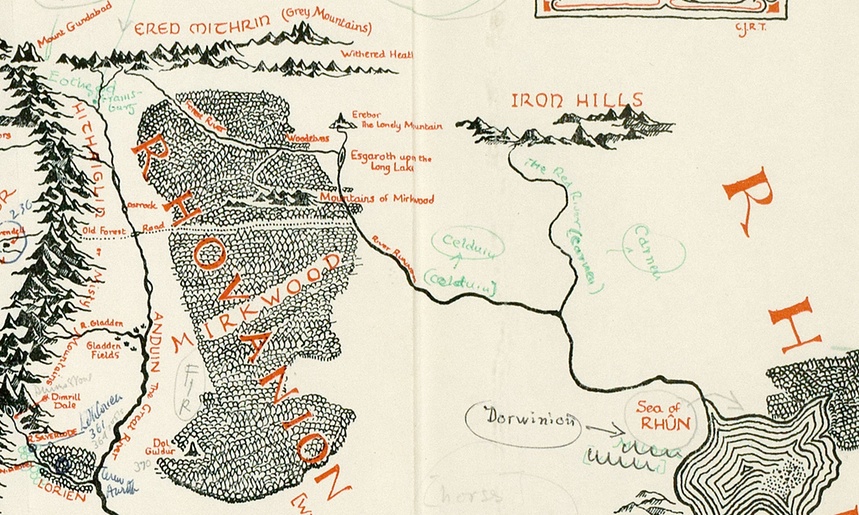
Image via Blackwell’s Rare Books
Back in April, we highlighted for you a trove of 110 illustrations by J.R.R. Tolkien, offering a rare glimpse of the author’s artistic talents. Tolkien didn’t just like to write books, as we saw. He also liked to draw illustrations for these books, which helped him to conceptualize the fantasy worlds he was creating.
Just this month, Houghton Mifflin released a new book called The Art of The Lord of the Rings by J.R.R. Tolkien, which brings together more than 180 drawings, inscriptions, maps, and plans–all drawn by Tolkien as part of his worldbuilding creative process. Most were never published until now.
And then we get this: a newly-discovered map annotated by Tolkien. Found in a copy of The Lord of the Rings that originally belonged to Pauline Baynes (the artist who illustrated Tolkien’s novels in print), the map intriguingly connects Tolkien’s fantasy world to real places on our globe. According to The Guardian, annotations on the map (click here to view the materials in a larger format) suggests that “Hobbiton is on the same latitude as Oxford [where Tolkien taught], and implies that the Italian city of Ravenna could be the inspiration behind the fictional city of Minas Tirith.” Belgrade, Cyprus, and Jerusalem also get listed as reference points. Discovered by Blackwell’s Rare Books, the rare map will be put on the market for an asking price of £60,000.
You can learn more about this map, considered “perhaps the finest piece of Tolkien ephemera to emerge in the last 20 years,” over at The Guardian.
Related Content:
110 Drawings and Paintings by J.R.R. Tolkien: Of Middle-Earth and Beyond
Discover J.R.R. Tolkien’s Personal Book Cover Designs for The Lord of the RingsTrilogy
The Only Drawing from Maurice Sendak’s Short-Lived Attempt to Illustrate The Hobbit
Hear J.R.R. Tolkien Read From The Lord of the Rings and The Hobbit
Soviet-Era Illustrations Of J. R. R. Tolkien’s The Hobbit (1976)
Read More...The Neuroscience of Bass: New Study Explains Why Bass Instruments Are Fundamental to Music
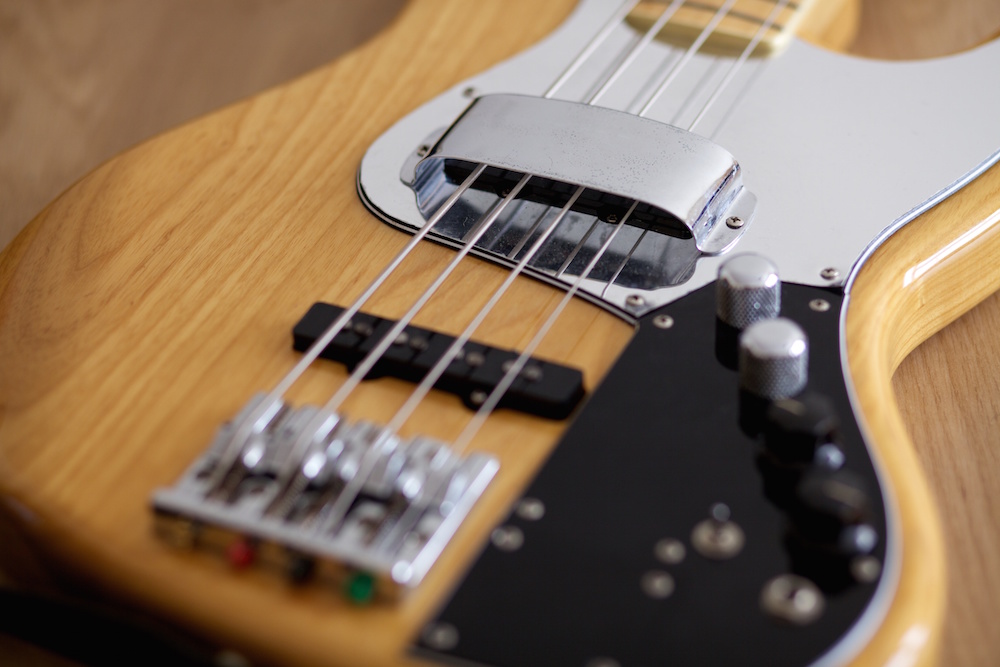
Photo by Sebastiaan term Burg via Wikimedia Commons
At the lower range of hearing, it’s said humans can hear sound down to about 20 Hz, beneath which we encounter a murky sonic realm called “infrasound,” the world of elephant and mole hearing. But while we may not hear those lowest frequencies, we feel them in our bodies, as we do many sounds in the lower frequency ranges—those that tend to disappear when pumped through tinny earbuds or shopping mall speakers. Since bass sounds don’t reach our ears with the same excited energy as the high frequency sounds of, say, trumpets or wailing guitars, we’ve tended to dismiss the instruments—and players—who hold down the low end (know any famous tuba players?).
In most popular music, bass players don’t get nearly enough credit—even when the bass provides a song’s essential hook. As Led Zeppelin’s John Paul Jones joked at his Rock and Roll Hall of Fame induction ceremony in 1995, “thank you to my friends for remembering my phone number.” And yet, writes Tom Barnes at Mic, “there’s scientific proof that bassists are actually one of the most vital members of any band…. It’s time we started treating bassists with the respect they deserve.” Research into the critical importance of low frequency sound explains why bass instruments mostly play rhythm parts and leave the fancy melodic noodling to instruments in the upper range. The phenomenon is not specific to rock, funk, jazz, dance, or hip hop. “Music in diverse cultures is composed this way,” says psychologist Laurel Trainor, director of the McMaster University Institute for Music and the Mind, “from classical East Indian music to Gamelan music of Java and Bali, suggesting an innate origin.”
Trainor and her colleagues have recently published a study in the Proceedings of the National Academy of Sciences suggesting that perceptions of time are much more acute at lower registers, while our ability to distinguish changes in pitch gets much better in the upper ranges, which is why, writes Nature, “saxophonists and lead guitarists often have solos at a squealing register,” and why bassists tend to play fewer notes. (These findings seem consistent with the physics of sound waves.) To reach their conclusions, Trainer and her team “played people high and low pitched notes at the same time.” Participants were hooked up to an electroencephalogram that measured brain activity in response to the sounds. The psychologists “found that the brain was better at detecting when the lower tone occurred 50 MS too soon compared to when the higher tone occurred 50 MS too soon.”
The study’s title perfectly summarizes the team’s findings: “Superior time perception for lower musical pitch explains why bass-ranged instruments lay down musical rhythms.” In other words, “there is a psychological basis,” says Trainor, “for why we create music the way we do. Virtually all people will respond more to the beat when it is carried by lower-pitched instruments.” University of Vienna cognitive scientist Tecumseh Fitch has pronounced Trainor and her co-authors’ study a “plausible hypothesis for why bass parts play such a crucial role in rhythm perception.” He also adds, writes Nature:
For louder, deeper bass notes than those used in these tests, people might also feel the resonance in their bodies, not just hear it in their ears, helping us to keep rhythm. For example, when deaf people dance they might turn up the bass and play it very loud, he says, so that “they can literally ‘feel the beat’ via torso-based resonance.”
Painfully awkward revelers at weddings, on cruise ships, at high school reunions—they just can’t help it. Maybe even this dancing owl can’t help it. Some of us keep time better than others, but most of us feel and respond physically to low-frequency rhythms.
Bass instruments don’t only keep time; they also play a key role in a song’s harmonic and melodic structure. In 1880, an academic music textbook informed its readers that “the bass part… is, in fact, the foundation upon which the melody rests and without which there could be no melody.” As true as this was at the time—-when acoustic precursors to electric bass, synthesizers, and sub-bass amplification provided the low end—it’s just as true now. And bass parts often define the root note of a chord, regardless of what other instruments are doing. As a bass player, notes Sting, “you control the harmony,” as well as anchoring the melody. It seems the importance of rhythm players, though overlooked in much popular appreciation of music, cannot be overstated.
Related Content:
Hear Isolated Tracks From Five Great Rock Bassists: McCartney, Sting, Deacon, Jones & Lee
The Story of the Bass: New Video Gives Us 500 Years of Music History in 8 Minutes
7 Female Bass Players Who Helped Shape Modern Music: Kim Gordon, Tina Weymouth, Kim Deal & More
The Neuroscience of Drumming: Researchers Discover the Secrets of Drumming & The Human Brain
Josh Jones is a writer and musician based in Durham, NC. Follow him at @jdmagness
Read More...
Stream 61 Hours of Orson Welles’ Classic 1930s Radio Plays: War of the Worlds, Heart of Darkness & More
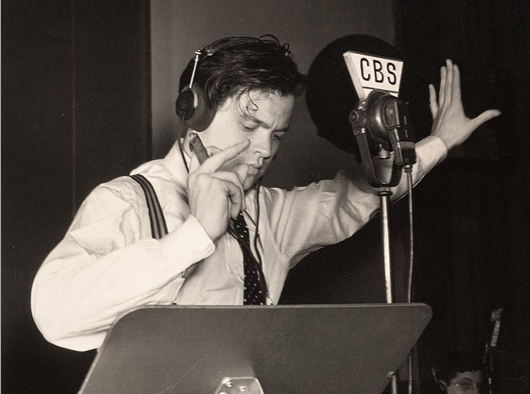
There has rarely ever been an artist more fully in command of as many different art forms as Orson Welles during his height — the late 1930s and early 40s. He revolutionized the stage, radio and cinema before the age of 26 and became a household name in the process.
Welles’s first brush with national fame came at the age of 20 when he staged an all-black production of Macbeth in Harlem. The 1936 play was groundbreaking both for its striking sets and its darling interpretation that set Shakespeare’s bloody tragic in Haiti. But perhaps the most remarkable aspect of this production was that it was done entirely with non-actors. Through sheer charisma and force of will, Welles coaxed and cajoled terrific performances out of day laborers and factory workers.
Two years later, in 1938, Welles ended up on the cover of TIME Magazine for his staging of Julius Caesar. He set the play in contemporary fascist Italy. It was a bold choice that turned a 340 year-old play into a work of great political urgency.
That same year, Welles also managed to freak out the nation with his brilliant, wildly irresponsible adaptation of War of the Worlds. Welles staged the beloved sci-fi novel as if it were a news report. The broadcast captured the drama and terror of an emerging calamity all too well; it caused a public panic.
Now you can listen to that infamous radio play along with 61 hours of other radio plays, all created by Welles for his 1930s radio show, The Mercury Theatre on the Air. The Spotify playlist, embedded below, includes A Christmas Carol, Heart of Darkness and even a rehearsal for Julius Caesar. Check it out. And if you need Spotify’s free software, download it here.
Or if Spotify isn’t your thing, you can listen to another big collection of Welles’s radio dramas below at archive.org. Start streaming that collection here:
The notoriety of Welles’ radio work landed him one of the most generous movie contracts in Hollywood studio history. This is doubly impressive because, at this stage in his life, Welles had no idea how to actually make a film. The resulting movie was a barbed, thinly veiled film à clef of one of the most powerful men in America – William Randolph Hearst. This proved to be a terrible career move; Hearst’s wrath derailed Welles’s career for years but it did produce a pretty good movie – Citizen Kane.
Via Criterion
Related Content:
Orson Welles’ Iconic War of the WorldsBroadcast (1938)
Listen to Eight Interviews of Orson Welles by Filmmaker Peter Bogdanovich (1969–1972)
Watch Orson Welles’ The Stranger Free Online, Where 1940s Film Noir Meets Real Horrors of WWII
The Hearts of Age: Orson Welles’ Surrealist First Film (1934)
Orson Welles Explains Why Ignorance Was His Major “Gift” to Citizen Kane
Jonathan Crow is a Los Angeles-based writer and filmmaker whose work has appeared in Yahoo!, The Hollywood Reporter, and other publications. You can follow him at @jonccrow. And check out his blog Veeptopus, featuring lots of pictures of vice presidents with octopuses on their heads. The Veeptopus store is here.
Read More...Hear the World’s Oldest Surviving Written Song (200 BC), Originally Composed by Euripides, the Ancient Greek Playwright
Imagine if you will that it is the year 4515, and future people slowly begin excavating the musical remains of millennia past. Now add the following wrinkle to this scenario, courtesy of classics scholar Armand D’Angour: “all that survived of the Beatles songs were a few of the lyrics, and all that remained of Mozart and Verdi’s operas were the words and not the music.” Would it be possible to recover the rhythms and melodies from these scraps? Wouldn’t this music be forever lost to history?
Not necessarily, D’Angour tells us; we could “reconstruct the music, rediscover the instruments that played them, and hear the words once again in their proper setting.” Given the inexact, speculative nature of much ancient history, I imagine the reconstructed Beatles might end up sounding nothing like themselves, but then again, now that scholars have begun to recover the music of ancient Greek tragedy from a few fragments of text, surely those future historians could remake “Love Me Do”
Reconstructing Don Giovani might be a little trickier, and that’s often the scale academics like D’Angour are working with, since not only the love-poems of Sappho, but also “the epics of Homer” and “the tragedies of Sophocles and Euripides—were all, originally, music. Dating from around 750 to 400 BC, they were composed to be sung in whole or part to the accompaniment of the lyre, reed-pipes, and percussion instruments.” This much we all likely know to some extent.
D’Angour goes on to describe in detail how scholars like himself use “patterns of long and short syllables” in the surviving verse to determine musical rhythm, and new revelations about ancient Greek vocal notation and tuning to reconstruct ancient melody.
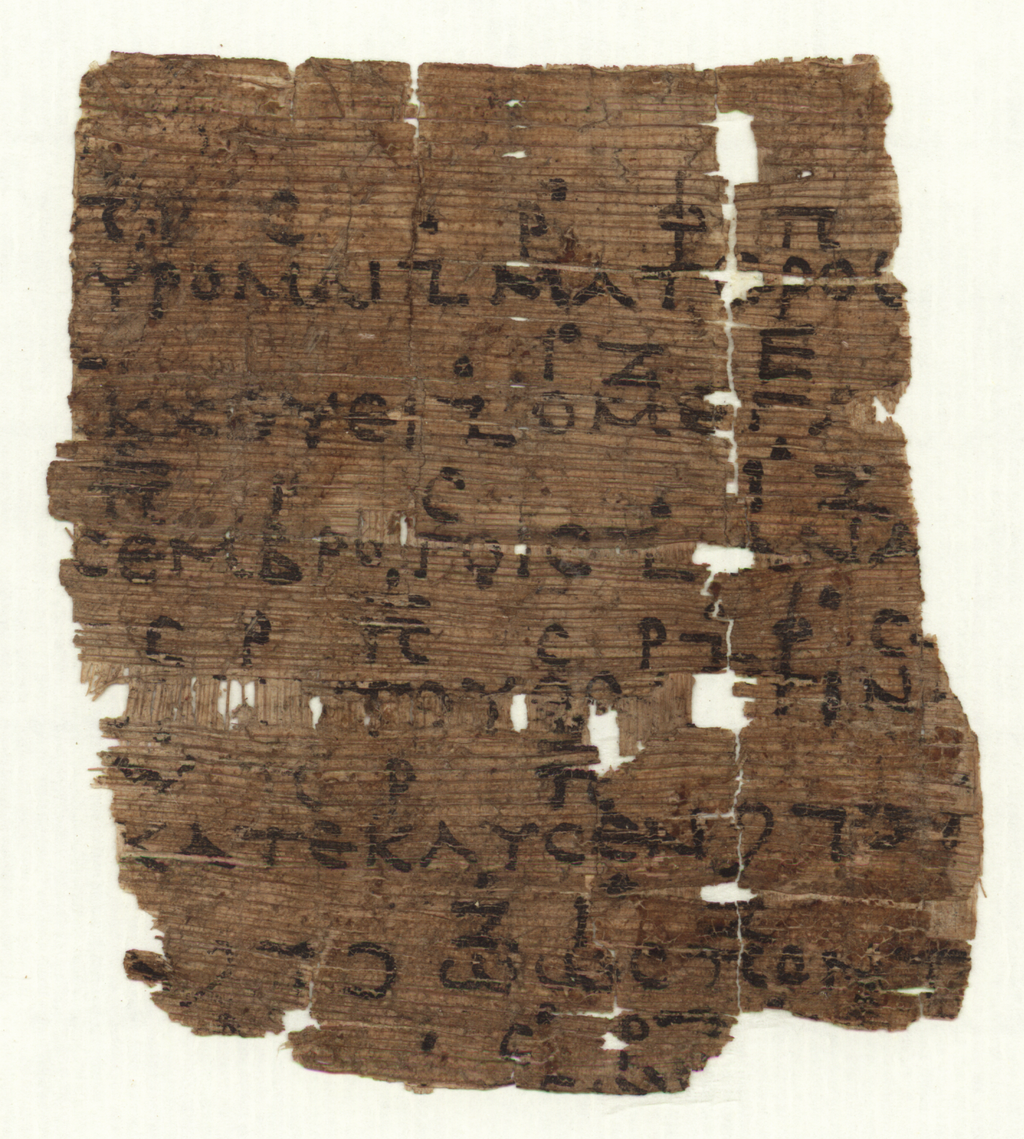
The earliest surviving musical document “preserves a few bars of sung music” from fifth-century tragedian Euripides’ play Orestes. A “notoriously avant-garde composer,” Euripides—scholars presume—“violated the long-held norms of Greek folk-singing by neglecting word-pitch.” You can see the papyrus fragment above, written around 200 BC in Egypt and called “Katolophyromai” after the first word in the “stasimon,” or choral song. Above the words, notice the vocal and instrumental notation scholars have used to reconstruct the music. The lines describe Orestes’ guilt after murdering his mother:
I cry, I cry, your mother’s blood that drives you mad, great happiness in mortals never lasting, but like a sail of swift ship, which a god shook up and plunged it with terrible troubles into the greedy and deadly waves of the sea.
This translation comes from “Greek Reconstructionist Paganism” site Baring the Aegis, who also describe the song’s rhythm, Dochmius, and mode, Lydian, with a helpful explanation for non-specialists of what these terms mean. They also feature the live performance of the stasimon at the top of the post, just one interpretation by Spyros Giasafakis and Evi Stergiou of neofolk band Daemonia Nymphe. Below it, hear another interpretation by Petros Tabouris and Nikos Konstantinopoulos. And just below and at the bottom of the post are two more versions of the ancient song.
Given Euripides’ experimentalism, we can’t expect that this reconstructed song would be representative of most ancient Greek music. “However, we can recognize that Euripides adopted another principle,” setting words to falling and rising cadences according to their emotional import. As D’Angour puts it, “this was ancient Greek soundtrack music,” and it was apparently so well-received that historian Plutarch tells a story about “thousands of Athenian soldiers held prisoner” in Syracuse: “those few who were able to sing Euripides’ latest songs were able to earn some food and drink.”
As for “the greatest of ancient poet-singers,” Homer, it seems according to reconstructions by the late Professor Martin West of Oxford that Homeric tunes were “fairly monotonous,” explaining perhaps why “the tradition of Homeric recitation without melody emerged from what was originally a sung composition.”
Related Content:
Listen to the Oldest Song in the World: A Sumerian Hymn Written 3,400 Years Ago
Hear the World’s Oldest Instrument, the “Neanderthal Flute,” Dating Back Over 43,000 Years
Free Courses in Ancient History, Literature & Philosophy
Josh Jones is a writer and musician based in Durham, NC. Follow him at @jdmagness
Read More...Watch Vincent Price Turn Into Edgar Allan Poe & Read Four Classic Poe Stories (1970)
Can you have a Halloween without Edgar Allan Poe? Sure you can — but here at Open Culture, we don’t recommend it. So that you need not go Poe-less on this, or any, Halloween night, we’ve featured not just his complete works free to download, but other material like the animated adaptation of “The Tell-Tale Heart” as well as animations of his other stories; Poe readings by the likes of Christopher Lee, James Earl Jones, and Iggy Pop; and Orson Welles’ interpretation of his work on an Alan Parsons Project album.
We also believe that you shouldn’t have to endure a Priceless Halloween — that is to say, a Halloween without Vincent Price. Though he proved his versatility in a wide variety of genres throughout his long acting career, history has remembered Price first and foremost for his work in horror, no doubt thanks in large part to his possession of a voice perfectly suited to the elegantly sinister. It also made him an ideal teller of Poe’s ingeniously macabre tales, which you can experience for yourself in the recordings we’ve posted of Price reading Poe, a playlist which also includes readings by Price’s equally versatile Basil Rathbone.
Rathbone may also have got to read Poe, the work, but despite his huge number of roles on stage and screen, he never actually played Poe, the man. But Price did, in the special An Evening of Edgar Allan Poe, the closest any of us will get to an audience with the troubled, brilliant, and terrifyingly inventive writer himself. In it, Price-as-Poe takes the stage and, over the course of an hour, weaves into his performance four of his most enduring stories: “The Tell-Tale Heart,” “The Sphinx,” “The Cask of Amontillado,” and “The Pit and the Pendulum.” Go on, join Edgar Allan Poe in his drawing room this Halloween by having Price bring him to life on your screen — it will guarantee you a memorable holiday evening.
Related Content:
Download The Complete Works of Edgar Allan Poe on His Birthday
Watch the 1953 Animation of Edgar Allan Poe’s “The Tell-Tale Heart,” Narrated by James Mason
Edgar Allan Poe’s “The Raven,” Read by Christopher Walken, Vincent Price, and Christopher Lee
Iggy Pop Reads Edgar Allan Poe’s Classic Horror Story, “The Tell-Tale Heart”
5 Hours of Edgar Allan Poe Stories Read by Vincent Price & Basil Rathbone
James Earl Jones Reads Edgar Allan Poe’s “The Raven” and Walt Whitman’s “Song of Myself”
Hear Orson Welles Read Edgar Allan Poe on a Cult Classic Album by The Alan Parsons Project
Edgar Allan Poe Animated: Watch Four Animations of Classic Poe Stories
Colin Marshall writes elsewhere on cities, language, Asia, and men’s style. He’s at work on a book about Los Angeles, A Los Angeles Primer, the video series The City in Cinema, and the crowdfunded journalism project Where Is the City of the Future? Follow him on Twitter at @colinmarshall or on Facebook.
Read More...Charles Darwin’s Kids Draw on Surviving Manuscript Pages of On the Origin of Species
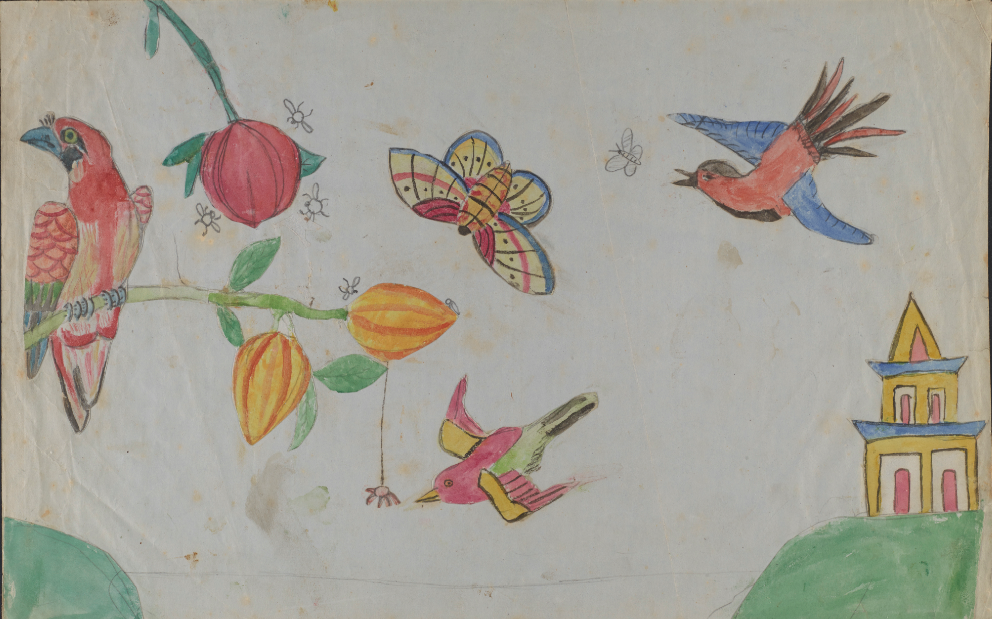
Charles Darwin not only created the theory of evolution, but he apparently dabbled often in human biology and sexuality. To wit: he fathered 10 children with his cousin Emma Wedgwood, six boys and four girls. It was this boisterous brood that filled the Darwin’s house in rural Kent, England, while Charles worked in his study on the first draft of On the Origin of Species by Means of Natural Selection, or the Preservation of Favoured Races in the Struggle for Life, his groundbreaking, world-changing work.
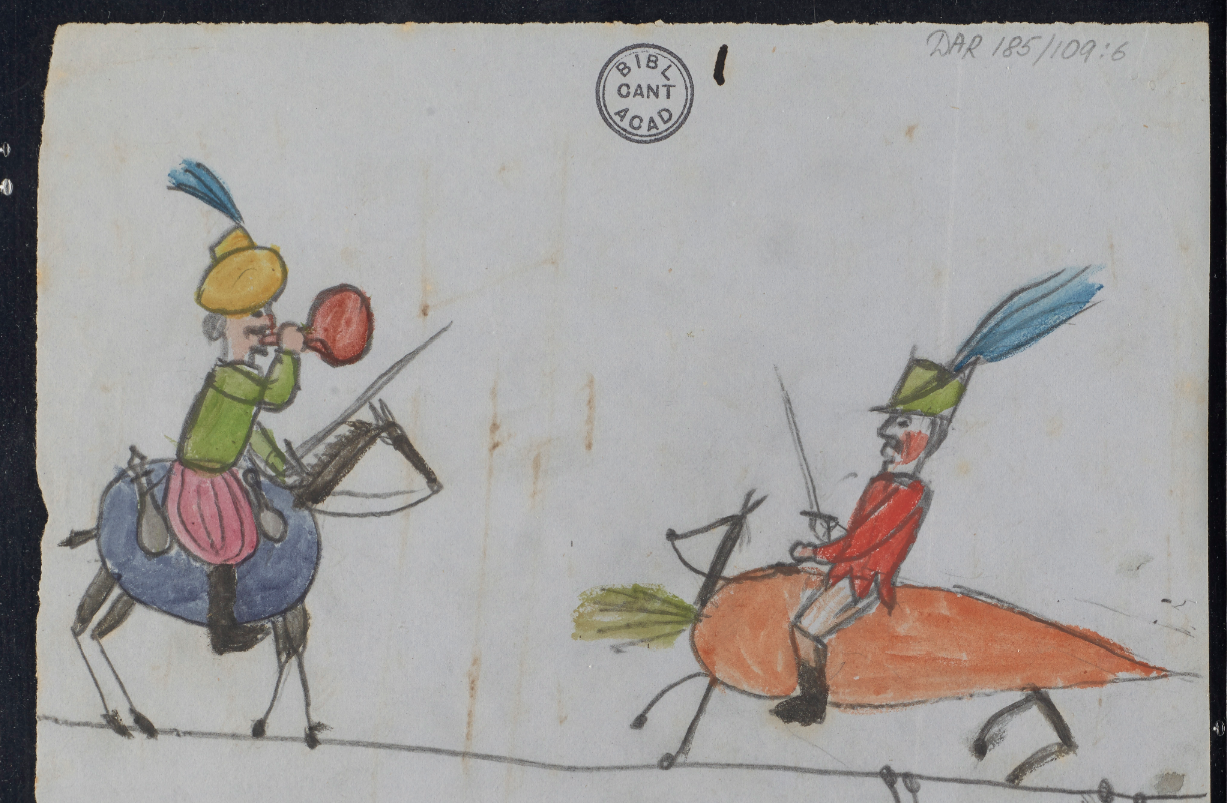
Last year we reported on the huge effort to digitize 30,000 pages of the scientist’s writing at the Darwin Manuscripts Project at the American Museum of Natural History. Among Darwin’s many papers, one thing the digitizers have found, curiously enough, is artwork drawn by his children, often on pages of Darwin’s manuscripts.
Darwin had no real use for the original manuscript once galley proofs came back from the publisher. So one can imagine father Charles giving his kids the only worthwhile paper in the house to draw on. It seems flippant now, but at the time, it was perfectly normal.
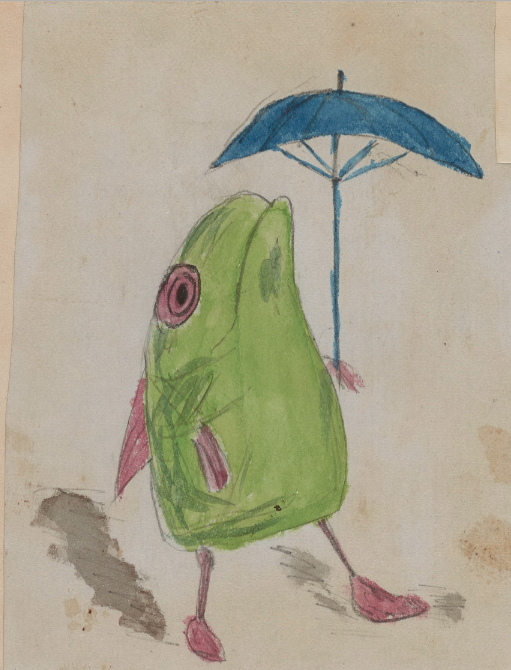
According to the New Yorker, they’ve found 57 drawings in total, nine of them on the back of pages from Origin of Species. Only 45 manuscript pages out of 600 from that book survive, and those nine are because of his kids. You can find a whole section at the Darwin Manuscripts project website dedicated to the drawings of the Darwin kids.
Researchers surmise that the majority of the art comes from three of the 10 children, Francis, George, and Horace, all of whom went into the sciences as adults. The illustrations are colorful and witty, drawn in pencil and sometimes colored in watercolor. Birds and butterflies are drawn and colored with attention to detail. Some creatures are imaginary, like the green fish with legs carrying an umbrella, and there are short stories about fairies and battles too.
Overall, the drawings show a Darwin who was a family man and not a reclusive scientist. We’re just glad that the kids let dad do his work in relative silence.
Related Content:
The British Library Puts Online 1,200 Literary Treasures From Great Romantic & Victorian Writers
What Did Charles Darwin Read? See His Handwritten Reading List & Read Books from His Library Online
Ted Mills is a freelance writer on the arts who currently hosts the artist interview-based FunkZone Podcast. You can also follow him on Twitter at @tedmills, read his other arts writing at tedmills.com and/or watch his films here.
Read More...The History of Modern Art Visualized in a Massive 130-Foot Timeline
If you visited The Tate Modern in recent years, perhaps you saw the large, 130-foot art installation covering a concourse wall. Created by illustrator Sara Fanelli, the “Tate Artist Timeline” provided museumgoers with a sprawling roadmap showing the major artistic movements and important artists of the 20th century, moving from Art Nouveau to more contemporary Graffiti Art.
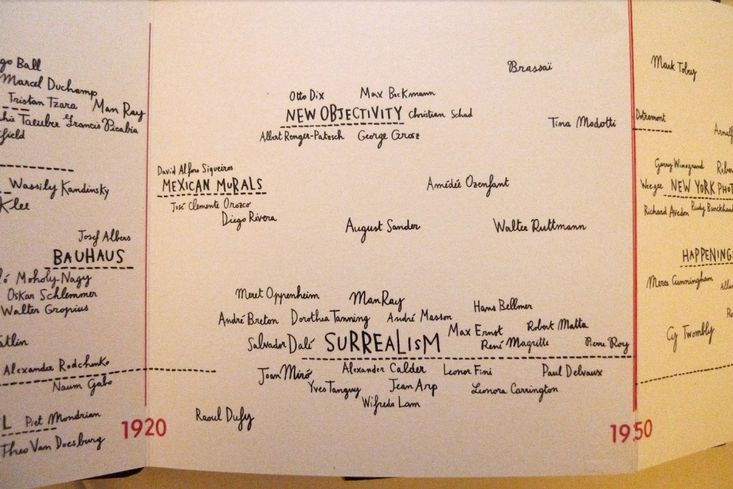
Nowadays, you can revisit Fanelli’s educational timeline by purchasing a copy in a handsome book format. You can also watch the timeline play out in the video above.
Or, happily we’ve been informed by the Tate, there’s now an updated, interactive version installed in the museum. The video below gives you a preview:
Related Content:
The History of Philosophy Visualized
5‑Minute Animation Maps 2,600 Years of Western Cultural History
10 Million Years of Evolution Visualized in an Elegant, 5‑Foot Long Infographic from 1931
4000 Years of History Displayed in a 5‑Foot-Long “Histomap” (Early Infographic) From 1931
Read More...Support Us
We're hoping to rely on loyal readers, rather than erratic ads. Please click the Donate button and support Open Culture. You can use Paypal, Venmo, Patreon, even Crypto! We thank you!

About Us

Open Culture scours the web for the best educational media. We find the free courses and audio books you need, the language lessons & educational videos you want, and plenty of enlightenment in between.
Advertise With Us

FREE UPDATES!
GET OUR DAILY EMAIL
Get the best cultural and educational resources on the web curated for you in a daily email. We never spam. Unsubscribe at any time.
FOLLOW ON SOCIAL MEDIA

Open Culture editor Dan Colman scours the web for the best educational media. He finds the free courses and audio books you need, the language lessons & movies you want, and plenty of enlightenment in between.
Advertise With Us

