The Maligned Impressionist Painter Pierre-Auguste Renoir Illustrates Emile Zola’s Gritty Novel L’Assommoir (1878)
We’ve all been to a museum with that friend or family member who just doesn’t “get” modern art and suggests it’s all a con. Conceptual art? Abstract expressionism? What is that?! Impressionism? Who wants blurry, poorly drawn paintings?! Arrgh!
Hey, maybe some of us are that friend or family member. Maybe our complaints are even more specific—maybe some of us are members of a “cultural justice” movement called “Renoir Sucks at Painting.” Maybe we show up at the Boston Museum of Fine Arts with signs parodying the cartoonishly terrible Westboro Baptist Church (“God Hates Renoir”) and demanding, with as much force as one can with a parody sign, that the Renoirs be removed from the company of worthier objets d’art.
One critical difference between the typical art hater and the Renoir Sucks crew: the latter do not object to Pierre-Auguste Renoir because his work is too hard to “get,” but because it’s too easy. Renoir, they say, painted “treacle” and “deformed pink fuzzy women.” As art critic Peter Schjeldahl writes in The New Yorker, “Renoir’s winsome subjects and effulgent hues jump in your lap like a friendly puppy.” Renoir is so far from avant-garde that Schjeldahl can peg his “exaggerated blush and sweetness” as an example of the “popular appeal” that “advanced the bourgeois cultural revolution that was Impressionism.” Ouch.
This kind of assessment gets no help from the painter’s great-great granddaughter, Genevieve, who responds to critics by quoting sales figures: “It is safe to say,” she writes, “that the free market has spoken and Renoir did NOT suck at painting.” By this measure, Thomas Kinkade and Sister Maria Innocentia Hummel were also artistic geniuses. The charges of “aesthetic terrorism” against Renoir come right out of the iconoclasm that functions in the art world as both meaningful dissent and successful gimmick (cf. Marcel Duchamp, or Ai Weiwei’s controversial, gallery-filling attacks on revered cultural artifacts.) But perhaps the honest question remains: does Renoir Suck at Painting?
Let us reserve judgment and take a look at another side of Renoir, a rarely seen excursion into book illustration—specifically the four illustrations he made for an 1878 edition of Emile Zola’s novel L’Assommoir (“The Dram Shop”). Described by the Art Institute of Chicago as “grittily realistic,” Zola’s naturalist depiction of what he called “the inevitable downfall of a working-class family in the polluted atmosphere of our urban areas” provoked many of its readers, who regarded the book as “an unforgivable lapse of taste on the part of its author.” It showed Parisians “an aspect of current life that most found frightening and repulsive.” Nonetheless, the novel became a popular success.
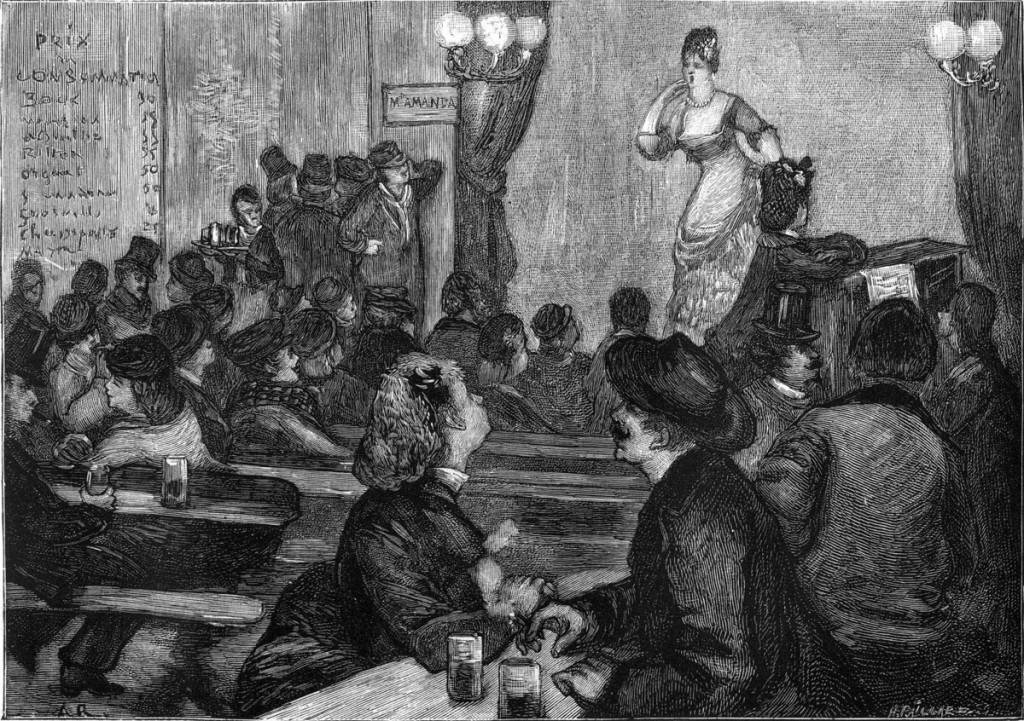
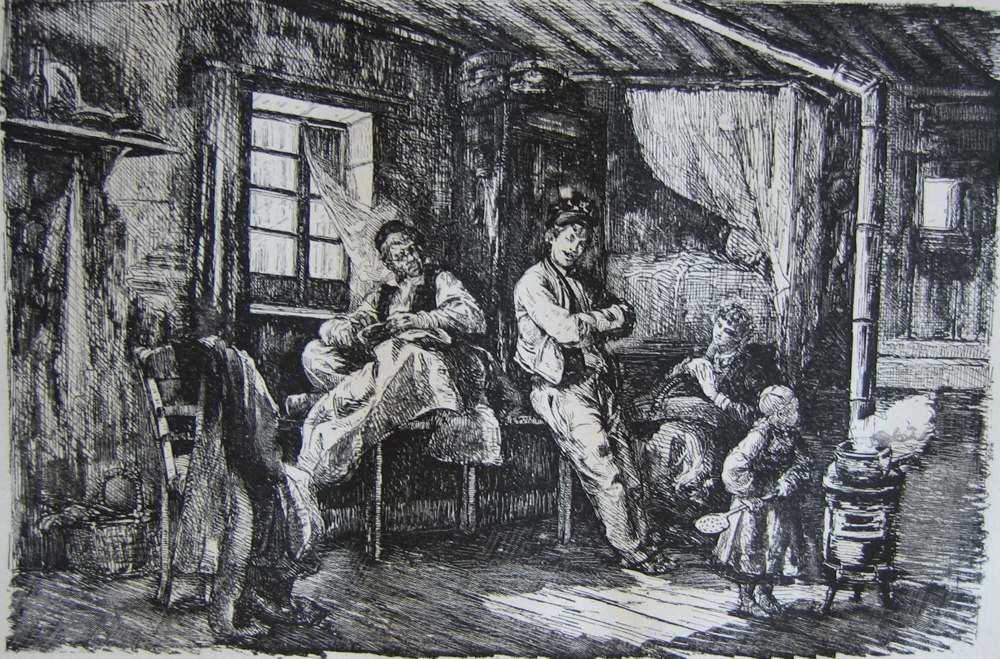
The four black-and-white engravings here—made from Renoir’s original drawings—are the impressionist’s contribution to Zola’s illlustrated novel. The choice of Renoir as one of several artists for this edition seems an odd one. (Zola, a friend of the painter’s, approached him personally.) Then, as now, Renoir had a reputation for sunny optimism: “he always looks on the bright side,” remarked one contemporary. Renoir’s “preference for creating images of beauty,” writes The Art Institute of Chicago, “made the illustration of the particularly seedy passages of the novel problematic, and some of the resulting drawings lack conviction.”
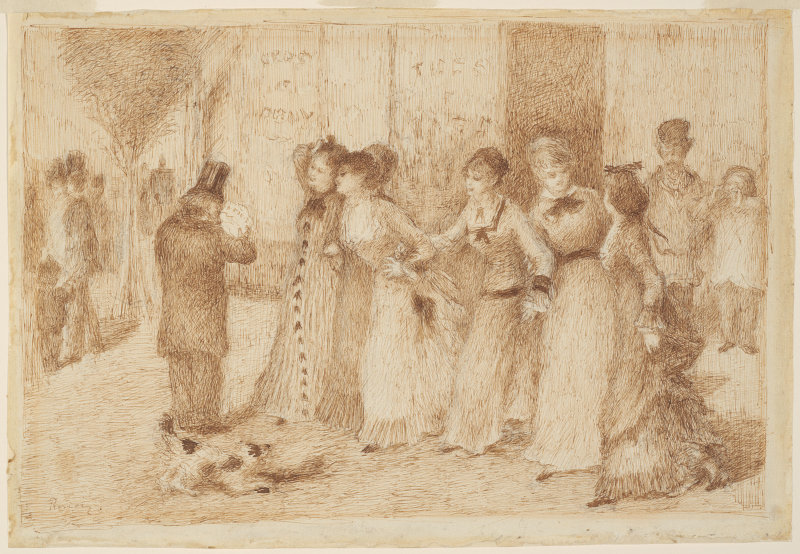
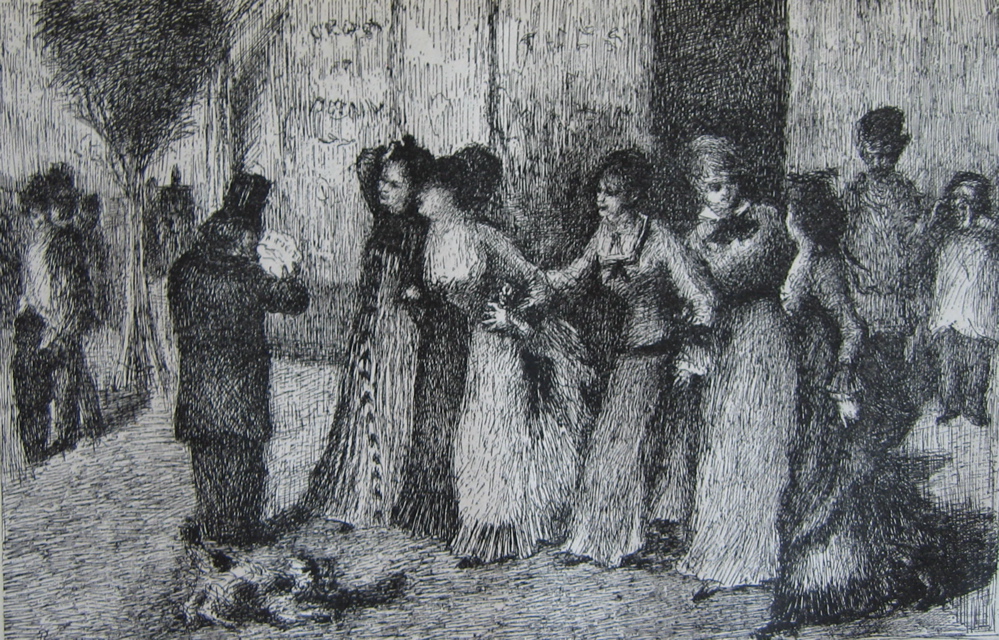
Instead of succumbing to the novel’s grim tone, Renoir’s original renderings, like the “loose wash drawing” in “warm, brown ink” at the top of the post, “gently subverted the dark undertones of Zola’s text.” Below the original drawing, see the engraving that appeared in the book. Book blog Adventures in the Print Trade concedes the plates “are of varying quality” and singles out the illustration just above as the most successful one, since “the subject-matter is perfect for Renoir, and the whole scene is brimming with life.”
As you can see from the two images at the top of the post, the translation from Renoir’s drawings to the final book engravings left many of his figures blurred and obscured, and introduce a dark heaviness to work undertaken with a much softer, lighter touch. Do these illustrations add anything to our understanding of whether Renoir Sucks at Painting? Who can say. It’s true that here, as in many of his well-known paintings, “the compositions tend to be slack,” as Schjeldahl writes. Nonetheless, the Art Institute of Chicago audaciously judges the brown ink wash drawing at the top of the post “one of the most important drawings the artist produced during the years of high Impressionism.”
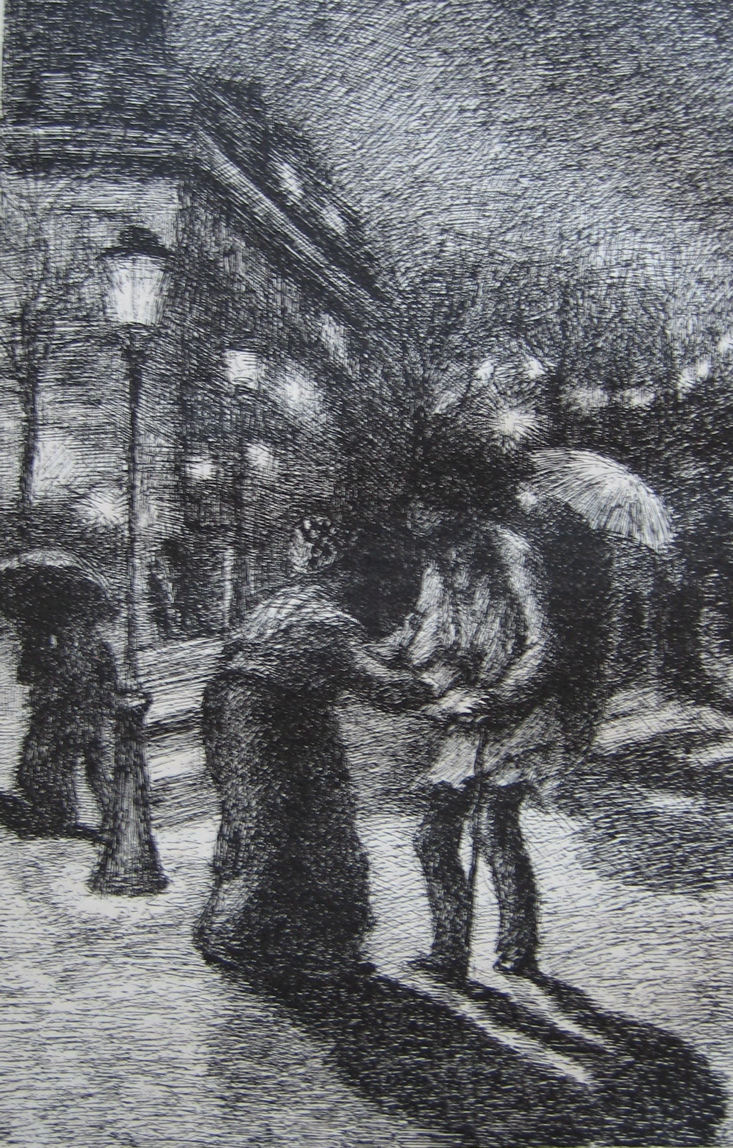
They only add to my appreciation of Renoir, who does not, I think, suck. Even if his work can be, as Schjeldahl says, “high glucose,” I would argue that his sweetness and light provide just the right approach to Zola, whose novels, like those of other naturalists such as Theodore Dreiser or Thomas Hardy, contain much more than a hint of sentimentality.
Related Content:
Astonishing Film of Arthritic Impressionist Painter, Pierre-Auguste Renoir (1915)
Henri Matisse Illustrates 1935 Edition of James Joyce’s Ulysses
The Postcards That Picasso Illustrated and Sent to Jean Cocteau, Apollinaire & Gertrude Stein
Josh Jones is a writer and musician based in Durham, NC. Follow him at @jdmagness
Read More...105 Animated Philosophy Videos from Wireless Philosophy: A Project Sponsored by Yale, MIT, Duke & More
You may remember that we featured Wireless Philosophy, an open access philosophy project created by Yale and MIT, back in 2013 when it first got started. Wi-Phi, for short, has kept on keeping in with its mission of producing free, informative and entertaining animated videos meant to introduce a host of philosophical issues. Our own Josh Jones called it “a necessary service to those just beginning to wade out into the sea of The Big Questions” in 2013, and now, in 2015, you can wade in from a wider expanse of the Big Question coastline than ever before. There are currently 105 Wiphi videos in total.
At the top of the post, you can watch a whole playlist of Wi-Phi’s videos on cognitive biases, which add up to a surprisingly thorough half-hour primer on the forces that knock our thinking askew, from the “alief” (an automatic or habitual mental attitude, as opposed to a deliberate belief) to reference dependence and loss aversion to what we might perhaps describe as a meta-bias amusingly called the GI Joe fallacy (the tendency for our biases to stick around even when we should know better). Just above, we have Wi-Phi’s three-part guide to the good life, as examined by Plato, Aristotle, and Kant.
Both of those playlists do come with a certain practicality, at least by philosophical standards: who, after all doesn’t want to think more correctly (or at least less incorrectly), and who doesn’t want to live the good life (or at least a better life than they live now)? But the harder core of casual philosophy enthusiasts — always a demanding group — should rest assured that Wiphi also offers video series on more abstract or historical philosophical topics, such as the seven-part playlist on classical theism above. Dig deeper into their Youtube channel and you’ll find more simple but not simplistic lessons on the philosophy of mathematics, language, ancient China, and much more.
The list of university stakeholders in Wireless Philosophy nowadays includes, we should note, Duke, University of Massachusetts at Amherst, and U. Toronto, in addition to Yale and MIT. Plus, you’ll find that profs from other universities have contributed to the video collection. For example, Chris Surprenant (University of New Orleans) created the videos on Plato, Aristotle, and Kant. Also find complete courses taught by Surprenant on our list of Free Online Philosophy Courses, a subset of our list, 1,700 Free Online Courses from Top Universities.
Related Content:
The Partially Examined Life: A Philosophy Podcast
Philosophy Bites: Podcasting Ideas From Plato to Singularity Since 2007
Download 90 Free Philosophy Courses and Start Living the Examined Life
Take First-Class Philosophy Lectures Anywhere with Free Oxford Podcasts
Colin Marshall writes elsewhere on cities, language, Asia, and men’s style. He’s at work on a book about Los Angeles, A Los Angeles Primer, the video series The City in Cinema, and the crowdfunded journalism project Where Is the City of the Future? Follow him on Twitter at @colinmarshall or on Facebook.
Read More...Apply to the New David Lynch Masters in Film Program, Where You’ll Meditate & Create
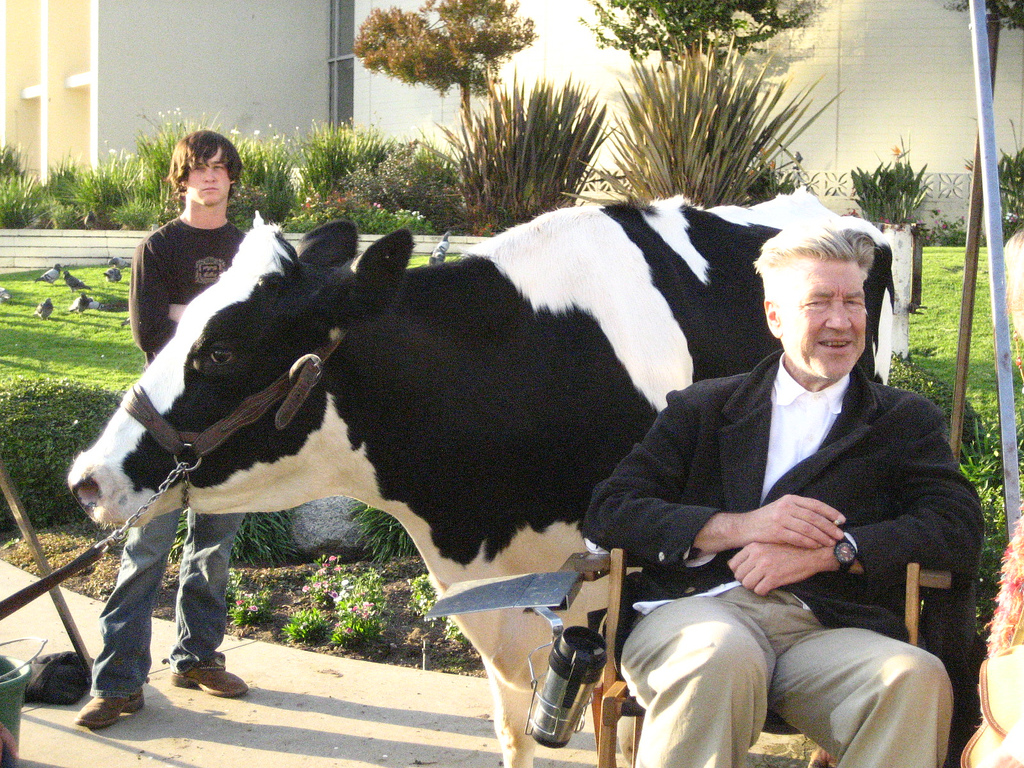
Image by amoebafinger on Flickr Commons.
When the American Film Institute set up its conservatory for Advanced Film Studies in 1969, its first round of students included Terrence Malick, Caleb Deschanel, Paul Schrader, and the Master of Absurd himself, David Lynch. (Now that’s a class reunion worth going to!) Now some 40 years on, the Maharishi University of Management, in Fairfield, Iowa, is accepting applications for its David Lynch MA in Film program.
Lynch has been practicing Transcendental Meditation for as long as he’s been a filmmaker, and in interviews and in books like Catching the Big Fish, he espouses the wonders of meditation for creativity. (See him talk more about that here.) Students enrolled in the David Lynch Film program will follow Lynch’s example by combining meditation with filmmaking. You might not create the next Eraserhead (Lynch’s AFI project that turned into his career-defining debut), but, according to Lynch, students are promised to discover
the ability to dive within—to transcend and experience that unbounded ocean of pure consciousness which is unbounded intelligence, creativity, happiness, love, energy, power, and peace.
Before one gets too excited and thinks that the director himself will be teaching every class and that you’ll get to hang out with him during office hours, that’s not the way the program works.
Classes are taught by director/cinematographer Michael W. Barnard (and once the head of the Maharishi’s film department), screenwriter Dorothy Rompalske, and David Lynch Foundation Television founder Amine Kouider. Guest speakers have included Jim Carrey, Peter Farrelly, script doctor Dara Marks, Twin Peaks alum Duwayne Dunham, and many other Hollywood insiders.
However, students do get a field trip to Los Angeles to meet Lynch and spend time with the filmmaker. The aspiring filmmakers should consider themselves lucky, seeing that the director is busy working on Twin Peaks’ new season and apparently writing an autobiography.
There are two scholarships up for grabs for applicants who have a film or script to submit, but the deadline is fast approaching on Nov. 1.
Related Content:
David Lynch Explains Where His Ideas Come From
Patti Smith and David Lynch Talk About the Source of Their Ideas & Creative Inspiration
David Lynch Explains How Meditation Enhances Our Creativity
David Lynch Creates a Very Surreal Plug for Transcendental Meditation
David Lynch Talks Meditation with Paul McCartney
Ted Mills is a freelance writer on the arts who currently hosts the artist interview-based FunkZone Podcast. You can also follow him on Twitter at @tedmills, read his other arts writing at tedmills.com and/or watch his films here.
Read More...Hear a Playlist of 300 Songs That Influenced Elvis Costello, Drawn From His New Memoir, Unfaithful Music & Disappearing Ink

Image via Wikimedia Commons
Everyone in the spotlight has at least one damning incident to live down, and sometimes a whole damning period. There’s David Bowie’s brief fascism controversy, for example, or Eric Clapton’s more substantive, and much more disturbing, far-right political views, which he broadcast from the stage in 1976, then repeated to the magazines shortly after. Clapton’s racist invective and support for Enoch Powell and the National Front was particularly appalling given that he rode in on the shoulders of blues artists and scored a huge hit just two years earlier with his version of Bob Marley’s “I Shot the Sheriff.” As photographer Red Saunders would write in a published letter to Clapton after the guitar god’s bizarre onstage rant: “Half your music is black. You’re rock music’s biggest colonist.” At least for a time, Clapton fell decidedly on the wrong side of a dichotomy Eric Lott called “Love and Theft.”
One might make similar accusations against punk troubadour Elvis Costello, who took his look from Buddy Holly, his name from The King, and has also drawn heavily from black music for the better part of thirty years. And Costello once had his own brief racist outburst in 1979 during a tour stop in Columbus, Ohio, dropping a couple n‑bombs in reference to James Brown and Ray Charles, and getting a beating from one of Stephen Stills’ backing singers. Costello maintained the outrage was a deliberately nasty way to troll the hated old guard Stills represented, but he thereafter received death threats and continued his tour under armed guard. Ironically, the previous year he had appeared with The Clash and reggae bands Misty in Roots and Aswad at a festival concert in London sponsored by Rock Against Racism, who formed in response to Enoch Powell, the National Front, and Clapton—and whose American chapter picketed Costello after the Ohio brawl.
Costello addresses the incident in his new memoir Unfaithful Music & Disappearing Ink, writing “whatever I did, I did it to provoke a bar fight. Surely this was all understood. Didn’t they know the love I had for James Brown and Ray Charles, whose record of ‘The Danger Zone’ I preferred to watching men walk on the moon?” (He’s made several other comments over the years, and even Ray Charles weighed in afterwards with something of a forgiving statement.) Stephen Deusner at Vulture writes, “you somehow never doubt the sincerity of that love, just as you don’t doubt that Costello could be a raving bastard when he’s drunk.” Unlike so many other examples of the genre, Unfaithful Music doesn’t peddle contrition or controversy for their own sake. On the contrary, The Quietus calls the book “without doubt, one of the greatest self-penned appraisals of a popular entertainer’s life and work.”
That greatness, Deusner argues, comes in large part from Costello’s “nerdishly prodigious” knowledge of, and love for—mostly American—music: “There are nearly 400 songs Costello name-checks as influences within the pages of Unfaithful Music, and hundreds more he refers to in passing.” These include songs from James Brown and Ray Charles, and also Billie Holiday, Aretha Franklin, David Bowie, Doc Watson, The Drifters, his namesake Elvis Presley, Fleetwood Mac, huge helpings of The Beatles, Burt Bacharach… even CSNY’s “Ohio.” Based on Costello’s encyclopedic devotion to country, pop, R&B, punk, reggae, and nearly every other genre under the sun, Vulture compiled the 300-song Spotify playlist above, “by no means complete,” writes Deusner, “due in large part to Spotify’s scarcity of Beatles, Bacharach, and Neil Young albums.” (If you need Spotify’s software, download it for free here.)
The playlist serves as an audio accompaniment to Costello’s almost 700-page reminiscence; taken together, both explain how “the angry young man of the late 70s,” with a “reputation as one of the smartest and bristliest figures in the London punk scene” became “a revered troubadour craftsman playing the White House, jamming with various Beatles, and composing ballet scores.” Just above, you can hear Costello himself read a brief excerpt from the book, a story about hanging out with David Bowie. The Quietus has another exclusive extract from Unfaithful Music. (Note that you can download the entire book, narrated by Costello himself, for free if you join Audible.com’s Free Trial program.) And if you need to hear more about what he now calls that “f***** stupid” fracas in ’79, see him talk about his angry young man persona and tell other “war stories” of his life in music in an interview with ?uestlove. Of his fierce devotion to so much of the music above, Costello tells The Roots’ drummer, “English musicians have such this weird outside love for American music, particularly rhythm and blues as we grew up to know it, that we sort of felt we had possession of it in some weird way.”
Related Content:
Elvis Costello Sings “Penny Lane” for Sir Paul
Josh Jones is a writer and musician based in Durham, NC. Follow him at @jdmagness
Read More...How Cultured Are You? Test Your Knowledge With Cultural Quizzes from 1958
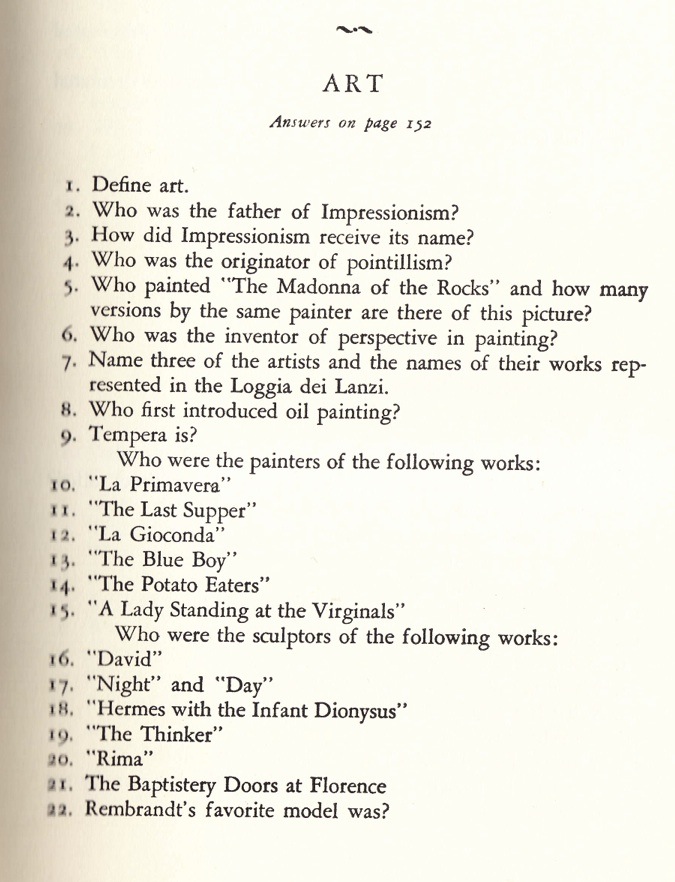
Do you consider yourself well-educated? Cultured, even? By whose standards?
We may superficially assume these terms name immutable qualities, but they are in any analysis dependent on where and when we happen to be situated in history. The most sophisticated of Medieval doctors—a title then closer to the European “docent” than our general use of Dr.—would appear profoundly ignorant to us; and we, with our painfully inadequate grasp of church Latin, Aristotelianism, and arcane theological arguments, would appear profoundly ignorant to him.
What does it mean to be cultured? Is it the acquisition of mostly useless cultural capital for its own sake, or of a set of codes that helps us navigate the world successfully? In an attempt to address these fraught questions, Ashley Montagu, a student of hugely influential German-born anthropologist Franz Boas, wrote The Cultured Man in 1958. Rebecca Onion at Slate describes the book as containing “quizzes for 50 categories of knowledge in the arts and sciences, with 30 questions each.” In the page above, we have the first 22 questions of Montagu’s “Art” quiz (with the answers here).
You’ll probably notice right away that while most of the questions have definite, unambiguous answers, others like “Define art,” seem patently unanswerable in all but the most general and unsatisfactory ways. Montagu defines art in one succinct sentence: “Art is the making or doing of things that have form and beauty”—which strikes me as anemic, though functional enough.
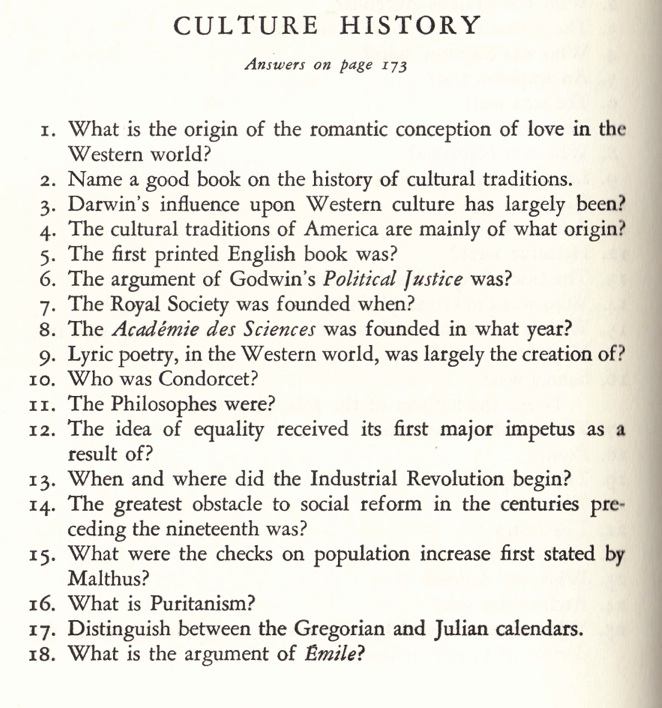
Montagu intended his book to test not only knowledge of cultural facts, but also of “attitudes”: a person “considered ‘cultured,’” writes Onion, “would not just be able to readily summon facts, but also to access humane feelings, which would necessarily come about after contact with culture.” Many administrators of “culture”—curators, art historians, literature professors, etc—would agree with the premise: ideally, the more cultural knowledge we acquire, the more empathy and understanding of other peoples and cultures we should manifest. Whether this routinely occurs in practice is another matter. For Montagu, Onion remarks, a “cultured man” is “curious, unprejudiced, rational, and ethical.”
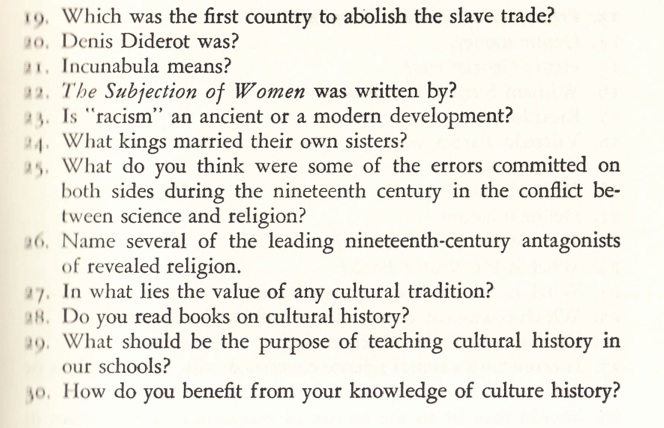
Given Montagu’s enlightened philosophical bent, we can charitably ascribe language in his book that itself seems prejudiced to our viewing this artifact from a distance of almost seventy years in the future. We might also find that many of his questions push us to examine our 21st century biases more carefully. His approach may remind us of frivolous internet diversions or the standardized tests we’ve grown to think of as the precise opposite of lively, critically-engaged educational tools. Yet Montagu intended his quizzes to be “both dynamic and constructive,” to alert readers to areas of ignorance and encourage them to fill gaps in their cultural knowledge. Many of his answers offer references for further study. “No one grows who stands still,” he wrote.
To see more of Montagu’s quiz questions—such as those above from the “Culture History” category (get the answers here)—and find out how you stack up against the cultured elite of the 50s, head over to Rebecca Onion’s post at Slate.
Related Content:
Hermann Rorschach’s Original Rorschach Test: What Do You See? (1921)
Take the 146-Question Knowledge Test Thomas Edison Gave to Prospective Employees (1921)
Josh Jones is a writer and musician based in Durham, NC. Follow him at @jdmagness
Read More...What Is Déjà Vu? Michio Kaku Wonders If It’s Triggered by Parallel Universes
I’ve spent the past week on a road trip across America, and, during it, experienced perhaps my most intense case of déjà vu ever. Rolling into Memphis for the first time in my life, I walked into the lobby of the hotel at which I’d reserved a room for the night and immediately felt, in every fiber of my being, that I’d walked into that lobby before. But I then realized exactly why: it followed the same floor plan, to the last detail — the same front desk, the same business center computers, the same café with the same chalkboard asking me to “Try Our Classic Oatmeal” — of the one I’d visited the previous day in Oklahoma City.
Should we chalk this up to generic American placemaking at its most efficient, or can we find a more interesting psychological phenomenon at work? Michio Kaku, though best known for his work with physics, has some ideas of his own about what we experience when we experience déjà vu. “There is a theory,” says Kaku in the Big Think video above,“that déjà vu simply elicits fragments of memories that we have stored in our brain, memories that can be elicited by moving into an environment that resembles something that we’ve already experienced.”
But wait! “Is it ever possible on any scale,” he then tantalizingly asks, “to perhaps flip between different universes?” And does déjà vu tell us anything about our position in those universes, giving us signs of the others even as we reside in just one? Kaku quotes an analogy first made by physicist Steven Weinberg which frames the notion of a “multiverse” in terms of our vibrating atoms and the frequency of a radio’s signal: “If you’re inside your living room listening to BBC radio, that radio is tuned to one frequency. But in your living room there are all frequencies: radio Cuba, radio Moscow, the Top 40 rock stations. All these radio frequencies are vibrating inside your living room, but your radio is only tuned to one frequency.” And sometimes, for whatever reason, we hear two signals on our radio at once.
Given that, then, maybe we feel déjà vu when the atoms of which we consist “no longer vibrate in unison with these other universes,” when “we have decoupled from them, we have decohered from them.” It may relieve you to know there won’t be an exam on all this. While Kaku ultimately grants that “déjà vu is probably simply a fragment of our brain eliciting memories and fragments of previous situations,” you may get a kick out of putting his multiverse idea in context with some more traditional explanations, such as the ones written about in venues no less dependable than Scientific American and Smithsonian. But in any case, I beg you, Marriott Courtyard hotels: change up your designs once in a while.
Related Content:
Michio Kaku Explains the Physics Behind Absolutely Everything
Michio Kaku Schools a Moon Landing-Conspiracy Believer on His Science Fantastic Podcast
Colin Marshall writes elsewhere on cities, language, Asia, and men’s style. He’s at work on a book about Los Angeles, A Los Angeles Primer, the video series The City in Cinema, and the crowdfunded journalism project Where Is the City of the Future? Follow him on Twitter at @colinmarshall or on Facebook.
Read More...Quentin Tarantino’s Original Wish List for the Cast of Pulp Fiction
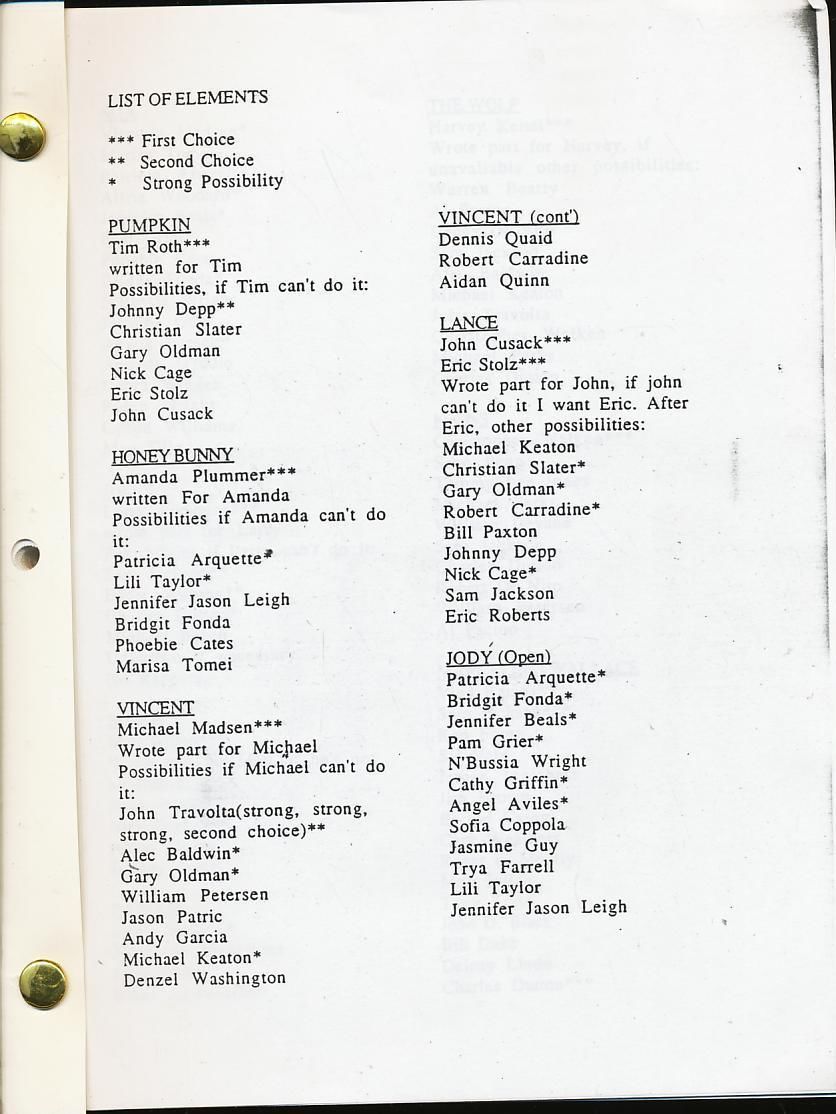
In an alternate universe version of Quentin Tarantino’s Pulp Fiction, Eddie Murphy, not Samuel L. Jackson, might have played Jules, the bible-spouting hit man. His partner-in-crime, Vincent Vega, might have been played by Gary Oldman, not John Travolta. And the role of Mia, played memorably by Uma Thurman in black bangs, could have been played by Debra Winger or perhaps Phoebe Cates.
Documents about the movie recently surfaced on Reddit, offering a fascinating glimpse into the early creative discussions for the hugely influential movie. In Tarantino’s wish list, which you can see above, he states that he wrote the roles of Pumpkin and Honey Bunny, the would-be Bonnie and Clyde of the family dining restaurant circuit, with Tim Roth and Amanda Plummer in mind. They, of course, were ultimately cast but Tarantino was willing to entertain Johnny Depp and Patricia Arquette. One wonders how Depp’s otherworldly weirdness would have translated as a low level street tough. On the other hand, Tarantino’s first choice for Lance, Vincent Vega’s bathrobe-sporting drug dealer, was none other than John Cusack. That would have been amazing.
Many of the studio’s approved casting choices for the movie, seen here in a fax also appearing in the same Reddit post, are much stranger. Eddie Murphy was tapped as a possible Jules. Miramax liked Nicolas Cage or Johnny Depp (really?) for Butch, the samurai-sword wielding boxer. Bruce Willis, who played the role, wasn’t even on the original list. And mob clean-up man The Wolf, played with an off-kilter decorousness by Harvey Keitel, could have gone to Warren Beatty or Danny DeVito. Strangely, the studio didn’t think Johnny Depp would have been right for the role.
Related Content:
Quentin Tarantino’s Handwritten List of the 11 “Greatest Movies”
Jonathan Crow is a Los Angeles-based writer and filmmaker whose work has appeared in Yahoo!, The Hollywood Reporter, and other publications. You can follow him at @jonccrow. And check out his blog Veeptopus, featuring lots of pictures of vice presidents with octopuses on their heads. The Veeptopus store is here.
Read More...Watch All 18,225 Lines of The Iliad Read by 66 Actors in a Marathon Event For an Audience of 50,000
Despite its ancient origins, The Odyssey is an epic for modernity. The Greek poem gives us the hero as a homesick wanderer and uprooted seeker, an exile or a refugee, sustained by his cunning; he even comes across, writes scholar Deirdre McClosky, as “a crafty merchant type,” while also representing “three pagan virtues—temperance, justice, and prudence.” He’s a complicated hero, that is to say—most unlike Achilles, his antithesis in the prior epic The Iliad, the “foundational text,” says Simon Goldhill, “of Western culture.”
Goldhill, a Cambridge classics professor, introduces an undertaking itself admirably epic: a reading of The Iliad featuring “sixty-six artists, 18,225 lines of text” and—on the day it took place, August 14th of this year—an “audience of more than 50,000 people across the world, watching online or in person at the Almeida and the British Museum.” Now you can watch all 68 sections of the marathon event at the Almeida’s website until September 21, 2016. (Access the videos on pages One, Two, and Three.) Just above, see a short video that documents the making of this historic reading.
Goldhill goes on to say that the epic poem, “puts in place most of the great themes of Western literature, from power to adultery.” In a way, it’s fitting that it be a huge communal event: If The Odyssey is novelistic in many ways, as James Joyce’s Ulysses seems to have definitively shown, The Iliad is like a blockbuster comic book film. Achilles, writes McClosky, “is what the Vikings called a berserker”—his motive force, over and above companionship or love—is kleos: fame and glory. The one question that drives the “whole of The Iliad,” says Goldsmith, is “the question of what is worth dying for. For Achilles, the answer is simple.”
Undoubtedly we admire Achilles even as we cringe at his fury, and we celebrate all sorts of people who run headlong into what seems like certain death. But we also find figures who embody his violence and certainty disturbing, to say the least, both on and off the battlefield. Though crafty Odysseus temporarily stays Achilles’ rage, the warrior eventually kills so many Trojans that a river turns against him, and his abuse of Hector’s body makes for stomach-turning reading—or listening as the case may be. Pragmatic Odysseus may have given us the modern hero, and anti-hero, but power and glory-mad strongmen like Agamemnon and Achilles may be even more with us these days, and The Iliad is still an essential part of the architecture of Western grand narrative traditions.
After Goldhill’s introduction, see “greatest stage actor of his generation” Simon Russell Beale pick up the text, then younger actors Pippa Bennett-Warner and Mariah Gale, followed by gruff Brian Cox. (Find the readings on this page.) Few of the readers are as famous as Scottish film and stage star Cox, but nearly all are British theater-trained actors who deliver stirring, often thrilling, readings of the Robert Fagles translation. See the remaining 63 readings at the Almeida Theatre’s website here.
h/t @EWyres
Related Content:
Hear Homer’s Iliad Read in the Original Ancient Greek
Homer’s Iliad and Odyssey: Free AudioBooks & eBooks
An Interactive Map of Odysseus’ 10-Year Journey in Homer’s Odyssey
Josh Jones is a writer and musician based in Durham, NC. Follow him at @jdmagness
Read More...The Worlds of Hitchcock & Kubrick Collide in a Surreal Mashup, The Red Drum Getaway
If you read Open Culture even casually, you know we love Alfred Hitchcock, Stanley Kubrick, and videos that make us see film in a new way. It only makes sense, then, that we’d jump right on Adrien Dezalay, Emmanuel Delabaere, and Simon Philippe’s The Red Drum Getaway, which mashes Hitchcock and Kubrick up into a four-minute shot of distilled cinematic collision. “Jimmy was having a rather beautiful day,” reads the video’s preparatory description, “until he bumped into Jack and things got weird.”
“Jimmy” refers, of course, to Jimmy Stewart as seen in the work of Alfred Hitchcock. “Jack” refers to Jack Nicholson seen in the work of Stanley Kubrick — which, of course, means Jack Nicholson of The Shining. Strange enough, you might think, that those two would ever encounter each other, but what might happen if the gang of droogs from A Clockwork Orange also turned up? Or if poor mild-mannered Jimmy found himself at the aristocratic, NSFW fetish party from Eyes Wide Shut?
When an auteur successfully taps into our subconscious minds, as Hitchcock and Kubrick so often did, we describe their work, in a complimentary sense, as “dreamlike.” But art that feels like a dream can also feed material to our nightmares, and as The Red Drum Getaway more closely intertwines these two disparate cinematic worlds as it goes, it begins to resemble the most harrowing filmic freakouts any of us have ever endured. It makes a perfect setting for Jack, who, as we know, has already gone insane due to his own alcoholism and the goading of the spirits who haunt the Overlook Hotel. And as for Jimmy, surely Vertigo put him through enough of the surreal to prepare him for the psychedelic end of 2001.
Related Content:
The Two Gentlemen of Lebowski: What If The Bard Wrote The Big Lebowski?
Dark Side of the Rainbow: Pink Floyd Meets The Wizard of Oz in One of the Earliest Mash-Ups
Watch Steven Soderbergh’s Creative Mashup of Hitchcock and Gus Van Sant’s Psycho Films
Discover the Life & Work of Stanley Kubrick in a Sweeping Three-Hour Video Essay
Alfred Hitchcock’s Seven-Minute Editing Master Class
Salvador Dalí Creates a Dream Sequence for Spellbound, Hitchcock’s Psychoanalytic Thriller
Colin Marshall writes elsewhere on cities, language, Asia, and men’s style. He’s at work on a book about Los Angeles, A Los Angeles Primer, the video series The City in Cinema, and the crowdfunded journalism project Where Is the City of the Future? Follow him on Twitter at @colinmarshall or on Facebook.
Read More...William Faulkner Draws Maps of Yoknapatawpha County, the Fictional Home of His Great Novels
If you’ve ever had difficulty pronouncing the word Yoknapatawpha—the fictional Mississippi county where William Faulkner set his best-known fiction—you can take instruction from the author himself. During his time as writer-in-residence at the University of Virginia, Faulkner gave students a brief lesson on his pronunciation of the Chickasaw-derived word, which, as he says, sounds like it’s spelled.
If you’ve ever had difficulty getting around in Yoknapatawpha—getting the lay of the land, as it were—Faulkner has stepped in again to help his readers. He drew several maps of varying levels of detail that show Yoknapatawpha, its county seat of Jefferson in the center, and various key characters’ plantations, crossroads, camps, stores, houses, etc. from the fifteen novels and story cycles set in the author’s native Mississippi.
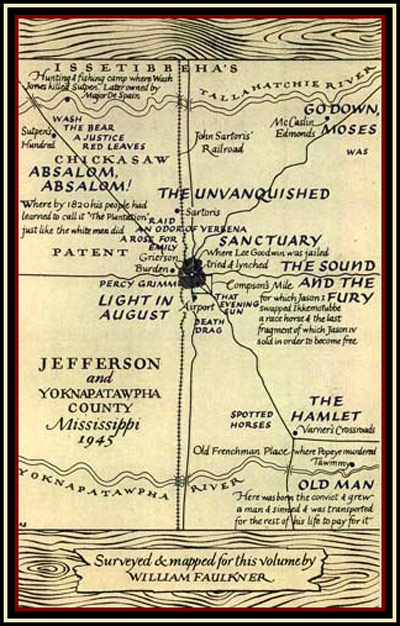
Perhaps the most reproduced of Faulkner’s maps, above, comes from 1946’s The Portable Faulkner and was drawn by the author at the request of editor Malcolm Cowley. We see named on the map the locations of settings in The Unvanquished, Sanctuary, The Sound and the Fury, The Hamlet, Go Down, Moses, Light in August, and the stories “A Rose for Emily” and “Old Man,” among others. This map, dated 1945, had an important predecessor, however: the map below, the final page in Faulkner’s epic tragedy Absalom, Absalom! Most readers of that novel, myself included, have thought of Quentin Compson’s deeply conflicted, repeated assertions that he doesn’t hate the South as the novel’s conclusion. It’s a passionate speech as memorable, and as final, as Molly Bloom’s silent “Yes” at the end of Joyce’s Ulysses. Not so, writes Faulkner scholar Robert Hamblin, the novel actually ends after Quentin, and after the appendix’s chronology and genealogy; the novel truly ends with the map.
What Hamblin wants us to acknowledge is that the map creates more ambiguity than it resolves. The map, he says “is more than a graphic representation of an actual place”—or in this case, a fictional place based on an actual place—“it is simultaneously a metaphor.” While it further attempts to situate the novel in history, giving Yoknapatawpha the tangibility of Thomas Hardy’s fictional Wessex or Sherwood Anderson’s Winesburg, Ohio, the map also elevates the county to a mythic dimension, like “Bullfinch’s maps depicting the settings of the Greek and Roman myths and the wanderings of Ulysses, Sir Thomas More’s map of Utopia, Jonathan Swift’s maps of the travels of Lemuel Gulliver.”

The Portable Faulkner map at the top of the post appears “in a style unlike Faulkner’s” and was “much reduced for publication in first and subsequent printings,” A Companion to William Faulkner tells us. The Absalom map, on the other hand, appeared in a first, limited-edition of the novel in 1936, hand-drawn and lettered in red and black ink, a color-coding feature common to “Faulkner’s many hand-made books.” Click the image, then click it again to zoom in and read the details. You’ll notice a number of odd things. For one, Faulkner gives equal attention to naming locations and describing events that occurred in other Yoknapatawpha novels, mainly murders, deaths, and various crimes and hardships. For another, his neat capital lettering reproduces the letter “N” backwards several times, but just as many times he writes it normally, occasionally doing both in the same word or name—a stylistic quirk that is not reproduced in The Portable Faulkner map.
Finally, in contrast to the map at the top, which Faulkner gives his name to as one who “surveyed & mapped” the territory,” in the Absalom map, he lists himself—beneath the town and county names, square mileage, and population count by race—as “sole owner & proprietor.” Against Alfred Korzybski’s famous dictum, Tokizane Sanae insists that at least when it comes to literary maps, “Map is Territory… proof of newly conquered ownership of a land”—the territory of a deed. Suitably, Faulkner ends a novel obsessed with ownership and property with a statement of ownership and property—over his entire fictional universe. In an ironic exaggeration of the power of surveyors, cartographers, architects, and their landowning employers, the map “spatializes and visualizes the concept of a mythical soil and the power of this God.” In that sense, it forces us to view all of the Mississippi novels not as historical fiction, but as episodes in a great religious mythology, with the same depth and resonance as ancient scripture or political allegory.
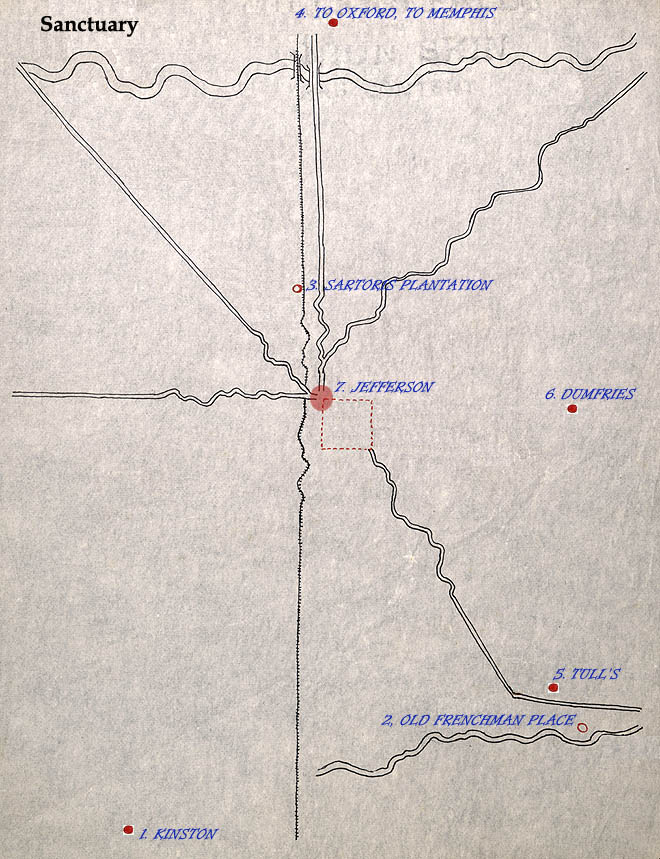
If we wish to see Faulkner’s map this way—a zoom out into an aerial shot at the end of an epic picture—then we’re unlikely to find it of much use as a guide to the plain-faced logistics of his fiction. It’s unclear to me that Faulkner intended it that way, as much as it’s unclear that Ezra Pound and T.S. Eliot’s footnotes to The Waste Land serve any purpose except to distract and confuse readers. But of course readers have been using those footnotes, and Faulkner’s map, as guidelines to their respective texts for decades anyway, noting inconsistencies and finding meaningful correspondences where they can. One interesting example of such a use of Faulkner’s mapmaking comes to us from the site of a comprehensive University of Virginia Faulkner course that covers a bulk of the Yoknapatawpha books. The project, “Mapping Faulkner,” begins with a considerably sparser Yoknapatawpha map, one probably made “late in his life” and which “seems unfinished,” lacking most of the place names and descriptions, and certainly the assertive signature. With overlaid blue lettering, the site does what the Absalom map does not—gives each novel, or 9 of them anyway, its own map, with discrete boundaries between events, characters, and time periods.
If Faulkner wanted us to see the books as manifestations of a singular consciousness, all radiating from a single source of wisdom, this project isolates each novel, and its themes. In the map of Sanctuary, above, only locations from that novel appear. On the page itself, a click on the circular markings under each locale brings up a window with annotations and page references. The apparatus might at first appear to be a useful guide through the notoriously difficult novels, provided Faulkner meant the locations to actually correspond to the text in this way. But what are we to do with this visual information? Lacking any legend, we can’t use the map to judge scale and distance. And by removing all of the other events occurring in the vicinity in the span of around a hundred years or so, the maps denude the novels of their greater context, the purpose to which their “owner & proprietor” devoted them at the end of Absalom, Absalom! Faulkner’s maps, as works of art in their own right, extend “the tragic view of life and history that the Sutpen narrative has already conveyed” in Absalom, Absalom!, writes Hamblin: “Through the handwritten entries that Faulkner made,” in that map, the most complete drawn in the author’s own hand, “the landscape of Yoknapatawpha is presented primarily as a setting for grief, villainy, and death.”
View more maps by Faulkner here.
Related Content:
The Art of William Faulkner: Drawings from 1916–1925
Revel in The William Faulkner Audio Archive on the Author’s 118th Birthday
William Faulkner Resigns From His Post Office Job With a Spectacular Letter (1924)
Josh Jones is a writer and musician based in Durham, NC. Follow him at @jdmagness
Read More...Support Us
We're hoping to rely on loyal readers, rather than erratic ads. Please click the Donate button and support Open Culture. You can use Paypal, Venmo, Patreon, even Crypto! We thank you!

About Us

Open Culture scours the web for the best educational media. We find the free courses and audio books you need, the language lessons & educational videos you want, and plenty of enlightenment in between.
Advertise With Us

FREE UPDATES!
GET OUR DAILY EMAIL
Get the best cultural and educational resources on the web curated for you in a daily email. We never spam. Unsubscribe at any time.
FOLLOW ON SOCIAL MEDIA

Open Culture editor Dan Colman scours the web for the best educational media. He finds the free courses and audio books you need, the language lessons & movies you want, and plenty of enlightenment in between.
Advertise With Us


