H.P. Lovecraft’s Monster Drawings: Cthulhu & Other Creatures from the “Boundless and Hideous Unknown”
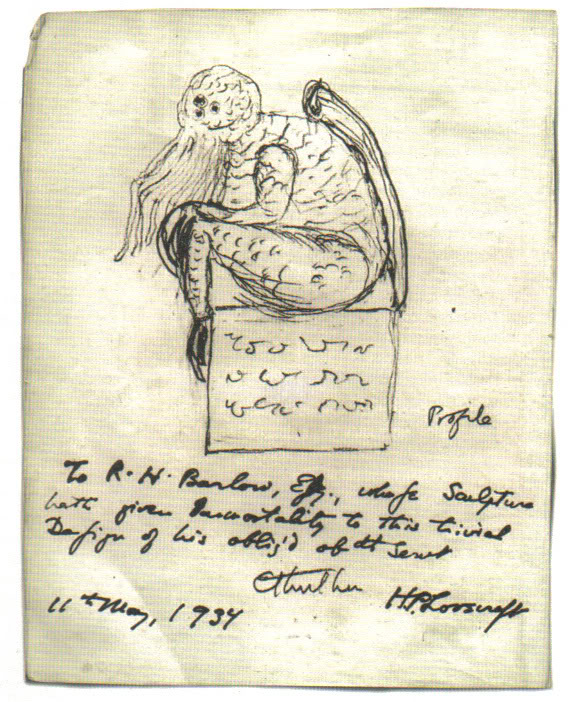
If you’ve ever played Call of Cthulhu, the tabletop role-playing game based on the writing of H.P. Lovecraft, you’ve felt the frustration of having character after painstakingly-created character go insane or simply drop dead upon catching a glimpse of one of the many horrific beings infesting its world. But as the countless readers Lovecraft has posthumously accumulated over nearly eighty years know, that just signals faithfulness to the source material: Lovecraft’s characters tend to run into the same problem, living, as they do, in what French novelist Michel Houellebecq (one of his notable fans, a group that also includes Stephen King, Joyce Carol Oates, and Jorge Luis Borges) calls “an open slice of howling fear.”
Read enough of Lovecraft’s middle-class east-coast professional narrators’ mortal struggles for the words to convey what he called “the boundless and hideous unknown” that suddenly confronts them, and you start to wonder what these creatures actually look like. The clearest word-picture comes in the 1928 story “The Call of Cthulhu,” whose narrator describes the titular ancient malevolence—avoiding instantaneous mental breakdown by looking at an idol rather than the being itself—as “a monster of vaguely anthropoid outline, but with an octopus-like head whose face was a mass of feelers, a scaly, rubbery-looking body, prodigious claws on hind and fore feet, and long, narrow wings behind.”
And so modern Lovecraftians have enjoyed a new variation of that giant octopus-dragon-man form on “Cthulhu for President” shirts each and every election year. (You can find one for 2016 here.) While that phenomenon would surely have surprised Lovecraft himself, constantly and fruitlessly as he struggled in life, I like to think he’d have approved of the designs, which align in fearsome spirit with the sketches he made. At the top of the post you can see one sketch of the Cthulhu idol, drawn in 1934 on a piece of correspondence with writer R.H. Barlow, Lovecraft’s friend and the eventual executor of his estate.
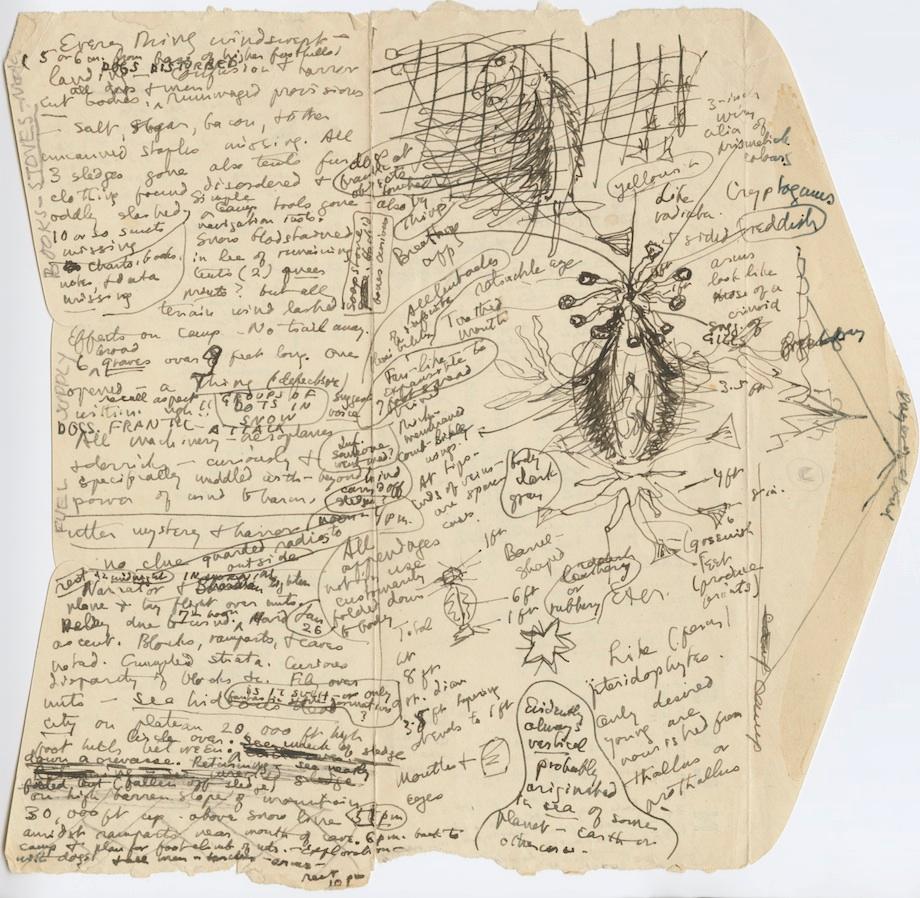
If “The Call of Cthulhu” ranks as Lovecraft’s best-known work, his 1936 novella At the Mountains of Madness surely comes in a close second. Just above, we have an illustrated page of the writer’s plot notes for this unforgettable cautionary tale of an Antarctic expedition that happens disastrously upon the mind-bending ruins of a city previously thought only a myth – and the monsters that inhabit it. It exemplifies the defining quality of Lovecraft’s mythology, where, as Slate’s Rebecca Onion puts it, “ancient beings of profound malevolence lurk just below the surface of the everyday world.”
“Mountains featured several species of forgotten, intelligent beings, including the ‘Elder Things.’ The sketch on the right side of this page of notes (click here to view it in a larger format), with its annotations (‘body dark grey’; ‘all appendages not in use customarily folded down to body’; ‘leathery or rubbery’) represents Lovecraft working out the specifics of an Elder Thing’s anatomy.” That such things lurked in Lovecraft’s imagination have made his state of mind a subject of decades and decades of rich discussion among his enthusiasts. But just the body count racked up by Cthulhu, the Elder Things, and the other denizens of this unfathomable realm should make us thankful that Lovecraft saw them in his mind’s eye so we wouldn’t have to.
Note: The second image on this page was featured in the 2013 exhibition held at Brown University, “The Shadow Over College Street: H. P. Lovecraft in Providence.” The Brown University Library is the home to the largest collection of H. P. Lovecraft materials in the world.
Related Content:
H.P. Lovecraft Gives Five Tips for Writing a Horror Story, or Any Piece of “Weird Fiction”
H.P. Lovecraft Highlights the 20 “Types of Mistakes” Young Writers Make
H.P. Lovecraft’s Classic Horror Stories Free Online: Download Audio Books, eBooks & More
Lovecraft: Fear of the Unknown (Free Documentary)
Colin Marshall writes on cities, language, Asia, and men’s style. He’s at work on a book about Los Angeles, A Los Angeles Primer, and the video series The City in Cinema. Follow him on Twitter at @colinmarshall or on Facebook.
Read More...1980s Photo Captures Neil deGrasse Tyson Looking Hip in Grad School (Plus More on His “Failed Experiment” at UT-Austin)
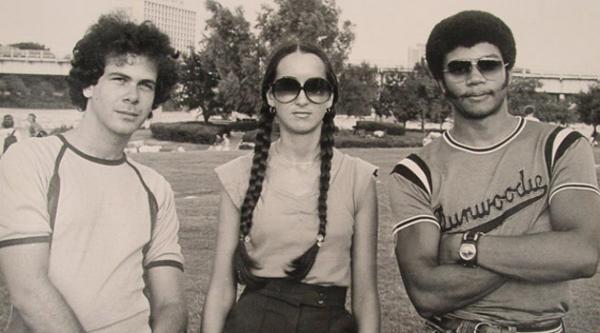
Last year, we revisited the high school days of Neil deGrasse Tyson. Growing up in New York City during the 1970s, Tyson attended Bronx Science (class of ’76), ran an impressive 4:25 mile, captained the school’s wrestling team, and, he fondly recalls, wore basketball sneakers belonging to the Knick’s Walt “Clyde” Frazier. Tyson was, of course, also a precocious student. Famously, Carl Sagan recruited Tyson to study with him at Cornell. But Tyson politely declined and went to Harvard for his undergraduate studies. Then, he headed off to Texas, to start his PhD at UT-Austin. That’s where the photo, taken circa 1980, captures him above — hanging out with friends, and looking hipper than your average astrophysics student.
This photo (now making the rounds on Reddit) originally appeared in a 2012 article published in the Alcalde, the alumni magazine of The University of Texas. To the magazine’s credit, the article takes an unvarnished look at Tyson’s “failed experiment” in Texas. The piece starts with the lede “Neil deGrasse Tyson, MA ’83, is the public face of science. But he says his success has nothing to do with UT.” And, from there, it recounts how professors and university police immediately stereotyped him.
The first comment directed to me in the first minute of the first day by a faculty member I had just met was, ‘You must join the department basketball team!
or
I was stopped and questioned seven times by University police on my way into the physics building. Seven times. Zero times was I stopped going into the gym—and I went to the gym a lot. That says all you need to know about how welcome I felt at Texas.
But the real problem wasn’t race. According to Tyson, “there was simply no room for me to be the full person that I was.” “An obsessive focus on one thing at a time; a strong connection to pop culture, from the moonwalk to the Rubik’s cube; and a refusal to put research first: these traits contributed to Tyson’s failure at UT,” concludes the Alcalde. They also allowed him to flourish later in life.
After his “advisors dissolved his dissertation committee—essentially flunking him,” Tyson transferred to Columbia, earned his PhD in 1988, and became the greatest popularizer of science since Carl Sagan. We like stories with happy endings.
Read more about Tyson’s experience in Texas at the Alcalde.
Related Content:
Neil deGrasse Tyson, High School Wrestling Team Captain, Invented a Physics-Based Wrestling Move
Carl Sagan Writes a Letter to 17-Year-Old Neil deGrasse Tyson (1975)
Neil deGrasse Tyson Lists 8 (Free) Books Every Intelligent Person Should Read
Read More...Stream 58 Hours of Free Classical Music Selected to Help You Study, Work, or Simply Relax
We are bombarded by music, all the time, whether we like it or not. In many cases—such as those almost daily, inescapable trips to the grocery store, drug store, pet store, what-have-you store—the musical accompaniment to our journey through life has been chosen specifically for its ability to make us buy things: However grating we may find the soft rock, lite pop, or easy listening that pumps out of pharmacy speaker systems, some sinister cabal of marketing researchers determined long ago that schmaltz equals sales. And so we endure yet another terrible pop song while waiting in line with our essentials. For people like myself—highly sensitive to sound and unable to tune out bad background music—the experience can be excruciating.
In our own private spaces—offices, cars, the space between our ears with headphones on—we become our own sound designers. We may prefer silence, or we may choose very specific kinds of music to accompany our leisure and our work (as we discussed in a few posts on music to write by some years back). These days, we can make our own digital playlists, grabbing music from all over the web, or we can have the algorithms of internet radio services like Pandora or Apple Radio curate our listening for us, a more—or sometimes less—satisfying experience. Lovers of classical music have a third online option, thanks to an enterprising digital curator who goes by the name of Ulyssestone and who compiled the Spotify playlist below of 58 hours of classical music — from Sibelius to Satie, Bach to Debussy. It’s designed for anyone who wants to study, work, or simply relax.
Ulysses has previously brought us a playlist of the enduringly classical music in Stanley Kubrick’s films and all of Mozart in a 127 hour playlist. As one music blogger put it, his interventions have made Spotify’s service “a whole lot easier for classical listeners.” See for yourself at Spotify Classical Playlists, where you’ll find blog posts on the changes to Spotify’s classical radio, as well as over 50 playlists dedicated to famous composers—“great starting points,” writes Ulysses, “for people who want to get into classical music or explore a bit more.” You can stream the 58-hour playlist of study-enhancing classical music (featuring 789 free tracks in total) by clicking this link, or streaming the player above. To download Spotify and start a free account, head on over to their site.
Related Content:
Download Free Music from 150+ Classical Composers, Courtesy of Musopen.org
The World Concert Hall: Listen To The Best Live Classical Music Concerts for Free
The Classical Music in Stanley Kubrick’s Films: Listen to a Free, 4 Hour Playlist
Philip K. Dick’s Favorite Classical Music: A Free, 11-Hour Playlist
Josh Jones is a writer and musician based in Durham, NC. Follow him at @jdmagness.
Read More...Watch Vincent, Tim Burton’s Animated Tribute to Vincent Price & Edgar Allan Poe (1982)
If you put together a list of the world’s greatest Vincent Price fans, you’d have to rank Tim Burton at the top. That goes for “greatest” in the sense of both the fervency of the fan’s enthusiasm for all things Price, and for the fan’s accomplishments in his own right. Burton’s filmmaking craft and his admiration for the midcentury horror-film icon intersected early in his career, when he made the six-minute animated film Vincent for Disney in 1982, three years before his feature debut Pee-Wee’s Big Adventure.
The short’s title refers not to Vincent Price himself, but to its seven-year-old protagonist, Vincent Malloy: “He’s always polite and does what he’s told. For a boy his age, he’s considerate and nice. But he wants to be just like Vincent Price.” Those words of narration — as if you couldn’t tell after the first one spoken — come in the voice of Price himself. Vincent Malloy, pale of complexion and untamed of hair, surely resembles Burton’s childhood self, and in more aspects than appearance: the filmmaker grants the character his own idolatry not just of Price but of Edgar Allan Poe, and it’s into their macabre masterworks that his daydreaming sends him — just as they presumably sent the seven-year-old Burton.
Burton and Price’s collaboration on Vincent marked the beginning of a friendship that lasted the rest of Price’s life. The appreciative actor called the short “the most gratifying thing that ever happened,” and the director would go on to cast him in Edward Scissorhands eight years later. Price died in 1993, the year before the release of Ed Wood
 , Burton’s dramatized life of Edward D. Wood Jr. In that film, the relationship between semi-retired horror actor Bela Lugosi and the admiring schlock auteur Wood parallels, in a way, that of the more enduringly successful Price and the much more competent Burton.
Vincent also drops hints of other things to come in the Burtoniverse: Nightmare Before Christmas fans, for instance, should keep their eyes open for not one but two early appearances of that picture’s bony central player Jack Skellington. This demonstration of the continuity of Burton’s imagination underscores that, as both his biggest fans and biggest critics insist, he’s always lived in a world of his own — probably since Vincent Malloy’s age, when teachers and other authority figures might have described him in exactly the same way.
Related Content:
4,000+ Free Movies Online: Great Classics, Indies, Noir, Westerns, Documentaries & More
Six Early Short Films By Tim Burton
Tim Burton’s The World of Stainboy: Watch the Complete Animated Series
How German Expressionism Influenced Tim Burton: A Video Essay
Edgar Allan Poe’s “The Raven,” Read by Christopher Walken, Vincent Price, and Christopher Lee
5 Hours of Edgar Allan Poe Stories Read by Vincent Price & Basil Rathbone
Colin Marshall writes on cities, language, Asia, and men’s style. He’s at work on a book about Los Angeles, A Los Angeles Primer, and the video series The City in Cinema. Follow him on Twitter at @colinmarshall or on Facebook.
Read More...“Auteur in Space”: A Video Essay on How Andrei Tarkovsky’s Solaris Transcends Science Fiction
If you haven’t yet seen Andrei Tarkovsky’s Solaris but do plan on watching it (find it online here), rest assured that there’s no wrong way to go about it. You can plunge, without preparation, right into its vivid, tormented Soviet sci-fi world of failing high technology, sublime natural forces, and haunting memory. You can do no end of preliminary research on the film, its maker, and its maker’s struggle to adapt the original Stanislaw Lem novel to his own distinctive sensibility. Or you could just precede your screening with “Auteur in Space,” a brief examination of Solaris by well-known cinephile video essayist kogonada. It was made on behalf of The British Film Institute.
“The very concept of genre is as cold as the tomb,” the narrator quotes Tarkovsky as writing, going on to cite his criticism of Stanley Kubrick’s 2001 “for being too enamored by the spectacle of the genre, for being too exotic, too immaculate.” From then on, the video demonstrates not just what Tarkovsky does to push Solaris out of the shadow of 2oo1, but also to break it out of the standard forms of science fiction and, ultimately, to free it from the strictures of genre itself — to occupy that category we can only call Tarkovsky.
And so the Russian auteur decides to make the space station on which most of the film takes place “look like a broken-down old bus.” He decides “to spend five minutes showing a man in an ordinary car traveling along the highway, and less than two minutes showing his main character traveling through space.” He gives in to his “occupation with the elemental things of Earth.” He comes to “question the limits of science in engaging the mysteries of existence,” ultimately using Solaris to pit science against fiction, “each with their own weight and history and pursuit of truth and knowledge.”
If, indeed, you haven’t yet seen Solaris and watch this video essay, you’ll surely find yourself no longer able to resist the temptation to experience the film as soon as possible. Maybe you’ll pop in the DVD or Blu-Ray, or better yet, maybe you’ll catch a theatrical screening. But if you understandably can’t wait for even a moment, you can watch it free online right now. And find other Tarkovsky films free online here.
Related Content:
Watch Solaris (1972), Andrei Tarkovsky’s Haunting Vision of the Future
Andrei Tarkovsky’s Solaris Shot by Shot: A 22-Minute Breakdown of the Director’s Filmmaking
The Masterful Polaroid Pictures Taken by Filmmaker Andrei Tarkovsky
Tarkovsky’s Advice to Young Filmmakers: Sacrifice Yourself for Cinema
A Poet in Cinema: Andrei Tarkovsky Reveals the Director’s Deep Thoughts on Filmmaking and Life
Colin Marshall writes on cities, language, Asia, and men’s style. He’s at work on a book about Los Angeles, A Los Angeles Primer, and the video series The City in Cinema. Follow him on Twitter at @colinmarshall or on Facebook.
Read More...Pres. Obama Releases a Free Playlist of 40 Songs for a Summer Day (Plus 6 Books on His Summer Reading List)

Like much of the rest of the country, President Obama is getting some downtime in August — in his case spending 16 days in Martha’s Vineyard. From that nice getaway spot, POTUS has launched on Spotify (download the free software here) two playlists of music — 20 songs for a hot summer day, and another 20 for a nice summer evening. You can play the songs below, and further down the page, find six books on his summer vacation reading list.
Daytime listening features songs from Bob Dylan, Bob Marley, Coldplay, Howlin’ Wolf, Aretha Franklin, Florence and the Machine, and The Rolling Stones. For nighttime, he’s serving up John Coltrane, Van Morrison, Joni Mitchell, Nina Simone and more. The man has taste. And for summer reading you can do worse than offer Jhumpa Lahiri, James Salter and Elizabeth Kolbert.
“The President’s Summer Playlist: Day”
“The President’s Summer Playlist: Night”
Obama’s Summer Reading List:
All That Is, by James Salter
All The Light We Cannot See, by Anthony Doerr
The Sixth Extinction, by Elizabeth Kolbert
The Lowland, by Jhumpa Lahiri
Between The World and Me, by Ta-Nehisi Coates
Washington: A Life, by Ron Chernow
If you would like to support the mission of Open Culture, consider making a donation to our site. It’s hard to rely 100% on ads, and your contributions will help us continue providing the best free cultural and educational materials to learners everywhere. You can contribute through PayPal, Patreon, and Venmo (@openculture). Thanks!
Read More...One of World’s Oldest Books Printed in Multi-Color Now Opened & Digitized for the First Time
Now free for the world to see on the Cambridge University Digital Library are some treasures from the library’s Chinese collections. Fire up that time machine called the Internet, and you can start perusing:
- The oracle bones (pieces of ox shoulder blades and turtle shells used for divination in ancient China) which importantly bear the earliest surviving examples of Chinese writing. They’re over three thousand years old.
- A digitization of one of the world’s earliest printed books (Mahapraj馻-paramita-sutra or Perfection of Wisdom), a Buddhist text dating between 1127 and 1175.
- A 14th-century banknote. According to Cambridge, “Paper currency first appeared in China during the 7th century, and was in wide circulation by the 11th century, 500 years before its first use in Europe.”
But what’s been burning up the Internet during the past few days (largely thanks to Hyperallergic) is the digitization of the Manual of Calligraphy and Painting.
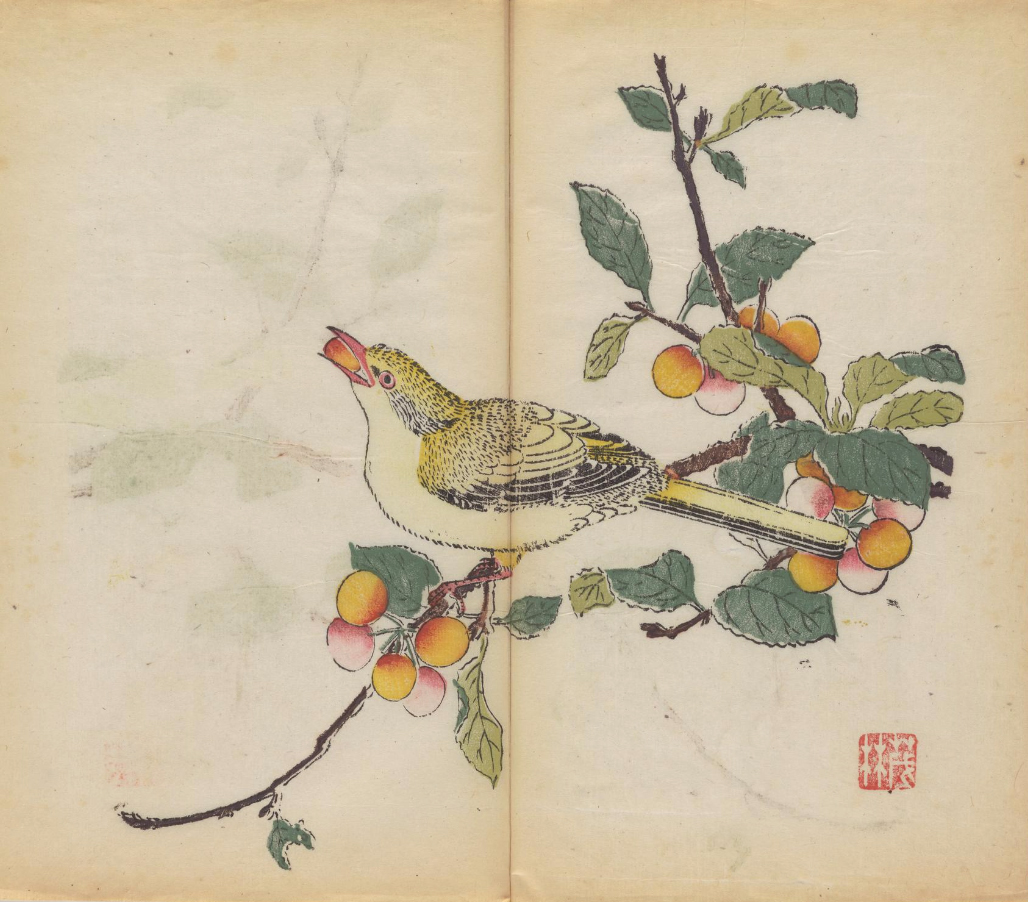
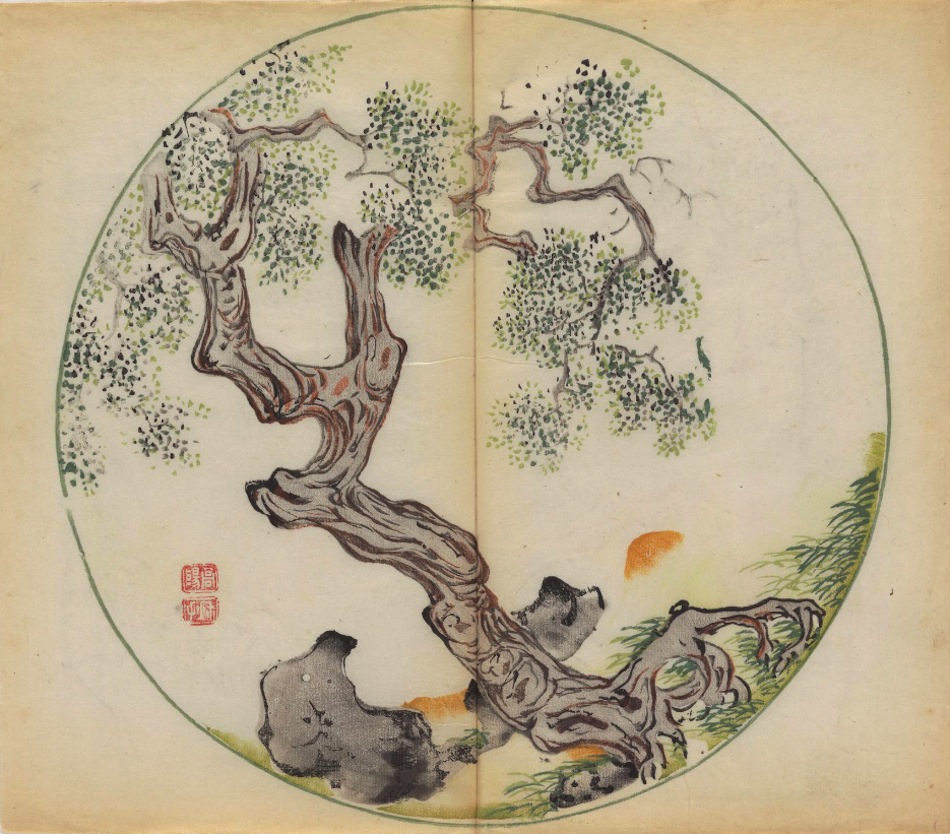
Made in 1633 in Nanjing, the Manual of Calligraphy and Painting is noteworthy partly because “It is the earliest and finest example of multi-colour printing anywhere in the world, comprising 138 paintings and sketches with associated texts by fifty different artists and calligraphers.” And partly because “The binding is so fragile, and the manual so delicate, that until it was digitized, we have never been able to let anyone look through it or study it – despite its undoubted importance to scholars,” says Charles Aylmer, Head of the Chinese Department at Cambridge University Library.
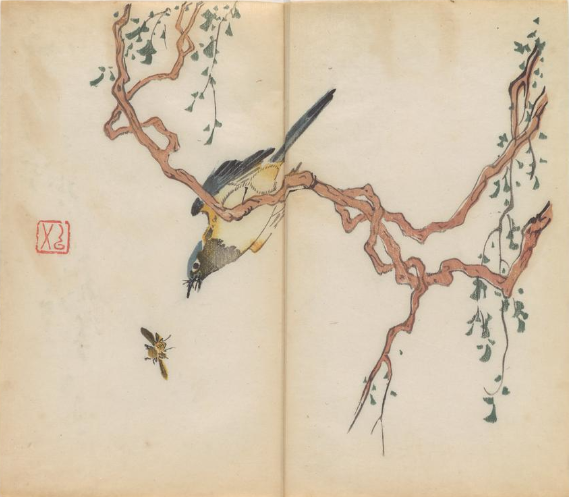
Begin your digital tour of the 388-page Manual here (or see a few samples above) and be among the first to lay eyes on it.
via Hyperallergic/Book Patrol/Cambridge University Library
If you would like to support the mission of Open Culture, consider making a donation to our site. It’s hard to rely 100% on ads, and your contributions will help us continue providing the best free cultural and educational materials to learners everywhere. You can contribute through PayPal, Patreon, and Venmo (@openculture). Thanks!
Read More...Get a Free Subscription to the Beta Version of The Great Courses Plus (Space Limited)

We’ve told you about the Great Courses Plus (now called Wondrium) before–a new video subscription service that lets you watch free courses (about 8,000 lectures in total) across a wide range of subjects, all taught by some of the best lecturers in the country. The topics cover everything from History, Philosophy, Literature, and Economics, to Math, Science, Professional Development, Cooking, and Photography. And you can binge-watch entire college courses in a matter of days by watching videos on your TV, tablet, laptop and smart phone, with the help of apps designed for Apple, Google Play, Kindle Fire, and Roku.
Interested in trying out this service? Right now, the Great Courses Plus/Wondrium is offering a special deal for Open Culture readers. If you click here, and sign up for a free trial, you can use this service for 30 days … for free. And then, if you would like, you can continue to subscribe and pay their normal prices. If you have time on your hands, this is a great way to keep your mind engaged and stream what PC Magazine has called “an excellent library of college-level lectures.”
Note: The Great Courses is a partner with Open Culture. So if you sign up for a free trial, it benefits not just you and Great Courses Plus. It benefits Open Culture too. So consider it win-win-win.
Read More...The End of an Era: A Short Film About The Last Day of Hot Metal Typesetting at The New York Times (1978)
This is usually what happens when I write a piece for Open Culture: As I drink an overpriced coffee at my local coffee shop, I research a topic on the internet, write and edit an article on Microsoft Word and then copy and paste the whole thing into WordPress. My editor in Open Culture’s gleaming international headquarters up in Palo Alto gives it a look-over and then, with the push of a button, publishes the article on the site.
It’s sobering to think what I casually do over the course of a morning would require the effort of dozens of people 40 years ago.
Until the 1970s, with the rise in popularity of computer typesetting, newspapers were printed the same way for nearly a century. Linotype machines would cast one line at a time from molten lead. Though an improvement from handset type, where printers would assemble lines of type one character at a time, linotype still required numerous skilled printers to assemble each and every newspaper edition.
The New York Times transitioned from that venerated production method to computer typesetting on Sunday, July 2, 1978. David Loeb Weiss, a proofreader at the Times, documented this final day in the documentary Farewell — Etaoin Shrdlu.
The title of the movie, by the way, comes from the first two lines of a printer’s keyboard, which are arranged according to a letter’s frequency of use. When a printer typed “etaoin shrdlu,” it meant that the line had a mistake in it and should be discarded.
Watching the movie, you get a sense of just how much work went into each page and how printers were skilled craftsmen. (You try spotting a typo on a page of upside down and backwards type.) The film also captures the furious energy and the cacophony of clinks and clanks of the composing room. You can see just how much physical work was involved. After all, each page was printed off of a 40-pound plate made of lead.
The tone of the movie is understandably melancholy. The workers are bidding farewell to a job that had existed for decades. “All the knowledge I’ve acquired over my 26 years is all locked up in a little box now called a computer,” notes one printer. “And I think most jobs are going to end up the same way.” Someone else wrote the following on the composing room’s chalkboard. “The end of an era. Good while it lasted. Crying won’t help.”
You can watch the full documentary above. It will also be added to our list of 200 Free Documentaries, a subset of our meta collection, 4,000+ Free Movies Online: Great Classics, Indies, Noir, Westerns, Documentaries & More.
H/T @KirstinButler
Related Content:
Friedrich Nietzsche’s Curious Typewriter, the “Malling-Hansen Writing Ball”
Mark Twain Wrote the First Book Ever Written With a Typewriter
Jonathan Crow is a Los Angeles-based writer and filmmaker whose work has appeared in Yahoo!, The Hollywood Reporter, and other publications. You can follow him at @jonccrow. And check out his blog Veeptopus, featuring lots of pictures of vice presidents with octopuses on their heads. The Veeptopus store is here.
Read More...Hear What Hamlet, Richard III & King Lear Sounded Like in Shakespeare’s Original Pronunciation
As we highlighted a few days ago, recent findings by South African scientists suggest that William Shakespeare may have smoked pot, possibly composing some of his celebrated plays while under the influence. Their research is sure to spark controversy among Shakespeare scholars and historians alike, but it’s certainly a more interesting controversy than the tired debate about whether Shakespeare wrote his plays at all. Perhaps even more interesting than Shakespeare’s drug of choice for lovers of his language are debates about what Shakespeare’s plays might have sounded like to his original audiences. In other words, high or not, what might Shakespeare, his actors, and his audience have sounded like when they spoke the language we call English.
Of course they called the language English as well, but we might not recognize some words as such when hearing Shakespeare’s accent aloud. On the other hand, it might be surprising just how much the Bard’s original pronunciation sounds like so many other kinds of English we know today.
In a post two years ago, we quoted Shakespearean actor, director, and writer Ben Crystal on Shakespeare’s original pronunciation, which, he says, “has flecks of nearly every regional U.K. English accent, and indeed American and in fact Australian, too.” Hearing Shakespeare’s English spoken aloud, Crystal remarks, is hearing a sound that “reminds people of the accent of their home.” You can test this theory, and hear for yourself the sound of Shakespeare’s English with the video and audio highlighted here, showcasing Crystal’s performance of the plays in original pronunciation (OP).
At the top, see Crystal recite an excerpt of Hamlet’s “to be or not to be” speech in a video promotion for a 2011 Kickstarter campaign to fund a film version of Hamlet in OP. And above, we have two audio clips of Richard III and King Lear, respectively, both from an OP Shakespeare CD Crystal recorded with several other actors. Crystal came by his version of original pronunciation honestly, and from a very reputable source, who also happens to be his father, David. The elder Crystal is perhaps the most highly-regarded linguist and scholar of the English language alive today, and in addition to publishing several books both scholarly and popular, he has worked with the Globe Theatre on producing plays in OP since 1994. Learn more about Crystal’s process at our previous post on his work.
Related Content:
Discover What Shakespeare’s Handwriting Looked Like, and How It Solved a Mystery of Authorship
Free Online Shakespeare Courses: Primers on the Bard from Oxford, Harvard, Berkeley & More
Josh Jones is a writer and musician based in Durham, NC. Follow him at @jdmagness
Read More...Support Us
We're hoping to rely on loyal readers, rather than erratic ads. Please click the Donate button and support Open Culture. You can use Paypal, Venmo, Patreon, even Crypto! We thank you!

About Us

Open Culture scours the web for the best educational media. We find the free courses and audio books you need, the language lessons & educational videos you want, and plenty of enlightenment in between.
Advertise With Us

FREE UPDATES!
GET OUR DAILY EMAIL
Get the best cultural and educational resources on the web curated for you in a daily email. We never spam. Unsubscribe at any time.
FOLLOW ON SOCIAL MEDIA

Open Culture editor Dan Colman scours the web for the best educational media. He finds the free courses and audio books you need, the language lessons & movies you want, and plenty of enlightenment in between.
Advertise With Us

