Arthur C. Clarke Reads His Classic Sci-Fi Works: Childhood’s End and “The Star”
Sir Arthur C. Clarke, the science fiction author best known for 2001: A Space Odyssey, started writing at the end of World War II and the beginning of the nuclear age, a time when technology promised to bring untold benefit to humanity and had the potential to utterly destroy it. So he wrote science fiction with some actual science in it, tales about space travel, alien encounters and human evolution.
The future was a continuing object of fascination for Clarke. He proved to be uncannily accurate at making divinations about the course of technology. Back in 1964, he predicted virtual surgery, 3D printers and the internet. Of course, he also predicted that we would have an army of monkey servants to cater to our every whim. You can’t always be right.
But thanks to the magic of one of his predictions – the internet – you can listen to Clarke read two of his most acclaimed works – Childhood’s End and “The Star.”
The former tale, written in 1953, is about a mysterious alien race that brings the Cold War to a screeching halt and kick starts human evolution. But at what cost? Stanley Kubrick was reportedly interested in developing the book until he settled on 2001. Listen to Clarke read long excerpts from Childhood’s End at the top of this post.
The latter story, published in 1955, might very well be the best sci-fi Christmas story ever. It was adapted into a Twilight Zone episode that thoroughly freaked me out as a kid. Listen to “The Star” just above.
Related Content:
Arthur C. Clarke Narrates Film on Mandelbrot’s Fractals; David Gilmour Provides the Soundtrack
Isaac Asimov Predicts in 1964 What the World Will Look Like Today — in 2014
Free Science Fiction Classics on the Web: Huxley, Orwell, Asimov, Gaiman & Beyond
1,000 Free Audio Books: Download Great Books for Free
Jonathan Crow is a Los Angeles-based writer and filmmaker whose work has appeared in Yahoo!, The Hollywood Reporter, and other publications. You can follow him at @jonccrow. And check out his blog Veeptopus, featuring lots of pictures of vice presidents with octopuses on their heads. The Veeptopus store is here.
Read More...
Theodor Adorno’s Critical Theory Text Minima Moralia Sung as Hardcore Punk Songs
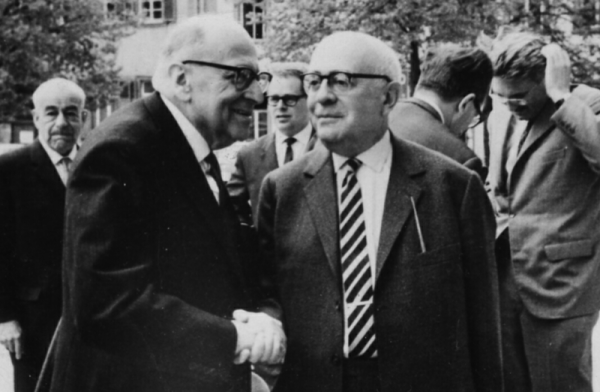
Image of Theodor Adorno (right) by Jeremy J. Shapiro, via Wikimedia Commons
With the possible exception of John Gray’s Straw Dogs, few works of philosophy confront the barrenness of human life in the modern world in bleaker terms than Theodor Adorno’s Minima Moralia. Taking its title from Aristotle’s Magna Moralia, or “The Great Ethics,” Adorno’s book subverts the classical idea of the good life as a realistic aspiration in a world dominated by totalitarian systems of control and inexorable, grinding logics of production and consumption. “Our perspective of life has passed into an ideology which conceals the fact that there is life no longer,” writes Adorno in his Dedication. The individual has been “reduced and degraded” by capitalism and fascism, flattened to mere appearance in the “sphere of consumption.”
Adorno’s book—a philosophical memoir of his experience as an “intellectual in emigration”—reflects his pessimism not only in its title but also in its subtitle: Reflections from Damaged Life. How little he could have suspected—and how much he likely would have despised—the kinship between his own postwar angst and the neurotic anger of the American hardcore punk generation to come some thirty-five years later.
Take, for example these lyrics to Black Flag’s “Damaged,” from their 1981 album of the same name:
Right now look at me now
Look at me now
Just shadows
I’m just shadows of what I was
I just want another thing
I don’t even get by for that
One might make the case that Black Flag lyrics—and those of so many similar bands—play out Adorno’s thesis over and over: to quote a much less angry pop band from a later generation: “Modern Life is Rubbish.”
Seizing on these pessimistic parallels between punk rock and critical theory, filmmaker and artist Brian J. Davis recorded an EP of readings from five chapters of Adorno’s book, set to blistering hardcore drums and guitars. (Anyone happen to know who is on vocals?) Above, hear “They, The People,” and “This Side of the Pleasure Principle” and below, we have “UNmeasure for UNmeasure,” “Johnny Head-in-the-Air,” and “Every Work is an Uncommitted Crime.”
As you’ll note, Adorno’s titles allude to well-known works of art, politics, folk song, and theory and—as the publisher’s note in my Verso edition puts it— “involve irony or inversion,” primary rhetorical methods of his “negative dialectic.” The hardcore punks who picked up, however unconsciously, on Adorno’s disaffected critique may have eschewed his self-consciously literary approach, but they were no less masters of irony, even if their targets happened to be much more pop-cultural.
Punk rock Adorno comes to us from WFMU’s Kenneth S as examples of “academic theory… sung by people who can’t sing.” As Colin Marshall pointed out in a post yesterday, Goldsmith has made his own contribution to the genre, singing writings by Walter Benjamin, Ludwig Wittgenstein, and Sigmund Freud. And to even more humorous effect, we’ve previously brought you the work of M.A. Numminen, Finnish performance artist who turned Wittgenstein’s Tractatus into a bizarre comic opera.
For a much more serious look at Adorno and music—a subject he wrote passionately and controversially about—check out this post on his own avant-garde compositions, which turn out to be much less punk rock than one might expect given his social alienation and despondency.
Related Content:
Ludwig Wittgenstein’s Tractatus Gets Adapted Into an Avant-Garde Comic Opera
Hear Theodor Adorno’s Avant-Garde Musical Compositions
Theodor Adorno’s Philosophy of Punctuation
Josh Jones is a writer and musician based in Durham, NC. Follow him at @jdmagness.
Read More...Learn to Speak 48 Languages for Free: Everything from Arabic to Indonesian to Yiddish on One Page
Even by the standards of United States Presidents, Barack Obama has led a pretty unusual life. His early experiences included a childhood plunge into internationalism in the form of not just his Kenyan father but his Indonesian stepfather, to whose homeland the family moved when Obama was six years old. For the next four years, the young future Commander in Chief attended local schools in Jakarta, and the language he picked up then has stuck with him today. It certainly served him well when he returned to Indonesia as President to give the speech above, in which he talks about his love for that country and his belief in its importance to the future, speaking bits and pieces in Indonesian throughout — and drawing great applause each time.
If you want to be like Barry and meet with a similarly rapturous reception when next you give a public address in the Emerald of the Equator, start by learning the basics of the Indonesian language at our Free Foreign Language Lessons page. There, you’ll find a wealth of podcasts like Learning Indonesian (iTunes), Indonesianpod101 (iTunes), and Indonesian Survival Phrases (iTunes). [Advanced learners might prefer tuning in to news-in-Indonesian podcasts from SBS (iTunes) and NHK World (iTunes) radio.] Indonesianpod101 even has a Youtube page with video lessons like the one just above.
Even if you don’t plan on becoming President, you may still have plenty of reasons to learn Indonesian. With its familiar alphabet and simple grammar without tenses, gender forms, noun cases, and the like, it ranks as one of the very easiest languages in which to attain fluency. I know an American college professor in South Korea who constantly urges his students to study Indonesian, since it offers the “golden tip” of a wedge into the rest of Asia: master it, and you’ll have built up momentum to learn the other, more complicated languages of the region, from Mandarin to Cantonese to Japanese and beyond — all of which you can also begin studying at, of course, our Free Language Lessons page.
If your linguistic interests slant toward Europe rather than Asia, don’t worry, we’ve still got your back: our lists include learning resources for languages of that continent as major as Spanish, French, Italian, Russian, English, and German to niche languages like Catalan, Finnish, Hungarian, and Serbo-Croatian. If you notice we’ve missed any language you’ve harbored a burning desire to learn, drop us a line so we can start gathering podcasts, videos, and PDFs on it. In the meantime, surely the Free Language Lessons page offers you something to start on and get that incomparable feeling of breaking into a new language for the first time. Semoga beruntung, as we say in Jakarta!
Related Content:
Learn 48 Languages Online for Free: Spanish, Chinese, English & More
Study 40+ Languages with Free Lessons from the U.S. Foreign Service Institute
Let’s Learn Japanese: Two Classic Video Series to Get You Started in the Language
Learn Latin, Old English, Sanskrit, Classical Greek & Other Ancient Languages in 10 Lessons
Colin Marshall writes on cities, language, Asia, and men’s style. He’s at work on a book about Los Angeles, A Los Angeles Primer, and the video series The City in Cinema. Follow him on Twitter at @colinmarshall or on Facebook.
Read More...A Vintage Infographic of the Human Brain: The Wonders Within Your Head (1938)
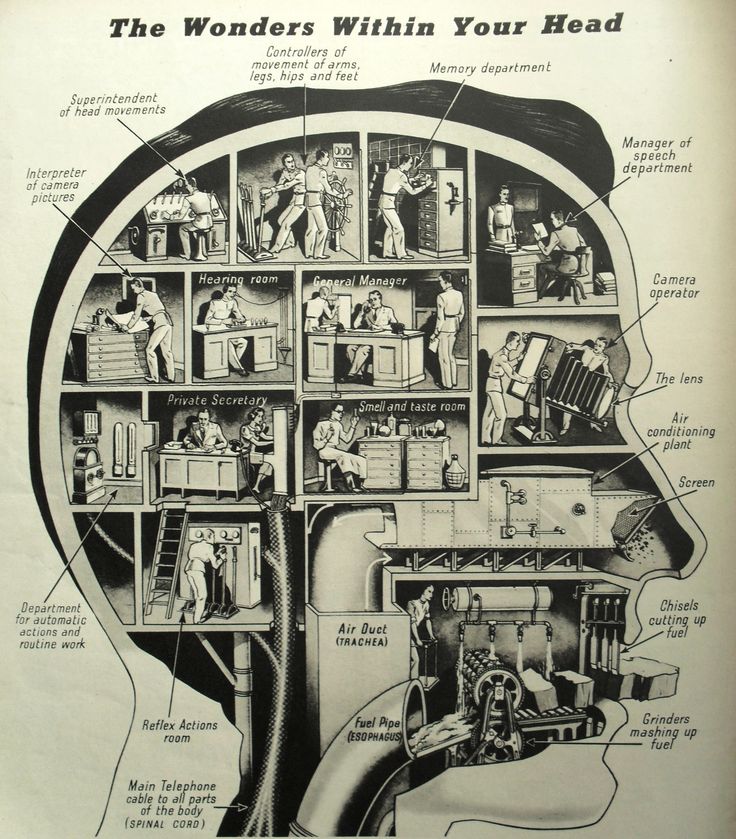
Click here to view the infographic in a larger format.
From the December 6, 1938 issue of LOOK magazine comes this vintage “infographic” showing “The Wonders Within Your Head.” It takes the human brain/head and presents it as a series of rooms, each carrying out a different function. Drawn a little more than a decade after Calvin Coolidge famously declared “The business of America is business,” it’s not surprising that the cognitive functions are depicted in corporate or industrial terms.
Besides for this visualization, the same edition of LOOK featured articles on Jean Harlow, Joan Crawford, President Roosevelt, and the Tragedy of the European Jews. Kristallnacht, or the “Night of Broken Glass,” had taken place a month before in Nazi Germany — another sign that the world was about to become a very, very dark place.
Follow us on Facebook, Twitter, Google Plus and LinkedIn and share intelligent media with your friends. And if you want to make sure that our posts definitely appear in your Facebook newsfeed, just follow these simple steps.
Related Content:
The Tree of Languages Illustrated in a Big, Beautiful Infographic
Download 78 Free Online History Courses: From Ancient Greece to The Modern World
4000 Years of History Displayed in a 5‑Foot-Long “Histomap” (Early Infographic) From 1931
Free Online Biology Courses
Read More...The Neuroscience of Drumming: Researchers Discover the Secrets of Drumming & The Human Brain
An old musician’s joke goes “there are three kinds of drummers in the world—those who can count and those who can’t.” But perhaps there is an even more global divide. Perhaps there are three kinds of people in the world—those who can drum and those who can’t. Perhaps, as the promotional video above from GE suggests, drummers have fundamentally different brains than the rest of us. Today we highlight the scientific research into drummers’ brains, an expanding area of neuroscience and psychology that disproves a host of dumb drummer jokes.
“Drummers,” writes Jordan Taylor Sloan at Mic, “can actually be smarter than their less rhythmically-focused bandmates.” This according to the findings of a Swedish study (Karolinska Institutet in Stockholm) which shows “a link between intelligence, good timing and the part of the brain used for problem-solving.” As Gary Cleland puts it in The Telegraph, drummers “might actually be natural intellectuals.”
Neuroscientist David Eagleman, a renaissance researcher The New Yorker calls “a man obsessed with time,” found this out in an experiment he conducted with various professional drummers at Brian Eno’s studio. It was Eno who theorized that drummers have a unique mental makeup, and it turns out “Eno was right: drummers do have different brains from the rest.” Eagleman’s test showed “a huge statistical difference between the drummers’ timing and that of test subjects.” Says Eagleman, “Now we know that there is something anatomically different about them.” Their ability to keep time gives them an intuitive understanding of the rhythmic patterns they perceive all around them.
That difference can be annoying—like the pain of having perfect pitch in a perpetually off-key world. But drumming ultimately has therapeutic value, providing the emotional and physical benefits collectively known as “drummer’s high,” an endorphin rush that can only be stimulated by playing music, not simply listening to it. In addition to increasing people’s pain thresholds, Oxford psychologists found, the endorphin-filled act of drumming increases positive emotions and leads people to work together in a more cooperative fashion.
Clash drummer Topper Headon discusses the therapeutic aspect of drumming in a short BBC interview above. He also calls drumming a “primeval” and distinctly, universally human activity. Former Grateful Dead drummer Mickey Hart and neuroscientist Adam Gazzaley have high hopes for the science of rhythm. Hart, who has powered a light show with his brainwaves in concerts with his own band, discusses the “power” of rhythm to move crowds and bring Alzheimer’s patients back into the present moment.
Whether we can train ourselves to think and feel like drummers may be debatable. But as for whether drummers really do think in ways non-drummers can’t, consider the neuroscience of Stewart Copeland’s polyrhythmic beats, and the work of Terry Bozzio (below) playing the largest drumkit you’ve ever seen.
Related Content:
Playing an Instrument Is a Great Workout For Your Brain: New Animation Explains Why
Isolated Drum Tracks From Six of Rock’s Greatest: Bonham, Moon, Peart, Copeland, Grohl & Starr
Josh Jones is a writer and musician based in Durham, NC. Follow him at @jdmagness.
Read More...The Theory of Walter Benjamin, Ludwig Wittgenstein & Sigmund Freud Sung by Kenneth Goldsmith
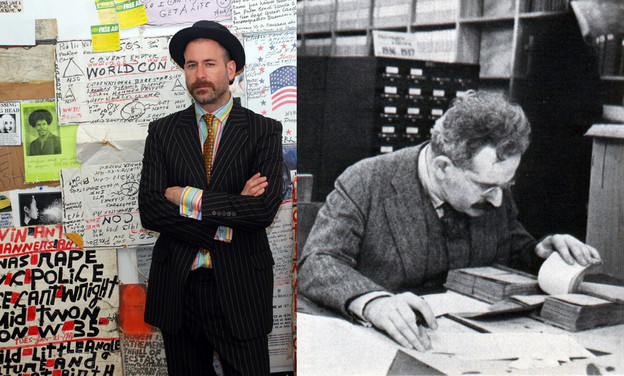
Walter Benjamin, Ludwig Wittgenstein, and Sigmund Freud: if these theorists share any quality at all, they share a reputation for not going easy on their readers. Each of them wrote in a way that exudes a different kind of intellectual difficulty — Benjamin’s sudden swerves into the zone where high relevance meets high irrelevance, Wittgenstein’s austere certainty, Freud’s elaborate flights into the near-fantastical — but all of their work poses a challenge to readers approaching it for the first time. And so Kenneth Goldsmith Sings Theory addresses the obvious question: what if you didn’t read it, but heard it sung instead?
“What is it about academic theory that begs to be, well, sung by people who can’t sing?” asks Goldsmith, poet, prof, UBUweb creator, and WFMU radio host, on the station’s blog. He cites examples from a punk-rockified Theodor Adorno to a Finnish eccentric’s conversion of the Tractatus Logico-Philosophicus into a songbook, eventually coming to his own “adventures into the field,” which you can hear in the Pennsound archive. Just above, we have have Goldsmith singing Benjamin’s “Unpacking my Library” to music by experimental violinist Eyvind Kang [MP3]. “Just as Benjamin lists copies of other books and the associations they bring,” writes Jacob Edmond at Jacket2, “so Goldsmith copies Benjamin, creating an idiosyncratic audio book version. ”
Wittgenstein Part 1
Wittgenstein Part 2
“In his performance of the text, Goldsmith fuses precisely delineated musical sections, or movements, with the chaotic, shifting pitch and tone of his voice, paralleling Benjamin’s observation in the essay that ‘if there is a counterpart to the confusion of a library, it is the order of its catalogue.’ ” Can you find similar parallels between Goldsmith’s manner of singing and the theory he delivers with it when he performs Wittgenstein’s Philosophical Investigations to Igor Stravinsky [MP3 part one, MP3 part two]? Or below, where he sings Sigmund Freud’s The Psychopathology of Everyday Life, starting on the passage of the “slips of the tongue” which have popularly come to bear Freud’s name, to The Who [MP3]? After all, style doesn’t count for much, as such a strikingly dressed character as Goldsmith knows full well, unless it aligns with substance.
Related Content:
Walter Benjamin’s Mystical Thought Presented by Two Experimental Films
Walter Benjamin’s Radio Plays for Kids (1929–1932)
Ludwig Wittgenstein’s Tractatus Gets Adapted Into an Avant-Garde Comic Opera
Sigmund Freud Speaks: The Only Known Recording of His Voice, 1938
Colin Marshall writes on cities, language, Asia, and men’s style. He’s at work on a book about Los Angeles, A Los Angeles Primer, and the video series The City in Cinema. Follow him on Twitter at @colinmarshall or on Facebook.
Read More...Hours of Edgar Allan Poe Stories Read by Vincent Price & Basil Rathbone
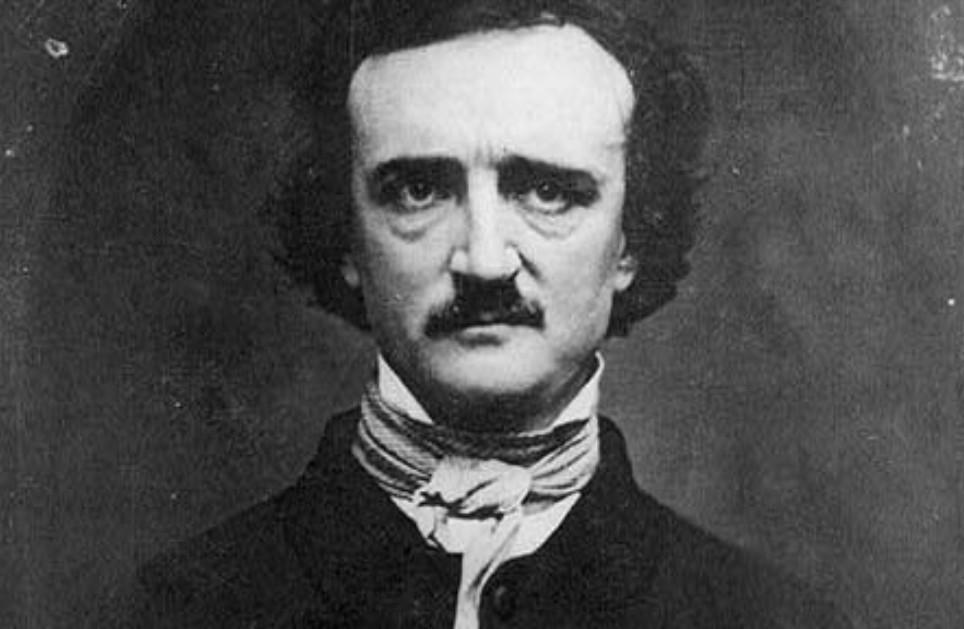
Record label Caedmon Audio specialized in spoken-word recordings, pairing great literary works with great actors. They got James Mason to read the poetry of Robert Browning, multi-Oscar winner Walter Brennan to read the works of Mark Twain and Sir Laurence Olivier to read Winston Churchill.
But there were a couple releases, later compiled into one glorious CD set, that is so head-slappingly perfect that it requires special attention: Basil Rathbone and Vincent Price read the works of Edgar Allan Poe over the course of 5 hours. Rathbone was, of course, a South African-born Shakespearean actor who is most famous for playing Sherlock Holmes in a string of films (watch one here) and radio plays, though he was also a veteran star of low-budget horror films like The Black Sheep and Tales of Terror. Vincent Price was, well, Vincent Price – the iconic cackling villain in dozens of horror flicks including Roger Corman’s campy cinematic adaptations of Poe – The House of Usher, The Raven and The Masque of the Red Death.
The Caedmon recordings, which are now available on Spotify (download the software here) and can be heard below, are pretty much Poe’s greatest hits – from “The Tell-Tale Heart” to “The Pit and Pendulum.” Poe’s gothic gloominess pairs brilliantly with Rathbone and Price’s sinister baritone.
So get into your favorite smoking jacket, get a fire started, pour yourself a stiff glass of absinthe, set aside a good block of time, and have a listen.
If you would like to support the mission of Open Culture, consider making a donation to our site. It’s hard to rely 100% on ads, and your contributions will help us continue providing the best free cultural and educational materials to learners everywhere. You can contribute through PayPal, Patreon, and Venmo (@openculture). Thanks!
Related Content:
Edgar Allan Poe’s “The Raven,” Read by Christopher Walken, Vincent Price, and Christopher Lee
Watch the 1953 Animation of Edgar Allan Poe’s “The Tell-Tale Heart,” Narrated by James Mason
Edgar Allan Poe Animated: Watch Four Animations of Classic Poe Stories
Download The Complete Works of Edgar Allan Poe on His Birthday
1,000 Free Audio Books: Download Great Books for Free
Jonathan Crow is a Los Angeles-based writer and filmmaker whose work has appeared in Yahoo!, The Hollywood Reporter, and other publications. You can follow him at @jonccrow. And check out his blog Veeptopus, featuring lots of pictures of vice presidents with octopuses on their heads. The Veeptopus store is here.
Read More...Pipes with Cannabis Traces Found in Shakespeare’s Garden, Suggesting the Bard Enjoyed a “Noted Weed”
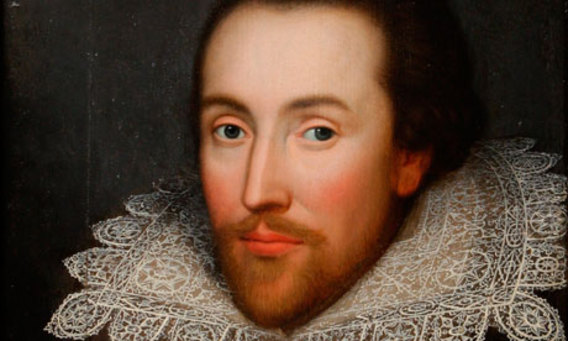
Not more than 10 days ago, Jonathan Crow highlighted for you Adam Bertocci’s Two Gentlemen of Lebowski, a book that asks you to suspend disbelief and imagine, What if…William Shakespeare had written The Big Lebowski?
Now comes news that makes the collision of the Bard’s and Lebowski’s worlds somewhat more plausible. According to The Telegraph, “South African scientists have discovered that 400-year-old tobacco pipes excavated from the garden of William Shakespeare contained cannabis, suggesting the playwright might have written some of his famous works while high.” Lebowski could relate.
If you want to get into the specifics, you can read the précis published in The South African Journal of Science called “Shakespeare, plants, and chemical analysis of early
17th century clay ‘tobacco’ pipes from Europe.” It details how a team, led by anthropologist Francis Thackeray at the University of the Witwatersrand in Johannesburg, used a “sophisticated technique called gas chromatography mass spectrometry (GCMS)” to analyze “pipes [that] had been excavated from the garden of William Shakespeare.” The results of their study? They “indicated Cannabis in eight samples, nicotine (from tobacco leaves of the kind associated with Raleigh) in at least one sample, and (in two samples) definite evidence for Peruvian cocaine from coca leaves of the kind which Thackeray et al. associated with Drake who had himself been to Peru before 1597.”
Thackeray also finds literary support for the idea that Shakespeare had a taste for Cannabis, noting that in “Sonnet 76 Shakespeare writes about ‘invention in a noted weed’. This can be interpreted to mean that Shakespeare was willing to use ‘weed’ … for creative writing (‘invention’).” The précis goes on to add: “In the same sonnet it appears that [Shakespeare] would prefer not to be associated with ‘compounds strange’, which can be interpreted, at least potentially, to mean ’strange drugs’ (possibly cocaine).” You can read Sonnet 76 in full here:
Why is my verse so barren of new pride,
So far from variation or quick change?
Why with the time do I not glance aside
To new-found methods and to compounds strange?
Why write I still all one, ever the same,
And keep invention in a noted weed,
That every word doth almost tell my name,
Showing their birth and where they did proceed?
O, know, sweet love, I always write of you,
And you and love are still my argument;
So all my best is dressing old words new,
Spending again what is already spent:
For as the sun is daily new and old,
So is my love still telling what is told.
Related Content:
Free Online Shakespeare Courses: Primers on the Bard from Oxford, Harvard, Berkeley & More
Read All of Shakespeare’s Plays Free Online, Courtesy of the Folger Shakespeare Library
Take a Virtual Tour of Shakespeare’s Globe Theatre
Read More...Read Arthur C. Clarke’s Super Short, 31-Word Sci-Fi Story, “siseneG”
As brevity in fiction goes, who can top “For sale: baby shoes, never worn”? That much-referenced six-word story, often attributed to Ernest Hemingway, certainly packs an impressive amount of human drama into its short length. But what about other genres? What would a six-word science- fiction story look like? i09 crowdsourced countless such works in 2014: responses, which tended toward the eschatological, included “The Universe died. He did not,” “New world. Cryogenic failure. Seeds dead,” and “Finally sentient, it switched itself off.”
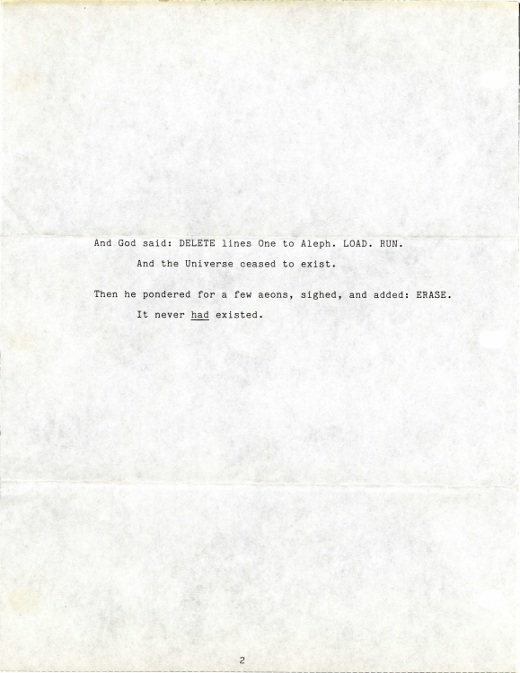
Not bad, but what would we get if we went to the professionals? Alas, Sir Arthur C. Clarke, prolific author of such respected sci-fi novels as 2001: A Space Odyssey and Rendezvous with Rama, passed away just five years before i09 issued its challenge. Still, we have an idea of the direction his entry might have gone in from of “siseneG,” a story story — a very short story indeed — Clarke sent in to Analog magazine in 1984:
And God said: DELETE lines One to Aleph. LOAD. RUN.
And the Universe ceased to exist.Then he pondered for a few aeons, sighed, and added: ERASE.
It never had existed.
“This is the only short story I’ve written in ten years or so,” Clarke wrote in the accompanying note. “I think you’ll agree that they don’t come much shorter.” We now know that they can come somewhat shorter, at least 25 words shorter than “siseneG,” but surely we can all agree that Clarke set a high standard for scientific (or perhaps technological-existential) flash fiction decades before the coinage of the term. But then, we always knew the man had a knack for looking ahead.
via Letters of Note
Related Content:
In 1964, Arthur C. Clarke Predicts the Internet, 3D Printers and Trained Monkey Servants
Arthur C. Clarke Predicts in 2001 What the World Will Look By December 31, 2100
Arthur C. Clarke Narrates Film on Mandelbrot’s Fractals; David Gilmour Provides the Soundtrack
Free Science Fiction Classics on the Web: Huxley, Orwell, Asimov, Gaiman & Beyond
Colin Marshall writes on cities, language, Asia, and men’s style. He’s at work on a book about Los Angeles, A Los Angeles Primer, and the video series The City in Cinema. Follow him on Twitter at @colinmarshall or on Facebook.
Read More...Sarcasm Can Boost Creativity According to Research From Harvard & Columbia Business Schools

Underlying image by Gage Skidmore.
Echoing Bill Murray, the Urban Dictionary defines sarcasm as “your body’s natural defense against stupid,” noting that it’s “the highest form of wit” in countries like the UK, but the lowest in America, owing to the population’s inability to detect whether or not one is being sarcastic.
Example:
Idiot: I beat up a ten-year-old today.
You: (with a hint of sarcasm) That’s impressive!
Idiot: I know, right!
A new study by Francesca Gino, Adam Galinsky, and Li Huang, of Harvard, Columbia and INSEAD business schools, respectively, suggests that the use of sarcasm promotes creativity for those on the giving and receiving end of sarcastic exchanges.
Gino told the Harvard Gazette, “To create or decode sarcasm, both the expressers and recipients of sarcasm need to overcome the contradiction (i.e., psychological distance) between the literal and actual meanings of the sarcastic expressions. This is a process that activates and is facilitated by abstraction, which in turn promotes creative thinking.”
Galinsky added, the givers and receivers in sarcastic exchanges “subsequently performed better on creativity tasks than those in the sincere conditions or the control condition. This suggests that sarcasm has the potential to catalyze creativity in everyone.” “That being said, although not the focus of our research, it is possible that naturally creative people are also more likely to use sarcasm, making it an outcome instead of [a] cause in this relationship.”
The evidence certainly seems solid in the hands of master practitioners such as Louis CK, Sarah Silverman, and the staff of The Onion, not to mention newcomer Shirley Jester, an animated Sarcastic Foul-Mouthed Teenage Comedian Girl from the Renaissance.
Things get a bit murkier when amateurs attempt to adopt their idols’ caustic poses. Tone and intent are easily misconstrued. Feelings get hurt.
Is sarcasm best left to the professionals?
Not necessarily. Gino and Galinksy found that the degree of trust between expresser and recipient determines how sarcasm is received. In other words, know your audience.
Even at its meanest, sarcasm—from the Greek and Latin for “to tear flesh”—involves abstraction, a hallmark of creative thinking.
Meanwhile, you can review Clinical Psychologist Chris Fulton’s “Try that again method,” below, one of many strategies for handling “sarcastic and sassy teenagers.” Creativity be squelched.
Cue a million teenage eye rolls, and check out Gino and Galinksy’s findings here.
Related Content:
John Cleese’s Philosophy of Creativity: Creating Oases for Childlike Play
The Most “Intellectual Jokes”: Our Favorite Open Culture Reader Submissions
Read More...Support Us
We're hoping to rely on loyal readers, rather than erratic ads. Please click the Donate button and support Open Culture. You can use Paypal, Venmo, Patreon, even Crypto! We thank you!

About Us

Open Culture scours the web for the best educational media. We find the free courses and audio books you need, the language lessons & educational videos you want, and plenty of enlightenment in between.
Advertise With Us

FREE UPDATES!
GET OUR DAILY EMAIL
Get the best cultural and educational resources on the web curated for you in a daily email. We never spam. Unsubscribe at any time.
FOLLOW ON SOCIAL MEDIA

Open Culture editor Dan Colman scours the web for the best educational media. He finds the free courses and audio books you need, the language lessons & movies you want, and plenty of enlightenment in between.
Advertise With Us