William S. Burroughs’ Scathing “Thanksgiving Prayer,” Shot by Gus Van Sant
“Thanksgiving Day, Nov. 28, 1986” first appeared in print in Tornado Alley, a chapbook published by William S. Burroughs in 1989. Two years later, Gus Van Sant (Good Will Hunting, My Own Private Idaho, Milk) shot a montage that brought the poem to film, making it at least the second time the director adapted the beat writer to film.
If you’ve seen Burroughs use Shakespeare’s face for target practice, or if you’ve watched The Junky’s Christmas, you’ll know that he wasn’t kind to convention or tradition. And there are no prisoners taken here, as you’ll see above.
For background on Burroughs, read the New Yorker piece “The Outlaw, The extraordinary life of William S. Burroughs.” Find the text for “Thanksgiving Prayer” here.
Now time for a little Thanksgiving dinner.…
If you would like to support the mission of Open Culture, consider making a donation to our site. It’s hard to rely 100% on ads, and your contributions will help us continue providing the best free cultural and educational materials to learners everywhere. You can contribute through PayPal, Patreon, and Venmo (@openculture). Thanks!
Related Content:
William S. Burroughs Tells the Story of How He Started Writing with the Cut-Up Technique
How William S. Burroughs Influenced Rock and Roll, from the 1960s to Today
William S. Burroughs Teaches a Free Course on Creative Reading and Writing (1979)
Read More...
Explore and Download 14,000+ Woodcuts from Antwerp’s Plantin-Moretus Museum Online Archive
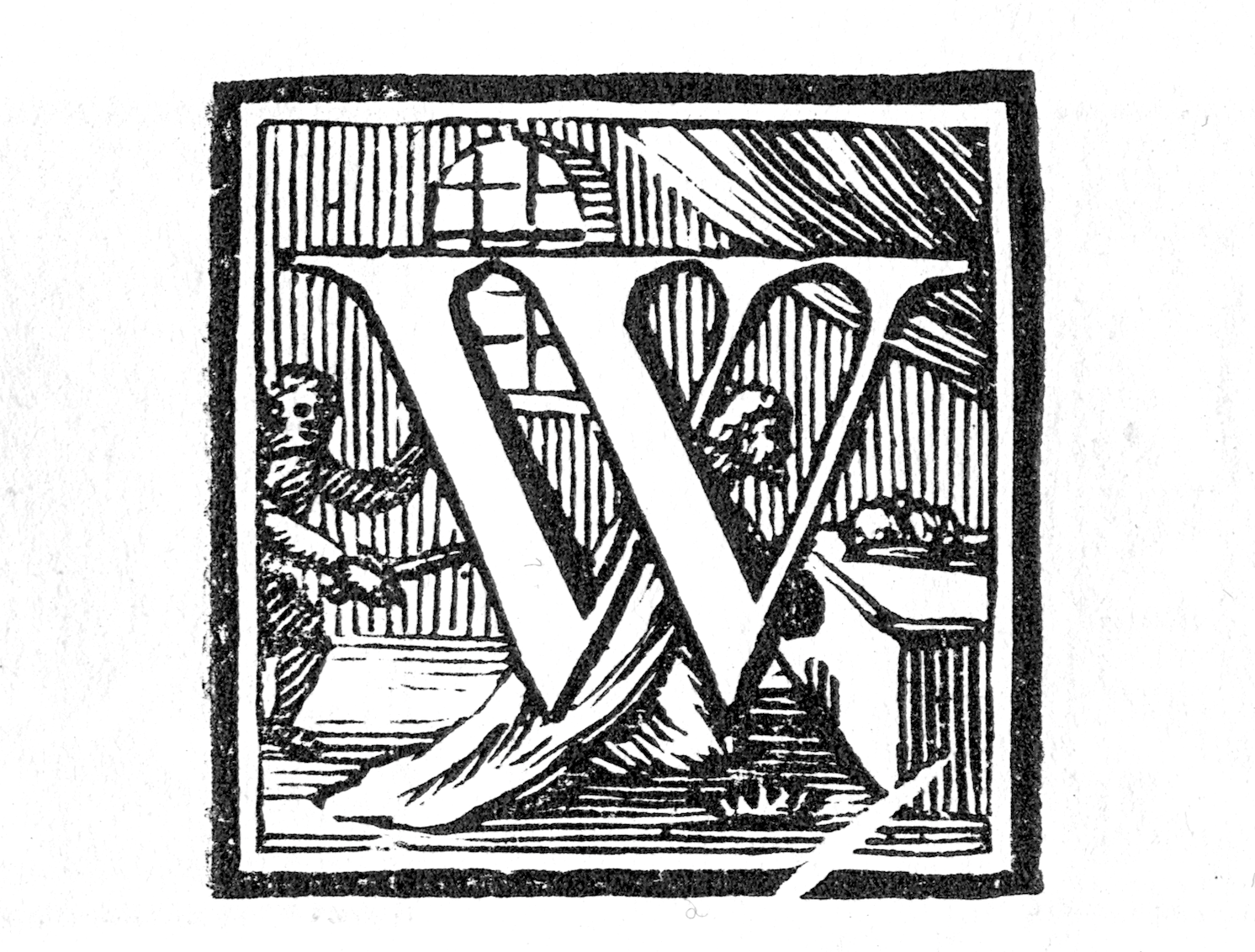
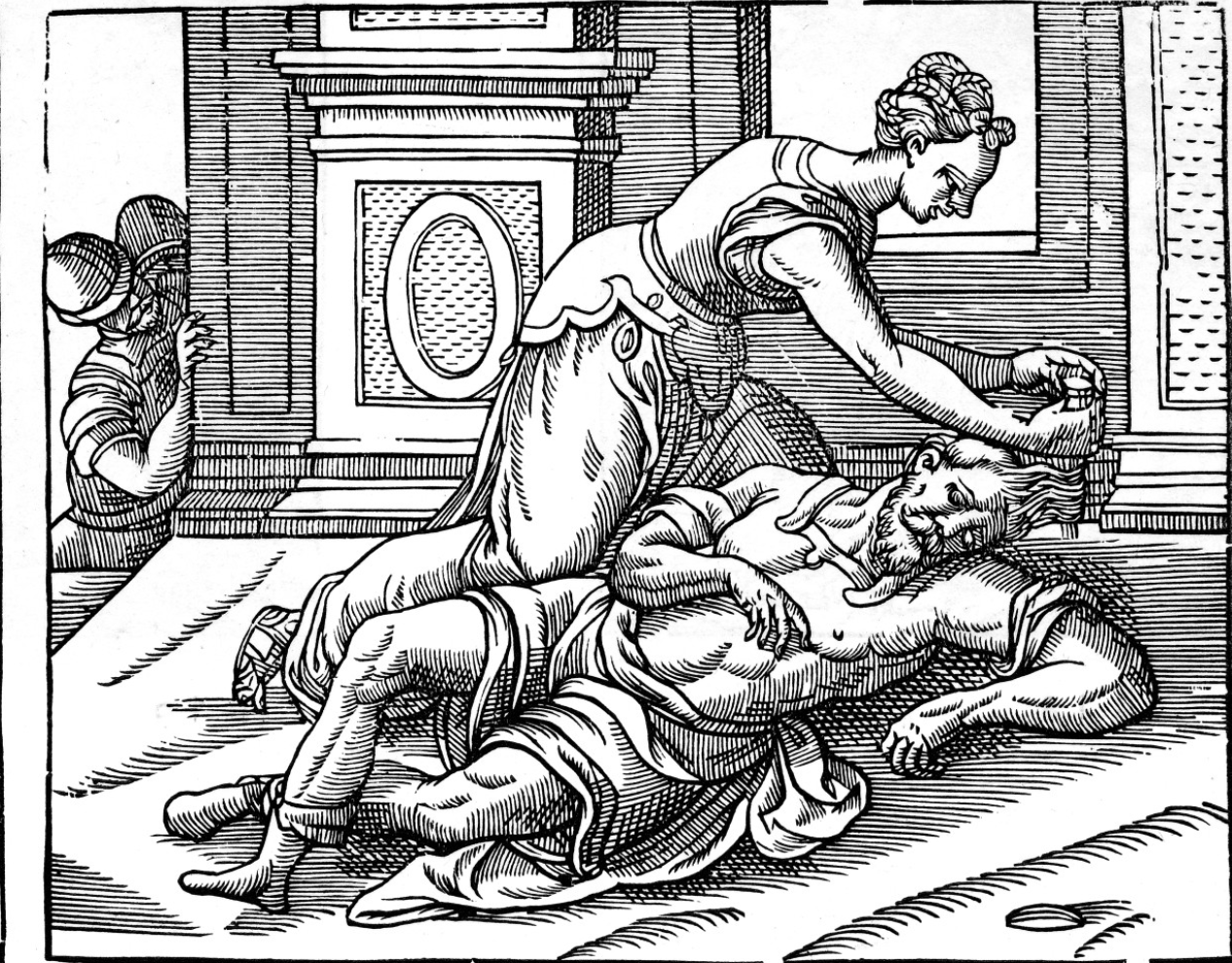
We appreciate illuminated manuscripts and historical books here on Open Culture, adhere though we do to a much more restrained aesthetic style in our own texts. But that’s not to deny the temptation to start this paragraph with one of those oversized initial letters that grew ever larger and more elaborate over centuries past. The online archive of Antwerp’s Plantin-Moretus Museum offers plenty of woodcut Ws to choose from, including designs sober and barely legible, as well as Ws that incorporate a sprouting plant, some kind of saint, and even a scene of what looks like impending murder.

If you’re not in the market for fancy letters, you can also browse the Plantin-Moretus woodcut archive through the categories of plants, animals, and sciences. Some of these illustrations are technical, and others more fanciful; in certain cases, the centuries have probably rendered them less realistic-looking than once they were.
Not all the more than 14,000 woodcuts now in the archive would seem to fit neatly in one of those categories, but if you take a look at particular entries, you’ll find that the museum has also labeled them with more specific tags, like “classical antiquity,” “map/landscape,” or “aureole” (the bright medieval-looking halo that marks a figure as holy).
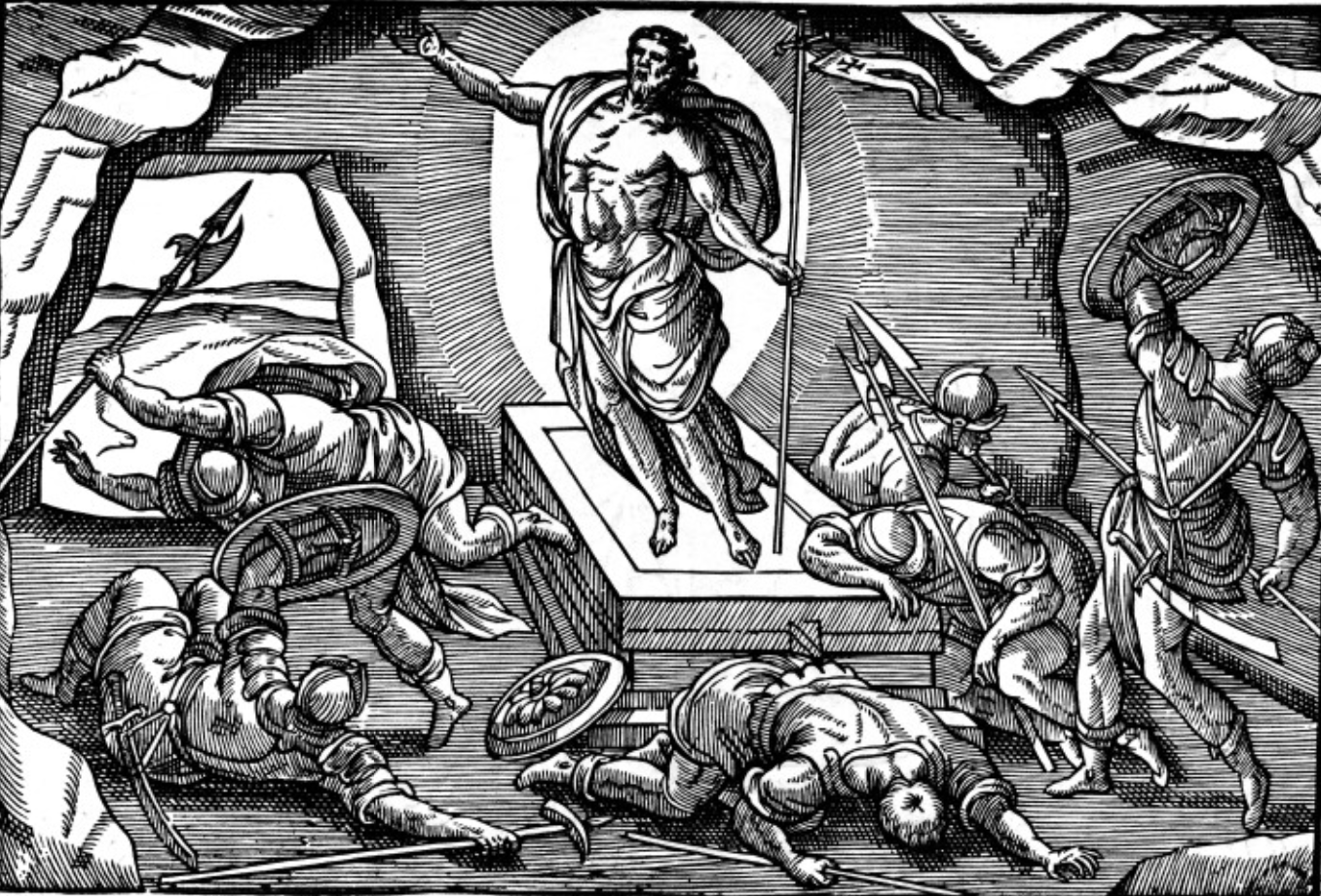
All these woodcuts, in any case, have been made free to download (just click the cloud icon in the upper-right of the window that opens after you click on the image itself) and use as you please. Back in the sixteenth century, Christophe Plantin and Jan Moretus, for whom the Plantin-Moretus Museum was named, were well-placed to collect such things. The Plantin-Moretus Museum’s website describes them as “a revolutionary duo.
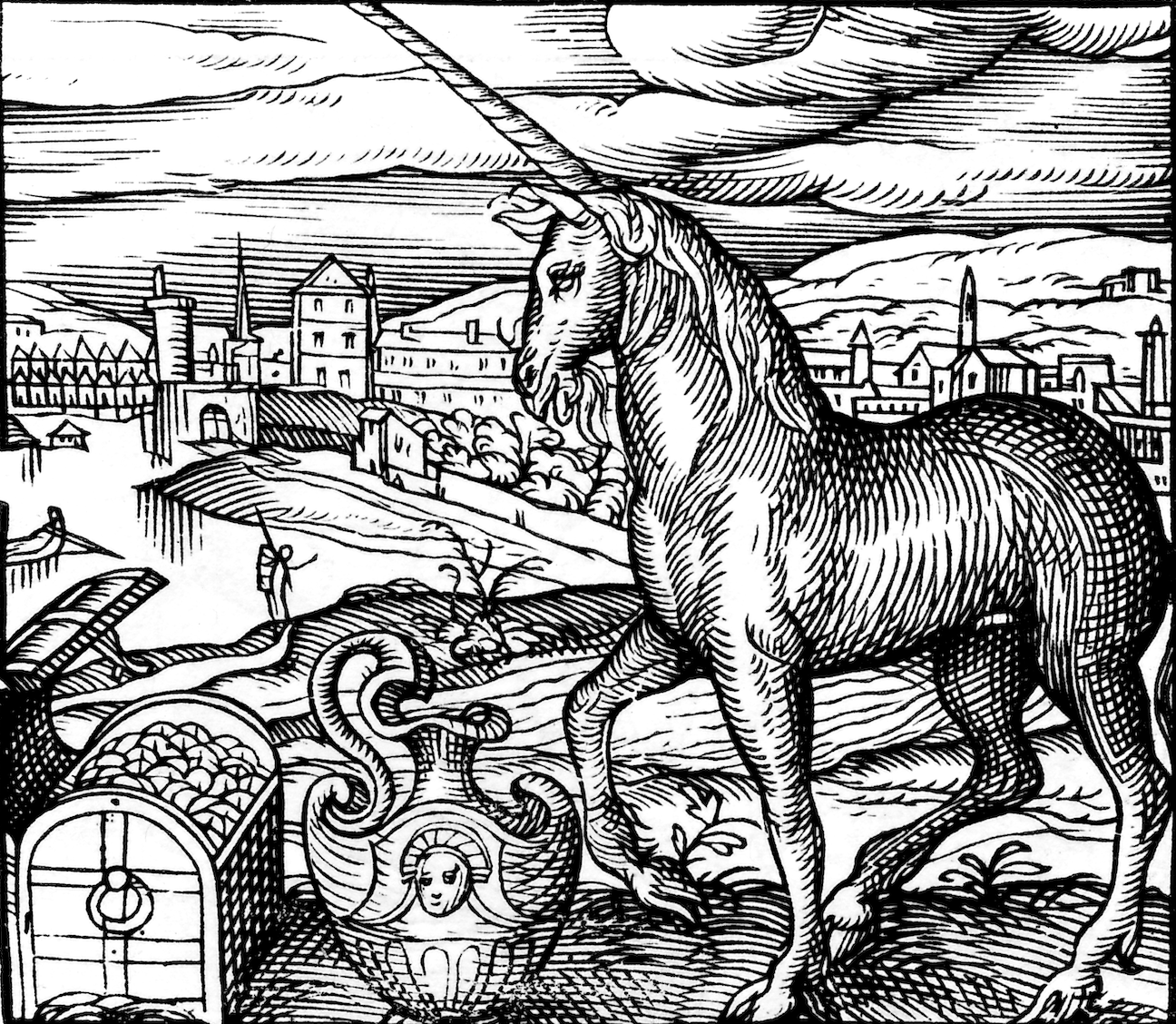
They were the first printers on an industrial scale — the Steve Jobs and Mark Zuckerberg of their day.” And if these decontextualized artifacts of the print revolution strike us as a bit strange to us today, just imagine how our surviving internet memes will look four centuries hence. Enter the woodblock collection here.
via Metafilter
Related content:
Stephen Fry Takes Us Inside the Story of Johannes Gutenberg & the First Printing Press
Classic Films and Filmmakers, Rendered in Woodcut By a Los Angeles Artist-Cinephile
Based in Seoul, Colin Marshall writes and broadcasts on cities, language, and culture. His projects include the Substack newsletter Books on Cities and the book The Stateless City: a Walk through 21st-Century Los Angeles. Follow him on Twitter at @colinmarshall.
Read More...Ken Burns’ New Documentary on Leonardo da Vinci Streaming Online (in the US) for a Limited Time
A quick heads up: The filmmaker Ken Burns has just released his new documentary on Leonardo da Vinci. Running nearly four hours, the film offers what The New York Times calls a “thorough and engrossing biography” of the 15th-century polymath. Currently airing on PBS, the film can be streamed online through December 17th. If you reside in the US, you can watch Part 1 here, and Part 2 here. The film’s trailer appears above.
PS: As Metafilter observes, the PBS website also features some nice bonus material, including 3D models of Leonardo’s inventions and a high-res gallery of some of Leonardo’s work featured in the documentary. Be sure to check them out.
If you would like to support the mission of Open Culture, consider making a donation to our site. It’s hard to rely 100% on ads, and your contributions will help us continue providing the best free cultural and educational materials to learners everywhere. You can contribute through PayPal, Patreon, and Venmo (@openculture). Thanks!
Related Content
Leonardo da Vinci’s Handwritten Resume (Circa 1482)
Leonardo Da Vinci’s To Do List (Circa 1490)
The Ingenious Inventions of Leonardo da Vinci Recreated with 3D Animation
Why Leonardo da Vinci’s Greatest Painting is Not the Mona Lisa
Read More...How Rasputin Inspired the “Fictitious Persons” Disclaimer Commonly Seen in Movies
“This is a work of fiction,” declares the disclaimer we’ve all noticed during the end credits of movies. “Any similarity to actual persons, living or dead, or actual events, is purely coincidental.” In most cases, this may seem so trivial that it hardly merits a mention, but the very same disclaimer also rolls up after pictures very clearly intended to represent actual events or persons, living or dead. Most of us would write it all off as one more absurdity created by the elaborate pantomime of American legal culture, but a closer look at its history reveals a much more intriguing origin.
As told in the Cheddar video above, the story begins with Rasputin and the Empress, a 1932 Hollywood movie about the titular real-life mystic and his involvement with the court of Nicholas II, the last emperor of Russia. Having been killed in 1916, Rasputin himself wasn’t around to get litigious about his villainous portrayal (by no less a performer than Lionel Barrymore, incidentally, acting alongside his siblings John and Ethel as the prince and czarina). It was actually one of Rasputin’s surviving killers, an exiled aristocrat named Felix Yusupov, who sued MGM, accusing them of defaming his wife, Princess Irina Yusupov, in the form of the character Princess Natasha.
The film casts Princess Natasha as a supporter of Rasputin, writes Slate’s Duncan Fyfe, “but the mystic, wary of her husband, hypnotizes and rapes her, rendering Natasha — by his logic, with which she agrees — unfit to be a wife. Yusupov contended that as viewers would equate Chegodieff with Yusupov, so would they link Natasha with Irina,” though in reality Irina and Rasputin never even met. In an English court, “the jury found in her favor, awarding her £25,000, or about $125,000. MGM had to take the film out of circulation for decades and purge the offending scene for all time,” though a small piece of it remains in Rasputin and the Empress’ original trailer.
Things might have gone in MGM’s favor had the film not included a title card announcing that “a few of the characters are still alive — the rest met death by violence.” The studio was advised that they’d have done well to declare the exact opposite, a practice soon implemented across Hollywood. It didn’t take long for the movies to start having fun with it, introducing jokey variations on the soon-familiar boilerplate. Less than a decade after Rasputin and the Empress, one nonsensical musical comedy previously featured here on Open Culture) opened with the disclaimer that “any similarity between HELLZAPOPPIN’ and a motion picture is purely coincidental” — a tradition more recently upheld by South Park.
via Kottke
Related content:
The Romanovs’ Last Ball Brought to Life in Color Photographs (1903)
Watch an 8‑Part Film Adaptation of Tolstoy’s Anna Karenina Free Online
Watch the Hugely Ambitious Soviet Film Adaptation of War and Peace Free Online (1966–67)
Based in Seoul, Colin Marshall writes and broadcasts on cities, language, and culture. His projects include the Substack newsletter Books on Cities and the book The Stateless City: a Walk through 21st-Century Los Angeles. Follow him on Twitter at @colinmarshall.
Read More...14 Self-Portraits by Pablo Picasso Show the Evolution of His Style: See Self-Portraits Moving from Ages 15 to 90
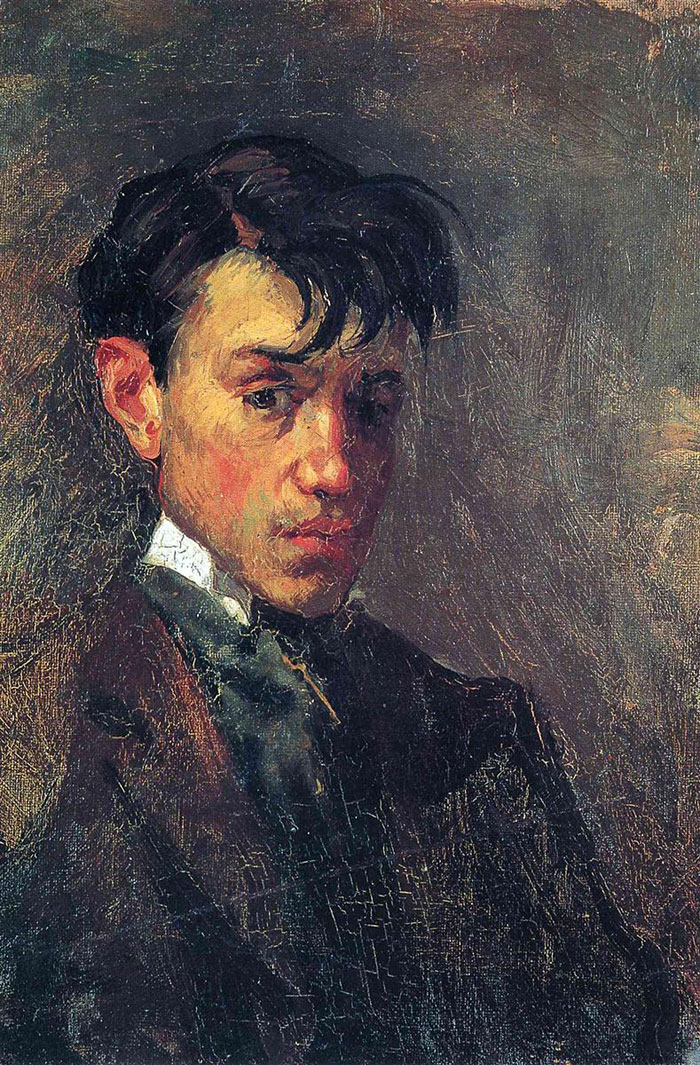
15 years old (1896)
It’s possible to look at Pablo Picasso’s many formal experiments and periodic shifts of style as a kind of self-portraiture, an exercise in shifting consciousness and trying on of new aesthetic identities. The Spanish modernist made a career of sweeping dramatic gestures, announcements to the world that he was going to be a different kind of artist now, and everyone had better catch up. Even in his most abstract periods, his work radiated with an emotional energy as outsized as the man himself.

18 years old (1900)
Picasso’s animus and vitality even permeate his least inviting painting, Les Demoiselles d’Avignon, a brothel scene with five geometrical women, two with African and Iberian masks; “a painting of nudes in which there is scarcely a curve to be seen,” writes The Guardian’s Jonathan Jones, “elbows sharp as knives, hips and waists geometrical silhouettes, triangle breasts.” The 1907 self-portrait of Picasso at age 25 (below) comes from this period, when the artist began his radical Cubist break with everything that had gone before.

20 years old (1901)
An older version Les Demoiselles d’Avignon contained a male figure, “a stand-in for the painter himself.” Even when he did not appear, at least not in a final version, in his own work, Picasso saw himself there: his moods, his heightened perceptions of reality as he imagined it.
The somber Blue Period paintings, with their moodiness and “themes of poverty, loneliness, and despair,” correspond with his mourning over the suicide of a friend, Catalan artist Carlos Casagemas. The Picasso in the 1901 portrait further up looks gaunt, broken, decades older than his 20 years. In the 1917 drawing further down, however, the artist at 35 looks out at us with a haughty, smooth-cheeked youthful gaze.

24 years old (1906)
During this time, as World War I ended, he had begun to design sets for Diaghilev’s famed Ballets Russes, where he met his wife, ballerina Olga Khokhlova, and moved in comfortable circles, though he was himself desperate for money. Each portrait delivers us a different Picasso, as he sheds one mask and puts on another. Tracing his creative evolution through his portraiture means never moving in a straight line. But we do see his demeanor soften and round progressively over time in his portraits. He seems to grow younger as he ages.

25 years old (1907)
The severe youth of 15, further up, brooding, world-weary, and already an accomplished draughtsman and painter; the grimly serious romantic at 18, above—these Picassos give way to the wide-eyed maturity of the artist at 56 in 1938, at 83, 89, and 90, in 1972, the year before his death. That year he produced an intriguing series of eclectic self-portraits unlike anything he had done before. See these and many others throughout his life below.

35 years old (1917)
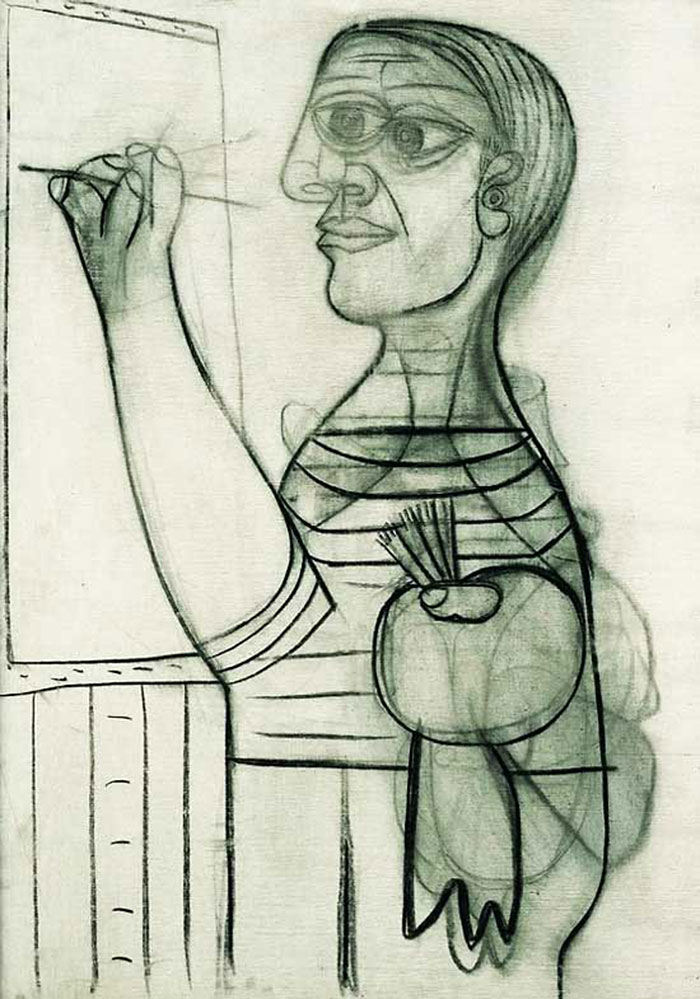
56 years old (1938)

83 years old (1965)
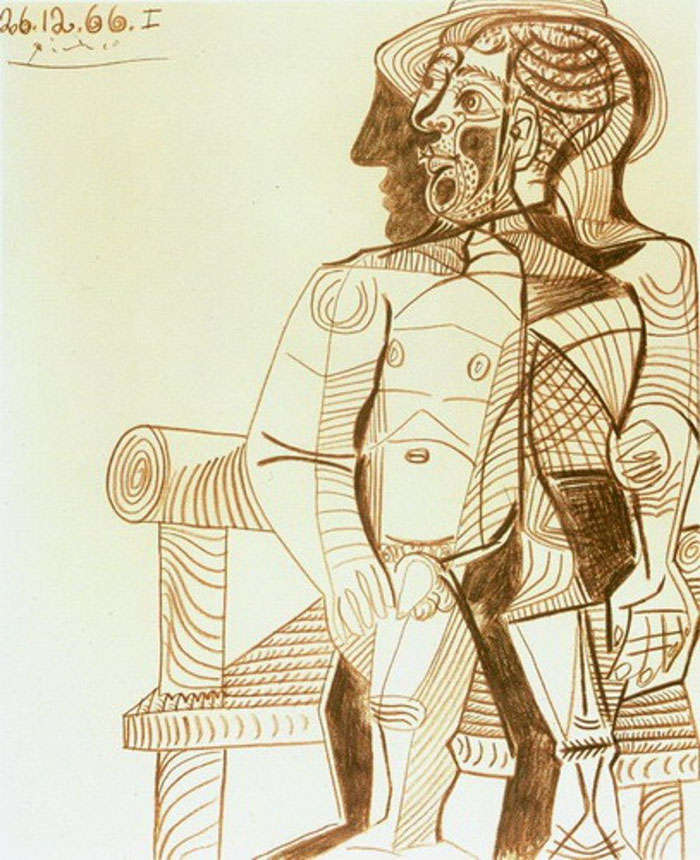
85 years old (1966)

89 years old (1971)

90 years old (June 28, 1972)

90 years old (June 30, 1972)

90 years old (July 2, 1972)
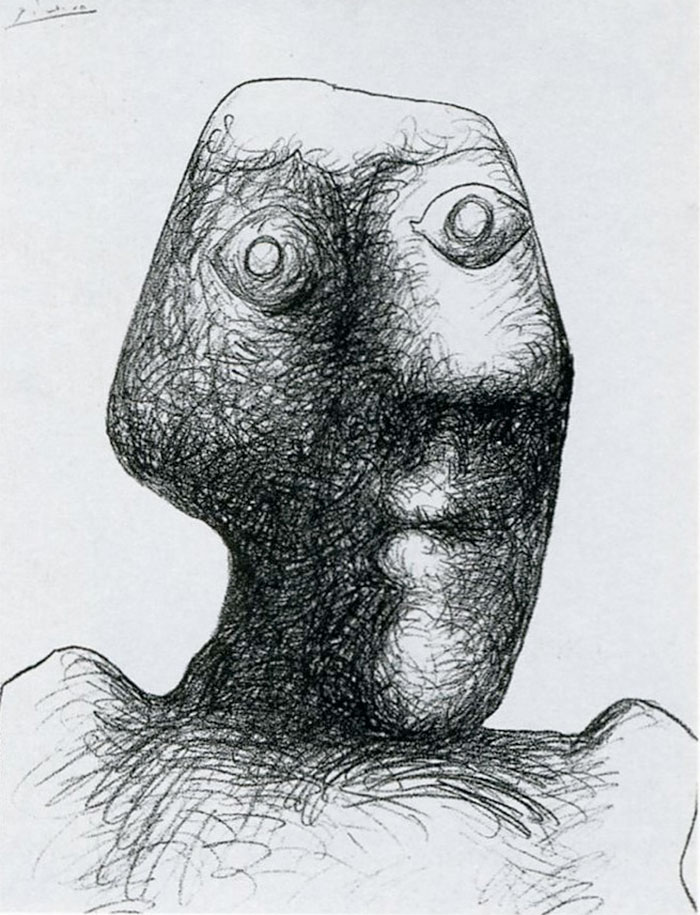
90 years old (July 3, 1972)
Related Content:
Thousands of Pablo Picasso’s Works Now Available in a New Digital Archive
15-Year-Old Picasso Paints His First Masterpiece, “The First Communion”
Josh Jones is a writer and musician based in Durham, NC. Follow him at @jdmagness
Read More...
How the Ancient Romans Traveled Without Maps
In an age when many of us could hardly make our way to an unfamiliar grocery store without relying on a GPS navigation system, we might well wonder how the Romans could establish and sustain their mighty empire without so much as a proper map. That’s the question addressed by the Historia Militum video above, “How Did Ancient People Travel Without Maps?” Or more to the point, how did they travel without scaled maps — that is, ones “in which the map’s distances were proportional to their actual size in the real world,” like almost all those we consult on our screens today?
The surviving maps from the ancient Roman world tend not to take great pains adhering to true geography. Yet as the Roman Empire expanded, laying roads across three continents, more and more Romans engaged in long-distance travel, and for the most part seem to have arrived at their intended destinations.
To do so, they used not maps per se but “itineraries,” which textually listed towns and cities along the way and the distance between them. By the fourth century, “all main Roman roads along with 225 stopping stations were compiled in a document called the Itinerarium Antonini, the Itinerary of Emperor Antonius Pius.”
This highly practical document includes mostly roads that “passed through large cities, which provided better facilities for housing, shopping, bathing, and other traveler needs.” With this information, “a traveler could copy the specific distances and stations they needed to reach their destination.” Still today, some seventeen centuries later, “most people wouldn’t use a paper scaled map for travel, but would instead break their journey down into a list of subway stations, bus stops, and intersections.” And if you were to attempt to drive across Europe, making a modern-day Roman Empire road trip, you’d almost certainly rely on the distances and points of interest provided by the synthesized voice reading aloud from the vast Itinerarium Antonini of the twenty-first century.
Related content:
A Map Showing How the Ancient Romans Envisioned the World in 40 AD
Download 131,000 Historic Maps from the Huge David Rumsey Map Collection
Based in Seoul, Colin Marshall writes and broadcasts on cities, language, and culture. His projects include the Substack newsletter Books on Cities and the book The Stateless City: a Walk through 21st-Century Los Angeles. Follow him on Twitter at @colinmarshall.
Read More...How to Potty Train Your Cat: A Handy Manual by Jazz Musician Charles Mingus
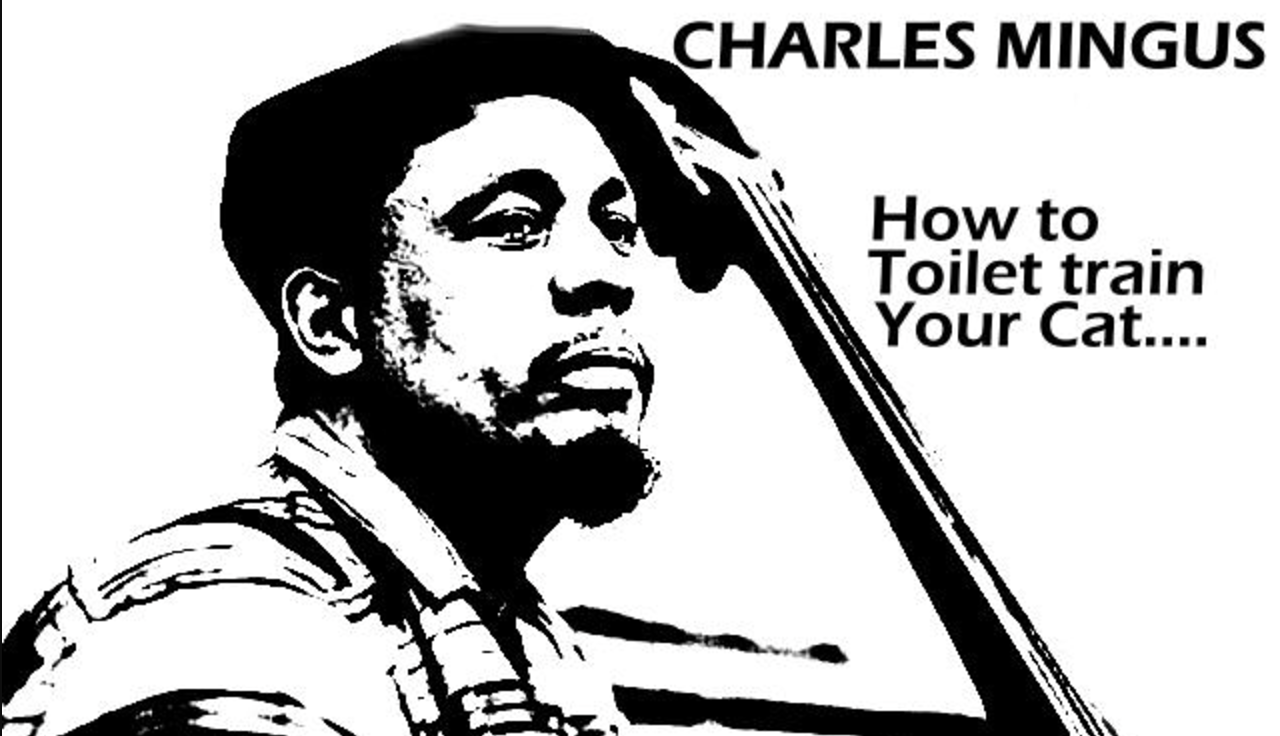
Charles Mingus, the innovative jazz musician, was known for having a bad temper. He once got so irritated with a heckler that he ended up trashing his $20,000 bass. Another time, when a pianist didn’t get things right, Mingus reached right inside the piano and ripped the strings out with his bare hands — a true story mentioned in the BBC documentary, 1959: The Year that Changed Jazz.
But Mingus had a softer, nurturing side too. If you head to the official Charles Mingus website, you will find a copy of the Charles Mingus Cat Toilet Training Program, a loving little guide created for cat owners everywhere. The trick to potty training your cat comes down to edging the litter box closer to the bathroom, eventually placing the box on the potty, and then cutting a hole in the center of the box. Expect to spend about three weeks making the transition. And who knows, Mingus says, your cat may even learn to flush. The full guide appears here. Or read it below:
1
First, you must train your cat to use a home-made cardboard litter box, if you have not already done so. (If your box does not have a one-piece bottom, add a cardboard that fits inside, so you have a false bottom that is smooth and strong. This way the box will not become soggy and fall out at the bottom. The grocery store will have extra flat cardboards which you can cut down to fit exactly inside your box.)
Be sure to use torn up newspaper, not kitty litter. Stop using kitty litter. (When the time comes you cannot put sand in a toilet.)
Once your cat is trained to use a cardboard box, start moving the box around the room, towards the bathroom. If the box is in a corner, move it a few feet from the corner, but not very noticeably. If you move it too far, he may go to the bathroom in the original corner. Do it gradually. You’ve got to get him thinking. Then he will gradually follow the box as you move it to the bathroom. (Important: if you already have it there, move it out of the bathroom, around, and then back. He has to learn to follow it. If it is too close to the toilet, to begin with, he will not follow it up onto the toilet seat when you move it there.) A cat will look for his box. He smells it.
2
Now, as you move the box, also start cutting the brim of the box down, so the sides get lower. Do this gradually.
Finally, you reach the bathroom and, eventually, the toilet itself. Then, one day, prepare to put the box on top of the toilet. At each corner of the box, cut a little slash. You can run string around the box, through these slashes, and tie the box down to the toilet so it will not fall off. Your cat will see it there and jump up to the box, which is now sitting on top of the toilet (with the sides cut down to only an inch or so.)
Don’t bug the cat now, don’t rush him, because you might throw him off. Just let him relax and go there for awhile-maybe a week or two. Meanwhile, put less and less newspaper inside the box.
3
One day, cut a small hole in the very center of his box, less than an apple-about the size of a plum-and leave some paper in the box around the hole. Right away he will start aiming for the hole and possibly even try to make it bigger. Leave the paper for awhile to absorb the waste. When he jumps up he will not be afraid of the hole because he expects it. At this point you will realize that you have won. The most difficult part is over.
From now on, it is just a matter of time. In fact, once when I was cleaning the box and had removed it from the toilet, my cat jumped up anyway and almost fell in. To avoid this, have a temporary flat cardboard ready with a little hole, and slide it under the toilet lid so he can use it while you are cleaning, in case he wants to come and go, and so he will not fall in and be scared off completely. You might add some newspaper up there too, while you are cleaning, in case your cat is not as smart as Nightlife was.
4
Now cut the box down completely until there is no brim left. Put the flat cardboard, which is left, under the lid of the toilet seat, and pray. Leave a little newspaper, still. He will rake it into the hole anyway, after he goes to the bathroom. Eventually, you can simply get rid of the cardboard altogether. You will see when he has got his balance properly.
Don’t be surprised if you hear the toilet flush in the middle of the night. A cat can learn how to do it, spurred on by his instinct to cover up. His main thing is to cover up. If he hits the flush knob accidentally and sees that it cleans the bowl inside, he may remember and do it intentionally.
Also, be sure to turn the toilet paper roll around so that it won’t roll down easily if the cat paws it. The cat is apt to roll it into the toilet, again with the intention of covering up- the way he would if there were still kitty litter.
It took me about three or four weeks to toilet train my cat, Nightlife. Most of the time is spent moving the box very gradually to the bathroom. Do it very slowly and don’t confuse him. And, remember, once the box is on the toilet, leave it a week or even two. The main thing to remember is not to rush or confuse him.
Bonus: Below you can hear The Wire’s Reg E. Cathey read “The Charles Mingus CAT-alog for Toilet Training Your Cat.”
If you would like to support the mission of Open Culture, consider making a donation to our site. It’s hard to rely 100% on ads, and your contributions will help us continue providing the best free cultural and educational materials to learners everywhere. You can contribute through PayPal, Patreon, and Venmo (@openculture). Thanks!
Related Content
Charles Mingus and His Eviction From His New York City Loft, Captured in Moving 1968 Film
Charles Mingus Explains in His Grammy-Winning Essay “What is a Jazz Composer?”
What People Named Their Cats in the Middle Ages: Gyb, Mite, Méone, Pangur Bán & More
Cats in Medieval Manuscripts & Paintings
A 110-Year-Old Book Illustrated with Photos of Kittens & Cats Taught Kids How to Read
Read More...Google Creates a Career Certificate That Prepares Students for Cybersecurity Jobs in 6 Months
In 2023, Google launched several online certificate programs designed to help students land an entry-level job, without necessarily having a college degree. This includes a certificate program focused on Cybersecurity, a field that stands poised to grow as companies become more digital and face mounting cyberattacks.
Offered on Coursera’s educational platform, the new Google Cybersecurity Professional Certificate features eight online courses, which will collectively help students learn how to:
- Understand the importance of cybersecurity practices and their impact for organizations.
- Identify common risks, threats, and vulnerabilities, as well as techniques to mitigate them.
- Protect networks, devices, people, and data from unauthorized access and cyberattacks using Security Information and Event Management (SIEM) tools.
- Gain hands-on experience with Python, Linux, and SQL.
The Cybersecurity Professional Certificate also now includes six new videos that explain how to use AI in cybersecurity. The videos cover everything from using artificial intelligence to help identify bugs and system vulnerabilities, to refining code and prioritizing alerts with AI.
Students can take individual courses in these professional certificate programs for free. (Above, you can watch a video from the first course in the cybersecurity certificate program, entitled “Foundations of Cybersecurity.”) However, if you would like to receive a certificate, Coursera will charge $49 per month (after an initial 7‑day free trial period). That means that the Cybersecurity Professional Certificate, designed to be completed in 6 months, will cost roughly $300 in total.
Once students complete the cybersecurity certificate, they can add the credential to their LinkedIn profile, resume, or CV. As a perk, students in the U.S. can also connect with 150+ employers (e.g., American Express, Colgate-Palmolive, T‑Mobile, Walmart, and Google) who have pledged to consider certificate holders for open positions. According to Coursera, this certificate can prepare students to become an entry-level “cybersecurity analyst and SOC (security operations center) analyst.”
You can start a 7‑day free trial of the Cybersecurity Professional Certificate here. Alternatively, if you sign up for Coursera Plus, whose price has been reduced by 40% until December 2, 2024, you can enroll in the cybersecurity certificate program at no charge. Find out more here.
Note: Open Culture has a partnership with Coursera. If readers enroll in certain Coursera courses and programs, it helps support Open Culture.
Read More...An Introduction to the Astonishing Book of Kells, the Iconic Illuminated Manuscript
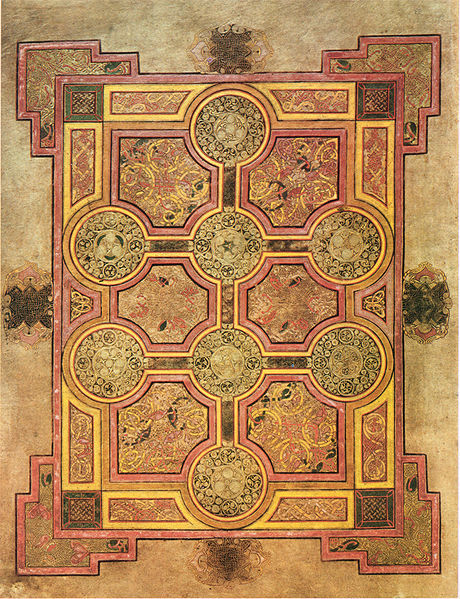
Whatever set of religious or cultural traditions you come from, you’ve probably seen a Celtic cross before. Unlike a conventional cross, it has a circular ring, or “nimbus,” where its arms and stem intersect. The sole addition of that element gives it a highly distinctive look, and indeed makes it one of the representative examples of Insular iconography — that is, iconography created within Great Britain and Ireland in the time after the Roman Empire. Perhaps the most artistically impressive Celtic cross in existence is found on one of the pages of the ninth-century Book of Kells (view online here), which itself stands as the most celebrated of all Insular illuminated manuscripts.
On what’s called the “carpet page” of the Book of Kells, explains Smarthistory’s Steven Zucker in the video above, “we see a cross so elaborate that it almost ceases to be a cross.” It has “two crossbeams, and these delicate circles with intricate interlacing in each of them, but the circles are so large that they almost overwhelm the cross itself.”
That’s hardly the only image of note in the book, which contains the four Gospels of the New Testament, among other texts, as well as numerous and extravagant illustrations, all of them executed painstakingly by hand on its vellum pages back when it was created, circa 800, in the scriptorium of a medieval monastery. These illustrations include, as Zucker’s colleague Lauren Kilroy puts it, “the earliest representation of the Virgin and Child in a manuscript in Western Europe.”
This is hardly a volume one approaches lightly — especially if one approaches it in person, as Zucker and Kilroy did on their visit to Trinity College Dublin. “When we were standing in front of the book,” says Kilroy, they “noticed how many folios formed the book itself” (which would have required the skin of more than 100 young calves). Coming to grips with the sheer quantity of material in the Book of Kells is one thing, but understanding how to interpret it is another still. Hence the free online course previously featured here on Open Culture, which can help you more fully appreciate the book in its digitized form available online. Even if the cross, Celtic or otherwise, stirs no particular religious feelings within you, the Book of Kells has much to say about the civilization that produced it: a civilization that, insular though it may once have been, would go on to change the shape of the world.
Related Content:
The Medieval Masterpiece the Book of Kells Is Now Digitized and Available Online
Take a Free Online Course on the Great Medieval Manuscript the Book of Kells
Based in Seoul, Colin Marshall writes and broadcasts on cities, language, and culture. His projects include the Substack newsletter Books on Cities and the book The Stateless City: a Walk through 21st-Century Los Angeles. Follow him on Twitter at @colinmarshall.
Read More...Discover the CIA’s Simple Sabotage Field Manual: A Timeless Guide to Subverting Any Organization with “Purposeful Stupidity” (1944)
I’ve always admired people who can successfully navigate what I refer to as “Kafka’s Castle,” a term of dread for the many government and corporate agencies that have an inordinate amount of power over our permanent records, and that seem as inscrutable and chillingly absurd as the labyrinth the character K navigates in Kafka’s last allegorical novel. Even if you haven’t read The Castle, if you work for such an entity—or like all of us have regular dealings with the IRS, the healthcare and banking system, etc.—you’re well aware of the devilish incompetence that masquerades as due diligence and ties us all in knots. Why do multi-million and billion dollar agencies seem unable, or unwilling, to accomplish the simplest of tasks? Why do so many of us spend our lives in the real-life bureaucratic nightmares satirized in The Office and Office Space?
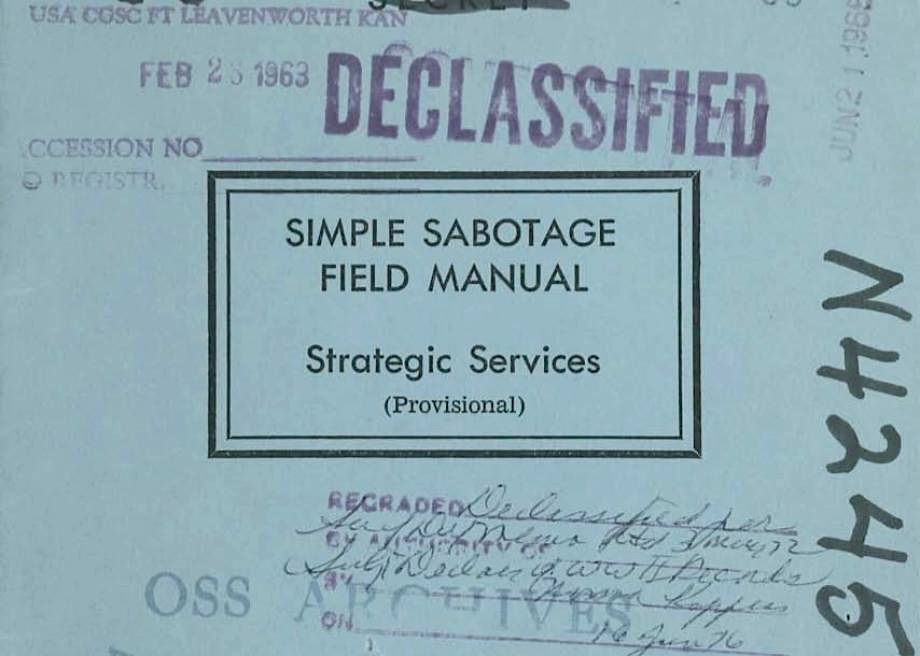
One answer comes via Laurence J. Peter’s 1969 satire The Peter Principle—which offers the theory that managers and executives get promoted to the level of their incompetence—then, David Brent-like, go on to ruin their respective departments. The Harvard Business Review summed up disturbing recent research confirming and supplementing Peter’s insights into the narcissism, overconfidence, or actual sociopathy of many a government and business leader. But in addition to human failings, there’s another possible reason for bureaucratic disorder; the conspiracy-minded among us may be forgiven for assuming that in many cases, institutional incompetence is the result of deliberate sabotage from both above and below. The ridiculous inner workings of most organizations certainly make a lot more sense when viewed in the light of one set of instructions for “purposeful stupidity,” namely the once top-secret Simple Sabotage Field Manual, written in 1944 by the CIA’s precursor, the Office of Strategic Services (OSS).
Now declassified and freely available online, the manual that the agency describes as “surprisingly relevant” was once distributed to OSS officers abroad to assist them in training “citizen-saboteurs” in occupied countries like Norway and France. Such people, writes Rebecca Onion at Slate, “might already be sabotaging materials, machinery, or operations of their own initiative,” but may have lacked the devious talent for sowing chaos that only an intelligence agency can properly master. Genuine laziness, arrogance, and mindlessness may surely be endemic. But the Field Manual asserts that “purposeful stupidity is contrary to human nature” and requires a particular set of skills. The citizen-saboteur “frequently needs pressure, stimulation or assurance, and information and suggestions regarding feasible methods of simple sabotage.”
Find an easy-to-read version on Project Gutenberg here. To get a sense of just how “timeless”—according to the CIA itself—such instructions remain, see the abridged list below, courtesy of Business Insider. You will laugh ruefully, then maybe shudder a little as you recognize how much your own workplace, and many others, resemble the kind of dysfunctional mess the OSS meticulously planned during World War II.
Organizations and Conferences
- Insist on doing everything through “channels.” Never permit short-cuts to be taken in order to expedite decisions.
- Make “speeches.” Talk as frequently as possible and at great length. Illustrate your “points” by long anecdotes and accounts of personal experiences.
- When possible, refer all matters to committees, for “further study and consideration.” Attempt to make the committee as large as possible — never less than five.
- Bring up irrelevant issues as frequently as possible.
- Haggle over precise wordings of communications, minutes, resolutions.
- Refer back to matters decided upon at the last meeting and attempt to re-open the question of the advisability of that decision.
- Advocate “caution.” Be “reasonable” and urge your fellow-conferees to be “reasonable” and avoid haste which might result in embarrassments or difficulties later on.
Managers
- In making work assignments, always sign out the unimportant jobs first. See that important jobs are assigned to inefficient workers.
- Insist on perfect work in relatively unimportant products; send back for refinishing those which have the least flaw.
- To lower morale and with it, production, be pleasant to inefficient workers; give them undeserved promotions.
- Hold conferences when there is more critical work to be done.
- Multiply the procedures and clearances involved in issuing instructions, pay checks, and so on. See that three people have to approve everything where one would do.
Employees
- Work slowly
- Work slowly.
- Contrive as many interruptions to your work as you can.
- Do your work poorly and blame it on bad tools, machinery, or equipment. Complain that these things are preventing you from doing your job right.
- Never pass on your skill and experience to a new or less skillful worker.
Note: This post originally appeared on our site in December 2015.
Related Content:
The CIA’s Style Manual & Writer’s Guide: 185 Pages of Tips for Writing Like a Spook
Josh Jones is a writer and musician based in Durham, NC. Follow him at @jdmagness
Read More...Support Us
We're hoping to rely on loyal readers, rather than erratic ads. Please click the Donate button and support Open Culture. You can use Paypal, Venmo, Patreon, even Crypto! We thank you!

About Us

Open Culture scours the web for the best educational media. We find the free courses and audio books you need, the language lessons & educational videos you want, and plenty of enlightenment in between.
Advertise With Us

FREE UPDATES!
GET OUR DAILY EMAIL
Get the best cultural and educational resources on the web curated for you in a daily email. We never spam. Unsubscribe at any time.
FOLLOW ON SOCIAL MEDIA

Open Culture editor Dan Colman scours the web for the best educational media. He finds the free courses and audio books you need, the language lessons & movies you want, and plenty of enlightenment in between.
Advertise With Us

