The Final Days of Leo Tolstoy Captured in Rare Footage from 1910
114 years ago today (November 20, 1910), Leo Tolstoy—the author who gave us two major Russian classics Anna Karenina and War & Peace—died at Astapovo, a small, remote train station in the heart of Russia. Pneumonia was the official cause. His death came just weeks after Tolstoy, then 82 years old, made a rather dramatic decision. He left his wife, his comfortable estate, and his wealth, then traveled 26 hours to Sharmardino, where Tolstoy’s sister Marya lived, and where he planned to spend the remainder of his life in a small, rented hut. (Elif Batuman has more on this.) But then he pushed on, boarding a train to the Caucasus. And it proved to be more than his already weakened constitution could handle. Rather amazingly, the footage above brings you back to Tolstoy’s final days, and right to his deathbed itself. This clip comes from a 1969 BBC series Civilisation: A Personal View by Kenneth Clark, and these days you can still find copies of Clark’s accompanying book kicking around online.
If you would like to support the mission of Open Culture, consider making a donation to our site. It’s hard to rely 100% on ads, and your contributions will help us continue providing the best free cultural and educational materials to learners everywhere. You can contribute through PayPal, Patreon, and Venmo (@openculture). Thanks!
Related Content
Thomas Edison’s Recordings of Leo Tolstoy: Hear the Voice of the Great Russian Novelist
Leo Tolstoy’s 17 “Rules of Life:” Wake at 5am, Help the Poor, & Only Two Brothel Visits Per Month
Read More...
Behold a Digital Restoration of 655 Plates of Roses & Lilies by Pierre-Joseph Redouté: The Greatest Botanical Illustrator of All Time
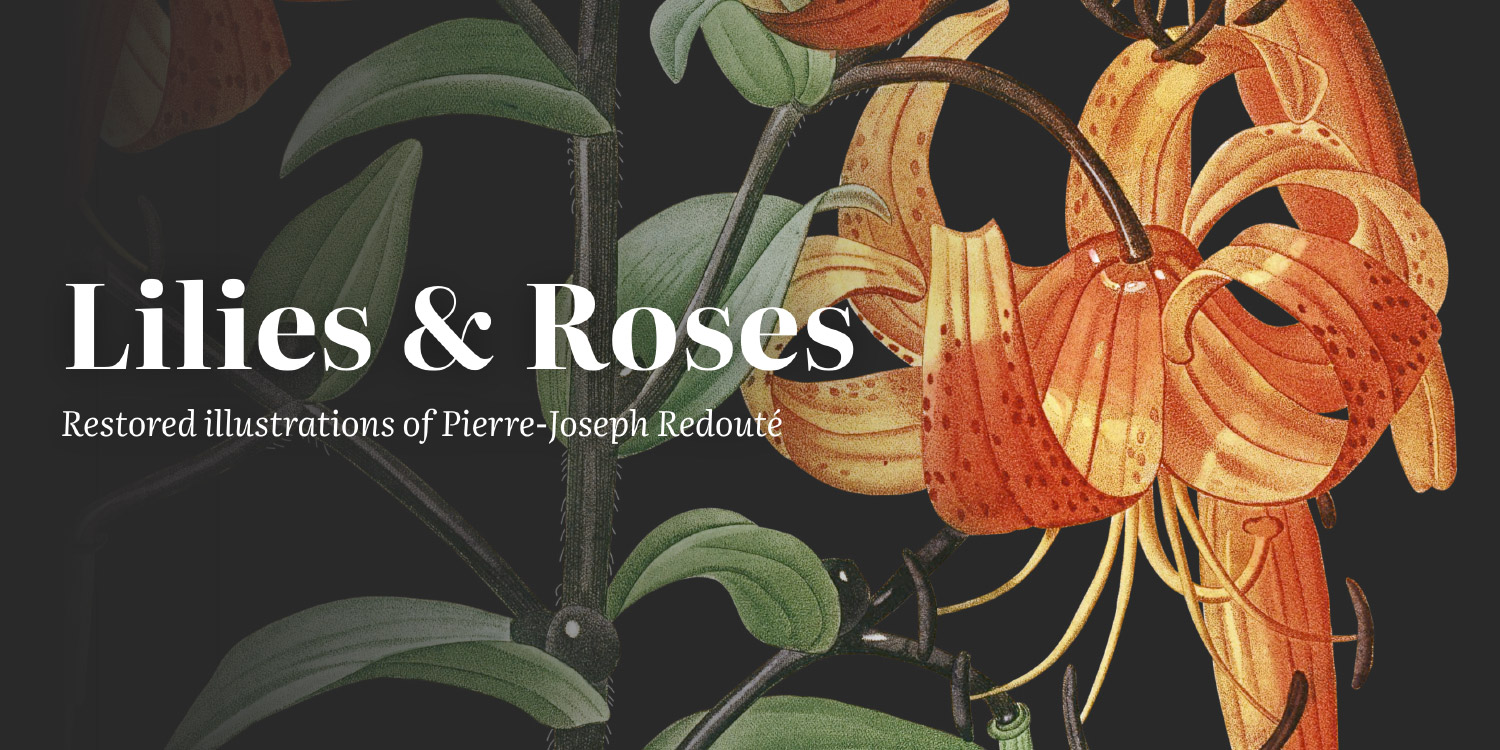
Pierre-Joseph Redouté made his name by painting flowers, an achievement impossible without a meticulousness that exceeds all bounds of normality. He published his three-volume collection Les Roses and his eight-volume collection Les Liliacées between 1802 and 1824, and a glance at their pages today vividly suggests the painstaking nature of both his process for not just rendering those flowers, but also for seeing them properly in the first place. While Redouté’s works have long been available free online, the digital forms in which they’ve been available haven’t quite done them justice — certainly not to the mind of designer and data artist Nicholas Rougeux.

We’ve previously featured Rougeux here on Open Culture for his online restorations of a host of venerable artistic publications that lavishly capture the natural world: Illustrations of the Natural Orders of Plants; British & Exotic Mineralogy; A Monograph of the Trochilidæ, or Family of Humming-Birds; Werner’s Nomenclature of Colours; and Euclid’s Elements. Even having deep experience with those works, Rougeux can declare that, “simply put, Redouté’s illustrations are stunning. His attention to detail in stippling and watercolor has earned him the title ‘the Raphael of Flowers’ and is considered the greatest botanical illustrator of all time.”

Hence Rougeux’s decision to undertake a restoration of Les Roses and Les Liliacées, an “opportunity to become intimately familiar with his techniques and develop a deeper appreciation for his efforts.” The project ended up demanding eleven months, only some of which were taken up by bringing the original colors back to Redouté’s paintings, which “not only depict the physical characteristics of the roses but also convey their delicate beauty and fragrance.” Rougeux also had to digitally re-create the reading experience of these books for the internet, custom-designing a digital gallery for viewing their roses and lilies as they pop out against their newly added dark backgrounds.

Placing all of Redouté’s flowers against those backgrounds entailed the real Photoshop labor, taking each image and “making the layer mask manually by carefully and slowly tracing along every edge” — for all 655 plates of Les Roses and Les Liliacées, as Rougeux writes in a detailed making-of blog post. “No matter the complexity, I traced every flower, every leaf, every stem, every root, and every hair to preserve all the details and ensure that Redouté’s hard work looked as good on a dark background as it did on a light one.” Translating art from one medium to another can be a supremely effective way to cultivate a full appreciation of the artist’s skill — and in this case, a no less full appreciation of his patience. See the online restoration of Les Roses et Les Liliacées here.

Related content:
Based in Seoul, Colin Marshall writes and broadcasts on cities, language, and culture. His projects include the Substack newsletter Books on Cities and the book The Stateless City: a Walk through 21st-Century Los Angeles. Follow him on Twitter at @colinmarshall or on Facebook.
Read More...How Magician David Copperfield Made the Statue of Liberty Disappear (1983)
In April, 1983, 50 million television viewers watched the illusionist David Copperfield make the Statue of Liberty disappear, straight into thin air. If you’re north of 50, you perhaps remember the spectacle. How did he do it? 40 years later, the YouTube channel Mind Blown Magic Illusion demystifies the large-scale magic trick, explaining how Copperfield distracted the audience, rotated the stage, and shifted Lady Liberty out of view. That’s apparently the gist of the illusion. However, in the comments section on YouTube, one commenter adds a little more important detail:
You missed the most important misdirection. He had a helicopter with a bright spotlight shining on the statue for a considerable length of time during which he apologized to the audience and said they were having “technical problems.” Eventually the curtain came across and the stage began to revolve imperceptibly slowly. However the helicopter moved in sync with the stage. The beam of light appeared to be stationary in relation to the stage. When the curtain was lifted they saw the helicopter in the same place but with no statue. The beam of light also helped black out the background. Otherwise the audience would have seen a different skyline. Pure genius!
For Open Culture readers, it’s worth mentioning that the legendary filmmaker Frank Capra (It’s a Wonderful Life, Mr. Smith Goes to Washington, It Happened One Night) played an unlikely role in the production. In an interview with Judd Apatow, Copperfield recalls how he enlisted Capra to help write the script for the episode:
So then I said [to myself] “Now the Statue of Liberty is going to disappear, but I’ve got to make this have more meaning.” So I went to visit Frank Capra, one of my idols, and did a kind of Judd Apatow interview with him. I said, “I’d like the Statue of Liberty to disappear, but I want to do it as a lesson in freedom, how valuable freedom is and what the world would be like without liberty.” And Frank Capra looked at me and said, “David, I love your idea, but here’s what you’re going to do. You’re going to try and it’s not going to work; it’s not going to disappear.” And I said, “Mr. Capra, I can’t do that.” You know? [laughs] And I got to watch Frank Capra, in his eighties, in action.
You can watch some of the original 1983 footage below. Enjoy!
If you would like to support the mission of Open Culture, consider making a donation to our site. It’s hard to rely 100% on ads, and your contributions will help us continue providing the best free cultural and educational materials to learners everywhere. You can contribute through PayPal, Patreon, and Venmo (@openculture). Thanks!
Read More...Join Us on Bluesky. We Will Have Fun Together

There’s an eXodus taking place, and millions are finding a new home on Bluesky. In recent days, the decentralized social media platform has been gaining 10,000 new users every 10–15 minutes, or about 1 million new users per day. Open Culture is already there, sharing the cultural posts you once enjoyed on Twitter. We hope you will join us. Find us at @openculture.bsky.social, or just click here.
PS. If you’re are on Threads, you can also find us there too.
Read More...Bertrand Russell’s Ten Commandments for Living Virtuously (1930)
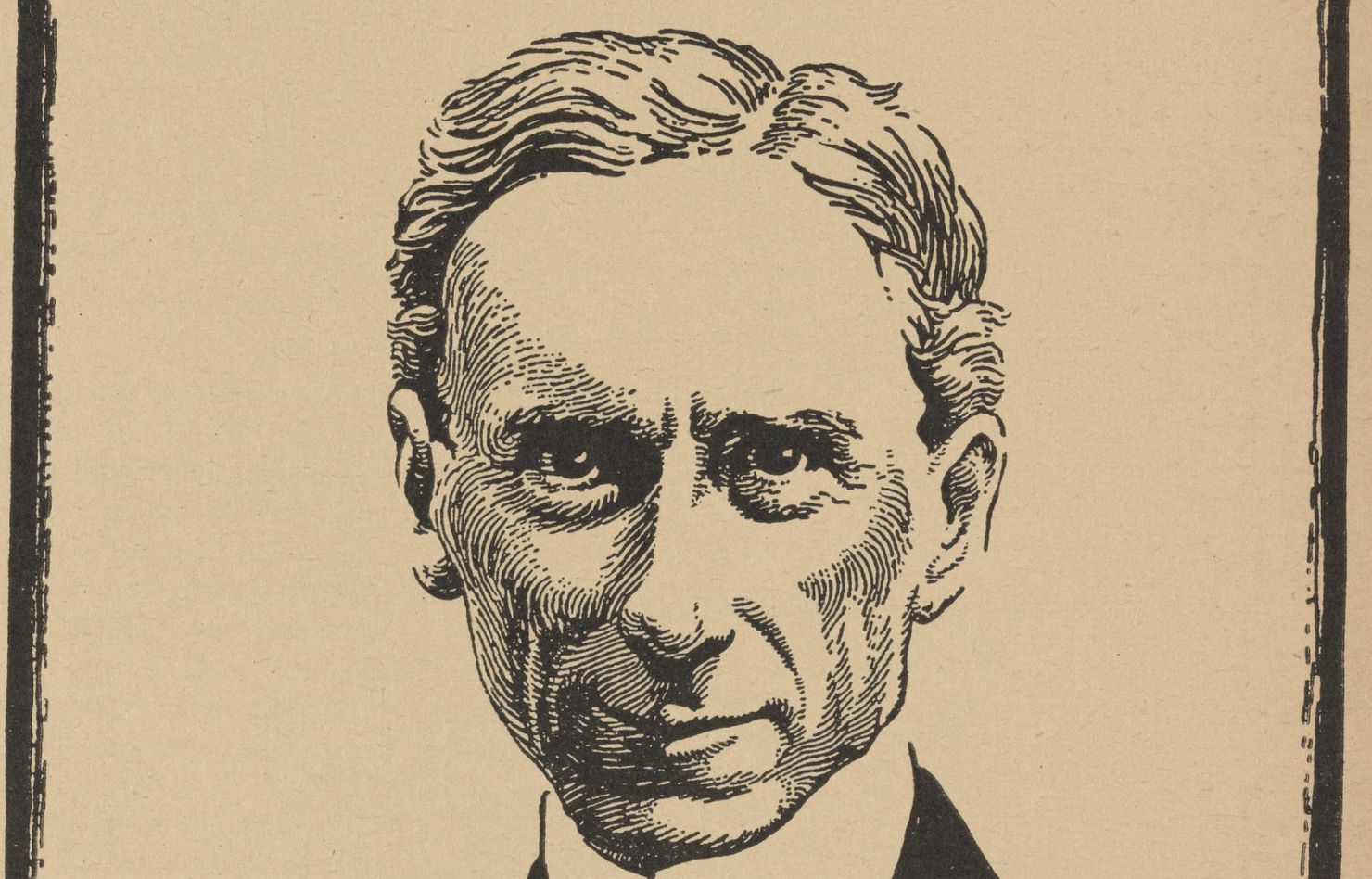
Image by J. F. Horrabin, via Wikimedia Commons
Bertrand Russell may have lived his long life concerned with big topics in logic, mathematics, politics, and society, but that didn’t keep him from thinking seriously about how to handle his own day-to-day relationships. That hardly means he handled every such relationship with perfect aplomb: take note of his three divorces, the first of which was formalized in 1921, the year he married his lover Dora Black. Possessed of similar bohemian-reformer ideals — and, before long, two children — the couple founded the experimental Beacon Hill School in 1927, intent on encouraging their young pupils’ development as not just thinkers-in-training but full human beings.
A few years later, Russell published his personal “ten commandments” in a culture magazine called Everyman, and you can read it in full in this 1978 issue of the Russell Society News. (Go to page 5.)
“Everybody, I suppose, has his own list of virtues that he tries to practice, and, when he fails to practice them, he feels shame quite independently of the opinion of others, so far at any rate as conscious thought is concerned,” he writes by way of introduction. “I have tried to put the virtues that I should wish to possess into the form of a decalogue,” which is as follows:
- Do not lie to yourself.
- Do not lie to other people unless they are exercising tyranny.
- When you think it is your duty to inflict pain, scrutinize your reasons closely.
-
When you desire power, examine yourself closely as to why you deserve it.
- When you have power, use it to build up people, not to constrict them.
- Do not attempt to live without vanity, since this is impossible, but choose the right audience from which to seek admiration.
- Do not think of yourself as a wholly self-contained unit.
-
Be reliable.
-
Be just.
- Be good-natured.
In the full text, Russell elaborates on the thinking behind each of these virtues. “When you wish to believe some theological or political doctrine which will increase your income, you will, if you are not very careful, give much more weight to the arguments in favor than to those against”: hence the importance of not lying to yourself. When it comes to lying to others, not only should governments tell the truth to their subjects, “parents should tell the truth to their children, however inconvenient this may seem.” And families as in states, “those who are intelligent but weak cannot be expected to forego the use of their intelligence in their conflicts with those who are stupid but strong.”
Russell’s fifth commandment also applies to relationships between the old and the young, since “those who deal with the young inevitably have power, and it is easy to exercise this power in ways pleasing to the educator rather than useful to the child.” And by his eighth commandment, he means “to suggest a whole set of humdrum but necessary virtues, such as punctuality, keeping promises, adhering to plans involving other people, refraining from treachery even in its mildest forms.” Alas, “modern education, in lessening the emphasis on discipline, has, I think, failed to produce reliable human beings where social obligations are concerned.”
This “prescriptive emphasis — notably the stress placed on the merits of some humble virtues — may have been influenced then by his practical experience of progressive education,” writes The Collected Papers of Bertrand Russell editor Andrew Bone. But Russell still revised his decalogue long after he left the Beacon Hill School in 1932, with world events of the subsequent decades inspiring him to use it in the service of what he regarded as a liberal worldview. One version broadcast on the BBC in 1951 includes such commandments as “Do not feel absolutely certain of anything,” “Find more pleasure in intelligent dissent than passive agreement,” and “Do not use power to suppress opinions you think pernicious, for if you do the opinions will suppress you” — all of which more of the last few generations of students could have done well to internalize.
Related content:
Bertrand Russell’s 10 Commandments for Living in a Healthy Democracy
Bertrand Russell: Authority and the Individual (1948)
Bertrand Russell & Buckminster Fuller on Why We Should Work Less, and Live and Learn More
Philosopher Bertrand Russell Talks About the Time When His Grandfather Met Napoleon
Christopher Hitchens Creates a Revised List of The 10 Commandments for the 21st Century
Based in Seoul, Colin Marshall writes and broadcasts on cities, language, and culture. His projects include the Substack newsletter Books on Cities and the book The Stateless City: a Walk through 21st-Century Los Angeles. Follow him on Twitter at @colinmarshall or on Facebook.
What Victorian People Sounded Like: Hear Recordings of Florence Nightingale & Queen Victoria Herself
More than 120 years after the end of the Victorian era, we might assume that we retain a more or less accurate cultural memory of the Victorians themselves: of their social mores, their aesthetic sensibilities, their ambitions great and small, their many and varied hang-ups. Some of the most vivid representations of these qualities have come down to us through primary sources, which tend to be texts and works of visual art. Late in Queen Victoria’s reign came photographs, and at the very end, even the motion picture. But how can we be sure how her people really sounded?
Strictly speaking, the earliest process for mechanically recording the sound of the human voice dates back to 1860, not even halfway through the Victorian era. But the technology still had a long way to go at that time, and it wasn’t until the 1880s that Thomas Edison’s phonograph and the wax cylinders it played became commercially viable. So explains the King and Things video above, on the spread of audio recording and the earliest possibilities it opened for capturing the voices of what we now regard as the distant past. Those voices include that of a man introduced as “one of England’s most famous after-dinner speakers, Mr. Edmund Yates.”
That cylinder was recorded in 1888, at one of the London soirées held by an American Edison employee named George Gouraud. The son of French engineer François Gouraud, who had introduced daguerreotype photography to the United States in the 1830s, he took it upon himself to bring the phonograph to Britain. He did so in a top-down manner, inviting socially distinguished guests to his home for dinner so that they might thrill to the novelty of after-dinner speeches delivered by machine — and then record their own messages to Edison himself. “I can only say that I am astonished and somewhat terrified at the results of this evening’s experiments,” said one of Gouraud’s guests, the composer Sir Arthur Sullivan.
That astonishment aside, Sullivan also admitted that he was “terrified at the thought that so much hideous and bad music may be put on record forever.” Many alive today would credit him with considerable prescience on that count. But he also understood that the phonograph would produce wonders, such as the recordings included in this video of such notables as four-time Prime Minister William Gladstone, Florence Nightingale, and Queen Victoria herself — at least according to the consensus of the scholars who’ve scrutinized the highly indistinct recording in question. Only long after Edison’s time would humanity develop a recording technology capable of being replayed again and again without degradation. But given our image of Victorians, perhaps it’s suitable that their voices should sound ghostly.
Related content:
Thomas Edison’s 1889 Recording of Otto von Bismarck Discovered
Hear the First Recording of the Human Voice (1860)
Based in Seoul, Colin Marshall writes and broadcasts on cities, language, and culture. His projects include the Substack newsletter Books on Cities and the book The Stateless City: a Walk through 21st-Century Los Angeles. Follow him on Twitter at @colinmarshall or on Facebook.
Read More...
Explore Burj Al Babas, Turkey’s Abandoned Town of 587 Disney-Style Castles
Burj Al Babas might have been constructed expressly to attract the attention of the internet. “Sitting near the Black Sea, the town is full of half-finished, fully abandoned mini castles — 587 of them to be exact,” write Architectural Digest’s Katherine McLaughlin and Jessica Cherner. Originally “planned as a luxurious, stately urban development offering the look of royal living for anyone willing to shell out anywhere from $370,000 to $500,000 for their own little palace,” it now stands as an unfinished ghost town. And though the project only broke ground a decade ago, it’s already settled into a veritably eerie — and highly photographable — state of decay.
This, of course, more than suits the sensibilities of an adventure-oriented YouTube channel like Fearless & Far. Its exploration of Burj Al Babas — one of several such videos currently available — offers on-the-ground views of what we can only call the town’s ruins. “This fantasy paradise land didn’t sell,” says its host. “Some blame the Turkish real estate crisis; some blame the kitschiness of it all. It’s all so strange. It’s all so fake.”
Indeed, write McLaughlin and Cherner, “as building the town got underway, locals became enraged with both the aesthetic of the homes and the business practices of the developers,” who subsequently declared bankruptcy, leaving the development in limbo.
Those who know their Middle Eastern languages will recognize the very name Burj Al Babas as a “nonsensical mashup of Arabic and Turkish,” as Ruth Michaelson and Beril Eski put it in an in-depth Guardian piece last month. Though located in Turkey, with an intent to take advantage of local hot springs, it was financed with money from Kuwait, Saudi Arabia and Bahrain. Since its construction “abruptly stopped in 2016, the project has become a bizarre white elephant,” causing scandal, lawsuits, an attempted suicide, “and even a minor diplomatic incident between Turkey and Kuwait.” Anyone who’s seen Burj Al Babas up-close will have their doubts about its prospects for completion — but if they’ve got a YouTube channel of their own, they’ll hardly want demolition to start before they can pay it a visit themselves.
Related content:
A Visit to Tianducheng, China’s Eerily Empty $1 Billion Copy of Paris
Exploring the Greatest of Italy’s 6,000 Ghost Towns: Take a Tour of Craco, Italy
Discover the Disappearing Turkish Language That is Whistled, Not Spoken
A Cultural Tour of Istanbul, Where the Art and History of Three Great Empires Come Together
Based in Seoul, Colin Marshall writes and broadcasts on cities, language, and culture. His projects include the Substack newsletter Books on Cities and the book The Stateless City: a Walk through 21st-Century Los Angeles. Follow him on Twitter at @colinmarshall or on Facebook.
Read More...Free: 356 Issues of Galaxy, the Groundbreaking 1950s Science Fiction Magazine
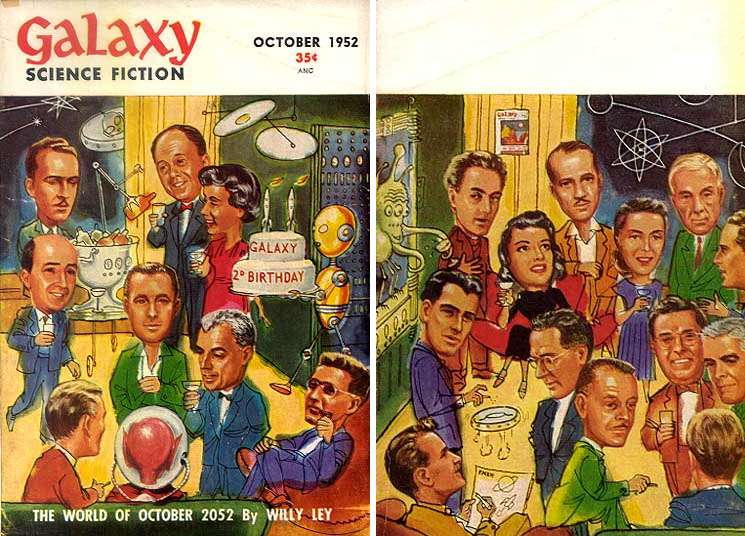
Along with Astounding Science Fiction and The Magazine of Fantasy and Science Fiction, Galaxy Magazine was one of the most important science fiction digests in 1950s America. Ray Bradbury wrote for it–including an early version of his masterpiece Fahrenheit 451–as did Robert A. Heinlein, Isaac Asimov, Frederik Pohl, Theodore Sturgeon, Cordwainer Smith, Jack Vance, and numerous others.
Now a fairly decent collection of issues (356 in total) is available for your perusal at archive.org for absolutely free. It’s not complete yet, but it’s close.
When Galaxy appeared in October 1950, it promised a kind of science fiction different from the space operas of previous decades. As an “annual report” written by publisher H.L. Gold proclaimed,
…other publishers thought the idea of offering mature science fiction in an attractive, adult format was downright funny. They knew what sold–shapely female endomorphs with bronze bras, embattled male mesomorphs clad in muscle, and frightful alien monsters in search of a human soul.
And while Astounding Science Fiction was focused on technology–suited for an America that had fundamentally changed since WWII–H.L. Gold’s Galaxy focused on ideas, humor, satire, psychology and sociology. It also had one of the best pay rates in the industry, and offered some of its writers exclusive contracts. And the writers responded in kind and followed their own obsessions–although Gold often pitched ideas.
(Ironically, though immersed in stories of inner and outer space, Gold was an acute agoraphobe, and stayed in his apartment, communicating by phone.)
After a wobbly start graphics-wise, Gold hired Ed Emshwiller in 1951 to paint covers, whose often humorous style (e.g. this Christmas issue below) suited the humor inside the issue.
Confident in their stable of writers, Galaxy produced the wonderful birthday cover at the top, featuring caricatures of everybody from Bradbury to Asimov. There’s also a guide to see who’s who.
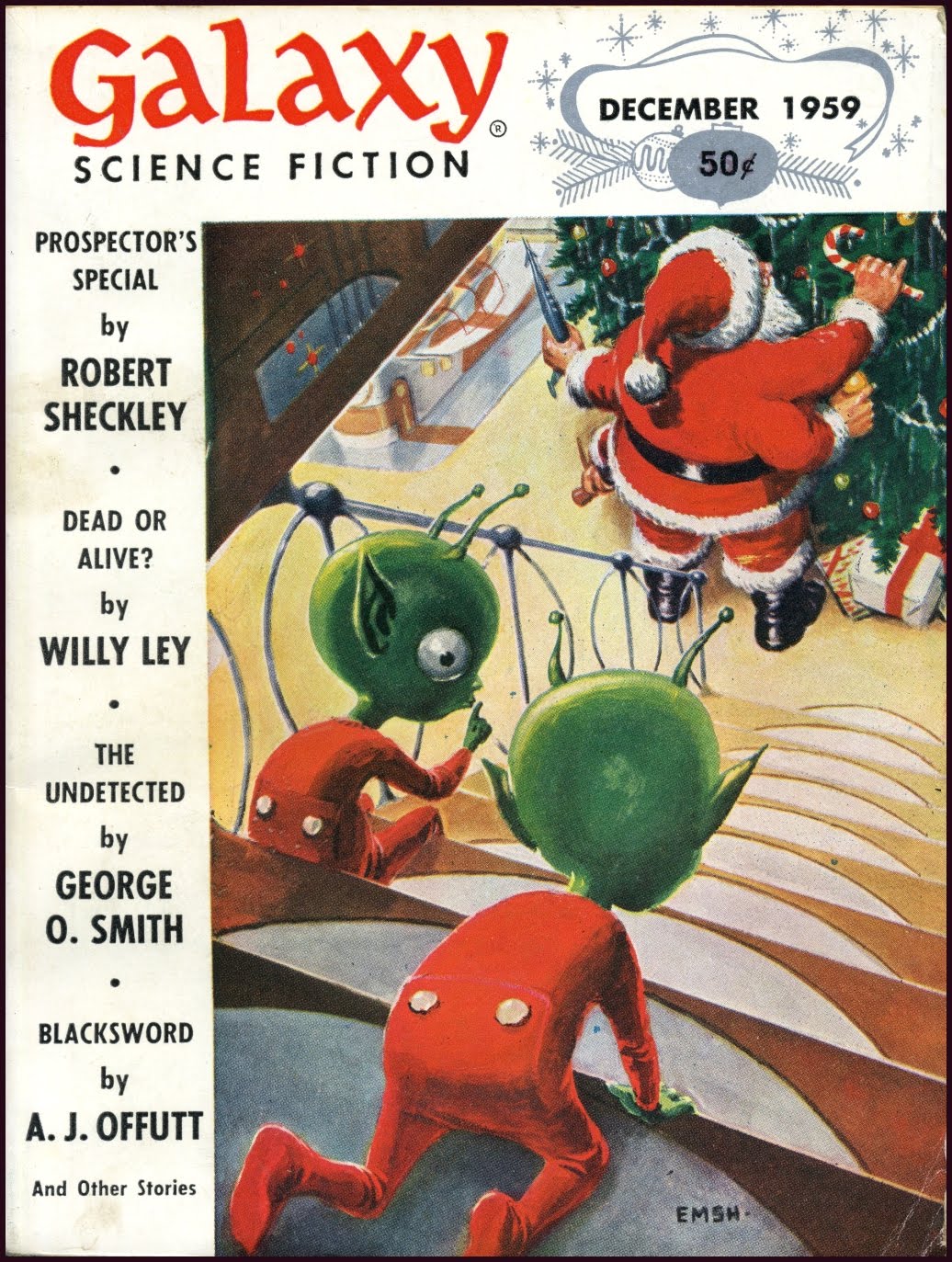
A series of editors–including Frederik Pohl–took over from Gold after a car accident in 1961, and by 1977–eight years after Pohl’s departure–the magazine was on its decline. There were more iterations, reprints, anthologies, and online versions, but the essential run is here. And those first ten years changed American science fiction forever, paving the way for experimental writers like Philip K. Dick and William Gibson.
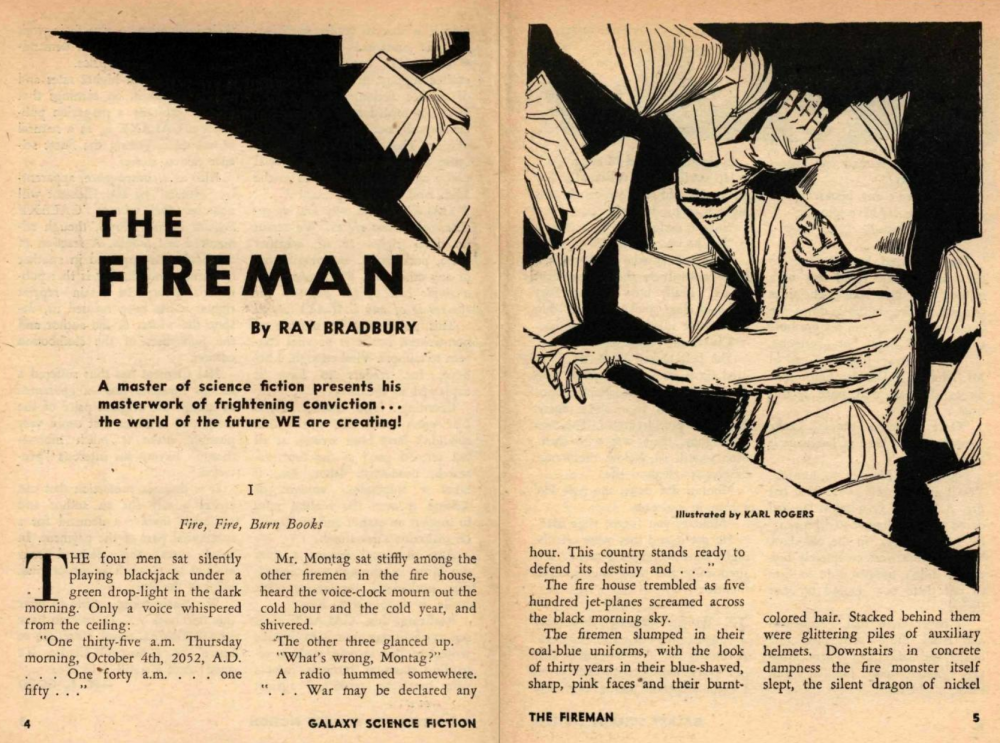
You could start with the Ray Bradbury story (“The Fireman”) we told you about, or Robert A. Heinlein’s “The Puppet.”
Related Content:
The Encyclopedia of Science Fiction: 17,500 Entries on All Things Sci-Fi Are Now Free Online
Isaac Asimov’s Foundation Trilogy: Hear the 1973 Radio Dramatization
X Minus One: Hear Classic Sci-Fi Radio Stories from Asimov, Heinlein, Bradbury & Dick
Ted Mills is a freelance writer on the arts who currently hosts the artist interview-based FunkZone Podcast and is the producer of KCRW’s Curious Coast. You can also follow him on Twitter at @tedmills, read his other arts writing at tedmills.com and/or watch his films here.
Read More...A New 3D Scan, Created from 25,000 High-Resolution Images, Reveals the Remarkably Well-Preserved Wreck of Shackleton’s Endurance
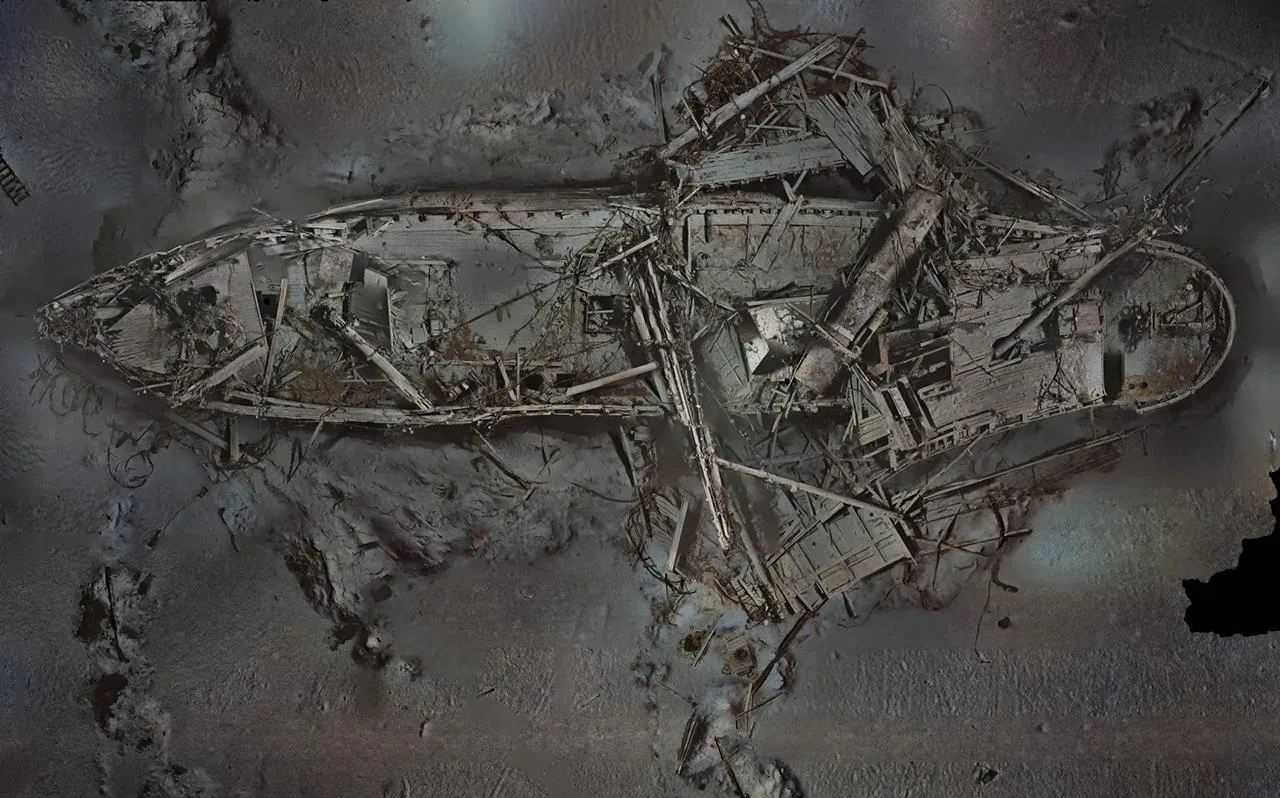
Photos on this page courtesy of the Falklands Maritime Heritage
Few who hear the story of the Endurance could avoid reflecting on the aptness of the ship’s name. A year after setting out on the Imperial Trans-Antarctic Expedition in 1914, it got stuck in a mass of drifting ice off Antarctica. There it remained for ten months, while leader Sir Ernest Shackleton and his crew of 27 men waited for a thaw. But the Endurance was being slowly crushed, and eventually had to be left to its watery grave. What secures its place in the history books is the sub-expedition made by Shackleton and five others in search of help, which ensured the rescue of every single man who’d been on the ship.
This harrowing journey has, of course, inspired documentaries, including this year’s Endurance from National Geographic, which debuted at the London Film Festival last month and will come available to stream on Disney+ later this fall. “The documentary incorporates footage and photos captured during the expedition by Australian photographer Frank Hurley, who [in 1914] brought several cameras along for the journey,” writes Smithsonian.com’s Sarah Kuta. “Filmmakers have color-treated Hurley’s black-and-white images and footage for the first time. They also used artificial intelligence to recreate crew members’ voices to ‘read’ their own diary entries.”
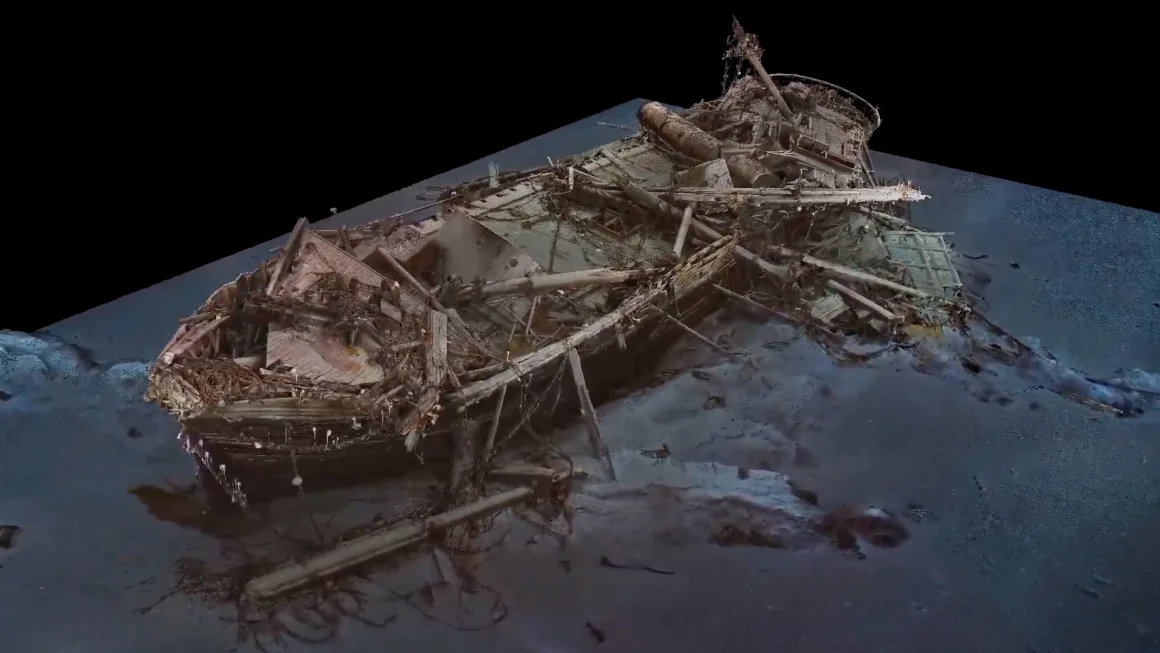
The fruits of an even more technologically impressive project have been released along with Endurance: a 3D digital model “created from more than 25,000 high-resolution images captured after the iconic vessel was discovered in March 2022.”
As we noted at the time here on Open Culture, the ship was found to be in remarkably good condition after well over a century spent two miles beneath the Weddell Sea. “Endurance looks much like it did when it sank on November 21, 1915. Everyday items used by the crew — including dining plates, a boot and a flare gun — are still easily recognizable among the protected wreckage.”

Endurance has, in other words, endured. Its intactness — which “makes it look as though the ship,” writes CNN.com’s Jack Guy, “has been miraculously lifted out of the Weddell Sea onto dry land in one piece” — is, in its way, as improbable and impressive as Shackleton and company’s survival of its fateful first expedition. The degree of detail captured by this new scan (not technologically feasible back at the time of the last acclaimed documentary on this subject), should make possible further, even deeper research into the story of the Endurance. But one question will remain unanswerable: would that story have resonated quite as long had the ship kept its original name, Polaris?
via Smithsonian.com
Related content:
How an Ancient Roman Shipwreck Could Explain the Universe
See the Well-Preserved Wreckage of Ernest Shackleton’s Ship Endurance Found in Antarctica
Hear Ernest Shackleton Speak About His Antarctic Expedition in a Rare 1909 Recording
Based in Seoul, Colin Marshall writes and broadcasts on cities, language, and culture. His projects include the Substack newsletter Books on Cities and the book The Stateless City: a Walk through 21st-Century Los Angeles. Follow him on Twitter at @colinmarshall or on Facebook.
Read More...The Mushroom Color Atlas: An Interactive Web Site Lets You Explore the Incredible Spectrum of Colors Created from Fungi

Enter the Mushroom Color Atlas, and you can discover the “beautiful and subtle colors derived from dyeing with mushrooms.” Featuring 825 colors, each associated with different types of mushrooms, the interactive atlas lets you appreciate the broad spectrum of colors latent in the fungi kingdom. The shades, tints, and hues will surprise you.
Julie Beeler, a designer living in Oregon, first launched the interactive Mushroom Color Atlas back in 2021. Now, she has released a companion book, The Mushroom Color Atlas: A Guide to Dyes and Pigments Made from Fungi. Illustrated by Yuli Gates, the book is “equal parts art book, field guide, and color distillation workshop.” You can order your copy today. The same goes for a Mushroom Color Atlas poster.

If you would like to support the mission of Open Culture, consider making a donation to our site. It’s hard to rely 100% on ads, and your contributions will help us continue providing the best free cultural and educational materials to learners everywhere. You can contribute through PayPal, Patreon, and Venmo (@openculture). Thanks!
Related Content
The Beautifully Illustrated Atlas of Mushrooms: Edible, Suspect and Poisonous (1827)
John Cage Had a Surprising Mushroom Obsession (Which Began with His Poverty in the Depression)
Read More...Support Us
We're hoping to rely on loyal readers, rather than erratic ads. Please click the Donate button and support Open Culture. You can use Paypal, Venmo, Patreon, even Crypto! We thank you!

About Us

Open Culture scours the web for the best educational media. We find the free courses and audio books you need, the language lessons & educational videos you want, and plenty of enlightenment in between.
Advertise With Us

FREE UPDATES!
GET OUR DAILY EMAIL
Get the best cultural and educational resources on the web curated for you in a daily email. We never spam. Unsubscribe at any time.
FOLLOW ON SOCIAL MEDIA

Open Culture editor Dan Colman scours the web for the best educational media. He finds the free courses and audio books you need, the language lessons & movies you want, and plenty of enlightenment in between.
Advertise With Us


