Discovered: The Only Known Picture of Vincent Van Gogh as an Adult Artist? (Maybe, Maybe Not)
Close your eyes for a moment and picture the artist Vincent Van Gogh. What do you see?
Probably one of the prolific post-Impressionist’s self-portraits. That’s all well and good, but who else did you see?
Indie darling (and Incredible Hulk adversary) Tim Roth?
Director Martin Scorsese?
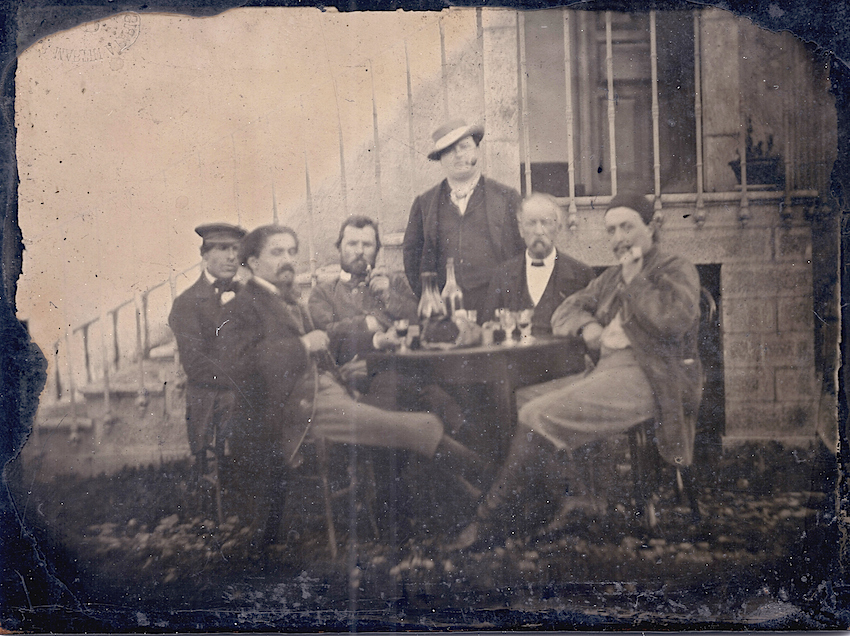
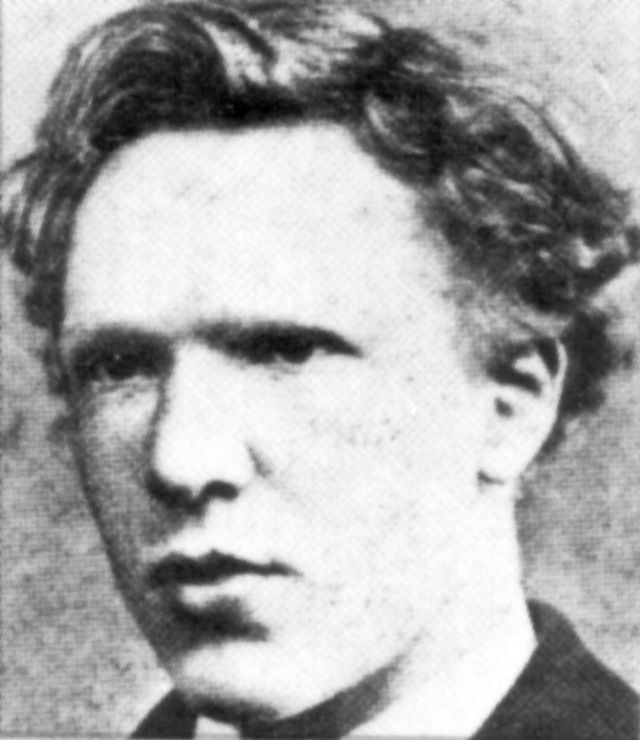
Thanks to the recently discovered photograph at the top of this article, we may soon have the option of picturing the actual Vincent Van Gogh as an adult artist. As Petapixel tells us, he sat for portraits at age 13, and again as a 19-year-old gallery apprentice (below), but beyond that no photographic evidence of the camera-shy artist was known to exist.
Exciting!
That’s Paul Gauguin on the far right. Others at the table include Emile Bernard and Arnold Koning, politician Felix Duval and actor-director André Antoine. But who is the bearded man smoking the pipe?
Van Gogh?
So thought the two collectors who purchased the small 1887 photo at a house sale a couple of years ago. Serge Plantureux, an antiquarian bookseller and photography expert who examined their find was optimistic enough to help them with further research, as he noted in the French magazine, L’Oeil de la Photographie:
I didn’t want to start doing what Americans call “wishful thinking,” that trap into which collectors and researchers fall, where their reasoning is governed only by what they want to see.
Don’t ditch Douglas, Roth, and Scorsese just yet, however. Experts at Amsterdam’s Van Gogh Museum say the bearded fellow cannot be the artist. According to them, there’s not even much of a resemblance. He wasn’t so much camera shy, as deadly opposed to the photographic medium. His refusal to be photographed was an act of resistance.
That kind of puts a damper on things…
So.. no go Van Gogh? Oh well…vive la photo nouvellement découverte de Paul Gauguin (and friends)!
Related Content:
The Unexpected Math Behind Van Gogh’s “Starry Night”
Simon Schama Presents Van Gogh and the Beginning of Modern Art
Van Gogh’s ‘Starry Night’ Re-Created by Astronomer with 100 Hubble Space Telescope Images
Ayun Halliday is an author, illustrator, and Chief Primatologist of the East Village Inky zine. Follow her @AyunHalliday
Read More...Did Stanley Kubrick Invent the iPad in 2001: A Space Odyssey?
While it now bears embarrassing marks of the 1960s here and there, the future envisioned by Stanley Kubrick’s 2001: A Space Odyssey remains, on many levels, chillingly plausible. True, Pan Am Airlines went under in the 1990s instead of launching a space station like they’ve got in the movie, but in the smaller details, 2001 gets a lot right, at least insofar as its reality resembles the one in which we find ourselves in the actual 21st century. No less an aggregation of brainpower than Samsung thinks so too: in fact, they’ve gone so far as to cite Kubrick’s sci-fi masterwork before a judge as proof that the director invented tablet computing.
“In 2011, an unusual piece of evidence was presented in court in a dispute between technology giants Apple and Samsung over the latter’s range of handheld tablets, which Apple claimed infringed upon the patented design and user interface of the iPad,” writes the British Film Institute’s Samuel Wigley.
“As part of Samsung’s defence, the company’s lawyers showed the court a still image and clip showing the astronauts played by Gary Lockwood and Keir Dullea eating while watching a TV show on their own personal, mini-sized, flat-screen computers.”
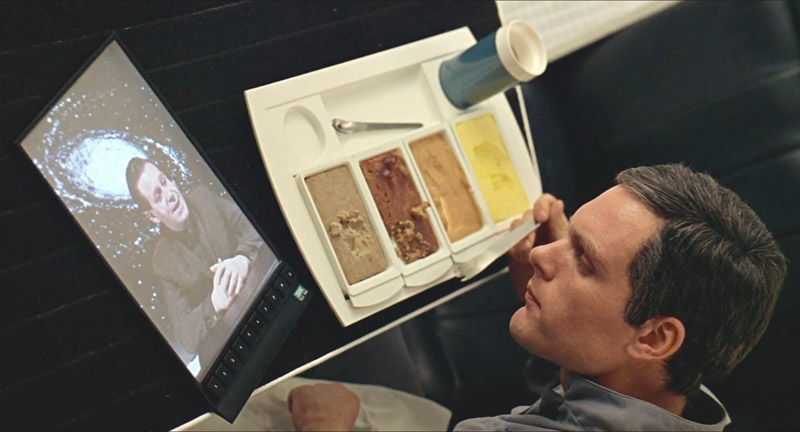
Apple and Samsung have not, in recent memory, played nice. Apple accused Samsung of “slavishly” copying the design of the iPad for their own Galaxy tablet, a charge that in some ways aligns with Samsung and other major Korean manufacturing companies’ reputation for rapidly adapting and even improving upon products developed in other countries. Samsung’s defense? Watch 2001’s footage of its “Newspads” (above), and you can see that Kubrick invented the tablet before either company — or, in the words of their attorneys, he invented a computer with “an overall rectangular shape with a dominant display screen, narrow borders, a predominately flat front surface, a flat back surface, and a thin form factor.”
Even in their lifetimes, 2001 gave Kubrick and his collaborator Arthur C. Clarke, sci-fi eminence and author of 2001 the book, reputations as something like seers. “I’m sure we’ll have sophisticated 3‑D holographic television and films,” Kubrick speculated in a Playboy magazine interview we featured last year, “and it’s possible that completely new forms of entertainment and education will be devised.” Certainly the opening up of the realm of tablets has made new forms of entertainment and education possible, but I wonder: could he ever have imagined we would one day use our Newspads to watch 2001 itself?
Related Content:
1966 Film Explores the Making of Kubrick’s 2001: A Space Odyssey (and Our High-Tech Future)
James Cameron Revisits the Making of Kubrick’s 2001: A Space Odyssey
Howard Johnson’s Presents a Children’s Menu Featuring Kubrick’s 2001: A Space Odyssey (1968)
Colin Marshall writes on cities, language, Asia, and men’s style. He’s at work on a book about Los Angeles, A Los Angeles Primer, and the video series The City in Cinema. Follow him on Twitter at @colinmarshall or on Facebook.
Read More...Watch Hayao Miyazaki Animate the Final Shot of His Final Feature Film, The Wind Rises
Hayao Miyazaki’s The Wind Rises came out in 2013 to a great deal of acclaim and attention—as, I suppose, do all the movies his Studio Ghibli puts out, so painstakingly have they built up their reputation for medium-transcending depth, artistry, craftsmanship, and attention to detail. But that fictionalized biographical story of Japanese World War II airplane designer Jiro Horikoski received even more notice than most due not just to the controversial nature of its material, but to its place as Miyazaki’s supposed swan song, the last feature film he would ever direct.
Then again, Hayao Miyazaki has spoken of many possible retirements over the years, and no longer animating feature films hardly means the end of his all-consuming impulse to create, which drives him to continue working on Tokyo’s Ghibli Museum and drawing the art for comic books, among other projects. Certain Miyazaki associates have publicly told us not to be surprised if the master one day emerges from this particular “retirement,” but since the man himself seems quite serious about putting full-length pictures behind him, we can assume for now that the clip above shows him at work on the last bit of film animation in his career: The Wind Rises’ final shot.
The footage comes from last year’s The Kingdom of Dreams and Madness, a documentary on a moment in the life of Studio Ghibli—and possibly one of the last moments in the life of Studio Ghibli, given their announcement of a “brief pause” production as a result of Miyazaki’s retirement. On the subject of the studio’s future Miyazaki speaks bluntly in the documentary: “The future is clear: it’s going to fall apart. I can already see it. What’s the use worrying? It’s inevitable.” But all things do, a fact which the finest works of Japanese art—Miyazaki’s films included—have always accepted. But they also take notice of what small things we can appreciate along the way to dissolution, as does Miyazaki himself: “Isn’t animation fascinating?” he asks, seemingly to himself, as he walks away from the drawing board.
Related Content:
Hayao Miyazaki’s Magical Animated Music Video for the Japanese Pop Song, “On Your Mark”
Watch Sherlock Hound: Hayao Miyazaki’s Animated, Steampunk Take on Sherlock Holmes
How to Make Instant Ramen Compliments of Japanese Animation Director Hayao Miyazaki
Colin Marshall writes on cities, language, Asia, and men’s style. He’s at work on a book about Los Angeles, A Los Angeles Primer, and the video series The City in Cinema. Follow him on Twitter at @colinmarshall or on Facebook.
Read More...See Flannery O’Connor’s Story “The Displaced Person” Adapted to a Film Starring a Young Samuel L. Jackson (1977)
There are strong people quietly willing to do “what needs to be done” for the public good, and then there are those who enjoy insinuating that they are that sort of person, usually as justification for their self-serving, frequently racist or xenophobic actions. When the latter reaches for the Bible as back up, look out!
No one ever had more fun with this monstrous type than the writer Flannery O’Connor, a devout Catholic with a knack for wrapping her characters’ foul purposes in the “stinking mad shadow of Jesus.”
In her longest story “The Displaced Person,” the boorish, Bible-thumping Mrs. Shortley is not the only baddie. The refined Mrs. McIntyre, widowed mistress of the dairy operation that employs the Shortleys and a couple of African-American farmhands, is just as quick to indict those with whom she imagines herself at cross-purposes.
Transfer them to the small screen, and every actress over 40 would be clamoring for the chance to sink her teeth into one or the other.
In 1977, PBS hired playwright Horton Foote to adapt “The Displaced Person” for “The American Short Story,” and the roles of Shortley and McIntyre went to Shirley Stoler and Irene Worth, both excellent.
(See above…it’s always so much more amusing to play one of the villains than the hardworking, uncomplaining, titular character, here a Polish refugee from WWII.)
The audio quality is not the greatest, but stick with it to see Samuel L. Jackson, not quite 30, as the younger of the two farmhands.
O’Connor buffs will be interested to know that Andalusia, the writer’s own Georgia farm, served as the location for this hour-long project. (No need to rent a peacock!)
Despite the stately production values that were de rigeur for quality viewing of the period, the story retains the unmistakable tang of O’Connor—it’s a bitter, comic brew.
Related Content
Flannery O’Connor Reads ‘Some Aspects of the Grotesque in Southern Fiction’ (c. 1960)
Rare 1959 Audio: Flannery O’Connor Reads ‘A Good Man is Hard to Find’
Flannery O’Connor’s Satirical Cartoons: 1942–1945
Ayun Halliday is an author, illustrator, and Chief Primatologist of the East Village Inky zine. Follow her @AyunHalliday
Read More...Umberto Eco’s Advice to Aspiring Writers
Umberto Eco, now 83 years old, has some advice to pass along to the young.
In March, the Italian semiotician, philosopher, literary critic, and novelist — and, of course, author of Foucault’s Pendulum — published How to Write a Thesis. It’s a witty, irreverent and practical guide for the student laboring over a thesis or dissertation. Josh Jones has more on that here.
Now, in a newly-released video from The Louisiana Channel (a media outlet based in Denmark), Eco turns his attention toward aspiring writers. And his wise counsel comes down to this: Keep your ego in check, make sure your ambitions are realistic, put in the time and the hard work, and don’t shoot for the Nobel Prize in Literature straight out of the gate. That, Eco says, kills every literary career. He’ll also tell you that writing is “10% inspiration and 90% perspiration.” They’re truisms — you discover when you’re an octogenarian — that turn out to be true.
Find more tips for aspiring writers below.
If you would like to support the mission of Open Culture, consider making a donation to our site. It’s hard to rely 100% on ads, and your contributions will help us continue providing the best free cultural and educational materials to learners everywhere. You can contribute through PayPal, Patreon, and Venmo (@openculture). Thanks!
Related Content:
Ernest Hemingway Creates a Reading List for a Young Writer, 1934
Ray Bradbury Gives 12 Pieces of Writing Advice to Young Authors (2001)
Toni Morrison Dispenses Writing Wisdom in 1993 Paris Review Interview
John Steinbeck’s Six Tips for the Aspiring Writer and His Nobel Prize Speech
Stephen King Creates a List of 96 Books for Aspiring Writers to Read
Kurt Vonnegut Gives Advice to Aspiring Writers in a 1991 TV Interview
Read More...Metropolis II: Discover the Amazing, Fritz Lang-Inspired Kinetic Sculpture by Chris Burden
Recently deceased artist Chris Burden had a long history of working with automobiles in his art. In his early days he crucified himself to the top of a VW Beetle (a piece called Trans Fixed). He set about designing and building a 100 mph and 100 mpg automobile based on intuition called the B‑Car. In Big Wheel he used a motorcycle to power…a big wheel. And in Porsche with Meteorite he suspended the two objects above the museum floor on each end of a gigantic scale.

But his massive kinetic sculpture Metropolis II is something else: a child’s fever dream of a Hot Wheels-scale city, with 1,100 cars driving endlessly on 18 roadways, with two ramps that are 12 feet high and three conveyor systems that feed the cars back into the loop. The metal and the electricity needed to run the sculpture means that the thing is not just a sight to behold, but it’s staggeringly loud.
The title of the kinetic sculpture gives away its reference, that of Fritz Lang’s 1927 Metropolis (watch it online) and its imaginary city scapes of elevated freeways and train tracks and people movers and planes that fly in between:
Burden’s work has its own structures too, some of which are made from building blocks, Lego, and Lincoln Logs, turned into houses and skyscrapers. Don’t expect sensible urban planning in this city: seen from above, Metropolis II is a chaos of roads, and closed systems from which there is no escape.
There was a trial run of the sculpture called Metropolis I, a smaller version that was soon sold to a Japanese collector and taken out of the public view.
For the sequel, Burden went bigger, enlisting eight people full time for five and a half years to build the piece. Said the artist:
“We wanted to expand it and make it truly overwhelming — the noise and level of activity are both mesmerizing and anxiety provoking.”
But instead of a nightmare commentary, Burden wanted the piece to be utopian. The cars are moving at 240 mph, according to scale, and there’s no gridlock. He was looking ahead to a future of driverless cars, as he shared a hatred like many Angelenos of endless traffic jams.
The 30 foot wide sculpture was bought for an undisclosed sum by billionaire businessman Nicholas Berggreun, who also sits on LACMA’s board. He’s loaned it to the museum until 2022 and it is currently now situated in a special wing where visitors can see it both at ground level and from above. It takes one assistant to keep it free of hiccups and it only runs for a few hours at a time, and only on weekends.
However, LACMA’s entryway is also home to a Burden piece one can see 24/7, the iconic Urban Light.
via Coudal
Related Content:
Watch Chris Burden Get Shot for the Sake of Art (1971)
LA County Museum Makes 20,000 Artistic Images Available for Free Download
Chris Burden (R.I.P.) Turns Late-Night TV Commercials Into Conceptual Art
Ted Mills is a freelance writer on the arts who currently hosts the FunkZone Podcast. You can also follow him on Twitter at @tedmills, read his other arts writing at tedmills.com and/or watch his films here.
Read More...A Proportional Visualization of the World’s Most Popular Languages
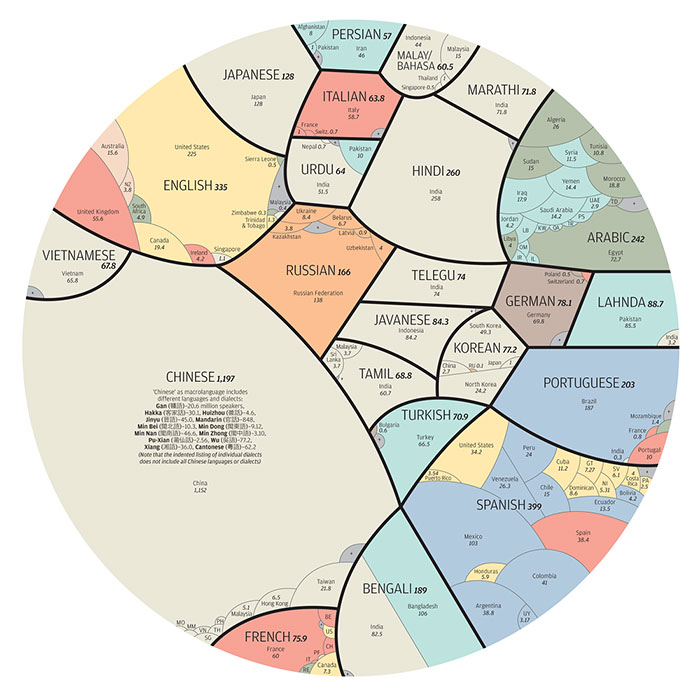
Today’s graphic — click here to view it in a large format — takes the world’s 23 most popular languages, and then gives you a visual sense of how many people actually speak those languages overall, and where geographically those languages are spoken. The more a language is spoken, the more space it gets in the visual.
When you view the original graphic, you’ll note that Chinese speakers outnumber English speakers by a factor of four. And yet English is spoken in 110 countries, as compared to 33 for Chinese. And the number of people learning English worldwide dwarfs the number learning Mandarin.
As you look through Lopéz’s visual, you’ll want to keep one thing in mind: Although the 23 languages visualized above are collectively spoken by 4.1 billion people, there are at least another 6700 known languages alive in the world today. Someone has to cook up a proportional visualization of those. Any takers?
Speaking of learning popular languages, don’t miss our collection: Learn 48 Languages Online for Free: Spanish, Chinese, English & More.
Follow us on Facebook, Twitter, Google Plus and LinkedIn and share intelligent media with your friends. Or better yet, sign up for our daily email and get a daily dose of Open Culture in your inbox.
Related Content:
The Tree of Languages Illustrated in a Big, Beautiful Infographic
The History of the English Language in Ten Animated Minutes
Noam Chomsky Talks About How Kids Acquire Language & Ideas in an Animated Video by Michel Gondry
Read More...Ralph Steadman’s Warped Illustrations of Alice’s Adventures in Wonderland on the Story’s 150th Anniversary
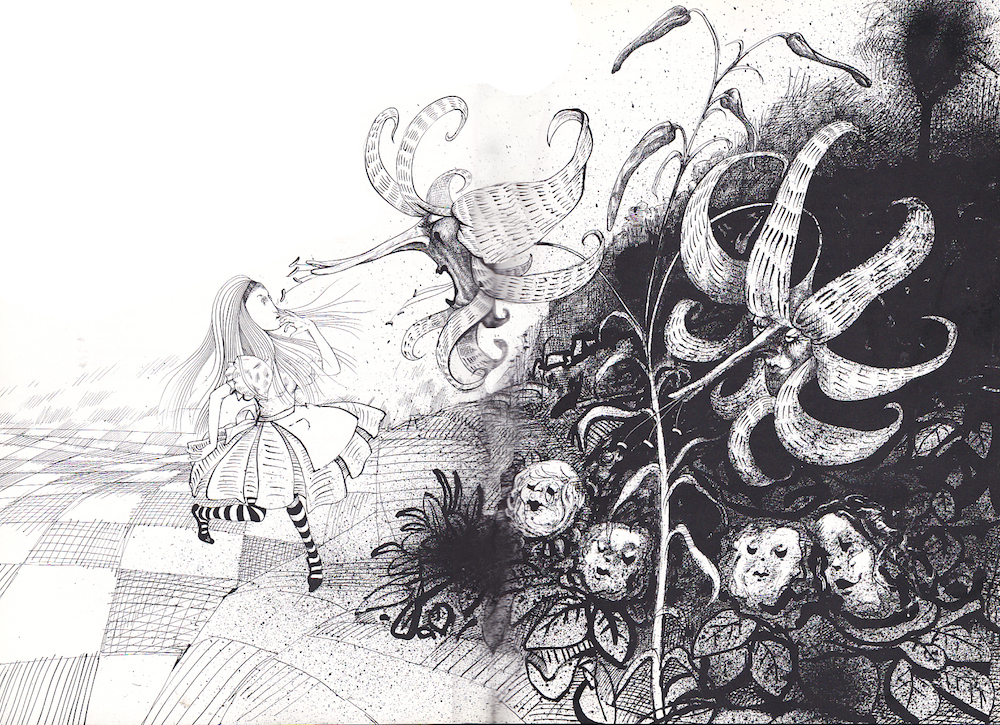
This year, readers worldwide celebrate the 150th anniversary of the publication of Alice’s Adventures in Wonderland. (Click to see the original manuscript, handwritten & illustrated by Lewis Carroll.) Carroll’s fantastical, unexpectedly psychological and intellectual children’s tale has inspired writers, artists, and other creators of all ages since it first came out in 1865. New editions and adaptations have kept appearing, each reflecting the spirit of their own time through the askew prism of Alice’s sensibility. And which living illustrator could provide more askew imagery than Ralph Steadman?
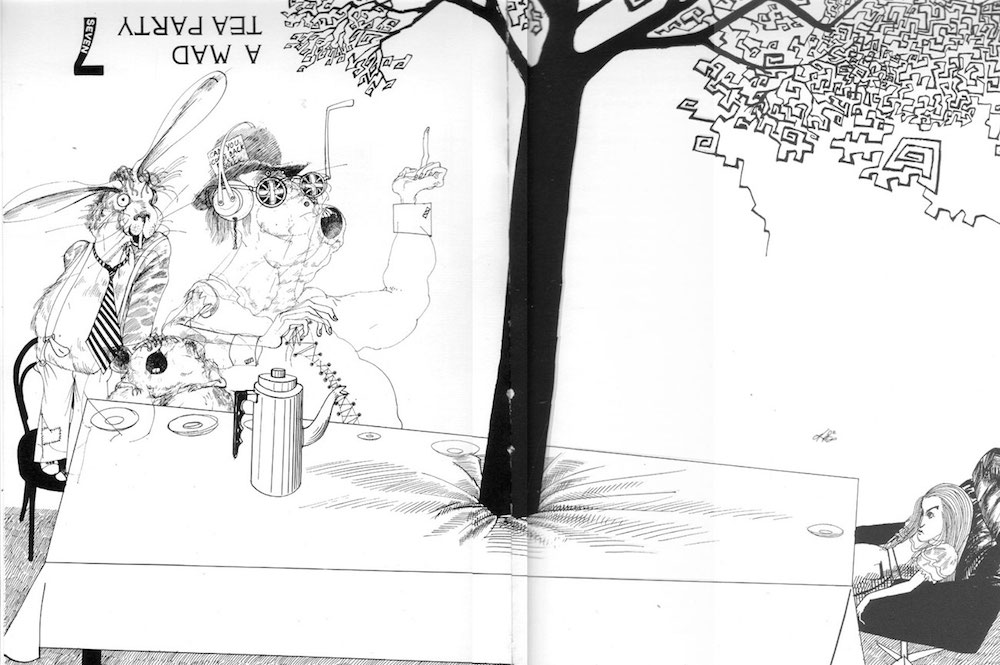
We all know that Alice’s dreamlike journey begins in earnest when she drinks from a bottle labeled “DRINK ME” and eats a cake labeled “EAT ME.” See what metaphors you will, but to my mind, this alone makes the story obvious Steadman material: many of us discover his art through its appearance in Hunter S. Thompson’s Fear and Loathing in Las Vegas, a collaboration that qualifies Steadman as no stranger at all to visualizing unreal circumstances heightened, or induced, by one ingested substance or another.
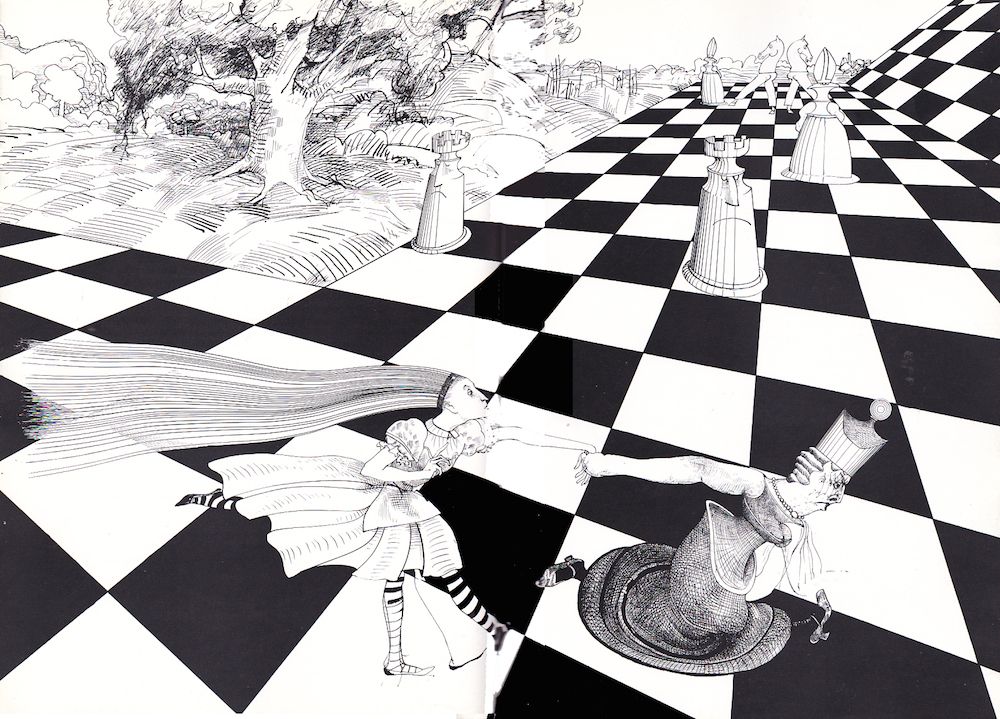
Fear and Loathing in Las Vegas appeared in book form in 1972; Alice in Wonderland Illustrated by Ralph Steadman appeared the next year, and went on to win the Francis Williams Book Illustration Award.
His version, writes io9’s Cyriaque Lamar, “has gone through various print runs throughout the decades, and he modeled several of the characters on decidedly modern personalities. For example, the Cheshire Cat is a television talking head, the Caterpillar is a grass-smoking pedant, the Mad Hatter is a barking quizmaster, and the King and Queen of Hearts are a melting mass of political authority.”
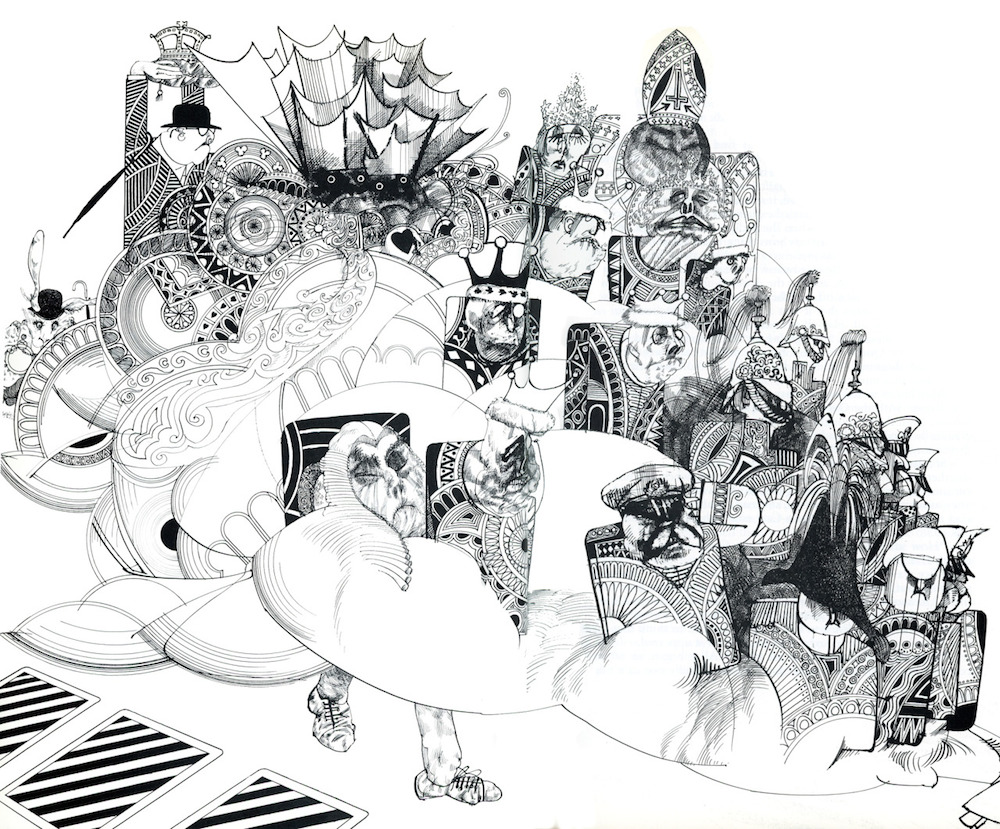
See more of Steadman’s pieces by picking up your own copy of the book, or visit Brain Pickings, where Maria Popova describes them as bringing “to Carroll’s classic the perfect kind of semi-sensical visual genius, blending the irreverent with the sublime.” Though by all available evidence thoroughly sane himself, Steadman’s illustrations have, over his fifty-year career, lent just the right notes of English insanity to a variety of subjects, from wine to dogs to psychogeography. Only natural, then, to see them accompany the insanity — which, sentence by sentence and page by page, comes to seem like sanity by other means — of a classic English tale like Alice’s Adventures in Wonderland.
Related Content:
See Salvador Dali’s Illustrations for the 1969 Edition of Alice’s Adventures in Wonderland
Lewis Carroll’s Photographs of Alice Liddell, the Inspiration for Alice in Wonderland
When Aldous Huxley Wrote a Script for Disney’s Alice in Wonderland
Colin Marshall writes on cities, language, Asia, and men’s style. He’s at work on a book about Los Angeles, A Los Angeles Primer, and the video series The City in Cinema. Follow him on Twitter at @colinmarshall or on Facebook.
Read More...Watch the New Trailer for the Stanford Prison Experiment Film, Soon in Theaters Near You
In 1971, Stanford psychology professor Philip Zimbardo undertook a study to determine whether situations determine behavior or whether a person’s disposition leads to behavior regardless of their situation. As seen in the above trailer for the Stanford Prison Experiment, a new film adaptation of Zimbardo’s controversial study, it was explained thusly: people acted like prisoners–lashing out at authority, angry, maladjusted–purely by dint of being put in prisons. And people abused their authority when put in the position of authority. The hypothesis had its basis in the past: the action of Nazi guards at the concentration camps. The results have ramifications through to the present: witness the confessions of the guards who tortured inmates in Abu Ghraib.
The trailer plays like a psychological thriller, but so far it looks true to the record. Prof. Zimbardo–having just earned tenure at Stanford (and played in the film by Billy Crudup)–chose 24 healthy student subjects and randomly assigned them either the role of guard or of prisoner. The Psychology Department’s basement was turned into a mock prison, with holding cells, guard rooms, solitary confinement, and an exercise yard. Cameras recorded all that went on, observed by Zimbardo and his crew. The “guards” could come and go according to shifts, but the “prisoners” could not. While the “guards” could not use physical force on the “prisoners,” they could use as many psychological tactics as possible to break the will of their fellow students. However, the “prisoners” were not told exactly what would happen to them. When, on the first day, the “prisoners” were “arrested” in the morning, stripped, searched, shaved and deloused, they were already in a state of shock. An early documentary exists on the experiment and its results here:
Suffice it to say (and you may have seen this coming) the student guards really got into their roles, and the “prisoners” rebelled. All the while Prof. Zimbardo wanted to keep going for the planned one to two weeks. Only because of the objections of Christina Maslach, a graduate student and Prof. Zimbardo’s girlfriend, did the group abandon the study after six increasingly frightening days. (Proving as well that Prof. Zimbardo was affected by the experiment in ways similar to his subjects, as he was unable to initially stop something out of control.)
The study was funded by the U.S. Office of Naval Research to “study antisocial behavior.” The student subjects were paid $15 a day for their help and half quit the experiment before it was finished. All of the guards stayed on. As detailed in the official FAQ on the study, none of the students showed any lasting trauma, though Prof. Zimbardo said:
“I was guilty of the sin of omission — the evil of inaction — of not providing adequate oversight and surveillance when it was required… the findings came at the expense of human suffering. I am sorry for that and to this day apologize for contributing to this inhumanity.”
The experiment is now used in psychology textbooks as an example of the “psychology of imprisonment.” Prof. Zimbardo turned his science to helping people, looking at promoting heroism in daily life, helping veterans normalize into social life, working with shy people, and, coming full circle, testifying during the court martial of Sgt. Ivan “Chip” Frederick, who was charged with crimes during his time at Abu Ghraib. Zimbardo has since retired and recently advised on the upcoming film. Christina Maslach later married Prof. Zimbardo and is currently Vice Provost for Undergraduate Education at the University of California, Berkeley.
And if Prof. Zimbardo’s experiment sounds a bit like Stanley Milgram’s 1961 experiment in obedience to authority, well, it’s no coincidence. Stanley Milgram and Philip Zimbardo were high school friends.
However, there’s some interesting differences. For one, the “victims” of Milgram’s experiment were acting the electric shocks they supposedly received. Despite that level of fakery, Milgram was denied tenure at Harvard. The City University of New York Graduate Center, on the other hand, knew a psychology superstar when they saw one and gave him tenure.
Related content:
Free Online Psychology Courses
How To Think Like a Psychologist: A Free Online Course from Stanford
Hermann Rorschach’s Original Rorschach Test: What Do You See? (1921)
Ted Mills is a freelance writer on the arts who currently hosts the FunkZone Podcast. You can also follow him on Twitter at @tedmills, read his other arts writing at tedmills.com and/or watch his films here.
Read More...Alan Watts Explains Why Death is an Art, Adventure and Creative Act
Many of us in the West live in some of the most fragmented religious landscapes in the world, but in the midst of deepening levels of conflict over policies of birth and death, these two issues that divide us also join us together. More than at any time in history, people live in expectation of similar spans of life; we all lament the loss of loved ones who die at any age; and most of us live with some fear of death, or at least violent, untimely death like the kind Alan Watts describes above.
Watts, English Zen guru of sorts (though he would not like the label) lectured more on death than perhaps any other philosophical or religious teacher since the Buddha, but he did so in a way that illuminates our ideas about the inevitable end, even if it should come upon us all of the sudden.
You heard a bomb coming at you, you could hear it whistle and you knew it was right above you and heading straight at you, and that you were finished.
This is no abstract thought experiment, of course, but the historical experience of millions of people, from Dresden to Iraq. But despite the terrifying example, Watts describes achieving in that moment absolute clarity and universality. The dreaded bomb whistles toward you, “and you accepted it,” he says.
How exactly does one achieve that acceptance? Without dogmatizing or mysticism, Watts offers some wisdom in another excerpt from a lecture above. This video’s use of melodramatic film clips and cinematic music may be a little schmaltzy, but his matter of fact talk isn’t lessened by it. Though not everyone passes on their genes to a next generation, an example he discusses in both excerpts, we do all leave the planet to make room for new people, wherever they come from, and this, he says, “is an honorable thing…. It’s a far more amusing arrangement for nature to continue the process of life through different individuals than it is through the same individual.”
Watts was not at all doctrinaire about death, particularly in his later years. In a conversation with Aldous Huxley’s wife Laura in 1968, he called dying “an art,” though not quite like Sylvia Plath did: “It is also,” he said, “an adventure.” He considered Aldous Huxley’s unorthodox death—on an LSD trip while Laura read to him from the Tibetan Bardo Thodol—a “highly intelligent form of dying.” Nonetheless, Watts, an Episcopal priest become an explainer of Zen Buddhism in America, also had a great deal to say about more formal religious ideas of death.
In the lecture above, from a 1959 American television program, Watts explains a particular Buddhist concept of reincarnation and rebirth through various realms. It’s a picture as fantastic and picturesque as Dante’s, and like his creative act, one that can be read with some literal and much profoundly philosophical significance. These conceptions help demonstrate that far from fearful, our puzzling over the inevitability and mystery of death can be, as it was for Watts, “one of the most creative thoughts I ever thought in my life.”
Related Content:
Zen Master Alan Watts Discovers the Secrets of Aldous Huxley and His Art of Dying
The Wisdom of Alan Watts in Four Thought-Provoking Animations
The Zen Teachings of Alan Watts: A Free Audio Archive of His Enlightening Lectures
Josh Jones is a writer and musician based in Durham, NC. Follow him at @jdmagness
Read More...Support Us
We're hoping to rely on loyal readers, rather than erratic ads. Please click the Donate button and support Open Culture. You can use Paypal, Venmo, Patreon, even Crypto! We thank you!

About Us

Open Culture scours the web for the best educational media. We find the free courses and audio books you need, the language lessons & educational videos you want, and plenty of enlightenment in between.
Advertise With Us

FREE UPDATES!
GET OUR DAILY EMAIL
Get the best cultural and educational resources on the web curated for you in a daily email. We never spam. Unsubscribe at any time.
FOLLOW ON SOCIAL MEDIA

Open Culture editor Dan Colman scours the web for the best educational media. He finds the free courses and audio books you need, the language lessons & movies you want, and plenty of enlightenment in between.
Advertise With Us


