New Jorge Luis Borges-Inspired Project Will Test Whether Robots Can Appreciate Poetry
Jorge Luis Borges, as any reader of his stories knows, had a lot of ideas. Some of his ideas must have seemed pretty fantastical when he wrote stories around them from the 1920s to the 1950s. But their mythic qualities have made them endure, and now Borges’ imaginative, technology-rich 21st-century fans have started to put their philosophical speculations into practice: you may remember, for instance, the online Library of Babel, ultimately to contain every possible 410-page book, which we featured in April.
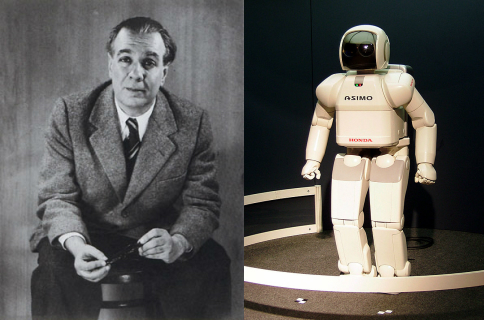
Borges also came up with intriguing and then-untestable notions about, in the words of Vice’s Daniel Oberhaus, “the importance of metaphor and its limitless possibilities in language. Borges theorized [listen above] that despite these boundless possibilities for poetic language, there were nevertheless distinct patterns of metaphors that kept cropping up — a favorite example of his being the metaphorical equivalence of ‘stars’ and ‘eyes.’ ” Now a site called Poetry for Robots, a joint effort between Neologic, Webvisions, and The Center for Science and the Imagination at Arizona State University, “seeks to put Borges’ theory to the test, asking on their website whether it is possible to teach machines the poetic quality of human language.”

“What if we used poetry and metaphor as metadata?” asks Poetry for Robots’ front page. “Would a search for ‘eyes’ return images of stars?” To find out, the site has begun crowdsourcing poetry from its users, who they’ve asked to submit pieces of verse (150 characters or fewer) prompted by a series of images posted there: you can write your poetry in response to the open ocean, an urban landscape, a cappuccino, paths diverging in a wood, or 117 other actual images meant to draw out textual imagery.
Then comes the test: can computers learn to make the same poetic associations humans do between word and image, image and word? If the Borgesian vision of metaphors existing in patterns holds true, then they will — computers perform few tasks better than pattern recognition, after all. This could lead not just to, say, artificial intelligence that can compose and even appreciate poetry, but poetic-language search engines — a deeply artistic extension of the seemingly frustrated natural-language search engine efforts pioneered by the likes of Ask Jeeves.
And if none of that works out, we’ll still have witnessed a fascinating thought experiment, just like Borges’ stories themselves. The writer’s original thoughts on the subject will certainly remain compelling, and you can hear them in his 1967–8 Harvard lectures on poetry (from where the clip above came) that we first featured here a few years back. Who knows — they might even give literature-inclined computer science students, or computer science-inclined literature students, the idea for their next big project.
Related Content:
Jorge Luis Borges’ 1967–8 Norton Lectures On Poetry (And Everything Else Literary)
Jorge Luis Borges Selects 74 Books for Your Personal Library
Jorge Luis Borges’ 1967–8 Norton Lectures On Poetry (And Everything Else Literary)
Jorge Luis Borges’ Favorite Short Stories (Read 7 Free Online)
Colin Marshall writes on cities, language, Asia, and men’s style. He’s at work on a book about Los Angeles, A Los Angeles Primer, and the video series The City in Cinema. Follow him on Twitter at @colinmarshall or on Facebook.
Read More...My First Time: Paris Review Video Series Features Writers Talking About Getting Started as Writers
Do you spend your days sweating blood over a laptop, working on a novel or poem or screenplay that always seems to fall short of the brilliant version that is in your head? Are you terrified that if you don’t squeeze out a first novel that will instantly make you the toast of the New York literary establishment you will be an abject failure? Do you feel compelled to work on a book but are still plagued with the slow corrosive drip of doubt? Well, take heart. Everyone feels like that when he or she starts out.
The Paris Review, one of the most important literary magazines around, made its name with long, in-depth interviews with literary figures. Now they are launching a video series called “My First Time,” where they interview authors, cartoonists and playwrights about the beginning of their careers.
“This is a chance to see how successful authors got their start, in their own words,” as the Paris Review’s Dan Piepenbring writes. “It’s a portrait of the artist as a beginner and a look at the creative process, in all its joy, abjection, delusion, and euphoria.”
It’s strangely comforting to watch these people talk about struggling with all the psychological crap that confronts anyone who has the audacity to try to create. They succeeded. Maybe you can too.
Above is the trailer for the series and lower down are interviews with author J. Robert Lennon, cartoonist Gabrielle Bell and playwright Branden Jacobs-Jenkins.
Related Content:
The Paris Review Interviews Now Online
Ray Bradbury Gives 12 Pieces of Writing Advice to Young Authors (2001)
H.P. Lovecraft Highlights the 20 “Types of Mistakes” Young Writers Make
Jonathan Crow is a Los Angeles-based writer and filmmaker whose work has appeared in Yahoo!, The Hollywood Reporter, and other publications. You can follow him at @jonccrow. And check out his blog Veeptopus, featuring pictures of vice presidents with octopuses on their heads. The Veeptopus store is here.
Read More...
The Staggering Human Cost of World War II Visualized in a Creative, New Animated Documentary
“More people died in World War II than any other war in history,” explains Neil Halloran in The Fallen of World War II. In his 15-minute film, Halloran uses innovative data visualization techniques to put the human cost of WW II into perspective, showing how some 70 million lives were lost within civilian and military populations across Europe and Asia, from 1939 to 1945. As one commenter put it, “One million, six million, seventy million. Spoken or written, these numbers become … incomprehensible. Presented graphically, they hit closer to the heart. As the Soviet losses climbed, I thought my browser had become frozen. Surely the top of the column must have been reached by now, I thought.” He’s referring to the staggering number of Soviets who died fighting the Nazis. If you fast forward to the 6‑minute mark above, you can see what he means.
The video comes accompanied by an interactive website, where users can “pause during key moments to interact with the charts and dig deeper into the numbers.” To use this interactive website, you will need a fairly new computer and a modern browser.
You can contribute money and support the ongoing Fallen of World War II project here.
If you would like to support the mission of Open Culture, consider making a donation to our site. It’s hard to rely 100% on ads, and your contributions will help us continue providing the best free cultural and educational materials to learners everywhere. You can contribute through PayPal, Patreon, and Venmo (@openculture). Thanks!
Related Content:
Free Online History Courses
Watch World War II Rage Across Europe in a 7 Minute Time-Lapse Film: Every Day From 1939 to 1945
31 Rolls of Film Taken by a World War II Soldier Get Discovered & Developed Before Your Eyes
Dramatic Color Footage Shows a Bombed-Out Berlin a Month After Germany’s WWII Defeat (1945)
Read More...Watch 1920s “City Symphonies” Starring the Great Cities of the World: From New York to Berlin to São Paulo
Cities as we know them came into being when they industrialized in the 19th century. Film as we know it came into being when its own industry developed in the 20th. And so film came into its own in an era when cities around the world had become the most fascinating places going. It makes sense, then, that early motion pictures — even the very earliest, in the form of the Lumière brothers’ shots of the streets of 1980s Lyon — often took cities as their subjects.
“The 1920s were a key decade in the development of cities,” writes urban cartographer and explorer Eric Brightwell. Not only did that era see the beginning of the preservation movement, “built around the notion that architecture and history were sometimes as worth preserving as wilderness and nature,” but “the 1920 census revealed that for the first time more Americans lived in cities than the country. Le Corbusier began writing his series, ‘1925 Expo: Arts Déco,’ and Art Deco soon became one of the architectural styles most closely associated with high-rises.”
Brightwell adds that “the 1920s also gave rise to the city symphony.” They’ve been loosely defined “as a poetic, experimental documentary that presents a portrait of daily life within a city while attempting to capture something of the city’s spirit.”
Some important examples within the genre include films such as Paul Strand and Charles Sheeler’s short Manhatta (1921), Alberto Cavalcanti’s Rien que les heures (1926) on Paris, Walter Ruttmann’s Berlin: Die Sinfonie der Großstadt (1927), André Sauvage’s Études sur Paris (1928), Dziga Vertov’s Man With a Movie Camera (1929), Adalberto Kemeny and Rudolf Rex Lustig’s São Paulo, Sinfonia da Metrópole (1929), and Alexander Hammid’s Bezúčelná procházka (1930). (Even fiction films of the era took notice of the new urban condition in a big way; see, to name one obvious example, Fritz Lang’s Metropolis.)
These films, each of a slightly different and sometimes more than slightly experimental form, do indeed capture the sense of possibility that only a city can give off. Alas, the next eighty years of the 20th century—a time when even some of the greatest metropolises would suffer population exodus, freeway-building, and “urban renewal” in all its forms—wouldn’t treat cities very well. But they’ve now made a comeback, signaled by the much-discussed fact that, in the 21st century, more human beings everywhere live in cities than not. Maybe this new era of cities will bring about a new era of city symphonies. If so, its filmmakers will certainly have a rich tradition to work with.
Related Content:
Free: Dziga Vertov’s A Man with a Movie Camera, the 8th Best Film Ever Made
Paris Through Pentax: Short Film Lets You See a Great City Through a Different Lens
A Drone’s Eye View of Los Angeles, New York, London, Bangkok & Mexico City
The Oldest Known Footage of London (1890–1920) Features the City’s Great Landmarks
London Mashed Up: Footage of the City from 1924 Layered Onto Footage from 2013
Dramatic Color Footage Shows a Bombed-Out Berlin a Month After Germany’s WWII Defeat (1945)
Colin Marshall writes on cities, language, Asia, and men’s style. He’s at work on a book about Los Angeles, A Los Angeles Primer, and the video series The City in Cinema. Follow him on Twitter at @colinmarshall or on Facebook.
Read More...13-Year-Old Jimmy Page Plays Guitar on TV in 1957, an Early Moment in His Spectacular Career
These days, most of our pop stars seem to come pre-printed from child-star factories, their looks and sound carefully crafted for maximum appeal. But every generation has its child stars, especially since the advent of radio and television, and many greats of the past got their start as kids, even if they made their way in a more individualized fashion. Elvis made his first public appearance onstage at a state fair at ten years of age, followed by a local radio appearance when he was twelve. Stevie Wonder made his public debut on TV at age twelve, showing off his harmonica skills at the Apollo theater and on the Ed Sullivan Show. And Jimmy Page—he of Yardbirds and Led Zeppelin fame—first caught the public’s eye as the thirteen-year old member of a skiffle band on the BBC’s All Your Own in 1957. See the shy, fresh-faced young “James Page” above.
Page discusses with the show’s host Huw Wheldon not just his musical ambitions, but his academic ones, specifically his interest in finding a cure for cancer, “if it isn’t covered by then.” Page stuck with his biological research, for a while, then went to art school for two years. But through it all there was the guitar, his true passion and life’s work. By 1963, Page was working full time as a session guitarist and seemed eager to discuss his new career in the recently re-discovered television interview above. It was at this point, as he recounted to journalist Steven Rosen in 1977, that he reached a “crossroads,” as he called it: “is it an art career or is it going to be music?”
Page obviously sorted out it out quickly. He may not have cured cancer, but he did re-invent rock and roll. Last year saw the publication of Jimmy Page by Jimmy Page, a 512-page autobiography in photographs, each one chosen by Page himself. His early teenage skiffle and session years are covered, all the way through his 2012 reception at the White House, and everything in-between. In November of 2014, Page sat down with superstar pop artist Jeff Koons at New York’s 92nd Street Y to discuss the book and his lifelong love of the guitar, including that “very embarrassing” 1957 TV appearance. “When you’ve had a whole lifetime full of music,” Page says, “there are certain things that sort of come up and haunt you, and that is one of them… but it’s got a charm about it.” Indeed it does, and there are certainly worse things that could haunt an artist of Page’s stature. See Page and Koons’ full conversation above, and watch Page discuss his “autobiography with photographs” below.
Related Content:
Jimmy Page Tells the Story of “Stairway to Heaven”: How the Most Played Rock Song Came To Be
Jimmy Page Gives Commencement Address at Berklee; Students Perform Led Zep Classics for Him
Jimmy Page and Robert Plant Reunite in Exotic Marrakesh, 1994
Josh Jones is a writer and musician based in Durham, NC. Follow him at @jdmagness
Read More...Gustav Machatý’s Erotikon (1929) & Ekstase (1933): Cinema’s Earliest Explorations of Women’s Sensuality
Czech cinema gained international acclaim in the 1960s with films like Closely Watched Trains (1966) and The Fireman’s Ball (1967) – movies that conflated the political with the sexual in ways that were as innovative as they were subversive. Much of the fuel of this New Wave of Czech film was the utter absurdity of the Communist rule and the horrors inflicted by the Nazis. Yet beneath that, there’s something within Czech culture that seems naturally skeptical of authority. Franz Kafka was a native of Prague, after all. And one of the most beloved books in the Czech language is Jaroslav Hašek’s The Good Soldier Švejk (1923), a frequently hilarious satire on the idiocy of war.
The works of Czech filmmaker Gustav Machatý weren’t overtly political yet they were still very subversive. At a time when the battles for universal suffrage was still a recent memory, Machatý had the audacity to show women as sexually autonomous beings.
Born in Prague in 1901, Machatý went to Hollywood at a young age and reportedly apprenticed under D. W. Griffith and Erich von Stroheim. When he returned to his home country, he started making movies.
Machatý’s third feature and final silent movie was Erotikon (1929), a story about a country girl seduced by an upper-class cad only to get pregnant and ostracized by her village. The film recalls F.W. Murnau in his emphasis on faces and his expressionistic use of the camera. This is perhaps most clearly seen in the scene above where the girl surrenders to her slick paramour and discovers sexual bliss. The camera spins around as she writhes on the bed. Showing female sexuality frankly was daring at that time. Women in movies by D. W. Griffith and Charlie Chaplin were chaste and pure. They received male appetites, perhaps, but were not subject to animalistic urges themselves.
Four years later, Machatý went even further with his movie Ekstase (1933). Early in the movie, we see the luminously beautiful Hedy Lamarr skinny-dipping in a pond. When her horse runs off with her clothes, she run naked over hill and dale to catch it. A bit later in the movie, in a scene that recalls Erotikon, she has an earth-shattering orgasm thanks to the strapping young worker who finds her horse. Ekstase might not be the first non-pornographic film to have nude scenes but it was certainly one of the first. And it was definitely the first film to clearly show a female orgasm.
The movie was an international sensation. It received raves at the Venice Film Festival only to be denied a prize because the Vatican objected. Worse, it couldn’t get a proper release in the US. First Ekstase was seized by U.S. Customs as pornography. Then, when it finally cleared that hurdle, the movie ran afoul of Hollywood’s self-censoring Hays Code. Ekstase only managed to screen in a handful of independent theaters in 1940, seven years after it first came out.
Nonetheless, the notoriety of the movie turned Hedy Lamarr into a star and soon she was starring opposite Hollywood icons like Jimmy Stewart and Clark Gable. (And just in case you thought that Lamarr was just a pretty face, she also co-invented and patented technology during WWII that laid the groundwork for things like Wi-Fi.)
Machatý had less success. As the threat of Nazism loomed, he fled back to Hollywood and ended up being an uncredited director for such studio films as The Good Earth and Madame X. He spent the last part of his life teaching film at the Munich Film School before dying in 1963.
You can watch the entirety of Erotikon below:
Related Content:
Fritz Lang’s M: Watch the Restored Version of the Classic 1931 Film
Kafka’s Famous Character Gregor Samsa Meets Dr. Seuss in a Great Radio Play
Brokeback Before Brokeback: The First Same-Sex Kiss in Cinema (1927)
Jonathan Crow is a Los Angeles-based writer and filmmaker whose work has appeared in Yahoo!, The Hollywood Reporter, and other publications. You can follow him at @jonccrow. And check out his blog Veeptopus, featuring pictures of vice presidents with octopuses on their heads. The Veeptopus store is here.
Read More...David Bowie Launches His Acting Career in the Avant-Garde Play Pierrot in Turquoise (1967)
We’ve posted plenty here from David Bowie the singer, which stands to reason, given his prominence in the set of all possible David Bowies. But rock-and-roll’s best-known shapeshifter has worked in other fields as well: a huge number of people love Bowie the singer, of course, but Bowie the actor has also accrued devoted fans of his own. Many continue to discover him through such “cult classic” films as Nicolas Roeg’s The Man Who Fell to Earth and Nagisa Oshima’s Merry Christmas, Mr. Lawrence. Here, we’ve previously featured his turns alongside Ricky Gervais and as Bertolt Brecht’s Baal. Plenty of successful musicians start up high-profile side careers as actors, but Bowie the actor got his break before Bowie the singer did.
“With hindsight, you can see where his career was going,” writes Dangerous Minds’ Paul Gallagher, “but by 1967, the teenager’s first recording career had come to a halt after the release of his oddment Laughing Gnome after which, Bowie didn’t release a record for another two years.” Having studied under Lindsay Kemp, Bowie placed himself well to appear in the famed English mime’s 1967 production of Pierrot in Turquoise or, The Looking Glass Murders. Bowie didn’t just act in it, but also wrote and performed its music. You can watch several clips of a 1969 production of the show captured by Scottish television, including the songs “Columbine,” “The Mirror,” and “Threepenny Pierrot.” (This Youtube playlist rounds up all the Bowie music from the show available.)
As much work as the young Bowie took on for Pierrot in Turquoise, he didn’t star in it. The title role of the Commedia dell’Arte’s beloved sad clown went to Kemp himself, though in 1976, Bowie declared himself as playing it in his career as a whole, through all his various personae: “I’m Pierrot. I’m Everyman. What I’m doing is theatre, and only theatre. What you see on stage isn’t sinister. It’s pure clown. I’m using myself as a canvas and trying to paint the truth of our time.” So we perhaps can’t speak of “Bowie the singer” and “Bowie the actor” after all — if they were inseparable back then, surely they’ve always been. And if Ziggy Stardust (in whose concerts Kemp performed) doesn’t count as theatre, what does?
Related Content:
Ricky Gervais Creates Outlandish Comedy with David Bowie
David Bowie Stars in a Classic Performance of Bertolt Brecht’s Baal (1982)
The Story of Ziggy Stardust: How David Bowie Created the Character that Made Him Famous
Colin Marshall writes on cities, language, Asia, and men’s style. He’s at work on a book about Los Angeles, A Los Angeles Primer, and the video series The City in Cinema. Follow him on Twitter at @colinmarshall or on Facebook.
Read More...Hear Toni Morrison’s Poetic Nobel Prize Acceptance Speech on the Radical Power of Language (1993)
Since her first novel, 1970’s The Bluest Eye, Toni Morrison has dazzled readers with her commanding language—colloquial, magical, magisterial, even fanciful at times, but held firm to the earth by a commitment to history and an unsparing exploration of racism, sexual abuse, and violence. Reading Morrison can be an exhilarating experience, and a harrowing one. We never know where she is going to take us. But the journey for Morrison has never been one of escapism or art for art’s sake. In a 1981 interview, she once said, “the books I wanted to write could not be only, even merely, literary or I would defeat my purposes, defeat my audience.” As she put it then, “my work bears witness and suggests who the outlaws were, who survived under what circumstances and why.”
She has sustained such a weighty mission not only with a love of language, but also with a critical understanding of its power—to seduce, to manipulate, confound, wound, twist, and kill. Which brings us to the recorded speech above, delivered in 1993 at her acceptance of the Nobel Prize for Literature. After briefly thanking the Swedish Academy and her audience, she begins, “Fiction has never been entertainment for me.” Winding her speech around a parable of “an old woman, blind but wise,” Morrison illustrates the ways in which “oppressive language does more than represent violence; it is violence; does more than represent the limits of knowledge; it limits knowledge.”
Another kind of language takes flight, “surges toward knowledge, not its destruction.” In the folktale at the center of her speech, language is a bird, and the blind seer to whom it is presented gives us a choice: “I don’t know whether the bird you are holding is dead or alive, but what I do know is that it is in your hands. It is in your hands.”
Language, she suggests, is in fact our only human power, and our responsibility. The consequences of its misuse we know all too well, and Morrison does not hesitate to name them. But she ends with a challenge for her audience, and for all of us, to take our own meager literary resources and put them to use in healing the damage done. You should listen to, and read, her entire speech, with its maze-like turns and folds. Near its end, the discursiveness flowers into exhortation, and—though she has said she dislikes having her work described thus—poetry. “Make up a story,” she says, “Narrative is radical, creating us at the very moment it is being created.”
We will not blame you if your reach exceeds your grasp; if love so ignites your words they go down in flames and nothing is left but their scald. Or if, with the reticence of a surgeon’s hands, your words suture only the places where blood might flow. We know you can never do it properly — once and for all. Passion is never enough; neither is skill. But try. For our sake and yours forget your name in the street; tell us what the world has been to you in the dark places and the light. Don’t tell us what to believe, what to fear. Show us belief’s wide skirt and the stitch that unravels fear’s caul. You, old woman, blessed with blindness, can speak the language that tells us what only language can: how to see without pictures. Language alone protects us from the scariness of things with no names. Language alone is meditation
If you would like to support the mission of Open Culture, consider making a donation to our site. It’s hard to rely 100% on ads, and your contributions will help us continue providing the best free cultural and educational materials to learners everywhere. You can contribute through PayPal, Patreon, and Venmo (@openculture). Thanks!
Related Content:
Toni Morrison Dispenses Writing Wisdom in 1993 Paris Review Interview
7 Nobel Speeches by 7 Great Writers: Hemingway, Faulkner, and More
Josh Jones is a writer and musician based in Durham, NC. Follow him at @jdmagness.
Read More...David Bowie Paper Dolls Recreate Some of the Style Icon’s Most Famous Looks

Perform an internet search on the phrase “David Bowie Paper Doll” and what do you get? Hint: it’s not a cover of the Mills Brothers hit. David Bowie paper dolls are proliferating in astonishing numbers.
Sharpen your scissors and behold!
The most comprehensive career representation is the Thin White Paper Doll Cutout Heather Collett designed for the Canadian Broadcasting Corporation (above). There’s even a printer friendly version for those who are serious about playing with Aladdin Sane, Ziggy Stardust, Labyrinth’s Goblin King, and other Bowie alter egos.
But wait! There’s more…
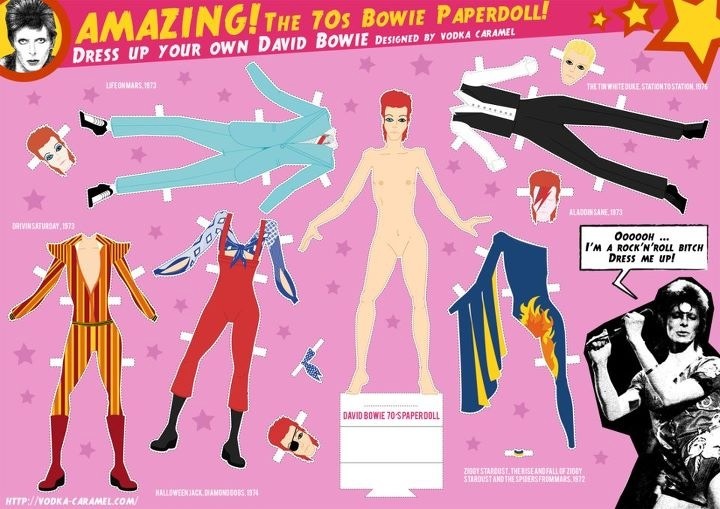
Elusive designer Vodka Caramel’s Amazing 70’s Bowie Paper Doll celebrates some of our hero’s most glamorous looks, but saddles him with the crotch of a Ken doll and no fewer than four interchangeable heads! And we thought the Thin White Paper Doll’s crew socks were an indignity.
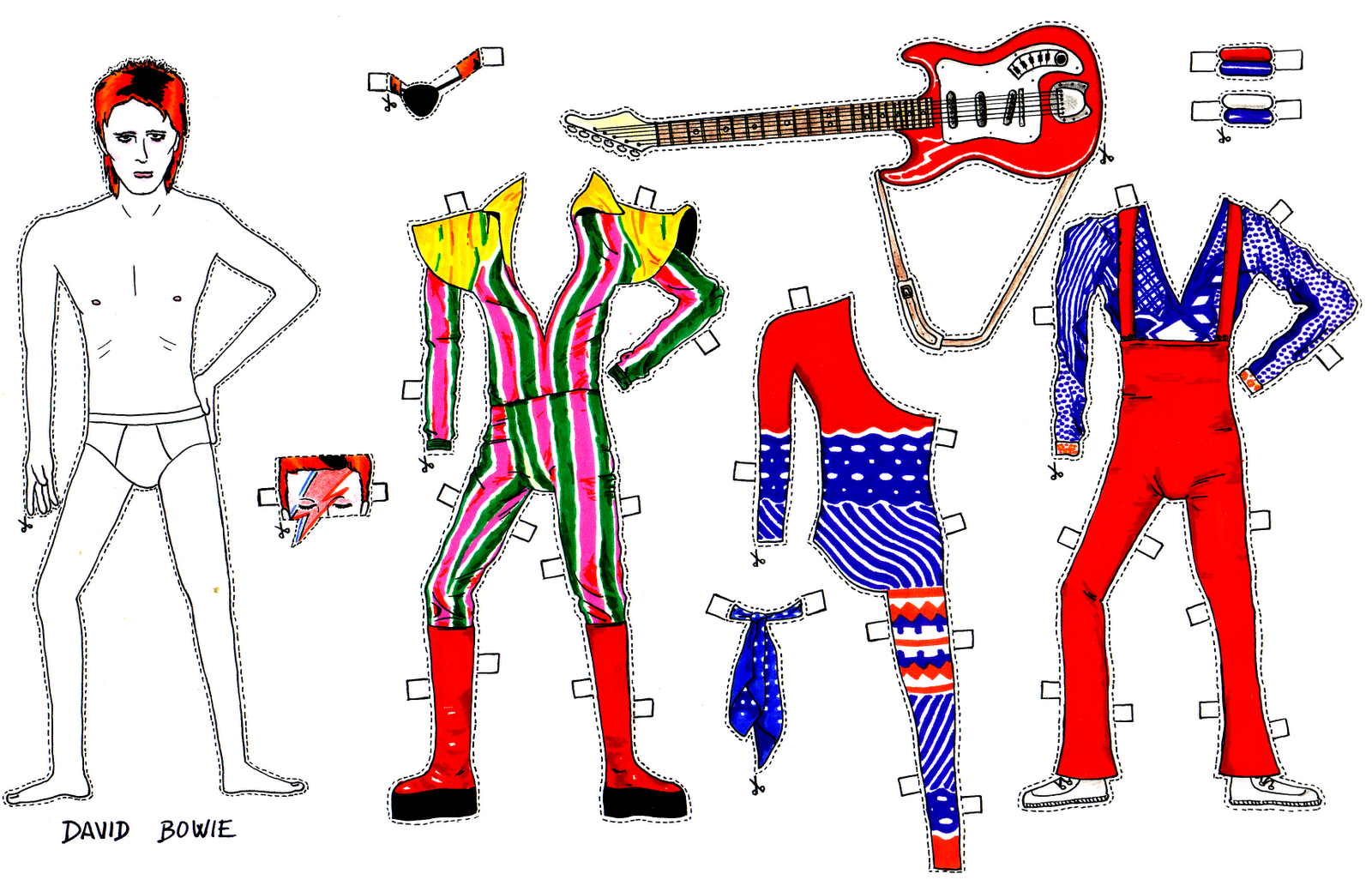
A Spanish fan observed Bowie’s 65th birthday by updating the abbreviated tighty whities of a notorious 1973 photo shoot to a modest pair of standard issue Y‑fronts. Interestingly, this paper doll’s suspendered Halloween Jack suit arrives with bulge intact.
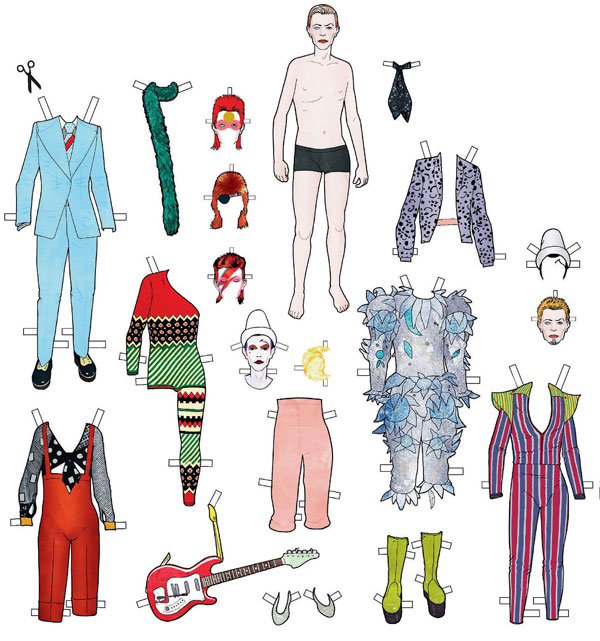
Points to Serge Baeken above for recognizing the paper doll possibilities in the Pierrot costume Bowie sported in the video for 1980’s “Ashes to Ashes.” (Fun fact: Bowie made his theatrical debut—and wrote the music for—a bizarre 1968 pantomime about Pierrot.… His character’s name was “Cloud”)
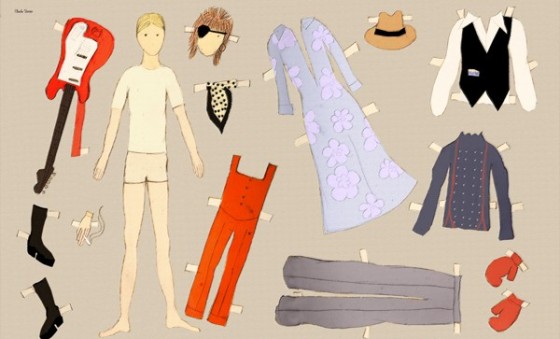
Artist Claudia Varosio’s entry in the Bowie paper doll stakes could pass as illustrations for a 1970’s children’s book. Title? Boys Keep Swinging, after a cut from Bowie’s 1979 Lodger album. Chaste young girls would love the t‑shirted, non-threatening Bowie.
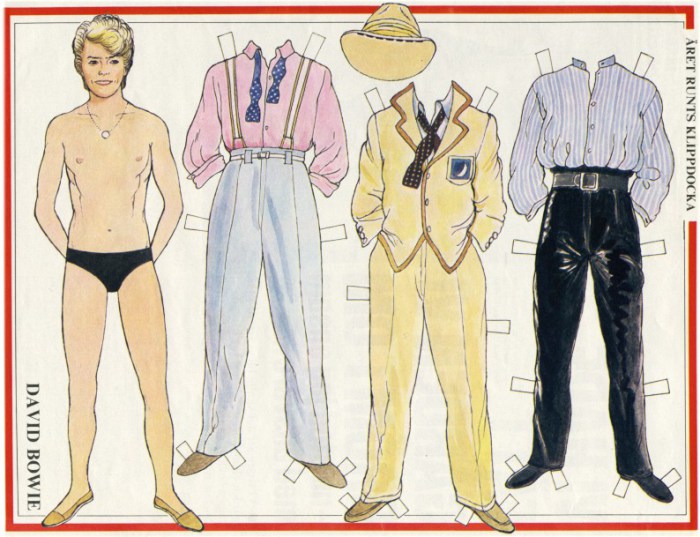
The comparatively conservative, full-faced Bowie above comes to us via Swedish family magazine Året Runt. I may never learn another word of Swedish, but thanks to David Bowie, I can now say paper doll (klippdockor). In appreciation, allow me to share another example of David Bowie klippdockor…
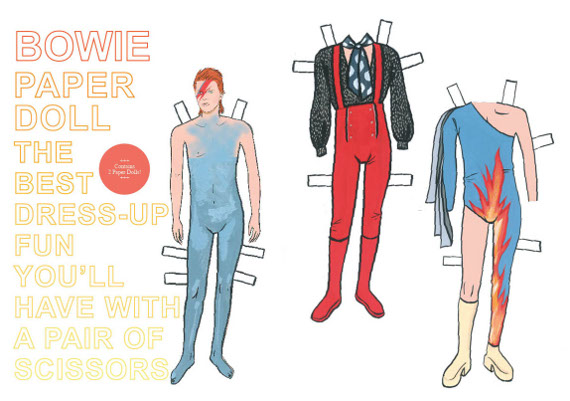
If it all starts seeming a bit rote, mix things up by having artist Mel Elliot’s paper doll Bowie swap duds with fellow pop star / style icon paper dolls, Beyonce, Debbie Harry, and Rihanna.
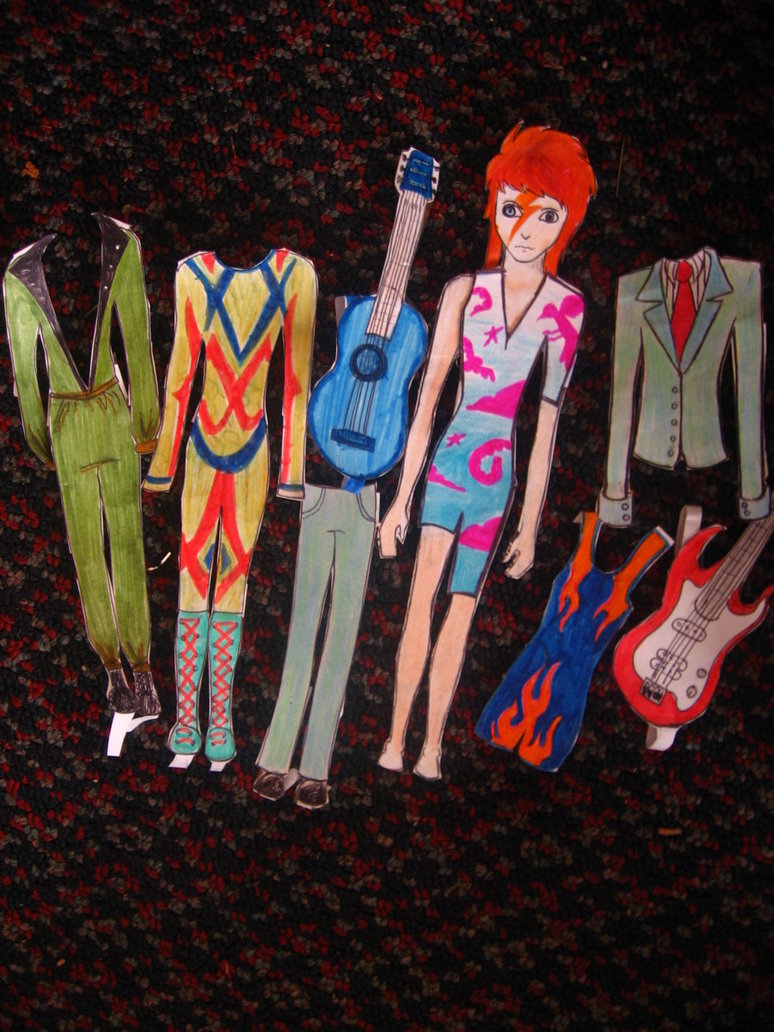
(image by Electric Sorbet)
There is only one David Bowie, but there can never be too many David Bowie paper dolls. Make your own today!
Related Content:
96 Drawings of David Bowie by the “World’s Best Comic Artists”: Michel Gondry, Kate Beaton & More
50 Years of Changing David Bowie Hair Styles in One Animated GIF
The Musical Career of David Bowie in One Minute … and One Continuous Take
Ayun Halliday is an author, illustrator, and Chief Primatologist of the East Village Inky zine. Follow her @AyunHalliday
Read More...JS Bach’s The Well-Tempered Clavier Artistically Animated with Pulsing Neon Lights
The Well-Tempered Clavier, composed by JS Bach between 1722 and 1742, remains one of the most innovative and influential works in the history of Western classical music. A website from Northern Arizona State U. sums up what essentially made Bach’s composition — a collection of 48 preludes and fugues spread across two volumes — so innovative, so influential.
One of Bach’s primary purposes in composing these cycles was to demonstrate the feasibility of the “well tempered” tuning system that would allow for composition in every key.
Another purpose of the Well-Tempered Clavier was to reveal how modern and progressive composition could be informed by conservative ideas. The Well-Tempered Clavier is an encyclopedia of national and historical styles and idioms. Its influences range from the white-note style of the Renaissance motet to the French manier. Ironically, half of this stylistic smorgasbord is expressed in fugue, a form that was out of date upon the cycle’s completion. Bach was of course aware of this. His hope was to defend the venerable form by demonstrating how it could absorb contemporary flavors.
If you’ve never experienced Bach’s piece, then I’d encourage you to listen to the 1960s recording by Glenn Gould. Or watch a section of the piece being performed on the All of Bach website — a site that will eventually put 1080 Bach performances online, for free.
Above, we have something a little different. Created by director and visual artist Alan Warburton, this newly-released video takes a famous section of Bach’s composition and animates it with pulsing neon lights. Describing what went into making this video, the Sinfini Music website writes:
Alan’s incredible design incorporated many thousands of separate CGI lights, every one of which had to be tailored to the precise duration of Pierre-Laurent Aimard’s note strikes. ‘I needed to find a way of automating the process of these turning on and off in time with the music,’ says Alan. With no midi file of the performance available, he was faced with the seemingly impossible task of matching every note of a stand-in midi file to the recording, by ear alone…
Then it was a question of rendering the animated data in CGI within the virtual space created especially for the animation. This too, was no mean feat, even for the army of cloud-based computers that had a hand in the task. Each frame took 15 minutes to render because of the thousands of calculations involved in activating each light as well as the shadows, glows and reflections required to make the scene look truly life-like.
Sinfini Music, which commissioned this project, has more on Warburton’s creation here.
Hope this gets your weekend started on the right, er, note.
Related Content:
All of Bach Is Putting Videos of 1,080 Bach Performances Online
A Big Bach Download: All of Bach’s Organ Works for Free
The Genius of J.S. Bach’s “Crab Canon” Visualized on a Möbius Strip
Read More...Support Us
We're hoping to rely on loyal readers, rather than erratic ads. Please click the Donate button and support Open Culture. You can use Paypal, Venmo, Patreon, even Crypto! We thank you!

About Us

Open Culture scours the web for the best educational media. We find the free courses and audio books you need, the language lessons & educational videos you want, and plenty of enlightenment in between.
Advertise With Us

FREE UPDATES!
GET OUR DAILY EMAIL
Get the best cultural and educational resources on the web curated for you in a daily email. We never spam. Unsubscribe at any time.
FOLLOW ON SOCIAL MEDIA

Open Culture editor Dan Colman scours the web for the best educational media. He finds the free courses and audio books you need, the language lessons & movies you want, and plenty of enlightenment in between.
Advertise With Us


