Susan Sontag’s List of 10 Parenting Rules

Image by Juan Fernando Bastos, via Wikimedia Commons
Parenting is difficult. I don’t need to tell you this—those of you who face the challenge daily and hourly. Those of you who don’t have heard your friends—and your own parents—do enough complaining that you know, in theory at least, how raising humans is rough business all around. Paradoxically, there is no rulebook for parenting and there are hundreds of rulebooks for parenting, seemingly a new one published every day. In my admittedly limited experience as the parent of a young child, most such guides have diminishing returns next to the direct lessons learned in the fray, so to speak, through trial after trial and no small amount of error.
But we do benefit from the wisdom of others, especially those who record their experiments in child-rearing with the precision and thoughtfulness of Susan Sontag. In the list below, made by a 26-year-old Sontag in 1959, we see how the young mother of a then 7‑year-old David Rieff approached the job.
The son of Sontag and sociologist Philip Rieff (“pop,” below), whom Sontag married at 17 then divorced in 1958, David has written a memoir of Sontag’s painful final days. He also edited her journals and notebooks, which contained the following rules.
- Be consistent.
- Don’t speak about him to others (e.g. tell funny things) in his presence. (Don’t make him self-conscious.)
- Don’t praise him for something I wouldn’t always accept as good.
- Don’t reprimand him harshly for something he’s been allowed to do.
- Daily routine: eating, homework, bath, teeth, room, story, bed.
- Don’t allow him to monopolize me when I am with other people.
- Always speak well of his pop. (No faces, sighs, impatience, etc.)
- Do not discourage childish fantasies.
- Make him aware that there is a grown-up world that’s none of his business.
- Don’t assume that what I don’t like to do (bath, hairwash) he won’t like either.
While Rieff has described his relationship with Sontag as “strained and at times very difficult,” it seems to me that a parent who adhered to these rules would create the kind of supportive structure children need to thrive. The remainder of Sontag’s journal entries show us a deeply introspective, self-conscious writer, and yet, writes Emily Greenhouse at The New Yorker, her work as a whole offers “surprisingly little of her own direct experience” and she never undertook an autobiography. Yet, this short list of parenting rules gives us a great deal of insight into the perspicacity and compassion she brought to her role as a mother, qualities most of us could use a bit more of in our daily parenting struggles.
The list above appears in the new book Lists of Note, the follow up to Shaun Usher’s Letters of Note, both compilations of his extensive online archives of personal notes and correspondence from famous and interesting people. Download a preview of the book and purchase a hardcover copy, just in time for Christmas, at Waterstones.com (if you live in the UK).
Related Content:
See Films Made by Susan Sontag and a List of Her 50 Favorite Films (1977)
“Nothing Good Gets Away”: John Steinbeck Offers Love Advice in a Letter to His Son (1958)
Josh Jones is a writer and musician based in Durham, NC. Follow him at @jdmagness
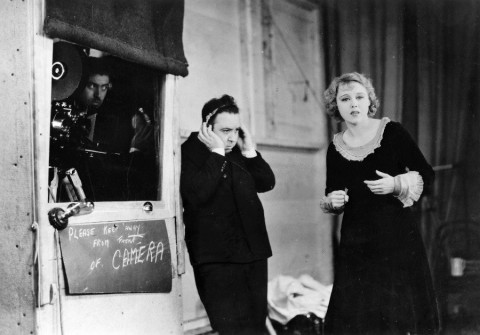
Read More...Alfred Hitchcock Conducts a Politically Incorrect Sound Test on the Set of Blackmail (1929)
Above we have a young Alfred Hitchcock on the set of Blackmail (1929), conducting a rather naughty sound test with actress Anny Ondra (1929).
In case you don’t know the backstory, Blackmail was originally meant to be a silent film. However, with talkies becoming the rage, Hitchcock decided mid-stream to make the film a talkie. That decision didn’t come without its own problems. Anny Ondra, a Czech actress, spoke English with a heavy accent and couldn’t pass as a Londoner in the film. So Hitchcock performed some cinema magic and had English actress Joan Barry dub Ondra’s lines. In those days, dubbing couldn’t take place in post-production. It all had to happen in real-time. Thus, as the camera rolled, Barry stood outside the frame and spoke the dialogue into a microphone, while Ondra pantomimed the words. Throughout, Hitchcock directed Ondra while listening to Barry through a pair of headphones.
You can watch Blackmail (Britain’s first talkie feature film) online here or find it in our collection of 23 Free Hitchcock Films Online.
Related Content:
37 Hitchcock Cameo Appearances Over 50 Years: All in One Video
Listen to François Truffaut’s Big, 12-Hour Interview with Alfred Hitchcock (1962)
The Pleasure Garden, Alfred Hitchcock’s Very First Feature Film (1925)
Read More...
Animated Louis CK Shows Demonstrates How “Animation Lets You Do Anything”
Fatherhood is a fertile subject for comedian Louis C.K.
Kids do say the darnedest things, but Louis’ observations reveal the depth of his investment.
He lit out after standardized testing and the Common Core on Twitter.
He made a passionate case against giving kids smartphones to Conan O’Brien.
Is it any wonder that the “dumber, funnier” version of himself he created for his TV show is preoccupied and often thwarted by his responsibilities as the single dad of two young daughters?
(Real life may provide inspiration, but the writer and star displays appropriate boundaries when he says that his actual daughters are markedly different characters than their TV counterparts.)
But the knife of fatherhood cuts both ways. Louis’ troubled relationship with his own dad gets less attention than the father-daughter bond, but it’s there in his work. The prospect of spending time with his estranged father causes the fictional Louis to vomit at the dinner table in season three.
The animated approach seen above, gives Louis more control over the situation. Animation, like reading, makes possible flights of fancy wherein children—including grown ones like Louis—can do “absolutely anything.” Flying and using a rainbow as a slide are among the fantastical activities the 2‑D Louis samples. Meanwhile, the quality of his narration conveys an underlying distaste for the sort of canned “imaginative” suggestions foisted on children by well-meaning educational programmers.
Left to their own devices, most kids will come up with scenarios and powers far weirder than anything peddled to them by an adult. Why “swim through the ocean like a fish” when you can anthropomorphize your elderly father as a malevolent spider, lodged in your chest, pooping out regular little “infestations of hate”?
Animation lets you go all the way, and C.K. certainly does, lopping off heads, and (SPOILER!) inadvertently Bonnie and Clyding himself from within.
Someone’s made a lot of progress since the 90’s, when he used his time on Dr. Katz’s animated couch to discuss K‑Mart and Chips Ahoy.
Related Content:
The Surreal Short Films of Louis C.K., 1993–1999
Seinfeld, Louis C.K., Chris Rock, and Ricky Gervais Dissect the Craft of Comedy (NSFW)
20-Year-Old Louis CK Performs Stand Up (1987)
Ayun Halliday is an author, homeschooler, and Chief Primatologist of the East Village Inky zine. Follow her @AyunHalliday
Read More...Watch Carl Sagan & Richard Dawkins Present the Royal Institution’s Famous Christmas Lectures
If only someone could have invented the internet by 1825. Not only would we have reached unimagined realms of communication by now, but we would have a full 189 years of Christmas lectures to stream online at our leisure. A production of the Royal Institution in the United Kingdom, the Christmas lectures began with the educational endeavors of electromagnetism and electrochemistry pioneer Michael Faraday. Between 1827 and 1860, Faraday gave the first Christmas lectures on the London grounds of the Royal Institution, holding forth on subjects like chemistry, electricity, and matter in an effort to get the general public excited about science. According to one of his soundest principles of lecturing, “a flame should be lighted at the commencement and kept alive with unremitting splendour to the end.” Generations of scientific lecturers have stepped forward to light and keep that splendid flame to this day.
At the top of the post, we have the first of Carl Sagan’s six Christmas lectures on Earth, Mars, and our solar system from 1977. Just above, you can watch the first of Richard Dawkins’ 1991 Christmas lecture series entitled Growing Up in the Universe. Though Sagan and Dawkins ostensibly geared their lectures toward kids — just as Faraday intended his scientific spectacles for a “juvenile audience” — don’t let that turn you off if you’ve already reached adulthood. In fact, grown-ups may stand to gain more than kids, given our tendency to binge-watch. Why not give yourself an educational holiday treat by plowing through the past several years of Christmas lectures archived at the Royal Institution’s web site? This Christmas, they’ve got professor Danielle George on “how the spark of your imagination and some twenty first century tinkering can change the world” — so get ready to gather ’round with all the future world-changers you know, young or old.
Related Content:
Carl Sagan Presents Six Lectures on Earth, Mars & Our Solar System … For Kids (1977)
Carl Sagan Explains Evolution in an Eight-Minute Animation
Colin Marshall hosts and produces Notebook on Cities and Culture and writes essays on cities, language, Asia, and men’s style. He’s at work on a book about Los Angeles, A Los Angeles Primer. Follow him on Twitter at @colinmarshall or on Facebook.
Read More...O Frabjous Day! Neil Gaiman Recites Lewis Carroll’s “Jabberwocky” from Memory
When the young Neil Gaiman was learning Lewis Carroll’s “Jabberwocky” by heart, he surely had no inkling that years later he’d be called upon to recite it for legions of adoring fans…particularly on the Internet, a phenomenon the budding author may well have imagined, if not technically implemented.
Worldbuilders, a fundraising portal that rewards donors not with tote bags or umbrellas, but rather with celebrity challenges of a non-ice bucket variety, scored big when Gaiman agreed to participate.
Earlier this year, a rumpled looking Gaiman read Dr. Seuss’s “rather wonderful” Green Eggs and Ham into his webcam.
This month, with donations to Heifer International exceeding $600,000, he found himself on the hook to read another piece of the donors’ choosing. Carroll’s nonsensical poem won out over Goodnight Moon, Fox in Socks, and Where the Wild Things Are.
Like fellow author, Lynda Barry, Gaiman is not one to underestimate the value of memorization.
The videography may be casual, but his off-book performance in an undisclosed tulgey wood is the stuff of high drama.
Callooh!
Callay!
Is that a memory lapse at the one minute mark? Another interpreter might have called for a retake, but Gaiman rides out a four second pause cooly, his eyes the only indicator that something may be amiss. Perhaps he’s just taking precautions, listening for telltale whiffling and burbling.
If you’re on the prowl to make some year end charitable donations, recreational mathemusician Vi Hart and author John Green are among those Worldbuilders has in the pipeline to perform stunts for successfully funded campaigns.
Jabberwocky is a poem that appears in Carroll’s Through the Looking-Glass, the 1871 sequel to Alice’s Adventures in Wonderland (1865). You can find both in our collection, 800 Free eBooks for iPad, Kindle & Other Devices.
Related Content:
Neil Gaiman Gives Graduates 10 Essential Tips for Working in the Arts
Where Do Great Ideas Come From? Neil Gaiman Explains
Ayun Halliday is an author, homeschooler, and Chief Primatologist of the East Village Inky zine. Follow her @AyunHalliday
Read More...Watch Bob Dylan Play a Private Concert for One Lucky Fan
On November 23rd, Bob Dylan played a live concert for one awed fan. As Rolling Stone described it, “Fredrik Wikingsson walked into Philadelphia’s Academy of Music, took a seat in the [sixth] row and prepared to watch his hero play a concert just for him.” “At this point,” Wikingsson said, “I still thought I was about to get Punk’d.” “I thought some asshole would walk onstage and just laugh at me. I just couldn’t fathom that Dylan would actually do this.”
But it wasn’t a joke. Dylan treated the superfan to a personal concert, playing covers of songs from the early days of American rock n roll. And it was all filmed for a Swedish TV series called Experiment Ensam (Experiment Alone), where individuals take part, alone, in activities usually meant for groups. The video of the experimental concert went online yesterday. You can watch it above.
For more news bringing together Bob Dylan and Sweden, see our recent post: Swedish Scientists Sneak Bob Dylan Lyrics Into Their Academic Publications For Last 17 Years.
Follow us on Facebook, Twitter and Google Plus and share intelligent media with your friends. Or better yet, sign up for our daily email and get a daily dose of Open Culture in your inbox.
Related Content:
Bob Dylan Reads From T.S. Eliot’s Great Modernist Poem The Waste Land
Bob Dylan and The Grateful Dead Rehearse Together in Summer 1987. Listen to 74 Tracks.
Bob Dylan and George Harrison Play Tennis, 1969
Read More...
Lou Reed Reads Delmore Schwartz’s Famous Story “In Dreams Begin Responsibilities”

In a galloping vignette in Tablet, writer Lee Smith manages to evoke the essences of both sentimental tough guy Lou Reed and his literary mentor and hero, “Brooklyn Jewish Troubadour” Delmore Schwartz. Although Schwartz’s “poetry is his real legacy,” Smith writes, that rich body of work is often obscured by the fact that “his most famous work is a short story,” the much-anthologized “In Dreams Begin Responsibilities” (1935) It’s a story written in prose as lyrical as can be—with sentences one wants to pause and linger over, reading again and again, out loud if possible. It’s also a story in which we see “a direct line… between Schwartz and Reed,” whose song “Perfect Day” performs similar kind of magical cataloguing of urban impermanence. For Reed, onetime student of Schwartz at Syracuse University, “Delmore Schwartz is everything.”
Reed dedicated the last song, “European Son,” on the first Velvet Underground album to Schwartz, and wrote an eloquent forward to a reissue of Schwartz’s first collection of stories and poems, also titled In Dreams Begin Responsibilities. And just above, you can hear Reed himself read the story aloud, savoring those lyrical sentences in his Brooklyn deadpan. It’s easy to imagine Reed writing many of these sentences, such was Schwartz’s influence on him. They shared not only common origins, but also a common sensibility; in Reed’s songs we hear the echo of Schwartz’s voice, the satirical world-weariness and the lyricism and longing. In the biographical documentary Rock and Roll Heart, Reed says that Schwartz showed him how, “with the simplest language imaginable, and very short, you can accomplish the most astonishing heights.” Reading, and listening to Schwartz’s astonishing “In Dreams Begin Responsibilities” may help you understand just what he meant.
This reading has been added to our collection, 1,000 Free Audio Books: Download Great Books for Free.
Related Content:
Lou Reed Rewrites Edgar Allan Poe’s “The Raven.” See Readings by Reed and Willem Dafoe
Rock and Roll Heart, 1998 Documentary Retraces the Remarkable Career of Lou Reed
Teenage Lou Reed Sings Doo-Wop Music (1958–1962)
Josh Jones is a writer and musician based in Durham, NC. Follow him at @jdmagness
Read More...Blade Runner Spoofed in Three Japanese Commercials (and Generally Loved in Japan)
Blade Runner’s vision of a thoroughly Japanified Los Angeles in the year 2019 reflects the western economic anxieties of the early 1980s. And while that once far-flung year may not have come quite yet, Japan — given the bursting of its postwar financial bubble and the “lost decade” of the 1990s that followed — looks unlikely to own a fraction as much of the United States as Ridley Scott’s Philip K. Dick adaptation (and many other futuristic stories besides) assumed it eventually would. Still, the film’s cultural prophesy came true: even during its economic stagnation, Japan exercised more “soft power” than ever before, turning the world to the unique claims of its culture, from the refinement of its cuisine to the hyperactive exuberance of its music and animation to the matchless elegance of its traditional aesthetics.
Even as Blade Runner showed us how much Japanese style would one day influence, the style of the film had, for its part, an immediate influence on Japan. Though famously unappreciated by westerners on its initial release (“a waste of time,” said Siskel and Ebert), its proto-cyberpunk sensibility won the hearts of Japanese viewers, and Japanese creators, right away. The video at the top of the post collects three Japanese television commercials that both spoof and pay homage to Blade Runner: the first for the Honda Beat, a Japan-only roadster; the second (an astute parody of a particularly memorable scene) for Menicon contact lenses; and the third for mobile service provider J‑Phone.
But the movie’s effect on Japan didn’t stop at the advertising industry. The 1987 animated series Bubblegum Crisis, which follows the adventures of a cyborg-battling team in the “Mega Tokyo” of 2032, plays so much like a homegrown Blade Runner that a fan could create the second video above: an animated recreation of Blade Runner’s trailer, using all its original sound, with Bubblegum Crisis’ footage. The 1988 video game Snatcher stars the decidedly Harrison-Fordian Gillian Seed, a detective in pursuit of the titular killer androids in the “Neo Kobe” of 2044. You can still see much of what the film inspired, and what inspired in the film, in major Japanese cities today. Even Los Angeles has made strides here and there toward the Blade Runner future, though I regret to admit that we still await our tower-side geisha.
Related Content:
The Blade Runner Promotional Film
Colin Marshall hosts and produces Notebook on Cities and Culture and writes essays on cities, language, Asia, and men’s style. He’s at work on a book about Los Angeles, A Los Angeles Primer. Follow him on Twitter at @colinmarshall or on Facebook.
Read More...10 Classic German Expressionist Films: From Nosferatu to The Cabinet of Dr. Caligari
In 1913, Germany, flush with a new nation’s patriotic zeal, looked like it might become the dominant nation of Europe and a real rival to that global superpower Great Britain. Then it hit the buzzsaw of World War I. After the German government collapsed in 1918 from the economic and emotional toll of a half-decade of senseless carnage, the Allies forced it to accept draconian terms for surrender. The entire German culture was sent reeling, searching for answers to what happened and why.
German Expressionism came about to articulate these lacerating questions roiling in the nation’s collective unconscious. The first such film was The Cabinet of Dr. Caligari (1920), about a malevolent traveling magician who has his servant do his murderous bidding in the dark of the night. The storyline is all about the Freudian terror of hidden subconscious drives, but what really makes the movie memorable is its completely unhinged look. Marked by stylized acting, deep shadows painted onto the walls, and sets filled with twisted architectural impossibilities — there might not be a single right angle in the film – Caligari’s look perfectly meshes with the narrator’s demented state of mind.
Subsequent German Expressionist movies retreated from the extreme aesthetics of Caligari but were still filled with a mood of violence, frustration and unease. F. W. Murnau’s brilliantly depressing The Last Laugh (1924) is about a proud doorman at a high-end hotel who is unceremoniously stripped of his position and demoted to a lowly bathroom attendant. When he hands over his uniform, his posture collapses as if the jacket were his exoskeleton. You don’t need to be a semiologist to figure out that the doorman’s loss of status parallels Germany’s. Fritz Lang’s M (1931), a landmark of early sound film, is the first serial killer movie ever made. But what starts out as a police procedural turns into something even more unsettling when a gang of distinctly Nazi-like criminals decide to mete out some justice of their own.
German Expressionism ended in 1933 when the Nazis came to power. They weren’t interested in asking uncomfortable questions and viewed such dark tales of cinematic angst as unpatriotic. Instead, they preferred bright, cheerful tales of Aryan youths climbing mountains. By that time, the movement’s most talented directors — Fritz Lang and F.W. Murnau — had fled to America. And it was in America where German Expressionism found its biggest impact. Its stark lighting, grotesque shadows and bleak worldview would go on on to profoundly influence film noir in the late 1940s after another horrific, disillusioning war. See our collection of Free Noir Films here.
You watch can 10 German Expressionist movies – including Caligari, Last Laugh and M — for free below.
- Nosferatu — Free — German Expressionist horror film directed by F. W. Murnau. An unauthorized adaptation of Bram Stoker’s Dracula. (1922)
- The Student of Prague — Free — A classic of German expressionist film. German writer Hanns Heinz Ewers and Danish director Stellan Rye bring to life a 19th-century horror story. Some call it the first indie film. (1913)
- Nerves — Free — Directed by Robert Reinert, Nerves tells of “the political disputes of an ultraconservative factory owner Herr Roloff and Teacher John, who feels a compulsive but secret love for Roloff’s sister, a left-wing radical.” (1919)
- The Cabinet of Dr. Caligari — Free — This silent film directed by Robert Wiene is considered one of the most influential German Expressionist films and perhaps one of the greatest horror movies of all time. (1920)
- Metropolis — Free — Fritz Lang’s fable of good and evil fighting it out in a futuristic urban dystopia. An important classic. An alternate version can be found here. (1927)
- The Golem: How He Came Into the World — Free — A follow-up to Paul Wegener’s earlier film, “The Golem,” about a monstrous creature brought to life by a learned rabbi to protect the Jews from persecution in medieval Prague. Based on the classic folk tale, and co-directed by Carl Boese. (1920)
- The Golem: How He Came Into the World — Free — The same film as the one listed immediately above, but this one has a score created by Pixies frontman Black Francis. (2008)
- The Last Laugh - Free — F.W. Murnau’s classic chamber drama about a hotel doorman who falls on hard times. A masterpiece of the silent era, the story is told almost entirely in pictures. (1924)
- Faust — Free - German expressionist filmmaker F.W. Murnau directs a film version of Goethe’s classic tale. This was Murnau’s last German movie. (1926)
- Sunrise: A Song of Two Humans — Free — Made by the German expressionist director F.W. Murnau. Voted in 2012, the 5th greatest film of all time. (1927)
- M — Free — Classic film directed by Fritz Lang, with Peter Lorre. About the search for a child murderer in Berlin. (1931)
For more classic films, peruse our larger collection, 4,000+ Free Movies Online: Great Classics, Indies, Noir, Westerns, Documentaries & More.
If you would like to support the mission of Open Culture, consider making a donation to our site. It’s hard to rely 100% on ads, and your contributions will help us continue providing the best free cultural and educational materials to learners everywhere. You can contribute through PayPal, Patreon, and Venmo (@openculture). Thanks!
Related Content:
Metropolis Restored: Watch a New Version of Fritz Lang’s Masterpiece
Fritz Lang’s “Licentious, Profane, Obscure” Noir Film, Scarlet Street (1945)
Free: F. W. Murnau’s Sunrise, the 1927 Masterpiece Voted the 5th Best Movie of All Time
Watch Nosferatu, the Seminal Vampire Film, Free Online (1922)
Jonathan Crow is a Los Angeles-based writer and filmmaker whose work has appeared in Yahoo!, The Hollywood Reporter, and other publications. You can follow him at @jonccrow. And check out his blog Veeptopus, featuring lots of pictures of badgers and even more pictures of vice presidents with octopuses on their heads. The Veeptopus store is here.
Read More...
John Waters Narrates Offbeat Documentary on an Environmental Catastrophe, the Salton Sea
In 2004, John Waters narrated Plagues & Pleasures on the Salton Sea, a humorous documentary on the accidental lake created in the desert of Southern California. You can now find the film hosted on the YouTube channel of KQED, the public television outfit in San Francisco (where we’re getting heavy, heavy rains today). They lay the foundation for watching the film as follows:
Once known as the “California Riviera,” the Salton Sea is now considered one of America’s worst ecological disasters: a fetid, stagnant, salty lake, coughing up dead fish and birds by the thousands. Narrated by cult-movie legend John Waters, Plagues & Pleasures is an epic western tale of real estate ventures and failed boomtowns.
Find Plagues & Pleasures on the Salton Sea listed in our collection, 285 Free Documentaries Online.
If you would like to support the mission of Open Culture, consider making a donation to our site. It’s hard to rely 100% on ads, and your contributions will help us continue providing the best free cultural and educational materials to learners everywhere. You can contribute through PayPal, Patreon, and Venmo (@openculture). Thanks!
Related Content:
John Waters Makes Handmade Christmas Cards, Says the “Whole Purpose of Life is Christmas”
An Anti, Anti-Smoking Announcement from John Waters
John Waters: The Point of Contemporary Art
Global Warming: A Free Course from UChicago Explains Climate Change
Read More...Support Us
We're hoping to rely on loyal readers, rather than erratic ads. Please click the Donate button and support Open Culture. You can use Paypal, Venmo, Patreon, even Crypto! We thank you!

About Us

Open Culture scours the web for the best educational media. We find the free courses and audio books you need, the language lessons & educational videos you want, and plenty of enlightenment in between.
Advertise With Us

FREE UPDATES!
GET OUR DAILY EMAIL
Get the best cultural and educational resources on the web curated for you in a daily email. We never spam. Unsubscribe at any time.
FOLLOW ON SOCIAL MEDIA

Open Culture editor Dan Colman scours the web for the best educational media. He finds the free courses and audio books you need, the language lessons & movies you want, and plenty of enlightenment in between.
Advertise With Us


