50 Film Noirs You Can Watch For Free: A Dame with a Past. A Desperate, Doomed Man. A Gun.
Film noir isn’t really a genre. It’s a mood. Its elements are so well known that they border on self-parody. Neon lights. Inky black shadows. An empty bottle of whiskey. A gun. A dame with a past. A desperate, doomed man.
Like German Expressionism during the 1930s, it was a cultural processing of a historic trauma. Like French Poetic Realism during that same decade, film noir is fixed in a particular culture during a particular time. In this case, the culture was the inherently optimistic one of the United States. The time was just after World War II when the foundations of that optimism were severely tested. A generation of men returned from Europe and the Pacific scarred and dazed by the mind-boggling carnage of the war only to discover that their women were doing just fine working in factories and offices. Is it any wonder then that perhaps the most frequent trope in noir is of a man, seemingly tough but riven with weakness, undone by a powerful, sexually-dominating femme fatale?
Though those gender roles were quickly reshuffled and women were, for a time, banished back to the realm of domesticity, cracks remained in the brittle veneer of American masculinity. Add to that existential anxieties over the bomb and the Red Scare’s corrosive paranoia and you have a whole toxic stew of cultural fears burbling out of the American collective unconscious. And film noir articulated those fears better than just about anything else.
Of course, the reason film noir has proved to be so enduring is because of its look. The spare lighting, the canted angles, the grotesque shadows. It’s German Expressionism cast through the lens of Orson Welles. Its stark style melded perfectly with noir’s bleak cynicism. It should come as no surprise that some of the best noir directors – Fritz Lang, Robert Siodmak and especially Billy Wilder – fled Germany for the warmer climes of Hollywood. The style was also cheap — lots of shadows means less money spent on lights. It was a boon for the scores of independent producers who made noirs on a shoestring.
If you want get into that film noir mood, Open Culture has 50, count ‘em, 50 film noir movies that you can watch right now for free. They include:
- Detour Free – Edgar Ulmer’s cult classic noir film shot in 6 days. (1945)
- D.O.A. — Free — Rudolph Maté’s classic noir film. Called “one of the most accomplished, innovative, and downright twisted entrants to the film noir genre.” (1950)
- The Hitch-Hiker — Free – The first noir film made by a woman noir director, Ida Lupino. It appears above. (1953)
- The Naked Kiss — Free - Constance Towers is a prostitute trying to start new life in a small town. Directed by Sam Fuller. (1964)
- The Stranger — Free – Directed by Orson Welles with Edward G. Robinson. One of Welles’s major commercial successes. (1946)
Check out the full list of 50 free noir films here, or find them in our larger collection, 4,000+ Free Movies Online: Great Classics, Indies, Noir, Westerns, Documentaries & More.
Related Content:
Detour: The Cheap, Rushed Piece of 1940s Film Noir Nobody Ever Forgets
Watch D.O.A., Rudolph Maté’s “Innovative and Downright Twisted” Noir Film (1950)
Jonathan Crow is a Los Angeles-based writer and filmmaker whose work has appeared in Yahoo!, The Hollywood Reporter, and other publications. You can follow him at @jonccrow. And check out his blog Veeptopus, featuring lots of pictures of badgers and even more pictures of vice presidents with octopuses on their heads. The Veeptopus store is here.
Read More...Three Strikingly Different Views of North Korea, the Most Secretive Country in the World
I once asked a friend based in Seoul, South Korea who used to write for a prestigious news magazine what that magazine wanted to hear from the Korea beat. “Let’s see… North Korea, North Korea, and more North Korea,” he replied. “Oh, and did I mention North Korea?” Since the creation of two Koreas after the Second World War, North Korea, the far less populated and infinitely more secretive sibling of the land of all-you-can-eat barbecue and “Gangnam Style,” has inspired deep and fearful fascination in its observers. This has held truer and truer as time goes on; South and North Korea looked surprisingly similar in the twenty years or so right after they put the Korean War on pause, but now they’ve diverged so far that one can scarcely believe that so little time, and even less distance, separates the two.
The world’s interest in North Korea has run especially strong in the 21st century, during the reigns of the late (and cinephilic) Kim Jong-Il and now his son, the even higher-profile (and seemingly unappreciative of the upcoming North Korea-themed James Franco-Seth Rogen comedy The Interview) Kim Jong-Un. Vice catered straight to it when they produced the documentary The Vice Guide to North Korea at the top, which provides a wisecracking first-person perspective on what you get when you sign up for a tour of the place. (Shooting pool with a lonely tea-shop girl ranks not lowest among the attractions.) If you sign up for one yourself, you’ll probably go with Koryo Tours, the firm with whose aid city-brander JT Singh and videographer Rob Whitworth put together “Enter Pyongyang,” the time-bending composite flight through the North Korean capital just above.

Pyongang shows up on illumination maps as the sole point of light in an otherwise dark country. So what goes on in the rest of it? According to One Free Korea, “the Committee for Human Rights in North Korea estimates that North Korea holds as many as 120,000 people in its system of concentration and detention camps, and that 400,000 people have died in these camps from torture, starvation, disease, and execution.” On that page, they’ve assembled Google Earth satellite images documenting the probable locations and elements of these camps. For more on these least-known parts of this least-known nation, see also Vice’s 40-minute program on North Korean Labor Camps below:
If all this doesn’t satiate your curiosity about North Korea — and what amount of information ever could? — have a look at National Geographic’s Inside North Korea, a slow-motion film of an intensely choreographed North Korean military parade, and of course, our guide to the five best North Korean movies, all free to watch online.
Related Content:
Orchestral Manoeuvres in North Korea Prove Yet Again That Music is Universal
A Slo-Mo Look Inside North Korea
The Five Best North Korean Movies: Watch Them Free Online
Colin Marshall hosts and produces Notebook on Cities and Culture and writes essays on cities, language, Asia, and men’s style. He’s at work on a book about Los Angeles, A Los Angeles Primer. Follow him on Twitter at @colinmarshall or on Facebook.
Read More...The Digital Dostoevsky: Download Free eBooks & Audio Books of the Russian Novelist’s Major Works
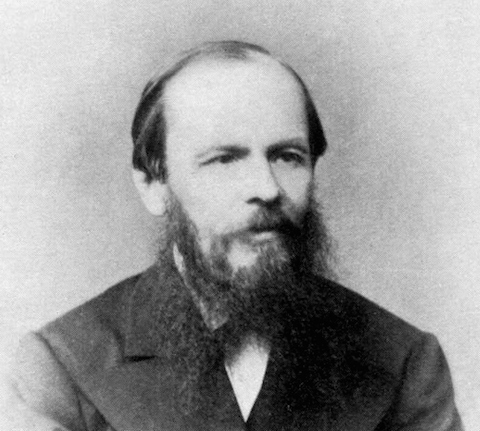
In the pantheon of Great Russian Writers, two heads appear to tower above all others—at least for us English-language readers. Leo Tolstoy, aristocrat-turned-mystic, whose detailed realism feels like a fictionalized documentary of 19th century Russian life; and Fyodor Mikhailovich Dostoevsky, the once-condemned-to-death, epileptic former gambler, whose fever-dream novels read like psychological case studies of people barely clinging to the jagged edges of that same society. Both novelists are read with similar reverence and devotion by their fans, and they are often pitted against each other, writes Kevin Hartnett at The Millions, like “Williams vs. DiMaggio and Bird vs. Magic,” even as people who have these kinds arguments acknowledge them both as “irreducibly great.”
I’ve had the Tolstoy vs. Dostoevsky back and forth a time or two, and I have to say I usually give the edge to Dostoevsky. It’s the high-stakes desperation of his characters, the tragic irony of their un-self-awareness, or the gnawing obsession of those who know a little bit too much, about themselves and everyone else. Dostoyevsky has long been described as a psychological novelist. Nietzsche famously called him “the only psychologist from whom I have anything to learn.” Henry Miller’s praise of the writer of particularly Russian forms of misery and trespass is a little more colorful: “Dostoevsky,” he wrote, “is chaos and fecundity. Humanity, with him, is but a vortex in the bubbling maelstrom.”
Perhaps the most succinct statement on the Russian novelist’s work comes from Scottish poet and novelist Edwin Muir, who said, “Dostoyevsky wrote of the unconscious as if it were conscious; that is in reality the reason why his characters seem ‘pathological,’ while they are only visualized more clearly than any other figures in imaginative literature.” Joseph Conrad may have found him “too Russian,” but even with the cultural gulf that separates him from us, and the well over one hundred years of social, political, and technological change, we still read Dostoevsky and see our own inner darkness reflected back at us—our hypocrisies, neuroses, obsessions, terrors, doubts, and even the paranoia and narcissism we think unique to our internet age.
This kind of thing can be unsettling. Although, like Tolstoy, Dostoevsky embraced a fiercely uncompromising Christianity—one more wracked with painful doubt, perhaps, but no less sincere—his willingness to descend into the lowest depths of the human psyche made him seem to Turgenev like “the nastiest Christian I’ve ever met.” I’m not sure if that was meant as a compliment, but it’s perhaps a fitting description of the creator of such expressly vicious characters as Crime and Punishment’s sociopathic Arkady Svidrigailov, Demons’ cruel rapist Nikolai Stavrogin, and The Brothers Karamazov’s psychopathic creep Pavel Smerdyakov (a character so nasty he inspired a Marvel comics villain).
Next to these devils, Dostoevsky places saints: Crime and Punishment’s Sonya, Karamazov brother Alyosha the monk, and holy fool Prince Myshkin in The Idiot. His characters frequently murder and redeem each other, but they also work out existential crises, have lengthy theological arguments, and illustrate the author’s philosophical ideas about faith and its lack. The genius of Dostoevsky lies in his ability to explore such heady abstractions while rarely becoming didactic or turning his characters into puppets. On the contrary—no figures in modern literature seem so alive and three-dimensional as his anguished collection of unforgettable anarchists, aristocrats, poor folks, criminals, flaneurs, and underground men.
Should you have missed out on the pleasure, if it can so be called, of fully immersing yourself in Dostoevsky’s world of fear, belief, and madness—or should you desire to refresh your knowledge of his dense and multifaceted work—you can find all of his major novels and novellas online in a variety of formats. We’ve done you the favor of compiling them below in ebook format. Where possible, we’ve also included audio books too. (Note: they all permanently reside in our Free eBooks and Free Audio Books collections.)
- Poor Folk (1846)
- eBook: Kindle + Other Formats
- The Double (1846)
- eBook: Kindle + Other Formats
- Notes From the Underground (1864)
- eBook: iPad/iPhone — Kindle + Other Formats
- Audio Book: Free MP3
- Crime and Punishment (1866)
- eBook: iPad/iPhone — Kindle + Other Formats — Read Online
- Audio Book: Free iTunes — Free MP3
- “The Dream of a Ridiculous Man” (1877)
- eBook: Read Online
- Audio Book: Free Stream
- The Gambler (1867)
- eBook: iPad/iPhone — Kindle + Other Formats
- Audio Book: Free MP3 Zip File — Free Stream
- The Idiot (1868/69)
- eBook: iPad/iPhone — Kindle + Other Formats
- Audio Book: Free MP3 Zip File — Free Stream
- Demons (also translated as The Possessed and The Devils, 1872)
- eBook: iPad/iPhone — Kindle + Other Formats
- Free Audio Book: Free MP3 Zip File — Free MP3
- The Adolescent (also translated as A Raw Youth, 1875)
- Free eBook: Kindle + Other Formats
- The Brothers Karamazov (1880)
- eBook: iPad/iPhone — Kindle + Other Formats — Read Online
- Audio Book: Free iTunes — Free Stream — Free MP3 Zip File
Find more of Dostoevsky’s work—including his sketches of prison life in Siberia and many of his short stories—at Project Gutenberg. Like his contemporary Charles Dickens, Dostoevsky’s novels were serialized in periodicals, and their plots (and character names) can be winding, convoluted, and difficult to follow. For a comprehensive guide through the life and work of the Russian psychological realist, see Christiaan Stange’s “Dostoevsky Research Station,” an online database with full text of the author’s work and links to artwork, critical essays, bibliographies, quotations, study guides and outlines, and museums and “historically important places.” And for even more resources, see FyodorDostoevsky.com, a huge archive of texts, essays, links, pictures and more. Enjoy!
Related Content:
The Digital Nietzsche: Download Nietzsche’s Major Works as Free eBooks
Watch a Hand-Painted Animation of Dostoevsky’s “The Dream of a Ridiculous Man”
Watch Piotr Dumala’s Wonderful Animations of Literary Works by Kafka and Dostoevsky
The Historic Meeting Between Dickens and Dostoevsky Revealed as a Great Literary Hoax
Crime and Punishment: Free AudioBook and eBook
Josh Jones is a writer and musician based in Durham, NC. Follow him at @jdmagness
Read More...Muhammad Ali Gives a Dramatic Reading of His Poem on the Attica Prison Uprising
In July of 1972, boxer Muhammad Ali traveled to Dublin to fight Alvin ‘Blue’ Lewis, an ex-con from Detroit. In the days leading up to the bout, he amused himself by busting on Fight of the Century victor Smokin’ Joe Frazier from afar, referring to him on live television as a “tramp” and a “slave” who lived on a “chicken plantation.”
It was a career defining encounter for interviewer Cathal O’Shannon, who praised Ali’s deftness in that area and noted that the champ said things “he would not have been able to say in America.”
It’s doubtful that O’Shannon was referring to the name calling, part of Ali’s campaign to draw Frazier back into the ring. (The champ got his wish less than two years later, when he defeated Frazier at Madison Square Garden in the second of their three fights.)
What’s more likely is that O’Shannon was alluding to the original poem Ali recites from memory, one minute into clip above, after orienting Irish viewers to the previous fall’s Attica Prison uprising, still the deadliest in U.S. history.
Ali imagines himself in the shoes of a black prisoner, responding to the white warden issuing a final ultimatum. His reply, which could be taken as a call to arms , but which Ali touchingly calls a “poetic poem,” takes the form of a dozen tercets:
Better far from all I see
To die fighting to be free
What more fitting end could be?
Better surely than in some bed
Where in broken health I’m led
Lingering until I’m dead
Better than with prayers and pleas
Or in the clutch of some disease
Wasting slowly by degrees
Better than of heart attack
Or some dose of drug I lack
Let me die by being Black
Better far that I should go
Standing here against the foe
Is the sweeter death to know
Better than the bloody stain
On some highway where I’m lain
Torn by flying glass and pane
Better calling death to come
Than to die another dumb
Muted victim in the slum
Better than of this prison rot
If there’s any choice I’ve got
Kill me here on the spot
Better far my fight to wage
Now while my blood boils with rage
Lest it cool with ancient age
Better vowing for us to die
Than to Uncle Tom and try
Making peace just to live a lie
Better now that I say my sooth
I’m gonna die demanding truth
While I’m still akin to youth
Better now than later on
Now that fear of death is gone
Never mind another dawn.
The poem draws to a close with an inexpert but heartfelt sound effect.
The poet — whose maternal great-grandfather was born in County Clare — went on to knock out his opponent in the 11th round.
The trailer for the documentary, When Ali Came to Ireland, featuring Cathal O’Shannon, is below.
More poetry readings can be found in our collection of Free Audio Books.
Related Content:
Muhammad Ali Plans to Fight on Mars in Lost 1966 Interview
Malcolm X, Debating at Oxford, Quotes Shakespeare’s Hamlet (1964)
Mailer on the Ali-Foreman Classic
Ayun Halliday is an author, homeschooler, and Chief Primatologist of the East Village Inky zine. Follow her @AyunHalliday
Read More...Animated Introductions to Quantum Mechanics: From Schrödinger’s Cat to Heisenberg’s Uncertainty Principle
If you never quite got a hang of quantum mechanics, you can take another run at it by watching four animated Ted-Ed primers, created by Chad Orzel, Associate Professor in the Department of Physics and Astronomy at Union College. He’s also the author of How to Teach Quantum Physics to Your Dog. In Particles and waves: The central mystery of quantum mechanics (above), Orzel briefly traces the conceptual development of quantum mechanics, highlighting the contributions of physicists like Max Planck, Niels Bohr and Louis de Broglie.
Next up, Orzel tackles the famous thought experiment known as Schrödinger’s cat, devised, of course, by the Nobel-prize winning Austrian physicist Erwin Schrödinger in 1935. For another primer on this topic, you should also check out this lesson presented by Sixty Symbols, a web site specializing in physics and astronomy videos hosted by The University of Nottingham. The two remaining videos in Orzel’s series appear below.
Einstein’s brilliant mistake: Entangled states
What is the Heisenberg Uncertainty Principle?
Related Content:
64 Free Online Physics Courses
Albert Einstein Reads ‘The Common Language of Science’ (1941)
“Do Scientists Pray?”: A Young Girl Asks Albert Einstein in 1936. Einstein Then Responds.
New Archive Puts 1000s of Einstein’s Papers Online, Including This Great Letter to Marie Curie
Read More...Watch Saul Bass’s Trippy, Kitschy Short Film The Quest (1983), Based on a Ray Bradbury Short Story

Saul Bass was one of the greatest graphic designers who ever lived. He created the logos for such ubiquitous organizations as AT&T, United Airlines and the Girl Scouts of America. He revolutionized the art of movie titles in such films as The Man with the Golden Arm, Vertigo and West Side Story. He may or may not have designed the famous shower sequence in Alfred Hitchcock’s Psycho. His design work was always marked by a clean, highly graphic style that you can pick out a mile away.
Yet when Bass got a chance to actually direct, he didn’t make slick movies with simple plots and great visuals, as you might expect. Instead, he made profoundly trippy movies with great visuals. His one and only feature film, Phase IV (1974), is a deeply weird movie about evolution. Think of it as a low-budget 2001: A Space Odyssey. With ants. The movie was butchered by scared distributors and consequently, it bombed at the box office. Almost a decade later, Bass, along with his second wife Elaine, made a short film called Quest, based on Ray Bradbury’s story “Frost and Fire.” You can watch it here.
The film centers on a tribe of robe-sporting people who live for only a mere eight days. If you’re an infant on a Monday, you will be elderly by the time the next Monday rolls around. At the opening, a nameless child is born as his elders ask in hushed tones, “Is this the one?” Of course he is. The reason he and his tribe have a shorter shelf life than grocery store sushi has something to do with a gate that blocks life sustaining light. “Beyond the great gate,” intones one elder, “people live 20,000 days or more.” The problem is that gate is five or so days away by foot.
So after a very brief training montage, the youth sets off across strange and fanciful landscapes that recall Yes album covers. Along the way, he faces down a beast that looks like a bear crossed with a lamprey, plays a video game with a Yeti on top of a ziggurat, and stumbles across a wizened old man who only the previous week was the tribe’s golden boy.
The movie is incredibly, hilariously dated, so much so that it goes right past kitsch into something close to sublime. If you remember watching, and loving, The Dark Crystal, Beast Master, Krull and Tron in your youth, you must check this out.
Related Content:
Saul Bass’ Vivid Storyboards for Kubrick’s Spartacus (1960)
A Brief Visual Introduction to Saul Bass’ Celebrated Title Designs
Saul Bass’ Oscar-Winning Animated Short Ponders Why Man Creates
4,000+ Free Movies Online: Great Classics, Indies, Noir, Westerns, Documentaries & MoreJonathan Crow is a Los Angeles-based writer and filmmaker whose work has appeared in Yahoo!, The Hollywood Reporter, and other publications. You can follow him at @jonccrow. And check out his blog Veeptopus, featuring lots of pictures of badgers and even more pictures of vice presidents with octopuses on their heads. The Veeptopus store is here.
Read More...Hear Russian Futurist Vladimir Mayakovsky Read His Strange & Visceral Poetry
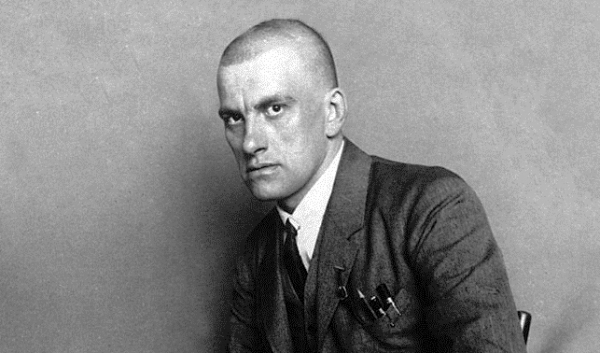
You have to give the Russian Futurists this: those guys didn’t mince words. It was in their 1912 publication Пощёчина общественному вкусу, known in English as A Slap in the Face of Public Taste, that poet, playwright, artist, actor, and filmmaker Vladimir Vladimirovich Mayakovsky (pictured above in the center of a group that includes Sergei Eisenstein, Boris Pasternak, and his muse Lilya Brik) made his literary debut. As his sensibility developed throughout the rest of that decade — a time which, of course, included the Russian Revolution — Mayakovsky made himself into an almost anti-poetic poet, incorporating the most common varieties of language, engaging straight-on with politics, and presenting himself as anything but a lofty artistic figure.
Here, courtesy of PennSound, you can hear Mayakovsky himself reading “An Extraordinary Adventure Which Happened to Me, Vladimir Mayakovsky, One Summer in the Country”:
You can read the Russian here, or an English translation here, and even in the latter version the poem’s final lines, which Mayakovsky speaks after having befriended the sun itself, remain memorably invigorating:
Shine all the time,
for ever shine.
the last days’ depths to plumb,
to shine — !
spite every hell combined!
So runs my slogan -
and the sun’s!
PennSound also has Mayakovsky’s own reading of “And Could You?” [Russian] [English], a much shorter but no less strangely visceral work (1913), which runs, in its entirety, as follows:
I suddenly smeared the weekday map
splashing paint from a glass;
On a plate of aspic
I revealed
the ocean’s slanted cheek.
On the scales of a tin fish
I read the summons of new lips.
And you
could you perform
a nocturne on a drainpipe flute?
Mayakovsky, the complete collection of whose translated poems you can download at Ubuweb, lived from 1893 until his suicide in 1930 — a span coeval with the development of the motion picture. He took to that art form just as he took to others like the stage play and the propaganda poster, and it makes sense that the kind of reality-bending visual mind revealed in his poetry would fall under the spell of that wholly new and dreamlike medium. In his short life — all in 1918, in fact — Mayakovsky directed and starred in three short films, It Cannot Be Bought for Money, Shackled by Film, and The Young Lady and the Hooligan. Only the last of them survives today, and you can watch it below. It’s also housed in our collection, 4,000+ Free Movies Online: Great Classics, Indies, Noir, Westerns, Documentaries & More. More poetry read by great poets can be found in our collection of Free Audio Books.
Related Content:
Penn Sound: Fantastic Audio Archive of Modern & Contemporary Poets
“PoemTalk” Podcast, Where Impresario Al Filreis Hosts Lively Chats on Modern Poetry
Colin Marshall hosts and produces Notebook on Cities and Culture and writes essays on cities, language, Asia, and men’s style. He’s at work on a book about Los Angeles, A Los Angeles Primer. Follow him on Twitter at @colinmarshall or on Facebook.
Read More...This is Your Brain on Jazz Improvisation: The Neuroscience of Creativity
It’s clear that amateur saxophonist and Johns Hopkins surgeon Charles Limb has an abiding interest in the neuroscience of creativity.
He’s also an unabashed fanboy. I’ll bet the spirit of scientific inquiry is not the only motivating factor behind this jazz fan’s experiments on jazz improvisers.
Sure, he has them play spontaneous variations on a MIDI keyboard in a functional MRI tube in order to study blood oxygen levels in various parts of their brains.
But he also gets to hang out in the technologist’s booth, ”trading fours” with captive musician Mike Pope, whom he describes in his TED Talk, above, as “one of the world’s best bassists and a fantastic piano player.”
Is this an experiment or a DIY fantasy camp?
I’m not sure one needs thousands of dollars’ worth of medical equipment to conclude that improvisation thrives when the inner critic is banished. But that’s exactly what Dr. Limb’s findings reveal. Activity in the lateral prefrontal cortex, an area associated with self-monitoring, dropped dramatically, while that in the medial prefrontal cortex—a structure associated with the self-expression—spiked.
The same thing happened when a rapper named Emmanuelle was in the tube, free-styling on a set of prompts contained in a rhyme Dr. Limb composed for the occasion:
My passion’s not fashion, you can see how I’m dressed
Psychopathic words in my head appear
Whisper these lyrics only I can hear
The art of discovering and that which is hovering
Inside the mind of those unconfined
All of these words keep pouring out like rain
I need a mad scientist to check my brain
(For me, the best part of the TED Talk was when a nervous Dr. Limb gamely performed his rap for the crowd, the lyrics projected on a giant screen in case they wanted to chime in. What I wouldn’t give to have a scan of his brain in this moment…)
The ultimate value of Dr. Limb’s research remains to be seen. If nothing else, we may get a bit more insight into the workings of this most mysterious of organs. But I was struck by a remark he made in an interview with Ability, a magazine focusing on health, disability and human potential:
At some point, every musician grapples with whether they’re going to pursue it as a profession, or do something else to make a living. Some musicians absolutely feel that there’s no other road for them. And then there are other people, like me, who could have gone into music, but I didn’t feel like I deserved to. And what I mean by that is I wasn’t willing to suffer for my art. You have to have the conviction, that you can ride out the lows, to be a really successful musician.
Perhaps in the future, those with the temperament for a career in improvisational jazz will use an fMRI to double check that their deoxyhemoglobin concentrations are also up to the task.
Related Content:
Free Online Psychology & Neuroscience Courses
Why We Love Repetition in Music: Explained in a New TED-Ed Animation
Playing an Instrument Is a Great Workout For Your Brain: New Animation Explains Why
Sonny Rollins Describes How 50 Years of Practicing Yoga Made Him a Better Musician
Ayun Halliday is an author, homeschooler, and Chief Primatologist of the East Village Inky zine. She studied comedy improvisation with Del Close and plays the piano poorly. Follow her @AyunHalliday
Read More...When Aldous Huxley Wrote a Script for Disney’s Alice in Wonderland
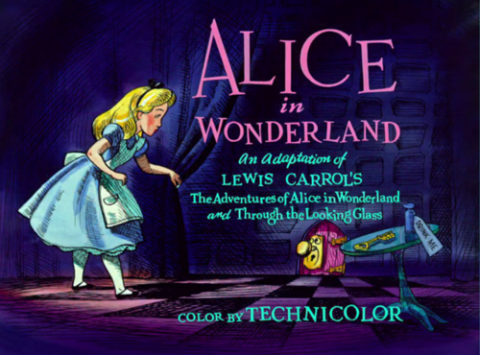
Many filmmakers have tried to adapt Lewis Carroll’s Alice’s Adventures in Wonderland, but none, in the estimation of most enthusiasts of either Alice or animation, have fully succeeded. Maybe the episodic nature of the book gives them trouble, maybe the humor and unexpected logic of its much-celebrated “nonsense” don’t really translate from the printed word to the spoken, or maybe Carroll knew how to handle the boundary between the real and the unreal in a way no other creator can imitate. Nobody knows how many Alice adaptations have, consequently, imploded before even beginning. But when Walt Disney, not a man of small ambitions, set about to bring Carroll’s world to the silver screen, he pressed on until it became 1951’s Alice in Wonderland — about 20 years after the idea came to him in the first place.
“No story in English literature has intrigued me more than Lewis Carroll’s Alice in Wonderland,” Disney told the American Weekly in 1946. “It fascinated me the first time I read it as a schoolboy and as soon as I possibly could after I started making animated cartoons, I acquired the film rights to it.” The animator found special personal resonance in the fact that “people in his period had no time to waste on triviality, yet Carroll with his nonsense and fantasy furnished a balance between seriousness and enjoyment which everybody needed then and still needs today.”
Others attempted to bring Carroll’s nonsense and fantasy up to date on film in 1903, 1910, and 1915, and Disney himself had begun planning an aborted Alice movie with silent-era icon Mary Pickford in the early 1930s, but by the end of the Second World War, a definitive Disney adaptation had yet to appear. Enter, in the fall of 1945, Aldous Huxley: author of Brave New World, scriptwriter on previous film projects like a life of Marie Curie as well as adaptations of Pride and Prejudice and Jane Eyre, habitué of the borderlands between reality and fantasy, and, in Disney’s words, “Alice in Wonderland fiend.” Disney needed such a fiend, having started to fear that his desired modernization of the material might upset the Carroll faithful.
Huxley’s script, a combination of live action and animation, deals with the friendship between the Oxford don Charles Dodgson (known, of course, by the pen name Lewis Carroll), held back from attaining his dreamed-of life as a librarian by the university’s stern vice chancellor, and Alice (based upon Alice Liddell, the real-life inspiration for Carroll’s fictional Alice), held back from all things impractical by her even sterner governess. Though Huxley enjoyed doing the work, Disney found it “too literary,” and nothing of it made it into the 1951 movie. Even then, the final product displeased the exacting animation visionary, as it still does quite a few Disney fans.
While the full text of Huxley’s screenplay hasn’t survived, and much of what Huxley wrote to produce it burnt up in a 1961 house fire, you can read a thorough synopsis of it and more of the backstory on the project at Mouseplanet. For even greater detail, see also “Huxley’s ‘Deep Jam’ and the Adaptation of Alice in Wonderland,” an essay by David Leon Higdon and Phill Lerhman in the Huxley volume of Harold Bloom’s Modern Critical Views series.
Related Content:
See Salvador Dali’s Illustrations for the 1969 Edition of Alice’s Adventures in Wonderland
Alice in Wonderland: The Original 1903 Film Adaptation
Lewis Carroll’s Photographs of Alice Liddell, the Inspiration for Alice in Wonderland
Colin Marshall hosts and produces Notebook on Cities and Culture and writes essays on cities, language, Asia, and men’s style. He’s at work on a book about Los Angeles, A Los Angeles Primer. Follow him on Twitter at @colinmarshall or on Facebook.
Read More...Digital Einstein: Princeton Web Site Puts 1000s of Einstein’s Papers Online
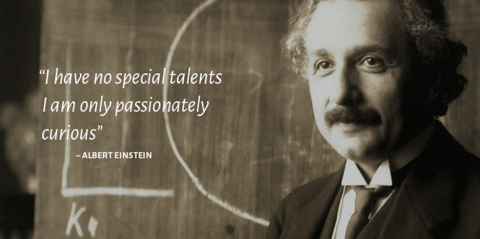
Last Friday saw the launch of The Digital Einstein Papers. Hosted by Princeton University Press, the web site gives web users free, online access to the The Collected Papers of Albert Einstein.
To date, 13 volumes of Einstein’s writing (or 7,000 pages from 2,900 documents) have been published, and they all now appear in electronic format on the Digital Einstein site. Eventually, a total of 30,000 documents will get uploaded to the digital collection.
The initial trove features, says Princeton University Press, “the writings and correspondence of Albert Einstein (1879–1955) from his youth [through] 1923.” And it includes things like: Einstein’s love letters, the notebook in which he worked out the general theory of relativity, and this gem of a letter (found by Vox) where Einstein counseled Marie Curie on how to deal with the trolls of last century.
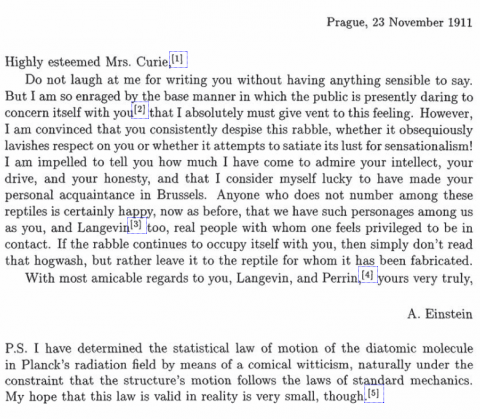
The texts are all presented in the original language in which they were written. Many have in-depth English language annotations, and generally readers can toggle to an English language translation of the documents.
As we noted in 2012, a separate online archive of Einstein’s papers lives on a web site hosted by the Hebrew University of Jerusalem. Courses on Einstein can be found in our collection of Free Online Courses, and important texts by Einstein can be downloaded from our Free eBooks collection.
If you would like to support the mission of Open Culture, consider making a donation to our site. It’s hard to rely 100% on ads, and your contributions will help us continue providing the best free cultural and educational materials to learners everywhere. You can contribute through PayPal, Patreon, and Venmo (@openculture). Thanks!
Related Content:
64 Free Online Physics Courses
Albert Einstein Reads ‘The Common Language of Science’ (1941)
“Do Scientists Pray?”: A Young Girl Asks Albert Einstein in 1936. Einstein Then Responds.
Read More...Support Us
We're hoping to rely on loyal readers, rather than erratic ads. Please click the Donate button and support Open Culture. You can use Paypal, Venmo, Patreon, even Crypto! We thank you!

About Us

Open Culture scours the web for the best educational media. We find the free courses and audio books you need, the language lessons & educational videos you want, and plenty of enlightenment in between.
Advertise With Us

FREE UPDATES!
GET OUR DAILY EMAIL
Get the best cultural and educational resources on the web curated for you in a daily email. We never spam. Unsubscribe at any time.
FOLLOW ON SOCIAL MEDIA

Open Culture editor Dan Colman scours the web for the best educational media. He finds the free courses and audio books you need, the language lessons & movies you want, and plenty of enlightenment in between.
Advertise With Us


