Jazz on the Tube: An Archive of 2,000 Classic Jazz Videos (and Much More)
What is the current state of jazz, you ask? You might ask genre-bending musician/producer/rapper Stephen Ellison, aka Flying Lotus, who also happens to be the nephew of John and Alice Coltrane. In a recent interview, Ellison lamented “it’s all gone quite stale over the past 20 years” and imagined that if Miles Davis “came back to Earth and heard a lot of these jazz cats, he’d be mad. He’d literally be mad, and he’d just go back to where he was dead at.” Given Miles’ infamous temper and disdain for the conventional, this isn’t hard to imagine at all. But whether you could call today’s jazz “elevator music” is a point I leave to others to debate.
Ah, but what is the state of digital jazz preservation? Now, that is a question I can answer, at least in some small part, by pointing you toward Jazz on the Tube. This online resource bills itself as three wonderful things in one: “a searchable database of thousands of carefully hand picked and annotated jazz videos”; “free Video-of-the-Day service”; and “up-to-date directory of jazz clubs, jazz festivals, and jazz organizations world-wide.” You’ll also find there podcasts and worldwide listings of jazz radio stations. But as its title implies, its most fulsome service offers a list of 2,000 videos from an A‑Z of several hundred artists—Abbey Lincoln to Zoot Sims.
Fancy some of that never-complacent Miles Davis magic? Check him out at the top doing “Sanctuary/Spanish Key” in 1970 at the Fillmore (opening for Santana—he also opened for Neil Young and the Grateful Dead that year). Dig some classic hard bop? Check out the Thelonious Monk Quartet in Poland, 1966. Like that N’Orleans’ sound? Do not miss Bunk Johnson below.
Whether it’s the avant-funk jazz stylings of contemporary trio Medeski, Martin & Wood or the trad big band swing of Cab Calloway you seek, at Jazz on the Tube, you will most surely find them. The breadth of artists, styles, and periods represented demonstrates the incredible range and adaptability of jazz. If it’s truly gone stale these days, I think we may anticipate that jazz will eventually find new forms its worthy ancestors approve of.
Perhaps you will fall in love with Jazz on the Tube. Perhaps you may find that it’s exactly what you need. If so, you should know that they also need you. Although their impressive archive of content is “all free to you,” it is not free for them to produce and maintain. They are currently asking help in the form of monthly memberships or one-time donations. Given the amount of curatorial work they’ve put into this digital jazz database, and how much enjoyment it’s likely to bring you, it seems only fair to give back to what they proudly describe as a “labor of love.”
Related Content:
1959: The Year that Changed Jazz
The Night When Miles Davis Opened for the Grateful Dead in 1970: Hear the Complete Recordings
Jazz Legend Jaco Pastorius Gives a 90 Minute Bass Lesson and Plays Live in Montreal (1982)
Josh Jones is a writer and musician based in Durham, NC. Follow him at @jdmagness
Read More...George Plimpton, Paris Review Founder, Pitches 1980s Video Games for the Mattel Intellivision
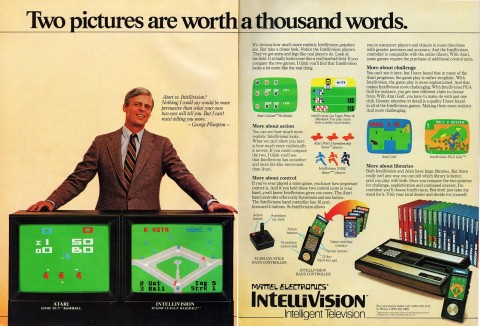
Space, choose Atari; sports, choose Intellivision. So went the conventional wisdom of early-1980s home video gaming, where the Atari 2600 enjoyed an insurmountable advantage when it came to blasting alien invaders, but where the Mattel Intellivision — putting aside the sheer discomfort of those wonky controllers — could satisfy the electronic sportsman like no other console.
For Mattel, winning over the jocks and the nerds at once would require a delicate marketing balance, one attempted by the hiring of George Plimpton, the man who personally pitched against the National League, sparred with Sugar Ray Robinson, trained with the Detroit Lions, tended goal amid the Boston Bruins, hit the PGA Tour in the heyday of Arnold Palmer and Jack Nicklaus, and helped found the Paris Review. (The name did stand for “intelligent television,” after all.)
“Who better to vouch for the realism of a sports video game than someone who had actually suited up and played for real?” asks Intellivisionlives.com. “His persona became the persona of Intellivision: a mix of smug superiority with a healthy touch of self-deprecation.” He starred, as “Mr. Intellivision,” in quite a few memorable television commercials such as the one at the top of the post, where we see him sit down at his trusty typewriter to announce the smaller, cheaper Intellivision II; the one just above, where he presides over a direct comparison with Atari to reveal the Intellivision’s sporting advantage (Mattel had provided him both consoles to play so he could honestly sign an affidavit confirming his preference); and spots like the one below, where he even trumpets the superiority of Intellivision space shooters. Plimpton’s influence on classic gaming survives him, most recently in the online “retro” game George Plimpton’s Video Falconry. Someone even cut together a fake 80s commercial for it, though they inexplicably made it a game for the ColecoVision. Come on — nobody bought a ColecoVision for the sports games.
Related Content:
The Great Gatsby and Waiting for Godot: The Video Game Editions
Fellini’s Fantastic TV Commercials
David Lynch’s Surreal Commercials
Jean-Luc Godard’s After-Shave Commercial for Schick
Ingmar Bergman’s Soap Commercials Wash Away the Existential Despair
Colin Marshall hosts and produces Notebook on Cities and Culture and writes essays on cities, language, Asia, and men’s style. He’s at work on a book about Los Angeles, A Los Angeles Primer. Follow him on Twitter at @colinmarshall or on Facebook.
Read More...Authors Page
All
Administrator|User role
Author|User role
Contributor|User role
Editor|User role
Premium Subscriber
Subscriber|User role
Read More...Future Shock: Orson Welles Narrates a 1972 Film About the Perils of Technological Change
The beginning of the 1972 documentary Future Shock, directed by Alex Grasshof, shows Orson Welles, bearded and chomping on a cigar, standing on an airport people mover. He turns to the camera and delivers a monologue in his trademark silken baritone. “In the course of my work, which has taken me to just about every corner of the globe, I see many aspects of a phenomenon which I’m just beginning to understand. Our modern technologies have changed the degree of sophistication beyond our wildest dreams. But this technology has exacted a pretty heavy price. We live in an age of anxiety and time of stress. And with all our sophistication, we are in fact the victims of our own technological strengths –- we are the victims of shock… a future shock.”
The documentary itself is wonderfully dated. From its bizarre opening montage; to its soundtrack, which lurches from early electronic music to jazz funk; to some endearing video special effects, which, for whatever reason, mostly centers around Orson Welles’s head, the film feels thoroughly rooted in the Nixon administration. Yet many of the ideas discussed in the movie are, if anything, more relevant now than in the 1970s.
The term “future shock” was invented in Alvin Toffler’s hugely bestselling book of the same name to describe the constant, bewildering barrage of new technologies and all the resulting societal changes those technologies bring about. Anyone who has struggled to comprehend a new, baffling and supposedly essential social media platform, anyone who has been driven to paralysis over the number of choices on Netflix, anyone who found their livelihood decimated because of a hot new app knows what “future shock” is.
Toffler (along with his wife and uncredited co-writer Heidi Toffler) argued that we are in the midst of a massive structural change from an industrial society to a post-industrial one – a society that boggles the mind with an overload of information and an overload of consumer choices. “Change,” as they wrote, “is the only constant.”
Along the way, the Tofflers managed to predict the collapse of America’s manufacturing sector, along with things like Prozac, temp jobs, the internet and the meteoric rise and fall of insta-celebs (Alex from Target, we hardly knew you.) Other predictions – underwater cities, paper clothes and being able to choose your own skin color – haven’t yet come to pass. Still, they had a surprisingly good track record considering these predictions were written over four decades ago.
The video ends with a plea from not Welles, but Toffler himself, who is seen addressing college students.
If we can recognize that industrialism is not the only possible form of technological society, if we can begin to think more imaginatively about the future, then we can prevent future shock and we can use technology itself to build a decent, democratic and humane society. […] We can no longer allow technology just to come roaring down at us. We must begin to say “No” to certain kinds of technology and begin to control technological change, because we have now reached the point at which technology is so powerful and so rapid that it may destroy us, unless we control it. But what is the most important is we simply do not accept everything; that we begin to make critical decisions about what kind of world we want and what kind of technology we want.
Find other short films narrated by Welles in our collection, 4,000+ Free Movies Online: Great Classics, Indies, Noir, Westerns, Documentaries & More.
Related Content:
Isaac Asimov Predicts in 1964 What the World Will Look Like Today — in 2014
Arthur C. Clarke Predicts the Future in 1964 … And Kind of Nails It
Walter Cronkite Imagines the Home of the 21st Century … Back in 1967
The Internet Imagined in 1969
Marshall McLuhan Announces That The World is a Global Village
Jonathan Crow is a Los Angeles-based writer and filmmaker whose work has appeared in Yahoo!, The Hollywood Reporter, and other publications. You can follow him at @jonccrow. And check out his blog Veeptopus, featuring lots of pictures of badgers and even more pictures of vice presidents with octopuses on their heads. The Veeptopus store is here.
Read More...Watch The Art of Travel, Alain de Botton’s Philosophical Look at Our Wanderlust Tendencies (2005)
The tradition of the uncomfortable intellectual aboard a cruise ship, while not a particularly long or wide one, has produced a few intriguing works. You may well know — and, if you’re anything like me, know very well indeed from countless rereadings — David Foster Wallace’s essay about his seven-night Caribbean cruise, known as it first ran in Harper’s as “Shipping Out,” and later in full form as the title piece of the collection A Supposedly Fun Thing I’ll Never Do Again. In this environment of constantly replenished amenities and unceasing “pampering” (a word that generates an essay’s worth of exegesis by itself), Wallace comes up against the inevitable question: can a cruise line, or any other form of human effort, really guarantee our happiness?
This question has also proven central to the career of another writer and thinker, Alain de Botton. No matter the subject on which his focus may come to rest — architecture, Proust, ancient philosophy, work — his mind never strays far from the issue of what makes us happy, and whether anything can keep us that way. The 2005 documentary The Art of Travel, a companion to his book of the same name, finds de Botton aboard a cruise liner, fully equipped with fine wines and line-dancing classes, bound for Spain. Will he disembark in the Barcelona of which he has dreamed, or will an obscure French novelist convince him of the foolishness of actually experiencing the very places you’ve long wanted to? (The answer may not come as a surprise to those familiar with de Botton’s professional temperament.)
But our intrepid host doesn’t stop at cruising: he takes a weekend “city break” in Amsterdam, follows around a World War II bunker enthusiast, goes for a road trip through east Germany, ponders the distinctive loneliness found only in Edward Hopper paintings; gets the grand tour of a “swingers’ hotel,” boards an all-Japanese Cotswolds tour bus (and teaches his fellow passengers about John Ruskin); and wonders, finally, whether the definition of a traveler comes not from the distance and frequency of the movement, but from the “attitude of curiosity and receptivity” to whatever captures the imagination. Having found myself in a career that involves more and more travel each year, I can’t ask myself these questions too often. Whether you care about getting to far-off places or richly experiencing the ones nearby, perhaps de Botton will get you asking them too. At the very least, he’ll save you a cruise.
More films by de Botton can be found in our collection, 285 Free Documentaries Online.
Related Content:
Alain de Botton Shows How Art Can Answer Life’s Big Questions in Art as Therapy
A Guide to Happiness: Alain de Botton Shows How Six Great Philosophers Can Change Your Life
Socrates on TV, Courtesy of Alain de Botton (2000)
Colin Marshall hosts and produces Notebook on Cities and Culture and writes essays on cities, language, Asia, and men’s style. He’s at work on a book about Los Angeles, A Los Angeles Primer. Follow him on Twitter at @colinmarshall or on Facebook.
Read More...H.P. Lovecraft Highlights the 20 “Types of Mistakes” Young Writers Make
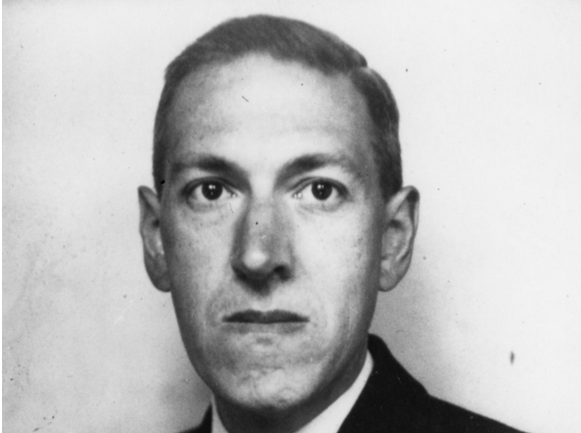
Image by Lucius B. Truesdell, via Wikimedia Commons
H.P. Lovecraft is remembered as a brilliant fantasist, a creator of a completely unique universe of horror. He’s also remembered, unfortunately, as a bigot. But the author whose head—to the chagrin of some—provided the model for the World Fantasy Award is not often remembered as a particularly good writer. Or rather, I should say, a particularly good stylist. His writing can sound stiflingly archaic, overstuffed with Victorianisms. “His prose, “writes Scott Malthouse, “can be turgid and adjectives suffocating,” and “his characters tend to be as thin as the paper they’re printed on.”
Writers love him, Malthouse argues, because he was such an original “world builder,” not because he was a fine artist. Elizabeth Bear at Tor echoes the sentiment, writing that Lovecraft’s work is “criticized for its style, for its purpleness and density and failures of structure,” yet still evokes such a potent response that “the Lovecraftian universe must be considered a collaborative effort at this point,” since so many writers have furthered his “appealingly bleak” vision. You can download a good part of his collected works in ebook and audiobook formats here.
So perhaps he isn’t such a bad writer after all? In any case, he’s certainly a very distinctive one whose style, like Joseph Conrad’s, say, or even William Faulkner’s, endears readers precisely for its feverish excesses. Lovecraft himself was very self-conscious about his craft and took writing very seriously—enough to have published a lengthy, highly detailed essay called “Literary Composition” which tackles in several paragraphs a host of issues the writer must contend with: grammar, “reading,” vocabulary, “elemental phrases,” description, narration, “fictional narration,” “unity, mass, coherence,” and “forms of composition.” We won’t recite the whole of his advice here—you can read the whole thing for yourself. But to give you some of the flavor of Lovecraft’s pedagogy, we bring you his list of twenty “types of mistakes” young writers make.
See his complete list below.
- Erroneous plurals of nouns, as vallies or echos.
- Barbarous compound nouns, as viewpoint or upkeep.
- Want of correspondence in number between noun and verb where the two are widely separated or the construction involved
- Ambiguous use of pronouns.
- Erroneous case of pronouns, as whom for who, and vice versa, or phrases like “between you and I,” or “Let we who are loyal, act promptly.”
- Erroneous use of shall and will, and of other auxiliary verbs.
- Use of intransitive for transitive verbs, as “he was graduated from college,” or vice versa, as “he ingratiated with the tyrant.”
- Use of nouns for verbs, as “he motored to Boston,” or “he voiced a protest,”
- Errors in moods and tenses of verbs, as “If I was he, I should do otherwise”, or “He said the earth was”
- The split infinitive, as “to calmly ”
- The erroneous perfect infinitive, as “Last week I expected to have met”
- False verb-forms, as “I pled with him.”
- Use of like for as, as “I strive to write like Pope wrote.”
- Misuse of prepositions, as “The gift was bestowed to an unworthy object,” or “The gold was divided between the five men.”
- The superfluous conjunction, as “I wish for you to do this.”
- Use of words in wrong senses, as “The book greatly intrigued me”, “Leave me take this”, “He was obsessed with the idea”, or “He is a meticulous”
- Erroneous use of non-Anglicised foreign forms, as “a strange phenomena”, or “two stratas of clouds”.
- Use of false or unauthorised words, as burglarise or supremest.
- Errors of taste, including vulgarisms, pompousness, repetition, vagueness, ambiguousness, colloquialism, bathos, bombast, pleonasm, tautology, harshness, mixed metaphor, and every sort of rhetorical awkwardness.
- Errors of spelling and punctuation, and confusion of forms such as that which leads many to place an apostrophe in the possessive pronoun its.
Most of this is solid, common sense writing advice. Some of it isn’t. As with all things Lovecraft, you would be wise to use your discretion. A full read of Lovecraft’s treatise on composition will give you some sense of how to begin writing your own Lovecraft pastiche. For even more of his advice on the writing of fiction—particularly, as he called it, “weird fiction,” see his list of five tips for horror writing, which we featured in October.
Related Content:
H.P. Lovecraft Gives Five Tips for Writing a Horror Story, or Any Piece of “Weird Fiction”
H.P. Lovecraft’s Classic Horror Stories Free Online: Download Audio Books, eBooks & More
Lovecraft: Fear of the Unknown (Free Documentary)
Stephen King’s Top 20 Rules for Writers
Writing Tips by Henry Miller, Elmore Leonard, Margaret Atwood, Neil Gaiman & George Orwell
Josh Jones is a writer and musician based in Durham, NC. Follow him at @jdmagness
Read More...How Bourbon is Made: The ABC’s in 9 Minutes
Head over to Princeton University’s web entry on Bourbon, and you will learn that, back in 1964, the U.S. Congress recognized Bourbon Whiskey as a “distinctive product of the United States,” and the Federal Standards of Identity for Distilled Spirits (27 C.F.R. 5.22) established a bunch of laws defining what Bourbon is, and isn’t. The Standards read as follows:
- Only whiskey produced in the United States can be called bourbon.
- Bourbon must be made of a grain mixture that is at least 51% corn (maize).
- Bourbon must be distilled to no more than 160 (U.S.) proof (80% alcohol by volume).
- Neither coloring nor flavoring may be added.
- Bourbon must be aged in new, charred oak barrels.
- Bourbon must be entered into the barrel at no more than 125 proof (62.5% alcohol by volume).
- Bourbon, like other whiskeys, must be bottled at not less than 80 proof (40% alcohol by volume.)
- Bourbon that meets the above requirements and has been aged for a minimum of two years may (but is not required to) be called Straight Bourbon.
- Straight Bourbon aged for a period less than four years must be labeled with the duration of its aging.
- If an age is stated on the label, it must be the age of the youngest whiskey in the bottle.
If a spirit doesn’t comply with these rules, it ain’t Bourbon.
In the video above, Gear Patrol takes a closer look at how Bourbon is made. The producers toured 12 distilleries in five days, and asked each to explain the Bourbon-making process. Along the way, you will figure out why so much Bourbon comes from Kentucky. It comes down to geology, not chance.
Related Content:
The Physics of Guinness Beer Demystified
How to Open a Wine Bottle with Your Shoe for the DIY Connoisseur
Science & Cooking: Harvard’s Free Course on Making Cakes, Paella & Other Delicious Food
MIT Teaches You How to Speak Italian & Cook Italian Cuisine All at Once (Free Online Course)
Read More...The Classical Music in Stanley Kubrick’s Films: Listen to a Free, 4 Hour Playlist
In 1967, Stanley Kubrick commissioned Spartacus composer Alex North to compose a score for 2001: A Space Odyssey. Yet, while at the editing bay, he fell in love with the movie’s temporary soundtrack consisting of a bunch of existing works of classical music. So in an unprecedented move, he chose those works in favor of North’s composition. He didn’t even re-record the tracks, as was the custom at the time. He just slotted the existing works right into the mix. And, for the pieces by Hungarian composer György Ligeti, he didn’t even bother to get the rights, resulting in a lawsuit.
As you might expect, this was hugely controversial in some circles. The great composer Bernard Herrmann, who scored everything from Citizen Kane to Taxi Driver, was appalled. “It shows vulgarity, when a director uses music previously composed! I think that 2001: A Space Odyssey is the height of vulgarity in our time. To have outer space accompanied by The Blue Danube, and the piece not even recorded anew!”
Yet anyone who’s ever seen 2001 knows that Kubrick made the right call. Who doesn’t think of bone-wielding monkey men when they hear the opening notes of Richard Strauss’s Thus Spoke Zarathustra? Or who doesn’t associate The Blue Danube with a zero‑G dance between spacecraft and space station?
2001 might be considered the most expensive (and most profitable) experimental movie ever made. It lacks a traditional narrative. It is largely wordless. The most memorable character in the movie is not a human being but a sociopathic computer. It ends with an awesomely trippy meditation on humanity’s next evolutionary iteration. It’s not an ordinary movie and so music was used in an entirely unordinary way.
Think of those monoliths that always appear with that otherworldly oratorio by Ligeti. It’s ambiguous whether those alien marble slabs are emitting the music or the music is layered over top the image. Yet the music is not used to tell the audience how to feel. Instead, it is like a voice from the chorus in an ancient Greek play, announcing from without a key moment in the film.
As Roger Ebert puts it: “North’s score … would have been wrong for ‘2001’ because, like all scores, it attempts to underline the action— to give us emotional cues. The classical music chosen by Kubrick exists outside the action.”
Tony Palmer, director of Stanley Kubrick: A Life in Pictures, put it another way. “Before Stanley Kubrick, music tended to be used in film as either decorative or as heightening emotions. After Stanley Kubrick, because of his use of classical music in particular, it became absolutely an essential part of the narrative, intellectual drive of the film.”
Perhaps this is the reason why some complain that Kubrick’s movies are chilly and cerebral. It also might explain why his use of music tends to linger in the mind.
Thanks to Spotify, you can listen to over four hours of classical music that Kubrick used in his movies. Find the playlist above, and a list of the classical music in Kubrick films here. The playlist features everything from Beethoven (A Clockwork Orange) to Schubert (Barry Lyndon) to Bartók (The Shining). If you need to download Spotify, grab the software on this site.
Related Content
Philip K. Dick’s Favorite Classical Music: A Free, 11-Hour Playlist
Read More...Hear Dave Grohl’s First Foo Fighters Demo Recordings, As Kurt Cobain Did in 1992
Like ‘em or lump ‘em, you should give ‘em credit—Dave Grohl’s Foo Fighters have kind of redefined the concept album with their latest, Sonic Highways, pushing a tired form in a refreshing direction. Rather than a self-contained narrative, the record opens itself up to tell the stories of rock ‘n’ roll itself or, as Allmusic puts it, “the classic rock that unites the U.S. from coast to coast.” Picking up where his celebratory film Sound City left off, Grohl ties in his newest release with a series of HBO documentaries that visit cities from New York, to Nashville, Austin, New Orleans, L.A., Washington, DC., and Seattle to tell their musical stories.
Of course, the musical history of that last metropolis cannot be narrated without reference to Grohl’s former band, and so, Consequence of Sound informs us, “Nirvana received heavy focus during the [Seattle Sonic Highways] episode as Dave Grohl recounted his time in the Rock and Roll Hall of Fame outfit. Among the biggest revelations was the time Kurt Cobain asked to hear solo recordings Grohl had been working on during Nirvana’s 1992 tour.”
“Kurt heard that, and kissed me on the face, as he was in a bath,” Grohl revealed. “He was so excited. He was like, ‘I heard you recorded some stuff with Barrett [Jones].’ I was like, ‘Yeah.’ He was like, ‘Let me hear it.’ I was too afraid to be in the same room as he listened to it.”
At the time, Grohl intended these early Foo Fighters recordings as an anonymous side project, but the demos garnered enough attention that he later [after Cobain’s death] formed a band and, well… we pretty much know the rest of that story, tragedy and all. But as for the demos, we can hear them too, just as Cobain did, possibly while in the bath, in ‘92. These early versions of songs like “Alone + Easy Target” (top), “Big Me” (above), and “Exhausted” (below)—all of which eventually made their way onto the first, eponymous 1995 Foo Fighters album—have been collected as an unofficial release called Nirvana: Dave’s Demotapes 1992–1993.
Grohl plays all the instruments on these recordings (hear more here), and wrote all the lyrics, though, as he tells us in an interview below, writing lyrics isn’t something he enjoys. He also discusses his admiration for Cobain’s natural writing ability, and reveals that the Nirvana frontman liked “Exhausted” and “Alone + Easy Target” so much he wanted to turn them into Nirvana songs. The opportunity was lost, but Cobain’s encouragement clearly had positive effect on the future Foo Fighter.
Becoming a rock frontman—and a current storyteller of rock history—may have been an evolutionary leap for Grohl, but drumming has been a constant before, during, and after the Nirvana phenomenon. As a denizen of the DC punk scene, Grohl lived part of the rock history of that city as well, playing with several hardcore bands, including Dain Bramage, the project that followed his first band, Mission Impossible. Music blog Antiquiet brings us that band’s 1986 demo recordings. They’re well worth a listen, showcasing a classic mid-80s DC sound, backed by what was even then some profoundly excellent drumming from Grohl. As Dain Bramage’s singer remarked, “After you’ve spent a couple years with Dave Grohl as your drummer it’s easy to feel like no other drummer exists.” The charismatic but humble Grohl writes some pretty decent songs too, even while working in the shadow of superfamous Kurt Cobain.
Related Content:
Nirvana Plays in a Radio Shack, the Day After Recording its First Demo Tape (1988)
The First Live Performance of Nirvana’s “Smells Like Teen Spirit” (1991)
Listen to The John Bonham Story, a Radio Show Hosted by Dave Grohl
Josh Jones is a writer and musician based in Durham, NC. Follow him at @jdmagness.
Read More...Scenes from Waking Life, Richard Linklater’s Philosophical, Feature-Length Animated Film (2001)
Richard Linklater’s latest film Boyhood has earned quite a lot of press by accomplishing the unprecedented cinematic feat of telling a story over a decade long with a production over a decade long, following the same characters, played by the same growing and aging actors, the whole time through. Viewers have understandably found it a striking viewing experience, but most of Linklater’s projects do something no other film has done before. His 1990s “Indiewood” breakout Slacker (watch it online), for instance, offered not just the portrait of the so-called Generation‑X, and not just a portrait of the then-rising American countercultural Mecca of Austin, Texas, but a form of storytelling that seemed to drift freely from one character to the next, crossing town on the winds of idle, everyday, intense, and even nonsensical conversation.
And what does Waking Life do? Released in 2001, Linklater’s first animated film (he would make a second, the Philip K. Dick adaptation A Scanner Darkly, in 2006) not only further develops the neglected branch of animation known as rotoscoping, which involves drawing over live-action footage, but puts it to work for the cause of the philosophical film. But rather than approaching that enterprise straight on, the movie interprets the philosophy with which it deals through a vast cast of characters both eccentric and mundane — intellectuals, often, but also crackpots, gadflies, and just plain slackers. When they speak their thoughts aloud, as they do in the short clips featured here, they speak on themes as varied, but as intriguingly interconnected, as reality, free will, anarchy, suicide, and cinema, all of which the animation vividly illustrates.
“Waking Life could not come at a better time,” wrote Roger Ebert when the movie opened, less than a month after 9/11. “It celebrates a series of articulate, intelligent characters who seek out the meaning of their existence and do not have the answers. At a time when madmen think they have the right to kill us because of what they think they know about an afterlife, which is by definition unknowable, those who don’t know the answers are the only ones asking sane questions. True believers owe it to the rest of us to seek solutions that are reasonable in the visible world.” Some viewers will no doubt write off Waking Life’s dialogue — whether spoken by actors, professors, Linklater regulars, or utter randoms — as mere “dorm room conversation,” but the film seems to ask an important question on that very point: are you really having more interesting conversations now than you did in the dorms?
If you have a subscription to Amazon Prime, you can watch Waking Life for free right now. A version appears on Youtube for $2.99.
It’s also worth noting that Waking Life appears on the list we recently explored, 44 Essential Movies for the Student of Philosophy.
Related Content:
4,000+ Free Movies Online: Great Classics, Indies, Noir, Westerns, Documentaries & MoreWatch The Idea, the First Animated Film to Deal with Big, Philosophical Ideas (1932)
Orson Welles Narrates Animation of Plato’s Cave Allegory
Watch Free Online: Richard Linklater’s Slacker, the Classic Gen‑X Indie Film
Colin Marshall hosts and produces Notebook on Cities and Culture and writes essays on cities, language, Asia, and men’s style. He’s at work on a book about Los Angeles, A Los Angeles Primer. Follow him on Twitter at @colinmarshall or on Facebook.
Read More...Support Us
We're hoping to rely on loyal readers, rather than erratic ads. Please click the Donate button and support Open Culture. You can use Paypal, Venmo, Patreon, even Crypto! We thank you!

About Us

Open Culture scours the web for the best educational media. We find the free courses and audio books you need, the language lessons & educational videos you want, and plenty of enlightenment in between.
Advertise With Us

FREE UPDATES!
GET OUR DAILY EMAIL
Get the best cultural and educational resources on the web curated for you in a daily email. We never spam. Unsubscribe at any time.
FOLLOW ON SOCIAL MEDIA

Open Culture editor Dan Colman scours the web for the best educational media. He finds the free courses and audio books you need, the language lessons & movies you want, and plenty of enlightenment in between.
Advertise With Us


