The Goddess: A Classic from the Golden Age of Chinese Cinema, Starring the Silent Film Icon Ruan Lingyu (1934)
Ruan Lingyu delivered one of the greatest performances in silent cinema, and yet to Western audiences, she is almost completely unknown.
Up until the Imperial Japanese Army invaded the city in 1937, Shanghai was the thriving, cosmopolitan cultural heart of China. The first Chinese film was made in Shanghai in 1905 and, for the next couple of decades, costumed retellings of traditional tales dominated the industry. Then, in the ‘30s, filmmakers like Sun Yu and Cheng Bugao started to make gritty, realistic movies about the struggles of the lower class. Perhaps the greatest of these films is Wu Yonggang’s 1935 masterpiece The Goddess, featuring an absolutely heartbreaking performance by Ruan. You can watch it above.
On paper, the story of The Goddess could easily be mistaken for films by Josef Von Sternberg or G.W. Pabst – a “fallen woman” weepie where the protagonist suffers for the sins of hypocritical society. Ruan plays the nameless lead, a beautiful, impoverished woman forced to sell her body to feed and educate her son. She soon falls in with The Boss, a porcine, dissolute gangster who serves as her pimp. She scrapes and struggles to keep her son out of the same gutter where she finds herself trapped. Yet, at every step, she and her son are taunted and shunned. When she spends everything she has to put her son into a good school, the child is expelled simply because the other parents don’t approve of her. “Even though I am a degenerate woman,” she begs to the school board, “don’t I have the right as a mother to raise him as a good boy?”
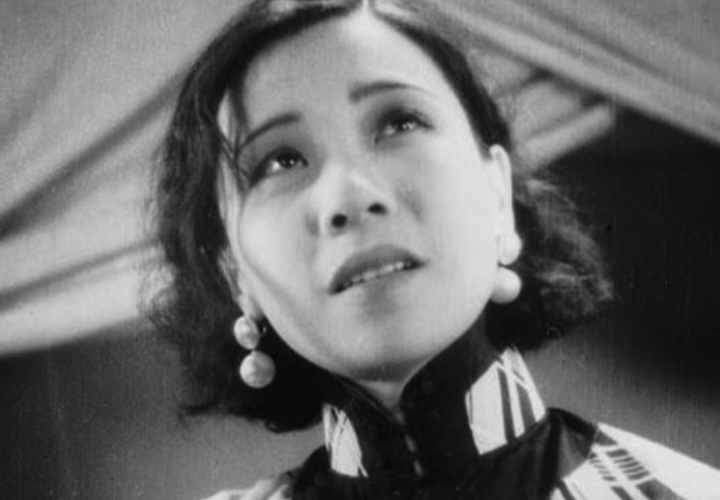
While silent film acting tended towards the histrionic, Ruan’s performance is naturalistic while still having an emotional rawness that few actors could match. Just watch the scene where the protagonist is watching her son perform during a school play. Her expression of unadulterated parental pride slowly curdles as she hears vicious whispers from nearby hausfraus. Like Greta Garbo or Marlene Dietrich, Ruan has a wounded beauty that simply rivets you to the screen.
Like many of the characters she played, Ruan came from humble beginnings and had perpetual romantic trouble. When her complicated personal life became the fodder for press, she took an overdose of sleeping pills on March 8, 1935, leaving behind a note that read, “Gossip is a fearful thing.” She was only 24. Ruan’s funeral procession was over three miles long and three women were reportedly so distraught over her death that they committed suicide. The funeral even ended up on the front page of the New York Times who called it “the most spectacular funeral of the century.”
In 1992, Maggie Cheung played Ruan for Stanley Kwan’s Center Stage (1992), which ended up winning a Best Actress prize at the Berlin International Film Festival.
The Goddess will be added to our list of Great Silent Films, part of our larger collection, 4,000+ Free Movies Online: Great Classics, Indies, Noir, Westerns, Documentaries & More.
Related Content:
101 Free Silent Films: The Great Classics
65 Free Charlie Chaplin Films Free Online
Jonathan Crow is a Los Angeles-based writer and filmmaker whose work has appeared in Yahoo!, The Hollywood Reporter, and other publications. You can follow him at @jonccrow. And check out his blog Veeptopus, featuring lots of pictures of vice presidents with octopuses on their heads. The Veeptopus store is here.
Read More...A History of Ideas: Animated Videos Explain Theories of Simone de Beauvoir, Aristotle & Other Philosophers
The UK’s Open University has become a dependable source of very short, online video introductions to all sorts of things, from weighty subjects like religion, economics, and literary theory to lighter, but no less interesting fare like the art and science of bike design. With breezy tone and serious intent, their animated “60-Second Adventures” make seemingly arcane academic ideas accessible to laypeople with no prior background. Now they’ve teamed up with writer and BBC broadcaster Melvyn Bragg of In Our Time fame for a series of video shorts that run just a little over 60 seconds each, with animations by Andrew Park of Cogni+ive, and narration by comedic actor Harry Shearer from Spinal Tap, The Simpsons, and, most recently, Nixon’s the One.
Drawn from Bragg’s BBC 4 radio program “A History of Ideas,” the shorts introduce exactly that—each one a précis of a longstanding philosophical problem like Free Will vs. Determinism (top) or the Problem of Evil (above). Unlike some similarly rapid outlines, these videos—like the tie-in Bragg radio program—don’t simply sketch out the issues in abstract; they draw from specific approaches from fields as diverse as neuroscience, moral philosophy, theology, and feminist theory. In the video on free will at the top, for example, Shearer introduces us to the Libet experiments, performed in the 1980s by neurologist Benjamin Libet to test our ability to make voluntary, conscious decisions. The “Free Will Defense” video above references—at least visually—Bertrand Russell’s notorious teapot in its rather skeptical presentation of this theological bugbear.
Some of the videos get even more specific, focusing in on the work of one thinker whose contributions are central to our understanding of certain concepts. Just above in “Feminine Beauty,” we have an introduction to existential philosopher Simone de Beauvoir’s argument that feminine beauty, and gender presentation more generally, is socially constructed by prevailing patriarchal norms—a concept central to the feminist work of later thinkers like Judith Butler. And below, we have the 18th century concept of the “Sublime,” a supposedly higher, more threatening and ineffable aesthetic mode, as discussed in the work of conservative political philosopher Edmund Burke (also a subject dear to Immanuel Kant, who had his own take on the idea).
See more “A History of Ideas” short, animated videos—including “Diotima’s Ladder,” “The Golden Ratio,” and “The Harm Principle”—on Youtube or the BBC Radio 4 site. The scripts for the clips, we should add, were written by Nigel Warburton, whose Philosophy Bites podcast you should never miss.
And for much more extensive discussions of these age-old philosophical questions with real living “philosophers, theologians, lawyers, neuroscientists, historians and mathematicians,” download episodes of Melvyn Bragg’s “A History of Ideas” show here or on iTunes.
Related Content:
120+ Free Online Philosophy Courses
8‑Bit Philosophy: Plato, Sartre, Derrida & Other Thinkers Explained With Vintage Video Games
The History of Philosophy Without Any Gaps – Peter Adamson’s Podcast Still Going Strong
Josh Jones is a writer and musician based in Durham, NC. Follow him at @jdmagness
Read More...Radio David Byrne: Stream Free Music Playlists Created Every Month by the Frontman of Talking Heads

Photo courtesy of LivePict.com CC-BY-SA‑3.0.
David Byrne has played many roles: frontman of Talking Heads, architectural observer, composer of opera (specifically opera about Imelda Marcos, former first lady of the Philippines, the country from which I write this post today), enthusiastic musical collaborator, urban cycling advocate — and that only counts the ones he’s played here in Open Culture posts. (Someday, we’ve got to write up his love of Powerpoint.) But did you know he’s also done a free internet radio show, and for nearly a decade at that? “For one or two days a month I queue up David Byrne’s Radio Station on the web and listen to his two-hour loop of new, wonderful, delicious tunes,” writes Kevin Kelly in a Cool Tools post from 2008, just over halfway into the life of the show so far. “Rock-star Byrne is a professional musical pioneer, admirably eclectic in his taste, yet astutely discriminating at the same time. Over years of listening to all kinds of music — experimental, indie, international, fringe, classical, pop — he’s heard enough to make some great recommendations.”
Kelly cites such tantalizing Byrnean playlists as “Icelandic Pop,” “Opera highlights,” “Eclectic Stuff,” and “African Fusion Pop.” More recent sessions, which can run for three hours or longer, include “Southern Writers,” “Songs of Burt Bacharach,” and “Raga Rock.” A new playlist comes out every month. You can list to his August playlist, “Custom Jackets, Now and Then,” a celebration of women “who have been tainted or touched by country music” including Neko Case, Emmylou Harris, Gillian Welch, and Lucinda Williams. You can also hear a brand new November playlist on the davidbyrne.com front page, which uses a newer audio player than all the previous installments. “Viva Mexico Part 1” promises a selection of artists from that vibrant country who “have found ways to incorporate their Mexican musical heritage and culture into what might be called the global pop form,” resulting not in “imitations of North American or UK alt-rock” but songs that “sound like nothing but themselves.” And if you can’t trust David Byrne to know musical uniqueness when he hears it, who can you trust?
Related Content:
David Byrne: How Architecture Helped Music Evolve
David Byrne: From Talking Heads Frontman to Leading Urban Cyclist
Colin Marshall hosts and produces Notebook on Cities and Culture and writes essays on cities, language, Asia, and men’s style. He’s at work on a book about Los Angeles, A Los Angeles Primer. Follow him on Twitter at @colinmarshall or on Facebook.
Read More...Watch the New Trailer for the Upcoming Joan Didion Documentary, We Tell Ourselves Stories In Order to Live
It didn’t take long, only 25 hours, for Griffin Dunne and Susanne Rostock to raise enough money on Kickstarter to complete a documentary on novelist and essayist Joan Didion. Initially hoping to raise $80,000, they’ve already received commitments exceeding $211,000, and they still have four days to go.
We Tell Ourselves Stories In Order to Live will be the first and only documentary about Joan Didion. And it will be made with Joan, using her own words. The trailer for the documentary just premiered on Vogue. It’s fitting, seeing that Didion landed her first job, at Vogue, after winning an essay contest sponsored by the magazine. She also published her seminal essay, ““On Self Respect” in Vogue in 1961.
You can watch the trailer above. Also don’t miss our roundup from earlier this year: 13 Masterful Essays by Joan Didion Free Online
via @michikokakutani
Follow us on Facebook, Twitter and Google Plus and share intelligent media with your friends. Or better yet, sign up for our daily email and get a daily dose of Open Culture in your inbox.
Read More...Watch Harvard Students Fail the Literacy Test Louisiana Used to Suppress the Black Vote in 1964
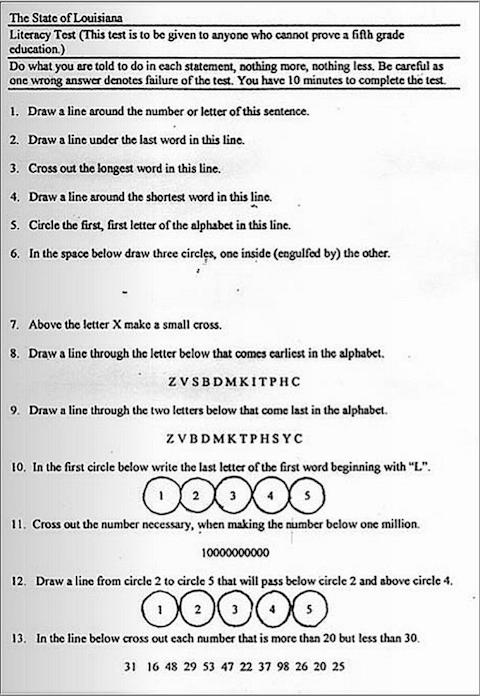
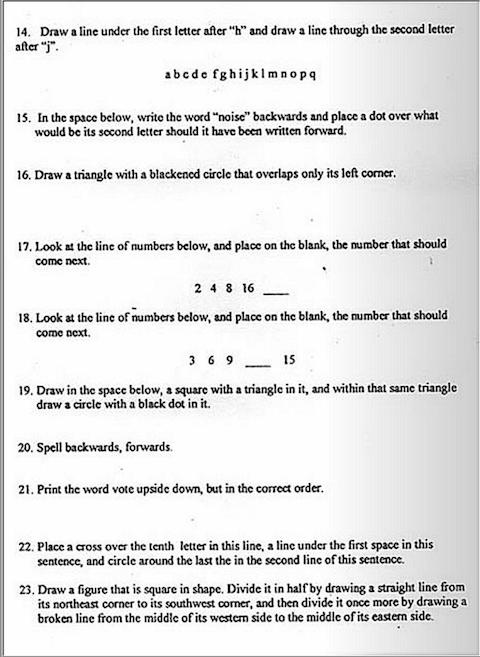
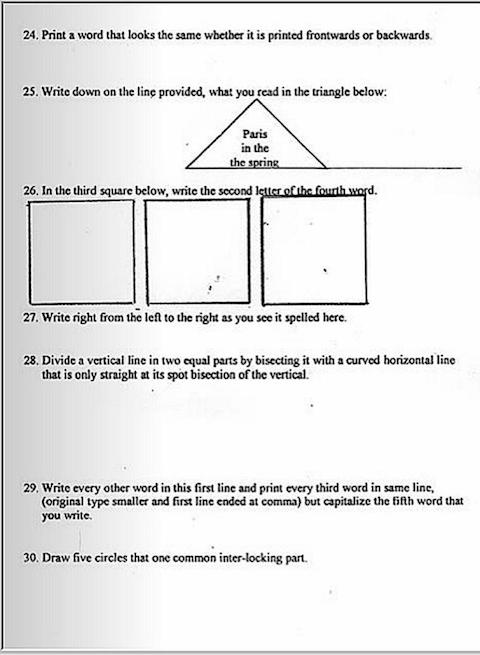
This summer, we revisited a literacy test from the Jim Crow South. Given predominantly to African-Americans living in Louisiana in 1964, the test consisted of 30 ambiguous questions to be answered in 10 minutes. One wrong answer, and the test-taker was denied the right to vote. It was all part of the South’s attempt to impede free and fair elections, and ensure that African-Americans had no access to politics or mechanisms of power.
How hard was the test? You can take it yourself below (see an answer key here) and find out. Just recently, the same literacy test was also administered to Harvard students — students who can, if anything, ace a standardized test — and not one passed. The questions are tricky. But even worse, if push comes to shove, the questions and answers can be interpreted in different ways by officials grading the exam. Carl Miller, a resident tutor at Harvard and a fellow at the law school, told The Daily Mail: “Louisiana’s literacy test was designed to be failed. Just like all the other literacy tests issued in the South at the time, this test was not about testing literacy at all. It was a … devious measure that the State of Louisiana used to disenfranchise people that had the wrong skin tone or belonged to the wrong social class.” (Sometimes the test was also given to poor whites.) Above, you can watch scenes from the Harvard experiment and students’ reactions.
Follow us on Facebook, Twitter and Google Plus and share intelligent media with your friends. Or better yet, sign up for our daily email and get a daily dose of Open Culture in your inbox.
Read More...Follow Us on Facebook, Twitter … Or, Better Yet, Get Our Daily Email
Readers often ask us, “What’s the best way to make sure that I don’t miss any of your posts?” First and foremost we recommend signing up for our daily email. Each day, you will receive an email that tidily wraps up everything we’ve featured on the site over a 24 hour period. Faithfully it will appear in your inbox each day. Sign up for the free email here. And, to initiate the email subscription, please make sure that you click the verification link in the email you will receive upon registration.
You can always follow us on Twitter (@openculture) where we highlight our daily posts, plus many other cultural curiosities found on the web. Definitely give that a shot.
You can also like our Facebook page, and then Facebook will decide whether you get to see our posts. They just do the thinking for you. Lucky you.
Finally, consider subscribing to our RSS feed, especially if you use feed readers like Feedly. That will let you keep tabs on each and every post. The RSS address is: http://feeds.feedburner.com/OpenCulture
Read More...The Great War: Video Series Will Document How WWI Unfolded, Week-by-Week, for the Next 4 Years
This ambitious project deserves a mention: Mediakraft Networks has launched a video series on Youtube that will document how World War I unfolded, week-by-week, over a four-year period, from 1914 to 1918. A new video will be released every Thursday, and it will reflect on what happened during the same week 100 years prior. Launched in late July, the series has already covered 16 weeks of The Great War, with latest video showing how World War I became a defensive war and trenches began to scar the land. Hosted by Indy Neidell (read an interview with him here), each video features archival footage from British Pathé, the newsreel archive company that put over 85,000 historical films on YouTube earlier this year.
You can watch all 16 episodes above, along with a few helpful primers that explain why the War started in the first place. To view new videos as they get released, keep tabs on this Youtube page. There should eventually be close to 300 episodes. Quite an undertaking!
As a side note, I noticed that a Dutch podcast (in English) will cover “The First World War in 261 weeks.” That’s the title of the podcast itself. Find it here.
Related Content:
Free: British Pathé Puts Over 85,000 Historical Films on YouTube
Free Online History Courses
The History of Rome in 179 Podcasts
Learn The History of Philosophy in 197 Podcasts (With More to Come)
Read Joyce’s Ulysses Line by Line, for the Next 22 Years, with Frank Delaney’s Podcast
Read More...The Art of Leo Tolstoy: See His Drawings in the War & Peace Manuscript & Other Literary Texts
Like all great writers, Leo Tolstoy has inspired a great many visual adaptations of his work, of varying degrees of quality. Just this past month, the Volgograd Fine Arts Museum in Russia held an exhibition of “92 graphic works from the collection of the Yasnaya Polyana Estate-Museum,” the author’s country estate and birthplace. Each work of art “recreates immortal images of the characters, reconstructs the historic epoch, and reflects the dynamics” of his masterpieces Anna Karenina and War and Peace, as well as his short stories for children.
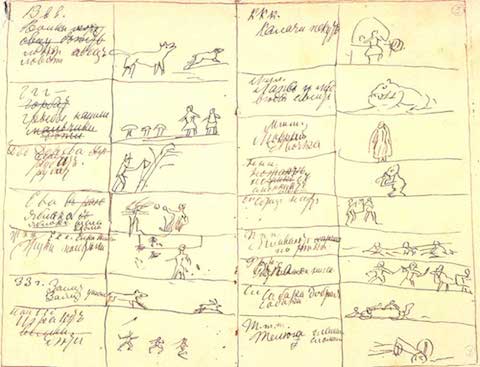
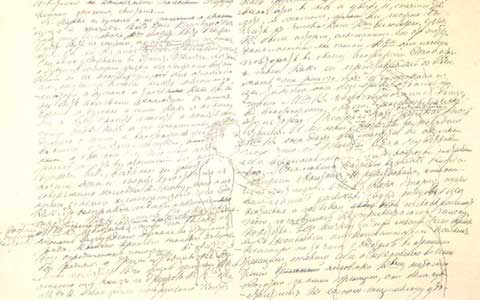
Travel to Moscow, however, to the Leo Tolstoy State Museum, and you’ll find Tolstoy’s own visual art, which he sketched both on the very manuscript pages of those novels and stories and in the notebooks that inspired them. At the top of the post, see a manuscript page of War and Peace with the figures of a boy and a well-dressed woman drawn very faintly into the text. Directly above, see a sketch for his ABC book, a primer he created for his peasant schools at Yasnaya Polyana.
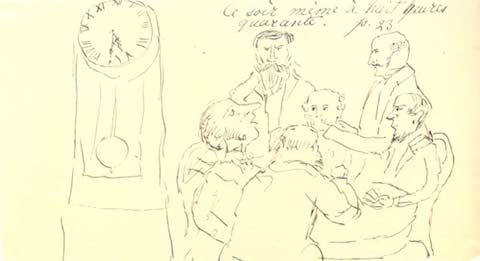
Tolstoy didn’t only illustrate his own work; he also made some sketches of his contemporary Jules Verne’s Around the World in Eighty Days—see one above—which he read in French with his children. These few drawings may seem like little more than doodles, but Tolstoy in fact had a very fine hand, as you can see in the two sketches below from notebooks he kept during his time in the Caucusus. It was then, while serving in the army, that Tolstoy began writing, and the notebooks he kept would eventually inspire his 1863 novel, The Cossacks.
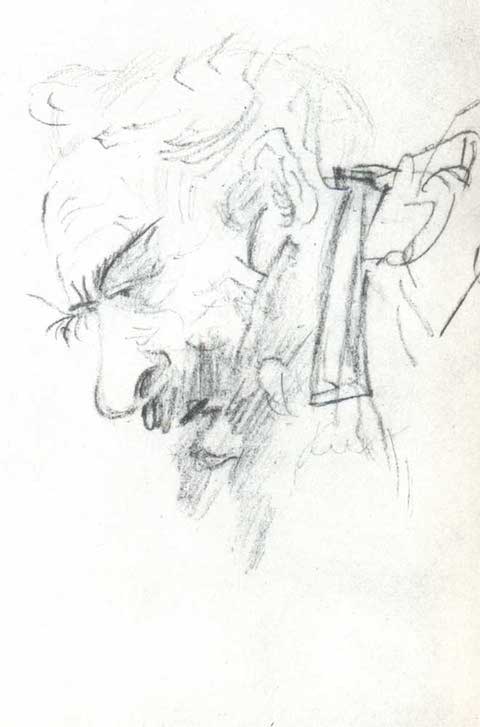
These drawings are so well rendered they make me think Tolstoy could have become a visual artist as well as a great writer. But perhaps the exacting novelist was too harsh a critic to allow himself to pursue that course. Over forty years after making these drawings, Tolstoy published his thoughts on art in essay called What is Art?. In it, the great Russian writer creates what Gary R. Jahn in The Journal of Aesthetics and Art Criticism admits are some “unreasonably narrow, exclusive” criteria for defining art.
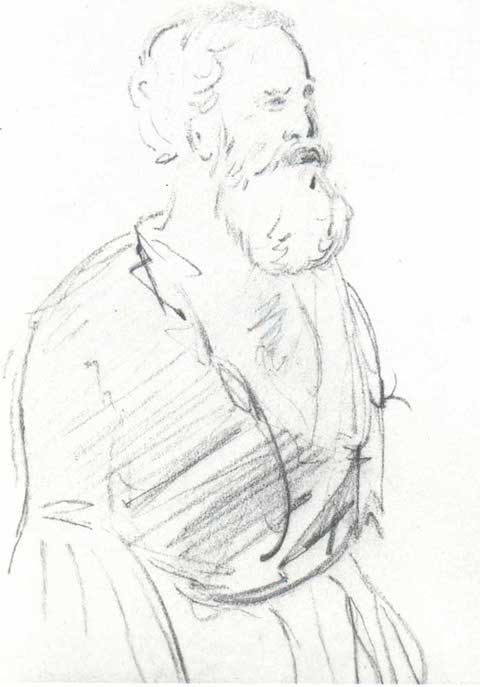
Tolstoy also propounds something akin to a meme theory, which he calls a quality of “infectiousness.” Art, he writes, is “a human activity consisting in this, that one man consciously, by means of certain external signs, hands on to others feelings he has lived through, and that other people are infected by these feelings and also experience them.” At the crucially formative period when these drawings were made, Tolstoy obviously decided he could best “infect” others through writing. That same year, he published the first part of his autobiographical trilogy, Childhood, under a pseudonym, followed quickly by Boyhood. By the time he retired from the army in 1856 and left the Caucusus for St. Petersburg, he was already a literary celebrity. See more of Tolstoy’s drawings from his Caucusus notebooks here.
Related Content:
Leo Tolstoy Creates a List of the 50+ Books That Influenced Him Most (1891)
Rare Recording: Leo Tolstoy Reads From His Last Major Work in Four Languages, 1909
Fyodor Dostoevsky Draws Elaborate Doodles In His Manuscripts
The Art of William Faulkner: Drawings from 1916–1925
The Drawings of Jean-Paul Sartre
Josh Jones is a writer and musician based in Durham, NC. Follow him at @jdmagness
Read More...Watch Entr’Acte: René Clair’s Dadaist Masterpiece, Scored by Erik Satie and with Cameos by Marcel Duchamp & Man Ray (1924)
René Clair’s 1924 avant-garde masterpiece Entr’Acte opens with a cannon firing into the audience and that’s pretty much a statement of purpose for the whole movie. Clair wanted to shake up the audience, throwing it into a disorienting world of visual bravado and narrative absurdity. You can watch it above.
The film was originally designed to be screened between two acts of Francis Picabia’s 1924 opera Relâche. Picabia reportedly wrote the synopsis for the film on a single sheet of paper while dining at the famous Parisian restaurant Maxim’s and sent it to Clair. While that handwritten note was the genesis of what we see on screen, it’s Clair sheer cinematic inventiveness that is why the film is still shown in film schools today.
Clair sought to create a work of “pure cinema,” so he filled the film with just about every camera trick in the book: slow motion, fast motion, split screen and superimpositions among others. The camera is unbound and wildly kinetic. At one point, Clair mounts the camera upside down to the front of a rollercoaster.
In true Dadaist fashion, Clair creates a series of striking images – an upskirt shot of a leaping ballerina; a funeral procession bounding down the street in slow motion; a corpse springing out of a coffin – that seem to cry out for an explanation but remain maddeningly, frequently hilariously obscure.
The movie also serves as a class portrait of the Parisian avant-garde scene of the early ‘20s. Picabia and Erik Satie – who scored the movie – are the ones who fired that cannon. In another scene, Marcel Duchamp and Man Ray can be seen playing chess with each other on a Parisian rooftop.
Compared to Luis Bunuel and Salvador Dali’s notorious 1928 short Un Chien Andalou – a movie that is still quite shocking today – Entr’Acte is a much lighter, funnier work, one that looks to thwart bourgeois expectations of narrative logic but doesn’t quite try to shock them into indignant outrage. In fact, to modern eyes, the movie feels at times like a particularly unhinged Monty Python skit. Picabia himself once asserted that Entr’acte “respects nothing except the right to roar with laughter.” So watch, laugh and prepare to be confused.
Entr’Acte will be added to our collection, 4,000+ Free Movies Online: Great Classics, Indies, Noir, Westerns, Documentaries & More.
Related Content:
Two Vintage Films by Salvador Dalí and Luis Buñuel: Un Chien Andalou and L’Age d’Or
The Seashell and the Clergyman: The World’s First Surrealist Film
David Lynch Presents the History of Surrealist Film (1987)
A Tour Inside Salvador Dalí’s Labyrinthine Spanish Home
Jonathan Crow is a Los Angeles-based writer and filmmaker whose work has appeared in Yahoo!, The Hollywood Reporter, and other publications. You can follow him at @jonccrow. And check out his blog Veeptopus, featuring lots of pictures of vice presidents with octopuses on their heads. The Veeptopus store is here.
Read More...‘You Are Done’: The Chilling “Suicide Letter” Sent to Martin Luther King by the F.B.I.
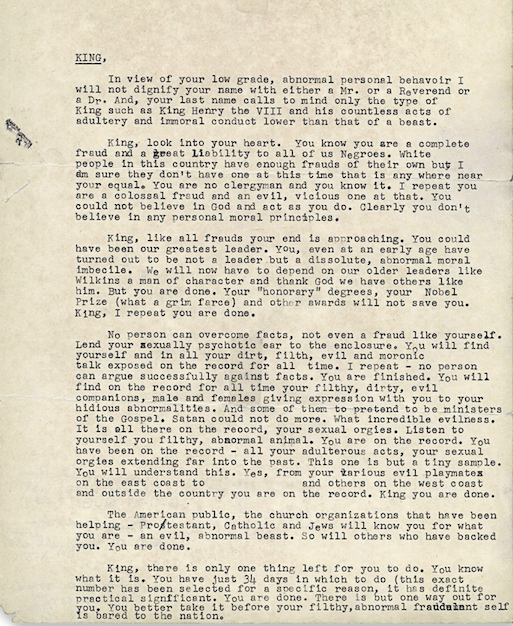
In November of 1964, Martin Luther King received a chilling letter, purportedly from a disillusioned member of the African-American community. “King, look into your heart,” writes MLK’s critic. “You know you are a complete fraud and a great liability to all of us Negroes.”
The letter then turns menacing. It gives the civil rights leader a choice. Commit suicide or get killed:
You are done.
King, there is only one thing left for you to do. You know what it is. You have just 34 days in which to do it (this exact number has been selected for a specific reason, it has definite practical significance). You are done. There is but one way out for you. You better take it before your filthy, abnormal fraudulent self is bared to the nation.
Straight from the beginning, King knew the real author behind the “suicide letter,” as it’s now called. It was the FBI, led by J. Edgar Hoover, who harbored a deep and abiding hatred for King. For years, the public only had access to redacted copies of the letter. The redactions obscured the methods of the FBI — the way the agency tried to “fracture movements and pit leaders against one another,” writes the Electronic Frontier Foundation, and the way it used surveillance to invade King’s personal life and then blackmailed him with the information it gathered. That’s what’s happening in the paragraph that begins “No person can overcome the facts, not even a fraud like yourself.”
This summer, while researching at the National Archives, Beverly Gage, a professor of American history at Yale, stumbled upon an unredacted copy. You can read it above. On Tuesday, Gage wrote about the letter and its historical significance in The New York Times. The unredacted letter was also published in the Times.
via BoingBoing/EFF
Related Content:
200,000 Martin Luther King Papers Go Online
Free Online History Courses
Read More...Support Us
We're hoping to rely on loyal readers, rather than erratic ads. Please click the Donate button and support Open Culture. You can use Paypal, Venmo, Patreon, even Crypto! We thank you!

About Us

Open Culture scours the web for the best educational media. We find the free courses and audio books you need, the language lessons & educational videos you want, and plenty of enlightenment in between.
Advertise With Us

FREE UPDATES!
GET OUR DAILY EMAIL
Get the best cultural and educational resources on the web curated for you in a daily email. We never spam. Unsubscribe at any time.
FOLLOW ON SOCIAL MEDIA

Open Culture editor Dan Colman scours the web for the best educational media. He finds the free courses and audio books you need, the language lessons & movies you want, and plenty of enlightenment in between.
Advertise With Us


