The New Yorker Web Site is Entirely Free This Summer (Until It Goes Behind a Paywall This Fall)

Yesterday, The New Yorker magazine published “A Note to Readers,” announcing the new strategy behind its web site. The site now has a different look and feel. It will also be governed by a new set of economics, which will include putting the entire site behind a paywall. The editors write, “in the fall, we [will] move to a second phase, implementing an easier-to-use, logical, metered paywall. Subscribers will continue to have access to everything; non-subscribers will be able to read a limited number of pieces—and then it’s up to them to subscribe. You’ve likely seen this system elsewhere—at the Times, for instance—and we will do all we can to make it work seamlessly.”
But, until then, the site won’t be half open (as it has been during recent years). It’ll be entirely open. Again, the editors write: “Beginning this week, absolutely everything new that we publish—the work in the print magazine and the work published online only—will be unlocked. All of it, for everyone. Call it a summer-long free-for-all. Non-subscribers will get a chance to explore The New Yorker fully and freely, just as subscribers always have.”
What should you read while The New Yorker is open? I’d focus on the old stuff, which will presumably get locked up too. Here are a few quick suggestions: Truman Capote’s In Cold Blood serialized in the pages of the magazine in 1965; J.D. Salinger’s January 1948 publication of his enduring short story “A Perfect Day for a Banana Fish;” and, of course, Hannah Arendt’s original articles on “the Banality of Evil”? If you have problems reading the text (in the latter two cases), be sure to click the pages to zoom in.
via GalleyCat
Read More...
Stephen Fry Explains the Rules of Cricket in 10 Animated Videos
Founded in London in 1787, The Marylebone Cricket Club (MCC) began publishing The Laws of Cricket in 1788, and later became the governing body of the game. More than two centuries later, the MCC has passed governing responsibilities to The International Cricket Council. But it still publishes The Laws of Cricket and helps young players and casual fans learn more about the bat-and-ball game that dates back to early 16th-century England, if not before. And let’s face it, if you didn’t grow up in a country that figured into the British Empire, you can probably use a primer. Or maybe 10 animated ones narrated by actor, writer, cricket lover and occasional umpire Stephen Fry. Click the play button on the video above, and you can watch the collection of animations, covering everything from what happens when a “wicket is down” to when the “batsman is out his ground.” When you’re done, you can enjoy some other Fry narrations we’ve featured in blog posts past. See the “relateds” below.
Related Content:
Stephen Fry Reads Oscar Wilde’s Children’s Story “The Happy Prince”
Stephen Fry Introduces the Strange New World of Nanoscience
Stephen Fry Explains Cloud Computing in a Short Animated Video
Stephen Fry Reads the Legendary British Shipping Forecast
Read More...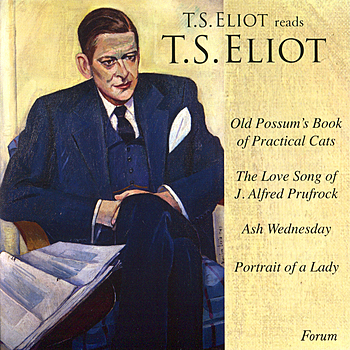
Sun Ra’s Full Lecture & Reading List From His 1971 UC Berkeley Course, “The Black Man in the Cosmos”
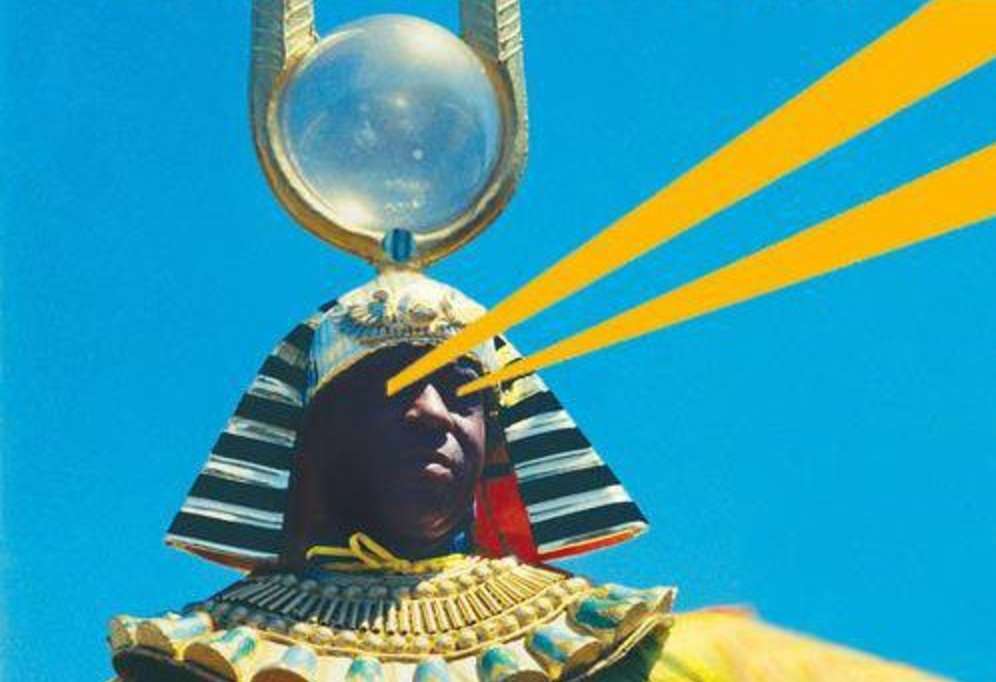
A pioneer of “Afrofuturism,” bandleader Sun Ra emerged from a traditional swing scene in Alabama, touring the country in his teens as a member of his high school biology teacher’s big band. While attending Alabama Agricultural and Mechanical University, he had an out-of-body experience during which he was transported into outer space. As biographer John Szwed records him saying, “my whole body changed into something else. I landed on a planet that I identified as Saturn.” While there, aliens with “little antenna on each ear. A little antenna on each eye” instructed him to drop out of college and speak through his music. And that’s just what he did, changing his name from Herman Blount and never looking back.
Whether you believe that story, whether Sun Ra believes it, or whether his entire persona is a theatrical put-on should make no difference. Because Sun Ra would be a visionary either way. Combining Afrocentric science fiction, esoteric and occult philosophy, Egyptology, and, with his “Arkestra,” his own brand of free jazz-futurism that has no equal on earth, the man is truly sui generis. In 1971, he served as artist-in-residence at UC Berkeley and offered a spring semester lecture, African-American Studies 198, also known as “Sun Ra 171,” “The Black Man in the Universe,” or “The Black man in the Cosmos.” The course featured readings from—to name just a few—theosophist Madame Blavatsky, French philosopher Constantin Francois de Chasseboeuf, black American writer and poet Henry Dumas, and “God,” whom the cosmic jazz theorist reportedly listed as the author of The Source Book of Man’s Life and Death (otherwise known as the King James Bible).
Now we have the rare opportunity to hear a full lecture from that class, thanks to Ubu.com. Listen to Sun Ra spin his intricate, bizarrely otherworldly theories, drawn from his personal philosophy, peculiar etymologies, and idiosyncratic readings of religious texts. Hearing him speak is a little like hearing him play, so be prepared for a lot of free association and jarring, unexpected juxtapositions. Szwed describes a “typical lecture” below:
Sun Ra wrote biblical quotes on the board and then ‘permutated’ them—rewrote and transformed their letters and syntax into new equations of meaning, while members of the Arkestra passed through the room, preventing anyone from taping the class. His lecture subjects included Neoplatonic doctrines; the application of ancient history and religious texts to racial problems; pollution and war; and a radical reinterpretation of the Bible in light of Egyptology.
Luckily for us, some sly student captured one of those lectures on tape.
For more of Professor Ra’s spaced out presentation, see the Helsinki interview above, also from 1971. And if you decide you need your own education in “Sun Ra 171,” see the full reading list from his Berkeley course below, courtesy of the blog New Day.
The Egyptian Book of the Dead
Radix
Alexander Hislop: Two Babylons
The Theosophical works of Madame Blavatsky
The Book of Oahspe
Henry Dumas: Ark of Bones
Henry Dumas: Poetry for My People eds. Hale Charfield & Eugene Redmond, Carbondale: Southern Illinois University Press 1971
Black Fire: An Anthology of Afro-American Writing, eds. Leroi Jones & Larry Neal, New York: William Morrow 1968
David Livingston: Missionary Travels
Theodore P. Ford: God Wills the Negro
Rutledge: God’s Children
Stylus, vol. 13, no. 1 (Spring 1971), Temple University
John S. Wilson: Jazz. Where It Came From, Where It’s At, United States Information Agency
Yosef A. A. Ben-Jochannan: Black Man of the Nile and His Family, Alkibu Ian Books 1972
Constantin Francois de Chasseboeuf, Comte de Volney: The Ruins, or, Meditation on the Revolutions of Empires, and the Law of Nature, London: Pioneer Press 1921
The Source Book of Man’s Life and Death (Ra’s description; = The King James Bible)
Pjotr Demianovitch Ouspensky: A New Model of the Universe. Principles of the Psychological Method in Its Application to Problems of Science, Religion and Art, New York: Knopf 1956
Frederick Bodmer: The Loom of Language. An Approach to the Mastery of Many Languages, ed. Lancelot Hogben, New York: Norton & Co. 1944
Blackie’s Etymology
Countless other free courses from UC Berkeley can be found in our collection, 1,700 Free Online Courses from Top Universities.
via Dangerous Minds and audio courtesy of Sensitive Skin Magazine
Related Content:
Space Jazz, a Sonic Sci-Fi Opera by L. Ron Hubbard, Featuring Chick Corea (1983)
Josh Jones is a writer and musician based in Durham, NC. Follow him at @jdmagness
Read More...Wearable Books: In Medieval Times, They Took Old Manuscripts & Turned Them into Clothes
I like old newspaper, smoothing it out to read about what was happening on the day an older relative packed away the good crystal or some other fragile tchotchke.
Traveling in India, I dug how the snacks I purchased to eat on the train came wrapped in old book pages. When my traveling companion realized he had lost his journal, there was comfort in knowing that it would be reincarnated as cones to hold delicious chana jor garam.
Taking a thrift store frame apart, I was thrilled to discover that behind the previous owners kittens in a basket print lurked a homemade Mother’s Day card from the 40’s and a calendar page that noted the date someone named David quit drinking. (I sent it along to Found Magazine.)
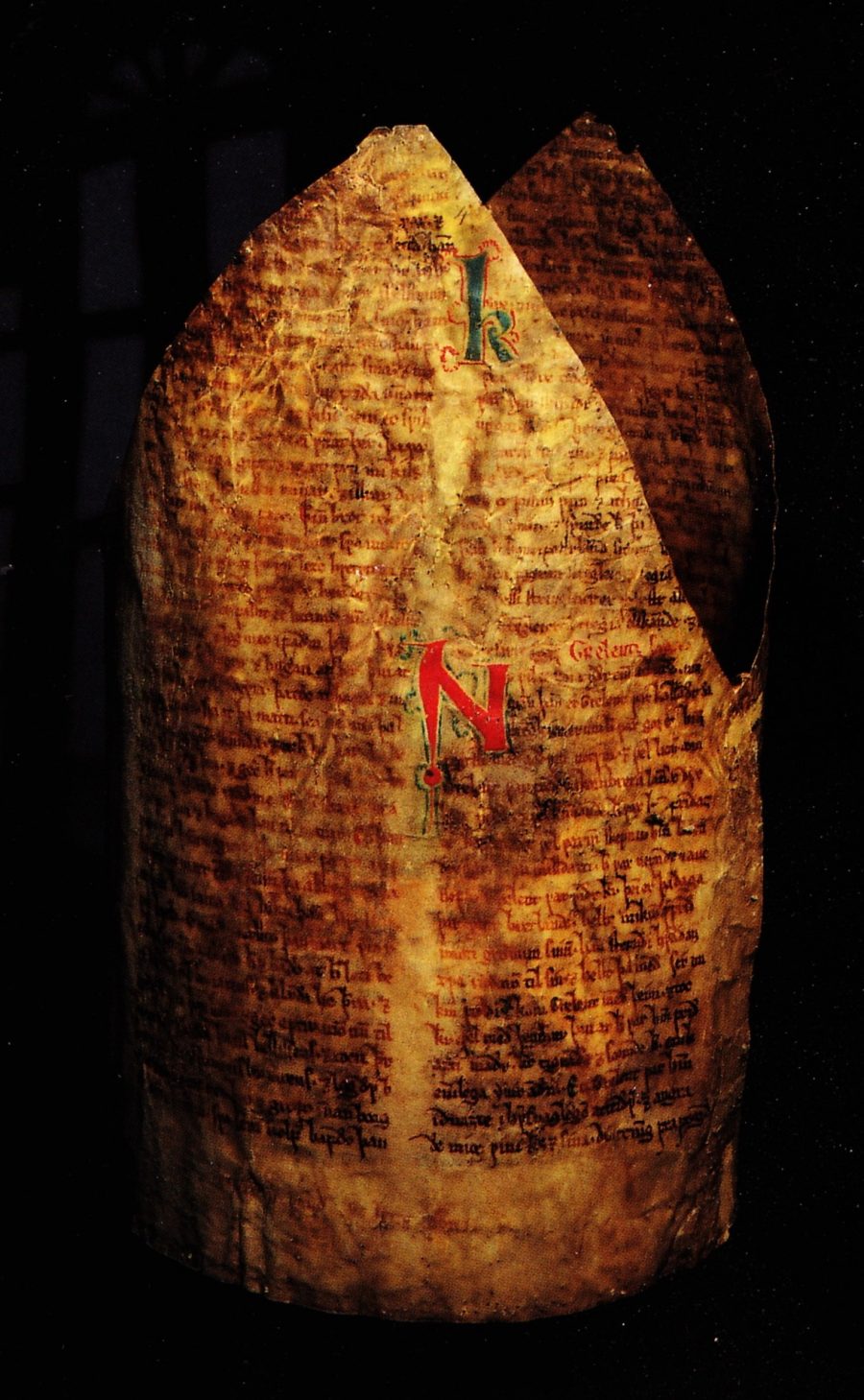
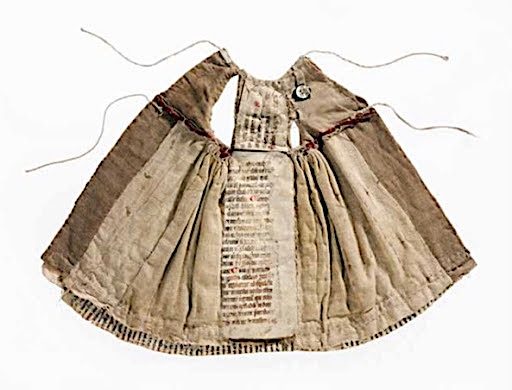
What I wouldn’t give to stumble upon a dress lined with a 13th-century manuscript. Or a bishop’s miter stiffened with racy 13th-century Norse love poetry!
Apparently, it’s a rich tradition, putting old pages to good use, once they start feeling like they’ve outlived their intended purpose. The bishop likely didn’t know the specifics on the material that made his hat stand up. I’ll bet the sisters of the German Cistercian convent where the dress above originated were more concerned with the outward appearance of the garments they were stitching for their wooden statues than the not-for-display lining.
As Dutch art historian Erik Kwakkel explains on his medievalfragments blog, the invention of the Gutenberg press demoted scads of handwritten text to more proletarian purpose. Ultimately, it’s not as grim as it sounds:
the dismembered books were to have a second life: they became travelers in time, stowaways… with great and important stories to tell. Indeed, stories that may otherwise not have survived, given that classical and medieval texts frequently only come down to us in fragmentary form. The early history of the Bible as a book could not be written if we were to throw out fragment evidence.
Related Content:
Dutch Book From 1692 Documents Every Color Under the Sun: A Pre-Pantone Guide to Colors
Archive of Handwritten Recipes (1600 – 1960) Will Teach You How to Stew a Calf’s Head and More
Ayun Halliday is an author, homeschooler and the Chief Primatologist of The East Village Inky zine. Follow her @AyunHalliday
Read More...T.S. Eliot Illustrates His Letters and Draws a Cover for Old Possum’s Book of Practical Cats
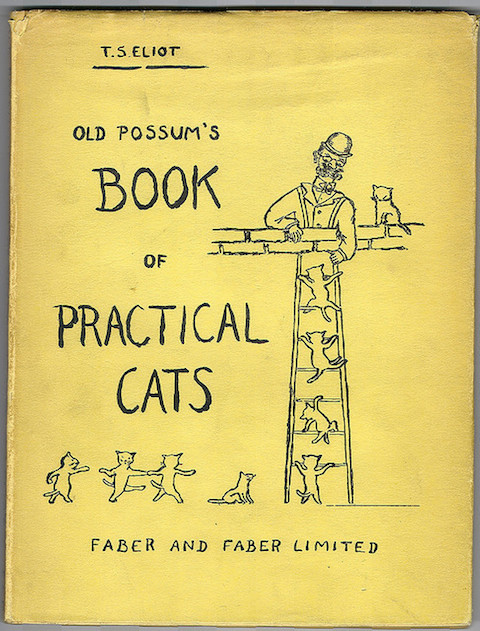
Like so many poets, Thomas Stearns Eliot could write a fine letter. Unlike quite so many poets, he could also illustrate those fine letters with an amusing picture or two. The T.S. Eliot Society’s web site has several examples of what the author of “The Waste Land” could do when he got thinking visually as well as textually. At the top of the post, we have a cover he drew for a book of his own, Old Possum’s Book of Practical Cats, a well-known work of Eliot’s in its own right but also indirectly known and loved by millions as the basis of Andrew Lloyd Webber’s musical Cats. Well before this satirical feline material attained such grand embellishment for and far-reaching fame on the stage, it took its first, humble public form in 1939. Had you bought Old Possum’s Book of Practical Cats then, you would have bought the one above, with Eliot’s hand-drawn cover. (It runs $37,000 now.) The very next year, a new edition came out fully illustrated by Nicholas Bentley. The inimitable Edward Gorey took his turn with the 1982 edition, and the latest, published in 2009, features the art of German illustrator Axel Scheffler.
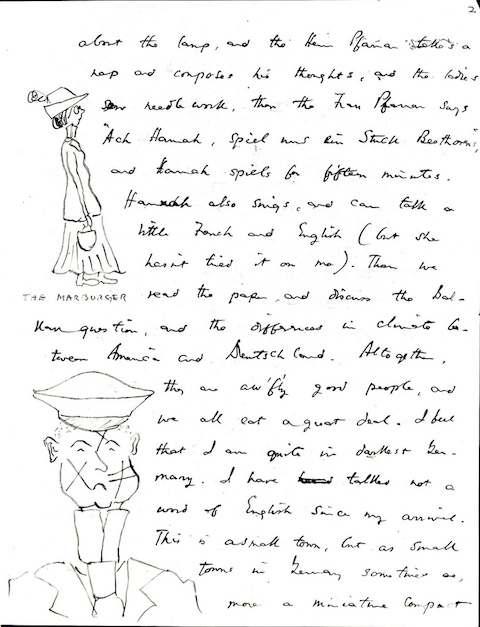
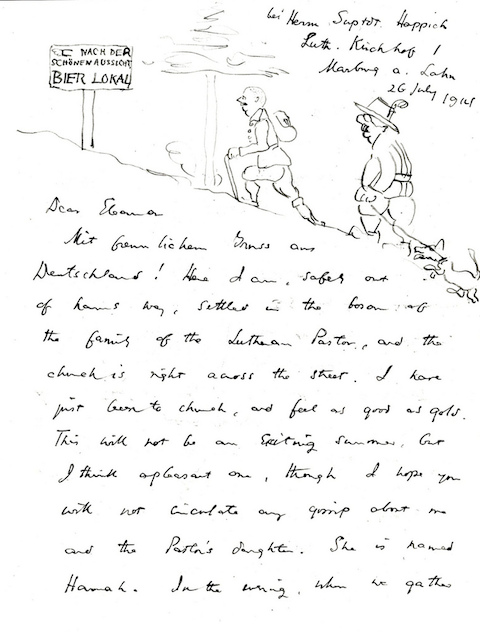
Above and below, you can see a couple more surviving examples of what Eliot could do with pen and ink, albeit not in a context necessarily intended for publication. While Eliot’s actual handwriting may not make for easy reading, even if you can read the German in which he sometimes wrote, his drawings vividly display his impressions of the people presumably mentioned in the text. I’d have taken such pains, too, if I had the expectation some 20th-century men of letters seemed to that their collected correspondence would eventually see print. Yet Eliot himself went back and forth about it, “torn over whether to allow public access to his private letters after his death,” writes Salon’s Kera Bolonik. “ ‘I don’t like reading other people’s private correspondence in print, and I do not want other people to read mine,’ he said in 1927. But six years later, he admitted he had an ‘ineradicable’ desire for his letters to reach a wider audience. ‘We want to confess ourselves in writing to a few friends, and we do not always want to feel that no one but those friends will ever read what we have written’ ” — or see what we have drawn.
Related Content:
Listen to T.S. Eliot Recite His Late Masterpiece, the Four Quartets
Bob Dylan Reads From T.S. Eliot’s Great Modernist Poem The Waste Land
Colin Marshall hosts and produces Notebook on Cities and Culture and writes essays on cities, language, Asia, and men’s style. He’s at work on a book about Los Angeles, A Los Angeles Primer. Follow him on Twitter at @colinmarshall or on Facebook.
Read More...In Dark PSA, Director Richard Linklater Suggests Radical Steps for Dealing with Texters in Cinemas
At the Alamo Drafthouse cinemas, they don’t mess around. They tell you right on their web site, “We have a zero-tolerance policy towards talking and texting during the movie. If you talk or text, you will receive one warning. If it happens again, you will be kicked out without a refund.” And they apparently mean it. Want some proof? Here’s Exhibit A — a clip that mocks a customer who apparently got kicked out of their “crappy” theater in Austin, Texas for texting. Then there’s Exhibit B above — a sardonic Alamo Drafthouse video featuring indie filmmaker Richard Linklater suggesting radical steps for dealing with the type of people found in Exhibit A. It’s all a bit of dark humor (of course). But here’s something that’s not a joke. You can watch Linklater’s breakthrough 1991 film, Slacker, free online. You can also hear the Texas native talk about his new film Boyhood on Fresh Air here.
Parting words: Don’t mess with Texas, particularly filmmakers in Texas.
Related Content:
Watch Free Online: Richard Linklater’s Slacker, the Classic Gen‑X Indie Film
An Anti, Anti-Smoking Announcement from John Waters
David Lynch’s Unlikely Commercial for a Home Pregnancy Test (1997)
Read More...George Harrison Wrote His Last Letter to Austin Powers Creator Mike Myers, Asking for a Mini Me Doll (2001)
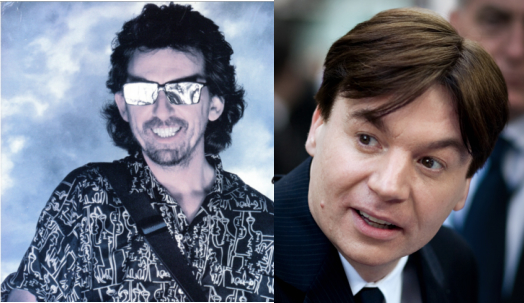
In a band full of extroverted goofballs and pranksters, George Harrison was the quiet one, the serious Beatle, the straight man and introspective mystic, right? Not so, according to Travelling Wilburys bandmate Tom Petty, who once countered the “quiet Beatle” sobriquet with “he never shut up. He was the best hang you could imagine.” Not so, according to Harrison himself, who once said “I think I’ve had an image, people have had a concept of me being really straight cause I was the serious one or something. I mean, I’m the biggest lunatic around. I’m completely comical, you know? I like craziness. I had to in order to be in the Beatles.”
It’s true that Harrison disliked fame and its trappings and dove deeply into life’s mysteries. In his final televised interview, he is contemplative and, yes, deeply serious. And while some of the stories of the end of his life are heartbreaking—like that of the oncologist who allegedly showed up unannounced at the dying Beatles’ door and cajoled him into signing an autograph when he could barely write his name—the story of the last letter he ever wrote made me smile.
According to Mike Myers, creator of Wayne’s World and the sixties spoof Austin Powers franchise, that letter arrived in his hands on the very day of Harrison’s death, delivered via private investigator as Myers and crew shot the third of the Powers films.
Harrison wrote but never mailed the short note a month before his death in November, 2001. In it, he reveals his love for Austin Powers, particularly the “Mini Me” character from The Spy Who Shagged Me (played by Verne Troyer)—a miniature clone of Powers’ nemesis Dr. Evil. In a GQ interview, Myers quotes from the letter: “…sitting here with my Dr. Evil doll…I just wanted to let you know I’ve been all over Europe for a mini-you doll.” Harrison also jokingly corrected Myers’ Liverpudlian: “Dr. Evil says frickin’ but any good Scouser dad will tell you it’s actually ‘friggin’ as in a ‘four of fish and finger pie,’ if you get my drift.”
The “Scouser dad” reference was particularly poignant for Myers, whose parents come from Liverpool. “You don’t know what The Beatles were in my house,” Myers told WENN news, “They were everything. Liverpool was poorish and it was rough and all of a sudden it was cool to come from this town, so my parents were eternally grateful.” Harrison returned the gratitude, writing “thanks for the movies, so much fun,” a sentiment Myers reacts to with “Dude, I can’t even.” And really, what could else could you say? “To get this letter,” and on the very day of Harrison’s passing no less, “was unbelievable,” said Myers, “It hits you and it can knock you off your feet.”
As for that reputation for seriousness? I don’t know about you, but from now on, when I think of the last days of George Harrison, I won’t think of his opportunistic doctor, or his turning down the OBE, or even that fateful final performance on VH1. I’ll imagine him sitting on the couch with a Dr. Evil doll, writing Mike Myers to request a Mini Me.
Related Content:
Bob Dylan and George Harrison Play Tennis, 1969
George Harrison in the Spotlight: The Dick Cavett Show (1971)
Here Comes The Sun: The Lost Guitar Solo by George Harrison
Josh Jones is a writer and musician based in Durham, NC. Follow him at @jdmagness
Read More...Did the Wayback Machine Catch Russian-Backed Rebels Claiming Responsibility for Malaysian Airlines Flight MH17?
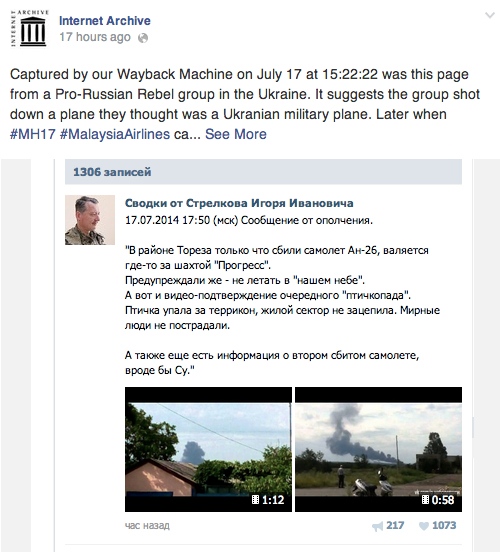
If you’re a long-time reader of Open Culture, you know all about Archive.org — a non-profit that houses all kinds of fascinating texts, audio, moving images, and software. And don’t forget archived web pages. Since 1996, Archive’s “Wayback Machine” has been taking snapshots of websites, producing a historical record of this still fairly new thing called “the web.” Right now, the Wayback Machine holds 417 billion snapshots of web sites, including one page showing that “Igor Girkin, a Ukrainian separatist leader also known as Strelkov, claimed responsibility on a popular Russian social-networking site for the downing of what he thought was a Ukrainian military transport plane shortly before reports that Malaysian Airlines Flight MH17 had crashed near the rebel held Ukrainian city of Donetsk.” (This quote comes from The Christian Science Monitor, which has more on the story.) Girkin’s post was captured by the Wayback Machine at 15:22:22 on July 17. By 16:56, Girkin’s post was taken offline — but not before Archive.org had its copy.
To keep tabs on this story, follow Archive’s Twitter and Facebook pages.
Read More...Akira Kurosawa & Gabriel García Márquez Talk About Filmmaking (and Nuclear Bombs) in Six Hour Interview
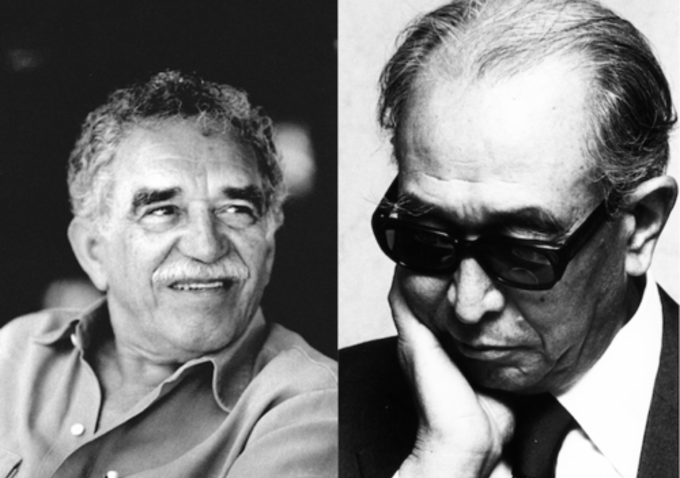
You know you’re doing something right in your life if the Nobel Prize-winning author of 100 Years of Solitude talks to you like a giddy fan boy.
Back in October 1990, Gabriel García Márquez sat down with Akira Kurosawa in Tokyo as the Japanese master director was shooting his penultimate movie Rhapsody in August — the only Kurosawa movie I can think of that features Richard Gere. The six hour interview, which was published in The Los Angeles Times in 1991, spanned a range of topics but the author’s love of the director’s movies was evident all the way through. At one point, while discussing Kurosawa’s 1965 film Red Beard, García Márquez said this: “I have seen it six times in 20 years and I talked about it to my children almost every day until they were able to see it. So not only is it the one among your films best liked by my family and me, but also one of my favorites in the whole history of cinema.”
One natural topic discussed was adapting literature to film. The history of cinema is littered with some truly dreadful adaptations and even more that are simply inert and lifeless. One of the Kurosawa’s true gifts as a filmmaker was turning the written word into a vital, memorable image. In movies like Throne of Blood and Ran, he has proved himself to be arguably the finest adapter of Shakespeare in the history of cinema.
García Márquez: Has your method also been that intuitive when you have adapted Shakespeare or Gorky or Dostoevsky?
Kurosawa: Directors who make films halfway may not realize that it is very difficult to convey literary images to the audience through cinematic images. For instance, in adapting a detective novel in which a body was found next to the railroad tracks, a young director insisted that a certain spot corresponded perfectly with the one in the book. “You are wrong,” I said. “The problem is that you have already read the novel and you know that a body was found next to the tracks. But for the people who have not read it there is nothing special about the place.” That young director was captivated by the magical power of literature without realizing that cinematic images must be expressed in a different way.
García Márquez: Can you remember any image from real life that you consider impossible to express on film?
Kurosawa: Yes. That of a mining town named Ilidachi [sic], where I worked as an assistant director when I was very young. The director had declared at first glance that the atmosphere was magnificent and strange, and that’s the reason we filmed it. But the images showed only a run-of-the-mill town, for they were missing something that was known to us: that the working conditions in (the town) are very dangerous, and that the women and children of the miners live in eternal fear for their safety. When one looks at the village one confuses the landscape with that feeling, and one perceives it as stranger than it actually is. But the camera does not see it with the same eyes.
When Kurosawa and García Márquez talked about Rhapsody in August, the mood of the interview darkened. The film is about one old woman struggling with the horrors of surviving the atomic attack on Nagasaki. When it came out, American critics bristled at the movie because it had the audacity to point out that many Japanese weren’t all that pleased with getting nuked. This is especially the case with Nagasaki. While Hiroshima had numerous factories and therefore could be considered a military target, Nagasaki had none. In fact, on August 9, 1945, the original target for the world’s second nuclear attack was the industrial town of Kita Kyushu. But that town was covered in clouds. So the pilots cast about looking for some place, any place, to bomb. That place proved to Nagasaki.
Below, Kurosawa talks passionately about the legacy of the bombing. Interestingly, García Márquez, who had often been a vociferous critic of American foreign policy, sort of defends America’s actions at the end of the war.
Kurosawa: The full death toll for Hiroshima and Nagasaki has been officially published at 230,000. But in actual fact there were over half a million dead. And even now there are still 2,700 patients at the Atomic Bomb Hospital waiting to die from the after-effects of the radiation after 45 years of agony. In other words, the atomic bomb is still killing Japanese.
García Márquez: The most rational explanation seems to be that the U.S. rushed in to end it with the bomb for fear that the Soviets would take Japan before they did.
Kurosawa: Yes, but why did they do it in a city inhabited only by civilians who had nothing to do with the war? There were military concentrations that were in fact waging war.
García Márquez: Nor did they drop it on the Imperial Palace, which must have been a very vulnerable spot in the heart of Tokyo. And I think that this is all explained by the fact that they wanted to leave the political power and the military power intact in order to carry out a speedy negotiation without having to share the booty with their allies. It’s something no other country has ever experienced in all of human history. Now then: Had Japan surrendered without the atomic bomb, would it be the same Japan it is today?
Kurosawa: It’s hard to say. The people who survived Nagasaki don’t want to remember their experience because the majority of them, in order to survive, had to abandon their parents, their children, their brothers and sisters. They still can’t stop feeling guilty. Afterwards, the U.S. forces that occupied the country for six years influenced by various means the acceleration of forgetfulness, and the Japanese government collaborated with them. I would even be willing to understand all this as part of the inevitable tragedy generated by war. But I think that, at the very least, the country that dropped the bomb should apologize to the Japanese people. Until that happens this drama will not be over.
The whole interview is fascinating. They continue to talk about historical memory, nuclear power and the difficulty of filming rose-eating ants. You can read the entire thing here. It’s well worth you time.
via Thompson on Hollywood H/T Sheerly
Related Content:
Watch Kurosawa’s Rashomon Free Online, the Film That Introduced Japanese Cinema to the West
Andy Warhol Interviews Alfred Hitchcock (1974)
Listen to François Truffaut’s Big, 12-Hour Interview with Alfred Hitchcock (1962)
Akira Kurosawa & Francis Ford Coppola Star in Japanese Whisky Commercials (1980)
Jonathan Crow is a Los Angeles-based writer and filmmaker whose work has appeared in Yahoo!, The Hollywood Reporter, and other publications. You can follow him at @jonccrow.
Read More...Support Us
We're hoping to rely on loyal readers, rather than erratic ads. Please click the Donate button and support Open Culture. You can use Paypal, Venmo, Patreon, even Crypto! We thank you!

About Us

Open Culture scours the web for the best educational media. We find the free courses and audio books you need, the language lessons & educational videos you want, and plenty of enlightenment in between.
Advertise With Us

FREE UPDATES!
GET OUR DAILY EMAIL
Get the best cultural and educational resources on the web curated for you in a daily email. We never spam. Unsubscribe at any time.
FOLLOW ON SOCIAL MEDIA

Open Culture editor Dan Colman scours the web for the best educational media. He finds the free courses and audio books you need, the language lessons & movies you want, and plenty of enlightenment in between.
Advertise With Us

