A Pre-Pantone Guide to Colors: Dutch Book From 1692 Documents Every Color Under the Sun
In 1963, the Pantone corporation began publishing a bi-yearly color guide, which divides and categorizes every color under the sun. The astonishingly ubiquitous guide is an essential tool for designers of every stripe, from a fashion guru figuring out what color to highlight in her fall line to the guy in charge of creating a color palette for the interior of a new Boeing-787.
Twice a year, Pantone, along with a shadowy cabal of colorists from around the world, meet in a European city and, with the secrecy of the Vatican choosing a new pope, they select the color of the season.
They are the reason why you painted your kitchen Wasabi Green a couple years ago and why, whether you want to or not, you’ll be wearing Radiant Orchid next year. Slate did a great write up about the whole confusing process a while back.
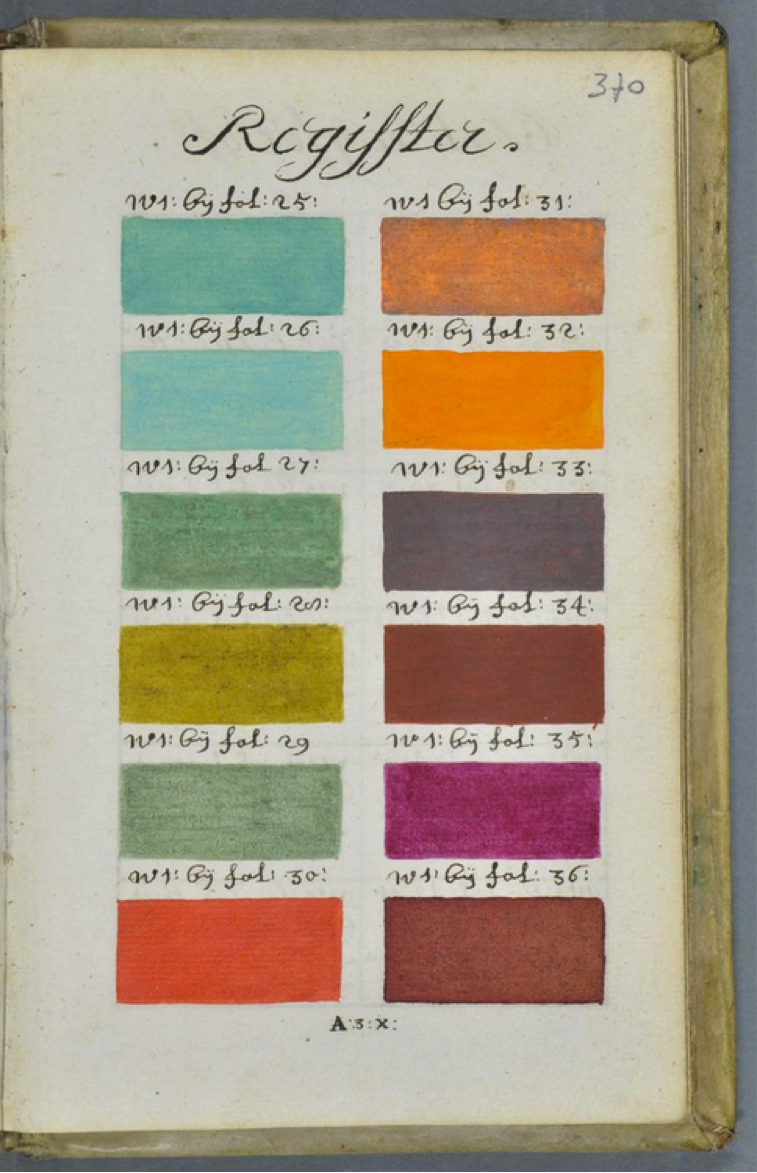
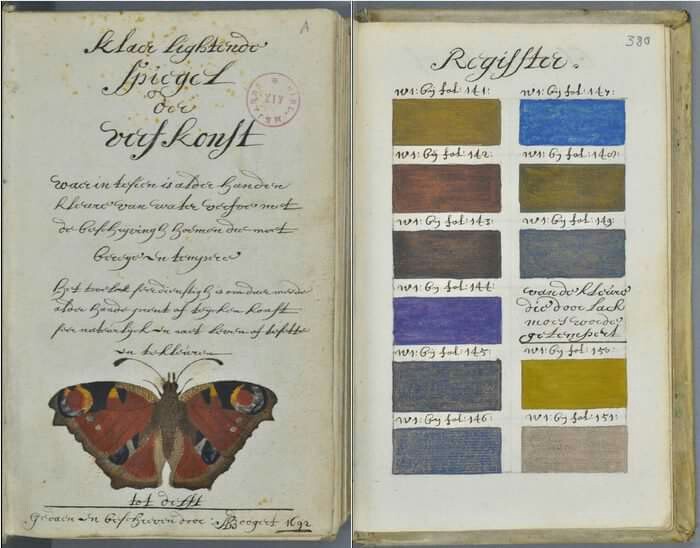
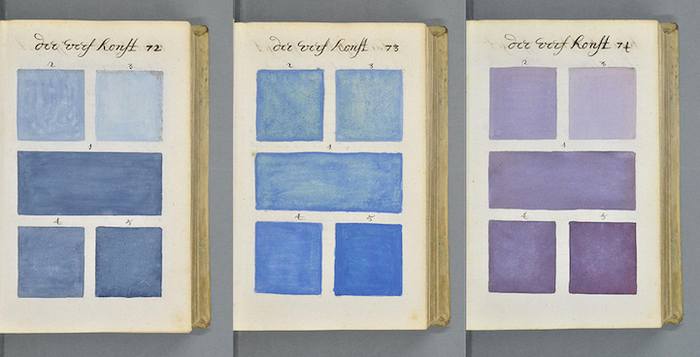
Over 250 years before the Color-Industrial Complex reared its head, a mysterious Dutch artist also detailed every color in the spectrum, only he did it all by hand. Known by the snicker-inducing name of A. Boogert, the author set out to demonstrate how to mix watercolor paint and how to manipulate the paint’s value by adding water. Yet he approached his task with a staggering level of detail and depth; the resulting book — Traité des couleurs servant à la peinture à l’eau — is over 700 pages. It’s about as thorough a color guide as one could imagine in a world without color printers.
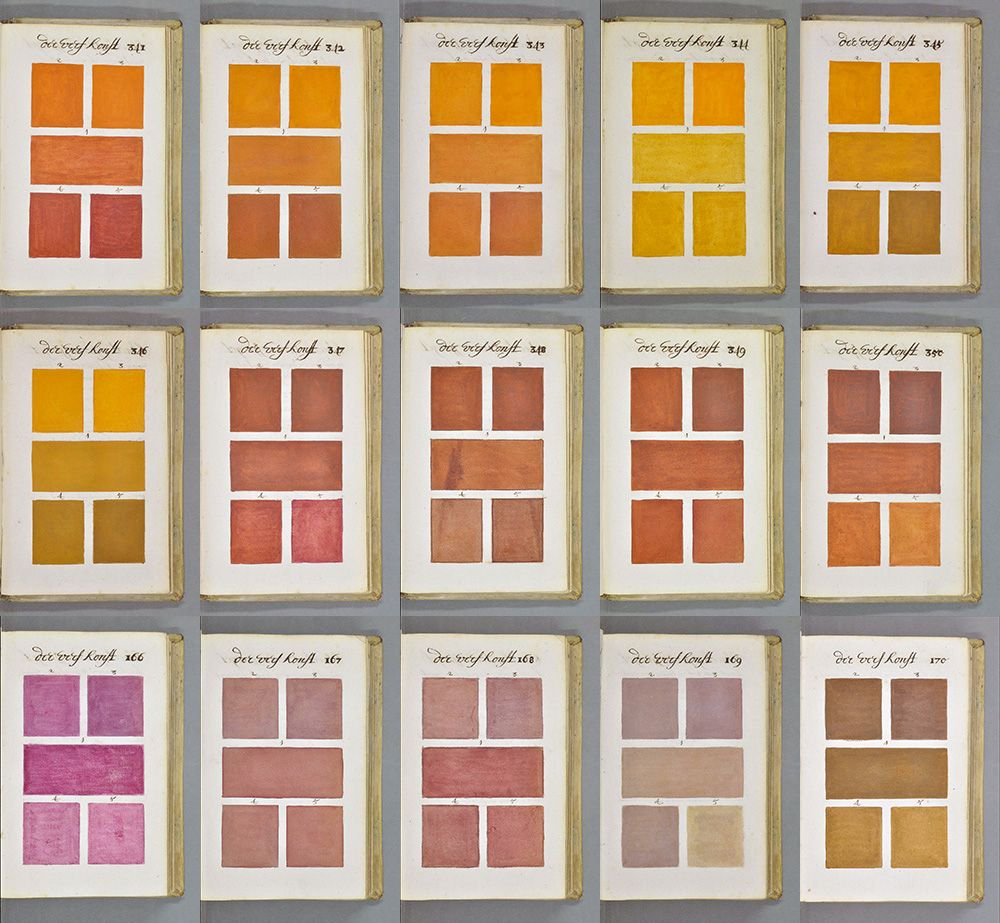
The book was largely forgotten, gathering dust at the Bibliothèque Méjanes in Aix-en-Provence, France until Dutch art historian Erik Kwakkel, who translated the introduction, posted selections from the book on his blog. Herr Boogert apparently intended the book to be educational for aspiring artists. Unfortunately, only a few artists at the time ever got a chance to see the one-of-a-kind book.
You can see scans of the book above. And if you want to more, click here to see them in high resolution.
For more intriguing manuscripts, be sure to follow Erik Kwakkel’s Tumblr here.
Related Content:
Wassily Kandinsky Caught in the Act of Creation, 1926
When Respected Authors, from Goethe to Henry Miller, Try Their Hand at Painting
Jonathan Crow is a Los Angeles-based writer and filmmaker whose work has appeared in Yahoo!, The Hollywood Reporter, and other publications. You can follow him at @jonccrow.
Read More...130 Free Microsoft eBooks & Guides

Quick fyi: Eric Ligman, a Microsoft Sales Excellence Manager, has gathered together a big list of free Microsoft ebooks and resource guides that will help you navigate through various Microsoft issues. Some of the texts are geared toward consumers; others toward IT professionals working with Microsoft products. A few handy titles include:
- How To Recover That Un-Saved Office Document
- Windows 8 Keyboard Shortcuts
- Microsoft Excel 2013 Quick Start Guide
Most titles are made available as in epub, pdf, and mobi formats.
via Metafilter
Related Content:
Free Online Computer Science Courses
Free Textbooks: Computer Science
800 Free eBooks for iPad, Kindle & Other Devices Read More...Read Online J.K. Rowling’s New Harry Potter Story: The First Glimpse of Harry as an Adult

Quick note: Earlier this year, J. K. Rowling began writing new stories about the 2014 Quidditch World Cup Finals for Pottermore, the website for all things Harry Potter. Today, she followed up with a story that takes the form of an article published in The Daily Prophet: “Dumbledore’s Army Reunites at Quidditch World Cup Final” by Rita Skeeter. Here, Rowling gives us the first glimpse of the adult Harry Potter.
About to turn 34, there are a couple of threads of silver in the famous Auror’s black hair, but he continues to wear the distinctive round glasses that some might say are better suited to a style-deficient twelve-year-old. The famous lightning scar has company: Potter is sporting a nasty cut over his right cheekbone. Requests for information as to its provenance merely produced the usual response from the Ministry of Magic: ‘We do not comment on the top secret work of the Auror department, as we have told you no less than 514 times, Ms. Skeeter.’ So what are they hiding? Is the Chosen One embroiled in fresh mysteries that will one day explode upon us all, plunging us into a new age of terror and mayhem?
You can read the full story on Pottermore, where registration is required. Or the complete story can also be read on Today.com (without registration).
Related Content:
How J.K. Rowling Plotted Harry Potter with a Hand-Drawn Spreadsheet
Take Free Online Courses at Hogwarts: Charms, Potions, Defense Against the Dark Arts & More
The Quantum Physics of Harry Potter, Broken Down By a Physicist and a Magician
Harry Potter Prequel Now Online
Read More...Marcel Duchamp, Chess Enthusiast, Created an Art Deco Chess Set That’s Now Available via 3D Printer
What would Marcel Duchamp have thought of the age of 3D printing, had he foreseen it? I reckon that the inventor of the “readymade” work of art — i.e., a piece found in the real world and placed into an artistic context, as he famously/infamously did with a urinal for 1917’s Fountain — would endorse it as the logical extension of his own creative principles. But man, especially a man like Duchamp, does not live by recontextualized plumbing alone: he also painted, sculpted, and even carved. This last practice resulted, after some time in Buenos Aires the year after Fountain, in his very own one-of-a-kind Art Deco chess set. But now this unique item has turned readymade, so Boingboing reports via Kottke, as “freely downloadable 3D print-files on Thingiverse, where the community is actively remixing them” into versions “like this one, with self-supporting overhangs.”
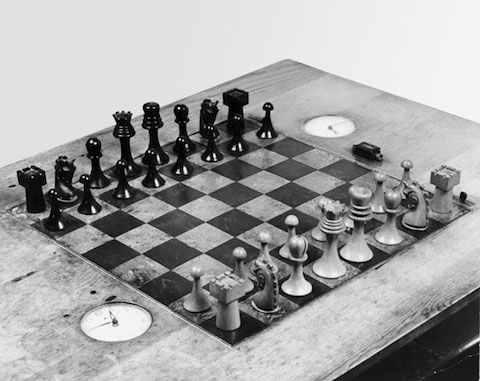
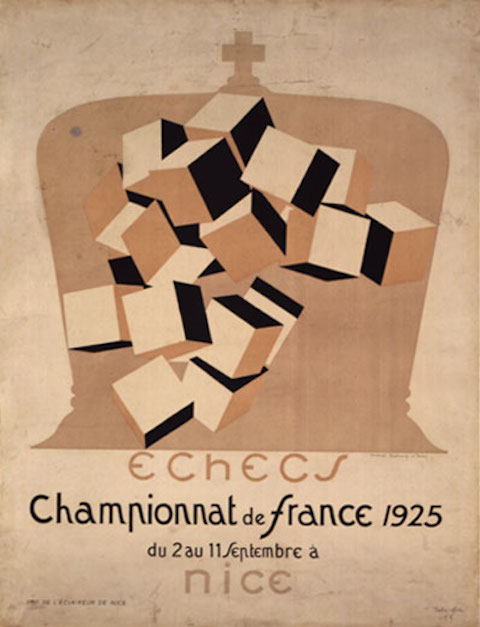
Duchamp himself, who appears in the video at the top of the post describing his passion for chess, surely would have enjoyed all this. After his time in Buenos Aires, he moved to Paris, then to America, and, in 1923, back to Paris again, by which time he’d dedicated himself almost fully to the game. Chess has obsessed many of humanity’s finest minds over centuries and centuries, and Duchamp seems to have shown little resistance to its intellectual and aesthetic pull. Still, just as he crossed chess and art when he crafted his Art Deco set (pictured above), he did it again in 1925, when he not only competed in the Third French Chess Championship (earning the title of grand master as a result) but also designed its striking poster below. The New York Times’ Holland Cotter, reviewing the Francis M. Naumann Fine Arts show “Marcel Duchamp: The Art of Chess,” writes that Duchamp ultimately found his two passions not just reconcilable but “complementary, an ideal intersection of brainpower and beauty. Chess was art; art was chess. Everything was about making the right moves.”
To delve deeper, you can explore the book, Marcel Duchamp: The Art of Chess by Francis M. Naumann.
via Boingboing/Kottke
Related Content:
Anémic Cinéma: Marcel Duchamp’s Whirling Avant-Garde Film (1926)
Free App Lets You Play Chess With 23-Year-Old Norwegian World Champion Magnus Carlsen
A Famous Chess Match from 1910 Reenacted with Claymation
Chess Rivals Bobby Fischer and Boris Spassky Meet in the ‘Match of the Century’
Colin Marshall hosts and produces Notebook on Cities and Culture and writes essays on cities, language, Asia, and men’s style. He’s at work on a book about Los Angeles, A Los Angeles Primer. Follow him on Twitter at @colinmarshall or on Facebook.
Read More...Robert De Niro’s Taxi Cab License Used to Prepare for Taxi Driver (1976)
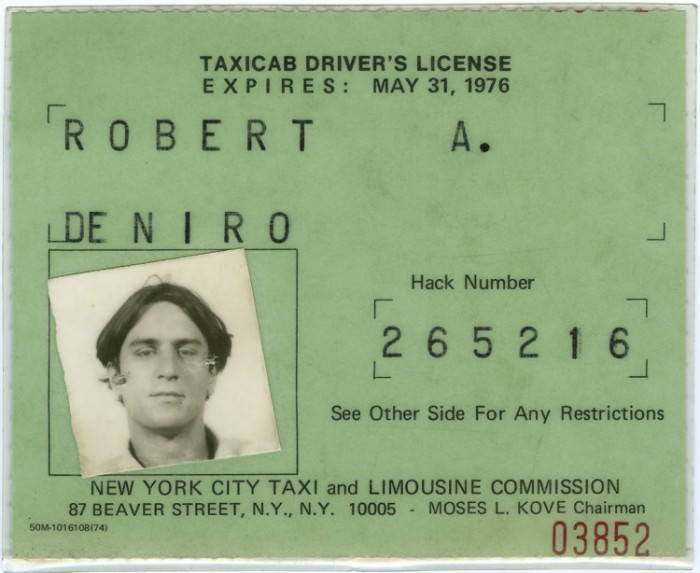
We all know that Robert De Niro has never cut corners when it comes to preparing for roles in films. Need him to gain 60 pounds to play the retired Jake LaMotta in Raging Bull? No problem. How about dropping down to a lean 4% body fat for Cape Fear? Consider it done. And while we’re at it, let’s pay a dentist $20k to grind the actor’s teeth down, you know, to achieve the menacing look of Max Cady. When it comes to Taxi Driver, the least a method actor can do is learn to drive a cab. Above, behold the hack license obtained by Bobby D. in 1976. As part of De Niro’s meticulous preparation for Taxi Driver, writes Andrew J. Rausch in The Films of Martin Scorsese and Robert De Niro, the actor spent some weekends as a cabbie. On one occasion, a passenger recognized him and asked him if he was Robert De Niro. The passenger, who also happened to be an actor, then quipped: “Well, that’s acting. One year the Oscar, the next you’re driving a cab!” (I’d really like to believe that story is true.) The license permanently resides at the Harry Ransom Center in Austin, Texas.
via That Eric Alper
Related Content:
Revisit Martin Scorsese’s Hand-Drawn Storyboards for Taxi Driver
Martin Scorsese’s Very First Films: Three Imaginative Short Works
Young Robert De Niro Appears in 1969 AMC Car Commercial
A Behind-the-Scenes Look at the Casting of The Godfather with Coppola, Pacino, De Niro & Caan
Read More...13-Year-Old Charlotte Brontë & Her Brother Wrote Teeny Tiny Adventure Books, Measuring 1 x 2 Inches
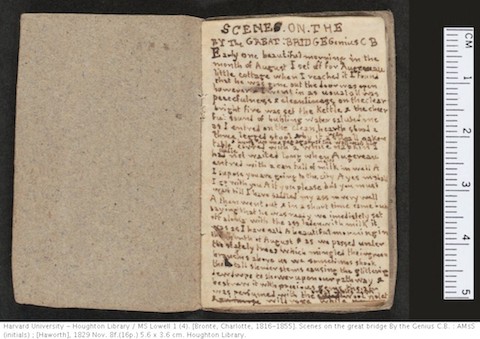
So you consider yourself a reader of the Brontës? Of course you’ve read Wuthering Heights, Jane Eyre, and The Tenant of Wildfell Hall. (Find these classics in our collection of Free eBooks and Free Audio Books.) You’ve probably even got on to the likes of The Green Dwarf and Agnes Grey. Surely you know details from the lives of Charlotte, Emily, and Anne. But have you read such lesser-known entries in the Brontë canon as Scenes on a Great Bridge, The Poetaster: A Drama in Two Volumes, or An Interesting Passage in the Lives of Some Eminent Personages of the Present Age? Do you know of Brontë brother Branwell, the ill-fated tutor, clerk, and artist, and have you seen his own literary output? Now you can, as Harvard University’s Houghton Library has put online nine very early works from Charlotte and Branwell Brontë — all of which measure less than one inch by two inches.
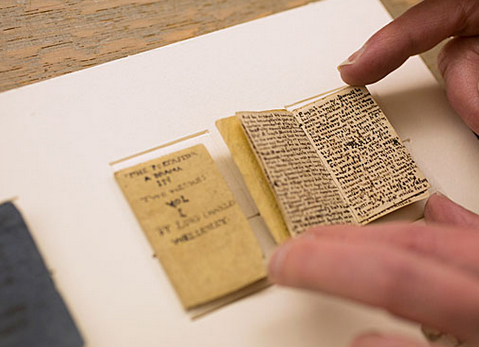
“In 1829 and 1830,” writes Harvard Library Communications’ Kate Kondayen, “Charlotte and Branwell cobbled pages together from printed waste and scrap paper, perhaps cut from margins of discarded pamphlets,” producing “tiny, hand-lettered, hand-bound books” in which “page after mini-page brims with poems, stories, songs, illustrations, maps, building plans, and dialogue. The books, lettered in minuscule, even script, tell of the ‘Glass Town Confederacy,’ a fictional world the siblings created for and around Branwell’s toy soldiers, which were both the protagonists of and audience for the little books.” A dedicated Brontë aficionado may settle for nothing less than seeing these in person, but a reader more interested in the avoidance of eyestrain will certainly prefer to read these digitally magnifiable editions on the web. The hat tip for these miniscule treasures of literary juvenalia goes to the Los Angeles Times’ Carolyn Kellogg, who provides a list of links to the individual works:
By Charlotte Brontë:
Scenes on the great bridge, November 1829
The silver cup: a tale, October 1829
Blackwoods young mens magazine, August 1829
An interesting passage in the lives of some eminent personages of the present age, June 1830
The poetaster: a drama in two volumes, July 1830
The adventures of Mon. Edouard de Crack, February 1830
By Patrick Branwell Brontë:
Branwells Blackwoods magazine, June 1829
Magazine, January 1829
Branwells Blackwoods magazine, July 1829
Related Content:
Colin Marshall hosts and produces Notebook on Cities and Culture and writes essays on cities, language, Asia, and men’s style. He’s at work on a book about Los Angeles, A Los Angeles Primer. Follow him on Twitter at @colinmarshall or on Facebook.
Read More...What Does the Spleen Do? A Music Video Starring Harvard School of Medicine’s Class of 2016
According to Harvard Medical School’s Admissions department, “to study medicine at Harvard is to prepare to play a leading role” in the “quest to improve the human condition.”
It might also prepare you to play a giant spleen, as Richard Ngo, Class of 2016, does in this video for the Harvard Medical School and Harvard School of Dental Medicine’s 107th Annual Second Year Show.
In this anatomical homage to “The Fox,” Norwegian comedy duo Ylvis’ deliberately bizarre hit, the Crimsonites demonstrate a pretty straightforward grasp of their studies:
Lungs go whoosh
Help you breathe
Kidneys filter
Make your pee
If, as they freely admit, they’re a bit murky on splenetic function, well, that’s why they’re at the top ranked medical school in the country, right? To learn?
And to dance?
Their parents, particularly the hard working immigrant ones, must have been so relieved to learn that music videos are a fallback should the doctor thing not work out.
Though why wouldn’t it? Secret male uterus? Vestigial fin? Possibly a backup tongue?
They may be guesses, but they’re educated guesses!
For comparison’s sake, here are two of the winning entries in the Medical and Dental School’s Organ Challenge, an anatomy-based music video contest for kids K‑12: Oakland’s Pacific Boychoir Academy’s Miley Cyrus-inspired take on the Digestive System (above) and Poolesville, Maryland’s local high school’s “Happy”-flavored anthem to healthy cardiac function (below).
I’d say those kids stand a good chance of getting into Harvard.
(Don’t be embarrassed if you remain a bit shaky on what exactly the spleen’s there to do. This simple, non-musical primer on the “Queen of Clean,” compliments of I Heart Guts, should clear things up right away.

Related Content:
The Stanford Mini Med School: The Complete Collection
Science & Cooking: Harvard Profs Meet World-Class Chefs in Unique Online Course
Learn to Code with Harvard’s Intro to Computer Science Course And Other Free Tech Classes
Ayun Halliday is an author, homeschooler and the Chief Primatologist of The East Village Inky zine. Follow her @AyunHalliday
Read More...Watch John Coltrane Turn His Handwritten Poem Into a Sublime Musical Passage on A Love Supreme
On Vimeo, James Cary describes his video creation:
A few years ago, knowing I absolutely adored the John Coltrane album, “A Love Supreme” my wife gave me this incredible book by Ashley Kahn : “A Love Surpreme/The Story of John Coltrane’s Signature Album.” Reading the book, I discovered something remarkable: the fourth movement, Psalm, was actually John Coltrane playing the ‘words’ of the poem that was included in the original liner notes. Apparently he put the handwritten poem on the music stand in front of him, and ‘played’ it, as if it were music. I immediately played the movement while reading the poem, and the hair stood up on the back of my neck. It was one of the most inspirational and spiritual moments of my life.
I’ve seen some nice versions of this posted on the net, but wanted to make one using his exact handwriting. I also wanted to keep it simple. The music and John’s poem are what’s important. I hope you enjoy this. I hope this inspires you, no matter what ‘God’ you may believe in.
You can find a transcript of the poem below the jump. And while we have your attention, we’d also strongly encourage you to explore another post from our archive: John Coltrane’s Handwritten Outline for His Masterpiece A Love Supreme. Housed at the Smithsonian’s National Museum of American History, this handwritten document captures Coltrane’s original sketch for his 33-minute jazz masterpiece. It’s truly a treasure of American history.
via Ellen McGirt
Read More...The Celebrity Encounters of Koko the Gorilla. For Her 43rd Birthday Today.
Koko the Gorilla, who celebrates her 43rd birthday today, keeps pretty down-to-earth company for a celebrity. While others court the paparazzi with their public canoodling and high profile Twitter feuds, Koko’s most comfortable hanging with non-marquee-name kittens and pals Penny Patterson and Ron Cohn, the human doctors who’ve headed her caregiving team for the past 41 years.
Her privacy is closely guarded, but there have been a handful of times over the years when her name has been linked to other celebs…
Above, actor William Shatner recalls how, as a younger man, he called upon her in her quarters. He was nervous, approaching submissively, but determined not to retreat. “I love you, Koko,” he told her. “I love you.”
She responded by gripping a part of his anatomy that just happens to be one of the thousand or so words that comprise her American Sign Language vocabulary. One that takes two hands to sign…
Their time was fleeting, but as evidenced below, the connection was intense.
Comedian Robin Williams also claims to have shared “something extraordinary” with Koko. Their flirtation seems innocent enough, despite Williams’ NSFW description of their encounter, below. (He undercuts his credibility by referring to her as a “silverback”.)
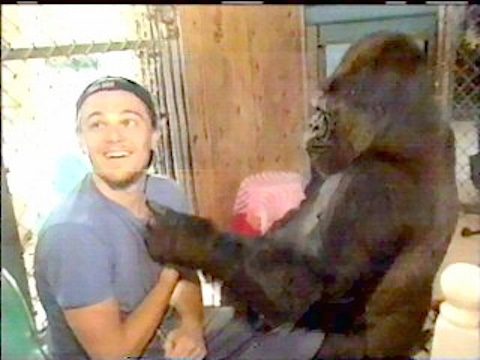
Leonardo DiCaprio is yet another famous admirer to be caught on camera with Koko. Is it any wonder that she embodies all of the qualities he claims to look for in a potential love interest: “humility, a sense of humor and not a lot of drama”? No word as to how the Titanic hunk measures up against the qualities Koko looks for in a mate, though footage of their one and only meeting has been known to get fans fantasizing in the comments section: “I wish I was that gorilla ;) lol I looooooooooooooooove u Leo”
From the lady’s perspective, Koko’s sweetest celebrity encounter was almost certainly with her favorite, the late children’s television host, Fred Rogers. She removed his shoes and socks, he studied her lips, love was a primary topic and yet their time together does not invite prurient speculation. I can’t think of another human male as deserving of her affection.
Related Content:
Planet of the Apes: A Species Misunderstood
Ayun Halliday invites you to read her thoughts on another July 4 birthday on Rewire Me. Follow her @AyunHalliday
Read More...Steven Pinker Uses Theories from Evolutionary Biology to Explain Why Academic Writing is So Bad
I don’t know about other disciplines, but academic writing in the humanities has become notorious for its jargon-laden wordiness, tangled constructions, and seemingly deliberate vagary and obscurity. A popular demonstration of this comes via the University of Chicago’s academic sentence generator, which allows one to plug in a number of stock phrases, verbs, and “-tion” words to produce corkers like “The reification of post-capitalist hegemony is always already participating in the engendering of print culture” or “The discourse of the gaze gestures toward the linguistic construction of the gendered body”—the point, of course, being that the language of academia has become so meaningless that randomly generated sentences closely resemble and make as much sense as those pulled from the average journal article (a point well made by the so-called “Sokal hoax”).
There are many theories as to why this is so. Some say it’s several generations of scholars poorly imitating famously difficult writers like Hegel and Heidegger, Lacan and Derrida; others blame a host of postmodern ‑isms, with their politicized language games and sectarian schisms. A recent discussion cited scholarly vanity as the cause of incomprehensible academic prose. A more practical explanation holds that the publish or perish grind forces scholars to turn out derivative work at an unreasonable pace simply to keep their jobs, hence stuffing journals with rehashed arguments and fancy-sounding puffery that signifies little. In the above video, Harvard cognitive scientist and linguist Steven Pinker offers his own theory, working with examples drawn from academic writing in psychology.
For Pinker, the tendency of academics to use “passives, abstractions, and ‘zombie nouns’” stems not primarily from “nefarious motives” or the desire to “sound sophisticated and recherché and try to bamboozle their readers with high-falutin’ verbiage.” He doesn’t deny that this takes place on occasion, but contra George Orwell’s claim in “Politics and the English Language” that bad writing generally hopes to disguise bad political and economic motives, Pinker defers to evolutionary biology, and refers to “mental habits” and the “mismatch between ordinary thinking and speaking and what we have to do as academics.” He goes on to explain, in some fairly academic terms, his theory of how our primate mind, which did not evolve to think thoughts about sociology or literary criticism, struggles to schematize “learned abstractions” that are not a part of everyday experience. It’s a plausible theory that doesn’t rule out other reasonable alternatives (like the perfectly straightforward claim that clear, concise writing poses a formidable challenge for academics as much as anyone else.)
Pinker’s talk was part of a larger Harvard conference called “Stylish Academic Writing” and sponsored by the Office of Faculty Development & Diversity. The full conference seems designed primarily as professional development for other academics, but layfolks may find much here of interest as well. See more talks from the conference, as well as a number of unrelated videos on good academic writing here. Or, for more amusement at the expense of clunky academic prose, see the results of the Philosophy and Literature bad writing contest, which ran from 1995–98 and turned up some almost shockingly unreadable sentences from a variety of scholarly texts.
Related Content:
Steven Pinker Explains the Neuroscience of Swearing (NSFW)
John Searle on Foucault and the Obscurantism in French Philosophy
Josh Jones is a writer and musician based in Durham, NC. Follow him at @jdmagness
Read More...Support Us
We're hoping to rely on loyal readers, rather than erratic ads. Please click the Donate button and support Open Culture. You can use Paypal, Venmo, Patreon, even Crypto! We thank you!

About Us

Open Culture scours the web for the best educational media. We find the free courses and audio books you need, the language lessons & educational videos you want, and plenty of enlightenment in between.
Advertise With Us

FREE UPDATES!
GET OUR DAILY EMAIL
Get the best cultural and educational resources on the web curated for you in a daily email. We never spam. Unsubscribe at any time.
FOLLOW ON SOCIAL MEDIA

Open Culture editor Dan Colman scours the web for the best educational media. He finds the free courses and audio books you need, the language lessons & movies you want, and plenty of enlightenment in between.
Advertise With Us

