Jack Kerouac’s On the Road Turned Into an Illustrated Scroll: One Drawing for Every Page of the Novel
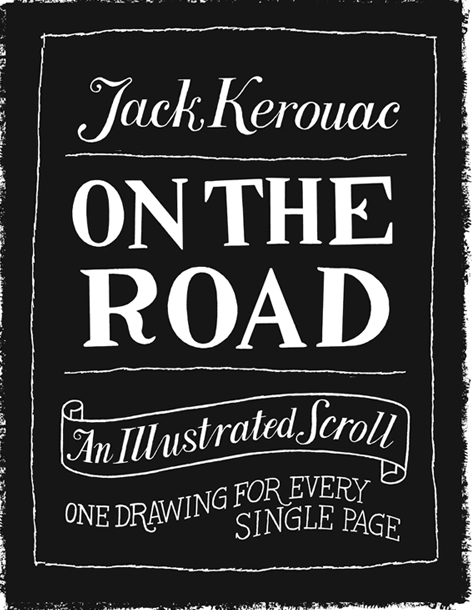
A great deal of mythology has built up around the life of Jack Kerouac, and especially around the experiences that went into his best-known work, the 1957 novel On the Road. Even the very act of its composition — perhaps especially the act of its composition — has, in the imaginations of many of Kerouac’s readers, turned into an image of the man “writing the book on a long scroll of teletype paper in three coffee-soaked-benzedrine-fueled days.” With this image in mind, illustrator Paul Rogers of Pasadena’s Art Center College of Design created On the Road, the illustrated scroll, featuring “a drawing for every page” of the novel, and depicting the historically researched “cars, buses, roadside architecture, and old signs” from Kerouac’s America of the late 1940s and early 50s, one that “looked awfully different than it does now.” You can scroll, as it were, through this work in progress at Rogers’ site.
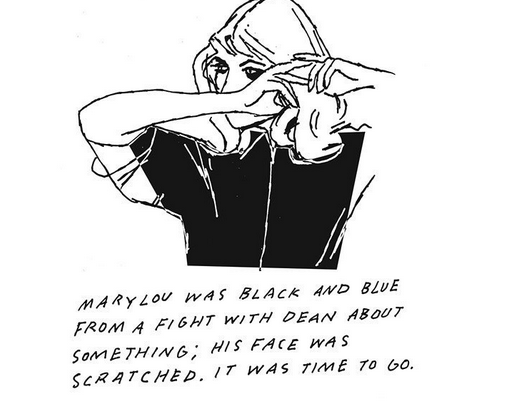
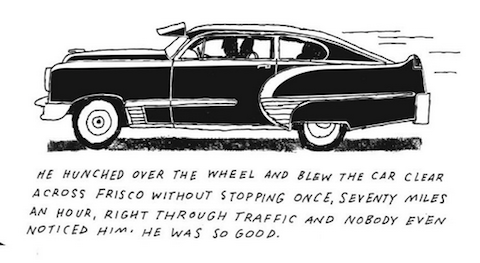
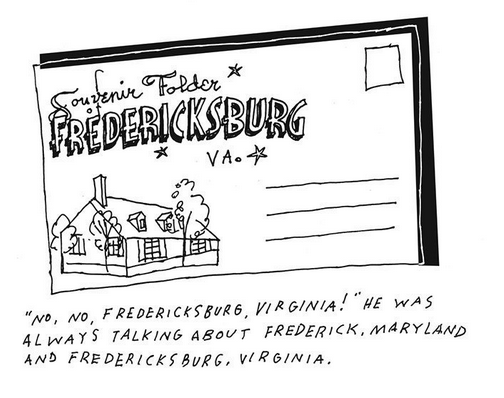
We’ve here included only four of the over 100 drawings Rogers has so far made, but these examples capture the novel’s multigenerationally intoxicating mix of Americana and pure momentum. You’ll also notice that, underneath each image, Rogers excerpts a passage of Kerouac’s. “Adding Kerouac’s words as captions to the drawings makes the series feel like a journal and not a carefully planned out illustrated book,” he writes, “and it seems to capture some of the spirit of Kerouac’s ‘this-happened-then-this-then-this’ writing style.”
You can read the scroll part-by-part on these pages: one through three, four, five, six, seven. Though I never took quite the lifestyle inspiration from On the Road some have, I can’t wait to see what visual inspiration Rogers draws from the bit about fabulous yellow roman candles exploding like spiders across the stars.
Related Content:
Jack Kerouac’s Hand-Drawn Map of the Hitchhiking Trip Narrated in On the Road
Jack Kerouac’s On The Road Turned Into Google Driving Directions & Published as a Free eBook
Jack Kerouac Lists 9 Essentials for Writing Spontaneous Prose
Colin Marshall hosts and produces Notebook on Cities and Culture and writes essays on cities, language, Asia, and men’s style. He’s at work on a book about Los Angeles, A Los Angeles Primer. Follow him on Twitter at @colinmarshall or on Facebook.
Read More...Ernest Hemingway’s Summer Camping Recipes
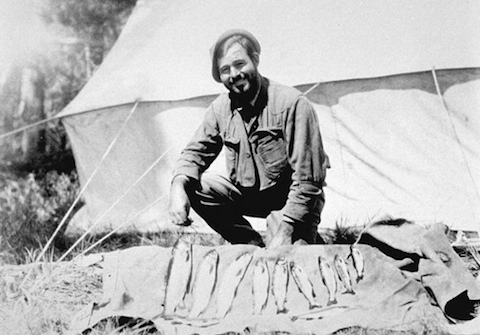
With regard to writing, Ernest Hemingway was a man of simple tastes. Were I to employ a metaphor, I’d describe Hem as the kind of guy who’d prefer an unadorned plum from William Carlos Williams’ icebox to Makini Howell’s Pesto Plum Pizza with Balsamic Arugula.
Don’t mistake that metaphor for real life, however. Judging by his 1920 Toronto Star how-to on maximizing comfort on camping vacations, he would not have stood for charred weenies and marshmallows on a stick. Rather, a little cookery know-how was something for a man to be proud of:
“…a frying pan is a most necessary thing to any trip, but you also need the old stew kettle and the folding reflector baker.”
Clearly, the man did not trust readers to independently seek out such sources as The Perry Ladies’ Cookbook of 1920 for instructions. Instead, he painstakingly details his method for successful preparation of Trout Wrapped in Bacon, including his preferred brands of vegetable shortening.
Would your mouth water less if I tell you that literary food blog Paper and Salt has updated Hem’s trout recipe à la Emeril Lagasse, omitting the Crisco and tossing in a few fresh herbs? No campfire required. You can get ‘er done in the broiler:
Bacon-Wrapped Trout: (adapted from Emeril Lagasse)
2 (10-ounce) whole trout, cleaned and gutted
1/2 cup cornmeal
Salt and ground pepper, to taste
8 sprigs fresh thyme
1 lemon, sliced
6 slices bacon
Fresh parsley, for garnish1. Preheat broiler and set oven rack 4 to 6 inches from heat. With a paper towel, pat trout dry inside and out. Dredge outside of each fish in cornmeal, then season cavity with salt and pepper. Place 4 sprigs of thyme and 2 lemon slices inside each fish.
2. Wrap 3 bacon slices around the middle of each fish, so that the edges overlap slightly. Line a roasting pan with aluminum foil, and place fish on pan. Broil until bacon is crisp, about 5 minutes. With a spatula, carefully flip fish over and cook another 5 minutes, until flesh is firm.
Like any thoughtful hostess (simile!), Hemingway didn’t leave his guests to starve whilst waiting for the main event. His choice of hors d’oeuvres was little pancakes made from a mix, and again, he leaves nothing to chance, or Aunt Jemima’s instructions…
With the prepared pancake flours you take a cupful of pancake flour and add a cup of water. Mix the water and flour and as soon as the lumps are out it is ready for cooking. Have the skillet hot and keep it well greased. Drop the batter in and as soon as it is done on one side loosen it in the skillet and flip it over. Apple butter, syrup or cinnamon and sugar go well with the cakes.
Here, Paper and Salt’s Nicole Villeneuve does us all a solid by doing away with prepackaged mix. Bonus points for using ingredients that would’ve been available in 1920’s Michigan, beloved site of Hemingway’s trout and pancake campouts.
Corn Cakes:
1 1/2 cups corn kernels (either fresh off the cob or thawed)
2 green onions, white parts only, coarsely chopped
2/3 cup flour
1/3 cup stone-ground yellow cornmeal
1 teaspoon baking powder
1/2 teaspoon red chile flakes
1/2 teaspoon salt
1 teaspoon sugar
1 egg, lightly beaten
2/3 cup buttermilk
2 tablespoons butter, melted and cooled
Canola oil, for frying1. In a food processor, add corn and green onions and pulse 4 to 5 times, until finely chopped. In a large bowl, stir together corn mixture, flour, cornmeal, baking powder, red chile flakes, salt, and sugar.
2. In a small bowl, combine egg, buttermilk, and butter. Add to corn mixture, stirring until just combined.
3. Coat a large skillet or pancake griddle with oil. Over medium heat, spoon batter onto pan in 1/4 cups and fry until cakes are golden on both sides, 1 to 2 minutes per side.
Villeneuve opts out of recreating Hemingway’s dessert, an al fresco fruit pie so good “your pals … will kiss you” (provided, of course, that they’re Frenchmen). Because I, too, aim higher than weenies and marshmallows, here are his lengthy, rather self-congratulatory instructions:
In the baker, mere man comes into his own, for he can make a pie that to his bush appetite will have it all over the product that mother used to make, like a tent. Men have always believed that there was something mysterious and difficult about making a pie. Here is a great secret. There is nothing to it. We’ve been kidded for years. Any man of average office intelligence can make at least as good a pie as his wife.
All there is to a pie is a cup and a half of flour, one-half teaspoonful of salt, one-half cup of lard and cold water. That will make pie crust that will bring tears of joy into your camping partner’s eyes.
Mix the salt with the flour, work the lard into the flour, make it up into a good workmanlike dough with cold water. Spread some flour on the back of a box or something flat, and pat the dough around a while. Then roll it out with whatever kind of round bottle you prefer. Put a little more lard on the surface of the sheet of dough and then slosh a little flour on and roll it up and then roll it out again with the bottle.
Cut out a piece of the rolled out dough big enough to line a pie tin. I like the kind with holes in the bottom. Then put in your dried apples that have soaked all night and been sweetened, or your apricots, or your blueberries, and then take another sheet of the dough and drape it gracefully over the top, soldering it down at the edges with your fingers. Cut a couple of slits in the top dough sheet and prick it a few times with a fork in an artistic manner.
Put it in the baker with a good slow fire for forty-five minutes and then take it out.
Remember, campers: The real woodsman is the man who can be really comfortable in the bush. — Ernest Hemingway
via Paper and Salt
Related Content:
Ernest Hemingway’s Favorite Hamburger Recipe
Seven Tips From Ernest Hemingway on How to Write Fiction
Ernest Hemingway Creates a Reading List for a Young Writer, 1934
Ayun Halliday is an author who once designed a course on outdoor cooking, just so she could order pie irons online. Follow her @AyunHalliday
Read More...Sonny Rollins Describes How 50 Years of Practicing Yoga Made Him a Better Musician
Indian mystic and philosopher Patanjali supposedly created modern yoga by transmitting his doctrine and disciplines to seven sages. In the mid-1950s, those teachings came down through the centuries to another sage, Sonny Rollins, who, like his good friend John Coltrane, incorporated his experiments with Eastern spirituality into his jazz improvisations. In Rollins’ case, yoga has given him, as he recounts in the short video above, “spiritual understanding” and “direction.” Setting out for India in 1967 to find “upliftment,” Rollins checked himself into an Ashram, with nothing but a bag and his horn, “and it worked out well,” he says. Rollins and his jazz “compatriots” like Coltrane “were trying to find a way to express life through our improvisations,” he tells NPR. “The music has got to mean something,” he says, “Jazz improvisation is supposed to be the highest form of communication, and getting that to the people is our job as musicians.”
In his new set of live recordings, Road Shows, Vol. 3, Rollins plays a “mantra-like” song called “Patanjali,” a tribute to the discipline that keeps him physically and musically vital. In his “Morning Edition” interview above, Rollins describes his yoga practice as helping his “concentration level.” “The thing is this,” he says, “When I play, what I try to do is to reach my subconscious level. I don’t want to overtly think about anything, because you can’t think and play at the same time—believe me, I’ve tried.” At age 83, and still sounding as fresh as he does, one imagines he’s tried it all and learned some valuable lessons. In 1963, Rollins met the Oki Yoga group in Japan, who combine yoga, Zen, and martial arts principles, and he’s also studied Rosicrucianism, Buddhism, and “Kabbalah, even—I was really into those philosophies of life.”
As for whether Sonny Rollins considers himself a member of any particular sect, hear his thoughts on organized religion in answer to a recent Google Hangout question (above). While he may not subscribe to a specific belief system, he’s certainly found spiritual techniques that give him—as he puts it in an interview with Yoga Journal—“a center.” Rollins “still practices asana [poses] every day, including Halasana (Plow Pose) and Urdhva Dhanurasana (Upward Bow Pose).” Want to learn more about yoga? You could always read Patanjali’s famous sutras. For more practical instruction in this peaceful physical discipline, perhaps take a look at the rather ironically named Lesley Fightmaster’s Youtube channel, with free lessons for virtually everyone.
Of course, no one teacher should be considered the authority on yoga. Like every spiritual practice, yoga has its many schisms and divisions, even so-called “Yoga Wars”: among Hindus and Christians, between corporate giants like Lululemon (and Western teachers like Fightmaster) and traditional Indian practitioners, between “Hot Yoga” (and its controversial founder) and everyone else…. I doubt Sonny Rollins has time to get enmeshed in these squabbles, and maybe neither do you. For a much less uptight fusion of Eastern practice and Western spirit, perhaps try some Star Wars Yoga. In this video, instructor Erica Vetra offers a free beginner’s class for those who “A. love Star Wars, B. have never seen Star Wars, C. love yoga, or D. have never done yoga.” The ecumenical Sonny Rollins might approve, though the venerable Patanjali, indifferent to “fancy” and “illusion,” may not have been amused.
Related Content:
Sonny Rollins’ New York City Bridge Sabbatical Recreated in 1977 Pioneer Electronics Ad
Free Guided Meditations From UCLA: Boost Your Awareness & Ease Your Stress
David Lynch Talks Meditation with Paul McCartney
Alan Watts Introduces America to Meditation & Eastern Philosophy (1960)
Josh Jones is a writer and musician based in Durham, NC. Follow him at @jdmagness
Read More...The Internet’s Own Boy: New Documentary About Aaron Swartz Now Free Online
On BoingBoing today, Cory Doctorow writes: “The Creative Commons-licensed version of The Internet’s Own Boy, Brian Knappenberger’s documentary about Aaron Swartz, is now available on the Internet Archive, which is especially useful for people outside of the US, who aren’t able to pay to see it online.… The Internet Archive makes the movie available to download or stream, in MPEG 4 and Ogg. There’s also a torrentable version.”
According to the film summary, the new documentary “depicts the life of American computer programmer, writer, political organizer and Internet activist Aaron Swartz. It features interviews with his family and friends as well as the internet luminaries who worked with him. The film tells his story up to his eventual suicide after a legal battle, and explores the questions of access to information and civil liberties that drove his work.”
The Internet’s Own Boy will be added to our collection, 285 Free Documentaries Online, part of our larger collection, 4,000+ Free Movies Online: Great Classics, Indies, Noir, Westerns, Documentaries & More.
Follow Open Culture on Facebook and Twitter and share intelligent media with your friends. Or better yet, sign up for our daily email and get a daily dose of Open Culture in your inbox. And if you want to make sure that our posts definitely appear in your Facebook newsfeed, just follow these simple steps.
Read More...Steve Buscemi’s Top 10 Film Picks (from The Criterion Collection)
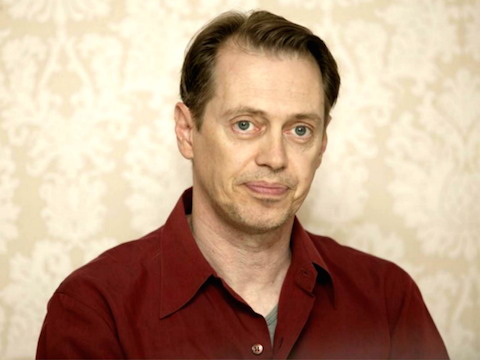
Ah, summer sunshine. It’s lovely, but so is the idea of drawing the drapes while Steve Buscemi schools me in some of the darker corners of cinema and the human psyche.
The man who’s met his onscreen end so frequently (and horribly) as to merit a Youtube tribute titled The Many Deaths of Steve Buscemi is one of dozens of luminaries who’ve compiled top 10 lists from the Criterion Collection’s film catalog.
What do Buscemi’s 10 picks reveal?
A fondness for black-and-white, a documentary sensibility, and an appreciation for anything deftly straddling the divide between horror and humor…
If, like me, you’re unfamiliar with some of his picks, take a look at the trailers. I wouldn’t be surprised to find him cropping up in any one of them.
This shining example of the British New Wave can be referred to as a kitchen sink drama, but Buscemi calls it a comedy, with “one of the saddest endings” he’s ever seen.
Picture a remake with Buscemi filling the shoes of sadistic prison guard Hume Cronyn.
Buscemi’s hometown gets the nod in one of his favorite-ever film lines: ‘Valley Stream. Valley Stream. What a joke!’”
Not hard to imagine the Coen Brothers enlisting Buscemi to hold forth on the ballast ratio for corpses. Those with the stomach for it can watch the whole disturbing thing here, though as Buscemi himself warns, it’s not for everybody.
Buscemi’s favorite River Phoenix flick.
Wondering how Albert Maysles will feel when he reads that fellow director Richard Linklater fixed Buscemi up with a bootleg of his doc about door-to-door Bible peddlers.
Looks like there’s an Altman fan in the house of Buscemi.
Symbiopsychotaxiplasm (whole film)
This unscripted, never theatrically released faux-documentary from the summer of ’68 was resurrected by Buscemi’s neighbor, the Brooklyn Museum.
If something gives Steve Buscemi nightmares, it’s likely to do a number on you too. Watch the whole film here if you dare.
Buscemi’s appreciation is so ardent, I’m hoping he’ll consider hipping us to his Top 10 Cassavetes films!
Related Content:
Quentin Tarantino & Steve Buscemi Rehearse Scenes for Reservoir Dogs in 1991 (NSFW)
A Young Jean-Luc Godard Picks the 10 Best American Films Ever Made (1963)
Ayun Halliday is an author, homeschooler and the Chief Primatologist of The East Village Inky zine. Follow her @AyunHalliday
Read More...The Speech Accent Archive: The English Accents of People Who Speak 341 Different Languages
Over the years, I’ve met with several foreign speaking partners. Through conversation, I learn their language — Spanish, Korean, Japanese — and they learn mine — English. Many of them first got serious about their study of that more-or-less-international tongue with the goal of completely eliminating their native accent which, while demonstrably possible, takes so much additional effort as an adult that I’ve always advised them to just spend that time learning another language (or two) instead. Many, of course, come to that conclusion themselves, realizing that English speakers all over the world have created a legitimate culture of speaking English in all kinds of different ways, with all kinds of different accents, whether or not they learned the language from childhood. But it still makes one wonder: how many different accents do people speak it in? And what do they all sound like? Wonder no longer, for we have The Speech Accent Archive, created by Steven H. Weinberger of George Mason University’s Linguistics department, who introduces it in the video above.
The site, “established to uniformly exhibit a large set of speech accents from a variety of language backgrounds,” collects audio samples of native and non-Native English speakers all reading the same paragraph. This lets the user “compare the demographic and linguistic backgrounds of the speakers in order to determine which variables are key predictors of each accent,” demonstrating that “accents are systematic rather than merely mistaken speech.” You can browse by the speaker’s native language, by their region, or (presumably exciting for the linguists) by their “native phonetic inventory.” You’ll find English as spoken by native speakers of everything from French and Chinese to Urdu and Chaldean Neo Aramaic. Here in Seoul, South Korea, where I write this post, I certainly do meet people who sound just like this sample speaker, a 19-year-old woman from the city who began learning English at 17 and spent a few months studying in America. The page describes her accent as characterized by, among other things, “final obstruent devoicing,” “vowel shortening,” and “obstruent deletion.” But don’t let the site’s linguistics jargon deter you; the salute to the Speech Accent Archive just above will give you an idea of just how much fun you can have there. You can enter the The Speech Accent Archive here.
Related Content:
Learn 45+ Languages Online for Free: Spanish, Chinese, English & MoreA Brief Tour of British Accents: 14 Ways to Speak English in 84 Seconds
Peter Sellers Presents The Complete Guide To Accents of The British Isles
Peter Sellers Reads The Beatles’ “She Loves You” in Four Different Accents
Colin Marshall hosts and produces Notebook on Cities and Culture and writes essays on cities, language, Asia, and men’s style. He’s at work on a book about Los Angeles, A Los Angeles Primer. Follow him on Twitter at @colinmarshall or on Facebook.
Read More...Caffeinated: How Our Daily Habit Helps, Hurts, and Hooks Us
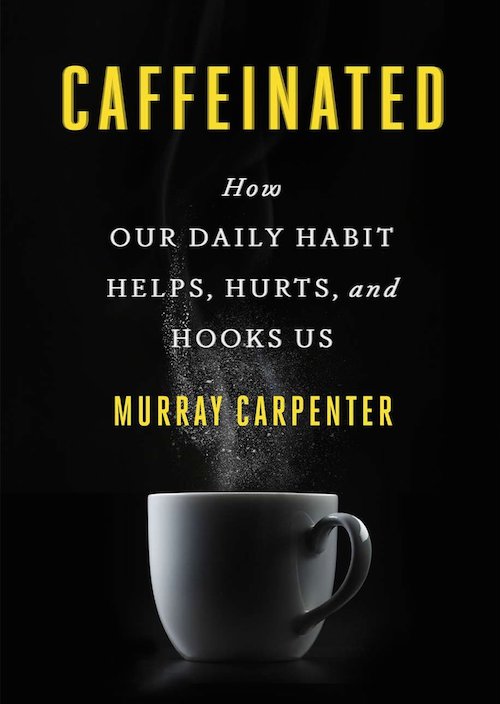
Journalist Murray Carpenter has written a new book about the world’s most popular drug — caffeine. And it answers questions that many coffee drinkers surely wonder about: Is caffeine addictive? What exactly does it do to our biochemistry? How does it gives us a jolt? And what health consequences does it have (or not have)? These questions all get answered in the book, Caffeinated: How Our Daily Habit Helps, Hurts, and Hooks Us. And much of them were discussed when Carpenter recently visited my favorite radio program in San Francisco, KQED’s Forum. You can listen to the interview below:
Related Content:
“The Vertue of the COFFEE Drink”: London’s First Cafe Creates Ad for Coffee in the 1650s
The History of Coffee and How It Transformed Our World
How Climate Change Is Threatening Your Daily Cup of Coffee
A Short, Animated Look at What’s Inside Your Average Cup of Coffee
Read More...Digital Dubliners: Free, 21st Century Ways to Read Joyce’s Great Story Collection on its 100th Anniversary
Read nearly any critical commentary on James Joyce’s Dubliners, his 1914 collection of short stories that chronicle the lives of ordinary Irish residents of the title city, and you’re sure to come across the word “epiphany.” This is not some academic jargon, but the word Joyce himself used to describe the way that each story builds to a shock of recognition—often in the form of painful self-awareness—for key characters. Short-circuiting the typical climax-resolution-dénouement of conventional narrative, Joyce’s epiphanies give his stories a verisimilitude that can still feel very unsettling, given our typical expectations that realist fiction still obey the rules of fiction. Dramatic moments in our lives rarely have neat and tidy endings. But in stories like “Eveline,” “Araby,” “A Little Cloud,” and the collection’s capstone piece, “The Dead,” the often feckless characters find themselves paralyzed in states of existential dread by sudden flashes of self-knowledge, unable to assimilate new and painful insights into their limited perspectives.
That final story (adapted into John Huston’s final film) “elevates the book to the level of the supreme artworks of the 20th century,” writes Mark O’Connell in Slate. O’Connell’s essay commemorates the centenary of Dubliner’s publication this month. Dubliners remains, he writes, a book that “writers of the short story form seem basically resigned to never surpassing.” Written in the author’s early 20s, the stories, as Ulysses would eight years later, “reveal something profound and essential and unrealized about the city and its people”: “Dublin can feel less like a place that James Joyce wrote about than a place that is about James Joyce’s writing.” All of us non-Dubliners can enter the city through Joyce’s exquisite stories, and in an increasing variety of ways, thanks to digital technology. At the top of the post, find a digitized first edition of Dubliners. Just above, we have a reading of “Eveline” by “velvet-voiced” Dubliner Tadhg Hynes, and below, hear Irish actor Jim Norton read “The Sisters.”
You’ll find many more readings of Dubliners’ stories online, such as this deadpan reading of “Araby” from one of our favorites, Tom O’Bedlam, a Bloomsday reading of “Eveline” by award-winning Irish playwright Miriam Gallagher, and this Librivox collection of readings from various voices. I think Joyce would have very much appreciated the use of technology to keep his work alive into the 21st century. Part of his literary mission—certainly in many of Dubliners’ stories—was to illustrate the stultifying effects of clinging to the past. An eager adopter of new technologies, Joyce in fact brought the first cinema, The Volta, to Dublin in 1909. So it seems fitting that 100 years after the publication of Dubliners, his book receive the multimedia app treatment in the form of Digital Dubliners, a free, “engaging and authoritative edition” of the book designed by Boston College students and featuring “three hundred-odd images, seven hundred or so notes and explanations, two dozen videos, critical essays and hyperlinks, interactive maps sourced from contemporary newspaper, sound, film and photographic archives, with essays, film, recordings, background and expert discussion.” Watch a short promo video for Digital Dubliners below, and download the book on iTunes here.
Finally, you may wish to read the text in a more late-20th-century, and more open, format with this fully searchable “hypertextual, self-referential edition” prepared for Project Gutenberg. Whichever way you read Joyce’s Dubliners, you should, I presume to suggest, read Joyce’s Dubliners. And if you have read these stories before, even “somewhere in the double figures,” as Mark O’Connell has, then you’ll know how richly they reward re-reading, or hearing, or studying along with other readers and lovers of Joyce and a well-worn map of Dublin, or its shimmering touch-screen digital equivalent.
Dubliners also appears in our two collections, 1,000 Free Audio Books: Download Great Books for Free and 800 Free eBooks for iPad, Kindle & Other Devices.
Related Content:
James Joyce’s Ulysses: Download the Free Audio Book
James Joyce’s Dublin Captured in Vintage Photos from 1897 to 1904
Josh Jones is a writer and musician based in Durham, NC. Follow him at @jdmagness
Read More...Led Zeppelin, Rolling Stones & The Beatles Played on a 3‑String Electric Mountain Dulcimer
My parents always seemed to me to represent two very different strains of sixties counterculture. My mom loved Peter, Paul and Mary, Appalachian folk and bluegrass, and played the dulcimer and autoharp. My dad loved psychedelic rock, and had an extensive collection of Zeppelin, Beatles, Floyd, and Hendrix records. It wasn’t a Dylan-goes-electric-level disagreement, but their fond reminisces of the glory days could sometimes get a little tense. But as we’ve seen in decades since, folkies, hippies, and psych-rockers can come together, and not only in 70s folk-rock bands from California. Take Robert Plant and Allison Krauss’s fruitful and unlikely collaboration, for instance, or the dozens of Led Zeppelin and Rolling Stones covers by dozens of flannel-clad indie folkers.
In the past decade or so, it almost came to seem like psychedelic blues-rock and mountain folk music had always made comfortable bedfellows, and maybe they had. (After all, Zeppelin included folk instruments on several of their classic songs, like John Paul Jones’ mandolin on “Going to California.”) As further evidence we have 3‑string electric mountain dulcimer player Sam Edelstein, who covers classic rock songs on an instrument usually thought of as particularly gentle, delicate, and sweet, as its name implies. At the top, see Edelstein rip through a searing version of Zeppelin’s “Whole Lotta Love.” Just above, he does a killer take on the Rolling Stones’ “19th Nervous Breakdown,” and below, Edelstein plays an increasingly rocking cover of The Beatles’ “Come Together” at the National Mountain Dulcimer Competition. As uploader Contemporary Dulcimer states on Youtube, “the dulcimer’s roots may be in folk music, but it’s a natural rock & roll instrument.” Indeed. Who knew?
Related Content:
Watch Jimi Hendrix’s ‘Voodoo Chile’ Performed on a Gayageum, a Traditional Korean Instrument
Musicians Re-Imagine the Complete Songbook of the Beatles on the Ukulele
Josh Jones is a writer and musician based in Durham, NC. Follow him at @jdmagness
Read More...Free Archive of Audio Interviews with Rock, Jazz & Folk Legends Now on iTunes
Back in 2012, we told you about how the Library of Congress launched the Joe Smith Collection, an audio archive featuring 200+ interviews with legendary music artists, all recorded during the 1980s by Joe Smith while researching and writing his book Off the Record. The audio collection, still available on the web, has now been brought to iTunesU. And the iTunes collection has a virtue that the web archive doesn’t — it lets you download instead of stream the audio files.
If you’re a music junkie, you won’t want to miss the longform interviews with legendary figures like Dave Brubeck, Lou Reed, Paul McCartney, Joan Baez, Herbie Hancock, David Bowie, George Harrison, Yoko Ono, James Brown, Bo Diddley, Jerry Garcia, Christine McVie, Mick Jagger, Linda Ronstadt and more. Each interview runs 30–60 good minutes. You can enter the archive here.
Related Content:
Library of Congress Releases Audio Archive of Interviews with Rock ‘n’ Roll Icons
Two Legends Together: A Young Bob Dylan Talks and Plays on The Studs Terkel Program, 1963
Watch John Lennon and Yoko Ono’s Two Appearances on The Dick Cavett Show in 1971 and 72
Read More...Support Us
We're hoping to rely on loyal readers, rather than erratic ads. Please click the Donate button and support Open Culture. You can use Paypal, Venmo, Patreon, even Crypto! We thank you!

About Us

Open Culture scours the web for the best educational media. We find the free courses and audio books you need, the language lessons & educational videos you want, and plenty of enlightenment in between.
Advertise With Us

FREE UPDATES!
GET OUR DAILY EMAIL
Get the best cultural and educational resources on the web curated for you in a daily email. We never spam. Unsubscribe at any time.
FOLLOW ON SOCIAL MEDIA

Open Culture editor Dan Colman scours the web for the best educational media. He finds the free courses and audio books you need, the language lessons & movies you want, and plenty of enlightenment in between.
Advertise With Us


